
#archived-dots
1 messages · Page 158 of 1
 tight blade
 zinc plinth
@tight blade this looks fine, tho I'm scratching my head into why you would compare entities between chunks but not within chunks
tight blade
because if you're only comparing within chunks, you wouldnt be checking against every entity
zinc plinth
also I think you made a typo var translations = chunk.GetNativeArray(TranslationType); var translations2 = chunk.GetNativeArray(TranslationType); var mycomponents = chunk.GetNativeArray(MyComponentType); var mycomponents2 = chunk.GetNativeArray(MyComponentType); you're getting from the same chunk instead of using chunk & chunk2
zinc plinth
but what I mean is that 2 entities from the same chunk will never be compared against one another
and idk if it's the behavior you want
tight blade
they would. if you see how the combo list is implemented, it includes pairs of the same index
(1, 1), (2, 2), etc, are in there
so in certain jobs, chunk and chunk2 will be the same chunk and ...
oh. right. so that would check distance against itself and always be true haha
so thats a bug.
fixed it with an if and a comment
 deft stump
@pliant pike I suggest looking up BlobAssets as a way to "convert" SOs.
also... does the GOConversion world get destroyed once it converts everything to the destination world?
zinc plinth
yes
also, a new conversion world is created & destroyed each time you do ConvertGOHierarchy, so be mindfull of what and when you convert stuff manually
 pliant pike
@deft stump yeah thanks, that's why I'm going to turn them into, I'm just trying to figure out the intermediate step
 odd ridge
@zinc plinth why not use a shared component? I was thinking, if I have a shared component / tag, all the entities that are in a same cell will have the same archetype and be next to each other in memory. if I use a flat array for my grid, then I only keep pointers to the entities in this grid right?
zinc plinth
@odd ridge because then you have 1 chunk minimum per coordinate
and this is bad
just on a 100 by 100 grid it's already a nightmare
you want the least amount of chunks possible in your worlds
odd ridge
I see, so I'm better off keeping all my entities in 1 chunk, and then my grid structure keeps pointers to each entity that belong in each cell?
pointers or entity ids
zinc plinth
the Entity struct with it's fields is a "reference" to the actual entity in theentity storage
you store the Entity struct in a component/buffer to be able to go from 1 to the other
here you want a buffer
I also suggest using InternalBufferCapacity(0) for your IBED to make it go imediately into heap
because 1 chunk will never be enough to store your while grid
odd ridge
do you know some resource to read about spatial grid implementation in dots / data oriented ?
it sounds like it doesn't belong in there
if I use buffers, it's just like making a normal gameobject, but wrapped into a ECS component, isn't it?
tight blade
is there a factorial function in math anywhere? or is there a c# syntax for that or anything like that?
zinc plinth
@odd ridge storing entities in components is a common things in ecs
I've been writing my own impl of a spatial grid, tho I'm only at the beginning https://i.imgur.com/9xg56Dl.png
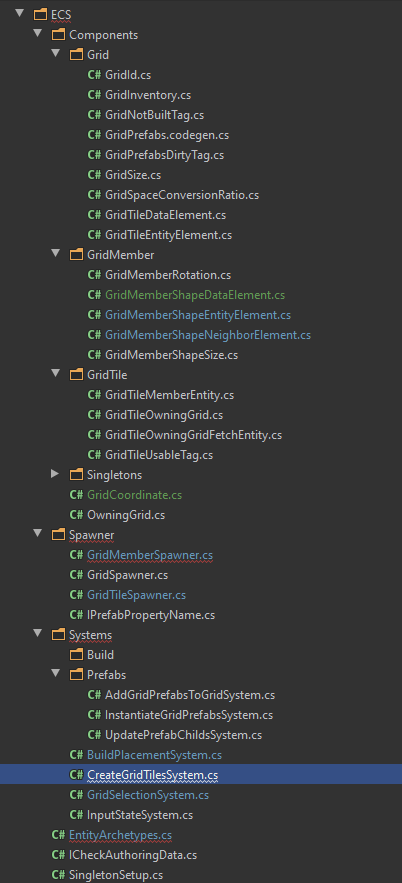
it's still DOP, just imagine the Entity struct to be an array index
it's ofc not the best way to go; it would be better to do without it
but for some things there's just no way around it
one limitation is that ECB(.Concurrent ?) doesn't allow to write components with Entity fields from jobs for some reason, but all of that linking mostly get done at instantiation time on main thread anyway
and buffers are just fancy arrays, it's still ordered memory; tho you won't often read it sequencially
odd ridge
@zinc plinth what you said about chunks made me think. DOTS says to use empty component as tags. for example, I could have a IsJumping tag to put certain entities in a given state, and a IsCrouching, and a IsRunning, etc. but doesn't adding tags create even more chunks? 3 different tags would mean 2^3 possible archetypes, or 8 different chunks. it's exponential. what do you say about that?
zinc plinth
that's still very few chunks
in the case of a 100 by 100 grid with shared components, you have 10 thousand chunks that will be next to empty
 rancid geode
@odd ridge they are working to have a new "Enabled" property for all CD/BED (even tags) so that you won't need to add/remove components in runtime, just enable/disable (which will work as if adding and removing, but without changing the archetype, and parallelable)
zinc plinth
ho neat
rancid geode
https://forum.unity.com/threads/new-enabled-disabled-state-filtering.902531/#post-5929685 official statement, in case anyone want further details
Unity Forum
This relates to the post from Joachim here on new feature coming but I thought it better to start a new thread on it than pollute that one.
Also I...
odd ridge
@rancid geode they will still have to be rearranged in memory if you want good cache coherency so I'm not sure how that's helping
oh, that's not for performance, just to reduce boilerplate right?
rancid geode
@odd ridge no, they won't be moving between chunks anymore
Enabled/Disable will act as if you Added/Removed the components, but it won't be actually remove component when disabled
So I consider that it is both to reduce boilerplate and for performance
odd ridge
@rancid geode doesn't this add branching code in your system? having to check whether each component is active or not when iterating?
rancid geode
See the post I linked to, it wont be necessary. For now, if you want to prepare your code for that feature, yes you will need to branch the condition yourself
zinc plinth
I'm so confused
if I try to resize a buffer in Convert after applying an archetype, mu entity inspector throws unicode string null reference errors if I select that entity
I get NullReferenceException: Object reference not set to an instance of an object Unity.Collections.NumberedWords.ToString () (at Library/PackageCache/com.unity.collections@0.9.0-preview.6/Unity.Collections/Unicode.cs:807)
I already got this error before, but I don't remember how I solved it --'
it feels like the whole entity gets deallocated as soon as I resize, which makes absolute no sense o.0
so it's something in the WordStorage that somehow is wrong
I have to find a repro because this is driving me insane
ok thank god this is an easy repro
now to try to shave it down
hooooo
I FOUND IT!
but I'm still sooo confused
so the problem has to do with buffers of component containing public Entity fields
the stuff that takes care of drawing the entity inspector will try to read that newly resized buffer contaning Entity; and will try to go fetch a name corresponding to this entity; but I guess the buffer data isn't cleared before given to us so you don't have neat Entity.null values, but a bunch of random nonsense
and the WordStorage will try to get the name associated at that Entity using it's Index
but it'll just fall out of allocated space and throw a null reference
jeez 
so I just have to MemSet the buffer to a bunch of zeroes
ahaha it works! https://i.imgur.com/uMF2Kpl.png
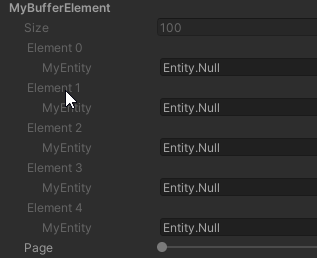
so yea you have to do this var buffer = em.AddBuffer<MyBufferElement>(entity); buffer.ResizeUninitialized(100); UnsafeUtility.MemClear(buffer.GetUnsafePtr(), UnsafeUtility.SizeOf<MyBufferElement>() * 100);
zinc plinth
at least I'm not insane and it isn't a weird niche bug from my setup 😁
 hollow sorrel
@odd ridge didn't get a chance to reply until now but torsina pretty much covered all of it
i don't know what your game's design is like but if you want a typical 2d grid like in a roguelike then a flat array (in this case dynamicbuffer) is prob the way to go
it's hard to make generic statements like this because the point of data oriented design is you optimize for the most common code path
odd ridge
@hollow sorrel I'm trying to replicate something like starcraft. entities move on a 2d grid, many entities can be on a single cell. the grid is used for movement and collision detection for combat.
zinc plinth
you'll use the cells for buildings, moving units on grid tiles doesn't make sense unless you want them to be stacked on the cell
use raycasts to select your entities as targets
and good luck for the path finding 
 toxic mural
Is the DOTS Editor only for Project Tiny?
hollow sorrel
@odd ridge not sure if this would be best solution but you could store a nested array with an array for each grid tile, but since nested nativearrays/dynamicbuffers aren't possible you'd have to fiddle with unsafearrays or similar
dunno if a dynamicbuffer that holds unsafearrays is a good way
odd ridge
@zinc plinth I would use grid tiles for spatial partitioning. units move physically like normal, but enter/leave cells as they move around. that way, I can just peek into 1 cell to find all the units in this spot
hollow sorrel
i think storing dynamic entities in your map data structure is something you wanna avoid if you can help it
odd ridge
@zinc plinth like a quadtree, but it's a fixed grid
@hollow sorrel I want to use a grid like you would use a quadtree. why not a quadtree? well, I suppose a fixed grid is much cheaper to compute
hollow sorrel
oh if this is for spatial partitioning look into NativeMultiHashmap
odd ridge
yes
 low tangle
The reason you are having trouble is that you need to separate your data
When you are looking at a tile in one system, you only want that unit/tile/entity to contain the minimal amount of data
Flat array for tile visuals, use to construct and render
Flat tile array for collision and pathing
Flat array with unit buckets for storing where a unit is
Flat array of units
Replace flat array with entity and you have a ecs structure
IDs and tagging for when you need to cross reference out of your flat array
odd ridge
@low tangle in all cases, a tile map in ecs would be flatened?
@hollow sorrel is there a DOTS demo using NativeMultiHashMap?
hollow sorrel
i think the boids demo in ecs sample project uses nmhm
low tangle
making the tiles out flatten can also mean one entity per
you want to be using those entitys as inputs to acceleration structures like nativemultihashmap and caching them within logical groups, or typically just per system
what I mean is you might have a 'physics' simulation structure, which contains the physics world, as a reflection of the entitys you modify and react to
those entities are brought into the physics structure in any way, (delta, naive copy em all) and then your much easier to formulate or more performant logic can be done on that properly formatted data (hopefully multi threaded using the job system and very fast)
complex problems require some sort of outside ecs world data to be created and stored, which is what the native memory system and job system manipulating them is for
most of the time, people really just need to create a bunch of entities to store some trait. Then in a system not directly related to that trait, but needs to check it, that system would just need to hash them entities to do its kernel of logic
odd ridge
can you add many components of a same type to a same entity? in other words, can an entity have multiple Position components?
low tangle
thats what buffers are for
you can also hint how many typically they need (or known fixed amount) with a compiler tag
odd ridge
@low tangle are buffers stored inside components themselves?
and by buffer, do you mean having a NativeArray of components inside a component?
 wanton apex
Hi !
I'm facing very strange issue. I have a Loot system, every ennemies have a DynamicBuffer of Entities, when an ennemi die, it have a chance to spawn a loot, pick random in the buffer. It works great in the Editor, but in a Build I don't get any entities spawn, even if I set the loot probability to 100%.
Is there a known issue in Build that could explain that?
Thanks in advance
I'm using Entities 0.11.1
odd ridge
@low tangle is this still cache friendly? wouldn't accessing these buffers be a random access?
low tangle
no, thats what internalbuffer is for
it reserves space in the same buffer the entity data is stored
if you add more then that, then yes it will jump to a new native array to store it instead of within the component SOA
size it right, or use a fixed amount matching or less than internal buffer count and it will be the same as accessing a component * n
 eager jungle
hey guys, anyone has a good pointer to either : trail renderers with ECS, and / or using vfx graph with ecs?
odd ridge
I want to add a RemoveComponent component that removes another component after 5 seconds.
Now I want to implement it for another component. is there a way to do this without duplicating both the component and the system?
 mint iron
reuse the same component?
 coarse turtle
you could create a sort of mask value and when certain bit flags are up you just remove certain components
 ocean cloud
use generics
although that is technically duplicating
how do you guys implement delays/waits in ECS? I'm still using coroutines in systems and although it works there's a lot of gotchas within timing and generally the performance isn't good
 willow plaza
Is it a delay of the whole system or for certain entity?
ocean cloud
for certain entity
willow plaza
Perhaps add a delay component? And make a delay system countdown and remove it. While other systems can ignore entities with this component in their queries.
 opaque ledge
pretty much yeah
 tawdry tree
What do they trigger? The obvious would be to just add a delay component - one field for the start time, and one for delay. that or just one field for when to activate
ocean cloud
Ah I see
tawdry tree
I'm a fan of delay systems that don't increment anything, but just check "is it time?" yet
willow plaza
what if you want to affect the timer speed. Let's say there's something on delay and you increase the timescale by 2. If you precalculate the delay it's not gonna be affected by that time scale.
wanton apex
Hi,
It looks like I have a system that is not included in Build. Is there a common reason? I don't know how to fix it. It works in Editor but not in build... Here is the system in question :
using System.Collections;
using System.Collections.Generic;
using UnityEngine;
using Unity.Entities;
using Unity.Mathematics;
using Unity.Transforms;

[UpdateAfter(typeof(ApplySimpleDamageSystem))]
[UpdateInGroup(typeof(SimulationSystemGroup))]
public class LootSystem : SystemBase
{
    EntityCommandBuffer buffer;
    protected override void OnCreate()
    {
        buffer = World.GetExistingSystem<EndSimulationEntityCommandBufferSystem>().CreateCommandBuffer();
        Debug.Log("Loot System Created");

    }

    protected override void OnUpdate()
    {
        var ecb = World.GetOrCreateSystem<EndSimulationEntityCommandBufferSystem>().CreateCommandBuffer().ToConcurrent();

        var random = new Unity.Mathematics.Random((uint)UnityEngine.Random.Range(0.0f, 1000000.0f));
        //Debug.Log(ecb);
        Entities.
            WithNativeDisableParallelForRestriction(ecb).
            ForEach((int entityInQueryIndex, Entity entity, in DynamicBuffer<LootDynamicBuffer> lootBuffer, in LootComponent loot, in HealthComponent health, in Translation tr) =>
        {
            if (health.CurrentLife <= 0.0f)
            {
                var proba = loot.probability;
                var rdm = random.NextFloat(0.0f, 1.0f);
                var rdmIndexFloat = random.NextFloat(0.0f, 1.0f);
                var rdmIndex = (int)(rdmIndexFloat * (lootBuffer.Length));
                if(rdm < proba)
                {
                    var lootEntity = lootBuffer[rdmIndex].entity;
                    var e = ecb.Instantiate(entityInQueryIndex, lootEntity);
                    ecb.SetComponent(entityInQueryIndex, e, new Translation { Value = tr.Value });
                }

            }
        }).WithBurst().ScheduleParallel();
        Debug.LogError("SPAWN LOOT");
        World.GetOrCreateSystem<EndSimulationEntityCommandBufferSystem>().AddJobHandleForProducer(this.Dependency);
    }
}
time.time tho
@tawdry tree right. Kinda missed that point. 😄
pliant pike
I don't suppose anyone knows how you destroy a system(from within that system)?
 var bakasystem = EntityManager.World.GetExistingSystem<ScriptabtleObjectConvert>();

EntityManager.World.DestroySystem(bakasystem);```I guess I can do that or is there maybe a better way?
 buoyant ivy
i just started learning ecs and was just wondering how to create an entity archetype. ( not using any "convert to entity" stuff ) I see you can make one from an array of ComponentTypes but after looking at the docs i can't figure out how to make a component type or exactly what they are, i imagine they are references to unity components or something.
or is ecs really just designed to best be used as a hybrid system and not by itself ?
hm i guess the best way is to create an empty entity, add components to it, than save the archetype somewhere ? so archetypes are a runtime thing, they aren't defined beforehand ?
 cosmic nexus
how do I incorporate dots with my perlin noise generator? Project Source: https://github.com/EppersonJoshua/procedural-worlds/

GitHub
Contribute to EppersonJoshua/procedural-worlds development by creating an account on GitHub.
ocean cloud
hm i guess the best way is to create an empty entity, add components to it, than save the archetype somewhere ? so archetypes are a runtime thing, they aren't defined beforehand ?
@buoyant ivy
you don't need to save the archetype, yes it's runtime thing, when you use AddComponent / RemoveComponent, the entity archetype changes
you define archetypes if you want to CreateEntity with a defined "structure"
buoyant ivy
so whats the general idea of how to code stuff in ecs. Do you make gameobject prefabs and just convert those ?
Or do you define archetypes in code and instantiate in code? And I don't really see how to define archetypes in the code other than just stringing together a bunch of addcomponent removecomponent things ?
and how would you get stuff like rigidbody and all those special components? just need to put them on a gameobject and convert them or is there like some function you can call that gets the ecs version of a rigidbody for example
ocean cloud
I use gameobject prefabs just because I want to easily edit my prefabs in the editor
but yes you can instantiate in code directly
physics is in a totally different package here in ECS, see Unity.Physics
buoyant ivy
ah i see so you have to use those functions to manipulate the object yourself instead of having a rigidbody automatically do it ?
ocean cloud
Nah, it has rigidbody, colliders, and all that stuff but just different, you manipulate them (like velocities, collision events, etc) through ECS
buoyant ivy
oh ok
so if i had a rigidbody and used the convert script, is it basically converting it to the Unity.Physics equivalent ?
ocean cloud
sadly no
buoyant ivy
wait so what happens in that case, does it just not work ?
ocean cloud
I think that rigidbody component will just be removed when you convert to entity
there's PhysicsBody component if I remember that right, that is a component that you can add to gameobjects and will be correctly converted to the ECS version
buoyant ivy
yea you are right i just tried it the rigidbody just dissapears
ocean cloud
yeah you need PhysicsBody component, the configurations are a little similar with the classic stuff
btw anyone know how to schedule jobs after EndSimulationEntityCommandBufferSystem without creating a new system after it?
buoyant ivy
can you tell me how to add a physics body component to an entity
ocean cloud
just do it from gameobject
buoyant ivy
is it entitymanager addcomponent is it entitycommandbuffer or what
ok
i guess this system was designed as a hybrid system then
ocean cloud
physics components are a pain to add from code now
well it's technically full ECS at runtime, you just use gameobjects for authoring
buoyant ivy
ok i see
so where does the main game loop get written. is it in one of these SystemBase files ?
ocean cloud
you create a new class derived from SystemBase, and override method OnUpdate
buoyant ivy
ok and you basically run jobs and stuff from there ? is the idea to have multiple systems or just one system as like the main game loop ?
ocean cloud
yes, multiple systems
buoyant ivy
so they effectively are like how the monobehavior Update was before, if you have 5 systems i guess it runs all their OnUpdate functions on the main thread right ?
ocean cloud
yup, but now every data are stored in a centralized entities
buoyant ivy
and the idea is you loop through those entities in some kind of multi threaded job or something and update them from what i understand
why does EntityManager and EntityCommandBuffer both have functions to add a component ? is one thread safe and the other isn't ?
ocean cloud
EntityCommandBuffer is just a deferred commands for EntityManager
calling EntityManager will make a sync-point, which forces all jobs to be completed before proceeding
so ECB is a way to minimize these sync-points
buoyant ivy
oh ok so will ecb defer the action rather than waiting for them to be completed ?
ocean cloud
ECB just defer the actions to be executed later (near the end of the frame)
buoyant ivy
ok i see thanks
does that mean all jobs will be done by the end of the frame ?
if you have a gameobject prefab, can you instantiate that into ecs ? or would you just do GameObject.Instantiate and then the conversion script would just run immediately and do it?
ocean cloud
there is EntityManager.Instantiate(entity),
don't instantiate gameobjects, every prefabs that you convert to entity will have a special "Prefab" component, this prefab entity is to be used with EntityManager.Instantiate(entity)
buoyant ivy
how do i even get the prefab into the System since i can't drag it into the monobehavior inspector? since its not a monobehavior
do i need to use the Resource.Load or whatever it is
ocean cloud
no, you have to make one monobehavior as a "prefab manager" or some sorts
with IDeclareReferencedPrefabs
then you fill the given list with your prefabs, then every prefabs you referenced will appear in the ECS world
If I remember that correctly 😕 , just try it
buoyant ivy
ok thanks. can you tell me how to use the entity query thing for foreach ? foreach seems to just take a function and not the query created by GetEntityQuery ?
ocean cloud
noo they're different
in foreach unity will read your lambda parameters and build the query from that
e.g. (MyComponent a, ref Translation t, ref Rotation rot) => ... will query all entities with all three, MyComponent, Translation, and Rotation but you take MyComponent as readonly because without ref
buoyant ivy
i see thanks
what about the "in" keyword there what would that be for
if you had it
theres an example that uses (..., in Velocity velocity) =>
ocean cloud
idk never used that myself, I think that is similar with ref maybe?
btw if you want more behaviour you can use WithNone WithAll WithAny etc, read the docs for this part it's actually good https://docs.unity3d.com/Packages/com.unity.entities@0.11/api/Unity.Entities.SystemBase.html
buoyant ivy
I see thanks
do i need to do something to make my systembase run ?
oh does logging not work from inside them ?
i think its running its just not logging
oh yea its working just not the logs
rancid geode
e.g.
(MyComponent a, ref Translation t, ref Rotation rot) => ...will query all entities with all three,MyComponent, Translation, and Rotationbut you take MyComponent as readonly because without ref
@ocean cloud if you want to make it readonly, use "in", use no keywords for object references (class-based ICD or UnityEngine.Component)
also, the order should always be ("all class-based references", "all with ref keyword", "all with in keyword")
buoyant ivy
ok i see thanks
so i noticed the ecs physics doesnt interact with classic unity physics. so if you have like an asset system that uses all monobehaviors and various physics stuff, does this basically mean you just cant really use ECS unless you completely rewrite that particular system ?
rancid geode
the Unity Physics package have conversion system for all (or almost all?) "classic" unity physics components
so if you want to go with the new Unity Physics package, you can just use your prefabs with Rigidbody, Colliders and stuff from the "classic" one and they will be properly converted to their "ECS physcis" version
ocean cloud
@rancid geode ah thanks for fixing, but isn't the order of ref doesn't matter? I often used refs in the middle
buoyant ivy
i dont think they do, it didn't seem to when i tried. also do monobehaviors get converted ?
rancid geode
@rancid geode ah thanks for fixing, but isn't the order of ref doesn't matter? I often used refs in the middle
@ocean cloud not sure if following, you just can't do something like: (in Translation t, ref Rotation r), instead you should do (ref Rotation r, in Translation t)
ocean cloud
ah ok, (in Translation t, ref Rotation r) doesn't work but (Translation t, ref Rotation r) works, I often use the latter
buoyant ivy
for example the steamvr plugin has hands and all these monobehaviors you can attach to objects to pick them up and stuff. i would guess this wouldn't just work out of the box if you attach the convert to ECS script to them.
rancid geode
i dont think they do, it didn't seem to when i tried. also do monobehaviors get converted ?
@buoyant ivy you have the Unity Physics installed and are you covnerting your GameObjects properly?
and no, MonoBehaviours don't get converted automatically, you need to write your own conversion system for that, but you can add a MonoBehaviour to your entity (but you won't be able to use it with Burst or in another thread, so you would do something like that:
Entities.WithoutBurst().ForEach((MyCustomMonoBehaviour behaviour, ref Translation t) => ....).Run();
maybe i didnt have physics installed when i tried it let me try again
rancid geode
ah ok, (in Translation t, ref Rotation r) doesn't work but (Translation t, ref Rotation r) works, I often use the latter
@ocean cloud this isn't a good practice as you will be copying the Translation value for each interaction, using the in keyword you get a readonly reference for it
for example the steamvr plugin has hands and all these monobehaviors you can attach to objects to pick them up and stuff. i would guess this wouldn't just work out of the box if you attach the convert to ECS script to them.
@buoyant ivy correct, it won't
buoyant ivy
yea you are right i must have tried it before i installed physics
so rigidbody does convert
ocean cloud
@ocean cloud this isn't a good practice as you will be copying the Translation value for each interaction, using the in keyword you get a readonly reference for it
@rancid geode Alright thanks, never usedinbefore, but now I know
buoyant ivy
@rancid geode so are you saying that it won't directly convert but you can kind of do it by running
Entities.WithoutBurst().ForEach((MyCustomMonoBehaviour behaviour, ref Translation t) => ....).Run();
will it have access to the monobehavior related functions properly or are those going to be throwing all errors and stuff
ocean cloud
but even if I have physics package installed the classic rigidbody doesn't get converted, I have to use Physics Body
rigidbody just dissapear in my entity
buoyant ivy
i guess they will fail if they are trying to access rigidbody and stuff right
rancid geode
yes, but you will still need to make a conversion system or an authoring component to it to your entity
i guess they will fail if they are trying to access rigidbody and stuff right
@buoyant ivy you can access UnityEngine.Component stuff just fine that way, just remember that it won't be good performance-wise, and you will always need to use WithoutBurst() and Run()
buoyant ivy
but what i mean is rigidbody wont exist right because it becomes PhysicsBody
or are you saying the regular rigidbody would actually still work on ECS if you manually add it and then call it with that WithoutBurst Run() thing
how can i actually add a monobehavior to an entity?
oh but if you added rigidbody and called it without burst orw hatever it would still use the old physics system so it wouldnt solve the problem anyway i'd guess
rancid geode
well, kinf of both haha yes, if you use Unity Physics package it will convert your rigidbody to a physics body (and then you should use Physics Body to manipulate your entities)
if you don't want to use the Unity Physics package, you can work with Unity classic physics by using standard rigidbody with your entities
oh but if you added rigidbody and called it without burst orw hatever it would still use the old physics system so it wouldnt solve the problem anyway i'd guess
@buoyant ivy yeah, correct
they are different stuff
the Unity Physics package just provide a simple way to use your already authored prefabs within their system, they don't really work together
how can i actually add a monobehavior to an entity?
@buoyant ivy https://docs.unity3d.com/Packages/com.unity.entities@0.11/api/Unity.Entities.EntityManager.html#Unity_Entities_EntityManager_AddComponentObject_Unity_Entities_Entity_System_Object_
buoyant ivy
right so you basically have to rewrite any assets you have that dont use the new system ( if they involve physics at least )
rancid geode
right so you basically have to rewrite any assets you have that dont use the new system ( if they involve physics at least )
@buoyant ivy basically, yes
buoyant ivy
i see thanks
id guess thats one of the big detriments for people to try using this system
 elfin plume
Hmm when should we use Jobs  , character controller/AI?
 minor sluice
Hi, I just have 2 short questions:
where is the best resource to get an up to date ecs tutorial, should I just go to the packages pages documentation?
and what unity version is minimally required to support the latest package versions for ecs,jobs etc.? is 2019.2 fine?
 safe lintel
package page for docs(double check latest under the version button), samples repo on github for examples
most tutorials should have transferrable knowledge but theres a good chance of them being out of date, double check the date they were created against the packages that you have installed
lastly the future versions will be moving to 2020.1, i believe whats out is fine with 19.3 not sure about 19.2 https://forum.unity.com/threads/moving-dots-to-2020-1.910931/

Unity Forum
Hi Users,
In preparation of the 2020.1 Release of the editor we are moving the DOTS development onto 2020.1.
This means that the Entities 0.11.x...
rancid geode
The latest package (0.11) requires 2019.3.12 or newer, and future releases will require 2020.1
odd ridge
I have a MovementSystem that increases a position and checks for destination. when destination is reached, the movement component is removed. in pseudocode ```MovementSystem {
foreach(Movement m) {
m.transition += m.speed * timescale;
    if (m.transition > 1.f) {
        delete(m);
    }
}
}```
is there a way to trigger the removal of the component without having to check for it every time? I want to avoid branching code so that the compute of the movement is as fast as possible, but not sure how to check for removal otherwise
zinc plinth
@odd ridge unless this takes 5ms+ to run; don't worry about it
your cpu does a shitton of work for branch prediction anyway
odd ridge
@zinc plinth not that it's a problem right now, just trying to learn what would the alternatives be if it would be a problem
how could you speed that up if needed
zinc plinth
to my knowledge there's no way to do what you're asking
odd ridge
alright
coarse turtle
dont know from the top of my head, but you could try IJobParallelForFilter (or something like that, I may have swapped the order in the job name) - if the end result you care about is a compact collection of elements you want to process on
zinc plinth
@coarse turtle that branching will happen even if under the hood 
coarse turtle
Yea
I understand that - since it's a filter 👀 but i was only suggesting it if they cared about the end result without having some conditional checks to process something ¯_(ツ)_/¯
zinc plinth
ye I get it
tho personally I find it better for this to not be hidden
odd ridge
so you're saying splitting the compute and the conditional check would allow the compute to be vectorized (no branching)
coarse turtle
there's branching under the hood as what @zinc plinth stated
zinc plinth
you'd have to check burst output to see if it's vectorized
odd ridge
is it still happening per entity?
zinc plinth
you could go the sledgehammer route and throw simd at it yourself
odd ridge
I'm not a fan of that, I like to help the compiler simd it for me you know ;p
zinc plinth
but seriously don't waste time on this unless you really have to
odd ridge
that's why I'm looking to remove the branching
zinc plinth
this is so early optimization it's absurd
odd ridge
I'm more studying about the techniques of how I would optimize if needed than anything
like I don't need this to be fast, just wanting to learn
zinc plinth
first check if burst doesn't vectorize this already
and I would be quite confident it does
zinc plinth
odd ridge
thanks
mint iron
@odd ridge have a look at math.select and math.compress
and watch this video https://youtu.be/BpwvXkoFcp8?t=1806

This session addresses how we are expanding the scope of the Burst Compiler to enable even the most demanding, hand-coded engine and gameplay problems to be expressed in HPC# via direct CPU intrinsics. Andreas shares the reasoning and use cases; as well as discussing implement...
odd ridge
@mint iron I watched it all. only question I have is, he says to adopt a simd mindset, which requires processing stuff vertically, but how can you use simd instructions in ECS if your ForEach loop only feeds you 1 piece of data per iteration? I would need 4 of them at once no?
zinc plinth
you use the job system
as in actual Job structs and not ForEach codegen
throw your native arrays of components at it, do your vectorized magic, and boom
odd ridge
all the demos I read were using the ForEach stuff, can you point an example of using native arrays instead?
odd ridge
@zinc plinth does this mean no ECS?
zinc plinth
low tangle
to do smid instructions in ecs you need to switch from a foreach lambda to a jobchunk and iterate the chunk entities yourself
this is what will let you run the for loop within the job at +=4 (whatever smid amount your packing)
and access entity[i+0] entity[i+1] .. entities's data structs
and then do some sort of fused op with all n of those values
zinc plinth
is anybody familiar with RotationPivot and/or RotationPivotTranslation and how we can use them ?
 rocky obsidian
is there any way to change the material for the RenderMesh?
opaque ledge
most likely, have you tried to get RenderMesh component and changed the material and set back in ?
RenderMesh is SharedComponent, so i think you have to use entityManager.GetSharedComponentData
deft stump
You can store the material in some blob and then assign it to the rendermesh component.
 lusty otter
Do I still get performance benefit from Burst if I'm doing single threaded things and no SIMD stuffs?
 dull copper
burst does "simd stuffs" for you
but short answer would be: yes for most cases
there's interop overhead from using burst which would be an issue if you used it for some really trivial things as then you'd pay the cost for the overhead alone basically
lusty otter
How harsh is the overhead?
 gusty comet
afaik one of the biggest performance benefits of burst is the fact that it results in native code, even if your code cannot be simd'ed
it doesn't have the il2cpp overhead either, so it becomes faster than that too
if you are doing gamecode stuff, you should take the simd as an extra bonus
I wouldn't strive for cache efficiency at all for gameplay code tbh
do that stuff when it makes sense
dull copper
I always suggest you try things on your own
if measuring these yourself is an issue, I wouldn't bother at all 🙂
lusty otter
Sure.
IL2Cpp overhead is pretty rough for my project, it has a lot of recursive function calls.
Guess I'll give it a shot.
 pulsar jay
Is there any way to copy an IntPtr from a native dll into a NativeArray?
mint iron
i'm not sure the issue @pulsar jay if its public in the dll you can just copy it, if its private you'll have to use reflection. If its not .net and not exported you'll have to reverse engineer it.
pulsar jay
its public. But how do I copy it? Marshal.Copy worked for managed arrays but how can I copy into a native array?
mint iron
you need to copy a single IntPtr into a NativeArray? or its a ptr to an array that needs to be converted into a NativeArray?
you can use UnsafeUtility.MemCpy(void* destination, void* source, long size)
so assuming you have a source ptr, you can just create a new NativeArray and GetUnsafePtr() on it for the destination ptr. and size is amount in bytes to copy so you'll have to UnsafeUtility.SizeOf<T>() and multiply it by the element count
pulsar jay
yeah it is pointing to an array
but UnsafeUtility.MemCpy needs an usafe context doesnt it?
minor sluice
you can set the whole project to allow for unsafe code in the project settings
*player settings
pulsar jay
atm I do a memcpy into a managed array and initialize the native array with it which somehow works without unsafe context
would be nice if I could avoid it as it seems to be possible
minor sluice
I think I haven't ever done job/native stuff without setting the project to allow for unsafe code, but I don't know what the recommended way is
mint iron
i would just set project to unsafe. Basically all of ECS is written as unsafe code.
there's nothing unsafe about it, except that a) you can crash unity if you mess something up, and b) you can create leaks if you forget to dipose something you allocated
pulsar jay
there is nothing unsafe about unsafe 🤔 😀
mint iron
theres nothing unsafe about unsafe except the unsafe parts 😄
pulsar jay
I was just wondering as NativeArrays manage to copy around all kinds of stuff without unsafe
mint iron
if you look at the source though, its just a wrapper around unsafe stuff. In other words, it looks safe to you, but its really not.
 north bay
They just hide the unsafe stuff
pulsar jay
oh thats interesting. I thought if sth is unsafe I can only call it from unsafe code. didnt know you can hide it away
minor sluice
I'm not even sure if the unsafe internal stuff that is hidden from the api works reliably if you don't set the project to unsafe?
it'd be interesting if they manage to do it though
mint iron
its its set per dll and the entities dll can be marked unsafe while the users project can be set to normal. (can also be wrapped in unsafe { } brackets within safe code but yeah)
gusty comet
Hi! I'm looking into generating my own subscenes through code. Do you know a good way I could study the way subscenes get created?
minor sluice
ah, good to know, thx
mint iron
@pulsar jay this is how nativeArray Copy method works (memcpy under the hood) https://hatebin.com/gqyqoprkot
pulsar jay
I see. Thx. Was just worried to set the whole project to unsafe as wrapping only this part in usafe didnt help. But I will just try to flag the dll as unsafe then
mint iron
@odd ridge you can also use WithCode https://docs.unity3d.com/Packages/com.unity.entities@0.11/manual/ecs_job_withcode.html now with SystemBase instead of an IJob
@gusty comet short answer is there is no easy/official way. Long answer is its probably possible: i would check the scene management part of the entities package, there's a SceneSystem that might be insightful for how to actually load them properly. But my understanding is that a subscene is just a gameObject with a SubScene.cs script on it that references a normal scene asset. And they're managed with normal loading/unloading and then processed into ECS SubScene
lusty otter
Welp, I redid my code to use NativeArray instead of managed array as the first step to integrate Job System and Burst.
And that crashed the editor when the call stack reaches 15 or so levels.
If I just change everything back to using managed arrays, it works just fine.
If I build it with the NativeArray version and deploy it on Android it works just fine on device.
I remember having some of these weird issues and that what made me ditch all these in the first place.
 odd cipher
I still don't really understand how to fix this aside from adding [NativeDisableParallelForRestriction]
this is the code that is making this ```csharp
Tile t = chunkTiles[index];
for (int x = 0; x < spriteSize; x++) {
int pixelX = (t.chunkX * spriteSize) + x;
for (int y = 0; y < spriteSize; y++) {
int pixelY = (t.chunkY * spriteSize) + y;
colors[pixelX + textureHeight * pixelY] = c[x + spriteSize * y];
}
}
specifically this line colors[pixelX + textureHeight * pixelY] = c[x + spriteSize * y];
ocean cloud
Hey guys, is there a way to disable some default systems such as EndSimulationEntityCommandBufferSystem other than destroying those system in OnCreate?
deft stump
why do you need to disable them?
zinc plinth
And ESECBS is generally the go to ECBS for most things you want to do, so this is a bit confusing
And I don't know if some internal systems don't use it for sole stuff
So you may break stuff by removing it
lusty otter
How would I go about reporting a bug in a huge project, which would require setting up a backend server to reproduce?
Is the only way to just strip down the project piece by piece? That would take so much development time to do.
ocean cloud
why do you need to disable them?
@deft stump Because I have my own ECBS with some additional features that I need
well tbh they can live together, just not comfortable seeing 2 ESECBS
low tangle
ICustomBootstrap
ocean cloud
Thanks!
zinc plinth
@lusty otter strip piece by piece or redo a blank project and work your way up to repro
It's either surprisingly easy, or astonishingly difficult 😁
lusty otter
😔
I'm fairly certain it's something low level, I remember the old builds with Burst and Job System would crash on iOS on something around that call stack as well.
I guess I'll just have to put away other stuffs and focus on this first, and there's no telling if it will get fixed.
gusty comet
Yo, does Entities.Foreach provide a quick way of requiring tags or should I go with the previous methods?
zinc plinth
.With<componentA>
buoyant ivy
anyone know why referencing a static singleton component monobehavior from within a burst job actually works despite giving you an error?
it shows an error like this one time
loading from a non-readonly static field 'TestTriggerInstance._instance' is not supported
but it actually proceeds to work as i see my log from that monobehavior being printed out. and all following executions work without that error.
 amber flicker
Anyone seen Missing Profiler.EndSample (BeginSample and EndSample count must match): Render Camera Previous 5 samples: Render Camera Render Camera Inl_Render Transparents Inl_Render Opaques FindMainCamera In the scope: Render Camera Render Camera UnityEngine.CoreModule.dll!UnityEngine.Rendering::RenderPipelineManager.DoRenderLoop_Internal() PlayerLoop Main Thread when using the profiler with Hybrid Renderer v2 in the 2020.1 beta's?
gusty comet
If I 'member right monobehavs are not thread safe so they may fuck you up randomly @buoyant ivy
Tho, I'm just refreshing my knowledge atm.
buoyant ivy
so the error is just to tell you that it may or may not work then i guess
but it doesnt actually like error out and prevent you from doing it
gusty comet
Basically undefined behaviour and that's a bad thing
amber flicker
yea I think that's right - in the future they may disallow / error out though
buoyant ivy
ok i see, makes sense
is there a way to just execute a job without the entities query? like Job.do(() => {...}).Schedule();
or something like that ?
amber flicker
there's Job.WithCode
buoyant ivy
oh ok thanks
amber flicker
you can also create job structs and execute those
gusty comet
I too I'm looking into taking ECS out of the job system because my current project requires a lot of in-game mesh manipulation, the shared comp system really hampers me.
I'd personally love a RenderMeshUnOptimized comp for this kind of use cases
safe lintel
Yeah I get those @amber flicker with hybrid v1 and 2020.2, pretty sure its urp for me.
amber flicker
thanks @safe lintel yea it's URP - found a reported issue - back to built-in for me 🙂
safe lintel
The previous package didn't do that if you want to revert
amber flicker
hmm might be an option - previous urp package right?
safe lintel
Yep, the first 9.0 package shouldn't have those issues
amber flicker
@buoyant ivy this post is a handy reference imo - think they also plan to add IJobForEntity or something in the future https://forum.unity.com/threads/deprecating-ijobforeach-good-replacement-patterns.846301/page-2#post-5644336
buoyant ivy
cool thanks for the link
amber flicker
^ though not about Job.WithCode, just lambdas
buoyant ivy
i dont suppose there is a way to make a rigidbody use the dots physics ?
theres no way for a gameobject to interact with a dots object essentially ?
amber flicker
to combine both physics systems you'd need to e.g. have a duplicate of one of them being simulated in the other - i.e. the rigidbody with a physicsbody - though I'm not sure how you then resolve the two - suspect this is covered on the forums
buoyant ivy
so you mean like have an entity and inside that entity it has a reference to the gameobject also and you maintain them in sync
amber flicker
The physics simulations are independent of each other. You would need to have either your entity also simulated in physx or an entity representation of your gameobject simulated in dots physics. I don't know the best way to go about this - I'd first be really sure you want dots physics at all, second really sure you want to mix both then check out what posts already exist on the forum about it as I haven't even installed the package yet 🙂
buoyant ivy
well is there any way to use ecs/dots with the regular physics, no right?
amber flicker
sure - that's what 'hybrid' is about
buoyant ivy
i thuoght hybrid was just so you could author entities in the editor and convert them into ecs
entities can actually use classic physics rigidbodies and stuff ?
are you implying some kind of setup where you have gameobjects in the game and then counterpart entities for each of them that maintains data that is processed by the burst jobs and then set back into the monobehaviors or something like that ?
buoyant ivy
is the dots renderer faster than the regular one? and if so how so exactly, is it because of shared components, or is the renderer itself just faster because of multi threading or something ?
gusty comet
It ought to be faster
buoyant ivy
so would doing something like having entities that render in dots but have a counterpart gameobject with a collider and rigidbody (but not renderer) outside of dots actually perform better than just vanilla unity ?
safe lintel
@buoyant ivy what is the problem that you are facing with wanting dual physics systems also interacting with each other?
buoyant ivy
well maybe i just dont understand how the hybrid works but how else would you have things in dots interacting with things outside of dots ?
i was just trying to figure out if there was really any way to use the steamvr asset with dots, that asset just uses the classic physics and monobehaviors for everything, so i was under the impression that you'd have to just completely rewrite the whole thing to make it work with dots right ?
safe lintel
when interacting with any gameobjects, essentially it will need to be done on the mainthread, if steamvr is physx i am assuming it will be more trouble than its worth to replicate it in a transparent entity physics sim alongside it
buoyant ivy
so does that basicaly mean if you use this asset you cant really use the ecs system for much
safe lintel
well, its not impossible at all, its just how much work do you want to do 🙂
buoyant ivy
would there be any advantage to just having stuff render in dots but have the physics in vanilla
or probably not really worth the overhead to do that
safe lintel
id suggest to try to make a simple test where you can click and drag to pickup say a physx rigidbody, and have ecs physics follow it, and then press a button to have the reverse where you manipulate a ecs rigidbody and then have the gameobject follow it. just like a sphere on a ground plane.
there is a simple example of manipulating an ecs rigidbody in this fashion in the physics samples repo(which itself is inside the entity component samples repo)
i think going through that yourself it will become pretty clear just what kind of work scaling that up to a full project would entail, and you would have a better understanding how hybrid works
i also think that rendering in dots atm is like a real mishmash, if your current logic in physx runs fine most likely it will render fine without dots
safe lintel
yeah physx is gameobject physics
amber flicker
sorry, only getting to glance at this atm but what @safe lintel says 👍 . Also, for context - currently rendering with pure entities is not much faster than traditional. Most savings come from manipulation of transforms - computing stuff related to your units/entities. Not to mention all the bugs, new physics and hybrid renderer are not yet much faster than e.g. urp + batching + physx.
buoyant ivy
oh ok I see thanks
safe lintel
yep like urp in dots doesnt support additional lights other than the main light with the latest hybrid renderer v2
and then in hybrid renderer v1 it supports stuff like ambient light by accident 😅
buoyant ivy
oh ok still pretty wip then
amber flicker
very - physics is also quite painful in some ways atm from what I understand
buoyant ivy
is the job system worth trying to use outside of dots
amber flicker
dots includes the job system.. if you mean outside of entities/ecs, then yea, it is
safe lintel
yes, imo if you can job+burst it without dots then definitely do it
buoyant ivy
oh ok cool thanks
safe lintel
many new unity packages use jobs and under the hood the engine uses jobs, afaik its pretty mature and solid to use
buoyant ivy
nice
tight blade
oh my gooood I dont understand how to convert something from local space to world space using the float4x4 of a LocalToWorld
I thought the whole point was that you should be able to just multiply the the float4x4 by the float4(xyz of local position, 1for scale) to get world position
zinc plinth
Matrix4x4.Inverse(transformMatrix).MultiplyPoint(Position);
owait that's world to local sorry
idk if it's the same math for the other side
so you use LocalToParent as the matrix and your pos would be in local space too
try that and see 
tight blade
what is this Matrix4x4 api?
sounds conceptually correct, though. So you're saying you wouldnt take the inverse of the matrix, youd just do whatever MultiplyPoint is doing with the LocalToWorld 4x4 and the position?
zinc plinth
no, I just mean don't use LocalToWorld but LocalToParent as the inverted matrix, and your f3 position is in local space; and you should maybe get world space coordinates
as I said, try and see
tight blade
no there is no LocalToParent in this situation
tight blade
how do you mean? I have coordinates that are relative to the parent. So there is object A and object B. Object B is at 0,0, 0.5 relative to object A
zinc plinth
yes, then your object B has the LocalToParent component
tight blade
negative, it is not a child of Object A
it is the anchor point of a fixed joint
it is always a fixed position from the object it refers to, but it is not, in and of itself, a child entity
zinc plinth
have coordinates that are relative to the parent.
it is not a child dude use the right terms then --'
if your entity only has LocalToWorld it's in world space; and if you have a coordinate offset from that entity for whatever your point is then just add the entity's coordinate to get world space
like....
tight blade
ah, you would prefer offset then, I see! adding the coordinates is insufficient to calculate the position of the offset, because the rotation of the object has to be factored in
zinc plinth
and if you have coordinate set for your entity will have a translation which gives you the f3 of your coordinates in that object's space
and yes it is suficient because rotation doesn't mater since your point is not by any mean in local space
it's just an offset from a world space coordinate
or you're unclear again
tight blade
you are winning this argument, torsina 🙂
zinc plinth
I don't care about winning; I want to help you but you're really damn unclear
tight blade
alright. so, I have an offset, that offset is relative to an object, including its rotation. heres a way to describe this. I want to find the worldspace position of the point 5 units in front of my character's nose. locally speaking it is at 0,0,5 (5 units on the characters z axis away). you cant just convert the character's position to world coordinates and add 5 to the z value, because 5 units in world Z are in a different direction than 5 units in character space
so, given an entity, how would you find the worldspace of the position 5 units in front of that entity
is that sufficiently clear?
so if the character is currently turned such that their local Z axis is aligned with the worlds X axis, I need to find the character's world space position +5 on the X axis, because now 5 units in front of the character refers to the X axis in world space.
does that make sense @zinc plinth ?
zinc plinth
show the code on how that point is defined please
tight blade
zinc plinth
rootT ?
pivotT ?
tight blade
T referring to the transform
so, it is defined by taking the pivots world position and using the root transforms InverseTransformPoint api
thus, its world space is converted into the local space of the Root
mint iron
new physics and hybrid renderer are not yet much faster than e.g. urp + batching + physx.
which is not too surprising if you look at the collider setup, its pretty much doing a full hull-hull for everything with a lot of branching, no simd. + rebuilding the BVH every frame. That's why it sits there eating 2ms while nothing is happening. Maybe havok is better.
safe lintel
that 2 ms is kinda painful to look at 🙃
zinc plinth
especially when you only have completly static physics colliders only meant for collison casting😁
hollow sorrel
i get stateless is part of the design but couldn't they cache that stuff (acceleration structures) and still have the actual data be stateless
it is pretty weird how even if you only use 1 collider it's still 2ms
mint iron
I guess you have a lot of overhead in all the physics system too
I read a paper on dynamic BVH and I think you can probably make it so the dynamic version replicates what a complete rebuild would produce. But its not easy.
this was my implementation from before Unity Physics existed, if anyone is curious, its got all the related reading material at the top https://github.com/jeffvella/UnityNativeCollision/blob/master/UnityNativeCollision/Assets/Plugins/Vella.Common/NativeBoundingHierarchy.cs

GitHub
SAT Collision in C# for Unity3D Burst Compiler. Contribute to jeffvella/UnityNativeCollision development by creating an account on GitHub.
rocky obsidian
so far, this is my code for some nice color interpolation effects: https://hatebin.com/aweadrumdg
however, it does not seem to be very performant
is there a better way to do this? like job chunks or burst?
zinc plinth
there aren't material property blocks in the hybrid renderer ?
mint iron
I thought they added that with v2
zinc plinth
cuz that would help you alot @rocky obsidian
rocky obsidian
ok
zinc plinth
replacing materials is one of the worst thing you can do
rocky obsidian
can you specify what you mean by material property blocks?
zinc plinth
this feels like it would be easily done in shaders instead tho
which would be infinetely better than anything done on cpu
rocky obsidian
so a simple shader graph
zinc plinth
yup hlsl
if I may recommend something

🔽 Click for Timestamps & Info
This is a several hours long improvised live introductory course to shader coding in Unity! It has been slightly edited in the beginning to remove useless info and me messing around with the mic. The rest is the stream in its fullest!
Timestamp...
zinc plinth
but it's good 
rocky obsidian
ok
rocky obsidian
@zinc plinth with hlsl, do i still need to do SetSharedComponentData on the RenderMesh?
zinc plinth
you just set the material shader as the one you created
rocky obsidian
aha
@zinc plinth https://hatebin.com/gkizdzgbvp
material is a class
so therefore
even though the RenderMesh returned is a struct, and therefore, separate
the material pointer points to the same object
so i initialize a material on play, and then change the color of that material without setting shared component data
hollow sorrel
@rocky obsidian if you don't want to do this in a shader you really wanna use materialpropertyblocks for this as torsina suggested
in hybridrenderer's case you should be able to just add a materialproperty component
https://docs.unity3d.com/Packages/com.unity.rendering.hybrid@0.5/manual/index.html#hdrp--urp-material-property-overrides
that way you can keep using the same material but have per-instance color overrides which is much more performant than seperate material for each
zinc plinth
there's even shadergraph property overrides https://docs.unity3d.com/Packages/com.unity.rendering.hybrid@0.5/manual/index.html#custom-shadergraph-material-property-overrides
that's pretty awesome actually 
 valid atlas
Question:
If most of my entities are unique in behaviour (no crowd/mass work here), how will DOTS be beneficial for me?
safe lintel
less coupling of logic, easier refactoring code/adding new features
rancid geode
performance-wise, you may get benefit of being able to process all those unique behaviours in parallel (which MonoBehaviour can't)
deft stump
better battery life for your mobile players too
rocky obsidian
@zinc plinth @hollow sorrel thx so much!
hollow sorrel
another benefit of ecs is that gameobject+monobehaviours are really slow compared to even regular C# classes
valid atlas
Thank you @safe lintel @rancid geode @deft stump @hollow sorrel
That gives me a good hint n insight.
gusty comet
Since this is the dot chat... ⚫
odd ridge
where is Entities in unity 2020.1? I can't find the package
 untold night
Go to "Project Settings > Package Manager > Enable Preview Packages".
They moved the preview switch out of the package manager itself
hollow sorrel
it won't show up with that either
ran into the same thing a couple days ago too
apparently this change kicked in https://forum.unity.com/threads/visibility-changes-for-preview-packages-in-2020-1.910880/
odd ridge
well.. the problem is I did enable that, like you can see in the picture I posted, I have the preview packages
and I can't find Entities in the list..
I have to join the beta to even access it?
odd ridge
Unable to add [com.unity.entities]: Package name 'com.unity.entities' is invalid
wut
okay, it worked on third attempt ;p
amber flicker
So.. it's been a few months and I've come back to trying to make a build. Does anyone know the rules? When do I need to use the new build pipeline? Is it when you use subscenes? Only for tiny?
tawdry tree
Should be able to do as before?
Pretty sure subscenes are optional (use them for the subscene workflow)
amber flicker
But does that require new build pipeline? And how do the platform packages fit in? They didn’t use to do anything before..?
 craggy orbit
you need the new build pipeline to build with subscenes, afaik. you also have to build from the build asset instead of the normal menu
no clue about anything else though
also requires IL2CPP backend, i think
amber flicker
oh? is that true?
craggy orbit
last time i tried to build with Mono, subscenes didn't appear, so i'm 94% sure that IL2CPP is required
Burst needs everything to be AOT too i think, so IL2CPP makes sense
amber flicker
hmm interesting
so I've got a build config which looks like this:
but I get No valid build pipeline found for EmptyBuildConfiguration. At least one component that derives from IBuildPipelineComponent must be present.
I took a look at the examples but I didn't see any of them on a recent version of entities etc so struggling to find an example of what I need.
amber flicker
hmm I wonder if I need the platforms.windows package
amber flicker
thanks - trying now
craggy orbit
as well as Platforms Desktop, though i think it's a dependency of Platforms Windows so it should auto install
amber flicker
you're right, it did, though nothing extra automatically appears in my platforms dropdown
craggy orbit
yeahhh i have that issue too right now. you should be able to open up the asset in a text editor and change the platform manually
"Platform": "Windows",
amber flicker
wuuuttt... haha thank you, i'll try. I'm on 0.3.0 preview 4 for all platforms as it's a dependency of latest entities. I guess they've improved that with more recent platform versions
craggy orbit
im on 0.5.0 preview 6 with the same issue 😅
amber flicker
actually it was already there - starts building fine now thank you
craggy orbit
cant even update to the latest because it needs a newer entities version 🙃
yeah no problem 🙂
amber flicker
damn, was hoping that would fix the error I was getting - found some on the forum with the same error but not really any resolution. Seen this?
  at Unity.Jobs.IJobBurstScheduableExtensions.Schedule[T] (T jobData, Unity.Jobs.JobHandle dependsOn) [0x0001d] in ..\com.unity.jobs@0.2.10-preview.12\Unity.Jobs\IJobBurstScheduable.cs:42
at Unity.Entities.ChunkIterationUtility.PreparePrefilteredChunkLists (System.Int32 unfilteredChunkCount, Unity.Entities.UnsafeMatchingArchetypePtrList archetypes, Unity.Entities.EntityQueryFilter filter, Unity.Jobs.JobHandle dependsOn, Unity.Jobs.LowLevel.Unsafe.ScheduleMode mode, Unity.Collections.NativeArray`1[System.Byte]& prefilterDataArray, System.Void*& deferredCountData) [0x000cf] in ..\com.unity.entities@0.11.1-preview.4\Unity.Entities\Iterators\ChunkIterationUtility.cs:439 ```never seen it, sorry 😦 you're using IL2CPP, right?
craggy orbit
no clue then
yeah no problem 🙂 i've got my own share of issues with it. could be a bug
craggy orbit
when i'm scheduling jobs, am i correct in passing in the previous job as a dependency? like so
Dependency = job1.Schedule(Dependency);
Dependency = job2.Schedule(Dependency);
Dependency = job3.Schedule(Dependency);
``` or should i be creating new dependencies for each job and combining them at the end, if they can run alongside each other?that looks fine to me
pliant pike
I thought you didn't need to do that with systembase 🤔
tawdry tree
If they can run side-by-side, you might get better perf from combining them.
var jobHandle1 = job1.Schedule(Dependency);
var jobHandle2 = job2.Schedule(Dependency);
var jobHandle3 = job3.Schedule(Dependency);
Dependency = JobHandle.CombineAll(jobHandle1, jobHandle2, jobHandle3);
As for what you're doing, unless you need to get the jobhandle (ex. for a concurrent ECB), SystemBase should automagically compile to do the same if you leave out any reference to Dependency.
craggy orbit
oh nice! will this only work for Entities.ForEach, or can i do IJobChunk, IJobParallelFor, etc. scheduling this way as well (all within SystemBase, of course)?
tawdry tree
Manually created jobs will need to be handled manually.
The automatic stuff applies to Entities.ForEach and Job.WithCode
See this for a more detailed explanation:
https://docs.unity3d.com/Packages/com.unity.entities@0.11/manual/ecs_job_dependencies.html
craggy orbit
ah silly me. should work for normal jobs too, according to the code up there 😅
oh
hm alright
thanks for the link! i'll give it a read
ah bummer. seems i can't get back as much performance as i'd hoped. still good to know. thanks again!
 low oasis
I'm looking into using worlds as a way to revert back to a previous state, but how would I go about COPYING the data from one world to another or duplicating world data? Moving data doesn't really help when I need versions of the data.
Also looking at ways to store information in ECS and I'm not sure if I'm doing it right. Let's say I have a set of points that make up a road. I want to read those in and make a mesh out of it. That means I need the points in order and I may be adding sections anywhere in that list. So I need to get the entities in order and have access to all the data to look backwards or forwards along the points.
zinc plinth
Depends if you need versions of every single entity, if so your allocated space will grow really damn fast
And the only real way to do that would be to do stuff that would inherit from SystemBase and EntityManager to save everything you need
But as I said this will be really costly
If you just want to do a rollback effect for your game, I recommend just saving your translations and rotations for the concerned entities each frame into a buffer
low oasis
not planning on saving everything, just the base data entities for the lines. From that I can turn it into a road or any other line. A bunch of positions with some extra data
 vagrant surge
@low oasis remember not everything has to be on the ecs
its perfectly fine to have a single entity, with a Road component, and said Road component has an array of points
low oasis
@vagrant surge as a dynamic buffer you mean?
vagrant surge
nah just array
low oasis
though arrays in and entity didn't work
tight blade
quick qq I could cut in, Simurr. Does anyone know off hand which system applies gravity? I want to set my system to update just after that
tawdry tree
Physics simulations happen in the physics world, I believe.
A separate world means separate systems, but it should be listed in the entity debugger.
tight blade
ahh, right. good point
tawdry tree
I mean, it does mean you could theoretically make your system run in that world, but I don't even want to try to wrap my head around the complexities and potential issues that'd lead to
tight blade
Right. Fortunately I'm testing something far less complex. I just wanted to set an entities Translation directly, independently of physics, so I wanted to set the position post physics
[UpdateAfter(typeof(ExportPhysicsWorld))] worked just fine. Thanks for reminding me to look in the entity debugger 😛
tawdry tree
ExportPhysicsWorld is definitely the one to go after for anything relying on an accurate position with physics...
 prisma anchor
When I use GameObjectConversionUtility.ConvertGameObjectHierarchy my prefab collides normally. When I use EntityManager.Instanstiate I receive multiple collision events? Has anyone had this happen? Or is this better for the physics channel?
tawdry tree
And yeah, the Entity debugger is all sorts of useful
@prisma anchor Sounds like you might might be having two entities on top of each other? Have you verified in the entity debugger that this is not the case?
prisma anchor
yes, its only one entity.
If I use a ConvertAndDestroy Component and leave the prefab in the scene everything works fine.
 icy kestrel
Does anyone know how I can write to a NativeMultiHashMap in an IJobParallelFor job? I've come across "Concurrent" but this does not exist in my project. The error I'm getting is this:
tawdry tree
Sounds like it doesn't actually support parallel writing.
You can work around it by using a container that does support parallel writing, and writing that to the hashmap afterwards.
That or some other workaround.
icy kestrel
Hmm, the reason I used it was because it's the only way I know of implementing a "2D Array" in a job system. What I need is to receive a path which is a set of positions from each job. And, I don't know how many positions there will be. Can you recommend anything to simulate this?
odd cipher
Honestly I would recommend just using 1D arrays.
icy kestrel
How can I get, say 1000, 1D arrays from a parallel job?
tawdry tree
Yeah, you probably want to use a flattened 2D array
odd cipher
disguise a 1D array as a 2D one I suppose
tawdry tree
If you are not familiar with the concept of flattening arrays, you should look it up
But in short, you turn
[ [11, 12, 13]
[21, 22, 23]
[31, 32, 33]]
into
[11, 12, 13, 21, 22, 23, 31, 32, 33]
You probably want some helper functions to easily convert between 2d coords and the flattened index (as I assume you're working with a 2d coord system here), and you can either come up with that or you own or do some quick searching - it's not exactly a new problem, just search for "flatten array helper" or something
icy kestrel
Ok thanks, my array lengths can't be predicted though, is that an issue here?
icy kestrel
Cool, I just assumed a list wouldn't support parallel writing
odd cipher
99% sure it does
also a common way to do it is simply by doing x * arrayWidth + y when indexing
not sure what the best way to go about it is with lists but it should be fine
tawdry tree
With flattened arrays you need to know the size of all but the last side at the time of use.
odd cipher
it might have to be an array now that I think about it
tawdry tree
@icy kestrel When you say array lengths can't be predicted, do you mean that they change over time, or simply that they are of arbitrary size?
icy kestrel
2nd
tawdry tree
As long as you know the size when you make and use them you're good
On the other hand, if you want to resize them you need to do a whole mess with offsetting most elements.
The NativeArray structure will actually resize itself if you try to outgrow it, though of course it's better if you instantiate it with exactly the size you need, or slightly larger
icy kestrel
I shouldn't be resizing it
tawdry tree
The idea then is that, when you make the array, you make it with the width*height as size.
Then, when accessing it, you code will look something like
//when inserting
arr[FlatIndexFromCoord(12, 34)] = item;
//if you are, for example, doing a for loop over each element:
pos = CoordFromFlatIndex(123);
Where FlatIndexFromCoord and CoordFromFlatIndex are static helper methods
You could of course shorten the names, and some trickery with using static and using ___ = ___ can make the code look a bit pretties than otherwise
icy kestrel
Oh, I meant I wasn't resizing again in runtime but yeah the width of each path will be different
tawdry tree
Oh, so you have a jagged array of uneven size... that makes things a lot more complicated.
icy kestrel
Yeah, a path could take 1000 coords or just 1 lol
tawdry tree
Care to explain the use case here? Might be possible to simplify it
Any reason why you're keeping track of many paths in the same array? Do they have any relation?
icy kestrel
The only reason I am keeping them inside 1 array is because I thought that was needed for the Job System
I have an A* algorithm which provides a simplified path. The path needs to be returned in the job somehow (1-1000+ points)
tawdry tree
If they 'belong' to an entity (as returned from the Entities.ForEach), you should use DynamicBuffers
Yeah, a pathfinding path is definitely a job for a dynamicbuffer. That removes the extra dimension
icy kestrel
I'm still working with oop and making use of purely the Job System and Burst
tawdry tree
Ah, so no ECS, just jobs and burst?
icy kestrel
Yeah, I didn't see a channel specific for Jobs
tawdry tree
That does complicate things slightly, yeah.
One possibility is to use single jobs instead of the big parallel jobs and give each their own NativeArray. That can still be run parallel, by the way, just a bit more manually.
Especially since you might want to recalculate or change the path of only a subset of things in a given frame
That way each MonoBehavior ultimately has its own path saved in a NativeArray, and you don't need to change that unless the path changes.
@icy kestrel Do you have a structure in place to run all the pathfinding from the same bit of code?
icy kestrel
Yeah
And, there is a check whether or not they need it already
They get that information from a statemachine
tawdry tree
Rough code to merge a bunch of jobhandles from jobs you create then and there:
var jobHandles = new NativeArray<JobHandle>(Allocator.Temp);
//Use proper loop in your code
foreach(var thing in needsUpdate) {
  var jobhandle = new AStarJob(/*inputs*/).Schedule();
  jobhandles.Add(jobHandle);
}
JobHandle.CompleteAll(jobHandles); //Complete now
//OR
var combinedhandle = JobHandle.CombineDependencies(jobHandles); //If you don't want to complete now
jobHandles.Dispose();
Ok, that doesn't look too bad xd. Would you recommend converting an entire project to ECS without any knowledge of it or stick with oop for this project?
tawdry tree
If you've already started with OOP, just using jobs and burst can give you a ton of performance where it really matters
Also, DOTS is rather unfinished when it comes to functionality at the moment - the basics (ECS, jobs, burst) are pretty solid, but if you want stuff like physics, animation, easily working in 2d, etc you gotta do it yourself.
icy kestrel
I think I'll pass for now then
tawdry tree
All in all, I recommend the full DOTS stack only to learn about it or if you have a simple project and have the time and motivation to code entire game systems for yourself.
Conversely, burstified jobs are a great addition to any game with some code that is fairly heavy(such as pathfinding), as you can generally work with more familiar methods (C# OOP with GameObjects), and still get great perf where it counts.
icy kestrel
Yeah I'm sure I will be using it a couple more times
With the above system you showed me, how do I get the individual paths? Is it something like jobHandles[0].path etc
tawdry tree
The usual tips for optimization apply:
-Make reasonably good good
-If you suspect bad perf, profile it to get hard numbers!
-Focus on one thing at a time
-Focus on the things which are the easiest to optimize first (often the ones that takes the most time, but later on that may change)
To get the individual paths, what you want as "inputs" to the code I gave is something like a list of the inputs, where each index of the list will match the index of the job being done, or you could do a dictionary to match the inputs with the outputs
odd cipher
Would merging two job handles help with performance?
tawdry tree
Combining jobhandles means you can easily complete or wait for all of them at the same time. otherwise you need to .Complete each of them individually. In code like this that would also force them to run sequentially instead of in parallel.
You probably also need to actually save the jobs, since you can't access the job, and thus outputs, from the jobhandle.
Exception to that is if you send the NativeArray for the path in as a reference.
Basically something like:
//MonoBehaviors needing path updates
foreach (var mbNeedingPath in mbsNeedingPaths){
  var job = new AStarJob{
    PathArray = ref mbNeedingPath.Patharray
    //other stuff
  };
  //other stuff
}
With this you should theoretically not need to check the output value, as it would set it directly in the monobehavior. Similarly, you could grab the jobhandle and not even complete it this frame.
You would want the jobhandle to check if it's already running a job next time it needs recalc, and of course you'd need to check .IsComplete each frame if you didn't send the path array by reference.
(to be clear I have no idea if this will work - it will most definitely not work without minor modifications)
For pathing you probably want to finish on the same frame, unless that causes lag, but for very heavy jobs (procedural generation comes to mind), grabbing the jobhandle and just checking .IsComplete each frame is a simple way to offload heavy work with minimal perf cost (unless you seriously overuse/abuse it)
tight blade
Nice. This is some awesome content, @tawdry tree .
I have a far less reasonable line of questioning if anyone wants to take a swing at it
tawdry tree
Thanks, I have thought about this... a little bit.
Okay maybe a lot
Okay maybe it's what my brain does when I go to bed at a reasonable time as opposed to whatever my sleeping cycle says
So what's the line of questioning?
tight blade
I feel that 😂
Basically its about working with chunks and wondering whether or not you can constrain the size of each chunk that you are operating on
The concept I have in my brain is a "sister system" where two queries are operated on at once.
so you have an AComp and a BComp. and for every entity with an AComp, an entity with a BComp is also created.
then in an IJobParallelFor you get two sets of chunks, populated with the AComp entities and BComp entities respectively. Since they are created at the same time, they should have the same offsets in their respective vectors.
and it seems that the offset part is actually true, somewhat to my surprise
the issue is that the chunks are often mismatched in size
the actual operation being tested here is very simple and could easily be accomplished in a different way:
its just setting the little sisters translation to the big sister's translation
tawdry tree
My big question here is "what the hell are you trying to accomplish and why?"
but for some kinda paired thing, what you could do is, I dunno, sharedcomponent with two distinct values?
tight blade
right. in that operation its absurd, and in fact I picked this example to work on because I've already implemented it in a simpler way. testing like for like and all that
its actually part of my mental model of how an ECS system should work. You don't have traditional graph relationships between entities to rely on when programming -- instead you're programming with rectangles
but using a shared offset from the beginning of your archetype vector is something that could open up a type of entity relationship processing that can be done without using the entity manager
now, in my case, I'm planning to use it to process relationships between the locations of physics entities, which arent allowed to have a LocalToParent that relates their local spaces to each other
icy kestrel
Just ran some very basic tests for the manual parallel jobs, looks good! Thanks for the help^^
tawdry tree
Happy to help 🙂
tight blade
Anyway, like I said this is an unreasonable line of questioning. its just bizarrely close to actually working, so I thought I'd ask if anyone had any ideas
zinc plinth
urhhh, I thought serialization would leave me alone after I did my property drawer, but no --'
https://i.imgur.com/CHnKcMQ.png these 2 should have the value of the one on the right; the log is taken in Convert of that object
and I have no idea why the value isn't applied
ok so the value is just not applied to the instance for some reason.. https://i.imgur.com/TQXwL63.png
 tight blade
huh, I guess jobs dont have to execute on chunks, do they? I could probably just pull in the array of components instead of the chunks and then split it up myself...
zinc plinth
yes you can
tight blade
nice, cool. well I guess frankensistersystem still has a shot then 😅
mint iron
by offset do you mean index in chunk?
tight blade
archetype offset, actually
mint iron
you should be fine using GetNativeArray because that will scan all the components on the archetypes and get the correct offset, but otherwise it will only work with the exact same archetype I think.
tight blade
so the third element in the bigsister archetype array matches with the third element in the littlesister archetype array
right, yeah. the issue is that these are two different archetypes, but they are always created in pairs, so the entities should have the same offset in their own respective archetypes
the CreateArchetypeChunkArray -> GetNativeArray strategy is failing for exactly the reason you are mentioning -- they're different archetypes, so the chunks are cut up differently
mint iron
it might also be assuming the chunks are empty to start with, they will do things like merge chunks sometimes when adding entities.
or adding/removing components from some entities in a chunk
tight blade
that makes sense. Im doing it in a very laboratory setting. just setting placing n of these pairs in the editor and pressing play
So, I dont know much about NativeSlice s and how they are represented in memory. I need to cut up the ToComponentDataArray into batches, and I'm wondering if I should try having the job operate on an array of NativeSlices or if I should copy the slices of the original NativeArray into their own arrays
I'm wondering if trying to operate on the slices themselves would effectively be violating shared memory rules, since they would all be referring to the same underlying array
mint iron
I think I looked at NativeSlice once and decided it was way too restrictive to bother with
just use the pointer imo
you will probably overlap if you use multiple threads on the same array, even if they never touch the same index, because of cache line sizes.
tight blade
hmmm
mint iron
which is a problem because every time one of them write, it discard the copy of the cache line the other thread was looking at
tight blade
so what do you mean by "just use the pointer"?
mint iron
GetUnsafePtr() and then use it like an array myPointer[index] and your slices are just a range of indexes
tight blade
ahhh
wait, isn't there some kind of restriction set up now though where jobs are only allowed to write to the index of their jobIndex parameter?
mint iron
there are no rules if you just have a ptr.
tight blade
nice, nice
mint iron
but you can also screw things up if you try writing to stuff that you shouldn't 😄
tight blade
right hahaha
well what are the odds I would make a mistake though? that'll never happen
prisma anchor
On ICollisionEventJob, I just want to reflect the entity's velocity. But it slows down, any Ideas? the Physics Body's Linear damping is 0 and Physics shape Friction is 0
tight blade
I know this isn't what you're asking, but does using restitution not work for your use case?
prisma anchor
That is zero, as I'm using the ICollisionEventJob to modify the velocity:
             var colliderComponent = ColliderEventImpulseGroup[entityB];
                var velocityComponent = PhysicsVelocityGroup[entityA];
                var translationComponent = TranslationGroup[entityA];

                var velocity = math.reflect(velocityComponent.Linear, colliderComponent.normal);

                velocityComponent.Linear = velocity;
                velocityComponent.Angular = float3.zero;
                translationComponent.Value += velocity * 0.01f; //nudge to not have multiple events

                PhysicsVelocityGroup[entityA] = velocityComponent;
TranslationGroup[entityA] = translationComponent;```The first collision causes the vel to be half, its not my doing. (I think)
tight blade
just brainstorming - is the behavior the same if you preserve angular velocity?
prisma anchor
Yea, its the same behaviour if I remove .Angular = zero
tight blade
again, apologies, I havent worked with collisions yet. But I take it multiplying the velocity by 2 doesn't get you what you need? That reflect function isn't taking friction into account, so it might just be arbitrarily dispersing half the force through the normal plane
I think generally reflection divides the force through a reflection vector and an incident vector, right? the combination of those two vectors produces the original vector?
so maybe the result needs to be normalized against that?
wait thats refraction. I dont know what I'm talking about
dont listen to me.
prisma anchor
Haha, ok. Reflection is: r=d−2(d⋅n)n. where n is normalized. Unity just made the method for us in math.reflect
odd ridge
does someone know why there is so little use of the avx2 instructions? when I see simd, it's always old avx with xmm registers. isn't it a waste of potential to ignore the much wider avx2 instructions?
dull copper
@odd ridge I don't know what you mean by that, burst does support SIMD up to AVX2
odd ridge
do I have to give it a special flag for it to use avx2?
dull copper
on my own tests, there was small but negligible improvement over AVX, there was bigger perf bump from SSE4 to AVX but even that's probably smaller than you'd expect
just go to player settings-> aot burst setting or something like that
there should be option to set burst targets
odd ridge
thanks
dull copper
also if you want to do perf testing do test it in actual build
@odd ridge just to be clear, Burst can automatically swap the SIMD instructions by the target computer, so if target computer only supports SSE4, it'll use that and if the computer supports AVX or AVX2, it'll take that set instead in use (as long as you've allowed all these on your build settings)
there's been some bugs for the automated target selection in past but they always get fixed
opaque ledge
no its not
you need URP/HDRP 9 and 2020.1 and define "ENABLE_HYBRID_RENDERER_V2" or something, you can find more info on hybrid renderer manual
 stark sonnet
Hi, I wanna make some simple states enemy ai, currently watching this: https://www.youtube.com/watch?v=db0KWYaWfeM&feature=youtu.be, but he mentions he already has an A* pathfinding script ready, so i go to the video where he makes it and he makes it (lol), I then find out he also has vids on all of this using DOTS (I'm not familiar with DOTS at all), in these vids, the performance and speed to get the pathfinding is waay better and faster, but he has 2 videos on the topic of DOTS pathfinding (One for the base and how fast it is: https://www.youtube.com/watch?v=1bO1FdEThnU, and one depending on that video and how you can make it more performant: https://www.youtube.com/watch?v=ubUPVu_DeVk (my game will be for mobile, so i need the performance)) and I also need to spawn enemies which he has this video for: https://www.youtube.com/watch?v=pk-C_h0WJZs . As I said I'm not experience with DOTS at all, neither with A* pathfinding, as my previous games had very simple enemy AI, and some didn't need enemy AI at all. So My final 2 questions:
Q1: Do i need to change the whole project to DOTS if i just need to make enemies using dots, or can i just make the enemies and use basic MonoBehaviours on the rest of the project?
Q2: Is it worth It to go with DOTS or just do basic A* pathfinding, and if i go with basic A* pathfinding, would it be a good idea later in the development of the game, to change to DOTS or I just stick with basic A* pathfinding?
Sorry For that long message i'm just really lost
tawdry tree
I would say that no, you should not.
Yesterday there was some discussion with someone using A* pathfinding in bursted jobs (but no ECS), which is something that can benefit you, and if you want the perf it's what you'll wanna do:
Relevant parts start around here:
https://discordapp.com/channels/489222168727519232/497874303463850004/733407820015206442
stark sonnet
So A* Pathfinding (basic) is what i should go with?
tawdry tree
In short, you can use jobs and burst without ECS, and by using those for performance-heavy parts, such as A*, you can get the perf you need.
You will want to run the jobs in parallel, either with one of the parallel job types or by scheduling multiple single jobs (as explained in the discussion linked)
stark sonnet
ik nothing about jobs neither tbh
tawdry tree
A* pathfinding is what you want if you're doing pathfinding on a grid, though for gameobjects there is already built-in pathfinding using navmesh (which is pretty darn fast even for many agents) which might be better use of your time
If you know nothing about jobs or ECS; then migrating to DOTS is a terrible idea
tawdry tree
It works just fine on a 2d plane
stark sonnet
I'll Just go with A* pathfinding
tawdry tree
If you're not familiar with A* from before, I highly suggest checking out navmesh first to see if it suits your purpose - it might save you a lot of work
stark sonnet
no tuts are there for navmesh on 2d
tawdry tree
2d is just 3d where you don't care about the Z axis
stark sonnet
true
besides this, i imported 2d entities before this conversation, and this happened
tawdry tree
package dependencies can get whacky
Uninstall it, close unity, delete the library/packagecache folder, then restart unity
tawdry tree
Clear the entire cache -it will be redownloaded
 sharp flax
nice to see A* and jobs pop up when I just finished doing exactly that lol https://discordapp.com/channels/489222168727519232/502171560359100437/733609329063755837
stark sonnet
Library\PackageCache\com.unity.2d.animation@3.2.3\Runtime\TransformAccessJob.cs(196,62): error CS1061: 'NativeHashMap<int, TransformAccessJob.TransformData>' does not contain a definition for 'Length' and no accessible extension method 'Length' accepting a first argument of type 'NativeHashMap<int, TransformAccessJob.TransformData>' could be found (are you missing a using directive or an assembly reference?)
got this error still
@tawdry tree
tawdry tree
Can you enter play mode?
tawdry tree
Under advanced, toggle OFF "show dependencies"
tawdry tree
That reduces some noise. After that, i suggest removing erroring packages you don't use
stark sonnet
i have animations in the project
stark sonnet
nope, sprite sheets
Sprite animations =/= 2d Animations
really?
how can i delete it tho?
tawdry tree
If you read the descriptions, you'll see that the pacakge is sfor skeletal anims
stark sonnet
i have these three stuff in the project
pretty sure there is something to do with this?
btw this is what the error is located?
tawdry tree
Hmm, that might confuse it, yes. The samples should probably not be in non-sample projects
stark sonnet
should i delete any of them?
tawdry tree
As a general rule you shouldn't be getting errors in any packages when things are installed correctly...
Remove it if you don't need it?
stark sonnet
alright
i tried removing it before, didn't work, i'm trying again now
i see now
i'm removing that 2d psd importer
tawdry tree
Ask in #💻┃code-beginner on how to fix package issues, not the topic here and I don't know a sure-fire way to do it ^.^
stark sonnet
i don't have ps y did i download it in the first place lmao
tawdry tree
If you used a template it comes with that
stark sonnet
yep, it's fixed now anyways
back to the main point, why not use DOTS, can't i just spend a couple of days learning their basics?
tawdry tree
The basics are in place, but it's lacking tooling and functionality all over the place
stark sonnet
also, my game "could" be multiplayer, would DOTS help
The basics are in place, but it's lacking tooling and functionality all over the place
@tawdry tree i don't understand
tawdry tree
Do you want animation? You'd need to code that yourself
Want X? probably need to code that yourself
stark sonnet
can't i just make the enemies DOTS, or i have to make the whole project DOTS?
tawdry tree
In the current state of DOTS, combining DOTS and GOs is painful
deft stump
the enemies in DOTS and the player in Classic Unity?
yep, no.
stark sonnet
Alright
tawdry tree
Use jobs for heavy work, that's a good place to start
Maybe for a later project you can do DOTS form the beginning
stark sonnet
then DOTS is out of the way, NavMesh seems very 3D based, watching brackeys' vid on it
tawdry tree
If you use mavmesh in orthogonal mode it seems like it's 2D ^.^
tawdry tree
It doesn't need a third axis
Do A* if you want
I'm just suggesting that you could get a better result with less effort using what's already there
tawdry tree
Yes
stark sonnet

Unity Forum
I am working on 2D game, My 2D project need use pathfinding. I search manual from official, and I found the NavMesh Pathfinding of unity support 3D...
huh?
tawdry tree
If you specifically want grid-based movement, A* does that
navmesh let's you walk in more than just 8 directions, tho
stark sonnet
If you specifically want grid-based movement, A* does that
@tawdry tree i DON'T want grid based movement, it's an RPG style game
tawdry tree
Then you can't use basics A*
stark sonnet
can i use NavMesh with tilemaps, pretty sure yes, just making sure
tawdry tree
Yeah you can
stark sonnet
tawdry tree
Are you that opposed to using the built-in navmesh stuff?
tawdry tree
It's made for 3d, but can just as easily be used for 2d
stark sonnet
just scared, it would be harder for 2d
stark sonnet
this is the game currently, for example i want the zombie to walk past me with avoiding some of the tiles in the tilemap
Just make all walls "3d" in that they have a 3d navmesh obstacle
@tawdry tree wdym? i don't understand?
tawdry tree
Navmesh system uses navmesh agents (they pathfind), navmesh obstacels (cannot move here), and navmesh surface (can move here)
stark sonnet
alright, so on the tilemap i DON'T want him to be able to walk on, i could make them "Obstacles" am i wrong here?
tawdry tree
Indeed
Giant navmesh surface underneath (using a plane), and collider tiles are obstacles
stark sonnet
Giant navmesh surface underneath (using a plane), and collider tiles are obstacles
@tawdry tree i'm lost here? can u improvise?
amber flicker
@stark sonnet It sounds like you're quite new to Unity and/or development - Dots channel is likely the wrong place to start 😅 - fwiw I'd recommend going through some more tutorials and checking out #💻┃code-beginner
stark sonnet
indeeed, i am new, but not that new, i just haven't gotten into any of these stuff, so i'm asking, i didn't know if DOTS was hard or not, so i asked, thx tho
amber flicker
my advice for you (other than to not listen to people's advice) is to avoid dots for now unless you want to do it for the learning - parts of it are simple in their elegance but a lot does require deep knowledge to make stuff
tawdry tree
Now that I'm finished with that match I can explain a bit better in DMs, if you want @stark sonnet
stark sonnet
sure!
my advice for you (other than to not listen to people's advice) is to avoid dots for now unless you want to do it for the learning - parts of it are simple in their elegance but a lot does require deep knowledge to make stuff
@amber flicker i'm tryna learn, i have no commercial purpose in any of this, i'm just a kid who makes games for fun! that's it!
amber flicker
I understand - most of us have been there - @tawdry tree is very kind - treat him well 😄
stark sonnet
I don't have a credit card in, on my itch acc
deft stump
is there a way to change the name of an entity in ecb?
zinc plinth
that's because strings aren't blittable, so you won't be able to outside the main thread @deft stump
deft stump
crap... well, I'll just ICD it. I just need it for debugging purposes anyways
gusty comet
How ready is DOTS as of today? I'm thinking about using it for a new project that I want to start releasing testing builds for within a year. What parts of it is most risky to invest in?
From what I've gathered so far, the authoring workflow is the one thing that might change a lot. But I'm still very new to dots
zinc plinth
the authoring workflow is a great tool but it's not at all necessary; I preferred not to use it at all rather than have patches of it in some random places because it couldn't do all I wanted
then archetypes become your best friends
it's a bit tedious to get right at first for entities that have a mesh and/or physics, but once you note down every component the entity needs by itself you can add all your stuff
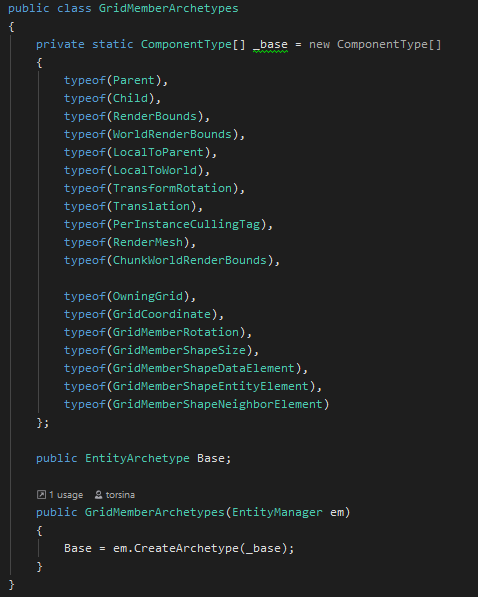


 deft stump
imo, right now the current api is solid enough that you can make a decent game with it.
but it's still really bad at optimizing fewer than 50 entities. (just GO it, if that's the use case)
if you're planning to use it for 2D you either need to install Tiny which is a whole other can of worms.
or do the hard route of making a material for your sprites.
 blazing skiff
any news on the network component?
gusty comet
@zinc plinth Oh, very cool. How does that work when you create levels though?
zinc plinth
levels ?
gusty comet
@zinc plinth Scenes, worlds, in the editor
zinc plinth
(you don't have to ping me everytime)
gusty comet
Sorry, old irc habit 😅
zinc plinth
and the authoring workflow is for components, I'm confused that you talk about it for scenes; and worlds are their own can of worms
gusty comet
Alright then, I'll just read up some more on dots (and maybe experiment with it) and then come back.
zinc plinth
the "authoring" workflow makes that you can add entity components as monobehaviors to the gameobject that will be converted
tho that's with a big asterisk
pliant pike
I don't suppose anyone knows if they've changed GameObjectConversionSystems recently?
I'm trying to get one to run some kind some code I'm even following a tutorial but it doesn't seem to work at all
zinc plinth
that's not helping us to help you
pliant pike
yeah I don't know I just thought they ran at the beginning of the program automatically
deft stump
the GOConversion hasn't changed
gusty comet
@pliant pike Give us the smallest non-working example code you could give us that recreates the issue. And what you expect would happen. And what actually happens.
pliant pike
public class TestGameObjectConvert : GameObjectConversionSystem
{
    protected override void OnUpdate()
    {
        Debug.Log("Why arent you working");
    }
}```that does nothing for instance
zinc plinth
of course it won't if your go gets converted as soon as it's instantiated
Start isn't even called in that instance
Awake will be called tho
pliant pike
but just going by this tutorial the guy does similar and his works

✅ Get the Project files and Utilities at https://unitycodemonkey.com/video.php?v=7_rZhp6V8ds
Let's learn what are Blob Assets, how to create and how to use them for massive performance!
Unity DOTS / ECS Tutorials
https://www.youtube.com/playlist?list=PLzDRvYVwl53s40yP5RQXitbT...
at 8 mins you can see the code
deft stump
that should work
pliant pike
you can't put that code on an object
mint iron
maybe you need live link enabled 🤔 maybe also a subscene.
low oasis
How would I go about getting Entities in a sorted order? Or rather, components from entities in a sorted order.
Maybe a dynamic buffer, but the only examples I see of those are very simple with one value and a specified size but my component has 5 ints, 2 bools a float and a float3.
there are a few systems that would edit this data, but for most it's read only, but still needs to be in order and traversable. Would be nice to be able to loop through it in burst compiled jobs as well. It's very confusing trying to find more specific information about ecs... Most examples are just really simple
 tardy spoke
Has anyone run across any good recent tutorials on ECS? It seems to be evolving fairly rapidly, haha. Looking for the simplest intro around for my feeble brain.
amber flicker
@tardy spoke Codemonkey's are the only ones I'm ambiently aware of and I think certainly the recent ones are quite up-to-date. Not sure beyond that sorry. Unity's samples are kept fairly up-to-date and provide a reasonable reference. I'm expecting things to change a bit again within the next few months though - I think they're working on the editor, instantiating prefabs and other related aspects but the non-conversion/editor stuff has stabilised a fair bit I believe.
@low oasis The first thing that I think of is a sorted NativeArray or even NativeList that has been allocated using Allocator.Persistent. This can live in a system and you can get at it in other systems via EntityManager.GetExistingSystem<SomeSystem>().mySortedArray. Perhaps that doesn't answer your question - let me know
tardy spoke
@amber flicker Thanks I'll check them out. I got through a bit of a Udemy course (Called Unity Dots Fundamentals) that was really good at the beginning but ramped up in difficulty pretty quickly. Would likely be a good pace for fairly competent programmers, but I got fairly lost, haha.
Just skimming through the ECS codemonkey's videos on YouTube this is pretty much exactly what I was looking for! Thanks.
amber flicker
Awesome - thanks for letting me know that Udemy course exists - especially if it goes fairly deep into some things - useful to know what materials are out there
tardy spoke
Yeah, he builds the whole game in 6 hours, so it's nice because the course is on the shorter side - but the downside of that is it moves fairly quick and skips some theory.
Also I have a question for people experienced with ECS -
I'm working on a game that will eventually likely end up being done in ECS as it's a very suitable use case for it (large numbers of players/enemies tracked on a SpatialOS server).
I currently suck at ECS, and the game is just starting to be built.
Is it likely more efficient to:
A) Build what I can in regular Unity programming style then convert it down the line to ECS when I'm more familiar with it.
B) Just start building the whole thing in ECS even though it'll cause the progress to be slower at first.
zinc plinth
Game Academy.school's tutorials are up to date and I learned way more from them than from codemonkey
@tardy spoke B
because you'll have to rewrite from scratch anyway
tardy spoke
Thanks, I'll take a look at them as well.
amber flicker
My opinion: If you plan to release within 1-2 years and it's a somewhat commercial enterprise, then maybe A. If your livelihood doesn't depend on it, you want to also get into dots and you like pain, then B. As an example, I simply can't build my project at the moment (it compiles fine). That isn't uncommon atm but of course will improve. Once you get into dots I think it's hard not to want to do everything that way.. but in reality, you could just use it in a more targeted fashion for perf critical points like pathfinding. In reality people so often are more gpu bound than anything and optimising things like many units usually requires gpu animation via textures.
zinc plinth
some game genres are way more cpu than gpu bound tho
tardy spoke
Nah, it's a hobby/experiment my friend and I are just doing for fun and unrelated to finances, haha. We're definitely picturing a 2-5 year range for the project to finish, if ever. It's a big one.
amber flicker
Then B 😄 - go have fun!
tardy spoke
Lol, it's a bizarre project. We're attempting to make a VR MMORPG that runs on Oculus quest for kicks. The CPU/GPU restrictions are unbelievable. Has to run 72FPS with 4X MSAA minimum.
We're actually not even convinced yet that it's possible, the tests we've done so far are right on the line.
amber flicker
on quest you get 4xmsaa pretty much for free I believe but certainly, it's a tricky target - trying to remember the quest game I saw with thousands of units/characters
tardy spoke
Yeah, I'll have to look into that because I have it set to do 4X MSAA on URP so I'll have to see how that's being applied
amber flicker
gpu animation will do a lot for you I'd say - be sure to avoid Unity's animator controllers etc
tardy spoke
Yeah, I'm going to need literally every possible optimization. It's a hilariously fun project though. Super challenging.
amber flicker
https://github.com/joeante/Unity.GPUAnimation as a reference point if you're not already doing something similar
tardy spoke
Haha I have a list of resources that I'm throwing all these links into for when I need them in 1+ year, haha. 🙂
Simple but very fast GPU vertex shader based animation system for Unity.Entities lol well that's perfect because we're using vertex colors with no lighting
tardy spoke
Just watching some of these tutorials - any workflow benefits from using the conversion workflow vs pure ECS either way?
It seems like my friend who is doing the level design might appreciate being able to put characters and stuff where they're supposed to go as opposed them just being invisible until runtime? Is the conversion workflow pretty much the standard approach?
gusty comet
conversion is the only direction for the unity devs as far as I understand it
pure ecs is a thing of the past really, you can go out of your way to achieve that, but Unity doesn't really care about that anymore
once the entire ecs ecosystem is in place, then they'll probably work on pure ecs, since at that point it makes total sense
but that's years from now
literally
tawdry tree
There are a couple ways to do conversion, though they share a lot of techniques.
One way is to use entity subscenes - they will automatically convert all objects on build. Another is to add the ConvertToEntity monobehavior.
Either way, the programmers ought to make authoring components that are handy to use for building a scene - both for their own sake with testing and development, and for any designers.
Realistically speaking, there are no benefits to completely eschewing GameObjects, though you want gameobjects to exist as little as possible to get the full benefits of, and to make the DOTS (coding) workflow easier.
That means GameObjects during design, of course, and you would likely also have prefab GameObjects, again made during design.
You want conversion to be pretty much part of "starting the game", and to never touch a gameobject (in code) afterwards, though at the current moment this isn't quite possible for most games.
gusty comet
Hi, anyone could give me a little help with rendering meshes in ecs? I've seen some tutorial but I must be doing something wrong
zinc plinth
if you can at all do it, use a gameobject with conversion instead of adding the components yourself
I have the xzjv seal of approval 😁
zinc plinth
or both
tardy spoke
@tawdry tree Right, so you would for example have gameObject prefabs say for certain "enemies" or something, but you're instantiating copies of those prefabs as entities when you "start the game"?
Also I'll look into the entity subscenes, because that sounds like something that would be useful.
Yeah from the videos and the way people call it the "conversion workflow" makes it sound like another common workflow exists - where as for real world applications it seems that it doesn't. Would seem like making a game with your hands tied behind your back to not be able to visualize the positioning of anything in your game at all until the game is actually started. I mean, maybe some simple simulations could be run like that, but not any sort of "game".
And as far as I can tell there really isn't a performance penalty for using the convert to entity mono behaviour vs instantiating via script, but I could be wrong there.
Haha, yeah I type a lot. Many questions! Turns out, there's a lot I don't know. 🤷♂️
zinc plinth
subscenes are a big pain to work with rn, so I'd advice to wait untill you understand more how ecs work before starting using them
mint iron
I tend to agree, they are very buggy, they crash my unity all the time.
safe lintel
the benefit is that you arent reinventing the wheel each time you want an entity, where it can easily be converted from a gameobject. there are many systems to handle conversion with more on the way and afaik unity want it to cover the vast majority of use cases.
In situations where it doesnt get converted to your liking manual conversion via the IConvertGameObjectToEntity interface can be used to explicitly describe what you want.
If you dont wish to use any of the conversion systems it might be a good idea to post on the forums to get the attention of the devs how conversion isnt handling your own use case but I think you would be fighting against the tide if you simply just dont wish to use any of this as unity consider it the official and best workflow for dots
tardy spoke
Right, no I have no problem with that at all, I was just verifying that that is in fact how most people are working in ECS currently. The videos make it sound like their are multiple workflows but it seems like everyone is really on the same wavelength in terms of authoring in gameObjects and converting them to entities at runtime. Makes sense to me.
mint iron
there really isn't a performance penalty for using the convert to entity mono behaviour
runtime conversion we were told has been abandoned, its likely still only around until sub-scenes are reliable enough. But more to your comment, there is a cost compared to sub-scenes, it might be small if you're not converting much, but subscenes pre-convert all your stuff in the editor and save it as a blob that can be pretty close to being straight copied into the format a world requires. that means you can load heaps of data really fast with no/minimal processing on it. At least that's the dream.
zinc plinth
a really big thing is also to have entity prefabs; to avoid spawning a GO each time you want an entity
tardy spoke
I have an additional question if anyone wants to answer it, but feel free not to because it's kind of a vague question.
Is virtually every ECS programming operation done with the foreach loop method on the components? Is there any common operations BESIDES that, or is that pretty much "what you're working with" and you just figure out how to solve your "problem" within that limitation/structure?
Also isn't this just turning into LISP programming? Hahahah
Moving modern programming back to ideas that came out in 1960 (which were really good ideas).
zinc plinth
well, on must stuff you want to "process action on all components of archetype X"
tardy spoke
Yeah, that's what I mean. On most things, that's what you want to do - but CAN you do anything different?
Or rather than "can", SHOULD you ever be doing anything different? Or is it all ideally performed within that one structure? ForEach --> if it has these components --> do action.
zinc plinth
well jobs can hide the loop from you and have the index in your Execute, but appart from that I don't see how you would do it diferently
and ecs is completly built around component iteration, that's why we can care about cpu cache lines
deft stump
Even if you were to collect the components via query, store it in a native array, then do operation on. You would have to for loop it any way
tardy spoke
Right, so the correct approach is to try is to frame your problem so that it's solved by that ForEach process - virtually regardless of the "type" of problem, whether you're manipulating 1 entity with ECS or 100,000, correct?
Like if I want to just move my player character 2 inches to the left, still runs through the loop, correct? Because the memory has been optimized via ECS to be efficient at that operation even if it's cycling through everything just to find the one entity?
zinc plinth
even if you only have 1 instance of your "problem" in the current world; you'll put a loop on it just in case there's more than 1 instance of it at some point
tardy spoke
Right, to me that makes a lot of sense.
zinc plinth
by doing so you avoid alot of troubleshooting of not doing loops too
tardy spoke
ECS to me makes a lot more sense than MonoBehaviours from a practical standpoint, but my background isn't OO. I'm a lousy javascript programmer that does mostly functional.
tawdry tree
@tardy spoke Give an entity the Prefab component and store the reference, then you can spawn a copy in pure ECS with EntityManager.Instantiate(Entity).
I always have a simple authoring component for Prefab which just adds the Prefab component to the entity on conversion, and you could have separate conversion scripts that, say, store the entity reference to somewhere useful (such as handing it to a system)
tardy spoke
That's a great idea
zinc plinth
^ doing this for my grid tiles went from creating 10K+ GO and going through conversion for all of them and having 10s+ load time; to having a entity prefab of it and loading in less than a ms
tardy spoke
That's awesome! The decrease in loading time wouldn't go amiss for sure.
tardy spoke
Woah, those subscenes look super cool. My solution for running a 20km map in VR without huge jitter problems was something along these lines - https://youtu.be/FwNMUCqKsz4 - but I'm thinking if SubScenes are coming down the line I could just do a "regular" floating player origin and load small sections of the map without even implementing the static "physics world" as I demonstrate in that video - since you're only dealing with maybe several hundred moving colliders per "level", it may not be the same computational problem it was with monoBehaviours.
If ECS can handle dealing with a lot of moving colliders more efficiently it'll save me a ton of headaches, haha.
Actually if the subscenes reset the origin point, which they most likely do, then I actually don't have to do any of this... hahaha.
zinc plinth
I would be really surprised if they do @tardy spoke
those entities are in the same world as the rest, so their LocalToWorld refer to the same thing
pliant pike
@mint iron Thanks for that suggestion, it appears you do need a converted subscene for gameobjectconversionsystems to run, just converted a random cube, and they work, Thanks
tardy spoke
@zinc plinth dang, I assumed with the mega city demo that that was exactly what they did.
Unity can get pretty shaky around 10km out from the origin due to floating point rounding errors. They're more pronounced in VR.
zinc plinth
as I said, "I would be really surprised if they do", as in I didn't see if they were
so maybe they are
mint iron
you need a nasa super computer to open the mega city demo :S
tardy spoke
@zinc plinth Yeah, it'd be nice, but due to potential technical challenges and limitations they proooobably don't. For example, doing a physics calculations is tricky if the origin moves discretely. You could do a Continuous Floating Origin like in my video though and move the entire world in reverse (Futurama style. The ship doesn't move, the universe moves around the ship) - ECS would probably actually be ideal for that. The issue is you lose static lighting and stuff doing that. And other implications of course, multiplayer requires the server to translate the location of enemies to your players local translation, etc.
zinc plinth
you could apply some lense effect via shaders to make it seem as tho the objects are far away but in reality they're not that much
would keep your in the "safe" float range
icy kestrel
Can anyone explain why this piece of code only works when the for loop runs once? I've started it at different points but if it runs > 1 time my CPU usage goes up to 100% and the game never starts. This is just inside a Start() function. (Not using DOTS, just Job System)
icy kestrel
Ok thanks
tardy spoke
@zinc plinth that's an interesting idea and i've never seen that done. Also unfortunately I don't think I'm good enough with shaders to be able to make that work, haha. Off topic - I was going to look into if it's possible to create a shader that enlarges pixels to use as a "low poly"-esque sniper rifle scope in VR, haha. I imagine it is, but my knowledge is pretty much limited to a bit of shadergraph.
On topic - just built my first ECS component and System... it changes a component float called hello to 42 and then starts moving the component +10 increments in the 'ol Y axis... needless to say... it's incredible. 🤷♂️
I'm thinking that generally it may be more flexible to keep components holding only a singular piece of data because my instinct was to use the System in that way. I instinctively tried to use .WithAll() to filter for the float I put inside the component instead of on the name of the actual component... seems like if you keep it to a singular piece of data, you're removing a potentially unnecessary layer of abstraction between components and the data they hold. I'm sure there's exceptions to that, but that's my inclination.