#archived-dots
1 messages · Page 139 of 1
 mint iron
 loud matrix
Yeah I was going to ask why that sounds liek dynamic buffer
 storm ravine
Because it's not fixed
if you overflow capacity
It will move to heap
and all memory management Unity doing automatically for you
loud matrix
ahh I see
storm ravine
Technically DynamicBuffer it's same as NativeArray
It's also NativeContainer with fixed size and simple pointer
Difference is
until you under initial capacity
you use chunk memory
Buffer has header
and when you read\write data it only use offsets in memory from header
 north bay
Is it possible to step certain physic bodies in Unity Physics? I'm asking since i want to network the RayCast Car sample, or are there other ways to archieve rollback/prediction on physic bodies?
storm ravine
But after overflow internal capacity it allocates (malloc) Persistent memory
and using pointer to persistent memory instead of header with offset limited by internal capacity in chunk (yes it's also pointer, just different word). Implementation pretty simple
storm ravine
Is it possible to step certain physic bodies in Unity Physics? I'm asking since i want to network the RayCast Car sample, or are there other ways to archieve rollback/prediction on physic bodies?
@north bay Your networking is P2P or through server?
storm ravine
Well all physics calculated on server side guess?
north bay
People are going to control the vehicle so having an input delay of ping + interpolation delay isn't really acceptable
It seems like i have to remove it from the physics simulation and step it myself like they did with the character controller, but i thought there would be an easier way
storm ravine
Well it's how all network AAA games works, calc gameplay important physics fully on client not acceptable (acceptable for local things which not correlates with gameplay, like flags and trees affected by some things like bird etc), especially when it not fully deterministic 🙂 For cars itself you should definitely calc it on server which will be "true" physic state, clients will have their local simulation but this simulation shouldn't be synchronized, this is just for hiding delay, server will send "true" simulation results 🙂
north bay
Well yea, but when the server sends the true state it will be x ticks behind the currently client predicted state and therefor i need to repredict the simluation for those ticks -> step the simluation for that object. Maybe im missing something obvious
storm ravine
Yes and commonly for that using Dead Reckoning
And ususally this covers delay smooth and thus (usually) differences not noticable 🙂
Write good networking is one of trickiest things, for latency sensitive games, in gameplay programming usually 😄
So many usually
 opaque ledge
Does anyone have a helper methods for logging inside jobs ?
 coarse turtle
Would the BurstDiscard attribute work on a proxy function to Debug.Log?
opaque ledge
Burst supports Debug.Log now
coarse turtle
Oh I guess its the inside jobs part 🤔
opaque ledge
but it is only callable on main thread, so it doesnt work with Schedule, ScheduleParallel
yeah
coarse turtle
Hmm you could try pushing the log statement into a parallel container with a timestamp
opaque ledge
weird thing is, it logs at first for a while then it gives error that i should call it from main thread
coarse turtle
and then flush that container later back on the main thread with the actual log statement to a file or console 🤔
mint iron
ive done it before, you can use shared static, write to some sort of stream/queue/whatever and then have it play back on main thread with some sort of hook.
coarse turtle
I also wonder if Visual Studio/Code's debugger works with the threads
I remember reading that rider had support sometime ago 🤔
opaque ledge
@mint iron no need now i think 😄 (if your sentence was for me)
is there a need for Burst Discard now ? since it works with burst now
opaque ledge
how can this work inside jobs exactly ?
you are just calling Debug.Log inside static methods
👀
mint iron
yeah... thats confusing, if it BurstDiscards, then it not going to run in burst
 zinc plinth
hemm in jobs from a system, am I sure that any entity struct that I get from a query will stay valid within the chain of jobs/dependencies from that system ?
this might be horibly worded sorry :x
opaque ledge
yeah they will stay valid as long as you dont do structral changes
log works thanks Eizen 😄
kinda weird, if we directly call it its an error but if we indirectly call it then it works 🤔
storm ravine
Well
problem in Burst usually is string concatenation
which not allowed
like "asdasd" + someVar
with string.Format("Some string {0}", index) right inside job it will work also
but will complain about Debug.Log
Because of how burst compiles things and Debug.Log works
Under hood Debug Log calls new Logger() and new DebugLogHandler() and here is come problem on which burst complains
Becuase of how burst compiles instances and call constructors
Like this:
Don't use this function in the constructor or field initializers, instead move initialization code to the Awake or Start function.```yea
storm ravine
Anyway it works? Then just s....t up and use that!
😂
Joke
hemm in jobs from a system, am I sure that any entity struct that I get from a query will stay valid within the chain of jobs/dependencies from that system ?
this might be horibly worded sorry :x
@zinc plinth well (why I always use that word) if you want schedule chain which in some job check\get some entity, stores it in some native container (for example) and you use that entity for something in other job in this chain yes?
zinc plinth
yep
before I had these ```
public NativeArray<GridMemberCoordinates> remainingGridMemberCoordinates;
public NativeArray<InventoryEmitter> remainingInventoryEmitter;
public NativeArray2D<GridMemberCoordinates> remainingNeighborsGridMemberCoordinates;
public NativeArray2D<RoadGroupGridElement> remainingNeighborRoadGroupsGridElements;
    public NativeArray<GridMemberCoordinates> activatedGridMemberCoordinates;
    public NativeArray<InventoryEmitter> activatedInventoryEmitter;
    public NativeArray2D<GridMemberCoordinates> activatedNeighborsGridMemberCoordinates;
    public NativeArray2D<RoadGroupGridElement> activatedNeighborRoadGroupsGridElements;``` but I saw that I needed an `Entity` to add a component to an entity so I added `        public NativeArray<Entity> remainingEntities;` and was afraid these structs could become invalid in some other system with the magic of the scheduler while this chain of jobs was still doing it's thing
Yes it will be stable always inside Jobs chain, because inside jobs chain structural changes not possible, they delayed by EntityCommandBuffers. (technically you can do structural changes directly inside job through ExclusiveEntityTransaction, which I described many times in many places, but this thing not for your case). If in a middle of chain you have system which completes jobs, doing structural changes - after that point validity of your entities not guaranteed
Also should mention ECB itself
zinc plinth
the structural change is the end of my job chain, so I'm all good
I'm using the EndSimulationCBS
storm ravine
if you have playbacks between your systems (which is structural change) - after that point validity of your entities not guaranteed. For example have multiple ECB systems which buffers used in chain
If you're doing all stuff with your entities before any playback it will be stable
zinc plinth
playback ?
storm ravine
But of course you should look at your dependency chain carefuly
because if systems use that array but not in same dependency chain it's again will be not guaranteed point
zinc plinth
I'm taking care of my deps 😃
storm ravine
playback ?
@zinc plinth All entity command buffers playbacks - call Playback which....playback recorded commands chain (through burstable function pointers now btw)
zinc plinth
hooo that
didn't really know the sense for that word ^^'
storm ravine
You have tape
You record your voice commands in to that
then you press play button on your tape recorder and all your recorded voice commands playbacks
storm ravine
Huh need to go sleep, but there is still so many work (3 AM in Russia, Witching hour) 😦 You guys distracting me 😄
zinc plinth
^^
 chilly halo
Hi guys.
I have a NativeMultiHashmap<Entity,int> and I need to do something in a Parallel Job with each entity and the sum of all INTs.
Those entities don't have anything in common and I cant use a query to loop through them.
Is there a known workaround or tip to do something like this?
zinc plinth
can't you get the key array from the multi hash map and use a IJobParralelFor ?
wait, do you mean the sum of all the ints, or just the ints relative to one key ? @chilly halo
opaque ledge
Just realized you cant put normal C# objects to entities thru AddComponentObject, i is sad
chilly halo
@zinc plinth The sum of all ints of each key.
And yes... I can do that but the thing is that the NMHM is being built in another job , and getting the array of unique keys must be done in the main thread, and I would prefer to dont do that.
zinc plinth
you can just get it in another job 
which runs only once
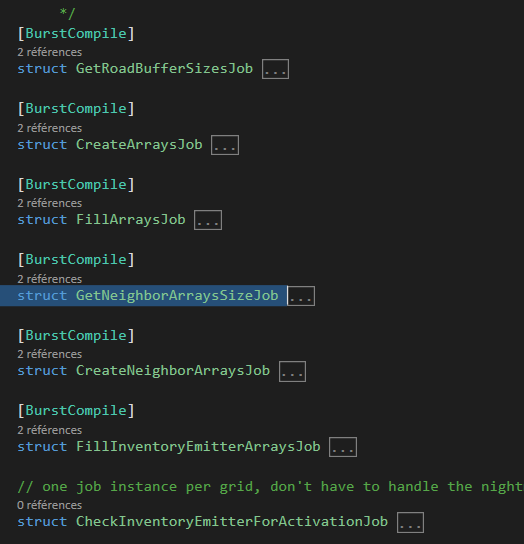
did quite alot more jobs than I anticipated following this principle but I think it's worth it imo (compared to Complete()) https://i.imgur.com/odIHR2N.png
 storm ravine
Just realized you cant put normal C# objects to entities thru AddComponentObject, i is sad
@opaque ledge class (not struct) IComponentData
opaque ledge
ah true, why i didnt think of that
you know this reminds me, if we can just make class IComponentDatas and add that to Entities, why do we need AddComponentObject for ? 🤔
storm ravine
@zinc plinth The sum of all ints of each key.
And yes... I can do that but the thing is that the NMHM is being built in another job , and getting the array of unique keys must be done in the main thread, and I would prefer to dont do that.
@chilly halo Write native counter and sum concurrently
opaque ledge
(except TextMeshPro stuff, build fails if so)
Also werent you going to sleep, its 04:14 😄
storm ravine
Fixing build
zinc plinth
well you still have to do that in a previous job @storm ravine
you'll end up with an NativeArray<int> sizes
mint iron
can't remember how to get the thread index in to Entities.ForEach, anyone?
zinc plinth
and I don't know how you could do that concurrently within one key
storm ravine
can't remember how to get the thread index in to Entities.ForEach, anyone?
@mint iron int nativeThreadIndex as one of lambda arguments
opaque ledge
ah in ForEach, nvm
storm ravine
and I don't know how you could do that concurrently within one key
@zinc plinth through written native counter
zinc plinth
yes, but how do you split an array of value from one key between parralel instance
from a NativeMultiHashMap
you only have Next
afaik 
you can parralel between keys, but not split the set of values of one key between multiple instances
mint iron
    public class LoggingTestSystem : SystemBase
    {
        protected override void OnUpdate()
        {
            Entities.ForEach((Entity entity, int nativeThreadIndex) =>
            {
                NativeDebugger.Log(nativeThreadIndex, FixedString.Format("The entity is {0}{1}", entity.Version, entity.Index));

            }).ScheduleParallel();
        }
    }
``` https://gist.github.com/jeffvella/ede829d9b6b8290009f083d6b7aa6604
Gist
Debug Logger that works in burst and any thread. GitHub Gist: instantly share code, notes, and snippets.
storm ravine
@zinc plinth IJobNativeMultiHashMapVisitKeyValue
zinc plinth
huuuuh
storm ravine
But it's just abstraction, under hood it's key per thread and it's what you need. Split one VALUE per thread will be bad, and reduce performance instead of give you gains
storm ravine
With multi threading you always should process buckets of data, but not one value per thread in general
Only case where you set 1 per thread is some heavy algorythm and you just should run one calculation instance per thread
otherwise performance of parallelization will be opposite and can be slower that single thread
loud matrix
@opaque ledge This thread might help you with logging n' debugging in jobs https://forum.unity.com/threads/as-debug-log-is-a-problem-in-job-i-made-this-simple-trick.860464/ Also this video https://www.youtube.com/watch?v=nou6AIHKJz0&feature=emb_title

Unity Forum
Simple but useful
public static class JobLogger
{
[BurstDiscard] public static void Log(T segment) =>...

Quick guide and some additional notes on the new native debugging support for Burst. Available from package version 1.3.0-preview.4. Timestamps are below for convenience.
Timestamps:
[0:13] Quick guide to debugging
[1:29] Current Limitations
[1:33] Threaded Debuggin...
opaque ledge
👍
zinc plinth
when you do ECB.AddComponent, what happens if the entity already has that component ? does it replace it or ?
opaque ledge
yes, it replaces it
zinc plinth
alright, thx!
 safe lintel
remember the good old days when it would just error out 😀
storm ravine
It not replace but will ignore after first AddComponent
storm ravine
AddComponent not replace any thing it's not the same as AddComponentData for ECB
opaque ledge
ah right, i assumed AddComponentData
storm ravine
Ah stop
I'm sleeping already
It's I missed
for ecb it's exactly AddComponent
AddComponentData it's for EM
safe lintel
yeah that made me go looking for a new addcomponentdata 🤔
opaque ledge
yeah i guess i am sleeping as well lol
storm ravine
For ecb AddComponent with instance yes latest override previous and now I'll go sleep
opaque ledge
I wonder if AddComponent causes a structral change if it already exists 🤔
storm ravine
No
It first execute AddComponentWithValidation
which check HasComponent
and after that it just set value
it only add on first AddComponent call
zinc plinth
what are the reasons a system could not show up in the entity debugger ? 
storm ravine
not in one of root groups
zinc plinth
ahh nvm, it was because it wasn't ran and it hides it by default ^^'
coarse turtle
yea if the dependencies arent met on system initial run they're not registered to run so it doesn't appear in the entitydebugger 🤔
chilly halo
@chilly halo you got your answer 😀
@zinc plinth @storm ravine Sorry I was dining
So... I have my NativeMultiHashMap<Entity,int> and the idea is to end up with a parallel job able to do something with each entity in that NMHM and the sum of all int, so....
Run a IJobNativeMultiHashMapVisitKeyValue for the NMHM and build a NativeArray<Entity> and a NativeArray<int> with the same sizes , where the second NativeArray is the sum of each int[] inside a NMHM.
What I dont get is how to use IJobNativeMultiHashMapVisitKeyValue for that. IJobNativeMultiHashMapVisitKeyValue only has a ExecuteNext, no index and is executed N times as values has each key. How can I use it to build those arrays?
Sorry if the question is a bit obvious, I think I'm missing something big here.
chilly halo
In order to add some more context I will write the full story here... I case is happening an XY problem of some sorts .
I'm simulating fluids in a voxel world. I have a 3D Grid where I have an entity for each cell. In a given time I add some of those entities a new component [LiquidCompoenent].
The way I simulate that liquid is first fetch all entities with [LiquidCompoenent] but without the [SettledComponent] (that compoenent is added to entities with liquid that dont need to be updated) saving them in a NativeHashSet to use it later.
Then there is a second job that goes through those entities again but this time creates a new struct of data that has a cache of all relevant values for each valid NEIGHBOUR.
Then I go one more through every "simulated liquid voxel" to simulate the liquid movement using the struct of data created in the previous step. In this job I create two NMHM<Entity,int>, one with the differences of liquid generated (in and our flow) and one with a settled counter.
Then Lastly I should go through every entity in those NMHM and apply the sum of that numbers to their components.
 craggy orbit
is it bad to use a cached monobehaviour in a system to change job parameters at runtime? like when the system is created, i get and save the monobehaviour as a property, then in the system's update i use public properties in the monobehaviour (exposed in the inspector) and pass them into the job?
i just feel like it'll be a lot quicker to test things rather than changing a single number, waiting to recompile, then seeing if the number even works
 wide fiber
this component type is
classIComponentData, not struct
@storm ravine wait what, a class deriving from IComponentData and not a struct? Native container inside IComponentData?
Can I use burst with a Class? Or are you making a query for the singleton, save the values that you want in local variables and then use them inside Entities.Foreach?
opaque ledge
Class is a managed type so you cant use burst with it, but you can make ForEach with class in your query but only with WithoutBurst().Run()
wide fiber
Yeah but to write cleaner code I want to use a singleton component instead of making some static variables inside the system, so @storm ravine talked about making the code cleaner
opaque ledge
Well, i dont know/remember that context so i just answered your question about if you can use burst with classes
wide fiber
How should I store a list inside a class deriving from IComponentData? With NativeList or with "normal" List? (I don't need burst, I need to query this component to read the data to use in other queries)
opaque ledge
You can do it with both
i mean, if you are going to somehow use that list in your other systems then make it NativeList, but if its self-contained then use List or Native
wide fiber
GenerateAuthoringComponent doesn't make NativeList inspectable :(
Should I dispose the native container inside the class deriving from IComponentData in the OnDestroy function of the system that writes to that component?
storm ravine
@storm ravine wait what, a class deriving from IComponentData and not a struct? Native container inside IComponentData?
Can I use burst with a Class? Or are you making a query for the singleton, save the values that you want in local variables and then use them inside Entities.Foreach?
@wide fiber yes class. You can’t work with that inside job/burst. Idea is query that singleton entity, get, for example NativeList, in local context of system OnUpdate and pass that list in to ForEach. No need fields on system for that, no need statics for that.
wide fiber
Ok, that means that I understood correctly
Should I dispose the native container inside the class deriving from IComponentData in the OnDestroy function of the system that writes to that component?
If the component doesn't exist and I query for that inside the OnDestroy() it gives me an error, should I use query.CalculateEntityCount to check if there is a singleton? (Or does a better way exist?)
I don't have this problem inside OnUpdate because I use RequireUpdate(query);
storm ravine
Should I dispose the native container inside the class deriving from IComponentData in the OnDestroy function of the system that writes to that component?
@wide fiber up to you. In my case as I mentioned above I have system which only destroy that containers in OnDestroy by querying that singleton entities
Yep, you need that check if your singleton may not exists
wide fiber
👍
storm ravine
@zinc plinth @storm ravine Sorry I was dining
So... I have my NativeMultiHashMap<Entity,int> and the idea is to end up with a parallel job able to do something with each entity in that NMHM and the sum of all int, so....
Run a IJobNativeMultiHashMapVisitKeyValue for the NMHM and build a NativeArray<Entity> and a NativeArray<int> with the same sizes , where the second NativeArray is the sum of each int[] inside a NMHM.
What I dont get is how to use IJobNativeMultiHashMapVisitKeyValue for that. IJobNativeMultiHashMapVisitKeyValue only has a ExecuteNext, no index and is executed N times as values has each key. How can I use it to build those arrays?
Sorry if the question is a bit obvious, I think I'm missing something big here.
@chilly halo now with you
You want TOTAL sum of ALL entities values in to one number yes?
Like you have 10 entities in map and every entity has 3 numbers - collected apple, orange, fish. And you want sum of all food from all entities? (Just as example)
zinc plinth
@storm ravine could you avoid the unnecessary pings please >.>
 wide fiber
Is there a way to get a random number inside a parallel job? (Foreach.ScheduleParallel())
mint iron
last i heard you have to create an array of randoms, one for each thread to avoid them producing the same value.
opaque ledge
i am using Shared Static for that, and put a Random in there and use that in my bursted jobs
 stone osprey
One of my systems has a performance of about 0.20 ms ( Processes about 100 entities )... is this a good ratio ?
It calculates the position each frame
wide fiber
        {
            return math.acos(math.dot(v1, v2) / (math.length(v1) * math.length(v2)));
        }```
The problem with that function is that if the angle should be 180°, it gives me 0
It gives me always positive values
It's like:
if(angle >= 180f)
angle -= 180f;
stone osprey
Lets say im still using gameobjects for the visuals of my game... those gameobjects do have colliders... how could i code a system for listening to collisions between those gameobjects ?
storm ravine
Yes it's how it works, because dot product
The problem with that function is that if the angle should be 180°, it gives me 0
@wide fibervar a = new float2(0,1); var b = new float2(0,-1); Debug.Log(a.AngleDegrees(b));where AngleDegrees is[MethodImpl(MethodImplOptions.AggressiveInlining)] public static float AngleDegrees(this float2 v1, float2 v2) { return math.degrees(v1.Angle(v2)); }
wide fiber
Maybe it's 180.5 that gives me 0.5 instead of 180.5
storm ravine
Yes that expected. Angle is always <= 180 here
Ah stop it should be not 0.5
it should be 179.5
wide fiber
It gave me 0.0197.. when it was at the opposite (so around 180°)
Probably the problem is another, I will check other systems
storm ravine
Angle works as expected
            var b = new float2(0.01f,-1f);

            var c = new float2(0, 1f);
            var d = new float2(-0.01f, -1f);


            Debug.Log(a.AngleDegrees(b));
Debug.Log(c.AngleDegrees(d));```179 right side 179 left side
wide fiber
Yeah, it was a problem of execution order, sorry
Now I am doing another thing.
Basically now the projectiles that are shot from weapons are perfectly aligned with the weapon (I am setting the rotation to be equal to the weapon one) but I want to add an offset (based on the precision of the weapon)
How can I add an offset to the Z axis (in Euler) of a quaternion?
storm ravine
You want add scatter?
 thorny halo
hello, is there a way to iterate over a NativeHashMap similar to how you can a dictionary. Just something like "foreach(var item in map.values)".
chilly halo
Like you have 10 entities in map and every entity has 3 numbers - collected apple, orange, fish. And you want sum of all food from all entities? (Just as example)
@storm ravine
Something like this...
NMHM a;
Entity e1;
Entity e2;
Entity e3;
a[e1] = [1,2,3,4,5]
a[e2] = [-1,1,-1,1]
a[e3] = [0,0,100,90,-50]
Inside the Job I need :
e1 -- 15
e2 -- 0
e3 -- 140
wide fiber
@storm ravine yes
chilly halo
good morning btw 😛
wide fiber
A random offset to the rotation of all the projectiles
chilly halo
@warped trail AFAIK that only works with <int,int>
 warped trail
oh🤔
thorny halo
does anyone know the difference between a multihashmap and a hashmap?🤔
chilly halo
I tried with IJobNativeMultiHashMapVisitKeyValue but that executes one time for each VALUE, and I need the sum of all of them.
Just to clarify, I need to use the sum to modify a component but also to remove/add components depending on the final value.
does anyone know the difference between a multihashmap and a hashmap?🤔
@thorny halo
HashMap= Dictionary <N,T>
MultiHashmap = Dictionary <N,T[]>
thorny halo
@chilly halo thanks
is there a way to iterate over NativeHashMap values in a job? I only see IJobNativeMultiHashMap interfaces.
storm ravine
@chilly halo there is IJobNativeMultiHashMapMergedSharedKeyIndices
@warped trail Deprecated. Only interface I mentioned above will continue exist (with mutable version)
coarse turtle

Unity Forum
We have just published a new preview “Project Tiny” that brings a few new features and usual bug fixes. Some notable features:
We’ve enabled...
Looks like its updated with the latest entities version 👀
chilly halo
@storm ravine Good to know about that, before I start beating my brain out to see how to implement that Interface
I have enough try to find a way to sum all ints in a NMHM in a parallel job.
loud matrix
Is this possible or am i barking up the wrong tree?
public struct ItemBlobAsset
{
    public BlobArray<ItemBlobData> data;
    public ref ItemBlobData getById(string id)
    {
        for (int i = 0; i < data.Length; i++)
        {
            if (data[i].name.Equals(id))
            {
                 return ref data[i];
            }
        }
         return ref default(ItemBlobData);
    }
}
Looking for a way to grab items in a blob array by a FixedString ID, but I need to pass back a ref, and I need to have a catch for there not being a result
mint iron
mmm i dont think compiler will let you return a ref default, it will require a valid field or ptr source
loud matrix
Yeah this is my issue. I'm thinking of adding a "null" item as 0 when creating the database and returning the data[0] and checking for that
mint iron
yeah that might work!
i've used a workaround like this before
        public ref struct TryResult<T> where T : struct
        {
            public bool HasValue;
            internal void* Ptr;

            public ref T Value => ref UnsafeUtilityEx.AsRef<T>(Ptr);
        }
or i could be more verbose and have it look for the index, and then just sue that, but both would be mroe painful
I saw something similar when looking up the issue, though i wasn't sure if they would play well with Blobs
mint iron
blobs have been doing some unexpected things that's for sure.
loud matrix
Well they let me store meshes so they let me be lazy :p
mint iron
try this
     public struct ItemBlobAsset
     {
         public BlobArray<ItemBlobData> data;

         public unsafe TryResult<ItemBlobData> getById(string id)
         {
             for (int i = 0; i < data.Length; i++)
             {
                 if (data[i].name.Equals(id))
                 {
                     return new TryResult<ItemBlobData>
                     {
                         Ptr = (byte*)data.GetUnsafePtr() + i * UnsafeUtility.SizeOf<ItemBlobData>()
                     };
                 }
             }
             return default;
         }
     }

     public unsafe ref struct TryResult<T> where T : struct
     {
         public bool HasValue;
         internal void* Ptr;
         public ref T Value => ref UnsafeUtilityEx.AsRef<T>(Ptr);
     }
Would the Value and HasValue not also need to be set there?
And would it not be cleaner to just have a TryResult that contains only a ref to a ItemBlobData and a HasValue?
mint iron
mmm yeah you would want to set HasValue, so you can know not to call the exploding value
i dont think you can store a ref as a struct field, even in a ref struct, they only let u do that with Span<T>
loud matrix
Yeah i just gave that a try and it didn;t like it
Seems to work, though as per usual with me I cower at the use of "unsafe"
And for some reason it's having a hissy fit over this way of getting the name and casting it to string as opposed to when referencing the data index by its int id
mint iron
this data[i].name.Equals(id) ? or something else
loud matrix
nvm im being stupid
mint iron
there's also FixedString.Format("The entity is {0}{1}", entity.Version, entity.Index) if its useful for embedding strings in jobs, but only seems to work if its directly in the job root.
loud matrix
my issue was just with the search query string not the result, because jobs are a dick and strings are apparently the devil even when coming from outside the job
As for some reason a FixedString32 inside a blob referenced inside a job is fine to use ToString but a FixedString32 just inside the job can't use ToString
opaque ledge
ToString method returns string tho, which is a class hence managed
 odd cipher
Hey, so I'm trying to make my noise generation code multithreaded but it for some reason generates some strange looking lines
code here https://pastebin.com/RFaHA59H


 bold sleet
im not sure if this is the right place to ask but, if i understand this right, if you use unity pro at all, and make a game using the Havok physics engine library, which you pay for (200 anual) and ship your game out as a standalone exe, and decide to cancel the license, the way Havok license reads is you must also remove all copies of your game featuring it too right?
opaque ledge
i think you should ask this question to DOTS/Physics forum, havoc people is there answering stuff
odd cipher
maxNoiseHeight is set to float.minValue and minNoiseHeight is set to float.maxValue
zinc plinth
hmm, do I need to dispose arrays from ArchetypeChunk.GetNativeArray myself or ?
odd cipher
im almost certain the problem is from me setting the minNoiseHeight and maxNoiseHeight in each execute
odd cipher
but not sure how to solve it
opaque ledge
i never did anything to do with noise but perhaps something about "x" variable ?
perhaps there is something weird going on with modulo and division
odd cipher
maybe, though the lines are only caused by the InverseLerp
and without the lerp it looks like this
opaque ledge
ah okay, something about lerping then
odd cipher
yeah, I think the minNoiseHeight and maxNoiseHeight variables are the problem but not sure
because the lerp did work without this job version
do those variables reset back to what they were after one Execute?
nvm it seems they dont
storm ravine
hmm, do I need to dispose arrays from
ArchetypeChunk.GetNativeArraymyself or ?
@zinc plinth no. Because this is direct reference to chunk memory, this is why you can change values in array and they immediately applied to chunk.
zinc plinth
hooo ok
odd cipher
cant figure this out at all
 solar spire
@odd cipher you're setting the min and max inside of a job and not waiting on it, so it's updated over the course of the entire run of the job over the array. You would need to split it so you've recalculated the min-max over the entire texture before you start using them
because right now what you're seeing is how the job is executing
odd cipher
well im not using those variables afterwards, only changed in the job
solar spire
should you perhaps be having the min-max variables local to the function, and not the job?
odd cipher
well they are needed for the job, and only used in the job
not sure what youre suggesting
storm ravine
He mean
That one Execute sets value and other execute calls use that value
instead of initial float.Max\Min
And because it's parallel
every execute get random min\max which was set from one of other Executes
Simple example - you set initial value 0 and expect that it will be 0 for every execute, but it wouldn't.
Reason for that is how job collect data for executes. Under hood it just get IntPtr (through JobScheduleParameters from your job data void* pointer (which in turn get by simple AddressOf) ) to your initial struct which as result shared across all executes.
odd cipher
it shouldnt be reset though, the original code that worked didnt do that.
the new set value should be carried on to the next execute
this is the original code https://pastebin.com/NYD3k09t
odd cipher
Yeah, I guess I'm just having a hard time wrapping my head around this
or how to fix it, I have a pretty poor understanding on how this noise generation works in the first place
I feel like it should work but it just doesnt
@storm ravine do you mean that the order of execution is random and therefore creating these weird lines?
storm ravine
Yes
Because all Execute runs in parallel
Mathf.InverseLerp(minNoiseHeight, maxNoiseHeight, output[index]); this part produces unexpected result because of random minNoiseHeight\maxNoiseHeight overwritten by other Executes
odd cipher
gotcha
storm ravine
Why you tying do that parallel? And not just main threaded\single threaded with burst. Which size of your map will be?
odd cipher
So, should I just do a IJobFor instead of IJobParallelFor?
storm ravine
Seems you trying noise generation implementation by Sebastian Lague. It runs on main thread fine (not the best but fine) Just use single bursted IJob \ Job.WithCode
IJobFor is same as IJobParallelFor but with two implementations of Schedule - all Execute runs sequentially on worker thread and ScheduleParallel - same as IJobParallelFor Schedule - batch size per thread
odd cipher
Yeah, a IJob works just fine
is there a way to do something like this but Burst compatible? System.Random prng = new System.Random(settings.seed);
odd cipher
Yeah, that works
6 milliseconds out of 26 is now gone with this new method, only took like 5 hours to figure out :p Thank you
 stiff skiff
That sounds pretty heavy for perlin
storm ravine
Because of big octaves count and world size definitely
Well you can parallelize that.
stiff skiff
Is the link above the code you run in the jobs?
odd cipher
no I mean, 20 milliseconds for the noise and terrain generation with noise AND setting each pixel corresponding on what terrain
stiff skiff
Yeah that sounds very long
storm ravine
I interested in noise part only
odd cipher
well I dont know what the best way would be to time a multithreaded piece of code
storm ravine
Well for test
odd cipher
im currently using a System Stopwatch
storm ravine
return parallel schedulind
64 batch size
comment inverse part and if (noiseHeight > maxNoiseHeight) { maxNoiseHeight = noiseHeight; } else if (noiseHeight < minNoiseHeight) { minNoiseHeight = noiseHeight; }
stiff skiff
@odd cipher even for single threads, this quite high
odd cipher
noise generation time takes 0-1 millseconds
stiff skiff
float2 sample = new float2((x - worldSize.x / 2) / settings.scale * frequency + octaveOffsets[i].x, (y - worldSize.y / 2) / settings.scale * frequency + octaveOffsets[i].y); A lot of this is duplicated work every octave iteration
You are also iteration in columns, instead of rows,.
noiseHeight += perlinValue * amplitude; This can be replaced with an math.madd intrinsic
noiseMap[x,y] = noiseHeight;
noiseMap[x,y] = Mathf.InverseLerp(minNoiseHeight, maxNoiseHeight, noiseMap[x,y]);
Yeap rows first, for reducing false sharing
stiff skiff
This stores a value, only the read it again for a transformation.. and overwrite it?
storm ravine
He is doesn't need that inversion here tbh
odd cipher
I mean the whole thing takes 1 millisecond
storm ravine
It can be faster with suggestions above
stiff skiff
The code for updating min and max could likely be replaced with some nice simd select methods
The focus is to have as your octaves look be as few cycles as possible, and the writes afterwards to be sequentian
storm ravine
min\max can be dropped here completely 🙂
stiff skiff
float2 point = new float2(x,y);
float2 sample = (point - worldSize / 2) / settings.scale * frequency + octaveOffsets[i]);
You might have to ensure that scale and frequency are also float2
Note that you can move worldSize / 2 outside of the octaves loop as well
Hell, the whole thing can move out, except for the * octaveOffsets[i])
You could probably rewrite the PerlinNoise function as well using the new mathematics package, in a much faster method
odd cipher
doesnt seem to work the same
stiff skiff
Ah sorry, I swapped a + for a *
odd cipher
ah yeah that fixed it
storm ravine
Hell, the whole thing can move out, except for the
* octaveOffsets[i])
@stiff skiff not only.frequencynot fixed
odd cipher
this is how it looks like right now, with burst https://pastebin.com/dgPqTcGH
storm ravine
reorder for loops, rows first
odd cipher
is that faster?
storm ravine
(point - worldSize / 2) / settings.scale move out of octaves loop
is that faster?
@odd cipher yes, because of false sharing
when x loop first you going through array not linearly
And processor cache refill cache lines every time
when rows first you use cache lines effectively
stiff skiff
@storm ravine I think it works atm because they are using the [x,y] method of storing
This will break once you move to a single NativeArray<float>(Width * Height)
storm ravine
and not get new values every time but rarely, because they already in cache
@storm ravine I think it works atm because they are using the [x,y] method of storing
@stiff skiff you mean float2 implementation here which used in his array?
stiff skiff
@odd cipher Looks good, but do swap the x and y loops
I only just saw your burst job link 😉 sorry bit behind
@odd cipher I wonder if it might be faster to move the checks for min and max noise outside of the loops
So instead of doing them for every pixel. You do a loop over the output array at the end and update the min and max. Should unroll the loop and SIMD it
storm ravine
Just remove them. They can be dropped here without any problem.
stiff skiff
Though I'm not sure how smart burst is at doing this
odd cipher
well I need some alternative to doing the same thing those two variables are doing
storm ravine
after dropping that he can easily parallelize that
unwrap XY loop and just calculate octaves part
odd cipher
ill have to continue tomorrow its 2:30 am and I have to get some sleep :p
stiff skiff
👍
opaque ledge
no sleep, only coding 👀
 nimble reef
What's the proper way to use an enum with IComponentData? I tried this:
https://pastebin.com/rnjCU3pJ
But I'm not sure how to actually set the tileType variable
wide fiber
@nimble reef ? (I haven't understood the problem, do you want to make it show up in the inspector?)
nimble reef
No, I just want to set each entity's TileComponent's tileType to some value from that enum
Also, how would I find a specific entity once they've all been created? Like if I want to update one of them
nimble reef
I think maybe I'm misunderstanding what ECS can/cannot do. But that's what I'm trying to learn here. I'm basically trying to represent the grid in a 2d game via ECS, so I thought I'd make each tile in the grid an entity
opaque ledge
that is doable, you just get Entity reference somehow
but it all depends on how you struct your stuff
i am guessing each tile has 2 ints, x and y positions, you could put all the grid entities to a buffer, and select the grid entity you want from that buffer
i am not sure what to say about tile Type, you just simply set it, like
new TileComponent{tileType = yourEnum}
odd cipher
@stiff skiff how would you suggest getting rid of the min/max variables?
bold sleet
hey im looking at the docs and i dont understand, because it doesnt say, and the samples are confusing to me, but this isn't working at all:
entityManager = new EntityManager();
Entity _newEntity = entityManager.CreateEntity();
it throws a NullReferenceException error
opaque ledge
every world has their own Entity Manager, you have to access world's entity manager
World.DefaultInitializationWorldSomethingSomething.EntityManager
 outer swift
How do I actually install DOTS in Unity 2020?
bold sleet
ok let me fix my code and i'll see if it works
outer swift
I can't see it in the list of packages, and the "show experimental packages" option is gone from the advanced settings in the package manager
I'm on the latest alpha, 2020.2.0a9
warped trail
show experimental packages escaped to Project Settings->PackageManager
outer swift
Ah, goodies. Thanks!
wide fiber
Any update on Physics Event handling? I want to receive the OnTrigger "event" without making an IJobIDontRememberTheName. But using SystemBase
opaque ledge
nah, we dont have those right now, maybe they will integrate to ForEach one day
i mean you can still call it in SystemBase, you just make the job thats all, instead of ForEAch
bold sleet
why isnt my Entity debugger seeing my entities
my list shows they are there, but the debugger doesnt see them
Entity _newEntity = entityManager.CreateEntity();
managerEntityList.Add(_newEntity);
that works, but it doesnt see them in the Entity Debugger
oh nevermind i figured it out...
 mystic mountain
Is there any good way for two systems to add entity references to a dynamicBuffer from created entities with commandBuffer?
opaque ledge
you have to create a workaround, since entity that is returned from commandBuffer isnt viable yet
my workaround is this, i put a RegisterComponent to new entity and put 'parent' entity in it, i have a system that queries for RegisterComponent and child adds itself to parent and then delete the RegisterComponent
 gusty comet
Hi 🙂 Quick question: I've created an entity that has been converted from a prefab (so it already has a physics body component on it), but I need to only update ONE aspect (linear velocity) of the component. If I use setComponentData, will the component be replaced? In other words, will I have to supply all the other configurations that I did on the prefab (gravity etc) just to set the linear velocity?
storm ravine
how would you suggest getting rid of the min/max variables?
@odd cipher I guess it’s question to me? 🙂
Just remove them and inversion. Use amplitude for reducing “whole black”
mystic mountain
@gusty comet Yes, the data of the component will be replaced with what you supply. So if you somehow was able to add angular velocity in your authoring it would be set to what you send in when you send in your linear velocty by SetComponent with PhysicsVelocity component.
gusty comet
@mystic mountain OK, thanks! 🙂
@mystic mountain actually, I realized my mistake - I thought while I wrote the question that there was a 1-to-1 mapping between physics body and the component I needed to update, but since I only need to update the "PhysicsVelocity" component it's not that big of a deal 🙂
odd cipher
@storm ravine So instead of InverseLerp I use amplitude somehow?
 last jasper
Hey, I just came across something counter-intuitive. If I call
localToWorld.Rotation, I would expect to get a quaternion that considers only the rotation of the object. Instead,localToWorld.Rotationalso considers the Scale of the object. I would consider this a bug, but am I misunderstanding something here?
For instance, two objects with Scale 0.1 and Scale 1:
And for completeness:
    public class DebugRotationSystem : SystemBase
    {
        protected override void OnUpdate()
        {
            Entities.ForEach(
                (ref LocalToWorld localToWorld) =>
                {
                    Debug.Log(string.Format("localToWorld.Rotation={0}", localToWorld.Rotation));
                }).WithoutBurst().Schedule();
        }
    }
(Should probably add using Entities 0.9.1)
mystic mountain
@last jasper If I'm not really bad at my maths here. LocalToWorld.rotation is be the full rotation, scale is not part of it, from local space to world space. I.e. if you have it nested, it will be the full rotation to world space, equivilent to transform.rotation in the old system.
last jasper
yup, that's what I expected. Instead, localToWorld.Rotation is affected by the Scale. The two entities in the above example are not nested for simplicity, but still show this behaviour.
mystic mountain
Really can't tell from the images what you have done wrong.
last jasper
Me neither 😄
mystic mountain
You will need to show the full hierarchy or setup.
last jasper
Sure, I'll make a forum post
mystic mountain
If you simply do some wolfram alpha of your quaternions you'll see that your first rotation is something like 10-20 degrees
last jasper
yeah
that's exactly the point though, both have the same rotation
but localToWorld.Rotation returns a different quaternion for both of them
sorry for slow reply, I'm trying to add a bit more detail for the forum post 🙂
here is the post https://forum.unity.com/threads/localtoworld-rotation-affected-by-entity-scale.882133/
Unity Forum
Hi,
I've noticed some behavior I did not expect with LocalToWorld - it seems that scale affects the LocalToWorld.Rotation. For example, consider...
You can see that Rotation is the same for both entities, neither has a parent, both are at the origin, but LocalToWorld.Rotation returns different quaternions. The only thing different between them is Scale
outer swift
What's the current best point of reference for pure DOTS design?
I've been looking at documentation and samples, and it's all a jumble.
I'm most interested in pure ECS, I can't say I like the idea of mixing GameObjects and Monobehaviours in, but if that's the intended workflow then I suppose I can hold my nose and cope.
What I really wonder about is really architecture. I'm sure I can get a few thousand cubes bouncing around on the screen, but that's not really going to help me understand how I'm supposed to handle stuff like input from multiple players, game sessions, asset pipelines and yada-yada
Am I asking a question with no real answer yet? Are batteries definitely not included?
 amber flicker
What's the best point of reference for pure Monobehaviour design? 😅 - you're right though, resources are thin on the ground. DOTS samples are partially supposed to be fulfilling this role but often criticized for their scope.
 dawn badge
It's a tough one. I currently have a single mono behavior to handle loading the entities and storing an array of location data for all Systems to reference for collision
outer swift
The best point of reference for monobehaviour design is don't but I get your point
Yeah, ok, so I should expect to use Monobehaviours to orchestrate the ECS
My current preferred development practice is to just use a single Monobehaviour to send update signals and deltatime into my own stack, so the idea sounds just dandy to me
dawn badge
Yea I do something like this for now:
amber flicker
GameObject->Pure is the workflow that's here to stay, at least for the next n years. If you're interested in getting as pure as you can, Tiny is where it's at.
dawn badge
Main.cs is the only Monobehavior
outer swift
@dawn badge What do you use for collisions?
dawn badge
It's 2D so I just do a simple cast:
    private static bool isColliding(float aX, float aY, float bX, float bY) {
      var radius = 1f;

      var deltaX = aX - bX;
      var deltaY = aY - bY;

      return ((deltaX * deltaX) + (deltaY * deltaY)) <= (radius * radius);
    }
that's in my CollisionSystem
outer swift
ah, right
I got my own very simple SAT-based collision system written using the new maths lib that I was hoooooping to use
dawn badge
I expose the "grid" from Main via a static method
and meshes/materials..not sure it's great but it works
outer swift
Right, so you just load in materials and meshes and keep them in the Main, then whoever needs them looks them up from there?
outer swift
So before you start your big rendering foreach in each rendering system, you just fetch the mesh and material references from Main and ta-da?
Wait, so you have arrays with IDs aligned with the rendering components so you can slice into them?
dawn badge
Yea I just call Graphics.DrawMesh( after pulling the meshes with Ioe.Main.GetPlayerMesh() and Ioe.Main.GetPlayerMaterial()
exactly so while my Entities.ForEach filters I can still ForEach through my LocationData and update the correct Ids
outer swift
Can you actually call Graphics.DrawMesh from a big parallel foreach?
outer swift
Ok, so it's a single-thread burst job
dawn badge
It's a raw compsystem but it runs after a burst job
so take your wins where you can 😛
outer swift
the job sets up everything, then the compsystem that depends on the job brrrrrrs through?
dawn badge
yep!
outer swift
Is that your general architecture? Jobs prep data for a compsystem that goes brrrrr?
And the dependencies decide order of execution?
dawn badge
[UpdateAfter(typeof(SomeScheduledSystem))]
outer swift
"beautiful"
dawn badge
The UpdateAfter is a life saver
you can really orchestrate to optimize where possible
outer swift
unity: c++ is bad we don't want users to deal with all that shit
also unity: haha we made c# into games-oriented erlang
dawn badge
haha well if you ever did erlang/elixir it's not terrible in comparisson. Similar to GenServers (mentally) just not purely sync which is nice
this is how I am learning C# and Unity and I am not having too hard a time
outer swift
I'm unfortunately from extremely imperative side of things
dawn badge
the docs need work though..like relying on intellisense and source definitions is pretty raw
mystic mountain
Is there any material on how using Adressables with DOTS yet?
outer swift
@dawn badge I noticed. Good to hear that it doesn't have to be tremendously complicated.
So thanks! That sorta allayed my fears a bit.
dawn badge
Isn't there a conversion script for that? I saw some people just telling Unity to convert to entity?
@outer swift yea it's doable! just be ready to yell at clouds 😂
outer swift
my yellinator is set to cloud
Fortunately decided to clone an easy game for practice
Gonna clone myself some Every Extend: https://www.youtube.com/watch?v=bWrCwZFro40

Every Extend is a unique little... shooter I guess you'd call it. Very short, but addictive and replayable, it uses an original concept and pokes fun at Ikaruga along the way :D
The premise is this: You can only attack by self-destructing. Each self destruct takes one life ...
dawn badge
Looks like a great candidate for ECS
storm ravine
Is there any material on how using Adressables with DOTS yet?
@mystic mountain not yet. Subscenes + addressables will be first step on unity near plan. Currently we use addressables with dots without problem. At app start loading all required stuff asynchronous, convert and store maps on entities (note: we use own persistent unique id for every resource, for excluding references to unity internal solutions and serialization which breaks from time to time)
 gentle osprey
Is there a way to access the shared component of a random entity inside an IJobChunk?
I'm doing the CombatBees ECS project, and need to see if 'this' bees target resource is held by a bee on the other team, and I store teams in SharedComponents. Open to change the use of SharedComponents of anyone has any other ideas.
To rephrase, the problem is essentially: I have an entity, which targets another entity, I need to know the SharedComponent of the other entity.
storm ravine
Is there a way to access the shared component of a random entity inside an IJobChunk?
I'm doing the CombatBees ECS project, and need to see if 'this' bees target resource is held by a bee on the other team, and I store teams in SharedComponents. Open to change the use of SharedComponents of anyone has any other ideas.
@gentle osprey Not directly. You can only get SCD index, because itself they not stored in chunk, chunk only store index to unique SCD in global map
gentle osprey
The SCD index is the same for all entities with the same shared component though? So, in this case I would only need to see if the other entities SCD is different from "mine".
mystic mountain
@storm ravine So you wait with the whole conversion before you've loaded all stuff?
storm ravine
@mystic mountain well that content local and load fast in our case. And it loads at app start right in intro scene with copyrights etc. 🙂
The SCD index is the same for all entities with the same shared component though? So, in this case I would only need to see if the other entities SCD is different from "mine".
@gentle osprey Yes
gentle osprey
But there's no easy ways to get access to the SCD index of a random entity? Like, there's no SharedComponentDataIndexFromEntity or similar?
mystic mountain
@storm ravine I see, what I want to do is load stuff based on map loaded and what other clients who joins map has chosen as visuals. 🤔 I've not gotten my hands dirty with adressables yet, so not sure if I should just wait for their solution to show up.
storm ravine
Well addressables part itself async, thus wouldn't stall main thread and can be wrapped in to nice loading 🙂
Conversion pretty fast, but you should convert batches, not one by one which inefficient. One of ways create hidden GO when every thing loaded, pass GO prefabs to that GO and using declare reference prefabs add them to conversion list and convert to entity in Convert, and store references to prefabs where you need. Or if don't need prefabs and just immediately instantiate content workflow will be similar, just without that utility GO.
But there's no easy ways to get access to the SCD index of a random entity? Like, there's no SharedComponentDataIndexFromEntity or similar?
@gentle osprey you can get SCD index on main thread by EntityManager and use that, or you can GetSharedComponentIndex from chunk to which entity belong
mint iron
a word of warning on that, runtime conversion is not going to be supported according to topher; the answer to all my issues was pretty much 'don't do it`. Conversions with IConvertGameObjectToEntity within a SubScene are fine, but hes talking about instantiating a go, and triggering a conversion at runtime.
For example i had an issue where i instantiate a GO at runtime, it converts and tries to create Entity prefabs based on referenced assets, but in the case of parent/child conversions, there's no guarantee that parents will have been converted before their children which for me broke everything. The process worked in earlier versions of Entities but it broke when they refactored to include assets other than GOs in conversion.
It seems that the intention now is to use Addressables to pull in an entire SubScene (a pre-converted blob of stuff that gets shoved right into the world).
mystic mountain
So I will need a subscene for each asset? 🤔
mint iron
no the subscene would contain all your entity prefabs, already converted.
storm ravine
Parent\child conversion works without problems, but you'll get result only on next frame, before that you only operate "hierarchy" through LinkedEntityGroup
mystic mountain
@mint iron Hmm right,.. but how would you go about; have a wide range of characters and only load the ones that are used? Would you chunk them into subsets and make subscenes of them?
storm ravine
For example after instantiation I want to get some things from child parts of complex prefabs, I use LinkedEntityGroup for that, because it's already here after GameObjectExportGroup run
mint iron
that's a good question; i haven't gotten that far yet; i gave up and went onto other things after being told it wasn't going to be supported.
afaik the ultimate plan is to kill convert & inject, ultimately everything will be scene conversion or conversion system
https://discordapp.com/channels/489222168727519232/497874303463850004/686924098730983426
After the game loads that prefab is instantiated, the conversion script
Runtime conversion is not supported
And not something we want to support
https://discordapp.com/channels/489222168727519232/497874303463850004/689161934616133644
storm ravine
https://discordapp.com/channels/489222168727519232/497874303463850004/686924098730983426
https://discordapp.com/channels/489222168727519232/497874303463850004/689161934616133644
@mint iron conversion system IS runtime conversion. Convert and inject is will deprecated part.
Conversion system is how Convert to entity processed 🙂 convert and inject just temporary dirty hack 🙂
mint iron
i think hes referring to anything that's not pre-converted
storm ravine
He speak about hybrid workflow
mint iron
conversion system supposed to run at editor time only?
mint iron
thats what it seems like he was saying, that conversion system/world would eventually not even exist at runtime. you can of course make your own to do that same thing, but they dont want to support it, is what i took away.
storm ravine
Only about convert and inject part
I’ll ask Fabrice
He is working on that part of dots
mint iron
okay well then his response to me was irrelevent, i would have the same issue with convert+inject as with a conversion system, becuse its a flaw in the underlying systems.
storm ravine
For clarifying and excluding “guessing” 🙂
mint iron
please, some clarity there would be great
storm ravine
Yep. Until that, just my thoughts:
Runtime conversion
I mean pure convert to entity should be anyway 🙂 subscenes for everything not cover that.
Simple example is some procedural things
You definitely wouldn’t have all variations of things 🙂
Yes you can predefine some parts and use subscenes
 vagrant surge
@storm ravine do you use shared components or chunk components in your project?
storm ravine
But IMO convert some things at runtime (not hybrid GO’s) will be here long time 🙂
@storm ravine do you use shared components or chunk components in your project?
@vagrant surge yes, SCD for filtering
Chunk component in todo list for some things 🙂
But not yet, it will be on pre release and final optimisations
loud matrix
This is probably a dumb C# question rather than a Blob one but, any reason why I'd get the following error when trying to use BlobBuilderArrray as a variable in a custom delegate?
The type 'BlobBuilderArray<T>' may not be used as a type argument
mint iron
BlobBuilderArray is a ref struct https://docs.microsoft.com/en-us/dotnet/csharp/language-reference/builtin-types/struct#ref-struct
loud matrix
Damn well that ideas downt he drain
As far as im aware there would not be a way to do this then
public class DatabaseBLobAssetConstructor<T> where T : struct, IDatabaseitem
{
    public BlobAssetReference<DatabaseBlobAsset<T>> reference;
    public DatabaseBLobAssetConstructor(List<T> rawData, AssetConversionAction<BlobBuilder, BlobBuilderArray<T>> dataConversion)
   {
        BlobBuilder blobBuilder = new BlobBuilder(Allocator.Temp);

        ref DatabaseBlobAsset<T> itemBlobAsset = ref blobBuilder.ConstructRoot<DatabaseBlobAsset<T>>();
        BlobBuilderArray<T> data = blobBuilder.Allocate(ref itemBlobAsset.data, rawData.Count);

        dataConversion(ref blobBuilder, ref data);

        reference = blobBuilder.CreateBlobAssetReference<DatabaseBlobAsset<T>>(Allocator.Persistent);
        blobBuilder.Dispose();
    }
}
AssetConversionAction being my delegate
mint iron
where does dataConversion come from
what about this
public interface IDatabaseBuilder<T> where T : struct, IDatabaseitem
{
    void Build(ref BlobBuilder blobBuilder, ref BlobBuilderArray<T> builderArray);
}

public class DatabaseBLobAssetConstructor<TBuilder, TItem>
    where TBuilder : struct, IDatabaseBuilder<TItem>
    where TItem : struct, IDatabaseitem
{
    public BlobAssetReference<DatabaseBlobAsset<TItem>> reference;

    public DatabaseBLobAssetConstructor(TBuilder builder, List<TItem> rawData)
    {
        BlobBuilder blobBuilder = new BlobBuilder(Allocator.Temp);

        ref DatabaseBlobAsset<TItem> itemBlobAsset = ref blobBuilder.ConstructRoot<DatabaseBlobAsset<TItem>>();
        BlobBuilderArray<TItem> data = blobBuilder.Allocate(ref itemBlobAsset.data, rawData.Count);

        builder.Build(ref blobBuilder, ref data);

        reference = blobBuilder.CreateBlobAssetReference<DatabaseBlobAsset<TItem>>(Allocator.Persistent);
        blobBuilder.Dispose();
    }
}
or
public class DatabaseBLobAssetConstructor<TItem> where TItem : struct, IDatabaseitem
{
    public BlobAssetReference<DatabaseBlobAsset<TItem>> reference;

    public void Build<TBuilder>(TBuilder builder, List<TItem> rawData) where TBuilder : struct, IDatabaseBuilder<TItem>
    {
        BlobBuilder blobBuilder = new BlobBuilder(Allocator.Temp);

        ref DatabaseBlobAsset<TItem> itemBlobAsset = ref blobBuilder.ConstructRoot<DatabaseBlobAsset<TItem>>();
        BlobBuilderArray<TItem> data = blobBuilder.Allocate(ref itemBlobAsset.data, rawData.Count);

        builder.Build(ref blobBuilder, ref data);

        reference = blobBuilder.CreateBlobAssetReference<DatabaseBlobAsset<TItem>>(Allocator.Persistent);
        blobBuilder.Dispose();
    }
}
Hummm that might indeed work, even looking at it is confusing me somewhat so I'd not have come up with doing it that way for sure.
 tardy locust
The first one looks very...
"This thing is doing more things than one"
The second one looks more readable.
loud matrix
I'm using the second to be fair, i am having to rewrite a chunk as i have two types floating around being converted between in IDatabaseBuilder.Build
but it looks like it should work, and cut out a massive amount of copy and pasting
loud matrix
More than my fix i mean, which was to just use the rest of my templating but have a new Constructor class for each type i needed to convert
tardy locust
Well it could give you some customization if you needed it
But if you don't, then yea, waste of time
loud matrix
That's true, but i can always do both
for ones that just need a conversion script I can use this method and for anything more in-depth just do it the old way
tardy locust
"Always future proof your code, but never try to be too smart" is how I like to look at that 😛
loud matrix
Being smart is what we have xzjv for
tardy locust
outsourcing, working smart not hard
loud matrix
And if for some reason they're sleeping, which doesn't seem to ever happen, Eizenhorn exists 😛
loud matrix
That is why I am currently resisting the urge to day drink while trying to wrap my head around this while expanding it.
tardy locust
There is that point though
Where the alcohol makes you the genius programmer
galaxy brain
loud matrix
I'm in that lovely grey area of having 24 years coding experience but very little high end C#
loud matrix
I was taught to code realllly young as my dad was a BT engineer and saw it being useful
tardy locust
How old are you though?
loud matrix
32
tardy locust
Ah okay.
 naive parrot
whats BT?
loud matrix
British Telecom
naive parrot
i see
tardy locust
I guess starting at 8 is not so bad
loud matrix
In order to understand Blob assets fully and memory management in DOTs i think he needed to have started a few years earlier
tardy locust
Well
Understanding the fundamentals is fairly easy...a bunch of arrays of numbers
But the hard part
Is to understand how to use it to your advantage
For example using 1D arrays to store different kinds of data is completely legitimate. Something other languages are shunned for (like Lua and JavaScript)
Difference is you represent by numbers rather than objects 😛
Isn't a blob just an arbitrary container of data?
loud matrix
Pretty much yeah, just cotnainers for immutable data accessed via reference
And until someone corrects me I'll pretend I'm right
tardy locust
Lol
dawn badge
whatever works in your head
tardy locust
We all go by this @loud matrix so you're fine:
dawn badge
haha 100%
loud matrix
I personally find i program in eldrich runes. The issue is once the code is written no mortal man can decipher the madness within.
tardy locust
We have comments for that
dawn badge
directories and apt naming are good as well
tardy locust
"If it was made by a human, it means we can analyse and understand it"
- Zelda, Breath of the Wild
😛
dawn badge
all systems go in the systems dir
all components go in a components dir
all archetypes go in an archetype dir
trust me it helps
namespaces help too..
loud matrix
I started that way, then had to go with contextual folders
as grouping all movement components and systems together just made it so much easier to find
tardy locust
final project
_final project private
final project (1)
final project 2
Master Project
master project (2)
dawn badge
that is interesting
so domain related?
Player
  Systems
  Components
FirstLevelBoss
  Systems
  Components
What about shared systems/things?
In a shared dir?
loud matrix
More general than that for mine
Scripts
    Camera
        Debugsystem
        FollowSystem
        TargetEntity
        TagMainCamera
     Movement
         Dampingssytem
         PlayerCiontrolSystem
         Throttle
         Velocity
         VelocitySystem
ah gotcha
loud matrix
so camera is camera only stuff, but movement is player and emery related
dawn badge
yea I guess it's just standard with Unity
tardy locust
The only folder that has to be the way it is would be "Assets"
That's it
The rest of the folders in your "Assets" is free game
Editor is one other exception I think
Because the editor looks in that specifically for editor extensions
dawn badge
huh
tardy locust
Don't know if Resources is still necessary to use? It might be
Resources is another special folder that you can use with the Resources loading system in Unity
But it's not like you can't put other things in there too
It's typically a nice place to dump things that can be modded by players
dawn badge
Yea currently in my small project I have
Ioe (master) $ find Assets/Scripts -type f -name '*.cs' | grep -v .meta
Assets/Scripts/EntityBuilders/EnemyEntityBuilder.cs
Assets/Scripts/EntityBuilders/PlayerEntityBuilder.cs
Assets/Scripts/Archetypes/EnemyArchetype.cs
Assets/Scripts/Archetypes/PlayerArchetype.cs
Assets/Scripts/Components/EnemyComponent.cs
Assets/Scripts/Components/PlayerComponent.cs
Assets/Scripts/Main.cs
Assets/Scripts/Systems/EnemyMoveSystem.cs
Assets/Scripts/Systems/PlayerRenderingSystem.cs
Assets/Scripts/Systems/EnemyRenderingSystem.cs
Assets/Scripts/Systems/CollisionSystem.cs
Assets/Scripts/Systems/EnemyAnimationSystem.cs
Assets/Scripts/Systems/PlayerAnimationSystem.cs
Assets/Scripts/Systems/PlayerInputSystem.cs
You use cmd for git?
dawn badge
hopefully it is maintainable..
I am on Mac, but yea I use cmdline for as much as possible
mystic mountain
Often ask myself if I can make my structure better x)
dawn badge
ahh well you have a Client and Server!
nice
Oh I use git a lot at work. So UI won't let me cherry pick from a specific branch into a release branch and rebase from a certain point in history
Didn't have a choice lol
tardy locust
I tend to find that all you need to do is have tight namespace organisation. Make sure your namespaces make sense and then make sure to use them properly. If something doesn't fit in a namespace you made, expand it and make sure to move everything in there that now fits it, rather than sorta fits another namespace you did.
@dawn badge Er
I do that in Gitkraken all the time
GUI based tool
tardy locust
And I can almost assure you that a lot of other GUIs also support what you just said
dawn badge
Reason I like ECS, less GUI more code/control haha
tardy locust
cherrypicking
Sure more control, I guess, but also make sure to support the design driven setup that Unity has. Ideally a programmer should make things that designers requests and then sit back and chill or fix bugs.
Help them to help themselves
dawn badge
Glad you like UIs. I can't use them very well for spatial things like Git
Oh I just do this on the side. Learning to make art, I already make music and code. This is what I am trying to do in my free time
tardy locust
"I can't use them very well for spatial things like Git"
Could you elaborate on what this means?
dawn badge
It means GUIs do things you don't 100% know all the time. If I am merging branches from separate remotes and rebasing I don't want to click the wrong button. If the mental model doesn't match the UI I get stuck. I have full control via CLI and can automate to my liking if need be.
tardy locust
hmkay
dawn badge
But yea anyways @mystic mountain your structure seems good
At the end of the day, if you are working on something alone and it makes sense go for it. If you are working on a team, document standards to explain the pattern(s)
loud matrix
I present to you why GIT should only ever be used in GUI form when working in a team
tardy locust
Yeah, that's a nice overview
loud matrix
That's not even the worse we'd had recently
When the language branches come in all hell breaks loose
dawn badge
If everything is a squash merge and master is protected nothing is complicated
but not every team can do 100% trunk based so I get it
loud matrix
I always end up just working on Master for my own work, I bounce back and forth on ideas and systems too frequently to do it properly :p
dawn badge
yea for local work master mostly, then branch if I know it's sketchy haha
dawn badge
but in teams master can only be merged into
loud matrix
That's what i use stashes for, but Unity seems to have a hissy fit when I stash sometimes and decided it needs to change my package versions.
tardy locust
In teams you should always have a git master who is the only one who can merge into master
Only stash while working in your GUI. As soon as you are done with it, pop
And go back in and work
dawn badge
ah stash and unity aren't friends? interesting
dawn badge
oh right..everything has to be generated
tardy locust
Yes
And some times Unity generates after a push
So you get new "changes" (which are non-changes)
And then you have to push meta files that Unity believes it changed
Even if you can compare to last push and see no changes
But Unity will damn keep on believing it did
dawn badge
it feels dirty to push meta files
tardy locust
Yea, but you gotta
dawn badge
but it is what it is I guess..
 lusty otter
I don't have issue with meta files
tardy locust
gets nam-like flashbacks with git and meta files
lusty otter
Some scene and project setting stuffs do randomly add missing props though.
What are the meta file changes you are seeing?
tardy locust
Here is a scenario I've experienced a couple of times:
- Do changes in scene. This affects meta files.
- Save the scene and everything in it.
- Go to Git client and commit/push
- Go back into Unity.
- Unity now claims to have made changes to other meta files (or the files you just pushed)
And so you have to save and push again
This is a very common issue
dawn badge
this is perfect use case for git commit --amend assuming you are not on master because it alters history if you have already pushed
but it sounds like a PITA
loud matrix
Problem is you don;t find out until you've done different work
tardy locust
I like pita
dawn badge
oh.. it does it "later"
tardy locust
Yes.
dawn badge
amazing 😂
loud matrix
so your metas in git just get messed up into a knot of what commit they actually belong to. A good use case for Pure ECS though 
tardy locust
And then you get the perpetual .meta commit
It's a type of commit where it keeps telling you that something went missing from a previous commit, so it deletes a meta file. Okay you think, I'll push that. No problem.
You push it, and it shows up again the next time someone makes a push.
tardy locust
It's so infuriating
tardy locust
That would be like having a single code file
tardy locust
It would be better if meta files are not necessary at all
dawn badge
yes that too lol
loud matrix
I remember hearing this as a reason for people moving to GODOT a while back (Well that and pixel precision in 2D)
dawn badge
GoDot has much less "keeping track" files, but still has some. Wish it had native ECS but Vulkan is the focus for 4.0
I guess with ECS I don't get many meta changes
dawn badge
ehh managing the threads?
tardy locust
It is a paradigm, still
lusty otter
That's Job system, has nothing to do with ECS.
tardy locust
A programming paradigm
dawn badge
right but DOTS is nice because it handles a lot for you
loud matrix
Screw it, guys, I have a solution!
dawn badge
brust compiling, job systems, etc..
loud matrix
FLASH!
dawn badge
FLASH!?
tardy locust
Sure, so you wish that Godot had DOTS
dawn badge
yea exactly lol or something similar
loud matrix
Action Script 1, never had these issues back in the day!
tardy locust
Lol
loud matrix
Sure we didn't have version control, but who cares 😛
tardy locust
ActionScript 🤣
Let me go grab my floppy disc 3.5 grandpa
Then you can transfer the code to me
dawn badge
you should make a game in DOTS that lets you write actionscript flash games?
like roblox? but worse? haha
loud matrix
pifft, 8" floppies were where its at
Now if you'll excuse me I need to find my 15 separate Ultima Underworld install floppies.
tardy locust
You need a floppy reader too
loud matrix
Got a USB one
tardy locust
That's cheating man
loud matrix
I've not had a PC case with bay slots in years
tardy locust
Yeah, adds to the challenge
loud matrix
I wonder, can i get a IDE to SATA2 converter
I think this may have been the most off topic this channel has ever managed to get
From my terrible programming, to folder structure, to unity meta issues to floppy disks
tardy locust
slow day at DOTS
dawn badge
yep
storm ravine
@mint iron Well, Joachim answered to me before Fabrice, great thanks to him for that (and whole DOTS team, they really kind and very responsive and helpful) 🙂 He don't know if they will deprecate runtime conversion, which confirms what I heard, that only Convert and Inject will be deprecated definitely but not Convert To Entity. But of course general recommendation is use subscenes everywhere if that possible, because off size & memory cost at runtime (which expected of course, with runtime conversion you of course keep everything in memory all the time, where with subscenes you can simply unload things until you need that again). And relates to that we decided use convert to entity with our workflow with Addressables now 🙂 But when they will add native support (and they will as they mentioned) we will compare, worth it for us - drop our solution or not 🙂
 dull copper
they do recommend to use subscenes but they still are the most broken part on the dots ecosystem 😄
mint iron
awesome, thank you for chasing that up.
dull copper
like, they work alone, but not that well with other dots packages
also hybrid setup is pain with subscenes as you can't just place cross scene refs even
in the future, definitely
I try them every now and them and after banging my head to the wall for some hours I always give up 😄
dots physics for one
but latest unity physics does work already better
in past the joints went all bonkers, then some other physics scripts (which I suppose were due to the way they were setup but at the same time, they were directly from ECS sample repo)
joints seemed to work on latest versions btw
but ultimately, going to subscenes makes non-hybrid rendering pain
and currently hybrid rendering v2 isn't faster on typical game scenes
(than old GO rendering)
yeah, I'm aware of the dark days ahead 😄
well, if you use it like it's supposed to be used, I guess it's not harder
but if you need the old renderer, you'd need to have some way to sync entities to GO transforms and subscenes make it pain
there are ways around it, but it's dirty
I basically just need the GO transform for the entities so can sync them efficiently on jobs
convert and destroy atm but inject would work too if the rendered GO would be on the same object
I'm basically using modified version of the old GameObjectEntity's transform syncing
I just set the transform to different GO, basically I have GO for dots conversion and separate GO for rendering and and animations etc, on conversion I assign the visual GO's transform to the entity that get's converted
it's a messy setup but it lets me get fully functional rendering and old animations
I guess, I've thought about the spawning too as it's going to happen anyway in some form
anyway, I did come up with solution for that in past but there were other dots subscene issues back then
I can look up the case where physics script broke on subscenes but worked fine on convert and destroy (on traditional scene)
I'm still so dots noob that I just try to avoid things that don't work my way 😄
and I totally understand that things I do are not usually things how Unity wants these things to be used
warped trail
im wondering if there will be some examples on how to properly use this new subscene stuff that was added with 0.10?🤔
dull copper
if some day hybrid rendering is fully featured, I'll probably consider it again
I'm assuming all scenes on DOTS will eventually be dots subscenes, or using similar structure
I mean it would make sense, considering the serialization benefits
vagrant surge
like it was on unity tiny old version
dull copper
I don't think that will happen any time soon
vagrant surge
subscenes definitely will be awesome for the next gen consoles
couse they would be literally instant to load
dull copper
the direction Unity is going, you still author with conversion, even for dots subscene
I really don't like the conversion scheme at all
mint iron
for runtime conversion, should we in the future be making our own conversion systems? i assume the conversion world will be around at runtime and run just work the same as if it were in a subscene/editor.
dull copper
talking of dots editor, is there any chances we could dock the entity conversion preview to where ever we want without it only freezing to single entity's view?
like, you can do that now but it won't track the selected part anymore
I'd love to dedicate it some actual space on the Unity editor
safe lintel
while youre here @digital scarab 🙂 i noticed when i updated to 0.10.0 inactive child gameobjects dont get added to a parent's child buffer after conversion, not sure if this is expected or not? the child entities did have the parent component pointing correctly to the parent entity though
storm ravine
in future there should never be a reason for runtime conversion, we need to figure out all the use cases and provide a solution for them
@digital scarab Yep it's definitely final target, that DOTS workflow should feel easy same as legacy workflow, and just give users "performance by default" 🙂
dull copper
hopefully that perf by default on more than few cores 😄
yes, I was supposed to send the repro project for that
mint iron
for the record my main use case is around asset management and remotely configurable system settings. I want to be able to download my stuff with addressables on load from remote server; from that i can dynamically build game elements. They can't all be baked into a downloaded SubScene because not all of the assets are currently convertible (sounds, particle effects), so i've had to do things like storing the addressables Runtime key to be able to link everything.
dull copper
I still try to get it out to get more feedback on that
amber flicker
err also cc @digital scarab 😬 any view on this? https://forum.unity.com/threads/entities-0-10-bug-future-of-addcomponentobject.879934/
nimble reef
i am guessing each tile has 2 ints, x and y positions, you could put all the grid entities to a buffer, and select the grid entity you want from that buffer
@opaque ledge What kind of buffer? Like a NativeArray?
opaque ledge
there is a component type called DynamicBuffer, it gives you the ability to have a 'nativelist' as a component on your entity
nimble reef
Oh interesting! Thanks
amber flicker
Oh thanks @digital scarab - sorry to add to the list 🙂 - yes, simple as add component object to an entity and then click on the entity in the inspector
Also... don't suppose you got a chance to sound out the ScheduleAuto / chunk threshold idea? No worries, just wondering.
nimble reef
@nimble reef https://docs.unity3d.com/Packages/com.unity.entities@0.10/manual/dynamic_buffers.html
@opaque ledge Sorry if this seems basic, so with this would I have one entity that holds the references to all the other entities in that buffer?
opaque ledge
yes, you can make a buffer that holds Entity field, and then you can put this buffer to an entity and put your referenced entities into that buffer
nimble reef
I see. Thanks again
nimble reef
I tried doing this:
https://pastebin.com/LWPACvmC
But when I run it I get an error "InvalidOperationException: The NativeArray has been deallocated, it is not allowed to access it" on line 16 there where I'm trying to add the entity to the buffer
storm ravine
Because you have synch point after getting buffer. Synch point with structural changes which invalidates your buffer.
nimble reef
I'm not familiar with that term. What does Synch Point mean here?
storm ravine
Place where all jobs completes for making structural changes
Structural changes is thing when chunks data layout changes
Which mean there is shouldn't be any work on chunk memory for excluding race conditions and data corruption
nimble reef
Oh, so me going into a for loop invalidates stuff?
storm ravine
Why this invalidates native arrays? Because they points to chunk memory and after structural changes there is no guarantee it will point to the same thing
In your loop you have CreateEntity
Which trigger structural changes
storm ravine
Every EM call which can change data layout (Add\Remove components, changing SetSharedComponentData value (because it changes entity chunk), Creating\Destroying entities, SwapComponents etc.)
loud matrix
There, database BS finally sorted. Now to stress test it and see how horrific an idea it is to do string based lookups on a blob database for every update
naive parrot
@storm ravine was wondering if your game uses any of the new SRPs or is it the Standard pipeline? would it be possible going forward to stick with old rendering pipeline and still adapt all of the new DOTS workflow and packages which as implied is sort of essential since subscene is entirely designed around 'pure' ecs workflow and requires hybrid renderer. am i mistaken.?
i have an ongoing project , 2yr into the development. slowly been moving performance critical aspects of it to DOTS land. often i am in more need of the ECS architectural advantage than performance benefit so am ok with hybrid nature of things with managed object sticking to entities here and there. on road ahead will this all be 'non ideal route'? some insights and suggestions would be nice..
tardy locust
It's likely that Unity will be completely DOTS/ECS based in the future under the hood and it won't matter much what you do on top.
But that's likely the really long term plan
storm ravine
We're on built in render pipeline, not using SRP, not using subscenes
naive parrot
so no Hybrid Renderer ?
naive parrot
what specifically have you added/changed to accomodate all your rendering needs , LOD and Culling aside..
storm ravine
gpu animation
naive parrot
i have read a bit on it since thats one of the major challenge trying to do all the 'core' stuff ECS way. dots animation package is apprently no go. i did take a look at a repo on Joacim's github as well , probably from nordeus demo ?
naive parrot
one very simple question since i haven't used HR first hand yet ,in own project , how do you go about updating material properties within ECS?
storm ravine
I only update them in my renderer, for HR I not update any thing, HR used for environment rendering, where I do stuff with my custom shaders, like triplanar mapping, shaking trees etc. which not using per instance properties but using global shader var's
naive parrot
i see. also , are you using light probes , reflection probes , lightmaps in your game. does it all work out of the box with HRV1 for supported shaders like Standard one for eg? or all of that stuff needs to be manually updated as some global params for shaders like standard renderer does..
storm ravine
If we'll require more properties, I just extend animation renderer or write new one
Not using, because everything is procedural generated at runtime
naive parrot
i see. that lends you lot of flexibility from ground up
storm ravine
Well you always can write your own renderer and shaders, and sample lightmap, probes etc by yourself
naive parrot
yea am all ok with that. just want to know if thats the route i need to take or existing solutions are already there.
i have realized ECS needs to be greatly complimented by design to warrant a full move to it. i would settle for core features like physics/rendering/navigation and interface with them via simple hybrid oriented APIs but apparently hybrid is forbidden fruit now.
loud matrix
Wellllll Fu-- (ノಠ益ಠ)ノ彡┻━┻
So after finally being able to stress test this database implementation. hooo boy does that take a hit on performance
1000 entities flying about referencing their data from a blob, 10fps. Just setting up a component and stuffing the data in on load without lookup, 60fps.
mint iron
no 10 fps for 1000
storm ravine
Yes but after that he speak about 60 for same entities without his db lookups
Or I misunderstood sentence? 🙂
storm ravine
Yep np
loud matrix
1000 entities both times, 10 with database lookups, 60 with direct data injection no entity creation
and i think my vsync may still be off
storm ravine
Your game GPU bound? Heavy graphic? Because 1000 entities in just 60 fps I can't imagine even with worst chunk layout where every entity in own chunk 🙂
And in editor with all possible sefety checks on
Or if you run it on mobile 🙂
naive parrot
performance by default intensifies
storm ravine
What your profiler tell you?
loud matrix
literaly rendering cubes and yeah its 61-62 with vsync off
storm ravine
Which part consuming performance?
Definitely not what you should expect with that count of cubes🤔
loud matrix
about 1/2 scripts 1/2 others
but i really dont know how to read the profiler
20k tris on screen
storm ravine
Expand jobs
PlayerControl 10ms... need to see if it stuck on semaphore and waiting other job finish
naive parrot
are we just gonna ignore 25ms on editor?
storm ravine
they ignored
loud matrix
iiiiii forgot to switch from run to schedule when fixing something earlier =.=
storm ravine

🙂
And even with Run
if it bursted (even if not)
it should be faster
What consuming 10ms in your player control?
loud matrix
most of the logic currently in the game
storm ravine
All logic inside PlayerControlSystem ?
loud matrix
i don;t have much to show for myself after 6 weeks ok 😛
I have a cube that flys around
It's a very good cube, but he is somewhat lacking in gameplay
player control is my take in input and add onto velocity that's then taken into velocity system, and as i wasn't moving the velocity system didn't have much to do.
storm ravine
I mean - PlayerControlSystem takes 10ms in profiler
This simple logic you described can't take that much time
Show not timeline but hierarchy view
or send your profiler snapshot here
loud matrix
You mean this?
storm ravine
This is definitely something wrong in system OnUpdate
because this OnUpdate itself takes 11ms
Not waiting jobs etc, code in PlayerControlSystem OnUpdate takes 11ms 😲
naive parrot
not the best utilization of jobs from what little i understand
loud matrix
Thats because its just using Run
storm ravine
No
naive parrot
is it Bursted code ?
loud matrix
withoutburst
storm ravine
This is because code inside doing something wrong if it that simple as you describes 🙂
You told that it just input and velocity
naive parrot
clearly fundamental logic is computationally heavy
whatever is happening in that system
loud matrix
it's pretty much just taking the velocity components two float3's and adding to it with some clamps. shouldn;t be anything in there that bad, unless my pc has a bitcoin miner in the background i don't know about
storm ravine
Show OnUpdate here
what you describes can't take 11ms
even without burst, job etc.
loud matrix
naive parrot
why mixed Mathf/math use? just stick to one , preferrably the new math one. general observation.
storm ravine
Is there only one ActivePlayerShip?
loud matrix
Don't think there was a moveTowards in the new mathamatics library (when i was looking for it)
no currently all 1000 are
just so they all took in movement data for testing
storm ravine
Aaaaaah
Now it's clear
I have a cube that flys around
I tought you have only 1 cube here flying around as you told
naive parrot
you can do pos += dir*speed*deltaTime , simple move towards , maybe with clamp.
loud matrix
That would not take into account the rotation
naive parrot
can do same for rotation , calculate manually
loud matrix
@storm ravine So is 10ms not an insane time?
naive parrot
anyways dont think without jobs/burst you gonna gain anything out of maths
storm ravine
@storm ravine So is 10ms not an insane time?
@loud matrix in that case without burst - no
naive parrot
1000 of those math ops ,non burst , non jobs , seems ok..
storm ravine
Here is not 1000
loud matrix
I was a quick bit of code @naive parrot, not optimised yet, obviously :p
loud matrix
I'm currently trying to make it run on schedule, but it is complaining that Ship is using IComponentData and thus not allowed
naive parrot
strip all those if/else use math.select/math.step and , enable burst and jobs. you have a winner.
storm ravine
And merge that in to 1 ForEach, there is no need iterate same loop again and again
naive parrot
yeah
storm ravine
You increase your loop iteration x3 here as I mentioned above
and instead one loop through 1000 you iterating 3000...
just that merging will give you ~x3 (of course it depends on inner loop logic one loop heavy than another etc. but you can see what the problem here) boost in that exact case without changing other parts
loud matrix
why the hell is my ship a class....
storm ravine
It's of course I event not mention that thing 🙂
storm ravine
Merge loop, use struct ICD and check again and you'll see big performance boost
Then use burst
one more BIG boost
then use off tread job
On moree BIG boost
and then optimize inner loops
loud matrix
I thought i had burst on
storm ravine
use simd friendly instructions, etc.
I speak only about your code posted above 🙂
If you already removed .WithoutBurst() I don't know that 🙂
loud matrix
yeah took it out with the run and converted to schedule
storm ravine
with minimal changes mentioned above it will give you more ms savings
loud matrix
A single foreach now and ... 0 performance boost, I've been lied to
storm ravine
Well because you now bursted and on worker thread
It's just not noticeable 🙂
But you should see that at scale
just disable render mesh system (for exclude GPU bounds) and check how 3 loops work on 50k in comparison with 1 loop 🙂 through jobs timeline, you'll see ms difference for that job
loud matrix
I assume when you say off thread job you mean one of the job worker threads?
loud matrix
My poor render mesh system is taking up a whole 2.3ms
Ahh k, just wanted to make sure there wasn;t some other terminology I was unaware of 🙂
storm ravine
My poor render mesh system is taking up a whole 2.3ms
@loud matrix your? I see only HR here🤔
loud matrix
Yeah that takes it from 170-190 up to 345
sorry that's what i meant
Not all of us are writing custom rendering engines
storm ravine
Yeah that takes it from 170-190 up to 345
@loud matrix 50k with 1 and 3 loops? 🙂