#archived-dots
1 messages · Page 89 of 1
 dreamy spear
 pliant pike
interesting @coarse turtle , I'll check that code out thanks
dreamy spear
i forgot it needs to be created using an entity manager. Say I want to create a bunch of archetypes in a separate class... and the entityManager is declared in a monobehaviour.. as long as is create the entityManager in a an accessible place it should work then?
while i have you well informed peoples around... world.active.entityManager
is there one that isn't WORLD.. or active ones under it etc... trying to understand that line of code
I know it works this way.. just want to know why that.. and if there are others like it that do something else (ie inactive entitiy managers? O_o)
pliant pike
you don't need world. in a componentsystem if I remember correctly
dreamy spear
and component systems basically run/update an entity right?
pliant pike
I dont use it generally anyway, you have to use world. to get existing systems though and thats about it
dreamy spear
so its just there to grab ALL systems
pliant pike
componentsystems basically do anything monobehaviour does
pliant pike
yeah they have specialised entities iterators
dreamy spear
also componentSystems (im watching a coding tutorial)....
the person is using a Entities.Foreach() with a ref to a specific component... im assuming this will iterate through ALL the entities in the world.active.entitiyManager that have said component, am I right to assume that?
whats the way to differentiate entities... are there specific functions or ways to do that (say I have 100 entities of two types... ) do i need to create a "tag" component to differentiate them if both have the same component types?
pliant pike
well entities just automatically searches in the active world(I wonder if you can search in an inactive one) 🤔
you can use tags yeah
dreamy spear
so that's the way to do that then... i ask this in case there is an actual built in way to do this... (say use the actual editor "tags") or something
ok i think that's got me set for a while thanks @pliant pike ! been a big help
pliant pike
you create tags the same way as other components except they are empty of any data
dreamy spear
oh one more thing... is there any reason then.. to ever use two "componentSystem"s ?
it seems like all of it can run off one
 slow epoch
Well you could also say all your game can be only one MonoBehaviour
dreamy spear
true... but I'm not sure how the entity system and job system tie in with componentSystems... especially when the job system tries threading things
pliant pike
componentsystems are just single threaded mostly just used to test and debug or things you know strictly cant be jobified
slow epoch
Also Jobs started from JobComponentSystems are handled automatically by the EntityManager
dreamy spear
thats good to know.. because I was assuming thats how entities SHOULD run normally.. not just for debug purposes
slow epoch
But yeah, JobComponentSystems and normal ComponentSystems are two different things
dreamy spear
ok.. so I'm looking at the wrong thing then XD... i need jobComponentSystems
but basically is the syntax similar in how the two componentSystems run?
except that one runs on the main thread and the other multi?
pliant pike
not completely jobcomponents are a bit more complicated
dreamy spear
i dont expect an in depth answer ... imma have to look them up and read up on them... just a generic answer is cool
thanks again tho : )
pliant pike
it might be best to get used to componentsystems before you go fully into jobs
dreamy spear
true... as long as I can extend that knowledge lol
slow epoch
As long as you are doing pure ECS, a lot of the simple stuff can be moved to jobs without a lot of trouble
 wary anchor
Single Responsibility Principle: 1 system, 1 task. Keep it simple for yourself by not making enormous monolithic blocks
slow epoch
Yeah
dreamy spear
like the link above.. from a day ago.. about the zombie game... i'm trying to use ECS and jobs for a mass amount of units that will translate and rotate.. (and hopefully animate)... but the rest will be normal monobehaviour code
slow epoch
I mean your entities hold simple data, not managed stuff like GameObjects or MonoBehaviours or stuff like that
dreamy spear
i know... which is why it's appealing for my purpose.. i only really need translation, rotation, and animation
but for units.. not the rest of my game
slow epoch
There are at this point a lot of ecs tutorials about how to setup a ComponentSystem and a JobComponentSystem
The unique difference is that you have to know which stuff you can't use on jobs
As long as you know that, you can do the same thing
dreamy spear
im going through one atm lol.. i just kinda spirllaed this conversation into too much depth XD sorry about that
I'm assuming I can't use jobs on things that wont thread well 😛 but yeah ill def google that up to check
slow epoch
There are a lot of different jobs for different scenarios, don't know if it covers all of them but i think it does to the majority
pliant pike
yeah the only way to really know is to test and try things theres no strict rules or particular ways of finding out beforehand
dreamy spear
question: whats the difference between an archetype with say: translation, rotation and a component holding 2 floats...
and a component with a translation, rotation and 2 floats?
apart of course from being able to use the component in other archetypes
wary anchor
float does not require the interface IComponentData.
or do you mean, One component with 2 floats vs 2 components with 1 float each?
The answer to that question is then: depends. If you always need those 2 floats together, put them both in one component. If they can be used independent of each other, use 2 components.
dreamy spear
im saying.. imagine... a component called "Comp"
Comp has 2 floats... (they don't matter)... comp can have 1 float doesn't matter...
what I'm asking is... whats the difference between an archetype with: translation, rotation, and Comp in it
and another component... lets say called Other.. with a translation, rotation and 2 floats.. or 1 or w/e
im asking.. apart from reusability.. if there is a difference in having a component with all of the values needed and an archetype with all of those values
pliant pike
do you mean whats the difference between if they are separate on their own or all stuck in a component together?
dreamy spear
yes
seperated.. but then an archetype made of them...
or if its just an archetype made of one component
which has all of them in it
pliant pike
generally you want to keep componentdata separate because its more efficient for the cpu
dreamy spear
so componentdata should ideally have one value in it..?
wary anchor
I think you just asked:
CreateArchetype
(
    typeof(Translation),
    typeof(Rotation),
    typeof(float)
);
which doesn't make any sense to me as float does not use the IComponentData interface
dreamy spear
no I asked:
CreateArchetype
(
typeof(Translation),
typeof(Rotation),
typeof(Comp)
);
pliant pike
you should watch a vid about it, its difficult to explain exactly, ecs is all about the data and pushing it through the cpu using the cache as efficiently as possible
dreamy spear
of which Comp is:
public struct Comp : IComponentData
{
public float something;
}
OR
CreateArchetype
(
typeof(Comp)
);
of which Comp is:
public struct Comp : IComponentData
{
public Translate thing;
public Rotation anotherthing;
public float something;
}
wary anchor
Oh right, well the archetype is the collection of components you are defining as making that type of entity
no definitely not the latter
pliant pike
that second comp is way less efficient for the cpu
dreamy spear
my question is... apart form reusability... does it hurt to have your component contain all the things you need.. vs making the archetype carry them
pliant pike
only group data together that really needs to be calculated together
dreamy spear
@pliant pike even if all the fields are used?
ahh so its for caching and burst compiling?
to seperate them
if so.. that makes sense
pliant pike
rotation and translation are already separate components I dont even think you can use them in your own
dreamy spear
fair enough.. i mean i used them.. but they may as well have been another type of variable
pliant pike
yeah you might be making your own unique types
dreamy spear
so for the most part... componentData components should be single variables?
structs... of single values
pliant pike
it depends like I said
dreamy spear
just trying to understand when I should use them as single values.. or as multiple
wary anchor
using Unity.Entities;
using Unity.Mathematics;

public struct UpAxisComponent : IComponentData
{
    public float3 DesiredUpVector;
    public float3 CurrentUpVector;
    public float VerticalSpeed;
    public float GravityAxisSmoothRate;
}
here's an example of one of mine
dreamy spear
so... when would you do THAT^ vs use four components each with one of those in them?
wary anchor
I ended up usiong more values in there than I wanted because I was up against the 6 components per JobForEach<> limit
pliant pike
you have to think about the data and how its going to be used
wary anchor
yup, it's all about the data.
dreamy spear
care to elaborate? also 6 component per JobForEach<> limit?
pliant pike
here's a good place to start http://www.dataorienteddesign.com/site.php
wary anchor
Well now this is where it's helpful to say this stuff... I did hit the limit of IJobForEach but during refactoring must have changed things around (I remember moving Translation and LocalToWorld components from this, probably some more too)
private struct SmoothVerticalAxisJob : IJobForEach<Rotation, UpAxisComponent>
So now UpAxisComponent could be split up into its component parts (pun intended)
dreamy spear
so if I have this right... unaligned structures are more cache friendly than aligned ones unless their working sets are relatively small
that makes sense... i didn't go too deep into it (my head hurts already XD) but just seems like they work better on the cpu caches than when they are large structs with lots of data in them
wary anchor
and also from your development perspective, maybe you have some enemies with health, a player with health, and some NPCs with health, you want to deal only with health in one component, not health & movement & status effects & etc etc. Separate as much as you can
dreamy spear
yeah.. i initially asked because I was only going to use ecs on one entity... but lots of them
so wanted to compact them as efficiently as possible.. that said, I think it seems that unless the struct has 1-8 values in it... its best to keep em seperate for making them cache friendly
wary anchor
welcome to the rabbit hole we all fell down
dreamy spear
its a good rabbit hole... this is part of future game dev.. might as well learn it as soon as I can and have optimizations that feel more natural to me in the future : P
 mint iron
can you use the blob stuff in a Burst Job ?
pliant pike
I'd presume so, well I'll find out soon enough
 gusty comet
Been trying to access the NavMeshAgent on an entity (hybrid ecs). In a ComponentSystem I'm manually iterating over chunks, then doing var agent = entityManager.GetComponentObject<UnityEngine.AI.NavMeshAgent>(entity);but agent is always null - anyone have any idea why?
I'm using a query, so it should have the component added correctly I think. When converting a scene object to an entity I'm doing dstManager.AddComponent<UnityEngine.AI.NavMeshAgent>(entity);Also tried with AddComponentObjectdstManager.AddComponentObject(entity, GetComponent<UnityEngine.AI.NavMeshAgent>());same result
 safe lintel
if you are doing chunk iteration why are you accessing the entity through the entitymanager?
also EntityManager is a direct property of a component system so no need to rename it with lowercase
ok just tested, technically should work by doing it that way, are you sure the entity is getting converted?
gusty comet
well the query is returning the entity
I'm trying to access the UnityEngine.AI.NavMeshAgent component, and nothing seems to work, that's why I'm trying GetComponentObject on the entity
also tried var chunkNavMeshAgents = chunk.GetComponentObjects(navMeshAgentType, entityManager);
safe lintel
first line of code works, so theres something else happening preventing your code from working
are you absolutely positive that the entity is converted?
gusty comet
convert and inject instead of convert and destroy?
safe lintel
it does have to be convert and inject if you want to use monobehaviours
gusty comet
when I was away from the computer I had that thought actually 🙂
thanks for the help, looks like it works
safe lintel
great 🙂
gusty comet
Might just make my own dots-based pathfinding solution if I can
safe lintel
tempted to just drop pathfinding and just have dumb enemies for my own project until unity does an official package
 gritty grail
Is PhysicsVelocity.Linear not relative to the rotation?
mint iron
today in jeffs crazy experiments - an attempt at ScriptableObject auto-conversions https://gist.github.com/jeffvella/aaa4f8faf7bf384c85079343868eb32b

Gist
Experiment with ScriptableObject entity conversion - GameData.cs
anyone know if you can make Editors for components in the EntityDebugger inspector?
 coarse turtle
at most i've only read data and displayed it in an editor window
I imagine you could grab the desired entity index -> get the entity and call the entitymanager to to set the data though when you update the value though 🤔
plus I wonder if the struct has to be serializable
 compact hound
hello
@coarse turtle back to our yesterday talk, have you any example of accessing childs entities? I did't found any reasonable example.
coarse turtle
the entitycomponentsystemsamples should have one, although they use the conversion workflow to set up parents and children
gusty comet
@safe lintel just so you know, after fixing the issue with injection I was able to get the mono component just by chunk.GetComponentObject<T> rather than messing with entityManager
compact hound
you mean they store child reference while converting from go?
coarse turtle
yes
Here's an example of how it's laid out in the EntityDebugger
so typically all you really need is the DynamicBuffer<Child> on the parent and a Parent component on every children entity if you happen to be building the entities manually
coarse turtle
well to get the Cannon component
gritty grail
Does anyone know how to calculate the velocity of an object relative to it's rotation with the Unity.Physics.PhysicsVelocity?
Or a similar component that does it automatically?
coarse turtle
var cannons = GetComponentDataFromEntity<Cannon>();

...
for (var i  = 0; i < buffer.Length; i++) {
  var childEntity = buffer[i].Value;
  var cannon = cannons[childEntity];
}
...
@compact hound
coarse turtle
fixed the mistake, it should be buffer[i].Value
If you have children entities that dont have cannons, you should do a check like
if (cannons.Exists(childEntity)) { ... }
 neon shore
A few new DOTS related videos uploaded again today I see.
compact hound
@neon shore from unite of something new?
neon shore
Yes, talks from Unite.
compact hound
so nothing exciting ;<
@coarse turtle thanks, one step further 🙂
Can I access buffer from job?
coarse turtle
Yes, there's an interface you can use IJobForEach_B<T> where B is a dynamic buffer
 tawdry tree
Would be a bit more helpful with a short manual of what each of them mean
safe lintel
ugh subscenes are so buggy, really hope the next update fixes my issues
compact hound
@coarse turtle thanks i finally get something working
coarse turtle
np
compact hound
and i think its pretty clean solution, or something could be better?
coarse turtle
and yeah the interfaces are bit weird
For job interfaces
B -> IBufferElementData
C -> IComponentData
But for EntityQueryBuilders
B -> IBufferElementData
C -> ComponentObject
D -> IComponentData
and @compact hound looks good, I think you can defer the ToEnityArray() call to a job - by passing an out JobHandle deps
dreamy spear
as someone who just started entities... the above like 20mins... is scaring me... i understanding NOTHING
compact hound
@dreamy spear i spend 3 days to just make something moving and shooting 😄
dreamy spear
lel
dreamy spear
is there somewhere that has a good set of tutorials to go from basic setup.. to ^^^THAT XD (ie structs that extend IjobforeachwithSatan_BBSBSBDBCBC)
coarse turtle
actually nvm, I need to a look a bit more into the entity queries
compact hound
@dreamy spear
https://github.com/Unity-Technologies/EntityComponentSystemSamples
https://github.com/UnityTechnologies/AngryBots_ECS
https://docs.unity3d.com/Packages/com.unity.entities@0.0/manual/index.html

GitHub
Contribute to Unity-Technologies/EntityComponentSystemSamples development by creating an account on GitHub.

GitHub
The DOTS project used for the presentation Converting Your Game to DOTS - UnityTechnologies/AngryBots_ECS
And Unite talks for really basic stuff
coarse turtle
Okay so you can actually defer query.ToEntityArray(Allocator) as a job to be executed later by doing query.ToEntityArray(Allocator.TempJob, out var deps) and schedule this to a worker thread to fetch the entities
compact hound
you mean this?
coarse turtle
yea - pretty much
it's something small - but I did notice it was quite pleasant on large volumes of entities
to just be able to defer it later in the pipeline than to immediately on that frame
compact hound
@coarse turtle InvalidOperationException: The system AICaptain.ProcessInputSystem reads AICaptain.RotationInput via ProcessInputSystem:ProcessRotationInputJob but that type was not returned as a job dependency. To ensure correct behavior of other systems, the job or a dependency of it must be returned from the OnUpdate method.
 dull copper
bunch of new DOTS sessions from last Unite:
https://www.youtube.com/watch?v=SecJibpoTYw
https://www.youtube.com/watch?v=BpwvXkoFcp8
https://www.youtube.com/watch?v=KuGRkC6wzMY
https://www.youtube.com/watch?v=Tzn-nX9hK1o
https://www.youtube.com/watch?v=tI9QfqQ9ATA
https://www.youtube.com/watch?v=-Csz_g3gezs
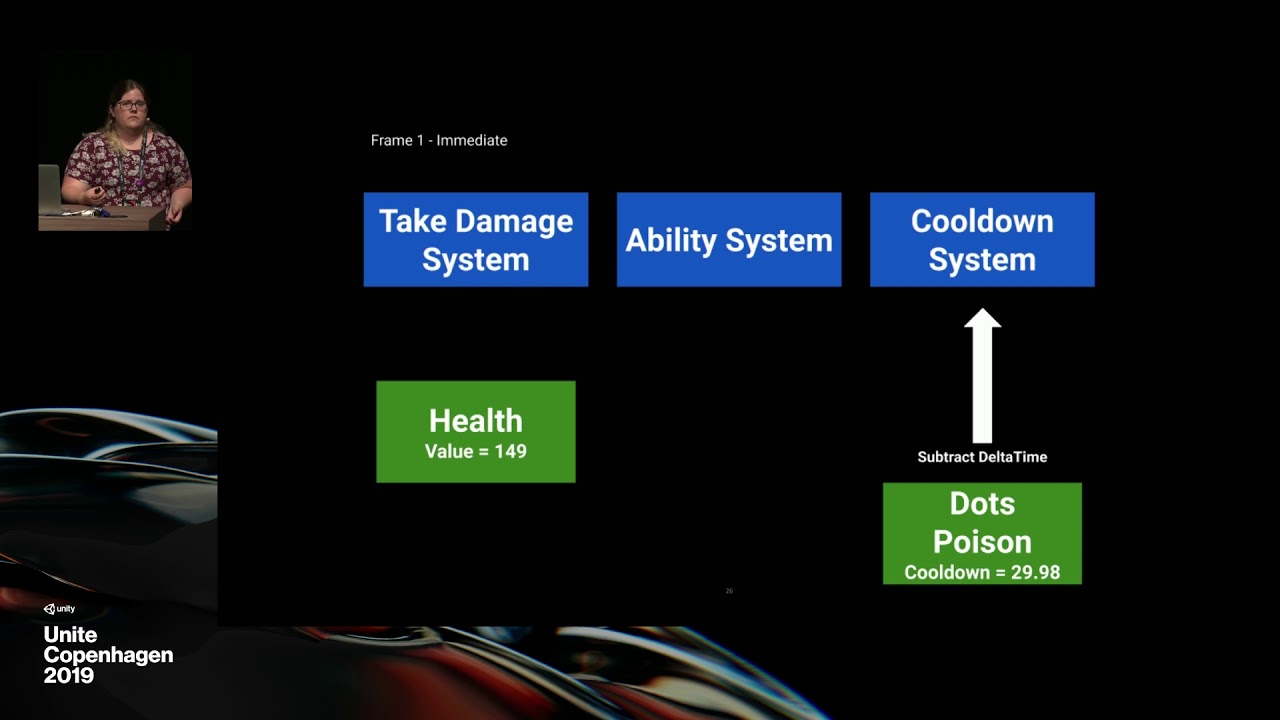
Not all gameplay needs to happen immediately. In fact, there are many cases in which deferring commands may offer a better outcome – improved user experience...

This session addresses how we are expanding the scope of the Burst Compiler to enable even the most demanding, hand-coded engine and gameplay problems to be ...

If you've heard about Burst but aren't sure how to start using it in your games, then this is the talk for you. The first part of this session is hands-on in...

This session gives an overview of the physics systems and workflows powering our Data-Oriented Technology Stack (DOTS). Get insight into design consideration...
coarse turtle
you probably want to do ```
var cannons = cannonsGroup.ToEntityArray(Allocator.TempJob, out var eDeps)
...
var jobShot = new ProcessInputJob { ... }.Schedule(this, JobHandle.CombineDependencies(jobMove, eDeps));
likely 4.7.x
compact hound
i was stuck with 3.5 😄
coarse turtle
its a just a short hand for stating
JobHandle eDeps;
var cannons = cannonsGroup.ToEntityArray(Allocator.TempJob, out eDeps)
 frosty holly
Anyone know if there are any world space UI text solutions for ECS even if they are quite experimental
I know that that Unity is working on the UI run-time coming out later and I have found a git repository that deals with screen space world UI. I was curious if anyone had any experience
neon shore
You're late with the videos today, 0lento. :P
coarse turtle
There is a DotsUI by supron https://forum.unity.com/threads/source-code-dotsui-open-source-ui-framework-for-dots.715880/

Unity Forum
This is the first release of the DOTS UI system (https://forum.unity.com/threads/showcase-pure-dots-ui-system-detailed-description-feedback.688531)....
the other way, which is what Im doing is interfacing with a scriptable render pass and projecting an orthographic plane to do my UI
 magic frigate
Is that last video supposed to be private?
 neon kraken
Hello, i want make an scriptable color on entity and i want know how i can pass my color (when i convert entity) to the mesh renderer
 warm yacht
you can grab the renderer of the object and set a new color normally @neon kraken
if you get the Renderer component of the object, then you can access the ".material.color" API
neon kraken
i can get the component MeshRenderer in Convert method ?
warm yacht
Oh sorry, dunno why i answered in dots. For ECS i don't know
mint iron
@neon kraken make a component with a Color field inside and add it during conversion. If you want to apply it to a RenderMesh:
var mesh = EntityManager.GetSharedComponentData<RenderMesh>(entity);
if (mesh.material.HasProperty("_Vector1_Opacity"))
{
    var material = new Material(mesh.material);
    material.SetFloat("_Vector1_Opacity", 0.5f);
    mesh.material = material;
    EntityManager.SetSharedComponentData(entity, mesh);
}
They don't yet support something like a MaterialPropertyBlock so you have to replace the mesh.
neon kraken
@mint iron ok but on Convert method i doesn't have RenderMesh 😦
 dire frigate
Is the new physics authorative body deterministic in terms of movement?
mint iron
@neon kraken that sounds plausible 🙂 i'm not sure if the default components are converted before or after IConvertGameObjectToEntity scripts. I would store the color on an entity then make a system that can apply it in update when its needed.
compact hound
Is it worth doing JobSystem for every thing? Or for systems that operates on small amount of entities better do normal one?
 mystic mountain
@compact hound Normal as in ComponentSystem with Entities.ForEach?
I would imagine it's faster with JobSystem as you can schedule all jobs with dependencies and let the workers do their job without have to wait between JobSystem and ComponentSystem, (Not actually sure if this creates sync points?), you will also be able to have smaller jobs in parallel.
pliant pike
I'm kind of curious about that, is it worth creating a job that works on a single entity say every half a second, or just keeping that to the main thread 🤔
mystic mountain
I mean are you talking about something that has a heavy execution load, or you intend to have multiple instances of this pattern?
compact hound
I mean something like system which handles shot input. I dont know process max 20 entites?
I curious also If Its worth to Creat job for this
Not much data and not much execution time
pliant pike
yeah mine is simple really light calculations for each entity, I might batch them all into say a group of 100, and have them precalculating and then throw away any excess when called by another system
or just calculate each individual as and when because the total sum have to keep roughly timed to another system
slow epoch
How does a large project with a lot of different Archetypes grow in terms of performance?
mint iron
They've said they intend to have it scale well into the thousands of systems, i don't think its quite there yet.
Archetype performance is linked to the number of components it contains. More components is worse for performance of Add/Remove/GetComponent methods.
Which is because each component type could be organized in a different order between chunks. e.g. one chunk has just a Translation, another chunk has Translation+Rotation, and you do a ForEach<Translation>, it returns chunks for two different archetypes.
So it can't know in advance the offset or index within that specific chunk for a component type, and so it looks through them all.
Lots of loops within loops and its going to multiply with more component types.
slow epoch
Yeah that was my concern
So having different Archetypes will be worse for performance
More archetypes = more chunks
 vagrant surge
if you have 1 entity per chunk, the performance is harmed but still similar to what monobehaviors are
and that is worst case scenario
i did benchmarks in my own unity-style ECS by creating 1024 different archetypes
and querying stuff on them
slow epoch
But that chunk has occupies more than a MonoBehaviour right?
slow epoch
Yeah that's right
vagrant surge
they also want to improve memory usage. At the moment all chunks are 16k
so minimum is 16kb
its possible to make stuff like 4kb memory chunks
slow epoch
I suppose if i'm gonna need a lot of different archetypes to notice that
vagrant surge
1024 archetypes in my benchmarking and it wasnt an issue at all
slow epoch
1024 as 1024 different components or just some components mixed to make 1024 archetypes
vagrant surge
(not exactly the same as unity, but a very similar chunked memory model)
10 components mixed completely rng
creating 2^10 combinations
vagrant surge
nope
they are the same
unity ECS doesnt care about the "order"
it orders stuff by itself
so did mine (in mine i order components by their hash)
slow epoch
Yeah i know but i'm talking about your test
Oh okay but then it is not 2^10
(I think)
And if it's mixed randomly i suppose some of them would be repeated
tawdry tree
Your point is that for the purposes of the combinatororsomething, you don't care about order, just unique combinations
tawdry tree
That's be 2^10, yeah
vagrant surge
so 2^10 different archetypes
slow epoch
Okay i got it with the bitfield
vagrant surge
i did it with a 50% chance at each comp to get it or not
so i had to move some pretty seriously huge numbers of entities, i did it on stuff like half a million
slow epoch
Well it's really scary the amount of archetypes you can do with that few components
vagrant surge
and then i could test matching different combinations. For example trying to match 8 out of 10 components would be pretty rare
not in a real project
slow epoch
So it should always work from archetypes instead of adding the components manually
vagrant surge
yes, that allways
you should allways do an archetype switch (not sure if unity ecs has it?) instead of doing add component multiple times
so you do the heavy cost at once
slow epoch
Yeah that would be the way to go
vagrant surge
adding/removing components in unity ecs (and mine) is about the same cost as removing one entity AND creating a new one
because after all that is exactly what the model is doing, just with some copying in the middle
slow epoch
Well then is not a good practice to use Components as flags
As unity does in their videos
vagrant surge
it really depends
of the ratio beetween "times you iterate" and "times you change state"
in an ECS like Entitas/Entt where adding/removing components is crazy cheap, state components are a good idea
in unity ECS, adding/removing will need a thread sync point, and its much more expensive
slow epoch
I supouse ECS has a long way for now
vagrant surge
for stuff like "Dead"? good idea to use it as a component
as far you only set it once and it significantly changes things
for things like "ReceivedDamage" (refreshed every frame)... hell no
tho in my experiments i did culling by adding/removing a Culled component
and i could handle 400.000 in 1-2 miliseconds
and it also depends on how "fat" your entity is
if you have a Player entity with 20 components, PLEASE dont add/remove anything from it
if you want a state machine on the player, you could have it on a smaller entity that points to parent (but loses a bit of perf)
 remote coyote
New entities release planned for next week! https://forum.unity.com/threads/dots-multiplayer-synchronization-lags.757415/#post-5052425

Unity Forum
Hi there,
I testing around with the new dots multiplayer tech stack from github. So I took the Astroids sample from github and try to implement my own...
tawdry tree
Anyone else having an issue where opening a link to the Unity forums (from bookmarks, search engine, or linked like above) takes you to an error page about unique usernames with an URL starting with https://forum.unity.com/register/genesis?code=?
Closing that tab and retrying works.
remote coyote
Weird, I don't have that
tawdry tree
More like, probably weird that I do.
I should probably report it...
slow epoch
Okay on what scenarios should i make different worlds?
I've seen people doing it for procedural generation
vagrant surge
worlds have completely separated multithread models. I think there is a way to move stuff from one world to another
so one use is to have background threads doing loading into a "background" world, and once stuff is loaded, copy the entire chunks directly into the main world
in a similar fashion, ive seen a "unactivated" world being done sometimes. Instead of deleting entities temporarely, have them moved into a background world where there is no code running, until you move them back into the real world
slow epoch
There is no docs about how moving entities from world to world?
That could be really useful also for stuff like saving games
Also i've seen people using it as regular scenes
Which i sure hope it's not the same in any way
But that makes me think if we have any way to load different levels that have entities
vagrant surge
why save games? but the scene case is legit
not in unity, but one of the things ive done is to have one world per level
including main menu
so when you load the main menu, thats one world
and then the load screen is on that world, but a second world is being loaded for the level itself
and then you just switch execution into the other world
compact hound
interesting
vagrant surge
i think unity physics also has its own internal world
for physical state
it has its own entities and physics shapes and stuff, and the "game" world is a different one
tawdry tree
Move/copy everything you want into a "save" world and run a system that serializes literally everything?`
I seem to remember a talk which used some world-magic with deterministic physics to enable you to rewind time and stuff. IIRC the world was to 'save' a snapshot, though I don't remember why.
vagrant surge
thats the overwatch ecs talk
and yeah, they do exactly that
they create backups of the entire world state for every frame
for the last 10 frames or something
compact hound
Enjoy the videos and music you love, upload original content, and share it all with friends, family, and the world on YouTube.
compact hound
How to get world position from entity that have parent component? I need to iterate all its parents?
compact hound
Ok get it to work 😄
slow epoch
Best way for a component to reference another entity's component?
For example to mimic the positions
mint iron
I'm aware of only two ways, 1) store the Entity of the other and use it to look up the position and copy it 2) lock the chunks involved and store a pointer directly to it (probably not a safe idea)
slow epoch
Oh so directly storing the Entity?
For some reason i thought that was a bad idea and it would be more complicated
mint iron
yeah its the primary way relationships are done. The default conversions do parent/child this way - storing a list of Entity. The entity Id never changes so you can rely on it and even if the entity is removed you can just check with EntityManager.Exists(Entity)
 crystal zephyr
And getting data from the related entity you can use in a componentSystem GetComponentData<Type>(entity)
or in a job with GetComponentDataFromEntity<MyType>(true);
slow epoch
What's the difference between one and the other?
crystal zephyr
GetComponentDataFromEntity<MyType>(true) gives you a lookup data structure which you can pass a job and then you a receive the component by entity. (lookup[entity])
slow epoch
But why not using that for everything then?
 amber flicker
Because doing so is essentially random access - sometimes that's just needed but the idea behind e.g. IJobForEach<X> is you iterate everything with linear access
slow epoch
Yeah sorry i think i've not explained myself properly. I mean why using GetComponentData over GetComponentDataFromEntity if the second one works everywhere and the first one does not
amber flicker
hmm.. for the reason I just described... when you do e.g. (CDFE) allTranslations[entity] that is rand access - when you do IJobForEach<Translation>... translation[i], that's linear (so faster)
slow epoch
But on IJobForEach<Translation> you don't need to use GetComponentData
It already gives you the component
I feel like i'm missing something here
amber flicker
yea, it's hard to guess what you're missing tbh... you could think of IJobForEach doing GetComponentData behind the scenes if that helps?
I'd recommend writing a couple of IJobChunk's if you haven't yet. It makes it much clearer what all the other IJob...'s are doing.
slow epoch
I mean i need one particular component from one entity and i know i can use GetComponentData and GetComponentDataFromEntity to get it
But both feel like doing the same
amber flicker
imagine you have IJobForEach<Translation,Bob> - you will have a chunk (or multiple) of linear memory of all the entities that have both those components. The execute method is iterating over the entities in that chunk. One by one, getting the next entity linearly in memory. When you use e.g. allTranslations = GetComponentDataFromEntity<Translation>() then do allTranslations[someEntity], you are leaving the linear memory layout of the chunk to go and look through all entities with a translation component
So if entity 1 has Translation & Bob but entity 2 has Translation & Sally, the job won't iterate Sally (because it requires Bob) and the only way you could get the Translation of entity 2 would be to use ComponentDataFromEntity
slow epoch
Okay i think i got it now actually
I really hope that ecs documentation could be a bit more detailed about stuff like this
crystal zephyr
I would always prefer this IJobForEach<Translation>... translation[i].
But I thought it was the problem that a component in your query is just linking to an other entity.
For example you have a Parent component which hold the Entity. So if you have a query for all parents you can access the parent component like parents[i]. But if you want to have the translation of this parent you need a dynamic lookup like allTranslations[parent.Entity].
amber flicker
yea the docs are actually a lot better than before (see pinned msgs if you haven't already) but it certainly isn't easy to just pick up straight away. If you managed to follow my rough paragraph above, you got this 👍
pliant pike
this is a good talk that explains Componentdatafromentity

Interaction is fundamental in games, both in how players interact with a game and receive responses, and in how parts of the game interact with one another. ...
 stuck hatch
Hello, I want to move data from ECS into my domain layer. For Example, I have a character who walks to a target position, if he reaches it, I want to signal my application, how can I achieve this?
I already thought about making a system, that checks distance to target but how reference Objects outside of ecs without using singleton?
pliant pike
maybe create an entity when the target is reached or add a component to another entity?
stuck hatch
I dont think that this would help me
pliant pike
personally I'm using an int which is normally used to iterate and move entity's through the waypoints, I can then check that value in other jobs or whatever to see if its the max value in which I destroy the entity, or if its any other value I can count them
stuck hatch
Sounds like ECS walks into my domain layer
pliant pike
there's lots of way of doing it, I'm not sure why would adding a tag component not work?
stuck hatch
Well, I am coming from a MVC project structure and until now, I though about ECS like view-data. But right now I think it is mixed. Example: An Entity can have both components. Something that moves and something that represents metadata like a car components describing the brand and color. you know what I mean?
I always seperated them
pliant pike
not sure, its all data either way
slow epoch
If adding and removing components from entities is that much of a problem for performance, i hope they come up with a solution in the future
 candid bough
lol whole idea of dots is to not move stuff around in memory; changing components makes the system have to
is it safe to ask a question or are you guys discussing something
pliant pike
I think they've said or the general rule is just to use a boolean if you have lots of entity's and want it to be really performant
slow epoch
Well the talks are constantly saying using Components as Tags and adding and removing them constantly
candid bough
https://i.imgur.com/HT8YPX0.png
i copied the code 1:1 from the sample to my new project, using a simple cube for both, where could this huge difference in performance and batches come from, does anyone have an idea
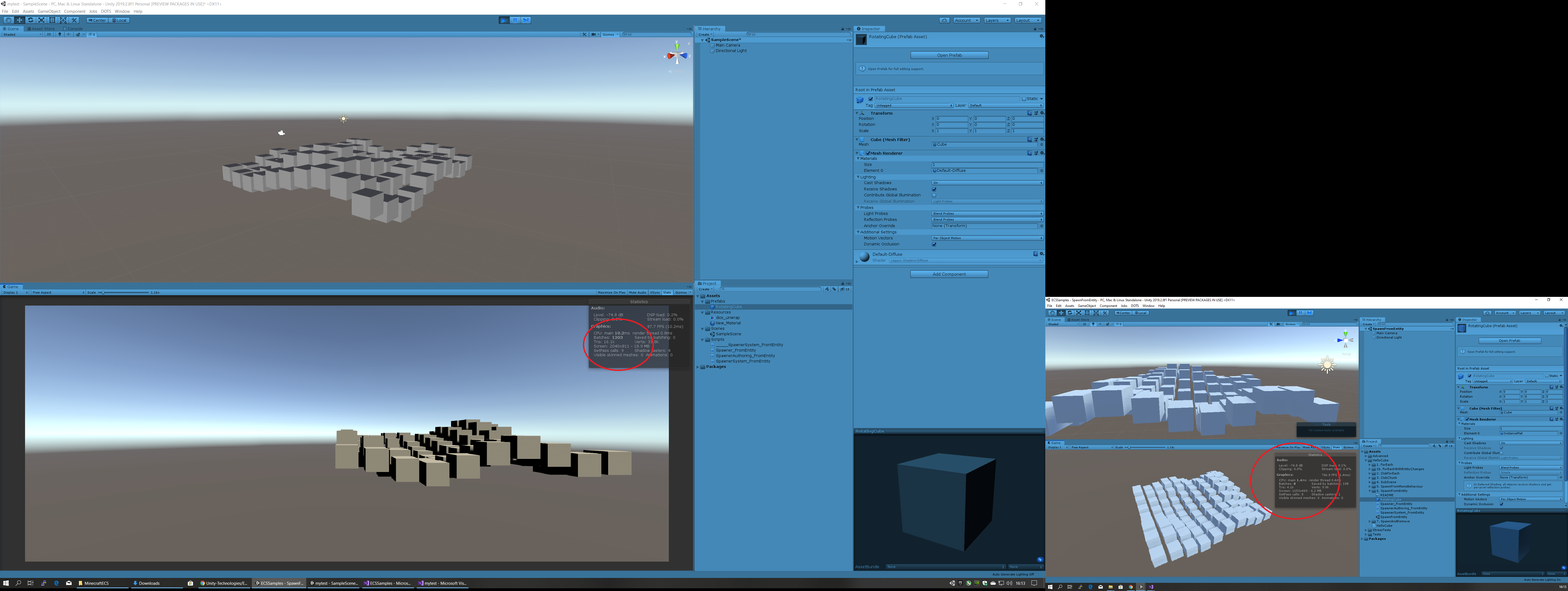
i doublechecked packages, im using the same versions etc
pliant pike
I'm not an expert or anything but it seems like you have a lot more entity's or geometry
pliant pike
your tris are 16.1k the example is 4.1k
candid bough
i just doublechecked and there are 201 entities vs 101
that's weird
pliant pike
maybe duplicate code somewhere or to many iterations
candid bough
i copy pasta'd the code 1:1
so i'll have to check where they are coming from lol
good tip tho
well that was dumb
i still had another system .cs which autoran
better but still
'saved by batching'
it seems that it somehow optimizes the sample project but doesnt for mine
crazy
turns out it was the material i used for my cube
so much to get the batches down but still a factor 10 less in fps
sneaky little bees
they tweaked quality settings etc
coarse turtle
https://gametorrahod.com/tag-component/ I think this blog is a good read on tag components instead of checking for bools

Game Torrahod
Tag component or "zero-sized component" is a special case in Unity ECS where IComponentData doesn't contain any field. The use is to intentionally separate entities to more chunks because a chunk is defined by one set of archetype.
vagrant surge
very important detail on tag components
when combined with manual chunk iteration, they get crazy powerful
because you can do branching on a chunk level
slow epoch
Okay that blog about tags is super helpful
Didn't know about the problems with If and Burst Compiler
coarse turtle
branch statements always have complexity on the compiler 😉
and yea @vagrant surge that's a very important detail about chunk iterations w/ tags 🙂
vagrant surge
@slow epoch no need to worry so much about the IFs
but yeah branchless gets optimized better and runs faster
tho it goes straight into microptimization territory
tawdry tree
Hello!
In order to provide 'HElp', pleas expand your query.
tawdry tree
Jokes aside, this is the place for that, so just write what you're trying to accomplish and what's not working
 zenith drum
inside other ecs class
Any ideas????
I just want to run Execute command in other class from other class
Is it possible
First i will say
tawdry tree
Might I suggest the usual programming best pratcice of extracting shared code to some mutually accessible class?
This could be done with inheritance (Ie. job A and job B both inherits from JobCWithExecute)
This could potentially be done with a static function both of them can access.
Or you could hvae duplicated code (genrally considered not-so-good)
gusty comet
For some reason I keep getting warnings like gnoring invalid [UpdateBefore] attribute on System1 because System2 belongs to a different ComponentSystemGroup. even though System1 and System2 both have the same ComponentSystemGroup specified in UpdateInGroup
tawdry tree
Have you checked that's actually the case, in the entity debugger?
Could be some black magic causing oddities
gusty comet
Did a few things and it went away, reverted those changes to the way it was (when I was getting the warnings) and now I'm still not getting the warnings. How weird
was trying to reproduce/confirm the fix 🙄
tawdry tree
Restarting the editor has a tendency to randomly fix random problems, too.
It should probably be item #3 or #4 on your "how do fix ECS" list (when it's not just clearly your code that's broken, anyway)
gusty comet
I can't be upset or anything, I'm using the alpha version anyways 😄
You're right in that restarting the editor helps alot, but I try to find fixes for bugs (or ways to avoid the same bug in the future) too
 torpid panther
I'm just starting to learn the specifics of DOTS, and I know it has a long way to go before the entire engine is rewritten for DOTS, but I really hope there is a lot of work put into making it beginner friendly, especially if it's the future and meant to replace monobehavior eventually. Right now is seems hard for someone in 10-15 years to pickup Unity and get a box moving around a screen easily.
gusty comet
To learn it I watched some videos (udc, gdc, tutorials) and took notes (~150k characters so far 😅 ) on every documentation page I could find about it. I'm still probably only 25% through all the links I've gathered
compact hound
ye i feel like I'm learning programming from the beginning xd
coarse turtle
Sweet I finally got my dots based controller UI working 🙂
compact hound
what is the best way to communicate UI <--> DOTS?
slow epoch
What should i do to make a camera movement system since the camera cannot be converted to entity yet
coarse turtle
A camera can be injected into an entity using ConvertAndInjectOriginal
that's the current work around and you can access the camera's xform and settings to start moving it around
@compact hound no ideal way atm
uGUI doesn't really scale and relies heavily on monobehaviours, you could try representing a 'fake button entity' with an ID and on click you just query for the button ID and set the value to true in a MonoBehaviour's function call
and at the end of the frame, unset the value to false if you want specifically a button press
UIElements for runtime should be coming in late 2020, and it might have dots support
¯_(ツ)_/¯
tawdry tree
@compact hound You can access the entitymanager from monobehaviors, so the button could create an event entity, or set values on an entity. Not entirely optimal, but should work fine; UI stuff doesn't happen all that often (unless you hook up some every-frame stuff, I guess. Still low volume)
That would be the 'write relationship mentioned in the video Calabi linked to above (Options for Entity interaction - Unite Copenhagen), and the video also mentions (but does not detail) entitymanager from mono.
compact hound
And how UI should react based on DOTS like hp bar?
gusty comet
If a gameobject has its mesh filter/renderer on a child object, and that gameobject is converted via convert & inject gameobject - does that mean it won't have a LocalToWorld?
seems like the child object has it, but not the parent
compact hound
every entity have it
with translation/rotation
is there a way of doing it in jobsystem?
https://github.com/Unity-Technologies/EntityComponentSystemSamples/blob/master/ECSSamples/Assets/Advanced/Boids/Scripts/SpawnRandomInSphereSystem.cs
GitHub
Contribute to Unity-Technologies/EntityComponentSystemSamples development by creating an account on GitHub.
gusty comet
I'm looking at it in the entity debugger and don't see a LocalToWorld (in the inspector when I select it)
but the child has a LocalToWorld 🤷
So strange, oh well I'll figure something out
huh, I'm getting InvalidCastException: Specified cast is not valid. when I select the entity I'm talking about - that's why the inspector isn't showing some of its components I suppose
Ah figured it out, had to remove the collider (there are unsupported datatypes which break the inspector when inspecting an entity)
coarse turtle
@compact hound if you wanted an HP bar, all you would really need is your normalised health between [0, 1] and find which health you want to apply on your image
Let's say we converted we injected an image to an entity with an ID (a custom component) of 0 and similarly we have another entity with the <Health, ID> components
we can build a map from player entity -> image entity, normalise the health and apply it to the image's fill amt
compact hound
but who should tell ui to update? just system?
coarse turtle
you can have a system do it
preferably I would do that to try and keep the logic in the ECS ecosystem
buttons are a whole diff story
 rugged wagon
I'm running into an issue where C# doesn't know how to differentiate between the quaternion struct and method. I have this at the top of my code:
using Unity.Mathematics;
using static Unity.Mathematics.math;
The using static lets me access all the methods within Unity.Mathematics.math without having to type math.
It makes my code look like this:
var point = mul(meshToAxis, float4(vertices[index], 1f));
instead of
var point = math.mul(meshToAxis, math.float4(vertices[index], 1f));
However this is preventing me from accessing the quaternion struct because it thinks I'm calling the quaternion method.
var rotation = quaternion.LookRotation(position - cameraPosition, cameraUp);
This code here ^ throws an error because it wants quaternion(float, float, float) not quaternion.LookRotation
Removing the using static fixes this, but I have to put math. at the beginning of everything. Is there a way to get the best of both worlds and have the succinct math methods while still being able to access static methods from the encapsulated structs?
tawdry tree
Use an alias
using ALIAS = Full.Namespace.To.Class
then access the class via the alias
ALIAS.StaticMethod()
var foo = new ALIAS()
Check the official C# docs if you wanna delve into that
rugged wagon
Thanks @tawdry tree! That looks like exactly what I need
compact hound
i think this makes code less readable
rugged wagon
Ideally c# would know I'm referencing the struct because quaternion is followed by a dot instead of parentheses, but I rarely need the *structs static methods so this is fine every once in a while
Unless you're talking about not having to prepend every math method with math. in which case I'd have to disagree with ya
Looks just like shader code!
@tawdry tree Idk if this is specifically what you were suggesting, but I can actually force c# to recognize quaternion as a struct and not a method by doing
using quaternion = Unity.Mathematics.quaternion;
Kinda sucks because I can't create a quaternion via the quaternion method but:
- I never need to assign the components of a quaternion directly - I just create them from utility methods like
LookRotation - If I need to I can still use the constructor
var r = new quaternion();
Actually nevermind with using quaternion = Unity.Mathematics.quaternion; I can now do
quaternion.LookRotation(forward, up) and quaternion(0f, 0f, 0f, 1f);
that's so weird that it can differentiate after the using statement instead of flip-flopping whether it expects a struct or method
 wispy walrus
are the intrinsics and assembler style math available in the unity alpha yet?
compact hound
What CommandBuffer should i use to apply changes after system update, like to precess shot command in next system in same frame
tawdry tree
@compact hound Did you see the "Options for entity interaction" Unite talk?
It talks about how to 'communicate' between entities (very useful, made a few things 'click' for me), and a bit about ordering (which would let you make it happen in the same frame). There's an illustration of the default system groups and their ECBs around 31:30
https://www.youtube.com/watch?v=KuGRkC6wzMY
Interaction is fundamental in games, both in how players interact with a game and receive responses, and in how parts of the game interact with one another. ...
compact hound
@tawdry tree ye i actually was there but back then i haven't tried DOTS by my self yet 😄 You are talking about this adding and removing tag in the same system?
I would need few of of such ECM that will resolve after system update. But this talk don't cover this topic.
And passing do job ComponentDataFromEntity like LocalToWorld component isn't too heavy?
tawdry tree
It talks about communicating between entities, and by extension, systems.
What CommandBuffer should i use to apply changes after system update, like to precess shot command in next system in same frame
By this it sounds like you wanted to hook up some input (player or otherwise) to something you want to happen. That's exactly what the talk is about.
Though I'm not entirely sure if I understand what you're trying to achieve. Care to elaborate?
What systems are doing what to what entities?
compact hound
Input add Tag to player entity
InputSystem process that tags and for eg. tells player to shot
ShootingSystem take specific player weapon nat tell it to spawn projectile
SpawnProjectileSystem ....
I think it takes 3-4 loops to actually spawn bullet
tawdry tree
So in short:
Player input->player shoot?
If it already works for you, but the issue is that it takes multiple frames, you should be able to make it take less frames (possibly just one) by using [UpdateBefore(otherSystem)] [UpdateAfter(otherSystem)] and the ECBs as illustrated in that talk. The input should probably be in the InitializationSystemGroup, and for the stuff after that, use Before and After on the ECBs
compact hound
yes im using UpdateAfter attributes but every system is in simulation group (shooting,spawning) and I'm using BeginInitializationEntityCommandBufferSystem
i probably would need ECB between shooting and spawning system
To SpawnProjectileCommand (Compnent tag) was already created
tawdry tree
If you put ALL of them in that ECB, then the commands aren't executed yet
For any entity command, you need anything dependent on the effect to run AFTER the ECB
mint iron
Does it matter if they’re a few frames behind? I guess If it’s a fast paced FPS maybe you’d notice 1/6 or 1/12 of a second.
You could put some of the systems in initialization, late or render group. Or add your own groups to simulation group and setup your own ECB start/end within it.
 frosty siren
I'm trying to understand ConvertToEntity workflow. Is it only for Pure ECS?
compact hound
@frosty siren its for doing all stuff still in editor like prefabs, scenes then convert all those objects to entites
You will see all those objects will disappear from scenes on play (when they are converted)
mint iron
Yeah it produces pure ecs stuff. So you setup your scene in editor then when game starts, from that point on you work with the entity/component version of it.
tawdry tree
You can still use gameobject, too. Anything you haven't created conversion for will stay as GOs
mint iron
It’s also super useful for converting go prefabs into entity prefabs. I can’t imagine spawning complicated/real object structures manually - especially if physics is involved- without entity conversion. it would be a huge waste of time.
compact hound
@mint iron this few frames matters, i see that i cannot spawn bullets as fast as i could
 modest reef
Hey so how do I remove the child safety lock on the job system? So that I can use an instance of a class in the job system? FYI my stuff is thread safe so don't tell me its so that I can't run unsafe thread stuff.
tawdry tree
The video I just linked mentions it, something about allow unsafe or something? Anyone know the exact attribute? (it goes on a particular variable/parameter)
mint iron
@compact hound I’d put input system in initialization group. Add an EarlySyncGroup at the start of simulation (or end of initialization if you have trouble ordering it) since creating the bullets will cause all other jobs to complete and I would just use the bulk instantiate overload rather than ECB if possible. Then your movement system can update bullet position before rendering hits and it should all work in one frame.
compact hound
Its better to have IBufferElementData that stores some list like child or better to have nativearray in component (for eg. for list of bulletspawners) NativeArray may be better because this data wont change its size?
@mint iron can you tell more about build instantiate and early sync group?
mint iron
Im away from my pc until Monday if you’re still blocked I can post some examples then.
Essentially I’m not using ECB since right now it’s pointless. (I’m hopeful next weeks entities release will introduce structural changes in burst to change that). But anyway, the idea is that you do all your add/remove entities/components at the start or end of simulation group. Then in the middle you allow all your jobs to run side by side for as long as possible without getting interrupted.
Bulk instantiate means to pass in a NativeArray to EntityManager.Instantiate and it just allocates all of them in one go which is light years faster than doing it one by one.
compact hound
@mint iron what about my other 2 questions?
- Its better to have IBufferElementData that stores some list like child or better to have nativearray in component (for eg. for list of bulletspawners) NativeArray may be better because this data wont change its size?
- Passing do job ComponentDataFromEntity like LocalToWorld component isn't too heavy? (many entities)
tawdry tree
I fail to parse the last of those two... Passing components to ComponentDataFromEntity? As for heavy or not.... try! Run basic profiling and see if there's any red flags. Know roughly the volume of changes you'll make. The video above also mentions the perf impact of the two interactions they explain.
gusty comet
Does anyone know if it is worth to code a player controller using DOTS? or this something that is better done using regular object orientated programming with Monobehaviour classes.
frosty siren
@mint iron , @compact hound so if i need some MonoBehaviour like SkinnedMesh and animation and i want compute some data with ECS way (which is Hybrid approach) i need to use GameObjectEntity?
tawdry tree
@gusty comet If you're using primarily ECS, then I'd say yes. If you're already mixing mono and ECS, then maybe.
At any rate, you can do it as easily as in monobehaviors, just make a 'PlayerInputSystem : IJobForEach<Player, OtherRelevantComponent(s)>' which checks for input and does the thing(s). Can have multiple, too, to be closer to ECS best practice/standards: PlayerMoveSystem, PlayerShootSystem, etc.
frosty siren
Sorry for against dumb questions from me, I just never went the Hybrid way
gusty comet
@tawdry tree I'm contemplating whether to go fully ECS or a hybrid of Mono + ECS.
I'm just worried if there's anything which ECS would make harder than it has to be or doesn't support something I'll need that will end up forcing a hybrid approach?
tawdry tree
My tip there would be that unless you'reconverting an existing project, it's probably easier to go as pure as possible, unless you have something completely sectioned off (not interacting with the other side).
Some things are a lot easier to do in mono-world, though.
What kind of project are you working on? There are a few core components (animation is one, I believe) that isn't DOTS ready yet, but if you don't need any of those...
Or tl;dr: Do ECS where you can. If you don't think you can, investigate (ask here) before falling back to mono.
gusty comet
@tawdry tree I want to make a game with a procedural world and where the player navigates it using a first person controller. I've done some research and it seems doable mainly using ECS but the animations part is what I think will require a hybrid approach.
 shut siren
personally I would assume that some degree of hybrid is inevitable for many projects right now, althouh I also understand the attraction of being able to do it all in a pure ECS world, and why some developers want to explore that pure world (which is much easier to do if you have the luxury of being able to not use all sorts of Unity systems that are not ECS ready yet)
tawdry tree
So fully rigged 3D models? Is that core to the experience? What if you don't have it? Have you considered alternatives? Are they good? Bad?
I'm not trying to make you change your mind here, but if you look at the history of games, working with limitations has created some of the best remembered games out there.
Point is, if you can achieve your goal and make things easier for yourself... why not?
shut siren
as for ECS making some things harder, this is really a question about the developers own knowledge, understanding, confidence etc in data oriented design and the way Unity is doing it. Plus things liek the fact that this stuff is still immature and evolving, so we are chasing a moving target more at the moment.
tawdry tree
Another thing is when these things come out. I think animation is in the near future(a month? Months?), but haven't been paying much attention to it in particular, and most time estimates are really fuzzy right now. Could you work without it for now, then add it later? That's one of ECS' strengths, after all, a strong separation of concerns and extremely low coupling.
shut siren
Another way that ECS may 'make things harder' is if the developer never really considered performance, optimised code, etc in the past with the old systems. The benefits of ECS & DOTS obviously require those designing and developing the game and its systems to embrace performance-focussed ways of thinking about your game and its data, and if this stuff is a new concept, it will seem harder than the old ways
tawdry tree
True, with monobehaviors it's a lot easier to do something 'brainlessly', just make something that (barely?) works. Of course, that's great for prototyping, but code has a tendency to stick around, even when it's long past it's best before date.
gusty comet
@tawdry tree @shut siren You both make very compelling point and I think ECS seems to be the best way to go as I can do without animations for the moment and after seeing some of the Unite Copenhagen talks on DOTS it seems super easy to add things it when they do become available (e.g. animations). Also seems like all the core things I'd need for everything else.
Plus making it well using DOTS would allow me to really think this through and use this system in all my new projects.
shut siren
I waited till this stage before starting my own DOTS journey because I wanted certain things to be in place so I could try the pure approach, and I was hoping for less boilerplate code and it looks like I got my wish
but to be honest, since they've decided not to try some kind of pure entity authoring approach, and instead to keep gameobjects etc for the authoring side, and focus on conversion of that stuff to the runtime entity world instead, the question of purity, hybrids, forgetting about monobehaviours etc reduces in importance to me.
I expect to be working in both worlds for years to come, so I'm not going to worry about whether a particualr project will end up a hybid or not
the important thing is to learn where to use new DOTS stuff where performance actually matters to your project
and how to think about everything in game systems design from a data oriented approach
tawdry tree
From the very beginning (of looking at ECS) my goal was only ever to learn the concept, the basic principles, and to keep up with development, but after watching a bunch of the Unite ECS talks and having a couple more things 'click', so I feel like if I am to make anything in Unity soon, it will be in ECS.
Well, as you say they do authoring at least in monoBehavior, so it's not like I'm never gonna touch that. But it would be for actual prototype code, dev/debug stuff, and of course, authoring
gusty comet
Yeah some of the developer case study like talks seem to have been using Monobehaviour and applied ECS to things which seems to hinder performance such as spawning a huge zombie hoard and the rest doesn't really matter or is up-to personal preferences which way you go about implementing.
mint iron
If you try to go as pure as possible you end up hitting things like UI, animation, sound, cameras and addressables etc - broader aspects of making a complete game. And many of those have to be in monobehavior world still with some kind of custom interop you cook up to make it work together with the ecs side. You can’t make purely pure right now really.
 shrewd night
Hello everyone! Just found out about the discord channel 🙂 I've been playing with the DOTS stack for a bit now and have a pretty good general understanding, however I can't figure out how to make a game that uses the new Unity Physics module to run the same on different devices. I really don't know where to involve the deltaTime, if it's needed or not. Maybe someone can point a relevant sample or some sites where I can learn more about this.
on the forums, under unity physics, my post with this questions is the last post made there... maybe if someone knows more about this they can give a helping hand 🙂
frosty siren
Why i have 0 entities at all but BuildPhysicsWorld takes 0,4~0,5ms?
neon shore
Basic call overhead?
gusty comet
Hello! Could anyone explain to me please how I would be able to delete an entity? I'm currently cycling through the entity list with ForEach loop, which doesn't allow me to get the entity so that I could delete it with "EntityManager.DestroyEntity(instance);" found here: https://docs.unity3d.com/Packages/com.unity.entities@0.0/manual/entity_manager.html
The entities are instanced in a spawner script that uses native array and Allocator.Temp
My goal is to delete an entity that runs out of "hp". Currently the ForEach loop manages the locations of entities and the hp values.
I would really appreciate any help! I've managed to overcome and avoid all the other obstacles so far but this one is just a great source of frustration for me. Thanks!
shrewd night
@gusty comet you could check the sample at https://github.com/Unity-Technologies/EntityComponentSystemSamples/tree/master/ECSSamples/Assets/HelloCube/7. SpawnAndRemove and go from there
GitHub
Contribute to Unity-Technologies/EntityComponentSystemSamples development by creating an account on GitHub.
gusty comet
Ohh, thanks alot! Haven't been able to land there yet!
shrewd night
there are good examples for basic usage there; make sure you check the readme.md files; good luck! 😄
gusty comet
I will, thanks again! 🙂
shrewd night
welcome
 round roost
Hi, I've been playing quite a lot with DOTS recently and been making simple zombie shooter. Everything works fine, but what's the easiest way to show damage numbers above the enemy when bullet hits? Basically I would like to use tmpro and show the number above enemy head few secs
neon shore
I'd create a separate entity and give that components to show the text and for destroying it over time etc. on hit
 dry dune
Hi, I'm trying to make a custom BinaryReader that can read from byte[], but i'm new to unsafe side of c#, am I doing it right?
public unsafe class ByteArrayReader : BinaryReader{
  private byte* ptr;

  public ByteArrayReader(ref byte[] arr){
    fixed( byte* fixedBuffer = arr ){ // it's not 100% clear for me what this line does
      ptr = fixedBuffer;
    }
  }

  public void ReadBytes(void* data, int bytes){
    UnsafeUtility.MemCpy(data, ptr, bytes);
    ptr += bytes;
  }
  public void Dispose(){}
}```is it ok to fix the array i'm passing by ref ?
mint iron
@dry dune probably a good idea to check the msdn docs but fixed will prevent the managed object from moving during its scope. So the pointer it gives you is safe to use until you leave the fixed statement. Storing it as a field for later use would end badly because it’s almost certainly going to move. https://docs.microsoft.com/en-us/dotnet/csharp/language-reference/keywords/fixed-statement. You could pin it formally see GCHandel https://docs.microsoft.com/en-us/dotnet/api/system.runtime.interopservices.gchandle?view=netframework-4.8

Provides a way to access a managed object from unmanaged memory.
 limpid bough
The obvious question though is what is that code for? In light of the binary stream stuff they provide and native arrays, just curious what the use case even is for that
dry dune
what i'm trying to achieve is a jump-back-in-time mechanic for my ecs game
my goal is to serialize world to memory and to restore it to that state later
limpid bough
have you looked at using worlds for that?
I haven't played around with worlds but I've used their binary serialization stuff enough to know that they do have a good amount of existing code to serialize all things ECS
dry dune
yes "backup" world is what i was thinking first, but in my case i need many restore points
limpid bough
Ok might work fine, my gut instinct on it is still stay a bit higher level with containers. I think that should be easier and more performant because due to less copies
How much data are we talking about?
dry dune
@mint iron thank you, this is exactly what was i suspected, but how to fix it for longer period?
not that much few hundred small entities
maybe i need to serialize to NativeArray instead?
limpid bough
If it's not a ton of data you could just save the entities and components into native arrays. Then a restore would be destroy all entities and use the batch api to create new entities from your saved data. But worlds might make that easier I really don't know as I haven't used them.
Like it might be relatively simple to just create a world for each save point. I would at least investigate that because it seems to have the best potential of making this easier
dry dune
I'll try to use worlds, and also try to figure out how to serialize to persistent NativeArray
 potent cape
Hey last night i ran into an issue when trying to convert https://github.com/hecomi/UnityECSBoidsSimulation/blob/master/Assets/Boid-PureECS-Sample5-Burst/ComponentSystem.cs into a newer Entities version.
My version currently looks like this: https://codeshare.io/249vm8

GitHub
Simple Boids simulation example using Unity ECS. Contribute to hecomi/UnityECSBoidsSimulation development by creating an account on GitHub.
The issue is that it does update the system once and after it is listed as "Not run"
tawdry tree
Have you checked the entity debugger to make sure entities it would affect actually exist? Systems tend to turn off if they don't have anything to affect.
potent cape
oh yeah... forgot to add an component, you shouldn't do late night coding kids
Thanks @tawdry tree 😄
tawdry tree
Always check the entity debugger to make sure your entities are what you think they are!
I've burnt myself on that, and related 'system deactivates' issues, several times
potent cape
Well for sure this ended up in other issues, but i think i can resolve those 😛
potent cape
Well now im at a point where from inside Unity i get the error
InvalidOperationException: The previously scheduled job GatherEntitiesJob writes to the NativeArray GatherEntitiesJob.Data.Entities. You must call JobHandle.Complete() on the job GatherEntitiesJob, before you can deallocate the NativeArray safely.
So the GatherEntitesJob (which is one of unity) doesn't Dispose it's own native array?! 😅
stuck hatch
Hello, I just found out, that string are not allowed in componentData, is there a workaround to enable strings?
potent cape
no since strings are objects and not structs
I haven't tried, but maybe you can do a NativeArray<char>
i recommend before comparing all the letters if the size is unequal
potent cape
Oh there are strings by now? Didn't know 😮
stuck hatch
yeah just found it, but NativeString64 produces weird result
The "C" is gone
even more weird, the last letter changes every frame
stuck hatch
for 3 chars?
potent cape
yeah it should be... i guess
stuck hatch
Unity quote "NativeString64 - consumes 64 bytes (one line) of memory. suitable for short names and descriptions."
NativeString512 - consumes 512 bytes (eight lines) of memory. can hold a few lines of text, a filename, a URL.
Well NativeString512 gives at least the same result only "AB" never with "C".
potent cape
I just tried it. When you debug.log it it gets converted back to ABC
or in my case 123
Maybe the debugger is weirded out by NativeArrays 😄
or better NativeStrings
stuck hatch
ok, debug.log works so it's riders fault
potent cape
It's the same in visual studio code. Probably an issue that the debugger doesn't know how to handle the new data layouting
stuck hatch
one more question, I am thinking about a software design with ecs, but I am struggling with either go the full ecs way and do everthing with or to use a hybrid between ecs and classic approach. But on hybrid, how can I reference back objects from ecs? Do I have to use some kind of Ids and dictionaries?
potent cape
Umm i personally handle it by having a double representation of the gameobject in the entity world
And the GameObject still has the Entity stored to access things that changed
stuck hatch
do you have an example for me?
 low tangle
for my one system that manages gameobject instances, I use the hashcode from the UnityEngine.Object (gameobject) and store that into a dict
everything newer I use a simple linked entity like the old hybrid proxy workflow
stuck hatch
@low tangle yeah I also thought about it, but I dont like it
What is the the old hybrid proxy workflow
low tangle
you pretty much want to do a reverse, everything in ecs, and only touch the monoworld as needed
the conversion workflow is the future, but still requires a full pure entity approach
the old proxy workflow is where you attach a gameobjectentity to a gameobject, it creates a entity in OnEnable() and deletes the entity on disable / destroy
stuck hatch
But there is also one downside of do everything in ecs, I dont like that each system can theoretically access every single data component
low tangle
it was a bit cumbersome and I needed to run a much simpler setup
thats not a bad thing
potent cape
Yeah that is what i am doing, since it is the most understandable way for me @low tangle
low tangle
ended up taking a pointer from the conversion workflow
this is a low n of gameobjects so I'm okay with the cost
class LinkedEntity : MonoBehaviour
    {
        public Entity entity;

        private void Start()
        {
            var em = ECS.EntityManager;
            if (em != null)
            {
                entity = em.CreateEntity();
#if UNITY_EDITOR
                Debug.Log("Creating linked entity for " + gameObject.name);
                em.SetName(entity, "Linked Entity:" + gameObject.name);
#endif
                em.AddComponentObject(entity, transform);

                var linked = gameObject.GetComponents<ILinkedEntity>();
                foreach (var link in linked)
                {
                    link.Attach(entity, em);
                }
            }
        }

        private void OnDestroy()
        {
            var em = ECS.EntityManager;
            if (em != null && em.IsCreated)
            {
                if (em.Exists(entity))
                    em.DestroyEntity(entity);
            }
        }

    }

    interface ILinkedEntity
    {
        void Attach(Entity entity, EntityManager manager);
    }
it only converts the few components I care about
which is my interaction components
class Hoverable : MonoBehaviour, ILinkedEntity
    {
        public bool Hovered;

        public void Attach(Entity entity, EntityManager manager)
        {
            manager.AddComponentObject(entity, this);
        }
    }
this allows you to run systems over top monobehavours instead of componentdata's
in low numbers its alright
for the love of god, dont build your whole game off this kind of setup
potent cape
Overall i would recommend having as little as possible interactions from entities to gameobjects, but there are just things that aren't possible (yet) to do with ecs
low tangle
yep
potent cape
But still does someone have an idea on'
nvalidOperationException: The previously scheduled job GatherEntitiesJob writes to the NativeArray GatherEntitiesJob.Data.Entities. You must call JobHandle.Complete() on the job GatherEntitiesJob, before you can deallocate the NativeArray safely.
This happens when i dispose my nativearray
low tangle
two jobs accessing that array?
potent cape
low tangle
or did you not gather(jobhandle) into the job that uses it
potent cape
when should i dispose instead?
low tangle
you've already got the tag to cleanup
right up here
ln:23
yeah that would clean up the entities nicely after running it
potent cape
Like i just converted this from a old ECS project, with some minor changes 😛
low tangle
no worries
stuck hatch
Thank you for help, you made me quite curious about the "AddComponentObject" Method, according to Unity "Accessing data in a managed object forfeits many opportunities for increased performance. Adding managed objects to an entity should be avoided or used sparingly." I am thinking about using it, but not sure. I dont want to use it everywhere, but if I use it to call back from a system to a monobehaviour for futher process, is this a way to go?
low tangle
yep thats a okay thing to do
I process a few like this
    class PlayerGrabHoverSystem : ComponentSystem
    {
        private EntityQuery query;

        protected override void OnCreate()
        {
            query = GetEntityQuery(
                typeof(Transform),
                typeof(PlayerHand)
                );
        }
            Entities.With(query).ForEach((Entity ent, Transform t, PlayerHand hand) =>
            {
                if (hand.HoveredItem != null)
                {
                    hand.HoveredItem.Hovered = false;
                    hand.HoveredItem = null;
                }
process a entity as normal, but you can touch monobehaviours
stuck hatch
It would be even better if I could throw normal c# objects in it
low tangle
you can in the monobehaviours
stuck hatch
but I can go with monobehaviour
low tangle
also this is a normal component system, so its all main thread, use whatever you want
low tangle
if you treat monobehaviours as databags instead of scripts like we used to, you can just do whatever in them dod style. which I highly recommend
stuck hatch
Type is System.Object but in Description it is UnityEngine.Component.
potent cape
I genuinly love how https://github.com/hecomi/UnityECSBoidsSimulation/blob/master/Assets/Boid-PureECS-Sample3-Jobify/ComponentSystem.cs
uses .Add(..) on a thing that's marked ReadOnly 
GitHub
Simple Boids simulation example using Unity ECS. Contribute to hecomi/UnityECSBoidsSimulation development by creating an account on GitHub.
low tangle
yeah, it wasn't a error and you couldnt get the safety system to shutup if you didnt
in the older entities version
stuck hatch
Well actually it has nothind to do with monobehaviours, I have a MVC software design in my projects, only a small part is monobehaviours, I am trying to integrate ECS in my MVC System
low tangle
ah I see
why not manage the entities directly from the mv (c)'s then?
its as simple as getting a global ref to the entity manager and keeping a few entity refs here and there
stuck hatch
This is what I am looking for, i hope the AddComponentObject helps me to build the bridge
low tangle
alright
stuck hatch
thank you for the help, I try now
potent cape
Well can i still force the safety system to shut up? 😄
low tangle
kinda?
I ran into some problems with the transport layer, with the same kinds of problems
its a pain in the ass to get around
I actually commented out the safety check
potent cape
Best solution 😄
stuck hatch
Unity wants me to use RegisterGenericComponentType, I tried to set it above the class, but now I need a special file, how to you use it?
AddComponentObject / GetComponentObject only takes Monobehaviour or other unity related objects
tawdry tree
Integrating MVC and ECS, in unity? I'm kinda wondering WTH you're making...
That aside, why does Unity 'want' you to use RegisterGenericComponentType?
potent cape
manager.SetSharedComponentData<RenderMesh>(entity, new RenderMesh { mesh = mesh, material = material });
I added the HybridRenderer, the mesh and material aren't empty, but as soon as i look at the entity in the inspector the mesh and material aren't there. 🤔
Any idea why this could be?
tawdry tree
Uh, meshrenderer should be one of those things that auto-convert, i think
potent cape
Yeah i created from archetype
dry dune
few hours ago i've been asking about BinaryReader
here is what i have now
public unsafe class NativeListWriter : BinaryWriter{
  public NativeList<byte> data = new NativeList<byte>(Allocator.Persistent);

  public void WriteBytes(void* srcData, int bytes){
    int length = data.Length;
    data.ResizeUninitialized(length + bytes);
    UnsafeUtility.MemCpy((byte*)data.GetUnsafePtr() + length, srcData, bytes);
  }
  public void Dispose() => data.Dispose();
}


public unsafe class NativeListReader : BinaryReader{
  private byte* ptr;

  public NativeListReader(NativeListWriter writer){
    ptr = (byte*) writer.data.GetUnsafePtr();
  }

  public void ReadBytes(void* data, int bytes){
    UnsafeUtility.MemCpy(data, ptr, bytes);
    ptr += bytes;
  }

  public void Dispose(){}
}```

do you see any problems with this code?@potent cape In my case I do
//In system
protected override void OnCreate(){
 _archetype = EntityManager.CreateArchetype(/*All components except shared RenderMesh*/);
}
protected override void OnStartRunning(){
  _renderer = EcsUtilities.GetLookFromPrototype("ProtoType");
}

//In job - IJobParallelFor (spawn X things):
public void Execute(int index){
  Entity thing =  ECB.CreateEntity(index, _archetype);
  //Set components
  CommandBuffer.AddSharedComponent(index, thing, _renderer);
}
that's my spawner script at the moment https://pastebin.com/mdjBpFQH

Do i miss any for rendering necessary components or so?
tawdry tree
@dry dune Never really worked with pointers in C#, not binary readers/writers, but I see no clear errors there. What kind of errors do you get? Or does it just not do what you want? What are you trying to achieve here?
compact hound
How to start with new unity physic and dots? I found this manual https://docs.unity3d.com/Packages/com.unity.physics@0.2/manual/index.html but I didn't found about triggers. I want to test 2 kinematic bodies (like bullet and body)
potent cape
@compact hound i haven't watched it yet, but might help https://www.youtube.com/watch?v=tI9QfqQ9ATA
This session gives an overview of the physics systems and workflows powering our Data-Oriented Technology Stack (DOTS). Get insight into design consideration...
dry dune
@tawdry tree i'm also not fill comfortable with unsafe code, this code works for me, but i'm not sure if it is safe enough to do it this way, would be nice to get some feedback from someone who has a deep understanding of unsafe code magic
stuck hatch
@tawdry tree I am using a MVC Software Design pattern to split view and domain logic
tawdry tree
Yeah, but I meant more what kind of thing you're making, it doesn't sound like a game.
At least, I can't think of any real-time game that MVC would be suited to. Maybe some on-interaction games like solitaire, but other than that...
Game engines already split render and logic, though the UI tend to be pretty tightly couple with the game, ie domain. Are you making a library/asset?
potent cape
I personally have used MVC for idle games
tawdry tree
That sounds like a remarkable good fit actually
And, in fact, I have an ASP.NET Core (Blazor webassembly) project for an idle game, or at least the framework of one.
But I don't really consider them real-time games
potent cape
Well they have progress bars and stuff that updates in real time 😛
stuck hatch
let me start with monobehaviour, often I see developers use them to represent view related things and make domain related things. I dont like to mix them because it produces bad code. I am using a self made design. I have a model the represents something in the game, multiple controller are for the functionality and the view represents data changes to the player.
My Monobehaviours are only like output behaviours, sometime they take input, like raycast or button input, are most of the time, they only react to the domain layer
tawdry tree
@potent cape This is how I get my rendermesh, by the way:
https://pastebin.com/YphiVbcm
(I realized that ECSUtilities class is my own, not built-in. Oops!)
dry dune
@stuck hatch this is a DOD related channel, why we discussing MVC here, it is meant to discuss ECS here which is very different from MVC
stuck hatch
sry, it pulled me away
tawdry tree
@stuck hatch Are you doing ECS or MonoBehaviours? MonoBehavior discussion is better suited in some other #channel.
Also ECS already splits data and logic, and each system should only have a single responsibility - be that UI stuff ('view layer') or game logic ('domain layer').
Remember that design patterns are just tools, and you ought to choose the right tool for the right job - Even if you're a lot more familiar with the hammer-for-all-nails.
dry dune
All native collections are unmanaged, does it mean that they never move in memory after creation?
vagrant surge
@stuck hatch mvc with ecs is kinda doing the same thing twice
ecs already does most of what mvc is for
by the way it works, it already splits everything by default
dry dune
key difference is that in mvc data layer is active (it sends notifications to presentation layer about it's changes) but in ecs data layer is completely passive (logic layer have to check for data changes)
vagrant surge
MVC is also a heavily OOP based pattern
tawdry tree
@dry dune They shouldn't move unless whatever (manualyl) manages then does so, at least. In this case, that would mean deleting and recreating or possibly resizing the collection.
dry dune
All native collections are unmanaged, does it mean that they never move in memory after creation?
found an answer: at least NativeList do move while resizing
documentation says:
If the list has reached its current capacity, it copies the original, internal array to a new, larger array, and then deallocates the original.
so for my case it should be safe to use memcopy on native list until i'm not writing there at the same time
 worldly pulsar
if all you need is memcopy, you can just do list.AsArray().CopyTo(otherArray), it does MemCpy under the hood
dry dune
i'm doing memcopy to chunk not to another array
i'm trying to write a custom BinaryReader and BinaryWriter to serialize world
to NativeList<byte>(Allocator.Persistent) and deserialize it back
tawdry tree
So manually implementing some of this?
https://docs.unity3d.com/Packages/com.unity.entities@0.0/api/Unity.Entities.Serialization.html
dry dune
yep
tawdry tree
Does SerializeUtility.SerializeWorld(EntityManager, BinaryWriter, out Int32[]) and SerializeUtility.DeserializeWorld(ExclusiveEntityTransaction, BinaryReader, Int32) not do the trick for you? Why not?
Becauseif that's the case, I'm sure the Unity ECS folks would love your feedback
dry dune
yes i do it using SerializeUtility.SerializeWorld
but second parameter is a BinaryWriter i'm trying to create
there only 2 exist, one writes to NativeList<byte>(Allocator.Temp) and returns unsafe pointer to it, another writes to file
what i need is to store serialized world in memory for a long period of time
my goal is jump-back-in-time mechanic for my game
code i posted above seem to work great, the only thing i'm worry about is if it is safe enough
tawdry tree
The NativeList, is that where you store it in memory? Because that Temp allocator is an issue, in that case
dry dune
i'm using NativeList<byte>(Allocator.Persistent) for storage
tawdry tree
So the temp list is just... temporary, while you copy to a persistent one?
worldly pulsar
@tawdry tree see the code like 30 msgs up 😉
tawdry tree
Oh yeah, that code
worldly pulsar
@dry dune as long as you don't write to the writer after creating the reader, and don't dispose of the writer while you still may need the data, you are fine
(I'd say the fact that writer owns the list and the only way to dispose it is to dispose of the writer is a design issue)
tawdry tree
Now that I took a deeper look, I was wondering why the reader needed a writer to be instantiated, but what Rett says is a good point. Why is the list owned by the writer? That seems unnecessarily coupled to me.
worldly pulsar
It's a copy of what Unity does, I guess it's fine with Allocator.Temp because it doesn't really care about Dispose()
dry dune
@worldly pulsar i'm not sure how to make writer that writes to the given list that he doesn't own
but I agree that it is better to store it outside
worldly pulsar
I mean "own" in the sense that disposing the writer is the same as disposing the list
just grab the list from it instead of deallocating it, and pass the list to the reader
dry dune
yes i'm disposing the writer only when do not need data anymore
worldly pulsar
then you're fine, again, it's more of an API design issue
dry dune
just grab the list from it instead of deallocating it, and pass the list to the reader
i'd like to avoid extra copying so right approach i think is to provide writer with a list to write to, but i have no idea how to pass it this way
mystic mountain
Anyone got any experience with using UnityWebRequest with ECS/Jobs?
 rare umbra
Anyone know if the self writing boilerplate stuff from the keynote has been released in a package yet?
dry dune
this week i hope
rare umbra
Cool can’t wait
dry dune
i'm personally waiting for Hybrid Render package update
instance material property overrides are part of the next entities / hybrid renderer release.
vagrant surge
thats huge
like really huge
it will make easier to do shader trickerye on the instanced units
like animation for example
dry dune
yes this going to make shadergraph exposed properties work with ecs, you finally be able to make instanced meshes look different
gusty comet
Is the Hybrid Renderer required for ECS? Because I'm seriously about tired of it being broke the moment I import it. (on 2019.3 beta 6), newest HDRP and tried the latest two Hybrid Renderers.
 twilit coral
I got the same errors a second ago, only thing I know is that it works with standard RP
tawdry tree
Have you tried restarting the editor after importing/enabling new packages?
slow epoch
Is there any reason why when using injection with a gameObject and modifiyng the position of the entity, the gameObject stays in the same spot?
gusty comet
@tawdry tree Yeah just tried restarting again just to make sure and yeah the errors stay.
mint iron
@gusty comet HybridRenderer and LWRP/URP have been an absolute nightmare for me, breaking more than they fix at the moment it feels like.
gusty comet
Yeah it's pretty annoying
mint iron
Latest core version for example broke any shadergraph linked to a material with gpu instancing enabled.
gusty comet
Dang that sucks
 mighty violet
I got those hybrid addtional light data errors as well, deleting the files in package cache solves in until I restart unity, then it comes back...
gusty comet
Eh I'll just wait I suppose to use Entities. Seems like it's just a lot of annoyances just to spawn in some projectiles lol.
slow epoch
I have no idea how to use NavMeshQuery inside a Job
 shut python
Hey there, I want to get into ECS and started with these 40 lines of code
https://hatebin.com/fzqycumoar
Unfortunately the Conversion throws an error at the AddComponent method Argument 2: cannot convert from 'NameComponent' to 'Unity.Entities.ComponentType'
Would someone mind telling me what's wrong =?
dry dune
@shut python
public struct NameComponent : IComponentData{
    public string Value; // <- string not blittable
}```@dry dune pardon, what is blittable =?
shut python
@dry dune thanks, I already figured that out. But what would be the workaround for that =?
 lime kettle
Look at NativeStrings
shut python
@lime kettle but when I use NativeString64 the error still remains
dry dune
if i remember it right you can't burst compile Debug.Log
compact hound
Any one know how to add or remove components from job that not have index like ITriggerEventsJob? Don't know what index pass to CommandBuffer. Just 0?
Second question is how to check if component exist form a job that will pass to command buffer.
Case:
2 bullet collides with one body. Both will try to add destroy component to one entity. I can check if component exist before adding it to command buffer but when it will resolve it will try to add 2 components and throw error.
shut python
@dry dune if I got you correctly I updated my code but the error still remains :/
tawdry tree
cannot convert from 'NameComponent' to 'Unity.Entities.ComponentType'
Sounds like NameComponent is Unity.Entities.ComponentType == false, or a fancy way way to say it can't cast NameComponent to ComponentType. Not sure what ComponentType is, though.
Is the error compile-time or runtime?
dry dune
dstManager.AddComponentData
dry dune
initially misinformed you
AddComponent take a type as second argument not component data itself
to add UnityEngine.Component should be used AddComponentObject
tawdry tree
Ahh, so for hybrid?
dry dune
yep
tawdry tree
Mistakes like that can often be corrected with proper intellisense
dry dune
also you can add tag components with AddComponent(entity, type)
mint iron
@compact hound for the index you could pass 0 if you're not running a threaded job or probably the proper way is to use an attribute to get the threadindex of the current job injected. I can't look it up for you right now. Check inside any .concurrent collection source code and you'll find it. (Or maybe don't use the concurrent version of command buffer?)
dry dune
@compact hound
for double adding same component
before AddComponent command you can add RemoveComponent in order to delete first one
(if i'm not mistaken RemoveComponent do not throw an error if component is missing)
compact hound
@mint iron thanks, found this one [NativeSetThreadIndex]
@dry dune thanks too, RemoveComponent don't throw errors
gusty comet
how do I fix this?
frosty holly
Subscenes will automatically be converted to entities and you therefore don't need a convert to entity component
If its a prefab and you double click on it. Unity will think its a subscene when its not. This is very confusing and likely will be changed in a future release of Unity
@gusty comet
gusty comet
Wait so....do I just leave the ConvertToEntity component on then and ignore the error message? (it's a prefab)
low tangle
They are harmless
frosty siren
What now the best way to sync Transform with Translate/Rotation DOTS Components when using ConvertToEntity with Injection of GameObject?
dry dune
@frosty siren normally after conversion GameObject is removed and you have nothing to synchronize
frosty siren
I use hybrid approach and set Conversion Mode to "Convert And Inject Game Object", so entities relates to archetype with Mono components.
slow epoch
Also with some monobehaviours that still doesn't have conversion that is needed like the camera
frosty siren
The problem is Transform and Translate/Rotation have no auto sync, and the only way i know is to use IJobParallelForTransform job and set transforms manually
dry dune
if you need things like camera on ecs side best approach imho is to create your own synchronizer system for it
but, camera isn't something that affects performance, so it is not a problem to leave it as game object
frosty siren
Actually i need NavMeshAgent that also have no representation with DOTS (i know about git repo with DOTS NavMesh System from one of forum users). I use Move() method of NavMeshAgent and manually rotate my GameObject, so i'm trying to push rotation calculation to the JobSystem
dry dune
as far as I know nothing prevents from using NavMesh api directly from entityes, you have to pass colliders and agent data and get tracks, it is all possible without NavMeshAgent wrapper (but I never tried to do it myself)
slow epoch
I've tried recently using the NavMesh API for jobs but right now is really incomplete and was only made for the first demo of ecs
They have not updated it since then
And the user that made it easier hasn't updated it either and it doesn't work anymore
mystic mountain
Is there a better way to write string to byteArray than this in a job? x) "acceptLoginData.token" is a NativeString64
            NativeArray<char> tempData = new NativeArray<char>(NativeString64.MaxLength, Allocator.Temp);
            var len = acceptLoginData.token.Length;
            dataWriter.Write((byte)len);
            acceptLoginData.token.CopyTo((char*)Unity.Collections.LowLevel.Unsafe.NativeArrayUnsafeUtility.GetUnsafePtr<char>(tempData), out outLen, len);
            dataWriter.WriteBytes((byte*)Unity.Collections.LowLevel.Unsafe.NativeArrayUnsafeUtility.GetUnsafePtr<char>(tempData), len * 2);
maybe you can skip the temp array
        NativeString64* tokenPtr = &acceptLoginData.token;
        dataWriter.Write((byte)tokenPtr->Length);
        dataWriter.WriteBytes(tokenPtr, tokenPtr->Length);
or if you know the destination ptr you could just UnsafeUtility.MemCpy it
compact hound
I wonder how to apply different logic to different projectiles/skills/abilities. I have ShootingSystem that fires projectile from weapon. For eg. how to apply to some weapon autoaim logic?
I came to one solution to add some component to weapon and ShootingSystem will apply specific shot logic (in this case add target to projectile). But I don't know if its best solution.
dry dune
Do anybody have idea how to clone the world with everything it contains
CopyAndReplaceEntitiesFrom does it with errors
@compact hound add tag to weapon, put specific logic in separate dedicated system
compact hound
@dry dune so there will se actual few shooting systems that will fire projectiles with different behaviors?
dry dune
whenever you came to point when your system need a switch/case to behave differently in some cases it is a reasonable time to split that system into two
or even 3 if there still a common part
gusty comet
If I throw a ConvertToEntity script onto a game object (in this instance the main camera), with Convert And Inject Game Object set, is there a way for me to write a system to interact with it and it alone? All it has is some transform properties so asking for that in a entities foreach would net me basically everything.
slow epoch
You can use component as a tag to identify it
slow epoch
Something like a PlayerCameraTag which is only an empty IComponentData
And use the RequiresComponentTag in your job
gusty comet
how do you actually add that component into the converted entity though?
slow epoch
You can make an authoring monobehaviour that converts itself into the tag
compact hound
@dry dune ok thanks
mystic mountain
@mint iron I modified to try cast it, but it doesn't seem that NativeString64 starts with the data of the chars so can't directly cast it x(
            fixed(NativeString64* stringPtr = &connectData.username)
            {
                dataWriter.Write((byte)stringPtr->Length);
                dataWriter.WriteBytes((byte*)stringPtr, stringPtr->Length*2);
            }
@mint iron Changing the order in the Entities packet fixed it (Y) 😄
pliant pike
I dont suppose anyone knows how you add a component tag to converted entity's in a subscene?(edit figured it out was a wrong naming of a thing)
pliant pike
it's interesting though it seems .SetName and RemoveComponent don't seem to work in the conversion
mint iron
@mystic mountain sorry that was my mistake, i forgot they have the length first, you could also just add sizeof(int) to your base ptr to skip over it.
mystic mountain
@mint iron Yeah, I was considering that, but then I'll have to change code in a lot of places if they change it. Const are memory wise elsewhere right?
pliant pike
I dont suppose anyone knows how I get data from entity's converted in a subscene? I thought because they show in the debugger before the program is even loaded that would mean you could use an Oncreate or Onstartrunning method, but it seems like they don't exist till much later
mint iron
@pliant pike sorry, not sure, i have only played with the subscene examples a little bit -https://github.com/Unity-Technologies/unite2019-scenedatatodots
GitHub
Unite 2019 - Converting Scene Data to DOTS (samples) - Unity-Technologies/unite2019-scenedatatodots
@mystic mountain yep static&const live elsewhere
pliant pike
yeah thanks xzjv I swear it worked at one point I'm having to use this currently to get it to work
protected override void OnUpdate()
    {
        NativeList<Translation> tempwapslist;
        tempwapslist = new NativeList<Translation>(Allocator.Temp);

        Entities.WithAll<WaypointsActual, Translation>().ForEach((Entity eppy, ref Translation chippy) =>
        {
                        tempwapslist.Add(chippy);
        });

        Debug.Log("How large is the list " + tempwapslist.Length);
        if (tempwapslist.Length == 13)
        {
            var entity = EntityManager.CreateEntity();
            EntityManager.AddComponentData(entity,
                new WaypointWalker {Waypoints = WaypointBlobs.ConstructBlobdata(tempwapslist.ToArray())});

            tempwapslist.Dispose();
            Enabled = false;
}```I dont suppose anyone knows how I get data from entity's converted in a subscene? I thought because they show in the debugger before the program is even loaded that would mean you could use an Oncreate or Onstartrunning method, but it seems like they don't exist till much later
when you close the subscene all it's content is converted to entities, those entities are stored on disc in [EntityCache] folder, next this cache loads to the world (this take some time to load), same way when you start the game, cached subscene start loading, so entities are not present in the world for few frames
dry dune
i have a singleton component... is it possible to make a system run only when this singleton do not present?
something opposite for RequireSingletonForUpdate
 naive parrot
how do you go about handling animations in ecs?
dry dune
@naive parrot https://github.com/PlasticApps/PlasticTween
dry dune
Dots.Animation package is upcoming very soon https://forum.unity.com/threads/751529/
Unity Forum
I'm sorry for asking this before the system is even put to preview (which according to the roadmap from Unite seems to be coming soon, as it says it...
naive parrot
thanks for heads up!
coarse turtle
@dry dune if (!HasSingleton<T>())?
or i guess you can make an entity query with none of type <T>
dry dune
this not going to prevent system from running
query with none of type <T> will give me everything else
coarse turtle
Hmm guess you might need something more than just 1 component on said entity or maybe im just not getting the question...
dry dune
yes with 2 components it easy, but i'm asking about one singleton component
coarse turtle
Hmm, I wouldn't know from the top of my head
mystic mountain
@dry dune Early out with a query of singleton component?
dry dune
subtractive singleton query
mystic mountain
You can do a isEmptyIgnoreFilter on a query to early out on the system.
dry dune
interesting idea
mystic mountain
I think it would be somewhat equal if(!HasSingleton<T>()) though, if you early out with that as well.
dry dune
early out is easy i'd like to not run it at all )
mystic mountain
Is there any difference in performance?
dry dune
not sure
magic frigate
Looks like the Havok talk is up. https://www.youtube.com/watch?v=qrgfJHMjkfc

This video gives an overview of the physics systems and workflows powering our Data-Oriented Technology Stack (DOTS). Gain insight into design considerations...
pliant pike
thanks for that info @dry dune that makes sense
coarse turtle
only other way I can think of is having a multiplexer system on other systems or component system groups, so you can just loop through a set of systems and turn them off based on some condition
pliant pike
yeah I've been trying to figure out something similar with singletons
they do need the negative for requireforupdate
 quaint snow
hello Everyone,
does anyone tried to change subscenes generated Files.entities in "Assets\StreamingAssets\EntityCache" to another location or have an idea on haw to do it?
im trying to do that cause im having a big problem of APK size, the ganerated .entities files are too big arround 150mo but goes down to 10mo after compression.
neon shore
Weird, I watched that Havok talk last week already and now it's also unlisted.
 winter onyx
gusty comet
winter onyx
gusty comet
So I've been following this vid https://www.youtube.com/watch?v=mL4qrt-15TE&t=921s and it says that "the way we write job systems changed" so the job code example isnt the newest system. Could anyone point me to the talk on the reworked system?
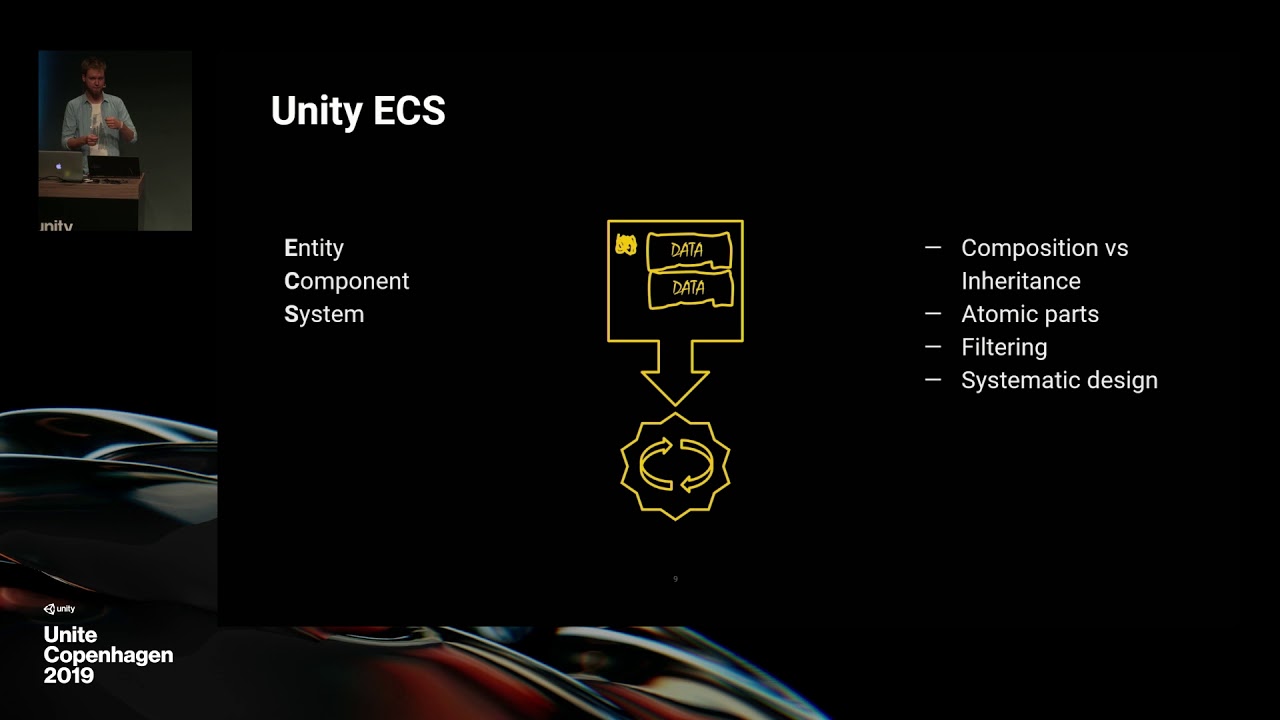
Get a high-level overview of the Entity Component System (ECS) and turn-based game loops, and see a proof of concept built using ECS. The session covers some...
pliant pike
I dont suppose anyone has a clue how I'm getting this warning
The previously scheduled job TurnTowardsWhatever:TurnTowardsjob reads from the NativeArray TurnTowardsjob.Data.wappapoints. You must call JobHandle.Complete() on the job TurnTowardsWhatever:TurnTowardsjob, before you can write to the NativeArray safely.
I've set it to [readonly] no job anywhere writes to the data, it worked before and now for some reason it doesn't work
naive parrot
@pliant pike strangely enough (not really ) i faced the very same thing today. i was scheduling jobs in Update and reading output ( jobHandle.Complete() ) in LateUpdate. as it happens , my routine was wrapped in a class that was polled from a monobehavior and i forgot to poll LateUpdate from main monobehavior resulting in same error. it could be that you are missing something similar in game loop code.
pliant pike
yeah, thanks, I dont know its weird the job is really simple, I'm not polling anything
it doesn't really matter I just wanted to go back to previous code to check that it still worked
guess I cant do that
gusty comet
I see a lot of code referencing the attribute [Inject] but it doesn't seem to exist? Is it deprecated, what's the new way? It seems like some magical way people got data into their systems.
pliant pike
yeah I'm pretty sure that's depreciated, you use subscenes or convertoentity now
gusty comet
what did it used to do? I'm looking into ways to access one entity's translation component to add it to another and I keep seeing [Inject] ..ComponentDataFromEntity
pliant pike
yeah just use componentdatafromentity or entityquery now
 hollow sorrel
from what i remember inject is really old from when they had multiple ways to do things because they weren't sure what people preferred to use and then removed 1 of them (injection) for clarity
fished up old docs from when it got deprecated maybe this helps https://github.com/Unity-Technologies/EntityComponentSystemSamples/blob/acc379a83e9ec8c93b907b523186171bfb2c7e23/Documentation~/injection.md
gusty comet
oh perfect, thank you :)
 old pulsar
As described in linked post (https://forum.unity.com/threads/building-entities-package.760244/), I'm trying to build the entities package in VS2017 so that I can better navigate the code. Anyone have a solution for this?
worldly pulsar
@old pulsar replied on the forum, forgot to mention that JetBrains Rider apparently doesn't have any problems with this (and the forum doesn't like it when I try to edit posts for some reason)
dry dune
btw Rider is free for open source projects and for students
old pulsar
@worldly pulsar worked, thanks!
gusty comet
kind of a bummer to find out new in game uielements isn't dots based 😦
dull copper
a lot of these new systems that release or are about to release now have been set in motion years ago when DOTS wasn't as big focus
but yeah, I get what you mean
gusty comet
So I've been following this vid https://www.youtube.com/watch?v=mL4qrt-15TE&t=921s and it says that "the way we write job systems changed" so the job code example isnt the newest system. Could anyone point me to the talk on the reworked system?
Get a high-level overview of the Entity Component System (ECS) and turn-based game loops, and see a proof of concept built using ECS. The session covers some...
dull copper
@gusty comet that probably just refers to the constant changes on Unity ECS API. not having watched that video, I'd still suggest to look at the dots sample repo and docs for recent usage info
especially the sample repo should be more up-to-date
(you can find all these in the pinned message on this channel)
gusty comet
thx olento
 twin raven
@winter onyx I remember Rocket League using modified Bullet physics engine
slow epoch
@gusty comet he's talking about the authoring i think, he says that cuz in a prev talk they showed how it's gonna work the authoring from now on and is not necessary to make the monobehaviour component ourselves
mystic mountain
One question I've had on my mind lately. Many things can use timers, like after X time do X. Simple here would be to use a component to store currentTime and finalTime and add a tag when it should do X (combined with some other component ofc). Would it be better to have a timerData + system for each individual action that is independent? E.g. timer to send data, timer to swap color on entity. I'm thinking if you have every timer in one system wouldn't it create sort of a sync point?
mint iron
Not really sure what you mean about creating a sync point.
I needed a timer to make game elements be destroyed after a few seconds. My solution was to have a 'PendingDestruction' component that contains the time when it should happen. A system goes through each of them and checks the time and destroys only the ones that are ready. Its been super useful.
Some objects start with the PendingDestruction component already on the entity prefab from conversion but its effectively idle until SetComponent populates it so i don't take the costs of adding a component.
mystic mountain
@mint iron What I mean is e.g. generic timer system. TimerData { currTime, finalTime}, TimerTriggeredTag {} , TimerSystem (checks timers and adds TriggerTag&RemovesTimer)
Then have SystemA,SystemB,SystemC,SystemD ... etc , query TimerTriggeTag with other Components.
Or have specific AAATimerData, BBBTimerData, CCCTimerData ..., TimerAAASystem, TIMERBBBSystem, TimerCCCSYstem ...
mint iron
i see... i think the generic version risks losing some readability. Like, how easy would it be on a larger solution to figure out what any particular timer is for and debug when things go wrong compared to them each being separated and explicit as to what they're supposed to be doing. Like oh its the 'DoThatThing' timer, i imediately know i have to go find the DoThatThingSystem.
mystic mountain
Mhm yeah. Also you can have multiple timers on same entity if that's useful. But was wondering in terms of performance of execution : )
mint iron
probably faster* to have them consolidated, each extra system does cost you.
maybe you could do a DynamicBuffer for timer+enum of what its for. a central system could just go through them with a chunk job buffer accessor, remove the timer, add your tag with ECB or (maybe add to second DynamicBuffer/Queue for triggered timers).
mystic mountain
I'll try with one system and see what happens when I hit the wall with full speed^^ 😄
dire frigate
Anyone had luck compiling DOTS to a build? 😅
Tried installing the platform packages from the package manager
but still get the "Burst Compiler failed running"
dull copper
@winter onyx I can confirm that RL used bullet, but not because it would be deterministic (it actually isn't 100% deterministic) but because it was their best option when getting hands on the source code for physics engine and bending it to their will
there really isn't a thing like 100% determnism on fast paced physics games anyway, on most physics engines the cache comes in the way, altering the simulation when you resimulate it
last mentioned thing is what Unity Physics package tries to avoid with it's stateless design
but then there's more things that come into play that make the 100% determnism impossible and that's basically the latency
to get 100% same results on each client, each client has to have same inputs for all physically simulated objects
and since there's latency between players, you can't have that
so your local predictions will always be somewhat off and need to be corrected
of course if you got like LAN connection and you got fully determnistic physics sim, then that's another thing
dry dune
@mystic mountain about timers,
for my game i need programmatic animations king of DoTween, after trying few approaches i ended up that it is better to store timer data on separate entity.
I have a dedicated entity for each pair of keyframes, that 2-keyframe-animation-entity has a target(object being animated), timing properties(tween duration, delay, current tween time, easing method etc) and values for properties i'm animating.
so for a single target object there may exist few animations for different properties, animation generic system walks over all animations and and updates target's values
https://gph.is/g/4wP09kj
on this gif each cube has 3 animations attached: move up, move down, and rotate, each with it's individual timers


all that runs at 300fps with 40k parallel tweens
mystic mountain
@dry dune What I'm asking is if I should run it through one system or multiple systems though.
On other note, RemovingTag (triggering) where it is used, or in a separate system at end of frame?
dry dune
I have all time calculations in a single place universal for all animations, but specific things for each kind of motion in a separate system
in my case time system that calculates progress for all tweens creates tween-end-tag components (events) and puts them on tween target entity, also it destroy used tween entities
consuming that event is a responsibility of that system who started animation
but there are few options for event-deletion:
- event component may be deleted at the end of the frame (in this case system that run before event creation will never see the event)
- allow system that use that event to delete it (problem here is that in some cases this may never happen)
- same system who created the event should destroy it on next frame (maybe best option)
mystic mountain
Hmm yeah. Didn't consider last. So how bad is it using the entity command buffer then? Doing option 2 would have multiple systems using one.
dry dune
entity command buffer is a tool to schedule structural changes after the loop/job end, how it can help with events?
i don't think that sharing same ECB across few systems is a good idea
mystic mountain
Since "event component"/"tag component" removal is strucural change? I've got the notion that using commandBuffers are slow, hence I wonder if spreading it out on multiple systems would be a bad approach.
dry dune
ECB is the only option when you need to destroy something from a job, there is no other faster option
mystic mountain
Well as you mentioned yourself you can do it in different ways. One way is using EntityCommandBuffer.RemoveComponent(EntityQuery, TagComponent);
Of what I've read, this is extremely fast.
dry dune
yes this is very fast
this works with the whole chunks instead of separate entities
it simply changes chunk archetype
 hot comet
hi, i'm thinking to re-code my mobile game in ECS but i'm not sure what it will do about performance
currently at my game scripts gets 5-6ms in 1000ms
10-50ms at rendering
so generally i'm like 30-60fps in android
if i re-code it in ECS, what would change?
 forest gulch
Hey, how can I make a MonoBehavior component without the Update/FixedUpdate call? I want to make a hybrid-esque game with DOTS but I don't want to use a MonoBehavior because of the Update/FixedUpdate methods and stuff.
dull copper
@forest gulch just don't put the Update or FixedUpdate methods there?
forest gulch
Aren't they gonna be called anyway though?
dull copper
no
from https://blogs.unity3d.com/2015/12/23/1k-update-calls/:
If a MonoBehaviour has a specific method it is added to a proper list, for example if a script has Update method defined it is added to a list of scripts which need to be updated every frame.
forest gulch
I mean, I don't really know how Update, Start and these methods work. Normally I'd use override but I don't see them there, so I don't know what's going on
Oh, I see. I that does make sense.
Alright, thanks :)
hot comet
could anyone help me?
hi, i'm thinking to re-code my mobile game in ECS but i'm not sure what it will do about performance
currently at my game scripts get 5-6ms in 1000ms
10-50ms at rendering
so generally i'm like 30-60fps in android
if i re-code it in ECS, what would change?
@hot comet You're asking us to analyze a game we know literally nothing about. The only thing I can tell is I doubt rewriting to ECS will reduce rendering time.
hot comet
actually the only thing i was curious about it was this, does it reduce the rendering time or not @worldly pulsar
vagrant surge
no
frosty siren
why no?)
If he have hundreds GameObjects with the same mesh renderer and filter, rewriting the game to DOTS with GPU instancing will give huge performance gain i suppose
worldly pulsar
In my experience the MeshRenderer pipeline is about on par in terms of performance with the Hybrid renderer, and if you want to render anything other than static meshes you pretty much have to use Hybrid ECS anyway (i.e. you don't drop the spawn/move gameobject overhead)
Yea, or you can just use GPU instancing with MeshRenderer
frosty siren
Is ECS system that renders graphic uses Jobs?
worldly pulsar
MeshRenderers use jobs as well
dull copper
unity's internal rendering is jobified too
I don't know how far they've gone with the built-in but the native side on SRPs is jobified
vagrant surge
yes
safe lintel
wasnt it a work in progress for jobifying the srp though?
frosty siren
If we raised the topic of DOTS using by built-in part of unity... I saw that animator does some work in job threads. And i'm very interest in new Animation Rigging package, because documentation says that it uses jobs. In my project i see terrifying duration of animation execution on a main thread, so i thought about using this package. But does it make sense?
dull copper
@safe lintel I talked with HDRP dev at Unite about this and the reason why we don't see bursted jobs on the SRPs is because most of the heavy lifting is already done on the native side
safe lintel
ahh
dull copper
I guess there could be still some c# things they could do better but that was like the general reason why it is like that
coarse turtle
oh interesting to know
dull copper
I'm just happy I asked many of these things on the expo floor and not on the NDA events so I can share what I know 😄
too bad my memory isn't doing me favors, I was told so much more in depth answer on that but can't rememer the fine details anymore
the main point was still that they do have all that stuff jobified, just not on c# side
safe lintel
glean any tidbits that you can share for dots that they didnt mention in the videos?
dull copper
I didn't really have time to discuss much with dots people, kinda missed most of the dots sessions too due to scheduling
I only briefly talked with Lucas about hybrid and DXR
but answer was pretty much expected
it was along the lines it'll happen at some point when they have time to integrate everything properly, it's not broken by design, just not developed right now to be compatible as it's done in parallel
well, I did talk briefly with the Andreas who does low level Burst code
his response to my questions wasn't super surprising either 😄
I asked if double precision SIMD is coming to burst with AVX etc at any point and the response was pretty much that you'll be doing things very wrong if you need doubles in game code
so, wouldn't hold my breath on getting the extra speed on double math 😄
vagrant surge
the only reason you might want doubles is if you are doing planetary scale logic
with milimeter detail
dull copper
I can understand his stance on this but not everyone cares about the brute force speed here, when you do like proper simulations, you care about the extra precisions
well, it doesn't even have to be huge scale
but yeah, if they would just support 4wide double math on burst via AVX, it would be easy 4x speedup
it doesn't matter if it's still way slower than single precision floats
as it's still fast enough for most purposes
but getting that free perf would still be nice
like, I did my own double precision physics solver on ue4 that ran single threaded and I could simulate my limited rigidbodies at 10kHz rate with it... with zero SIMD math
but with proper optimizations I could have easily done way more
the actual target I was heading at was like 240-360 Hz rate so that was totally within reach
other question I asked was about burst function calls without jobs... because they would be just so handy
but the response I got there was that I should just jobify everything
of course they want to make that happen eventually but it's probably not going to happen soon
safe lintel
i reckon a lot of people will be inquiring about the lack of double precision as time goes by
dull copper
it's not really a thing game engines usually support
and in general, I'm happy that we even got double support on the new mathematics lib
it's still not burst supported but at least it's not totally neglected
I think mainly transform math is missing
like, if you want to do double precision world, you have to roll out your own double precision transform setup
but rest of the math operations should be there in doubles too
I was actually one of the first people who kept nagging about the lack of doubles on the new math lib
as more people kept asking, they just implemented it on the math lib, I guess to keep us quiet 😄
it wasn't really huge effort for them as it's just mirroring what they do with regular floats minus the burst optimizations
I don't think the AVX support would be that huge task for them if they really wanted to make it happen either
but it has more limited platforms that can benefit from it
vagrant surge
their vectorization is basically llvm default vectorization
they dont really do that much, other than some LLVM codegen that allows LLVM to vectorize it well
dull copper
tbh, I haven't tested if burst actually does vectorize doubles
probably should have
but the official stance have always been it's not supported by burst
oh wait, Burst compilation is still restricted to SSE4 on PC
so even if it would do that, it wouldn't help much as SSE4 can do doubles only 2-wide
they did make the cpu extension autoselection somewhat recently, so they could just add AVX to that if they wanted
right now PC builds can have both SSE2 and SSE4 compiled and it picks the right one at runtime
because there are still old amd phenoms and some other same era cpu's around that don't support SSE4
those computers wouldn't run modern games well anyway but people can get quite vocal when the game just refuses to launch vs when it runs 15 fps
 covert spire
So I'm trying to start a project using DOTS but the only tutorials I can find are from 2018. Is making a "bootstrap" with [RuntimeInitializeOnLoadMethod(RuntimeInitializeLoadType.BeforeSceneLoad)] still necessary?
coarse turtle
Best to use the EntityComponentSystemSamples github pinned to this channel as a good way to see how DOTs works
You can try recreating the examples to have a basic understanding/practice how to get things working
The RuntimeInitialization isn't necessary
dull copper
@covert spire try the official docs first, all internet tutorials are just horribly outdated
you can find the official stuff linked in the pinned message here
along with the already mentioned sample repo 🙂
old pulsar
Are chunk components a recent edition? Their documentation is very thin, and I can't find any videos talking about them.
They sound like shared components in that a chunk only has one value for a chunk component rather than per entity, but unlike shared components these are regular IComponentData blittable types and so can be accessed in jobs. It also seems to differ in that multiple chunks with the same chunk component value have their own copies (whereas ISharedComponentData values can be shared across multiple chunks).
They are also stored external to the chunk itself, though I'm not clear on how exactly. Looking through the entities package code, they seem to be stored on a 'metaentity' of the chunk, but the code gets very hard to follow from there.
I'm especially unclear on what happens when you add a new entity with a given chunk component value: if the entity is guaranteed to be added only to chunks that share the same value, how is that guaranteed? Are the values hashed like ISharedComponentData?
What is the full list of differences between chunk components and ISharedComponents and their intended use cases?
safe lintel
where did you see mention of chunk components? did you mean chunk jobs?
gusty comet
out of curiosity, being stateless unity dots physics should be easy to modify for origin shifting right? I'm not sure if havok has that kind of support since its cached and all
dull copper
shouldn't be super hard
safe lintel
or did you mean ArchetypeChunkComponent(Type)s?
bah shouldnt check discord before sleep 😄
mint iron
@old pulsar its not something i've played with yet but i'm also pretty curious about it. Here's some relevant info from the source:
A chunk component is common to all entities in a chunk. You can access a chunk IComponentData instance through either the chunk itself or through an entity stored in that chunk. In either case, getting or setting the component reads or writes the same data.
So can be accessed with a reference to any entity in the chunk or the chunk itself (or EntityQuery). Internally there's a metaChunk Entity and Archetype attached to the chunk which contains the layout and data and presumably is shared across multiple chunks.
Removing the chunk component from an entity changes that entity's archetype and results in the entity being moved to a different chunk (that does not have the component). Adding a chunk component to an entity changes that entity's archetype and results in the entity being moved to a different chunk, either one that already has an archetype containing the chunk component or a new chunk.
So you could deliberately split data with same Archetype using this mechanism, similar to with SharedComponentData. I wonder what happens when there are no longer any entities matching an archetype with added chunk data).
low tangle
also what about race conditions?
I guess per chunk thread so its okay
still seems odd, I think it was used for chunk render bounds for the level streaming system
for mega city
the uh talk on how they did hlods has it in it, for megacity
 simple cradle
is it possible to use the 2d animation package (the bone based animation stuff) with ECS? At least in some hybrid way?
old pulsar
@safe lintel They're mentioned in the official docs: https://docs.unity3d.com/Packages/com.unity.entities@0.1/manual/ecs_chunk_component.html
gusty comet
btw, How do you guys go about doing controlled system activations? Do you add/remove flag components at runtime? Do you have a bool on a component and check against it?
 plain cloak
Depends on the activation frequency for me. If it keeps changing every couple frame or so I use bool check but if it is less frequent I try to use tag components. Here is good article about it https://gametorrahod.com/tag-component/
gusty comet
so I guess you define flags as the ones with bools in them
plain cloak
edited the typo, my bad