#archived-networking
1 messages · Page 55 of 1
 final depot
RTS and Fighting games for example absolutely tank if you use a client-server architecture
 misty shale
Yeah true that. I’m thinking authoritative in terms of reward distribution and in game soft currency purchases
This would be for a mobile card battler game
final depot
If it's turn based, you can easily get away with server authoritative
misty shale
I guess these games use web services rather than a client
final depot
It actually wouldn't be that hard to set up a HTTP server to handle it, yes.
Or just plain websockets.
Backed by a in-memory database like Redis
misty shale
Not turn based no but I could do a submit each time the player beats a level to see if it’s technically feasible
And then dish out rewards
final depot
Oh if that's the case, a HTTP server is more than enough
final depot
Only thing you might need to do is check for is the validity of the player's claims
misty shale
Are the cool kids using node.js these days? Been a while since I did backend coding
final depot
So that if someone finds the endpoint, they can't just spam it to get the rewards
misty shale
Yep, I can check some basic stats to ensure it’s valid
final depot
Personally, I mostly do Python and Elixir
misty shale
Ooh yes Elixir is supposed to be nice
final depot
Elixir tends to be better for soft-realtime commuications
final depot
Alternatively, if you have money: Firebase
It's even easier since they have a Unity plugin
Don't even need to consider the hosting at that point
misty shale
Oh interesting, what does the plugin do?
final depot
DM me later for more info
misty shale
Will do thanks!
final depot
But a gist: It's a cloud based service backend as a service. No servers, just a plain API to hit.
It's sort of weird: public facing database with security rules editable directly from clients
misty shale
Like Parse? (RIP)
final depot
You just hook up clients to the database
And it uses Google Cloud Functions as a way to add compute on top of that storage
it's realtime so it should fit game needs
 weak plinth
Websockets are p good
 hollow aspen
I'm using WebGL and Addressables. I have SD textures on a model by default and when the game first loads, it loads HD textures and applies them to the model. Here's by bug. When the Addressable Asset is first loaded, it applies black textures to the model. If the Addressable Asset is cached, then the LoadAssetAsync call results in a error.
Any thoughts as to (1) why the texture from an AssetBundle is black and (2) why I get a UnityEngine.AddressableAssets.Initialization.InitializationOperation error upon subsequent loads?
 barren pebble
Are the cool kids using node.js
would totally go for that
super easy to set something up with express and node.js
if you also use mongodb, thats totally enough and very fast and easy to setup for a prototype @misty shale
misty shale
I have no experience with Node, would love to get going but no idea where to start
I’ll also take a look at mongodb
Thanks @barren pebble
 versed cliff
does anyone have any recommendations for a tutorial series on setting up a dedicated game server for a simple rts game? Apparently Unity is reworking their networking thing and there's a lot of outdated videos, so I'm not sure where to start
 foggy vale
@versed cliff got the same problem.... I'm also wondering where to start hosting a custom made multiplayer server
versed cliff
yeah it's extremely complicated @foggy vale I've been looking into Nakama but I'm still not sure where to start
foggy vale
@versed cliff lot of money the nakama... I'm looking for a service similar to the unity hosting, free for small number of players... but that doesnt force me like unity to use UNET
versed cliff
apparently unet is going to be phased out though if I'm understanding right
so maybe playfab might be the way to go
 exotic valve
Is it best to have each player determine animations for other players to calculate based on their velocity, or just have the client post their animator state to be replicated
 gleaming fossil
are there any reliable character controllers that are available currently? Would love a non-DOTS controller that works with 2019.2+. All of my client side predictions end up correcting to the server position, depending on how long you run around and the complexity of the colliders in the scene
 burnt axle
How do you manage the player prefab when using a lobby manager and network manager? They both have slots for player prefabs and the lobby manager runs in the background through all scenes. Im unsure of you are supposed to choose on over the other or use both.
misty shale
So I’m thinking about how I’d implement an authoritative inventory / upgrades server using a http server and DOTS. I’m thinking that I’ll have a system which periodically pings the server to query the inventory data on the server and download the data in a format such as .json.
I’d then parse the data and for each item in the json create an entity with an item component with the appropriate data set.
All client would ever do would read this local entity data and display UI based upon it.
Any time the game wants to add / remove / upgrade an item to the players inventory it would happen via a script on the server editing the player’s profile data on the server and then get pushed to the client as above.
Sound logical? Is there a different way to do this? One thing that scares me with this approach is keeping the data in sync. I’m thinking:
- By default update data every x seconds
- Forced update on player actions such as buying new items
- On update delete all entities and create them from the latest data. This worries me in terms of performance / redundancy (most items shouldn’t change very often) but it’s the simplest and most synchronized way I can think of
Thoughts appreciated!
 jade glacier
Seems needlessly complicated unless your inventory actually is tied to a different location than your game logic. But typically the server knows what you have, and anything clients try to do involving that inventory are subject to the server not acknowledging as having happened
The most typical is to put everything into your simulation, and then you just sync any of that like all other data, using delta frames and normal serialization
JSON is bloated and human readable
misty shale
So you mean just serealizing all of the inventory data and syncing it?
Doesn’t that make it vulnerable to cheating?
Like say if this was Hearthstone and players were able to trick the client into thinking they have certain cards that they don’t. They’ll then be pushed to the server, right?
jade glacier
JSON vs any other method doesn't matter, what matters if what clients are trusted with
if the server knows what everyone has, and only responds to player inputs, it won't allow anything illegal
hearthstone is a cardgame, so thats even more basic
but JSON and server auth are totally separate convos
JSON is a verbose way of serializing stuff, that is WAY bloated for a game
misty shale
Oh I think I misunderstood what you said
So just use unity serialization with DOTS and deltas and then let the player only officially talk to the server?
jade glacier
I mean, there is no way I am going to explain the entirety of how you achieve eventual consistency with networking typing here
but the idea is that you create a simulation and that simulation consumes a previous state and inputs, to produce a new state. You serialize the state and the inputs.
If you get buried in the woods of how to "send inventory" you are already down an ugly path
You can sloppily sync things like inventory adhoc, but you will start to run into some serious order of exec and race condition snafus
So typically you want to start with your simulation, and then once that basically is working, you start thinking about how to tie the various inputs and state items involved (like inventory) to that.
misty shale
Ok thanks for the tips! Ok ultra new to networking so I’m happy to find better ways of doing things I didn’t know about
Haven’t thought about doing a state simulation with a http server. TBH I thought this model only applied to games like FPS
jade glacier
simulation makes all game types sane
misty shale
Yeah just wasn’t anticipating using a constant connection to the server - will also need to figure out persistence with this model. My approach was more based on web services I guess. Will do more digging, thanks!
jade glacier
If this is stateless it makes things pretty easy, bit its still all basically a series of states
versed cliff
would a simple RTS game be better off using peer-to-peer system or an authoritative server system?
Because peer-to-peer can be hackable but authoritative server can cause latency issues if I'm understanding this right
misty shale
Peer to peer could have just as much latency depending on where they are, no?
final depot
@misty shale @versed cliff
RTS generally has too much state to send authoritatively. I advise a peer to peer deterministic lockstep model.
In such a model, everyone only sends inputs to each other
And every peer is responsible for their own state
jade glacier
Though even with determinism you still will have an authority, that authority just is the final word on what the inputs were, unless you are doing like a lockstep
final depot
This makes a strong assumption that your simulation steps are purely deterministic
If you have a client who is lying about their inputs, it only causes them to desync
There's no need for anyone to authoritatively establish inputs
jade glacier
If you are deterministic you want that
again, unless you are doing a locksteppy thing, but that requires either a relay or a server... which still... you have a server
pure p2p is not something I would ever recommend
final depot
How would lockstep require a relay or a server?
If a local client has all inputs for a frame for all remote clients
jade glacier
Depends if this RTS needs to keep on trucking
if a packet gets lost, there has to be a reconcilliation
final depot
It is by definition in lockstep
jade glacier
we talking just 2 players here?
final depot
Potentially more
versed cliff
let's say it was a 2v2 rts game
jade glacier
That is fine with 2 players.. one player decides to give bullshit and it just ends the game
16 players and one player starts spewing bullshit... the whole thing goes into lockdown
final depot
How would it be bullshit? The only thing that is sent is inputs
You don't send state, so there is no way to fake or hack
jade glacier
If I lost a packet from player B and my determinism needs to know what that input was to continue....
Until they get that to me, everything is in limbo
final depot
This is a case where reliable sending is indeed required
jade glacier
yeah, but again... how do you proceed if you stop getting updates from one of the players?
without an auth server to say "just run with this"... everything stops
That is how Quantum deals with it as I know it. The server is the input authority
if someone fails to send in time, the server will extrapolate the input and give that to everyone.. and that becomes the input - and the player that was losing packets needs to resim
without that, you have a true oldschool lockstep
final depot
In such a game, a disconnect is indeed fatal to the game state
You would just kill the entire match
jade glacier
which is not so friendly to more than 2 players
final depot
Admittedly yes, but it's not something most RTS games will have a reasonable fallback for
jade glacier
We are making massive guesses about his game at this point
versed cliff
this seems extremely complicated. I'm new to game networking 😓
jade glacier
networking is the most complicated part of game dev
final depot
And they did at it's 2 player
jade glacier
Start simple
People think I am joking when I say "Go make Pong"
but pong is brutal to do well
misty shale
@jade glacier been thinking some more about my need for an authorities inventory service. Still not entirely convinced that I should be doing a full simulation on the server given that it only needs to act as a data store and persist items between sessions
Authoritative*
jade glacier
you don't have to, but the more you go adhoc, the more hell is waiting for you down the line
There are no hard rules in coding. Just best practices.
ignore them at your own risk
networking + adhoc mixing of simulation and messaging = tangled race condition hell
If you just want to get in and make a mess and have some fun, go use Mirror and hit it with synclists and syncdictionaries
You will eventually hit a hard wall, but you will learn a lot in the process
If you have a data store, you can backup to that
but the simulation is not going to want those values to just be changing unexpectly out of turn
versed cliff
So if I understand this right, in a 2v2 peer-to-peer RTS game, everyone is sending their inputs to each other and essentially simulating the game on their own machine. One player is the host and if there's any discrepancies they will sync to what gamestate he has?
misty shale
I feel like there’s an assumption on your end that using a database and websocket connection is wrong, but plenty of games (e.g. Destiny) do this
final depot
@jade glacier wait, so you would advise against P2P even in games with very tight latency requirements?
I've been working on a low latency fighting game
jade glacier
Testing for the out of sync will also be on you, you will have to run checksums and such to detect that or else the game will just get bizarre as hell for players @versed cliff
final depot
and the GGPO style of rollback/frame delay with P2P actually decreased overall latency
Since there isn't a secondary hop to an authority
jade glacier
Depending how you define your "inputs"
final depot
It's strictly the player inputs. there is no exchanged state other than an initial configuration (i.e. random seed, character selection, etc.)
jade glacier
For someone who just said "I am new to networking"... I would NOT TOUCH pure P2P
versed cliff
what do you recommend I do
jade glacier
Make pong
final depot
Sure, but every game has it's requirements to fulfuill
And if the design doesn't meet the requirements, you're only going to be redoing previous work.
jade glacier
Making networked games is brutally hard, set yourself up for a few wins before doing your dream project
I mean, sure - he can do whatever.
final depot
I've gone from using UNET HLAPI to Photon to writing my own transport level library + porting GGPO
Learned a lot along the way, but wasted a bunch of work trying to approach the correct solution.
jade glacier
The HLAPIs can be nice as starting points since they get you right into serialization and such right out of the gate
jade glacier
But you are like 20 refactors and restarts away from making a serious networking attempt, so just set yourself up for a series of wins you can learn from
pure p2p means every player is talking to every other player
directly
with firewalls and such, that is a list of challenges to deal with
versed cliff
so authoritative server is easier to start with?
jade glacier
Server and Relays are easier and more standard - because you can call something the authority
so at least one location on the network you can call "real"
final depot
@versed cliff I actually suggest reading up on networking primers to understand the full stack first:
Gaffer on Games has an amazing set of informative articles on some key principles.
Then try experimenting with small examples like Pong, yes
jade glacier
Gaffer is toast now, trying to read it through archive is lame without the images
Just make small experiements of concepts
final depot
Alternatively, if you haven't started on the project yet. Try networking games with looser requirements.
jade glacier
They will teach you tons
final depot
Pong is a bit of a high note for netwokring as there is realtime state.
I would actually advise looking at some turn based games to at least get the grasp of sending messages or RPCs
versed cliff
I started by working through this playlist https://www.youtube.com/playlist?list=PLWeGoBm1YHVgXmitft-0jkvcTVhAtL9vG
 jade glacier
Pong is tricky because you have to deal with an object that is constantly changing time references. Shared objects are tricky.
But it does run you right smack into what you are up against with networking... how latency creates paradoxes you have to learn to hide and account for.
final depot
And it's more of an art than a fine science, haha
rollback netplay has actually requried me to completely rearchitect my game
versed cliff
is there a tutorial you know of on how to make pong with photon
I might work through this to start https://forum.unity.com/threads/tutorial-creating-a-multiplayer-game-with-unity3d-photon-and-playfab.543989/

Unity Forum
[IMG]
In this tutorial series we will be creating a simple multiplayer game using Photon for networking and Playfab for player login/registration....
jade glacier
I actually know of no good pong tutorials, because it is a real networking challenge
there are probably some terrible ones
versed cliff
you'll just have to make one then
jade glacier
If you are after turn based, just start with a very simple card game I would say, any library will do.
weak plinth
Hm
final depot
In contrast to what was discussed yesterday: here's a project I've been hammering away on for pure P2P games.
And the associated GGPO style rollback library: https://github.com/HouraiTeahouse/Backroll

Unity Forum
Hourai Networking
P2P Transport Abstraction Layer
Did you know that Steam and Discord offer free P2P networking relay services? How to take advantage...

GitHub
Unity C# Port of GGPO built atop Hourai Networking - HouraiTeahouse/Backroll
A DOTS compatible version is forthcoming
 gleaming prawn
This is super cool.
jade glacier
The main concern being that it totally is riding on top of shifting sands. But since its abstracted, it should be adaptable to other relays systems that pop up
final depot
GitHub
A 2.5D Touhou Platform Fighter, By the fans, for the fans. - HouraiTeahouse/FantasyCrescendo
@jade glacier
It's not merged into the main line develop branch yet, but it will be used for it
jade glacier
cool, when I get a bit of free time I will check it out
final depot
You can rip out the lower level stuff if our want to
There is a thin connection manager and message serialization manager built a top the lobby abstraction layer
jade glacier
I'm pretty much locked into doing dev work for PUN2 for the next X years at the moment, but this is interesting since its related.
final depot
Which is bounded by some strict restrictions
But it's not required to use.
I would actually advise it's use mostly for small scale latency sensitive games
So things like a fighting game with max 4 players is a perfect fit.
The entire idea is to build small messages that are all below MTU to avoid fragmentation to minimize packet loss and repeatedly sending redundant messages to account for unreliable networks.
The one problem is that it is contingent on deterministic simulation
And I have been working on a fixed point math library to fix some of that
I chose this path since I am purely developing this as a hobby and not a job
I don't have the personal funding to set up a server cluster
And Steam and Discord's relay services are free
And the community I am developing for is small enough that I can identify my players by name
So even if someone does cheat and screw with others, they'll just find themselves alone in a lobby.
jade glacier
I do development for Exit on PUN2, so pretty sure I can't "use it" for any of that, but others here certainly could. 🙂
final depot
It's a shame that Google took down their matchmaking service for Android
I could have integerated with theirs for mobile platforms
jade glacier
That really is the reason abstraction of any of this is good... nice to not have to rely on any particular service for your game to exist
final depot
Steam IIRC is pretty solid, Valve themselves depends on the relay network for their games, and just recently doubled down with the public release of their networking sockets API.
Discord, I'm not entirely sure of right now, it's still in it's infancy
gleaming prawn
@final depot what is your goal with this?
gleaming prawn
Yeah.
Are you working on this because of a game you are writing?
And then just sharing because reasons?
final depot
The libraries are funcitonally complete as is. I don't plan on adding anything other than potentially more platforms.
My game is purely open osurce
Though it leverages closed source software
I see no reason not to share my code freely
gleaming prawn
So you do this on your spare time only?
gleaming prawn
What do you do in the "normal" time then? Lol
Just curious, as another deterministic fella
🙂
final depot
Enterprise machine learning work for Google
gleaming prawn
West coast HQ?
final depot
Mountain View, CA, yes
gleaming prawn
Cool, been there a few times...:) Have some friends around.
Were you ever aware of our stuff?
final depot
"our stuff"?
gleaming prawn
Photon Quantum
final depot
Oh yeah I was
gleaming prawn
It's like "GGPO on Steroids"
final depot
I just didn't want to pay, no offense, haha
gleaming prawn
fair enough... Although there are options around that...;)
final depot
it's a bit more than a hobbyist can handle
gleaming prawn
Anyway, super cool stuff.... If you feel like discussing nitty gritty details of cross platform determinism, just shoot...:)
final depot
And when I started the project, it was still in early development
gleaming prawn
it's a bit more than a hobbyist can handle
As I said, there are ways around it...:)
We were always interested in teams that could build great demos, etc.
We hired a few of them for that reason at the time.
It's also nice that GGPO is now around again...
final depot
Yeah it was the open sourcing of it under MIT that got me to port it
gleaming prawn
Although that is super thin, and doesn't give you anything to help you have a determinsitic rollbackable simulation layer... Also only works for small games with normally 1v1 only (no server to manage input latency and clock)
final depot
Actually, I found it to work well for up to 8 players
Which is more than enough for me
gleaming prawn
With no centralized clock, in 2-3min hardrware clocks drift enough to start to become a problem
With short games it's fine
final depot
There's a time synchronization module in both the GGPO and Backroll implementaions
well, it's up to the developer to actually leverage that callback and actually wait
gleaming prawn
There are two issues:
- clock symc
- carthesian product of messages to distribute input around (unless you design it with one being a "host")
final depot
That latter is definitely a problem for large games, yes
gleaming prawn
well, it's up to the developer to actually leverage that callback and actually wait
for short games it's fine
Also a problem is: if ONE player stops/slows down, all peers suffer (unless there's an input-,anagement host)
final depot
But doesn't that host add an extra hop?
gleaming prawn
It always made me curious why GGPO got so famous, because it's the simples and less generic/complete version of this... And there's prior art thats much more complete
final depot
Expecially when there's a relay in between that nearly quadruples latency
gleaming prawn
Maybe it's just the fact that it worked SO WELL for fighting games
final depot
It really is that latency mitgation
gleaming prawn
But doesn't that host add an extra hop?
For more than 2 players, the benefits are much more important
final depot
That's true, I can see that
I am making a fighting game
and that latency is really important for me
gleaming prawn
Expecially when there's a relay in between that nearly quadruples latency
That's why we actually run the server logic on the relay...
final depot
most of the matches I see are 1v1 anyway
gleaming prawn
yeah
Is it LAN?
Anyway, you have a transport abstraction, right?
So you can work over steam, photon or discord, I guess
final depot
right now the code is tailored for use across the internet via Steam/Discord (GCP)'s backbone
gleaming prawn
yeah, fine
final depot
I need to whip up local LAN code
gleaming prawn
Another question, what are your plans to have a rollbackable sim layer?
final depot
Is photon capable of just doing message relaying?
final depot
I implemented that myself already
gleaming prawn
Just curious...:)
final depot
Like GGPO, that simulation layer is purely on the developer, not on the library's end
gleaming prawn
We share a lot of the ideas we use with Quantum.
Like GGPO, that simulation layer is purely on the developer, not on the library's end
That's one extra step we made...
final depot
I have a seperate layer between (Fixed)Update that runs simulations
gleaming prawn
There are several ways... For a fighting game, it's so tiny that even deep copies work
gleaming prawn
For the rollbacks, verified/predicted states, or ring buffer?
final depot
Ringbuffer of states
gleaming prawn
There are normally only these two variants
yeah
So, deep copy on forward sim.
So you have the buffer of past states down to rollback-window...
final depot
Right now I use the same serializer for the network messagse to create a binary blob that is managed by Backroll/GGPO
gleaming prawn
You PROBABLY reuse that to compute input buffers for combos (being this a fighting game)
gleaming prawn
Got it
8KB the game state?
That looks big for a fighting game... But maybe it's a complex one...:)
final depot
I had to do some wonky stuff with projectiles and persistent hitboxes
it's a platform fighter akin to Smash Bros
gleaming prawn
got it
final depot
has a lot of extra physics state
final depot
Probably need to slim that down, but it works for now
final depot
Yeah, haha
gleaming prawn
BTW, what did you use for FP, Q48.16?
or maybe smaller, being a fighting game
no need for big ranges
final depot
Q16.16 and Q0.8 for inputs
final depot
I think we maxed out our velocities at 32k
gleaming prawn
Same accuracy as 16.16, bigger range, 32 bit buffer for non-overflow-checked multiplication (so, fastest possible)
final depot
which is the only quantity that goes above 1000 on the regular
gleaming prawn
we only use the extra 32 bits as buffer, so we clamp between -+16k
final depot
Does casting to 64 bit for division/multiplication slow things down?
Because that's what I'm doing right now
gleaming prawn
No
We considered doing this... But already storing directly as 64 is not that much of a problem even for beefier game states
Goal is always to fit game state into L2 cache
a single cast is still one "store" on the function stack anyway...
If you're like me and want to avoid even those... lol
final depot
What I've found hardest actually was coercing Unity's animation system to work with it all, haha
I still haven't found a square solution yet
gleaming prawn
We use 3 different approachs
final depot
It's a fighting game, so gameplay contingent on attacks is actually tied directly to animation positions.
gleaming prawn
I mean, we offer 3 ways, game developers choose what to do
But we're a LONG way down that route...
final depot
I'm using playables + a frame tick * Time.fixedDeltaTime to project something righ tnow
gleaming prawn
We even have FPAnimationCurves, etc
final depot
Oof
gleaming prawn
We do use playables with the more "complete" solution indeed
Playables is a super nice API for that prupose
final depot
Does your animation system completely override the transform placements?
gleaming prawn
Our fighting game sample also uses playables to keep the anims snapped, of course. (it was built even before we had our current set of tools)
Does your animation system completely override the transform placements?
That's game by game
We offer data driven ways for the developer to export that kind of data into determinsitic data (like FPAnimationCurves, etc)
final depot
That's what I'm hoping to avoid, haha
gleaming prawn
And we offer a mecanim exporter for state transitions
final depot
Excited for the DOTS Animation promises there
gleaming prawn
So both can be combined...
Excited for the DOTS Animation promises there
I like the playables API. Hope they build somthing similar in use
final depot
I couldn't find a way to compose hitboxes and mecanim in a reasonable way so I just wrote my own state machine composition system
gleaming prawn
But it's a long way until they have soething our customers will trust to use into production games...
final depot
It's super clunky and has a nigh unusable creative workflow right now
gleaming prawn
I couldn't find a way to compose hitboxes and mecanim in a reasonable way so I just wrote my own state machine composition system
Well.... You found the RIGHT way...
Mecanim is just... not good...:O
gleaming prawn
I've seen amazing custom timeline editors (from a few high profile customers)
final depot
I'm using Timeline right now, but it's a bit clunky to use, ended up writing my own frame data editor
As you can see, lots of extra custom stuff crufted on top to support this game.
final depot
Ohhhh
gleaming prawn
Most bigger studios don't use any of the half-baked standard solutions..
final depot
It definitely wasn't easy, though not like there's anything that currently exists for these use cases
gleaming prawn
Which are fine for toy projects, small indie games, etc
final depot
I mean, if you have the man power to do so
gleaming prawn
Yeah
final depot
This game is literally just me coding it and a bunch of other hobbyists with spare time
gleaming prawn
I'm a bit aprehensive, DOTS has still a LONG way to be usable in production.
Not even close yet
final depot
But it is exciting: I wrote https://github.com/james7132/DanmakU with it before ECS was even available.
 gleaming prawn
This is super super super old: https://www.youtube.com/watch?v=IUyluTmmkPA
But the animation is snappped to tick accurate using playables (simulation is tick accurate with synced clock to within 1ms or so)
The third screen is an overlap of the two clients...
Recorded simultaneously (both clients from the same machine, but server ping is stated)
So no direct connection between them (inputs go through server)
final depot
Interesting
I'll take note of this, I don't think I'm doing any in-Playables snapping
Only through the time state (it's a ushort that I just multiply by Time.fixedDeltaTime to get the playable time to evaluate at)
gleaming prawn
You can see some quick "ghosting" when there are input mispredictions, which are quickly solved
and the two games play almost the same pixels...
final depot
For input prediciton, do you just assume the last seen acknowledged input is held?
gleaming prawn
If you fix the anim state + anim time, you ARE snapping
final depot
Or do you have more complex prediction algorithms?
I've been considering doing some real time machine learning to learn the local player's input patterns, then using it as a sequence model to predict it on remote clients.
gleaming prawn
For input prediciton, do you just assume the last seen acknowledged input is held?
Either this, or DonÄt predict at all... The developer has the choice on a tick by tick basis to set a repeatable flag on/off
We NEVER needed to go more complex...
We considered exposing a prediction callback, nobody needed...
final depot
i.e. learn input patterns via local play, then ship the model to remote clients at match start
then use the model to predict inputs on remote clients
gleaming prawn
I doublt, really doubt, this could be better
Your company is giving this a different name... maybe they are researching this very topic
They call it "negative latency", fancy name... lol
it's just input prediction... so stadia can send frames ahead of time... I'm waiting to see...:)
Maybe they know enough about me because of the number of G homes I have, so I'll be surprised how well they can predict my button presses...:)
final depot
Haha, the marketing egg heads doing their worst
gleaming prawn
But the answer is there:
- we either repeat, or just don`T (controlled by dev tick by tick)
- never needed more than that.
- in the past we had input "prediction" filling both forward and backwards... because we can receive input confirmations our of order
that didn't help... so we stripped it out... Just unnecessary complexity
final depot
I might try it if people deem the rollbacks too visually jarring
gleaming prawn
I might try it if people deem the rollbacks too visually jarring
you calibrate this giving them the option to play with a bit of delay... that's what GGPO does
What we do is give a lot of options to developer:
- he can decide to run a bit of input delay (per client);
- he can use a bit more interpolation (we have an error based interpolator that works super nicely for the views)
 wispy glen
Hello. I'm trying to create a multiplayer First Person thing, and I'm just making it basic for now.
I have a FirstPersonController Prefab that spawns when you load in, but how can I make two FirstPersonControllers be able to see eachother
jade glacier
You have a networking library you are working with?
 solar garden
How do you make up for lag on other clients than your simulation ? as we all have different lag how to be sure you won't lets say shoot at a past enemy position ?
gleaming prawn
welcome to favor the shooter mechanics...:) This is a whole topic on itself. I assume this is something like and FPS.
Quick answer: store a buffer of hitbox positions of every character on server... when you receive a shot command from a client, use the positions proportional to that client's ping to query hitboxes as they were in the past.
But this topic is super super complex... Multiplayer libraries like Photon Bolt, Source Engine or UE4 have these things built in to help you...
solar garden
Yeah but frop the source engine i know that they interpolate the position of the enemies now is it predicting or late interpolate is the thing i dont understand
gleaming prawn
Entites from other players are interpolated on your screen... Your own character is predicted/extrapolated with your local input (so you don't feel the server lag)
This is the general "rule" for an FPS.
solar garden
What do you mean by interpolated like just from the updating of the positions ?
jade glacier
Players see other networked objects that are in the past
So every clients own entities love on the future
The past you see arrives as ticks and gets buffered
And every tick, you advance what frame in those buffers is currently being consumed
Interpolation is to lerping from the last consumed frame to the newly consumed frame
So the world looks smooth and not like a slideshow
Net latency, buffers, and interpolation all produce latency. But when you number all of these ticks, the server can easily reconstruct the world as the player saw it
That is what CS does, it knows how many ticks in the future each client is existing, and rewinds the world to match what a player would have seen when firing, and then recreates the shot to verify it
solar garden
ok but thats on the server if everyone is in the past like i am a client shooting at someone i'll have to shoot further than the the model because of the latency + lerping righ t?
jade glacier
Locally you shoot at what you see
that is where favor the shooter comes in
a player's view of reality is wrong, but that is ok because this is the opposite of deterministic
You shoot at what you see, because the server will do the work of re-arranging the furniture to confirm your shot (IF you go that route, it is a bit expensive and not something games with lots of players do)
To do it, it requires your game to have pretty inexpensive physics/simulation code, since the server is going to have to constantly be rewinding and reconstructing a simulation world to test shots... so if its bullet-hell that is going to be brutal on your server asking it to verify every shot like that.
If you are building around PhysX, you probably don't want to go this route
Bigger games lean on other methods, like just testing the general plausibility of a shot, or not testing at all an just trusting the client
I don't know all of the methods employed, but its a pretty creative field
 graceful zephyr
@jade glacier A for effort.
😄
that you have energy to explain this every day in here lol
graceful zephyr
hey o/
jade glacier
Presenting to Christof and Tobi in like an hour
graceful zephyr
ah best of luck
jade glacier
The stuffs all working, just NO idea how to present stuff online, so going to be messy using discord screen share pretty much
I can invite you in if you are curious at all @graceful zephyr
jade glacier
Another big push under way?
jade glacier
No worries, no benefit to me having spectators LOL
I just have talked you to death about this stuff for 2 years
weak plinth
@jade glacier Good luck on your presentation
jade glacier
Thanks man
gleaming prawn
Lol, you should invite others...
jade glacier
They already know what's in it - so its not a sales pitch or anything stressful. I'm just a bit scattered on how to organize it into something that isn't painful to listen to me explain
Its good practice, because once its beta, I have to figure out how to explain it to users
weak plinth
@shy salmon https://www.youtube.com/watch?v=CZFKWt3S2Ys
This is how you explain it 😂
jade glacier
Done
graceful zephyr
super mega secret
we have to send agents after you if you heard it
dial 555-FBI
quick
jade glacier
SWAT will storm in though if you do
jade glacier
I was just showing my Alpha to other Exit guys. Hopefully will be an actual Beta sooner than later that I can share in the channels
@solar garden
solar garden
Yeah would be cool keep us updated
jade glacier
I'll definitely be letting people know when its in Beta here in the channels. Going to need people trying to break things and coming up with wish lists.
weak plinth
@gleaming prawn I"m struggling with something in my head...
How do I serialize/deserialize structs if they are all different types and have nothing in common?
I can't use an interface because that will cause boxing
So, I have some network manager where I send a different lot of inputs
What would these methods/collections look like?
It's easy with interfaces.... But I have no clue how to do this with different types of structs.
How do you guys do this?
And then there's also the question of some things not working on, say Xbox?
jade glacier
If they are unmanaged you can cast the pointer
weak plinth
What do you do with structs?
Ugh, I think I need a break. I'm probably looking the completely wrong way at this..
final depot
Is casting a C# struct to a buffer safe (disregarding the buffer overflows)
The endianness of numeric types is not enforced by neither IL2CPP or Mono
jade glacier
I cast it to a type I know it is, but that let's me have a generic delegate
The delegate takes an intptr for structs
By casting, I mean I am casting from intptr to what I know the struct is
It's an odd use case though, it's part of my code gen
Makes little sense for other use cases
graceful zephyr
@final depot endianness depends on target architecture, not compiler/runtime
@weak plinth not sure what problem you're having
gleaming prawn
Me neither. As we stated a few times, we do cogegen and the code ends up being type aware for serialization. We have a single Serialize(...) signature for all structs, etc, but more for convenience, as the customer might use that for other purposes... But our game state serializer is just a long list of type-aware calls to serialize...:)
Well... It WAS at least...:)
In quantum 1.2.x
weak plinth
I don't know how it can be type aware?
I'm supposed to use some kind of buffer to buffer the states for predict/rollback right?
What type do I put in there?
And suppose I rollback to some index of this buffer, how do I know what type of struct this is?
gleaming prawn
you need meta-data that places the data of specific types into certain offsets...
Then your serialization code can go through the buffer as pointers to the specific types...
weak plinth
Like... with a big switch or?
I don't know if I follow
gleaming prawn
Anyway you want... There are a few ways...
example: keep a collection separately with a struct to represent the entity instances...
then, yes a big switch would do
final depot
@graceful zephyr @jade glacier yeah I was talking in terms of casting a struct directly to a message buffer pointer.
It's generally unsafe to do so
graceful zephyr
@final depot if you don't know what you're doing, yes 😄
but it's not inherently unsafe in and of itself
just if you're writing code you shouldn't, then yes... it's unsafe
final depot
I would call it unsafe: any integer value larger than 1 byte will get mangled if the endianness doesn't match on remote machines.
graceful zephyr
@final depot running into a non-little endian today is fairly rare tbh
all modern devices most people are using are little endian only, or little endian by default.
final depot
I still regularly see it on ARM machines
which includes quite a few mobile platforms
graceful zephyr
eh. no. ARM is little endian by default, and was little endian only originally, but can be put into bi-endian mode
unless you're dealing with extremely old android phones, like android 2-3-4 era stuff, then they're all gonna be little endian
ios/android/xbox/ps4/switch/pc can all be assumed to be little endian
for all intents and purposes
final depot
If you are safe to make the assumption, then by all means go ahead. But I don't exactly control the exact deployment enviroment of my projects.
graceful zephyr
well, you kinda of do - the only platform this in theory could be a problem on is android, and modern unity versions can't even build to android versions so old that it could be a problem
but sure if you are exporting an android project from Unity 4.x or something, yeah you might have to care
final depot
That makes the assumption that the only remote you are communicating with is on Unity.
Which for most people, may be a safe assumption.
graceful zephyr
no, the assumption i would make is that the remote im talking to is on x86 or at least modern server/desktop-ARM CPUs (which both are little endian)
gleaming prawn
In our case, that assumption is fine.
We run outside of Unity (our server stuff)
But it's lil endian anyways
weak plinth
@gleaming prawn Is there a good way to automate dirty flags?
gleaming prawn
Maybe FHolm has a suggestion in this.
final depot
Maybe my view is biased. Google still supports older Android phones, and our messaging standard (Protobuf) is resilient against these kinds of platform differences. 😛
gleaming prawn
For Google this is a requirement, definitely
We can be super efficient by assuming a few things...:)
graceful zephyr
In the context of Unity, now a days you don't need to care about endianess
gleaming prawn
Look at the native collection framework fholm put together. It beats original .net's in a few cases just because it doesn't have to deal with objects.
graceful zephyr
@weak plinth what do you mean by automate dirty flags?
gleaming prawn
About dirty flags @weak plinth I'm not dealing with this right now (not a requirement in quantum)
weak plinth
Say you have a struct with 8 fields, and you only want to serialize the ones that have changed
gleaming prawn
I assume you mean a Boolean that would switch to true everytime data is modified in the struct
weak plinth
A shadow copy 🤔
Where would this live?
Does this mean you have every struct double in memory?
graceful zephyr
yes how else are you going to detect changes
gleaming prawn
I assume the shadow copy would be more efficient in the long term than having Properties set the flags
weak plinth
I was thinking properties, yes
gleaming prawn
Does this mean you have every struct double in memory?
Just double is super fine...
We keep a full rung buffer...:)
ring
graceful zephyr
shadow copy is the easiest way
can do the property way also, bolt does it like that
weak plinth
Where would this copy live though?
graceful zephyr
some memory you control
weak plinth
And at serialization, you compare and set the flags?
graceful zephyr
no done way before that
weak plinth
Is there some example of a predict rollback system out there?
So I at least have some sense of direction
weak plinth
@gleaming prawn
This means for games that push the limits of a computer’s processing power; or MMO games where there can be hundreds of players simultaneously connected, the chance of a single player dragging down the performance of the game session is high.
This article is talking about predict rollback
What DO they use for large amounts of clients then?
gleaming prawn
server
this is a no problem
There's no way one client can delay the inputs of everyone
The server has a very aggressive timeout system for inputs...
Quantum is not GGPO...:)
Just play battlelands royale @weak plinth . 32 players on mobile shitty networks..::)
pretty big battle map also
For MMOs it's a different story... It's NOT that one single palyer could affect everyone... It's more that bandwidth stops being small (because you cannot CULL input)
So there's a threshold in the number of players where it starts to make more sense to use state transfer with very aggressive culling + scheduling...
And there's a range (in player count) in which both state transfer AND deterministic rollback both work nicely... this varies game by game.
But of course predict rollback is NOT a silver bullet, not even close...
graceful zephyr
@weak plinth you mean determinstic predict rollback or client side prediction for normal networking?
gleaming prawn
Oh right... Lol
graceful zephyr
@weak plinth for normal fps style networking with predict-rollback for client side prediction, you can look at unitys fps sample
gleaming prawn
Maybe that is referring to traditional client-server predict/rollback for lag compensation
Which has absolutely nothing to do with deterministic predict rollback (people confuse those two a lot)
weak plinth
I assumed this would be client side prediction?
gleaming prawn
Yes, but it implies in the server rolling back for lag compensation
I'd need to see the full article just to understand what that is refering to
weak plinth
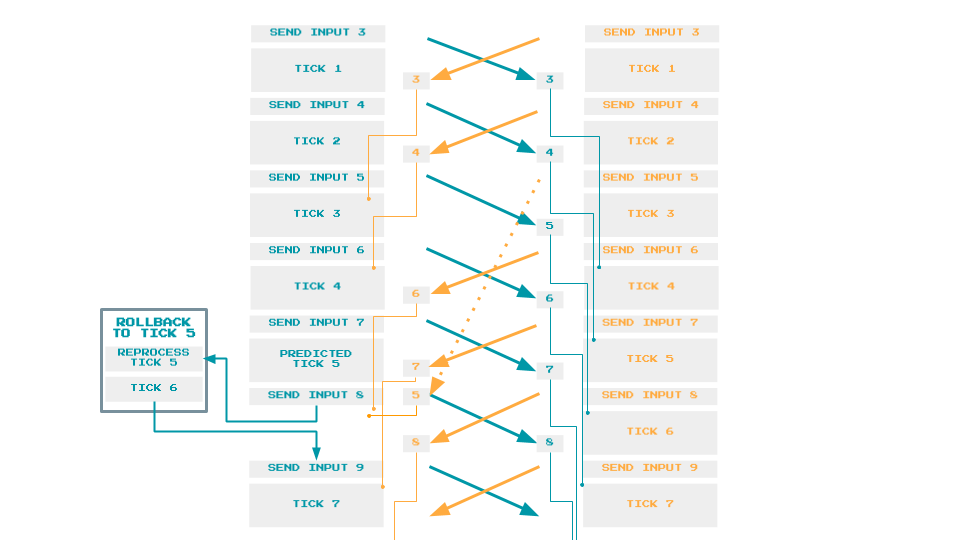 gleaming prawn
Ok, so this is just Naive GGPO
Not a problem for us...:) This is "deceiving" to say the least... IMHO
weak plinth
What's GGPO?
I'm trying to find some source for this
graceful zephyr
GGPO = Good Game Peace Out
weak plinth
I'm hearing so many different terms and I have no idea where to look
gleaming prawn
without a server acting as input management/batching
P2P style...
GGPO definitely only works in low player count cases... Actually is only super good on 2 player games.
weak plinth
So, say I have a use-case like Diablo. You suggested predict rollback
What if I keep increasing the CCU?
Should the model change at some point?
gleaming prawn
CCU in the SAME game instance? Or total CCU
CCU is normally a business-term
for the total player count
graceful zephyr
diablo style game can be built with deterministic lockstep, deterministic predict/rollback or regular fps-style networking
gleaming prawn
yeah, it gets into one of those cases I mentioned several solutions work
weak plinth
CCU in the same game instance
gleaming prawn
Depends on a few details, but up to 24/32 should be fine with predict/rollback... Up to 64 fine with lockstep...
Just out of my head... It depends on other factors
weak plinth
@graceful zephyr @gleaming prawn I need to focus in on one implementation. What would you recommend? Especially someone with my knowledge (ie, very limited)
gleaming prawn
And how good you are (that's a demanding game, you need to know what you are doing no matter the netcode, lol)
@weak plinth limited knowledge? Then use Bolt...
weak plinth
I mean, granted that I want to learn this as well
graceful zephyr
build standard fps style networking then
delta compressed snapshots or eventual consistency
determinism doesn't teach you anything about networking
gleaming prawn
Determinism is somehow easy if you are building the GAME... But the tech behind is NOT simple...:)
graceful zephyr
or very little at least
weak plinth
Well, I am planning to actually make something too, yes
gleaming prawn
networking wise it is simpler than FPS style
weak plinth
Is this a good source? https://blogs.unity3d.com/2018/10/24/introducing-the-fps-sample/
weak plinth
Ok, that should be a very good starting point then
How many CCU in one instance would this handle? Ballpark numbers?
graceful zephyr
it was built for 16 player competitive game
weak plinth
And this still works with input/state right? (As do all games I think?)
gleaming prawn
it's full snapshots
every tick
so it doesn't scale to much more than 16
or complex games with big game state... But super good codebase to LEARN...:)
graceful zephyr
@weak plinth go through the whole source code, and fully understand it, once you do that... you'll have a good understanding of classic delta snapshot networking stuff
gleaming prawn
It's the simpler classic client-server that is also top-notch (recommended for competitive FPS, etc) AFAIK.
weak plinth
Big game state would include a lot of AI?
graceful zephyr
that's like asking how long a piece of string is
gleaming prawn
🙂
game state size depends on your game
it's YOUR code
you should know how big it is...:)
That code transfers the full game state every tick (with delta compression on top)
How much does delta-C can reduce that in average Fredrik?
graceful zephyr
@gleaming prawn a lot, like 90% or something
weak plinth
I think I'm better off understanding this FPS sample first before I can judge how big the game state is
gleaming prawn
so considering you need to transfer 10% of your full game state every tick, you need sizeof(gameState) * 60/10
so 6* game state
as download bandwdth (not counting serialzation performance, delta compression performance, etc
I can judge how big the game state is
This is your game's state, not the FPS sample's
The FPS sample game state is super compact and made to fit that strategy perfectly
weak plinth
I know, but I don't have a clear idea yet on what a game state includes in total
gleaming prawn
That's why normally you also start (when creating a game) by clearly defining a model+simulation (that's decoupled from the rendering aspects)
Because THAT model is your game-state
Then you can also decide (based on other requirements as well) if you need state transfer, snapshot interpolation, lockstep determinism or predict rollback determinism...
BUT, Just check that sample, it teaches you proper custom-made snapshot interpolation
weak plinth
Yes, I will. Thank you both for the advice @graceful zephyr @gleaming prawn
graceful zephyr
np
misty shale
I think I figured out how to keep things in sync between my web server (http) and the ECS inventory data on the client.
Thinking that I’ll keep a profile version number and ping the server frequently checking the version number. If there’s a mismatch pull down the whole profile (json) and then import to entities / components
That’s the easy version, the more advanced one is where I only send the diff 🙂
For simplicity I was thinking of doing it via REST at first
But I guess I could use web sockets afterwards
jade glacier
@graceful zephyr Happen to know off the top of your head the best place to insert my traffic sniffing into the Photon Realtime code? The goal being to capture all of the overhead and not just what I am handing the transport.
gleaming prawn
@stiff ridge knows that...:)
jade glacier
ah yeah, he is online - will ping him @gleaming prawn thanks
And good morning/evening
graceful zephyr
Sorry I do not
jade glacier
No worries, didn't see Tobi was online - will harass him
and good afternoon/eve. Ever find some PID code to steal? @graceful zephyr
gleaming prawn
I found some
jade glacier
👌
No official dev server that I know of for cross Photon discussions
But I am PMing Tobi
 vital hawk
my bad (removed the message before your reply), I see that you're not their staff 😄
jade glacier
I contract with them, but I am not an employee nope
weak plinth
@jade glacier I'm sorry if I'm asking this again.
But what's THE easiest way to separate game from sim?
I need to know how I can have someone else implementing game mechanics without making multiplayer impossible in the future
jade glacier
If you want to restrict yourself, just literally limit yourself to an input struct and a master Simulate() method that everything conforms to
avoid having stuff in Update() and FixedUpdate() throughout the game
So basically EVERTYTHING related to the simulation gets buffered, and derrered
weak plinth
So all the input goes into this "central" Simulate method?
jade glacier
yeah, that is a good way to keep yourself from scattering your simulation stuff into hard to control places like MonoB Fixed/Updates
weak plinth
How do I apply these inputs to the sim then?
jade glacier
They all get buffered or queued rather than immediately applied
and your simulation only looks at the buffer for inputs for the frame it is simulating, and the previous state results
and that produces and new numbered frame of state results
Think like PhysX
FixedUpdate is actually just a "last chance before simulation" callback
weak plinth
Where would the things go that normally go into fixed?
jade glacier
You want a pre and post simulation callback
weak plinth
Suppose you have a uhm... attack mechanic with a cooldown
jade glacier
They can either go in fixed, but they just add themslves to a que or buffer...
or you create a whole update manager of your own
weak plinth
Normally I'd throw that in the fixed
jade glacier
so nothing happens until the callback fires for that phase
weak plinth
I think I saw something like this in that FPS example
jade glacier
Very possible
deferring stuff brings sanity
you want very distinct timings, and deterministic orders of serialization where you can make that happen
The deterministic order is pretty easy in monoB land for a gameobject
weak plinth
I'm trying to visualize this in my head...
jade glacier
since the order of GetComponents<> always will come out the same on all machines
There is no easy answer, because how you tackle keeping your sim clean is largely on you
But you basically want every input to land in a frame id'd buffer
and every state to be isolated into a frame bufferable form as well
weak plinth
But there's still going to be quite some stuff in (fixed)updates right?
jade glacier
So the simulate when it is called is just grabbing the inputs for that frame... and applying that to the previous state... and that produces a new state
weak plinth
Just not the inputs...
jade glacier
You can put stuff in fixed, just be aware that its going to be very hard to track the timings or order of that stuff
which is where deferment comes in
if you collect your inputs all over the place ad hoc in FixedUpdates... you will want to bring some sanity to that in creating your input struct
How you do that... is up to you
but you want to produce some form of a struct or class or whatever that you feed to the sim as your inputs
weak plinth
Hmm
jade glacier
You can be less restrictive
weak plinth
But this "sim" is the Mono's themselves also?
jade glacier
but for that I recommend an update manager
because if you don't have a monolithic sim, and your sim is actually all over the place in MonoBs and such, you will want to enforce a strict deterministic order of exec on all of those things
For example... first move all objects... then apply animators... then trigger weapon fire... etc
weak plinth
Sounds like ECS 🤔
jade glacier
you don't want player one to move... then maybe fire... then maybe change its animator... then player two change its animator.. then fire... then move
you end up with race condition hell
weak plinth
You know, this all sounds very complicated 😂
jade glacier
The point is to remove the complexity
and replace it with strict and deterministic as possible
But this is why we say the simulation part is 90% of networking
messaging is... who cares
weak plinth
Is there an easy switch between SP and MP?
jade glacier
nope
weak plinth
I mean, if you have a game that supports multiplayer
jade glacier
design for MP always
weak plinth
Is there an easy switch
weak plinth
I assume that games like Borderlands (or whatever) where a peer is a host
They use exactly the same code for sim?
Just... internal?
jade glacier
I believe borderlands single player runs itself like a MP game, but I can't say that for sure
weak plinth
I'm thinking that's the easiest way to do it
jade glacier
Typically yeah, if its going to be MP, design for that, then you are just disabling some stuff for single. But the simulation is the simulation
so its going to look nearly identical
good games should all use a strict simulation
weak plinth
But how should I see this, are you running 2 different "things" in single player?
jade glacier
yeah, Unity is guilty of encouraging it... because its an easy start
but it creates so much pain down the line
jade glacier
Getting good at isolating out a tick based sim is useful for lots of aspects of game dev
weak plinth
I can imagine less spaghetti
jade glacier
and opens the door for other stuff non MP... like smooth rewinds, replays, game saves... reduction of race conditions... less frame rate dependency and hitching... and so on
and of course determinism. Never going to get that using Time.deltaTime
weak plinth
So you're saying that, professional games are not at all developed like Unity is portraying?
jade glacier
Even Unity doesn't recommend what the tutorials show
weak plinth
Lmao
jade glacier
There are a LOT of things in the tutorials their devs are pretty appalled by. Its a tale of two game engines in one.
gleaming prawn
You mean... 95% of people that work with Unity?
Literally every tutorial online
yes
weak plinth
Well, where can I find tutorials that actually show what I need
jade glacier
Unity is quick and accessible.. but there is a price for that.
gleaming prawn
Well, where can I find tutorials that actually show what I need
Learn C..:)
jade glacier
But Unity also has a LOT of very correctly done stuff going on internally
weak plinth
I'm semi-competent with C currently
gleaming prawn
Tutorials...
jade glacier
ECS is going to be where the two worlds collide... painfully
gleaming prawn
Most of the modern tutorials are targeted at non-professional devs. So full of bad practies
jade glacier
ECS + easily accessible.... not a fun thing to try and make
gleaming prawn
Not saying those guys don't KNOW... They just don't SHOW, because the audience needs simple things
jade glacier
exactly
gleaming prawn
You have correct stuff on GDC videos, on old gamasutra blog posts
jade glacier
Everyone has the same experience... you try unity and go "wow, this is fun and easy"... then you come to these channels and everyone is like "OMG, your code is garbage"
gleaming prawn
On some papers (the one on the Tribes networking model, for example)
Or in good code like Source Engine, etc
weak plinth
I think 1 good example would help me immensely. Just to get a clear idea of what we're discussing here
gleaming prawn
Everything from Carmack is also good (the super neat ideas of his old code, etc)
weak plinth
I'll write these down
jade glacier
Doom, Quake and CS are pretty much the history of snapshot
weak plinth
You reckon that unity fps example is correct?
gleaming prawn
yes
At least the networking part
Doom, Quake and CS are pretty much the history of snapshot
This
jade glacier
I have yet to be able to even run it... laptops don't like that FPS sample
weak plinth
Well, I'm concerned about the non-network part as well
gleaming prawn
There are a few good videos from the Overwatch Blizzard team
jade glacier
The Overwatch talk is a good one too for the current interpretation of it yeah
gleaming prawn
there's another one on their ECS model
jade glacier
Even without the ECS part, there are great takeaways
like the buffer management through sim rates, and just the whole importance of deferrement
the biggest trap I see in networking is people don't defer
 dapper spindle
Anyone able to recommend a library which allows for player hosted servers and has reliable UPnP?
jade glacier
Messaging <-> Buffers <-> Simulation people break that model right out of the gate, and let Messaging and Simulation touch one another directly... and its race condition hell
gleaming prawn
reliable UPnP?
Reliable = works 75% or less (for UPnP)
if using STUN based punch it can go up to 85-90%
@dapper spindle Steam would be reliable (because it falls back to relay)
And it punches... Super well. almost 90% success rate
dapper spindle
I am not really wanting to use steam. To clarify I don't mind if users have to port forward its just the libraries I have used so far have all seemed to not work.
gleaming prawn
To clarify I don't mind if users have to port forward
You then accept that a great part of the player will just not play and be angry, right?
jade glacier
Port forwarding manually was an accepted practice in 1996
gleaming prawn
That's the benefit of something like xbox
XB doesn't allow you to do ANYTHING... It don't pass through cert
It has a nice library (Teredo)
weak plinth
I mean, for the user 🙂
gleaming prawn
and then they accept certified providers (like us and others)
weak plinth
You port forward 3079 (I think) and all games work equally
jade glacier
XBox I don't see being excempt from the whole punch issue
gleaming prawn
for the developer to do his own thing is super complicated
dapper spindle
I mean, port forwarding has become a lot easier at least thats what I remember.
jade glacier
the issue isn't the xbox... its that everyone has a router at home
dapper spindle
Well it does
jade glacier
asking users to log into their wifi router, and forward a port.. and then lock their game devices IP to a fixed IP....
gleaming prawn
Alone at least
jade glacier
not going to happen
gleaming prawn
I mean, doesn't work in PRATICE
dapper spindle
Well i mean Minecraft does it.
gleaming prawn
If you expect your home users to configure port forwarding, then fine
weak plinth
@jade glacier Well, it depends I suppose
weak plinth
There is a plethora of games where the norm is user-hosted servers
gleaming prawn
User hosted servers != solely relying on UPnP and Port Forwd
weak plinth
But if I had to manually port forward even half of my games on steam, I wouldn't even use that platform
jade glacier
but for an unknown game to be like "hey, try me... but first here are 200 lines of instructions on how to reconfigure your firewall...."
in 2000 that was acceptable because people largely existed outside of firewalls... and anyone gaming was savvy with the ways of the internet. in 2020 the average user doesn't even know what an IP is
weak plinth
I guess the majority of home routers has upnp enabled?
dapper spindle
Literally: Open router control panel > go to firewall > add forwarding rule > type in some numbers > select your device.
Done
jade glacier
Not that simple
weak plinth
I wonder about the statistics on how many people you can reach with upnp and nat traversal
jade glacier
dynamic IP
oops, you restarted your device... go do it again
Anyway, not here to debate that
weak plinth
Open router control panel
jade glacier
if you think your users will port forward... go for it
dapper spindle
I mean at least in Britain nearly all ISP routers automatically make your devices IP static when you assign a port.
weak plinth
Oh shit, what's my username/password
dapper spindle
Oh its on that sticker on my router.
jade glacier
I'm savvy, and I have to burn 15 mins whenever I have to go into my wifi router
weak plinth
Time to enter some random generated 20 character string
Because some dev is too lazy to properly make his p2p game
jade glacier
You do you though, not saying its not possible
just that as a biz model... not going to fly
weak plinth
I agree
dapper spindle
2 minutes. It literally takes me 2 minutes to do it.
weak plinth
Unless we are talking about user hosted servers
jade glacier
Then do it
weak plinth
No-one is going to use this product
I can imagine the steam reviews already
People have hundreds of games to choose from
What makes you think they will choose yours granted that they can't even play it online out of the box?
jade glacier
yup, its not 1996.... people aren't going to dick around with the modern equivalent of Kali
weak plinth
Can't play with my friends atm because I have to port forward
Fuck it, we'll play something else
jade glacier
You CAN however offer an option for self hosting
for the hardcore
but that should not be the only conduit. It should just work with punch and relay for new users
weak plinth
There are games that are client-server exclusively
Like Minecraft
And Space engineers
Etc. etc
dapper spindle
Are people really that lazy to spend 2 minutes port forwarding.
jade glacier
yup
weak plinth
It's either single player, or client-dedicated server
jade glacier
depends on the people
weak plinth
I'm not too lazy
jade glacier
but the average steam/google/apple user... will try your game... be like WTF... give it 1 star... uninstall
weak plinth
I just don't want to clutter my router with port forward rules for random games
If I have to port forward for a game like borderlands
Fuck it, not happening
Not punching random permanent holes in my firewall just for some random game
dapper spindle
Ok I can go the punch route but still, any networking library I have tried still wont work in unity.
weak plinth
Look for the compatibility that Unity has
IE anything in standard 2 works with unity
gleaming prawn
Punch needs a server to do signaling
STUN servers only provide reflexive addresses
So you are asking for a service (maybe google has something, but AFAIK they only have public STUN servers, not signaling stuff)
Maybe I'm wrong
weak plinth
How to dc websockets client side 😋
 gray pond
@dapper spindle Mirror has a UDP transport with uPnP built in, and a relay server you can host as a fallback.
https://assetstore.unity.com/packages/tools/network/mirror-129321
dapper spindle
Any suggestions for something like Lidgren or LiteNetLib
jade glacier
if you are working with a transport, just be sure to abstract it out so you aren't overly entwined with it
Same for any library, try to avoid hardcoding it into your simulation and such
weak plinth
Lidgren is pretty bad afaik
dapper spindle
I can use Lidgren, Just doesnt work in unity
weak plinth
I'd avoid it
jade glacier
So its an easy swap later when you know what you are actually needing
weak plinth
There's an entire article floating about how someone tried to use lidgren for their product
And ended up rewriting most of it
Because it was poorly implemented with very poor performance
If I can advocate for a transport, It'd be ENet
dapper spindle
Hmmm, I saw quite a few recommendations for lidgren.
jade glacier
You'll go crazy trying to pick the perfect library
which is why I suggest abstraction
dapper spindle
Less the perfect one more one that works
jade glacier
just make it easier on yourself later to change your mind
its a good practice anyway to keep that layer isolated
dapper spindle
Oh yeah it's pretty easy, I set up a chunk before even testing to see if it would work in unity.
weak plinth
@dapper spindle The problem is that there's many people that lack sufficient knowledge to determine if something's good or not (me included)
So to those people, if it works for them = good
jade glacier
Messaging <-> Buffers <-> Simulation Just keep that Messaging part connected by the thinnest thread
weak plinth
That's why things like TCP still get brought up in gaming as a good option
Disclaimer; there are use cases for tcp in games, but they are minor
Anything real-time, preferably not
dapper spindle
Eve doesnt have to be exact though
graceful zephyr
I meant in regards to realtime
graceful zephyr
TCP doesn't cause jitter by just being used
weak plinth
No, TCP causes jitter by resends
I don't know. It seems strange for games like those to use TCP.
Dealing with resends and stale data
Maybe there's a good reason that I don't know about
graceful zephyr
Simplicity and throughput @weak plinth
weak plinth
Throughput? Isn't UDP throughput going to be better?
weak plinth
Does this "requirement" for throughput have to do with the large-scale of the game then I assume?
graceful zephyr
usually yes
weak plinth
One of the things that I've taken away from the past few days conversation is that game networking has a milion different use/edge cases all with a different outcome
weak plinth
I currently have the image in my head that one specific use case has one ideal solution. But that's probably not the case
graceful zephyr
well
i mean, it depends on how specific the solution is
if you're talking about an RTS, then the ideal solution is deterministic lockstep, if you talk about an competitive FPS then the ideal solution is delta snapshots with client side prediction, if you talk about fighting games the ideal solutions is deterministic predict/rollback @weak plinth
so yes there are ideal solutions
but thats in the broadest possible sense, sure someone could come up with an competitive FPS that delta snapshots might not be good for, etc.
weak plinth
I think it's currently best for me to heed your advice and study that FPS example
graceful zephyr
yes
weak plinth
Erick told me about some useful sources as well
That paper on tribal networking seems really good
graceful zephyr
tribes you mean
weak plinth
Yes tribes 😄
graceful zephyr
tribes uses an eventual consistency model
weak plinth
Do you know of a source that gives some idea about models out there?
graceful zephyr
no
 chrome flint
Hey guys, can you help recommend a multiplayer tool I can use for a simple FPS game? Just two players who shoot each other.
I guess my priorities are that the network allows for fluid movement/actions and then second priority would be ease of use
 somber drum
lots of simple fps kits using photon that you can get setup fairly easily, pm me if you need an example of one i can link.
solar garden
What are called the ways of networking where you send inputs to the server and the one where you send a whole snapshot thing ?
 rapid girder
I have a unity project that uses PUN2 for RPC's. Problem is, I really need a server to store permanent info on (player accounts), and maybe to handle the matches themselves too (hack protection). I think I can't do those within PUN.
What services do you recommend?
graceful zephyr
@solar garden Those two are not mutually exclusive
solar garden
ahh
weak plinth
Hack protection, first of all, obfuscate ur games dll good
Or make layers of protection before working on anti cheats inside game
gleaming prawn
being honest:
- care about this only if you already have a game... successful one...
- if you don't have one, start by choosing a networking strategy (because they are going to have a big impact on the gameplay, and you need one that fits your game)
And if you are thinking about wallhacks and aimbots... Obfuscation is of very little help... Most of these hacks are done in the video card driver (adding outlines, or spotting for the aimbot at the vertex shaders).
weak plinth
Obfuscation is done many times to prevent easy stealing of software
weak plinth
Now thag i think of it what erick said is right
That
Ez af u can check about files size and shit
 jade wharf
C# obfuscation is a joke
obfuscation of code in general i would call a joke
anyone dedicated enough will figure it out
or has a software that deobfuscates it with a push of a button
weak plinth
Yah deobfuscation is ez aswell
There are enough deobfuscators out there, that can do the job for most of obfuscators
But its just an idea
You just gotta be creative and create diff layers of security
gray pond
wallhacks and aimbots
Apparently these apply to client-trusted games?
Maybe I'm missing something, but client shouldn't know anything about the interior of a building unless it's practically in the door
it should just be an empty hull at a distance...nothing in there to be outlined.
I'll admit I don't know really how aimbots actually work without altering the client source
gray pond
I don't see how having the client source would be helpful, really. client only knows what server tells it, and server doesn't tell about things that aren't near the client or would be occluded.
I just watched a video where apparently some sort of wall hack allowed the player to pass through a barred window. As far as the server's concerned, that player is still in the room, and isn't going to tell the client about anything outside that room. It will keep telling the client where the player should be, and will continue to apply player inputs as if the player is still in that room, ramming into walls. If the "molested" client ignores the position update, the player will find himself in a very empty scene.
weak plinth
Any and all data the client has can be used to cheat
And unless you plan to make the most overly convoluted system ever to only update the client with data they can actually visually see
And MAGICALLY achieve this complete bug free
Seeing other players through walls based on position data is available
gray pond
You're missing my point entirely
weak plinth
But imo, trying to prevent that kind of stuff in networking. You're doing stuff in the wrong place
gray pond
client does not know about entities the server can easily determine it shouldn't know about
weak plinth
Define "easily"
And also define how this "easily" can in no way be used for things like aimbots of wallhacks
gray pond
player A is in the street. Server knows that. Server says nothing about what's in the buildings...no spawn messages, no position updates, etc.
weak plinth
Player B is just about to walk around the corner where A is
Going to be an interesting case that 🤔
Also, going to be some juicy overly-convoluted system
Or are you planning to let the server check every frame for every player vs every other player if they can see ANY part of their character? 🤔
Playercount ^2
gray pond
If you're referring to close range, aimbot is no real help - target is too close to miss regardless
gray pond
ok stop a sec
weak plinth
And you have no idea what kind of benefit you can get if you see before-hand if someone comes walking around a corner
gray pond
I'm not going to spend hours with a 5 year old picking corner cases
weak plinth
Ok, so you come up with a flawed idea
And when I point out flaws? You call me a 5-year old?
👌
gray pond
I'm saying that some of this stuff I'm seeing in videos about aim bots and wall hacks are impossible in a server auth game - they must be trusting the client a LOT