#risc-v
1 messages · Page 2 of 1
 cinder sierra
Presumably you'd "just" need to upgrade the existing ESP32 core's version of ESP-IDF and blibble a few settings.
But I think even the ESP32S2 is lagging there.
 potent echo
@restive ice why would cpy be a no go for now?
 restive ice
No native USB and BLE/WiFi CPY loading isn’t ready yet as far as I know
MicroPython would probably work
potent echo
I tough native usb was on this chips. Even an article mentioned it was "new" as if the S2 didn't have it.
restive ice
And at least for now USB/JTAG isn’t supported on the engineering samples yet
potent echo
I'm guessing it would be the same as the saolas, just grab the pins and put a custom cable to it.
restive ice
That might be possible
potent echo
I just got my pine-pencil (riscv-inside) and also a nice NUT-01S chip. Let's see what I can do with it.
 tropic cosmos
Got my 'C3 a short while ago. Antenna sticking out (I know, it's a devkit) is a bit odd, and kinda 🤨 with teh Micro-USB, but again, it's a devkit. So, time to get these kids in bed and bust out the docs!
restive ice
😬
 fringe girder
potent echo
I just got my pine-pencil (riscv-inside) and also a nice NUT-01S chip. Let's see...
fringe girder
potent echo
I just got my pine-pencil (riscv-inside) and also a nice NUT-01S chip. Let's see...
Thats a really funny chip, a lot of the code in the sdks is taken from the ESP32 and Nordic processors
potent echo

When I got these new RISC-V ESP32 boards in my mail, I asked myself: Is this new technology revolutionary as written everywhere? What are the advantages for a typical Maker? Time for a closer look. But pay attention: It will be a rough ride and not for the fainthearted because we will talk about “stacks,” “IP,” “ecosystems,” and a lot about stan...
fringe girder
Oh yay, thanks for the notification I havnt checked my subs yet today
 random notch
 deft zinc
Oh, the C3 is RISC-V! I’ve been living under a rock...
potent echo
@deft zinc I'm getting mine here in CR probably monday or tuesday.
potent echo
Ok, I'm part of the "C3" club :). Bit late, but hey...
 ember glacier
nice fede2
restive ice
Nice! 🙂
tropic cosmos
You're going to need to change your name @potent echo - It'll have to be "fede5", or "fedeV" with all the RISC-V goodness you've got going on!
potent echo
Makes sense. Maybe "fede<3", so the V is on it's side, so it also means "loves V" 🙂
tropic cosmos
I like it!
fringe girder
I got my C3s as well 🙃
 young tusk
anyone used theirs?
cinder sierra
I am fighting with env issues about installing IDF.
restive ice
I was going to do stuff this last Sunday but ran out of time
Maybe this coming Weekend I can on my stream
Well, not this weekend but next
 willow lodge
cinder sierra
I am fighting with env issues about installing IDF.
willow lodge
cinder sierra
I am fighting with env issues about installing IDF.
Hi! Can you share the issues that you had? (Espressif guy here)
cinder sierra
willow lodge
Hi! Can you share the issues that you had? (Espressif guy here)
Mostly I need to deal with my machine's Python install.
cinder sierra
I have a very long history of my Python setup for my machines getting horked in some fashion and having to rebuild it by destroying it with fire.
potent echo
BTW, I made a fork of a qemu-riscv-debian project, and added Icecc for a compilation cluster. In case someone is working on riscv64 but needs more power for building a bunch of things... this is your place to start.

GitHub
Contribute to fede2cr/riscv-emulator-docker-image development by creating an account on GitHub.
 lean marsh
@potent echo I noticed your arch github action. I have starred it and will try and look at it.
potent echo
Here's the cluster at full capacity. 138 xeon cores.
 potent echo
lean marsh
<@!342460018433589251> I noticed your arch github action. I have starred it and ...
potent echo
lean marsh
<@!342460018433589251> I noticed your arch github action. I have starred it and ...
Sure, let me know if I can help with anything.
fringe girder
New riscv-v update:Version 0.10 (also 1.0-draft-20210129) https://github.com/riscv/riscv-v-spec/releases
This is a milestone release that is intended to be close to the 1.0 spec
potent echo
Good news for the slackware-riscv64 project. I just got an email saying I got a BeagleV on it's way.
I also plan to port as soon as I get it, Blinka, and also for Yocto.
restive ice
Nice!!
potent echo
I also had ssh access to a Xuantie C1, and was able to port and test on it PlatformDetect. This weekend I'll sort out the pinout and make a PR for blinka.
 normal kestrel
da real mvp
potent echo
mpv as the virtualization register?
The C1 has a vector unit, which is what most of the other people who has access to it where trying. Doing primer factorization and such.
normal kestrel

Dictionary.com
You the real MVP is meme that humorously applauds people for doing mundane but helpful acts.
potent echo
Sharing some news from Costa Rica, one of the state universities just built their own riscv 32bit processor, special for medial stuff (low power).
https://www.tec.ac.cr/hoyeneltec/2021/04/27/microprocesador-integralmente-disenado-costa-rica-demuestra-altas-capacidades

Hoy en el TEC
En 2020 docentes y estudiantes del Tecnológico de Costa Rica (TEC) culminaron con éxito las pruebas en Siwa, el primer microprocesador diseñado integralmente en el país. Los análisis llenaron de orgullo a los ingenieros, en tanto que demostraron que el chip funcionaba a la perfección y, por tanto, la capacidad del país para hacer lo que muy poca...
(google translate should help, if not, i'd be happy to. The papers (at the end) need either access or pay for the pdf 😭 )
restive ice
Oh that’s really cool!
 dusty sundial
I have found that emailing the authors of a paper and asking them for a PDF copy of it will often get you the paper for free.
Doesn't always work, but is worth a try
 feral dock
Can confirm. Usually the authors hate the publishing restrictions, and are more than happy to connect with interested folks. They don't see a dime of the payment anyway.
 polar tree
sci-hub is quicker 😄
potent echo
Agree. I do need to talk to the devs of the chip to see if I can get my hands on one. I doubt it, since they probably have only a handful on eng-samples.
polar tree
Haha, just read the article and they're really proud of having designed this chip (and rightly so).
potent echo
I did got my BeagleV. So let me repeat the offer I made for the sifive board. If anyone needs to develop or test something in riscv, I'd be happy to share an ssh access.
(Having said that, the load on the box will probably be very high, as I like to develop certain packages natively instead of using cross compiling. Only for some...)
potent echo
polar tree
Haha, just read the article and they're really proud of having designed this chi...
I know that some universities have their students make chips and order the silicon from the factories. But in Costa Rica, that just doesn't happen. Instead of having pico-sat project at the kindergarden level like it has happened in the US and EU, we have nation-wide pico-sats. So similarly, they have been teaching computer architecture, by writing and drawing the hardware on paper.
If anyone has ever received a programming class where they do things on paper first, you know how frustrating and boring that must be.
 normal kestrel
🤤
tropic cosmos
Copper and aluminium - getting some good macronutrients and minerals! 🙂
 keen acorn
@potent echo love it
 analog wharf
potent echo
analog wharf
potent echo
Where would I get one of those heatsinks?
potent echo
analog wharf
Where would I get one of those heatsinks?
It came like that from the factory.
 analog wharf
That's neat
potent echo
You can see the copper tubes on the right side of this thermal image. What you see in red, it's the heatsink on the processor itself. It's really cool to the touch, even with heavy load.
But it is a bit loud... (maybe we can pwm it or something)
 fair bone
Is that a Beagle?
potent echo
fair bone
Is that a Beagle?
BeagleV Starlight, yes. One of the "beta" ones.
fair bone
Ohh, I hadn't heard of that one
Oh wow, it's supposed to be ~$119, that's nuts
It's amazing what power and specs they can cram into tiny, inexpensive boards!
keen acorn
Good day kind mages, i have a artifact i am beckoning to make work.
It's creators no longer support it due to lack of customer interest and sales.
I kindly ask if you think it's possible to get the m5stickV to work with the arduino ide instead of python.
i found sipeed has a git and board defines i was hoping someone can assist me as if i make a custom board defines for it i'm not sure what k210 board i can base it on.
https://github.com/sipeed/Maixduino
https://github.com/sipeed/Maixduino/tree/master/variants

GitHub
Arduino port on Maix board ( k210 ). Contribute to sipeed/Maixduino development by creating an account on GitHub.
GitHub
Arduino port on Maix board ( k210 ). Contribute to sipeed/Maixduino development by creating an account on GitHub.
keen acorn
🤷♂️
potent echo
@keen acorn You would need to check a board where the k210 chip has the same resources (ram, flash memory) as the m5 V.
keen acorn
i'm trying but i don't even know if the display will work
i can build it
but i have no idea if it's doing anything and dont have the tools
potent echo
It's best to try it with a serial console first, and then move up the the screen.
And tools, for now, only a serial console is needed. I don't think there is need for jtag or logic analyzer so far.
keen acorn
ok
potent echo
So, it did flashed ok, rebooted, and then no output.
keen acorn
yes
@potent echo
sorry been busy the weekend.
Basically now flashes perfectly.
and serial monitor can connect.
The display is flickering agressively and i think it's not good for the back light driver.
Not sure if this is related to the AXP or most probably display is not correctly configured.
potent echo
Sounds great.
The flicker might be some garbage random data on the screen when it turn on. As soon as some code initializes the screen, it might go to black as expected, I suppose.
That is a very nice riscv board, keep us posted on what you do with it.
And as soon as you publish the changes (I'm a kinda 'realease early-release often' person, a-la ESR), I'm sure the m5 people will love to hear you got it working with arduino.

keen acorn
close to sharing my git as soon as the screen works
from there people hopefully assist with the dirtier parts
potent echo
Now I want one... 🙂
keen acorn
- they should have made more pins available.
- they should have kept the esp32 onboard.
- she gets hotter than 50*C fast.
- the battery is there for the pure existence of being a ups
Sipeed have gone to make the k233 way faster.
but m5stack have decided to make their v2 arm based and took time to add a fan to v2
potent echo
- I'd try to use i2c and chain stuff up.
- I like that they try to experiment with riscv32 hardware, very little people are, and very few options are available.
keen acorn
i should tell you my idea for what i want to use this for 😂
you gona either laugh or hate me
potent echo
- Wow, that is hot for a microcontroller. I like them, because they are so small, that they are a perfect size-model for a camera trap project I'm working at the moment. There, it would only fire every time there is movement or something like that.
- Same, maybe for video with AI it's not ideal for that battery, but maybe pictures, then sleep, then AI... something like that. It is a very small thing.
potent echo
Yeah, I have face tracking and other goodies with the maix boards. So cheap and cool, and yes, with esp wifi.
I did wanted a k210 "+" chip with native usb, so that  would be a nice option.
keen acorn
i have played with the ai enough to be bored at this point till i can get a nvidia marvell core
potent echo
keen acorn
you gona either laugh or hate me
I love all sorts of projects. 🙂
keen acorn
ironically i am making a small fps rouge like that works with minimal part on a esp32
and the nice thing is i made it so you can play it in many ways
different hardware configs
potent echo
Something I am really amazed with, is the "gpu" for circuitpython that lady ada showed only a week or two ago.
keen acorn
so i figured why not have a esp32 feed the player position in game and have the k210 emulate a software version of opengl 2.0
potent echo
That thing moooves...
potent echo
The Gameduino 3X Dazzler is an Adafruit Feather M4-compatible underwing that outputs HD picture and sound to any HDMI display or TV.The Dazzler is ideal for game designers ...
potent echo
Same here.
potent echo
Trying to make hardware to sell to try to get some extra...
potent echo
Yeah, it's a cool cheap fpga, and animated gif, or the video from new products, it looks so sharp. None of the linux screensavers look so nice.
Similar thing here, before covid I'm starting to organize people in central america. I want to get a nice big pick and place, and offer at-cost services to people that make open hardware.
keen acorn
i watched one guy config a ai core to show the patterns of ant movement
and resulted in fungal simulation
game dev tools are crazy these days
potent echo
With a friend, before covid, we were also trying to film some native stingless bees, to see if we can catch their 'bee dance' and compare it with apis.
keen acorn
fascinaling
you see this is true science
what i live for
when i was a kid i dreamt of this stuff
now i'm 38
ans it's all become reality
potent echo
We are still the same kid that played with microscopes, and coded in atari 🙂
potent echo
I had an atari XE. Miss not having it around.
keen acorn
i would like to see a kid of 8 put in a tape in a drive and go "is it doing something?"
i had a HP 486 laptop that was built like a brick for the army
it had 2x 20A 19V lithium cells
it was used to run a misle system
and had 4 lpt ports and 8 serial ports
and i loved it
eventually the old ide drive died and a friend wanted her
When they discharged my old man they gave it to him and he bought a 166MHz beast
the earth quaked
good times
potent echo
The one-core D1 riscv SBC from Japan are showing their lovely head.
https://twitter.com/SipeedIO/status/1394121356153815044/photo/1

Newest RV64 D1 EVB is almost ready ! (photoed in SMT factory)
It will release this week~

 Twitter
·
keen acorn
Twitter
·
keen acorn
interesting
potent echo
There here. Or.. there.
https://www.aliexpress.com/item/1005002668194142.html

aliexpress.com
Smarter Shopping, Better Living! Aliexpress.com
potent echo
It's a risc-v plague 🙂
https://twitter.com/M5Stack/status/1395341525140185093/photo/1


 keen acorn
@potent echo
turns out the stickV was not getting serial.. i connected to the wrong com port.
the core runs but the pin config is a problem.
so i need to figure out how to port all of this

and i even found the schematic to verify this..
but i have no freaking idea how to get all that... into the arduino variant list

🙇♂️
i have been trying for days and i'm just getting more confused
i'm not sure what i need to define
i'm gona try remove all the trash 1st
and then just define the serial pins for a start
potent echo
Yup, I like that approach. And don't despair, it does look like you are on the right track.
I've been doing something similar with blinka for the BeagleV and got stuck with an error message saying I don't have a library that I just installed. So I'll give it a short rest while I tend to other things, and then get back to it with a fresh mind.
keen acorn
ok so i think i know whats happening, the flash is not completeing
so i'm gona grab the packed bin and test manually flashing it
 last gull
adversin erm i mean "exclusive" shirt
potent echo
Another good news for riscv, it's a uart/jtag based on the BL702
https://www.cnx-software.com/2021/05/28/rv-debugger-plus-uart-jtag-debug-board-bl702-zigbee-ble-risc-v-soc/
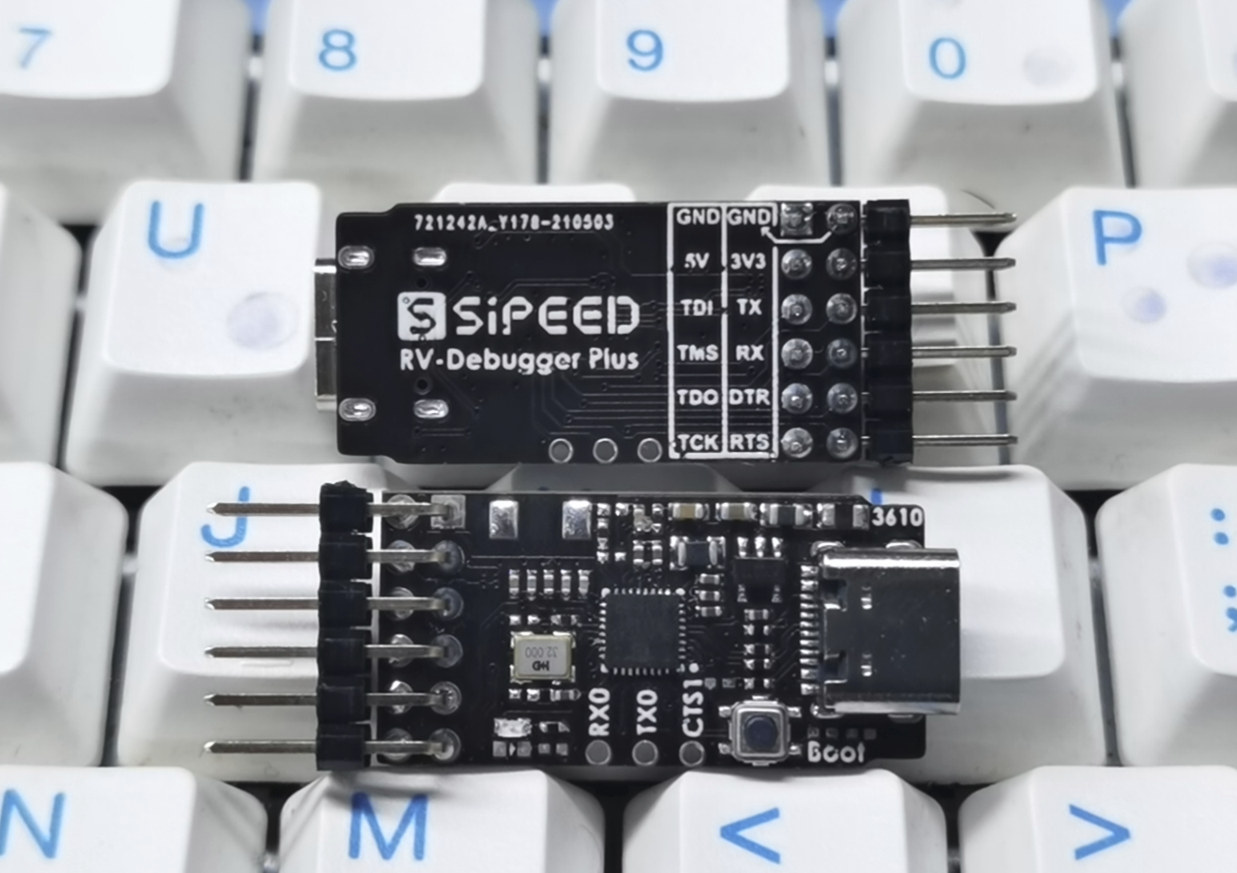
Sipeed RV-Debugger Plus UART & JTAG debug board features Bouffalo Lab BL702 Zigbee & Bluetooth LE RISC-V SoC for IoT & Smart Home products.
This is another set of chips which are quite cheap, and if they can now be used for multiple things other than just radio stuff, it's cool imho.
keen acorn
i removed the post as it's arm based not riscv
ok so now i'm making progress
i grabbed the built rom and manually flashed.
And the serial terminal is connecting
now
getting the AXP192 configured so the display stays on and i can then look at the display controller
restive ice
There’s not really a VLSI channel so this is probably the closest to being on topic. A few months ago I started a IRAD division of my main company Oak Technology Holdings, LLC called Oak Semiconductor Company.
I wanted to start an open source fabless semiconductor company because why not? I have taken plenty of electrical engineering courses and VLSI design courses as well. So this weekend I’m finally able to take the first steps in starting the design process for my first open source IC.
Im hoping to get on one of the free Skywater shuttles, but if not I’m going to possibly fund one of the paid die slots that is $10k.
I’m pretty excited for this journey, and I plan on sharing as much as I can in the coming months about the process and the designs I generate
polar tree
Sounds exciting!
 thorny lichen
Hi guys!👋
I'm not able to compile the Adafruit LIS3DH library for ESP32-C3 DevKit M1 board....can somebody help ?

 restive ice
and another NAND gate
 restive ice
now here's an AND gate

the building blocks to a RISC-V processor
What’s interesting to think about with these is how the width of the polysilicon channel affects Vgs, speed, current, parasitic capacitance, etc.. with these gates.
So nonchalantly making the channels of the gates the same isn’t necessarily the right thing to do though I can be in some applications
 wicked oar
restive ice
now here's an AND gate
wicked oar
restive ice
now here's an AND gate
This looks interesting, but I have absolutely no idea how to read these images. Is it the actual channels in the silicon?
restive ice
So the red bits is the polysilicon
The green represents p channel substrate and brown/orange represents n channel substrate
The hatched line is n-well, the general design area is p-well material
The blue would be metal layer or basically the wires
wicked oar
wow, so it's the actual materials level implementation of the circuit?
restive ice
Yeah
wicked oar
That's really something cool!
restive ice
It’s what would be laid down when they make an IC
I took some VLSI courses but didn’t do anything with them until now
And with more emphasis with open silicon design, it’s a perfect opportunity to use the knowledge
wicked oar
That is really neat. I never had enough time to take any of those materials courses in college but I had always wanted to know what was going on at that level. This is really cool to see you setting up and laying stuff out!
ember glacier
good way to learn
restive ice
The hard part is reorienting myself with what I know and expanding complexity from there
So I started with an inverter and have made two types of nand gates and an AND gate.
Going to make an OR gate and XOR gate
Then make a ripple carry adder
wicked oar
"The hard part" as you do some really complex and tough stuff.
I'm looking forward to seeing you work with this more!
restive ice
I’m hoping they will add a VLSI channel because it’s really interesting stuff and there are plenty of people coming in and asking about making their own microcontrollers and whatnot
Even if you just learn how to do it on VLSI software, that’s a fun thing to do in general. And you learn a lot too about architecture
restive ice
I shared this in the livebroadcast channel but I figured I’d share this here as well with a few more details

This gate here represents a 2-input OR gate
The cmos model like this works is exactly how the OR gate works
When we apply an logic 1 to A, B we are turning on the nmos gates associated with those inputs
We can see that Vdd is connected to the ends or basically the inputs for the gates. Even with only one on, we provide Vdd to F which is the output
But when both A B inputs have logic 0 voltage levels, then the pmos transistors are on bringing the output F to ground.
If you swap the nmos and pmos configuration we get a NOR gate
potent echo
Yay, I'm a RISC-V intl member (individual).
ember glacier
good job @potent echo
fringe girder
restive ice
I shared this in the livebroadcast channel but I figured I’d share this here as ...
Playing with the skywater stuff?
restive ice
fringe girder
Playing with the skywater stuff?
Skywater PDK will be fun to use. But I’m not quite there yet
I’d love to get on one of the free shuttles
potent echo
Is it giving an error? Maybe it has less memory and it's filling up after a while?
keen acorn
possible
restive ice
So it turns out the ESP32-C3 mini module can now be ordered from Digi-Key
 versed prairie
Hi.
 coarse relic
Elektor Press has a book out on the RISC-V architecture, available as both paper and ebook: https://www.elektor.com/inside-an-open-source-processor
restive ice
Ohhhh
potent echo
I'm guessing you folks have seen the ESP32-H2 chip, which is riscv, but also BT + 802.15.4, which is nice because I've been wanting to play with Thread (mesh for IoT) for a while.
ember glacier
nice
restive ice
Yeah, I did see that! Super cool chip I’d love to get my hands on
ember glacier
having BLE in it is so awesome
feral dock
I'm very curious about the price point, too.
coarse relic
It's confusing to name it that, as the other ESP chips are Extensa.
 cold umbra
Actually there is also esp32-c3 which is also risc-v
potent echo
It says on the README: "I would really love if someone takes a shot at a RISC-V implementation!"
https://github.com/rust-embedded/rust-raspberrypi-OS-tutorials
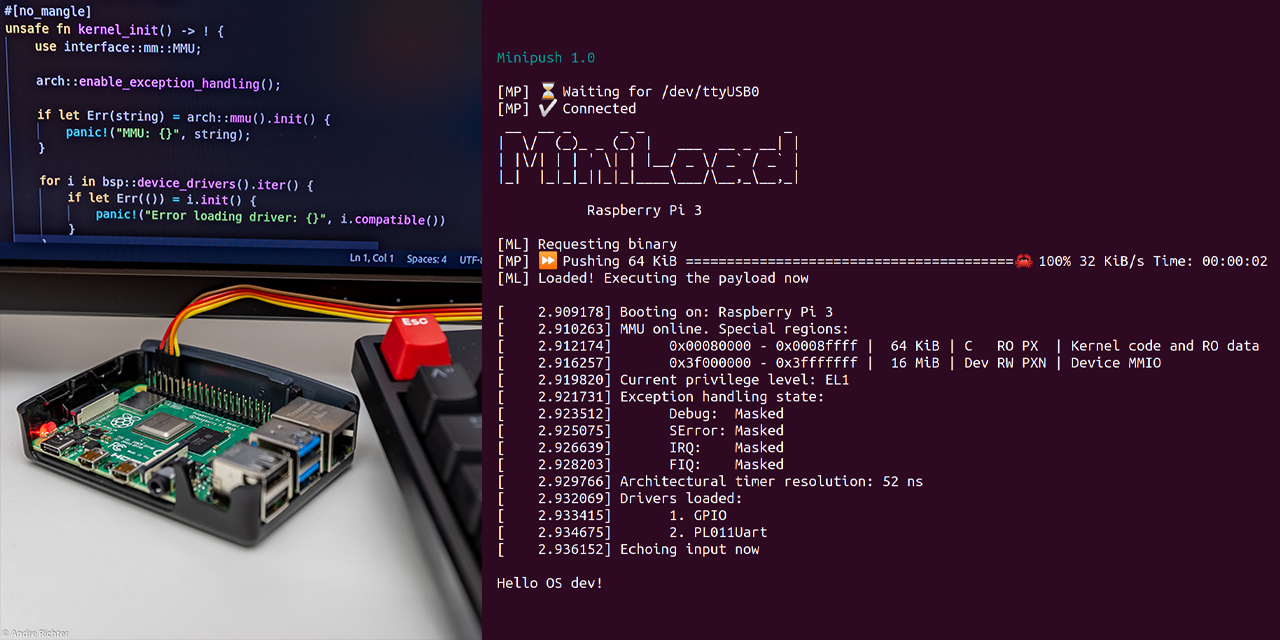
GitHub
:books: Learn to write an embedded OS in Rust :crab: - GitHub - rust-embedded/rust-raspberrypi-OS-tutorials: Learn to write an embedded OS in Rust
But even on the Pi, it could be a useful reference for @young tusk
young tusk
good find! /me looks
normal kestrel
learning bare metal pi os dev or rust?
 ebon wagon
I really hope a professor takes that and uses it for a university operating systems course...
young tusk
bare metal pi
keen acorn
@potent echo ok i made progress with compiling C++ for the k210
i ditched the arduino ide and went for the stand alone sdk.
display working, pmu configured, serial working.
Also way faster than python.
keen acorn
i'm having problems with sd cards but that seems well known issue sadly
 acoustic wind

 minor lynx
does anyone know how many instructions risc-v and its extensions have? The base ISA has 47 instructions I believe. Update: I counted 481 'good' risc v 64bit instructions (including base 32)
 shrewd pollen
Hello. I have been curious about RISC-V for a couple of years since a friend of mine mentioned being interested in it.
Would it be completely crazy to try to learn about it by poking at one of the ESP32-S3 boards?
feral dock
Do you mean the ESP32-C3? I think the S3 is the original LX7 CPU architecture.
shrewd pollen
I think you are right.
shrewd pollen
I'm trying to figure out if it would be an interesting way to play with an architecture I don't know, or just a frustrating experience reminding me I don't know C very well.
Because I haven't done machine code since college, and I don't know where I would find a RISC-V emulator to play with.
But I haven't looked, so I could just be ignorant.
feral dock
I think the good old QEMU supports it, for example.
shrewd pollen
Yeah, it does.
I think I'm not specifying what I want very well, though.
What I want is a simulator that I can manually clock, that will show me which logical wires are connected and for how many clock steps, to execute the instructions.
For a simple RISC-V processor.
feral dock
Ah, in that case you probably want a Verilog simulator running one of the RISC-V open-source IP cores. You can trade off the core design you want to be simpler or more heavily pipelined.
coarse relic
Seeing all the wires for RISC-V seems like it would be bewildering, but there are some great graphical simulators that show the operation of simpler CPUs at the transistor level.
acoustic wind
@shrewd pollenNot exactly what you are looking for, but perhaps useful (graphical RISC-V simulator). https://guillaume-savaton-eseo.github.io/emulsiV/
shrewd pollen
But it's in the neighborhood of "I want to understand how the RISC machine code moves around the logical parts of the chip"
Which is part of where I want to be.
This is why "What is the problem you are trying to solve?" and all its better-phrased variants is such a vital question when in figuring out which information to give people.
shrewd pollen
@acoustic wind that graphical RISC-V simulator is a lot of what I was looking for, and a great starting off point. Thank you very much!
It's been fun to play with and step through.
acoustic wind
Cool. It seemed well done. 🙂
shrewd pollen
Part of what I eventually want to get around to is to have a better grasp on how deep the pipelines are in the RISC-V architecture. I have a very fuzzy grasp on the pipelining contexts in x86 CPUs, and my understanding of the situation was that simpler instruction sets could enable shallower pipelines and lower branching penalties.
And I have the brain bandwidth this week for some of that. 🙂
feral dock
shrewd pollen
Part of what I eventually want to get around to is to have a better grasp on how...
That'll vary in different RISC-V implementations... it's not really a defined part of the architecture itself.
shrewd pollen
Fair enough.
Getting a handle on the instructions and excavating the parts of my brain that used to know MIPS assembly is kinda the first part.
The little-endian messes with me, though.
I'm not used to it and it lays out in memory in ways that I don't immediately expect.
acoustic wind
Endian is a "simple" thing that is surprisingly confusing. 😅
 worthy shuttle
I doubt that will be the.. endian of the matter...
 grave abyss
i just now noticed this channel!!! I'm going to be lurking excitedly. RISC-V is just above my skill level right now but I'm so excited by the concept of open source processors!
i've had 2 computer architecture classes but no hands-on experience yet
 lyric shadow
been trying to learn how to use CP libs on the MP core available for the c3-devkitc-02, bewildered and befuddled
 ionic ermine
during computer architecture I used to use this webRISC simulator to learn: https://webriscv.dii.unisi.it/
Load Program at the top lets you write instructions.
Execute ALL
And check the Registers on the left.
e.g. addi s2,x0,1 will load 1 into Register s2.
grave abyss
@ionic ermine that's cool, did you get good at using it eventually?
minor lynx
whats going on with riscv gpus? Are there none available right now
acoustic wind
@minor lynxHello. 🙂 It sounds like it is making some progress, but still a ways off from a product AFAIK However, e.g., this seems interesting https://www.youtube.com/watch?v=h1xDQILSZnI
minor lynx
acoustic wind
<@!234196445576691713>Hello. 🙂 It sounds like it is making some progress, but...
thanks, there was also an SIMT ISA for it too i think
ionic ermine
grave abyss
<@!226080676380803083> that's cool, did you get good at using it eventually?
Not really, I wanted to take a hardware course, so I learned how CPUs worked though the RISC-V ISA, with the ultimate goal of (hopefully one day) understanding a variety of Quantum computers.
potent echo
minor lynx
whats going on with riscv gpus? Are there none available right now
Here's a bit of info about free gpus. Work in progress as well.
https://lists.freedesktop.org/archives/mesa-dev/2022-March/225701.html
potent echo


I flashed @CircuitPython v7.2.0 on my new #Espressif RISC-V ESP32-C3 dev board. The video is a quick test of the onboard RGB. https://t.co/iB56JMM6Oi
Twitter
·
acoustic wind
Nice RISC-V Guide: https://github.com/mikeroyal/RISC-V-Guide

GitHub
RISC-V Guide. Contribute to mikeroyal/RISC-V-Guide development by creating an account on GitHub.
 visual helm
Today, my QT Py ESP32-C3 arrived, and I look forward to test driving Adafruit's RISCV board!
I intend to use it with the Arduino IDE, but to my surprise, the board got mis-identified? Arduino reports it as an ESP32-S3, instead of an ESP32-C3.

This is with the boards manager pointed to Adafruit's board list: https://adafruit.github.io/arduino-board-index/package_adafruit_index.json
I also have the boards list for esp32 in the manager: https://raw.githubusercontent.com/espressif/arduino-esp32/gh-pages/package_esp32_dev_index.json
 sleek nebula
visual helm
I intend to use it with the Arduino IDE, but to my surprise, the board got mis-i...
sleek nebula
visual helm
I intend to use it with the Arduino IDE, but to my surprise, the board got mis-i...
That's actually kind of funny, because the ESP32-S3 reports as ESP32C2 Dev Module in the Arduino IDE.
It should still work fine. Apparently they recycled the VID or whichever thing it is that makes it show up as something, so it shows up incorrectly. But, I'm surprised that they show up as each other. Either way, it's on espressif's end, and you should still be able to use it.
visual helm
Heh heh.. so someone seems to have switched the IDs.
sleek nebula
Apparently!
visual helm
I also have an ESP32C3 devkit from Espressif. I checked, and when I plug that one in, Arduino IDE just reports ttyUSB0 without a device name.
sleek nebula
Did you go ahead and try loading a sketch?
Oh, hmm, I'm not sure if the C3 has a ROM bootloader, which is one way to make it show up as a dev module.
Or rather, if you can put the devkit into the ROM bootloader.
I'm only familiar with the QT Py.
visual helm
One sec... I will upload something the the QT Py C3.
sleek nebula
I assume you must be able to get to the ROM bootloader, because it's required for using esptool I think.
I do have one here I can test if needed.
visual helm
Yeah, programming works...
sleek nebula
Great!
visual helm
I uploaded the GetChipID example...
sleek nebula
So basically, keep your BSP updated, and perhaps espressif will fix the issue eventually.
visual helm
13:48:55.131 -> ESP32 Chip model = ESP32-C3 Rev 3
13:48:55.131 -> This chip has 1 cores
13:48:55.131 -> Chip ID: 3306520
So the chip itself knows what it is 🙂
sleek nebula
Nice!
visual helm
BSP?
sleek nebula
Arduino Board Support Package. It's what you install through the "Board Manager", and it's what lets you choose a specific board to load a sketch onto.
visual helm
Ah, ok. Thanks for your help!
sleek nebula
You're quite welcome!
restive ice
Wow, Espressif announced all their future products are going to be RISC-V!

@robertlipe Yes. In fact all of the subsequent chips are RISC V.
Twitter
·
ember glacier
that is good news
visual helm
Neat! Hopefully they will bring one that has 2 cores, like the ESP32 and ESP32-S3 have.
 green flare
Seems so
 minor lynx
whats the scalar rf? Like a unit that processes radio frequency signals?

oh never mind its register file I think
coarse relic
They're not very forthcoming with details, but I found this diagram
 ionic ermine
Anyone see the new M2 presentation? https://www.apple.com/apple-events/event-stream/
 ionic ermine
No...my textbook says apple used ARM processors and NPUs.
young tusk
they did in M1
potent echo
I now have a bigger collection of RISCV64 boards, and I'm in the process of a. building a compilation/general cluster for slackware-riscv64 and a new CBL Mariner port; and b. making it available to software developers or all kinds, hopefully via github runners in a near future (dotnet deps).
If anyone needs access to it, let me know and I'll try to accommodate you dev needs.
minor lynx
potent echo
I now have a bigger collection of RISCV64 boards, and I'm in the process of a. b...
I could test an OS on it?
potent echo
Not directly, as I have no good way to share a serial console, and boot drive, but if you need to test something up, I could test it out for you.
The problem there would be iterating, but let's see what can be done.
 lone dew
Seeed Studio have announced a new XIAO ESP32-C3 https://www.seeedstudio.com/Seeed-XIAO-ESP32C3-p-5431.html

Seeed Studio XIAO ESP32C3 is a thumb-sized microcontroller, equipped a highly-integrated ESP32-C3 chip, built around 32-bit RISC-V operating up to 160 MHz. By 2.4GHz Wi-Fi and BLE wireless capabilities, along with low-power cost and charging ability, it provides a perfect solution for various IoT controlling scenarios and wearable device applica...
 unique sand

Why is RISC-V’s popularity growing, what are the specs of the new laptop, and could this help push the use of Linux onto everyday users?