
#live-broadcast-chat
1 messages · Page 158 of 1
 strong acorn
 turbid sparrow
I remember watching that a while back, really cool tool
 gusty wedge
Yup, it is. My bad.
In wifi they call those two "suscriber unit" or SU, and AP.
Yeah, just by moving the tools out, it should shrink the lib a bunch.
strong acorn
UDP is not implemented properly / fully in current esp32spi, but can be used with workaround
gusty wedge
no problem with the image here.
strong acorn
e.g., battery level on co-processor
(GetAnalogRead)
Yes, PWMOut.py and digitalio.py are abstractions to make the API like circuitpython, using the underlying NINA capabilities
 fair fulcrum
@rapid hornet What is your reason for choosing Sublime Text? it there particular things you like about the way it works?
gusty wedge
_esp instead of esp? (line 101)
strong acorn
We'll need pinouts for each variation of ESP32 co-processor, to be able to use native circuitpython digitalio, or does digitalio not really care?
Can add pins "34, 35, 36, 39" as inputs (maybe 37,38 on some boards)
gusty wedge
On twitch, you can "move" the users on your stream to Nina's (once you are done)
Good stream @rapid hornet, thanks. Yeah, keep doing them.
strong acorn
Looking forward to using the re-architected network stack 🙂
fair fulcrum
i would get lost so fast moving that much stuff around.
 rapid hornet
totally covered this up and missed these chats. sorry all!
@fair fulcrum I like how sublime is fast. I don't use most of the fancy features
thanks @gusty wedge
fair fulcrum
=^-^=b
rapid hornet
@strong acorn native digitalio won't work with the coprocessor pins
rapid hornet
just using the DriveMode and Direction values
 haughty quiver
@rapid hornet this screenshot looks like you got into MakeCode in a really big way :]
rapid hornet
Haha
fair fulcrum
LOL!
 cobalt harness
Hello.
First off, Happy 4th!
I’m thinking of ordering the oshwa badge assembled. However, @wanton dome, you mentioned that is very similar to the Adafruit CLUE. So, I’m now wondering, what additional features does the badge have? And should I get a CLUE to play with for now, or should I just get the badge?
 wanton dome
@cobalt harness The badge is a watch, so there's that. In terms of sensors they both have the same type of sensors, but I was wrong about them having the same exact sensors. Close, but not the same:
CLUE vs OHS2020 Badge
9DoF IMU
LSM6DS33 Accel/Gyro + LIS3MDL mag vs LSM9DS1

Temp/Hum/Press:
SHT Humidity+ BMP280 temp & pres vs. BME680 Temp, Press, Hum

PDM Mic vs. SPH0645LM4H-B Microphone

Buttons/Pins:
2+Buttons + Microbit conn., reset  vs 4 user buttons

Battery Connector:
JST PH-2 vs JST SH-2

Both:
APDS9960 Proximity, Light, Color, and Gesture Sensor
Quiic/Stemma QT Connector
You'll have to look up the datasheets to see what the functional differences between the sensors are but generally speaking they're all very similar and provide the same capabilities
@cobalt harness You said you were thinking of ordering the badge assembled; where from?
One of the designers, Michael Welling is going to do a crowd funding campaign for them but he's going to do some modifications to the design first
@cobalt harness you can sign up for in to about the ChronoPy at the bottom of the page here:
https://www.hackster.io/launch
Hackster in partnership with GroupGets, bring your hardware to life.
haughty quiver

Twitch
Microsoft MakeCode brings computer science to life for all students with fun projects, immediate results, and both block and text editors for learners at different levels.
Live!
 inner spade
YouTube is alive!
haughty quiver
swell!
 viral sail
Hi.
inner spade
Music audio level is very low, -24db
Voice audio level is low, as well.
@haughty quiver Better, level is about -12db now. No clipping.
Board sound level is very low on this end.
No echo, though.
Much better! Putting the mic closer to the speaker helped significantly.
gusty wedge
Hi.
 solid wyvernBOT
adafruit is live at https://www.twitch.tv/adafruit

Twitch
Adafruit was founded in 2005 by MIT engineer, Limor "Ladyada" Fried. Her goal was to create the best place online for learning electronics and making the best designed products for makers of all ages and skill levels.
gusty wedge
Very cool way... using direct midi notes/ is the worst :).
 wind spoke
Why not just do index+45 ?
inner spade
Relatively simple in CircuitPython: ```python
list of valid note names used by note_lexo, note_name, and name_note helpers
note_base = ['C', 'C#', 'D', 'D#', 'E', 'F', 'F#', 'G', 'G#', 'A', 'A#', 'B']
def note_to_name(note):
""" Translates a MIDI sequential note value to a note name. Note values are
of integer type in the range of 0 to 127 (inclusive). Note names are
character strings expressed in the format NoteOctave, such as
'C4' or 'G#7'. Note names can range from 'C-1' (note value 0) to
'F#9' (note value 127). If the input value is outside of that range,
the value of None is returned.
"""
if 0 <= note <= 127: # check for valid note value range
return note_base[note % 12] + str((note // 12)-1) # assemble name
else: return None # note value outside valid range
def name_to_note(name):
""" Translates a note name to a MIDI sequential note value. Note names are
character strings expressed in the format NoteOctave, such as
'C4' or 'G#7'. Note names can range from 'C-1' (note value 0) to
'F#9' (note value 127). Note values are of integer type in the range
of 0 to 127 (inclusive). If the input value is outside of that range,
the value of None is returned.
"""
name = name.upper() # convert lower to uppercase
if (name[:1] or name[:2]) in note_base: # check for valid note name
if '#' in name: # find name and extract octave
note = note_base.index(name[:2])
octave = int(name[2:])
else: # find name and extract octave
note = note_base.index(name[0])
octave = int(name[1:])
return note + (12 * (octave + 1)) # calculate note value
else: return None # string not in note_base
Note to frequency to note is fairly easy, too.
def note_to_frequency(note):
    """ Translates a MIDI sequential note value to its corresponding frequency
          in Hertz (Hz). Note values are of integer type in the range of 0 to
          127 (inclusive). Frequency values are floating point. If the input
          note value is less than 0 or greater than 127, the input is
          invalid and the value of None is returned. Ref: MIDI Tuning Standard
          formula.
    """
    if 0 <= note <= 127:
        return pow(2, (note - 69) / 12) * 440
    else: return None  # note value outside valid range

def frequency_to_note(freq):
    """ Translates a frequency in Hertz (Hz) to the closest MIDI sequential
          note value. Frequency values are floating point. Note values are of
          integer type in the range of 0 to 127 (inclusive). If the input
          frequency is less than the corresponding frequency for note 0 or
          greater than note 127, the input is invalid and the value of None
          is returned. Ref: MIDI Tuning Standard formula.
    """
    if (pow(2, (0 - 69) / 12) * 440) <= freq <= (pow(2, (127 - 69) / 12) * 440):
        return int(69 + (12* log(freq / 440, 2)))
    else: return None  # frequency outside valid range
 dense marlin
Hi there!
inner spade
Yeah. Multithreading in MakeCode is so much simpler!
 tiny axle
Where is the speaker on the microbit, I haven't looked at mine in ages
 cinder wind
actually... having a threading model in CircuitPython would be really useful (and doesn't have to be "real" threads, just coop multitasking with a "yield" construct)
tiny axle
Multiple voices
dense marlin
Multithreading must be supported by the language or by the microcontroller or both? In Open Roberta I can’t multithreading with microcontrollers also supported in MakeCode.
cinder wind
You can do cooperative multitasking without any language support with a timing library. This is how a lot of Arduino libraries work, they'll have an 'update()' method that should be called as frequently as possible. Not sure how this maps onto MakeCode. For CircuitPython, looks like this is the issue where people are talking about it: https://github.com/adafruit/circuitpython/issues/1380

GitHub
These are some strawman thoughts about how to provide handling of asynchronous events in a simple way in CircuitPython. This was also discussed at some length in our weekly audio chat on Nov 12, 20...
 sterile forge
How about pitchbending the held cord
tiny axle
ouu nice
viral sail
Thanks JP.
inner spade
Thanks!
dense marlin
Thanks @haughty quiver
haughty quiver
thank you all!
gusty wedge
Thanks @haughty quiver , very cool as usual
haughty quiver
Clearly I love this stuff and could have gone on another hour or two :]
cinder wind
can't believe how easy it is to do MIDI on MakeCode
inner spade
It's a very well thoughtout extension.
haughty quiver
I looked up and was like "uh oh, I need to end this, there's usually another show scheduled right after!"
The biggest questions I have are: what would it take to add USB MIDI support proper (instead of serial over USB and a software bridge) and can we get the extension on MakeCode Arcade and CPX.
Hi @dense marlin !
Thanks @gusty wedge
dense marlin
Oh, Midi on Arcade and CPX would be nice.
cobalt harness
?showtimes
 arctic abyssBOT
MakeCode Live - 3pm ET Tuesdays
3D Hangouts - 11am ET Wednesdays
Show & Tell - 7pm ET Wednesdays
Ask an Engineer - 8pm ET Wednesdays
Desk of Ladyada - Random hacker times
John Park's Workshop - 4pm ET Thursdays
John Park's Show & Tell - 5:30pm ET Thursdays
Deep Dive w/Scott - 5pm ET Fridays
 pastel barn
Hey @haughty quiver I tried setting up serial midi but to no avail. Any suggestions?
haughty quiver
Hi @pastel barn I used this to bridge the serial to midi https://github.com/raspy135/serialmidi
GitHub
Serial to MIDI bridge Python script for OS X and Windows - raspy135/serialmidi
The video on this page shows the setup for the IAC driver on the Mac https://support.microbit.org/support/solutions/articles/19000053392-how-do-i-play-a-midi-instrument-on-the-micro-bit

Help & Support
There are extensions for MIDI and MIDI-over-Bluetooth for the MakeCode Editor. To use on a computer, you can output raw MIDI serial data, then use Hairless MIDI to convert the serial data to MIDI and playback on a MIDI device of your choice....
If you are using an os other than Catalina you can try Hairless Midi instead of that Python script.
pastel barn
I only have catalina
haughty quiver
Same
pastel barn
And you can't rollback your time machine backups so I didn't wanna risk anything
Thanks man, I'm VERY new to this but I stumbled across your video minutes after I googled microbit midi controller so hopefully I can get at least the basics
haughty quiver
Right on, that's funny as I just streamed that today :]
pastel barn
Haha, yeah I think the upload was like "34 minutes ago" when it hit my results
perfect timing
haughty quiver
Good luck, LMK if you run into difficulties with that setup.
 waxen thistle
Good morning all you wonderful folks!
 wise iris
good morning!
 split gazelle
good morning everyone
 hard hollow
morning folks ☕️
 lavish patrol
Good day, good people.
waxen thistle
Morning @wise iris, @split gazelle, @hard hollow, and @lavish patrol !
 nova totem
Good morning everyone - at least until a conference call takes me away
 rocky reef
good morning !
#3DHangouts Episode #288 LIVE – LED Hourglass and Card Holder https://www.youtube.com/adafruit/live #3DPrinting
Enjoy the videos and music you love, upload original content, and share it all with friends, family, and the world on YouTube.
lavish patrol
Bleeps and Bloops.
 median meteor
Hello folks!
gusty wedge
Hi Everyone.
 signal solar
When I go to the YouTube link, I get "Video Unavailable. This video is restricted". I'm getting this on my computer and iPad. Any ideas why I'm unable to view the video?
lavish patrol
Despite the name, we are not discordant.
gusty wedge
@signal solar https://www.youtube.com/watch?v=HEfwRtWz4IA ?
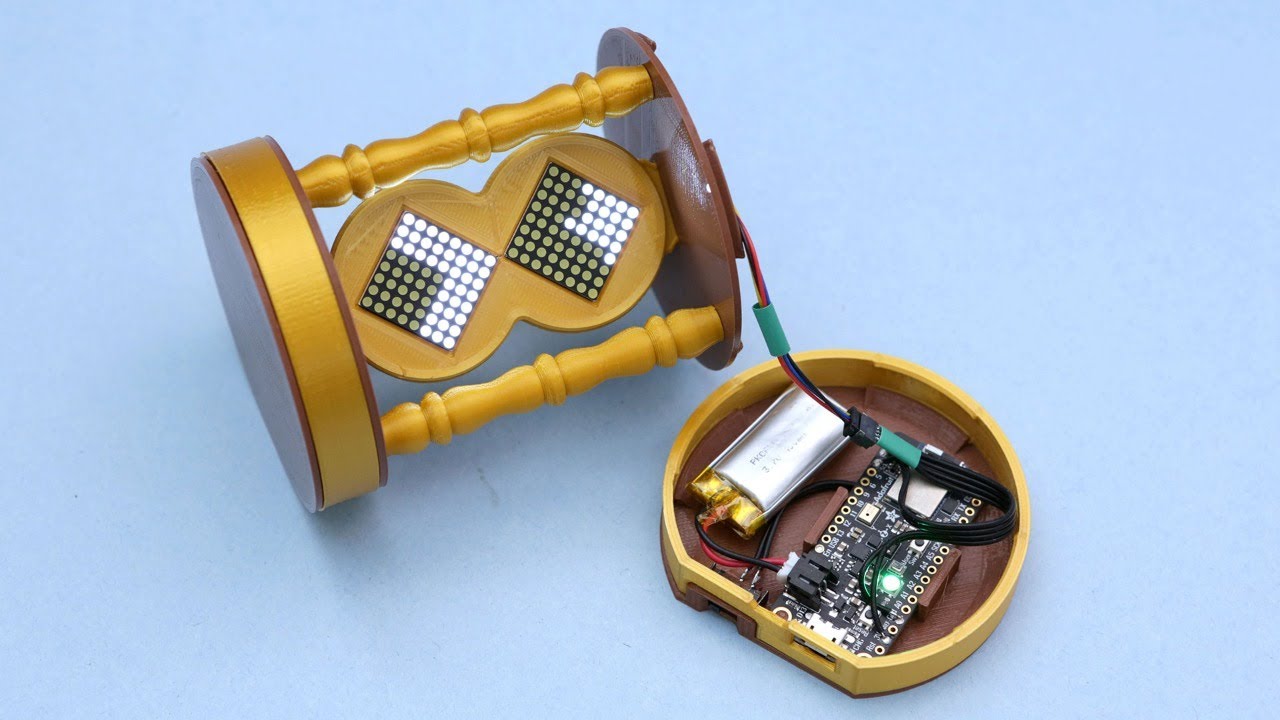
Learn guide
https://learn.adafruit.com/led-matrix-hourglass/
Code on Github
https://github.com/adafruit/Adafruit_Learning_System_Guides/tree/master/CircuitPython_LED_Sand_Hourglass
YouTube Video
https://youtu.be/sO3tqN-1lj8
Feather Sense
https://www.adafruit.com/product/...
wise iris
that link worked fine for me
rocky reef
#3DPrinting projects on Adafruit Learning System Learn Guide:
https://learn.adafruit.com/led-matrix-hourglass
 waxen thistle
It's about time we have a 3D printed hourglass.
lavish patrol
I don't have an hourglass figure...
rocky reef
Mini 0.8in Yellow LED Matrix and Backpack
https://www.adafruit.com/product/871

What's better than a single LED? Lots of LEDs! A fun way to make a small display is to use an 8x8 matrix or a 4-digit 7-segment display. Matrices like these are 'multiplexed' - ...
 shell mason
looks awesome
rocky reef
Small 1.2in Yellow LED Matrix and Backpack
https://www.adafruit.com/product/1050

What's better than a single LED? Lots of LEDs! A fun way to make a small display is to use an 8x8 matrix or a 4-digit 7-segment display. Matrices like these are 'multiplexed' - ...
shell mason
some connectors with clip to it for cover those connectors would be cool addin
waxen thistle
The fit and finish of this hourglass is top notch. Better than most traditional hourglasses I've seen
rocky reef
Feather Sense
https://www.adafruit.com/product/4516

The Adafruit Feather Bluefruit Sense takes our popular Feather nRF52840 Express and adds a smorgasbord of sensors to make a great wireless sensor platform. This Feather microcontroller comes ...
gusty wedge
The mixture of 3dprinted with acrylic looks quite sharp.
shell mason
next gen of this hour glass would be tenserity hour glass
rocky reef
3D Parts Library on GitHub
https://github.com/adafruit/Adafruit_CAD_Parts

GitHub
CAD files for various boards, components and parts - adafruit/Adafruit_CAD_Parts
1.75mm Silk Gold PLA
https://amzn.to/2NXPHvV
2.85mm Silk Gold PLA
https://amzn.to/2Z3WSZF
nova totem
I need to learn how to make those feather snap fits. I tried and I had the "snap" part down
shell mason
with tenserity matrix hour glass it could be holding with wires so could make look cool
waxen thistle
Snap (fit). Crackle (of Sparky the Blue Smoke Monster). Pop (of every capacitor).
shell mason

rocky reef
Adafruit Fritzing Library parts https://github.com/adafruit/Fritzing-Library/tree/master/parts
GitHub
Adafruit parts, components, breakouts, etc...in Fritzable format! - adafruit/Fritzing-Library
split gazelle
very mathematical
gusty wedge
Oh, that's 3d printed. I was tricked into thinking it was acrylic. Very nice.
shell mason
some cool transparent filaments what you can print visors for example
rocky reef
Layer by Layer CAD Tutorials Playlist:
https://www.youtube.com/playlist?list=PLjF7R1fz_OOVsMp6nKnpjsXSQ45nxfORb

YouTube
Learn how to use CAD for 3D printing and DIY electronics! In this series, we'll walk through some projects and learn how to use features in CAD software to b...
 normal belfry
Hello folks. Love from India
shell mason
now think some creative masks for example with visor part for example can be connected
normal belfry
@rocky reef Please share the amazon links
rocky reef
1.75mm Silk Gold PLA
https://amzn.to/2NXPHvV
and 2.85mm Silk Gold PLA
https://amzn.to/2Z3WSZF
 strange mantle
yes, via I2C, but not with circuitpython, since ESP (8266, 32) is no longer supported (ESP32-S2 will be though)
median meteor
I kind of like the idea of the virtual sand flowing upwards 😉
lavish patrol
Lol.
gusty wedge
esp32-s2 fan here...
lavish patrol
I sence Twitchbot approaching...
gusty wedge
I missed the 8266 days in cpy 2 and 3. But this usb thingy is going to be huge...
strange mantle
ESP32-S2 circuitpython support is in the works 🙂
solid wyvernBOT
adafruit is live at https://www.twitch.tv/adafruit
Twitch
Adafruit was founded in 2005 by MIT engineer, Limor "Ladyada" Fried. Her goal was to create the best place online for learning electronics and making the best designed products for makers of all ages and skill levels.
hard hollow
?showtimes
arctic abyssBOT
MakeCode Live - 3pm ET Tuesdays
3D Hangouts - 11am ET Wednesdays
Show & Tell - 7pm ET Wednesdays
Ask an Engineer - 8pm ET Wednesdays
Desk of Ladyada - Random hacker times
John Park's Workshop - 4pm ET Thursdays
John Park's Show & Tell - 5:30pm ET Thursdays
Deep Dive w/Scott - 5pm ET Fridays
gusty wedge
@strange mantle I've been following closely.. I have the saolas to test and mess with.
shell mason
CircuitHangout
lavish patrol
?showtimes-GMT
arctic abyssBOT
MakeCode Live - 20:00 Tuesdays
3D Hangouts - 16:00 Wednesdays
Show & Tell - 00:00 Thursdays
Ask an Engineer - 01:00 Thursdays
Desk of Ladyada - Random hacker times
John Park's Workshop - 21:00 Thursdays
John Park's Show & Tell - 22:30 Thursdays
waxen thistle
A basketball hoop project will be nothin' but net 🏀
split gazelle
a sport ball project
lavish patrol
That joke was a slam dunk.
lavish patrol
Or purr...
median meteor
With my ability to throw, it would remain absolutely silent 😉
lavish patrol
Neat.
waxen thistle
Wait, you can get a 360 camera for this? With that stabilization and low light? Woah.
strange mantle
thanks for giving it the awesome 3D treatment
waxen thistle
⛈️
lavish patrol
What was the price?
gusty wedge
uno, I win
shell mason
Bruce yeah
rocky reef
sorry folks power just tripped
lavish patrol
It hung on Youtube.
wise iris
ah that explains it :)
lavish patrol
Maybe the storm took out the power.
waxen thistle
quick, break out the giant 3D-printed hamster wheel!
waxen thistle
They really showed their hand with that card holder.
lavish patrol
Next weeks project - a UPS.
gusty wedge
Youtube weirdness going on?
waxen thistle
Depends on their internet provider's resiliency -- if their ISP doesn't have a strong battery-backed up network with multiple paths, then a UPS won't help much with uptime during a stream 😕
Bleeps and bloops!
shell mason
Card holder back
waxen thistle
UPS batteries do die out over the years -- either one can get a new unit or find a replacement battery (amazon/ebay/bh photo for that).
rocky reef
we should be back now
shell mason
hold all the cards
lavish patrol
Will we get another Twitchbot in 33 minutes?
waxen thistle
No mic @hard hollow and @rocky reef
lavish patrol
Yep. Mic died.
lavish patrol
Maker charades...
lavish patrol
Thanks, @hard hollow and @rocky reef 😀
rocky reef
thanks for hanging out folks!
hard hollow
thanks for hangin' in there folks 😉
gusty wedge
Thanks @hard hollow and @rocky reef , cool show.
rocky reef
link to the black silk pla https://www.amazon.com/gp/product/B083PYVP5C/ref=ppx_yo_dt_b_asin_title_o06_s01?ie=UTF8&psc=1
waxen thistle
@rocky reef Your downshooting camera stand (which looks to be a mic stand). Is the right angle arm built-in, or was it an add-on?
median meteor
Thanks guys! I got distracted part way through by my son.
rocky reef
@waxen thistle its this little adapter
hard to find because the name should be mic tripod adapter 
waxen thistle
Actually, I have the same one 🙂 It's what caught my attention ---- most of the tabletop mic stands I've seen are just straight up, but yours has a boom on it. Was that boom added afterwards?
rocky reef
oh the boom was an on added- we got it at guitar center so dont have a link 😦 @waxen thistle
 distant junco
so... I'm thinking about joining show and tell tonight (if my kids let me... 7PM is 6PM by time... which is dinner time). Anyway.... how does one actually "show and tell"? Is there a sign up?
nova totem
@distant junco They will post a link just around the start time to StreamYard. You join that. But just know that it fills up as the lobby is small so you have to keep trying to join usually just after someone else leaves
distant junco
ahh.. ok
nova totem
it's pretty easy once you see it. You will be put in a lobby area where you can check your cam and mic, and then wait. There's an option to share your screen if you want to as well
waxen thistle
Good evening all you wonderful folks! 🎉
 pure raven
hi
nova totem
Good evening all
 opaque hearth
hiya!
 trim mountain
I heard that Stream Yard has increased from 6 participants up to 10 so it might be a little easier to get in.
lavish patrol
Greetings, good people.
waxen thistle
@lavish patrol Ready for another Cylon invasion in ~33 mins?
lavish patrol
@waxen thistle Vipers at the ready.
Although, I believe there's a Six hiding out on Colonial One...
split gazelle
good evening folks
lavish patrol
Hi, Liz.
waxen thistle
Howdy Liz!
 lime falcon
Hi Liz!
 open girder
Link to join to show and share your project: https://streamyard.com/7f9xtx38u3

Engage your Facebook, or YouTube, Live audience with interviews and shows; all the tools you need for professional shows right in your browser.
 azure halo
waaa full
open girder
WE ARE LIVE! SHOW AND TELL! https://youtu.be/xNfHxpL1xTc

To show and share your project at 7pm today, view the chat or in discord https://adafru.it/discord and look for the JOIN link to join.
For best results be on a wired connection and have a headset and mic!
gusty wedge
Hi, all.
split gazelle
i'm digging the "six feet please" shirt
lavish patrol
Mister Gaetor, start the clock.
 wicked copper
hello
lavish patrol
Better picture quality at Digi-Key this week. 🙂
wicked copper
yup
waxen thistle
My two favorite mousepads; a Mario Paint hard plastic mousepad for the SNES game, and a promotional cellular provider mousepad for the Simpsons "Who shot Mr. Burns?".
split gazelle
mine is a cat djing on a pizza in space
lavish patrol
I have a cordless mouse, and the mouse mat is plugged in instead.
gusty wedge
C are also for people in the US, we let you use it if you want to 🙂
nova totem
I have a friend who would love that cat mousepad. he already has a shirt of a cat in space
 fallow fractal
Hello
wicked copper
I have a mousepad, it's called a laptop housing (I use a laptop)
split gazelle
i got it cheap on amazon a couple of years back so it might still be circling around
lavish patrol
waxen thistle
❤️  ❤️
❤️
 deep scarab
Hello!
waxen thistle
Very awesome Jeff 🙂
split gazelle
yay @robust horizon !
wicked copper
how do people get on show and tell?
waxen thistle
@wicked copper Link to join to show and share your project: https://streamyard.com/7f9xtx38u3
Engage your Facebook, or YouTube, Live audience with interviews and shows; all the tools you need for professional shows right in your browser.
nova totem
Awesome that's working @robust horizon
waxen thistle
Can't wait for the guides @sage aspen 🙂
[some of us are more patient than others haha]
split gazelle
awesome @sage aspen
 sage aspen
Thanks @waxen thistle and @split gazelle
 leaden trail
Good evening all.
waxen thistle
Where's your fedora, Indiana Erin?
leaden trail
I saw the video of the led whip. Wow, those are some tough LEDs to handle the crack action.
sage aspen
It's Erindiana Jones
viral sail
It would be neat to put an accelerometer on that to see how fast it really goes.
wicked copper
^^
lavish patrol
I can just imagine what it would look like on a long exposure in the dark.
turbid sparrow
Hello 👋
waxen thistle
@wanton dome If you're looking for a performance headlamp, check out Zebralight. It's a rabbit-hole of options -- not the cheapest, but I've used them for years and absolutely love them.
The one I have uses an 18650 rechargeable battery, can go over a 1000 lumens, has a zero-hot-spot ~120degree field of view. With you choice of high-CRI color tint (cool, medium, or warm).
gusty wedge
Side note, good name for a compressor pedal 🙂
strange mantle
"20 minutes into the future"
wanton dome
@waxen thistle Thanks for the tip, I'll give them a look
my current plan is to try and max out the price/performance ratio by modding cheap off the shelf stuff but it might be nice to get a solid backup as well
azure halo
MIDI Clue is nice!
waxen thistle
Harbor Freight makes some nice things to tweak, that's for sure. Their floormats are in more than one of my pelican cases as padding.
 ripe blade
That’s a really nice hack for the cables.
wanton dome
ya, I might have a few acres of those mats
gusty wedge
I used to do that to my long-ish guitar cables.
deep scarab
That’s a great trick!
split gazelle
i low key love coiled cables
wanton dome
I big fat high key love them
ripe blade
@split gazelle preach it
gusty wedge
file test.
turbid sparrow
Synth all the things!
lavish patrol
There's another trick you can do once you curled it up - reverse the coil on it so that the curl is tight.
split gazelle
so satisfying
haughty quiver
I've heard that, but never tried it @lavish patrol thanks, I'll do it next time
 manic wagon
remember when telephone chords used to get all tangled.....
wanton dome
@haughty quiver I've done the same when making a paddle leash for my kayak
 smoky island
Oooooooo love that hourglass
turbid sparrow
I haven't used one of those curly corded phones in ages..
lime falcon
I love the hourglass - but time is flowing backwards right now!
manic wagon
hehe
lime falcon
That may actually be happening as far as I can tell.
split gazelle
i've printed the parts in a sailor moon theme (gold and light pink). very excited to assemble 🌙
lavish patrol
Yes, we're in some sort of time warp.
 wraith pasture
My sound is off, but isn't that black LED acrylic?
lime falcon
Love that!
wraith pasture
the faceplate on the matrix
manic wagon
(throws rice)
split gazelle
this has been really fun to code 😺
wanton dome
great job @split gazelle !
lavish patrol
@split gazelle 👍
waxen thistle
Purrfect project, @split gazelle
lime falcon
@claire, it looks like it - otherwise the camera would saturate...
turbid sparrow
Nice work @split gazelle
gusty wedge
"Last time since failed print: ______ "
nova totem
That would be so satisfying over a recycling bin at work
sage aspen
@wraith pasture I'm pretty sure it is the Black LED Acrylic.
wraith pasture
Raaaaad
turbid sparrow
the devices are basically standalone 😄
the tft and usb drive make it like a mini little standalone basic computer 😄
sage aspen
That looks great @low fractal
lavish patrol
😺 🐶
nova totem
okay that eye just made me laugh and choke on my water
wanton dome
"One sec, let me grab an eyeball"
gusty wedge
👁️
lavish patrol
Yikes.
wraith pasture
I love the choice of the eyeball
opaque hearth
a threaded eye-ball at that
wraith pasture
And money!
split gazelle
whoa!
wraith pasture
Excellent choices
wanton dome
so cool!
turbid sparrow
I wonder if they use these in those cheap microscopes 😄
gusty wedge
🔬
wraith pasture
MONEY EYEBALL
lavish patrol
That eyeball looks like it's got a quarter twenty thread on the back. So you can mount it on a tripod. 😁
wraith pasture
ok, I did not see that coming
turbid sparrow
super cool
 sleek knoll
eye see squared
gusty wedge
Question for all, What is the weirdest thing you have a drawer full of?
wraith pasture
Doll heads.
turbid sparrow
I think I have a bunch of chop sticks form take out 😄
lavish patrol
Donuts.
wraith pasture
lego minifigs. loose.
wanton dome
miscellaneous fishing line, hooks and sinkers
deep scarab
Does a shelf of dead once-boiled bugs in the freezer count?
wanton dome
(used)
waxen thistle
Small gauge metal wire, used in jewelry making/model ships.
wanton dome
@wicked copper You'd have to extend the Adafruit_CircuitPython_WSGI library
wicked copper
okaay
turbid sparrow
printf is great 😄
wanton dome
or roll your own
split gazelle
that's a great tip
wanton dome
@wicked copper It's still early days in CircuitPython web land
sage aspen
Not really that weird, but I have a drawer full of displays and that's not even all of them.
waxen thistle
Given how much awesome work you do with them, I'd be surprised if you didn't have a drawer full of them @sage aspen
leaden trail
@sage aspen Are we surprised at your drawer full of displays???? Nope.
sage aspen
It's because I need to make sure code works on a wide variety of displays.
split gazelle
great learn guide and great cat @trim mountain
lavish patrol
Split screen 👍
gusty wedge
I like the letter "O" as 
leaden trail
He needs Phil's camera.
waxen thistle
Barry Allen approves of this board 🌩️
split gazelle
very cool
turbid sparrow
very nice!
wanton dome
👁️ 🖤 @azure halo my hero!
nova totem
really neat
waxen thistle
Very nice @azure halo !
lavish patrol
Vipers at the ready...
wanton dome
it's an @deep scarab !
azure halo

GitHub
SAMD programmer. Contribute to mzero/multi-flash development by creating an account on GitHub.
solid wyvernBOT
adafruit is live at https://www.twitch.tv/adafruit
Twitch
Adafruit was founded in 2005 by MIT engineer, Limor "Ladyada" Fried. Her goal was to create the best place online for learning electronics and making the best designed products for makers of all ages and skill levels.
lavish patrol
Launch!
split gazelle
i love those mini breadboards. they're so cute
lavish patrol
It's the mini-me of breadboards.
 autumn storm
instructions would be GREAT ~ that is awesome
wanton dome
the mini-breadboards are the best. They fit perfectly between the headers on a metro
split gazelle
yes! forgot about that- it is a perfect fit
wanton dome
indeed. I've been iterating on prototyping/testing/bringup shields using them and the proto shield. I'll probably spin a custom one at some point
split gazelle
that's awesome @ripe blade
wanton dome
@ripe blade so cool!
nova totem
it's so compact too, that's crazy
deep scarab
@autumn storm I'll definitely write up instructions and post them up here when they're ready. I'm waiting for the battery/switch breakout to arrive, so it might be next week!
lavish patrol
It's a healthy project.
haughty quiver
@azure halo are there any details you can share about the board you were flashing?
deep scarab
@split gazelle I really like the tiny breadboards too - I'm going to work on a little mini-series of learning projects with them, I think they'll be great for learning at home without having to tackle soldering too. And they're adorbs. 🙂
azure halo
Oh sure - that fully open hardware / open software as well! It is a clock system for modular synths designed for doing odd meters and polyrhythms
split gazelle
sweet! that'll be great @deep scarab 😺
haughty quiver
Right on @azure halo I dig that
azure halo
GitHub
Contribute to mzero/pulsar-buddy development by creating an account on GitHub.
waxen thistle
We all stand taller when we stand together 🙂
azure halo
The image there is the previous iteration - all through hole
lavish patrol
True that, @waxen thistle
haughty quiver
Ooh, I can see that fitting in with SOMA Labs gear :] @azure halo
azure halo
That is exactly what I built it for! I play a Pulsar-23
ripe blade
@split gazelle @wanton dome thank you! I’ll share some of my public libraries hopefully next week.
haughty quiver
Wow that's quite a Serge in your demo video!
azure halo
You can see me playing both the Pulsar-23 and Pulsar Buddy (my thing) - in the top video on my music web site: https://electric.kitchen/
(I studied music with Ivan Tcherepnin... Serge's brother. I built that system in 1989!)
haughty quiver
Wonderful!
My friend Jbum studied under Serge IIRC at Cal Arts. Update: maybe it was Subotnick.
waxen thistle
To quote The Doctor: Bowties are cool.
wraith pasture
Is that wood?
lavish patrol
Cool bowtie
ripe blade
That's pretty awesome.
lavish patrol
David Bowtie
split gazelle
i dig it
waxen thistle
Thanks Greg!
ripe blade
it's so compact too, that's crazy
@nova totem thanks! You should have seen Rev A. LOLOLOLOL. It was tacky. Rev B is coming along nicely.
waxen thistle
Thanks everyone for sharing your awesome work!
split gazelle
great projects everyone!
lavish patrol
Another great show.
viral sail
Thanks everyone. Keep up the great work.
deep scarab
thank you, everyone! Always fun to see what you all are making!
azure halo
This show is always so fun!
distant junco
great projects!
nova totem
Thanks everyone great seeing things
wraith pasture
I love this show 😁 Thanks everyone!
haughty quiver
@azure halo love that video thanks for sharing it
azure halo
oh! the performance? glad you liked it
the album is now out (that and another performance) on bandcamp.
haughty quiver
Terrific! I look forward to listening to it.
azure halo
https://electrickitchen.bandcamp.com/album/alone-together (hope that's okay to post that)
 haughty quiver
Excellent to post that!
azure halo
And yes - that board (Pulsar Buddy) was used in both of those tracks.
open girder
WE ARE LIVE! ASK AN ENGINEER! https://youtu.be/s3Xs7ZP893Y

Visit the Adafruit shop online - http://www.adafruit.com
LIVE CHAT IS HERE! http://adafru.it/discord
Adafruit on Instagram: https://www.instagram.com/adafruit
Subscribe to Adafruit on YouTube: http://adafru.it/subscribe
New tutoria...
lavish patrol
...and we're back. Reset the clock.
 velvet beacon
woohoo hi all!
split gazelle
hello @velvet beacon !
lavish patrol
Hi, @velvet beacon
waxen thistle
Heya @velvet beacon !
haughty quiver
Greetings @velvet beacon
( @velvet beacon is the only CFO in the hacker world w a posse)
velvet beacon
hah @haughty quiver only way to roll
lavish patrol
Lol.
waxen thistle
Do you even know your own CFO? What about another company's CFO? Let alone have their own fan club 🙂
nova totem
I'm going to ask my CFO if he has a fan club next time I see him
waxen thistle
If you do good, you'll do well.
 slow spire
Hi, @velvet beacon ! Thanks for all the work I've heard about you doing to keep Adafruit running during these strange times!
lavish patrol
I'm retired, so I'm my own CFO. Also CEO and PA. Plus I clean the toilet.
waxen thistle
@lavish patrol Be nice to the janitorial and office assistance staff. They're the gatekeepers 😛
velvet beacon
hihi @slow spire thank you 🙂 we're all doing what we can. Couldn't do this without ladyada, pt and the team!
@waxen thistle 100% agree with you there
split gazelle
i love an if statement
lavish patrol
@split gazelle Then...
sleek knoll
else
waxen thistle
No joke -- if there's anyone you should deeply respect (and I think that should be everyone, but I digress) are those who have the keys to the kingdom (assistants) and those who clean up your messes (janitorial).
lavish patrol
Wise words, @waxen thistle
 robust horizon
I gotta make a heptagonal featherwing, something truly new and original
haughty quiver
I'll appologize in advance that attempting to show the MakeCode streamer INSIDE another streamer caused a black hole to occur...
lavish patrol
@haughty quiver In stop motion.
haughty quiver
right
slow spire
@robust horizon …and then you can make a heptagonal breadboard for that. 🙂
robust horizon
that's a lot of parts
inner spade
@haughty quiver nice unintended tribute to Ray Harryhausen.
slow spire
Hmmm… Is Streamer Microsoft's hidden secret exploration area for challenging OBS/Streamlabs?
haughty quiver
:}
waxen thistle
⏱️ 🎮 @haughty quiver's MakeCode Minute was 2min 39sec of awesome streaming tools! Warning: remember to never cross the streams, unless Egon gives you permission. 🎮 ⏱️

Streamer BETA is an experimental web application that simplifies the creation of interactive, high quality coding videos. Streamer is designed for teachers, students or generally anyone who would want to do any kind of online MakeCode coding.
haughty quiver
"What would happen if we cross the streams?"
lavish patrol
Lol
waxen thistle
It would be...bad.
autumn storm
This makes me sad ...
slow spire
Wow
lavish patrol
Melbourne (Aus) has gone back into full lockdown again. And straight away all the toilet paper disappeared off the shelves again. 🤔
waxen thistle
I'm not one to encourage panic buying. But if you need to restock on any essentials, now would be the best time to re-evaluate what you need and make arrangements to get it.
autumn storm
do you have a link to that information on
website?
OMG a light up mask! Digital...scrolling sign ?? my brain exploding with ideas ....hhaahha
split gazelle
one day at a time
slow spire
Everyone should note that Victoria AU is locking down with about 200 new cases. Florida alone, meanwhile, reported just shy of 10,000 new cases today.
waxen thistle
Stay home if you can -- if you're lucky to be able to do that.
Just because something is open....that you can go out, doesn't mean you should go out. Shop smart, shop small, shop fast, and shop local.
split gazelle
just because you ameriCAN doesn't mean you ameriSHOULD -jonathan van ness
autumn storm
STOP HATE and EDUCATE
lavish patrol
@slow spire Remember that Australia has a very low population for its size. About 25 million in an area the size of the US.
waxen thistle
And remember folks, this is a tough time for all of us. If you need help, someone to talk to -- reach out. We all handle the challenges we face in different ways. Just because you think someone has it "worse" doesn't invalidate the struggles you're facing.
slow spire
@lavish patrol True, but Florida has 22 million, and even though more dense, is being pushed to reopen with 10000 new cases per day.
waxen thistle
Facebook has such hateful comments -- and the worst part, it's attached to your real name. You'd think you'd get more nonsense when folks can hide behind a handle/anonymity. It's baffling.
lavish patrol
@slow spire True.
slow spire
Really happy about how civil our Adafruit communities are.
autumn storm
I love Adafruit ...Thank you
 dim knot

Follow John Lewis: Good Trouble
http://facebook.com/johnlewisdoc
https://twitter.com/JohnLewisDoc
https://www.instagram.com/johnlewisdoc/
Using interviews and rare archival footage, JOHN LEWIS: GOOD TROUBLE chronicles Lewis’ 60-plus years of social activism and legislative ac...
ripe blade
Wow. I honestly thought the comments section was the same everywhere. I didn't realize Facebook was doing such a poor job moderating. Is it mostly the lack of moderation tools or because those hate groups just like Facebook for some reason? Anyone have any insight?
robust horizon
Thanks @open girder we're watching it this Friday night!
ripe blade
Also, that light up mask is so cool.
dim knot
open girder
@ripe blade facebook allows it, so it flourishes on their platform, it's unlike every other platform
ripe blade
@open girder wild.
open girder
we report hate groups and more all the time, they remove some (sometimes) but rarely
slow spire
@ripe blade, different social networks have very different expected behaviors. To a certain extent, that's OK. But here on the Adafruit communities, there's a higher value on making everyone feel welcome and supported.
solid wyvernBOT
adafruit is live at https://www.twitch.tv/adafruit
Twitch
Adafruit was founded in 2005 by MIT engineer, Limor "Ladyada" Fried. Her goal was to create the best place online for learning electronics and making the best designed products for makers of all ages and skill levels.
open girder
facebook claimed they are a mirror of society, that is not a good excuse
lavish patrol
waxen thistle
As PT says, "We are what we celebrate." We celebrate each other.
lavish patrol
Yep.
slow spire
@ripe blade Some networks are very dependent on engagement and ad clicks, and are dependent on even very negative engagement for revenue.
waxen thistle
Time to break that mirror if you ask me.
open girder
all that said, there is progress, it's just slow and facebook has not listened (until now)
we will not stop
lavish patrol
Topical music...
slow spire
Are those the real whip sounds, or triggered by acceelerometer inputs?
haughty quiver
@steep pilot that video! amaze!
split gazelle
fantastic video 🤘
robust horizon
realizes he's several minutes behind the live broadcast
slow spire
RIP Ennio Morricone. https://en.wikipedia.org/wiki/Ennio_Morricone

Ennio Morricone, OMRI (Italian: [ˈɛnnjo morriˈkoːne]; 10 November 1928 – 6 July 2020) was an Italian composer, orchestrator, conductor, and trumpet player who wrote music in a wide range of styles. Morricone composed over 400 scores for cinema and television, as well as over 1...
waxen thistle
Shhhh! You'll spoil their secret.
lavish patrol
Lol.
robust horizon
that hourglass print just looks amazing
waxen thistle
That fit and finish is better than nearly every commercial product I've seen.
split gazelle
the snap fit is especially satisfying
ripe blade
that hourglass print just looks amazing
@robust horizon Agreed. It is beautiful.
lavish patrol
@hard hollow and @rocky reef are the masters of the snap-fit.
waxen thistle
Also, the production and editing of their videos -- that's a master class I'd happily take from them.
lavish patrol
Yep.
robust horizon
would love to see this oldie revved with a snap fit for the main PCB. hint hint. https://www.thingiverse.com/thing:2209964

YouTube: https://www.youtube.com/watch?v=jy7a-z19UEQ
NEW UPDATE April 8, 2016 – Added new parts for Adafruit 2.4" TFT Feather Wing
This is our 3D printed case for the Adafruit Feather. It’s for anyone looking to put their project in a box. It’s a multipurpose enclosure, so you...
slow spire
I learn so much from @rocky reef & @hard hollow ; love their thoughtful and elegant builds. Every time they say “snapfit” take a shot.
lavish patrol
Hic!
robust horizon
hehe. say "snap fit" responsibly, everyone
lavish patrol
Lol.
waxen thistle
Jammin' tunes
lavish patrol
Bleeps and Bloops.
slow spire
@waxen thistle I assume we take a shot when @haughty quiver goes over 1 minute.
waxen thistle
@slow spire lol. I love the MakeCode minute. You always get more than what you expect 🙂
robust horizon
It is easy for a "real programmer" to be dismissive of MakeCode. But a mistake.
lavish patrol
With bonus Lars...
waxen thistle
I personally have been super burned by that attitude in the past @robust horizon -- dismissive of an "entry level" coding class, because I had a "ton" of prior experience.
I learned very quickly how fragmented my knowledge-base actually was....and I was playing catchup suddenly on something I thought was simplistic.
ripe blade
It's so weird seeing how we can shrink down GHz processors to a few square millimeters, but still have a ton of these giant capacitors. Lol.
split gazelle
so cool
waxen thistle
It's amazing how far we're come with tech -- makes it so much easier to build awesome tools
slow spire
@robust horizon @waxen thistle When I got the CircuitPlayground Express, I put together an accelerometer triggering LED, and sound demo for my designers in minutes. Made the accelometer idea tactile and comprehensible instantly.
robust horizon
I finally figured out the pattern when I saw people dismissing Python as a toy language, but of course I knew they were wrong. 🙂 funny how sometimes you get perspective suddenly.
waxen thistle
It's a hard desert to eat, that slice of humble pie. But we learn the most valuable lessons that way.
slow spire
I see people dismissing Arduino and insisting on Atmel Studio, and being totally OK with getting stuck for weeks.
ripe blade
I always thought Python was considered one of our more superior languages. I'm shocked to hear folks dismissing it so casually. It's so powerful and user-friendly at the same time.
waxen thistle
CPX bluefruit. CPX + MakeCode. I can spin up a "proof of concept" in a few minutes, and it's functionally equivalent to almost any code i could write in Arduino. And faster to write & edit. Easier to troubleshoot. Which makes me wonder, why even use Arduino unless there's a specific use case....
robust horizon
but .. does it run blinka yet ?
slow spire
I love most of the tools for one reason or another; it's great having a choice of how I can bring an idea to life, in days, hours, or minutes, as needed.
Good ideas die when people think there's a risk or difficulty. Building a simple prototype quickly is a superpower.
NEW!
split gazelle
i'm so hyped for adabox 🙌
dim knot
Rugged Panel Mount Fingerprint Sensor with Bi-Color LED Ring - R503 https://www.adafruit.com/product/4651

Secure your project with biometrics - this all-in-one optical fingerprint sensor will make adding fingerprint detection and verification super simple. It even has an LED ring built around ...
slow spire
I renewed my Adabox subscription, just for this special occasion.
waxen thistle
"Which superpower would you want? Flight? Invisibility?"
Being able to build a prototype simply and quickly. That and problem solving. I'd like them as my superpowers please.
haughty quiver
That's terrific @slow spire thanks!
manic wagon
@waxen thistle hehe...SHAZAM!
waxen thistle
I can think of a few spy briefcase projects to make use of that fingerprint sensors --- it'd be fun for escape rooms. Remember those? Back before the plague?
dim knot
LR44 / AG13 1.5V Button Cell Batteries (10-pack) https://www.adafruit.com/product/4645

These batteries are super popular in small electronic objects - and now you don't have to toss it out when the battery dies. This product comes with a ten pack of non-rechargeable ...
split gazelle
ohh i remember those kind of talking books from when i was a young pup. i used to love those
waxen thistle
Today is a good day to make! ~Worf
dim knot
Adafruit DS1841 I2C Digital 10K Potentiometer Breakout - STEMMA QT / Qwiic https://www.adafruit.com/product/4570

Potentiometers are the perfect tool when you want to change your circuit by turning a knob. Turns out, there are times when you want to adjust your circuit without manually turning a knob, ...
manic wagon
'Ate any good book today warf? - Q"
dim knot
Adafruit BMP280 I2C or SPI Barometric Pressure & Altitude Sensor - STEMMA QT https://www.adafruit.com/product/2651

Bosch has stepped up their game with their new BMP280 sensor, an environmental sensor with temperature, barometric pressure that is the next generation upgrade to the BMP085/BMP180/BMP183. ...
PM2.5 Air Quality Sensor with I2C Interface - PMSA003I https://www.adafruit.com/product/4505

Breathe easy, knowing that you can track and sense the quality of the air around you with this PM2.5 Air Quality Sensor with I2C Interface particulate sensor. Mad Max & ...
robust horizon
is that the most chonky stemma qt board ever?
lavish patrol
Blue smoke coming...
robust horizon
oh wow I need to NOT put off building that solder fume extractor any more.
dim knot
Adafruit PMSA003I Air Quality Breakout - STEMMA QT / Qwiic https://www.adafruit.com/product/4632

Breathe easy, knowing that you can track and sense the quality of the air around you with this Adafruit PMSA003I Air Quality Breakout. This sensor is great for monitoring air quality, ...
waxen thistle
Question: With such a prolonged shutdown, was there any unexpected maintenance needed for your manufacturing machines?
lavish patrol
That's our world now - pre COVID and post COVID...
robust horizon
that reminds me I finally got triples on the fruit machine .. I think it was
waxen thistle
Interested in the active terminator? Don't worry. It'll be back.
velvet beacon
☀️
lavish patrol
Good day sunshine 🎵 🎶
waxen thistle
Mr. Blue Sky 🎹
wicked copper
@open girder What's the difference between I2C and SPI?
 echo canopy
Question about Adafruit IO
This week there was an update to a certificate that the connection needs
Can you explain more about why this is needed ?
And if in the future if there would be a way to update the certificate with a “drag and drop drive” like Circuit Python so you don’t have to upload the sketch again (arduino)
wicked copper
that drag and drop stuff is actually using the bootloader, not circuitpython itself. Someone would have to write an alternative bootloader for arduinos
echo canopy
True
 noble grove
Why does the i2c terminator need two connectors?
distant junco
Question - I'm dreaming of adding a second TFT (SPI) to the PyPortal. Unfortunately, there isn't a SPI hardware breakout. So I guess I could implement software SPI... if I use the D3/D4 with the SWDIO and SWCLK. Is that even do-able? Or recommended?
wicked copper
so I2C for multiple relays, SPI for live temp sensors (example use case, would this make sense?)
 digital crescent
Are you still using the HDMI video capture adapter from the previous week?
azure halo
Question: I just encountered my first set of bad NOR flash chips - And I thought they were basically fool-proof.... do you folks see bad flash chips on your boards? Do you flash test them?
robust horizon
Browser software manufacturers are planning to limit certificates to no more than about 390 days (1 year + 1 month + 2 days or something like that)
echo canopy
Thanks for the very long and in-depth answer 🙂
distant junco
Awesome. Thanks!
azure halo
One was on a Feather M0 Express!
robust horizon
Question: When a board has SMT components on both sides, is it just two trips through the same kind of reflow process, or does the second side need special handling?
 junior hornet
which pcb board manufacturers do you guys like to use for large volume production (bare boards)?
echo canopy
Follow up question — so in theory I should not have to worry about a certificate as much on a ES32 vs ES8266 boards ? Less having to update 1-2 year timeframe .. thinking about expanding the number of WiFi devices
 tough flame
So I'm planning to use 15+ 18650 batteries in a 3s5+p config but I'm not sure how it will work out. Do you think this will be the best way of using them? (Load will be 5v 6+A.)
slow spire
@azure halo If it's on an Adafruit product, I'd suggest posting that issue on https://forums.adafruit.com.
robust horizon
I am learning kicad and I'm getting better at it. un-learning years of eagle, but eagle's changed a LOT since 2005 or so
azure halo
I did, @slow spire - and they're replacing it... but I thought it seemed so unlikely that they may want to see it!
 worldly anvil
How do I create Hardware Serial 1/2/3 on the Adafruit Grand Central similar to Arduino MEGA HW serial pins?
slow spire
@azure halo And I'm assuming you weren't inadvertently rewriting it 10,000s of times, right?
azure halo
Yeah - fresh board, and small number of rewrites - the post has all the details, and I created a simple flash tester for Express boards --- posted in a gist
Board works if you use 1/4 speed for the SPI connection - so perhaps this is about power or bypass caps or something bad on the PCB...
lavish patrol
I'd love to listen to @clear matrix's dulcet tones, but it's way past my bedtime.
So goodnight all.
robust horizon
Thanks so much for the answers, @proper trench
sage aspen
Goodnight @lavish patrol
velvet beacon
night all!
slow spire
@worn spire Good notes on how connecting arbitrary LiPo/LiIon batteries can be dangerous: https://learn.adafruit.com/li-ion-and-lipoly-batteries/multi-battery-packs

Adafruit Learning System
All about the power packs that propel your projects!
sage aspen
Goodnight @velvet beacon
velvet beacon
you as well @sage aspen !
split gazelle
have a good one @velvet beacon thanks for all you do
 livid ermine
@echo canopy I'm in cyber security and dealt with certificates, root certificates typically last for 5-8 years unless it gets revoked by the provider. to add on, website certificates are moving more towards a 1 year life span to increase security.
azure halo
@slow spire - details here: https://forums.adafruit.com/viewtopic.php?f=57&t=167134
slow spire
@clear matrix 's voice is so clear, so soothing.
waxen thistle
Indeed, thanks for all the things each and every one of you folks do. It might be routine for you, but it might be the world to someone else. 🙂
slow spire
@azure halo Interesting read about the clock rate experiments.
robust horizon
You all are the reason I get to work on CircuitPython everyday. Thanks so much.
azure halo
yeah - now I'm finding similar issues on the boards I built... but I may not have done such a good job of laying out the flash, power and SPI runs..... again, the board works at 1/4 CPU clock rate
azure halo
(er, SPI to flash at 1/4 CPU clock - rest of board runs at full 48MHz)
robust horizon
Is 2020 the year of Linux on embedded systems?
split gazelle
@robust horizon i used the mp3 library for the first time today- super easy and straightforward, looking forward to using it more!
wicked copper
@robust horizon No, it's the year of the latest Ubuntu LTS release, and mac os users getting unhappy with big sur. Let's go linux desktop!
slow spire
@robust horizon Several years ago, I was figuring out the protocol to talk to a tiny Belkin SmartPlug, and was surprised to find it running Linux.
azure halo
Oh... I might have to build and perform on that lime-keyboard in my new music stream.....!
wicked copper
yeah, everything embbeded runs linux nowadays. What else would it run? @slow spire
slow spire
RTOS maybe?
wicked copper
what is that?
robust horizon
FreeRTOS
Portable operating system interfaces (POSIX) for FreeRTOS
waxen thistle
Thanks @clear matrix for another soothing Python Newsletter!
slow spire
Real Time Operating System; typically these are smaller than Linux variants. The Pebble Smartwatch and others run on an RTOS instead of Linux.
slow spire
Or, no OS at all, for example, when running C on bare metal (typical for Arduino projects)
wicked copper
hmmm
viral sail
Thanks @open girder and good night. 🌖
waxen thistle
Thanks for another awesome evening of shows @open girder!
split gazelle
thanks for a great set of shows!
 frail oracle
Thanks @open girder!
dim knot
Night all - see ya next week!
slow spire
@wicked copper Espressif's chips and modules run an RTOS.
https://docs.espressif.com/projects/esp8266-rtos-sdk/en/latest/get-started/
slow spire
Also, Adafruit's Bluefruit nRF microcontrollers run an RTOS. That divides the time between your Arduino, CircuitPython, or MakeCode user code, and the necessary housework that the nRF chip has to do to keep the Bluetooth radio connection responsive.
robust horizon
I believe that esp32s2 uses freertos, including when running CircuitPython on it. (anything using esp-idf)
@split gazelle I wanna hear about your mp3 project when it's ready
split gazelle
@robust horizon it's actually for that basketball hoop project that Noe showed- there's going to be a random sound effect every time you score 😺
robust horizon
nice
I'm thinking of the "crowd cheering" sound effect that all the Intellivision sports games used
split gazelle
oh! that's a great idea! like for certain score thresholds
robust horizon
I found it in wav format ... http://spatula-city.org/~im14u2c/intv/sound/ [warning: kinda loud at the start!]
split gazelle
sweet! thanks!
haughty quiver
Hello livebroadcastchat-ers
inner spade
Ready to chatt-er!
waxen thistle
Good afternoon all you wonderful folks!
tiny axle
evening
waxen thistle
bleeps and bloops are a go!
lavish patrol
Bleep and Bloop monitor engaged.
haughty quiver
Is YT looking healthy?
inner spade
Bleep audio level is -6db on YT
tiny axle
bleep tester active
waxen thistle
If I see Lars, it'll be like riding a roller coaster during Covid. I'll scream in my heart.
inner spade
Bloops level is -6.2db. 😉
haughty quiver
LOL
tiny axle
@haughty quiver now that is a question
waxen thistle
screams in his heart
inner spade
voice audio peaking at -6db, sounds great!
lavish patrol
Lars is trying to hide
waxen thistle
Find maker jobs in 3D and CAD, Art, Design, Education, Embedded Development, Engineering, Fabrication, Marketing and Communications, and Web Development
Lars isn't hiding. He is exactly seen as much as he intends.
lavish patrol
Got a weird background rumble...
inner spade
Can hear the 120Hz fan noise a little. Not a big issue considering that you might pass out otherwise.
waxen thistle
If S&T is a bit sparse, you could always tell us stories about your time as an animator 🙂 I'd happily pay for tickets to that TED talk 🎙️
tiny axle
If Lars appears, i'm gone. that thing scares me
waxen thistle
@tiny axle Don't go. He's on the left side of the workbench. He's waving hi. From his heart.
lavish patrol
He's down there on the far left...
tiny axle
After seeing the anamatronic singing rabit, Noooooo
waxen thistle
Electrical tape does leave a nasty residue -- it's a temporary solution that quickly gets regretted.
tiny axle
@haughty quiver Electrical tape mkes good bandaids
inner spade
The premium 3M tape doesn't have the adhesive thermal creep or aging issues. Spendy stuff, though.
waxen thistle
It has to be the best 3M tape though, their cheaper lines are suspect to the issues mentioned.
tiny axle
you can never have enough heatshrink
22 working years and I still use the tape as band aids
inner spade
Haven't tried heat shrink as a band-aid
cinder wind
oh yeah, if you look... Lars is moving
tiny axle
shudder
waxen thistle
You don't need to go to a gym -- squats with that light is more than sufficient.
 rustic yacht
yeah, electrical tape is good for autmotive wiring looms, together with the split loom conduit.
lavish patrol
Lars is trying to loosen his bonds...
waxen thistle
Lars has a BLE connection to Streamlabs.
inner spade
Lars is chewing on the camera cables again.
waxen thistle
Lars vs the evil slugs.
 past nova
Wow love this makecode feature
tiny axle
lars is evil
lavish patrol
Lars has the tracking device. That's how the cylons know how to find us...
inner spade
Yes, game sound was okay.
tiny axle
Just heard it
shell mason
coiling
solid wyvernBOT
adafruit is live at https://www.twitch.tv/adafruit
Twitch
Adafruit was founded in 2005 by MIT engineer, Limor "Ladyada" Fried. Her goal was to create the best place online for learning electronics and making the best designed products for makers of all ages and skill levels.
lavish patrol
Lars has summoned the cylons.
waxen thistle
He's the first human-form cylon.
lavish patrol
"Human form"
waxen thistle
He is our ideal form, but that level of sophistication was impossible to mass-produce -- hence why we're in the form we're in currently.
lavish patrol
So, Lars is what we are to become...
waxen thistle
All this has happened before, and all this will happen again.
shell mason
CoilPark the human form of Cylon?
rustic yacht
that's the nature of heatshink, left till last then you go "ohhh, I screwed up"
lavish patrol
Lol.
rustic yacht
I keep my heatshink within arms reach of the soldering station for a reason
cinder wind
see if you wrapped that coiled cable around a metal straw, you could just cool it down by sipping on a margarita
shell mason
having that heat station as other soldering things on soldering station is great
 tribal jay
hurray adabox!
lavish patrol
Great show @haughty quiver
viral sail
Thanks @haughty quiver
waxen thistle
Thanks JP!
inner spade
Thanks @haughty quiver !
tribal jay
great show!
waxen thistle
[JP looked so confused reading our Cylon banter. Poor JP, he's trying to put on an informative and entertaining show and here we are paying attention to Lars 😛 ]
lavish patrol
Lol
I was, however, paying attention to JP's demo. I was the one who suggested the coil reversal trick.
haughty quiver
thanks all. LOL yes, what Cylon what? scan scan
lavish patrol
Cylars.
haughty quiver
It's no accident that Battlestar Galactica was created by Glen A. LARSon...
lavish patrol
Aha.
waxen thistle
😮
lavish patrol
"There are many copies, and they have a plan"
waxen thistle
Stream is live on Twitch -- no audio yet
waxen thistle
Loud and clear 🙂
Well, it's cutting in and out a little bit -- anyone else hearing that?
deep scarab
@waxen thistle cutting for me too
 low fractal
Audio is, yep.
gusty wedge
What is the restream url?
deep scarab
Is the streamyard link posted? I didn't see it in the recent history.
haughty quiver
Engage your Facebook, or YouTube, Live audience with interviews and shows; all the tools you need for professional shows right in your browser.
waxen thistle
That is such a handy sized monitor.
inner spade
Perfect for a MIDI controller/sequencer.
gusty wedge
For a tall terminal.
waxen thistle

aliexpress.com
Smarter Shopping, Better Living! Aliexpress.com

Creative Engineer for Adafruit Industries • Maker of Things • LED Whisperer • Obsessed with Dragons & Monsters
Tweets
14124
Followers
6973
 Twitter

ASUS Global
ZenBook Pro Duo features a 4K ScreenPad Plus that works with the main 4K OLED display, powered by Intel Core i9 CPU and NVIDIA GeForce RTX 2060 GPU.
Buying traffic lights really is a stop-and-go decision process...
gusty wedge
That's the only way to control a big light, with a big button 🙂
waxen thistle
I love the button holders, chunky!
gusty wedge
My brother would die for that lavaza clock 🙂
waxen thistle
@gusty wedge https://www.ebay.com/itm/LavAzza-Wall-Clock/174183752267?hash=item288e29224b:g:X~sAAOSw48ZeJqZY
 deep scarab
Thanks! Here's a link to the traffic light project - we're calling it Traffic Jam. https://hackaday.io/project/170907-traffic-jam

I picked up three giant traffic lights at a surplus store, because really, how I could I pass them up at $12 each? I thought it would be a great display item / game / piece of artwork for the Alpenglow Indsutries shop, and the perfect project to teach my team beginning Arduin...
waxen thistle
Such an awesome project, thanks for sharing @deep scarab
deep scarab
@gusty wedge my uncle used to work for a coffee distributor and gave me the clock...gah...maybe almost 20 years ago now!
@waxen thistle The 3D printing files for the button enclosures are up on Thingiverse, I showed them a month or so ago. 🙂 Gotta enable button projects.
https://www.thingiverse.com/thing:4373592

Big red arcade buttons are great additions to any project, but they need an enclosure to be able to stand up on their own. This one has been designed specifically for 60mm buttons, with enough internal space for a wire harness that uses right angle quick connects, and has an ...
waxen thistle
I thought they looked familiar! 🙂
For MacOS webcam settings: https://apps.apple.com/us/app/webcam-settings/id533696630?mt=12

Mac App Store
Quickly customize your webcam's settings while using FaceTime, Photo Booth or Skype on your Mac.
◼ Pick of the Week 2012-07-16 Episode | GFQ Network
◼ Show picks from Alex Lindsay in MacBreak Weekly 313 | TWiT.TV
◼ Webcam tip by Chris Marquardt - Tech Guy Labs Episode 914 ...
IF you have a logitech webcam, the built-in tools aren't too bad for Windows.
Well, they used to be good. Many years ago when I used Windows for creative work -- Mac is my daily driver anymore.
gusty wedge
The cool thing would be to have something physical to control the webcam. Like a neotrellis...
Maybe linear motorized pots, or rotary.
waxen thistle
This is wicked cool @azure halo
deep scarab
dang, cool UI @azure halo
gusty wedge
Because you can control brightness, white balance and other webcam settings that mess up people streams while showing neopixels or just normal streams.
Next week I'll try to show some guitar pedals I'm working on...
deep scarab
Nice work @azure halo welcome to the dark hardware side.
gusty wedge
@azure halo That's amazing for being the first piece of hardware, very cool.
gusty wedge
@azure halo do you sell the hardware you make?
waxen thistle
Thanks everyone for sharing your awesome projects!
deep scarab
😆 I don't know the history of mixed unit parts, but yeah, it just adds to the fun.
inner spade
Thanks!
viral sail
Thanks everyone.
deep scarab
Thanks, @haughty quiver ! Super fun.
haughty quiver
Thank you!
gusty wedge
Thanks @haughty quiver
waxen thistle
It gets tricky when distance and time are measured by the same unit, a parsec 😛
gusty wedge
And thanks all.
low fractal
Thank you @haughty quiver !
haughty quiver
Thanks so much for the terrific shows and tells @deep scarab @gusty wedge
@low fractal
@azure halo
azure halo
Thanks @haughty quiver
For the PulsarBuddy project: https://github.com/mzero/pulsar-buddy/wiki
GitHub
Contribute to mzero/pulsar-buddy development by creating an account on GitHub.
oh - and I see someone got my music website there as well
I recently released a live album on the instruments you saw (including the buddy): http://electric.kitchen/at
anyhoot - all open hardware and open software
gusty wedge
@azure halo And very cool. I'm listening, and after 1 song, I'm a fan.
azure halo
oh! thanks!
 vale ember
💯
gusty wedge
I'm getting some hardware from TingerGen, which is a spinoff of Seeedstudio. They have a microbit line, and I want to use them but with Clue.
An idea. It would be really cool to have the circuitpython.org "boards" page... with in physical wall with the real boards.
vale ember
I love the window at the back
viral sail
Funny how they use the old school IE logo.
gusty wedge
Yeah, it look very nice.
 simple fractal
i did order one. i'm trying to find if they actually shipped it . Probably lost in canadian mail system
vale ember
cheaper than i expected too
simple fractal
"Once Wio Terminal is in the Bootloader mode, the blue LED will start to breath in a way that is different to blinking."
i like breathing leds
i'm only reading their wiki
yes uf2 it is
gusty wedge
That's a fatality, I think.
simple fractal
awesome, things that work
gusty wedge
I like that you can change the label for the filesystem. I'm now playing at the same time with a PyPortal, and a Clue, and it's confusing to have CPY and CPY1
And wow, that was fast. You just "proved" the 5-min-experience that it is part of Adafruit.
simple fractal
well in this case Seeed
vale ember
its a really nice device for a good price
 drifting arch
open it 😉
vale ember
reminds me of the m5 stack, more features tho
simple fractal
I just checked. My order from March was just shipped. I guess mail was a bad option 🙂
drifting arch
I've got the wio riscv board...have thought of getting CPY on it...
simple fractal
"2020-07-01 14:41:00 Despatched to overseas,CAYTO"
gusty wedge
castellated... yum.
simple fractal
now i need to look through my box of seeed stuff.
vale ember
the interesting thing is the m5 stack costs a similar price but this seems more powerful
simple fractal
i saw that gregdavill is prototyping a tiny esp32s2 board. or at least ordered the boards
 timid plover
🙂
viral sail
It's probably April 7
gusty wedge
The plates for a wall light switch come on those packages 🙂
solid wyvernBOT
adafruit is live at https://www.twitch.tv/adafruit
Twitch
Adafruit was founded in 2005 by MIT engineer, Limor "Ladyada" Fried. Her goal was to create the best place online for learning electronics and making the best designed products for makers of all ages and skill levels.
simple fractal
everyone should use the french format for dates 🙂 YearMonthDay hard to make a mistake
drifting arch
X is pronounced SH in Maltese...which is kind of Arabic...
simple fractal
maltesers?
drifting arch
nom nom
simple fractal
drifting arch
Cute
simple fractal
he has the pcb gerbers up on oshpark. i dont think he has actually built one yet
turbid sparrow
Hello 👋
simple fractal
M.2 E-key they say
simple fractal
i never liked their usage of their own c compiler and libraries
but mikroe does have some nice stuff, true
drifting arch
turbid sparrow
I always end up coming back to the castellated edges for cost reasons
simple fractal
pretty.
turbid sparrow
but that means its not removeable
turbid sparrow
Yeah, pin headers are really cheap 😄
drifting arch
oh look...can even use a saola as the mcu 😉
turbid sparrow
interesting layout 😄
I've played with some extended feather boards that look similar
I just can't bring myself to actually make it because it looks silly lol
 left pier
@drifting arch I got all excited about the URL on your board..
wind spoke
What about "WIZnet W5500", is that the recommended option for Ethernet controller compatible with CP?
strong acorn
@wind spoke Yes, but be aware there's no TLS
wind spoke
Anything with TLS?
gusty wedge
I did not know it had enterprise.
wind spoke
You use time.monotonic() should you use time.monotonic_ms()?
strong acorn
should gethostbyname and similar methods be a separate class for DNS type stuff? it's independent of almost everything
waxen thistle
Good afternoon all you wonderful folks!
drifting arch
Would love to stay, but must sleep...enjoy...cya laterz
gusty wedge
Remember to watch the comet after you wakeup 🙂
Do you normally write unit testing into a rewrite like this?
Sure, I'll test the enterprise stuff.
What would be a nice simple place to start adding unit testing?
turbid sparrow
good software takes forever and is hard 😄
I've been working on the giant board stuff for almost 2 years at this point and it still needs work and could be better
rapid hornet
turbid sparrow
I've been shifting a lot more towards software. The main idea now is make hardware you know how to setup and consult to your customers.
gusty wedge
Is this socketspool more efficient in mem? I need to process a +1mb jsons for a covid pyportal. (right now it only works with small countries like CR )
strong acorn
Is UDP implementation largely the same? (it's kludgy due to NINA implementation)
turbid sparrow
Yeah, PCB design is like a one time thing. The software is always changing
timid plover
I always learn - happy to follow either path C or Python
wind spoke
Do you "sniff" (let's say on the ethernet side) the trafic you generate to debug your code?
gusty wedge
I can help debug the network stuff is you need some pcap captures.
sterile forge
UDP dose not check for missing packets among other things
turbid sparrow
waiting 2 weeks for iterations of the PCB is lame
gusty wedge
My nutube-amp is so cool, I was actually looking out the window looking for a truck.
wind spoke
Is it possible to do low level things like Scapy when using a co-processor and high level API like this?

Packet crafting for Python2 and Python3
strong acorn
you can certainly sniff wi-fi with Scapy from a separate machine, if that's what you're asking
wind spoke
Packet "forging and sniffing" in Python.
gusty wedge
Scapy would be if netcat is not low level enough.
timid plover
I had often used "ack" - but switched to "ag" after observing Scott's use of it - ( 80% ag now - thanks )
gusty wedge
That is a good problem to have. "what happens when cpx does cooler things than cpython" 🙂
left pier
Looks like people recommend ijson for that approach
https://pypi.org/project/ijson/
 sterile forge
What about malformed jason doc
I guess it would be the responsibilty of the provider
fair fulcrum
oh dont worry, it has been out of sync for a while lol.
gusty wedge
Has anyone tested obs-ing on a pi4?
waxen thistle
The audio is pretty in-sync for me.
timid plover
the audio video is in sync for me to - but sometimes the subtitles come in before you say them !
on youtube - humorous sometimes - on technical stuff
fair fulcrum
looks like it synced back up for me now too
simple fractal
i just turned on the captioning. amazing. our robot overloards are taking over
gusty wedge
In spanish, it curses a couple of times for technical stuff. 🙂
simple fractal
and they can send all the text directly to some 3 letter agency. just for funsies
shell mason
@gusty wedge earlier on microsoftdevelopr channel was stream from jetson nano
waxen thistle
You're still streaming 🙂
left pier
haha
timid plover
here
waxen thistle
[Friday afternoons are when things ramp up before everyone heads "out" for the weekend.]
waxen thistle
Grilling or proper smoker BBQ?
wind spoke
It's Saturday here...
 clever summit
Yeah, @ornate coyote doesn't count though. He is on European stream time,
waxen thistle
Unit testing....that brings back memories.
clever summit
If it compiles it's fine. Just ship it.
viral sail
Yes.
smoky island
Just got my esp32-s2 from digikey this week excited to start playing with it.
clever summit
It compiled, just ship it to CPython.
viral sail
Yeah there's a lot of lag in Youtube. Yes to being excited for ESP32-S2
clever summit
I will port CircuitPython to our IoT hub if you do the Quectel cellular coprocessor support. 🙂
left pier
I looked into the ESP32-S2's camera support...
I was hoping we could get CP high res cameras, but the support is for DVP (1080p\2MP OmniVision sensors) not the MIPI support the Raspberry Pi has to get higher res.
clever summit
Disappointing... 🙂
timid plover
no clues from the hex value
$ printf "%x" 537067144
2002fe88
left pier
Which Quectel are you using Johnny ?
clever summit
UG96 for the time being
wind spoke
I have no clue what you did, but it seems to work.
clever summit
So, just write the unit test and you are done! 🙂
simple fractal
i've returned from package fetching. i expected success.
clever summit
Ok, my work is done here! 🙂
simple fractal
i received a seeed gd32 risc-v kit w/lcd. i must have ordered thismonths ago
clever summit
@simple fractal I have been eye balling that one,.
simple fractal
nordic family nomenclature is puzzling sometimes
strong acorn
The new CPython-like ESP32SPI libraries will be a separate, in parallel to the current library?
simple fractal
i must have had a reason to order it. cant remember.
clever summit
I actually already written an Arduino library for the Quectel coprocessor.
https://github.com/m2m-solutions/M2M_Quectel

GitHub
Arduino library for Quectel cellular modules. Contribute to m2m-solutions/M2M_Quectel development by creating an account on GitHub.
simple fractal
i think i was planning a canbus coprocessor for another project
using the GD32VF.
viral sail
Thanks Scott.
rapid hornet
GitHub
This way we don't need to load the whole string version of the
json into memory.
clever summit
Thanks
simple fractal
well something accomplished. thanks
left pier
Woo Hoo PR!
Speaking of PRs, all you U.S. Folks... you can help enter U.S. Election Calendar data at https://github.com/electioncal/us

GitHub
Election calendar data for the US. Contribute to electioncal/us development by creating an account on GitHub.
turbid sparrow
Thanks for the stream!
simple fractal
i only missed part of the bonus
timid plover
thanks !
waxen thistle
@rapid hornet Thanks for streaming 🙂 A chill way to end the week.
simple fractal
it distracted me from pcb layout. so thanks for that as well
timid plover
happy birthday!
left pier
BIRTHDAY !
waxen thistle
Wait, I missed it -- who's birthday?
rapid hornet
🙂
left pier
just slyly drop that in... ha !
rapid hornet
my birthday is next week
waxen thistle
Whoo hoo, Happy Birthday Scott! 🎉
rapid hornet
karma is that I broke the unit tests 🙂
fair fulcrum
Happy Birthday @rapid hornet
rapid hornet
thanks! still a few days away
 vital orchid
How old?
timid plover
during the 10-July deep dive - one of my diversions let me to a book that (from what I can see in google books) seems to talk mostly about CircuitPython even though the title includes "MicroPython" in the name. Has anyone looked at this book? Does it still apply? Any comments or background information?
MicroPython Cookbook: Over 110 practical recipes for programming embedded systems and microcontrollers with Python
by Marwan Alsabbagh | May 21, 2019
open girder
Repairing an Ember smart mug with replacement parts from Digi-Key https://youtu.be/nmpqPui97Ew

Repairing an Ember smart mug with replacement parts from Digi-Key
#deskofladyada
Visit the Adafruit shop online - http://www.adafruit.com
LIVE CHAT IS HERE! http://adafru.it/discord
Adafruit on Instagram: https://www.instagram.com/...
haughty quiver
I love now when some devices say "no screw under label"
waxen thistle
Good evening all you wonderful folks!
haughty quiver
hai!
I want an experimental Digi-Key search feature where you just stare intently at your webcam and the Digi-Key site discerns your intent.
waxen thistle
Me: -stares intently into my webcam.....then I plug it in, and stare again-
Website: Digi-Key has shipped you a Pastrami sandwich.
Me: Wow, I didn't even know I wanted that! But they're right, I do want that!
haughty quiver
ha. excactly
maybe there's also a USB load cell you squeeze to convey how badly you want it
Now I want to find an English pub called The Sleeve & Plunger.
waxen thistle
Website: Digi-key has shipped an extra-heavy duty load cell to replace the one you just squeezed more than Elmira squeezed animals in Tiny Toon Adventures. [this reference really shows my age ha]
haughty quiver
whoa!
solid wyvernBOT
adafruit is live at https://www.twitch.tv/adafruit
Twitch
Adafruit was founded in 2005 by MIT engineer, Limor "Ladyada" Fried. Her goal was to create the best place online for learning electronics and making the best designed products for makers of all ages and skill levels.
viral sail
I could tell because the link was purple already.
waxen thistle
The magic of TV 🙂
inner spade
Love the electronics maker patina on that board vise.
waxen thistle

The best mini-vise for working on smaller PCBs (2.875" or less in one dimension)! The jaws are strong plastic that wont damage the PCB and doesn't mind if you hit it with the ...
I learned a long time ago, always get one to two spare parts -- more if I'm prototyping. There's always going to be a (hopefully small) pile of oops/rejects/'where's the fire extinguisher' learning experiences...
MaaS -- and make sure you buy a Coffee subscription as an In-App-Purchase.
haughty quiver
nice fix!
viral sail
Thanks @open girder , glad to see Desk of Ladyada is back.
waxen thistle
Nice relaxing evening stream!
inner spade
Thanks @open girder!
waxen thistle
We need more days like today.
haughty quiver
Announcing the grand re-opening of The Sleeve and Plunger
waxen thistle
hahaha
arctic abyssBOT
MakeCode Live - 20:00 Tuesdays
3D Hangouts - 16:00 Wednesdays
Show & Tell - 00:00 Thursdays
Ask an Engineer - 01:00 Thursdays
Desk of Ladyada - Random hacker times
John Park's Workshop - 21:00 Thursdays
John Park's Show & Tell - 22:30 Thursdays
gusty wedge
?showtimes
arctic abyssBOT
MakeCode Live - 3pm ET Tuesdays
3D Hangouts - 11am ET Wednesdays
Show & Tell - 7pm ET Wednesdays
Ask an Engineer - 8pm ET Wednesdays
Desk of Ladyada - Random hacker times
John Park's Workshop - 4pm ET Thursdays
John Park's Show & Tell - 5:30pm ET Thursdays
Deep Dive w/Scott - 5pm ET Fridays
 echo bay
?help
cinder wind
?showtimes-pdt
inner spade
bleeps! bloops!
cinder wind
but when is now
haughty quiver
2020
inner spade
Voice audio level is peaking at about -24db. Could come up a bit.
Yes, better. Loudest peak is about -12db now.
cinder wind
oh strip.range() in MakeCode! wow that is cool
tiny axle
Ahh, I never thought to create functions for the letters then just calling the functions instead off defining th leds that make the letter each time!
solid wyvernBOT
adafruit is live at https://www.twitch.tv/adafruit
Twitch
Adafruit was founded in 2005 by MIT engineer, Limor "Ladyada" Fried. Her goal was to create the best place online for learning electronics and making the best designed products for makers of all ages and skill levels.
gusty wedge
Love the huge 7-seg
cinder wind
you're using functions with arguments, only in the beeta
gusty wedge
@haughty quiver All clear. Nice topic today.