#Iris - A Journey through OpenGL and beyond to learn Graphics
1 messages · Page 4 of 1
 wicked notch
Once for the main camera and once for each shadow cascade
Performance was actually a bit worse than not doing ROC on shadows, but I assume it scales better?
 finite yacht
oh ok. Is it actually worth it for the shadows.... Yeah about to ask
wicked notch
With representative_fragment_test it looks like it's viable
Like it takes much less time than the shadow map passes themselves
Previously it was ~400us for each cascade
Depending on the cascade of course.
finite yacht
yeah but without the extension idk. Because the shadow map generation pass the fragment shader does basically nothing
so that you are not saving anything
wicked notch
Ye
I was looking at other methods for shadow caster culling, but they are all so ridiculously complicated that it turned me off
Like building a whole octree to accelerate culling and stuff.. crazy stuff
finite yacht
are you already doing compute frustum culling
wicked notch
Yes
Takes no time at all
I'm surprised by how little time it takes honestly lol
It's the small gray rect

Less than 10 microseconds 
finite yacht
yep its amazing and so useful
16 bit depth can help speed up shadow map generation. and dont use a geometry shader if you are
wicked notch
Yeah no geometry shader
I was thinking about going full reverse Z because ROC has some precision issues on very small AABBs
Such as floor planes etc..
finite yacht
like false negatives, where the aabb doesnt produce any fragments and the mesh is not drawn?
but then the mesh wouldnt be drawn in the first place i guess
wicked notch
No, it's because of temporal incoherence due to the camera moving relatively quickly and ROC not being able to keep up with last frame's depth
I guess at least
I could fix this by making the AABBs slightly bigger though, now that I think about it
To add some buffering
 frank sail
last frame's depth should be irrelevant
wicked notch
frank sail
last frame's depth should be irrelevant
My bad, current frame's depth*
frank sail
the temporal incoherence is solved by the step that renders just-disoccluded objects
wicked notch
Ah yeah, I forgot about that
I found that adding some epsilon to the AABB works pretty good at "solving" this temporal incoherence too
And it doesn't reduce the effectiveness of culling by much
void main() {
    ...
    vec3 position = make_cube(gl_VertexID) - 0.5;
    const vec3 aabb_max = object_info.aabb.max.xyz;
    const vec3 aabb_min = object_info.aabb.min.xyz;
    const vec3 aabb_size = (aabb_max - aabb_min) * 0.5;
    const vec3 aabb_center = object_info.aabb.center.xyz;
    const vec3 local_view_pos = vec3(transpose(inverse(transform)) * vec4(camera.position, 1.0));
    position *= (aabb_size + 20) * 2.0;
    position += aabb_center;
    if (all(lessThan(abs(local_view_pos - aabb_center), aabb_size))) {
        roc_visibility[object_id] = 1;
        gl_Position = vec4(-2.0, -2.0, -1.0, 1.0);
    } else {
        o_object_id = object_id;
        gl_Position = camera.pv * transform * vec4(position, 1.0);
    }
}
LODs are also something I could do in the future, but I would like some hugemonogous scenes to test with first
I'm getting sidetracked here a lot though, hehe, TAA is the primary objective.
wicked notch
The infamous reprojection is here
Although now that I'm beginning to understand TAA I know I can't just apply this to the shadow map hmm...
I would definitely need a shadow mask.. maybe?
Oh well, temporal supersampling shadows can wait for now
frank sail
yeah
shivoa mentioned that shadow masks can be trivially TAA'd in the context of the new zelda game having awful shadow aliasing
it's probably worth it if you're suffering from bad aliasing from the sun shadow
wicked notch
Ahh I see
Speaking of bad aliasing, Elden Ring on ultra had pretty bad aliasing too..
I wonder why they don't just filter the thing..
For Zelda, is the nintendo switch unable to perform shadow filtering efficiently?
frank sail
spatial filtering doesn't remove temporal aliasing
wicked notch
Yeah, I mean spatio temporal filtering
 wicked notch
Beaten by a beginner in OpenGL smh
frank sail
tbf, they have to carefully consider all features they add since they will eat into the rendering budget
wicked notch
Ye jokes aside I'm sure they err on the side of caution most of the time
frank sail
that being said, temporally filtering a shadow mask should be quite cheap in the grand scheme of things
they probably just don't have motion vectors or some other thing that would be dealbreaker when it comes to this
adding those would likely make rendering the scene more expensive
frank sail
that's quite a bit of extra bandwidth
wicked notch
Hmm I see
frank sail
imagine if the g-buffer was already like 96 bits, an extra 32 or 64 could affect perf quite a lot
wicked notch
I am actually limited by VRAM throughput just by rendering shadow maps 
And that's on desktop, I imagine mobile and low power chips have even lower bandwidth?
 wispy spear
i dont understand the hype for zelda 😦
wicked notch
Maybe it's good I don't know. I never played it
frank sail
it's allegedly a fun game
I know people really liked the previous one, so of course they would be excited for a sequel
wispy spear
hmm, the lets plays i watched so far were meh, but thats probably just me
wicked notch
I like FPS and Arena more anyways 😛
An open world like Elden Ring would be good too, I loved it
wispy spear
also didnt like that one, but that applies to all dark souls and clones
frank sail
wicked notch
I like FPS and Arena more anyways 😛
arena? 🧓
wicked notch
Anyways, after I get TAA done I really want to experiment with Atmospheric Scattering, I'm getting bored of the void sky
wicked notch
By arena I mean stuff like ULTRAKILL or DOOM
frank sail
mmm ultrakill is special
wicked notch
They are considered arena shooters right?
frank sail
it's relegated to boomer shooter now
wicked notch
I thought "standard" was more like CoD or something
wispy spear
nah its all the same
wicked notch
Anyways, I like DOOM
 wicked notch
Very cool indeed
 wicked notch
DRG is so good
 wicked notch
🪨and🪨
wispy spear
hehe
frank sail
celeste and hollow knight are also pretty good if you want a break from fpses
I played both last year and was pretty blown away
wispy spear
i know the author of celeste
frank sail
Personally?
wispy spear
no
frank sail
Ah
wispy spear
well its made by 2 peeps
they hang out on the FNA discord
(FNA = XNA reimplementation)
wispy spear
i didnt like celeste either btw : (
frank sail
You mustn't be easily impressed like I am
wispy spear
perhaps i prefer more space-y stuff
wicked notch
wispy spear
perhaps i prefer more space-y stuff
I wish Starfield will be huge
Except it's Bethesda...
wicked notch
I also want a proper space game, Star Citizen is the closest we get
wispy spear
same
wicked notch
But it's permanently beta
wispy spear
Freelancer was superb
then i played Everspace 2 recently which is praised as the new freelancer or better even
but the end was VERY disappointing
frank sail
I thought about it a little more and the shadows in totk can probably still be TAA'd for static objects without motion vectors
marking dynamic objects to ignore would still require 1 bit in the gbuffer
wicked notch
This do be some good anti aliasing
 finite yacht
why can I see the stone behind some curtains
wicked notch
Twas a little bugged
This is not

(There's the comparison in #wip)
I wonder how I should handle stuff that just pops into existence, what do I use as the previous frame's model matrix?
Just a zeroed out mat4?
finite yacht
just using the current one sounds more correct
you can also have a bias mask that controls how strongly should be blended between history and current color
wicked notch
Hmm yes makes sense
wicked notch
Motion Vectors™️
 wicked notch
Full TAA is here, it looks incredibly good
I should filter it a bit more though, so objects in the distance don't shimmer, but I know that I can tweak and tune TAA for the next 10 years and it'll never be perfect 😄
wicked notch
I will patiently wait for Mr. Jaker to port FSR2 to OpenGL so I can have free antialiasing AND upscaling
wicked notch
He was hard at work with FSR2 this morning so that's good 😛
Where to go next hmm
I kinda want to continue with mesh shaders, but the situation's dire in OpenGL..
Next is Atmospheric Scattering which is really cool
And some UI wouldn't be too bad as well..
Oh, terrain rendering as well!
I will have to get started, sooner or later, to making open worlds after all
wispy spear
nah
next is volume clustered rendering
and then is void's GI thingy
before all else
wicked notch
wispy spear
next is volume clustered rendering
wicked notch
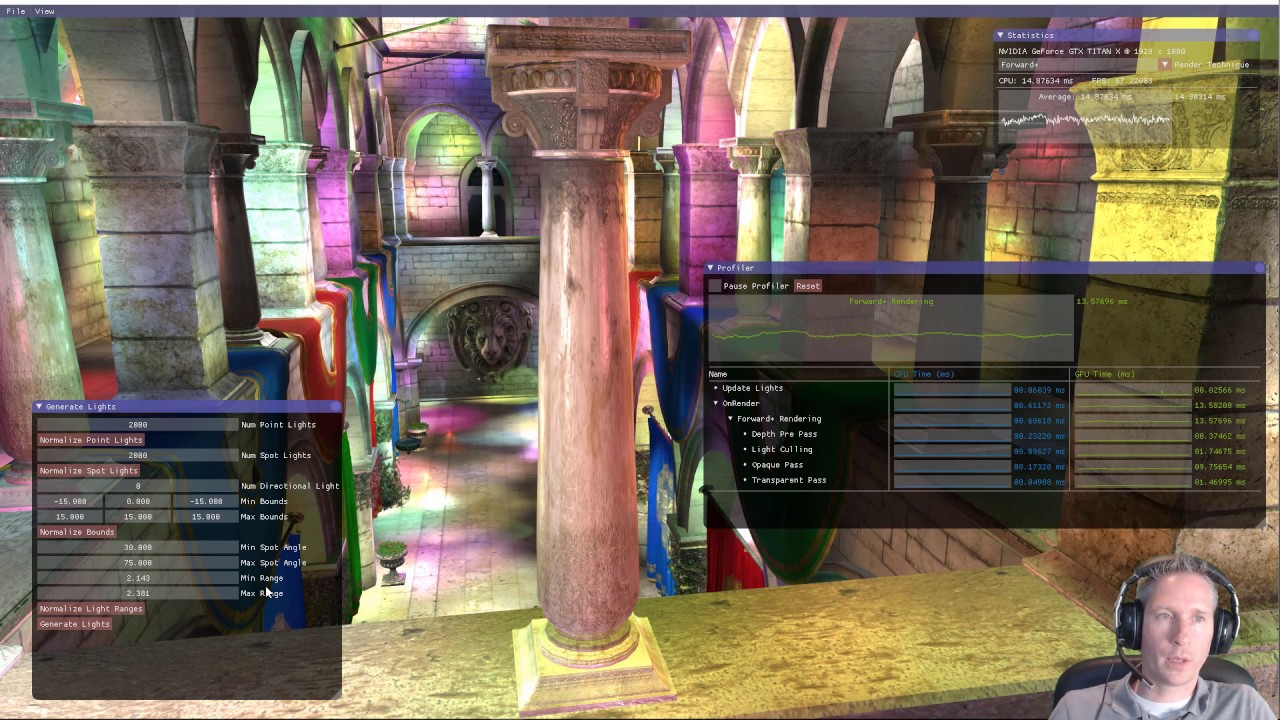
In this video Volume Tiled Forward Shading is described. Volume Tiled Forward Shading is based on Tiled and Clustered Forward Shading from Ola Olsson et. al.
In this video, the Sponza (Crytek, 2010) scene is used to demonstrate Volume Tiled Forward Shading. By first constructing a Bounding Volume Hierarchy (BVH) over the lights, we can achieve ...
This?
wispy spear
yes
wicked notch
Psychedelic Lighting Simulator I see
wispy spear
hehe
wicked notch
It's basically point light culling?
wispy spear
i mean i couldnt tell the difference between 500 and 1mio lights
not just point light i guess
wicked notch
wicked notch
https://www.youtube.com/watch?v=nyItqF3sM84
This has been successfully added to the TODO list™️
Hmm I really don't want to implement a GUI myself, is there any library I could use? I have found this: https://github.com/Immediate-Mode-UI/Nuklear
frank sail
wispy spear
next is volume clustered rendering
Lel
deccer has found someone worthy of the task
wicked notch
Progress report on Operation Black Mage (porting FSR2 to OpenGL)
frank sail
wicked notch
Progress report on Operation Black Mage (porting FSR2 to OpenGL)
Uh
The shaders and cmake are probably done, now I just need to make the backend
frank sail
Btw, how is your TAA under motion
wispy spear
looks neat still
frank sail
Even the best TAA implementations I've seen shimmer a little bit in motion
wicked notch
Visual representation of Jaker's progress:

Jk by the way, it's your personal time so I'll be patient
wispy spear
: )
wicked notch
~~Perhaps I'll switch to Vulkan faster than you port it ~~
By the way RMLUI looks very interesting, finally my useless HTML and CSS skills will be put to use
On a whim I decided to actually look at the vulkan tutorial in my bookmarks
This is.. frightening lol

Words I've never seen before
frank sail
Tbf you only have to do like 70% of that once in your whole life
Since it's boilerplate
wicked notch
Yeah but why is there a physical and a logical device, what does that even mean
For SLI or something?
Ah alright it's explained, perhaps I should just read
VkPhysicalDevice is the actual hardware, VkLogicalDevice VkDevice lets you specify what extensions and features of the VkPhysicalDevice you want to use and stuff like that?
To draw to a VkImage acquired from the swap chain, we have to wrap it into a VkImageView and VkFramebuffer. An image view references a specific part of an image to be used, and a framebuffer references image views
Ah yes, indirection.
 finite quartz
wicked notch
Ah alright it's explained, perhaps I should just read
finite quartz
wicked notch
Ah alright it's explained, perhaps I should just read
A recommended method, which has been proved over the years :p
wispy spear
how come you fiddle with Vk now?
wicked notch
Nothing special, I just wanted to check out how much I can delay using Vulkan
wispy spear
heh
 cunning atlas
honestly i set up my device stuff once and I look at it only when I need to enable something
if you use C++ vkbootstrap helps a lot with the setup too
wicked notch
I really like this Vulkan thingy where you put your stuff into structs and then use these as parameters
It reminds me of my framebuffer constructor with 10 parameters or something
I'll probably adopt this
frank sail
don't forget that OpenGL features zero structs
wispy spear
almost
frank sail
a mind boggling choice tbh
frank sail
wispy spear
almost
the indirect structs don't count
 wicked notch
I really hate `glCopyImageSubData`
wicked notch
wicked notch
I really hate `glCopyImageSubData`
15 goddamned parameters
frank sail
You'd love fwog hehe
 wicked notch
frank sail
You'd love fwog hehe
wicked notch
frank sail
You'd love fwog hehe
The next time OpenGL manages to anger me with its unhingedness I'll switch to Fwog
frank sail
you can do whatever, I just like shilling
wicked notch
Yes, I think I've used enough raw OpenGL, so I'll gladly accept your shilling
wispy spear
wouldnt surprise me that you switch to vk and make a better Fwovk before jaker even considers switchting to vk
frank sail
Fvog
wispy spear
and martty will get inspiration from it for vuk2
wicked notch
int main() {
    if (!glfwInit()) {
        IRIS_LOG_ERROR("failed to initialize glfw");
        return -1;
    }

    glfwWindowHint(GLFW_CLIENT_API, GLFW_NO_API);
    glfwWindowHint(GLFW_RESIZABLE, GLFW_FALSE);
    auto* window = glfwCreateWindow(800, 600, "IrisVk", nullptr, nullptr);

    // instance
    {
        auto count = 0_u32;
        const auto** extensions = glfwGetRequiredInstanceExtensions(&count);

        auto application_info = VkApplicationInfo();
        application_info.sType = VK_STRUCTURE_TYPE_APPLICATION_INFO;
        application_info.pNext = nullptr;
        application_info.pApplicationName = "IrisVk";
        application_info.applicationVersion = VK_MAKE_API_VERSION(0, 1, 0, 0);
        application_info.pEngineName = "IrisVk";
        application_info.engineVersion = VK_MAKE_API_VERSION(0, 1, 0, 0);
        application_info.apiVersion = VK_API_VERSION_1_3;

        auto instance_info = VkInstanceCreateInfo();
        instance_info.sType = VK_STRUCTURE_TYPE_INSTANCE_CREATE_INFO;
        instance_info.pNext = nullptr;
        instance_info.flags = {};
        instance_info.pApplicationInfo = &application_info;
        instance_info.enabledLayerCount = 0;
        instance_info.ppEnabledLayerNames = nullptr;
        instance_info.enabledExtensionCount = count;
        instance_info.ppEnabledExtensionNames = extensions;

        auto instance = VkInstance();
        auto result = vkCreateInstance(&instance_info, nullptr, &instance);
        IRIS_LOG_INFO("instance created: %p", (const void*)instance);
    }

    while (!glfwWindowShouldClose(window)) {
        glfwPollEvents();
    }

    glfwDestroyWindow(window);
    glfwTerminate();
    return 0;
}
``` This is what I wrote in the past 30 minutesAnd I'm already tired
It's 40 lines of code
wicked notch
You need less than 30 for a colored triangle 😎
frank sail
glfwDestroyTheChild
wicked notch
wispy spear
did you know that glfwTerminate calls glfwDestroyWindow

Does it actually?
frank sail
big chads don't call either
wispy spear
true
frank sail
let os mommy clean up after you
wispy spear
and claim that their shit works whifout calling sdlInit when using sdl
what about cleaning up before you?
frank sail
wut
wispy spear
there was a dude somewhere in #vulkan or idk where, claiming that
frank sail
 wicked notch
Hmm I don't really like RML, it forces you to use OpenGL 3.3 if I didn't misunderstand anything?
It also comes with its own glad and stuff
Actually maybe not
wicked notch
Yeah okay, after using RmlUi for a few hours I decided it's not very comfortable to use.. I think it's more intended for Apps and stuff instead of real time 3D
wicked notch
dearimgui looks promising, it's even used by Rockstar Games lol
wicked notch
I will eventually, but I'll probably use something easier like Electron or something like that
I would like to see my render targets right now mostly
wispy spear
yeah then dear imgooey
frank sail
babagooey
 frank sail
Is that the docking branch
wicked notch
Yes, I've discovered that after I initially did this all manually without docking of course
frank sail
Try drawing ImGui without framebuffer srgb
It'll fix some of the colors, but too bad it's wrong either way
wicked notch
Hmm need everything as linear sRGB and then perform the conversion manually in the TAA resolve pass?
frank sail
You should be drawing ImGui at the very end of everything
And without framebuffer sRGB, because in theory it should already be sRGB (thus it doesn't need the linear-srgb conversion)
wicked notch
But doesn't OpenGL convert back to linear space when sampling from textures?
wicked notch
I suppose ImGui samples from my output texture when I give it the texture id to ImGui::Image, then it will write that into the default framebuffer and since it's not sRGB it will be stored in linear space?
wispy spear
can you not draw imgui onto the final image after resolving everything else
or even once you blitted everything to fb0, draw imgui then
frank sail
I'm talking about imgui itself, not the random image you draw with ImGui::Image
wicked notch
Ah by the way, my pipeline is simply: Depth Prepass -> Frustum + Occlusion Culling -> Depth Reduce -> Shadow Setup -> Shadow Render -> Color Pass (SRGB texture) -> TAA Setup -> TAA Resolve -> Draw UI (To SRGB framebuffer)
wicked notch
frank sail
I'm talking about imgui itself, not the random image you draw with ImGui::Image
ImGui is drawn at the very end, to the default framebuffer
frank sail
and I'm saying to disable framebuffer srgb right before that
It should make your imgui darker
wicked notch
Ah I see
wispy spear
glDisable(GL_FRAMEBUFFER_SRGB)
frank sail
I can tell it's on because the colors are too bright
wicked notch
Nope it still looks very bad
 frank sail
Btw, the author of ImGui literally doesn't understand color encodings, so it's wrong no matter what 
https://github.com/ocornut/imgui/issues/578
frank sail
wicked notch
Nope it still looks very bad
The gui colors look correct at least
But now your scene is super dark lol
wicked notch
I don't care too much about color correctness of the UI to be quite honest
I'm afraid to step into uncharted territory (#vulkan)
I looked again at whatever little Vulkan I wrote yesterday and I just realized I'm passing over 15 parameters to a single function
The whole "ApplicationInfo" and stuff..
wicked notch
I think that's enough Vulkan for today
230 lines and still no pretty colors on the screen 😦
Time to learn about atmospheric scattering!
frank sail
just a few hundred more lines and you'll have a clear color going
wicked notch
frank sail
just a few hundred more lines and you'll have a clear color going
Do you recommend anything for atmospheric scattering? Besides scratchapixel's article?
wicked notch
Does Fwog have any samples I can copy reference?
frank sail
I only have a local mie scattering fog thingy
which isn't suitable for atmospheres, since you need rayleigh scattering for dat
wicked notch
frank sail
https://sebh.github.io/publications/egsr2020.pdf
Rip, I'll read scratchapixel first and then this then
frank sail
there are probably also some siggraph pbr course thingies you can look at
frank sail
I also have this thing sitting in a tab
https://www.ea.com/frostbite/news/physically-based-sky-atmosphere-and-cloud-rendering

Electronic Arts Inc.
Talk by Sebastien Hillaire at SIGGRAPH 2016 in the Physically Based Shading in Theory and Practice course.
wicked notch
There's also the thing about stars and clouds
And fog
And rain
Making an atmosphere is hard
frank sail
fog is something I can help with
wicked notch
Lovely, one piece at a time I'll solve this puzzle hopefully
frank sail
I'm not sure about rain rendering techniques
you can probably get something decent with a particle system
I guess there are quite a few components to a weather system though
clouds, precipitation, ground effects (like puddles, snow, 'wettening', etc.)
wicked notch
Hmm yes, the most difficult thing would be to dynamically update each object based on how it reacts to rain
Why can't the dumb silicate rock figure it out on it's own smh
frank sail
I wrote about particles and teardown (which has some nice weather effects) in my blog
https://juandiegomontoya.github.io/
frank sail
wicked notch
Hmm yes, the most difficult thing would be to dynamically update each object bas...
how do objects react to rain?
wicked notch
The things you wrote
wispy spear
with shriwwle
frank sail
ah
wicked notch
Objects become more shiny or their roughness is accentuated
frank sail
I think some tomb raider game had a presentation where they mentioned this stuff
wicked notch
I'm getting very ahead of myself though, atmosphere first.
It seems like the easiest of them all
wicked notch
Thanks for all the links, big preesh
frank sail
ah yeah uncharted 4 was the one
https://advances.realtimerendering.com/other/2016/naughty_dog/NaughtyDog_TechArt_Final.pdf
they use some wetness mask
btw ignore the mip fog in that presentation
wicked notch
Me: Heavily constrained by VRAM Throughput
Also me: What's 6 or 7 more full screen passes
How do games even do this
Without running into absurd amounts of render targets
cunning atlas
wicked notch
230 lines and still no pretty colors on the screen 😦
you'll get there 🙂
frank sail
wicked notch
Without running into absurd amounts of render targets
lol. lmao
btw the bandwidth isn't that bad when you read/write to each pixel once
full screen passes are generally super cheap
wicked notch
There's no way we're reading once per pixel from the wetness mask is there
frank sail
one trick is combining a lot of full screen passes into a single one also
wicked notch
Hmm, like making a huge shader?
frank sail
t h i c c
wicked notch
How many buffer bindings was the limit per shader stage?
frank sail

frank sail
wicked notch
There's no way we're reading once per pixel from the wetness mask is there <:KEK...
it looks like this is just affecting the values they write to the g-buffer in the scene pass
wicked notch
Hmm I see
frank sail
wetness is an additional material input thingy that they use
so it's one extra texture read I guess
wicked notch
I am still using a regular forward renderer, should I go deferred?
frank sail
but it doesn't affect how chonky the g-buffer is
wicked notch
Even more render targets
frank sail
wicked notch
I am still using a regular forward renderer, should I go deferred?
deferred is nice because it makes a lot of post processing stuff possible
like ssao, ssr, etc.
wicked notch
I'll have to think carefully about what I put in the gbuffer
I'm thinking just uvs and depth?
frank sail
everythingggggg
wicked notch

frank sail
wicked notch
I'll have to think carefully about what I put in the gbuffer
that's a tough question
"standard" deferred renderers will put surface material info in the g-buffer (material type, normals, roughness, metallic, ao) and depth
wicked notch
Yeah but that's a lot of bandwidth
frank sail
boohoo
the new hotness is visibility rendering, which is basically depth+triangle&instance ID, then you can fetch material parameters in the shading pass
wicked notch
Look, I don't want my occupancy to look like it's starving
frank sail
meh
visibility buffer is quite a bit more effort for probably 0 gain in most projects
UE still uses a massive g-buffer in its regular rasterized renderer and that performs fine
wicked notch
Does depth + uv not work?
frank sail
how do you know what texture to sample with just the UV
frank sail
now how do you get mipmap+anisotropic filtering
frank sail
just pass 4 more floats for UV gradient on x and y 
wicked notch
depth + uv + material id + ddx/ddy
Do I only need derivatives for aniso?
If I had meshlets I could easily calculate derivatives
Just get 3 vertices with gl_MeshPrimitiveID, compute barycentrics, ezpz
frank sail
if you have the triangle ID, you can compute the derivatives (and UV, etc.) analytically
http://filmicworlds.com/blog/visibility-buffer-rendering-with-material-graphs/
frank sail
you need instance ID and triangle ID to uniquely identify a triangle
frank sail
implying you'll have more than one vertex/index buffer
wicked notch
It's easy if you have only one ofc
wicked notch
frank sail
>implying you'll have more than one vertex/index buffer
I made it like this because I thought it was more appropriate
Jokes aside it's actually very easy to solve
frank sail
well, if you're going to optimize meaningless stuff, you better go the full way
with one mega vertex/index buffer, you can do MDI
wicked notch
Every object already stores their index to their VBOs and EBOs
So I just need one more id, object id
And I can uniquely identify any triangle
frank sail
homie is speedrunning graphics
wicked notch
frank sail
well, if you're going to optimize meaningless stuff, you better go the full way
True this is pretty meaningless lol
I'll just keep my good old forward renderer until I need a reason to change it
frank sail
I guess you can write a thin g-buffer if you need that stuff for post-fx
like what I think 🇩 does
does
wicked notch
Atmosphere is cooler than random api plumbing 😎
wicked notch
frank sail
with one mega vertex/index buffer, you can do MDI
Btw I do MDI already, in case you forgor
I just preallocate 256MiB and if it spills I make another 256MiB
frank sail
oops 
frank sail
wicked notch
I just preallocate 256MiB and if it spills I make another 256MiB
you may need to up that if you do visbuffer
or mayhaps make some adjustments to the algorithm
I guess you could record the buffer id and do multiple shading passes (or one where you have all the buffers bound)
wicked notch
The scheduler in my brain says this process (deferred) is very low priority
But I will think about it
frank sail
I'm not saying you should do it. I'm saying that it will happen at some point
Beware the pipeline!
frank sail
@wicked notch what do you remember about the reason for physical devices and logical devices being separate things? I just (hopefully correctly) remembered that one logical device can correspond to multiple physical devices, e.g., for SLI
wicked notch
I think it's the other way around
One physical -> many logical
Yeah, a VkPhysicalDevice is the actual hardware while the VkDevice specifies what features and extensions of that specific physical device you want to use
frank sail
https://stackoverflow.com/questions/31833776/howd-multi-gpu-programming-work-with-vulkan
The idea with this is that the SLI aggregation is exposed as a single VkDevice, which is created from a number of VkPhysicalDevices. Each internal physical device is a "sub-device". You can query sub-devices and some properties about them. Memory allocations are specific to a particular sub-device. Resource objects (buffers and images) are not specific to a sub-device, but they can be associated with different memory allocations on the different sub-devices.
frank sail
tutorial vs so answer, unstoppable force vs immoveable object
 frank sail
wicked notch
```After selecting a physical device to use we need to set up a logical device t...
frank sail
wicked notch
```After selecting a physical device to use we need to set up a logical device t...
I think this is a bit different
I think you can ask for certain things before getting the logical device
sadly my knowledge of vulkan device creation is quite limited
anyways, the tutorial provided reason enough to have such a separation
the SLI thingy is just an aside (and mostly irrelevant)
wicked notch
If you can query for SLI in OpenGL I'd just do:
if (is_sli_enabled) {
    printf("bro wasted his money lmao");
    debug_break();
}```Rate my (non-antialiased) sun
 finite quartz
 wicked notch
I forgor everything about my physics classes, how do you calculate the sun's trajectory over time again?
wispy spear
sunpos = sunpos + 1
frank sail
x = cos(time)
y = sin(time)
wispy spear
fisically accurate
wicked notch
I remember it more involved but that's accurate enough I guess?
frank sail
making it have an offset is up to the reader to figure out
wispy spear
good thing void is not here atm :>
frank sail
@ void !!! math alert !!!
wicked notch
Now we can start doing the atmosphere thingy
frank sail
Looks like a perfect UK atmosphere already
wicked notch
Still no clear color has been achieved
At least I have a swapchain now, I have no idea how OpenGL abstracts the swapchain away from me...
Anyways it's cool seeing the inner workings of how things work effectively
frank sail
wicked notch
At least I have a swapchain now, I have no idea how OpenGL abstracts the swapcha...
it's cursed
the windowing system defines it
you can write to it by binding framebuffer 0, but you can't read from it or query anything about its attachments
wispy spear
its a little sad
frank sail
glfw gives you a minimal amount of control over the swapchain when you create the window
wispy spear
one could simulate a swapchain, with an ordinary fbo, and you never care about fb0
and your swapchain::present is just a glBlitNamedFramebuffer(..to fb0...)
i am toying with that idea for some time now, and prohaps emove BeginRenderToSwapchain and replace it with an acchual schwapschain object
frank sail
hmm, how do you render to the actual swapchain then
is it just a secret blit somewhere
frank sail
not a bad idea tbh
I could copy that idea to shrimplify fwog (by removing RenderToSwapchain stuff)
wispy spear
: )
technically
you could still draw your UI after it if you wanted with a little gymnastics to put it between blit and swap, or you also just draw into the swapbuffer-fbo
pretty much like you would do in dx11
wicked notch
Hmm I can't find the necessary motivation to study Atmospheric Scattering
Exams are also coming up
frank sail
Rayleigh will still be here too
wicked notch
I'll definitely be there for the FSR2 inauguration
wicked notch
I guess I'll try to continue with the Vulkan triangle instead of randomly reading scratchapixel
We're at day 3 and counting by the way
wicked notch
The more I sink into Vulkan the less I understand how OpenGL works
How anything "just works" in GL is purely beyond me at this point
wispy spear
ObenGL is just Vulkan minus info structs and synchronization thingies (i forgot the word)
frank sail
wicked notch
The more I sink into Vulkan the less I understand how OpenGL works
That's normal when learning Vulkan
wicked notch
I wanted to notify I reached the "Synchronization and Command Buffers" phase
If you don't hear from me within 30 minutes, that means Khronos has claimed my soul
frank sail
 wicked notch
Alright
I came back
I have this.

...But I understood close to nothing about synchronization
wicked notch
I understood a bit of synchronization
Which I am pretty happy about, I at least have 1 clue of what the thing is doing
That being said I will definitely do atmosphere tomorrow, while I digest the casual 1k lines for a single triangle..
I also realized earlier I am not even using a vertex buffer, that's probably another thousand lines
cunning atlas
Don’t worry, there’s a good portion of that 1k you won’t have to mess with all the time
 wispy spear
czech and german number plates
 cedar seal
OpenGL: Driver does lots of mostly useful stuff for you, hides some nastyness.
Vulkan: You deal with everything yourself.
finite yacht
I have a question. Do you do the ROC with an indirect draw or not
finite yacht
alright thats exactly what I was going to ask
so I need to add an other indirect buffer 😦
wicked notch
Yeah, and it's just a single indirect command too if you use Jaker's trick
Which is to do a TRIANGLE_STRIP with the number of objects that were visible as instanceCount
cedar seal
Roc?
wicked notch
Raster Occlusion Culling
finite yacht
wicked notch
Which is to do a TRIANGLE_STRIP with the number of objects that were visible as ...
so the compute frustum culling would modify the instanceCount of this single draw command?
wicked notch
Yes
finite yacht
i smell an other layer of indirection
wispy spear
i was also thinking about that last night
when you let your cs cull all sorts of things, then how to transfer the right gl_DrawID, to fetch the instance data for the object you want to render
unless you also pass that to the cs, and let it also store the instance data that way it does for indirects
but gave up thinking further a minute later 🙂
wicked notch
Along the indirect buffer to write, I also pass another buffer yes
It's sole purpose is to store the relationship between the index of the object and the index of the thread in the compute shader that culled the object
That's where the additional layer of indirection comes from
wicked notch
I never thought that mate :p
wispy spear
i do/did 🙂
cedar seal
I can see how the compute shader culling works, but how does roc work?
wicked notch
You rasterize every object's bounding volume and check it against the depth buffer
You also abuse EarlyZ so that you can simply have a fragment shader that does visibility[object] = 1
Because all the samples that don't pass will not enter the fragment shader
cedar seal
Where does the depth buffer come from?
wicked notch
You use this frame's depth buffer to write visibility for the next frame
cedar seal
How does it deal with false negatives?
wicked notch
Generally object "pop-in" is not noticeable unless at low framerates but you can fix that by also drawing all the objects that changed visibility from 0 to 1
wicked notch
You keep two visibility buffers and copy current to last at the end of the frame
Then in the culling compute shader, you just check both last and current
So the pipeline looks like this:
frustum_cull();
draw_all_visible();
occlusion_cull();
draw_changed_visibility();```At least I think it was this way?
cedar seal
All of these in gpu?
wicked notch
cedar seal
All of these in gpu?
Yes
frank sail
Wait no it's the first occlusion cull that you don't need
wicked notch
Yeah, we have the visibility from the previous' frame
cedar seal
I should give it a try
Do you use bounding spheres and bounding boxes, any other shapes?
wicked notch
I just use regular AABBs, I used bounding spheres for HiZ but I prefer ROC 😛
frank sail
republic of china
cedar seal
What step is roc? draw*?
frank sail
occlusion_cull
and draw_changed_visibility would also be something you implement due to roc
cedar seal
Okay now it makes a bit more sense
frank sail
chicken-and-egg problem hehe
wicked notch
I suck at explaining
wispy spear
egg and chicken problem
frank sail
wicked notch
I suck at explaining
naw you did good
or at least no worse than myself when explaining this 😄
wispy spear
even i understood it somehow
cedar seal
- frustum cull - clear
- draw all visible - this is just normal draw, fills depth buffer
- roc - draw bounding volumes, update visibility buffer for next frame
Like that?
frank sail
ye
wicked notch
Pretty much
cedar seal
Does roc execute fragment shader for every fragment for the bounding shape?
frank sail
there is also an nv extension that allows just one fragment to be rasterized
https://registry.khronos.org/OpenGL/extensions/NV/NV_representative_fragment_test.txt
wicked notch
Unless you do glEnable(GL_REPRESENTATIVE_FRAGMENT_TEST_NV); ye
cedar seal
That would be one fragment per triangle, I see. Cool stuff.
Is this worth on mobile as well?
frank sail
roc in general?
no clue here, I don't do mobile
it makes huge savings on desktop, so I'd imagine that some of it would translate to mobile hw
frank sail
@wicked notch try Nsight Graphics
wicked notch
It's gone
frank sail
 wicked notch
They removed it in this version
frank sail
welp
wicked notch
Ah one thing I'm doing is this though
frank sail

Starting in Nsight Graphics 2023.1, the GPU Trace Profiler is the best way to profile your graphics application at the frame level. The Frame Profiler activity, and the Range Profiler tool window…
wicked notch
foreach cascade {
    dispatch() // does frustum culling, writes indirect commands
    glMultiDrawIndirectCount(); // draws
}```Could this cause problems?
frank sail
nvidia doesn't like "subchannel switches" (changing between compute and graphics work) because it forces a WFI each time
but that will manifest as a tiny gap of no work on the GPU
and you have only like 4 cascades, so it's no biggie
wicked notch
Yeah, but there's a stupid amount of compute warps active
Where do these all come from
frank sail
That's a good question
frank sail
have you seen this extension
https://registry.khronos.org/OpenGL/extensions/ARB/ARB_texture_filter_minmax.txt
it seems supported on new hw from both vendors
frank sail
it's all yours, my friend
wicked notch

frank sail
@wicked notch have you figured out how to view multi-frame gpu traces in nsight
for some reason it's only showing me the first frame
I presume this means it'll capture 5 consecutive frames anyways
 wicked notch
Yeah, as far as I know it just calculates the frame deltas
frank sail
this grayed out button tells me that something weird is happening
 wicked notch
Hmm probably an estimate or weird shit happening
I also have the thing greyed out for some reason
Mayhaps it's due to the debug group markers?
frank sail
ah
when I change the metric set to throughput metrics, now I can aggregate the frames
much better
wicked notch
epic
I didn't even notice the difference between advaced and throughput
Documentation on nvidia's site is outdated
frank sail

yeah
this post shows some "srcunit" metrics that have been renamed since
https://developer.nvidia.com/blog/optimizing-vk-vkr-and-dx12-dxr-applications-using-nsight-graphics-gpu-trace-advanced-mode-metrics/
you can now find them by just searching "L2"
btw you can analyze a range with shift+drag (I accidentally discovered it a few days ago)
wicked notch
Nice
wicked notch
frank sail
this post shows some "srcunit" metrics that have been renamed since
<https://dev...
This looks more updated indeed, I hope it's not just for VK and D3D
frank sail
yeah I'm looking at my gl app with it right now
wicked notch
I am a bit conchfused by C#'s generics system
Given the following:
private static void GenericThing<T>(T x)
    where T : IThing
{
    x.DoThing();
}

private static void InterfaceThing(IThing x)
{
    x.DoThing();
}```What is the difference between the first and the second thingy?
If the generic type is constrained, then what's the point? 
wispy spear
one is compiletime the other is runtime
wicked notch
Hmm
Looking at the IL code both seem to do a callvirt does that mean I'm doing something wrong?
wispy spear
no
wicked notch
What do you mean by compile time?
wispy spear
i think constructed questions like that dont lead to anywhere
you cant do typeof(x) in interfaceThing, but you can do typeof(T)
wicked notch
Hmm I see
wispy spear
and use it to run code
if typeof(x) == typeof(whatever) for instance
but you could in the generic thing
wicked notch
What I don't understand is why the GenericThing is doing a virtual call 🤔
 twin musk
callvirt is used for more or less everything, typically the jit will devirtualize it if it can
wicked notch
Ooh
So let's say I have this:
Thing thing = new Thing();
IThing thing2 = new Thing();
GenericThing(thing);
GenericThing(thing2);```I assume the first will be devirtualized while the second will not?
wispy spear
never had to dig down that deep
wicked notch
Hehe, I enjoy getting to know the language
wispy spear
id rely on the compiler to lower properly
wicked notch
I want to explore C#'s guts as much as possible
wispy spear
good exercise right there 🙂
you can also emit IL with c#, but its been years since i did that last time 😄 it was in the summer of 2005
wicked notch
I have this very nice thing on the right
 twin musk
wicked notch
I assume the first will be devirtualized while the second will not?
twin musk
wicked notch
I assume the first will be devirtualized while the second will not?
i think both will probably be devirtualized, since even though thing2 has type IThing the jit can go back and see that it's got to be of type Thing
wicked notch
Hmm I see
So if the compiler can prove that T is going to be Thing then it will devirtualize the call
Epic
twin musk
i'm not 100% certain on that though, i could be completely wrong there!
wicked notch
That's fine, I'll be reading stuff on C#'s JIT compiler anyways
Guesswork and theorycrafting are appreciated as well
wispy spear
its interesting to see how people approach new languages : )
wicked notch
https://www.youtube.com/watch?v=4yALYEINbyI This is a great talk tbh
Explains a lot about generics, devirtualization and stuff
Unfortunately no one really knows how the JIT compiler actually performs devirtualization, but this issue is pretty good: https://github.com/dotnet/runtime/issues/7541
I've seen from the various threads that the rule of thumb to avoid hindering the JIT's compiler ability to devirtualize is to use:
- Sealed Classes
- Don't assign T to an interface, just use
var - Generics and
typeofare your best friend
wispy spear
i am not sure i understand 2)
wicked notch
With 2 I mean this:
IThing thing = new Thing();
``` is potentially dangerousWhile
Thing thing = new Thing();``` is safeah, but it shouldnt
wicked notch
Yeah of course, this is a shrimple example
The compiler is big brained enough I'm sure
wispy spear
its a good thing that all the dotnet/and c#isms are also worked upon in public
wispy spear
i need to make more use of spans too - https://learn.microsoft.com/en-us/archive/msdn-magazine/2018/january/csharp-all-about-span-exploring-a-new-net-mainstay

weird how this article is inbetween all this other crap
wicked notch
C# has been pretty fun so far, however Avalonia's AXAML is a bit of a pain to use
Why couldn't it just be HTML smh
wispy spear
i agree avalonias xaml is scuffed
WPF's xaml is >> all
HTML is not an option 🙂 its not xhtml
cedar seal
😉 ImGui
frank sail
dear imgui is the end-all be-all of gui solutions
wicked notch
Alright
Trying to render the City Sample (even the small one) caused my GPU's driver to reset infinite times, I had to hard-reset my PC
Turns out that if two or more meshes are equal, different vertex buffers with the same contents are still created for them, which is really suboptimal
So I was basically loading the full 116 million triangles for no reason at all, spilling it into system RAM, and even into the page file
wispy spear
are you going to break the mesh into chunks?
physical ones
and stream/load on demand?
is it even "large" (dimension wise) enough? 🙂
wicked notch
I think for now I'll shrimply NOT allocate vertex buffers with the same contents lol
Then I might do some software meshlet shenanigans perhaps
Streaming is still a dream I don't think I can achieve right now, but soon™️
wispy spear
: ) oki
frank sail
the stream dream meme
wicked notch
Also, I'll upload the city sample if any of you want to break your engine try it out yourself
wispy spear
be careful with your git repo
wicked notch
License issues?
wispy spear
size and bandwiff
wicked notch
I dunno anything about licensing tbh
Ah, yeah 300MiB is not much but still quite heavy
wispy spear
there is a stupid limit for unpaid git plans
perhaps you can upload it to discord
and link from zer
not sure what the non nitro upload limit is, with nitro its 500mibs iirc
frank sail
only 100mb for plebs like us
wicked notch
I have a hetzner storage box but I have no idea how to setup permissions
For a quicc upload 🙂
Try it out, let me know how many levels of backrooms you'll fly through
wispy spear
wicked notch
I have a hetzner storage box but I have no idea how to setup permissions <:KEKW:...
sudo chmod +777 -R /
😄
(dont run that)
wicked notch
Hehe I've used linux for a long time
wispy spear
890mb 😄
wicked notch
ngl I've actually fallen for that joke way back
wispy spear
hehe
wicked notch
On a VPS though so nothing catastrophic
wispy spear
i got rid of all my servers over the years
SharpGLTF.Validation.SchemaException: Accessor[208] _count: 0 must be greater or equal to 1.Model generated by <Unreal Engine 5.2.0> seems to be malformed; Please, check the file at https://github.khronos.org/glTF-Validator/
lets see if vscode can load it
wicked notch
Hmm, blender could load it so I assumed it had no errors
wispy spear
gltf seems indeed kaputt here and there
according to the red indicators of the linter/validator thing
wispy spear
you need to rewrite UE into the german umlaut u 😄 and yell it, puts more emfasis on the sillyness
frank sail
oo ee
wispy spear
"i blame Ü"
frank sail
why ü smiling
wispy spear
201 validation messages for /home/deccer/Private/Code/Projects/lessGravity/OpenSpace/src/OpenSpace.Assets/Data/Props/Small_City_LVL/Small_City_LVL.gltf
wispy spear
frank sail
why ü smiling
haha, i didnt see it until you said it
wicked notch
cgltf doesn't seem to complain though I did pass it through gltfpack
So perhaps it did some weird shenanigans
wispy spear
hmm its also just warnings but ye
wicked notch
Just do the big ignore™️
wispy spear

{
            "bufferView": 208,
            "count": 0,
            "type": "VEC3",
            "componentType": 5126
        },
        {
            "bufferView": 209,
            "count": 0,
            "type": "VEC3",
            "componentType": 5126
        },
        {
            "bufferView": 210,
            "count": 0,
            "type": "VEC4",
            "componentType": 5126
        },
for those kind of things
wicked notch
I mean, yeah a 0 sized buffer is nonsensical
wispy spear
or is it?
wicked notch

wispy spear
heh
hmm i probably have to open another iShoe with that lib
since validation is pretty much off already
frank sail
I'm not touching my home pc until I'm off work
wispy spear
i was about to say that an excuse is about to come .. something about work
you live in ze wong timezone
frank sail
no u
wispy spear
nuh uh

 frank sail
 wispy spear
wicked notch
wispy spear
wicked notch
So, it's exam season but I have not been idling, I have done quite a bit of research a lot of stuff: How Nanite works, Micropolygon Software Rasterizers, Visbuffers and Vulkan.
- Regarding "software" meshlets (i.e.: without mesh shaders) it turns out you lose quite a bit on performance because you lose the vertex cache. I'm not sure if this'll be a problem in the future with hugely detailed meshes, we'll see.
- Micropolygon Software Rasterizers are incredibly cool and they somehow beat a hardware rasterizer. It turns out they also work really well with a 64-bit Visibility Buffer.
- Visibility buffer are another thing that's incredibly cool, if you store the cluster index and the triangle ID within that cluster, along with the depth you have all the informations you need to render a triangle.
I, however, am getting VERY ahead of myself, given that I don't even render a single triangle with my current Vulkan abstraction
I'm also quite tired of using raw OpenGL and don't have the life force to abstract it on my own, so I guess Fwog will have another user!
Unfortunately I don't have time to properly sit down and program as I used to, once exam season ends I should start again
 discord wont be running away 🤌
wicked notch
discord wont be running away 🤌
wicked notch
Alright, I have one hour before my brain batteries run out, it's time to clone Fwog
Jaker I expect techsupport within 2 nanoseconds of my requests
wicked notch
Thanks 🎩
wispy spear
🇳🇵
wicked notch
There is an error here https://github.com/JuanDiegoMontoya/Fwog/blob/main/include/Fwog/Rendering.h#L79
This tells me you always use a -1 to 1 depth range
Unforgivable
frank sail
wicked notch
This tells me you always use a -1 to 1 depth range
I uh

unrelated, but I also need to fix a bunch of missing enumerators because they didn't appear in the refpages when I was copying them
wispy spear
before or after working on them articles?
frank sail
babogey
wicked notch
frank sail
I forgot what the missing enumerators were though so I'll forget about it altogether
wicked notch
Regardless of Jaker's questionable time management skills
We have Mr. Triangle for the 28595th time

Time to do hybrid software-hardware rasterization with LOD'ing and basically reimplement nanite
Hold on
OpenGL does support 64 bit atomics right?
wicked notch
I mean 64 bit image atomics, sorry
frank sail
wicked notch
I mean 64 bit image atomics, sorry
what's the ext called
wispy spear
ill revoke the first tringle being rendered properly
wispy spear
GL_EXT_extension
wicked notch
GL_EXT_shader_image_int64
wispy spear
close
frank sail
I don't see it on gpuinfo
maybe it's one of those glsl extensions that "just works" when you add it on supporting drivers
wicked notch
frank sail
maybe it's one of those glsl extensions that "just works" when you add it on sup...
So is this concerning? "0(3) : error C0202: extension EXT_shader_image_int64 not supported\n"
wispy spear
no
wicked notch
How do I feed SPV to your thing
frank sail
that's the neat part
uh
would you like me to add a way to feed spirv to fwog shaders
wicked notch
Nah, don't bother, it's too painful
Alright change of plans
I will not do the 64 bit visbuffer in OpenGL
I'll shrimply do software meshlets
 frank sail
I mean for buffers
wicked notch
Hm
frank sail
maybe your epic renderer could be enough pressure to get vendors to add 64-bit image atomics
wicked notch
Yeah, let's not do 64 bit visbuffer in GL
wispy spear
its been 1.5years or so since devsh showed off his  of a visbuffer
frank sail
and if you look at #vulkan right now you can tell it took a toll
wispy spear
jebus they talk faster than i can read
finite yacht
wispy spear
BBK might know something about it
I do actually remeber being able to enable GL_EXT_shader_image_int64 and declare u64image3D in the shader without compile error on amd
but the new amd drivers are weird. Cant say if it works when you have backing storage and actually read/write it
wicked notch
Epic
Btw, how do mesh shaders handle vertex cache? We do basically both vertex and index pulling here, does it not matter because clusters are small enough to fit in L1 anyways?
frank sail
my educated guess is that they don't, at least on AMD hardware
since mesh shaders bypass the part of the hardware (the geometry engine) that implements vertex reuse
frank sail
lemme know if there is anything in fwog that sucks
wicked notch
Ayeaye chief
wicked notch
vertices[v_offset + vertex_indices[i_offset + primitive_indices[p_offset + thread_index]]]
Lovely three way indirection
wicked notch
How in god's holy name is this struct not trivially copyable
struct raw_meshlet_t {
    uint32 vertex_offset = 0;
    uint32 index_offset = 0;
    uint32 index_count = 0;
    uint32 triangle_offset = 0;
    uint32 triangle_count = 0;
    // custom data
    uint32 group_id;
};```Is C++ shitting me?
TriviallyCopyableByteSpan(std::span<T> t) : std::span<const std::byte>(std::as_bytes(t))```??????Ah TriviallyCopyableSpan accepts a single T too for some reason smh
wicked notch
Alright, we got software mesh shaders in Fwog
 wicked notch
It's how I call "rendering meshlets without mesh shaders"™️ lol
The pipeline is actually very simple, from the meshlet buffer I build indirect commands that have a vertexCount of primitive_count * 3 triangles and one instance
Then the vertex shader just fetches primitives, indices and vertices from gl_DrawID
void main() {
    const meshlet_t meshlet = meshlets[gl_DrawID];
    const mat4 transform = transforms[meshlet.group_id];
    o_meshlet_id = gl_DrawID;

    const uint primitive_index = primitives[meshlet.triangle_offset + gl_VertexID];
    const uint vertex_index = indices[meshlet.index_offset + primitive_index];
    const vertex_format_t vertex = vertices[meshlet.vertex_offset + vertex_index];
    gl_Position = camera.pv * transforms[meshlet.group_id] * vec4(vertex.position.xyz, 1.0);
}```Only problem is uh, L1 hit rates being 20%
finite yacht
ok so this could easily be done in actual mesh shaders when available on the hardware
the fact that the vertex shader manually fetches the index makes it sounds slow
wicked notch
Yeah, I didn't change anything on building meshlets or the buffers from my previous mesh shaders attempt
wicked notch
finite yacht
the fact that the vertex shader manually fetches the index makes it sounds slow
Yep
This is one sad frame capture lol
 finite yacht
where should I be looking at to see its bad? (i dont use nsight and stuff)
wicked notch
"Unit Throughput" being very smol
Also "SM Occupancy" is all grey
The blue thingy in SM Occupancy is how many vertex warps were in flight
Less vertex warps = less throughput = less ms
Actually more ms but you get the point
finite yacht
the meshlets are generated by some libary?
wicked notch
Yes, I use meshoptimizer
wicked notch
Hmm that's a pain indeed, but you only need these two functions to build meshlets: meshopt_buildMeshletsBound and meshopt_buildMeshlets
So perhaps you could just DllImport your way through these two
finite yacht
yeah If I really wanted, I would do that. Like I am trying to do right now with fsr2 and failling horribly
but first I need to look for a faster mesh shader emulation. I remember there was compute shader emulation: https://tellusim.com/mesh-shader-emulation/
have you looked into that?
finite yacht
great
wicked notch
Much better

But L1 hit rates are still pure garbage
This is shrimply MDI + Index Buffer + Post-T&L cache
Compute will come after I study
wispy spear
 frank sail
fun learning time has ended, now it is boring learning time
wispy spear

 minor root
i have cooked up a new horrible way of studying
factorio on one monitor, watching lectures i missed on the other
very effective
frank sail
I can't focus on more than one thing at a time
if I'm programming with a video playing on the other monitor, I don't retain anything from the video
and vice versa
minor root
it depends for me
the lecture is mostly audio, and the material is not extremely complicated
frank sail
at best I'll tab out of a game while I'm waiting to respawn so I can read a sentence or two of a blog post
 twin bough
frank sail
if I'm programming with a video playing on the other monitor, I don't retain any...
twin bough
frank sail
if I'm programming with a video playing on the other monitor, I don't retain any...
Same, I tried watching some doom horror mod showcase while programming, and I don't remember shit 2 hours later
finite yacht
finite yacht
I do actually remeber being able to enable `GL_EXT_shader_image_int64` and decla...
ok it only "works" until you try to use imageStore. Because then you get a runtime exception in glLinkProgram...
i wonder if others can reproduce it. @frank sail next time you are on on your amd card and you have time can you try compiling and linking this please (as fragment shader):
#extension GL_EXT_shader_image_int64 : require
#extension GL_ARB_gpu_shader_int64 : require
layout(binding = 0) restrict writeonly uniform u64image3D ImgResult;
void main() {
    imageStore(ImgResult, ivec3(0), uvec4(0));
}
you might need the format in the binding thing too
layout(binding = 0, xxx) blabla blabla; where the xxx is
finite yacht
its writeonly so the format is not needed
wispy spear
ah
finite yacht
(but i also tried with)
frank sail
there's an extension that makes the format unneeded even when it's not writeonly
frank sail
GL_EXT_shader_image_load_formatted
wispy spear
one really has to read the little txt files of the extensions first to know when to use which 🙂 neh?
wicked notch
finite yacht
ok it only "works" until you try to use `imageStore`. Because then you get a run...
Epic
frank sail
what's the deal with these ktx compile options
https://github.com/LVSTRI/Iris/blob/master/CMakeLists.txt#L67
wicked notch
I dunno what's the deal either but I couldn't compile KTX because it uses -Werror and it has warnings so...
I just yoinked warnings out of the equation
wicked notch
Probably just an issue with my outdated MSVC tools
frank sail
I'm about to find out if that's the case
frank sail
yeah there were a bunch of warnings lol
frank sail
@wicked notch are you shrimply assuming that all textures in your gltfs are compressed
https://github.com/LVSTRI/Iris/blob/848591e2f896d03a17a34a9d3eaaf0b6c77d5cc1/src/model.cpp#L81
I don't see a call to texture_t::create in that file, so I guess so
just learned how basis universal works too and it seems quite nice
imagine being the poor schmuck who has to write the BU->ASTC transcoder
wicked notch
frank sail
<@320895822394818561> are you shrimply assuming that all textures in your gltfs ...
Yeah, it's a very primitive model loader, the Vulkan one is much better
soon™️
frank sail
btw
how do you obtain the ktx images
do you just use the toktx tool in ktx-software
frank sail
ah
sweet
doesn't look like blender can output basisu textures or draco meshes 
anyways, I should™️ have compressed texture support pushed to fwog tomorrow. It's already in, but I have to test before committing
wicked notch
Lovely, I'll be the first in the world to use Fwog's compressed textures™️
wicked notch
Referencing: https://tellusim.com/mesh-shader-emulation/ How can they possibly use only one DrawElements call?
Hmm I suppose they just call it with the max number of indices
I do not understand this quite well...
wispy spear
same way you can use glDrawArrays(... big number);
and get the triangleId by gl_VertexID % 3 to index into some other buffer to draw many triangles/sprites in 2d games
wicked notch
Does gl_VertexID reset when gl_InstanceID is incremented?
wicked notch
I crashed the driver so hard I got a BSOD
Is this even possible?
Ah I see
mfw windows shits itself when I add 3059167329581762395871623049847601294875601948657 to my vertex offset
minor root
lvstri trying to read vertices from another timeline
wicked notch
I have cooked up a solution
The only problem is that it's a garbage solution
Basically for each vertex ID, store the meshlet it belogs to
wicked notch
And is gl_VertexID just the content of the index buffer?
wicked notch
the index of the vertex currently being processed. When using non-indexed rendering, it is the effective index of the current vertex (the number of vertices processed + the first value). For indexed rendering, it is the index used to fetch this vertex from the buffer.``` What does "index used to fetch this vertex from the buffer" mean? vertices[base_vertex + gl_VertexID]?
finite yacht
yes but base_vertex is already taken into account
wicked notch
Wait, is it the index in the index buffer or the index in the vertex buffer?
Say my index buffer is [2, 0, 1], I call glDrawElements(3, 1, ...)
gl_VertexID represents the index of the current index being processed?
So like vertices[indices[gl_VertexID]]
finite yacht
for indexed drawing its the value of the index not the index of the index in the element buffer.
So if you do indexed drawing and want to manually fetch the vertex you'd do vertices[gl_VertexID]
wicked notch
Ah I see, there's a big fat dumb monkey in my brain
Thanks for engaging in my meaningless ramble, I understand now
wispy spear
are you on the path of VisBuffer again?
finite yacht
its not an uncommen question
wispy spear
wicked notch
Thanks for engaging in my meaningless ramble, I understand now
its not meaningless btw 🙂 its akschually kwite interesting
wicked notch
wispy spear
are you on the path of VisBuffer again?
I can't really do that in GL unfortunately
Or rather, I can, but I'm not brave enough to hack spirv into OpenGL and pray for the best (and that the driver doesn't notice)
wispy spear
devsh did it
wicked notch
How did she/he/they manage?
wispy spear
its a brainworm
wicked notch
Yeah well, I figured
wispy spear
ask him, he has a dedicated channel on his discord explaining it in 6, 7 vidjeos
wicked notch
I'll see if I catch him in #vulkan sometime, I see they're quite active in there
wicked notch
Yeah but Vulkan is a beast
I can do meshlet rendering in less than 200 lines in OpenGL
finite yacht
wicked notch
I can't really do that in GL unfortunately
why not? I am not so familiar about visbuf
wicked notch
finite yacht
why not? I am not so familiar about visbuf
Regular visbuffer is perfectly doable with OpenGL, what I'm trying to do requires 64 bit image atomics and I recall that the extension for it was not present/very broken in OpenGL?
Also there's no GL_R64UI image format so... there's that
wispy spear
why does it have to be 64bit?
wicked notch
Because I can put depth in it as well
wispy spear
ah packing
wicked notch
And if I can put depth in it I can do imageAtomicMax and do hybrid software rasterization in compute
I am not aware if I could do the same without imageAtomicMax or with a GL_RG32UI target
wispy spear
you could add it into llvmpipe perhaps 😄
wicked notch
Drivers are magic as far as I know, I don't think I should be allowed anywhere near them
wispy spear
im sure you could figure something out heh
wicked notch
I'd guess Vulkan is far less effort than hacking the driver