
4 messages · Page 1 of 1 (latest)
 coral agate
So in this video by mathologer https://www.youtube.com/watch?v=yPl64xi_ZZA. here at a point he says Euler constructed infinite polynomial in a different way corrosponding to zeros of sine. How the equation here in the screenshot attached holds. Why we divided it by constant 1/pi^2
NEW (Christmas 2019). Two ways to support Mathologer
Mathologer Patreon: https://www.patreon.com/mathologer
Mathologer PayPal: paypal.me/mathologer
(see the Patreon page for details)
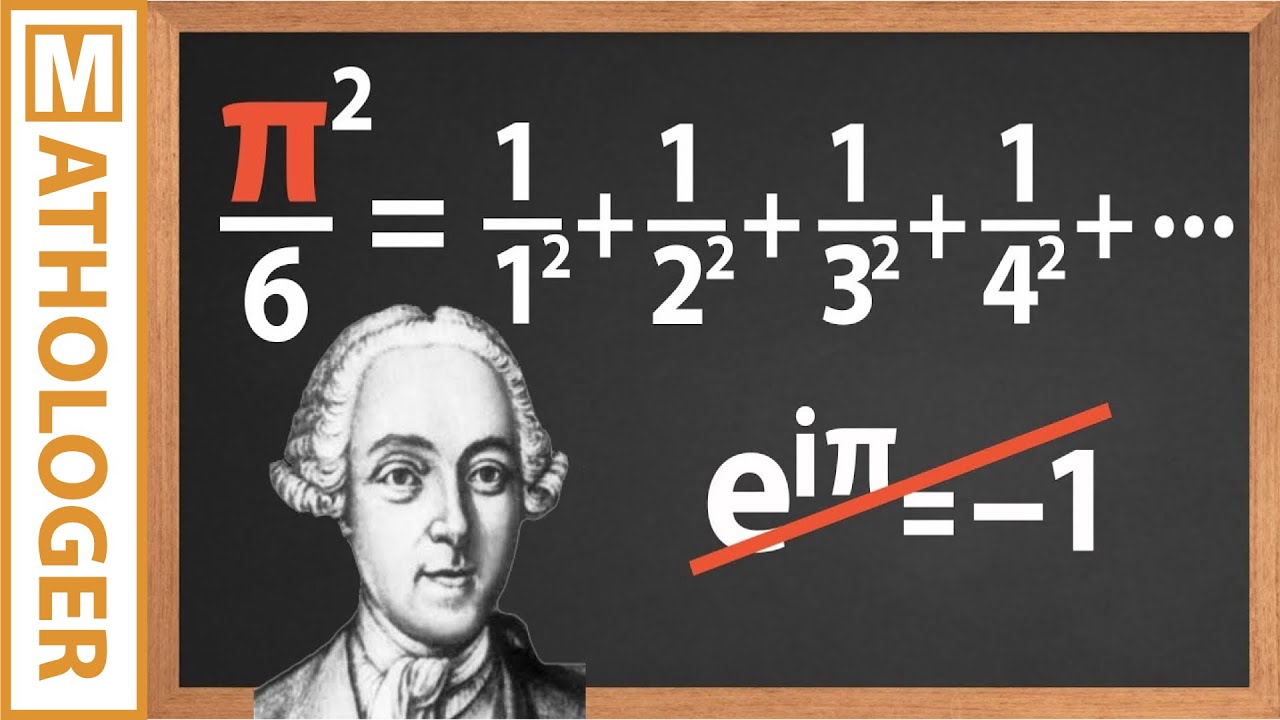
I've got some good news and some bad news for you. The bad news is that Euler's identity e to the i pi = -1 is not really Euler's identity. The good news is that...
 round micaBOT
 knotty dove
Hello !!!
We want to construct a polynome who have zero for the value : 0, pi, -pi
Let's do simple let's say i have degree 2 polynome and I want to fix his root to a and b, I can take the polynome P= C * (x-a)(x-b), if you plug x=a or x=b P=0 it's a simple construction
In your example the root are 0, pi and -pi so we can construt P = C * (x-0) (x-pi) (x+pi) you can try if you plug one of these 3 value this give 0 and that's normal we construct the polynome like that we want that 3 value be the root of our polynome.
Next there is infinitly many polynome who have this root, we need to fix C, let's take C like our polynome fit the best to the sinus function.
Let's say we want our polynome have the same slope (derivative) of the sinus at 0, so :
We want P'(0)=sin'(0)
lets calculate derivative first then evaluate at x=0
(C ( x^3 - pi ² * x))' = cos(x) ( I just developp the polynome in the video that s the same)
C ( 3x² -pi²) = cos(x)
now evaluate at 0:
C ( -pi²) = 1
C= 1/pi²
Hope you understand !!
byebye
 viral valve
In brief, We want the polynomial to match exactly with the sine graph
So for that Their derivatives at x= O must be equal or 1