#help-43
1 messages · Page 18 of 1
 strange pendant
 muted elbow
idk what is orthogonal projection
strange pendant
.
muted elbow
maybe projection is not the term used in the book you read
idk how to explain it
you gotta watch a video on the geometrical meaning of dot product
then you will get it
strange pendant
.close
 compact pewterBOT
Channel closed
Closed by @strange pendant
Use .reopen if this was a mistake.
 Available help channel!
Send your question here to claim the channel.
Remember:
• Ask your math question in a clear, concise manner.
• Show your work, and if possible, explain where you are stuck.
• After 15 minutes, feel free to ping <@&286206848099549185>.
• Type the command .close to free the channel when you're done.
• Be polite and have a nice day!
Read #❓how-to-get-help for further information on how to ask a good question, and about conduct in the question channels.
 deft tangle
 compact pewterBOT
deft tangle
deft tangle
compact pewterBOT
deft tangle
deft tangle
L is finte so value of A will be?
I tried to use binomial expansion
( a - |a| \left(1 - \frac{x^2}{2a^2} - \frac{1}{8} \frac{x^4}{a^4} \right) )
 boreal girderBOT
Andy
 deft tangle
What should I do next?
 latent ridge
deft tangle
latent ridge
deft tangle
try rationalizing it
deft tangle
Which term?@latent ridge
 flint oar
Rationalize it with a+√(a^2-b^2)
compact pewterBOT
@deft tangle Has your question been resolved?
 stone wing
deft tangle
stone wing
deft tangle
Or expand the terms
deft tangle
boreal girder
**Andy**
@stone wing
 jagged blade
Is L'Hopital not an option?
stone wing
L hospital 4 times?
stone wing
Yea didn't see it
jagged blade
I'm also tempted to use a trig sub here
stone wing
x=asin§ ?
jagged blade
Don't just give answers without explanation
stone wing
Sorry I'm new
jagged blade
The idea is to help them solve it themself
jagged blade
stone wing
x=asin§ ?
Yeah
stone wing
deft tangle
<@489384296994570241>
So for the limit to exist the x^2 terms must vanish
stone wing
jagged blade
The idea is to help them solve it themself
I am myself a beginner actually.
compact pewterBOT
@deft tangle Has your question been resolved?
deft tangle
stone wing
So for the limit to exist the x^2 terms must vanish
denominator term x^4
deft tangle
deft tangle
\( a - |a| \left(1 - \frac{x^2}{2a^2} - \frac{1}{8} \frac{x^4}{a^4} \right) \)
Nobody is looking at it and giving me further response what I do next?
stone wing
deft tangle
denominator term x^4
.
deft tangle
.close
compact pewterBOT
Channel closed
Closed by @deft tangle
Use .reopen if this was a mistake.
Available help channel!
Send your question here to claim the channel.
Remember:
• Ask your math question in a clear, concise manner.
• Show your work, and if possible, explain where you are stuck.
• After 15 minutes, feel free to ping <@&286206848099549185>.
• Type the command .close to free the channel when you're done.
• Be polite and have a nice day!
Read #❓how-to-get-help for further information on how to ask a good question, and about conduct in the question channels.
 carmine garden
I don'
 compact pewterBOT
carmine garden
I don'
carmine garden
compact pewterBOT
carmine garden
I don'
carmine garden
I don't get how 3 implies 2
carmine garden
 kind viper
this solution does it as 1 => 2 => 3 => 1
kind viper
this solution does it as 1 => 2 => 3 => 1
I see
okay that works then
thanks!
carmine garden
kind viper
they don't show 3 => 2 outright
I don't think there's a simple way to show that, is there
2 to.3 that is
kind viper
3 => 2 is... eh.
like without going through 1 somehow?
yeah i don't see a way immediately
 dusky nymph
you could argue somewhat similarly to how they did 3==>1, like as follows:
carmine garden
what I see is we can say let t be in their intersection, then for any vector v
and yeah, that should work
dusky nymph
suppose x is a common element of v + U and w + U, say
x = v + u1 = w + u2
then v + u1 is contained in w + U
if u is any element of U, then
v + u = v + u1 + (u - u1) is contained in w + U + (u - u1), and the latter is just w + U
dusky nymph
er, i might have garbled that a bit, but that's the general gist
dusky nymph
there fixed typos in the last line
so that shows v + U is contained in w + U
and the reverse containment is shown identically
dusky nymph
yw
carmine garden
.close
compact pewterBOT
Channel closed
Closed by @carmine garden
Use .reopen if this was a mistake.
compact pewterBOT
Available help channel!
Send your question here to claim the channel.
Remember:
• Ask your math question in a clear, concise manner.
• Show your work, and if possible, explain where you are stuck.
• After 15 minutes, feel free to ping <@&286206848099549185>.
• Type the command .close to free the channel when you're done.
• Be polite and have a nice day!
Read #❓how-to-get-help for further information on how to ask a good question, and about conduct in the question channels.
 torpid carbon
yo what’s the deal with double derivatives
compact pewterBOT
torpid carbon
yo what’s the deal with double derivatives
torpid carbon
second
 unkempt sail
Do you have a specific question in mind
torpid carbon
unkempt sail
Do you have a specific question in mind
yes i’m getting this map of stationary points and setting f’(x) as 0
and then checking with second
yo find a maxima or minima
when do you use this
and how does this work
unkempt sail
Ah I see
Second derivative usually gives the shape of the curve i.e convexity/concavity of the curve
torpid carbon
unkempt sail
Second derivative usually gives the shape of the curve i.e convexity/concavity o...
okay… do in what scenarios would you need to utilise the second derivative
compact pewterBOT
@torpid carbon Has your question been resolved?
Channel closed
Closed by @torpid carbon
Use .reopen if this was a mistake.
compact pewterBOT
Available help channel!
Send your question here to claim the channel.
Remember:
• Ask your math question in a clear, concise manner.
• Show your work, and if possible, explain where you are stuck.
• After 15 minutes, feel free to ping <@&286206848099549185>.
• Type the command .close to free the channel when you're done.
• Be polite and have a nice day!
Read #❓how-to-get-help for further information on how to ask a good question, and about conduct in the question channels.
 silent wigeon
Are my answers fine
 compact pewterBOT
silent wigeon
Are my answers fine
silent wigeon
compact pewterBOT
silent wigeon
Are my answers fine
silent wigeon
Allowed by mark scheme BUT mine are in minus
 icy nymph
silent wigeon
Are my answers fine
icy nymph
silent wigeon
Are my answers fine
why would u do it that way 😭
icy nymph
silent wigeon
Allowed by mark scheme BUT mine are in minus
only one of your solutions is right
it should be 3.73, not -3.73
silent wigeon
icy nymph
why would u do it that way 😭
?? I used the quadratic equation
stone wing
Yea you could just take the root lol
icy nymph
stone wing
Yea you could just take the root lol
^^
icy nymph
silent wigeon
?? I used the quadratic equation
just square root both sides
compact pewterBOT
@silent wigeon Has your question been resolved?
 storm lichen
silent wigeon
?? I used the quadratic equation
storm lichen
silent wigeon
?? I used the quadratic equation
(x-2)^2 = 3
|x-2| = √3
x = √3 + 2
x = -√3 + 2
compact pewterBOT
Channel closed
Closed due to timeout
Use .reopen if this was a mistake.
Available help channel!
Send your question here to claim the channel.
Remember:
• Ask your math question in a clear, concise manner.
• Show your work, and if possible, explain where you are stuck.
• After 15 minutes, feel free to ping <@&286206848099549185>.
• Type the command .close to free the channel when you're done.
• Be polite and have a nice day!
Read #❓how-to-get-help for further information on how to ask a good question, and about conduct in the question channels.
 hushed magnet
,rotate
boreal girderBOT
 hushed magnet
whats 6.20
ok
yes you can basically just copy 6.20
instead of the straight line you have your given cont function between two points
compact pewterBOT
Channel closed
Closed by @copper loom
Use .reopen if this was a mistake.
compact pewterBOT
Available help channel!
Send your question here to claim the channel.
Remember:
• Ask your math question in a clear, concise manner.
• Show your work, and if possible, explain where you are stuck.
• After 15 minutes, feel free to ping <@&286206848099549185>.
• Type the command .close to free the channel when you're done.
• Be polite and have a nice day!
Read #❓how-to-get-help for further information on how to ask a good question, and about conduct in the question channels.
 pallid gorge
 compact pewterBOT
pallid gorge
compact pewterBOT
pallid gorge
 kind elm
Well the inflection point is technically the point at which the concavity of the function changes
pallid gorge
Ya
kind elm
you need to ensure that f'' is of different signs on either side of your inflection point
which it is not, it's always non-negative
for a simpler example, x^3 does have an inflection point at x = 0 but x^4 does not
despite both second derivatives being 0
(it can be graphically verified too)
pallid gorge
kind elm
you need to ensure that f'' is of different signs on either side of your inflect...
wait i am confused
so i can sub in
kind elm
kind elm
Well the inflection point is technically the point at which the concavity of the...
.
kind elm
not always but yeah
pallid gorge
then x = 1 is an inflection?
kind elm
it doesn't have to be in a space of 1
pallid gorge
oh
kind elm
it could be within any distance
pallid gorge
what woul dbe the easiest
compact pewterBOT
@pallid gorge Has your question been resolved?
compact pewterBOT
Channel closed
Closed due to timeout
Use .reopen if this was a mistake.
Available help channel!
Send your question here to claim the channel.
Remember:
• Ask your math question in a clear, concise manner.
• Show your work, and if possible, explain where you are stuck.
• After 15 minutes, feel free to ping <@&286206848099549185>.
• Type the command .close to free the channel when you're done.
• Be polite and have a nice day!
Read #❓how-to-get-help for further information on how to ask a good question, and about conduct in the question channels.
 forest token
 compact pewterBOT
forest token
forest token
compact pewterBOT
forest token
forest token
not able to start
muted elbow
forest token
in near proximity of q1 the effect of q2 is negligible
same for q2
using this you can find the sign of charge
there is an equilibrium point to the right of q2
that means q1 has higher magnitude
forest token
muted elbow
in near proximity of q1 the effect of q2 is negligible
did not understand this
forest token
muted elbow
that means q1 has higher magnitude
just because there is an equilibrium point why does that mean q1 has higher magnitude?
muted elbow
forest token
did not understand this
E field intensity due to a particular charge ∝ 1/r^2
forest token
muted elbow
E field intensity due to a particular charge ∝ 1/r^2
yeah
muted elbow
when r→0 for q1 this is a very big number
for q2 its some small number
so the total field can be approximated as that of q1 only
since q2 has negligible contribution
forest token
muted elbow
for q2 its some small number
isnt it going to infinity for q2 also?
muted elbow
forest token
isnt it going to infinity for q2 also?
near q1 what is the distance from q2
forest token
infinity?
forest token
muted elbow
near q1 what is the distance from q2
okay..no distances are mentioned tho...
what do i answer for this
forest token
ok
muted elbow
so when the distance from q1 → 0 the distance from q2 → L
forest token
yeah
muted elbow
the magnitude of E field of q1 tends to infinity
while for q2 its some finite quantity
so its negligible in comparison
forest token
ohk yeah
muted elbow
so towards right of q1 we have - ∞
forest token
so q1 will be bigger but how to comment on the signs
muted elbow
forest token
so q1 will be bigger but how to comment on the signs
no
this does not comment on magnitude of q1
this is for sign
muted elbow
muted elbow
then what is the charge of q1
sign of charge
forest token
but E inversely proportional to r^2 and directly proportional to q..q1 is still having an impact at a distance L from q2 dosent that mean q1 is bigger
muted elbow
yes but
q1 and q2 are not given to us
we just assume them to be some finite quantity
i am just changing the distance
consider everything else as constant
forest token
muted elbow
then what is the charge of q1
negative?
muted elbow
like lets say we are 10^-10 m to the right of q1
muted elbow
forest token
negative?
yes
forest token
muted elbow
like lets say we are 10^-10 m to the right of q1
okay
how do i comment on magnitude then
muted elbow
you dont have to
just comment on relative magnitude
for q1
we will have something like 1/(10^-10)^2
while for q2 we will have 1/(L-10^-10)^2
which is bigger
although yes you can set L such that its actually bigger for q2 but there will always exist a neighbourhood around q1 where effect of q2 is negligible
forest token
muted elbow
we will have something like 1/(10^-10)^2
huh why are we doing inversely proportional to 1/r^2 when we are talking about magnitude of the charge and not electric field
muted elbow
we are doing sign rn
have you understood doing sign?
and why it works
i can help with magnitude as well
what is the sign of q2
forest token
muted elbow
we are doing sign rn
oh ok
forest token
muted elbow
have you understood doing sign?
i think ive got it..electric field to right of q1 goes to -infinity when q2 effect is negligible so it will be negative?
forest token
yeah
muted elbow
now what is the sign of q2
muted elbow
forest token
hmm left of q2 it goes to -infinity so it is trying to attract
repulse
but ye you are right
forest token
muted elbow
repulse
repulse meaning?
muted elbow
repulsion
forest token
why will it repel
muted elbow
the test charge is assumed to be positive
q2 is positive
so it will repel it
repulse is wrong i think
forget that
forest token
ohk fine
muted elbow
repel is the correct word
forest token
👍
muted elbow
now since q1 is negative and q2 is positive
do you think there will be a point in between q1 and q2 that will have 0 electric field
forest token
no
muted elbow
and since in the graph there is no point where E field is zero towards the left of q1
that means q1 must have higher magnitude
cause q1 field is towards right and q2 field is towards left in the region left of q1
forest token
oh ok yeah
i have learnt doing this from questions also..find pt of equilibrium of third charge when a system of 2 charges is present
muted elbow
yes
the equilibrium point if two charges are of opposite signs always lies outside the charge with smaller magnitude
compact pewterBOT
Channel closed
Closed by @forest token
Use .reopen if this was a mistake.
compact pewterBOT
Available help channel!
Send your question here to claim the channel.
Remember:
• Ask your math question in a clear, concise manner.
• Show your work, and if possible, explain where you are stuck.
• After 15 minutes, feel free to ping <@&286206848099549185>.
• Type the command .close to free the channel when you're done.
• Be polite and have a nice day!
Read #❓how-to-get-help for further information on how to ask a good question, and about conduct in the question channels.
 warped oar
Solve the quadratic congruence:
x^2 = 1 (mod 77)
compact pewterBOT
warped oar
Solve the quadratic congruence:
x^2 = 1 (mod 77)
@warped oar Has your question been resolved?
warped oar
,w (43^2 - 1)/77
boreal girderBOT


 Requested by forlorn1002
 formal yarrow
warped oar
43 and 34
formal yarrow
warped oar
43 and 34
yeah those and 1 and -1
compact pewterBOT
Channel closed
Closed by @warped oar
Use .reopen if this was a mistake.
 bleak dock
warped oar
Prove there are no more.
bleak dock
warped oar
Prove there are no more.
CRT with x^2 = 1 (mod 7) and x^2 = 1 (mod 11)
ah there's also a theorem that says that x^n = k in modular arithmetic has at most n solutions modulo p
to get an idea of how that would work here, suppose that $m^2 \equiv n^2 \pmod p$
boreal girderBOT
south
 bleak dock
CRT with x^2 = 1 (mod 7) and x^2 = 1 (mod 11)
bleak dock
bleak dock
CRT with x^2 = 1 (mod 7) and x^2 = 1 (mod 11)
so CRT implies a maximum of 2 * 2 = 4 solutions here
all are possible if you check
compact pewterBOT
Available help channel!
Send your question here to claim the channel.
Remember:
• Ask your math question in a clear, concise manner.
• Show your work, and if possible, explain where you are stuck.
• After 15 minutes, feel free to ping <@&286206848099549185>.
• Type the command .close to free the channel when you're done.
• Be polite and have a nice day!
Read #❓how-to-get-help for further information on how to ask a good question, and about conduct in the question channels.
 rough coyote
can someone help me with this problem please
 compact pewterBOT
rough coyote
can someone help me with this problem please
compact pewterBOT
compact pewterBOT
rough coyote
can someone help me with this problem please
compact pewterBOT
Channel closed
Closed by @rough coyote
Use .reopen if this was a mistake.
Available help channel!
Send your question here to claim the channel.
Remember:
• Ask your math question in a clear, concise manner.
• Show your work, and if possible, explain where you are stuck.
• After 15 minutes, feel free to ping <@&286206848099549185>.
• Type the command .close to free the channel when you're done.
• Be polite and have a nice day!
Read #❓how-to-get-help for further information on how to ask a good question, and about conduct in the question channels.
silent wigeon
how is the diameter not x
 compact pewterBOT
silent wigeon
how is the diameter not x
compact pewterBOT
silent wigeon
how is the diameter not x
 idle mountain
what is a diameter?
silent wigeon
a line in a circle
idle mountain
a line that PASSES through the center of the circle
 subtle helm
silent wigeon
a line in a circle
subtle helm
silent wigeon
a line in a circle
which?
silent wigeon
idle mountain
a line that PASSES through the center of the circle
Oh shit i forgot that it had to pass through the center
subtle helm
a line passing through a circle is just a chord (connecting two edges)
silent wigeon
what abt radius then? does it have to be half at the centre too?
like half a line before center
silent wigeon
idle mountain
basically half of diameter
Oh alr, if a line doesn't pass through centre. It's not considered a diameter or radius right?
idle mountain
yes
silent wigeon
Ok thank you
idle mountain
it is considered as a chord
compact pewterBOT
Channel closed
Closed by @silent wigeon
Use .reopen if this was a mistake.
compact pewterBOT
Available help channel!
Send your question here to claim the channel.
Remember:
• Ask your math question in a clear, concise manner.
• Show your work, and if possible, explain where you are stuck.
• After 15 minutes, feel free to ping <@&286206848099549185>.
• Type the command .close to free the channel when you're done.
• Be polite and have a nice day!
Read #❓how-to-get-help for further information on how to ask a good question, and about conduct in the question channels.
forest token
 compact pewterBOT
forest token
compact pewterBOT
forest token

 versed sigil
well, use {x} = x - floor(x), perhaps? 😄
forest token
oh right
versed sigil
but before that, this expression can be simplified quite a lot ! nevermind!
forest token
oh how
forest token
versed sigil
well, use {x} = x - floor(x), perhaps? 😄
im getting a kind of ugly expression
forest token
im getting
sqrt(3) - 2(sqrt 2) + 1/(-2 sqrt(3) + 4(sqrt 2)-2)
oh
it cancels
nevermind
kind elm
lol
compact pewterBOT
Channel closed
Closed by @forest token
Use .reopen if this was a mistake.
compact pewterBOT
Available help channel!
Send your question here to claim the channel.
Remember:
• Ask your math question in a clear, concise manner.
• Show your work, and if possible, explain where you are stuck.
• After 15 minutes, feel free to ping <@&286206848099549185>.
• Type the command .close to free the channel when you're done.
• Be polite and have a nice day!
Read #❓how-to-get-help for further information on how to ask a good question, and about conduct in the question channels.
 spiral jackal
 compact pewterBOT
spiral jackal
spiral jackal
compact pewterBOT
spiral jackal
spiral jackal
Could someone please do part ci and cii and see what answer they get
<@&286206848099549185>
 elfin silo
spiral jackal
<@&286206848099549185>
elfin silo
spiral jackal
<@&286206848099549185>
you want to check if your answer is correct?
spiral jackal
elfin silo
you want to check if your answer is correct?
i just want someone to tell me the answers for both i and ii
since i think im doing it wrong
just a bit of doubt
elfin silo
you can show your work and we can comment if there's any mistake
elfin silo
explain your reasoning so we can see what's wrong
spiral jackal
if independent P(J and K) = P(J) x P(K)
P(J and K) = u
P(J) = 0.27 + u
P(K) = (0.2 + u)
elfin silo
are you sure P(K) = 0.2+u?
spiral jackal
yh thats the part not 100% sure
elfin silo
it seems to me L is part of K and 0.2 is only the probabily of K \ (L∪J)
u is that of K∩J
you're missing that of K∩L = L
spiral jackal
wait bc the circle is in K does it mean its part of K
elfin silo
That's usually how Venn diagrams are read
if you draw a set inside another, it is contained
spiral jackal
so what is the probability of K
elfin silo
K can be broken into 3 mutually exclusive events
K = (K∩J) ∪ (K∩L) ∪ (K \ (J∪L))
so P(K) is the sum of the probabilities of these events
what are they?
spiral jackal
(K∩L) = v?
spiral jackal
btw for c i) it wants it in terms of u
elfin silo
sure, let's write it down first though
spiral jackal
so is the probability u + 0.27 + v + v
elfin silo
there's only one v
no wait, what is that the probabily of?
it should be u+v+0.2
K = (K∩J) ∪ (K∩L) ∪ (K \ (J∪L))
P(K) = P(K∩J) +P (K∩L) +P (K \ (J∪L)) = u+v+0.2
don't you agree?
elfin silo
yes
spiral jackal
(0.27 + u) (0.55)=u
elfin silo
there's the equation
if you solve it you find u, with which you find v
elfin silo
you're welcome
spiral jackal
btw
spiral jackal
makes sense
elfin silo
$$L \subset K$$
boreal girderBOT
Luigi
 elfin silo
you write it like this
compact pewterBOT
Channel closed
Closed by @spiral jackal
Use .reopen if this was a mistake.
Available help channel!
Send your question here to claim the channel.
Remember:
• Ask your math question in a clear, concise manner.
• Show your work, and if possible, explain where you are stuck.
• After 15 minutes, feel free to ping <@&286206848099549185>.
• Type the command .close to free the channel when you're done.
• Be polite and have a nice day!
Read #❓how-to-get-help for further information on how to ask a good question, and about conduct in the question channels.
 vapid yacht
 compact pewterBOT
vapid yacht
vapid yacht
compact pewterBOT
vapid yacht
vapid yacht
I have done the first part of this question, that is, when a = 1
obviously, a solution only exists if b = c = d
for the second case, that is a not equal to 1, I did gaussian row reduction, in which I fond the following combination of elements in the last row:
$(0 | 0 | \frac{a^4 + 2a - 3a^2}{a^3 - a} | d - \frac{ab + ca}{a(a + 1)})$
actually its best I type out the entire augmented matrix
boreal girderBOT
Klein Bottle
Compile Error! Click the  reaction for more information.
(You may edit your message to recompile.)

Klein Bottle
Compile Error! Click the reaction for more information.
(You may edit your message to recompile.)
 vapid yacht
and then finally
boreal girderBOT
Klein Bottle
Compile Error! Click the reaction for more information.
(You may edit your message to recompile.)
 vapid yacht
in this as well, I think there would be two solutions: one with infiintely many solutions and one with a unique solution in which (a - 1) + \frac{(a - 1)^2}{a^2 -1} cannot equal to zero
am I on the right path?
<@&286206848099549185>
compact pewterBOT
@vapid yacht Has your question been resolved?
compact pewterBOT
Channel closed
Closed due to timeout
Use .reopen if this was a mistake.
Available help channel!
Send your question here to claim the channel.
Remember:
• Ask your math question in a clear, concise manner.
• Show your work, and if possible, explain where you are stuck.
• After 15 minutes, feel free to ping <@&286206848099549185>.
• Type the command .close to free the channel when you're done.
• Be polite and have a nice day!
Read #❓how-to-get-help for further information on how to ask a good question, and about conduct in the question channels.
forest token
 compact pewterBOT
forest token
forest token
compact pewterBOT
forest token
forest token
can someone help me with this? im trying to do it graphically but i dont know how to start
 lime juniper
forest token
can someone help me with this? im trying to do it graphically but i dont know ho...
lime juniper
forest token
can someone help me with this? im trying to do it graphically but i dont know ho...
call f(x) y and divide the image of f (also known as the range of f, depending on your book) into intervals. have you heard of either term before? i can explain it
forest token
lime juniper
call f(x) y and divide the image of f (also known as the range of f, depending o...
yeah i know what range is 💀
could u explain a bit more?
lime juniper
yeah sure
forest token
about how to divide it into intervals
lime juniper
im gonna call it the image because thats what im used to, one sec
 proud halo
Why don't you do it normally instead of with a graph
You'll need to do the interval dividing anyways
lime juniper
[
f(y) =
\begin{cases}
y + 1 & \text{if } y \leq 1 \
5 - y^2 & \text{if } y > 1
\end{cases}
\qquad
g(x) =
\begin{cases}
x & \text{if } x \leq 1 \
2 - x & \text{if } x > 1
\end{cases}
]
notice I renamed g(x) to g(y) but that doesn't matter, you agree?
forest token
proud halo
Why don't you do it normally instead of with a graph
like our teacher taught a graphical method and i couldnt understand it properly thats why
forest token
f(g(x)) =
g(x)+1, g(x)<=1
5-g(x)^2, g(x)>1
forest token
lime juniper
can I use a computer for it
yeah
lime juniper
oh I confused which was was which , one sec
boreal girderBOT
gfauxpas
 forest token
ohk
lime juniper

okay so, the vertical line at x=1 is not actually a vertical line it's a limitation of the program, did you learn that about computer graphs?
proud halo
forest token
f(g(x)) =
g(x)+1, g(x)<=1
5-g(x)^2, g(x)>1
just work with this
solve the inequalities
and you're done
lime juniper
proud halo
and you're done
yeah but they want a graphical interpretation too which is fine
forest token
proud halo
and you're done
for this question yes but im just using this as a base to learn another method..but in an exam yeah ill solve it using normal method only
proud halo
okay
forest token
lime juniper
okay so, the vertical line at x=1 is not actually a vertical line it's a limitat...
yeah i got it
forest token
lime juniper
so how can i graph f(g(x)) from here?
lime juniper
alright. what's the image of f?
forest token
[-4,4]
lime juniper
good
funny stuff happens at x=1, so let's see which half of the curve the points there are on
what is (1,f(1))?
forest token
f(1)=2
lime juniper
great
notation i'm gonna use:
f([interval]) <- the image of the function f as applied to the interval
f([-2,4)) ? f({4})? f((4,3])?
if you dont understand the notation, I mean that:
f([-2,4)) = [-1,2)
forest token
lime juniper
if you dont understand the notation, I mean that:
f([-2,4)) = [-1,2)
oh ok yeah im a bit unfamiliar with the notation
f of an interval
but yeah i understood
forest token
f(4) = 5-(4^2)?
lime juniper
f({1})={2}
f((1,3]) = [-4,4)
I didnt mean f({4}) that was a mistake
basically this notation means, whats the SET of all output numbers when f is applied to every number in the SET of inputs
forest token
👍
 forest token
f(g(x)) =
g(x)+1, g(x)<=1
5-g(x)^2, g(x)>1
forest token
forest token
f(g(x)) =
g(x)+1, g(x)<=1
5-g(x)^2, g(x)>1
yeah
f(g(x)) =
g(x)+1, g(x)<=1
5-g(x)^2, g(x)>1
lime juniper
so yeah I actually should have analyed g(x) not f(x)
that was my mistake, if you want to do it graphically
forest token
oh
lime juniper
yeah it really is hard to do this graphically because doing it with algebra is so tempting, it's only really going to be worth doing the graph if you dont have the formula for the function
 forest token
lime juniper
yeah it really is hard to do this graphically because doing it with algebra is s...
forest token
lime juniper
yeah it really is hard to do this graphically because doing it with algebra is s...
😔
lime juniper
but sure let's take a look
forest token
lime juniper
so we analyse this from x<=1 and x>1 right
lime juniper
g([-1,1]) = [-1,1]
g([1,3])=[1,3])
hey that's pretty neat
forest token
yeah lol
lime juniper
so for f(y), you have:
let y=g(x)
y+1, when g(x)<=1
5-y^2, when g(x) > 1
when is g(x) > 1?
I made a bad typo
forest token
uh never?
lime juniper
lime juniper
g([-1,1]) = [-1,1]
g([1,3])=[1,3])
hey that's pretty neat
g([1,3])=[-1,1] I should have said
meaning g never exceeds 1 and never goes below -1
forest token
oh okay
yeah
and g(x)<=1 for all real numbers
so we just have to graph
x+1,x<=1
and (2-x)+1,x>1
 gloomy sparrow
y r u trying to graph
forest token
bro what is ur problem if i try to graph 😭 i know there are better methods
lime juniper
gloomy sparrow
y r u trying to graph
We don't have to graph, Yoda just wants to see how you do it with a graphj
lime juniper
forest token
bro what is ur problem if i try to graph 😭 i know there are better methods
this is a different person than before
gloomy sparrow
oh okay
forest token
lime juniper
this is a different person than before
yeah i know
that guys my friend lol
lime juniper
oh lol
lime juniper
anyway a teacher might ask you to do a question like this and not give you the definition of the functions themselves
forest token
gloomy sparrow
i was just wondering y
yeah no i was just learning how to do it using a graph thats it
lime juniper
anyawy youre done
forest token
forest token
so we just have to graph
x+1,x<=1
and (2-x)+1,x>1
oh ok
thanks a lot
.close
compact pewterBOT
Channel closed
Closed by @forest token
Use .reopen if this was a mistake.
Available help channel!
Send your question here to claim the channel.
Remember:
• Ask your math question in a clear, concise manner.
• Show your work, and if possible, explain where you are stuck.
• After 15 minutes, feel free to ping <@&286206848099549185>.
• Type the command .close to free the channel when you're done.
• Be polite and have a nice day!
Read #❓how-to-get-help for further information on how to ask a good question, and about conduct in the question channels.
 dusk coral
where is this *3 coming from like i dont get it
compact pewterBOT
dusk coral
where is this *3 coming from like i dont get it
dusk coral

 kind crane
dusk coral
kind crane
dusk coral
looks like it's the binomial expansion theorem / formula
or are you asking why $\binom{3}{2} = 3$ ?
boreal girderBOT
riemann
 dusk coral
yes
kind crane
did you learn $\binom{n}{k} = \frac{n!}{k! (n-k)!}$
boreal girderBOT
riemann
 kind crane
looks like it's the binomial expansion theorem / formula
kind crane
kind crane
looks like it's the binomial expansion theorem / formula
yea it's important to learn the binomial coefficient to understand what P means in here
dusk coral
well thanks a lot
ye true without im doing no progress
well thanks i will close
.close
compact pewterBOT
Channel closed
Closed by @dusk coral
Use .reopen if this was a mistake.
Available help channel!
Send your question here to claim the channel.
Remember:
• Ask your math question in a clear, concise manner.
• Show your work, and if possible, explain where you are stuck.
• After 15 minutes, feel free to ping <@&286206848099549185>.
• Type the command .close to free the channel when you're done.
• Be polite and have a nice day!
Read #❓how-to-get-help for further information on how to ask a good question, and about conduct in the question channels.
 dapper fable
 compact pewterBOT
dapper fable
compact pewterBOT
dapper fable
 compact pewterBOT
@dapper fable Has your question been resolved?
compact pewterBOT
@dapper fable Has your question been resolved?
compact pewterBOT
@dapper fable Has your question been resolved?
kind crane
dapper fable
is this the right way?
you should be using the fact that f is k-times differentiable somewhere since problem 5 suggests Dn * f doesn't need to converge uniformly to f
dapper fable
kind crane
you should be using the fact that f is k-times differentiable somewhere since pr...
😭😭
Maybe Taylor?
kind crane
don't see how that'd help, but sure try it
differentiable -> can do integration by parts
you should also be using fourier representation of f since the question tells you f is periodic
dapper fable
kind crane
you should also be using fourier representation of f since the question tells yo...
Oh god, there is so much things to do haha
But okay, I’ll try it tomorrow and hope it’ll be enough
Do you have any idea about an example for 5?
compact pewterBOT
@dapper fable Has your question been resolved?
compact pewterBOT
Channel closed
Closed due to timeout
Use .reopen if this was a mistake.
Available help channel!
Send your question here to claim the channel.
Remember:
• Ask your math question in a clear, concise manner.
• Show your work, and if possible, explain where you are stuck.
• After 15 minutes, feel free to ping <@&286206848099549185>.
• Type the command .close to free the channel when you're done.
• Be polite and have a nice day!
Read #❓how-to-get-help for further information on how to ask a good question, and about conduct in the question channels.
 stone jackal
\subsection*{19) $\begin{aligned}
&h(x, y) = \ln(\sqrt{x^2 + y^2}) \
&(x, y, z) = (3, 4, \ln(5))
\end{aligned}$}
$$z = \ln(\sqrt{x^2 + y^2}) \implies f(x, y, z) = \ln(\sqrt{x^2 + y^2}) - z$$
$$\begin{aligned}
\vec n &= \nabla h \
&= \left<\frac{2x}{x^2 + y^2}, \frac{2y}{x^2 + y^2}, -1 \right> \
&= \left<\frac{6}{25}, \frac{8}{25}, -1 \right>
\end{aligned}$$
$$\frac{6}{25}(x - 3) + \frac{8}{25}(y - 4) - (z - \ln(5)) = 0$$
compact pewterBOT
stone jackal
\subsection*{19) $\begin{aligned}
&h(x, y) = \ln(\sqrt{x^2 + y^2}) \\
&(...
boreal girderBOT
@stone jackal
 stone jackal
boreal girder
<@751533372890677398>
stone jackal
boreal girder
<@751533372890677398>
I'm trying to find the tangent plane to h(x, y) at the point (x, y, z) = (3, 4, ln(5)). Where did I go wrong?
.close
compact pewterBOT
Channel closed
Closed by @stone jackal
Use .reopen if this was a mistake.
stone jackal
,w partial z = ln(sqrt(x^2 + y^2))
boreal girderBOT

 Requested by en.ratham
stone jackal
Requested by en.ratham
stone jackal
.reopen
compact pewterBOT
✅
stone jackal
\subsection*{19) $\begin{aligned}
&h(x, y) = \ln(\sqrt{x^2 + y^2}) \
&(x, y, z) = (3, 4, \ln(5))
\end{aligned}$}
$$z = \ln(\sqrt{x^2 + y^2}) \implies f(x, y, z) = \ln(\sqrt{x^2 + y^2}) - z$$
$$\begin{aligned}
\vec n &= \nabla h \
&= \left<\frac{x}{\sqrt{x^2 + y^2}}, \frac{y}{x^2 + y^2}, -1 \right> \
&= \left<\frac{3}{25}, \frac{4}{25}, -1 \right>
\end{aligned}$$
$$\frac{3}{25}(x - 3) + \frac{4}{25}(y - 4) - (z - \ln(5)) = 0$$
boreal girderBOT
@stone jackal
 stone jackal
boreal girder
<@751533372890677398>
stone jackal
boreal girder
<@751533372890677398>
On Desmos, this looks right to me. Can anyone confirm?
 keen granite
math appears to check out
compact pewterBOT
Channel closed
Closed by @stone jackal
Use .reopen if this was a mistake.
compact pewterBOT
Available help channel!
Send your question here to claim the channel.
Remember:
• Ask your math question in a clear, concise manner.
• Show your work, and if possible, explain where you are stuck.
• After 15 minutes, feel free to ping <@&286206848099549185>.
• Type the command .close to free the channel when you're done.
• Be polite and have a nice day!
Read #❓how-to-get-help for further information on how to ask a good question, and about conduct in the question channels.
 cyan trench
 compact pewterBOT
cyan trench
cyan trench
compact pewterBOT
cyan trench
cyan trench
I understand that the 1/3 got moved using a rule
But how did that last chunk just turn from positive to negative
 tulip ivy
Distribution
 jagged sparrow
cyan trench
I understand that the 1/3 got moved using a rule
jagged sparrow
cyan trench
I understand that the 1/3 got moved using a rule
It gets transformed to exponent. And 1/3 means cube root.
1/3 as exponent means cube root
cube root of 27 is 3
tulip ivy
cyan trench
But how did that last chunk just turn from positive to negative

You mean that, right?
jagged sparrow
the last one turned from positive to negative because - x + = -
cyan trench
Lemme continue tho
jagged sparrow
T-T
cyan trench
I'll probably run into another issue soon
jagged sparrow
GL
compact pewterBOT
@cyan trench Has your question been resolved?
Channel closed
Closed by @cyan trench
Use .reopen if this was a mistake.
Available help channel!
Send your question here to claim the channel.
Remember:
• Ask your math question in a clear, concise manner.
• Show your work, and if possible, explain where you are stuck.
• After 15 minutes, feel free to ping <@&286206848099549185>.
• Type the command .close to free the channel when you're done.
• Be polite and have a nice day!
Read #❓how-to-get-help for further information on how to ask a good question, and about conduct in the question channels.
cyan trench
 compact pewterBOT
cyan trench
cyan trench
compact pewterBOT
cyan trench
cyan trench
So I was suppost to simply that
Where does all of the stuff on the right side come from
And how does x need to be greater then 3 but also less then-3
That's impossible
subtle helm
It’s required from x^2 > 9
cyan trench
Why do we need to talk about that
Like what makes us need to do that
Some questions don't have these weird redirections
cyan trench
Ok
cyan trench
subtle helm
Cuz the input of log

How come my teacher didn't write all of that type of stuff up for this question
subtle helm
Weird..
cyan trench
subtle helm
Can only > 0
But the numerator shouldn't matter right?
Just the denominator
Isek
subtle helm
Yes, for this one
From the denominator it’s x > -3
From the initial expression we have x > 1
For it to make sense
subtle helm
cyan trench
 cyan trench
subtle helm
cyan trench
subtle helm
So if it's ever in brackets besdie the log?
jagged sparrow
Oh u asked why x<-3 and x>3?
cyan trench
Yea got that figure out tho
subtle helm
cyan trench
So if it's ever in brackets besdie the log?
If it’s the input
It must x>0
cyan trench
subtle helm
If it’s the input
Okay
But I only do that with brackets
Like the brackets ring a bell to check, and besdies that it's x>0
subtle helm
Yes u need to check the domain of log
cyan trench
subtle helm
Yes u need to check the domain of log

If I had this without the brackets then would I have to write x>-5
Or x can't be -5
Or wtf you do
bleak dock
cyan trench
If I had this without the brackets then would I have to write x>-5
so that would become $y = (\log_3 x) + 5$
boreal girderBOT
south
 bleak dock
now +5 is a vertical shift and that doesn't change the position of the vertical asymptote
bleak dock
boreal girder
**south**
so the domain of that is just x > 0
compact pewterBOT
@cyan trench Has your question been resolved?
compact pewterBOT
Channel closed
Closed by @cyan trench
Use .reopen if this was a mistake.
compact pewterBOT
Available help channel!
Send your question here to claim the channel.
Remember:
• Ask your math question in a clear, concise manner.
• Show your work, and if possible, explain where you are stuck.
• After 15 minutes, feel free to ping <@&286206848099549185>.
• Type the command .close to free the channel when you're done.
• Be polite and have a nice day!
Read #❓how-to-get-help for further information on how to ask a good question, and about conduct in the question channels.
 small brook
how does this part become the next part?
-how does adding a 1/2 into the integral allow you to integrate?
 compact pewterBOT
small brook
how does this part become the next part?
-how does adding a 1/2 into the integra...
compact pewterBOT
small brook
how does this part become the next part?
-how does adding a 1/2 into the integra...
 stark marsh
small brook
how does this part become the next part?
-how does adding a 1/2 into the integra...
stark marsh
small brook
how does this part become the next part?
-how does adding a 1/2 into the integra...
For u sub
small brook
.close
compact pewterBOT
Channel closed
Closed by @small brook
Use .reopen if this was a mistake.
small brook
thx
stark marsh
small brook
thx
Note that they also multiplied 2 so they didn’t really change the input
compact pewterBOT
Available help channel!
Send your question here to claim the channel.
Remember:
• Ask your math question in a clear, concise manner.
• Show your work, and if possible, explain where you are stuck.
• After 15 minutes, feel free to ping <@&286206848099549185>.
• Type the command .close to free the channel when you're done.
• Be polite and have a nice day!
Read #❓how-to-get-help for further information on how to ask a good question, and about conduct in the question channels.
 woven panther
Number Theory Problem - need hint
https://codeforces.com/problemset/problem/1732/A
Can someone give a hint ?
I tried to apply the operation greedily from the end to the front of the array but I found that it fails.
Then I thought that if an operation is applied on an index and it removes some primes from the element then it should remove all the powers of that prime.
Now for each prime in gcd of all array numbers I should calculate the least cost and if it is possible to entirely remove instances of more than one prime from a number then cost is counted only once.
But I think I have overcomplicated it.
compact pewterBOT
woven panther
**Number Theory Problem - need hint**
https://codeforces.com/problemset/problem/...
formal yarrow
woven panther
**Number Theory Problem - need hint**
https://codeforces.com/problemset/problem/...
oh wait this one
woven panther
formal yarrow
oh wait this one
yeah, I still didn't get it. I tried something but it got complicated
formal yarrow
hint : take ANY array and apply the operation on last two elements, what happens to gcd of whole array now?
woven panther
let me try
formal yarrow
or better : what happens to gcd of last two elements after the operation
woven panther
is gcd(n, n-1) = 1 helpful here ?
woven panther
oooh, let me think
formal yarrow
woven panther
yeah, I still didn't get it. I tried something but it got complicated
(I explained very badly lol that time)
compact pewterBOT
@woven panther Has your question been resolved?
woven panther
formal yarrow
(I explained very badly lol that time)
np
don't give me sol rn, I almost got it
formal yarrow

woven panther
I think I have formaly proved it
g1 = gcd(n, an) | n
g2 = gcd(n - 1, a_n-1) | n -1
gcd(g1, g2) = 1
n = g1 * k1
n - 1 = g2 * k2
where k1, k2 are non zero integers
after taking gcd on last two numbers if take gcd on these individual gcd's then
gcd (g1, g2) = gcd (n/k1 , (n-1)/k2)
since g1, g2 are integers
k1 | n
k2 | n-1
woven panther
woven panther
gcd (g1, g2) = gcd (n/k1 , (n-1)/k2)
gcd (n/k1 , (n-1)/k2) = gcd( (nk2)/(k1k2) , ((n-1)k1)/(k1k2))
= 1/(k1k2) * gcd ((n-1) k1 , nk2)
= 1/(k1k2) * gcd(g2k1k2, g1k1k2)
= gcd(g1, g2)
= 1
formal yarrow
you tried to prove gcd(g1,g2)=1 right
you have used gcd(g1,g2)=1 to prove that
circular argument
youre right that gcd(g1,g2) is 1
formal yarrow
but for proof, let gcd(g1,g2)=d
from g1 | n, g2 | n-1
you get d | n and d | n-1
continue from here
in simple words, g1 is a divisor of n, g2 is a divisor of n-1 and since n and n-1 don't have any common factors, g1 and g2 also don't have any common factors
woven panther
formal yarrow
in simple words, g1 is a divisor of n, g2 is a divisor of n-1 and since n and n-...
Oh, I finally got it intuitively
thanks
formal yarrow
woven panther
Oh, I finally got it intuitively
nice
now you can make the algorithm
woven panther
formal yarrow
now you can make the algorithm
yeah, that's the easy part
formal yarrow
compact pewterBOT
Channel closed
Closed by @woven panther
Use .reopen if this was a mistake.
formal yarrow
🎉
compact pewterBOT
Available help channel!
Send your question here to claim the channel.
Remember:
• Ask your math question in a clear, concise manner.
• Show your work, and if possible, explain where you are stuck.
• After 15 minutes, feel free to ping <@&286206848099549185>.
• Type the command .close to free the channel when you're done.
• Be polite and have a nice day!
Read #❓how-to-get-help for further information on how to ask a good question, and about conduct in the question channels.
 tropic agate
I'm reading about condition numbers $\operatorname{cond}(A)$. I'm faced with the true or false question "If $Ax=b$ is well-conditioned, then $\operatorname{cond}(A)$ is small." I think it is false, and I think a counterexample is given by the matrix $$\begin{pmatrix} k^2&0\ 0&1 \end{pmatrix}\text{ with } k\gg 1.$$I'm just learning the ropes of this; how do I show a system with the above matrix is well-conditioned?
compact pewterBOT
tropic agate
I'm reading about condition numbers $\operatorname{cond}(A)$. I'm faced with the...
boreal girderBOT
psie
 compact pewterBOT
@tropic agate Has your question been resolved?
hushed magnet
how did you define well conditioned systems
did you not define it by using that cond(A) is small?
its been some time since I've done that kinda stuff. but wikipedia does define it in that way
tropic agate
hushed magnet
its been some time since I've done that kinda stuff. but wikipedia does define i...
well, it is true I think that if cond(A) is small, then the system is well-conditioned. But this is the converse. A system is well-conditioned if small relative changes in the coefficients of the system cause small relative errors in the solution. So for example, consider x+y=5 and x-y=1. This system has the solution (x,y)=(3,2). Then consider x+y=5 and x-y=1.00001, which has the solution (3.00005,1.99995). Thus this system is well-conditioned.
tropic agate
.close
compact pewterBOT
Channel closed
Closed by @tropic agate
Use .reopen if this was a mistake.
hushed magnet
the maximum relative error is precisely given by the condition number
compact pewterBOT
Available help channel!
Send your question here to claim the channel.
Remember:
• Ask your math question in a clear, concise manner.
• Show your work, and if possible, explain where you are stuck.
• After 15 minutes, feel free to ping <@&286206848099549185>.
• Type the command .close to free the channel when you're done.
• Be polite and have a nice day!
Read #❓how-to-get-help for further information on how to ask a good question, and about conduct in the question channels.
tropic agate
hushed magnet
the maximum relative error is precisely given by the condition number
I think I found a counterexample. Consider $b=(0,1)$ and also $b'=(0,1+h)$ where $h$ is small. Then the solutions are $x=(0,1)$ and $x'=(0,1+h)$, and the relative change in $b$ is $|b'-b|/|b|=|h|$ whereas the relative change in $x$ is $|x'-x|/|x|=|h|$, so the system is well-conditioned. But $\operatorname{cond}(A)=k$ can be made arbitrarily large.
compact pewterBOT
tropic agate
I think I found a counterexample. Consider $b=(0,1)$ and also $b'=(0,1+h)$ where...
boreal girderBOT
psie
 tropic agate
hushed magnet
ok but thats not all possible errors
tropic agate
hushed magnet
ok but thats not all possible errors
yeah, you're right. I didn't consider all errors. Do you know any efficient way to assess all errors of the system?
hushed magnet
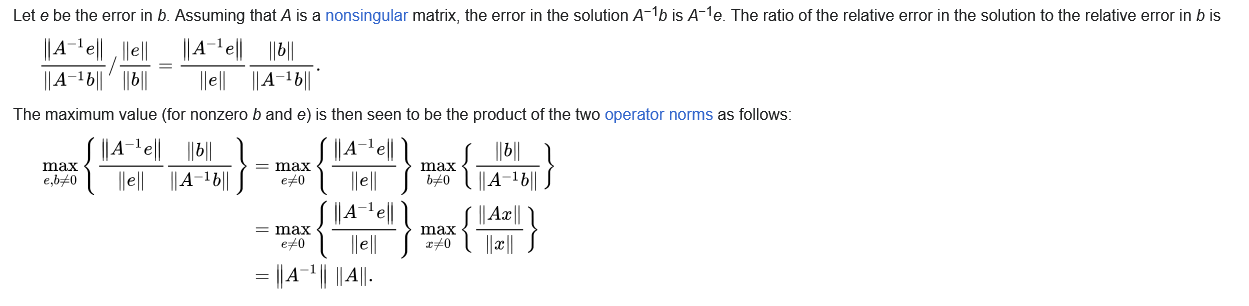
but I mean your system is 2x2. you could just let the error be e=(h1,h2) and then do all the calculations
tropic agate
hushed magnet
https://i.imgur.com/DdCjceG.png
interesting. How come we are only considering error in b? Shouldn't one consider errors in A as well?
hushed magnet
hushed magnet
https://i.imgur.com/DdCjceG.png
have you not seen that before? how did your course introduce the condition if not with this
not sure why errors in A are not considered
compact pewterBOT
@tropic agate Has your question been resolved?
tropic agate
hushed magnet
not sure why errors in A are not considered
I think I finally understand now. We have if $A$ is invertible, that $$\frac1{\operatorname{cond}(A)}\Delta b\leq \Delta x\leq \operatorname{cond}(A)\Delta b,$$where $\Delta b$ and $\Delta x$ are the relative changes in $b$ and $x$. So if the system is well conditioned, we have $\Delta b\approx\Delta x$, so divide the above inequality by $\Delta b$, then $\Delta x/\Delta b=1+\epsilon$ where $|\epsilon|$ is small. And so the inequality reduces to $$\frac1{\operatorname{cond}(A)}\leq 1+\epsilon\leq \operatorname{cond}(A).$$Clearly this does not imply $\operatorname{cond}(A)$ is small.
boreal girderBOT
psie

 compact pewterBOT
Channel closed
Closed by @tropic agate
Use .reopen if this was a mistake.
Available help channel!
Send your question here to claim the channel.
Remember:
• Ask your math question in a clear, concise manner.
• Show your work, and if possible, explain where you are stuck.
• After 15 minutes, feel free to ping <@&286206848099549185>.
• Type the command .close to free the channel when you're done.
• Be polite and have a nice day!
Read #❓how-to-get-help for further information on how to ask a good question, and about conduct in the question channels.
 worn wyvern
\begin{align*}
\frac{e^{2x} - 1}{6e^x} &= \frac{2e^{2x} \cdot 6e^x - 6e^x (2e^{2x} - 1}{6^2 e^{2x}} \
&=\frac{2e^{2x}-6e^x\cdot e^{2x} +6e^x}{6^2e^{2x}}
&=
\end{align*}
compact pewterBOT
worn wyvern
\begin{align*}
\frac{e^{2x} - 1}{6e^x} &= \frac{2e^{2x} \cdot 6e^x - 6e^x (2e^{2...
worn wyvern
pressed enter by mistake 
keen granite

 fluid stag
this is what you have written
boreal girderBOT
<rajel />
 worn wyvern
.close
compact pewterBOT
Channel closed
Closed by @worn wyvern
Use .reopen if this was a mistake.
compact pewterBOT
Available help channel!
Send your question here to claim the channel.
Remember:
• Ask your math question in a clear, concise manner.
• Show your work, and if possible, explain where you are stuck.
• After 15 minutes, feel free to ping <@&286206848099549185>.
• Type the command .close to free the channel when you're done.
• Be polite and have a nice day!
Read #❓how-to-get-help for further information on how to ask a good question, and about conduct in the question channels.
carmine garden
can I have a hint
 compact pewterBOT
carmine garden
can I have a hint
carmine garden
compact pewterBOT
carmine garden
can I have a hint
carmine garden
I was thinking of starting by saying v \in U and U is spanned by e_1,e_2,\dots,e_m
So $T( \sum_{i=1}^{m} \alpha_i e_i)= \sum_{i=1}^{m} \beta_i e_i$
boreal girderBOT
wai

 slate sand
What does the invariant part mean, T(U) = U for every T:V->V linear?
carmine garden
slate sand
What does the invariant part mean, T(U) = U for every T:V->V linear?
the domain and co-domain are the same
slate sand
So T(U) = U
carmine garden
yes
slate sand
Is this question under dual spaces?
carmine garden
no
slate sand
Before?
carmine garden
after
I need dual spaces here? Denascite suggested I come dual spaces to this later
slate sand
I don’t know I’m thinking
carmine garden
I was thinkng contrapositive
consider a vector space that's neither V not {0} . Then there exists a linear transfomration that's not invarient
slate sand
slate sand
What does the invariant part mean, T(U) = U for every T:V->V linear?
I don’t think this is right because how can this be true
carmine garden
wdym
slate sand
carmine garden
the domain and co-domain are the same
Codomain or range/image
slate sand
I mean
Is it even true that every operation is invariant on V itself
The map that sends everything to 0 maps V to 0 not V to V
Or does it just mean that T(U) ⊆ U
 hybrid walrus
I find that taking a basis of U and expanding it to a basis of V makes this very simple
slate sand
boreal girder
**wai**
Okay this makes a lot more sense then
That would be my thought too
carmine garden
Won't contrapositive work better?
carmine garden
hybrid walrus
I find that taking a basis of U and expanding it to a basis of V makes this very...
How would this work?
hybrid walrus
Contrapositive, yeah. Take the linear operator on V that swaps a basis element of U with a basis element not in U (which both exist by assumption).
carmine garden
hybrid walrus
Contrapositive, yeah. Take the linear operator on V that swaps a basis element o...
Yea, that was my thought too for contrapositive
I thought you were talking about direct proof
😭
thanks
.close
compact pewterBOT
Channel closed
Closed by @carmine garden
Use .reopen if this was a mistake.
compact pewterBOT
Available help channel!
Send your question here to claim the channel.
Remember:
• Ask your math question in a clear, concise manner.
• Show your work, and if possible, explain where you are stuck.
• After 15 minutes, feel free to ping <@&286206848099549185>.
• Type the command .close to free the channel when you're done.
• Be polite and have a nice day!
Read #❓how-to-get-help for further information on how to ask a good question, and about conduct in the question channels.
deft tangle
 compact pewterBOT
deft tangle
deft tangle
compact pewterBOT
deft tangle
deft tangle
I didn't understand the question properly what they are giving and asking
Information is too much tricky
carmine garden
Given:$p,q \in \Z$ . $\alpha, \beta$ are the roots of $x^2-x-1$. $a_m= p \alpha^n + q \beta^n$. If $a,b \in \Q$ and $a+ \sqrt{5}b=0 \implies a=b=0$.
\
If $a_4=28$, find $p+2q$
boreal girderBOT
wai
 kind viper
hang on
alpha and beta are the roots of x^2 - x - 1 = 0 sure
but do we know which is which?
i think the question is wrong
 west canyon
kind viper
but do we know which is which?
west canyon
kind viper
but do we know which is which?
it could be a special case like p=q in this instance so it doesn't matter
kind viper
i mean ok like p alpha^4 + q beta^4 = 28
west canyon
west canyon
it could be a special case like p=q in this instance so it doesn't matter
wait yeah it will be this cus ||if you let \sigma be the other element of Gal(x^2-x-1), then applying sigma to both sides should give you what you need||
kind viper
west canyon
wait yeah it will be this cus ||if you let \sigma be the other element of Gal(x^...
that's quite the nuke LMAO
but i did also work it out the honest way
west canyon
kind viper
that's quite the nuke LMAO
fair lmao
 compact pewterBOT
@deft tangle Has your question been resolved?
 short ferry
deft tangle
short ferry
deft tangle
notice that the equation can be rearranged into x^2 = x + 1
both α and β are roots of that equation, that means
α^2 = α + 1
β^2 = β + 1
try using this to reduce the powers in a_4
kind viper
ie try expressing alpha^4 as linear function of alpha
 gleaming field
What is the square root of 1690
kind viper
gleaming field
What is the square root of 1690
!occupied
compact pewterBOT
gleaming field
What is the square root of 1690
Someone else is already using this help channel. If you need help with a question, please open your own help channel/thread (see #❓how-to-get-help for instructions).
short ferry
gleaming field
What is the square root of 1690
around 41.1, if it's not related to the question though, move to another channel. If it is how you are solving the question, then you are likely approaching it in a wrong way
gleaming field
short ferry
around 41.1, if it's not related to the question though, move to another channel...
Alr mb
compact pewterBOT
@deft tangle Has your question been resolved?
deft tangle
a_4=28
=Pa^4+qB^4
deft tangle
Yeah
short ferry
short ferry
both α and β are roots of that equation, that means
α^2 = α + 1
β^2 = β + 1
now use this
btw you can multiply it with a^2
deft tangle
α^2 = α + 1
β^2 = β + 1
short ferry
so you get a^4 = a^3 + a^2
short ferry
short ferry
so 28 = Pa^4+qB^4
now you can substitute that inside this
and you repeat it for a^3 and a^2
short ferry
short ferry
so 28 = Pa^4+qB^4
yeah, so just keep reducing this thing
short ferry
deft tangle
What should I do next?
Continue
rewrite a^3 using a^2 + a
then a^2 using a and 1
and same for beta
short ferry
hmm
that doesnt look right
shouldnt it be Pa and qB
28 = 2pa^2 + pa + 2qb^2 + qb
do you know fibonacci btw?
notice that a^n acts kinda like it
deft tangle
short ferry
do you know fibonacci btw?
Nope
short ferry
okay, nvm then
just continue doing it
until you reach something so simple, that it has only a and b in it with no powers at all
compact pewterBOT
@deft tangle Has your question been resolved?
compact pewterBOT
@deft tangle Has your question been resolved?
compact pewterBOT
@deft tangle Has your question been resolved?
compact pewterBOT
Channel closed
Closed due to timeout
Use .reopen if this was a mistake.
Available help channel!
Send your question here to claim the channel.
Remember:
• Ask your math question in a clear, concise manner.
• Show your work, and if possible, explain where you are stuck.
• After 15 minutes, feel free to ping <@&286206848099549185>.
• Type the command .close to free the channel when you're done.
• Be polite and have a nice day!
Read #❓how-to-get-help for further information on how to ask a good question, and about conduct in the question channels.
 cedar mortar
How do I calculate the test statistic and the p-value by using the TI-84 Plus CD calculator? I need help!
 compact pewterBOT
cedar mortar
How do I calculate the test statistic and the p-value by using the TI-84 Plus CD...
compact pewterBOT
cedar mortar
How do I calculate the test statistic and the p-value by using the TI-84 Plus CD...
 rigid perch
stat -> tests -> 6: 2-prop Z-test
compact pewterBOT
@cedar mortar Has your question been resolved?
cedar mortar
rigid perch
stat -> tests -> 6: 2-prop Z-test
so what numbers do put?
 compact pewterBOT
Channel closed
Closed due to timeout
Use .reopen if this was a mistake.
Available help channel!
Send your question here to claim the channel.
Remember:
• Ask your math question in a clear, concise manner.
• Show your work, and if possible, explain where you are stuck.
• After 15 minutes, feel free to ping <@&286206848099549185>.
• Type the command .close to free the channel when you're done.
• Be polite and have a nice day!
Read #❓how-to-get-help for further information on how to ask a good question, and about conduct in the question channels.
rigid perch
cedar mortar
so what numbers do put?
. n = sample size, x = number who say "yes" = n * p
cedar mortar
rigid perch
. n = sample size, x = number who say "yes" = n * p
Thanks!
compact pewterBOT
cedar mortar
Thanks!
cedar mortar
.close
compact pewterBOT
Channel closed
Closed by @cedar mortar
Use .reopen if this was a mistake.
compact pewterBOT
Available help channel!
Send your question here to claim the channel.
Remember:
• Ask your math question in a clear, concise manner.
• Show your work, and if possible, explain where you are stuck.
• After 15 minutes, feel free to ping <@&286206848099549185>.
• Type the command .close to free the channel when you're done.
• Be polite and have a nice day!
Read #❓how-to-get-help for further information on how to ask a good question, and about conduct in the question channels.
 digital wraith
Can you guys help me with this question:
When a polynomial is divided by x-1 the remainder is 3. When the polynomial is divided by x+2 the remainder is -12. Find the remainder when the polynomial is divided by x^2+x-2
compact pewterBOT
digital wraith
Can you guys help me with this question:
When a polynomial is divided by x-1 th...
kind viper
digital wraith
idk where to start
kind viper
ok right
When a polynomial is divided by x-1, the remainder is 3.
call your polynomial P(x).
do you know how you could rephrase this sentence?
digital wraith
no I didn't really listen when my teacher was going trhough a question similar to this
digital wraith
soz
kind viper
do the words "remainder theorem" sound familiar?
kind viper
ok can you state the remainder theorem
digital wraith
its like a proof tho
Suppose that P(x) is a polynomial and α is a constant. Prove that the remainder after dividing P(x) by (x-α) is P(α)
P(x) = (x-α) Q(x) + R(x)
P(α) = (α-α) Q(α) + k
kind viper
well ok it would be good to distinguish a theorem and its proof
digital wraith
ok
kind viper
the remainder after dividing P(x) by (x-α) is P(α)
this is what you need
you prove it once -- presumably, you already did in class one way or another -- and then you use it later.
digital wraith
so do i use that to solve my question
kind viper
yes
When a polynomial is divided by x-1, the remainder is 3.
use the remainder theorem to rephrase this
as P(__) = __
fill in the blanks
digital wraith
do i jsut sub in x-1
kind viper
i am extremely hesitant to instruct you to just "sub in" anything into anything.
kind viper
general theorem:
When P(x) is divided by (x-a), the remainder is P(a).
your question says:
When P(x) is divided by (x-1), the remainder is 3.
fill in the blanks in P(__) = __
digital wraith
P(1) =
digital wraith
3?
kind viper
yes
so P(1) = 3.
good.
When the polynomial is divided by x+2 the remainder is -12.
now do the same here. rephrase this statement using the remainder theorem.
exact same logic as i just walked you through, only the numbers are different.
 earnest wyvern
hey did this type of questions in my preparation for additional mathematics
wait i might help maybe

 digital wraith
ok thank you rajput
earnest wyvern
actually very interesting question
kind viper
digital wraith
so if P(1) = 3 and P(-2) = -12 how do i find p(x+2)(x-1)
not the right notation
 boreal nimbus
digital wraith
so if P(1) = 3 and P(-2) = -12 how do i find p(x+2)(x-1)
boreal nimbus
digital wraith
so if P(1) = 3 and P(-2) = -12 how do i find p(x+2)(x-1)
the divisor (x + 2)(x - 1) is a quadratic, so the remainder is of form Ax + B
kind viper
earnest wyvern
ill tell u
!nosols
compact pewterBOT
earnest wyvern
ill tell u
As a helper, please do not give out answers that could be copied as a homework solution. Have the student work through the problem themselves and guide them along the way.
earnest wyvern
ok
digital wraith
i dont get it
like how to apply it
so i can actually do other similar questions bc i dont understand how to do these questions
but sketching polynomials is fine for me
kind viper
earnest wyvern
-36 is the remainder
!nosols
compact pewterBOT
earnest wyvern
-36 is the remainder
As a helper, please do not give out answers that could be copied as a homework solution. Have the student work through the problem themselves and guide them along the way.
kind viper
@digital wraith ok so let's pick this back up shall we
kind viper
you know that P(1) = 3 and P(-2) = -12.
earnest wyvern
when p(1) = 3 and p(-2) = -12 and after factorization of x^2 +x -2
i m writing sol
digital wraith
i have to get my homework done sicne i have exam block to worry about
kind viper
earnest wyvern
i m writing sol
with all due respect please back off i've already reminded you of server policy twice here
dont dump the entire solution at him
kind viper
the division-with-remainder of P(x) by (x^2 + x - 2) will look like this:
P(x) = (x^2 + x - 2)Q(x) + Ax + B
since x^2 + x - 2 is a polynomial of degree 2, any remainder on division by it will look like a linear or maybe constant polynomial
earnest wyvern
wont happen again
kind viper
kind viper
the division-with-remainder of P(x) by (x^2 + x - 2) will look like this:
P(x) ...
@digital wraith do you understand this?
digital wraith
kind viper
the division-with-remainder of P(x) by (x^2 + x - 2) will look like this:
P(x) ...
i understand the 1st part
cuz it was the wroking
earnest wyvern
kind viper
<@1335540122631798798> do you understand this?
why r u telling it then
digital wraith
for the example we did in class
but then i dont understand the remainder on divison part (last part)
earnest wyvern
do u see a connection
kind viper
i am taking him through it step by step mate
im not going to dump the whole thing at him
i already asked you to back off
i do not want to repeat myself here
you're kind of interrupting and getting in my way and honestly i am a little frustrated at that
earnest wyvern
(x-1) has remainder 3 and x+2 has remainder -12
boreal nimbus
earnest wyvern
-36 is the remainder
(this is wrong, by the way)
kind viper
<@&268886789983436800>
digital wraith
the answers are at the back of my book and it says 5x-2
im not gonna copy
it cuz i wanna understand steps
to do good in quiz
its for tutoring
kind viper
im trying to explain it but rajput is getting in the way here and it is hard for me to get a word in.
ok
digital wraith
ok
kind viper
let me repeat my last phrase
since x^2 + x - 2 is a polynomial of degree 2, any remainder on division by it will look like a linear or maybe constant polynomial
do you understand this part
like, the remainder of a polynomial division always has strictly lower degree than the divisor
for a divisor whose degree is 2, this means remainder has degree 1 or 0
digital wraith
oh yeah
earnest wyvern
so (x-1)(x+2) will be remainder of first equation i.e 3 multiplied with remainder of second equation which is -12. 3 x (-12)
kind viper
earnest wyvern
so (x-1)(x+2) will be remainder of first equation i.e 3 multiplied with remainde...
this is just plain wrong lmfao
earnest wyvern
kind viper
this is just plain wrong lmfao
how
digital wraith
i get it
kind viper
divising by x-1 or x-a in general will give a constant (and you know precisely what constant)
digital wraith
ye its 3 for when P(x) when divide by x-1
kind viper
earnest wyvern
how
x+10 divided by x gives remainder 10 and divided by x-1 gives remainder 11 but x+10 divided by x(x-1) does not give remainder 110.
anyway
kind viper
@earnest wyvern please take this argument to your own help channeol
digital wraith
i just wanna learn
kind viper
P(x) = (x^2 + x - 2)Q(x) + Ax + B
are we good on this
digital wraith
kind viper
> P(x) = (x^2 + x - 2)Q(x) + Ax + B
are we good on this
yes its from the formula