#help-42
1 messages · Page 179 of 1
 crisp sphinx
so you have found the solutions 
the next question is, because a is a variable, are there any restrictions on a?
 still terrace
crisp sphinx
so you have found the solutions <:joia:1376070667174281226>
the next question i...
still terrace
crisp sphinx
so you have found the solutions <:joia:1376070667174281226>
the next question i...
bro
are you there
im confused here

 leaden thunder
still terrace
im confused here
leaden thunder
still terrace
im confused here
should explain why you're confused exactly
still terrace
leaden thunder
should explain why you're confused exactly
so if d=0 then a is 4 or -4?
leaden thunder
yea why is that confusing
leaden thunder
what is "it"
leaden thunder
can you speak in complete sentences
still terrace
actually nvm i got it
so when D is 0 you have x1,2 = 4
so that would mean i have 2 points with horizontal tangent?
 calm coralBOT
@still terrace Has your question been resolved?
calm coralBOT
Channel closed
Closed due to timeout
Use .reopen if this was a mistake.
 Available help channel!
Send your question here to claim the channel.
Remember:
• Ask your math question in a clear, concise manner.
• Show your work, and if possible, explain where you are stuck.
• Do not immediately ping people or roles. After 15 minutes, feel free to ping <@&286206848099549185> once.
• Type the command .close to free the channel when you're done.
• Be polite and have a nice day!
Read #❓how-to-get-help for further information on how to ask a good question, and about conduct in the question channels.
 tidal basalt
Set of integer Z is not a field
calm coralBOT
tidal basalt
Set of integer Z is not a field
calm coralBOT
Channel closed
Closed by @tidal basalt
Use .reopen if this was a mistake.
calm coralBOT
Available help channel!
Send your question here to claim the channel.
Remember:
• Ask your math question in a clear, concise manner.
• Show your work, and if possible, explain where you are stuck.
• Do not immediately ping people or roles. After 15 minutes, feel free to ping <@&286206848099549185> once.
• Type the command .close to free the channel when you're done.
• Be polite and have a nice day!
Read #❓how-to-get-help for further information on how to ask a good question, and about conduct in the question channels.
 viscid lark
Give me the value of sin 45
calm coralBOT
viscid lark
Give me the value of sin 45
 fleet stone
,w sin(45)
 potent lotusBOT


 Requested by leafwingtowa
fleet stone
Requested by leafwingtowa
fleet stone
there you go
viscid lark
Ty
fleet stone
!done?
calm coralBOT
If you are done with this channel, please mark your problem as solved by typing .close
viscid lark
And all the values of cosec
 kind axle
viscid lark
And all the values of cosec
kind axle
viscid lark
And all the values of cosec
just google it
fleet stone
or Google it yeah
viscid lark
Ik I just passing my free time
fleet stone
then pass your free time looking these up on Google or a calc lol
kind axle
yall get free time?
 rustic osprey
.close
calm coralBOT
Channel closed
Closed by @rustic osprey
Use .reopen if this was a mistake.
Available help channel!
Send your question here to claim the channel.
Remember:
• Ask your math question in a clear, concise manner.
• Show your work, and if possible, explain where you are stuck.
• Do not immediately ping people or roles. After 15 minutes, feel free to ping <@&286206848099549185> once.
• Type the command .close to free the channel when you're done.
• Be polite and have a nice day!
Read #❓how-to-get-help for further information on how to ask a good question, and about conduct in the question channels.
 odd moon
i need clarification regarding "resonance" in the context of potential forms for particular solutions to second order linear differential equations
say we have solved the characteristic for r1 and r2 and have the complementary solution
we also have g(t) we need to find a potential form for
for simplicity's sake lets say that g(t) is just one term for now
what i currently have is that if g(t) has the form of a term in the complementary solution, then you need to multiply the potential form by t^n where n is the multiplicity of the root for the term
i know if i don't increase the order of the potential form, then everything cancels out when substituting the potential form in, leaving nothing useful
but i need some solid grounds on when i have to do this
i don't quite have a concrete understanding
examples (part a):
 calm coralBOT
odd moon
i need clarification regarding "resonance" in the context of potential forms for...
odd moon
calm coralBOT
odd moon
i need clarification regarding "resonance" in the context of potential forms for...
odd moon
originally i put $Y(t) = Ate^{-t} + e^{-t}(...$ but apparently it's supposed to be $Y(t) = Ae^{-t} + te^{-t}(...$?
 potent lotusBOT
tten ʚɞ

 ok maybe i need sleep
calm coralBOT
ok maybe i need sleep
calm coralBOT
Channel closed
Closed by @odd moon
Use .reopen if this was a mistake.
calm coralBOT
Available help channel!
Send your question here to claim the channel.
Remember:
• Ask your math question in a clear, concise manner.
• Show your work, and if possible, explain where you are stuck.
• Do not immediately ping people or roles. After 15 minutes, feel free to ping <@&286206848099549185> once.
• Type the command .close to free the channel when you're done.
• Be polite and have a nice day!
Read #❓how-to-get-help for further information on how to ask a good question, and about conduct in the question channels.
tidal basalt
 calm coralBOT
tidal basalt
tidal basalt
calm coralBOT
tidal basalt
tidal basalt
option A seems correct because diagonal elements will be like |a1|^2+|a2|^2+.....|an|^2
option B is wrong
i wonder about option C and D
if n=1
 potent smelt
What is Star and Oplus?
I assume one is adjoint
Is the other transpose? If so which is which?
Or maybe it's adjoint and conjugate?
tidal basalt
it is conjugate matrix
calm coralBOT
@tidal basalt Has your question been resolved?
Channel closed
Closed by @tidal basalt
Use .reopen if this was a mistake.
Available help channel!
Send your question here to claim the channel.
Remember:
• Ask your math question in a clear, concise manner.
• Show your work, and if possible, explain where you are stuck.
• Do not immediately ping people or roles. After 15 minutes, feel free to ping <@&286206848099549185> once.
• Type the command .close to free the channel when you're done.
• Be polite and have a nice day!
Read #❓how-to-get-help for further information on how to ask a good question, and about conduct in the question channels.
 tawny raven
Trying to understand what I got to do for number 5. Genuinely feel stumped on the question. Need someone to help me out.

 calm coralBOT
tawny raven
Trying to understand what I got to do for number 5. Genuinely feel stumped on th...
tawny raven
calm coralBOT
tawny raven
Trying to understand what I got to do for number 5. Genuinely feel stumped on th...
tawny raven
<@&286206848099549185>
tawny raven
mb
 jade quartz
ok lets break this down though
tawny raven
Just a little inpatient
jade quartz
how do we go from $f(x)$ to $f(x/4)$
potent lotusBOT
Arnavutköy
 jade quartz
do u know?
tawny raven
Divide x by 4?
jade quartz
no
tawny raven
So do we just apply what the question gave us or something?
jade quartz
tawny raven
So do we just apply what the question gave us or something?
"how does the graph change" if we are plotting y is f(x/4) instead of y is f(x)
tawny raven
jade quartz
"how does the graph change" if we are plotting y is f(x/4) instead of y is f(x)
The graph stretches horizontally by 4, right?
jade quartz
yes sry im busy cant help more rn
tawny raven
Damn bru
calm coralBOT
@tawny raven Has your question been resolved?
tawny raven
æ
 tardy marten
There are 10 points in a plane of which no three are collineear and 4 points are concyclie the no of different circles that can be drawn through atleast 3 of these is
 haughty torrent
tardy marten
There are 10 points in a plane of which no three are collineear and 4 points are...
haughty torrent
tardy marten
There are 10 points in a plane of which no three are collineear and 4 points are...
think it's just 10c3 minus 4c3 plus 1, so 117 circles total
fleet stone
tardy marten
There are 10 points in a plane of which no three are collineear and 4 points are...
!occupied, mate.
calm coralBOT
tardy marten
There are 10 points in a plane of which no three are collineear and 4 points are...
Someone else is already using this help channel. If you need help with a question, please open your own help channel/thread (see #❓how-to-get-help for instructions).
tardy marten
Thanks a lot man
fleet stone
btw OP you seemed to have crossposted this question in the forums. so are you done here or...?
tawny raven
fleet stone
btw OP you seemed to have crossposted this question in the forums. so are you do...
I decided to skip it for now since I’m not really getting any help. The question I posted in the forums is an entirely different one.🙏
fleet stone
oh okay
where are you stuck at for this question though
I see you've dealt with the horizontal stretching already
tawny raven
fleet stone
where are you stuck at for this question though
Honestly I just genuinely don’t know where to start. The first guy helped me out a bit. Now I have an understanding of the horizontal stretch but I honestly don’t know much else.
fleet stone
so you got the horizontal stretch and you now need to figure out what the b and c do in f(ax - b) + c
do you want to proceed with me as the helper or have you decided to take a break? no pressure.
fleet stone
cool
so now since you've gotten the horizontal stretch, we can throw that in the trash for a while, while we consider what b does in f(x + b)
now, let's assume we have a mystery function f. we know nothing about f save for the fact that f(1) = 1, f(3) = 5, and f(5) = 20
now, let's consider something like, say, f(x + 1)
first question. is f(x + 1) still 1 for x = 1?
tawny raven
fleet stone
first question. is f(x + 1) still 1 for x = 1?
Would it be something like (x+1) = 1
Or am I not grasping something important
fleet stone
not exactly. remember, we know nth about the function except its values for certain inputs
actually maybe it'd be more prudent to consider f(x + 2)
so a slight change then. knowing f(1) = 1 and f(3) = 5, what does f(x+2) yield when x = 1?
tawny raven
X would equal 2?
 teal drift
...
tawny raven
Bru
teal drift
You have to phrase it correctly, even though we understand what you're thinking about
teal drift
tawny raven
f would yield 3
The input would be 3, not the output
fleet stone
oh sorry lost connection for a sec
f would not yield 3, OP
for none of the known values does f yield 3
teal drift
tawny raven
f would yield 3
This reads as the output of f is 3, which is wrong
tawny raven
F(1+2) since x equals 1
teal drift
Sure
fleet stone
that is correct
teal drift
So you have f(3), which is different from saying f would yield 3
fleet stone
but that would be feeding the number 3 into f, not getting f to yield 3
teal drift
tawny raven
That’s why I said 3
But the way you said was wrong 🤷♂️
tawny raven
teal drift
But the way you said was wrong 🤷♂️
Pluh
fleet stone
okay so we found out that using x = 1 feeds the number 3 into f, which gets us?
(what is the output of f at x = 3?)
tawny raven
F(3) or something
fleet stone
and what is the value of f(3)?
tawny raven
3?
teal drift
Why?
fleet stone
fleet stone
so a slight change then. knowing f(1) = 1 and f(3) = 5, what does f(x+2) yield w...
careful.
tawny raven
5
fleet stone
there we go
tawny raven
a
fleet stone
so (3,5) on the original graph got moved to (1,5)
now, suppose we use x = 3 instead. what goes into f this time around and what do we get from it? (remember, f(x+2))
tawny raven
F(3+2) which would be f(5) right
fleet stone
fleet stone
now, let's assume we have a mystery function f. we know nothing about f save for...
refer back.
tawny raven
20
teal drift
Correct
fleet stone
good job!
so now the point (5,20) has been moved to (3,20)
and it doesn't take too long to figure out that the point (1,1) would be moved to (-1, 1)
tawny raven
Cool
fleet stone
so now, notice something about each point. they all seem to be shifted compared to the original points
tawny raven
Yes
fleet stone
can you tell me in what direction and by how much they've shifted?
as a reminder, one such transformed point is (3,5) being moved to (1,5).
tawny raven
-2 right
fleet stone
2 is correct, and because you said -2 I presume you actually meant 2 units to the left
and that is correct!
so f(x + 2) shifts the function 2 units to the left
what about f(x - 2)?
tawny raven
fleet stone
2 is correct, and because you said -2 I presume you actually meant **2 units to ...
I meant -2 going left. What’s with the positive 2 though?
fleet stone
-2 going left?
tawny raven
Yeah
teal drift
What does that mean?
fleet stone
let's not have a negative number of units shifted
if you want to express the opposite direction, just remove the negative sign and flip the direction
so with that
how many units has the function been shifted by (non-negative values only!) and in what direction?
tawny raven
Ah I get it now
tawny raven
fleet stone
what about f(x - 2)?
2 units to the right
fleet stone
hm. but (3, 5) was moved to (1, 5)
wouldn't one expect (3,5) to be moved to (5, 5) if it was being moved 2 units right?
remember, moving to the right means a larger x-coordinate
oh shit I did not see the function you were replying to
I am so sorry
tawny raven
I was thinking bruh
fleet stone
I thought we were still on f(x + 2)
yes, f(x - 2) shifts f(x) 2 units right
and f(x + 2) shifts f(x) 2 units left, agreed?
tawny raven
Yes
tawny raven
tawny raven
Trying to understand what I got to do for number 5. Genuinely feel stumped on th...
Now do we finally do this question?
fleet stone
so how many units and in which direction is the function shifted?
tawny raven
fleet stone
so how many units and in which direction is the function shifted?
6 to the left
fleet stone
perfect!
now, let's address the last elephant in the room
f(x) + c
well this is very straightforward
say x = 3 with the same mystery function as we used earlier
if we had, say, y = f(x) + 4, at x = 3, what is the value of y? (remember, f(3) = 5.)
tawny raven
Y=f(3)+4
fleet stone
no
evaluate f(3) first, then add 4 to it
c is not being added to the inout of f
input*
c is being added to the output of f
haughty torrent
tawny raven
Or y=f(-1)
since f(3) is 5, you're basically just doing 5 + 4 now
fleet stone
well I wanted OP to figure it out but yeah sure
tawny raven
haughty torrent
since f(3) is 5, you're basically just doing 5 + 4 now
Do we just know that f(3) is 5
fleet stone
fleet stone
if we had, say, y = f(x) + 4, at x = 3, what is the value of y? (remember, f(3) ...
I gave you that piece of info for free, OP.
teal drift
tawny raven
ah
And you used it earlier as well 😉
fleet stone
so then, for f(x) + 4, how many units and in which direction is the function shifted by?
tawny raven
4 units to the left
fleet stone
but the x-coordinate wasn't moved... 
tawny raven
4 units up??
fleet stone
there we go
so f(x) + c moves the function c units up
or down if c is negative
now apply that to your original question
tawny raven
My c is -7, it is moving 7 units down
tawny raven
Right
Give me a sec
Stretch horizontally by 4, move 6 units left and move 7 units down
fleet stone
well done
tawny raven
Was that it?
fleet stone
mhm
tawny raven
Damn
fleet stone
oh wait
there's a negative sign out the front of f(x)
which means we have to consider the last kind of transformation
y = af(x)
this is much like c in that it affects the output
so let's speedrun this quick
again, take f(3) = 5. if y = -f(x), what's y at x = 3?
remember, evaluate f(3) first.
fleet stone
tawny raven
Y=-f(5) which would maybe be like y=f(-5)
and no, this is not correct. do not modify the input
tawny raven
Y=-f(x) Y=-f(3) Y=-f(5) because f(3) = 5
fleet stone
uh if f(3) = 5, how is it that after you have a 5 there the f still remains
if you said y = -f(3) -> y = -5 I could accept that
tawny raven
Wtf am I supposed to do😭😭😭
tawny raven
So the answer is negative 5?
fleet stone
yes
so (3, 5) moved to (3, -5)
I'll help you with this one as it isn't a shifting
this is a reflection about the x-axis
why? because if you see the other points, you'll see that (5,20) moves to (5,-20) and (1,1) moves to (1,-1). the y-coordinates all have their signs flipped
tawny raven
So depending whether or not the f is negative, it will dictate whether or not the graph is upside down or not
Correct?
fleet stone
yes
tawny raven
Nice
fleet stone
and the magnitude of a dictates how much the graph is stretched vertically
much like your horizontal stretching earlier
btw if I may ask, what grade is this?
tawny raven
fleet stone
now you can complete that question
Would this be it?
 fleet stone
reflection about the x-axis, not of
more or less yes otherwise though I would rather say horizontal stretch by a factor of 4
tawny raven
fleet stone
reflection **about** the x-axis, not of
Can you go more in depth?
fleet stone
you wrote reflection of x-axis
the x-axis is not being reflected here
it's the axis of reflection
so the reflection happens about the x-axis (that is, the reflection is done with the x-axis as a reference)
the way you wrote it sounds like you're reflecting the x-axis itself
tawny raven
So how should I write it?
fleet stone
fleet stone
reflection **about** the x-axis, not of
^
change that one word and all good
tawny raven
 tawny raven
fleet stone
change that one word and all good
tawny raven
fleet stone
change that one word and all good
Is this it
fleet stone
yeah this would be decent enough!
fleet stone
well done!
tawny raven
.close
calm coralBOT
Channel closed
Closed by @tawny raven
Use .reopen if this was a mistake.
calm coralBOT
Available help channel!
Send your question here to claim the channel.
Remember:
• Ask your math question in a clear, concise manner.
• Show your work, and if possible, explain where you are stuck.
• Do not immediately ping people or roles. After 15 minutes, feel free to ping <@&286206848099549185> once.
• Type the command .close to free the channel when you're done.
• Be polite and have a nice day!
Read #❓how-to-get-help for further information on how to ask a good question, and about conduct in the question channels.
 low lodge
 low lodge
any (small!) hint will be welcome 🙂
 vagrant oak
low lodge
any (small!) hint will be welcome 🙂
vagrant oak
low lodge
any (small!) hint will be welcome 🙂
cant u just apply what you have down there now?
ln(1+ax) / bx -> a/b
 steep zinc
With $b = 1$
potent lotusBOT
1 divided by 0 equals Infinity

 lucid junco
low lodge
lucid junco
low lodge
hmm try making the term outside log, the reciprocal of h(2x+h)/(1+x^2)
and then use the log property
alogm = logm^a
calm coralBOT
@low lodge Has your question been resolved?
vagrant oak
low lodge
Oh i think i see what your issue is
the "a" has an h in it

you can just solve it by this
now the first part -> 1 and you can probably figure out what the second part tends to
lucid junco
vagrant oak

i think this method is better if we're strictly finding the derivative from the first principles
calm coralBOT
Channel closed
Closed due to timeout
Use .reopen if this was a mistake.
Available help channel!
Send your question here to claim the channel.
Remember:
• Ask your math question in a clear, concise manner.
• Show your work, and if possible, explain where you are stuck.
• Do not immediately ping people or roles. After 15 minutes, feel free to ping <@&286206848099549185> once.
• Type the command .close to free the channel when you're done.
• Be polite and have a nice day!
Read #❓how-to-get-help for further information on how to ask a good question, and about conduct in the question channels.
 cold wagon
for part c)
the second image is the solutions, i have no clue whats going on

 calm coralBOT
cold wagon
for part c)
the second image is the solutions, i have no clue whats going on
cold wagon
calm coralBOT
cold wagon
for part c)
the second image is the solutions, i have no clue whats going on
cold wagon
i understand that the area is given by the area of the triangle minus the area of the curve
but for one
why are the limits flipped when integrating the curve?
 cyan flame
flipping the limits gives you a negative sign
check the mark scheme and you'll see the signs match up that way
cold wagon
well i did
i did it myself but the signs didnt match up
and this was the only reason


 cyan flame

funnily enough someone asked about this question here like 2 weeks ago, this is an mspaint i did back then
i think your initial limits might be the wrong way around
cold wagon
why though?
is it not the integral of
theta at p
as the upper
and
theta at m
as the lower
according to your diagram
haughty torrent
cold wagon
why though?
usually happens if your substitution is a decreasing function on that interval
haughty torrent
cold wagon
according to your diagram
it's usually because of the parametric substitution, check if your dx/dtheta is negative
cyan flame
what parametric integration is doing under the table, is that you're really integrating with respect to the x values where the limits are
 haughty torrent
cold wagon
so if my derivative is negative, i reverse the order of the integrals?
haughty torrent
cold wagon
so if my derivative is negative, i reverse the order of the integrals?
the signs work themselves out if you just match the t values to the x limits
cyan flame
even if t at a is larger (maybe idk t=30) then at b (maybe t=5), you still integrate with respect to the values of t at the limits
i meant to say t=-5 at b there
dun matter too much its just an example

cold wagon
okayy
that makes a little sense
i got it working
but
what i did was
for the "left" limit
the x coordinate is 5/2 root 2
so i plugged that into the x piece of the parametric equations
and got theta = pi/4
right
but surely
since the equation is a circle
cyan flame
cold wagon
since the equation is a circle
nononnonononono
cold wagon
pi/4 also applies to the point below the axis where the x coordinate
is also
5/2 root 2
cyan flame
its an elipse
cold wagon
right
ah thats probably just the other solution to the equation cos theta = root 2 / 2
so therefore 3pi/2
okay
other question
cyan flame
if youre making 5/2 root 2 as your lower limit, youd be integrating from right to left
cold wagon
how does this method actually work
like i get with polar integration
youd find the area of the curve to the origin
as sector
but this?
its like
both integrating left to right
and also
kind of the same intuition ish as polar
if you get what i mean 😭
 cold wagon
it might also be bc of the theta
but yeah its kinda weird to be bc surely if we integrate wrt theta
cyan flame
but with parametrics, the tricky part is that, to "properly integrate" from left to right, you need to make sure your values of t at the limits are bang on at where youre integrating from and to
cold wagon
then wed be finding the area from the curve to to origin
cold wagon
cyan flame
but with parametrics, the tricky part is that, to "properly integrate" from left...
could you elaborate
cyan flame
cold wagon
could you elaborate
ive revised my picture

this is in essence what you need to do
cold wagon
yeah i do get it
you just find the values of the parameter
at the specific limits
ykw i dont actually think what i was on abt was that important
cyan flame
lol 
calm coralBOT
Channel closed
Closed by @cold wagon
Use .reopen if this was a mistake.
calm coralBOT
Available help channel!
Send your question here to claim the channel.
Remember:
• Ask your math question in a clear, concise manner.
• Show your work, and if possible, explain where you are stuck.
• Do not immediately ping people or roles. After 15 minutes, feel free to ping <@&286206848099549185> once.
• Type the command .close to free the channel when you're done.
• Be polite and have a nice day!
Read #❓how-to-get-help for further information on how to ask a good question, and about conduct in the question channels.
 south bloom
 calm coralBOT
south bloom
south bloom
calm coralBOT
south bloom
south bloom
i need help with his,
for the green part , how can we choose people from pairs?
do we have to change pairs to a number ? so like 5 pairs means 10 people
but how do we even know that the pairs are unique
 knotty perch
south bloom
but how do we even know that the pairs are unique
knotty perch
south bloom
but how do we even know that the pairs are unique
5 pairs of dance partners means completely unique
one person isn't going to be a partner of two
 amber bolt
not the right idea
 graceful dust
hi frowny 
amber bolt
hi
graceful dust
you’re gonna have to pick 1 person from 4 different pairs
it’s just multiplication principle once you see that
south bloom
wait, why isnt my idea correct
amber bolt
it would work
graceful dust
it’s convoluted
calm coralBOT
Channel closed
Closed by @south bloom
Use .reopen if this was a mistake.
Available help channel!
Send your question here to claim the channel.
Remember:
• Ask your math question in a clear, concise manner.
• Show your work, and if possible, explain where you are stuck.
• Do not immediately ping people or roles. After 15 minutes, feel free to ping <@&286206848099549185> once.
• Type the command .close to free the channel when you're done.
• Be polite and have a nice day!
Read #❓how-to-get-help for further information on how to ask a good question, and about conduct in the question channels.
 proven bough
 calm coralBOT
proven bough
odd moon
proven bough
calm coralBOT
proven bough
odd moon
proven bough
what is the equation of the line
proven bough
odd moon
what is the equation of the line
uhh I dont know
odd moon
well you have two points on the lattice what are they
 proven bough
odd moon
well you have two points on the lattice what are they
proven bough
odd moon
well you have two points on the lattice what are they
I am only in the grade before hs so this is kinda confusing
leaden thunder
lattice is just a more general word for grid
proven bough
leaden thunder
lattice is just a more general word for grid
oh okay
odd moon
find points where the line is on an intersection of grid lines
leaden thunder
this segment shows two points on the line. use it to find a line in point slope form

i think we have to assume each box is length and height 1
proven bough
uh okay
proven bough
leaden thunder
this segment shows two points on the line. use it to find a line in point slope ...
im only 13 so I really have no idea what you guys are talking about
leaden thunder
¯_(ツ)_/¯
proven bough
yeah so idk how I can help you help me solve this
leaden thunder
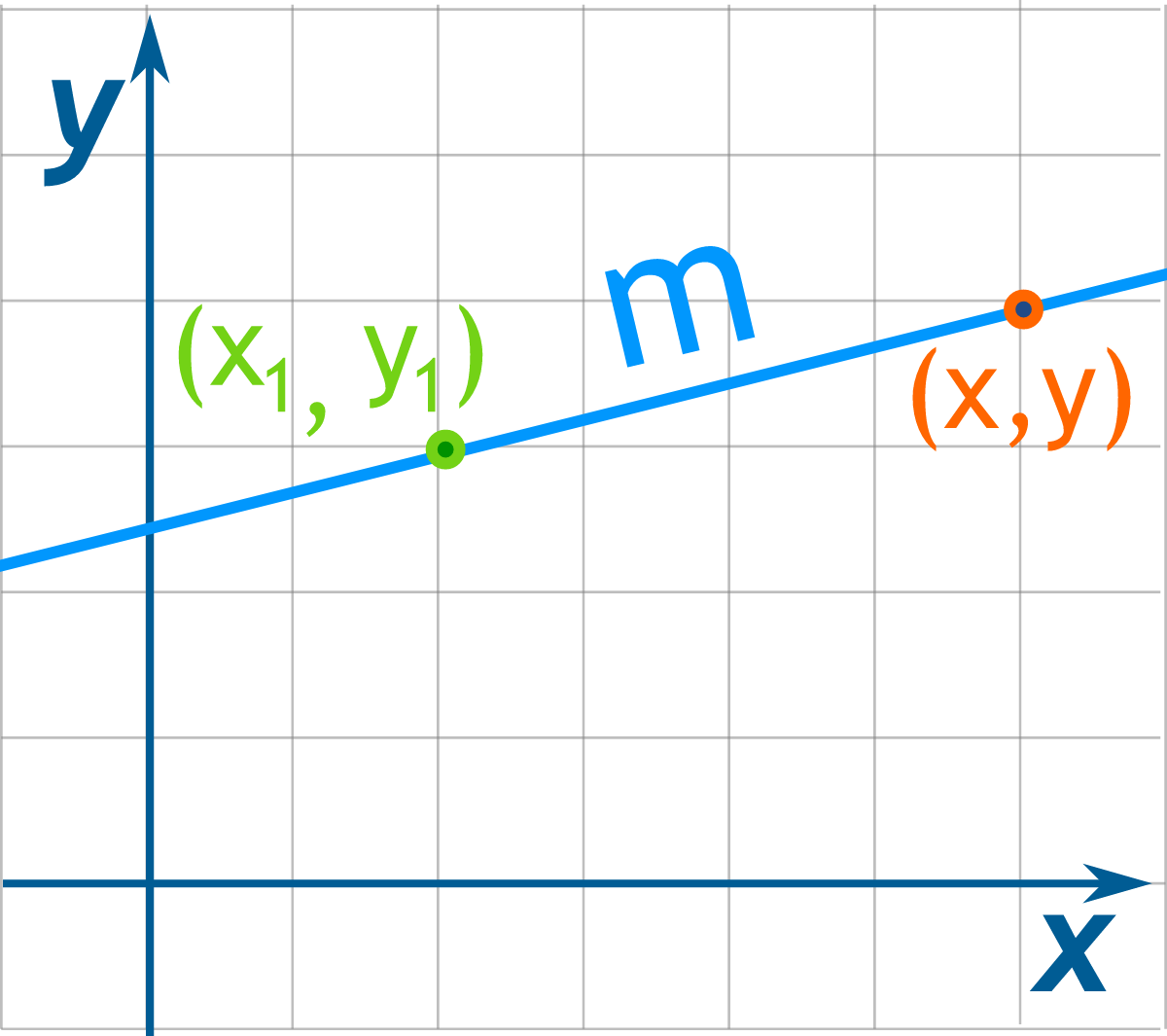
Math is Fun
The point-slope form of the equation of a straight line is: y − y1 = m(x − x1). The equation is useful when we know:
odd moon
proven bough
yeah so idk how I can help you help me solve this
look at where the line touches a cross ➕ on the grid
what points are those
proven bough
odd moon
what points are those
I still have no idea.. Im just gonna ask ai
odd moon
proven bough
I still have no idea.. Im just gonna ask ai
AI isnt on the test
proven bough
odd moon
AI isnt on the test
yeah but its the highest chance I have of success
odd moon
no it isn't going to learn in your place
proven bough
.close
calm coralBOT
Channel closed
Closed by @proven bough
Use .reopen if this was a mistake.
Available help channel!
Send your question here to claim the channel.
Remember:
• Ask your math question in a clear, concise manner.
• Show your work, and if possible, explain where you are stuck.
• Do not immediately ping people or roles. After 15 minutes, feel free to ping <@&286206848099549185> once.
• Type the command .close to free the channel when you're done.
• Be polite and have a nice day!
Read #❓how-to-get-help for further information on how to ask a good question, and about conduct in the question channels.
 pliant spruce
Would my wave start at green or blue x
 calm coralBOT
pliant spruce
Would my wave start at green or blue x
pliant spruce
calm coralBOT
pliant spruce
Would my wave start at green or blue x
pliant spruce
I'm leaning towards green cause on desmos the graphs are in the same spot
but I think thats cause if I move back pi it would end up in the same place as if I moved forward pi
but +pi means move back
cause bx-c turns it negative
btw the red is the original spot without the horizontal shift
 candid fjord
So it's cos(x) stretched by a horizontal scale factor of 1/6, shifted left by pi, stretched vertically by a scale factor of 3, and reflected vertically
Does that seem sensible for you?
pliant spruce
shifted left by pi, stretched vertically by a scale factor of 3 this makes sense
where are you getting 1/6
is it from 1pi/6 ?
candid fjord
I see (...)*cos(6x + ...)
Are you familiar with what happens when you have f(x) and then consider what f(2x) looks like for example?
pliant spruce
no
pliant spruce
u want me to graph this ?
candid fjord
 pliant spruce
I don't see ur point thats just the basic sin wave
pliant spruce
oh its every pi right ?
candid fjord
right, we want x = ..., -pi, 0, pi, 2pi, 3pi, ...
so if we consider
g(x) = f(2x) = sin(2x)
where are the zeroes of g(x)?
pliant spruce
well isn't the number attach to x the number of oscillations so would it be half of pi ?
candid fjord
hint: ||this is the same as asking for the zeroes of f(2x)||
pliant spruce
like pi/2
candid fjord
pliant spruce
well isn't the number attach to x the number of oscillations so would it be half...
also a good way of looking at it yea!
(but this kind of reasoning won't work for functions that don't oscillate so you should look at the hint for a more mechanical way to answer the problem)
pliant spruce
I looked at the hint I don't get it
pliant spruce
yeah but I don't know how f(2x) changes the equation from f(x)
its f(2x) just like the name
candid fjord
candid fjord
right, we want x = ..., -pi, 0, pi, 2pi, 3pi, ...
We found the zeroes of f(x) to be these values of x
pliant spruce
so it changes the x inside the parenthesis
candid fjord
so the zeroes of f(2x) are 2x = ..., -pi, 0, pi, 2pi, 3pi, ...
i.e. x = ..., -pi/2, 0, pi/2, pi, 3pi/2, ...

and this is evidenced by the graph
and you can play this game with any point on the graph (not just the zeroes but they were a good example here)
so f(2x) is horizontally stretching by a scale factor of 1/2
(i.e. squishing it)
and in general
f(ax) is horiz stretching f(x) by a s.f. of 1/a
pliant spruce
wait are all the zeros from the x graph just being divided by 2 ?
pliant spruce
so if I had f(3x) would the zeros be ..., -pi/3, 0, pi/3, 2pi/3, pi, ... ?
pliant spruce
pliant spruce
Would my wave start at green or blue x
to relate this back to my question anyway then it would be the blue x where I start
@candid fjord
candid fjord
pliant spruce
so if I had f(3x) would the zeros be ..., -pi/3, 0, pi/3, 2pi/3, pi, ... ?
yea
candid fjord
pliant spruce
to relate this back to my question anyway then it would be the blue x where I st...
I don't really know the "starting point" because your question doesn't specify a range of values that your input can take
technically that cosine curve goes on forever in both directions
ykwim
pliant spruce
well there isn't a range but since it shifts pi back and the p.s is -pi/6 I think that means I go to the blue x
candid fjord
what's p.s. mean?
pliant spruce
phase shift
candid fjord
why would the phase shift be -pi/6?
candid fjord
candid fjord
So it's cos(x) stretched by a horizontal scale factor of 1/6, shifted left by pi...
this is the order
candid fjord
if it was -3cos(6(x+pi)) then I would agree that you;
- shift by pi to the left
- horizontal stretch
- vertical stretch
pliant spruce
its worked for homework
candid fjord
but it's -3cos(6x** + pi**)
I'm not a physicsy person so idk these terms
but one just does what we described
take the cos(x) curve
pliant spruce
but its bx-c so the + turns negative
candid fjord
and then do those operations fr
just plug the point in to see where its y-value is btw
pliant spruce
yeah the graph is right just did it on desmos
I can't tell where it starts but the graph doesn't need to be 100% accurate it just needs to look like it
on the test
pliant spruce
my teach calls the period stop and the phase shift start
candid fjord
still arbitrary tbh
you could say cosine "starts" at the point (0,1)
and ends at the point (2pi, 1)
and that's 1 full cycle
pliant spruce
he always reminds a us it goes forever he just uses it as a guidance so we know what the graph looks like
 pliant spruce
candid fjord
hopefully teach can clarify what "start" means because idk <:KEK:586240877358350...
pliant spruce
candid fjord
hopefully teach can clarify what "start" means because idk <:KEK:586240877358350...
idk but all I know is when I start at the phase shift and draw the graph it always looks similar to desmos lmao
pliant spruce
candid fjord
hopefully teach can clarify what "start" means because idk <:KEK:586240877358350...
https://youtu.be/6SvQt8vHARI?si=20Iw3rO1-vgIcskM skip to 3:00 he says he wants to start at his phase shift
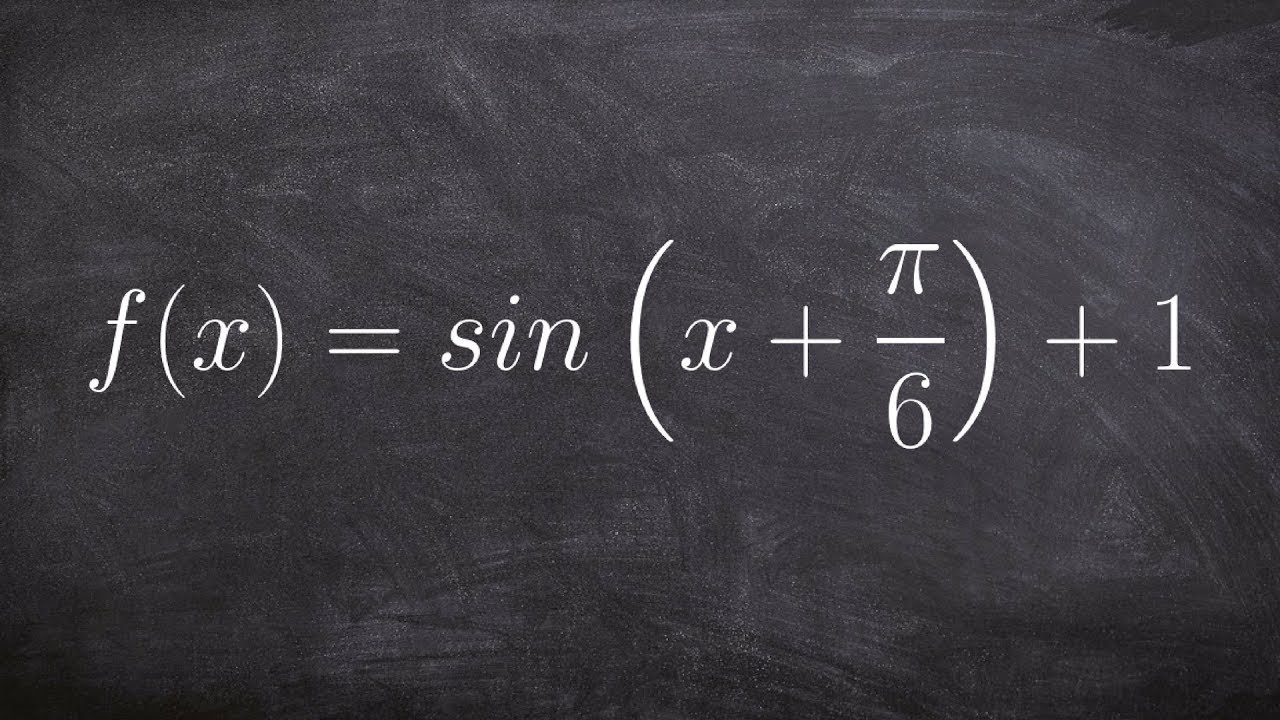
👉 Learn how to graph a sine function. To graph a sine function, we first determine the amplitude (the maximum point on the graph), the period (the distance/time for a complete oscillation), the phase shift (the horizontal shift from the parent function), the vertical shift (the vertical shift from the parent function) and the x-scale (the dis...
pliant spruce
candid fjord
you nailed it though 👏
thanks
pliant spruce
candid fjord
hopefully teach can clarify what "start" means because idk <:KEK:586240877358350...
honestly now that I think about it though u could also just start at the origin shift pi and end up with the same graph
idk man
If anyone can tell me why teachers do this it would be appreciated <@&286206848099549185>
 chrome reef
pliant spruce
If anyone can tell me why teachers do this it would be appreciated <@&2862068480...
chrome reef
pliant spruce
If anyone can tell me why teachers do this it would be appreciated <@&2862068480...
teachers do what…?
pliant spruce
call phase shift the start of the graph
if u look at the video and skip to 3:00 he says he wants to start at the phase shift
chrome reef
pliant spruce
if u look at the video and skip to 3:00 he says he wants to start at the phase s...
oh its because you know the point and its easier to start there i guess
pliant spruce
chrome reef
oh its because you know the point and its easier to start there i guess
makes sense I don't really think its that deep its probably just what u said
pliant spruce
yeah it probably doesn't just make it eaiser to graph the function
does*
ill ask tomorrow since I have his class
thanks guys
chrome reef
pliant spruce
ill ask tomorrow since I have his class
👍
pliant spruce
.close
calm coralBOT
Channel closed
Closed by @pliant spruce
Use .reopen if this was a mistake.
calm coralBOT
Available help channel!
Send your question here to claim the channel.
Remember:
• Ask your math question in a clear, concise manner.
• Show your work, and if possible, explain where you are stuck.
• Do not immediately ping people or roles. After 15 minutes, feel free to ping <@&286206848099549185> once.
• Type the command .close to free the channel when you're done.
• Be polite and have a nice day!
Read #❓how-to-get-help for further information on how to ask a good question, and about conduct in the question channels.
 wise moss
What is the product $(X^2+I)(X^2+I)$ in the factor ring $R/I$, where $R=\mathbb{F}_2[X]$ and $I=,_R\langle X^3+1 \rangle$
calm coralBOT
wise moss
What is the product $(X^2+I)(X^2+I)$ in the factor ring $R/I$, where $R=\mathbb{...
potent lotusBOT
lyric
 wise moss
there are a few options for an answer, being $X+I, X, 0+I, 0$
potent lotusBOT
lyric
 wise moss
im confused by the wording of the question though, what does it mean 'what is this product in the factor ring'? is it asking which one of them is a representative of the same class?
 ancient thistle
R/I is a ring, and its elements are r + I for r in R
the question wants you to calculate (X^2 + I)(X^2 + I) as an element of R/I
wise moss
is that not just X^4 + I
ancient thistle
it is, yes
but that's not amongst your options
the point is that X^4 + I = r + I for another choice of r in the options
wise moss
ah ok which happens when X^4 is equivalent to r, that being when X^4 - r is in I
ancient thistle
yes
wise moss
neither X^4 - X or X^4 - 0 are in I, and X and 0 dont make sense as an answer?
wise moss
ah true
ok still a little stuck; i figure it's X+I, since we need $X^4-r=P(X)\cdot(X^3+1)$ so P is linear, so $$X^4-r=(X+a)(X^3+1)=(X^4+aX^3+X+a)$$
potent lotusBOT
lyric
 ancient thistle
seems good
wise moss
oh well 1 is its own inverse so X=-X?
ancient thistle
yep
wise moss
okay thankuuu <33
ancient thistle
one way to think about this is X^3 + 1 + I = 0 + I in R/I
so X^3 + I = -1 + I = 1 + I
now multiply by X + I
wise moss
ohhh smart
graceful dust
whatever snow is saying don’t fall for it
ancient thistle
who is snow?
wise moss
is that the convention in this sort of arithmetic
ancient thistle
eventually yes
you can write (mod I) after all the equalities if you want to be more precise
,, X^3 + 1 \equiv 0 \pmod I
potent lotusBOT
 ancient thistle
well, you have see it in the form of R/I presumably
it's the same thing
,, a \equiv b \pmod I \Iff a - b \in I \Iff a + I = b + I \in R/I
potent lotusBOT
 wise moss
well really ive only seen modulo used in Z/nZ but that is itself a factor ring
ancient thistle
yes
wise moss
icwym
ancient thistle
 wise moss
by the looks of things thats where im heading 🙏 hon analysis was gross
ancient thistle

 calm coralBOT
Channel closed
Closed by @wise moss
Use .reopen if this was a mistake.
ancient thistle
ancient thistle
graceful dust
whatever snow is saying don’t fall for it
i was snow all along 
wise moss
😭 😭 😭
calm coralBOT
Available help channel!
Send your question here to claim the channel.
Remember:
• Ask your math question in a clear, concise manner.
• Show your work, and if possible, explain where you are stuck.
• Do not immediately ping people or roles. After 15 minutes, feel free to ping <@&286206848099549185> once.
• Type the command .close to free the channel when you're done.
• Be polite and have a nice day!
Read #❓how-to-get-help for further information on how to ask a good question, and about conduct in the question channels.
 cedar rune
For the following series i have to figure out the radius of convergence. i used the formula of cauchy-hadamard and got 2/7. sequences and series was a few months ago yet. so i dont really know how or what to interpret in this situation. so i got the radius. but was that it or is it important to say smth else to it. like give an interval or smth?
calm coralBOT
cedar rune
For the following series i have to figure out the radius of convergence. i used ...
cedar rune
$\sum_{n=0}^{\infty}\frac{(7z)^n}{3n\cdot2^n+5\cdot2^n}$
potent lotusBOT
Quark
 cedar rune
z is complex
calm coralBOT
@cedar rune Has your question been resolved?
cedar rune
.close
calm coralBOT
Channel closed
Closed by @cedar rune
Use .reopen if this was a mistake.
calm coralBOT
Available help channel!
Send your question here to claim the channel.
Remember:
• Ask your math question in a clear, concise manner.
• Show your work, and if possible, explain where you are stuck.
• Do not immediately ping people or roles. After 15 minutes, feel free to ping <@&286206848099549185> once.
• Type the command .close to free the channel when you're done.
• Be polite and have a nice day!
Read #❓how-to-get-help for further information on how to ask a good question, and about conduct in the question channels.
 tired kernel
I'm having trouble figuring out how to solve this. Trying to define p and q as some reciprocal of a number with a difference of 6 but I don't know if it's helpful.
 calm coralBOT
tired kernel
I'm having trouble figuring out how to solve this. Trying to define p and q as s...
calm coralBOT
tired kernel
I'm having trouble figuring out how to solve this. Trying to define p and q as s...
 pure breach
i suppose fractions of the form 1/x, 1/y
 rapid cliff
 robust sedge
p = 1/q? but that seems too trivial
robust sedge
p = 1/q? but that seems too trivial
that's what it means
tired kernel
i was thinking 1/x and 1/y but re reading it that makes more sense
steep zinc
$p = \frac{1}{q}$
potent lotusBOT
1 divided by 0 equals Infinity
 steep zinc
so basically this?
tired kernel
so does that mean that the absolute value of p-q is just the difference
and the differnce is 6
steep zinc
what the fuc
 north linden
so cant u solve for q and p using p=q+6
steep zinc
that's kinda obvious what the answer is
you can literally find $A$ and $B$ and then find $A + B$?
potent lotusBOT
1 divided by 0 equals Infinity
 rapid cliff
steep zinc
you can literally find $A$ and $B$ and then find $A + B$?
rapid cliff
steep zinc
you can literally find $A$ and $B$ and then find $A + B$?
yes
tbh, it's not that obvious until you see it
north linden
hold on yea lol
steep zinc
using only that $p$ and $q$ differs by $6$
potent lotusBOT
1 divided by 0 equals Infinity
 rapid cliff
there's a lot of extra information in the question that isn't needed
north linden
correct me if im wrong but isnt it ||5||
rapid cliff
north linden
correct me if im wrong but isnt it ||5||
how did you get that? I have ||7||
||A = 6, B = 1||
north linden
rapid cliff
how did you get that? I have ||7||
||A=3,B=4||
LOL yea there are two answers
rapid cliff
north linden
||A=3,B=4||
yeah, that would also work
steep zinc
north linden
||A=3,B=4||
B is not divisible by the square of any prime
4 is divisible by 2^2
so that's invalid
tired kernel
but 4 is divisible by 2^2
rapid cliff
north linden
||A=3,B=4||
B here is divisible by ||4 = 2^2|| which is the suqare of a prime
 rapid cliff
huh?
tired kernel
i got 7
rapid cliff
well neither of us have that answer XD
north linden
tired kernel
what
north linden
tired kernel
so my first thought was right
rapid cliff
tired kernel
the first sentence is wrong in the markscheme.
north linden
u solve using a quadratic
north linden
yea theres a lot of ambiguity in the question
tired kernel
a lot of these older rounds have a ton of errors
rapid cliff
I think they meant "p and q are complex conjugates"
a+bi and a-bi (it's complex conjugate) are only reciprocals if a^2 + b^2 = 1
Yeah, the markscheme is wrong. It correctly solves p = 3 ± sqrt(10), but then it wrongly assumes 3 + sqrt(10) and 3 - sqrt(10) are reciprocals.
they are negative reciprocals
(3 + sqrt(10)) (3 - sqrt(10)) = 9 - 10 = -1
calm coralBOT
@tired kernel Has your question been resolved?
Channel closed
Closed by @tired kernel
Use .reopen if this was a mistake.
Available help channel!
Send your question here to claim the channel.
Remember:
• Ask your math question in a clear, concise manner.
• Show your work, and if possible, explain where you are stuck.
• Do not immediately ping people or roles. After 15 minutes, feel free to ping <@&286206848099549185> once.
• Type the command .close to free the channel when you're done.
• Be polite and have a nice day!
Read #❓how-to-get-help for further information on how to ask a good question, and about conduct in the question channels.
calm coralBOT
 nocturne gulch
4^x=18^(2x-1)
nocturne gulch
nocturne gulch
4^x=18^(2x-1)
nocturne gulch
logs
leaden thunder
 craggy haven
leaden thunder
nocturne gulch
i just did log4^x=log18^(2x-1)
craggy haven
leaden thunder
nocturne gulch
i just did log4^x=log18^(2x-1)
,tex .log rules
potent lotusBOT
riemann
 nocturne gulch
oh i got xlog4=(2x-1)log18
potent lotusBOT
Result:
1.3862943611199
do i js tae the actual like decimal number an then foil it out on the right side???
leaden thunder
,calc log(18)
potent lotusBOT
Result:
2.8903717578962
why is my log4 0.602
nocturne gulch
potent lotus
Result:
```
1.3862943611199
```
my teacher got this too
leaden thunder
it doesn't matter which base you use as long as you're consistent
nocturne gulch
but i did log base ten 4 and got smth diff
oh okay awesome
thankd!
ooh so
what abt 100^square root x=10
leaden thunder
potent lotus
**riemann**
.
leaden thunder
nocturne gulch
so i have square root of x100=10
why are there no logs here
leaden thunder
nocturne gulch
oh i got xlog4=(2x-1)log18
like you did here
leaden thunder
i don't know what you mean by "make"
leaden thunder
potent lotus
**riemann**
you just follow these rules
nocturne gulch
sorry i mean take the logs of both sides
so square root x log 100=log 10
so square root x times 2 = 1
div by 2 squared
ahhh
okay i understand it now thx!!!
.close
calm coralBOT
Channel closed
Closed by @nocturne gulch
Use .reopen if this was a mistake.
Available help channel!
Send your question here to claim the channel.
Remember:
• Ask your math question in a clear, concise manner.
• Show your work, and if possible, explain where you are stuck.
• Do not immediately ping people or roles. After 15 minutes, feel free to ping <@&286206848099549185> once.
• Type the command .close to free the channel when you're done.
• Be polite and have a nice day!
Read #❓how-to-get-help for further information on how to ask a good question, and about conduct in the question channels.
 cursive tiger
need some help on (b)
 calm coralBOT
cursive tiger
need some help on (b)
cursive tiger
calm coralBOT
cursive tiger
need some help on (b)
cursive tiger
I got this start so far
 calm coralBOT
@cursive tiger Has your question been resolved?
 waxen bay
cursive tiger
need some help on (b)
waxen bay
cursive tiger
need some help on (b)
Intuitively you can think of this as a composition of the polynomials
T/U takes all vectors in V into U by forming cosets/ewuivalence classes over U, and min poly of T|U kills every vector in U
And ofc if a polynomial annihilates V then it's a polynomial multiple of the min poly of T on V
Just formalize this idea a bit more
rustic osprey
<@&268886789983436800>
calm coralBOT
Channel closed
Closed due to timeout
Use .reopen if this was a mistake.
Available help channel!
Send your question here to claim the channel.
Remember:
• Ask your math question in a clear, concise manner.
• Show your work, and if possible, explain where you are stuck.
• Do not immediately ping people or roles. After 15 minutes, feel free to ping <@&286206848099549185> once.
• Type the command .close to free the channel when you're done.
• Be polite and have a nice day!
Read #❓how-to-get-help for further information on how to ask a good question, and about conduct in the question channels.

 calm coralBOT
 tribal kindle
tribal kindle
tribal kindle
Does my drawing look good
graceful dust
very mid handwriting
 tame crag
tribal kindle
tame crag
tribal kindle
thanks
calm coralBOT
@tribal kindle Has your question been resolved?
Channel closed
Closed by @tribal kindle
Use .reopen if this was a mistake.
Available help channel!
Send your question here to claim the channel.
Remember:
• Ask your math question in a clear, concise manner.
• Show your work, and if possible, explain where you are stuck.
• Do not immediately ping people or roles. After 15 minutes, feel free to ping <@&286206848099549185> once.
• Type the command .close to free the channel when you're done.
• Be polite and have a nice day!
Read #❓how-to-get-help for further information on how to ask a good question, and about conduct in the question channels.
 boreal river
 calm coralBOT
boreal river
boreal river
calm coralBOT
boreal river
boreal river
Hi guys
Can someone kindly help me with this vector math/physics problem i would rlly appreciate it
if someone comes please ping
 quaint temple
boreal river
if someone comes please ping
quaint temple
boreal river
if someone comes please ping
I’m pretty sure u have to find the net area under each graph
And rank it from greatest to lowest net area
Since work is force*distance
boreal river
ohhh
boreal river
quaint temple
I’m pretty sure u have to find the net area under each graph
tysm bro i appreciate u king
or queen
calm coralBOT
boreal river
or queen
If you are done with this channel, please mark your problem as solved by typing .close
quaint temple
How did the bot know??
calm coralBOT
Channel closed
Closed by @boreal river
Use .reopen if this was a mistake.
calm coralBOT
Available help channel!
Send your question here to claim the channel.
Remember:
• Ask your math question in a clear, concise manner.
• Show your work, and if possible, explain where you are stuck.
• Do not immediately ping people or roles. After 15 minutes, feel free to ping <@&286206848099549185> once.
• Type the command .close to free the channel when you're done.
• Be polite and have a nice day!
Read #❓how-to-get-help for further information on how to ask a good question, and about conduct in the question channels.
 slender socket
How can I go about proving c? It doesn't seem to hold. Say n=0 we have $\sum_{k=0}^1 \frac{g^{(k)}(a)}{k!}(x-a)^k= g^{(0)}(a)+g^{(1)}(a)(x-a)=$\int_a^a f(t)dt + f(a)(x-a)$
 calm coralBOT
slender socket
How can I go about proving c? It doesn't seem to hold. Say n=0 we have $\sum_{k=...
potent lotusBOT
calm coralBOT
slender socket
How can I go about proving c? It doesn't seem to hold. Say n=0 we have $\sum_{k=...
potent lotusBOT
BigBen
Compile Error! Click the  reaction for more information.
(You may edit your message to recompile.)
 slender socket
But the other sum is $\int_a^x \sum_{k=0}^0 \frac{ f^{(k)}(a)}{k!}(x-a)^k= \int_a^x f(a)$
potent lotusBOT
BigBen
 leaden thunder
slender socket
But the other sum is $\int_a^x \sum_{k=0}^0 \frac{ f^{(k)}(a)}{k!}(x-a)^k= \int_...
leaden thunder
slender socket
But the other sum is $\int_a^x \sum_{k=0}^0 \frac{ f^{(k)}(a)}{k!}(x-a)^k= \int_...
you need to keep going and do the integral
for both sides
leaden thunder
potent lotus
**BigBen**
Compile Error! Click the <:errors:504266556054962196> reaction for mo...
.
slender socket
So your saying the first one is just f(a)(x-a) and that matches the second one
leaden thunder
yes
slender socket
Ok so then the proof itself. I see that we have $\sum_{k=0}^n \frac{ \frac{d^k}{dx^k}\int_a^a f(t)dt}{k!} (x-a)^k$
potent lotusBOT
BigBen
 slender socket
@leaden thunder but this cannot make any sense since then it will all be 0 but we are evaluating each g at a?
leaden thunder
wut
is
"it"
you should write out the sum for an n greater than 0
1, 2, and 3 should suffice
slender socket
leaden thunder
wut
Everything inside the sum will be 0 since we have g^(k)(a). Also I'm doing it for a general n
So we would have $\frac{d^k}{dx^k} \int_a^a f(t)dt$
potent lotusBOT
BigBen
 slender socket
Which is derivatives of 0
leaden thunder
potent lotus
**BigBen**
this is not the kth derivative of g evaluated at a
slender socket
How can I correct it?
potent lotusBOT
riemann
Compile Error! Click the reaction for more information.
(You may edit your message to recompile.)
 leaden thunder
use order of operations. differentiate first, then plug in x=a
calm coralBOT
@slender socket Has your question been resolved?
slender socket
leaden thunder
use order of operations. differentiate first, then plug in x=a
Ok so then our sum is equal to itself but starting from k=1
slender socket
Then if we differentiate we have $\sum_{k=1}^{n+1} \frac{f^{(k)}(a)}{k!}(x-a)^k$
potent lotusBOT
BigBen
 leaden thunder
1, 2, and 3 should suffice
leaden thunder
leaden thunder
1, 2, and 3 should suffice
you really should just do this.
slender socket
potent lotus
**riemann**
Compile Error! Click the <:errors:504266556054962196> reaction for m...
Just the sum from 0 to n+1 with this/k! (x-a)^k
slender socket
leaden thunder
you really should just do this.
But we need to show it for all n?
leaden thunder
yea i know
but you keep messing up simple steps because you don't understand them
leaden thunder
leaden thunder
you really should just do this.
.
slender socket
Ok
calm coralBOT
@slender socket Has your question been resolved?
calm coralBOT
Channel closed
Closed due to timeout
Use .reopen if this was a mistake.
Available help channel!
Send your question here to claim the channel.
Remember:
• Ask your math question in a clear, concise manner.
• Show your work, and if possible, explain where you are stuck.
• Do not immediately ping people or roles. After 15 minutes, feel free to ping <@&286206848099549185> once.
• Type the command .close to free the channel when you're done.
• Be polite and have a nice day!
Read #❓how-to-get-help for further information on how to ask a good question, and about conduct in the question channels.
calm coralBOT
Channel closed
Channel closed due to the original message being deleted.
If you did not intend to do this, please open a new help channel,
as this action is irreversible, and this channel may abruptly lock.
calm coralBOT
Available help channel!
Send your question here to claim the channel.
Remember:
• Ask your math question in a clear, concise manner.
• Show your work, and if possible, explain where you are stuck.
• Do not immediately ping people or roles. After 15 minutes, feel free to ping <@&286206848099549185> once.
• Type the command .close to free the channel when you're done.
• Be polite and have a nice day!
Read #❓how-to-get-help for further information on how to ask a good question, and about conduct in the question channels.
 gentle olive
<@&268886789983436800>
calm coralBOT
Channel closed
Channel closed due to the original message being deleted.
If you did not intend to do this, please open a new help channel,
as this action is irreversible, and this channel may abruptly lock.
calm coralBOT
Available help channel!
Send your question here to claim the channel.
Remember:
• Ask your math question in a clear, concise manner.
• Show your work, and if possible, explain where you are stuck.
• Do not immediately ping people or roles. After 15 minutes, feel free to ping <@&286206848099549185> once.
• Type the command .close to free the channel when you're done.
• Be polite and have a nice day!
Read #❓how-to-get-help for further information on how to ask a good question, and about conduct in the question channels.
calm coralBOT
Channel closed
Channel closed due to the original message being deleted.
If you did not intend to do this, please open a new help channel,
as this action is irreversible, and this channel may abruptly lock.
Available help channel!
Send your question here to claim the channel.
Remember:
• Ask your math question in a clear, concise manner.
• Show your work, and if possible, explain where you are stuck.
• Do not immediately ping people or roles. After 15 minutes, feel free to ping <@&286206848099549185> once.
• Type the command .close to free the channel when you're done.
• Be polite and have a nice day!
Read #❓how-to-get-help for further information on how to ask a good question, and about conduct in the question channels.
calm coralBOT
Please don't occupy multiple help channels.
Channel closed
Channel closed due to the original message being deleted.
If you did not intend to do this, please open a new help channel,
as this action is irreversible, and this channel may abruptly lock.
calm coralBOT
Available help channel!
Send your question here to claim the channel.
Remember:
• Ask your math question in a clear, concise manner.
• Show your work, and if possible, explain where you are stuck.
• Do not immediately ping people or roles. After 15 minutes, feel free to ping <@&286206848099549185> once.
• Type the command .close to free the channel when you're done.
• Be polite and have a nice day!
Read #❓how-to-get-help for further information on how to ask a good question, and about conduct in the question channels.
calm coralBOT
Channel closed
Channel closed due to the original message being deleted.
If you did not intend to do this, please open a new help channel,
as this action is irreversible, and this channel may abruptly lock.
Available help channel!
Send your question here to claim the channel.
Remember:
• Ask your math question in a clear, concise manner.
• Show your work, and if possible, explain where you are stuck.
• Do not immediately ping people or roles. After 15 minutes, feel free to ping <@&286206848099549185> once.
• Type the command .close to free the channel when you're done.
• Be polite and have a nice day!
Read #❓how-to-get-help for further information on how to ask a good question, and about conduct in the question channels.
 pearl iron
Let w = $[x_1, \cdots, x_n]^T \in \mathcal{M}{n,1}(\mbb{R})$ be fixed, and let $W = \text{span}\left{w\right}$. Show that there exists a matrix $A \in \mathcal{M}{n,n}(\mbb{R})$ whose solution space is $W$.
calm coralBOT
pearl iron
Let w = $[x_1, \cdots, x_n]^T \in \mathcal{M}_{n,1}(\mbb{R})$ be fixed, and let ...
pearl iron
how may i write a complete sol to this
potent lotusBOT
zeta theta beta eta
 calm coralBOT
@pearl iron Has your question been resolved?
robust sedge
so w is just a vector in Rn?
you want a matrix whose range is span w
actually what is solution space
oh solution space means kernel
lucid junco
Omg the infamous channel is back
robust sedge

 crude widget
Bro had to type
graceful dust
lucid junco
Omg the infamous channel is back
your need to speak is worse than my need for a bf
 amber wedge
💔
calm coralBOT
@pearl iron Has your question been resolved?
pearl iron
i figured it out by explicitly constructing A
calm coralBOT
Channel closed
Closed by @pearl iron
Use .reopen if this was a mistake.
calm coralBOT
Available help channel!
Send your question here to claim the channel.
Remember:
• Ask your math question in a clear, concise manner.
• Show your work, and if possible, explain where you are stuck.
• Do not immediately ping people or roles. After 15 minutes, feel free to ping <@&286206848099549185> once.
• Type the command .close to free the channel when you're done.
• Be polite and have a nice day!
Read #❓how-to-get-help for further information on how to ask a good question, and about conduct in the question channels.
pure breach
yall i forgof how do i check if $ f(x) = x \left| x \right| \sin \left( \frac{1}{x} \right), x \neq 0$ and $0$ if $x=0$ is differentiable everywhere
calm coralBOT
pure breach
yall i forgof how do i check if $ f(x) = x \left| x \right| \sin \left( \frac{1}...
potent lotusBOT
kidding
 calm coralBOT
Channel closed
Closed by @pure breach
Use .reopen if this was a mistake.
Available help channel!
Send your question here to claim the channel.
Remember:
• Ask your math question in a clear, concise manner.
• Show your work, and if possible, explain where you are stuck.
• Do not immediately ping people or roles. After 15 minutes, feel free to ping <@&286206848099549185> once.
• Type the command .close to free the channel when you're done.
• Be polite and have a nice day!
Read #❓how-to-get-help for further information on how to ask a good question, and about conduct in the question channels.
 cobalt basalt
how do i solve for x
arccos(3/4x)=arcsin(2/3x)
cobalt basalt
also given x>3/4
 sweet spoke
cobalt basalt
how do i solve for x
arccos(3/4x)=arcsin(2/3x)
sweet spoke
cobalt basalt
how do i solve for x
arccos(3/4x)=arcsin(2/3x)
Graph it and find the intersection 
 mortal orbit
cobalt basalt
also given x>3/4
mortal orbit
cobalt basalt
also given x>3/4
so, arccos(3/4x) and arcsin(2/3x) are the same angle, call it theta
cobalt basalt
sweet spoke
Graph it and find the intersection <:Screenshot20260403182327:148992570904347035...

mortal orbit
then by definition, cos(theta) = 3/4x and sin(theta) = 2/3x, right?
cobalt basalt
mortal orbit
so, arccos(3/4x) and arcsin(2/3x) are the same angle, call it theta
what i did is convert the arcsin into arccos
and equate the angles
mortal orbit
cobalt basalt
and equate the angles
?
cobalt basalt
made triangle and found arccos
mortal orbit
ok, I'm guessing the method is similar
mortal orbit
mortal orbit
then by definition, cos(theta) = 3/4x and sin(theta) = 2/3x, right?
given this
what is the link between cos(theta) and sin(theta)?
cobalt basalt
mortal orbit
what is the link between cos(theta) and sin(theta)?
the angles are different no?
mortal orbit
they aren't though? we literally supposed arccos(3/4x) and arcsin(2/3x) are the same angle
cobalt basalt
dang i didnt think of this method
mortal orbit
mortal orbit
then by definition, cos(theta) = 3/4x and sin(theta) = 2/3x, right?
so...
cobalt basalt
what i did was instead convert arcsin into arccos
would that be considered incorrect?
mortal orbit
cobalt basalt
what i did was instead convert arcsin into arccos
through which formula?
cobalt basalt
mortal orbit
through which formula?
i didnt use a formula and instead made a triangle
perpendicular is 2 hypo is 3x
found base
and got arccos
cobalt basalt
yeah
mortal orbit
the way you found the base used pythagoras
cobalt basalt
yeah
mortal orbit
so it's the same idea, but I guess more convoluted since you went through the square root as well
and then equated both expressions for the arccos
cobalt basalt
what does convoluted mean?
mortal orbit
complicated
cobalt basalt
oh
cobalt basalt
well the original question was sum of arccos = pi/2
so ig i though more abt turning eqn into arccos
well thanks
.close
calm coralBOT
Channel closed
Closed by @cobalt basalt
Use .reopen if this was a mistake.
calm coralBOT
Available help channel!
Send your question here to claim the channel.
Remember:
• Ask your math question in a clear, concise manner.
• Show your work, and if possible, explain where you are stuck.
• Do not immediately ping people or roles. After 15 minutes, feel free to ping <@&286206848099549185> once.
• Type the command .close to free the channel when you're done.
• Be polite and have a nice day!
Read #❓how-to-get-help for further information on how to ask a good question, and about conduct in the question channels.
 sullen bridge
is this legal?
 calm coralBOT
sullen bridge
is this legal?
sullen bridge
calm coralBOT
sullen bridge
is this legal?
sullen bridge
$$z , w \in C$$
potent lotusBOT
Hydra_Nuker
 amber bolt
no
 fringe reef
sullen bridge
is this legal?
fringe reef
sullen bridge
is this legal?
you mean rewriting |z|^2 as z zbar? yes that's legal
sullen bridge
why not
amber bolt
maybe
potent lotusBOT
artemetra
 sullen bridge
if i know $$Z \neq 0$$ can i subtract $$(Z+1)$$ from both sides$$
fringe reef
$(a+bi)(a-bi) = a^2 - (ib)^2 = a^2 + b^2 = |a+bi|^2$
potent lotusBOT
artemetra
 amber bolt
thanks
potent lotusBOT
Hydra_Nuker
Compile Error! Click the reaction for more information.
(You may edit your message to recompile.)
 fringe reef
sullen bridge
if i know $$Z \neq 0$$ can i subtract $$(Z+1)$$ from both sides$$
fringe reef
sullen bridge
if i know $$Z \neq 0$$ can i subtract $$(Z+1)$$ from both sides$$
use $ for inline math btw
sullen bridge
oh
fringe reef
sullen bridge
if i know $$Z \neq 0$$ can i subtract $$(Z+1)$$ from both sides$$
i don't really understand the question, you can subtract (z+1) from both sides regardless if z is 0 or not
idk if that'll help you in whatever it is that you are solving though
calm coralBOT
Please show the original problem, exactly as it was stated to you, with the entire original context. A picture or screenshot is best. If the original problem is not in English, then post it anyway! The additional context might still be helpful. Do your best to provide a translation.
fringe reef
sullen bridge
is this legal?
did you mean to divide both sides by z instead, assuming z is not 0?
sullen bridge
$$|Z|^2w=|w|^2z=z-w ; z, w \in C$$
potent lotusBOT
Hydra_Nuker
 fringe reef
are you trying to solve that for z,w?
sullen bridge
fringe reef
did you mean to *divide* both sides by z instead, assuming z is not 0?
yeah
 fringe reef
sullen bridge
$$|Z|^2w=|w|^2z=z-w ; z, w \in C$$
fringe reef
sullen bridge
$$|Z|^2w=|w|^2z=z-w ; z, w \in C$$
oh that's supposed to be - not =
the first one
sullen bridge

those are the options
i know A is right but i think D is also correct
let me show u my work
fringe reef
sullen bridge
oof
sullen bridge


i found both options to be true
unless i did a blunder
also translation is wild cuz i had to do it now
also $m \in C$
potent lotusBOT
Hydra_Nuker
 calm coralBOT
@sullen bridge Has your question been resolved?
sullen bridge
<@&286206848099549185> is this perfectly fun and legal math
 subtle ember
 remote mural
sullen bridge
<@&286206848099549185> is this perfectly fun and legal math
remote mural
sullen bridge
<@&286206848099549185> is this perfectly fun and legal math
bro this math is little hard for me
sorry
calm coralBOT
@sullen bridge Has your question been resolved?
rustic osprey
sullen bridge
This equation implies that $z=w$ or $z\bar{w}=1$. So technically neither A nor D is implied, but only A or D can ever be true.
potent lotusBOT
Civil Service Pigeon
