#help-42
1 messages · Page 128 of 1
 plain bone
For example, in ASA, you have to start with an angle, immediately go to a side, and immediately go to another angle in the same direction
These triangles are congruent by AAS because you start at angle U, go to angle T, and go to side TR
 normal gull
Thank you !! FOR REAL FOR REAL FOR REAL
THANK YOU MAN
Ur the best
Can i give you any vouch or smth in this server ?
 calm coralBOT
@normal gull Has your question been resolved?
calm coralBOT
Channel closed
Closed due to timeout
Use .reopen if this was a mistake.
 Available help channel!
Send your question here to claim the channel.
Remember:
• Ask your math question in a clear, concise manner.
• Show your work, and if possible, explain where you are stuck.
• After 15 minutes, feel free to ping <@&286206848099549185>.
• Type the command .close to free the channel when you're done.
• Be polite and have a nice day!
Read #❓how-to-get-help for further information on how to ask a good question, and about conduct in the question channels.
 midnight dove
Why is the span of the input what determines the column length and output span determines row length. Am I plotting the second question correctly or should I be connecting the dots before and after transformation
 calm coralBOT
midnight dove
Why is the span of the input what determines the column length and output span ...
calm coralBOT
midnight dove
Why is the span of the input what determines the column length and output span ...
 main oak
For the first question, you need to be able to multiply a vector from the domain by the mapping matrix, so the number of columns has to be equal to the dimension of the domain (4). The number of rows will determine the amount of rows your output vector will have (5).
midnight dove
ohh like how a 2x2 matrix multiplies with a 2x1 and the outter dimensions of the equation determines the matrix?
2x2 2x1
main oak
yeah, basically
the inner dimensions must match and the outer dimensions determine the resulting dimensions
You could make up an example and see what happens when you change the number of rows/columns if you are not completely convinced.
midnight dove
im lowkey confused conceptually what is going on with this mapping thingy and stuff
main oak
Regarding the second question, I am not sure if you are supposed to connect the dots or not and I'm assuming you see what the transformation does to each vector.
midnight dove
my professor did this but he was given more coordinates

it makes sense to not connect the dots because i can simply say each dot maintained their y coordinate but went to x=0
main oak
Yeah, it's easy to see what the transformation does without connecting the points. You could still connect the points before and after the transformation if your professor did so.
midnight dove
either connect or no connect my answer should be correct right
and my professor seems generous
I pray 🙏
.close
calm coralBOT
Channel closed
Closed by @midnight dove
Use .reopen if this was a mistake.
main oak
good luck then haha, my linear algebra professor was quite generous as well
midnight dove
😎
calm coralBOT
Available help channel!
Send your question here to claim the channel.
Remember:
• Ask your math question in a clear, concise manner.
• Show your work, and if possible, explain where you are stuck.
• After 15 minutes, feel free to ping <@&286206848099549185>.
• Type the command .close to free the channel when you're done.
• Be polite and have a nice day!
Read #❓how-to-get-help for further information on how to ask a good question, and about conduct in the question channels.
 mossy geode
why wont it represent the min arc
 calm coralBOT
mossy geode
why wont it represent the min arc
mossy geode
calm coralBOT
mossy geode
why wont it represent the min arc
mossy geode
since angle is acute
calm coralBOT
@mossy geode Has your question been resolved?
calm coralBOT
Channel closed
Closed due to timeout
Use .reopen if this was a mistake.
Available help channel!
Send your question here to claim the channel.
Remember:
• Ask your math question in a clear, concise manner.
• Show your work, and if possible, explain where you are stuck.
• After 15 minutes, feel free to ping <@&286206848099549185>.
• Type the command .close to free the channel when you're done.
• Be polite and have a nice day!
Read #❓how-to-get-help for further information on how to ask a good question, and about conduct in the question channels.
 vital scaffold
 calm coralBOT
vital scaffold
calm coralBOT
vital scaffold
 jolly pilot
this is basically just vectors. Khanacademy has it
 remote mural
khan academy has so many calc 2 things
jolly pilot
multi var calculus has actual calculus. that pic has only basic concepts in vectors
which is basically just algebra
remote mural
its called AP Calculus BC though cause thats the class in america
jolly pilot
on khan academy
jolly pilot
remote mural
its called AP Calculus BC though cause thats the class in america
thats fine. but the contents of the topics mentioned in the picture form just the prerequisites of the course. They are not the actual contents of the course itself. These topics should be revised from when they were taught in previous classes (whatever they may be named)
calm coralBOT
@vital scaffold Has your question been resolved?
calm coralBOT
Channel closed
Closed due to timeout
Use .reopen if this was a mistake.
calm coralBOT
Available help channel!
Send your question here to claim the channel.
Remember:
• Ask your math question in a clear, concise manner.
• Show your work, and if possible, explain where you are stuck.
• After 15 minutes, feel free to ping <@&286206848099549185>.
• Type the command .close to free the channel when you're done.
• Be polite and have a nice day!
Read #❓how-to-get-help for further information on how to ask a good question, and about conduct in the question channels.
 magic otter
Could someone help me find where I went wrong?
 calm coralBOT
magic otter
Could someone help me find where I went wrong?
magic otter
calm coralBOT
magic otter
Could someone help me find where I went wrong?
magic otter
Looking for F=c, looking for c
 potent lotusBOT
Bonk

 swift dragon
you write f'(y)=6y^2-6xy
but clearly there is an x
so its f'(x,y)=6y^2-6xy
which this shouldnt bethe case
,w (6x^2+5y^2)dx+(10xy+6y^2)dy=0
potent lotusBOT


 swift dragon
uhm.....
magic otter
Sorry one sec I'll get on it I was grabbing coffee
swift dragon
ye im not sure lol
magic otter
I found a previous mistake but I still have an error somewhere
 magic otter
No it's not, you have to set F = c
I know it's weird, it doesn't make sense to me
There's a proof for it using a rectangle
swift dragon
F(x,y(x))=2x^3+5xy(x)^2+2y(x)^3=C
magic otter
Yeah
The C's do not add to 0
Oh nevermind! I just put it in wrong lol
These are sooo difficult
swift dragon
$\dv{x} F(x,y(x))=6x^2+5y(x)^2+\left(10xy(x)+6y(x)^2\right)\dv{y}{x} = 0$
potent lotusBOT
Bonk
 swift dragon
$F(x,y(x))=2x^3+5xy(x)^2+2y(x)^3+C$
potent lotusBOT
Bonk
 magic otter
Yeah, like all that plus C_1
swift dragon
yeah yeah
magic otter
Yep
swift dragon
its just some constant
swift dragon
magic otter
These are sooo difficult
thats why you practice 😄
magic otter
Duuudddeee these are so hard D= :
Tysm for helping me out, bestie
I appreciate you ❤️
swift dragon
❤️
 calm coralBOT
If you are done with this channel, please mark your problem as solved by typing .close
magic otter
I've messed up
 calm coralBOT
@magic otter Has your question been resolved?
calm coralBOT
@magic otter Has your question been resolved?
Channel closed
Closed by @magic otter
Use .reopen if this was a mistake.
calm coralBOT
Available help channel!
Send your question here to claim the channel.
Remember:
• Ask your math question in a clear, concise manner.
• Show your work, and if possible, explain where you are stuck.
• After 15 minutes, feel free to ping <@&286206848099549185>.
• Type the command .close to free the channel when you're done.
• Be polite and have a nice day!
Read #❓how-to-get-help for further information on how to ask a good question, and about conduct in the question channels.
calm coralBOT
Channel closed
Channel closed due to the original message being deleted.
If you did not intend to do this, please open a new help channel,
as this action is irreversible, and this channel may abruptly lock.
Available help channel!
Send your question here to claim the channel.
Remember:
• Ask your math question in a clear, concise manner.
• Show your work, and if possible, explain where you are stuck.
• After 15 minutes, feel free to ping <@&286206848099549185>.
• Type the command .close to free the channel when you're done.
• Be polite and have a nice day!
Read #❓how-to-get-help for further information on how to ask a good question, and about conduct in the question channels.
 blazing coyote
 calm coralBOT
blazing coyote
blazing coyote
calm coralBOT
blazing coyote
blazing coyote
I would start off with x+2y=v
and y-x=u
so y=v+u/3
and x=v+2u/3
hmm
This is sus
 swift laurel
i would double check how you solved for x,y
blazing coyote
oops
x=(v-2u)/3
so y=x
or u+v=v-2u
or u=0
The other line is v=2
then we have v-u/3=0
so v=u
and v=u+2/3
It's essentially this region( the upper triangle)

so $\int_{0}^{2} \int_{u}^{u+2/3} Jve^u dv du$
potent lotusBOT
What a wonderful world it is !
 swift laurel
blazing coyote
so y=v+u/3
swift laurel
blazing coyote
so y=v+u/3
this isn't correct
blazing coyote
huh?
x+2y=v
y-x=u
adding them gives 3y=v+u
so y=(v+u)/3
forgot the brackets
oops
swift laurel
so i would double check your bounds for v as a result
calm coralBOT
@blazing coyote Has your question been resolved?
calm coralBOT
Channel closed
Closed due to timeout
Use .reopen if this was a mistake.
calm coralBOT
Available help channel!
Send your question here to claim the channel.
Remember:
• Ask your math question in a clear, concise manner.
• Show your work, and if possible, explain where you are stuck.
• After 15 minutes, feel free to ping <@&286206848099549185>.
• Type the command .close to free the channel when you're done.
• Be polite and have a nice day!
Read #❓how-to-get-help for further information on how to ask a good question, and about conduct in the question channels.
 spice wasp
i got 123/99 (simplified to 41/33) but apparently thats wrong so now im lost
 calm coralBOT
spice wasp
i got 123/99 (simplified to 41/33) but apparently thats wrong so now im lost
calm coralBOT
spice wasp
i got 123/99 (simplified to 41/33) but apparently thats wrong so now im lost
 velvet osprey
123/999, not 123/99
spice wasp
I MADE A FUCKING ERROR IN MY WRITING
I WROTE times100 INSTEAD OF times1000
thank you ann in a teacup
.close
calm coralBOT
Channel closed
Closed by @spice wasp
Use .reopen if this was a mistake.
Available help channel!
Send your question here to claim the channel.
Remember:
• Ask your math question in a clear, concise manner.
• Show your work, and if possible, explain where you are stuck.
• After 15 minutes, feel free to ping <@&286206848099549185>.
• Type the command .close to free the channel when you're done.
• Be polite and have a nice day!
Read #❓how-to-get-help for further information on how to ask a good question, and about conduct in the question channels.
 exotic oracle
I have a cloud of water particles of various sizes, and I want to calculate their size distribution. These particles falling speed is proportional to their radius squared. I can measure transmittance at any point in the cloud too, which is proportional to both particle size and particle density
calm coralBOT
exotic oracle
I have a cloud of water particles of various sizes, and I want to calculate thei...
exotic oracle
Assuming ideal conditions (perfect distribution to start, no air movement no motion to start they instantly hit their terminal velocity etc) is it possible to extract the distribution based on how transmittance changes over time?
calm coralBOT
@exotic oracle Has your question been resolved?
calm coralBOT
Channel closed
Closed due to timeout
Use .reopen if this was a mistake.
calm coralBOT
Available help channel!
Send your question here to claim the channel.
Remember:
• Ask your math question in a clear, concise manner.
• Show your work, and if possible, explain where you are stuck.
• After 15 minutes, feel free to ping <@&286206848099549185>.
• Type the command .close to free the channel when you're done.
• Be polite and have a nice day!
Read #❓how-to-get-help for further information on how to ask a good question, and about conduct in the question channels.
 calm coralBOT
 upper lance
no clue how to solve this
velvet osprey
upper lance
no clue how to solve this
velvet osprey
you need to separate out the "integer part" from the fraction
there's also a 'dumb'/bruteforce way to do it if you'd like to hear that
 deep violet
Isn't part (b) easy?
upper lance
deep violet
Isn't part (b) easy?
probably im just dumb
deep violet
Any logical person would figure it out in 10 seconds.
velvet osprey
neither a nor b are particularly hard for me or you but there's no way we would expect OP to find this easy given he's shown up here with this problem
upper lance
do i need to perform synthetic dibision
velvet osprey
deep violet
Any logical person would figure it out in 10 seconds.
do not do this.
velvet osprey
upper lance
do i need to perform synthetic dibision
thatll get you there yeah
well you don't like need it
upper lance
no im sure you can do it mentally
i mean i can do it mentally
but to be fair
im not gonna get marks for that in an exam
A = constant and B = remainder then?
velvet osprey
yes
velvet osprey
well A is the quotient, which in this case is a constant
calm coralBOT
Channel closed
Closed by @upper lance
Use .reopen if this was a mistake.
Available help channel!
Send your question here to claim the channel.
Remember:
• Ask your math question in a clear, concise manner.
• Show your work, and if possible, explain where you are stuck.
• After 15 minutes, feel free to ping <@&286206848099549185>.
• Type the command .close to free the channel when you're done.
• Be polite and have a nice day!
Read #❓how-to-get-help for further information on how to ask a good question, and about conduct in the question channels.
 simple musk
 calm coralBOT
simple musk
simple musk
calm coralBOT
simple musk
simple musk
Let $L_1:\lambda(1,2,-1)+(a,-3,5)$ and $L_2:\lambda(0,-1,2)+(-1,2,a)$. The value of $a\in\mathbb{R}$ for which there exists a plane that contains both $L_1$ and $L_2$ simultaneously is
potent lotusBOT
938c2cc0dcc05f2b68c4287040cfcf71
 simple musk
I actually have no idea
I get that the normal of the plane is (1,2,-1) x (0,-1,2)
,w (1,2,-1)x(0,-1,2)
potent lotusBOT


 Requested by 938c2cc0dcc05f2b68c4287040cfcf71
simple musk
Requested by 938c2cc0dcc05f2b68c4287040cfcf71
simple musk
3x -2y -z + D = 0
((a,-3,5)-(-1,2,a)) = (a+1,-3-2, 5-a)
,w (a+1,-5,5-a).(3,-2,-1)=0
potent lotusBOT
 Requested by 938c2cc0dcc05f2b68c4287040cfcf71
calm coralBOT
Requested by 938c2cc0dcc05f2b68c4287040cfcf71
calm coralBOT
@simple musk Has your question been resolved?
calm coralBOT
@simple musk Has your question been resolved?
calm coralBOT
Channel closed
Closed due to timeout
Use .reopen if this was a mistake.
Available help channel!
Send your question here to claim the channel.
Remember:
• Ask your math question in a clear, concise manner.
• Show your work, and if possible, explain where you are stuck.
• After 15 minutes, feel free to ping <@&286206848099549185>.
• Type the command .close to free the channel when you're done.
• Be polite and have a nice day!
Read #❓how-to-get-help for further information on how to ask a good question, and about conduct in the question channels.
calm coralBOT
 brittle valve
try expanding first the given expression
 tall moon
sub x=a-b y=a+b if your feeling frisky
 unkempt drift
tall moon
sub x=a-b y=a+b if your feeling frisky
unkempt drift
tall moon
sub x=a-b y=a+b if your feeling frisky
this is the best approach
you should show what you've tried so far first
we can't help you if you don't show work
brittle valve
thats what u get after u expand, u can factor that
unkempt drift
,w expand (a-b)^2-7(a^2-b^2)+12(a+b)^2
potent lotusBOT

 unkempt drift
ah okay
brittle valve
then it can still be factored rightt
brittle valve
yea u can still factor it
unkempt drift
ah there's a special way you can break 10 into two factors
unkempt drift
did you try 5b and 2b?
try the same order, 5b and 2b
see what you get
try expanding (3a + 5b)(a + 2b)
unkempt drift
 exotic cosmos
are we not going the x = a - b and y = a + b route anymore?
exotic cosmos
are we not going the x = a - b and y = a + b route anymore?
yeah I was going to say, that would have been much easier to factor
exotic cosmos

calm coralBOT
Channel closed
Closed by @cursive timber
Use .reopen if this was a mistake.
calm coralBOT
Available help channel!
Send your question here to claim the channel.
Remember:
• Ask your math question in a clear, concise manner.
• Show your work, and if possible, explain where you are stuck.
• After 15 minutes, feel free to ping <@&286206848099549185>.
• Type the command .close to free the channel when you're done.
• Be polite and have a nice day!
Read #❓how-to-get-help for further information on how to ask a good question, and about conduct in the question channels.
 waxen swan
helloo would appreciate if someone could check on this….
 calm coralBOT
waxen swan
helloo would appreciate if someone could check on this….<:blobcry:97179757491690...
unkempt drift
waxen swan
helloo would appreciate if someone could check on this….<:blobcry:97179757491690...
calm coralBOT
waxen swan
helloo would appreciate if someone could check on this….<:blobcry:97179757491690...
unkempt drift
waxen swan
helloo would appreciate if someone could check on this….<:blobcry:97179757491690...
yes, that's all correct
brittle valve
waxen swan
helloo would appreciate if someone could check on this….<:blobcry:97179757491690...

or am i trippin
unkempt drift
brittle valve
sec^2 -1
yeah, the way how I remember it is sec^2 (0) = 1/cos^2(0) = 1
brittle valve
oh wait
unkempt drift
and tan^2 (0) = 0, so you subtract 1 from sec^2
unkempt drift
,w d/dx sqrt(2)/2 ln(abs((x + sqrt(x^2 - 2))/sqrt(2))
potent lotusBOT
 unkempt drift
just checking, hooray
unkempt drift
waxen swan
helloo would appreciate if someone could check on this….<:blobcry:97179757491690...
nice work sis!
calm coralBOT
Channel closed
Closed by @waxen swan
Use .reopen if this was a mistake.
calm coralBOT
Available help channel!
Send your question here to claim the channel.
Remember:
• Ask your math question in a clear, concise manner.
• Show your work, and if possible, explain where you are stuck.
• After 15 minutes, feel free to ping <@&286206848099549185>.
• Type the command .close to free the channel when you're done.
• Be polite and have a nice day!
Read #❓how-to-get-help for further information on how to ask a good question, and about conduct in the question channels.
 foggy crypt
Hi chaps. Any chance of help with this question? (actually, I've read the solution - triangle inequality, bound the two guys, etc. - but I don't get the `idea' behind it or how I would think of that, so any insight into that would be appreciated)
 calm coralBOT
foggy crypt
Hi chaps. Any chance of help with this question? (actually, I've read the soluti...
calm coralBOT
calm coralBOT
foggy crypt
Hi chaps. Any chance of help with this question? (actually, I've read the soluti...
calm coralBOT
@foggy crypt Has your question been resolved?
Channel closed
Closed by @foggy crypt
Use .reopen if this was a mistake.
 potent smelt
.reopen
calm coralBOT
✅
potent smelt
@foggy crypt you still around?
I'm not entirely convinced of the second part of this prompt.
If we take F to be all rational numbers, for instance, then because the rationals are dense g(x) = 0 for all x, not just the rationals.
potent smelt
Ah!
I did miss that, thanks for the correction
Critical part that
Anyway, if you're still around, OP, I could use a little bit more information about your understanding, and where the gap in intuition is. Otherwise, I'll just let this time out again.
foggy crypt
potent smelt
<@464887818448273408> you still around?
Yep. Sorry
I just left to get lunch and I didn’t want to… not respond while eating. 😛
So I was going to re-ask later
velvet osprey
wait so which part are you interested in
foggy crypt
potent smelt
Anyway, if you're still around, OP, I could use a little bit more information ab...
Essentially, I’m understand what the question means (it’s the smallest distance between x and a member of the set) but I’m not sure how one can ‘see’ what to do from there.
velvet osprey
continuity, or nonzeroness outside of F?
foggy crypt
Ah, continuity
I think nonzeroness is quite easy
I understand my question is quite …abstract.
Initially I tried to use the sequence characterisation
calm coralBOT
@foggy crypt Has your question been resolved?
velvet osprey
foggy crypt
I think nonzeroness is quite easy
that it is
wait are you allowed to use basic continuity results like
|x| is continuous
foggy crypt
Yes, that should not be a problem
velvet osprey
oh then it's not too hard is it
foggy crypt
I think things like that are fine to assume. Proving them would just market things tedious
velvet osprey
do you also know any open set in R decomposes into a union of disjoint open intervals
foggy crypt
Hmm… I know that the union of open sets is open. Probably this follows from that
 paper mason
I don't quite know where I should ask for math questions, but could someone help me with this? "A recipe for oat balls made 32 pieces. Next time, every other oat ball was made with double the diameter, and every other with half the diameter. When the dough was no longer enough to make oat balls with double the diameter, oat balls with half the diameter were made from the rest. How many oat balls did the recipe make then?"
The answer i found on the book was 67 oat balls, but I don't know how it came to the answer
paper mason
How do i find available channel?
velvet osprey
foggy crypt
Hmm… I know that the union of open sets is open. Probably this follows from that
not quite
foggy crypt
Oh, maybe the fact they have to be 'intervals' complicates matters
I guess you could make an open set out of open intervals but maybe turning an arbitrary open set into the constituent intervals is harder.
But what relation does that have with the task anyway?
foggy crypt
.close
calm coralBOT
Channel closed
Closed by @foggy crypt
Use .reopen if this was a mistake.
calm coralBOT
Available help channel!
Send your question here to claim the channel.
Remember:
• Ask your math question in a clear, concise manner.
• Show your work, and if possible, explain where you are stuck.
• After 15 minutes, feel free to ping <@&286206848099549185>.
• Type the command .close to free the channel when you're done.
• Be polite and have a nice day!
Read #❓how-to-get-help for further information on how to ask a good question, and about conduct in the question channels.
 novel dock
I have function
f : [0, 1] → [0, ∞)
integral from 0 to 1 of this function > 0 - true/false
my book says its true but what if f(x) = 0
calm coralBOT
novel dock
I have function
f : [0, 1] → [0, ∞)
integral from 0 to 1 of this function > 0 - ...
plain bone
novel dock
I have function
f : [0, 1] → [0, ∞)
integral from 0 to 1 of this function > 0 - ...
One could argue that if f(x) = 0, then the range does not extend to infinity.
I'm not 100% sure about this though
novel dock
the function is continuous
chat gpt told me the [0; ∞) means the possible outputs of the funtion are between 0 and ∞
 deft tree
chatgpt is unreliable
 sweet stag
can you send a picture of the problem? @novel dock
 novel dock
the function is continuous
novel dock
novel dock
the function is continuous
.
sweet stag
novel dock
you can see integral and function
the whole line
ur cutting it in the middle
novel dock
 sweet stag
okey better now
sweet stag
plain bone
One could argue that if `f(x) = 0`, then the range does not extend to `infinity`...
The phrase "the range extends to infinity" is not a formal mathematical requirement. Instead, it is often used informally to describe functions whose values can grow arbitrarily large
sweet stag
novel dock
I have function
f : [0, 1] → [0, ∞)
integral from 0 to 1 of this function > 0 - ...
and no it isnt true, consider f(x) = 0 forall x in [0,1]
novel dock
Ye i needed to ask because it's in our exam sheets and I guess someone made mistake and put true in answers
Thanks
.close
calm coralBOT
Channel closed
Closed by @novel dock
Use .reopen if this was a mistake.
 mortal orbit
novel dock
mortal orbit
novel dock
if you suppose f is continuous and not the 0 function, THEN the statement will become true
novel dock
.reopen
calm coralBOT
✅
calm coralBOT
Channel closed
Closed by @novel dock
Use .reopen if this was a mistake.
calm coralBOT
Available help channel!
Send your question here to claim the channel.
Remember:
• Ask your math question in a clear, concise manner.
• Show your work, and if possible, explain where you are stuck.
• After 15 minutes, feel free to ping <@&286206848099549185>.
• Type the command .close to free the channel when you're done.
• Be polite and have a nice day!
Read #❓how-to-get-help for further information on how to ask a good question, and about conduct in the question channels.
 uneven rose
 calm coralBOT
uneven rose
uneven rose
calm coralBOT
uneven rose
uneven rose
I tried to do it for some small numbers but it doesn t take my anywhere
And I need a general term formula
remote mural
i like your writing
uneven rose
It s from romanian math gazette so I translated it on sheet
Can you help me with it?
remote mural
are you from romania?
uneven rose
Yes
calm coralBOT
@uneven rose Has your question been resolved?
uneven rose
<@&286206848099549185>
uneven rose
 ornate meadow
umm, could you maybe type that out?
ornate meadow
umm, could you maybe type that out?

There (-1)^n is a power
Not product
ornate meadow
hmm from the wording the question doesnt require you to do that
but you can combine all the terms
to the previous number
$a_{n+1} = \frac{1}{a_1}+ \frac{a_2}{2}+...+\left(\frac{a_n}{n}\right)^{(-1)^n}=a_{n}+\left(\frac{a_n}{n}\right)^{(-1)^n}$
potent lotusBOT
DeadTomato
 ornate meadow
and then look at the two cases, where n is even or odd
ornate meadow
also i misread the question a bit 😅, yeah there are more solutions
ornate meadow
uneven rose
If it s even than (a)n+1 is bigger than (a)n
the sequence is always increasing, as its a sum of positive real numbers
ornate meadow
try to prove first, that if n is even and an an integer, the next one cant be
ornate meadow
yeah
uneven rose
Well yeah because n is smaller than (a)n
And it will be something under 1 plus something integer
ornate meadow
uneven rose
Well yeah because n is smaller than (a)n
you dont know that
uneven rose
ornate meadow
you dont know that
They are positive
ornate meadow
why are they out of the question
isnt that sequence even an example for ones that work?
$a_{n+1} = \frac{1}{a_1}+ \frac{a_2}{2}+...+\left(\frac{a_n}{n}\right)^{(-1)^n}=a_{n}+\left(\frac{a_n}{n}\right)^{(-1)^n}$
uneven rose
So I think that an is bigger than n for n>=4
potent lotusBOT
DeadTomato
 uneven rose
The fact that n is even shows only the fact that n is the numitor
ornate meadow
you mean denominator
ornate meadow
yeah so if n is even and with some manipulation $a_{n+1}=a_n+\frac{a_n}{n} = a_n(1+\frac{1}{n})$
uneven rose
Yes
potent lotusBOT
DeadTomato
 uneven rose
Yes
ornate meadow
yeah but we said n is even
uneven rose
Still the next isn t integer
Cause it s 1/an ×(an+n)
=(a)n+1
Dang
Both cases are not good
ornate meadow
uneven rose
Cause it s 1/an ×(an+n)
not quite
potent lotusBOT
DeadTomato
 uneven rose
Anyways that means the only case is a1 a2?
ornate meadow
potent lotus
**DeadTomato**
you suppose an is already an integer, when is that term also an integer
uneven rose
ornate meadow
you suppose an is already an integer, when is that term also an integer
Yes but it can t
So a1 a2 is the only right?
ornate meadow
uneven rose
Yes but it can t
hmm but we found an example so somehow it can
ornate meadow
potent lotus
**DeadTomato**
what condition can you extract from that term for it to be an integer
uneven rose
an being 1?
ornate meadow
no but an has to divide n
uneven rose
Ah yeah true
So there are more strings?
Bro tell me
Wouldn t that mean in the other case n has to divide an
?
ornate meadow
uneven rose
Wouldn t that mean in the other case n has to divide an
yes but we showed that thats not possible
uneven rose
So the only problem is in this case?
ornate meadow
yeah
uneven rose
And how i finish the problem?
ornate meadow
wel now the question is, when can we construct back a sequence, from a chosen n and an, where we let an divide n
well also i just realized i made an oopsie xd
in fact even and odd dont quite differ
uneven rose
Anyways the problem is solved in my opinion
ornate meadow
it is indeed possible for even to have the next thing be an integer
like you said you just have to have n dividing an for that
ornate meadow
if an is even, it has the form k*n, if its odd, n has the form k*an
uneven rose
Good thanks man
How do i end the conversation?
I mean the channel
@ornate meadow
@calm coral
 wintry geode
.close
swift dragon
uneven rose
How do i end the conversation?
!done
calm coralBOT
uneven rose
How do i end the conversation?
If you are done with this channel, please mark your problem as solved by typing .close
swift dragon
.close
calm coralBOT
Channel closed
Closed by @swift dragon
Use .reopen if this was a mistake.
Available help channel!
Send your question here to claim the channel.
Remember:
• Ask your math question in a clear, concise manner.
• Show your work, and if possible, explain where you are stuck.
• After 15 minutes, feel free to ping <@&286206848099549185>.
• Type the command .close to free the channel when you're done.
• Be polite and have a nice day!
Read #❓how-to-get-help for further information on how to ask a good question, and about conduct in the question channels.
deft tree
Find functions f(x) and g(x) so the given function can be expressed as f(g(x)). p(x) = (2x3 + 1) / (x3– 1)
calm coralBOT
deft tree
Find functions f(x) and g(x) so the given function can be expressed as f(g(x)). ...
deft tree
g(x) equals x^3
i can solve for f(x)
but is there an easier way
than just thinking abouit for like 3 minutes straight
swift dragon
$f(g(x))\cdot p(x)=\frac{2x^3+1}{x^3-1}$?
potent lotusBOT
Bonk

 mystic burrow
How are you doing it right now?
deft tree
just thinking about it
mystic burrow
Okay, so what's your method?
swift dragon
if you have g(x)=x^3, then what could f(x) be?
deft tree
2x+1/x-1
swift dragon
deft tree
2x+1/x-1
BRACKETS
deft tree
bruh
mystic burrow
Try plugging in g(x)=x^3 into the f(x).
deft tree
mystic burrow
Okay, so what's your method?
thinking about it
mystic burrow
What do you have now?
deft tree
potent lotus
**Bonk**
tthis
mystic burrow
Because youre trying to find fx??
deft tree
but i already did?
mystic burrow
$f(x^3)\cdot p(x)=\frac{2x^3+1}{x^3-1}$
potent lotusBOT
pratikitiki
 deft tree
mystic burrow
What do you have now?
deft tree
mystic burrow
What do you have now?
(2x^3 + 1) / (x^3– 1)
mystic burrow
Now, from this equation, f(x) could either be 1/(x-1) or 2x+1.
Just by thinking about it.
swift dragon
thats p(x)?
swift dragon
i thought that was f(g(x))
deft tree
well yeah
it is
fgx is px
we have to find gx and fx so that when we plug it into fgx it makes px
swift dragon
so yeah then youre done
swift dragon
$f(x)=\frac{2x+1}{x-1}$ and $g(x)=x^3$
potent lotusBOT
Bonk
 swift dragon
then whats your question now?
deft tree
oh what
deft tree
kk
swift dragon
i think the fastest way would be to look at repetitions
you noticed x^3 appearing twice
so that could be a possible g(x)
deft tree
so i put gx as x^3
oh oka
well in this: h(x) = √(2x – 1) /√(3x + 4) i see √ comes twice
so how would i do that
√x?
as gx
?
swift dragon
like if i give you $h(x)=\frac{(4x^2-3)^2}{3+(4x^2-3)}$
potent lotusBOT
Bonk
 swift dragon
you can see the 4x^2-3 is repeated twice, so thats a good start for g(x)
deft tree
ohhhh
swift dragon
deft tree
well in this: h(x) = √(2x – 1) /√(3x + 4) i see √ comes twice
this is a bit trickier
and i dont think there is a nice and clean f(g(x)) for that
$\sqrt{\frac{2x-1}{3x+4}}$
potent lotusBOT
Bonk
 swift dragon
there isnt rly a good f(g(x))
swift dragon
potent lotus
**Bonk**
but here there clearly is
swift dragon
no
deft tree
bruh
swift dragon
then you would get $f(g(x))=f(\sqrt{2x-1})=\frac{\sqrt{2x-1}}{\sqrt{3\sqrt{2x-1}}+4}$
potent lotusBOT
Bonk
 swift dragon
see the issue?
swift dragon
potent lotus
**Bonk**
can you determine g(x) and f(x) here?
swift dragon
deft tree
what grade are u in?
im in uni
deft tree
yeah
deft tree
swift dragon
im in uni
ohh
deft tree
swift dragon
can you determine g(x) and f(x) here?
should i
or
like
idk what ur asking
like ar eu asking am i able to
or are u telling me to do it
swift dragon
im giving you a question
deft tree
oh ok
swift dragon
thats similar to what youre doing
swift dragon
(just extra practice i suppose)
swift dragon
hm?
deft tree
gx= 4x^2-3 and fx =x^2/3+x
swift dragon
deft tree
gx= 4x^2-3 and fx =x^2/3+x
BRACKETS
deft tree
lol
swift dragon
(can you add brackets pls? <3)
swift dragon
you wrote: $x^2/3+x$ which is interpreted as $\frac{x^2}{3}+x$
deft tree
uh
swift dragon
texit is dying idk
potent lotusBOT
Bonk
 deft tree
ok
swift dragon
but what you meant was: $x^2/(3+x)$ which is equal to $\frac{x^2}{3+x}$
deft tree
wait
potent lotusBOT
Bonk
 swift dragon
see the problem?
deft tree
with the ()?
swift dragon
(4x^2-3)=4x^2-3
swift dragon
deft tree
with the ()?
yeah
deft tree
oh lol
deft tree
okie
potent lotusBOT
Bonk
 swift dragon
what is g(x) and f(x)?
swift dragon
i suppose you can do that aswell
but you can take the exact same g(x) and f(x) as you did before
g(x)=4x^2-3 and f(x)=x^2/(3+x)
deft tree
what.
swift dragon
$h(x)=\frac{(4x^2-3)^2}{4x^2}=\frac{(4x^2-3)^2}{4x^2-3+3}=\frac{(4x^2-3)^2}{(4x^2-3)+3}$
potent lotusBOT
Bonk
 swift dragon
see it now?
deft tree
oh
oh wow
thats kinda cool
okay i think im good now
thank you so much bonk
for taking the time
to help my dumb ahh
.close
calm coralBOT
Channel closed
Closed by @deft tree
Use .reopen if this was a mistake.
swift dragon
deft tree
thats kinda cool
neat trick huh
being able to spot stuff like this is a really useful ability
calm coralBOT
✅
calm coralBOT
Please show the original problem, exactly as it was stated to you, with the entire original context. A picture or screenshot is best. If the original problem is not in English, then post it anyway! The additional context might still be helpful. Do your best to provide a translation.
deft tree

 swift dragon
thats g(x)?
swift dragon
and then whats f(x)?
deft tree
ye thats gx
swift dragon
you sure?
deft tree
well
if that was fx
i mean gx
and if u substitutes that into sqroot x
OHHH
What am i doing
yeah
i see
okay
LAST THING I SWEAR
Find f(12) for the given piecewise function:
f(x) = {-18x + 20, if x < 19}
{-16x2
, if x ≥ 19}
for this
do u just substitite
swift dragon
!original pls
calm coralBOT
Please show the original problem, exactly as it was stated to you, with the entire original context. A picture or screenshot is best. If the original problem is not in English, then post it anyway! The additional context might still be helpful. Do your best to provide a translation.
deft tree
that is orignianal
deft tree

The middle one
is it just [-18(12) +20]?
what about the stuff with x<19
i gtg soon
@swift dragon sorry
swift dragon
deft tree
is it just [-18(12) +20]?
yup
because you are in the case x<19
f(12)=-18*12+20
swift dragon
with this function youd be in the other case
if x=25, then you are in the -16x^2 part
deft tree
wdym im in that [part
 deft tree
then its in the second one
deft tree
hm sop in this case x=12 so its in the first case
swift dragon
deft tree
im not that dumb

deft tree
💀
swift dragon
deft tree
so u leave the otther one aslone?
yeah you can only be in one case
deft tree
i see
swift dragon
since function cannot have two values at one x
swift dragon
nice
deft tree
god i just realized i have been talking to a stranger about math for one hour
swift dragon
😄
swift dragon
read the bio
swift dragon
🙂
swift dragon
np
deft tree
.close
calm coralBOT
Channel closed
Closed by @deft tree
Use .reopen if this was a mistake.
swift dragon
open a channel anytime 🙂
calm coralBOT
Available help channel!
Send your question here to claim the channel.
Remember:
• Ask your math question in a clear, concise manner.
• Show your work, and if possible, explain where you are stuck.
• After 15 minutes, feel free to ping <@&286206848099549185>.
• Type the command .close to free the channel when you're done.
• Be polite and have a nice day!
Read #❓how-to-get-help for further information on how to ask a good question, and about conduct in the question channels.
 gusty lance
bit confused on whats going on after the teacher differentiates with respect to time
 calm coralBOT
gusty lance
bit confused on whats going on after the teacher differentiates with respect to ...
gusty lance
calm coralBOT
gusty lance
bit confused on whats going on after the teacher differentiates with respect to ...
gusty lance
can someone explain this to me like im 5
calm coralBOT
@gusty lance Has your question been resolved?
 keen flare
gusty lance
bit confused on whats going on after the teacher differentiates with respect to ...
keen flare
gusty lance
bit confused on whats going on after the teacher differentiates with respect to ...
after $\frac{dy}{dt} = 8\cos{\theta} \cdot \frac{d\theta}{dt}$?
potent lotusBOT
BuilderDolphin
 gusty lance
no like getting to that step
keen flare
oh from the y =
keen flare
do you know implicit differentiation
gusty lance
yep
but
im kinda shaky on the working of it here
usually, i would only be dealing with one variable
like
with the implicit differentiation of for ex sin(x+y) = 1
i would be familiar with dy/dx
and so that way it made sense since for x we would js take the deriv normally
but this time its like 2 variables? idk how to explain
keen flare
this is just a more universal application of implicit differentiation
swift dragon
keen flare
after $\frac{dy}{dt} = 8\cos{\theta} \cdot \frac{d\theta}{dt}$?
$\dv{y}{t}$
potent lotusBOT
Bonk
 keen flare
gusty lance
but this time its like 2 variables? idk how to explain
keen flare
gusty lance
but this time its like 2 variables? idk how to explain
well you're trying to find the derivative of the variables with respect to time
which basically means that you perform the chain rule on the variables that you differentiate that are not t (im sort of bad at explaining that)
in this case y and theta
y and theta are treated as implicit functions of t
keen flare
gusty lance
but this time its like 2 variables? idk how to explain
eg in this case $y = 8\sin{\theta}$
treat $y$ and $\theta$ as functions of t:
$y(t) = 8\sin{({\theta}(t))}$
differentiate:
$y'(t) = 8\cos{({\theta}(t))} \cdot {\theta}'(t)$
rewrite:
$\dv{y}{t} = 8\cos{\theta} \cdot \dv{\theta}{t}$
potent lotusBOT
BuilderDolphin
 gusty lance
keen flare
y and theta are treated as implicit functions of t
gusty lance
keen flare
y and theta are treated as implicit functions of t
so we treat them as if they are t?
gusty lance
can you give me a simpler exmaple 😭
gusty lance
cuz from what im understanding, when its like a rate we have to differntiate every variable with respect to time, so every variable is being implicitly differentiated?
keen flare
let's say we have $1 - 2y^2 = x^2$ and are trying to differentiate with respect to x. we know that y changes based on x so we can treat it as a function of x, let's call if $f(x)$: $1 - 2(f(x))^2 = x^2$. Differentiating this, we get: $-4f(x) \cdot f'(x) = 2x$, which is the same as $-4y \cdot \dv{y}{x} = 2x$, which is how it would look like if you did implicit differentiation normally
potent lotusBOT
BuilderDolphin
 keen flare
gusty lance
cuz from what im understanding, when its like a rate we have to differntiate eve...
keen flare
gusty lance
cuz from what im understanding, when its like a rate we have to differntiate eve...
well when we're differentiating with respect to a variable (t) we are implying that the other variables change based on the variable (t)
so we can just rewrite it as a function of t
gusty lance
potent lotus
**BuilderDolphin**
okok i see
gusty lance
keen flare
well when we're differentiating with respect to a variable (t) we are implying t...
right okk
that acc makes much more sense now
thank you
.close
calm coralBOT
Channel closed
Closed by @gusty lance
Use .reopen if this was a mistake.
calm coralBOT
Available help channel!
Send your question here to claim the channel.
Remember:
• Ask your math question in a clear, concise manner.
• Show your work, and if possible, explain where you are stuck.
• After 15 minutes, feel free to ping <@&286206848099549185>.
• Type the command .close to free the channel when you're done.
• Be polite and have a nice day!
Read #❓how-to-get-help for further information on how to ask a good question, and about conduct in the question channels.
 vestal tree
H
calm coralBOT
vestal tree
H
 pallid halo
if it's a math question then probably
vestal tree
It is math but like it had some economic terms in it
pallid halo
yea people ask that sort of question here
vestal tree
Okay so I’m having a hard time using the formula fixed costs/(cost per product - variable costs)=the break even point
Like I have the formula but everytime I’m supposed to use it my brain goes kappor
Wait I’ll find a question with it in it
Okay I found one


How do I use that formula in this question
<@&286206848099549185> anyone?😭
 sacred trellis
I'll help
vestal tree
THANK YOU
If I’m gonna be honest here the first question confuses me too cause all the costs are fixed…
The income is only variable
sacred trellis
Variable include ad & transaction fee
Everything else is fixed
50 per ad
60k
= 60000×50
=3000000 sek
sacred trellis
sacred trellis
50 per ad
60k
= 60000×50
=3000000 sek
Minus total variable cost & you get profit
Break even= (fixed cost/ price per ad)- variable cost per ad
calm coralBOT
@vestal tree Has your question been resolved?
calm coralBOT
Channel closed
Closed by @vestal tree
Use .reopen if this was a mistake.
Available help channel!
Send your question here to claim the channel.
Remember:
• Ask your math question in a clear, concise manner.
• Show your work, and if possible, explain where you are stuck.
• After 15 minutes, feel free to ping <@&286206848099549185>.
• Type the command .close to free the channel when you're done.
• Be polite and have a nice day!
Read #❓how-to-get-help for further information on how to ask a good question, and about conduct in the question channels.
 mental tendon
what happened to the b
 calm coralBOT
mental tendon
what happened to the b
main oak
calm coralBOT
mental tendon
what happened to the b
main oak
lhopital
mental tendon
How
 eternal shard
calm coralBOT
eternal shard
calm coralBOT
Channel closed
Closed by @mental tendon
Use .reopen if this was a mistake.
calm coralBOT
Available help channel!
Send your question here to claim the channel.
Remember:
• Ask your math question in a clear, concise manner.
• Show your work, and if possible, explain where you are stuck.
• After 15 minutes, feel free to ping <@&286206848099549185>.
• Type the command .close to free the channel when you're done.
• Be polite and have a nice day!
Read #❓how-to-get-help for further information on how to ask a good question, and about conduct in the question channels.
Channel closed
Channel closed due to the original message being deleted.
If you did not intend to do this, please open a new help channel,
as this action is irreversible, and this channel may abruptly lock.
Available help channel!
Send your question here to claim the channel.
Remember:
• Ask your math question in a clear, concise manner.
• Show your work, and if possible, explain where you are stuck.
• After 15 minutes, feel free to ping <@&286206848099549185>.
• Type the command .close to free the channel when you're done.
• Be polite and have a nice day!
Read #❓how-to-get-help for further information on how to ask a good question, and about conduct in the question channels.
Channel closed
Channel closed due to the original message being deleted.
If you did not intend to do this, please open a new help channel,
as this action is irreversible, and this channel may abruptly lock.
calm coralBOT
Available help channel!
Send your question here to claim the channel.
Remember:
• Ask your math question in a clear, concise manner.
• Show your work, and if possible, explain where you are stuck.
• After 15 minutes, feel free to ping <@&286206848099549185>.
• Type the command .close to free the channel when you're done.
• Be polite and have a nice day!
Read #❓how-to-get-help for further information on how to ask a good question, and about conduct in the question channels.
 ripe coral
i forgot what to do with the amplitude
 calm coralBOT
ripe coral
i forgot what to do with the amplitude
calm coralBOT
calm coralBOT
ripe coral
i forgot what to do with the amplitude
calm coralBOT
Channel closed
Closed by @ripe coral
Use .reopen if this was a mistake.
 marble holly
😂
 tranquil wasp
aw you gotta give em that sohcahtuah
calm coralBOT
Available help channel!
Send your question here to claim the channel.
Remember:
• Ask your math question in a clear, concise manner.
• Show your work, and if possible, explain where you are stuck.
• After 15 minutes, feel free to ping <@&286206848099549185>.
• Type the command .close to free the channel when you're done.
• Be polite and have a nice day!
Read #❓how-to-get-help for further information on how to ask a good question, and about conduct in the question channels.
 covert orchid
Assume f(x) is a continuous function on $[x_0, \infty)$ and differentiable on $(x_0, \infty)$ such that $f'(x) \geq a > 0$ for every $x > x_0$, prove that $\lim_{x \to \infty}f(x) = \infty$ \
My proof:
Let's take the segment $[x_0, x]$ the function is continuous and differentiable on $[x_0, x]$ therefore using Lagrange mean value theorem there exists a point $c \in (x_0, x)$ such that $f'(c) = \frac{f(x)-f(x_0)}{x-x_0}$ from the given that $f'(x) \geq a > 0$ for every $x > x_0$ we get $f'(c) = \frac{f(x)- f(x_0)}{x-x_0} \geq a$ therefore $f(x) \geq a(x-x_0)+f(x_0)$ we got a linear function with a positive gradienr and therefore it diverges to infinity, using pizza theorem we get $\lim_{x \to \infty}f(x)= \infty$ \
The answer sheet:
Let $x_0 < a_n$ be an arbitrary sequence that diverges to infinity. Therefore for every natural b in $[x_0, a_n]$ we can use LMVT, therefore there exists $c_n \in (x_0,a_n)$ such that $\frac{f(a_n)-f(x_0)}{a_n-x_0} = f'(c) \geq a > 0$. Therefore $f(a_n) \geq a(a_n-x_0) + f(x_0)$ using "pizza" and infinite limits arithemtics we get $\lim_{n \to \infty}f(a_n)= \infty$. We showed that for every sequence $a_n > x_0$ that diverges to infinity we get $\lim_{n \to \infty}f(a_n)= \infty$. Using heine theorem we get $\lim_{x \to \infty}f(x)= \infty$
calm coralBOT
covert orchid
Assume f(x) is a continuous function on $[x_0, \infty)$ and differentiable on $(...
potent lotusBOT
prograce
 covert orchid
My proof is different from the answer sheet, is it wrong? If so then why? Also I don't understand why they had to use sequences in the answer, also note that the answer sheet is not formal writing
 ornate flint
you cant disentiable at x0
see the range
Other than that, in the open section you can use MVT
 quiet swan
potent lotus
**prograce**
quiet swan
potent lotus
**prograce**
as noted already you need MVT only need differentiability at (x_0,x), it doesn't matter for your proof but you need to fix the part where you said it is differentiable on [x_0,x].
what is pizza's theorem?
ornate flint
covert orchid
My proof is different from the answer sheet, is it wrong? If so then why? Also I...
ps. think Proof by contradiction
quiet swan
the definition of limit should just give lim_{x\to \infty}f(x)=\infty, I sort of don't get why the official solution uses the "every sequence thing"
Is your definition the following: We say $\lim_{x\to\infty} f(x)=\infty $ if for all $C\in \mathbb R$ there exists some $N\in \mathbb R$ such that for all $x>N$ we have $f(x)>C$.
potent lotusBOT
qwertytrewq
 covert orchid
quiet swan
as noted already you need MVT only need differentiability at (x_0,x), it doesn't...
covert orchid
quiet swan
as noted already you need MVT only need differentiability at (x_0,x), it doesn't...
I think It's a typo It's supposed to be differentiable on (x0, x)
Pizza theorem is when you havetwo function f(x)<=g(x) and you know that f(x) diverges to infinity then you conclude immediately that g(x) also diverges to infinity
covert orchid
ornate flint
you cant disentiable at x0
I don't understand what is disentiable ?
quiet swan
covert orchid
I don't understand what is disentiable ?
differentiate is what they meant i think
covert orchid
covert orchid
I think It's a typo It's supposed to be differentiable on (x0, x)
Pizza theorem...
Ohh, then yea.
covert orchid
quiet swan
the definition of limit should just give lim_{x\to \infty}f(x)=\infty, I sort of...
That's what I'm asking about and I really reallly wanna know😭
quiet swan
potent lotus
**prograce**
yeah yours looks fine
theirs looks weird lol
your professor might be speedrunning solution write up that they missed it

covert orchid
They use this method a lott and I really wanna know whyy why can't I just not use sequences and do what I did
covert orchid
quiet swan
your professor might be speedrunning solution write up that they missed it
Lmaoo
quiet swan
covert orchid
They use this method a lott and I really wanna know whyy why can't I just not us...
well, is pizza thing stated for sequences or functions?
if it is for sequences then theirs makes more sense
quiet swan
honestly the proof is pretty short anyways... you can just write your own pizza function lemma
covert orchid
It is indeed for functions
 quiet swan
i see math and symbols 😵💫
quiet swan
covert orchid
It is indeed for functions
yeah you should be fine then you should ask your prof if they allow one to use the function version
who knows, maybe they are picky
calm coralBOT
Channel closed
Closed by @covert orchid
Use .reopen if this was a mistake.
quiet swan
covert orchid
Ty for checking it!
nw
quiet swan
covert orchid
It is indeed for functions
oh what that is limit to a not to infinity
you might also want to confirm the infinity case
covert orchid
Ohhh
quiet swan
mb i missed that lol
covert orchid
It says "if f,g are functuions that are defined on a segemnt of point a, given f(x)<=g(x), if limx->af(x)=inf then limx->ag(x)=inf"
I guess if the functions are defined on R then it also works for limit to infinity no ? I'll try to prove it anyways
quiet swan
covert orchid
It says "if f,g are functuions that are defined on a segemnt of point a, given f...
it does work for infinity... you need f to be defined on some [c, infty)
but the proof is the same lol
covert orchid
potent lotus
**prograce**
Yeahh in my questions the funcrions are defined
quiet swan
covert orchid
Yeahh in my questions the funcrions are defined
yeah so it is applicable but ig they probably didn't do the infinity version
covert orchid
They did tho
What the they used pizza theorem on sequences in their answer
I mean it should works on sequences too
Ah it exists in sequences too
quiet swan
covert orchid
What the they used pizza theorem on sequences in their answer
my guess is that they did pizza on sequences, and proved it for functions converging to a, but not functions going to infinity
idk tho you should check
covert orchid
Alr will do🫡
calm coralBOT
Available help channel!
Send your question here to claim the channel.
Remember:
• Ask your math question in a clear, concise manner.
• Show your work, and if possible, explain where you are stuck.
• After 15 minutes, feel free to ping <@&286206848099549185>.
• Type the command .close to free the channel when you're done.
• Be polite and have a nice day!
Read #❓how-to-get-help for further information on how to ask a good question, and about conduct in the question channels.
 hot olive
 velvet osprey
solve that equation for y
and you will see y = -4/(x-1) eventually, or an equivalent form
+4/(x-1) would give you curves NE and SW of the asymptote intersection point like you're describing
hot olive
i divide y-xy yby y and got y(x-1)=4 so divide both sides by x-1
wait
itw ould be -x+ 1
so jsut gotta make bottom postive and top ends up becoming negacive?
.close
calm coralBOT
Channel closed
Closed by @hot olive
Use .reopen if this was a mistake.
calm coralBOT
Available help channel!
Send your question here to claim the channel.
Remember:
• Ask your math question in a clear, concise manner.
• Show your work, and if possible, explain where you are stuck.
• After 15 minutes, feel free to ping <@&286206848099549185>.
• Type the command .close to free the channel when you're done.
• Be polite and have a nice day!
Read #❓how-to-get-help for further information on how to ask a good question, and about conduct in the question channels.
 knotty lake
 calm coralBOT
knotty lake
knotty lake
calm coralBOT
knotty lake
knotty lake
I'm certainly making this harder than it has to be
Where did l go wrong
I'm trying to find X y and z
 versed trout
this is the system?
 knotty lake
Yes
versed trout
have u learnt gaussian elimination
knotty lake
NO clue what that is
versed trout
okay u can do this then
isolate x from the first equation
so express it in terms of y and z
then sub it into the x of the second equation
then isolate y (expressing only in terms of z)
versed trout
yeah thats the next simplest method
knotty lake
everything there is that
versed trout
gaussian elimination is the easiest method to do this
knotty lake
just trying to get it in z
im sure of it and i think i can look that up by myself but like
i feel like there should not be this much work needing to be done
i feel like im making extra steps where i dont need to
versed trout
u could proceed with standard elimination as well
eliminating x first
then eliminating y
knotty lake
elimination i dont know too well
and it eventually succumbs to being substitution as well right
versed trout
can u use calculators then
versed trout
yeah a normal calculator
knotty lake
which i dont have
versed trout
well then substitution is the best method here
knotty lake
thats what ive been doing though
should i just like
bite the bullet and keep going where im going
versed trout
yes
knotty lake
if so i dont know how to comfortably solve that -45x = 35 + 6/5
versed trout
https://www.youtube.com/watch?v=eDb6iugi6Uk&t=52s
do learn this though. it will be useful later and useful for this as well
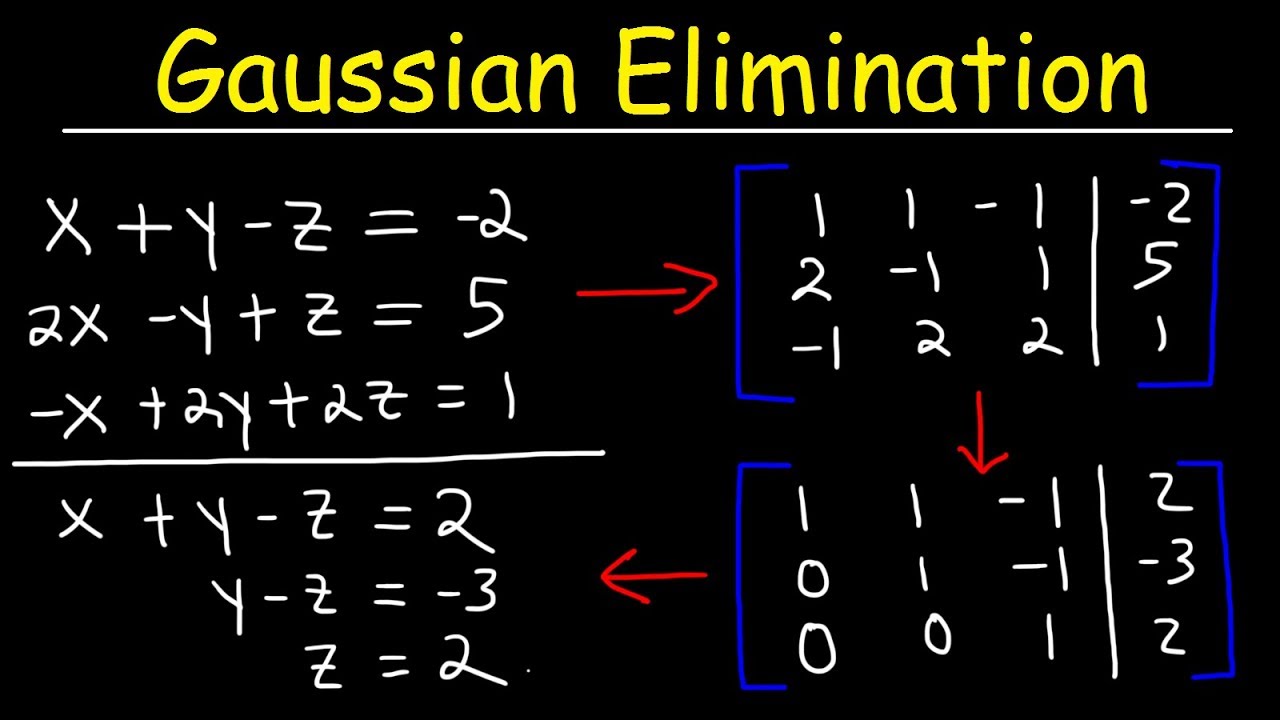
This precalculus video tutorial provides a basic introduction into the gaussian elimination - a process that involves elementary row operations with 3x3 matrices which allows you to solve a system of linear equations with 3 variables. You need to convert the system of equations into an augmented matrix and use matrix row operations to write it ...
its very simple
calm coralBOT
Channel closed
Closed by @knotty lake
Use .reopen if this was a mistake.