#help-39
1 messages · Page 261 of 1
 outer yarrow
 pastel umbra
Und wird es schon, denn es händelt einen Log
outer yarrow
also weiter grübeln...
pastel umbra
Muss es aber natürlich sein?
pastel umbra
ah
outer yarrow
aber es ist ja keine natürliche zahl...
outer yarrow
Leider muss man die komplette richtige Lösung haben, man kann nicht ein Part der Lösung richtig und ein Part falsch haben
Also ich hab es eingegeben
pastel umbra
Ab diesem Zahl wäre es mindestens 10 verkleinert, oder?
outer yarrow
outer yarrow
Also ich hab es eingegeben
Aber jetzt ist man für 10 Minuten Nachdenkzeit gesperrt...
outer yarrow
pastel umbra
**Ab** diesem Zahl wäre es mindestens 10 verkleinert, oder?
Würde Sinn machen...
outer yarrow
pastel umbra
**Ab** diesem Zahl wäre es mindestens 10 verkleinert, oder?
Vielleicht doch 176268?
 pastel umbra
Ah dann wurde es doch gerundet
outer yarrow
Ja
pastel umbra
dann 176 269 nehmen?
pastel umbra
nöooo dann bin ich leider komplett verloren
outer yarrow
macht der log10 vielleicht den unterschied?
weil wir haben ja log
und nicht log10
oder?
pastel umbra
Mal probieren I guess
outer yarrow
geil von wolfram dass er mir keine werte gibt

,w solve ( t / log10(t) ) / sqrt( t log10(t) ) = 10
 jolly parrotBOT


 Requested by yukiemeow
outer yarrow
Requested by yukiemeow
outer yarrow
gut so wolfram, haste toll gemacht 
pastel umbra
,w solve for t: ( t / log10(t) ) / sqrt( t log10(t) ) = 10
jolly parrotBOT

 Requested by waes_wires
jolly parrotBOT
Requested by waes_wires
jolly parrotBOT
 Requested by waes_wires
 pastel umbra
Graph transformation
Because now it crosses the x-axis when this whole thing equals zero, i.e. when the fraction = 10
Komplett verloren wies man schnell auf Deutsch sagt 
outer yarrow
5095 versuch ich gleich
wenn es falsch ist, geb ich auf für die nacht
weil das macht mich schon kirre
outer yarrow
pastel umbra
das ding ist, wieso ich mal denken würde. dass das falsch ist, ist ja weil die ja nix von runden in der aufgabenstellung sagen
und es ist leider falsch... :(
outer yarrow
ja, ich guck mal morgen nochmal neu rauf
nur check ich nicht, wo man hier was anderes noch machen kann
pastel umbra
You can close this channel and then open another one tomorrow
(send that original picture then too btw)
pastel umbra
keine Sorge
outer yarrow
and at least we got some progress
pastel umbra
-# .close to close the channel btw
outer yarrow
.close
 pearl pondBOT
Channel closed
Closed by @outer yarrow
Use .reopen if this was a mistake.
pearl pondBOT
 Available help channel!
Send your question here to claim the channel.
Remember:
• Ask your math question in a clear, concise manner.
• Show your work, and if possible, explain where you are stuck.
• Do not immediately ping people or roles. After 15 minutes, feel free to ping <@&286206848099549185> once.
• Type the command .close to free the channel when you're done.
• Be polite and have a nice day!
Read #❓how-to-get-help for further information on how to ask a good question, and about conduct in the question channels.
 void grail
 pearl pondBOT
void grail
void grail
pearl pondBOT
void grail
void grail
I can spot the pattern center is perhaps a limit
if Z(G) = { g ∈ G | ∀ h ∈ G, g∙h = h∙g }, it looks like a limit
pearl pondBOT
@void grail Has your question been resolved?
void grail
S₂ abélien → Z(S₂) = S₂ (2 éléments)
S₃ non abélien → Z(S₃) = {id} (1 élément)
∀ foncteur F : Grp → Ab doit appliquer Z(S₂) → Z(S₃) en respectant ∀ homs du groupe.
impossible
en carrelage:
S₂ = 2 carreaux → ∀ mouvements invisibles Z(S₂)=2
S₃ = ∆ 3 carreaux → seul id commute Z(S₃)=1
impossible traduire 2 mouvements invisibles en 1 de façon functoriell
pastel umbra
-# au moins traduis ton français
pearl pondBOT
@void grail Has your question been resolved?
void grail
pastel umbra
-# au moins traduis ton français
- S₂ commutative → Z(S₂) = S₂ (has two elements)
2 tiles AB ↔ BA,
every swap commutes → “every move is invisible” - S₃ is not commutative → Z(S₃) = {id} (1 element)
3 tiles ABC, there are swaps that don’t commute
→ only identity invisible
- ∀ functor
F: Grp → Abhas to map ∀ arrowsZ(S₂) → Z(S₃)preserving composition
this is not possible, because you can’t map 2 commuting moves to 1 and preserve every diagram
2 invisible moves on a 2-tile strip
→ can’t fit them onto single invisible move on 3-tile triangle
∴ ¬∃F : G ↦ Z(G), Grp ⟶ Ab
void grail
I think what seems a bit confusing is that I am maybe thinking in terms of individual arrows, while the goal is about functors.
Why can we prove this statement with a counterexample?
there may be individual arrows, but functor maps every arrow, it maps the structure, so all arrows must have this property, so it suffices to point at a counterexample
so it's like saying a forall statement in an existence statement? seems quite cool
∃ F: Grp → Ab, ∀ f: G → H ∈ Grp, F(f) = Z(f) preserves composition
ah, so it is a ∃ x ∀ y`
¬∃ F: Grp → Ab, ∀ f: G → H ∈ Grp, F(f) = Z(f) preserves composition
∀ F: Grp → Ab, ∃ f: G → H Grp, ¬(F(f) = Z(f) preserves composition)
Ah the goal is a forall statement:
¬∃ F: Grp → Ab, ∀ f, F(f)=Z(f) preserves composition
S₂ → S₃ is counterexample
void grail
wow this ∃∀ maybe is something that functors have:
∃F = “there is a functor”
∀ f ∈ Hom(G,H) = “for all arrows, F(f) exists and preserves composition”
a functor is a limit?
it seems like a limit of ∀ arrows and composition?
a global something of local arrows
global map of local structure
adjoint?
local maps ⊣ global map ?
arrows ⊣ functor
global map of all local moves
S₂ → S₃ → S₂
Z(S₂) = 2 elements, Z(S₃) = 1 element
2 → 1 → 2 can't preserve composition
.close
pearl pondBOT
Channel closed
Closed by @void grail
Use .reopen if this was a mistake.
pearl pondBOT
Available help channel!
Send your question here to claim the channel.
Remember:
• Ask your math question in a clear, concise manner.
• Show your work, and if possible, explain where you are stuck.
• Do not immediately ping people or roles. After 15 minutes, feel free to ping <@&286206848099549185> once.
• Type the command .close to free the channel when you're done.
• Be polite and have a nice day!
Read #❓how-to-get-help for further information on how to ask a good question, and about conduct in the question channels.
 chilly jay
i do not how to start with it
 pearl pondBOT
chilly jay
i do not how to start with it
chilly jay
pearl pondBOT
chilly jay
i do not how to start with it
chilly jay
the writing a relation part
 vagrant trout
I'll try to explain it to you from the beginning just in case
Basically we want to count the number of binary strings of length n that do not contain two zeros in a row
For example:
n = 1 -> strings are 0, 1
Meanwhile, n = 2, strings are 01, 10, 11
Since 00 is not allowed (it contains two zeroes in a row)
First off, define the relation
Let s_n be the number of valid n-bit strings with no two consecutive zeros
And then try in such a way that if the first bit is 1, then the remaining n-1 bits form a valid string of length n-1
And if the first bit is 0, then the second bit MUST BE 1 to avoid two zeros in a row, so the first two bits are 01, and then the remaining n-2 bits form a valid string of length n-2
From there, try writing the total number of valid strings of length n combining those two
That should form your relation, or well, define it
pearl pondBOT
@chilly jay Has your question been resolved?
pearl pondBOT
Channel closed
Closed due to timeout
Use .reopen if this was a mistake.
pearl pondBOT
Available help channel!
Send your question here to claim the channel.
Remember:
• Ask your math question in a clear, concise manner.
• Show your work, and if possible, explain where you are stuck.
• Do not immediately ping people or roles. After 15 minutes, feel free to ping <@&286206848099549185> once.
• Type the command .close to free the channel when you're done.
• Be polite and have a nice day!
Read #❓how-to-get-help for further information on how to ask a good question, and about conduct in the question channels.
 midnight haven
 pearl pondBOT
midnight haven
midnight haven
pearl pondBOT
midnight haven
midnight haven
I saw that L1 starts at (0,0,0) and ends at (15,10,4)
so I came up with a direction vector <15,10,4>
and then for L2 seemingly starts at (15,0,0) and ends at (0,10,0) I got the direction vector <-15,10,0>
I took the cross product of those two to get a vector orthogonal
The components of that orthogonal vector is <-40,-60,300>
How would I use that to find the freaking minimum distance between the two lines/vectors
Please help 
<@&286206848099549185>
🙁
Anyone able to help me, please?
 spiral pivot
midnight haven
and then for L2 seemingly starts at (15,0,0) and ends at (0,10,0) I got the dir...
spiral pivot
midnight haven
and then for L2 seemingly starts at (15,0,0) and ends at (0,10,0) I got the dir...
I don't agree with these direction vectors
midnight haven
spiral pivot
I don't agree with these direction vectors
why?
what's wrong with them
spiral pivot
Well, they don't point in the correct direction.
The vector from <0, 0, 0> to <15, 10, 4> should point in the direction of <15, 10, 4> for instance.
midnight haven
yes
OH
OMG
I PUT THEM IN WRONG
LET ME EDIT HOLD ON
you understand what i mean now?
spiral pivot
Yup ok
midnight haven
Does my orthogonal vector make sense though
spiral pivot
Assuming you did the number crunching right, yes. I'm on phone
midnight haven
oh okay
spiral pivot
So now
midnight haven
my problem is, how do I find the minimum distance with this info
i feel like im so stupid and not good at maths but im trying
spiral pivot
Now, you have two lines defined parametrically, the first is <0, 0, 0> + <15, 10, 4> t
The second is what? Use s as a variable
midnight haven
i dont remember learning that
spiral pivot
This is just the parametric form of a line
midnight haven
I remember parametric form of a vector
spiral pivot
a + bt with a, b vectors
By varying t, we generate all of the points along the line
midnight haven
so the second would be <15,0,0> + <0,10,0> s
?

this is how i remember writing it
like in relation to the line
spiral pivot
So if we have two lines, a + bt and c + ds, and we know a direction of a third line that intersects both of them, we can call this third line e + fr, with e and f vectors. We can massage this into a slightly nicer to handle form pr + q(1-r)
We know p = a + bt for some unknown t, and q = c + ds for some unknown s. But we know that when r = 1 we are at p, and r = 0 gives q instead. This is a system of two equations with two unknowns
midnight haven
spiral pivot
Now, you have two lines defined parametrically, the first is <0, 0, 0> + <15, 10...
oh wiat I remember this
midnight haven
spiral pivot
So if we have two lines, a + bt and c + ds, and we know a direction of a third l...
is there a different way to solve without system of equations
spiral pivot
I don't believe so
midnight haven
that just doesnt make sense to me


I found this online
would that work
or nah
pearl pondBOT
@midnight haven Has your question been resolved?
spiral pivot
@midnight haven you can use the formula instead, I don't recognize it, but it seems to be fine?
midnight haven
spiral pivot
<@456226577798135808> you can use the formula instead, I don't recognize it, but...
i found it on a website called mathspanda
but i dont remember learning what a position vector is
is there another name for that
 severe quarry
If I recall correctly you derive this by drawing in a parallelogram
severe quarry
midnight haven
but i dont remember learning what a position vector is
in your a + bt term, that's a
midnight haven
what does position vector mean though
severe quarry
midnight haven
what does position vector mean though
I mean, you describe a line in space by considering some point and then deciding on some slope
That point you considered is (from the origin) the position vector
midnight haven
ok
severe quarry
For n, you will have to form the cross product of your two slope terms
midnight haven
so the first position vector could be <0,0,0> and the second position vector could be <15,0,0>
I did the cross product to get n
severe quarry
I didn't read the history, what are the equations of your two lines?
midnight haven
the orthogonal vector
I saw that L1 starts at (0,0,0) and ends at (15,10,4)
so I came up with a direction vector <15,10,4>
and then for L2 seemingly starts at (15,0,0) and ends at (0,10,0) I got the direction vector <-15,10,0>
I took the cross product of those two to get a vector orthogonal
The components of that orthogonal vector is <-40,-60,300>
 severe quarry
If you found the cross product of the two direction vectors then that's fine yes
That's your n
midnight haven
yep
spiral pivot
That's the correct ballpark
We know that it will be slightly closer than 2.
Because it's exactly 2 over the midway point both ways
pearl pondBOT
@midnight haven Has your question been resolved?
Channel closed
Closed by @honest linden
Use .reopen if this was a mistake.
Available help channel!
Send your question here to claim the channel.
Remember:
• Ask your math question in a clear, concise manner.
• Show your work, and if possible, explain where you are stuck.
• Do not immediately ping people or roles. After 15 minutes, feel free to ping <@&286206848099549185> once.
• Type the command .close to free the channel when you're done.
• Be polite and have a nice day!
Read #❓how-to-get-help for further information on how to ask a good question, and about conduct in the question channels.
 bronze pike
what did i do wrong? why the function should drastically drop down on 0 to 1
 pearl pondBOT
bronze pike
what did i do wrong? why the function should drastically drop down on 0 to 1
bronze pike
pearl pondBOT
bronze pike
what did i do wrong? why the function should drastically drop down on 0 to 1
bronze pike
and what about the asymptote because there are two seperate functions
with sepereate asymptots
 light helm
how did you get from \ \
$\frac{-1}{x-1}$ to $\frac{-1}{x-1} \red{- 1}$
jolly parrotBOT
ραμOmeganato5
 pearl pondBOT
@bronze pike Has your question been resolved?
pearl pondBOT
Channel closed
Closed due to timeout
Use .reopen if this was a mistake.
Available help channel!
Send your question here to claim the channel.
Remember:
• Ask your math question in a clear, concise manner.
• Show your work, and if possible, explain where you are stuck.
• Do not immediately ping people or roles. After 15 minutes, feel free to ping <@&286206848099549185> once.
• Type the command .close to free the channel when you're done.
• Be polite and have a nice day!
Read #❓how-to-get-help for further information on how to ask a good question, and about conduct in the question channels.
 stoic imp
 jolly parrotBOT
Renato

 versed mica
stoic imp
versed mica
stoic imp
i need help with strong induction
versed mica
ok do you have any work to show?
stoic imp
not really no, because idk how the inductive hypothesis goes
versed mica
well you assume a_n > 2^n for all n up to some point
then do the usual implication
show its true for n + 1
stoic imp
versed mica
well you assume a_n > 2^n for all n up to some point
for the base case, we need to have multiple base cases or what
because an depends on an+1 and an+2
stoic imp
so can i use weak induction?
versed mica
i don't see how you would here
stoic imp
why is that weak induction doesn't work here
versed mica
because a_{n + 1} is also in terms of a_{n - 1}
which we have no information about
if you only assume the inequality holds for a_n
stoic imp
but we have a1 and a2
versed mica
ok then how do you think you should proceed with that though?
stoic imp
versed mica
because a_{n + 1} is also in terms of a\_{n - 1}
i mean first instinct after seeing this is that i need strong induction but i can't articulate why
versed mica
like if you insist on using weak induction you're just going to mirror the standard proof that strong induction is equivalent to weak induction
stoic imp
versed mica
like if you insist on using weak induction you're just going to mirror the stand...
let's rewind, how do i prove this
versed mica
so you just declare a new statement about the natural numbers that is literally the statement that its true up to some n
as the strong induction hypothesis says
strong induction says if P(1) is true and if P(1), P(2), ..., P(n) is true then P(n + 1) is true then P(n) is true for all n yes?
you literally just define idk lets call it P'(n) to be the first part of the implication
stoic imp
versed mica
you literally just define idk lets call it P'(n) to be the first part of the imp...
can you give an example for the proof sketch
pearl pondBOT
@stoic imp Has your question been resolved?
 versed mica
what do you mean for all 0 <= n <= n?
stoic imp
ok
stoic imp
 versed mica
you know a_n > 2^n
and a_{n - 1} > 2^{n - 1}
so use those inequalities on the right
stoic imp
ok
 versed mica
whats that bottom line?
stoic imp
wdym
versed mica
why did you exclude the /7?
stoic imp
i just multiplied by 7
versed mica
oh you're multiplying by 7 on both sides and reducing it to an obviously true statement
stoic imp
yes of course
versed mica
i usually do a chain of inequalities but yes ok this is fine
versed mica
well
lets look back before you divided by 7
$a_{n + 1} > \frac{2(n - 1) + 3}{7} (2^n + 2 \cdot 2^{n - 1}) = \frac{2(n - 1) + 3}{7}\cdot 2^{n + 1}$
jolly parrotBOT
knief
 stoic imp
2^n+1
versed mica
mhm
so we want to show a_{n + 1} > 2^{n + 1}
hey
we have that on the right
theres just that (2(n - 1) + 3)/7
so what do we need to show to finish this off
stoic imp
yeah we need to prove that is greater than 0
stoic imp
stoic imp
i want to prove 2(n-1) + 3 > 0
.
versed mica
greater than 1
multiplying by something between 0 and 1 makes it smaller
we want it to be larger than 2^{n + 1}
which means we want the other factor to be greater than 1
can you show (2(n - 1) + 3)/7 >= 1
stoic imp
2n-2+3 >= 7
2n+1>=7
2n >= 6
n >= 3
what? i thought n was >= 1
versed mica
no we need n >= 3 because its a recurrence involving the previous two terms
we showed its true for n = 1, 2
when we do this induction step here and use this recurrence relation we have to have n >= 3
a_1 and a_2 aren't defined by the previous terms
they are just given
and they both satisfy the inequality
stoic imp
wtf is going on
stoic imp
versed mica
can you show (2(n - 1) + 3)/7 >= 1
it cannot be 1
otherwise the strict inequality is fake
@versed mica
versed mica
what?
if a > b and b >= c then a > c
$a_{n + 1} > \frac{2(n - 1) + 3}{7} (2^n + 2 \cdot 2^{n - 1}) = \frac{2(n - 1) + 3}{7}\cdot 2^{n + 1} \geq 2^{n + 1}$
since (2(n - 1) + 3)/7 >= 1
jolly parrotBOT
knief
 versed mica
combine the first > with the last >= to get the desired inequality
versed mica
versed mica
if a > b and b >= c then a > c
^


 versed mica
yes this looks great
stoic imp
versed mica
yes this looks great
i appreciate the help
versed mica
no worries
stoic imp
let me find more recurrence relations so i practice my strong induction
versed mica
👍
pearl pondBOT
@stoic imp Has your question been resolved?
Channel closed
Closed by @stoic imp
Use .reopen if this was a mistake.
Available help channel!
Send your question here to claim the channel.
Remember:
• Ask your math question in a clear, concise manner.
• Show your work, and if possible, explain where you are stuck.
• Do not immediately ping people or roles. After 15 minutes, feel free to ping <@&286206848099549185> once.
• Type the command .close to free the channel when you're done.
• Be polite and have a nice day!
Read #❓how-to-get-help for further information on how to ask a good question, and about conduct in the question channels.
 vague stump
 pearl pondBOT
vague stump
pearl pondBOT
vague stump

 dapper kraken
._.
vague stump
?
 plain warren
rip
plain warren
uhh thats statistics right
vague stump
yep
plain warren
i kinda forgot all about the p value
pearl pondBOT
@vague stump Has your question been resolved?
vague stump
<@&286206848099549185>
pearl pondBOT
@vague stump Has your question been resolved?
pearl pondBOT
Channel closed
Closed due to timeout
Use .reopen if this was a mistake.
pearl pondBOT
Available help channel!
Send your question here to claim the channel.
Remember:
• Ask your math question in a clear, concise manner.
• Show your work, and if possible, explain where you are stuck.
• Do not immediately ping people or roles. After 15 minutes, feel free to ping <@&286206848099549185> once.
• Type the command .close to free the channel when you're done.
• Be polite and have a nice day!
Read #❓how-to-get-help for further information on how to ask a good question, and about conduct in the question channels.
 rustic yoke
I'm stuck on part A of this question.
I have a plan but im not sure how to perform this plan.
The plan:
Compute the Expectation and Variance of both estimators
Show that the expected value is equal to θ (though i don't know what θ exactly describes).
 pearl pondBOT
rustic yoke
I'm stuck on part A of this question.
I have a plan but im not sure how to per...
rustic yoke
pearl pondBOT
rustic yoke
I'm stuck on part A of this question.
I have a plan but im not sure how to per...
rustic yoke
Wrong screenshot. this is the question i'm stuck on
 pearl pondBOT
@rustic yoke Has your question been resolved?
 viscid dew
@rustic yoke a or b portion?
rustic yoke
portion A mostly
viscid dew
@rustic yoke do you know what "unbiased" means?
viscid dew
yah
so, how do you prove that? (literally by definition)
@rustic yoke [btw if the pings are bothering you just tell me, im just pinging since ur not responding otherwise so maybe you want them]
rustic yoke
please keep pinging me, it helps cuz im doing other stuff in the meantime.
im not sure of the definition of θ so im not sure how to prove it
viscid dew
rustic yoke
please keep pinging me, it helps cuz im doing other stuff in the meantime.
ah, i see
 wind rapids
well, part (a) gave you two estimators for mu, the population mean
viscid dew
rustic yoke
it means the expectation never differentiates from θ right?
oh, it just means E[T] = E[V] if T is unbiased. I'm using V to denote the population variable here
wind rapids
and theta denotes your population parameter that you're trying to estimate
rustic yoke
so i need to prove it by computing the expectation of T1 and T2
viscid dew
yes — do you know how to do that, @rustic yoke?
rustic yoke
For T1 1/m SUM(Xi) Xbar denotes the mean of variable X, so its Expectation is mu
and for Ybar it's the sample mean mu of variable Y
1/2 (muX + muY) feels unbiased but im not sure why
viscid dew
$\mathbb E[\overline X]=\mathbb E[\overline Y]=\mu$, right?
jolly parrotBOT
Sunny — ping me plz
 viscid dew
so what can you say about $\mathbb E\left[\frac12\left(\overline X+\overline Y\right)\right]$?
jolly parrotBOT
Sunny — ping me plz
 rustic yoke
is it the same mu though?
1/2 (2mu) is obviously mu
but im confused as to why we can say mu(x) = mu(y) in this case @viscid dew
viscid dew
Ah, that's why. The researchers are measuring the same variable lol.
rustic yoke
oh... yeah that makes a lot of sense
so T1 is mu which is unbiased
T2 is mXbar + nYbar / m+n
We know xbar = mu and ybar = mu from T1
m*mu + n*mu / m+n can be split up into (mu * (m+n)) / m+n
viscid dew
10-2 [this is police code for receiving good / continue]
rustic yoke
trying to think hard about how algebra works again
(a*b) / b = a
so it's also just mu
which is unbiased
viscid dew
yes :-)
viscid dew
rustic yoke
trying to think hard about how algebra works again
not me this morning thinking 2 + 3 = 6
rustic yoke
sweet! For part B its calulating variance and lowest is best estimator right?
rustic yoke
let me find the formula for that
rustic yoke
viscid dew
[sorry for slightly late response, had quick dinner]
all good, no worries
For T1 it's 1/4 (Var(Xbar) + Var(Ybar)) [using Var(aX) = a²Var(X)]
var Xbar would be sigma²/m and var Ybar would be sigma²/n (same sigma because it's the same property)
viscid dew
rustic yoke
For T1 it's 1/4 (Var(Xbar) + Var(Ybar)) [using Var(aX) = a²Var(X)]
hmm, no be careful
wait oh
sorry my mistake
never mind me, i thought you were... yah
you're currently all right
rustic yoke
so T1 would have a Variance of 1/4(sig²/m + sig²/n)
which i don't think i'd need to simplify further
viscid dew
well, you could always find T2 first and see what you need to simplify
actually — you should try intuiting the result first, before you compare. its a nice way to build intuition
rustic yoke
T2 is denotable as 1/m+n (mXbar + nYbar) so its variance is
1/(m+n)² * m²Var(Xbar) + n²Var(Ybar) = 1/(m+n)² * m²sig² + n²sig²
is that correct?
viscid dew
Var(Xbar) isn't sig^2, watch out @rustic yoke
rustic yoke
It's not?
Let me look again to see if i can find my mistake
Oh yeah it's sig^2/m and for Ybar its sig^2/n
So youd have 1/(mn)^2 * (msig^2 + nsig^2)
Which differs from T1 by having a multiplier of 1/mn^2 instead of 1/4
It can be assumed that mn^2 > 4 so the variance of T2 would be smaller and thus T2 would be a better estimator
viscid dew
rustic yoke
Which differs from T1 by having a multiplier of 1/mn^2 instead of 1/4
noo... check again, you're just missing something, everything before this is fine
rustic yoke
Is the mistake still at the variance of mXbar?
viscid dew
rustic yoke
It can be assumed that mn^2 > 4 so the variance of T2 would be smaller and thus ...
(and that's not something you should assume)
viscid dew
rustic yoke
Is the mistake still at the variance of mXbar?
no, 1/4(sig²/m + sig²/n) and 1/(mn)^2 * (msig^2 + nsig^2) are both fine, but its not just about having a multiplier of 1/mn^2 instead of 1/4
rustic yoke
The better estimator has the smallest variance, correct?
rustic yoke
Oh its times m and n instead of divided by
If you multiply its obviously larger
So T2 remains the better estimator but not only because you factor it by 1/mn^2
No actually its the other way around
T1 is the better estimator because it divides sigma by m and n
viscid dew
no, this is more complicated
on one hand, T1 multiplies by 1/4 but T2 multiplies by 1/(mn)^2, so T2 seems smaller (assuming m and n are large), but on the other hand, T1 divides by m and n but T2 multiplies by m and n, so T1 seems smaller. you need to do actual calculation to figure this out
rustic yoke
If i write it out you get
T1: sig2/4m + sig2/4n
T2: msig2/mn2 + nsig2/mn2
viscid dew
assuming you mean (mn)2, correct
viscid dew
now what, though? hint: ||factor out the sig^2||
rustic yoke
That can be simplified to msig2/m2n2 2mn
So sig²/m²+n²+ 2n
And respectively with n too
viscid dew
can you try typing in the exponents, this is becoming painful lol
rustic yoke
Yeah let me try find it on my phones keyboard
rustic yoke
rustic yoke
So sig²/m²+n²+ 2n
Edited for readability
viscid dew
rustic yoke
So sig²/m²+n²+ 2n
which simplifies to this? — even though this doesnt look right
rustic yoke
Give me a moment gotta get on the train
viscid dew
(sure, sure, no rush) (wait train?)
rustic yoke
viscid dew
which simplifies to this? — even though this doesnt look right
Train of thought was that you have m * a/(mn)²
viscid dew
wha— what's a?
rustic yoke
viscid dew
wha— what's *a*?
sig² in this case
viscid dew
ok
viscid dew
rustic yoke
Wait it doesnt
haha, typical algebra moment
viscid dew
yep
rustic yoke
So m*a/m²n² makes a/m*n²
viscid dew
yep
rustic yoke
Respectfully too with n instead of m
viscid dew
I want to re-post so I don't have to scroll up
1/4(sig²/m + sig²/n) and 1/(mn)^2 * (msig^2 + nsig^2)
viscid dew
sure — but you'll find out that it doesnt really help you much anyways, and you're better off leaving it as a(m+n)/m²n²
viscid dew
rustic yoke
T1 was `1/4×(a/m + a/n)`
and this would be a(m+n)/4mn
rustic yoke
Without knowing m or n this doesnt really help me no
viscid dew
not really. by this point i would assume the question is in good faith and say a(m+n)/m²n²<a(m+n)/4mn... unless by some miracle the scientists really didnt want to take a lot of measurements
rustic yoke
m or n would have to have been a single measurement for that to be troo (that it would be wrong due to m and n being small)
rustic yoke
Do you have a general action plan for figuring out variances like this? I could try follow that in another exercise
viscid dew
its really just breaking it down
rustic yoke
I appear to find that difficult
viscid dew
rustic yoke
Wrong screenshot. this is the question i'm stuck on
but anyhow, this matches our intuition — T2 is more reliable, since T1 is essentially weighting our measurements, which shouldnt be good
rustic yoke
The algebra is mostly because phone small n
viscid dew
rustic yoke
I appear to find that difficult
thats completely normal, so do practice!
rustic yoke
viscid dew
thats completely normal, so do practice!
I try! Its hard to start when you have 0 clue what to do but thats when this place helps a ton. Thanks and maybe later if a latter exercise has me stuuck again.
.closed
.close
pearl pondBOT
Channel closed
Closed by @rustic yoke
Use .reopen if this was a mistake.
pearl pondBOT
Available help channel!
Send your question here to claim the channel.
Remember:
• Ask your math question in a clear, concise manner.
• Show your work, and if possible, explain where you are stuck.
• Do not immediately ping people or roles. After 15 minutes, feel free to ping <@&286206848099549185> once.
• Type the command .close to free the channel when you're done.
• Be polite and have a nice day!
Read #❓how-to-get-help for further information on how to ask a good question, and about conduct in the question channels.
 naive marlin
yo
pearl pondBOT
naive marlin
yo
naive marlin
i'm trying to SNF of this matrix

Here is my working out
Swap 3rd row with 1st row
subtract 9Col1s from the 2nd column
Subtract 6s col1 from the third column
Subtract 7Row1s from 2nd row
Subtract 3 row1s from third 3rd row
We have this left


i finsih with SNF 1,2,8
pearl pondBOT
@naive marlin Has your question been resolved?
pearl pondBOT
@naive marlin Has your question been resolved?
Channel closed
Closed by @naive marlin
Use .reopen if this was a mistake.
pearl pondBOT
Available help channel!
Send your question here to claim the channel.
Remember:
• Ask your math question in a clear, concise manner.
• Show your work, and if possible, explain where you are stuck.
• Do not immediately ping people or roles. After 15 minutes, feel free to ping <@&286206848099549185> once.
• Type the command .close to free the channel when you're done.
• Be polite and have a nice day!
Read #❓how-to-get-help for further information on how to ask a good question, and about conduct in the question channels.
 tiny trench
sqrt(x + 1) + 1/sqrt(x + 1)
Find infimum, supremum, maximum and minimum for this
pearl pondBOT
tiny trench
sqrt(x + 1) + 1/sqrt(x + 1)
Find infimum, supremum, maximum and minimum for this
 glass meadow
What have you tried?
naive marlin
x can be any real number ?
tiny trench
idk how to solve
glass meadow
Supremum and maximum should be obvious
pearl pondBOT
Please show the original problem, exactly as it was stated to you, with the entire original context. A picture or screenshot is best. If the original problem is not in English, then post it anyway! The additional context might still be helpful. Do your best to provide a translation.
naive marlin
tiny trench
can be any integer
hv u at least found one of the four ?
tiny trench
so say it's only :
sqrt(x) + 1/sqrt(x)
not 1+x
one is infinity
one is 0
and the other are infinity
sup is infinity
inf is 0
min is 1
right?
glass meadow
No
tiny trench
then how?
naive marlin
do u know calculus ?
tiny trench
we're doing sqrt(x) + 1/sqrt(x)
glass meadow
If the minimum is 1, where is it achieved?
naive marlin
ok let's kinda test it, what do you get at x =0
you get 2
at x = 1
you get sqrt(2) + 1/root(2)
naive marlin
sqrt(1) is defined tho
glass meadow
How often are you going to change the problem statement
naive marlin
bru
pearl pondBOT
@tiny trench Has your question been resolved?
pearl pondBOT
Channel closed
Closed due to timeout
Use .reopen if this was a mistake.
Available help channel!
Send your question here to claim the channel.
Remember:
• Ask your math question in a clear, concise manner.
• Show your work, and if possible, explain where you are stuck.
• Do not immediately ping people or roles. After 15 minutes, feel free to ping <@&286206848099549185> once.
• Type the command .close to free the channel when you're done.
• Be polite and have a nice day!
Read #❓how-to-get-help for further information on how to ask a good question, and about conduct in the question channels.
 stiff nymph
a,b,c>0. Prove:
pearl pondBOT
stiff nymph
a,b,c>0. Prove:
stiff nymph
[
\sum \frac{a^{2025}}{4b^{2025} + c^{2025}} \ge \frac{\sqrt{\sum 3a^2}}{5}
]
 signal atlas
If a,b,c are constants then what are you summing over
stiff nymph
[
\sum_{\text{cyc}} \frac{a^{2025}}{4b^{2025} + c^{2025}} \ge \frac{\sqrt{\sum 3a^2}}{5}
]
jolly parrotBOT
AKL
 stiff nymph
signal atlas
If a,b,c are constants then what are you summing over
stiff nymph
signal atlas
If a,b,c are constants then what are you summing over
can you explain for me?
i dont understand what you mean
stiff nymph
signal atlas
What have u tried
i have no ideas right now
signal atlas
I can’t think of a full solution rn but I would prob try lagrange multipliers first and choose a good constraint function to simplify the problem
pearl pondBOT
@stiff nymph Has your question been resolved?
pearl pondBOT
Channel closed
Closed by @stiff nymph
Use .reopen if this was a mistake.
Available help channel!
Send your question here to claim the channel.
Remember:
• Ask your math question in a clear, concise manner.
• Show your work, and if possible, explain where you are stuck.
• Do not immediately ping people or roles. After 15 minutes, feel free to ping <@&286206848099549185> once.
• Type the command .close to free the channel when you're done.
• Be polite and have a nice day!
Read #❓how-to-get-help for further information on how to ask a good question, and about conduct in the question channels.
 haughty cosmos
Q4a
 pearl pondBOT
haughty cosmos
Q4a
haughty cosmos
pearl pondBOT
haughty cosmos
Q4a
haughty cosmos

I don’t know how sin2x is negative when pi/2 - theta - pi
When I am finding pi/ -2theta - 2pi
Has some intervals when sin2x is positive
Ignore pi/8 and 3pi/8
<@&286206848099549185>
.close
pearl pondBOT
Channel closed
Closed by @haughty cosmos
Use .reopen if this was a mistake.
pearl pondBOT
Available help channel!
Send your question here to claim the channel.
Remember:
• Ask your math question in a clear, concise manner.
• Show your work, and if possible, explain where you are stuck.
• Do not immediately ping people or roles. After 15 minutes, feel free to ping <@&286206848099549185> once.
• Type the command .close to free the channel when you're done.
• Be polite and have a nice day!
Read #❓how-to-get-help for further information on how to ask a good question, and about conduct in the question channels.
 rugged depot
my teacher was teaching permutation and combination he was telling that 5 people can occupy 6 chairs in this many ways i said what if 2 people can sit on one chair he scolded me so i need to prove him wrong by deriving the no of possibilites that can happen if 2 people can sit on n chair we can scale the no of people in one chair also
pearl pondBOT
rugged depot
my teacher was teaching permutation and combination he was telling that 5 people...
 toxic fractal
permutations are supposed to be in how many ways you can order stuff
so elements cannot occupy the same position
rugged depot
yea i mean that only
toxic fractal
so two people are not supposed to sit in the same chair
if they could then you dont have permutations, you have variations
rugged depot
but i want them to form groups and those groups can occupy positions
 toxic lichen
is the vertical ordering of people within a single chair significant
ie do they sit on each other's lap or do they squeeze in horizontally adjacent
 frozen lantern
rugged depot
my teacher was teaching permutation and combination he was telling that 5 people...
frozen lantern
rugged depot
my teacher was teaching permutation and combination he was telling that 5 people...
i mean
you cant change the question
rugged depot
toxic lichen
ie do they sit on each other's lap or do they squeeze in horizontally adjacent
thell sit horizontally ig it doesnt matter
frozen lantern
lets say you do allow pairing
then its 4 entities
3 individuals and one pair
in 6 places
also account for how many ways you can pair
voilà
rugged depot
uhh i dont understand
toxic fractal
permutation is a specific keyword which means a way of ordering
what you're asking, while possible, is not a permutation
rugged depot
ohh
but whatever it is i need to solve it and get how many possibilities can be there
to prove my teacher wrong
rugged depot
but ik what im thinking is possible
toxic fractal
look up the wikipedia permutation page i guess?
what you're asking is under the permutation with repetition title
 rugged depot
frozen lantern
change the definitions of math words
rugged depot
frozen lantern
change the definitions of math words
yea i sometimes do that
toxic fractal
you should probably stop doing that
rugged depot
one day i had an idea to change the periodic table bcs it was shit
and soo many exceptions
toxic fractal
...what
rugged depot
yea
toxic fractal
how does the periodic table have exceptions?
rugged depot
uhh it does
toxic fractal
it just orders the elements by atomic number
toxic fractal
thats... not what the periodic table was designed to address?
frozen lantern
jee bro spotted
frozen lantern
toxic fractal
thats... not what the periodic table was designed to address?
well
kinda was
rugged depot
frozen lantern
jee bro spotted
yeaa
rugged depot
toxic fractal
thats... not what the periodic table was designed to address?
yea thats why i tried making my own
frozen lantern
but its a miracle anything works in the first place be grateful
frozen lantern
rugged depot
yea thats why i tried making my own
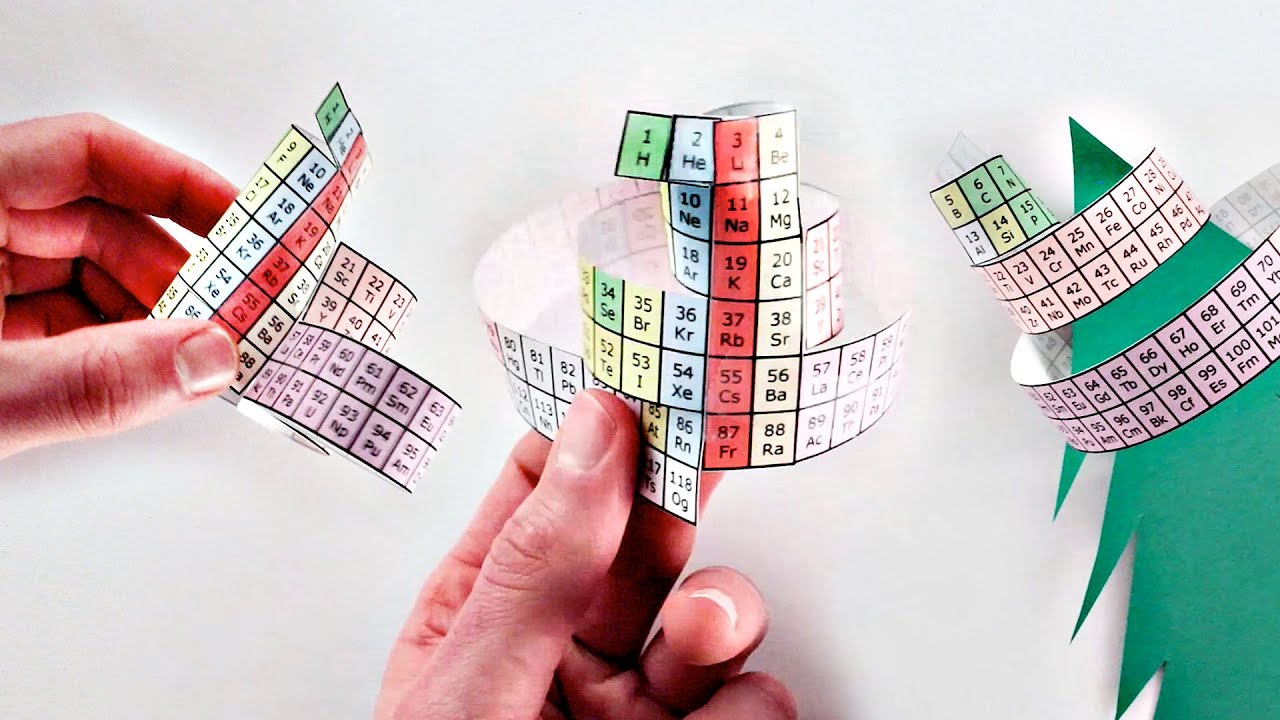
Go to https://Brilliant.org/MinutePhysics to gift Brilliant Premium for the holidays, and for 20% off!
This video is about cutting, taping, and rearranging the periodic table into the Left Step form, the Mendeleev's flower form, the cake form, the wide form, the standard form, and so on. A great holiday craft!!
REFERENCES
Alternate Periodic T...
toxic fractal
frozen lantern
kinda was
no it fucking wasnt. If you wanna go that road it was not because of the electron affinity, is the avaliable electrons for bonds, which is a big difference
frozen lantern
toxic fractal
no it fucking wasnt. If you wanna go that road it was not because of the electro...
well no not electron affinity
trends broadly i mean
rugged depot
yea i meant to give an example dude
toxic fractal
fking s orbital getting filled before we'd like to
rugged depot
yea
frozen lantern
frozen lantern
well no not electron affinity
pretty sure that wasnt a concept back then
rugged depot
like d orbital be filling before p
frozen lantern
,w mendeleev
jolly parrotBOT


 rugged depot
what
toxic fractal
*discovered
rugged depot
yea
frozen lantern
he was too negative
frozen lantern
toxic fractal
*discovered
its a fucking joke
rugged depot
lol
frozen lantern
i saw a reel the other day of like
someone saying newton invented gravity
...
like whole heartedly literally saying that
rugged depot
people these days be dumb asf
frozen lantern
anyway lol
toxic fractal
frozen lantern
i saw a reel the other day of like
see, there's your mistake. You were seeing reels
which is basically brainrot
rugged depot
i didnt the the answer to my question
toxic fractal
literally they made reels cuz people cant have attention span over 1 minute
toxic fractal
rugged depot
i didnt the the answer to my question
i did explicitly tell you were it was
and that it was not called permutation
toxic fractal
good luck with that
rugged depot
variable capacity allocation rule ??
toxic fractal
call them maths II: math harder
 autumn fossil
rugged depot
variable capacity allocation rule ??
autumn fossil
rugged depot
variable capacity allocation rule ??
we already can compute that
frozen lantern
how long before you can report this guy for trolling
autumn fossil
it's just not what "permutations" mean
rugged depot
autumn fossil
we already can compute that
howw ??
toxic fractal
rugged depot
howw ??
for the third time, i told you explicitly where it was
rugged depot
frozen lantern
how long before you can report this guy for trolling
im not trolling
frozen lantern
rugged depot
howw ??
if only someone had explained that

 keen ore
rugged depot
im not trolling
keen ore
rugged depot
im not trolling
I guess I'll add my own two cents which might not be worthwhile at all, but an general advice, if you do see a reel and learn a fact from it, please make sure it is correct by referring to multiple other studies which has already been done. Peer reviewing is a thing and is done to preserve integrity of a claim.
toxic fractal
rugged depot
howw ??
Here, since google is too hard for you
 autumn fossil
rugged depot
howw ??
autumn fossil
rugged depot
howw ??
If we have n people and m chairs, there are m^n ways to seat the ppl (assuming multiple people can occupy one chair)
frozen lantern
keen ore
I guess I'll add my own two cents which might not be worthwhile at all, but an g...
riku youre so missing context lol
keen ore
frozen lantern
riku youre so missing context lol
I guess.. I am, my bad.
frozen lantern
that was my stupid joke
autumn fossil
autumn fossil
If we have n people and m chairs, there are m^n ways to seat the ppl (assuming m...
each one of the n ppl can choose out of m chairs, so it's m x m x m x m x ... x m - n times, so m^n
we don't call that permutations though
rugged depot
whats it clled then
frozen lantern
not sure
autumn fossil
no idea
autumn fossil
yeah, that sounds cool
keen ore
Assignment is fine
autumn fossil
"In how many ways can you assigne n ppl to m chairs?" would probably be fine
ideally, you should add that more ppl can sit at one chair, to make it 100% clear
rugged depot
imagine if chair were in quantam state and they are present and absent at the same time
autumn fossil
No
toxic fractal
rugged depot
whats it clled then
#help-39 message If only somene had said it 4 times...
autumn fossil
rugged depot
i prolly need to sleep
sleep more and think about quantum chairs less
good night
rugged depot
until and unless i treat humans as an electron cloud being present and absent at the quantum chairs
keen ore
Sleep is much more consequential than quantum chairs, or beds for example
Do sleep while you still can.
rugged depot
its 2:30 rn
keen ore

rugged depot
how do i close this ticket
autumn fossil
. close
keen ore
dot close it
rugged depot
.close
pearl pondBOT
Channel closed
Closed by @rugged depot
Use .reopen if this was a mistake.
autumn fossil
or u can try some quantum stuff and see if it works
pearl pondBOT
Available help channel!
Send your question here to claim the channel.
Remember:
• Ask your math question in a clear, concise manner.
• Show your work, and if possible, explain where you are stuck.
• Do not immediately ping people or roles. After 15 minutes, feel free to ping <@&286206848099549185> once.
• Type the command .close to free the channel when you're done.
• Be polite and have a nice day!
Read #❓how-to-get-help for further information on how to ask a good question, and about conduct in the question channels.
 brittle harbor
Dumb question, can contour lines skip steps (not be consecutive)? For example, take these contour lines of a 3D graph in the xy plane, can something like this happen?
 pearl pondBOT
brittle harbor
Dumb question, can contour lines skip steps (not be consecutive)? For example, t...
pearl pondBOT
brittle harbor
Dumb question, can contour lines skip steps (not be consecutive)? For example, t...
 tropic saddle
not if the function is continuous
brittle harbor
tropic saddle
not if the function is continuous
Would this be a function at all?
tropic saddle
sure why not
brittle harbor
I tried picturing the scenario and if the 3D graph is continuous I don't think it would be a function
tropic saddle
ok I'm not sure what you mean
you can have a situation like you have drawn. but only if the function is not continuous
you cannot have that situation with a continuous function
brittle harbor
tropic saddle
you cannot have that situation with a continuous function
But I'm not assuming it's a function. Are contour lines for functions only?
tropic saddle
well if you dont even want a function then you can essentially have whatever you want
 sharp vigil
contour lines are the solution curves to the equation f(x,y) = C where C is some constant
pearl pondBOT
@brittle harbor Has your question been resolved?
brittle harbor
.close
pearl pondBOT
Channel closed
Closed by @brittle harbor
Use .reopen if this was a mistake.
pearl pondBOT
Available help channel!
Send your question here to claim the channel.
Remember:
• Ask your math question in a clear, concise manner.
• Show your work, and if possible, explain where you are stuck.
• Do not immediately ping people or roles. After 15 minutes, feel free to ping <@&286206848099549185> once.
• Type the command .close to free the channel when you're done.
• Be polite and have a nice day!
Read #❓how-to-get-help for further information on how to ask a good question, and about conduct in the question channels.
stoic imp
 jolly parrotBOT
Renato

 worthy lance
Which one do you need help with? all 3?
pearl pondBOT
@stoic imp Has your question been resolved?
stoic imp
worthy lance
Which one do you need help with? all 3?
yes
we can start with 2)


@worthy lance
naive marlin
hello renato
stoic imp
naive marlin
hello renato
hey
 crimson comet
that's for q3
stoic imp
!nosols
pearl pondBOT
As a helper, please do not give out answers that could be copied as a homework solution. Have the student work through the problem themselves and guide them along the way.
crimson comet
oh sorry, mb
then u can solve it modular arithmetic, just think about a^2 should take only a few variables in mod3 and mod7
stoic imp


 crimson comet
It seems okay
and for q4, we can think like a=5x and b=5y for gcd(x,y) = 1. All that remains is to open the expressions and see what we can see.
stoic imp
theres an easier way
 wraith stag
stoic imp
wraith stag
stoic imp
the first slide is very good
to summarize you have that a = 0 (mod 3) is the only possibility and that a = 2 or 4 (mod 7)
i'll just give you the idea to move forward from here
a^3 will have three factors of 3 and a^2 + 3 will have one factor of 3, this gives you the 3^4 part of the proof
if a = 2 (mod 7) then a^2 = 4 (mod 7) so that a^2 + 3 is divisible by 7
finish off with analysis of the a = 4 (mod 7) case
pearl pondBOT
@stoic imp Has your question been resolved?
pearl pondBOT
@stoic imp Has your question been resolved?
stoic imp
.close
pearl pondBOT
Channel closed
Closed by @stoic imp
Use .reopen if this was a mistake.
pearl pondBOT
Available help channel!
Send your question here to claim the channel.
Remember:
• Ask your math question in a clear, concise manner.
• Show your work, and if possible, explain where you are stuck.
• Do not immediately ping people or roles. After 15 minutes, feel free to ping <@&286206848099549185> once.
• Type the command .close to free the channel when you're done.
• Be polite and have a nice day!
Read #❓how-to-get-help for further information on how to ask a good question, and about conduct in the question channels.
 left anchor
What’s the point of writing sth with this modulus?
Doesn’t that just mean i=0
 pearl pondBOT
left anchor
What’s the point of writing sth with this modulus?
Doesn’t that just mean i=0
left anchor
pearl pondBOT
left anchor
What’s the point of writing sth with this modulus?
Doesn’t that just mean i=0
left anchor
Yes that
tropic saddle
somewhat weird notation for {1,...,M}
tropic saddle
yes
left anchor
What does the statement mean in that case
tropic saddle
one of the x_i can be written as a linear combination of the other ones
left anchor
It’s about a set of linearly independent vectors x_1 up to x_M
tropic saddle
there exists some i between 1 and M such that x_i can be written as that linear combination
left anchor
Is i relevant for the factors Beta?
To me the first row looks like i doesn’t matter and its still just Beta_1 to Beta_M
tropic saddle
beta_i doesnt appear
left anchor
Oh fair point
So every beta from 1 to M without beta_i
Do we know anything about beta_i? How is it different from the other Betas
tropic saddle
cause you dont need it?
the next equation doesnt have it
if you want you could set beta_i=1 and put it before your x_i if you want
left anchor
tropic saddle
if you want you could set beta_i=1 and put it before your x_i if you want
I think I get why it’s gone now yeah that makes sense
tropic saddle
the point is that the specific x_i can be written as some linear combination with the other x_j
and the beta_j tell you the coefficients in that linear combination
tropic saddle
wanted to use a different letter
left anchor
I see
Does this mean that a set of linearly dependent vectors keeps the exact same span even if you remove one of the vectors?

It’s the next statement and I feel like it’s pretty similar
Want to make sure I understood
tropic saddle
left anchor
Does this mean that a set of linearly dependent vectors keeps the exact same spa...
exactly
pearl pondBOT
Channel closed
Closed by @left anchor
Use .reopen if this was a mistake.
pearl pondBOT
Available help channel!
Send your question here to claim the channel.
Remember:
• Ask your math question in a clear, concise manner.
• Show your work, and if possible, explain where you are stuck.
• Do not immediately ping people or roles. After 15 minutes, feel free to ping <@&286206848099549185> once.
• Type the command .close to free the channel when you're done.
• Be polite and have a nice day!
Read #❓how-to-get-help for further information on how to ask a good question, and about conduct in the question channels.
 short orchid
guys why is it that in the mark scheme, they put it “x<1/7 OR x>3”

 pulsar flax
Both can't happen at the same time
short orchid
How do we know that?
ohh wait
Ive been doing alot question abt this but i wasnt paying attention to it
short orchid
pulsar flax
Both can't happen at the same time
Like a number cant be lesser than 1/7 but greater than 3 right?
 spiral coyote
short orchid
Like a number cant be lesser than 1/7 but greater than 3 right?
spiral coyote
short orchid
Like a number cant be lesser than 1/7 but greater than 3 right?
yep its either this or that
short orchid
spiral coyote
yep its either this or that
Alrightt thank you so much
pearl pondBOT
Channel closed
Closed by @short orchid
Use .reopen if this was a mistake.
pearl pondBOT
Available help channel!
Send your question here to claim the channel.
Remember:
• Ask your math question in a clear, concise manner.
• Show your work, and if possible, explain where you are stuck.
• Do not immediately ping people or roles. After 15 minutes, feel free to ping <@&286206848099549185> once.
• Type the command .close to free the channel when you're done.
• Be polite and have a nice day!
Read #❓how-to-get-help for further information on how to ask a good question, and about conduct in the question channels.
 soft otter
,,\lim_{n \to \infty} \sum_{i=1}^{n} \left[ 5 + \left(\frac{3i}{n}\right)^2 \right] \left(\frac{3}{n}\right)
pearl pondBOT
soft otter
,,\lim_{n \to \infty} \sum_{i=1}^{n} \left[ 5 + \left(\frac{3i}{n}\right)^2 \rig...
jolly parrotBOT
nino
 soft otter
i need to compute the limit of this
i have this hint
,,\sum_{i=1}^{n} i^2 = \frac{n(n+1)(2n+1)}{6}
jolly parrotBOT
nino

 compact ridge
yep, it depends whether you are allowed to recognise this is a Riemann sum, then integrate
or if your teacher wants you to discover that the Riemann sum is the same as the integral by using summation methods
soft otter
yeah i got this from a different part of the problem
we actually take it from an integral
compact ridge
compact ridge
or if your teacher wants you to discover that the Riemann sum is the same as the...
ah okay so I think it's this then
soft otter
no yeah it is the same
we're working in the other direction like going from integram to its sum and then evaluating the integral but like
thru the riemman sum with limits
i did something wrong somewhere
im in a dark room so theres not like an
easy way to show the work
pearl pondBOT
@soft otter Has your question been resolved?
Channel closed
Closed by @soft otter
Use .reopen if this was a mistake.
Available help channel!
Send your question here to claim the channel.
Remember:
• Ask your math question in a clear, concise manner.
• Show your work, and if possible, explain where you are stuck.
• Do not immediately ping people or roles. After 15 minutes, feel free to ping <@&286206848099549185> once.
• Type the command .close to free the channel when you're done.
• Be polite and have a nice day!
Read #❓how-to-get-help for further information on how to ask a good question, and about conduct in the question channels.
 royal galleon
How could n+1 be in the set. Is it from the fact that p is an inactive set. If so couldn't we just use that fact to prove that p is unbounded. Since for any upper bound you choose say b. b+1 exists and is in the set
 pearl pondBOT
royal galleon
How could n+1 be in the set. Is it from the fact that p is an inactive set. If s...
tropic saddle
pearl pondBOT
royal galleon
How could n+1 be in the set. Is it from the fact that p is an inactive set. If s...
tropic saddle
b doesnt have to be an integer itself
royal galleon
Ok but how do we know that n+1 is in the set then?
tropic saddle
n is a positive integer so n+1 is also a positive integer
pearl pondBOT
@royal galleon Has your question been resolved?
royal galleon
Oh I see thx
pearl pondBOT
Channel closed
Closed by @royal galleon
Use .reopen if this was a mistake.
Available help channel!
Send your question here to claim the channel.
Remember:
• Ask your math question in a clear, concise manner.
• Show your work, and if possible, explain where you are stuck.
• Do not immediately ping people or roles. After 15 minutes, feel free to ping <@&286206848099549185> once.
• Type the command .close to free the channel when you're done.
• Be polite and have a nice day!
Read #❓how-to-get-help for further information on how to ask a good question, and about conduct in the question channels.
 dawn shell
Question 21 part (ii) and (iii)
 pearl pondBOT
dawn shell
Question 21 part (ii) and (iii)
dawn shell
pearl pondBOT
dawn shell
Question 21 part (ii) and (iii)
dawn shell
I have taken s = sin^2 and c = cos^2 then simplify
I works but it's quite ridiculous. So looking for any another approach to this problem.
 spiral coyote
cant say its better tho
 pearl pondBOT
@dawn shell Has your question been resolved?
dawn shell
spiral coyote
cant say its better tho
Hmm.. I see. Using a^3 + b^3 and (a + b)^2 is much cleaner
But part(iii) will be pain either way I guess
pearl pondBOT
Channel closed
Closed by @dawn shell
Use .reopen if this was a mistake.
Available help channel!
Send your question here to claim the channel.
Remember:
• Ask your math question in a clear, concise manner.
• Show your work, and if possible, explain where you are stuck.
• Do not immediately ping people or roles. After 15 minutes, feel free to ping <@&286206848099549185> once.
• Type the command .close to free the channel when you're done.
• Be polite and have a nice day!
Read #❓how-to-get-help for further information on how to ask a good question, and about conduct in the question channels.
 white grail
@untold yarrow
pearl pondBOT
white grail
<@1362799291395084429>
toxic lichen
!noping
pearl pondBOT
Please do not ping individual helpers unprompted.
toxic lichen
white grail
<@1362799291395084429>
did you mean to do this in #discussion ?
 clear shore
dawn shell
I have taken `s = sin^2` and `c = cos^2` then simplify
I works but it's quite r...
clear shore
dawn shell
I have taken `s = sin^2` and `c = cos^2` then simplify
I works but it's quite r...
I found a way that looks extremely clean
and you won't have to deal with that much algebra steps lol
dawn shell
.reopen
clear shore
ehhh try open a new one ig
toxic lichen
dawn shell
.reopen
nope
pearl pondBOT
@white grail Has your question been resolved?
pearl pondBOT
Channel closed
Closed due to timeout
Use .reopen if this was a mistake.
pearl pondBOT
Available help channel!
Send your question here to claim the channel.
Remember:
• Ask your math question in a clear, concise manner.
• Show your work, and if possible, explain where you are stuck.
• Do not immediately ping people or roles. After 15 minutes, feel free to ping <@&286206848099549185> once.
• Type the command .close to free the channel when you're done.
• Be polite and have a nice day!
Read #❓how-to-get-help for further information on how to ask a good question, and about conduct in the question channels.
 compact shale
 pearl pondBOT
compact shale
compact shale
pearl pondBOT
compact shale
compact shale
Given the series
- FInd the convergence radius
- Analyze conditional and absolute convergence in R
so i could use root test or quotient test here but the series is already in root form, does that change anything?
toxic lichen
well you're gonna have $(\text{all that shit})^{1/n^2}$ but other than that there's no real significant change
jolly parrotBOT
Ann
 compact shale
 toxic lichen
(where "all that shit" stands for the shit under the root)
compact shale
yeah i get that
i'm wondering since its already of the form n-th root of all that shit
it's already a root test
i think this is actually easier done through quotient?
because of the factorials
we've been taught any time you have factorials it's usually easier to just take quotient
toxic lichen
ngl i don't really have any concrete ideas besides stirling
compact shale
im gonna try quotient


@toxic lichen see it pisses me off cause then some of the exercises are stupid easy like these
pearl pondBOT
@compact shale Has your question been resolved?
wraith stag
compact shale
i think this is actually easier done through quotient?
quotient might be the only move here
compact shale
wraith stag
quotient might be the only move here

Chocked into the “i’ll do it later” pile
wraith stag
i do not blame you at all
 dense jasper
this is the same as $\sum c_n (4x-3)^n$ where $$c_n=\sqrt[n]{\frac{n! e^n+n^2}{(n+1)! \ln n}}$$
jolly parrotBOT
Civil Service Pigeon
 dense jasper
If $c_n$ converges (it probably does), then ratio test gives you $$\lim_{n \to \infty} \frac{c_{n+1}}{c_n} (4x-3)^n=(4x-3)^n$$
jolly parrotBOT
Civil Service Pigeon
 dense jasper
since if $c_n$ converges, then $\lim_{n \to \infty} c_n=\lim_{n \to \infty} c_{n+1}$
jolly parrotBOT
Civil Service Pigeon
 dense jasper
as for computing that limit of $c_n$, I feel like the limit definition of $e$ should trivialise it
jolly parrotBOT
Civil Service Pigeon
 pearl pondBOT
@compact shale Has your question been resolved?
compact shale
dense jasper
but this is just me idea dumping
Yeah it makes sense
I’ll probably email my prof, honestly
It’s pretty complex
Thanks for your help
.close
pearl pondBOT
Channel closed
Closed by @compact shale
Use .reopen if this was a mistake.
pearl pondBOT
Available help channel!
Send your question here to claim the channel.
Remember:
• Ask your math question in a clear, concise manner.
• Show your work, and if possible, explain where you are stuck.
• Do not immediately ping people or roles. After 15 minutes, feel free to ping <@&286206848099549185> once.
• Type the command .close to free the channel when you're done.
• Be polite and have a nice day!
Read #❓how-to-get-help for further information on how to ask a good question, and about conduct in the question channels.
stoic imp
 jolly parrotBOT
Renato
 pearl pondBOT
@stoic imp Has your question been resolved?
 rough forge
<@&268886789983436800>
pearl pondBOT
Channel closed
Closed due to timeout
Use .reopen if this was a mistake.
Available help channel!
Send your question here to claim the channel.
Remember:
• Ask your math question in a clear, concise manner.
• Show your work, and if possible, explain where you are stuck.
• Do not immediately ping people or roles. After 15 minutes, feel free to ping <@&286206848099549185> once.
• Type the command .close to free the channel when you're done.
• Be polite and have a nice day!
Read #❓how-to-get-help for further information on how to ask a good question, and about conduct in the question channels.
 lean plume
a shop sells bread. if 5 brown bread and 6 white cost 98 cents while 3 brown bread and 5 white bread cost 62c, find the cost of each type of hops
pearl pondBOT
lean plume
a shop sells bread. if 5 brown bread and 6 white cost 98 cents while 3 brown bre...
 ivory basin
Are you familiar with simultaneous linear equations
 feral olive
set up a simultaneous equation
 wooden merlin
If you we're using B for brown bread, W for white bread, how would you make up the following two statements into two equations:
5 brown bread and 6 white cost 98 cents
3 brown bread and 5 white cost 62cents
 slow grove
lean plume
3b + 5w = 62
slow grove
lean plume
3b + 5w = 62
yes these are correct, do you know how to solve this?
lean plume
slow grove
yes these are correct, do you know how to solve this?
im gonna eliminate b
so im gonna find an lcm for 5b and 3b
which is 15
i only know what to do up to this point
slow grove
ok well you know what your aim is, elminate b
and you know to find the lcm of 3 and 5
why would we want to know the lcm, what might we do next
slow grove
lean plume
5b + 6w = 98
have you seem problems like this before
where you have two equations
lean plume
15b + 18w = 294
15b + 25w = 310
lean plume
we have to eliminate b
slow grove
yep
lean plume
so we subtract both
lean plume
0 -7w = -16
slow grove
yep
lean plume
what else
slow grove
well now you have an equation only in terms of w
so you can figure out the value of w
lean plume
but we didnt find out what is w first
slow grove
i dont follow what youre asking
lean plume
we didnt find out the cost of each white bread
slow grove
the goal is to figure this out
slow grove
lean plume
0 -7w = -16
which you can now do with this equation
lean plume
2.29
slow grove
you should leave it as a fraction
unless the original question asks you to write it as a decimal to some number of decimal places
lean plume
ok
wait i got it
i understand now
i got another question
consider a cup and soacer cost $3.15 togeter. a cup and 2 soacers cost $4.50 find the cost of a cup and of a saucer
lean plume
ok so
i did
c + s = 3.15 (1)
c + 2s = 4.50 (2)
i did 4.50 subtract 3.15 which gave me the cost of one soacer
which gives 1.35
and i subsituted 1.35 into equation 1
and i got c + 1.35 (s) = 3.15
slow grove
thats all correct so far, youre nearly done
lean plume
i subtracted 3.15 from 1.35 and got 1.8
slow grove
actually you subtracted 1.35 from 3.15 but yes 1.8 is correct
you did that all by yourself, just maybe you werent confident in your answer?
if thats the case, dont forget that you can always check your answer by substituting your values back into the original two equations
for example here 1.8 + 1.35 = 3.15 and 1.8 + 2 * 1.35 = 4.5 so your answers are correct
lean plume
ok
i got one more
the cost of 2 beef is the same as the cost of 3 patties. one beef and one patty together cost 3.50. what do they each cost
i did b + p = 3.50
2b + 3p =
 viscid shale
B and P are variables for the price, right?
lean plume
yes