#help-39
1 messages · Page 229 of 1
 past perch
ok wtv i'll explain
now let's say for example in a different scenario, you start at the origin again and this time move right with a positive velocity
youre still moving away from the origin
HOWEVER
lets go back to this
 pearl pondBOT
 Available help channel!
Send your question here to claim the channel.
Remember:
• Ask your math question in a clear, concise manner.
• Show your work, and if possible, explain where you are stuck.
• After 15 minutes, feel free to ping <@&286206848099549185>.
• Type the command .close to free the channel when you're done.
• Be polite and have a nice day!
Read #❓how-to-get-help for further information on how to ask a good question, and about conduct in the question channels.
past perch
you moved left first
pearl pondBOT
past perch
you moved left first
past perch
then after you moved left for some time, now you decide to move right with a positive velocity
now because youre on the left of the origin and now moving right, youre moving TOWARDS the origin
YOU -------> origin
EVENTUALLY you will reach the origin again
if you CONTINUE at your positive velocity
you will CROSS the origin and now start moving away from it
origin -------> you
therefore now even though your velocity is positive you're moving AWAY relative to the origin
so for part d, it's asking when does the particle start from the origin, move left, stop, then move right and reach the origin again. it's asking for when is the NEGATIVE DISPLACEMENT EQUAL TO THE POSITIVE DISPLACEMENT
we know the displacement is the area under the curve
we can see by congruency that the negative right triangle is the same as the positive right triangle
you moved left 9 metres till time = 3
then you stopped
then you moved right
for 3 more seconds
and find the area
youll see you moved right 9 metres again
so basically at the end of the line
you reached the start again
left 9
right 9
overall 0
applying this same logic can you now solve f and G
 terse tartan
past perch
applying this same logic can you now solve f and G
terse tartan
past perch
applying this same logic can you now solve f and G
So what was the answer for d?
pearl pondBOT
Channel closed
Closed by @past perch
Use .reopen if this was a mistake.
past perch
terse tartan
VERY longwinded way of saying what I said.
why do people complain about in depth explanations that focus on building concept rather than giving a solution
terse tartan
past perch
why do people complain about in depth explanations that focus on building concep...
I'm not complaining.
Very detailed. I like it.
pearl pondBOT
Available help channel!
Send your question here to claim the channel.
Remember:
• Ask your math question in a clear, concise manner.
• Show your work, and if possible, explain where you are stuck.
• After 15 minutes, feel free to ping <@&286206848099549185>.
• Type the command .close to free the channel when you're done.
• Be polite and have a nice day!
Read #❓how-to-get-help for further information on how to ask a good question, and about conduct in the question channels.
 brittle quail
 pearl pondBOT
brittle quail
brittle quail
pearl pondBOT
brittle quail
brittle quail
Stuck with this
 desert timber
brittle quail
desert timber
brittle quail

 keen wolf
desert timber
keen wolf
desert timber
Yep now split and solvd
desert timber
are you asking me to solve
keen wolf
desert timber
are you asking me to solve
Lol i thought it was wd _nesumo
 desert timber
yeah
 sonic wigeon
how do i join a live
brittle quail
Shouldn't then this be the result?
 compact ridge
sonic wigeon
how do i join a live
compact ridge
sonic wigeon
how do i join a live
A what
sonic wigeon
a group
compact ridge
sonic wigeon
a group
This entire server already is one
pearl pondBOT
@brittle quail Has your question been resolved?
pearl pondBOT
Channel closed
Closed due to timeout
Use .reopen if this was a mistake.
Available help channel!
Send your question here to claim the channel.
Remember:
• Ask your math question in a clear, concise manner.
• Show your work, and if possible, explain where you are stuck.
• After 15 minutes, feel free to ping <@&286206848099549185>.
• Type the command .close to free the channel when you're done.
• Be polite and have a nice day!
Read #❓how-to-get-help for further information on how to ask a good question, and about conduct in the question channels.
 swift spindle
how do i prove that cos 70 + sin 40 = cos10
pearl pondBOT
swift spindle
how do i prove that cos 70 + sin 40 = cos10
 rustic tendon
,w cos(70 degrees) + sin(40 degrees) - cos(10 degrees)
 jolly parrotBOT


 rustic tendon
write cos 70 as sin 20 and use the sum to product formula
swift spindle
how do yk that cos 70 is sin 20?
rustic tendon
cos x = sin (90 - x)
pearl pondBOT
Channel closed
Closed by @swift spindle
Use .reopen if this was a mistake.
pearl pondBOT
Available help channel!
Send your question here to claim the channel.
Remember:
• Ask your math question in a clear, concise manner.
• Show your work, and if possible, explain where you are stuck.
• After 15 minutes, feel free to ping <@&286206848099549185>.
• Type the command .close to free the channel when you're done.
• Be polite and have a nice day!
Read #❓how-to-get-help for further information on how to ask a good question, and about conduct in the question channels.
 unborn quarry
Can somebody explain how to get angle 31 ?

 pearl pondBOT
unborn quarry
Can somebody explain how to get angle 31 ?
pearl pondBOT
unborn quarry
Can somebody explain how to get angle 31 ?
@unborn quarry Has your question been resolved?
pearl pondBOT
@unborn quarry Has your question been resolved?
 dense jasper
unborn quarry
Can somebody explain how to get angle 31 ?
dense jasper
unborn quarry
Can somebody explain how to get angle 31 ?
Use the dot product
,w arccos(10/(sqrt(68*2)) in degrees
jolly parrotBOT


 Requested by civil_service_pigeon
dense jasper
Requested by civil_service_pigeon
dense jasper



Wolfram|Alpha brings expert-level knowledge and capabilities to the broadest possible range of people—spanning all professions and education levels.
pearl pondBOT
@unborn quarry Has your question been resolved?
pearl pondBOT
Channel closed
Closed due to timeout
Use .reopen if this was a mistake.
pearl pondBOT
Available help channel!
Send your question here to claim the channel.
Remember:
• Ask your math question in a clear, concise manner.
• Show your work, and if possible, explain where you are stuck.
• After 15 minutes, feel free to ping <@&286206848099549185>.
• Type the command .close to free the channel when you're done.
• Be polite and have a nice day!
Read #❓how-to-get-help for further information on how to ask a good question, and about conduct in the question channels.
 calm wing
this is my task
 pearl pondBOT
calm wing
this is my task
calm wing
pearl pondBOT
calm wing
this is my task
calm wing
this is the suggested solution

this is my solution

wait nvm i see my mistake
i can't just ignore 1/(x^2+y^2), can i?
i guess it's because i don't take into account 1/(x^2+y^2) when i dot product with the derivative of the parametrization
but i don't entirely understand why my method doesn't work, given that x^2+y^2=a^2 for the entire integral
oh i see a typo
fuck
it should be (-a sin theta, a cos theta) injstead of (a cos theta, a sin theta)
yeah it works out like this

awesome
thanks everyone (the voices)

.close
pearl pondBOT
Channel closed
Closed by @calm wing
Use .reopen if this was a mistake.
pearl pondBOT
Available help channel!
Send your question here to claim the channel.
Remember:
• Ask your math question in a clear, concise manner.
• Show your work, and if possible, explain where you are stuck.
• After 15 minutes, feel free to ping <@&286206848099549185>.
• Type the command .close to free the channel when you're done.
• Be polite and have a nice day!
Read #❓how-to-get-help for further information on how to ask a good question, and about conduct in the question channels.
 inland laurel
number of ordered pairs (a,b) such that gcd(a,b) = 6 and lcm(a,b) = 24 ?
pearl pondBOT
inland laurel
number of ordered pairs (a,b) such that gcd(a,b) = 6 and lcm(a,b) = 24 ?
inland laurel
a. 0
b. 1
c. 3
d. 2
how to approach this problem?
<@&286206848099549185>
anyone here
 placid geyser
do you know this thing:
if we take a = dx, b = dy
where gcd(x, y) = 1
gcd(a, b) = d and lcm(x, y) = dxy
??
inland laurel
gcd(x,y) = 1
placid geyser
yes
inland laurel
so d = 1?
placid geyser
no
placid geyser
placid geyser
then d is their highest common divisor
sorry, i meant: d is (a and b's highest common divisor)
hence, gcd(a, d) = d
inland laurel
what u mean by d is a
placid geyser
d is the greatest common divisor of a and b
inland laurel
and a and b are co primes?
placid geyser
no, a and b are any 2 numbers given in the question
x and y are the co primes we considered
a = dx and b = dy
inland laurel
didn't understand
placid geyser
let's start from scratch
so, take 2 co-primes x and y
such that a = dx and b = dy
inland laurel
placid geyser
such that a = dx and b = dy
why
placid geyser
for example, if a = 16 and b = 12
a = 4×4
b = 4×3
here, x and y would be 4 and 3
placid geyser
inland laurel
why
just wait and see
inland laurel
alr
inland laurel
placid geyser
here, x and y would be 4 and 3
yes
placid geyser
and d would be 4, right?
inland laurel
yes
placid geyser
the common multiple
inland laurel
yes
placid geyser
it's also the greatest common multiple
inland laurel
yes
inland laurel
greatest common multiple is same as greatest common divisor?
placid geyser
now, coming to lcm,
placid geyser
yes?
placid geyser
cause 4 is the greatest number that is a divisor of both 12 and 16
no other number greater than 4 can do the job
inland laurel
alr
placid geyser
what method did they use to teach you to find the lcm and hcf of 2 numbers in general?
do u know the one where you write 2 numbers beside each other
inland laurel
prime factorization
inland laurel
and if hcf look out for common factors of lowest power
and if lcm look out for all factors of highest power
placid geyser
do u know this method?
 placid geyser
inland laurel
and if hcf look out for common factors of lowest power
placid geyser
inland laurel
and if hcf look out for common factors of lowest power
common factors
2 is common factor
3 is a common factor (twice)
inland laurel
2x3x3 is lcm them
placid geyser
yes
inland laurel
common factors are lcm?
inland laurel
yes
placid geyser
so, 2x3x3 is the gcd?
inland laurel
i do
placid geyser
and lcm is 2x3x3x1x3 which is the same as (2x3x3) x (1x3) = d x (1x3) = dxy
placid geyser
placid geyser
do u know this method?
there, 1 and 3 are the remaining co-primes
inland laurel
18 = 2x3x3 = 2 x 3^2 54 = 2x2x3x3 = 2^2 x 3^2 lcm (18,54) = 3^2 x 2^2 = 9x4 = 36 hcf (18,54) = 2 x 3^2 = 2x9 = 18
i do this ^
very shit concept
idk why even that works?
placid geyser
18 = 2×3×3×1 = 2×3²
54 = 2×3×3×3 = 2×3³
so, the common prime factors are 2, 3 and 3
inland laurel
yes
placid geyser
inland laurel
`18 = 2x3x3 = 2 x 3^2
54 = 2x2x3x3 = 2^2 x 3^2
lcm (18,54) = 3^2 x 2^2 = 9x4 = 3...
that is the same as what is done here
inland laurel
hm
placid geyser
selecting the lowest power is the same as picking the 3s that are common and leaving the others
inland laurel
oh
placid geyser
that is how gcd works
inland laurel
got it
inland laurel
both of what???
placid geyser
first, starting with the definition of a multiple
placid geyser
inland laurel
both of what???
a and b
placid geyser
placid geyser
first, starting with the definition of a multiple
let's do this first
a multiple of a number "x" can be divided by "x" right?
inland laurel
yes
placid geyser
so if we want a common multiple, of a and b, it should be divisible by both a and b
inland laurel
yes
placid geyser
and the smallest one of them is called the lcm
placid geyser
yes
placid geyser
placid geyser
```
18 = 2×3×3×1 = 2×3²
54 = 2×3×3×3 = 2×3³
```
coming back to this,
remember how you take the higher power for lcm?
isn't it the same as first taking the lower power, then adding the 3s and other numbers you left out?
placid geyser
Yes
placid geyser
placid geyser
isn't it the same as first taking the lower power, then adding the 3s and other ...
??
inland laurel
u wanna say that\
take
2x3^2 + 3
21
Im taking rest i think my mind is not working now
ill ask u later this on dm ig
placid geyser
Okay
pearl pondBOT
@inland laurel Has your question been resolved?
inland laurel
Yes
pearl pondBOT
Channel closed
Closed by @inland laurel
Use .reopen if this was a mistake.
Available help channel!
Send your question here to claim the channel.
Remember:
• Ask your math question in a clear, concise manner.
• Show your work, and if possible, explain where you are stuck.
• After 15 minutes, feel free to ping <@&286206848099549185>.
• Type the command .close to free the channel when you're done.
• Be polite and have a nice day!
Read #❓how-to-get-help for further information on how to ask a good question, and about conduct in the question channels.
 stiff mauve
anyone?
 rustic tendon
@stiff mauve what have you tried?
do you know the definition of conditional expectation?
stiff mauve
rustic tendon
<@566943768775753729> what have you tried?
i genuinely have no idea how to start
stiff mauve
rustic tendon
do you know the definition of conditional expectation?
yeah
rustic tendon
honestly your notation is tripping me up a bit
rustic tendon
stiff mauve
yeah
maybe start with that then and see what happens
is E(Y|x) = E(Y| X = x)?
stiff mauve
f(Y | X = x) = f(Y, X = x) / f( X = x) right
rustic tendon
yeah
rustic tendon
right then expand with that
stiff mauve
uh
rustic tendon
It will be $x = \sum_y yP(Y = y | X = x)$
jolly parrotBOT
dyxn
 rustic tendon
but like i've never seen the notation Y|x ~ POI(x)
stiff mauve
isnt poission and expontenial, continuous distributions
rustic tendon
Poisson is discrete 
 rustic tendon
yeah sorry man I just don't get the notation here, you should ask your teacher, wait for someone else, or maybe post it in #probability-statistics
stiff mauve
okay thank u for your time
pearl pondBOT
@stiff mauve Has your question been resolved?
Channel closed
Closed by @stiff mauve
Use .reopen if this was a mistake.
pearl pondBOT
Available help channel!
Send your question here to claim the channel.
Remember:
• Ask your math question in a clear, concise manner.
• Show your work, and if possible, explain where you are stuck.
• After 15 minutes, feel free to ping <@&286206848099549185>.
• Type the command .close to free the channel when you're done.
• Be polite and have a nice day!
Read #❓how-to-get-help for further information on how to ask a good question, and about conduct in the question channels.
 dense iris
 pearl pondBOT
dense iris
dense iris
pearl pondBOT
dense iris
dense iris
So I did this question and I got it wrong
because I thought only the first line equation would use the negative reciprocal as the gradient
could someone explain to me why both of them use the neg reciprocal?
 merry carbon
dense iris
because I thought only the first line equation would use the negative reciprocal...
merry carbon
dense iris
because I thought only the first line equation would use the negative reciprocal...
How do you mean here?
(could you maybe show how you did it?)
 merry carbon
Assumedly you're setting x = 4 here - how comes you have sqrt{8}?
 merry carbon
It does happen 
Other than that, I'm mostly happy with what you've done, a small comment here (though noting that you may not have intended to show anyone this!), be careful not to set y equal to the gradient here 
 dense iris
oh yeah
What i was originally wondering tho was

why have they used the neg reiciprocal for the curve
I thought it was only for the line
merry carbon
As in this bit here?
 dense iris
ye
merry carbon
If so, they're noting the fact that your normal gradient is -1/(dy/dx), so you can get an equation that way as well
The more "natural" (imo) way would be to get the tangent gradient via the normal and go about it like that, but they wanna give you as many ways to do it, hence the oe (or equivalent)
 pearl pondBOT
Channel closed
Closed by @dense iris
Use .reopen if this was a mistake.
pearl pondBOT
Available help channel!
Send your question here to claim the channel.
Remember:
• Ask your math question in a clear, concise manner.
• Show your work, and if possible, explain where you are stuck.
• After 15 minutes, feel free to ping <@&286206848099549185>.
• Type the command .close to free the channel when you're done.
• Be polite and have a nice day!
Read #❓how-to-get-help for further information on how to ask a good question, and about conduct in the question channels.
 fossil jewel
anyone have any ideas? i dont know where to start

 harsh gyro
i found a solution but it's rather involved
im not sure if there's something simpler
the idea is to split into two cases
case 1: for every point in M, there exists an open ball around M containing no other points
case 2: for some point in M, there are other points in any open ball around M
 fringe robin
use hausdorff?
pearl pondBOT
@fossil jewel Has your question been resolved?
pearl pondBOT
Channel closed
Closed due to timeout
Use .reopen if this was a mistake.
Available help channel!
Send your question here to claim the channel.
Remember:
• Ask your math question in a clear, concise manner.
• Show your work, and if possible, explain where you are stuck.
• After 15 minutes, feel free to ping <@&286206848099549185>.
• Type the command .close to free the channel when you're done.
• Be polite and have a nice day!
Read #❓how-to-get-help for further information on how to ask a good question, and about conduct in the question channels.
 royal aspen
How do I solve this frq? I'm just genuinly confused on where to even begin. I know I can use integral from a to b of 1/2 r^2 dtheta but besides that I have no idea
 pearl pondBOT
royal aspen
How do I solve this frq? I'm just genuinly confused on where to even begin. I kn...
pearl pondBOT
royal aspen
How do I solve this frq? I'm just genuinly confused on where to even begin. I kn...
 chrome plank
royal aspen
How do I solve this frq? I'm just genuinly confused on where to even begin. I kn...
chrome plank
royal aspen
How do I solve this frq? I'm just genuinly confused on where to even begin. I kn...
a) you need to find for what values of theta does the curve cross back over itself. then you can integrate between these values
chrome plank
find the largest value of r
royal aspen
like the critical point?
chrome plank
It might help if you instead, plot a graph of r vs theta
(instead of plotting on the cartesian grid)
 chrome plank
royal aspen
wouldn't the critical point be a maximum though?
chrome plank
royal aspen
wouldn't the critical point be a maximum though?
what do you mean by "critical point"?
royal aspen
when dr/dtheta = 0 I think
chrome plank
royal aspen
when dr/dtheta = 0 I think
yes
when dr/dt = 0, the graph will be flat, and r will be a local maxima or minima
(unless it's a saddle point, but there are none here)
royal aspen
so all I have to do is just solve for when dr/dtheta is 0? (is it dr/dtheta or dr/dt)
chrome plank
royal aspen
so all I have to do is just solve for when dr/dtheta is 0? (is it dr/dtheta or d...
pretty much
you'll get two solutions between 0 and 3/2pi, only one of which will be a local maxima
(see the green plot)
pearl pondBOT
@royal aspen Has your question been resolved?
Channel closed
Closed by @royal aspen
Use .reopen if this was a mistake.
pearl pondBOT
Available help channel!
Send your question here to claim the channel.
Remember:
• Ask your math question in a clear, concise manner.
• Show your work, and if possible, explain where you are stuck.
• After 15 minutes, feel free to ping <@&286206848099549185>.
• Type the command .close to free the channel when you're done.
• Be polite and have a nice day!
Read #❓how-to-get-help for further information on how to ask a good question, and about conduct in the question channels.
 worn turret
How do I find an equation of a reflected line given an equation y=mx+c reflection line y=2*x?
pearl pondBOT
worn turret
How do I find an equation of a reflected line given an equation y=mx+c reflectio...
@worn turret Has your question been resolved?
 frozen night
what have you done so far?
worn turret
frozen night
what have you done so far?
not sure how I can get the equation of the reflected line
 frozen night
you want a transformation that you apply to the thing you are reflecting
and you are given a transformation
remember, matrices are just systems of equations
pearl pondBOT
@worn turret Has your question been resolved?
pearl pondBOT
Channel closed
Closed due to timeout
Use .reopen if this was a mistake.
Available help channel!
Send your question here to claim the channel.
Remember:
• Ask your math question in a clear, concise manner.
• Show your work, and if possible, explain where you are stuck.
• After 15 minutes, feel free to ping <@&286206848099549185>.
• Type the command .close to free the channel when you're done.
• Be polite and have a nice day!
Read #❓how-to-get-help for further information on how to ask a good question, and about conduct in the question channels.
 outer hare
Are factor groups just the collection of left cosets of a normal subgroup (strictly the set, i understand the opperation is coset multiplication)?
pearl pondBOT
outer hare
Are factor groups just the collection of left cosets of a normal subgroup (stric...
outer hare
like for G\H, H being normal, say |H| = d, then G\H is just H,dH, 2dH, etc etc until d-1
 lilac jackal
outer hare
Are factor groups just the collection of left cosets of a normal subgroup (stric...
lilac jackal
outer hare
Are factor groups just the collection of left cosets of a normal subgroup (stric...
yes, we also call them quotient group
outer hare
ok so like
we know SL is normal in GL right
so the cosets would just be
det(1), det(2), etc etc
det(1) being id
 elfin stirrup
If G is a Group and H is a subgroup then
G\H has cosets as elements gH for all g in G
If H is a normal subgroup then G\H is actually a group if you define the operation as
gH * hH = (gh) * H (yes this product is well defined one has to check that)
outer hare
got u
so quotent groups only work with normal subgroups
because thats needed for the opperation to work
elfin stirrup
yes otherwise you cant define the product this way
or the operation is not well defined
pearl pondBOT
Channel closed
Closed by @outer hare
Use .reopen if this was a mistake.
pearl pondBOT
Available help channel!
Send your question here to claim the channel.
Remember:
• Ask your math question in a clear, concise manner.
• Show your work, and if possible, explain where you are stuck.
• After 15 minutes, feel free to ping <@&286206848099549185>.
• Type the command .close to free the channel when you're done.
• Be polite and have a nice day!
Read #❓how-to-get-help for further information on how to ask a good question, and about conduct in the question channels.
 charred tinsel
Can I get some help on this?
pearl pondBOT
charred tinsel
Can I get some help on this?
charred tinsel
Just wanna make sure I’m going in the right direction

I just got to this trig stuff, and I’m kinda stuck
 edgy wren
charred tinsel
Just wanna make sure I’m going in the right direction
edgy wren
charred tinsel
Just wanna make sure I’m going in the right direction
going good
charred tinsel
Is this good?
 edgy wren
charred tinsel
Is this good?
edgy wren
charred tinsel
Is this good?
looks correct got close enough answers when chekcing
pearl pondBOT
@charred tinsel Has your question been resolved?
charred tinsel
I have one more
edgy wren
ok
charred tinsel
Please check my work so far. Did I do ok with my formula?
 edgy wren
charred tinsel
Please check my work so far. Did I do ok with my formula?
edgy wren
charred tinsel
Please check my work so far. Did I do ok with my formula?
yeah going ok,
my brain was a little off forgot about the -2ab when I was calculating
charred tinsel
This specifically applies to Law of Cosines when solving for interior angles right?
edgy wren
yeah but you can just find 1 angle then use sine rule for the rest
I feel that approach is eaiser for me
charred tinsel
can u elaborate?
edgy wren
like you found 31 as one of the angles you can continue finding the other angles using the sine rule (becuase you have 2 known sides and an angle)
charred tinsel
edgy wren
like you found 31 as one of the angles you can continue finding the other angles...
Got it. I'll leave now. Thanks for the help.
How do you leave btw?
compact ridge
charred tinsel
How do you leave btw?
type .close
charred tinsel
.close
pearl pondBOT
Channel closed
Closed by @charred tinsel
Use .reopen if this was a mistake.
pearl pondBOT
Available help channel!
Send your question here to claim the channel.
Remember:
• Ask your math question in a clear, concise manner.
• Show your work, and if possible, explain where you are stuck.
• After 15 minutes, feel free to ping <@&286206848099549185>.
• Type the command .close to free the channel when you're done.
• Be polite and have a nice day!
Read #❓how-to-get-help for further information on how to ask a good question, and about conduct in the question channels.
pearl pondBOT
 toxic lichen
<@&268886789983436800> scam
pearl pondBOT
Channel closed
Channel closed due to the original message being deleted.
If you did not intend to do this, please open a new help channel,
as this action is irreversible, and this channel may abruptly lock.
Available help channel!
Send your question here to claim the channel.
Remember:
• Ask your math question in a clear, concise manner.
• Show your work, and if possible, explain where you are stuck.
• After 15 minutes, feel free to ping <@&286206848099549185>.
• Type the command .close to free the channel when you're done.
• Be polite and have a nice day!
Read #❓how-to-get-help for further information on how to ask a good question, and about conduct in the question channels.
 brave portal
I've got a geometry problem I just have no idea how to solve:
I'm given a triangle ABC with two cevians AF and BE, where point F divides line BC into segments BF:FC with the ratio of 3:2 and point E divides line AC into segments AE:EC with the ratio of 6:2.5. These cevians intersect at point K. (image of figure attached) The task asks for me to find the ratio of AK:KF.
Due to my country's (frustatingly) limited curriculum, I likely can't use mass points as a method of solving the problem as we weren't taught it. Ceva's theorem is also off-limits for the same reason.
The effort of trying to prove that the cevians are perpendicular wasn't fruitful because I'm pretty sure I lack info. I tried to draw a line parallel to cevian AF so that it touches point B, but for whatever reason I can't come to the conclusion that the line segment BK would be perpendicular to both of these parallel lines (figure 2). I didn't find any successful application of the right angles despite failing to recognize that fact in my previous tries (law of sines, Pythagoras's theorem and trigonometric ratios all don't work due to insufficient info or useless results).
Drawing other lines to create new shapes, such as a parallelogram with BE and EC as its sides, also hasn't harnessed any useful info. Trying to prove that triangle ABC is a right triangle also failed because the perpendicular bisectors of the triangle meet outside the triangle (figure 3, tried my best).
I do know that, according to my textbook, the right answer should be 4:1.
I'm likely missing an obvious step or two, so any pointers would be appreciated.


 pearl pondBOT
brave portal
I've got a geometry problem I just have no idea how to solve:
I'm given a trian...
pearl pondBOT
brave portal
I've got a geometry problem I just have no idea how to solve:
I'm given a trian...
 dapper kraken
brave portal
I've got a geometry problem I just have no idea how to solve:
I'm given a trian...
dapper kraken
brave portal
I've got a geometry problem I just have no idea how to solve:
I'm given a trian...
try this: since BCA can be anything/its not related to the ratios and the way the question was setup, the answer should be constant for whatever triangle ABC that fits the ratio criteria, assume BCA is an ideal angle such as 90 degrees and continuing it shouldnt be too hard
pearl pondBOT
@brave portal Has your question been resolved?
brave portal
dapper kraken
try this: since BCA can be anything/its not related to the ratios and the way th...
ill try this
.close
pearl pondBOT
Channel closed
Closed by @brave portal
Use .reopen if this was a mistake.
pearl pondBOT
Available help channel!
Send your question here to claim the channel.
Remember:
• Ask your math question in a clear, concise manner.
• Show your work, and if possible, explain where you are stuck.
• After 15 minutes, feel free to ping <@&286206848099549185>.
• Type the command .close to free the channel when you're done.
• Be polite and have a nice day!
Read #❓how-to-get-help for further information on how to ask a good question, and about conduct in the question channels.
 craggy lark
if i plug the formula on wolfram alpha it wont work, where is the mistake in my calculations... (day 3 of asking for this)
 pearl pondBOT
craggy lark
if i plug the formula on wolfram alpha it wont work, where is the mistake in my ...
pearl pondBOT
craggy lark
if i plug the formula on wolfram alpha it wont work, where is the mistake in my ...
 rich jolt
whats the question
 long flicker
@craggy lark
Have you heard of “integration by parts”?
rich jolt
can u post that
long flicker
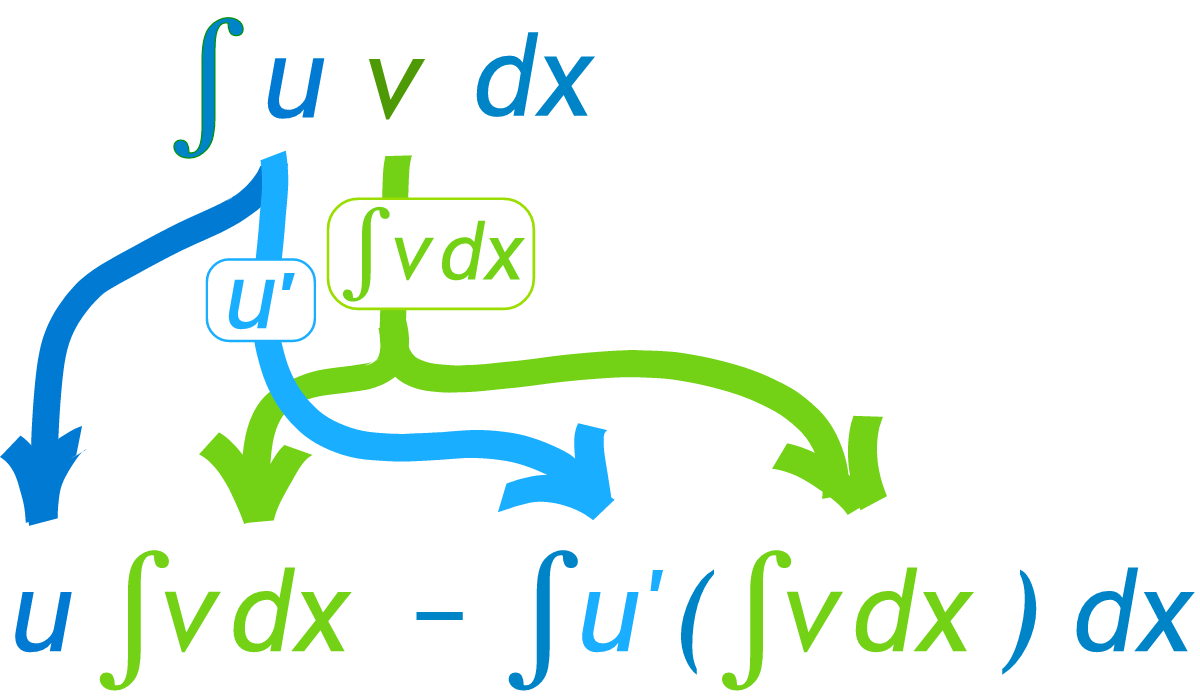
Math is Fun
Integration by Parts is a special method of integration that is often useful when two functions are multiplied together, but is also helpful in...
craggy lark
long flicker
<@723123419670904852>
Have you heard of “integration by parts”?
bro i was looking for a new representation of the gamma function
if you ibp you get (x)!
 rose robin
craggy lark
if i plug the formula on wolfram alpha it wont work, where is the mistake in my ...
rose robin
craggy lark
if i plug the formula on wolfram alpha it wont work, where is the mistake in my ...
it should be xdu in after the first u sub
and then I have no idea about the rest
pearl pondBOT
@craggy lark Has your question been resolved?
craggy lark
rose robin
it should be xdu in after the first u sub
and then I have no idea about the rest
x!=gamma(x+1)=xgamma(x)
then simplified the x you are left with just gamma(x)
rose robin
ah mb, missed that you switched from x! to gamma(x)
craggy lark
dwdw
pearl pondBOT
@craggy lark Has your question been resolved?
pearl pondBOT
Channel closed
Closed due to timeout
Use .reopen if this was a mistake.
pearl pondBOT
Available help channel!
Send your question here to claim the channel.
Remember:
• Ask your math question in a clear, concise manner.
• Show your work, and if possible, explain where you are stuck.
• After 15 minutes, feel free to ping <@&286206848099549185>.
• Type the command .close to free the channel when you're done.
• Be polite and have a nice day!
Read #❓how-to-get-help for further information on how to ask a good question, and about conduct in the question channels.
 midnight haven
 pearl pondBOT
midnight haven
midnight haven
pearl pondBOT
midnight haven
midnight haven
what happened here
 pearl kite
midnight haven
pearl kite
midnight haven
cot(x) = 1/tan(x)
 oak ivy
Get closer to 0?
 fleet pollen
midnight haven
what does converge mean
fleet pollen
midnight haven
what does converge mean
Basically what x is at n = infinity
fleet pollen
fleet pollen
Basically what x is at n = infinity
If it converges, that means that when n is infinity, x is a defined number (meaning it isn’t undefined or also infinity)
midnight haven
pearl kite
is there something missing
wait
 fleet pollen
Since when n is infinity, x converges to a, that means that at really large values of n, the x’es are really close to each other
midnight haven
fleet pollen
If it converges, that means that when n is infinity, x is a defined number (mean...
oh okay
kinda got it
fleet pollen
So we can set x _ n and x_n+1 as the same number
And after that, we can just solve what x_n is
And that equation gives us 3x_n = cot(x_n/2)
For when n approaches infinity
pearl kite
midnight haven
let me try to analyse give me a min
u know alpha is the point x such that cot(x/2)-3x = 0
u understand that right?
pearl kite
midnight haven
nope
its what u did in part a
midnight haven
let me understand what converges is again
midnight haven
it is when the number is definded right?
midnight haven
pearl kite
which we denoted as alpha
oh yea
pearl kite
such that at x=alpha we have a root e.g = 0
pearl kite
midnight haven
it is when the number is definded right?
converging is that as you go to infinity you reach a specific point/number
diverges means as you go to infinity you go to infinity
midnight haven
oh so we rearranged to equation
pearl kite
now lets suppose that the iteration formula converges
midnight haven
and to be converged it must equal the alpha thingy
pearl kite
that means x_n+1 and x_n is gonna be the same (as n->infinity) lets call that point L
when you do the algebra
fleet pollen
For example, in the geometry equation 1, 1/2, 1/4, 1/8… if it goes on infinitely we eventually reach 0, so we say it converges to 0
midnight haven
oh
midnight haven
pearl kite
the wording of ur question is ugly
yea cambridge is a bitch
pearl kite
midnight haven
yea cambridge is a bitch
cambridge international a levels?
midnight haven
pearl kite
cambridge international a levels?
yea
 midnight haven
pearl kite
edexcel is usually a lot nicer
midnight haven
pearl kite
edexcel is usually a lot nicer
ik their system is better as well
pearl pondBOT
@midnight haven Has your question been resolved?
Channel closed
Closed by @mint glade
Use .reopen if this was a mistake.
Available help channel!
Send your question here to claim the channel.
Remember:
• Ask your math question in a clear, concise manner.
• Show your work, and if possible, explain where you are stuck.
• After 15 minutes, feel free to ping <@&286206848099549185>.
• Type the command .close to free the channel when you're done.
• Be polite and have a nice day!
Read #❓how-to-get-help for further information on how to ask a good question, and about conduct in the question channels.
calm wing
 calm wing
does my answer look good?

 urban coral
how do you treat sups if (M) is unbounded
jolly parrotBOT
peanutbutter
 urban coral
would you say (\sup M = \infty)?
jolly parrotBOT
peanutbutter
 urban coral
and why does a smallest x exist with that property
that's way stronger than you need
you know that if (\alpha = \sup M), then (M\cap (\alpha - 1/n, \alpha]\neq \emptyset) since (\alpha) is the least upper bound
jolly parrotBOT
peanutbutter
 urban coral
or said another way, you know that (\alpha - 1/n) is not an upper bound of (M)
jolly parrotBOT
peanutbutter
 urban coral
so there is an (a_n\in M) with (\alpha - 1/n \le a_n \le \alpha)
jolly parrotBOT
peanutbutter
 urban coral
calm wing
does my answer look good?
urban coral
calm wing
does my answer look good?
also, it looks like you are trying to define a_n to be a set
a_n = {x with some property}
and how do you know that it converges to the sup
i think you'd probably be expected to check
an example where an (x) like yours doesn't exist is when you have something like (M = (99/100,1)) and you take ``the smallest'' (x) such that (x\in (1/2,1]\cap M = (99/100,1))
jolly parrotBOT
peanutbutter
 pearl pondBOT
@calm wing Has your question been resolved?
calm wing
urban coral
also, it looks like you are trying to define a_n to be a set
sorry notational quirk, ignore the { }
i want every a_n to be the smallest x such that x > sup M - 1/n
calm wing
urban coral
so there is an \(a_n\in M\) with \(\alpha - 1/n \le a_n \le \alpha\)
that's sorta what i am going for tho
urban coral
calm wing
i want every a_n to be the smallest x such that x > sup M - 1/n
(this doesn't necessarily exist)
calm wing
why not
calm wing
jolly parrot
**peanutbutter**
i can find you an x from that set given an epsilon nvm
calm wing
urban coral
(this doesn't necessarily exist)
if we drop the "smallest" condition will my thing work then
urban coral
Yeah
calm wing
alright i was also uncertain about that part lol
urban coral
Although can you prove that the sequence converges to the sup
calm wing
yes
calm wing
jolly parrot
**peanutbutter**
when you proof the limit it basically becomes this
so by squeeze thm it would be the supremum
i'll treat the infinite case separately
rustic tendon
shouldn't the left inequality be strict?
calm wing
it should
calm wing
calm wing
i'll treat the infinite case separately
hmm
i am not sure about that one
$a_n = \inf (M \cap [n, +\infty))$
jolly parrotBOT
artemetra
 calm wing
idk if i can use inf tho
@urban coral sorry for the ping but is there a way to avoid using inf?
acutally i don't have to use inf
i can just pick any element
rustic tendon
can't you just use the Archimedean property
urban coral
rustic tendon
shouldn't the left inequality be strict?
it doesn't really matter
urban coral
if (\sup M = \infty), then for every (n), there is an (a_n\in M) such that (a_n \ge n)
jolly parrotBOT
peanutbutter
 pearl pondBOT
@calm wing Has your question been resolved?
urban coral
yes, ive resolved it.
pearl pondBOT
Channel closed
Closed due to timeout
Use .reopen if this was a mistake.
Available help channel!
Send your question here to claim the channel.
Remember:
• Ask your math question in a clear, concise manner.
• Show your work, and if possible, explain where you are stuck.
• After 15 minutes, feel free to ping <@&286206848099549185>.
• Type the command .close to free the channel when you're done.
• Be polite and have a nice day!
Read #❓how-to-get-help for further information on how to ask a good question, and about conduct in the question channels.
 eager jewel
 pearl pondBOT
eager jewel
pearl pondBOT
eager jewel
What step are you on?
1. I don't know where to begin.
2. I have begun but got stuck midway.
3. I got an answer but I was told that it's wrong.
4. I got an answer and would like my work checked.
5. I have a question about someone else's work/solution.
6. I have completed the problem and don't need help anymore. Thank you.
7. None of the above
2
took e^iA = a
e^iC = c
e^iB = b
then got determinant
(abc)(1)(1)
(1) (abc) (1)
(1) (1) (abc)
not able to simplify
then i tried taking angles eg A = pi/2
B= pi/3
C = pi/6
didnt work
 solid pier
[ping dealt with]
eager jewel
solid pier
[ping dealt with]
hm?
urban coral
eager jewel
hm?
there was a scoundrel while you were away
eager jewel
oh
rustic tendon
there you go
eager jewel
oh huh
 sterile imp
eager jewel
sterile imp
eager jewel
I mean if A + B + C = 180 which = pi
So my gut says it’s -1
And call it a day
rustic tendon
also if you consider a straight line a triangle... A = B = 0, C = pi
sterile imp
PFFT
eager jewel
sterile imp
So my gut says it’s -1
🙏
eager jewel
rustic tendon
also if you consider a straight line a triangle... A = B = 0, C = pi
how can u consider st line a triangle? but let me try that
sterile imp
Trust me, I’m good at multiple choice PFFT
rustic tendon
eager jewel
how can u consider st line a triangle? but let me try that
abstraction?
the only property that defines a triangle in this universe is the sum of the angles
eager jewel
OH
rustic tendon
,w det{{1, -1, 1}, {-1, 1, 1}, {1, 1, 1}}
jolly parrotBOT
 jolly parrotBOT
peanutbutter
 sterile imp
I was close enough 😔
rustic tendon
jolly parrot
**peanutbutter**
ah did you just brute force open it?
eager jewel
@rustic tendonlove u
urban coral
rustic tendon
ah did you just brute force open it?
i just put it into chatgpt
sterile imp
-1 and -4 doesn’t look much different
urban coral
i wasn't calculating it
sterile imp
Work smarter not harder
urban coral
sterile imp
-1 and -4 doesn’t look much different
you know, i think you might be onto something
no, you're definitely not
rustic tendon
sterile imp
Work smarter not harder
that's why sub 0, 0, pi
sterile imp
urban coral
you know, i think you might be onto something
I think I’m on something actually
sterile imp
JOKING ofc
pearl pondBOT
@eager jewel Has your question been resolved?
Channel closed
Closed by @eager jewel
Use .reopen if this was a mistake.
Available help channel!
Send your question here to claim the channel.
Remember:
• Ask your math question in a clear, concise manner.
• Show your work, and if possible, explain where you are stuck.
• After 15 minutes, feel free to ping <@&286206848099549185>.
• Type the command .close to free the channel when you're done.
• Be polite and have a nice day!
Read #❓how-to-get-help for further information on how to ask a good question, and about conduct in the question channels.
 royal galleon
I want to show that the set of negative integers are unbounded below. So I know the set of positive integera are unbounded above. So I can multiply the set of positive by -1 which creates the set of negative integers. So by multiplying by negative one all I am doing is flipping the direction. So the amount of elements is the same but now it starts from -1 and goes down by -1. Which shows it is unbounded below. But I feel like this is not a strict proof
pearl pondBOT
royal galleon
I want to show that the set of negative integers are unbounded below. So I know ...
rustic tendon
are you working with supremums and infimums?
royal galleon
Yes
royal galleon
rustic tendon
are you working with supremums and infimums?
But how can you apply those concepts to this?
rustic tendon
Do you have access to the axiom of completeness?
royal galleon
One second let me check
 royal galleon
Ye but how can you interaate theoguht the elements of the set of negative numbers like positive numbers
rustic tendon
What?
royal galleon
Like positive numbers are inductive set so I can say it is bounded then say there is n+1 so there is a contradiction
rustic tendon
just do n - 1 here
royal galleon
Ye but how do we know n-1 exists in the set of negative integers
The only reason we knew n+1 existed in positive integera was because it was an inductive set
rustic tendon
if n is an integer then n - 1 is also an integer
I assumed you already had some sort of construction for Z^-
what if you just did -(|n| + 1) then?
royal galleon
Wdym by that?
rustic tendon
you can iterate over |n| right?
royal galleon
Are those absoule value signs?
rustic tendon
yeah
royal galleon
So your saying it doesn't matter if it is an inductive set?
rustic tendon
i don't think so
royal galleon
Wait what says that n-1 exists in the set of integers?
rustic tendon
closure? 😭
pearl pondBOT
Channel closed
Closed by @royal galleon
Use .reopen if this was a mistake.
pearl pondBOT
Available help channel!
Send your question here to claim the channel.
Remember:
• Ask your math question in a clear, concise manner.
• Show your work, and if possible, explain where you are stuck.
• After 15 minutes, feel free to ping <@&286206848099549185>.
• Type the command .close to free the channel when you're done.
• Be polite and have a nice day!
Read #❓how-to-get-help for further information on how to ask a good question, and about conduct in the question channels.
 karmic karma
i know that the value of f(x) is a maximum at 6
 karmic karma
but how do i find the actual value
 open rivet
plug it in
karmic karma
into where
open rivet
into f(x)
karmic karma
i dont see the equation for f(x)
karmic karma
so i just start counting the blocks?
 versed wigeon
You just find the highest point and compare to Oy because it says maximum value? Nvm it's f'(x) 😭mb
open rivet
there is an easier way
karmic karma
open rivet
there is an easier way
how so
open rivet
karmic karma
how so
remember what f'(x) means
karmic karma
ok i get what f'x but not sure how im supposed to use it to evaluate
open rivet
karmic karma
ok i get what f'x but not sure how im supposed to use it to evaluate
f(x+1)=f(x)+f'(x)
this comes from f'(x)=f(x+1)-f(x)
karmic karma
open rivet
this comes from f'(x)=f(x+1)-f(x)
is this like a formula
also im still confused because i dont have f(x)
open rivet
karmic karma
also im still confused because i dont have f(x)
you have f(2)
and you have f'(2)
so you can find f(3)
open rivet
karmic karma
is this like a formula
remember what f'(x) means
karmic karma
open rivet
so you can find f(3)
i got 110 as my approximation
open rivet
sounds about right
karmic karma
open rivet
remember what f'(x) means
but i still dont get how you get f(x+1)=f(x)+f'(x)
the value of the function + the slope gets you the next y value?
y=x^2
f(1) + f'(1) = 3
f(2) = 4
open rivet
karmic karma
but i still dont get how you get f(x+1)=f(x)+f'(x)
the value of the function + t...
do you know the defintion of f'(x)?
open rivet
$f'(x)=\lim_{h\to0}\frac{f(x+h)-f(x)}{h}$
jolly parrotBOT
Bonk
 open rivet
generally, we let h go to 0
to get the proper value
but we can approximate it by choosing a small h
for example, h = 1
then you get...?
karmic karma
f(x+1)-f(x)
open rivet
karmic karma
i just thought of it as the current value + its slope = next value
here you take steps of size 1
but you can also take steps of size 2
or size 1/4
etc
karmic karma
how would i think of that using my informal way
open rivet
jolly parrot
**Bonk**
using h=1 here
the smaller your h gets
the better your approximation gets
pearl pondBOT
Channel closed
Closed by @karmic karma
Use .reopen if this was a mistake.
open rivet
karmic karma
so like (f(x+1/2) - f(x))*2
yup 🙂
pearl pondBOT
Available help channel!
Send your question here to claim the channel.
Remember:
• Ask your math question in a clear, concise manner.
• Show your work, and if possible, explain where you are stuck.
• After 15 minutes, feel free to ping <@&286206848099549185>.
• Type the command .close to free the channel when you're done.
• Be polite and have a nice day!
Read #❓how-to-get-help for further information on how to ask a good question, and about conduct in the question channels.
 orchid token
why are they saying t_(r+1)th term? if for example I want to find the x^2 term of (2+x)^4, my n = 4, p = 2, q = x, and r = 2 to get the right ans of 24x^2
 pearl pondBOT
orchid token
why are they saying t_(r+1)th term? if for example I want to find the x^2 term o...
orchid token
pearl pondBOT
orchid token
why are they saying t_(r+1)th term? if for example I want to find the x^2 term o...
orchid token
or is it still techincally the same cuz there is a 0 term?
idk
how am i supposed to be interpreting this
would x^2 term be T_3? so r = 2? idk
dense jasper
I'm assuming that they're basing the terms off of increasing powers of q
So the first term would have q^0
the second term would have q^1
and so on
Ex. (p+q)^4 = p^4 q^0 + 4p^3 q+6p^2 q^2+4pq^3+q^4
Here, we're considering p^4 q^0 to be our first term, 4p^3 q to be our second term, etc.
@orchid token
orchid token
oh so the third term in the expansion has the x^2 power?
dense jasper
mhm
orchid token
oh kk
 light helm
its not intuitive to number it this way
orchid token
right cuz (a+ b)^3 has 4 terms
light helm
either way you'd use r for the power you want
orchid token
oh kk
so i can js think of it like if i want to find the x^2 term in a sequence to just set r = 2
so r is the power i want
and n is the the power of the binomial
light helm
yeh
pearl pondBOT
Channel closed
Closed by @orchid token
Use .reopen if this was a mistake.
pearl pondBOT
Available help channel!
Send your question here to claim the channel.
Remember:
• Ask your math question in a clear, concise manner.
• Show your work, and if possible, explain where you are stuck.
• After 15 minutes, feel free to ping <@&286206848099549185>.
• Type the command .close to free the channel when you're done.
• Be polite and have a nice day!
Read #❓how-to-get-help for further information on how to ask a good question, and about conduct in the question channels.
 low wadi
Im so lost, tried using ai and that confused me even more

 orchid pendant
low wadi
Im so lost, tried using ai and that confused me even more
orchid pendant
low wadi
Im so lost, tried using ai and that confused me even more
what is the goal
to simplify them?
low wadi
orchid pendant
to simplify them?
If this is simplifying. to eventually solve the code
 orchid pendant
low wadi
If this is simplifying. to eventually solve the code
orchid pendant
low wadi
If this is simplifying. to eventually solve the code
what have you done
low wadi
orchid pendant
what have you done
Ignore the circled part. Thats level 1 (this is all ai btw)
 placid geyser
!nogpt
pearl pondBOT
Please do not trust ChatGPT or similar AI tools for mathematical tasks, as they often generate output which "sounds correct" but has numerous factual or logical errors. Use of these AI tools to answer other people's help questions is strictly against server rules (see #rules).
orchid pendant
low wadi
Ignore the circled part. Thats level 1 (this is all ai btw)
what is confusing you
low wadi
orchid pendant
what is confusing you
Everything 😂
orchid pendant
low wadi
Everything 😂
okay focus on the 10s, keep them separate
and then multiply out the decimals
or their respective property
ex, for R, (4 * 10^4)/(3.63 * 10^-4)
= 4/3.63 * (10^4)/(10^-4)
~1.1 * 10^8
pearl pondBOT
Channel closed
Closed by @low wadi
Use .reopen if this was a mistake.
pearl pondBOT
Available help channel!
Send your question here to claim the channel.
Remember:
• Ask your math question in a clear, concise manner.
• Show your work, and if possible, explain where you are stuck.
• After 15 minutes, feel free to ping <@&286206848099549185>.
• Type the command .close to free the channel when you're done.
• Be polite and have a nice day!
Read #❓how-to-get-help for further information on how to ask a good question, and about conduct in the question channels.
 leaden osprey
 pearl pondBOT
leaden osprey
merry carbon
pearl pondBOT
leaden osprey
merry carbon
Would you like us to just admire your handwriting? (it is really good  )
)
(or do you have a question you wanted to ask us?  )
)
leaden osprey
merry carbon
Would you like us to just admire your handwriting? (it is really good <:catLove:...
Omg thank u lol
Idk I’m just confused
I just tried something else
Does this work

I used 3pi/4 and the other one on the unit circle
merry carbon
The solutions 3pi/8 and 7pi/8? Those seem fine sure 
merry carbon
Well, I mean, considering that tan is pi-periodic, the "opposite sides" are pi apart, so as per the diagram, they're fine
(for sin and cos, you need to be careful, as those aren't pi-periodic, but 2pi-periodic)
 merry carbon
As in, if u = 3pi/4, or u = [any of the other points you marked] were a solution to tan(u) = [what you wanted], then so would u = 7pi/4 [= 3pi/4 + pi], or any of the "opposite" points (which would correspond to adding or subtracting pi)
leaden osprey
Wait what
merry carbon
In your one, you circled 3pi/4, you're also allowed to circle 7pi/4, for tan
(of course, I'm being quite careful in my phrasing, to make sure it's as clear as possible: the fact you needed to divide means you need to be careful how you go about it!)
leaden osprey
merry carbon
(of course, I'm being quite careful in my phrasing, to make sure it's as clear a...
Oh yea the 2x
But if it were another line on the circle
Like
Pi/4 and 5pi/4
Would it still work
merry carbon
leaden osprey
Would it still work
Yes, it would, as would 5pi/6 and 11pi/6 etc etc
pearl pondBOT
@leaden osprey Has your question been resolved?
leaden osprey
merry carbon
Yes, it would, as would 5pi/6 and 11pi/6 etc etc
Thank you
pearl pondBOT
Channel closed
Closed due to timeout
Use .reopen if this was a mistake.
pearl pondBOT
Available help channel!
Send your question here to claim the channel.
Remember:
• Ask your math question in a clear, concise manner.
• Show your work, and if possible, explain where you are stuck.
• After 15 minutes, feel free to ping <@&286206848099549185>.
• Type the command .close to free the channel when you're done.
• Be polite and have a nice day!
Read #❓how-to-get-help for further information on how to ask a good question, and about conduct in the question channels.
 proper flare
If a is prime to b and y, and b is prime to x, prove that ax + by is prime to ab.
pearl pondBOT
proper flare
If a is prime to b and y, and b is prime to x, prove that ax + by is prime to ab...
 fringe goblet
can anyone help me solve this : Find no. Of integral values of a for which (x - 3a)( x - a - 3) ≤ 0 for all x €[1,3]
proper flare
Hell naw
proper flare
fringe goblet
can anyone help me solve this : Find no. Of integral values of a for which (x - ...
!occupied
pearl pondBOT
fringe goblet
can anyone help me solve this : Find no. Of integral values of a for which (x - ...
Someone else is already using this help channel. If you need help with a question, please open your own help channel/thread (see #❓how-to-get-help for instructions).
proper flare
!help
pearl pondBOT
To ask for mathematics help on this server, please open your own help channel or help thread. See #❓how-to-get-help for instructions.
 subtle geyser
proper flare
!help
subtle geyser
proper flare
!help
u good?
oak ivy
Lol hes not
proper flare
?
subtle geyser
do u have a question @proper flare
oak ivy
proper flare
If a is prime to b and y, and b is prime to x, prove that ax + by is prime to ab...
.
subtle geyser
oh
toxic lichen
proper flare
If a is prime to b and y, and b is prime to x, prove that ax + by is prime to ab...
when you say "prime to" do you mean "coprime to"
proper flare
Yes.
proper flare
Yes.
subtle geyser
proper flare
If a is prime to b and y, and b is prime to x, prove that ax + by is prime to ab...
bezout's identity?
proper flare
Huh?
subtle geyser
have u learned bezouts identity
proper flare
subtle geyser
bezout's identity?
It's allowed.
subtle geyser
fringe goblet
can anyone help me solve this : Find no. Of integral values of a for which (x - ...
what do u mean integral values?
i dont get the q
toxic lichen
so we have:
\begin{itemize}
\item $m_1 a + n_1 b = 1$
\item $m_2 a + n_2 b = 1$
\item $m_3 b + n_3 x = 1$
\end{itemize}
jolly parrotBOT
Ann
 toxic lichen
subtle geyser
what do u mean integral values?
toxic lichen
subtle geyser
what do u mean integral values?
don't encourage channel hogging btw
subtle geyser
oh my bad
toxic lichen
toxic lichen
so we have:
\begin{itemize}
\item $m_1 a + n_1 b = 1$
\item $m_2 a + n_2 b = 1$
...
we have this, where m_i and n_i are some integers
and we want to find a linear combination of ax+by with ab that adds to 1
proper flare
Did you mean n_2 y in the second one?
 vital crescent
proper flare
If a is prime to b and y, and b is prime to x, prove that ax + by is prime to ab...
vital crescent
proper flare
If a is prime to b and y, and b is prime to x, prove that ax + by is prime to ab...
Another way to do this is by showing a Lemma: if m is coprime to n, and l is coprime to n, then show that ml is coprime to n.
proper flare
Got it
Let (ax + by, ab) = d
Let (a,d) = d_0
d_0 | d and d | (ax + by)
So d_0 | ax + by
So (ax + by)/(d_0) is an integer.
(a/d_0)x + by/d_0 = integer
by/d_0 = integer
Let (b, d_0) = d_1
Then d_1 | d_0 and d_1 | b
d_0 | a. So d_1 | a.
Since (a,b) = 1, d_1 = 1
So (b, d_0) = 1
Now let (y, d_0) = d_2
d_2 | d_0 | a. So d_2 | a.
d_2 also divides y.
Since (a, y) = 1, d_2 = 1
So (b, d_0) = 1 = (y, d_0)
But by/d_0 = integer
This is only possible when d_0 = 1, because if d_0 >= 2, then this would mean that d_0 has common factors with b and/or y.
So d_0 = 1 = (a,d)
In the same way, we can show that (b,d) = 1
But d | ab. We can say that this is only possible when d = 1. So d = 1 = (ax + by, ab).
Is this proof correct?
vital crescent
proper flare
Is this proof correct?
yeah just need to justify why d|ab and (b,d)=(a,d)=1 implies d=1
proper flare
Let ab/d = k
ab = d(k)
(dk, d) = 1
d(k,1) = 1
d(1) = 1
d = 1
Is this correct?
k is a positive integer, and because 1 | k, (k,1) = 1.
Because if a | b, then (a,b) = a.
<@&286206848099549185>
pearl pondBOT
@proper flare Has your question been resolved?
pearl pondBOT
@proper flare Has your question been resolved?
vital crescent
proper flare
Let ab/d = k
ab = d(k)
(dk, d) = 1
d(k,1) = 1
d(1) = 1
d = 1
why is (dk,d)=1?
the third line
you have to essentially prove that (b,d)= (a,d)=1 implies (ab,d)=1
pearl pondBOT
@proper flare Has your question been resolved?
pearl pondBOT
Channel closed
Closed due to timeout
Use .reopen if this was a mistake.
pearl pondBOT
Available help channel!
Send your question here to claim the channel.
Remember:
• Ask your math question in a clear, concise manner.
• Show your work, and if possible, explain where you are stuck.
• After 15 minutes, feel free to ping <@&286206848099549185>.
• Type the command .close to free the channel when you're done.
• Be polite and have a nice day!
Read #❓how-to-get-help for further information on how to ask a good question, and about conduct in the question channels.
 sharp smelt
Trying to prove or disprove the existance of a sequences, such that for every $n$ in $N$ it's possible to find $n$ consecutive one's somehwere in the sequence
pearl pondBOT
sharp smelt
Trying to prove or disprove the existance of a sequences, such that for every $n...
jolly parrotBOT
What a wonderful world !
 sharp smelt
I was thinking of $a_n=1$
jolly parrotBOT
What a wonderful world !

 edgy stone
sharp smelt
I was thinking of $a_n=1$
edgy stone
sharp smelt
I was thinking of $a_n=1$
that works
placid geyser
Does the sequence have to have a proper form? Can it be an infinite sequence?
By proper form, I mean "can be expressed in common mathematical functions"
sharp smelt
placid geyser
By proper form, I mean "can be expressed in common mathematical functions"
I don't follow
placid geyser
So it doesn't have to be?
 cursive wraith
a_n = 1 works anyways
cursive wraith
placid geyser
I was thinking of the digits of π
then prove it does satisfy the statement
placid geyser
π has an infinite number of digits, hence any sequence number can be found in there
 tropic saddle
thats not how that works
placid geyser
It's not?
cursive wraith
nope
tropic saddle
0.111111..... is infinite but doesnt contain the digit 2
placid geyser
Well...
tropic saddle
0.101001000100001... is irrational and doesnt contain the digit 2
cursive wraith
"any finite sequence can be found in its base x expansion" is the property of a universe number
placid geyser
Is there any proof that π does not?
tropic saddle
we dont know about pi
cursive wraith
placid geyser
Is there any proof that **π** does not?
is there any proof that pi does?
We THINK pi is a universe number
never had one proof
placid geyser
Random strings of numbers are found though
cursive wraith
placid geyser
Random strings of numbers *are* found though
but can you prove ALL of them are there?
placid geyser
tropic saddle
0.111111..... is infinite but doesnt contain the digit 2
That's rational
π is irrarional
cursive wraith
tropic saddle
0.101001000100001... is irrational and doesnt contain the digit 2
then consider this
tropic saddle
reasons why I gave the second example
placid geyser
Hmmm
tropic saddle
as if I could look into the future
placid geyser
cursive wraith
but can you prove ALL of them are there?
There r people who say so
cursive wraith
placid geyser
There r people who say so
Then I'm looking forward to meeting them
in the meantime
placid geyser
tropic saddle
0.101001000100001... is irrational and doesnt contain the digit 2
But is defined to follow a pattern
cursive wraith
we don't know if pi is a universe number or not
tropic saddle
well yes and?
placid geyser
placid geyser
But is **defined** to follow a pattern
π on the other hand, appears to be random for us so far,
tropic saddle
appears to be
cursive wraith
placid geyser
π on the other hand, appears to be random for us so far,
appears, so far
xdd
placid geyser
Yes
cursive wraith
"and that's the proof folks!"
placid geyser
Yes lol
cursive wraith
placid geyser
Yes lol
-_- I thought at least you would see the irony
Imagine if everything that 'oh it seems to be the case' was assumed true and people relied on those statements without ever checking on if there was a valid proof for it, in order to build more statements
What would math look like then, when we realize one of those "oh it seems to be the case" statements at the foundation of maths turned out, not to be the case?
(circa Hilbert problems and set theory stuff)
So anything neither proven nor disproven cannot be taken as true or false
and while "pi is a universe number" is some very interesting claim
it stops there
placid geyser
How r we even supposed to approach this problem of proving/disproving this statement?
That π has all strings of numbers
Just finding all the digits?
cursive wraith
that's a different question, I feel like we've strayed far off from the original question from the owner of this channel
you can open a new one to discuss it if you want
tropic saddle
there is a reason why we dont know
showing claims like this so far has only been done for very special examples
cursive wraith
like 0.01234567891011121314...
pi's digits are unpredictable, and we're still computing them
vital crescent
iirc there is a paper that shows that weird numbers like 0.1010010001... have measure 0
i forgot the specifics of the statement
tropic saddle
its somewhat easy to show that almost all numbers are normal
cursive wraith
non-universal numbers indeed have measure 0 on [0,1]
tropic saddle
which is an even stronger claim
vital crescent
tropic saddle
its somewhat easy to show that almost all numbers are normal
oh yeah thats what i was looking for
cursive wraith
it's an easy statement to prove
take some string of digits that's not allowed, say its length is n
the probability that it doesn't show up on a real number between decimal 1 and decimal n is 1 - 10^(-n)
(someone correct me if the exponent is wrong)
the probability it doesn't show up between decimal n+1 and 2n is the same, 1- 10^(-n)
betwen 2n+1 and 3n, same probability
etc...
placid geyser
vital crescent
iirc there is a paper that shows that weird numbers like 0.1010010001... have me...
What does it mean?
cursive wraith
so the probability that string doesn't show up in a real number in [0,1] is smaller than (1-10^(-n))(1-10^(-n))(1-10^(-n))... = 0
since there is a countable amount of possible strings of digits of finite length
measure of countable union of events of measure 0
= 0
almost every real number is a universe number in base 10
and well, since there's also a countable amount of bases
almost every real number is a universe number in every base
vital crescent
cursive wraith
measure of countable union of events of measure 0
oh didnt realize its that simple i never looked at the proof
cursive wraith
placid geyser
What does it mean?
measure is an extension of the notion of "length"
at least the lebesgue measure over the real numbers
sorry for polluting your help channel @sharp smelt we can take a new one if you don't want us to continue 😭
vital crescent
placid geyser
What does it mean?
the examples they give, where it some string of integer never occurs, is a "small" subset of real numbers
sharp smelt
cursive wraith
sorry for polluting your help channel <@796939110815629322> we can take a new on...
nah, it's fine
I'm writing another answer rn in overleaf, so this helps keep the channel open

cursive wraith
xddd
alright so, to sum up
we know if we pick a random real number, it's almost certain that it will be a universe number
however, pi is not a random real number
in fact it's among the set of definable real numbers
which if I recall correctly is countable
so also of null measure
so, looking at the first digits of pi
we have a small idea as to if pi is indeed normal/universe or not
but we don't have the tools to prove it
you can easily show rational numbers are not normal/universe
because we know something about their base x representation
we don't know crap about pi's base x representation however other than the first trillion digits (in base 10)
which sounds like a lot but pales in comparison to infinity
tropic saddle
funnily enough there are formulas for computing the nth digit of pi in base 16
cursive wraith
yeah I do remember that
proper flare
vital crescent
you have to essentially prove that (b,d)= (a,d)=1 implies (ab,d)=1
yes
pearl pondBOT
@sharp smelt Has your question been resolved?
pearl pondBOT
Channel closed
Closed due to timeout
Use .reopen if this was a mistake.
pearl pondBOT
Available help channel!
Send your question here to claim the channel.
Remember:
• Ask your math question in a clear, concise manner.
• Show your work, and if possible, explain where you are stuck.
• After 15 minutes, feel free to ping <@&286206848099549185>.
• Type the command .close to free the channel when you're done.
• Be polite and have a nice day!
Read #❓how-to-get-help for further information on how to ask a good question, and about conduct in the question channels.
 sonic mist
hello dear server, its me again :/ i feel genuinely embarassed
 sonic mist
the questionmark is the only place i didnt understand
the 2/3s and stuff are just the teacher explaining a fact dont mind them
 hazy pilot
(-1)*(-1) = +1
pearl pondBOT
Channel closed
Closed by @sonic mist
Use .reopen if this was a mistake.
pearl pondBOT
Available help channel!
Send your question here to claim the channel.
Remember:
• Ask your math question in a clear, concise manner.
• Show your work, and if possible, explain where you are stuck.
• After 15 minutes, feel free to ping <@&286206848099549185>.
• Type the command .close to free the channel when you're done.
• Be polite and have a nice day!
Read #❓how-to-get-help for further information on how to ask a good question, and about conduct in the question channels.
 rapid wagon
Let I(x) be the antiderivative of $arctan^2(x)$ express using I(x) the antiderivative: $\int \frac{ln(1+x^2)}{1+x^2}dx$
pearl pondBOT
rapid wagon
Let I(x) be the antiderivative of $arctan^2(x)$ express using I(x) the antideriv...
jolly parrotBOT
prograce
 rapid wagon
How
hazy pilot
let ln(1 + x^2) = u
toxic lichen
some nontrivial integration by parts fuckery
rapid wagon
hazy pilot
let ln(1 + x^2) = u
Ok so dx=du(1+x^2)/2x