#help-36
1 messages · Page 167 of 1
 edgy mauve
Huh
Wait
So (x-2) is a
2(sqrt(2)) is b
U hv it in a²-b² form
U can break it down to (a+b)(a-b)
Cant u
 grizzled lily
He added and subtracted 4 like it never existed so you won’t use general formula
 crimson socket
Why don't you just use the quadtaric equation to solve for x?
 fringe vault
edgy mauve
So i thought u would get it
fringe vault
edgy mauve
So i thought u would get it
i jst followed a formula 😢 i dont get it
fringe vault
crimson socket
Why don't you just use the quadtaric equation to solve for x?
already did
crimson socket
oh
fringe vault
i need to shoe it with factoring
edgy mauve
fringe vault
i jst followed a formula 😢 i dont get it
I'll explain
So (x-2)² has x²-4x+4
Do we understand that
fringe vault
mhm
fringe vault
yea
edgy mauve
So what we want to do is
We want to for a whole square which would be
(x-2)² here
And to get that we will put a +4 in the eqn
But +4 wasnt in the eqn initially so we need to neutralize it
That's y i added another -4 so that
+4-4=0
Let me know if u dont understand
 edgy mauve
-4-4=-8 ryt?
edgy mauve
Sqrt 8 gives u what
edgy mauve
fringe vault
how did you get the part after it tho
I m on it
fringe vault
edgy mauve
Sqrt 8 gives u what
2(sqrt2)
fringe vault
edgy mauve
So when u square 2(sqrt(2)) ,u get 8
yes
why is it a b tho
like why do you do that
edgy mauve
Okay so do u understand how i got what i got
edgy mauve
fringe vault
like why do you do that
Umm i js used b to denote it to make u understand
We wanted to factorize didnt we
edgy mauve
Do u?
 languid robin
:p
 dapper hull
languid robin
:p
dapper hull
languid robin
:p
absolute cinema
edgy mauve
(2sqrt(2))^2
Gives u 8
So to bring 8 in squared form
I used that
We need a²-b² to work out here
fringe vault
why does (x-2)^2 expand to that
languid robin
this is the only channel with problem i can do
edgy mauve
Take over
languid robin
what the question
languid robin
fringe vault
until this step?
 edgy mauve
fringe vault
edgy mauve
fringe vault
Um (2root(2) )^2
languid robin
em
edgy mauve
2nd last line
edgy mauve
We couldn't find other ways
fringe vault
 ripe jewel
it's called completing the square
ripe jewel
it's called completing the square
i already did completing the square
edgy mauve
We did quadratic
languid robin
fringe vault
second line isnt it x^2-4x+4-8
edgy mauve
Did completing square too
languid robin
💀
fringe vault
 edgy mauve
languid robin
second line wrong.
edgy mauve
languid robin
second line wrong.
And she phrased it wrong
fringe vault
ripe jewel
because this isn't factoring
wait so idk what im doing 😭 i wa sjust going alon
edgy mauve
ripe jewel
because this isn't factoring
How would u do it
We dk other methods
ripe jewel
this looks like completing the square to me
languid robin
oh ok
edgy mauve
fringe vault
wait so idk what im doing 😭 i wa sjust going alon
Help
ripe jewel
what are you trying to do
languid robin
i understood
edgy mauve
.
fringe vault
 languid robin
the use a^2-b^2
edgy mauve
edgy mauve
.
5his is the main question
ripe jewel
well it depends on which of the 4 methods youve done and which you havent
edgy mauve
This is how i tried
edgy mauve
ripe jewel
well it depends on which of the 4 methods youve done and which you havent
Quadratic done
Compelting square done
ripe jewel
huh
languid robin
well the bot only pined a "hwllo"
ripe jewel
it's not factorable though
languid robin
then whats wrong with the question
fringe vault
ripe jewel
it's not factorable though
should i just say that because i wqs thinking that too
languid robin
💀
ripe jewel
well you can factor it using the quadratic formula
but that really is the same answer as usijng the quadratic formula
edgy mauve
Yeah
languid robin
em
edgy mauve
ripe jewel
it's not factorable though
Yeah not through middle split up
edgy mauve
ripe jewel
write it as (x-r1)(x-r2)=0
That's what i tried
 soft zealotBOT
Question mark
 fringe vault
 ripe jewel
languid robin
no need to be =0 isnt it
ripe jewel
languid robin
no need to be =0 isnt it
if it's not = 0 then factoring is pointless
languid robin
ripe jewel
if it's not = 0 then factoring is pointless
ha
ripe jewel
if you say (x-r1)(x-r2)=0 you can deduce that x=r1 or x=r2
if you say that (x-r1)(x-r2)=5 you can't say that x=5+r1 or anything like that
languid robin
:p oh ye x is not integer
ripe jewel
and then for factoring use the values from the quadratic formula
languid robin
graphically done? :p
edgy mauve
ripe jewel
and then for factoring use the values from the quadratic formula
Proceed with factoring then
ripe jewel
that's the only way you can "factor" it practically speaking
unless you want to start fucking around with
pq=-4, p+q=-4 and non integer solutions
which is not easy
edgy mauve
languid robin
graphically done? :p
Nah
I mean doesnt a²-b² consider factoring
Like it still does make sense
Tho similar to completing squares
languid robin
we need to draw out the graphic using hand??
fringe vault
languid robin
we need to draw out the graphic using hand??
i think so
languid robin
:0 brain ded
 fringe vault
i already did
languid robin
$x^2-4x-4=0$
soft zealotBOT
Question mark
 fringe vault
 edgy mauve
This is what she got
fringe vault

does this make sense
at all
i cant make sense of it
probs cz i havejtslept tho so my brains runningnonly on stuff i know
edgy mauve
Like u cant get a 0 as a product if at least one of the numbers u r multiplying isnt 0
Cuz 1×1=1
1×0=0
So no matter what u multiply if one of the number isnt 0
U cant get 0 as a product
fringe vault
im going to bed ive been on this questionf or like 2 horus now
edgy mauve
Sure
languid robin
fringe vault
im going to bed ive been on this questionf or like 2 horus now
:p its 11.43AM here
fringe vault
PM here
 final saddleBOT
@fringe vault Has your question been resolved?
 tired walrus
.close (OP said she's off to bed)
final saddleBOT
Channel closed
Closed by @tired walrus
Use .reopen if this was a mistake.
 Available help channel!
Send your question here to claim the channel.
Remember:
• Ask your math question in a clear, concise manner.
• Show your work, and if possible, explain where you are stuck.
• After 15 minutes, feel free to ping <@&286206848099549185>.
• Type the command .close to free the channel when you're done.
• Be polite and have a nice day!
Read #❓how-to-get-help for further information on how to ask a good question, and about conduct in the question channels.
 remote vine
Hello,
with numbers 7 and 15,
summarizing them at any individual amount,
prove we can represent any Natural number bigger than a certain number
What should I learn to solve this?
final saddleBOT
remote vine
Hello,
with numbers 7 and 15,
summarizing them at any individual amount,
prov...
 cedar obsidian
number theory i believe
 stable copper
 worthy wren
remote vine
Hello,
with numbers 7 and 15,
summarizing them at any individual amount,
prov...
worthy wren
remote vine
Hello,
with numbers 7 and 15,
summarizing them at any individual amount,
prov...
peano axioms
and if by any number u wanna include reals then u'd get into the construction of reals and well-ordering principle
 wheat lark
i need help f (x) lim->2 42π^2/42-72^27 (62-4^9)
worthy wren
!occupied
final saddleBOT
Someone else is already using this help channel. If you need help with a question, please open your own help channel/thread (see #❓how-to-get-help for instructions).
 iron mist
remote vine
Hello,
with numbers 7 and 15,
summarizing them at any individual amount,
prov...
iron mist
remote vine
Hello,
with numbers 7 and 15,
summarizing them at any individual amount,
prov...
Kinda sounds like Chicken McNugget Theorem
worthy wren
oh i properly read it
can u post the full question
there should be more hypothesis otherwise it is trivial since 7 spans R
 sturdy cypress
it's cuz you can add 15s until you're over and then you replace 15 with 7+7 to go back to where you want
but you can't go below 7
iron mist
7+7=14 not 15
sturdy cypress
yes, so your number is smaller
so you can go backwards and forwards and reach any number
there's nothing to learn
you need to learn induction to write a formal proof i suppose
oh ok, it's not 7, it's much higher
i can't solve it ok
it's like, 120 maybe
remote vine
worthy wren
can u post the full question
it's from a high school additional student book, and it is short in text so that is full version. Could you say more about the triviality of it, I don't get it why?
sturdy cypress
there's no name for what you need to learn, it's just some subset of number theory without a name
iron mist
If you are allowed to use the Chicken McNugget theorem (yes that is a real thing, google it), then it’s over instantly
Otherwise, you have to break up the naturals into a bunch of cases and then find a formula for each case (as well as exceptions thereof)
remote vine
Thank you guys
final saddleBOT
@remote vine Has your question been resolved?
final saddleBOT
Channel closed
Closed due to timeout
Use .reopen if this was a mistake.
Available help channel!
Send your question here to claim the channel.
Remember:
• Ask your math question in a clear, concise manner.
• Show your work, and if possible, explain where you are stuck.
• After 15 minutes, feel free to ping <@&286206848099549185>.
• Type the command .close to free the channel when you're done.
• Be polite and have a nice day!
Read #❓how-to-get-help for further information on how to ask a good question, and about conduct in the question channels.
 narrow river
I dont understand this, especially the last part about the difference between mathematical incorrectness vs process incorrectness
 final saddleBOT
narrow river
I dont understand this, especially the last part about the difference between ma...
final saddleBOT
narrow river
I dont understand this, especially the last part about the difference between ma...
Please don't occupy multiple help channels.
 sudden comet
narrow river
I dont understand this, especially the last part about the difference between ma...
sudden comet
narrow river
I dont understand this, especially the last part about the difference between ma...
what that last part means is what rule of math does this break as opposed to there being a mistake in the process
narrow river
is it that they ignored the terms with y in the second integrand? because idk why they would have done that
i mean i also think the first step is wrong, but after that i dont know why theyre ignoring y terms
sudden comet
there's that, but there's also integration with a seperate variable than what the integral is being taken with respect to i believe
 teal glen
narrow river
i mean i also think the first step is wrong, but after that i dont know why they...
teal glen
narrow river
i mean i also think the first step is wrong, but after that i dont know why they...
Ignoring terms with y leads to incomplete integrations and destroys the potential function construction of exact differential equations
narrow river
teal glen
Ignoring terms with y leads to incomplete integrations and destroys the potentia...
I agree. but can you really just integrate without separating the variables and call it a solution? that doesnt seem right either
my thinking is that by integrating without separated variables you are ignoring the impact of x and y in the differential equation for the left hand and right hand side, respectively
sudden comet
narrow river
I agree. but can you really just integrate without separating the variables and ...
nope, for instance take $\frac{dy}{dx} = \frac{y}{x}$, normally you would need to solve it linearly using $e^{\int P(X) dx}$, but if you did it the way the problem does you would get $x dy = y dx \implies xy = yx$ which is obviously wrong
soft zealotBOT
orange20063
 narrow river
yea
but even if you were to do it in that wrong way why would you ignore y terms in the rhs integration
sudden comet
I honestly couldn’t tell you
But since we’re not working with partial derivatives, we can’t integrate like this
final saddleBOT
@narrow river Has your question been resolved?
 whole halo
narrow river
I dont understand this, especially the last part about the difference between ma...
whole halo
narrow river
I dont understand this, especially the last part about the difference between ma...
the mistake is here

"ignoring any terms" cant work
for one, you can see the y^2 - 6xy on the right completely disappear which is pretty bold
ignoring terms only work if y doesnt depend on x, such as if x and y are both functions of t
here, y depends on x because y is a function of x
if you had f(x)^2 - 6 x f(x) - 3x^2, you wouldnt integrate it by treating the f(x) as constant
 tulip coyote
(for what it's worth, I interpret their "process incorrectness" to mean that of a stated step, they made a mistake in doing it, as opposed to one of the stated steps being incorrect of itself)
final saddleBOT
Channel closed
Closed due to timeout
Use .reopen if this was a mistake.
final saddleBOT
Available help channel!
Send your question here to claim the channel.
Remember:
• Ask your math question in a clear, concise manner.
• Show your work, and if possible, explain where you are stuck.
• After 15 minutes, feel free to ping <@&286206848099549185>.
• Type the command .close to free the channel when you're done.
• Be polite and have a nice day!
Read #❓how-to-get-help for further information on how to ask a good question, and about conduct in the question channels.
 errant basin
in proving [0,1)x[0,1) is homeomorphic to [0,1)x[0,1], line 3 paragraph 2 "clearly"
 final saddleBOT
errant basin
in proving [0,1)x[0,1) is homeomorphic to [0,1)x[0,1], line 3 paragraph 2 "clear...
errant basin
final saddleBOT
errant basin
in proving [0,1)x[0,1) is homeomorphic to [0,1)x[0,1], line 3 paragraph 2 "clear...
errant basin
i would love it if somebody gicves a motivation for the proof, or rather, construction
tired walrus
so the very rough visual motivation is that [0,1) × [0,1) has two "open sides" while [0,1] × [0,1) has one "open side"
and the goal of the homeo is to "stretch" that one open side into two
errant basin
tired walrus
and the goal of the homeo is to "stretch" that one open side into two
how can you strecth something that doesnt exist.
tired walrus
i did say it was very rough and informal
but heres another way to think about it
in terms of existent things
X has 3 "closed" sides and Y has 2
so you need to "compress" those 3 sides into 2
while keeping everything else continuous
id probably do it differently than them tbh
errant basin
what would be your solution.
tired walrus
mmmm idk if i can describe it in full verbally
but basically im thinking of fixing the center (1/2, 1/2) in place and then mapping the lines joining the center to the corners roughly like so:
 errant basin
tired walrus
errant basin
tired walrus
oh, thats more intuitive;
 desert mantle
I have yet another way of thinking about it: blow out the sides so that the square gets converted into a disk. so part of the boundary of the disk is included and part isnt. and then by stretching/squishing certain sectors of the disk its imo very intuitive that you can convert between 1/4th not included and 1/2th not included
tired walrus
true
which is basically the same as what i showed just now only without the inflation
errant basin
wait, what is a homeomorphism between square and circle.
oh
okok
i think i can formalise that?
thanks a lot that rly helped, some of the answers in this pdf is bit "strange"
.closed
.close
final saddleBOT
Channel closed
Closed by @errant basin
Use .reopen if this was a mistake.
final saddleBOT
Available help channel!
Send your question here to claim the channel.
Remember:
• Ask your math question in a clear, concise manner.
• Show your work, and if possible, explain where you are stuck.
• After 15 minutes, feel free to ping <@&286206848099549185>.
• Type the command .close to free the channel when you're done.
• Be polite and have a nice day!
Read #❓how-to-get-help for further information on how to ask a good question, and about conduct in the question channels.
 zenith cedar
2 points A and B are chosen above the x axis. 2 points P and R lie on the x axis and Q lies on the line ax+by+c=0 above the x axis. Minimize the path APQRB
P Q R are variable points and A B are fixed
final saddleBOT
zenith cedar
2 points A and B are chosen above the x axis. 2 points P and R lie on the x axi...
zenith cedar
 long thorn
Try to use principle of reflection
zenith cedar
I have used that I am not sure if this gave the minimum path
There was a possibility of no minimum in the previous discussion
long thorn
Did you use P and R to lie on the line segments?
zenith cedar
I don't think so
final saddleBOT
@zenith cedar Has your question been resolved?
zenith cedar
yes
final saddleBOT
@zenith cedar Has your question been resolved?
final saddleBOT
Channel closed
Closed due to timeout
Use .reopen if this was a mistake.
zenith cedar
.reopen
final saddleBOT
✅
zenith cedar
there was also another part to this where the angle of reflection equals angle of incidence abd we need to minimize path ABPQR
final saddleBOT
@zenith cedar Has your question been resolved?
 sullen gale
zenith cedar
there was also another part to this where the angle of reflection equals angle o...
sullen gale
zenith cedar
there was also another part to this where the angle of reflection equals angle o...
wdym?
final saddleBOT
Channel closed
Closed due to timeout
Use .reopen if this was a mistake.
final saddleBOT
Available help channel!
Send your question here to claim the channel.
Remember:
• Ask your math question in a clear, concise manner.
• Show your work, and if possible, explain where you are stuck.
• After 15 minutes, feel free to ping <@&286206848099549185>.
• Type the command .close to free the channel when you're done.
• Be polite and have a nice day!
Read #❓how-to-get-help for further information on how to ask a good question, and about conduct in the question channels.
 solar crest
I’m so confused and stuck
 final saddleBOT
solar crest
I’m so confused and stuck
final saddleBOT
solar crest
I’m so confused and stuck
 golden slate
L’Hopital’s rule?
solar crest
golden slate
L’Hopital’s rule?
Not allowed
 slender basin
tan(2h+pi) is simply tan(2h) then just write it as sin/cos and then use limit sin(x)/x
solar crest
 terse crypt
sub with n := x - pi/2
terse crypt
sub with n := x - pi/2
Thta wat I did ….
solar crest
slender basin
tan(2h+pi) is simply tan(2h) then just write it as sin/cos and then use limit si...
Oh just rewrite as sin and cos?
terse crypt
[ \lim_{n \to 0} \frac{\tan(2n)}{n} = \lim_{n \to 0} \frac{\sin(2n)}{n} \cdot \frac{1}{\cos(2n)}]
soft zealotBOT
k
 terse crypt
thisi s what ViNton is saying
 thin cloud
I remember some one asked this problem recently
terse crypt
this is my method
[ \lim_{x \to \pi/2} \frac{\tan(2x) - \tan(2(\pi/2))}{x - \pi/2} = \dv{x} (\tan(2x)) \big|_{x = \frac{\pi}{2}} = 2\sec^2(2\left(\frac{\pi}{2})\right)]
solar crest
thin cloud
I remember some one asked this problem recently
I think it was me
 slate dove
аааа задроты
thin cloud
Can you just multiply both by 2 and get $\lim_{h \to 0} \frac{2tan(2x)}{2x}$

 terse crypt
soft zealot
**Alexis\_Fx**
terse crypt
soft zealot
**Alexis\_Fx**
or this
solar crest
terse crypt
\[ \lim_{x \to \pi/2} \frac{\tan(2x) - \tan(2(\pi/2))}{x - \pi/2} = \dv{x} (\tan...
No dedication fees
solar crest
thin cloud
Can you just multiply both by 2 and get $\lim_{h \to 0} \frac{2tan(2x)}{2x}$
How does that’ll help
terse crypt
[ \lim_{x \to 0} \frac{\tan(x)}{x} = 1]
soft zealotBOT
k
 thin cloud
soft zealot
**Alexis\_Fx**
thin cloud
soft zealot
**Alexis\_Fx**
that x should be h
terse crypt
it should be noted that as ${x \to 0}$, ${\sin x \approx \tan x \approx x}$
soft zealotBOT
k
 terse crypt
anyhow
slender basin
or you can manually get it to sin(2x)/2x to use one of important? limits (idk how they called in eng)
terse crypt
U can use:
- sin(x)/x -> 1
- tan(x)/x -> 1
- derivative defn
- l'hopital
- approx
terse crypt
slender basin
or you can manually get it to sin(2x)/2x to use one of important? limits (idk ho...
does it even have a name
slender basin
terse crypt
does it even have a name
in my language yes literally called 'wonderful limits' xD
thin cloud
If you haven't been taught sin(x)/x , prove it would be a problem
@solar crest Have you learnt this yet?
terse crypt
 solar crest
thin cloud
<@776570662831259679> Have you learnt this yet?
solar crest
thin cloud
<@776570662831259679> Have you learnt this yet?
no…………..
terse crypt
this is the mistake
solar crest
terse crypt
this is the mistake
Huh
solar crest
yea so cooked
thin cloud
$\lim_{x \to 0} \frac{sin(x)}{x}=1$
soft zealotBOT
Alexis_Fx
 terse crypt
solar crest
yea so cooked
terse crypt
solar crest
yea so cooked
there is no mistake on that part

 solar crest
thin cloud
$\lim_{x \to 0} \frac{sin(x)}{x}=1$
solar crest
thin cloud
$\lim_{x \to 0} \frac{sin(x)}{x}=1$
how is that even true OMF
terse crypt
solar crest
how is that even true OMF
squeeze theorem
u will learn soon
🙂
anyway
so u've gotten here
solar crest
terse crypt
squeeze theorem
I learnt it
terse crypt
what
solar crest
but not in this format
terse crypt
now thats a surprise 😭
solar crest
Bro I rushed it and self learnt it son
terse crypt
soft zealot
**Alexis\_Fx**
but u are allowed to use this right?
solar crest
So*
solar crest
terse crypt
but u are allowed to use this right?
Nope…
 thin cloud
solar crest
Nope…
thin cloud
solar crest
Nope…
If you prove it, you will be allowed to use it right? 😂
solar crest
terse crypt
derivative defn?
huh wdym by this
 solar crest
terse crypt
solar crest
terse crypt
LOL
solar crest
thin cloud
If you prove it, you will be allowed to use it right? 😂
I guess,.l
Is there another way
😭
terse crypt
solar crest
huh wdym by this
[ f'(a) = \lim_{x \to a} \frac{f(x) - f(a)}{x-a}]
soft zealotBOT
k
 solar crest
Without having to do a whole proof
terse crypt
can we use this
solar crest
Yep
terse crypt
cool
now
[ \lim_{x \to \frac{\pi}{2}} \frac{\tan(2x) - 0}{x-\frac{\pi}{2}} = \lim_{x \to \frac{\pi}{2}} \frac{\tan(2x) - \tan\left(2\cdot \frac{\pi}{2}\right)}{x-\frac{\pi}{2}} ]
soft zealotBOT
k
 terse crypt
do u agree with this
solar crest
Ye
 ebon agate
soft zealot
**k**
ebon agate
soft zealot
**k**
Wow wtf 😭
final saddleBOT
@solar crest Has your question been resolved?
final saddleBOT
Channel closed
Closed due to timeout
Use .reopen if this was a mistake.
Available help channel!
Send your question here to claim the channel.
Remember:
• Ask your math question in a clear, concise manner.
• Show your work, and if possible, explain where you are stuck.
• After 15 minutes, feel free to ping <@&286206848099549185>.
• Type the command .close to free the channel when you're done.
• Be polite and have a nice day!
Read #❓how-to-get-help for further information on how to ask a good question, and about conduct in the question channels.
 lethal tapir
Is the best way to approach these problems by plugging in numbers?

 vivid walrus
final saddleBOT
vivid walrus
final saddleBOT
Channel closed
Closed by @lethal tapir
Use .reopen if this was a mistake.
final saddleBOT
Available help channel!
Send your question here to claim the channel.
Remember:
• Ask your math question in a clear, concise manner.
• Show your work, and if possible, explain where you are stuck.
• After 15 minutes, feel free to ping <@&286206848099549185>.
• Type the command .close to free the channel when you're done.
• Be polite and have a nice day!
Read #❓how-to-get-help for further information on how to ask a good question, and about conduct in the question channels.
lethal tapir
How does f(x) exist as x appraches 2? Also, how can you tell if the 2 functions are equal?
 final saddleBOT
lethal tapir
How does f(x) exist as x appraches 2? Also, how can you tell if the 2 functions ...
final saddleBOT
lethal tapir
How does f(x) exist as x appraches 2? Also, how can you tell if the 2 functions ...
 stuck juniper
lethal tapir
How does f(x) exist as x appraches 2? Also, how can you tell if the 2 functions ...
stuck juniper
lethal tapir
How does f(x) exist as x appraches 2? Also, how can you tell if the 2 functions ...
Wym by the first question
lethal tapir
Its telling me that f(x) does exist as x approaches 2. I dont know how because there's a hole and the other point isn't going anywhere
at x=2
stuck juniper
This looks like a removable discontinuity
 tardy void
lethal tapir
Its telling me that f(x) does exist as x approaches 2. I dont know how because t...
tardy void
lethal tapir
Its telling me that f(x) does exist as x approaches 2. I dont know how because t...
The limit does exist though

 inner acorn
nonono
tardy void
stuck juniper
But the discontinuity is removed
Huh
inner acorn
the limit is still there if
stuck juniper
Oh its there 
inner acorn
lim x->2+ = lim x->2-
stuck juniper
?maybe im wring then
stuck juniper
inner acorn
lim x->2+ = lim x->2-
Its not equal to the function value at that point tho
inner acorn
they are just different values
inner acorn
stuck juniper
Its not equal to the function value at that point tho
yeah that is allowed
you gotta understand that
f(2) is not lim x->2 f(x)
they are different as one is the exact value and the other is the value it APPROACHES when getting close to x=2
lethal tapir
So f(2) is the closed point and the limit is the hole?
inner acorn
exactly
lethal tapir
Wait, so holes can exist?
tardy void
lethal tapir
Wait, so holes can exist?
Yes they can
inner acorn
it GET infinitly close to the hole
but when you actualy touch x=2
it jumps to the solid point
tardy void
tardy void
Yes they can
Have you dealt with greatest integer functions
inner acorn
for these limits, you gotta watch out, as the limit only exist if lim x->2+ = lim x->2-
in the picture shown tho, it is v ery clear that lim x->2+=0.5 and lim x->2-=0.5
therefore lim x->2=0.5
stuck juniper
Plug it into the given function
stuck juniper
U can convert it
tardy void
stuck juniper
U can convert it
Yeah
But that’s where the removable discontinuity comes from
stuck juniper
Should be quite straightforward
Factorise x from numerator
And use difference of squares
tardy void
Does op know about asymptotes and removable discontinuities
thin cloud
Should wait for OP to say something first
stuck juniper
tardy void
Does op know about asymptotes and removable discontinuities
Probably should given that she is given the graph and stuff
lethal tapir
so you get (x/x+2) then you plug in 2?
stuck juniper
lethal tapir
so you get (x/x+2) then you plug in 2?
Yes
lethal tapir
tardy void
Does op know about asymptotes and removable discontinuities
yes
But how do know that 2 appraching to the right and appraching to the left are the same from that
tardy void
lethal tapir
But how do know that 2 appraching to the right and appraching to the left are t...
Look at the graph
final saddleBOT
Channel closed
Closed by @lethal tapir
Use .reopen if this was a mistake.
Available help channel!
Send your question here to claim the channel.
Remember:
• Ask your math question in a clear, concise manner.
• Show your work, and if possible, explain where you are stuck.
• After 15 minutes, feel free to ping <@&286206848099549185>.
• Type the command .close to free the channel when you're done.
• Be polite and have a nice day!
Read #❓how-to-get-help for further information on how to ask a good question, and about conduct in the question channels.
 torn summit
i need help at solving y''+a(x)y'+b(x)y=c(x)
final saddleBOT
torn summit
i need help at solving y''+a(x)y'+b(x)y=c(x)
torn summit
i saw earlier this:
y''-4y=0
(y''-2y')+2(y'-2y)=0
and then
z=y'-2y
and from there its easy
but this is one case, and they did it very easily.
now i want to generalize it.
 vital crag
torn summit
now i want to generalize it.
vital crag
torn summit
now i want to generalize it.
There's no generalized formula
All depends on the form of c(x)
torn summit
vital crag
All depends on the form of c(x)
why so?
i mean, can you make some integral games with it somehow
to get something... closed form?
vital crag
Sure try it yourself and see
torn summit
vital crag
Sure try it yourself and see
i will.
ebon agate
torn summit
y''-4y=0
There's a way to solve if a,b,c are constant functions like this case
ripe jewel
in general
if you have an ode of the form
P(Dt)[y]=0
where P(Dt) is a polynomial in the derivative operator
you can try factoring
torn summit
i dont accept failure.
ebon agate
torn summit
i dont accept failure.
Just wait
ripe jewel
ripe jewel
P(Dt)[y]=0
@torn summit do you understand my notation
torn summit
ripe jewel
<@1326974484632174683> do you understand my notation
P(x) is polynomial
whats Dt
eulers derivative?
torn summit
why 3 notations :-;
torn summit
ripe jewel
because they have different connotations
where is D used?
i saw dy/dx
for example
ripe jewel
(Dt²-2Dt-3id)[y]=0
torn summit
y' sin y= cos x
ripe jewel
torn summit
where is D used?
now lol
what i just wrote would be awkward with other notations
torn summit
ripe jewel
what i just wrote would be awkward with other notations
so deriving around t?
as in, d/dt?
ebon agate
ripe jewel
(Dt²-2Dt-3id)[y]=0
Is this the same as y" - 2y' - 3?
ripe jewel
ebon agate
Is this the same as y" - 2y' - 3?
yes but from a different perspective
ripe jewel
meaning you are now considering objects such as
D²-2D-3I
this has a polynomial form
but its not a function of numbers
ebon agate
Ah ok
ripe jewel
its a function of functions
ebon agate
Ah got it
ripe jewel
(D+I)²[y] is a better notation
ebon agate
Not 1
ripe jewel
or just (D+I)²y
ebon agate
torn summit
🤔
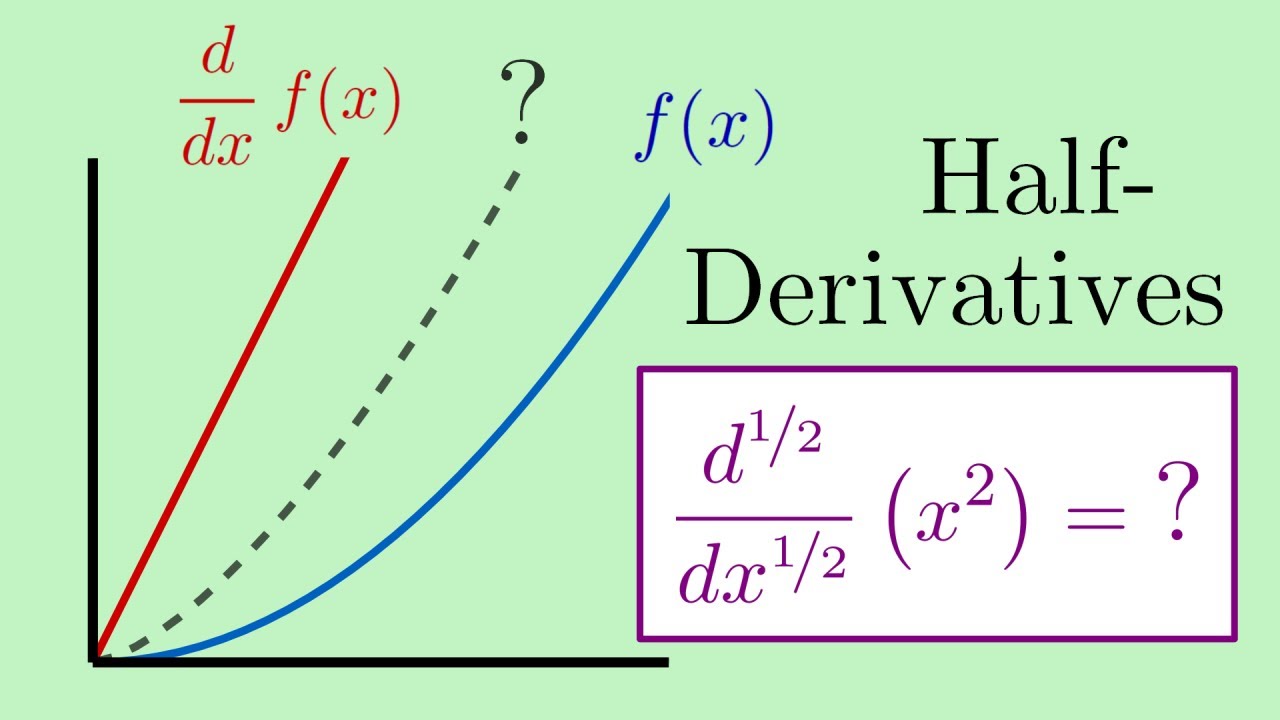
Can you take a derivative only partway? Is there any meaning to a "half-derivative"? Does such a concept even make sense? And if so, what do these fractional derivatives look like?
Previous video about Cauchy's Formula for Repeated Integration:
https://youtu.be/jNpKKDekS6k
A really nice video that derives the gamma function from scratch:
http...
torn summit
ebon agate
https://youtu.be/2dwQUUDt5Is?si=fFHg2sVkVXMzQeJy
but sqrt d/sqrt dy
it sounds so wrong
ebon agate
That's a square root?
torn summit
ebon agate
That's a square root?
its wrong, so wrong
ripe jewel
there is such a thing as fractional function composition
but ive never seen it actually useful
torn summit
ripe jewel
there is such a thing as fractional function composition
how so?
 rocky tusk
fractional calculus
torn summit
ripe jewel
but ive never seen it actually useful
sounds useless tbh
ripe jewel
torn summit
how so?
like see if there exists a function f such that fof=cos
ebon agate
ebon agate
https://youtu.be/2dwQUUDt5Is?si=fFHg2sVkVXMzQeJy
I thought this was very gimmicky in its definition and everything
But who am I to judge
ripe jewel
torn summit
sounds useless tbh
thats my impression of it
rocky tusk
torn summit
sounds useless tbh
word
torn summit
ripe jewel
like see if there exists a function f such that fof=cos
yes...
rocky tusk
it’s niche
ripe jewel
however
torn summit
and i dont see a use for that.
ripe jewel
square roots of matrix operators exist often enough to be useful
but theyre generally not unique
torn summit
ripe jewel
square roots of matrix operators exist often enough to be useful
so, what you are telling me
you can find, for some reason (you want to find it for some unknown use)
the function f, such that f(f(x))=g(x)
can wolfram alpha even solve these things?
bc this sounds VERY niche
torn summit
tired walrus
and maybe WA can't
i tried giving it
f(f(x))=x^4
its easy to guess it is f(x)=x^2
it doesnt understand anything
it does function analysis on x^4, which is not what i wanted.
tired walrus
well then i guess WA can't do it. cry about it ig lol
ripe jewel
torn summit
so, what you are telling me
i said for matrix opetators specifically
torn summit
ripe jewel
i said for matrix opetators specifically
anyways, we are swerving here, i still want to solve y''+a(x)y'+b(x)y=c(x)
i just finished the first book, about first order ODEs
slope fields and all, it makes sense tbh
the second book is second order ODEs, its far fatter than the first
the y'' stuff is weird.
also, @ripe jewel i love your ideas for solving it
but i dont think my uni accepts D as an existant thing
i remember coming to it
and seeing y'=y
ripe jewel
ty but what i said is not a novel idea its just not usually presented exactly that way
ripe jewel
usually its done using an Ansatz and writing a polynomial in r instead of in Dt
torn summit
ripe jewel
usually its done using an Ansatz and writing a polynomial in r instead of in Dt
im 2 pages in
the first problem was
y''-4y=0
doing here the trick of y'/y, wont work
we dont have here difference of 1, we have here 2
ripe jewel
yeah so the usual approach is to write
torn summit
so y''/y, is useless.
ripe jewel

torn summit
but i dont think its ok to use
ripe jewel

ripe jewel

torn summit
if you do 2+1 as 1+2, teachers get mad.
because you do it "wrong"
even tho differential equations have a trillion ways to solve
torn summit
ripe jewel
<:DisgustedAlexia:937373133025972234>
im sorry, i dont want to lower my grade
being smarty pants in my first course isnt an idea.
i needed to do calculus first, and iirc also matrices
but we didnt yet get to those.
torn summit
ripe jewel
consider the polynomial r²-4
also, what do you mean here
i dont think you can treat y^(n) as y^n
tho, im stupid, so enlighten me.
ripe jewel
torn summit
tho, im stupid, so enlighten me.
In mathematics, the characteristic equation (or auxiliary equation) is an algebraic equation of degree n upon which depends the solution of a given nth-order differential equation or difference equation. The characteristic equation can only be formed when the differential equation is linear and homogeneous, and has constant coefficients. Such a...
its more or less the same thing as writing P(D)
more of a different perspective than a different approach
torn summit
ripe jewel
more of a different perspective than a different approach
and how do you solve it?
i did the substitution trick
where you say
ripe jewel
you assume the answer is a linear combination of functions exp(rt), where r is a root of the characteristic equation
torn summit
y''-2y=z
torn summit
ripe jewel
you assume the answer is a linear combination of functions exp(rt), where r is a...
mhm.
we do use exponents
but i like solving, not assuming
ripe jewel
the WP page explains it better than i can
torn summit
ripe jewel
the WP page explains it better than i can
and it looks like honestly gibberish
and btw, i still cant use it
the trick they used here
 ripe jewel
torn summit
but i like solving, not _assuming_
ripe jewel
torn summit
but i like solving, not _assuming_
i hear that, but, {e^(rt)}_r in C is a very powerful basis for these types of problems
you took lin alg yeah?
torn summit
ripe jewel
you took lin alg yeah?
uhhhhhhh
nope i did not
i jumped straight from highschool stuff to this
ripe jewel
oh
torn summit
torn summit
tho, im stupid, so enlighten me.
as i said
torn summit
ripe jewel
oh
consider tomato is a member of stupid.
i learn fast, but i need the why of things
thats why i learn slower than others
and took 2500h to finish highschool math
ripe jewel
i thought Israeli math courses used English books
torn summit
ripe jewel
i thought Israeli math courses used English books
they do...
if i bought them
in english
ripe jewel
oh
torn summit
its in hebrew, because the official language is hebrew
torn summit
and ben gurion, first prime minister, dictated (quite literally) that hebrew is THE ONLY language
torn summit
ripe jewel
im fluent, i am aware
at hebrew?
ripe jewel
level dalet proficiency
torn summit
ripe jewel
level dalet proficiency
huh.
well, good enough i guess
thats hebrew that i dont understand
like mathematical english
but asimptota, you know its an asymptote
we didnt invent our own language
torn summit
torn summit
either way
they say here that they did a so called trick
with the (y''-2y')+2(y'-2y)
but this seems so primitive and limited
@ripe jewel i dont know how it would work with, say, y''+e^x y'+2x sin x y=0
this method is so limited, i cant see it ever being used
torn summit
ripe jewel
but i know most of them cant ve solved explicitly
ish yes
eh if only.
may i ping helpers?
torn summit
torn summit
i need help at solving y''+a(x)y'+b(x)y=c(x)
<@&286206848099549185>
torn summit
 shrewd nexus
You cant find a general solution to it
shrewd nexus
You cant find a general solution to it
:-;
shrewd nexus
Do you need help with a specific case?
torn summit
i cant take that as an answer man
torn summit
shrewd nexus
Do you need help with a specific case?
well
shrewd nexus
Well it is how it is you know
shrewd nexus
Depending on a,b,c, some of these difeqs are literally unsolvable
provably unsolvable
torn summit
(y''-2y')+2(y'-2y)
and then z=y'-2y
and you solved it.
but this is a stupid solution
shrewd nexus
not me, but ye
shrewd nexus
torn summit
(y''-2y')+2(y'-2y)
also doing it like that is a bit convoluted lol
but sure
shrewd nexus
torn summit
its not useful and brings me nowhere
Well thats how difeqs are man
torn summit
its such a stupid solution
shrewd nexus
we cant do much about it
torn summit
shrewd nexus
we cant do much about it
in first order i can
we define some A(x)
and integrate a(x)
shrewd nexus
you cant solve it generally
torn summit
in the form of
y'+y a(x)=b(x)
then
[y e^A(x)]'=b(x)
and thats easy.
y=B(x) e^-A(x)
@shrewd nexus but this doesnt work for second order!
btw, i have zero background on linear algebra, and calculus i barely know.
shrewd nexus
you might not be able to integrate tho, so that solution doesnt really work does it
torn summit
shrewd nexus
you might not be able to integrate tho, so that solution doesnt really work does...
well, thats true.
shrewd nexus
even first order
torn summit
but more than this theres nothing
shrewd nexus
You cant say much in the general sense
torn summit
shrewd nexus
even first order
i want to reach some form of an integral
shrewd nexus
yeah ofc
 smoky egret
torn summit
well, thats true.
smoky egret
torn summit
well, thats true.
if there is no general solution for first order diff eqs then why do you expect a general solution for any other order 
shrewd nexus
but some integrals cant be expressed as a closed form of known functions
ebon agate
I actually tried the exact same thing in school dng
torn summit
smoky egret
if there is no general solution for first order diff eqs then why do you expect ...
it is some solution
y=B(x) e^-A(x)
smoky egret
there are some ways to deal with second order linear homogeneous diff eqs for example
shrewd nexus
B and A might not exist...
smoky egret
but thats too specific
torn summit
shrewd nexus
B and A might not exist...
thats something at least.
shrewd nexus
eh not really tho but ok
torn summit
shrewd nexus
eh not really tho but ok
i can use a million methods to go around the integral
and i want my problem to be this integral
smoky egret
torn summit
i can use a million methods to go around the integral
idk what you mean by this
torn summit
smoky egret
idk what you mean by this
taylor works
smoky egret
but if you mean that you can solve the integral to get an elementary function then the answer is no
smoky egret
torn summit
taylor works
well using power series is a thing but i am not sure if you would be satisfied with a power series as your y
torn summit
smoky egret
well using power series is a thing but i am not sure if you would be satisfied w...
i prefer one unknown function
rather than two
ebon agate
Ig he just wants the solution of the differential in integral form
To solve is his problem
?
torn summit
i havent seen how they solve it, but the y''-4y=0 trick was honestly useless
torn summit
ebon agate
Ig he just wants the solution of the differential in integral form
yes.
i want some y=f(x)
or x=f(y)
ebon agate
torn summit
i havent seen how they solve it, but the y''-4y=0 trick was honestly useless
I mean did you get what gfauxpas said?
torn summit
ebon agate
I mean did you get what gfauxpas said?
which of his words
ebon agate
Characteristic equations to solve these kinds of problems
ebon agate
ebon agate
Characteristic equations to solve these kinds of problems
Where A(x),B(x) and C(x) are constants
torn summit
because for the y''-4y=0 problem i guess it is 0, and you cant tell me no.
torn summit
ebon agate
Where A(x),B(x) and C(x) are constants
if they are
what can you do, to solve it?
torn summit
a(x) isnt reliant on x, nor is b, or c
ebon agate
This is always going to be in the form of
Ae^r1*t + Be^r2t
And r1,r2 will be the roots of a characteristic equation
torn summit
ebon agate
And r1,r2 will be the roots of a characteristic equation
yes.
ebon agate
ebon agate
y" - 6y' + 5y = 0
You will make the characteristic equation by taking this equation
But treating double differential as squaring
torn summit
ebon agate
But treating double differential as squaring
wait whar
wait wait
where squaring from
ebon agate
Yes
torn summit
well, that sounds too easy.
ebon agate
Double differential will turn into a quadratic
Same way if it was a triple differential
It would turn into a cubic
shrewd nexus
Second order difeqs with constant coefficients are super common in physics if you take that you will see some
torn summit
shrewd nexus
Second order difeqs with constant coefficients are super common in physics if yo...
huh. ok.
ebon agate
torn summit
well, that sounds too easy.
Find the roots of this quadratic equation now
r^2 - 6r + 5 =0
The roots of this equation will be r1 and r2
shrewd nexus
torn summit
huh. ok.
You will see if you take it, you will learn to solve them in the general sense very quickly
ebon agate
Ig it turns a bit complicated if there are complex roots (trig fxns) and repeated roots
shrewd nexus
sqrt (16) not 26
torn summit
shrewd nexus
sqrt (16) not 26
mb not 2ac
shrewd nexus
ye algood
torn summit
sorry, cosine theorem
torn summit
and y^(n) is r^n?
ebon agate
I mean equal wont be a good word
ebon agate
torn summit
and y^(n) is r^n?
Yes
torn summit
but this seems so absurd
ebon agate
Oh well
torn summit
how so?
ebon agate
Once you find the solution to this differential, put it back in, you'll see it how it works
It's pretty neat
torn summit
can you show me how you reached from y''+a(x)y'+b(x)y=c(x) to a solution with r?
torn summit
ebon agate
Once you find the solution to this differential, put it back in, you'll see it h...
so if say, r=5
ebon agate
I just know when a(x),b(x) are constants and c(x) is preferrably 0
Very specific case
torn summit
so y=5?
ebon agate
ebon agate
Ae^r1*t + Be^r2t
.
shrewd nexus
A and B are found with the conditions of the problem
ebon agate
Same thing
ebon agate
Initial value conditions
torn summit
ebon agate
Yk how n degree differentials have n arbitary constants
so... c?
torn summit
ebon agate
Yes
integration constant.
ebon agate
Welcome
torn summit
im now reaching home at last
and can open the book to see the methods
im really confused yet still
but this one is helpful.
ok i see
so, they have here a problem, harder than before
y''=(1-y')/x
now they did here, since theres no y, z=y'
shrewd nexus
yes
torn summit
and here things get worse.
shrewd nexus
and then you can solve like you were saying earlier
torn summit
y'' = (y')^2/y(y-1)
torn summit
shrewd nexus
and then you can solve like you were saying earlier
yes, first order is somewhat east
easy
it makes sense.
as much as integrals can.
@shrewd nexus for you to know
i never did anything except d/dx
with this notation
i didnt get f(y) dy=g(x) dx
shrewd nexus
torn summit
y'' = (y')^2/y(y-1)
Do you need help with this is that it?
shrewd nexus
ok
torn summit
z=y'
dz/dx=z^2/y(y-1)
yes... ok...
works i guess.
dz/dy = dz/dx dx/dy
x'=1/y'=1/z
uh huh.
z dz/dy=dz/dx
shrewd nexus
Its hard to follow like this 😅
shrewd nexus
torn summit
x'=1/y'=1/z
What is this line
torn summit
shrewd nexus
weird stuff they are doing
yeah you telling me.
oh god
let me quote what they say
to cancel complications, we use the same letter z to mark two different functions:
z(x) and z(y)=z(x(y))
sorry
shrewd nexus
they are doing some weird stuff man tbh
torn summit
shrewd nexus
they are doing some weird stuff man tbh
yes, dont tell me
im perfectly aware.
shrewd nexus
hmm
torn summit
let me write it down
shrewd nexus
My instinct is to notice that y'' / y'^2 = d/dx(1/y')
Therefore your difeq is essentially:
d/dx(1/y') = 1/y(y-1) but im not sure how to continue for now
 torn summit
shrewd nexus
Shouldnt the second to last line be dz/dx and not dz/dy?
torn summit
shrewd nexus
Shouldnt the second to last line be dz/dx and not dz/dy?
no, because z is defined by y
z(y)=y'
final saddleBOT
@torn summit Has your question been resolved?
slate dove
пацаны скоко 142646 + 245 срочнгоооо
final saddleBOT
Channel closed
Closed due to timeout
Use .reopen if this was a mistake.
Available help channel!
Send your question here to claim the channel.
Remember:
• Ask your math question in a clear, concise manner.
• Show your work, and if possible, explain where you are stuck.
• After 15 minutes, feel free to ping <@&286206848099549185>.
• Type the command .close to free the channel when you're done.
• Be polite and have a nice day!
Read #❓how-to-get-help for further information on how to ask a good question, and about conduct in the question channels.
final saddleBOT
Channel closed
Channel closed due to the original message being deleted.
If you did not intend to do this, please open a new help channel,
as this action is irreversible, and this channel may abruptly lock.
Available help channel!
Send your question here to claim the channel.
Remember:
• Ask your math question in a clear, concise manner.
• Show your work, and if possible, explain where you are stuck.
• After 15 minutes, feel free to ping <@&286206848099549185>.
• Type the command .close to free the channel when you're done.
• Be polite and have a nice day!
Read #❓how-to-get-help for further information on how to ask a good question, and about conduct in the question channels.
 ionic gate
Continuity means the delta doesn't depend on the point c we choose to work with. Or is that uniform continuity?
final saddleBOT
ionic gate
Continuity means the delta doesn't depend on the point c we choose to work with...
 blissful meadow
That's uniform continuity. Do note that uniform continuity describes the behaviour of a function on a set, whereas continuity discusses behaviour at a point.
ionic gate
So, for continuity here, are we just evaluating specific points to understand the behavior?
blissful meadow
Yes.
Informally, continuity ensures there are no jumps in your function at a point, which you can think of as infinitely steep ascents/descents at a certain point.
Uniform continuity is stronger in the sense that it also forbids very quick ascents/descents, instead of just straight up jumps.
final saddleBOT
@ionic gate Has your question been resolved?
ionic gate
I see.
ANother question I have is about proving the that there exists a point c that lies in a function:

For continuity.
What would be the logical starting point?
ripe jewel
see if g has a root
blissful meadow
I don't think the path is to use continuity, at least not directly.
Use the function g you're given. Is it continuous? See what happens when you plug in key points, and then try to make use of fun theorems that arise when dealing with continuous functions on closed intervals ||think intermediate value theorem||
ionic gate
5.3.7 Bolzano’s Intermediate Value Theorem Let I be an interval and let f : I — R be continuous on I. Ifa,b € Land ifk € R satisfies f(a) < k < f(b), then there exists a point c € I between a and b such that f(c) = k.
 faint edge
Try it with g
ionic gate
Could I take f(0) < k < f(1)?
ionic gate
ripe jewel
euro symbol for set membership...
Blame the book publisher
ripe jewel
What's L?
ionic gate
L is the limit that we are trying to evaluate.
We don't know yet. The problem doesn't say.
ripe jewel
"if a, b are in the limit" doesn't make sense
faint edge
I think L is a typo for I?
Did you copy paste this?
Sometimes formatting gets fucked up when you copy paste latex
That's probably why set membership became the euro symbol too.
$\in \text{ vs €}$
soft zealotBOT
DootDooter
 blissful meadow
brexit
faint edge
ionic gate
Could I take f(0) < k < f(1)?
You have g from the hint in your problem. g is defined on a particular interval. Do you see any possible a,b values you can try in that interval?
ionic gate
 ionic gate
faint edge
You have g from the hint in your problem. g is defined on a particular interval....
ionic gate
faint edge
You have g from the hint in your problem. g is defined on a particular interval....
0, 1/2, 1
faint edge
Yeah that'll work.
What happens if g is nonzero between 0 and 1/2?
The intermediate value theorem tells you something nice in that case.
ionic gate
There exists a point where g(c) = k
ionic gate
A real number s.t g(a) < k < g(b)
faint edge
Yeah. So you see we are letting a=0, b=1/2?
ionic gate
What about that exactly?
faint edge
You can plug those in and look at g(0) and g(1/2).
ripe jewel
why do you assume g(a)<g(b)?
faint edge
It doesn't matter.
Can you see anything about how the signs of g(0) and g(1/2) are related?
ionic gate
What?
ionic gate
What?
faint edge
I'll tell you more if you write out what you think g(1/2) is.
ionic gate
g(1/2) = ??
faint edge
ionic gate
ANother question I have is about proving the that there exists a point c that li...
Use the definition they gave you here for g. Plug in 1/2.
ionic gate
g(1/2) = f(1/2) - f(1)
faint edge
Yeah and they told you f(1)=f(0) so g(1/2)=f(1/2)-f(0)
My calculation a sec ago was g(0)=f(0)-f(1/2)
You see that these have opposite signs?
ionic gate
Yeah
faint edge
Okay, so if we assume between 0 and 1/2 g is never zero, then either g(0) < 0 < g(1/2) or g(1/2) < 0 < g(0).
What's the problem with this?
ionic gate
It can only be an our, I guess:
 faint edge
ionic gate
faint edge
ionic gate
Yeah that's a special case of this theorem.
Intermediate value theorem tells you that there would have to be a point c somewhere between 0 and 1/2 where g(c)=0
Which would be a contradiction.
So, g has to be zero between 0 and 1/2 somewhere
There's several ways to phrase the proof I was trying to walk you through. The main pt is that applying intermediate value theorem (or your 5.3.5) to g will force you into getting the c you need by considering the possible signs g can have at 0 and 1/2.
ionic gate
I see. What does the antipodal mean here for this question?
faint edge
Ah oops
Sorry if you have a pt x the antipodal pt should be -x
Like, if you were on a circle at a pt x the antipode of x would be on the opposite side of the circle
ionic gate
This is confusing. I am skipping this question