#help-33
1 messages · Page 107 of 1
 sand fable
u waited like a total of one minute
 static quarry
sadly not uncommon
 sinful thistle
sand fable
u waited like a total of one minute
sinful thistle
sand fable
u waited like a total of one minute
i am an impatient man
sand fable
valid ig
sinful thistle
patience is a virtue i do not possess
and no actually been asking nutka here to expand cos(2x) for approximately 6 minutes
 sinful thistle
jesus chr7st
 glossy bobcat
XD
sinful thistle
what-
glossy bobcat
i dont know
sinful thistle
okay let's go back for a second
glossy bobcat
okay
sinful thistle
you've already figured out that sin^2 2x + cos^2 2x = 1
we know that sin 2x = 14/19
glossy bobcat
yes
sinful thistle
so sin^2 2x = 196/361
all good so far
after that we get sqrt 165 / 19 = cos 2x
,calc 361-196
 elfin berryBOT
Result:
165
yep
glossy bobcat
yes
sinful thistle
we know that sin^4 x - cos^4 x = 1(sin^2 x - cos^2 x)
what's the expansion of cos 2x?
glossy bobcat
sin^4x-cos^4x
sinful thistle
okay look
glossy bobcat
hahah
static quarry
glossy bobcat
sqrt (165)/19 isnt the answer
^ can you justify this answer?
glossy bobcat
I have weird "5" in my hand writing
I understand
wait
?
but it dont have any sense
I cant solve it
static quarry
i don't know what any of this is
weren't we talking about sin(2x) and cos(2x)?
i don't see either of those in your work
sinful thistle
sinful thistle
what's cos^2 x - sin^2 x = cos 2x IN RELATION TO sin^2 x - cos^2 x
.
glossy bobcat
first I had sin2x = 14/19,
then => cos2x= v165/19
<=> cos^x - sin^x = v165/19
and I have to solve |sin^x - cos^x|
sinful thistle
yes look
sinful thistle
sinful thistle
what's cos^2 x - sin^2 x = cos 2x IN RELATION TO sin^2 x - cos^2 x
answer this. please
its the literal last step
sinful thistle
@static quarry help me out here bro
static quarry
glossy bobcat
first I had sin2x = 14/19,
then => cos2x= v165/19
<=> cos^x - sin^x = v165/19
an...
^ this stuff
sinful thistle
thanks bungo
static quarry
you have established that $\sin(2x) = 14/19$
elfin berryBOT
Bungo
 static quarry
then you used $\sin^2(2x) + \cos^2(2x) = 1$ to get $\cos^2(2x) = 1 - 14^2/19^2 = 165/19^2$
elfin berryBOT
Bungo
 static quarry
so far correct?
glossy bobcat
glossy bobcat
so -cos^x + sin^x = -(v165/19)
I think this is the answer
static quarry
well the problem is i have no idea what cos^x means
sinful thistle
^
static quarry
and your v165 apparently means square root of 165
this is hard to read
that's why i want to typeset it
glossy bobcat
and |-v165/19|
static quarry
i think you probably did the right thing you're just not expressing it in a legible way
glossy bobcat
static quarry
and your v165 apparently means square root of 165
this is hard to read
that's wh...
yea sorry
Its easier to write that and I ussualy using that way to write
okay so I uderstand it
thank you so much
static quarry
i get it
but if you want people to help you have to make a bit of effort to make it more readable, learning a bit of tex will take you a long way
glossy bobcat
okay sorry I thought it is understable
static quarry
no need to apologize
my handwriting isn't great either haha
i compensate for that by using tex 😆
glossy bobcat
okay
 marsh citrusBOT
If you are done with this channel, please mark your problem as solved by typing .close
glossy bobcat
Can I dont close that, and ask for more help for few minutes?
static quarry
yea sure
although if it's a new question/doubt, you should just open a new channel for that
glossy bobcat
okay
static quarry
helpers are more likely to reply to new channels
static quarry
cheers
glossy bobcat
.close
marsh citrusBOT
Channel closed
Closed by @glossy bobcat
Use .reopen if this was a mistake.
marsh citrusBOT
 Available help channel!
Send your question here to claim the channel.
Remember:
• Ask your math question in a clear, concise manner.
• Show your work, and if possible, explain where you are stuck.
• After 15 minutes, feel free to ping <@&286206848099549185>.
• Type the command .close to free the channel when you're done.
• Be polite and have a nice day!
Read #❓how-to-get-help for further information on how to ask a good question, and about conduct in the question channels.
 still temple
I to show that v has a potential, and calculate all the potentials of v.
I kniw that i need to do rot=0 but i don’t understand how i can calculate all if the potentials
marsh citrusBOT
still temple
I to show that v has a potential, and calculate all the potentials of v.
I kniw ...
still temple

 fervent rampart
since you know that the components of the vector are the partial derivatives of the potential function, you can find it by integration. some examples here: https://tutorial.math.lamar.edu/Classes/CalcIII/ConservativeVectorField.aspx
marsh citrusBOT
Channel closed
Closed by @formal edge
Use .reopen if this was a mistake.
marsh citrusBOT
Available help channel!
Send your question here to claim the channel.
Remember:
• Ask your math question in a clear, concise manner.
• Show your work, and if possible, explain where you are stuck.
• After 15 minutes, feel free to ping <@&286206848099549185>.
• Type the command .close to free the channel when you're done.
• Be polite and have a nice day!
Read #❓how-to-get-help for further information on how to ask a good question, and about conduct in the question channels.
 sterile scroll
So I’m confused the work done by a force F WF = |F| * |deltax| * cosa. If a object’s moving down and a force acts down then the work is positive since the direction of displacement and force is the same cos0 = 1. Why is work by gravity negative when Wmg = |mg| |deltay| cos0(since it’s falling and force is also down). So it’s |mg| |deltay| how can that be negative ?
marsh citrusBOT
sterile scroll
So I’m confused the work done by a force F WF = |F| * |deltax| * cosa. If a obje...
 hard gull
sterile scroll
So I’m confused the work done by a force F WF = |F| * |deltax| * cosa. If a obje...
hard gull
sterile scroll
So I’m confused the work done by a force F WF = |F| * |deltax| * cosa. If a obje...
it isnt
work done if the object is displaced downwards due to gravity is positive
if the object was going upwards then work is said to be negative cuz cos180 is -1
sterile scroll
That’s what I’m thinking as well
hard gull
is there any context to this question? like something from ur textbook or smthing
where they took work as negative even though displacement and force is in same direction
sterile scroll
The teacher drew some ball that’s falling down and it’s work is mg * (-deltay)
I was confused
sterile scroll
Nope its under the influence only of gravity a conservative force
marsh citrusBOT
@sterile scroll Has your question been resolved?
sterile scroll
Ok all good she’s assuming that we plug in for deltay the negative y since it was displaced down. - - is positive
marsh citrusBOT
Channel closed
Closed by @sterile scroll
Use .reopen if this was a mistake.
Available help channel!
Send your question here to claim the channel.
Remember:
• Ask your math question in a clear, concise manner.
• Show your work, and if possible, explain where you are stuck.
• After 15 minutes, feel free to ping <@&286206848099549185>.
• Type the command .close to free the channel when you're done.
• Be polite and have a nice day!
Read #❓how-to-get-help for further information on how to ask a good question, and about conduct in the question channels.
 acoustic vapor
 marsh citrusBOT
acoustic vapor
marsh citrusBOT
acoustic vapor
 sleek topaz
acoustic vapor
sleek topaz
acoustic vapor
what is the question
acoustic vapor
Prove it
 midnight obsidian
,rotate
elfin berryBOT
 sleek topaz
elfin berry
sleek topaz
elfin berry
apply $tan^{-1}(a) + tan^{-1}(b)$ formula on lhs
midnight obsidian
sleek topaz
apply $tan^{-1}(a) + tan^{-1}(b)$ formula on lhs
{-1}
elfin berryBOT
swerriee
 marsh citrusBOT
@acoustic vapor Has your question been resolved?
Channel closed
Closed by @acoustic vapor
Use .reopen if this was a mistake.
acoustic vapor
 marsh citrusBOT
Available help channel!
marsh citrusBOT
Available help channel!
Send your question here to claim the channel.
Remember:
• Ask your math question in a clear, concise manner.
• Show your work, and if possible, explain where you are stuck.
• After 15 minutes, feel free to ping <@&286206848099549185>.
• Type the command .close to free the channel when you're done.
• Be polite and have a nice day!
Read #❓how-to-get-help for further information on how to ask a good question, and about conduct in the question channels.
 patent vine
 marsh citrusBOT
patent vine
patent vine
marsh citrusBOT
patent vine
patent vine
can someone help me read my teacher's hand writing?

just this part
the inner loop (shaded ?????) has ??? graphed ??? 7pi/6 and11pi/6 set r = 0
help me with the question marks 🙏
 paper musk
maby like the inner loop (shaded margin) has been graphed btw
marsh citrusBOT
Channel closed
Closed by @patent vine
Use .reopen if this was a mistake.
Available help channel!
Send your question here to claim the channel.
Remember:
• Ask your math question in a clear, concise manner.
• Show your work, and if possible, explain where you are stuck.
• After 15 minutes, feel free to ping <@&286206848099549185>.
• Type the command .close to free the channel when you're done.
• Be polite and have a nice day!
Read #❓how-to-get-help for further information on how to ask a good question, and about conduct in the question channels.
 knotty ivy
 marsh citrusBOT
knotty ivy
sinful thistle
marsh citrusBOT
knotty ivy
sinful thistle
this is pretty simple, just split the summation
elfin berryBOT
ren
 sinful thistle
switch indexes and solve
knotty ivy
dang i didnt even think to split them
 crystal lintel
you shouldn't go splitting things up like this without knowing if they even converge
 bleak ibex
To make it more rigorous you could put a limit in front
as N goes to infinity
and take the sums from 1 to N
crystal lintel

knotty ivy
im sorry but im still lost ,how can i find the limit if i dont have an exact function
@helper sorry..
 stark trail
sinful thistle
this is pretty simple, just split the summation
stark trail
sinful thistle
this is pretty simple, just split the summation
Did your sir not teach you about uniform convergence
stark trail
The value of the infinite sum if it converges
Is the limit if its partial sums
Do you agree
knotty ivy
yes
 marsh citrusBOT
@knotty ivy Has your question been resolved?
marsh citrusBOT
@knotty ivy Has your question been resolved?
knotty ivy
.close
marsh citrusBOT
Channel closed
Closed by @knotty ivy
Use .reopen if this was a mistake.
marsh citrusBOT
Available help channel!
Send your question here to claim the channel.
Remember:
• Ask your math question in a clear, concise manner.
• Show your work, and if possible, explain where you are stuck.
• After 15 minutes, feel free to ping <@&286206848099549185>.
• Type the command .close to free the channel when you're done.
• Be polite and have a nice day!
Read #❓how-to-get-help for further information on how to ask a good question, and about conduct in the question channels.
 dusky viper
can someone quickly help. I am conducting an experiment on transformers to test the efficiency of various materials in the core, I have the input voltage at 10V and a 1:2 coil ratio so i'm expecting 20V, how would i calculate percentage error? Do i calculate how close each value is to 20V, to me that seems wrong since I should be expecting a different voltage for each material since they have varying efficiencies, but at the same time i am expecting 20V due to the coil ratio
marsh citrusBOT
dusky viper
can someone quickly help. I am conducting an experiment on transformers to test ...
@dusky viper Has your question been resolved?
marsh citrusBOT
Channel closed
Closed due to timeout
Use .reopen if this was a mistake.
Available help channel!
Send your question here to claim the channel.
Remember:
• Ask your math question in a clear, concise manner.
• Show your work, and if possible, explain where you are stuck.
• After 15 minutes, feel free to ping <@&286206848099549185>.
• Type the command .close to free the channel when you're done.
• Be polite and have a nice day!
Read #❓how-to-get-help for further information on how to ask a good question, and about conduct in the question channels.
 fleet sail
help ive been trying to connect tthem but i cannot find the right sentence and it doesnt sound right, decided to get help

 marsh citrusBOT
fleet sail
help ive been trying to connect tthem but i cannot find the right sentence and i...
marsh citrusBOT
fleet sail
help ive been trying to connect tthem but i cannot find the right sentence and i...
@fleet sail Has your question been resolved?
marsh citrusBOT
@fleet sail Has your question been resolved?
marsh citrusBOT
@fleet sail Has your question been resolved?
marsh citrusBOT
Channel closed
Closed due to timeout
Use .reopen if this was a mistake.
marsh citrusBOT
Available help channel!
Send your question here to claim the channel.
Remember:
• Ask your math question in a clear, concise manner.
• Show your work, and if possible, explain where you are stuck.
• After 15 minutes, feel free to ping <@&286206848099549185>.
• Type the command .close to free the channel when you're done.
• Be polite and have a nice day!
Read #❓how-to-get-help for further information on how to ask a good question, and about conduct in the question channels.
 gray maple
 gray maple
How to start this one?
marsh citrusBOT
@gray maple Has your question been resolved?
marsh citrusBOT
Channel closed
Closed by @gray maple
Use .reopen if this was a mistake.
marsh citrusBOT
Available help channel!
Send your question here to claim the channel.
Remember:
• Ask your math question in a clear, concise manner.
• Show your work, and if possible, explain where you are stuck.
• After 15 minutes, feel free to ping <@&286206848099549185>.
• Type the command .close to free the channel when you're done.
• Be polite and have a nice day!
Read #❓how-to-get-help for further information on how to ask a good question, and about conduct in the question channels.
 coral lagoon
 marsh citrusBOT
coral lagoon
coral lagoon
marsh citrusBOT
coral lagoon
coral lagoon
I need to use TFD [series] to state if it diverges or converges
This is what i think i need to do:
arctanx = tan^-1x
= 1/1/tanx
= tan(x)
but im unsure where to go after this
sand fable
coral lagoon
This is what i think i need to do:
arctanx = tan^-1x
= 1/1/tanx
= tan(x)
b...
btw this is not correct
arctanx is not 1/tanx
sand fable
think abt what happens to arctan(n) as n goes to infinity
marsh citrusBOT
Channel closed
Closed by @coral lagoon
Use .reopen if this was a mistake.
marsh citrusBOT
Available help channel!
Send your question here to claim the channel.
Remember:
• Ask your math question in a clear, concise manner.
• Show your work, and if possible, explain where you are stuck.
• After 15 minutes, feel free to ping <@&286206848099549185>.
• Type the command .close to free the channel when you're done.
• Be polite and have a nice day!
Read #❓how-to-get-help for further information on how to ask a good question, and about conduct in the question channels.
 lofty sun
ABCD is a parallelogram. m and n are trisecton points of AD. find the ratios of regions, III:I, II:I, and triangle MDC:AMCB
 marsh citrusBOT
lofty sun
ABCD is a parallelogram. m and n are trisecton points of AD. find the ratios of ...
lofty sun
marsh citrusBOT
lofty sun
ABCD is a parallelogram. m and n are trisecton points of AD. find the ratios of ...
lofty sun
i know the ratio of III:I is 9:1 because similar triangles and areas^2
but if you know how to find II:I or triangle MDC:AMCB plz help because ive been stuck on this question for 5 hrs
<@&286206848099549185>
marsh citrusBOT
@lofty sun Has your question been resolved?
marsh citrusBOT
Channel closed
Closed by @lofty sun
Use .reopen if this was a mistake.
marsh citrusBOT
Available help channel!
Send your question here to claim the channel.
Remember:
• Ask your math question in a clear, concise manner.
• Show your work, and if possible, explain where you are stuck.
• After 15 minutes, feel free to ping <@&286206848099549185>.
• Type the command .close to free the channel when you're done.
• Be polite and have a nice day!
Read #❓how-to-get-help for further information on how to ask a good question, and about conduct in the question channels.
 amber viper
 marsh citrusBOT
amber viper
marsh citrusBOT
marsh citrusBOT
amber viper
marsh citrusBOT
@amber viper Has your question been resolved?
marsh citrusBOT
@amber viper Has your question been resolved?
marsh citrusBOT
Channel closed
Closed due to timeout
Use .reopen if this was a mistake.
Available help channel!
Send your question here to claim the channel.
Remember:
• Ask your math question in a clear, concise manner.
• Show your work, and if possible, explain where you are stuck.
• After 15 minutes, feel free to ping <@&286206848099549185>.
• Type the command .close to free the channel when you're done.
• Be polite and have a nice day!
Read #❓how-to-get-help for further information on how to ask a good question, and about conduct in the question channels.
 tulip fiber
 marsh citrusBOT
tulip fiber
tulip fiber
marsh citrusBOT
tulip fiber
tulip fiber
How do i find the volume? is the volume of a right triangular prism (1/2) Base * Height * length?
If so, how do i also find the length?
 quasi patrol
They give you the lenght
tulip fiber
are both legs 6 and 6?
for the triangle sorry
Is my formula correct for the triangular prism?
quasi patrol
Yes
 marsh citrusBOT
@tulip fiber Has your question been resolved?
marsh citrusBOT
Channel closed
Closed by @tulip fiber
Use .reopen if this was a mistake.
marsh citrusBOT
Available help channel!
Send your question here to claim the channel.
Remember:
• Ask your math question in a clear, concise manner.
• Show your work, and if possible, explain where you are stuck.
• After 15 minutes, feel free to ping <@&286206848099549185>.
• Type the command .close to free the channel when you're done.
• Be polite and have a nice day!
Read #❓how-to-get-help for further information on how to ask a good question, and about conduct in the question channels.
 whole hinge
 marsh citrusBOT
whole hinge
marsh citrusBOT
whole hinge

 whole hinge
so what is the right solution?
 winged parrot
whole hinge
so what is the right solution?
winged parrot
whole hinge
so what is the right solution?
I haven't done inequalities for a long time, I'll have to think
 brittle shuttle
First we know by applying AM-GM inequality (AM ≥ GM) that (a⁴ + b⁴)/2 ≥ √(a⁴b⁴), right?
whole hinge
brittle shuttle
First we know by applying AM-GM inequality (AM ≥ GM) that (a⁴ + b⁴)/2 ≥ √(a⁴b⁴),...
how can you get a^4?
brittle shuttle
oh, let me show you the process first
whole hinge
ok
brittle shuttle
brittle shuttle
First we know by applying AM-GM inequality (AM ≥ GM) that (a⁴ + b⁴)/2 ≥ √(a⁴b⁴),...
so do u get this
whole hinge
no i dont
whole hinge
oh ya i get, but u got the a^4 by power it right?
brittle shuttle
whole hinge
oh ya i get, but u got the a^4 by power it right?
wdym by this?
whole hinge
r u indonesian ppl im sorry
i mean like square the equation
idl how can i sa y that in english
winged parrot
whole hinge
oh ya i get, but u got the a^4 by power it right?
What he is saying is right
brittle shuttle
whole hinge
r u indonesian ppl im sorry
no, im not, sorry
whole hinge
i dont know bro, im very confusing rn
winged parrot
brittle shuttle
what is he trying to say?
What you are saying is right @still temple
brittle shuttle
whole hinge
i dont know bro, im very confusing rn
no, dont worry
 boreal rose
brittle shuttle
what is he trying to say?
boreal rose
brittle shuttle
what is he trying to say?
do you mind if I take over rq
sorry I don't mean to hijack
brittle shuttle
boreal rose
do you mind if I take over rq
sure
whole hinge
no prob
brittle shuttle
boreal rose
sorry I don't mean to hijack
no worries!
boreal rose
whole hinge
no prob
okay so basically a good way to solve this question
is to look at the RHS and first come up with a common denominator
we still use AM-GM in my solution
but I think it's a lil more clear
once you find a common denominator and multiply
brittle shuttle
boreal rose
once you find a common denominator and multiply
yes, you should do this
whole hinge
RHS what is that mean
boreal rose
the problem becomes $a^4 + b^4 + c^4 \ge a^2bc + ab^2c + abc^2$
boreal rose
whole hinge
RHS what is that mean
Right hand side
elfin berryBOT
nosqldb
 brittle shuttle
elfin berry
**nosqldb**
brittle shuttle
elfin berry
**nosqldb**
you can simplify rhs further as abc(a+b+c)
boreal rose
brittle shuttle
you can simplify rhs further as abc(a+b+c)
yes but I will not bc I want the AM-GM to be clearer
boreal rose
but basically b4 I go
apply AM-GM to two copies of a^4, one copy of b^4 and one copy of c^4
then also apply AM-GM to two copies of b^4, one copy of a^4 and one copy of c^4
two copies of c^4, one copy of b^4 and one copy of a^4
boreal rose
elfin berry
**nosqldb**
the kinda AM-GM hint is there when u reformulate the q like this
whole hinge
boreal rose
apply AM-GM to two copies of a^4, one copy of b^4 and one copy of c^4
a^4+b^4+c^4/3>...
like that u mean
inthe right side apply GM formula
brittle shuttle
@boreal rose , do u know how to hide whatever im saying because i want to share the solution with you but in the hidden form
boreal rose
brittle shuttle
<@465950637985890327> , do u know how to hide whatever im saying because i want ...
||yes||
the /spoiler
whole hinge
 brittle shuttle
boreal rose
||yes||
brittle shuttle
boreal rose
||yes||
||thank you||

 brittle shuttle
||@boreal rose , here is my solution to this problem: by AM-GM inequality, (a⁴+b⁴)/2 ≥ √(a⁴b⁴)=a²b² so a⁴+b⁴ ≥ 2a²b² , similarly b⁴+c⁴ ≥ 2b²c² and a⁴+c⁴ ≥ 2a²c². adding the inequalities we get 2(a⁴+b⁴+c⁴) ≥ 2(a²b²+b²c²+c²a²) and thus a⁴+b⁴+c⁴ ≥ a²b²+b²c²+c²a². on similar lines if we apply AM-GM inequality again, (a²b²+b²c²)/2 ≥ √(a²b²)(b²c²) and thus a²b²+b²c² ≥ 2b²ac, similarly b²c²+c²a² ≥ 2c²ab and c²a²+a²b² ≥ 2a²bc. Adding these three inequalities again, we get 2(a²b²+b²c²+c²a²) ≥ 2(b²ac+c²ab+a²bc) and thus a²b²+b²c²+c²a² ≥ abc(b+c+a). now since a⁴+b⁴+c⁴ ≥ a²b²+b²c²+c²a² and a²b²+b²c²+c²a² ≥ abc(b+c+a), we must have a⁴+b⁴+c⁴ ≥ abc(b+c+a). Now diving by abc on both sides of the inequality, we have a^3/bc + b^3/ac + c^3/ab ≥ a+b+c hence proving the inequality given a, b and c are positive numbers||
brittle shuttle
whole hinge
U guys can read my note?
sorry, but im a bit confused. could u explain each line of working?
whole hinge
wait
brittle shuttle
ok
 whole hinge
brittle shuttle
||<@465950637985890327> , here is my solution to this problem: by AM-GM inequal...
whole hinge
brittle shuttle
||<@465950637985890327> , here is my solution to this problem: by AM-GM inequal...
our way is a bit same
brittle shuttle
whole hinge
here you proved that both a^4+b^4+c^4 and a^2bc+b^2ac+c^2ab are greater than or equal to (abc)^4/3, but that does not mean that a^4+b^4+c^4 ≥ a^2bc+b^2ac+c^2ab
brittle shuttle
brittle shuttle
||<@465950637985890327> , here is my solution to this problem: by AM-GM inequal...
do u get this solution?
whole hinge
brittle shuttle
||<@465950637985890327> , here is my solution to this problem: by AM-GM inequal...
i need time for understand this
but if there is smth i dont understand is it okay if i dm you?
brittle shuttle
whole hinge
i need time for understand this
sure, im sorry i wasnt much help to you. im bad at explaining things. but i shared with you what was my solution to your problem
brittle shuttle
whole hinge
but if there is smth i dont understand is it okay if i dm you?
sure, feel free to dm me!
whole hinge
but i think if u could write it in the note
it will be more easier for me to understand
marsh citrusBOT
@whole hinge Has your question been resolved?
marsh citrusBOT
@whole hinge Has your question been resolved?
marsh citrusBOT
Channel closed
Closed due to timeout
Use .reopen if this was a mistake.
Available help channel!
Send your question here to claim the channel.
Remember:
• Ask your math question in a clear, concise manner.
• Show your work, and if possible, explain where you are stuck.
• After 15 minutes, feel free to ping <@&286206848099549185>.
• Type the command .close to free the channel when you're done.
• Be polite and have a nice day!
Read #❓how-to-get-help for further information on how to ask a good question, and about conduct in the question channels.
 proud zealot
 marsh citrusBOT
proud zealot
proud zealot
marsh citrusBOT
proud zealot
proud zealot
can someone explain me why is 5! needed here
i understand we chose 5 men and 5 womenes and combine them together for every such choice bu using 10C5 12C5
but why 5!
please tag if you answer
 noble oak
may i?
proud zealot
?
 worldly yew
Im just trolling
noble oak

worldly yew
Because the 5 men can be switched around
noble oak
5! is for the differnt combiantions that can be made
proud zealot
you mean they can have different partners?
worldly yew
proud zealot
you mean they can have different partners?
Yuh
proud zealot
but can't we use combinations instead
10!/5! * 12! * 7!
sorry permutations
the first one was combinations
worldly yew
Now im just confused, are we not using permutations in the first place?
 steep storm
nope
worldly yew
5p5?
steep storm
its 10 c 5
proud zealot
worldly yew
Now im just confused, are we not using permutations in the first place?
anyway acn i do this instead 10!/5! * 12! * 7!?
steep storm
why are you using permutations
worldly yew
10c5 is 5! ?
proud zealot
worldly yew
10c5 is 5! ?
is 10!/5!*5!
steep storm
proud zealot
anyway acn i do this instead 10!/5! * 12! * 7!?
why do you thinkl this would work
try explaining your reasoning
@proud zealot
proud zealot
becuase it takes care of the order
permutations don't care about the order the cancel the things that repeat
worldly yew
WHAT?
proud zealot
isn't clear what i said?
worldly yew
Permutations does care about the order tho
proud zealot
anyway im confused with the terms
steep storm
however we have to choose 5 men from 10, here the order of the men doesnt matter
proud zealot
thats why i wanted to do this 10!/5! * 12! * 7!?
steep storm
could you write it in latex
its pretty confusing
do you mean this
$\frac{10!}{5!} \times 12! \times 7!$
elfin berryBOT
flurry
 worldly yew
He does but that looks wrong
steep storm
yeah the 7! is in the denominator
steep storm
so when expanding it becomes
$\frac{10!}{5! \times 5!} \times \frac{12!}{7! \times 5!} \times 5!$
elfin berryBOT
flurry
 proud zealot
no bro
steep storm
yes bro
proud zealot
its (10!/5!) * (12!/7!)
steep storm
what
proud zealot
never mind
worldly yew
He meant 10!/5!
steep storm
that still isnt correct
proud zealot
elfin berry
**flurry**
this is the answer i get it
my question is why mine is not correct
steep storm
could you write yours in latex
its very diff to interpret it in text
or just handwrite it and send a picture
proud zealot
i don't know how to use latex
proud zealot
proud zealot
its (10!/5!) * (12!/7!)
is it that hard to understand this
proud zealot
$\frac{10!}{5! } \times \frac{12!}{7!}$
steep storm
add a $
elfin berryBOT
lordi
 steep storm
there should be another 5! in either the denominator of 10! or 12!
proud zealot
thats wha i don't get

 proud zealot
ok thank you very much
marsh citrusBOT
If you are done with this channel, please mark your problem as solved by typing .close
@proud zealot Has your question been resolved?
marsh citrusBOT
Channel closed
Closed due to timeout
Use .reopen if this was a mistake.
Available help channel!
Send your question here to claim the channel.
Remember:
• Ask your math question in a clear, concise manner.
• Show your work, and if possible, explain where you are stuck.
• After 15 minutes, feel free to ping <@&286206848099549185>.
• Type the command .close to free the channel when you're done.
• Be polite and have a nice day!
Read #❓how-to-get-help for further information on how to ask a good question, and about conduct in the question channels.
 desert prairie
 marsh citrusBOT
desert prairie
desert prairie
marsh citrusBOT
desert prairie
desert prairie
How do I answer this
marsh citrusBOT
@desert prairie Has your question been resolved?
desert prairie
.close
marsh citrusBOT
Channel closed
Closed by @desert prairie
Use .reopen if this was a mistake.
marsh citrusBOT
Available help channel!
Send your question here to claim the channel.
Remember:
• Ask your math question in a clear, concise manner.
• Show your work, and if possible, explain where you are stuck.
• After 15 minutes, feel free to ping <@&286206848099549185>.
• Type the command .close to free the channel when you're done.
• Be polite and have a nice day!
Read #❓how-to-get-help for further information on how to ask a good question, and about conduct in the question channels.
 urban bobcat
"a )For what values of the constant k form the vectors a base for R^4?"
 marsh citrusBOT
urban bobcat
"a )For what values of the constant k form the vectors a base for R^4?"
urban bobcat
marsh citrusBOT
urban bobcat
"a )For what values of the constant k form the vectors a base for R^4?"
urban bobcat
how does he breakout k from the matrix here?

 remote rampart
urban bobcat
how does he breakout k from the matrix here?
remote rampart
urban bobcat
how does he breakout k from the matrix here?
This is just using the definition of a determinant
This is a really good video going over the concept of a determinant
While this one shows you how to compute it
The idea is that for a set of vectors to form a basis, it must have a nonzero determinant. So by finding which values of k give you a zero determinant, you can deduce that the remaining values will form a basis
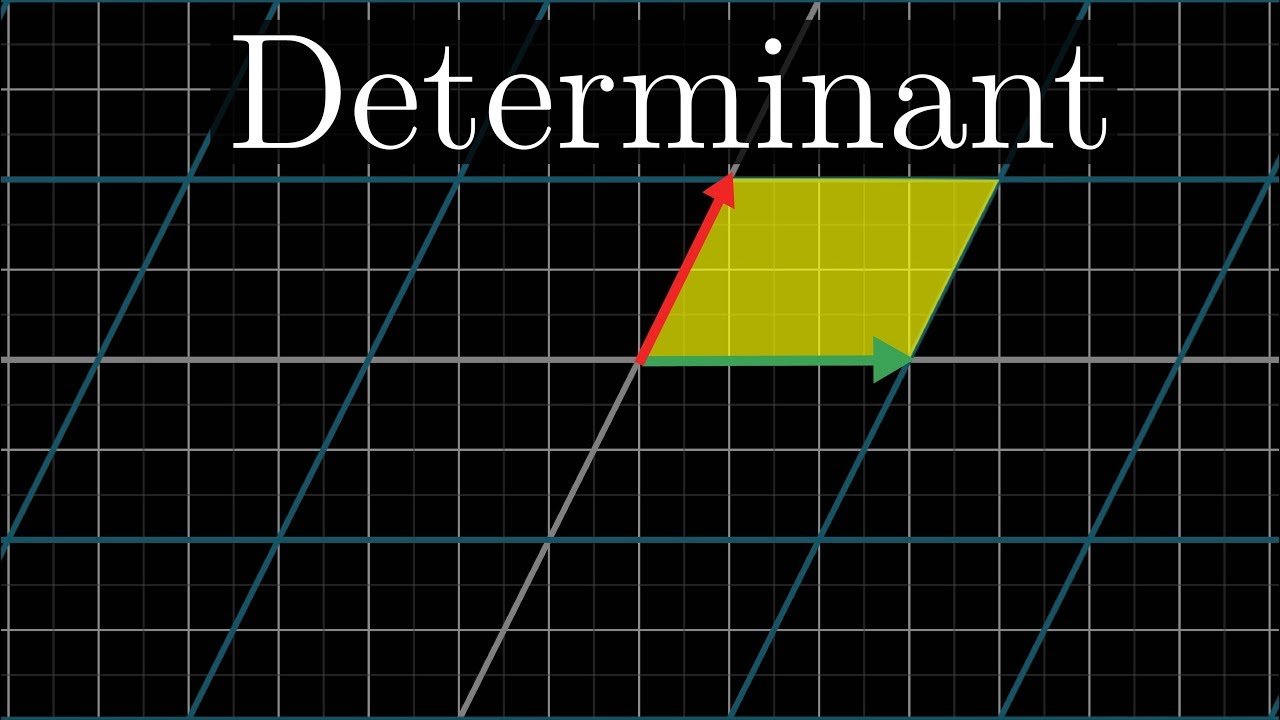
The determinant measures how much volumes change during a transformation.
Help fund future projects: https://www.patreon.com/3blue1brown
An equally valuable form of support is to simply share some of the videos.
Home page: https://www.3blue1brown.com/
Full series: http://3b1b.co/eola
Future series like this are funded by the community, throug...

When it comes to matrices, beyond addition, subtraction, and multiplication, we have to learn how to evaluate something called a determinant. This is a new concept that only applies to square matrices, so let's learn what it means and how to do it!
Watch the whole Mathematics playlist: http://bit.ly/ProfDaveMath
Classical Physics Tutorials: ht...
urban bobcat
hmm okay!
remote rampart
urban bobcat
hmm okay!
You can see also in the thumbnail of Professor Dave's video how he is "breaking out" one of the values. This is how your problem is doing it, but for k
remote rampart
I'm glad 🙂
urban bobcat
but why does he take this here can´t i just do k | 0 2 0, K 3 2, 1 1 1 |?
 remote rampart
urban bobcat
but why does he take this here can´t i just do k | 0 2 0, K 3 2, 1 1 1 |?
remote rampart
urban bobcat
but why does he take this here can´t i just do k | 0 2 0, K 3 2, 1 1 1 |?
You have quite a bit of freedom in choosing how you compute the determinant. The way that it is written is easiest IMO since a lot of the ocmputation is multiplied by 0. You could do it that way and get the same answer, but the computation will be a bit more hairy
urban bobcat
oh okay i am not sure how to do it the way he does
but what do i do know that i have -K |0 2 0, K 3 2, 1 1 1| + 3 |0 K 0, K 3 2, 1 1 1| - 1| 0 K 2, K 3 3, 1 1 1|?
remote rampart
Now you take the 3x3 matrices and repeat the algorithm to get 2x2 matrices. The algorithm is recursive, and each step reduces the matrix down. Follow along with the professor Dave video. It might be easier to start practicing determinants on a smaller matrix
urban bobcat
ohh i see! yes okay i will
i dont quite understand what he does in the last step here
 remote rampart
urban bobcat
i dont quite understand what he does in the last step here
remote rampart
urban bobcat
i dont quite understand what he does in the last step here
Ahh yes, so we \textit{define} the derivative of a 2x2 matrix as follows
$$
\begin{vmatrix}
a & b\
c & d
\end{vmatrix} = ad - bc
$$
So once you get to that step, you just use the definition of a 2x2 determinant to evaluate
elfin berryBOT
curry
 remote rampart
that.... that is a good question
hold on, let me check to make sure there isn't a mistake in that
remote rampart
Ohhh I see what they did
They combined a few simplification steps together
I'll explain in just a sec
urban bobcat
yes okay!
remote rampart
wait ...... so I'm not too sure how they did that step either. I'm going to assume that there was a mistake, and the missing parenthesis suggests to me that they were being a bit sloppy. I think for you, what is best is to ignore that last step and chalk it up to them making a mistake
urban bobcat
yes okay i agree!
remote rampart
yeah Looks like it was a rush job and the professor messed up the algebra a little. The determinant is still correct, however.
urban bobcat
yes he has done that a few times before also
okay i will try to calculate it and see if i get the same answer
remote rampart
Free Pre-Algebra, Algebra, Trigonometry, Calculus, Geometry, Statistics and Chemistry calculators step-by-step
But careful not to 100% rely on it as it does things slightly differently than you may have learned.
urban bobcat
yes okay i won´t, thank you!
marsh citrusBOT
@urban bobcat Has your question been resolved?
Channel closed
Closed by @urban bobcat
Use .reopen if this was a mistake.
marsh citrusBOT
Available help channel!
Send your question here to claim the channel.
Remember:
• Ask your math question in a clear, concise manner.
• Show your work, and if possible, explain where you are stuck.
• After 15 minutes, feel free to ping <@&286206848099549185>.
• Type the command .close to free the channel when you're done.
• Be polite and have a nice day!
Read #❓how-to-get-help for further information on how to ask a good question, and about conduct in the question channels.
still temple
 marsh citrusBOT
still temple
elfin berryBOT
marsh citrusBOT
still temple
elfin berryBOT
Derivative
 still temple
its in a textbook chapter on combinatorics (chapter on permutations and combinations)
remote rampart
yeah that makes sense
So I'm thinking something like this
$$
\sum_{k=1}^n \frac{k}{(k+1)!} = \frac{1}{(n+1)!}\sum_{k=1}^n \frac{k(n + 1)!}{(k+1)!}
$$
elfin berryBOT
krotkin
 still temple
elfin berry
**Derivative**
still temple
elfin berry
**Derivative**
here
i think
since
its from combinatorics
you should try
turning it
into a sum of binomial
coefficients
$\binom{n}{k} = \dfrac{n!}{k!(n-k)!}$
yes
this form
try to get it into this form
elfin berryBOT
Derivative
 still temple
the general term of the summation
then it can get easier as you can do alot things
once you have the operator nCr
in the summation
ok
let me try
welll thats what ive been trying to do for the past few days 🤣
uh
elfin berryBOT
Derivative
 still temple
im trying to get it in the form $\binom{n}{k+1}$
elfin berryBOT
Derivative
 still temple
so which means
$\sum_{k=1}^n \dfrac{n!(n-(k+1))!}{n!(k+1)!(n-(k+1))!}$
elfin berryBOT
Derivative
 still temple
now:
$\dfrac{1}{n!} \sum \binom{n}{k+1} \cdot \dfrac{1}{(n-k-1)!}$
elfin berryBOT
Derivative
 still temple
but now i dont know what to do
 cunning fiber
There’s an easier way
still temple
what if you just had sigma 1/n!
cunning fiber
cunning fiber
There’s an easier way
Note that $n=(n+1)-1$
elfin berryBOT
Civil Service Pigeon
 cunning fiber
elfin berry
**Civil Service Pigeon**
cunning fiber
elfin berry
**Civil Service Pigeon**
From here, ||the series telescopes||
still temple
cunning fiber
From here, ||the series telescopes||
yup
you know whats funny, the moment i looked at this a few days ago, i said telescoping series 🤣
lmao
i just didnt know what to do
just down write down the terms
cunning fiber
still temple
yes
Oh I didn’t notice that mb
still temple
they cancel
cunning fiber
cunning fiber
Oh I didn’t notice that mb
I just saw the barrage of Texit lol
I’ll leave you to it 👋
still temple
so i manipulate k?
still temple
still temple
so i manipulate k?
write k as
(k+1) - 1
now simplify
the expression in the summation
\sum $\dfrac{k+1-1}{(k+1)!}$
 stoic slate
Before simplifying u need go rewrite denominator
elfin berryBOT
Derivative
Compile Error! Click the  reaction for more information.
(You may edit your message to recompile.)
 still temple
yes
stoic slate
As (k+1) * k!
still temple
now
simplify
ok let me see
finally i get
$\sum_{k=1}^n \dfrac{1}{k!} - \dfrac{1}{(k+1)k!}$
elfin berryBOT
Derivative
 still temple
and yes this is telescoping
but, why is this problem in a combinatorics chapter?????
so weird
still temple
still temple
but, why is this problem in a combinatorics chapter?????
cause maybe you can turn it into a sum of
binomial coefficients
then solve it using combinatorics
( which i won't recommend you can do it with simple summation or differentiation or integration if some constants are multiplied with the binomial coefficients
still temple
still temple
then solve it using combinatorics
yes but i think i should learn it the combinatorics way
so i have the above equation
its telescoping, yes.
but can i convert telescoping into a sum of binomial coefficients?
no
idk
marsh citrusBOT
@still temple Has your question been resolved?
marsh citrusBOT
Channel closed
Closed due to timeout
Use .reopen if this was a mistake.
marsh citrusBOT
Available help channel!
Send your question here to claim the channel.
Remember:
• Ask your math question in a clear, concise manner.
• Show your work, and if possible, explain where you are stuck.
• After 15 minutes, feel free to ping <@&286206848099549185>.
• Type the command .close to free the channel when you're done.
• Be polite and have a nice day!
Read #❓how-to-get-help for further information on how to ask a good question, and about conduct in the question channels.
gray maple
 marsh citrusBOT
gray maple
marsh citrusBOT
gray maple
 marsh citrusBOT
@gray maple Has your question been resolved?
Channel closed
Closed by @gray maple
Use .reopen if this was a mistake.
Available help channel!
Send your question here to claim the channel.
Remember:
• Ask your math question in a clear, concise manner.
• Show your work, and if possible, explain where you are stuck.
• After 15 minutes, feel free to ping <@&286206848099549185>.
• Type the command .close to free the channel when you're done.
• Be polite and have a nice day!
Read #❓how-to-get-help for further information on how to ask a good question, and about conduct in the question channels.
 rocky lark
if two planes have two points in common, then their intersection is a straight line
marsh citrusBOT
rocky lark
if two planes have two points in common, then their intersection is a straight l...
 calm harbor
rocky lark
if two planes have two points in common, then their intersection is a straight l...
calm harbor
rocky lark
if two planes have two points in common, then their intersection is a straight l...
no, not really
The two place can stick to each other
Their intersection would be a plane under that circumstance
 calm harbor
rocky lark
would the intersection be that red line?
calm harbor
rocky lark
would the intersection be that red line?
yes
rocky lark
which would be a straight line
calm harbor
That happens when the two plane are separated
rocky lark
also in the book it is written that if it is in more dimensions (space) the intersection could only become a point. But I can't understand how
rocky lark
calm harbor
no, not really
I wrote it wrong, they were two separate plans
if two distinct planes have a point in common, then their intersection is a straight line
if I considered 3 planes their intersection could be a point
 delicate aspen

This is from this tutorial https://understandinglinearalgebra.org/sec-expect.html
delicate aspen
rocky lark
What does the one on the right form?
Three lines, and no common point that is common to all three
marsh citrusBOT
Channel closed
Closed by @rocky lark
Use .reopen if this was a mistake.
marsh citrusBOT
Available help channel!
Send your question here to claim the channel.
Remember:
• Ask your math question in a clear, concise manner.
• Show your work, and if possible, explain where you are stuck.
• After 15 minutes, feel free to ping <@&286206848099549185>.
• Type the command .close to free the channel when you're done.
• Be polite and have a nice day!
Read #❓how-to-get-help for further information on how to ask a good question, and about conduct in the question channels.
still temple
Hello
marsh citrusBOT
still temple
Hello
still temple
Can someone explain to me what is arccos and how it works?
Asking because i'm using this formula: $arccos(deltaZ / hypotenuse) * (frac{180 / pi})$ to calculate the Pitch angle..
elfin berryBOT
Cut

 upper gust
Its the Inverse function of the cosine
still temple
yea
upper gust
just like e and ln are inverses
still temple
The thing is, i don't know anything about it, my school isn't teaching it, none of my teachers know this
I'm studying all alone, so all this is new to me
upper gust
its like division and multiplication these are also inverse operations for non zero numbers
 nova totem
arccos takes the ratio from a supposed right triangle and finds the angle that makes that ratio
still temple
nova totem
arccos takes the ratio from a supposed right triangle and finds the angle that m...
What is this ratio?
nova totem
so let's say cos(θ) = R. Then arccos(R) = θ, or some angle within its proper domain that kicks out
nova totem
still temple
What is this ratio?
adjacent/hypotenuse
cos
so arc(whatever) is like inverse(whatever)
arcsin is inverse sin
arccos is inverse cos
etc
still temple
nova totem
arcsin is inverse sin
arccos is inverse cos
etc
Is what i said correct?
delicate aspen
 nova totem
Well do you even know what sine, cosine, and tangent do

Courses on Khan Academy are always 100% free. Start practicing—and saving your progress—now: https://www.khanacademy.org/math/geometry-home/right-triangles-topic/intro-to-the-trig-ratios-geo/v/basic-trigonometry
Introduction to trigonometry
Practice this lesson yourself on KhanAcademy.org right now:
https://www.khanacademy.org/math/trigonome...
still temple
nova totem
Well do you even know what sine, cosine, and tangent do
no idea
still temple
nova totem
Do watch the video first
Okay
still temple
delicate aspen
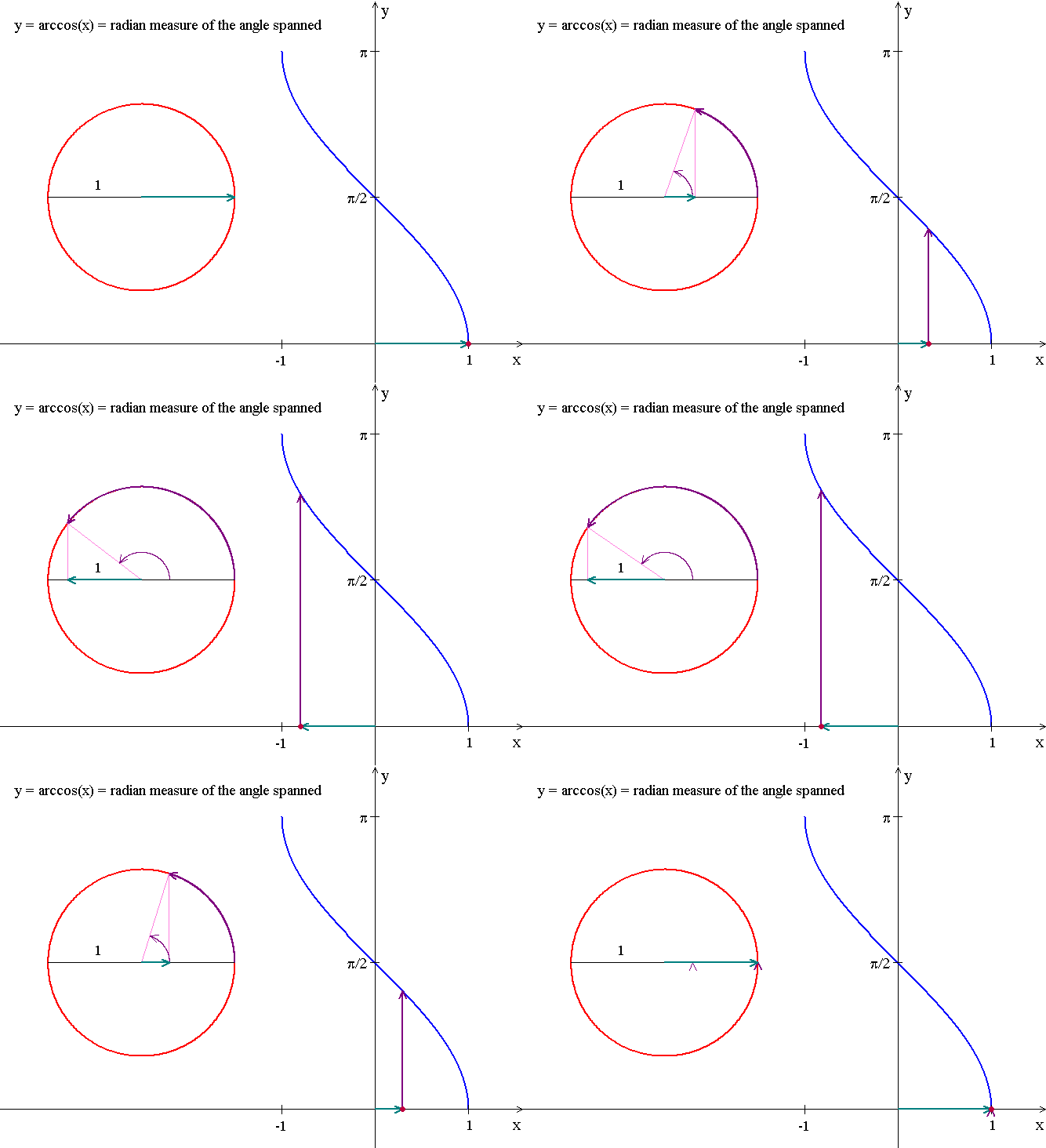
https://www.math.hkust.edu.hk/~machiang/1013/Notes/arccos.gif
Can it be like
Go to the right too?
Ay, @nova totem, thank you very much for the video
May i save your DM so we can chat sometimes?
delicate aspen
still temple
Go to the right too?
I think so, but this is how the unit circle is usually oriented
still temple
delicate aspen
I think so, but this is how the unit circle is usually oriented
Okay thanks
still temple
nova totem
Just ask for help in here
Yeah, thanks !
still temple
delicate aspen
https://www.mathsisfun.com/algebra/trig-interactive-unit-circle.html
THIS IS SOO GOOD
Thanks
delicate aspen
You are welcome!
still temple
.close
marsh citrusBOT
Channel closed
Closed by @fickle quail
Use .reopen if this was a mistake.
marsh citrusBOT
Available help channel!
Send your question here to claim the channel.
Remember:
• Ask your math question in a clear, concise manner.
• Show your work, and if possible, explain where you are stuck.
• After 15 minutes, feel free to ping <@&286206848099549185>.
• Type the command .close to free the channel when you're done.
• Be polite and have a nice day!
Read #❓how-to-get-help for further information on how to ask a good question, and about conduct in the question channels.
 cursive jolt
 marsh citrusBOT
cursive jolt
cursive jolt
marsh citrusBOT
cursive jolt
cursive jolt
any suggestions
on how i can approach this
i was thinking of using bayes thereom

but im not quite sure on how
marsh citrusBOT
@cursive jolt Has your question been resolved?
cursive jolt
😢
 limber imp
Bayes theorem will probably be useful here. Have you drawn a probability tree yet?
Actually, you can substitute from the word problem itself
In Bayes' theoerm, based on the probelm, what is A and what is B
cursive jolt
limber imp
In Bayes' theoerm, based on the probelm, what is A and what is B
A could be the result being positive
and B could the aliens having bleep blop condition
limber imp
Read the question again, what is the probability that you are asked to find?
cursive jolt
the probability that the alien has Bleep Bloop given that the test result is positive?
this is how i denoted my p's thus far

then i believe P(Bleep) would be 1/5
(the probability that an alien has Bleep Bloop)
P(Zp) would be 2/3 i think
limber imp
cursive jolt
the probability that the alien has Bleep Bloop given that the test result is pos...
Yeah, so A would be probability of bleep bloop and B conditioned probability of being positive
limber imp
cursive jolt
then i believe P(Bleep) would be 1/5
I agree yeah
cursive jolt
Oh switched, Yea makes sense
limber imp
What might be tricky here is finding the denominator
do you know what P(B) stands for in the equation you shared?
cursive jolt
the probability that the test result is positive
i think
the probabilities for the two conditions (Bleep Bloop and not Bleep Bloop)
limber imp
cursive jolt
the probability that the test result is positive
yeah the total probability of having a positive test
You will have to find this based on wether the alien has had a ZAP or a ZOP
cursive jolt
and the numerator?
P(P|B) (P(B)
would that just be

multiplied by P(B) which is 1/5
limber imp
P(bleep bloop|positive)P(positive)
cursive jolt
right
marsh citrusBOT
@cursive jolt Has your question been resolved?
cursive jolt
limber imp
Yes, that looks right

for P(P)
which is the probablity the test is positive
how would you approach this
limber imp
I haven't reread the question but were you given P(positive |bleep) or were you given P(positive|bleep, zap) and P(positive|bleep, zop)?
if it's the former then yeah, if it's the latter you need to go down each branch of the probability tree to get the total probability
P(positive) @cursive jolt
limber imp
your approach is correct, just check to use what you are given 👍
cursive jolt
thanks
this is what i ended up cooking

sort of just found each part of bayes thereom
and put it all together
limber imp
Your approach looks right, i didn't check the number but symbolically it looks correct
you found the marginal of probability of positive which is the long part
and yeah you put it together
marsh citrusBOT
@cursive jolt Has your question been resolved?
marsh citrusBOT
@cursive jolt Has your question been resolved?
marsh citrusBOT
@cursive jolt Has your question been resolved?
marsh citrusBOT
Channel closed
Closed due to timeout
Use .reopen if this was a mistake.
Available help channel!
Send your question here to claim the channel.
Remember:
• Ask your math question in a clear, concise manner.
• Show your work, and if possible, explain where you are stuck.
• After 15 minutes, feel free to ping <@&286206848099549185>.
• Type the command .close to free the channel when you're done.
• Be polite and have a nice day!
Read #❓how-to-get-help for further information on how to ask a good question, and about conduct in the question channels.
 serene basalt
I want to know about area under a graph by double integration
serene basalt
We do double integration by limits of x and y of a function f(x,y) in 3d to find out the volume between the graph and the limits of x and y right?
For area of a surface we use
dydx straight double integration and limits of surface we use f(x,y)=1 so it is a z=1 plane and we calculating volume between the surface and z=1 plane so why it is equal to its surface area please help
marsh citrusBOT
@serene basalt Has your question been resolved?
serene basalt
<@&286206848099549185>
 amber birch
serene basalt
<@&286206848099549185>
amber birch
serene basalt
For area of a surface we use
dydx straight double integration and limits of sur...
amber birch
serene basalt
<@&286206848099549185>
amber birch
serene basalt
For area of a surface we use
dydx straight double integration and limits of sur...
You've seriously misinterpreted the surface area formula
The surface area is the double integral of 1 ds over the surface
You can imagine it as taking the arclength in the x-direction
And then summing all of these arc lengths as you move along the y-direction
amber birch
amber birch
https://tutorial.math.lamar.edu/Classes/CalcIII/SurfaceArea.aspx
The formula here comes from the distance between (x, y, z) and (x + dx, x + dy, x + dz)
Which is approximately sqrt(dx^2 + dy^2 + dz^2)
Take sqrt(dx)^2 = dx out and you get sqrt(1 + (dy/dx)^2 + (dz/dx)^2)) dx
amber birch
amber birch
Take sqrt(dx)^2 = dx out and you get sqrt(1 + (dy/dx)^2 + (dz/dx)^2)) dx
https://math.libretexts.org/Bookshelves/Calculus/Calculus_3e_(Apex)/13%3A_Multiple_Integration/13.05%3A_Surface_Area
There's a better derivation here: it should indeed be dA and not dx

Mathematics LibreTexts
The natural extension of the concept of "arc length over an interval'' to surfaces is "surface area over a region.''
serene basalt
amber birch
The formula here comes from the distance between (x, y, z) and (x + dx, x + dy, ...
In my textbook let's say we have to calculate area of Circle x^2+y^2=1, I use limit x 0,1 and y -(√1-x^2) , √(1+x^2) and integrate by double integral
Here I say f(x,y) integrand is 1
amber birch
serene basalt
In my textbook let's say we have to calculate area of Circle x^2+y^2=1, I use li...
Oh that's not a surface area then
serene basalt
So basically it is the volume under circle and its image
amber birch
That's just regular integration with respect to dx dy (or dy dx)
serene basalt
Ya
amber birch
serene basalt
So basically it is the volume under circle and its image
Nope, the circle is already an area
So you don't have to take the area under a multivariable surface
serene basalt
No like we use double integral we have to integrate some f(x,y) and we have limits of x and y like I have for circle so we get volume between the f(x,y) map and circle
amber birch
serene basalt
No like we use double integral we have to integrate some f(x,y) and we have limi...
There's absolutely no volume in a circle
serene basalt
So here f(x,y)=1
serene basalt
amber birch
There's absolutely no volume in a circle
No we are in 3d because z=f(x,y)
Like volume of 1 height cylinder is same as 1 radius circle surface area
amber birch
Fair enough, okay so in the formula
The partial derivative of 1 w.r.t x is 0
The partial derivative of 1 w.r.t y is 0
serene basalt
Ok
amber birch
So we have sqrt(1 + (fx)^2 + (fy)^2) dA = 1 dA
It's literally the same double integral
Okay yeah so that's kind of nice it simplifies down like that
serene basalt
You not getting me
serene basalt
serene basalt
In my textbook let's say we have to calculate area of Circle x^2+y^2=1, I use li...
In my question f(x,y)=1 so it's a surface z=1, in 3d and by double integration we get volume of a cylinder which is 1 height,1 radius and its same as surface area of circle
amber birch
serene basalt
In my question f(x,y)=1 so it's a surface z=1, in 3d and by double integration w...
Yes I understand you now
If you take the area under that 3D surface, the integral becomes the same as if you use regular double integration
serene basalt
Ya
I not read it anywhere is it true
If again we take a sqaure like length 2 and width 2 so double integral taking f(x,y) =1,is give us a cuboid of height 1 ,now the volume of cuboid is 4, and surface area of square is 4 ,my mind is blown right now
It is like we increase the height of any surface by 1 and calculate volume it is same as curves surface area
@amber birch
amber birch
serene basalt
It is like we increase the height of any surface by 1 and calculate volume it is...
Yeah that's what the formula tells you, it's the same if your surface is a constant
marsh citrusBOT
Channel closed
Closed by @serene basalt
Use .reopen if this was a mistake.
amber birch
npnp
marsh citrusBOT
Available help channel!
Send your question here to claim the channel.
Remember:
• Ask your math question in a clear, concise manner.
• Show your work, and if possible, explain where you are stuck.
• After 15 minutes, feel free to ping <@&286206848099549185>.
• Type the command .close to free the channel when you're done.
• Be polite and have a nice day!
Read #❓how-to-get-help for further information on how to ask a good question, and about conduct in the question channels.
 zenith sail
 marsh citrusBOT
zenith sail
marsh citrusBOT
zenith sail
 upbeat sable
What have you tried
 upbeat sable
What do you mean by "I have tried to just do the root"
You have to look at what happens when you differentiate x^2+1
You get 2x
zenith sail
ye already... oh
zenith sail
so I need to do by subtitution and the i will get it?
upbeat sable
Yes
zenith sail
upbeat sable
You have to look at what happens when you differentiate x^2+1
wait but that would be a chain derivative
upbeat sable
I was trying to tell you what substitution you have to make
And in order to see that, differentiate x^2+1
 spice plover
u=x^2+1
du=2xdx
or
$u=\sqrt{x^2+1}$
$du=\frac{x}{\sqrt{x^2+1}}dx$
So the integral becomes,
$\int 1 du$
$u+C$
$\sqrt{x^2+1}+C$
elfin berryBOT
The Prophet Of The Damned
 zenith sail
wait why 1?
the derivative I already did it
but never understood why the 1?
oh
thx
.close
marsh citrusBOT
Channel closed
Closed by @zenith sail
Use .reopen if this was a mistake.
marsh citrusBOT
Available help channel!
Send your question here to claim the channel.
Remember:
• Ask your math question in a clear, concise manner.
• Show your work, and if possible, explain where you are stuck.
• After 15 minutes, feel free to ping <@&286206848099549185>.
• Type the command .close to free the channel when you're done.
• Be polite and have a nice day!
Read #❓how-to-get-help for further information on how to ask a good question, and about conduct in the question channels.
 copper ice
how do i find the sum of this series? i just dont know what to do with (-1)^k, if we wouldnt have had it, it would be just geometric series which is easy to calculate
 marsh citrusBOT
copper ice
how do i find the sum of this series? i just dont know what to do with (-1)^k, i...
marsh citrusBOT
copper ice
how do i find the sum of this series? i just dont know what to do with (-1)^k, i...
 twilit arrow
((-1)^k\left(\frac{1}{2}\right)^k = \left(\frac{-1}{2}\right)^k)
elfin berryBOT
maximo¹
 stoic slate
 novel juniper
good, you got the key idea already
novel juniper
good, you got the key idea already
He is not the one with the question
marsh citrusBOT
Channel closed
Closed by @copper ice
Use .reopen if this was a mistake.
marsh citrusBOT
Available help channel!
Send your question here to claim the channel.
Remember:
• Ask your math question in a clear, concise manner.
• Show your work, and if possible, explain where you are stuck.
• After 15 minutes, feel free to ping <@&286206848099549185>.
• Type the command .close to free the channel when you're done.
• Be polite and have a nice day!
Read #❓how-to-get-help for further information on how to ask a good question, and about conduct in the question channels.
 restive field
Hi, just wondering does anybody know how to do question 5(a)?

 icy scarab
You can substitute the values of x given, you will get two linear equations
restive field
Ok
icy scarab
So for f(2) for example, since f(x) = mx + c
f(2) = 2m + c
And it's given that f(2) = 7
Therefore
2m + c = 7
restive field
Ya
icy scarab
Similarly do for f(4) and solve the two equations
restive field
 icy scarab
Yes, that is correct so far
restive field
Ok
icy scarab
So while solving a linear equation with two variables, we try to eliminate one of them.
So that we can get the value of one variable, and then with that we get the other one
icy scarab
So you can subtract the two equations
I will send a picture, I don't know latex to type it in discord
restive field
Ok
I got it
I think so
Ya
I got it
M=-4
Now i need to find c
C=15
I got it already
Thank you soo much ya!
icy scarab
Uhh sorry, I don't know how to do that question either
Maybe another helper can help
icy scarab
Glad to help
restive field
Maybe I'll ask my school teacher
icy scarab
Okay
marsh citrusBOT
@restive field Has your question been resolved?
marsh citrusBOT
Channel closed
Closed due to timeout
Use .reopen if this was a mistake.
Available help channel!
Send your question here to claim the channel.
Remember:
• Ask your math question in a clear, concise manner.
• Show your work, and if possible, explain where you are stuck.
• After 15 minutes, feel free to ping <@&286206848099549185>.
• Type the command .close to free the channel when you're done.
• Be polite and have a nice day!
Read #❓how-to-get-help for further information on how to ask a good question, and about conduct in the question channels.
 pastel ridge
 rocky lava
hello
marsh citrusBOT
rocky lava
hello
rocky lava
yo so i need some of my work to be checked
i’ll send the work when someone is online cuz i have a feeling most of these are wrong tbh
so lmk when ur online
<@&286206848099549185>
i’ll just send it afchalky
for question 4 would the domain be (-infinity,infinity) and the range (4, infinity), the vertex (-2,4), and the axis of symmetry x=2, and the function increased on the right and decreasing on the left

also would it be as y increases x increases when x < -2
i’ll just post this for now and then when someone responds i’ll post the rest
 past frigate
rocky lava
for question 4 would the domain be (-infinity,infinity) and the range (4, infini...
past frigate
rocky lava
for question 4 would the domain be (-infinity,infinity) and the range (4, infini...
Everything seems right except the axis of symmetry
marsh citrusBOT
@rocky lava Has your question been resolved?
rocky lava
past frigate
Everything seems right except the axis of symmetry
oh shoot sorry for the late reply
r u still there
and also what’s wrong with it
rocky lava
rocky lava
for question 4 would the domain be (-infinity,infinity) and the range (4, infini...
wait
sorry i meant x=4
@past frigate
idk why i typed 2
rocky lava
rocky lava
also would it be as y increases x increases when x < -2
this is true also right?
past frigate
rocky lava
sorry i meant x=4
4?
rocky lava
rocky lava
also would it be as y increases x increases when x < -2
is this true tho?
rocky lava
past frigate
As y increases x should decrease, no?
oh right
past frigate
Another(better) way to say that would be that y decreases in (-inf,-2)
past frigate
rocky lava
and then vice versa it would be when x>-2, y increases as x increases
Yeah
rocky lava
aight ima send the best question
*next
for 8, i put the vertex is the same and the axis of symmetry is the same also, and the transformation is vertical compression by a factor of 0.75
 marsh citrusBOT
Channel closed
Closed due to timeout
Use .reopen if this was a mistake.
marsh citrusBOT
✅
rocky lava
rocky lava
for 8, i put the vertex is the same and the axis of symmetry is the same also, a...
ok look up here to see it
past frigate
rocky lava
for 8, i put the vertex is the same and the axis of symmetry is the same also, a...
The same as what again?
rocky lava
past frigate
The same as what again?
both graphs have the same vertex and axis of symmetry
vertex is (0,0) and the axis of symmetry is x=0
past frigate
y=x² and y=0.75x² you mean?
rocky lava
and then i think it’s vertical compression
rocky lava
past frigate
y=x² and y=0.75x² you mean?
yes
past frigate
rocky lava
and then i think it’s vertical compression
One sec
past frigate
rocky lava
and then i think it’s vertical compression
Ok yeah that's right too
Coz 0.75 lies between 0 and 1
past frigate

rocky lava
rocky lava
for 8, i put the vertex is the same and the axis of symmetry is the same also, a...
ok so for 12 i got the axis of symmetry and vertex to be the same, and it is a vertical compression by -2/3 and reflection in the x axis
past frigate
👍
rocky lava
rocky lava
for 8, i put the vertex is the same and the axis of symmetry is the same also, a...
14 i got the axis of symmetry and vertex to be the same again, and it’s. a horizontal stretch by -4
past frigate
It would be -4 if the function would be -4x²
In this case it's (-4x)²
See the difference?
past frigate
What is (-4x)²
rocky lava
rocky lava
ok so for 12 i got the axis of symmetry and vertex to be the same, and it is a v...
i forgot to say this is by -2/3 also
rocky lava
past frigate
What is (-4x)²
16x
past frigate
16x²**
past frigate
rocky lava
right
It's similar to the last few so I'm sure you'll be able to answer this on your own
rocky lava
oh would it be compression then
past frigate
No it'll be a stretch itself, you're right
rocky lava
oh
past frigate
I said similar coz
past frigate
past frigate
I said similar coz
In the last few we multiplied with a constant too
rocky lava
past frigate
In the last few we multiplied with a constant too
yea

 past frigate
In a, do you think it's a vertical stretch or compression?
rocky lava
compression
rocky lava
oh yea true