#help-28
1 messages · Page 249 of 1

 slate violet
probably ask someone else, I'm tired
 sly solstice
alright nws lol
slate violet
you can close this one and ask in a new channel
 full forumBOT
Channel closed
Closed by @sly solstice
Use .reopen if this was a mistake.
full forumBOT
 Available help channel!
Send your question here to claim the channel.
Remember:
• Ask your math question in a clear, concise manner.
• Show your work, and if possible, explain where you are stuck.
• After 15 minutes, feel free to ping <@&286206848099549185>.
• Type the command .close to free the channel when you're done.
• Be polite and have a nice day!
Read #❓how-to-get-help for further information on how to ask a good question, and about conduct in the question channels.
 woeful anvil
Do you not change the bounds when making a u substitution for a improper integral?
 full forumBOT
woeful anvil
Do you not change the bounds when making a u substitution for a improper integra...
full forumBOT
woeful anvil
Do you not change the bounds when making a u substitution for a improper integra...
 umbral dome
you can do it either way
woeful anvil
I thought it’s suppose to be like
 fast peak
well they skipped over the entire u sub
woeful anvil
 fast peak
it basically didnt even happen
woeful anvil
Would this be wrong
fast peak
so where should they change the bounds
woeful anvil
woeful anvil
Do you not change the bounds when making a u substitution for a improper integra...
But the x got cancelled from the u substitution
umbral dome
you can take the antiderivative any way you like, including u-sub, and as long as you get an antiderivative with x out then you can use the original bounds
you can change the bounds into u and not go back to x but they chose not to
woeful anvil
I see
woeful anvil
umbral dome
you can change the bounds into u and not go back to x but they chose not to
So just to be clear
Nothing is wrong with what I’m doing
Right
umbral dome
i would recommend you change the bounds as soon as you do the substitution, it's confusing to have an integral wrt u with the bounds still in x. but the bounds you get at the end are correct
full forumBOT
Channel closed
Closed by @woeful anvil
Use .reopen if this was a mistake.
full forumBOT
Available help channel!
Send your question here to claim the channel.
Remember:
• Ask your math question in a clear, concise manner.
• Show your work, and if possible, explain where you are stuck.
• After 15 minutes, feel free to ping <@&286206848099549185>.
• Type the command .close to free the channel when you're done.
• Be polite and have a nice day!
Read #❓how-to-get-help for further information on how to ask a good question, and about conduct in the question channels.
 fluid prawn
 full forumBOT
fluid prawn
full forumBOT
fluid prawn
 full forumBOT
@fluid prawn Has your question been resolved?
 urban jacinth
fluid prawn
urban jacinth
fluid prawn
Are those supposed to be 2 cones?
fluid prawn
Yeah
full forumBOT
Channel closed
Closed due to timeout
Use .reopen if this was a mistake.
Available help channel!
Send your question here to claim the channel.
Remember:
• Ask your math question in a clear, concise manner.
• Show your work, and if possible, explain where you are stuck.
• After 15 minutes, feel free to ping <@&286206848099549185>.
• Type the command .close to free the channel when you're done.
• Be polite and have a nice day!
Read #❓how-to-get-help for further information on how to ask a good question, and about conduct in the question channels.
 sacred bluff
 full forumBOT
sacred bluff
sacred bluff
full forumBOT
sacred bluff
sacred bluff
could someone explain how we get the domain here
the domain of lnx is 0,infinty?
but when we subract it from x
what would it be
umbral dome
the domain doesn't change
all the domain cares about is whether or not the expression is defined, so in this case the only part which could be undefined is ln(x)
sacred bluff
okay
so like can i think it as after i have lnx defined
its like a linear polynomial
NO
eh
or like if it was a linear polynomial i could take all real values but since i have lnx here i take only the x parts that are definifng lnx
 indigo frost
to get the domain you just check every expression
\begin{align*}
&for \ x \ its \ in \ \mathBB{R} , \ so \ Df = (-\infty,+\infty) \
&for \ \ln(x) \ \ its \ defined \ in (0, +\infty) \
&the \ domain \ of \ the \ function \ is \ the \ intersection \ of \ both \ domains \
&\rightarrow (0,+\infty)
\end{align*}
 glossy valveBOT
<rajel />
Compile Error! Click the  reaction for more information.
(You may edit your message to recompile.)
 indigo frost
!done
full forumBOT
If you are done with this channel, please mark your problem as solved by typing .close
sacred bluff
.close
full forumBOT
Channel closed
Closed by @sacred bluff
Use .reopen if this was a mistake.
Available help channel!
Send your question here to claim the channel.
Remember:
• Ask your math question in a clear, concise manner.
• Show your work, and if possible, explain where you are stuck.
• After 15 minutes, feel free to ping <@&286206848099549185>.
• Type the command .close to free the channel when you're done.
• Be polite and have a nice day!
Read #❓how-to-get-help for further information on how to ask a good question, and about conduct in the question channels.
 thorn marten
Hi!
Prove that limit n->inf e^x = (1 + x/n)^n
full forumBOT
thorn marten
Hi!
Prove that limit n->inf e^x = (1 + x/n)^n
umbral dome
that doesn't seem right
 iron cradle
the statement isnt correct, its limit as n goes to infinity
umbral dome
also the e^x should be the result of the limit, not the expression whose limit is taken
 stiff musk
how you prove this depends on how you have defined e^x
thorn marten
Prove that e^x = limit n->inf (1 + x/n)^n
urban jacinth
Hmm
 rapid rain
thorn marten
Prove that e^x = limit n->inf (1 + x/n)^n
rapid rain
thorn marten
Prove that e^x = limit n->inf (1 + x/n)^n
what is e^x to you?
stiff musk
if you used the series definition then this is a full-page proof from rudin (so probably a 2-page proof if you write out the details)
urban jacinth
thorn marten
We know that e = limit n->inf (1 + 1/n)^n
Have you done integration as a sum of limit?
Or rather the opposite actually
umbral dome
thorn marten
We know that e = limit n->inf (1 + 1/n)^n
not too difficult to proceed from exponentiating this limit to x then
 brittle parcel
thorn marten
We know that e = limit n->inf (1 + 1/n)^n
brittle parcel
thorn marten
We know that e = limit n->inf (1 + 1/n)^n
do yourself a favor, and say,
if you want to use this definition of e,
define
exp(x) = lim_{n to infty) (1+x/n)^n
rapid rain
(1+1/n)^(xn) = (1+x/n + xC2/n^2 + ...)^n
brittle parcel
otherwise you have to use approximation of irrationals by rationals and it's more work than hyou're probably expected to do
rapid rain
brittle parcel
define
exp(x) = lim_{n to infty) (1+x/n)^n
they said they wanted the proof for when x was a natural integer
brittle parcel
but, wait, that's what youre trying to prove, so it cant be the definition youre using
thorn marten
natural number
brittle parcel
rapid rain
they said they wanted the proof for when x was a natural integer
ah
I missed that, well, scratch what I said about irrational numbers then!
rapid rain
rapid rain
(1+1/n)^(xn) = (1+x/n + xC2/n^2 + ...)^n
use that
rapid rain
now all that's left to do is to show the 1/n^2, 1/n^3, etc... terms are irrelevant
rapid rain
thorn marten
1/n^2 is negligible for values of n - > inf
well that remains to be shown
but that's the idea
let's name A = 1 + x/n and B = (the rest in the parenthesis)
(A+B)^n = A^n + ...
rapid rain
sure
thorn marten
e^x = limit n->inf (1 + 1/n)^(nx)
Let nx = d
Clearly, d -> inf
Then e^x = limit (d,n)->inf (1 + 1/(d/x))^(nx) = limit d->inf (1 + x/d)^(d)
 ruby cargo
<@&268886789983436800>
full forumBOT
Channel closed
Closed by @thorn marten
Use .reopen if this was a mistake.
thorn marten
,w sin(x) = cos(x)
full forumBOT
Available help channel!
Send your question here to claim the channel.
Remember:
• Ask your math question in a clear, concise manner.
• Show your work, and if possible, explain where you are stuck.
• After 15 minutes, feel free to ping <@&286206848099549185>.
• Type the command .close to free the channel when you're done.
• Be polite and have a nice day!
Read #❓how-to-get-help for further information on how to ask a good question, and about conduct in the question channels.
thorn marten
Hello
 worn moon
 thorn marten
!15min
full forumBOT
Please only use the <@&286206848099549185> ping once if your question has not been answered for 15 minutes. Please do not ping or DM individual users about your question.
ruby cargo
Substitute in different values of x to get the respective y values and plot them
worn moon
What would be the functions?
ruby cargo
Are you not just supposed to plot the one they already gave?
worn moon
no I have to consider the functions
 onyx glen
one of y'all needs a new pfp for real.
worn moon
ruby cargo
It definitely says to graph the function
Yeah and I don’t have the points to graph it with
ruby cargo
worn moon
Yeah and I don’t have the points to graph it with
You don't need to??? You just substitute it in
worn moon
ruby cargo
You don't need to??? You just substitute it in
no? Cause I would need the points to make it into a ray?
ruby cargo
f(x) = -0.75 | x - 2| + 5
What happens if x = 0?
Then |x-2| = 2
2 * -0.75 +5 = -1.5 + 5 = 4.5 = f(x) = y
That's all you do
Then you choose a different value of x
worn moon
Ohhhh
ruby cargo
Remember, f(x) is y lol
worn moon
Thanks
ruby cargo
np
full forumBOT
@worn moon Has your question been resolved?
full forumBOT
Channel closed
Closed due to timeout
Use .reopen if this was a mistake.
Available help channel!
Send your question here to claim the channel.
Remember:
• Ask your math question in a clear, concise manner.
• Show your work, and if possible, explain where you are stuck.
• After 15 minutes, feel free to ping <@&286206848099549185>.
• Type the command .close to free the channel when you're done.
• Be polite and have a nice day!
Read #❓how-to-get-help for further information on how to ask a good question, and about conduct in the question channels.
 ebon blaze
 full forumBOT
ebon blaze
urban jacinth
full forumBOT
ebon blaze
urban jacinth
Do you know what the sign P means?
 deep python
Oh it's the p of permutations
ebon blaze
I don’t remember the spelling for it
urban jacinth
So i assume you know it's formula
ebon blaze
urban jacinth
So i assume you know it's formula
N!/(n-r)! right?
urban jacinth
Yeah
ebon blaze
deep python
Just replace
Wdym by replace?
deep python
On the lhs you have n(n-1)...(n-5) and on the rhs it's 8(n-1)(n-2)...(n-5)
You can see that 1, 2, 3, 4 and 5 are solutions. Divide by (n-1)...(n-5) on both sides to get the last solution
urban jacinth
deep python
On the lhs you have n(n-1)...(n-5) and on the rhs it's 8(n-1)(n-2)...(n-5)
You c...
No 1,2,3,4,5 are not the solutions.
deep python
Oh yeah otherwise u'd have a negative factorial
urban jacinth
The given question restricts The domain of n to be greater than 5, else nPr won't be defined
urban jacinth
Yep
full forumBOT
Channel closed
Closed by @ebon blaze
Use .reopen if this was a mistake.
full forumBOT
Available help channel!
Send your question here to claim the channel.
Remember:
• Ask your math question in a clear, concise manner.
• Show your work, and if possible, explain where you are stuck.
• After 15 minutes, feel free to ping <@&286206848099549185>.
• Type the command .close to free the channel when you're done.
• Be polite and have a nice day!
Read #❓how-to-get-help for further information on how to ask a good question, and about conduct in the question channels.
 static geyser
translation in second picture, on B why is it not 1<y<144? dont the angles have to exist to be a triangle?

 full forumBOT
static geyser
translation in second picture, on B why is it not 1<y<144? dont the angles have ...
static geyser
full forumBOT
static geyser
translation in second picture, on B why is it not 1<y<144? dont the angles have ...
static geyser
.close
full forumBOT
Channel closed
Closed by @static geyser
Use .reopen if this was a mistake.
full forumBOT
Available help channel!
Send your question here to claim the channel.
Remember:
• Ask your math question in a clear, concise manner.
• Show your work, and if possible, explain where you are stuck.
• After 15 minutes, feel free to ping <@&286206848099549185>.
• Type the command .close to free the channel when you're done.
• Be polite and have a nice day!
Read #❓how-to-get-help for further information on how to ask a good question, and about conduct in the question channels.
 plucky remnant
Hey, so I don't understand the second term on the righthand side of
dP/dR

 full forumBOT
plucky remnant
Hey, so I don't understand the second term on the righthand side of
dP/dR
plucky remnant
full forumBOT
plucky remnant
Hey, so I don't understand the second term on the righthand side of
dP/dR
plucky remnant
Questions for Term 2:
**☆**Why is the term negative?
**☆**Why is the R multiplied by 2?
**☆**Why is the sum of all resistances cubed?
I'm using quotient
To see what happens
 vast fossil
They applied product rule, namely, viewed P(R) as R * V^2/(r + R)^2
The factor of 2 comes from power rule
Same answer to the third question
plucky remnant
vast fossil
They applied product rule, namely, viewed P(R) as R * V^2/(r + R)^2
I thought I was meant to use quotient rule
vast fossil
You could apply quotient rule as well
plucky remnant
Alright, I'm trying that
full forumBOT
@plucky remnant Has your question been resolved?
Channel closed
Closed by @plucky remnant
Use .reopen if this was a mistake.
full forumBOT
Available help channel!
Send your question here to claim the channel.
Remember:
• Ask your math question in a clear, concise manner.
• Show your work, and if possible, explain where you are stuck.
• After 15 minutes, feel free to ping <@&286206848099549185>.
• Type the command .close to free the channel when you're done.
• Be polite and have a nice day!
Read #❓how-to-get-help for further information on how to ask a good question, and about conduct in the question channels.
 north temple
why is arcsin(x)’s domain -1<=x<=1?
full forumBOT
north temple
why is arcsin(x)’s domain -1<=x<=1?
 fathom saddle
Basically by definition
 sudden condor
north temple
why is arcsin(x)’s domain -1<=x<=1?
sudden condor
north temple
why is arcsin(x)’s domain -1<=x<=1?
inverse functions domains are the range of the original functions
north temple
sudden condor
inverse functions domains are the range of the original functions
ok i understand because sin’s range is -1<=x<=1
and then inverse is reverse
.close
full forumBOT
Channel closed
Closed by @north temple
Use .reopen if this was a mistake.
north temple
.reopen
full forumBOT
✅
sudden condor
north temple
how did you memorize the unit circle?
first memorize the special angles
then use reference angles for angles not in quadrant 1
fathom saddle
I personally think of tan as "the slope of the terminal arm" which helps me
There's a lot of ways to think of tan
north temple
ok but is there a song or fun word i can know?
north temple
sudden condor
first memorize the special angles
then use reference angles for angles not in q...
i will try that
fathom saddle
A teacher once gave the values like this:
√0/2, √1/2, √2/2, √3/2, √4/2
I don't personally like this list, and would vouch for just knowing them. But, maybe it will work for you
sudden condor
fathom saddle
A teacher once gave the values like this:
√0/2, √1/2, √2/2, √3/2, √4/2
this is the like the most taught way to memorize it lol
full forumBOT
Channel closed
Closed by @north temple
Use .reopen if this was a mistake.
north temple
.reopen
full forumBOT
✅
north temple
what is the reasoning that lim x—>0 of (1-cos(x))/x is 0?
sudden condor
north temple
what is the reasoning that lim x—>0 of (1-cos(x))/x is 0?
know l'opital ?
fathom saddle
,w graph (1 - cos(x))/x
glossy valveBOT


 fathom saddle
Worth seeing the graph, if you haven't yet
sudden condor
fathom saddle
Worth seeing the graph, if you haven't yet
the fact that this is the first time seeing it in my life lol
north temple
sudden condor
know l'opital ?
so what is it?
fathom saddle
You can't plug in x = 0, but looking at the graph makes it pretty clear that near x = 0 goes near y = 0
north temple
fathom saddle
Worth seeing the graph, if you haven't yet
yes graph helps thanks
north temple
fathom saddle
You can't plug in x = 0, but looking at the graph makes it pretty clear that *ne...
understood
sudden condor
north temple
so what is it?
some method to evaluate 0/0 limits using derivatives
north temple
sudden condor
some method to evaluate 0/0 limits using derivatives
so it would go to lim x->0 sin(x)/1
 green merlin
Very useful
sudden condor
north temple
so it would go to lim x->0 sin(x)/1
you can use lopital here by diffrentiating the numerator and denominator
then taking the limit should yield a result
sudden condor
north temple
so it would go to lim x->0 sin(x)/1
this is just 0
even without lopital
sudden condor
north temple
so it would go to lim x->0 sin(x)/1
i think you meant sin(x)/x ?
north temple
yes
sudden condor
then yea diffretiating the numerator and denominator
will give cos(x)/1
cos(0)/1=1
fathom saddle
north temple
so it would go to lim x->0 sin(x)/1
That's what you get if you differentiate 1 - cos(x) and x
I think you are still on the cos(x) problem
north temple
fathom saddle
That's what you get if you differentiate 1 - cos(x) and x
yes thats the limit im solving
north temple
so i can do it from the graph and use lopital rule
sudden condor
north temple
so i can do it from the graph and use lopital rule
the longer way (if your teacher doesn't accept it) is using squeeze theorem
north temple
so how to write the squeeze theorem
sudden condor
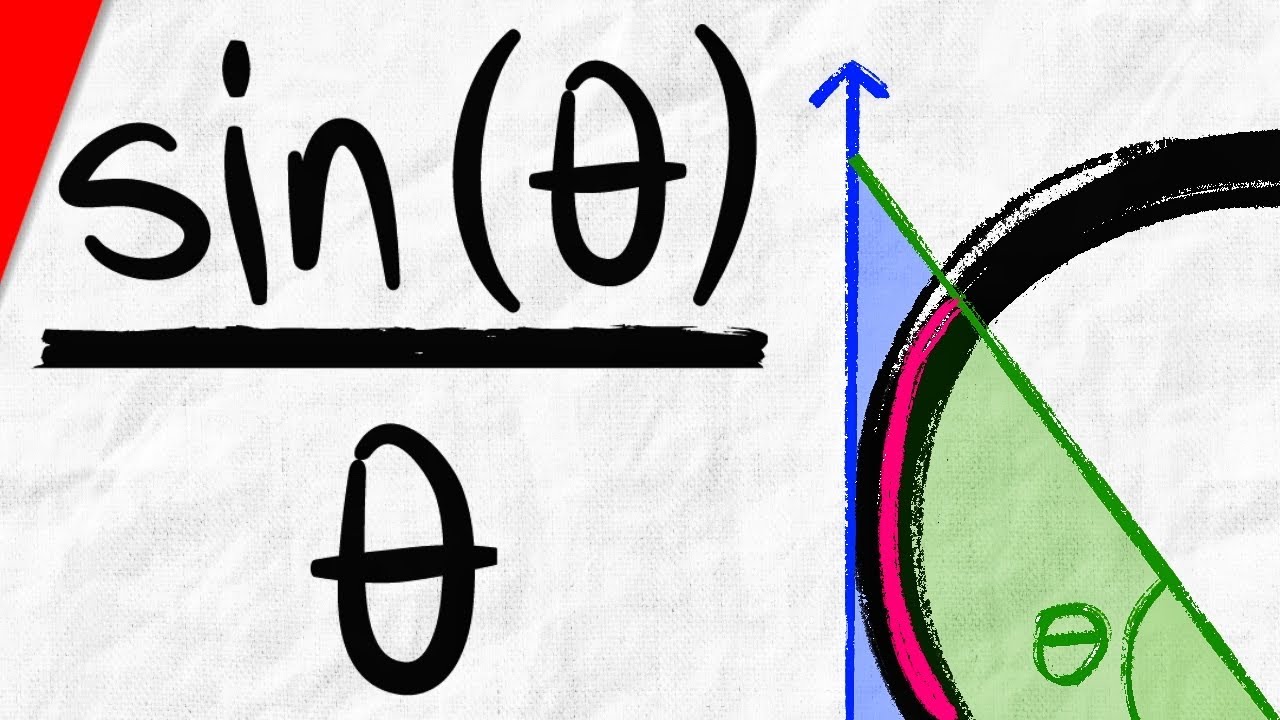
We prove the limit of sinx/x as x goes to 0 equals 1 using the squeeze theorem and a geometric argument involving sectors and triangles on the unit circle. #calculus1 #apcalculus
Join Wrath of Math to get exclusive videos, lecture notes, and more:
https://www.youtube.com/channel/UCyEKvaxi8mt9FMc62MHcliw/join
Squeeze Theorem Explained: (coming...
fathom saddle
Yes if you want to prove these limits, you need to do so geometrically
L'hopital is technically circular. You need the derivative to get the limit, but you need this limit to know the derivative
Not a big deal if you just forgot the limit though
full forumBOT
Channel closed
Closed by @north temple
Use .reopen if this was a mistake.
north temple
.reopen
full forumBOT
✅
north temple
is this true: lim x->0 of sin(ax)/bx goes to a/b?
 ember solstice
,w limit of sin(ax)/(bx) as x -> 0
glossy valveBOT


 Requested by en.ratham
ember solstice
glossy valve
Requested by en.ratham
ember solstice
glossy valve
@north temple
north temple
.close
full forumBOT
Channel closed
Closed by @north temple
Use .reopen if this was a mistake.
north temple
.reopen
full forumBOT
✅
sudden condor
can't you like send a picture ?
sudden condor
why not send it then but ok
use the fact that 1+tan^2(x)=sec^2(x) rearrange for tan^2(x) and go on from here
north temple
.close
full forumBOT
Channel closed
Closed by @north temple
Use .reopen if this was a mistake.
Available help channel!
Send your question here to claim the channel.
Remember:
• Ask your math question in a clear, concise manner.
• Show your work, and if possible, explain where you are stuck.
• After 15 minutes, feel free to ping <@&286206848099549185>.
• Type the command .close to free the channel when you're done.
• Be polite and have a nice day!
Read #❓how-to-get-help for further information on how to ask a good question, and about conduct in the question channels.
 vernal coral
for part(c), what limits would you consider to find the limiting value of T?
 full forumBOT
vernal coral
for part(c), what limits would you consider to find the limiting value of T?
vernal coral
full forumBOT
vernal coral
for part(c), what limits would you consider to find the limiting value of T?
vernal coral
i know i gotta explain why T < u/g, but have no idea how to get to that
full forumBOT
@vernal coral Has your question been resolved?
 gritty rose
catches up means x_A = x_B at some point
full forumBOT
Channel closed
Closed due to timeout
Use .reopen if this was a mistake.
full forumBOT
Available help channel!
Send your question here to claim the channel.
Remember:
• Ask your math question in a clear, concise manner.
• Show your work, and if possible, explain where you are stuck.
• After 15 minutes, feel free to ping <@&286206848099549185>.
• Type the command .close to free the channel when you're done.
• Be polite and have a nice day!
Read #❓how-to-get-help for further information on how to ask a good question, and about conduct in the question channels.
 jade cradle
does my venn diahgram look correct?
 full forumBOT
jade cradle
does my venn diahgram look correct?
full forumBOT
jade cradle
does my venn diahgram look correct?
@jade cradle Has your question been resolved?
 neon surge
jade cradle
does my venn diahgram look correct?
neon surge
jade cradle
does my venn diahgram look correct?
42 are also enrolled in anatomy, but not only anatomy exclusively
so that 42 is incorrect for students only in A
same thing for 27
to check if you are correct you can sum all numbers in the diagram and it should equal the number of students
jade cradle
so i would get the correct numbers by subtracting it from their intersection?
jade cradle
if i did it that way i would get 2 for a and 0 for c

and that just doesnt feel right like at all
jade cradle
chat im cooked
full forumBOT
@jade cradle Has your question been resolved?
 hot herald
can you show your work
full forumBOT
Channel closed
Closed due to timeout
Use .reopen if this was a mistake.
Available help channel!
Send your question here to claim the channel.
Remember:
• Ask your math question in a clear, concise manner.
• Show your work, and if possible, explain where you are stuck.
• After 15 minutes, feel free to ping <@&286206848099549185>.
• Type the command .close to free the channel when you're done.
• Be polite and have a nice day!
Read #❓how-to-get-help for further information on how to ask a good question, and about conduct in the question channels.
 hasty sinew
If 5x is congruent to 3 mod 13, find the minimum value of 3-digit even no. x
full forumBOT
hasty sinew
If 5x is congruent to 3 mod 13, find the minimum value of 3-digit even no. x
hasty sinew
Is it wrong if x is congruent to 11 mod 13?
full forumBOT
@hasty sinew Has your question been resolved?
 hushed barn
hasty sinew
Is it wrong if x is congruent to 11 mod 13?
hushed barn
hasty sinew
Is it wrong if x is congruent to 11 mod 13?
It’s not wrong because gcd(5,13) = 1 tells us that there exists a multiplicative inverse which we can find through Bezout’s lemma (or Euclidean algorithm) but you already found it. I’m pretty sure this is the only unique solution mod13, but you can double check by quickly testing 0 to 12 in x and seeing which works.
full forumBOT
Channel closed
Closed due to timeout
Use .reopen if this was a mistake.
Available help channel!
Send your question here to claim the channel.
Remember:
• Ask your math question in a clear, concise manner.
• Show your work, and if possible, explain where you are stuck.
• After 15 minutes, feel free to ping <@&286206848099549185>.
• Type the command .close to free the channel when you're done.
• Be polite and have a nice day!
Read #❓how-to-get-help for further information on how to ask a good question, and about conduct in the question channels.
 bitter granite
Function is a relation (except one to many mapping)
green merlin
!original
full forumBOT
Please show the original problem, exactly as it was stated to you, with the entire original context. A picture or screenshot is best. If the original problem is not in English, then post it anyway! The additional context might still be helpful. Do your best to provide a translation.
bitter granite
green merlin
!original
A function is a type of relation, except it does not allow one-to-many mappings.
Not for specific problem just for conformation whether my argument is TRUE r not
rapid rain
you can view a function as its graph if you want, but then it's a little bit more complicated than that
so indeed you can view a function f:E->F as a subset of E x F
bitter granite
I wnt to know in mapping perspective
rapid rain
call that subset G
but you need for each e in E, there exists exactly ONE g in G such that g = (e, something)
so it's not just "one to many" that's excluded
there's also "one to nothing" excluded
if we can call it that
bitter granite
rapid rain
but you need for each e in E, there exists exactly ONE g in G such that g = (e, ...
So my argument is TRUE because relation is definited because relation is defined as subset of E x F
bitter granite
rapid rain
there's also "one to nothing" excluded
Ok
rapid rain
functions are relations yes
not all relations are functions
for a relation to be a function, you need it to not be "one to many", and not be "one to nothing"
bitter granite
rapid rain
for a relation to be a function, you need it to not be "one to many", and not be...
Ok
full forumBOT
@bitter granite Has your question been resolved?
Channel closed
Closed by @bitter granite
Use .reopen if this was a mistake.
Available help channel!
Send your question here to claim the channel.
Remember:
• Ask your math question in a clear, concise manner.
• Show your work, and if possible, explain where you are stuck.
• After 15 minutes, feel free to ping <@&286206848099549185>.
• Type the command .close to free the channel when you're done.
• Be polite and have a nice day!
Read #❓how-to-get-help for further information on how to ask a good question, and about conduct in the question channels.
 weary terrace
Facing issue with this question specifically 3rd part and answer
 weary terrace
Wht i hv done

 keen fern
i
full forumBOT
@weary terrace Has your question been resolved?
weary terrace
<@&286206848099549185>
weary terrace
<@&286206848099549185>
urban jacinth
weary terrace
Wht i hv done
Why haven't you drawn the graph for 2 to 5?
urban jacinth
weary terrace
Wht i hv done
Also the segment between -2root2 to 0 is a circle right? Cuz it looks like a parabola from what y9uve drawn
weary terrace
urban jacinth
Why haven't you drawn the graph for 2 to 5?
Thats the part m having problem in
weary terrace
urban jacinth
Also the segment between -2root2 to 0 is a circle right? Cuz it looks like a par...
Yes
urban jacinth
weary terrace
Thats the part m having problem in
Ah isee
Draw the individual graphs of |x - 2| and -2x^2+8x-5
Observe in which intervals is one function greater than the other
The max function will only give output of that function which is the greater one in a certain interval
weary terrace
Ok ill do once m home now
full forumBOT
@weary terrace Has your question been resolved?
full forumBOT
Channel closed
Closed by @weary terrace
Use .reopen if this was a mistake.
full forumBOT
Available help channel!
Send your question here to claim the channel.
Remember:
• Ask your math question in a clear, concise manner.
• Show your work, and if possible, explain where you are stuck.
• After 15 minutes, feel free to ping <@&286206848099549185>.
• Type the command .close to free the channel when you're done.
• Be polite and have a nice day!
Read #❓how-to-get-help for further information on how to ask a good question, and about conduct in the question channels.
 burnt cave
l2i7timalat 😭
full forumBOT
burnt cave
l2i7timalat 😭
 austere cove
@burnt cave did you have a question?
burnt cave
austere cove
<@1363982092458786908> did you have a question?
Im so sorry, no i didn't have any questions.
i'm js new to this server
austere cove
No worries, welcome to the server!
onyx glen
what does l2i7timalat mean 
austere cove
If you don't have a question you can close this channel by using .close
burnt cave
.close
full forumBOT
Channel closed
Closed by @burnt cave
Use .reopen if this was a mistake.
Available help channel!
Send your question here to claim the channel.
Remember:
• Ask your math question in a clear, concise manner.
• Show your work, and if possible, explain where you are stuck.
• After 15 minutes, feel free to ping <@&286206848099549185>.
• Type the command .close to free the channel when you're done.
• Be polite and have a nice day!
Read #❓how-to-get-help for further information on how to ask a good question, and about conduct in the question channels.
 loud haven
anyone up for finding the mistake in a haystack?
 full forumBOT
loud haven
anyone up for finding the mistake in a haystack?
loud haven
full forumBOT
loud haven
anyone up for finding the mistake in a haystack?
loud haven


been looking at this for a solid hour now and i am not finding a mistake. Its all gaussian integrals and some feynman tricks.
result should have been -2/pi e^(-2|α|²) (1-4|α|²)
loud haven
loud haven
seeing a mistake here now. the feynman trick is missing a minus. This results in losing the first term in the brackets, thats not better
feynman integration fixed, but still bad result

 loud haven
anyone up for finding the mistake in a haystack?
loud haven
loud haven
anyone up for finding the mistake in a haystack?
its quantum mechanics. What a wigner function is, is written in the second line here and the characteristic function for a fock state is inserted in the third line
full forumBOT
@loud haven Has your question been resolved?
full forumBOT
Channel closed
Closed by @loud haven
Use .reopen if this was a mistake.
full forumBOT
Available help channel!
Send your question here to claim the channel.
Remember:
• Ask your math question in a clear, concise manner.
• Show your work, and if possible, explain where you are stuck.
• After 15 minutes, feel free to ping <@&286206848099549185>.
• Type the command .close to free the channel when you're done.
• Be polite and have a nice day!
Read #❓how-to-get-help for further information on how to ask a good question, and about conduct in the question channels.
 open lantern
Hello!
Can someone help with orientated angles? I'm stuck on part 5 and idk what to do
 full forumBOT
open lantern
Hello!
Can someone help with orientated angles? I'm stuck on part 5 and idk what...
open lantern
full forumBOT
open lantern
Hello!
Can someone help with orientated angles? I'm stuck on part 5 and idk what...
open lantern
I thought about switching it from (DB,EB) to (-BD,-BE)
But I'm not sure how to solve it from there.
Is it 2π - (BD,BE)?
Or is (DB,EB) the same as (BD,BE)
ABD = π/6 = 30° (given)
EBA = 60° (equilateral triangle)
(DB,EB) = (BD,BE)
-ve sign (it's clockwise)
Thus, the answer is
-π/2 + 2kπ
Is this correct
full forumBOT
@open lantern Has your question been resolved?
Channel closed
Closed by @open lantern
Use .reopen if this was a mistake.
open lantern
.close
full forumBOT
Available help channel!
Send your question here to claim the channel.
Remember:
• Ask your math question in a clear, concise manner.
• Show your work, and if possible, explain where you are stuck.
• After 15 minutes, feel free to ping <@&286206848099549185>.
• Type the command .close to free the channel when you're done.
• Be polite and have a nice day!
Read #❓how-to-get-help for further information on how to ask a good question, and about conduct in the question channels.
 tall folio
 full forumBOT
tall folio
tall folio
full forumBOT
tall folio
tall folio
Who tryna help a brother out
full forumBOT
@tall folio Has your question been resolved?
full forumBOT
Channel closed
Closed due to timeout
Use .reopen if this was a mistake.
Available help channel!
Send your question here to claim the channel.
Remember:
• Ask your math question in a clear, concise manner.
• Show your work, and if possible, explain where you are stuck.
• After 15 minutes, feel free to ping <@&286206848099549185>.
• Type the command .close to free the channel when you're done.
• Be polite and have a nice day!
Read #❓how-to-get-help for further information on how to ask a good question, and about conduct in the question channels.
 sleek quest
alr this is what i have so far
 full forumBOT
sleek quest
alr this is what i have so far
full forumBOT
sleek quest
alr this is what i have so far
 balmy karma
whats that function again?
 full forumBOT
@sleek quest Has your question been resolved?
full forumBOT
@sleek quest Has your question been resolved?
full forumBOT
@sleek quest Has your question been resolved?
Channel closed
Closed by @sleek quest
Use .reopen if this was a mistake.
full forumBOT
Available help channel!
Send your question here to claim the channel.
Remember:
• Ask your math question in a clear, concise manner.
• Show your work, and if possible, explain where you are stuck.
• After 15 minutes, feel free to ping <@&286206848099549185>.
• Type the command .close to free the channel when you're done.
• Be polite and have a nice day!
Read #❓how-to-get-help for further information on how to ask a good question, and about conduct in the question channels.
 torn jolt
Helloes am doing some prep for entrance exams and I'm currently stuck with this equation, translated it goes something along the lines of "in the set of all real numbers are all solutions to the equation:"
 full forumBOT
torn jolt
Helloes am doing some prep for entrance exams and I'm currently stuck with this ...
torn jolt
full forumBOT
torn jolt
Helloes am doing some prep for entrance exams and I'm currently stuck with this ...
torn jolt
tried a few things I first tried to use the exponent rule I think it is called converting it to

which got me to 10^2000 = x which wasn't right so then I tried to separate the 1000x value and then use the rule giving me this

which I tried to manipulate a bit but couldn't get a good easily solvable value
also tried to divide the whole thing by x from the start but I just ended up getting logx/x = 1000

<@&286206848099549185>
 slender bane
I am not sure how to algebraically solve it
but like aren't you provided with 4 options?
torn jolt
slender bane
but like aren't you provided with 4 options?
I belive the abcd are meant to be the answers and you choose which one is correct
torn jolt
substitution right
slender bane
yes
torn jolt
shall try
full forumBOT
@torn jolt Has your question been resolved?
torn jolt
sooo tried it I saw the vision but the quadratic didn't give me pretty numbers :((

I aam like
starting to question whether these are even meant to be solvable T.T
oh wait
forgot to ^2
lemme see again
yeah still doesnt seem to match
 spice knot
torn jolt
Helloes am doing some prep for entrance exams and I'm currently stuck with this ...
spice knot
torn jolt
Helloes am doing some prep for entrance exams and I'm currently stuck with this ...
is the log in the problem base 10 or natural log
torn jolt
seems to jusst say log so I assume base 10
torn jolt
log(1000) + log(x^2) right? then turning it to log (1000) + 2*log(x) or am I doing something incorrect?
torn jolt
OH log10(1000) = 3 right?
spice knot
yep
torn jolt
oh snap my small brain didn't realize T.T
lemme try again
OKAY
is correct!!
Thankiess so much!
cant belive the answer is real T.T

.closed
.close
full forumBOT
Channel closed
Closed by @marble sigil
Use .reopen if this was a mistake.
Available help channel!
Send your question here to claim the channel.
Remember:
• Ask your math question in a clear, concise manner.
• Show your work, and if possible, explain where you are stuck.
• After 15 minutes, feel free to ping <@&286206848099549185>.
• Type the command .close to free the channel when you're done.
• Be polite and have a nice day!
Read #❓how-to-get-help for further information on how to ask a good question, and about conduct in the question channels.
 hoary ember
where did a(a+4)=0 come from at the very end
 full forumBOT
hoary ember
where did a(a+4)=0 come from at the very end
full forumBOT
hoary ember
where did a(a+4)=0 come from at the very end

 grave elm
hoary ember
where did a(a+4)=0 come from at the very end
grave elm
hoary ember
where did a(a+4)=0 come from at the very end
-b/a = b/2sqrt(-a)
-a = 2sqrt(-a)
green merlin
 sturdy valve
heyy my teacher gave me this same question
sturdy valve
heyy my teacher gave me this same question
oh cool
full forumBOT
Channel closed
Closed by @hoary ember
Use .reopen if this was a mistake.
Available help channel!
Send your question here to claim the channel.
Remember:
• Ask your math question in a clear, concise manner.
• Show your work, and if possible, explain where you are stuck.
• After 15 minutes, feel free to ping <@&286206848099549185>.
• Type the command .close to free the channel when you're done.
• Be polite and have a nice day!
Read #❓how-to-get-help for further information on how to ask a good question, and about conduct in the question channels.
 upper galleon
I need to find the area that's bounded by two polar curves
r = 1 and r= 2 cos(theta)
Can I use double integral for polar to tackle this problem? I'm not sure about the bounds for r
Is it from 0 to 1 or from 2cos(theta) to 1
 full forumBOT
upper galleon
I need to find the area that's bounded by two polar curves
r = 1 and r= 2 cos(t...
rapid rain
upper galleon
I need to find the area that's bounded by two polar curves
r = 1 and r= 2 cos(t...
full forumBOT
upper galleon
I need to find the area that's bounded by two polar curves
r = 1 and r= 2 cos(t...
rapid rain
upper galleon
I need to find the area that's bounded by two polar curves
r = 1 and r= 2 cos(t...
depends on if you chose theta before or after
if you chose theta first, so independently of r, then r's bounds will depend on theta
if you chose r first, so independently of theta, then theta's bounds will depend on r
(I suggest the first option)
so now you have to find the true bounds of theta
upper galleon
The theta is -pi/3 to pi/3 (?)
rapid rain
upper galleon
The theta is -pi/3 to pi/3 (?)
it's a bit more complicated than that
While I'd agree that on this angle interval, r can exist between 2cos(theta) and 1
but that's not the only angles that are in the area between the polar curves
rapid rain
upper galleon
I need to find the area that's bounded by two polar curves
r = 1 and r= 2 cos(t...

Right now you're describing this green sector
upper galleon
ah yeah, I understand
rapid rain
also it's better to see that on this sector, r will vary from 0 to 1
and not from 2cos(theta) to 1
what about the leftover area? how to describe it?
what's the angle range and what's the radius range?
upper galleon
I think it's very close to -pi/2 to pi/2 ?
Sorry I'm new to this polar things 🙂
full forumBOT
@upper galleon Has your question been resolved?
full forumBOT
Channel closed
Closed due to timeout
Use .reopen if this was a mistake.
Available help channel!
Send your question here to claim the channel.
Remember:
• Ask your math question in a clear, concise manner.
• Show your work, and if possible, explain where you are stuck.
• After 15 minutes, feel free to ping <@&286206848099549185>.
• Type the command .close to free the channel when you're done.
• Be polite and have a nice day!
Read #❓how-to-get-help for further information on how to ask a good question, and about conduct in the question channels.
sturdy valve
 full forumBOT
sturdy valve
sturdy valve
full forumBOT
sturdy valve
sturdy valve
i need help in part b
sturdy valve
yeah
urban jacinth
I suggest using x^2 - x = t
sturdy valve
first i found min values of those quadratics and multiplied them
but i realised that approach is wrong
sturdy valve
urban jacinth
I suggest using x^2 - x = t
and then multiply and differentiate?
urban jacinth
sturdy valve
and then multiply and differentiate?
Yep
full forumBOT
Channel closed
Closed by @sturdy valve
Use .reopen if this was a mistake.
urban jacinth
Np
full forumBOT
Available help channel!
Send your question here to claim the channel.
Remember:
• Ask your math question in a clear, concise manner.
• Show your work, and if possible, explain where you are stuck.
• After 15 minutes, feel free to ping <@&286206848099549185>.
• Type the command .close to free the channel when you're done.
• Be polite and have a nice day!
Read #❓how-to-get-help for further information on how to ask a good question, and about conduct in the question channels.
 full delta
 full forumBOT
full delta
full forumBOT
full forumBOT
full delta
full forumBOT
@full delta Has your question been resolved?
 woeful pasture
im not sure
but | | is the cardinality or size, i think?
and S is the inductive definition used to create the language, maybe
full delta
The language?

 full delta
?
We are defining the structure on which Number Theory is defined
Right?
Thx
.close
full forumBOT
Channel closed
Closed by @full delta
Use .reopen if this was a mistake.
full delta
.reopen
full forumBOT
✅
 snow plume
I didn’t learn number theory this way but I guess is that it means we can define this structure with a underlying set with cardinality the natural number and the zero object satisfying that 0^N =0 whatever?
full delta
Whats that 0^ thing
I don't get that notation
The actual material is pretty straightforward, it's just defining a structure for developing number theory over
 twin wolf
🦑
full delta
Hi waterbeam, do u know what that notation is
twin wolf
no 
full delta
.close
full forumBOT
Channel closed
Closed by @full delta
Use .reopen if this was a mistake.
full forumBOT
Available help channel!
Send your question here to claim the channel.
Remember:
• Ask your math question in a clear, concise manner.
• Show your work, and if possible, explain where you are stuck.
• After 15 minutes, feel free to ping <@&286206848099549185>.
• Type the command .close to free the channel when you're done.
• Be polite and have a nice day!
Read #❓how-to-get-help for further information on how to ask a good question, and about conduct in the question channels.
 modern horizon
Prove that there exists a continuous bijection $f:\mathbb{R}\to\mathbb{R}$, whose inverse $f^{-1}$ is also continuous, such that $f(2x)=f(x)+[f(x)]^3$ for all $x\in\mathbb{R}$.
full forumBOT
modern horizon
Prove that there exists a continuous bijection $f:\mathbb{R}\to\mathbb{R}$, whos...
glossy valveBOT
(ᗜ ˰ ᗜ)
 full forumBOT
@modern horizon Has your question been resolved?
modern horizon
<@&286206848099549185>
urban jacinth
modern horizon
Prove that there exists a continuous bijection $f:\mathbb{R}\to\mathbb{R}$, whos...
Have they found a function?
I'm not getting one except for f = 0
@modern horizon
modern horizon
;( I don’t know if there is a closed form for f…
urban jacinth
I'm also not getting one
modern horizon
But I just need to prove it exists.
rapid rain
I have a feeling that you can just pick whatever you want between something like [1/2,1), like a straight line
and then pick a nice enough function so that it connects for each interval of the form [2^n,2^(n+1))
Oh I just looked in helpers lounge and someone got the idea before me xddd
anyways if anyone wants to explain that
 thick hedge
modern horizon
But I just need to prove it exists.
thick hedge
modern horizon
But I just need to prove it exists.
So an example suffices
modern horizon
o.o
modern horizon
rapid rain
and then pick a nice enough function so that it connects for each interval of th...
Sorry could you explain it in more detail ;o
<@&286206848099549185>
rapid rain
Since f(2^n x) is determined entirely by f(x) for every x and n
you only need to know f on some interval like [1/2,1) or [1,2)
so now just pick some appropriate values such that when you "stitch" those intervals together
f is continuous and, let's say increasing
then f(0) = 0 is for sure
and take f(-x) = -f(x) to keep the same monotonicity for the negative reals
so let's say
f(x) = x for x in [1,2) works for example
modern horizon
@rapid rain So like.. Let $S={\frac{k}{n}:k\in\mathbb{Z}, n\in\mathbb{N}}$ and $g$ defined on $S$. We have that $g$ is a strictly increasing and unbounded bijection. Since $S$ is dense in $\mathbb{R}$, we can extend $g$ continuously to $\mathbb{R}$ by $f=\lim_{s\in S}g(s)$. By the strict monotonicity and the continuity, $f^{-1}$ is also continuous. Q.E.D.?
glossy valveBOT
(ᗜ ˰ ᗜ)
 rapid rain
modern horizon
<@246787399991033858> So like.. Let $S=\{\frac{k}{n}:k\in\mathbb{Z}, n\in\mathbb...
rapid rain
modern horizon
<@246787399991033858> So like.. Let $S=\{\frac{k}{n}:k\in\mathbb{Z}, n\in\mathbb...
It would be more like this: write g(u) = u + u^3
let x in (0,infinity)
there exists $t \in [1,2)$ and $n \in \bZ$ such that $x = 2^nt$
glossy valveBOT
rafilou is not not born in 2003
 rapid rain
we thus let $f(x) = g^n(t)$
glossy valveBOT
rafilou is not not born in 2003
 rapid rain
here g^n is to be taken as g composed with itself n times
g^0 is the identity
and g^(-n) is the inverse of g composed with itself n times, n > 0
then let f(0) = 0 and f(-x) = -f(x) to complete the values of f
rapid rain
modern horizon
Qs, is there something wrong with my construction? O.O
many things yes
first of all it seems like you let S = Q the set of rationals
and you suppose "g" that works well is defined on that set
you haven't defined what g is so I'm having a hard time believing you already
then you said g is a bijection
between S and S?
and is that even true?
then you state that we can extend it continuously to R
why?
rapid rain
modern horizon
https://math.stackexchange.com/questions/76854/extending-a-function-by-continuit...
that would require you to prove that g is uniformly continuous on S, or at least continuous
I don't know how you would do that
and what about everything else I listed
so yeah, there are some things wrong with how your tried to construct it
modern horizon
No, from the answer below, no uniform continuity is required
rapid rain
modern horizon
No, from the answer below, no uniform continuity is required
so still requires to prove continuity
modern horizon
rapid rain
we thus let $f(x) = g^n(t)$
Thank you very muchhh I now have a rough idea of how to prove the monotonic continuity of f.
full forumBOT
@modern horizon Has your question been resolved?
full forumBOT
Channel closed
Closed due to timeout
Use .reopen if this was a mistake.
Available help channel!
Send your question here to claim the channel.
Remember:
• Ask your math question in a clear, concise manner.
• Show your work, and if possible, explain where you are stuck.
• After 15 minutes, feel free to ping <@&286206848099549185>.
• Type the command .close to free the channel when you're done.
• Be polite and have a nice day!
Read #❓how-to-get-help for further information on how to ask a good question, and about conduct in the question channels.
 manic bramble
I'm taking some linear algebra notes. Can you please double check the underlined part of my note? I want to make sure that it's correct:
 full forumBOT
manic bramble
I'm taking some linear algebra notes. Can you please double check the underlined...
full forumBOT
manic bramble
I'm taking some linear algebra notes. Can you please double check the underlined...
 silver topaz
you have the idea, but maybe "length" isnt the best word, since v_i can be negative and we dont think of lengths as negative
i would instead write something along the lines of "signed length"
full forumBOT
Channel closed
Closed by @manic bramble
Use .reopen if this was a mistake.
silver topaz
glad to help 😄
full forumBOT
Available help channel!
Send your question here to claim the channel.
Remember:
• Ask your math question in a clear, concise manner.
• Show your work, and if possible, explain where you are stuck.
• After 15 minutes, feel free to ping <@&286206848099549185>.
• Type the command .close to free the channel when you're done.
• Be polite and have a nice day!
Read #❓how-to-get-help for further information on how to ask a good question, and about conduct in the question channels.
 strange basalt
In one of my class today , our sir gave us this question
 strange basalt
He told us to set all the coeff and constant to zero if the questions mentions a polynomial of degree suppose n
and it states the number of roots the given polynomial has is >n
i dont understand its implication
why are we creating a zero function
what does this question even mean
Is there a framing error?
stiff musk
the key fact is that a non-constant polynomial of degree N has at most N roots
strange basalt
yeah thats in my knowledge box
stiff musk
so if the given polynomial is not constant, the equation has at most 2 solutions
thus it must be constant if there are going to be 3 (or more) solutions
and the right hand side is zero, so that constant must be zero
and the only way that happens is if all three coefficients of the polynomial are zero
strange basalt
oh yeah i can see that yeah
stiff musk
(in fact there will of course be infinitely many solutions in that case, not just 3)
strange basalt
oh the key fact to note is that it states will have three solution , not atmost three i belive?
strange basalt
stiff musk
(in fact there will of course be infinitely many solutions in that case, not jus...
yeahhhhhh okay yeah
stiff musk
yea, your sir should have said "3 or more" really
strange basalt
yeah that cleared up the mess , thanks for the perspective!!!
stiff musk
sure, yw
full forumBOT
Channel closed
Closed by @strange basalt
Use .reopen if this was a mistake.
full forumBOT
Available help channel!
Send your question here to claim the channel.
Remember:
• Ask your math question in a clear, concise manner.
• Show your work, and if possible, explain where you are stuck.
• After 15 minutes, feel free to ping <@&286206848099549185>.
• Type the command .close to free the channel when you're done.
• Be polite and have a nice day!
Read #❓how-to-get-help for further information on how to ask a good question, and about conduct in the question channels.
 azure flax
 full forumBOT
Channel closed
Closed due to timeout
Use .reopen if this was a mistake.
Available help channel!
Send your question here to claim the channel.
Remember:
• Ask your math question in a clear, concise manner.
• Show your work, and if possible, explain where you are stuck.
• After 15 minutes, feel free to ping <@&286206848099549185>.
• Type the command .close to free the channel when you're done.
• Be polite and have a nice day!
Read #❓how-to-get-help for further information on how to ask a good question, and about conduct in the question channels.
 half oyster
 full forumBOT
half oyster
full forumBOT
half oyster

 glacial thorn
half oyster
glacial thorn
half oyster
Nope, this is incorrect. If you have a fraction exponent, the numerator of the exponent is the power of the under root, while the denominator is the index of the root
 lime ether
half oyster
lime ether
half oyster
same shit
half oyster
alright


 lime ether

 brave ruin
Yea it's correct
brave ruin
brave ruin
Yea it's correct
@half oyster
 clear pumice
$(x^{\frac{1}{n}})^m = (x^m)^{\frac{1}{n}} = x^{\frac{m}{n}}$
glossy valveBOT
BuilderDolphin
 half oyster
okay bet I trust you all
clear pumice
(if the root is rewritten as power 1/n)
full forumBOT
Channel closed
Closed by @half oyster
Use .reopen if this was a mistake.
Available help channel!
Send your question here to claim the channel.
Remember:
• Ask your math question in a clear, concise manner.
• Show your work, and if possible, explain where you are stuck.
• After 15 minutes, feel free to ping <@&286206848099549185>.
• Type the command .close to free the channel when you're done.
• Be polite and have a nice day!
Read #❓how-to-get-help for further information on how to ask a good question, and about conduct in the question channels.
 spring bay
how do I do this? I’m not sure how to start
 full forumBOT
spring bay
how do I do this? I’m not sure how to start
full forumBOT
spring bay
how do I do this? I’m not sure how to start
 ornate bobcat
Do you know, what's the equation of a line ?
spring bay
y=mx+b
ornate bobcat
Oh wait, you need to ketch not to derive hmm
spring bay
ornate bobcat
Oh wait, you need to ketch not to derive hmm
I need to find the parametric system
nvm sketch too
 carmine minnow
spring bay
I need to find the parametric system
carmine minnow
spring bay
I need to find the parametric system
there's a really simple parametric system you can get from a y=f(x)
just set x=t
(i believe you are looking for parametric equations?)
but there are other ones which might be even easier to state
spring bay
carmine minnow
just set x=t
wait wdym
carmine minnow
how to change y=f(x) into parametric equations for any f
x=t
y=f(t)
of course, this is probably not the intended method
spring bay
should I like find the equation of the line first
ornate bobcat
Ok that works but is that what the instructor wants : )
carmine minnow
(and there is an easier way)
spring bay
ornate bobcat
Ok that works but is that what the instructor wants : )
not sure cuz he never taught us this
soo i don’t think he’ll mind
carmine minnow
the question only asks for a parametric system
ornate bobcat
Good point
carmine minnow
and obviously it's not unique
ornate bobcat
spring bay
should I like find the equation of the line first
So you know what a parametric equation is right
You will just derive the equation of a line using those 2 points
You know what's m in your formula right?
spring bay
ornate bobcat
So you know what a parametric equation is right
You will just derive the equati...
so like y=3x-5?😭
ornate bobcat
spring bay
so like y=3x-5?😭
It's correct
spring bay
is that like the parent function
ornate bobcat
spring bay
is that like the parent function
What?
spring bay
actually idk what im talking about
cuz like usually when I solve parametric systems, it’ll tell me to find the parent function
ornate bobcat
You used the function
y = mx + c
And derived the equation of a line without knowing what's m in the equation?
spring bay
ornate bobcat
You used the function
y = mx + c
And derived the equation of a line without know...
m is 3
ornate bobcat
Generally m is the slope between 2 points
Which is calculated by
$$m = \frac{y_2-y_1}{x_2-x_1}$$
spring bay
ornate bobcat
Generally m is the slope between 2 points
I did 10-1/5-2
glossy valveBOT
Sherif Player
 ornate bobcat
Yeah
And yeah you substitute the a point in the original equation to calculate c
And vowala you got the equation
After you got the equation you can do as Element118 said
spring bay
ornate bobcat
After you got the equation you can do as Element118 said
im kinda confused on that
ornate bobcat
Set x=t
And turn any x in the original y equation into t
spring bay
y=3t-5?
ornate bobcat
spring bay
im kinda confused on that
Yeah and x = t
Wrong replay
But yeah yeah you can stop here
And call it a day
If you wanted the systematic way
In parametric equations of second order you have 2 variables
X and Y
$$x = x_0 + at$$
$$y = y_0 + bt$$
glossy valveBOT
Sherif Player
 ornate bobcat
Where
$(x_0, y_0)$ is the starting point
And $(a,b)$ is a direction victor starting from that point
glossy valveBOT
Sherif Player
 ornate bobcat
So all you have to do is to get a direction vector from the 2 points
How do you think we can get it
spring bay
ornate bobcat
So all you have to do is to get a direction vector from the 2 points
what’s a direction vector
ornate bobcat
A vector that points into a certain/wanted direction from a certain point
spring bay
(5-2,10-1) = (3,9)?
spring bay
ornate bobcat
At what point do you think this starts at
(3,9)?
ornate bobcat
Generally a vector starting at a and going to b
Is calculated via b - a
So
What you calculated is a vector going from one of the 2 points to the other
What do you think is it
spring bay
I’m confused 😭
cuz I thought direction vectors doesnt have a starting point
or r u talking about the line
(2,1)
ornate bobcat
Vectors have a starting point
ornate bobcat
spring bay
(2,1)
(2,1) is a point
But it is actually the starting point of the vector
fathom saddle
You can move that starting point, but it's helpful to sometimes give a vector a starting point
spring bay
x = 2 + 3t
y = 1+ 9t
?

 spring bay
can I use that method for similar questions like this? like if it’s a ray instead of a line
ornate bobcat
ornate bobcat
And that's the systematic one we just did
Both are the same
And this is the original line
 ornate bobcat
spring bay
can I use that method for similar questions like this? like if it’s a ray instea...
ornate bobcat
spring bay
can I use that method for similar questions like this? like if it’s a ray instea...
Ray?
spring bay
ornate bobcat
That's the solution of Equation118
tyy
full forumBOT
Channel closed
Closed by @spring bay
Use .reopen if this was a mistake.
ornate bobcat
Np
full forumBOT
Available help channel!
Send your question here to claim the channel.
Remember:
• Ask your math question in a clear, concise manner.
• Show your work, and if possible, explain where you are stuck.
• After 15 minutes, feel free to ping <@&286206848099549185>.
• Type the command .close to free the channel when you're done.
• Be polite and have a nice day!
Read #❓how-to-get-help for further information on how to ask a good question, and about conduct in the question channels.
 spark tangle
yoooo
full forumBOT
spark tangle
yoooo
 tired sedge
!xy
full forumBOT
Please show the original problem, exactly as it was stated to you, with the entire original context. A picture or screenshot is best. If the original problem is not in English, then post it anyway! The additional context might still be helpful. Do your best to provide a translation.
 craggy tapir
spark tangle
yoooo
craggy tapir
spark tangle
yoooo
do you have a question?
spark tangle
tired sedge
!xy
i love how you haven’t talked in 4 days and this is what you chose to come back to lurker
green merlin
spark tangle
i love how you haven’t talked in 4 days and this is what you chose to come back ...
if you dont have a question then close
And dont insult ppl
spark tangle
green merlin
if you dont have a question then close
since we telling people what to do, dont talk to me
that’s MY request
green merlin
<@&268886789983436800> troll
 spice knot
oh there we go
spark tangle
green merlin
<@&268886789983436800> troll
because i said stop talking to me?
green merlin
do you want me to respond now that you dont want me to talk to you
spark tangle
green merlin
do you want me to respond now that you dont want me to talk to you
you just looking to fight w me
green merlin
L ragebait
 nimble crane
spark tangle
nimble crane
spark tangle
what's confusing you here? 
spice knot
I think thats called defense
 wide star
spice knot
wide star
spice knot
lol
full forumBOT
Channel closed
Closed by @wide star
Use .reopen if this was a mistake.
nimble crane
hm 
full forumBOT
Available help channel!
Send your question here to claim the channel.
Remember:
• Ask your math question in a clear, concise manner.
• Show your work, and if possible, explain where you are stuck.
• After 15 minutes, feel free to ping <@&286206848099549185>.
• Type the command .close to free the channel when you're done.
• Be polite and have a nice day!
Read #❓how-to-get-help for further information on how to ask a good question, and about conduct in the question channels.
 sharp osprey
Hi
full forumBOT
sharp osprey
Hi
sharp osprey

and it says "If (x,y) doesn't equal 0"
to figure out if it is 0 if (x,y) = 0
If I wanted to use polar coordinates
would I have to take the limit from both the left and right
or just one
 kindred parcel
sorry, just for clarification, is it asking you to find values for which f(x,y)=0?
and the definition is just this and the function is 0 at (x,y)=(0,0), right?
sharp osprey
kindred parcel
sorry, just for clarification, is it asking you to find values for which f(x,y)=...
yes I believe so, it isn't entirely clear, this is what was written
apparently that was some kind of notation
they just put a 0 there and it means the rest?
kindred parcel
I see. ok, well, then it is equal 0 at (0, 0) and whenever $x^3+6y^3=0$
glossy valveBOT
00100000
 kindred parcel
sharp osprey
I think they want me to show
kindred parcel
sharp osprey
I think they want me to show
oh
well
that's by definition
the function is defined that way
you cut off the right side of the function definition I think
but it'd only be sensible for it to be defined that way
sharp osprey
yes the right side says if (x,y) isn't equal to 0
and under that
it says (x,y) = (0,0)
kindred parcel
I figured
sharp osprey
kindred parcel
I figured
I did say!
kindred parcel
sharp osprey
I did say!
I thought you were saying the question at the top of the post. it wasn't clear
sharp osprey
sry I think I am mostly to blame
 steel nest
sharp osprey
steel nest
sharp osprey
without more context, this notation with brackets defines f(x,y) in two cases, but you cropped the picture so i’m not 100% sure
 kindred parcel
sharp osprey
I am not sure what you mean by definition
kindred parcel
sharp osprey
I am not sure what you mean by definition
if this function is defined as "$f(x,y)=0$ when $(x,y)=(0,0)$", then it means that $f(0,0)=0$
glossy valveBOT
00100000
 kindred parcel
sharp osprey
kindred parcel
sharp osprey
I don't understand why you cropped it in the first place
sharp osprey
kindred parcel
I don't understand why you cropped it in the first place
Not in English
Only reason
steel nest
sharp osprey
yeah it just define f(x,y) in two cases
sharp osprey
I thought maybe it was standard to write it that way
so people would understand anyway
It was my bad
I was wrong
We can move on
kindred parcel
sharp osprey
Not in English
but still, more context is always helpful
kindred parcel
glossy valve
**00100000**
^
sharp osprey
steel nest
yeah it just define f(x,y) in two cases
And the two cases are for 0+ and 0-?
sharp osprey
That's what the original question was
glossy valveBOT
00100000
 kindred parcel
sharp osprey
That's what the original question was
kindred parcel
sharp osprey
That's what the original question was
didn't you just say the original question is "show that f(0,0)=0"
kindred parcel
sharp osprey
I think they want me to show
^
kindred parcel
limit??
sharp osprey
Yes, limit
kindred parcel
there's no limit at all
you're looking at the value (0,0)
I'm beginning to think that you explained the question wrong
kindred parcel
could you give what the original question was in exact words?
kindred parcel
sharp osprey
but the function isn't defined
yes it is
kindred parcel
it's defined to be $0$ at $(0,0)$
glossy valveBOT
00100000
 kindred parcel
sharp osprey
I am dividing by 0?
kindred parcel
sharp osprey
I am dividing by 0?
no because that's how it's defined when $(x,y)\neq (0,0)$
glossy valveBOT
00100000
 kindred parcel
but when $(x,y)=(0,0)$, it is defined to be 0
glossy valveBOT
00100000
 kindred parcel
I can't really uh... say anything other than that
that's just how the function is defined
sharp osprey
Okay
I have to apologise
I missed something essential to the question...
Can we start over?
I'm sorry.
kindred parcel
if it says "the function behaves this way" and your question is "why does it behave this way," well, then the answer has to be "because when we said how the function behaves, we said that it behaves this way"
sharp osprey
I totally missed what was the question, I thought the entire question itself was just this image

The actual question is clear
steel nest
sharp osprey
And the two cases are for 0+ and 0-?
no the function is defined by two cases if (x,y) = (0,0) this notation say we impose that f(x,y) = 0 and if the imput (x,y) is not (0,0) then it’s the fraction. imo with what you have showed there is no question just a function definition
i type slow it seems
kindred parcel
steel nest
i type slow it seems
lol
sharp osprey
And it is to investigate if f is continuous for (x,y) = (0,0)
sharp osprey
sharp osprey
And it is to investigate if f is continuous for (x,y) = (0,0)
This was the actual question
kindred parcel
||it's not continuous||
sharp osprey
Sorry
sharp osprey
From single variable calculus we had to take the limit from the left and right
but the person does it from only one side using polar coordinates
is it just because cos and sin are periodic?
sharp osprey
sharp osprey
From single variable calculus we had to take the limit from the left and right
is that wrong?
I swear that's how you found out if something was continuous or at least one way
kindred parcel
sharp osprey
is that wrong?
yes, because there is no "left and right"
this is a function with a 2d domain $\R^2$
steel nest
you can approach (0,0) in many different way in R^2
glossy valveBOT
00100000
 sharp osprey
kindred parcel
yes, because there is no "left and right"
sharp osprey
kindred parcel
yes, because there is no "left and right"
well not for polar coordinates
or wait
kindred parcel
steel nest
you can approach (0,0) in many different way in R^2
infinitely many ways, in fact
sharp osprey
but what was all the stuff about 0+ and 0- then?
kindred parcel
you mean from single variable calculus?
sharp osprey
yes
kindred parcel
well, that's when your domain is 1d
right?
if it's 1d, then you can approach a point from 2 directions
but in 2d, you can approach it from infinitely many directions, right?
sharp osprey
that is what i was specifically asking about
kindred parcel
because now your domain can be visualized as a plane
sharp osprey
sorry if that unclear
kindred parcel
does that make intuitive sense?
steel nest
 sharp osprey
for single variable
sharp osprey
kindred parcel
does that make intuitive sense?
not entirely to me* but i think i could convince myself that it does make sense
kindred parcel
if not, we'd have to probably start getting our hands dirty with some epsilons and deltas, but idt ur class is going to use that
kindred parcel
sharp osprey
not entirely to me* but i think i could convince myself that it does make sense
yeah uhhhh... when we teach introductory calculus, we fail to introduce a lot of the "foundational" sort of ideas and kind of rely on mental pictures and intuition for stuff
so there's not much else I can say without getting dirty with definitions
sorry
kindred parcel
steel nest
^ great picture tho
steel nest
sharp osprey
we can use right and left limits
to check that f is discontinuous in single var calc yeah you can check that the limit approaching from the left is different from the limit approaching from the right
sharp osprey
steel nest
to check that f is discontinuous in single var calc yeah you can check that the ...
I understand how that might not make sense here since yeah we have to variables in the domain
tbh I don't have a good mental image of what that would mean
but I can ask my tutor on Wednesday about that next week
 steel nest
for a function of two variable, you can approach (0,0) in infinitely many way and if two of these way give different answer the function is discontinuous
sharp osprey
he used polar coordinates and substituted them into the function
and for some reason r is approacing 0+
i dont get why it is 0+ only
he said because r is greater than equal to 0
steel nest
sharp osprey
he used polar coordinates and substituted them into the function
he checked what was the result of the limit when approaching 0 with rays
sharp osprey
and i dont get why (x,y) approaching (0,0) swapped to r approaching 0+
i get he had to swap variables
sharp osprey
steel nest
he checked what was the result of the limit when approaching 0 with rays
with rays?
^ idk what that means
 steel nest
fixed theta but r getting smaller makes a line getting close of (0,0) in R^2
sharp osprey
steel nest
wait
thats wild
since r is the radius
it is like i am
shrinking a circle
around (0,0)
and you said there was no left or right
but that circle is everywhere
left right up down
so i really am approaching that point everywhere
when using polar coordinates
when r is approaching 0
but why 0+
why not just 0?
steel nest
meh you only approach (0,0) using lines
sharp osprey
i mean an infinitely short line might as well be a point
steel nest
but you could approach (0,0) in other funky way
sharp osprey
how if the radius is coming from origo
sharp osprey
sharp osprey
i mean an infinitely short line might as well be a point
why the  ?
?
steel nest
and you can come up with function such that for all lines going to the origin the limit has the same value but for some other curve like a parabolla a different value

lines don’t cover all cases
sharp osprey
okay then maybe I am misunderstanding how to look at the ray
sharp osprey
steel nest
these were rays?
sharp osprey
is this the wrong way
to look at it

and that circle shrinks
when r is shrinking
and it is because r is approaching 0
do i really have to view them as rays
i assume you drew
4 rays instead of infinite rays
or are there
specifically 4 rays?
ah
okay then that isn't a circle shrinking in on 0
sharp osprey
kindred parcel
but in 2d, you can approach it from infinitely many directions, right?
i thought there were infinite rays
because of this comment earlier
infinite many directions
but now there are 4 directions
we can approach from?
let me ask you this
steel nest
argh the emote is a missclick there are infinite rays
steel nest
each theta gives you a different ray
sharp osprey
steel nest
each theta gives you a different ray
so i can view it as a circle?
steel nest
and then for that theta you make r go to 0
sharp osprey
shrinking in on 0
actually see
it would genuienly be a circle
with an area
when it gets to 0
it might as well be a point
i am covering the whole point of interest with my very small circle and thus i can tell how it behaves no matter the direction we're coming from
why is it 0+ though
since r changes
like depending on which angle we have
it would be coming in from every side
i thought it would have to be approaching 0
and not 0+
sharp osprey
kindred parcel
yes, because there is no "left and right"
like doesnt that + imply a left and right
but there shouldnt be a left or right
r is a length so it is always positive, is that why it is 0+
it doesnt make intuitive sense to me
from single variable that + or - was talking about a direction
steel nest
sharp osprey
it would genuienly be a circle
imo i see it more as you choose a theta and on that line you make r go to 0 so on this line you approach (0,0) and you can do this for any theta
sharp osprey
steel nest
imo i see it more as you choose a theta and on that line you make r go to 0 so o...
does the angle matter?