#help-27
1 messages · Page 353 of 1
 misty crest
cheating on his wives too
 muted sapphire
Or being a simp for Elon musk?
misty crest
straight pimp
muted sapphire
misty crest
cheating on his wives too
Oh yeah
He cheated on her wife with a pornstar
misty crest
yea
muted sapphire
Lmao
muted sapphire
lol
misty crest
🙌🏻🙌🏻
muted sapphire
True
misty crest
muted sapphire
Why he cheated
rich people don’t have to be faithful
muted sapphire
misty crest
every rich dude i know has like 3 mistresses
Wow
Wow.
We are in 2025 r? Not 1800…..😭
misty crest
i know some guy who would have a girl come up to his penthouse right after his wife and kids left
🤣
and would brag about it to the valet dudes
muted sapphire
misty crest
and would brag about it to the valet dudes
Bruh why
misty crest
men will be men
misty crest
muted sapphire
We are in 2025 r? Not 1800…..😭
humans haven’t evolved that much
muted sapphire
Geez
misty crest
muted sapphire
Like cheating ….
many women is admirable for some people
muted sapphire
Instead of on business or study
misty crest
some girl i talked to two years ago was hella rich and her dad kept cheating with her moms friend
muted sapphire
Like I think that is wasting time plus inappropriate
Wow
Oh yeah
Money probably will solve that problem
misty crest
yep
i mean
are the women with these dudes because of anything but their money?
let’s be real
muted sapphire
misty crest
yep
Btw thx a lot
 muted sapphire
misty crest
you’re welcome sir
muted sapphire
misty crest
you’re welcome sir
You make me feel old lol
 misty crest
have a nice night
muted sapphire
.close
 devout snowBOT
Channel closed
Closed by @muted sapphire
Use .reopen if this was a mistake.
devout snowBOT
 Available help channel!
Send your question here to claim the channel.
Remember:
• Ask your math question in a clear, concise manner.
• Show your work, and if possible, explain where you are stuck.
• After 15 minutes, feel free to ping <@&286206848099549185>.
• Type the command .close to free the channel when you're done.
• Be polite and have a nice day!
Read #❓how-to-get-help for further information on how to ask a good question, and about conduct in the question channels.
 slate peak
Is {{{1},{1,2},{1,{2},3}}} a set with one element
devout snowBOT
slate peak
Is {{{1},{1,2},{1,{2},3}}} a set with one element
slate peak
{{1,empty set}, empty set} is 2 elements right...
 autumn girder
slate peak
Is {{{1},{1,2},{1,{2},3}}} a set with one element
autumn girder
slate peak
Is {{{1},{1,2},{1,{2},3}}} a set with one element
Yes
autumn girder
slate peak
{{1,empty set}, empty set} is 2 elements right...
Yes
The outermost set, yes
autumn girder
Well what is the original question?
 pseudo basin
{ {{1},{1,2},{1,{2},3}} }
autumn girder
slate peak
{{1,2},3}=2 elements
The outermost set has two elements, yes.
slate peak
So, the easiest way to determine the element of sets is to count the outermost bracket that isn't the set bracket?
autumn girder
slate peak
So, the easiest way to determine the element of sets is to count the outermost b...
If it means what I think it means, yes.
devout snowBOT
Channel closed
Closed by @slate peak
Use .reopen if this was a mistake.
devout snowBOT
Available help channel!
Send your question here to claim the channel.
Remember:
• Ask your math question in a clear, concise manner.
• Show your work, and if possible, explain where you are stuck.
• After 15 minutes, feel free to ping <@&286206848099549185>.
• Type the command .close to free the channel when you're done.
• Be polite and have a nice day!
Read #❓how-to-get-help for further information on how to ask a good question, and about conduct in the question channels.
 lyric moat
Let X be a non-empty set and $p \in X$.
particular point topology - define the topology $\tau_p$ as -,
$\tau_p = {X, \emptyset} \cup {U\subseteq X| p\in U}$
excluded point topology -,
$\tau^p = {X, \emptyset} \cup {U \subseteq X | p\notin U}$
task - find the path-connected components of $(X, \tau_p)$ and $(X, \tau^p)$
devout snowBOT
lyric moat
Let X be a non-empty set and $p \in X$.
particular point topology - define the ...
 woven radishBOT
st123
 devout snowBOT
@lyric moat Has your question been resolved?
devout snowBOT
Channel closed
Closed due to timeout
Use .reopen if this was a mistake.
devout snowBOT
Available help channel!
Send your question here to claim the channel.
Remember:
• Ask your math question in a clear, concise manner.
• Show your work, and if possible, explain where you are stuck.
• After 15 minutes, feel free to ping <@&286206848099549185>.
• Type the command .close to free the channel when you're done.
• Be polite and have a nice day!
Read #❓how-to-get-help for further information on how to ask a good question, and about conduct in the question channels.
 drifting sinew
\subsection*{9) $\begin{aligned}
    &f(x, y, z) = xy + yz + xz \\
    &(x, y, z) = (1, 2, -1) \\
    &\vec v = \ihat - 2\jhat + 3\khat
\end{aligned}$}
$$\vec v = \left<1, -2, 3 \right> \implies \lm \vec v \rm = \sqrt{14} \implies \hat v = \left<\frac{1}{\sqrt{14}}, -\frac{2}{\sqrt{14}}, \frac{3}{\sqrt{14}} \right>$$
$$\nabla f = \left<y + z, x + z, x + y\right>$$
$$\begin{aligned}
    \mathrm{D}_{\hat v} f(1, 2, -1) &= \left<\frac{1}{\sqrt{14}}, -\frac{2}{\sqrt{14}}, \frac{3}{\sqrt{14}} \right> \cdot \left<3, 0, 1\right> \\
    &= \frac{3}{\sqrt{14}} + \frac{1}{\sqrt{14}} \\
    &= \frac{4}{\sqrt{14}}
\end{aligned}$$```@drifting sinew
 drifting sinew
woven radish
<@751533372890677398>
drifting sinew
woven radish
<@751533372890677398>
Can someone check my work?
 lost laurel
 swift dune
directional derivative by the looks of it yea
the last term of the dot product (from multiplying the z components) looks off, check that again
oh wait and the first term too?
drifting sinew
swift dune
the last term of the dot product (from multiplying the z components) looks off, ...
\subsection*{9) $\begin{aligned}
    &f(x, y, z) = xy + yz + xz \\
    &(x, y, z) = (1, 2, -1) \\
    &\vec v = \ihat - 2\jhat + 3\khat
\end{aligned}$}
$$\vec v = \left<1, -2, 3 \right> \implies \lm \vec v \rm = \sqrt{14} \implies \hat v = \left<\frac{1}{\sqrt{14}}, -\frac{2}{\sqrt{14}}, \frac{3}{\sqrt{14}} \right>$$
$$\nabla f = \left<y + z, x + z, x + y\right>$$
$$\begin{aligned}
    \mathrm{D}_{\hat v} f(1, 2, -1) &= \left<\frac{1}{\sqrt{14}}, -\frac{2}{\sqrt{14}}, \frac{3}{\sqrt{14}} \right> \cdot \left<3, 0, 1\right> \\
    &= \frac{3}{\sqrt{14}} + \frac{3}{\sqrt{14}} \\
    &= \frac{6}{\sqrt{14}}
\end{aligned}$$```@drifting sinew
 drifting sinew
swift dune
oh wait and the first term too?
drifting sinew
swift dune
oh wait and the first term too?
What's wrong with the first term?
swift dune
yea uh check your gradient vector again
i think you have the order of the components backward
 acoustic leaf
the gradient vector with point plugged in seems wrong
swift dune
oh might be just the z component of the gradient?
acoustic leaf
i think you plugged in your direction vector instead of your point
swift dune
i'm getting (1,0,3) for the gradient if im doing it correctly?
drifting sinew
\subsection*{9) $\begin{aligned}
    &f(x, y, z) = xy + yz + xz \\
    &(x, y, z) = (1, 2, -1) \\
    &\vec v = \ihat - 2\jhat + 3\khat
\end{aligned}$}
$$\vec v = \left<1, -2, 3 \right> \implies \lm \vec v \rm = \sqrt{14} \implies \hat v = \left<\frac{1}{\sqrt{14}}, -\frac{2}{\sqrt{14}}, \frac{3}{\sqrt{14}} \right>$$
$$\nabla f = \left<y + z, x + z, x + y\right>$$
$$\begin{aligned}
    \mathrm{D}_{\hat v} f(1, 2, -1) &= \left<\frac{1}{\sqrt{14}}, -\frac{2}{\sqrt{14}}, \frac{3}{\sqrt{14}} \right> \cdot \left<1, 0, 3\right> \\
    &= \frac{1}{\sqrt{14}} + \frac{9}{\sqrt{14}} \\
    &= \frac{10}{\sqrt{14}}
\end{aligned}$$```can someone check this
so the final answer would come out as 10/sqrt14?
acoustic leaf
you haven't updated your later calculations
woven radishBOT
@drifting sinew
 swift dune
nice
acoustic leaf
ok now that seems correct
devout snowBOT
Channel closed
Closed by @drifting sinew
Use .reopen if this was a mistake.
devout snowBOT
Available help channel!
Send your question here to claim the channel.
Remember:
• Ask your math question in a clear, concise manner.
• Show your work, and if possible, explain where you are stuck.
• After 15 minutes, feel free to ping <@&286206848099549185>.
• Type the command .close to free the channel when you're done.
• Be polite and have a nice day!
Read #❓how-to-get-help for further information on how to ask a good question, and about conduct in the question channels.
 kindred yacht
is the answe key wrong or my calculatr
 devout snowBOT
kindred yacht
is the answe key wrong or my calculatr
devout snowBOT
kindred yacht
is the answe key wrong or my calculatr
 pseudo basin
you forgor a zero in the exponent
kindred yacht
💀
pseudo basin
you put -0.0012... instead of -0.00012...
kindred yacht
how does it make such a huge difference
pseudo basin
you're essentially raising their answer to the tenth power
kindred yacht
pseudo basin
you put -0.0012... instead of -0.00**0**12...
thnx
devout snowBOT
Channel closed
Closed by @kindred yacht
Use .reopen if this was a mistake.
devout snowBOT
Available help channel!
Send your question here to claim the channel.
Remember:
• Ask your math question in a clear, concise manner.
• Show your work, and if possible, explain where you are stuck.
• After 15 minutes, feel free to ping <@&286206848099549185>.
• Type the command .close to free the channel when you're done.
• Be polite and have a nice day!
Read #❓how-to-get-help for further information on how to ask a good question, and about conduct in the question channels.
 minor turtle
Need help with iii

 devout snowBOT
minor turtle
Need help with iii
devout snowBOT
devout snowBOT
minor turtle
Need help with iii
devout snowBOT
@minor turtle Has your question been resolved?
devout snowBOT
Channel closed
Closed due to timeout
Use .reopen if this was a mistake.
Available help channel!
Send your question here to claim the channel.
Remember:
• Ask your math question in a clear, concise manner.
• Show your work, and if possible, explain where you are stuck.
• After 15 minutes, feel free to ping <@&286206848099549185>.
• Type the command .close to free the channel when you're done.
• Be polite and have a nice day!
Read #❓how-to-get-help for further information on how to ask a good question, and about conduct in the question channels.
 hollow glacier
how to do 2a (iii)?
 devout snowBOT
hollow glacier
how to do 2a (iii)?
devout snowBOT
hollow glacier
how to do 2a (iii)?
 north roost
try pulling -9 out
 lament kraken
of the last two terms
north roost
👀
hollow glacier
north roost
try pulling -9 out
yeah I did that already, thats the only step I did
north roost
so what do u have
hollow glacier
so it'll become (x+3)^3-9(x-5)
lament kraken
hollow glacier
so it'll become (x+3)^3-9(x-5)
you carelessed the last part
north roost
what 🥀
lament kraken
is it x-5?
hollow glacier
oh yeah its +5
hollow glacier
lament kraken
Can you do now?
not really, I'm stuck at that part
lament kraken
hollow glacier
not really, I'm stuck at that part
O ok
So combine the (x+5) term first
Express (x+5)^3 as (x+5) (x+5)^2
hollow glacier
so I break up the (x+3)^3?
lament kraken
hollow glacier
so I break up the (x+3)^3?
its (x+5)^3 but ok
yes
Take out the (x+5) term
hollow glacier
so it'll become (x+5)^2(x+5)
lament kraken
Ya
hollow glacier
lament kraken
Ya
ok so what do I do next?
lament kraken
hollow glacier
ok so what do I do next?
combine the terms under (x+5)
We have (x+5) [(x+5)^2 -9]
hollow glacier
lament kraken
We have (x+5) [(x+5)^2 -9]
how you get that?
lament kraken
hollow glacier
how you get that?
pull the (x+5) out
hollow glacier
lament kraken
pull the (x+5) out
which one?
hollow glacier
lament kraken
Just take a (x+5) term out
why do we do that tho?
lament kraken
hollow glacier
why do we do that tho?
To factorise it
hollow glacier
so it'll be (x+5)^2(x+5)-9?
lament kraken
hollow glacier
so it'll be (x+5)^2(x+5)-9?
no what
hollow glacier
lament kraken
no what
then?
devout snowBOT
@hollow glacier Has your question been resolved?
hollow glacier
<@&286206848099549185>
devout snowBOT
@hollow glacier Has your question been resolved?
 outer eagle
still need help?
devout snowBOT
Channel closed
Closed due to timeout
Use .reopen if this was a mistake.
devout snowBOT
Available help channel!
Send your question here to claim the channel.
Remember:
• Ask your math question in a clear, concise manner.
• Show your work, and if possible, explain where you are stuck.
• After 15 minutes, feel free to ping <@&286206848099549185>.
• Type the command .close to free the channel when you're done.
• Be polite and have a nice day!
Read #❓how-to-get-help for further information on how to ask a good question, and about conduct in the question channels.
 spring gulch
In context of linear algebra, I'm looking for a small confirmation:
I'm reading a passage from a book that's talking about the nullspace of a matrix.
The passage mentions a matrix having a nonempty nullspace, and also a nullspace with only the zero vector.
devout snowBOT
spring gulch
In context of linear algebra, I'm looking for a small confirmation:
I'm reading ...
spring gulch

I'm guessing what the author meant was something like If a matrix has a nonempty null space (except for the zero vector)
 keen oxide
Yes except 0 vector
devout snowBOT
Channel closed
Closed by @spring gulch
Use .reopen if this was a mistake.
devout snowBOT
Available help channel!
Send your question here to claim the channel.
Remember:
• Ask your math question in a clear, concise manner.
• Show your work, and if possible, explain where you are stuck.
• After 15 minutes, feel free to ping <@&286206848099549185>.
• Type the command .close to free the channel when you're done.
• Be polite and have a nice day!
Read #❓how-to-get-help for further information on how to ask a good question, and about conduct in the question channels.
 burnt rover
Hi everyone, I have a question:
If $0 < a_k \le 1$ and $\sum_{k=1}^\infty a_k$ is convergent, then $\sum_{k=1}^\infty a_k^6$ is convergent as well, right?
devout snowBOT
burnt rover
Hi everyone, I have a question:
If $0 < a_k \le 1$ and $\sum_{k=1}^\infty a_k$ i...
woven radishBOT
nico.alesi
 pseudo basin
why do you think it is?
burnt rover
since $a_k$ is less than 1 it means that every $(a_k)^{2n} \le a_k$, by the comparison test we can confirm that
woven radishBOT
nico.alesi

 stone stump
I want to note that if \sum a_k is convergent, then a_k -> 0, so eventually a_k < 1 anyway
and for all kinds of convergence you only care about things that eventually hold
burnt rover
if you assume that the series is non-negative, yes
burnt rover
but if it's negative you can't use the comparison test, right?
stone stump
god am I making a silly mistake?
burnt rover
what?
stone stump
well yes ok you need to go to absolute convergence. so more or less make your terms positive anyway
woven radishBOT
nico.alesi
 devout snowBOT
Channel closed
Closed by @burnt rover
Use .reopen if this was a mistake.
devout snowBOT
Available help channel!
Send your question here to claim the channel.
Remember:
• Ask your math question in a clear, concise manner.
• Show your work, and if possible, explain where you are stuck.
• After 15 minutes, feel free to ping <@&286206848099549185>.
• Type the command .close to free the channel when you're done.
• Be polite and have a nice day!
Read #❓how-to-get-help for further information on how to ask a good question, and about conduct in the question channels.
 wind mason
AAAAAAAAA
 devout snowBOT
wind mason
AAAAAAAAA
wind mason
devout snowBOT
wind mason
AAAAAAAAA
wind mason
My wifi is being slow
 rare kernel
wind mason
AAAAAAAAA
rare kernel
wind mason
AAAAAAAAA
do u know the r vector in this case?
wind mason
Bruh
SEND MESSAGES SEND
Ok there
No, that's what I'm confused about
Since it says w.r.t. C I thought it would be $-40\vec{j}+50\vec{k}$
woven radishBOT
;(
 wind mason
But that produces a result with all 3 components, rather than just 2
Alr imma go do smth
drifting sinew
wind mason
AAAAAAAAA
$$\tau = Fr\sin(\theta)$$
woven radishBOT
@drifting sinew
 acoustic leaf
we are interested in the vector torque so [ \vec \tau = \vec r \times \vec F ]
woven radishBOT
cloud

 wind mason
acoustic leaf
we are interested in the vector torque so \[ \vec \tau = \vec r \times \vec F \]
wind mason
acoustic leaf
we are interested in the vector torque so \[ \vec \tau = \vec r \times \vec F \]
Yeah but what the hell is my r
I'm so confused 💀
drifting sinew
wind mason
Wut
It’s true. I’ll leave it to cloud to explain.
drifting sinew
wind mason
AAAAAAAAA
 acoustic leaf
the r vector should be the vector pointing from C to the point of application of F
wind mason
The point of application is B, no?
wind mason
woven radish
**;(**
^
acoustic leaf
judging from the diagram it appears to be A
wind mason
,w 30^2*sqrt(2)
woven radishBOT


 Requested by exiled_hype
wind mason
rare kernel
<@1245133657690214403> do u know right hand thumb rule?
Requested by exiled_hype
wind mason
rare kernel
<@1245133657690214403> do u know right hand thumb rule?
Yeah I know I can cheese it
But I want to do the actual calculation
Looks to be b
,w -24(30sqrt(2))
woven radishBOT
 Requested by exiled_hype
rare kernel
wind mason
But I want to do the actual calculation
Requested by exiled_hype
rare kernel
wind mason
But I want to do the actual calculation
ohk 👍
devout snowBOT
Channel closed
Closed by @wind mason
Use .reopen if this was a mistake.
Available help channel!
Send your question here to claim the channel.
Remember:
• Ask your math question in a clear, concise manner.
• Show your work, and if possible, explain where you are stuck.
• After 15 minutes, feel free to ping <@&286206848099549185>.
• Type the command .close to free the channel when you're done.
• Be polite and have a nice day!
Read #❓how-to-get-help for further information on how to ask a good question, and about conduct in the question channels.
 alpine mist
can someone explain how to do this parametric question? I don’t understand why u need to create sin^2 t and cos^2 t
 devout snowBOT
alpine mist
can someone explain how to do this parametric question? I don’t understand why u...
drifting sinew
alpine mist
can someone explain how to do this parametric question? I don’t understand why u...
devout snowBOT
alpine mist
can someone explain how to do this parametric question? I don’t understand why u...
drifting sinew
alpine mist
can someone explain how to do this parametric question? I don’t understand why u...
It can be easy to use a Pythagorean Identity to combine the two equations.
drifting sinew
drifting sinew
It can be easy to use a Pythagorean Identity to combine the two equations.
$$\sin^2(t) + \cos^2(t) = 1$$
woven radishBOT
@drifting sinew
 alpine mist
I’m confused cuz usually wouldn’t you have to solve for t? and then plug the t value into the y(t) function
drifting sinew
alpine mist
I’m confused cuz usually wouldn’t you have to solve for t? and then plug the t v...
The problem with that is that sin and arcsin aren't perfect inverses.
alpine mist
I’m confused😭
 lone ore
sin is not bijective over R so it's not invertable over R
drifting sinew
lone ore
sin is not bijective over R so it's not invertable over R
Okay, let's not give too much complicated jargon.
,w plot y = arcsin(x)
woven radishBOT

 Requested by en.ratham
alpine mist
Requested by en.ratham
alpine mist
how did it lead up to (x-1)^2 + (y+1)^2 = 4 from there
drifting sinew
$$4\sin^2(t) + 4\cos^2(t) = 4 \qty(\sin^2(t) + \cos^2(t)) = 4$$
woven radishBOT
@drifting sinew
 alpine mist
ohh
I still don’t know why i have to use the sin^2 t + cos^2 t = 1 identity here cuz usually wouldn’t u solve for t?
okay maybe I’m not understanding what the question is asking help😭
lone ore
the objective is to find y in terms of x
drifting sinew
alpine mist
I still don’t know why i have to use the sin^2 t + cos^2 t = 1 identity here cuz...
They simply want some direct relation between x and y.
drifting sinew
lone ore
the objective is to find y in terms of x
Wouldn't this remove half of the circle?
lone ore
drifting sinew
Wouldn't this remove half of the circle?
depends on the representation. x^2 + y^2 = 1 gives the unit circle. y = sqrt(1-x^2) gives the upper half of the unit circle because of the way sqrt is defined
drifting sinew
lone ore
depends on the representation. x^2 + y^2 = 1 gives the unit circle. y = sqrt(1-x...
Exactly. x^2 + y^2 = 1 is not y in terms of x.
alpine mist
drifting sinew
They simply want some direct relation between `x` and `y`.
so like if it’s like x(t) = cos t and y(t) = sin t, it would be like x^2 + y^2 = 1 bc of the trig identity sin*2 t + cos^2 t = 1?
lone ore
sqrt is defined as having only 1 positive output because having 2 outputs makes it not a function. a function only gives at most 1 output
drifting sinew
lone ore
sqrt is defined as having only 1 positive output because having 2 outputs makes...
And that's exactly the problem. You would have to use sqrt to find y in terms of x, but that would only return half the circle.
lone ore
you can define it as plus/minus sqrt but it causes problems with derivatives not being well defined. in other words, it's done like this for higher level convenience
drifting sinew
lone ore
you can define it as plus/minus sqrt but it causes problems with derivatives not...
it's done like this
You mean like the standard form of a circle?
alpine mist
so like every time there’s a trig question like this, ill just need to create sin^2 t and cos^2 t bc of their relationship in the identity sin^2 t + cos^2 t = 1?
drifting sinew
alpine mist
so like every time there’s a trig question like this, ill just need to create si...
You don't necessarily have to. In this case, it was simply the best way to relate x and y.
lone ore
drifting sinew
> it's done like this
You mean like the standard form of a circle?
i meant defining sqrt to give 2 outputs
alpine mist
drifting sinew
You don't necessarily _have_ to. In this case, it was simply the best way to rel...
alright ill look into it more after school
tyy!
drifting sinew
alpine mist
tyy!
!done
devout snowBOT
alpine mist
tyy!
If you are done with this channel, please mark your problem as solved by typing .close
alpine mist
.close
devout snowBOT
Channel closed
Closed by @alpine mist
Use .reopen if this was a mistake.
devout snowBOT
Available help channel!
Send your question here to claim the channel.
Remember:
• Ask your math question in a clear, concise manner.
• Show your work, and if possible, explain where you are stuck.
• After 15 minutes, feel free to ping <@&286206848099549185>.
• Type the command .close to free the channel when you're done.
• Be polite and have a nice day!
Read #❓how-to-get-help for further information on how to ask a good question, and about conduct in the question channels.
 warm kindle
Anybody know how to solve this?
 devout snowBOT
warm kindle
Anybody know how to solve this?
devout snowBOT
warm kindle
Anybody know how to solve this?
What step are you on?
1. I don't know where to begin.
2. I have begun but got stuck midway.
3. I got an answer but I was told that it's wrong.
4. I got an answer and would like my work checked.
5. I have a question about someone else's work/solution.
6. I have completed the problem and don't need help anymore. Thank you.
7. None of the above
@warm kindle Has your question been resolved?
devout snowBOT
@warm kindle Has your question been resolved?
 humble grail
warm kindle
Anybody know how to solve this?
humble grail
warm kindle
Anybody know how to solve this?
tagging this because i'm curious how someone would solve this ^^
devout snowBOT
Channel closed
Closed due to timeout
Use .reopen if this was a mistake.
devout snowBOT
Available help channel!
Send your question here to claim the channel.
Remember:
• Ask your math question in a clear, concise manner.
• Show your work, and if possible, explain where you are stuck.
• After 15 minutes, feel free to ping <@&286206848099549185>.
• Type the command .close to free the channel when you're done.
• Be polite and have a nice day!
Read #❓how-to-get-help for further information on how to ask a good question, and about conduct in the question channels.
 spring oasis
how can I find all x such that cos(x)=1/2 in x ∈ [-π,π]
spring oasis
i have some ideas but idk, like
 obsidian thorn
 knotty sage
spring oasis
i have some ideas but idk, like
knotty sage
spring oasis
i have some ideas but idk, like
arccos, inverse cosine, cos^-1
spring oasis
knotty sage
arccos, inverse cosine, cos^-1
arcos is restricted in first quadrant
 lyric hornet
spring oasis
how can I find all x such that cos(x)=1/2 in x ∈ [-π,π]
lyric hornet
spring oasis
how can I find all x such that cos(x)=1/2 in x ∈ [-π,π]
when does cos(x) equal 1/2? just one value
spring oasis
lyric hornet
when does cos(x) equal 1/2? just one value
pi/3
that, I got from arccos
,w arccos(1/2)
woven radishBOT

 Requested by 938c2cc0dcc05f2b68c4287040cfcf71
knotty sage
Requested by 938c2cc0dcc05f2b68c4287040cfcf71
knotty sage
then use reference angles
spring oasis
wdym?
lyric hornet
recall cos(x) is periodic over 2pi
spring oasis
lyric hornet
recall cos(x) is periodic over 2pi
wdym?
lyric hornet
wait nvm I just realized the [-pi,pi] restriction
there is actually another value where cos(x)=1/2 that the arccos function doesn't cover due to domain issues
 knotty sage
recall that cos(-x)=cos(x)
spring oasis
knotty sage
recall that cos(-x)=cos(x)
sin(-x) = -sin(x)
cos(-x) = -cos(x)
knotty sage
spring oasis
sin(-x) = -sin(x)
cos(-x) = -cos(x)
nope not for cosine
spring oasis
knotty sage
recall that cos(-x)=cos(x)
cos(-x)=cos(x)
knotty sage
cosine is an even function
spring oasis
knotty sage
recall that cos(-x)=cos(x)
how do we know there is only 2 solutions?
knotty sage
spring oasis
how do we know there is only 2 solutions?
sometimes it's infinite depending on the question
how do we know is up for how the question is stated
spring oasis
knotty sage
sometimes it's infinite depending on the question
how do we know is up for how t...
-pi <= pi/3 + 2kpi <= pi
-3pi/3 - pi/3 <= 2kpi <= 3pi/3 - pi/3
-4pi/3 <= 2kpi <= 2pi/3
-4pi/6pi <= k <= 2pi/6pi
-2/3 <= k <= 1/3
-pi <= -pi/3 + 2kpi <= pi
-3pi/3 + pi/3 <= 2kpi <= 3pi/3 + pi/3
-2pi/3 <= 2kpi <= 4pi/3
-2pi/6pi <= k <= 4pi/6pi
-1/3 <= k <= 2/3
spring oasis
knotty sage
sometimes it's infinite depending on the question
how do we know is up for how t...
we can check with math there is only 2 solutions
for k ∈ Z
lyric hornet
spring oasis
-pi <= pi/3 + 2kpi <= pi
-3pi/3 - pi/3 <= 2kpi <= 3pi/3 - pi/3
-4pi/3 <= 2kpi <=...
you should note that all this reduces to saying that the only integer k that satfies these inequalities is 0
so we have no extra angles due to periodicity
then the only angles that remain are pi/3 and -pi/3 (of which are both contained in the interval [-pi,pi])
spring oasis
yeah, but I think this is the true justification right?
lyric hornet
well yes but to get the general forms pi/3+2kpi and 2kpi-pi/3 we must first know that the principal angles are pi/3 and -pi/3
spring oasis
lyric hornet
well yes but to get the general forms pi/3+2kpi and 2kpi-pi/3 we must first know...
yeah, we got that from the identity cos(-x)=cos(x)
but idk, seems like complicated exercise
lyric hornet
correct, and then one can realizing that adding or subtracting any integer amount of 2pi would go outside the interval
so without doing the inequality business one can realize straight off of the bat that -pi/3 and pi/3 are the only solutions
knotty sage
intuition goes brrrr
spring oasis
lyric hornet
so without doing the inequality business one can realize straight off of the bat...
really?
well pi/3 + 2pi = pi/3 + 6pi/3
so its outside
i found this challenging though, anyone on this boat?
lyric hornet
when I first encountered these types of problems they were very difficult to imagine, but as with everything it'll get easier with practice :)
spring oasis
yeah
I first tried arccos and got pi/3
then tried doing the inequality business and got k = 0
but I missed the -pi/3
but yeah is because cos identity cos(-x)=cos(x)
but idk, is nasty exercise i think?
spring oasis
lyric hornet
when I first encountered these types of problems they were very difficult to ima...
maybe I am just bad at trig
spring oasis
lyric hornet
so we have no extra angles due to periodicity
yeah, this question sucks ass
lyric hornet
spring oasis
but idk, is nasty exercise i think?
this is not too bad, again just practice :) people tend to underestimate it
devout snowBOT
Channel closed
Closed by @spring oasis
Use .reopen if this was a mistake.
devout snowBOT
Available help channel!
Send your question here to claim the channel.
Remember:
• Ask your math question in a clear, concise manner.
• Show your work, and if possible, explain where you are stuck.
• After 15 minutes, feel free to ping <@&286206848099549185>.
• Type the command .close to free the channel when you're done.
• Be polite and have a nice day!
Read #❓how-to-get-help for further information on how to ask a good question, and about conduct in the question channels.
 hollow wagon
im tryna learn integrals i have my final test tmrw can anyone help me understand some stuff
devout snowBOT
hollow wagon
im tryna learn integrals i have my final test tmrw can anyone help me understan...
drifting sinew
hollow wagon
im tryna learn integrals i have my final test tmrw can anyone help me understan...
Sure. Upload some questions and I (or someone else) will try to guide you through them.
hollow wagon
oh
i was wondering if we can get on a call if anyones down to it
cuz
im tryna write it on paper
so i learn the process
drifting sinew
hollow wagon
i was wondering if we can get on a call if anyones down to it
I can't call right now. And it seems like this server is highly against VCs due to lack of moderation.
 drifting sinew
hollow wagon
drifting sinew
hollow wagon
This seems to need Integration by Parts.
drifting sinew
drifting sinew
This seems to need Integration by Parts.
Do you want to try it yourself, or should I walk you through the problem?
 drifting sinew
hollow wagon
i was given all these formulas
drifting sinew
hollow wagon
i was given all these formulas
$$\int u \dd{v} = vu - \int v \dd{u}$$
Have you heard of this formula?
woven radishBOT
@drifting sinew

 drifting sinew
hollow wagon
but like idk why dv converts to 1/3e^3y
drifting sinew
hollow wagon
but like idk why dv converts to 1/3e^3y
$$\int e^{3y} \dd{y}$$
$$\frac 13 \int 3e^{3y} \dd{y}$$
$$u = 3y \implies \dd{u} = 3 \dd{y}$$
$$\frac13 \int e^u \dd{u}$$
$$\frac13 e^u$$
$$\frac13 e^{3y}$$
woven radishBOT
@drifting sinew
 hollow wagon
so we integrate that
and u we just derivate

this
btw how old r u
so we get the terms
drifting sinew
hollow wagon
btw how old r u
drifting sinew
hollow wagon
so we get the terms
Yes, now can you apply the Integration by Parts formula?
hollow wagon
and then place them like in the formula
i alr got the problems solved but tbh i just copied the board
drifting sinew
hollow wagon
i alr got the problems solved but tbh i just copied the board
So you don't fully understand how to get the solution?
 drifting sinew
hollow wagon
drifting sinew
hollow wagon
So do you know what to write from here?
hollow wagon
um
no
i just know that we take 2 terms
1 gets derivated
1 gets integrated
and the i place them as in the formula
and from there im kinda lost
drifting sinew
$$\boxed{\begin{matrix}
&u = y^2 &\dd{v} = e^{3y} \dd{y} \
&\dd{u} = 2y \dd{y} &v = \frac13 e^{3y} \end{matrix}}$$
$$uv - \int v \dd{u}$$
hollow wagon
yea
woven radishBOT
@drifting sinew
 drifting sinew
$$\boxed{\begin{matrix}
&u = y^2 &\dd{v} = e^{3y} \dd{y} \\
&\dd{u} = 2y \dd{y...
drifting sinew
drifting sinew
$$\boxed{\begin{matrix}
&u = y^2 &\dd{v} = e^{3y} \dd{y} \\
&\dd{u} = 2y \dd{y...
Can you try to convert the bottom formula to be in terms of y?
 devout snowBOT
Channel closed
Closed by @hollow wagon
Use .reopen if this was a mistake.
devout snowBOT
Available help channel!
Send your question here to claim the channel.
Remember:
• Ask your math question in a clear, concise manner.
• Show your work, and if possible, explain where you are stuck.
• After 15 minutes, feel free to ping <@&286206848099549185>.
• Type the command .close to free the channel when you're done.
• Be polite and have a nice day!
Read #❓how-to-get-help for further information on how to ask a good question, and about conduct in the question channels.
 crude anvil
hollow wagon
i was given all these formulas
crude anvil
hollow wagon
i was given all these formulas
bruh memorize nearly none of those
devout snowBOT
crude anvil
bruh memorize nearly none of those
devout snowBOT
@crude anvil Has your question been resolved?
 lime steeple
.close
 jaunty mantle
.close
devout snowBOT
Channel closed
Closed by @jaunty mantle
Use .reopen if this was a mistake.
Available help channel!
Send your question here to claim the channel.
Remember:
• Ask your math question in a clear, concise manner.
• Show your work, and if possible, explain where you are stuck.
• After 15 minutes, feel free to ping <@&286206848099549185>.
• Type the command .close to free the channel when you're done.
• Be polite and have a nice day!
Read #❓how-to-get-help for further information on how to ask a good question, and about conduct in the question channels.
 restive river
Should be -8 right
devout snowBOT
restive river
Should be -8 right
restive river
Q65

Chatgpt is saying it's 8 because it says behind meaning negative
Formula is negative distance of image over distance of object is equal to height of image over height of object
knotty sage
-d_i/d_o 12 behind= -12
-(-12)/6=h_i/4 , h_i=8
restive river
What does the behind even mean of course it's behind the image virtually
There's already a sign for that in the formula so
knotty sage
behind here means the image forms behind the mirror
(convex mirror it seems like in this context)
restive river
Question 67 same thing but it says concave mirror
knotty sage
there is a case for concave mirrors to have behind mirror images
@restive river
These are the cases mostly (with two missing case where do=f and do=r)
 restive river
If it didn't say behind we assume it's the other sign?
knotty sage
restive river
If it didn't say behind we assume it's the other sign?
if it didn't say behind then the image is formed in front of the mirror yep
and also negative image height would mean the image is flipped
like the f<do<r case and do>r in concave mirrors
restive river
How does the image form Infront of the mirror?
knotty sage
restive river
How does the image form Infront of the mirror?
using a ray diagram the light rays will converge to a certain point and can be projected on a screen
restive river
Do you have a picture?
knotty sage
restive river
Do you have a picture?
This ok ?
 restive river
Why wouldn't any scenario be able to do this
I mean if you have a lighted object it will reflect from the mirror and light up somewhere in front of it
And also the object will be visible inside the mirror so it's like magnification is both negative and positive
knotty sage
In some sense for image contexts and curved mirrors that’s how it is using ray diagram and concluding the image real(in front of the mirror) or virtual( behind the mirror)
restive river
Oh so the formula tells you which image we are talking about the virtual one inside or the reflected one outside?
knotty sage
Yep using both formulas
1/f=1/di+1/do and m=hi/ho=-di/do
shows the distances and height
I gotta go for now sorry
Hope I did enough
devout snowBOT
Channel closed
Closed by @rich geyser
Use .reopen if this was a mistake.
devout snowBOT
Available help channel!
Send your question here to claim the channel.
Remember:
• Ask your math question in a clear, concise manner.
• Show your work, and if possible, explain where you are stuck.
• After 15 minutes, feel free to ping <@&286206848099549185>.
• Type the command .close to free the channel when you're done.
• Be polite and have a nice day!
Read #❓how-to-get-help for further information on how to ask a good question, and about conduct in the question channels.
 vagrant loom
Solve the inequality:
(sin(e^x) + cos(e^x^2)) > 1
devout snowBOT
vagrant loom
Solve the inequality:
(sin(e^x) + cos(e^x^2)) > 1
 fossil locust
vagrant loom
Solve the inequality:
(sin(e^x) + cos(e^x^2)) > 1
fossil locust
vagrant loom
Solve the inequality:
(sin(e^x) + cos(e^x^2)) > 1
it's not solvable algebraically
devout snowBOT
Channel closed
Closed by @vagrant loom
Use .reopen if this was a mistake.
devout snowBOT
Available help channel!
Send your question here to claim the channel.
Remember:
• Ask your math question in a clear, concise manner.
• Show your work, and if possible, explain where you are stuck.
• After 15 minutes, feel free to ping <@&286206848099549185>.
• Type the command .close to free the channel when you're done.
• Be polite and have a nice day!
Read #❓how-to-get-help for further information on how to ask a good question, and about conduct in the question channels.
 keen sundial
Is this incorrect by any chaance?
 devout snowBOT
keen sundial
Is this incorrect by any chaance?
devout snowBOT
keen sundial
Is this incorrect by any chaance?
 solid osprey
the only sokution is x=3
pseudo basin
how did x=0 happen at the end @keen sundial
keen sundial
Im not sure thats the soln i got
solid osprey
whete did jt comr from?
 radiant hinge
yeah i wonder
 vital sedge
I think that's a point, like its the point x = 3 and y = 0
keen sundial
pseudo basin
how did x=0 happen at the end <@1098469645347995748>
9/3 = 3
keen sundial
keen sundial
Is this incorrect by any chaance?
<@&286206848099549185>
what have i done wrong
I was tryna find the point of B
 vital sedge
you did it correctly
 keen sundial
vital sedge
you did it correctly
keen sundial
vital sedge
you did it correctly
apparently its not correct
vital sedge
make a new help channel @marble crest
solid osprey
 marble crest
chat
marble crest
chat
!occupied
devout snowBOT
marble crest
chat
Someone else is already using this help channel. If you need help with a question, please open your own help channel/thread (see #❓how-to-get-help for instructions).
marble crest
vital sedge
make a new help channel <@1299836336383070249>
kk
vital sedge
keen sundial
apparently its not correct
how come
solid osprey
also do not spam (could you delete the messages tho?)
pseudo basin
keen sundial
I was tryna find the point of B
uhhhhh
keen sundial
 pseudo basin
$y = \sqrt{3} \cdot x - 3$, not $y = \sqrt{3x} - 3$
woven radishBOT
Ann
 pseudo basin
keen sundial
pseudo basin
keen sundial
!nogpt
devout snowBOT
keen sundial
Please do not trust ChatGPT or similar AI tools for mathematical tasks, as they often generate output which "sounds correct" but has numerous factual or logical errors. Use of these AI tools to answer other people's help questions is strictly against server rules (see #rules).
vital sedge
don't assume chatgpt is correct.
pseudo basin
but here at least GPT parsed the problem correctly as the equation of the line reads sqrt(3)*x - 3 and not sqrt(3x) - 3
keen sundial
oh my bad
keen sundial
pseudo basin
but here at least GPT parsed the problem correctly as the equation of the line r...
so was gpt still correct?
vital sedge
Yes, you just rewrote the equation incorrectly :(
woven radishBOT
Ann
 pseudo basin
- do you understand what i mean?
- do you understand why it is the case?
- do you understand why it's a red flag?
solid osprey
maybe it was just a terribly written diagram 
keen sundial
- dont know what u mean because I cant pinpoint whree i did the mistake
 pseudo basin
line 1.
ok
but let me be more specific
do you understand what i mean when i say "NONLINEAR EQUATION"? yes or no.
solid osprey
keen sundial
1. dont know what u mean because I cant pinpoint whree i did the mistake
$\sqrt{3x}$ and $\sqrt{3}x$ is completely diffrent
woven radishBOT
skissue.in.a.teacup
 keen sundial
pseudo basin
do you understand what i mean when i say "NONLINEAR EQUATION"? yes or no.
keen sundial
pseudo basin
do you understand what i mean when i say "NONLINEAR EQUATION"? yes or no.
yes I believe so, isnt it when its power of 1?
pseudo basin
overused "it"
also confused wording generally
a NON-linear function or equation is one that ISN'T of the form ax+b.
capisce?
keen sundial
yes i do
pseudo basin
ok
do you understand why writing down a nonlinear equation to find the x-int of a straight line is a red flag?
devout snowBOT
Channel closed
Closed by @keen sundial
Use .reopen if this was a mistake.
devout snowBOT
Available help channel!
Send your question here to claim the channel.
Remember:
• Ask your math question in a clear, concise manner.
• Show your work, and if possible, explain where you are stuck.
• After 15 minutes, feel free to ping <@&286206848099549185>.
• Type the command .close to free the channel when you're done.
• Be polite and have a nice day!
Read #❓how-to-get-help for further information on how to ask a good question, and about conduct in the question channels.
restive river
How do I find whether I have to use lcm or hcf for this word problem
restive river
 pseudo basin
the books need to be able to be given out equally to A => number of books is divisible by 32
fossil locust
restive river
well you need more than 36 books for sure
pseudo basin
ditto for B => number of books is divisible by 36
fossil locust
so it can't be the hcf, cause the hcf is 36 or fewer
devout snowBOT
Channel closed
Closed by @vivid sleet
Use .reopen if this was a mistake.
devout snowBOT
Available help channel!
Send your question here to claim the channel.
Remember:
• Ask your math question in a clear, concise manner.
• Show your work, and if possible, explain where you are stuck.
• After 15 minutes, feel free to ping <@&286206848099549185>.
• Type the command .close to free the channel when you're done.
• Be polite and have a nice day!
Read #❓how-to-get-help for further information on how to ask a good question, and about conduct in the question channels.
 blazing crest
 devout snowBOT
blazing crest
blazing crest
devout snowBOT
blazing crest
blazing crest
so i first defined L(theta) = .....................
then i took the log of both sides
and then derivative equal to zero
and i get 2/theta = 0
but im stuck afer that
 crude wasp
blazing crest
so i first defined L(theta) = .....................
crude wasp
blazing crest
so i first defined L(theta) = .....................
plot the likelihood and stare
what u did doesn't work here cus the likelihood is discontinuous
blazing crest
crude wasp
plot the likelihood and stare
this is my first time hearing this
what even is a likelihood 😭
crude wasp
blazing crest
this is my first time hearing this
the likelihood is the probability of observing x if theta was the given theta
you should think of it as having observed x
we know the probability of observing x if theta were say 2 would be 8x^-3 if 2 <= x etc.
(so just frame f as a function of theta with x fixed instead)
crude wasp
blazing crest
what even is a likelihood 😭
it's the L part of MLE
crude wasp
blazing crest
probability of observing x if theta was the given theta
sorry i don't think i phrased it too well lol
crude wasp
blazing crest
so i first defined L(theta) = .....................
this is the likelihood, u did it here
blazing crest
mhm
crude wasp
normally this function is continuous in theta so you can differentiate & set = 0
but here this function is not continuous in theta
crude wasp
well write it down as a function of theta
blazing crest
1/ (theta2 - theta1)^n
do u mean like there is a theta where you have 1/0 and therefore discontinuous?
 sullen island
blazing crest
how can we see it is not continuous
sullen island
blazing crest
how can we see it is not continuous
What happens if you have a sample x < theta ?
blazing crest
depends on which theta it is right?
if x is smaller than theta1, then the likelihood is zero
sullen island
Wdym theta1 ?
blazing crest
arent there 2 variabeles
oh my god
i sent a screenshot of exercise 5 but im looking at exersize 6
okay wait then so
sullen island
blazing crest
if x is smaller than theta1, then the likelihood is zero
But yeah that's the idea
blazing crest
sullen island
What happens if you have a sample x < theta ?
likelihood zero
sullen island
Indeed
blazing crest
mhm so?
sullen island
As long as theta is smaller than all the samples x1, .. xn, likelihood is positive
blazing crest
yes
sullen island
Then when theta is bigger than even just one of the samples, likelihood goes down straight to zero
blazing crest
do we take theta = min(x1, x2 ....... xn), since that is the largest number of theta for which the likelihood is at its max
sullen island
Gg m8
blazing crest
woooooow
sullen island
That's exactly it
sullen island
blazing crest
and i get 2/theta = 0
That derivative you computed is always positive
blazing crest
blazing crest
and how did we conclude
the function wasnt continuous
sullen island
So the theta that maximizes the likelihood is the biggest one you can get away with
Increasing theta increases the likelihood, until the likelihood gets zero
That's the idea
sullen island
You don't
blazing crest
or to a visual analysis and see oh ok this and this
blazing crest
could u maybe quickly help w these aswell to see if i understand it
 blazing crest
sullen island
There is no point where the derivative is zero
blazing crest
sullen island
There is no point where the derivative is zero
in that case no, but when i see a random question on my exam in a few days, how can i tell ahh this is continuous so i can derivative = 0,
sullen island
Well the main trick is to be careful about the domain of your distribution
blazing crest
ok so L(theta1, theta2) = 1 / (theta2 - theta1)^n
sullen island
Theta <= x, here the domain depends on theta
It's in these cases mostly that you get in fishy situations where the derivative is discontinuous
blazing crest
right
so ok if i dont know ill do the derivative first if it doesnt work ill know to do discontinuous case
sullen island
blazing crest
ok so L(theta1, theta2) = 1 / (theta2 - theta1)^n
Well the domain depends on the thetas again
blazing crest
blazing crest
ok so L(theta1, theta2) = 1 / (theta2 - theta1)^n
this is at its biggest when theta2- theta1 is the smallest
sullen island
Right
sullen island
But what are the constraints on theta1, theta2 so that you don't end up with zero likelihood ?
blazing crest
every x has to be bigger than theta1
sullen island
Yea
blazing crest
so theta1 = max(x1, x2 ... xn) and theta2 = min(x1...... xn)
sullen island
Other way around
sullen island
Every sample is bigger than theta1
blazing crest
oops
 pure stump
math.
sullen island
math.
devout snowBOT
Channel closed
Closed by @blazing crest
Use .reopen if this was a mistake.
devout snowBOT
Available help channel!
Send your question here to claim the channel.
Remember:
• Ask your math question in a clear, concise manner.
• Show your work, and if possible, explain where you are stuck.
• After 15 minutes, feel free to ping <@&286206848099549185>.
• Type the command .close to free the channel when you're done.
• Be polite and have a nice day!
Read #❓how-to-get-help for further information on how to ask a good question, and about conduct in the question channels.
 rich quail
how do i find x 
 devout snowBOT
rich quail
how do i find x <:tcry:800594935652548628>
devout snowBOT
rich quail
how do i find x <:tcry:800594935652548628>
 timber notch
rich quail
timber notch
rich quail
thank you  im also struggling with this question if you could help

 scarlet fox
rich quail
thank you <:yummy:800595150601977876> im also struggling with this question if y...
scarlet fox
rich quail
thank you <:yummy:800595150601977876> im also struggling with this question if y...
i will help u in portuguese and then you translate okay?
rich quail
okay
scarlet fox
rich quail
thank you <:yummy:800595150601977876> im also struggling with this question if y...
sorry
i have to go
but you can use law of cosins
and the both sides are congruents
scarlet fox
srry
rich quail
.close
devout snowBOT
Channel closed
Closed by @rich quail
Use .reopen if this was a mistake.
devout snowBOT
Available help channel!
Send your question here to claim the channel.
Remember:
• Ask your math question in a clear, concise manner.
• Show your work, and if possible, explain where you are stuck.
• After 15 minutes, feel free to ping <@&286206848099549185>.
• Type the command .close to free the channel when you're done.
• Be polite and have a nice day!
Read #❓how-to-get-help for further information on how to ask a good question, and about conduct in the question channels.
 worn flax
 worn flax
is the top part a standard RA inequality
 thin fern
It's the AM-GM inequality
worn flax
ive seen that for the product of 2 factors
worn flax
Ok but shouldn't that be $xyz \leq (x+y+z)^3$ then
woven radishBOT
astral
 thin fern
woven radish
**astral**
thin fern
woven radish
**astral**
it'd be 3xyz
north roost
GM = ${\sqrt{x^2y^2z^2} = xyz}$ for ${x,y,z \geq 0}$. So, AM = $\frac{x^2 + y^2 + z^2}{2}$.
thin fern
GM = ${\sqrt[3]{x^2y^2z^2}}$. So, AM = $\frac{x^2 + y^2 + z^2}{3}$

 worn flax
${\sqrt[3]{x^2y^2z^2}} < \frac{x^2 + y^2 + z^2}{3} < {x^2 + y^2 + z^2} < ({x^2 + y^2 + z^2})^{(3/2)}$
woven radishBOT
astral

 worn flax
does this need z^2 + y^2 + z^2 >1
north roost
worn flax
does this need z^2 + y^2 + z^2 >1
why?
north roost
north roost
should leq for first one
and all, i think
devout snowBOT
Channel closed
Closed by @worn flax
Use .reopen if this was a mistake.
worn flax
thin fern
GM = ${\sqrt[3]{x^2y^2z^2}}$. So, AM = $\frac{x^2 + y^2 + z^2}{3}$
hey we have a mutual discord friend
thin fern
worn flax
hey we have a mutual discord friend
we got to the same school
me and the mutual
devout snowBOT
Available help channel!
Send your question here to claim the channel.
Remember:
• Ask your math question in a clear, concise manner.
• Show your work, and if possible, explain where you are stuck.
• After 15 minutes, feel free to ping <@&286206848099549185>.
• Type the command .close to free the channel when you're done.
• Be polite and have a nice day!
Read #❓how-to-get-help for further information on how to ask a good question, and about conduct in the question channels.
 umbral maple
idk where to start
 devout snowBOT
umbral maple
idk where to start
umbral maple
devout snowBOT
umbral maple
idk where to start
umbral maple
do i do herrons?
north roost
Incircle..
umbral maple
north roost
Incircle..
whats that
north roost
line bisects stuff
 umbral maple
uh
north roost
Ye
north roost
U get two right triangles
umbral maple
i saw that and dropping to the center point to get another 2 or a kite
but idrk how that helps
north roost
And a similar right triangle inside…
umbral maple
north roost
And a similar right triangle inside…
what
 polar chasm
 umbral maple
yea
north roost
 polar chasm
can you see whether / why are those 2 triangles similar?
umbral maple
north roost
why is it 6 on inside
umbral maple
polar chasm
can you see whether / why are those 2 triangles similar?
yea i see it but i wouldnt be able to prove that it is similar
nvm i lied
i can
umbral maple
north roost
It’s b
ohh
polar chasm
they basically share one angle, the one at A and they also both have 90° angle
so they must be similar
now just label the stuff and try solving it
using the ratios
 rotund onyx
hi guys
i just joined the group
I was waiting for 10 mins
Now i can chat
So i can prove how it is similar
They have a same angle a
and both have 90 degreess
if we set an equation
90 +a+b
This will be equal to )
0
For both triangles if we do 180 -a-90
answer will be b for both triangles
all three angles are same so triangles are similar
umbral maple
rotund onyx
all three angles are same so triangles are similar
gotcha
umbral maple
yea ty
rotund onyx
ok good
devout snowBOT
Channel closed
Closed by @umbral maple
Use .reopen if this was a mistake.
Available help channel!
Send your question here to claim the channel.
Remember:
• Ask your math question in a clear, concise manner.
• Show your work, and if possible, explain where you are stuck.
• After 15 minutes, feel free to ping <@&286206848099549185>.
• Type the command .close to free the channel when you're done.
• Be polite and have a nice day!
Read #❓how-to-get-help for further information on how to ask a good question, and about conduct in the question channels.
 quartz bear
Asked by a q to draw the characteristic curves on the xt plane
quartz bear

this sounds dumb but like

which graph do i use..
i was checking over my work
my first impression was heyyy time is usually the dependent var might as well put it on horizontal axis
then i see a pic online

i dont wanna get docked marks for dum reasons ;-; wanted to confirm with someone
devout snowBOT
@quartz bear Has your question been resolved?
devout snowBOT
Channel closed
Closed due to timeout
Use .reopen if this was a mistake.
Available help channel!
Send your question here to claim the channel.
Remember:
• Ask your math question in a clear, concise manner.
• Show your work, and if possible, explain where you are stuck.
• After 15 minutes, feel free to ping <@&286206848099549185>.
• Type the command .close to free the channel when you're done.
• Be polite and have a nice day!
Read #❓how-to-get-help for further information on how to ask a good question, and about conduct in the question channels.
 proper storm
what's the area of it
 devout snowBOT
proper storm
what's the area of it
devout snowBOT
proper storm
what's the area of it
 upper schooner
"it" being?
proper storm
Right trapezoid
upper schooner
(there are three you could consider: which one? ABCD, or one of the smaller ones?)
proper storm
the bigger one?

this is the farthest I could get
wait
can I just carry that triangle?
north roost
Similarity
 full rampart
You know x+k=10
 proper storm
full rampart
You know x+k=10
proper storm
full rampart
You know x+k=10
yeah
north roost
Angle EFC = ABC?
 north roost
proper storm
so I can carry it
north roost
proper storm
so I can carry it
Yes
proper storm
can we call 2 triangles similar if they have 2 of the same angles and one of the same sides
proper storm
wait the other angles is same also
north roost
Side angle side congruency
 north roost
Where does 10*12 come from?
proper storm
 full rampart
proper storm
10*12 = 120
full rampart
proper storm
10*12 = 120
Yea correct
Bro self-did it, idk if this term even make sense
restive river
E is midpoint of DA and F is midpoint of CB, and the drawn triangles are congruent, so they carried that triangle below to fit in the above and form a rectangle with sides of length equal to EF = 10 and AD = 12
devout snowBOT
Channel closed
Closed by @proper storm
Use .reopen if this was a mistake.
Available help channel!
Send your question here to claim the channel.
Remember:
• Ask your math question in a clear, concise manner.
• Show your work, and if possible, explain where you are stuck.
• After 15 minutes, feel free to ping <@&286206848099549185>.
• Type the command .close to free the channel when you're done.
• Be polite and have a nice day!
Read #❓how-to-get-help for further information on how to ask a good question, and about conduct in the question channels.
proper storm
got stuck
 devout snowBOT
proper storm
got stuck
proper storm
devout snowBOT
proper storm
got stuck
proper storm
the ratio of k to 4k is given in the question
yeah maybe I did angles wrong
idrk

 sonic smelt
Try using similarity of triangles and the equation obtain by pythagorean theorem on the triangle you just formed
sonic smelt
proper storm
is ECB 90 degrees
No
sonic smelt
proper storm
but a + b should be 90
Your labels are incorrect
You seem to have defined a to be the complementary angle of b and also the angle AED at the same time
sonic smelt
Yeah forget about it I was mislead by the labels
 sonic smelt
Sounds like a tautology
restive river
Wait nvm what am I doing
full rampart
Lol
proper storm
aren't the four triangles similar to each other
restive river
The pairs that form the upper and lower rectangles are congruent pairwise
proper storm
.close
devout snowBOT
Channel closed
Closed by @proper storm
Use .reopen if this was a mistake.
 neat plume
hmm
devout snowBOT
Available help channel!
Send your question here to claim the channel.
Remember:
• Ask your math question in a clear, concise manner.
• Show your work, and if possible, explain where you are stuck.
• After 15 minutes, feel free to ping <@&286206848099549185>.
• Type the command .close to free the channel when you're done.
• Be polite and have a nice day!
Read #❓how-to-get-help for further information on how to ask a good question, and about conduct in the question channels.
 gusty gazelle
Hey, I'm currently struggling on a question on my combinatorial struct. exercise sheet, namely
"Suppose you are rolling eight dices. What is the probability, that every number from 1, .. 6 is rolled at least one time."
It has to do something with inclusion/exclusion principle, but i really don't see the connection to it 😅
devout snowBOT
gusty gazelle
Hey, I'm currently struggling on a question on my combinatorial struct. exercise...
 supple knot
gusty gazelle
supple knot
gusty gazelle
yes, I thought about that. but in this case the probability of no 6s is the same as the probability of no 5s and so on.
This led me to P(one number is missing) = P(no 1) + ... P(no 6) = 6 * (5/6)^8 ~= 76% but I dont think. this is right 😅
 midnight echo
You're on the right track, but think inclusion exclusion
You can have no 6s and no 5s at the same time
gusty gazelle
You mean somehting like that? And the real probability would be the union of all of them?
 gusty gazelle
Ahh.. and the thing I calculated are jsut the single sets no-6, no-5 and so on
the (5/6)^8
midnight echo
yeah exactly. you basically have those circles, but you need to subtract the overlap
gusty gazelle
Okeyy.. phu
gusty gazelle
Holy shit.. those are very much overlaps
 devout snowBOT
@gusty gazelle Has your question been resolved?
devout snowBOT
Channel closed
Closed due to timeout
Use .reopen if this was a mistake.
devout snowBOT
Available help channel!
Send your question here to claim the channel.
Remember:
• Ask your math question in a clear, concise manner.
• Show your work, and if possible, explain where you are stuck.
• After 15 minutes, feel free to ping <@&286206848099549185>.
• Type the command .close to free the channel when you're done.
• Be polite and have a nice day!
Read #❓how-to-get-help for further information on how to ask a good question, and about conduct in the question channels.
proper storm
 devout snowBOT
proper storm
thin fern
proper storm
devout snowBOT
proper storm
thin fern
proper storm
Couldn't think of anything
proper storm
.close
devout snowBOT
Channel closed
Closed by @proper storm
Use .reopen if this was a mistake.
devout snowBOT
Available help channel!
Send your question here to claim the channel.
Remember:
• Ask your math question in a clear, concise manner.
• Show your work, and if possible, explain where you are stuck.
• After 15 minutes, feel free to ping <@&286206848099549185>.
• Type the command .close to free the channel when you're done.
• Be polite and have a nice day!
Read #❓how-to-get-help for further information on how to ask a good question, and about conduct in the question channels.
 tough quartz
How to represent ax^2 + bx + c on a graph
devout snowBOT
tough quartz
How to represent ax^2 + bx + c on a graph
tough quartz
I have no idea how i can do this :((
 faint gorge
That's a whole family of parabolas.
devout snowBOT
tough quartz
How to represent ax^2 + bx + c on a graph
Please show the original problem, exactly as it was stated to you, with the entire original context. A picture or screenshot is best. If the original problem is not in English, then post it anyway! The additional context might still be helpful. Do your best to provide a translation.
 jolly parcel
tough quartz
How to represent ax^2 + bx + c on a graph
jolly parcel
tough quartz
How to represent ax^2 + bx + c on a graph
It's a quadratic equation
tough quartz
Yes
jolly parcel
It can be represented on the graph in a parabolic form
tough quartz
I have no idea what us parabolas
knotty sage
tough quartz
How to represent ax^2 + bx + c on a graph
better off changing it to vertex form
jolly parcel
Hmmm how do I explain what a parabola is
tough quartz
jolly parcel
Hmmm how do I explain what a parabola is
Whatever comes in your mind
tough quartz
knotty sage
better off changing it to vertex form
Can you elaborate pleasw
 jolly parcel
Yep
north roost
a > 0, the thing opens up. a < 0, the thing opens down
solid osprey
jolly parcel
yeah like this, c basically just moves it up and down, b changes it left/right, a changes how narrow/wide it is
jolly parcel
north roost
a > 0, the thing opens up. a < 0, the thing opens down
Yes
knotty sage
tough quartz
Can you elaborate pleasw
for any quadratic you have there is two form that you can graph it and the vertex is the easier (imo) one to use
vertex form:a(x-h)^2+c
tough quartz
Dang well
solid osprey
https://www.desmos.com/calculator/7nxswyw5db
jusy play around here

Desmos
tough quartz
I dont get it, i am only in class 9th and my teacher is stupid and gave me class 10th homework(pretty sure)
tough quartz
solid osprey
https://www.desmos.com/calculator/7nxswyw5db
jusy play around here
Hmm
Lemme try that
solid osprey
i mean technichally this is class 9 but its much more in depth
jolly parcel
tough quartz
I dont get it, i am only in class 9th and my teacher is stupid and gave me class...
This is smthn that u learn in ninth grade
solid osprey
also has 9th grade not graduated yet by now 
tough quartz
Maybe but there is nothing like this in my book and my teacher never taught me
solid osprey
tough quartz
Maybe but there is nothing like this in my book and my teacher never taught me
what does your teacher want you to do exactly
tough quartz
solid osprey
what does your teacher want you to do exactly
Lemme paste exact words
Geometrical representation of the factorization of the following quadratic polynomial: ax^2 + bx + c
jolly parcel
Ye
Geomatrical representation
The answer is parabola
They r not asking for the exact rep on a piece of graph paper
tough quartz
jolly parcel
The answer is parabola
Do i just make a parabola in my homework file then
jolly parcel
jolly parcel
They r not asking for the exact rep on a piece of graph paper
I mean it's not possible
jolly parcel
tough quartz
Do i just make a parabola in my homework file then
I mean u cud just write the answer as parabolic or parabola rather than drawing it
tough quartz
jolly parcel
I mean u cud just write the answer as parabolic or parabola rather than drawing ...
Def not
jolly parcel
Y not?
jolly parcel
Oh
jolly parcel
tough quartz
You cant just end it in 1 word
Ok ic then u can go ahead n draw it
tough quartz
jolly parcel
Ok ic then u can go ahead n draw it
How do i exactly draw a parabola?
If you could tell me some steps it could be nice
Because i have no idea about it
jolly parcel
Ye that's what I said it's not possible to draw one
tough quartz
jolly parcel
I will make this
jolly parcel
Ye that's fine ig
faint gorge
tough quartz
Geometrical representation of the factorization of the following quadratic polyn...
The context given, maybe they expect something like this
https://youtu.be/dc9ysw2fOn8?si=_TLJNUJ9L-TJIwqS&t=385
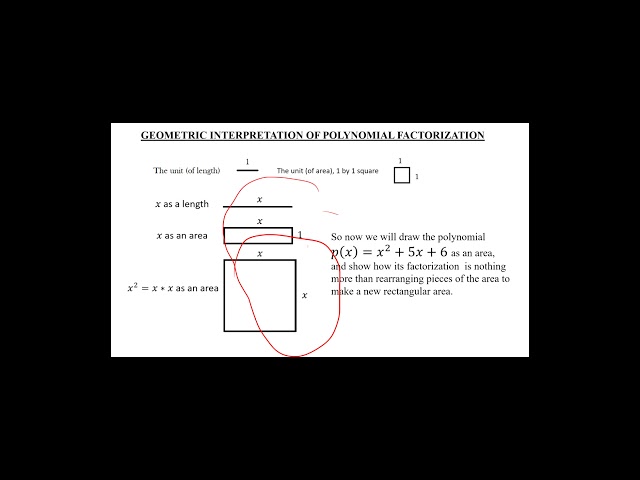
We show a simple example of how the factorization of a quadratic polynomial can be understood as a geometric jigsaw puzzle, and hint at how it generalizes to higher dimensions.
Find me on Instagram @camilosnotebooks
 cloud remnant
if you need to label points then well you need to factorize it
tough quartz
cloud remnant
if you need to label points then well you need to factorize it
Like factorise "ax^2 + bx + c" into (ab)(cx) form
Or smtg like that
tough quartz
faint gorge
The context given, maybe they expect something like this
https://youtu.be/dc9ysw...
Lemme checl
cloud remnant
tough quartz
Like factorise "ax^2 + bx + c" into (ab)(cx) form
no the form would be 4a(x+h)^2 + c
a not being the same a as in your equation
general equation of a parabola is y=4ax^2
tough quartz
faint gorge
The context given, maybe they expect something like this
https://youtu.be/dc9ysw...
But my teacher didnt provided any value of coefficents
cloud remnant
now if the vertex is at (h,k) then the equation becomes y-h=4a(x-k)^2
cloud remnant
tough quartz
But my teacher didnt provided any value of coefficents
you can work with variables
but i think its out of scope of a class 9 student
tough quartz
cloud remnant
now if the vertex is at (h,k) then the equation becomes y-h=4a(x-k)^2
Hmm
faint gorge
Well of course it's not the solution, but it shows how you can approach this question. For the coefficients you might wanna consider cases.
How to interpret it at all.
 light oyster
cloud remnant
general equation of a parabola is y=4ax^2
light oyster
cloud remnant
general equation of a parabola is y=4ax^2
Isnt it y = x^2/4a
For focus
tough quartz
faint gorge
Well of course it's not the solution, but it shows how you can approach this que...
Well my teacher want representation on graph
So i think my teacher prob talking about parabolas
light oyster
The hraph of a quadratic equation happens to be a parabola and not the other way aroung
cloud remnant
light oyster
Isnt it y = x^2/4a
oh wait its y^2 = 4ax my bad
light oyster
A parabola is a collection of points equidistant from a focus and directrix
at evry point
light oyster
cloud remnant
oh wait its y^2 = 4ax my bad
Horizontal parabola
tough quartz
My teacher didnt taught me 😭
cloud remnant
$\left ( x + \frac{b}{2a} \right ) ^2 = y + \left ( \frac{b^2 - 4ac}{4a^2} \right )$
woven radishBOT
Shockshwat
 cloud remnant
this would be the general parabolic equation for your parabola
tough quartz
Hmm
cloud remnant
so you would want something like
light oyster
tough quartz
Hmm
Its just shifting the graph of x^2 such that the new vertex is at the point (-b/2a , -D/4a)
light oyster
You know discriminant right?
tough quartz
light oyster
You know discriminant right?
Well no
light oyster
Oh
cloud remnant
Just draw this in a neat way and that should be full marks i guess
 light oyster
cloud remnant
Just draw this in a neat way and that should be full marks i guess
light oyster
cloud remnant
Just draw this in a neat way and that should be full marks i guess
What if there is a constant term
the y intercept would change
cloud remnant
light oyster
What if there is a constant term
the original equation is given as ax^2 + bx +c
tough quartz
cloud remnant
Just draw this in a neat way and that should be full marks i guess
The thing is, what am i gonna do if teacher asks for an explanation for it
I am all cooked if that happens
cloud remnant
light oyster
It will intersect at y=c
yeah, i didnt deliberately cut it at the origin, dumb luck
tough quartz
Nah never asked me before