#help-23
1 messages · Page 484 of 1
 final halo
 plucky elk
kek
final halo
Cool, riemann agrees with me
 tawdry jackal
thank you
plucky elk
2 min
plucky elk
,w differentiate arccos(x)/x
 flat frigateBOT


 Requested by riemann#2529
tawdry jackal
Requested by riemann#2529
tawdry jackal
,w differentiate log(y)
flat frigateBOT

 Requested by An Elite#4425
tawdry jackal
Requested by An Elite#4425
tawdry jackal
wait. isnt it 1/y * dy/dx?
plucky elk
@final halo i'm off by a minus sign, but that's maybe just an algebra mistake on my part
plucky elk
$x = \cos(xy) \implies y = \arccos(x)/x$
flat frigateBOT
riemann

 compact wraith
 flat frigateBOT
riemann
 plucky elk
$\arccos(x) = xy$ so
$y' = -\frac{\tfrac{x}{\sqrt{1-x^2}} + xy}{x^2}$
flat frigateBOT
riemann
 compact wraith
Actually yes it's off by a factor of negative 1
compact wraith
 tawdry jackal
was this. and it didnt make sense
compact wraith
It's basically right tho just show be a negative on the outside
final halo
plucky elk
<@182179228840755200> i'm off by a minus sign, but that's maybe just an algebra ...
Me too, mistake in question
compact wraith
tawdry jackal
was this. and it didnt make sense
That is a dumb question
The y's cancel lmao
tawdry jackal
these images are sent by my teacher
for holiday hw
and these are one of the first 3 questions.
and i havent got the second one either.
plucky elk
sign errors are like 0.1% of the server's questions. good find
tawdry jackal
nah. multiplied by -1 right
compact wraith
Just google "implicit differentiation problem sheet PDF" ur wasting ur time on these questions
There are lots of good sheets for this topic
plucky elk
i like doing implicit differentiation by hand
tawdry jackal
compact wraith
Just google "implicit differentiation problem sheet PDF" ur wasting ur time on t...
cant. teacher's gotta check these. but luckily all of it aint from the same book only diff. application and pair of straight lines are extra. so ill be happy with them
tawdry jackal
compact wraith
There are lots of good sheets for this topic
i shall. i need to do them, i gotta sstart integration soon
plucky elk
but yea this one has examples
https://cdn.kutasoftware.com/Worksheets/Calc/03 - Implicit Differentiation.pdf
tawdry jackal
plucky elk
but yea this one has examples
https://cdn.kutasoftware.com/Worksheets/Calc/03%20...
this is actually.. quite interesting
plucky elk
but not trig functions tho
final halo
Is any case An Elite, you did everything correctly
compact wraith
tawdry jackal
i shall. i need to do them, i gotta sstart integration soon
Good luck brah
tawdry jackal
final halo
Is any case An Elite, you did everything correctly
i did correctly with your help
tawdry jackal
compact wraith
Good luck brah
thank you.
tawdry jackal
plucky elk
but not trig functions tho
not much of a prob
thank you all a lot.
just one last... small doubt
,w differentiate logy
flat frigateBOT
 Requested by An Elite#4425
flat frigateBOT
Requested by An Elite#4425
flat frigateBOT
riemann
 tawdry jackal
flat frigate
**riemann**
tawdry jackal
flat frigate
**riemann**
yeah thats what i remember
tawdry jackal
flat frigate
so this.
plucky elk

This calculus video tutorial provides a basic introduction into logarithmic differentiation. It explains how to find the derivative of functions such as x^x, x^sinx, (lnx)^x, and x^(1/x). You need to take the natural log of both sides of the equation and perform implicit differentiation to find dy/dx. You need to be familar with product rule ...
plucky elk
flat frigate
wolfie thinks your differentiating variable is y, not x
tawdry jackal
Oh right rightt
tawdry jackal
ah well.
flat frigateBOT
 Requested by riemann#2529
tawdry jackal
Requested by riemann#2529
tawdry jackal
anyways i gotta do more of these "questions"
plucky elk
there we go
tawdry jackal
flat frigate
perfect
so now. i shall take my leave. with the knowledge and confidence yall have bestowed upon me.
.close
 safe radishBOT
Channel closed
Closed by @tawdry jackal
Use .reopen if this was a mistake.
Please take a minute to participate in [our survey](#changelog message) if you haven't already!
 Available help channel!
Send your question here to claim the channel.
Remember:
• Ask your math question in a clear, concise manner.
• Show your work, and if possible, explain where you are stuck.
• After 15 minutes, feel free to ping <@&286206848099549185>.
• Type the command .close to free the channel when you're done.
• Be polite and have a nice day!
Read #❓how-to-get-help for further information on how to ask a good question, and about conduct in the question channels.
 sharp imp
Do I include the excluded value here?
 safe radishBOT
sharp imp
Do I include the excluded value here?
sharp imp
safe radishBOT
sharp imp
Do I include the excluded value here?
sharp imp
The left side is the original expression, on the right is the simplified one
0 I think, but that’s for the simplified expression
Not the OG one
Do I still include it tho?
There’s no denominator for the first one tho
 thin bridge
just because there isn't an explicit fraction doesn't mean that there's no restriction
safe radishBOT
@sharp imp Has your question been resolved?
Channel closed
Closed by @sharp imp
Use .reopen if this was a mistake.
Please take a minute to participate in [our survey](#changelog message) if you haven't already!
Available help channel!
Send your question here to claim the channel.
Remember:
• Ask your math question in a clear, concise manner.
• Show your work, and if possible, explain where you are stuck.
• After 15 minutes, feel free to ping <@&286206848099549185>.
• Type the command .close to free the channel when you're done.
• Be polite and have a nice day!
Read #❓how-to-get-help for further information on how to ask a good question, and about conduct in the question channels.
plucky elk
@lean chasm @glass sonnet i'd like to speak to your manager about your behavior.
safe radishBOT
plucky elk
<@391270706186420224> <@356358102641278977> i'd like to speak to your manager ...
plucky elk
it's completely inappropriate to my entitlement because i'm so much better than you
do you even know who i am
 lean chasm
can't tell if you're being serious or not
plucky elk
 lean chasm
is it normal that I have hair loss during puberty
 glass sonnet
plucky elk
<@391270706186420224> <@356358102641278977> i'd like to speak to your manager ...
glass sonnet
plucky elk
<@391270706186420224> <@356358102641278977> i'd like to speak to your manager ...
Umm i don't have a manager due to me not having a job
 glass sonnet
College takes up most of my time these days
lean chasm
lmao imagine college
glass sonnet
On the grind for those A levels
plucky elk
lmao imagine being in debt in this economy
lean chasm
imagine having to pay taxes
plucky elk
imagine having to pay property taxes and a mortgage
glass sonnet
Yeah I'll save that for when it comes to it
Also this is probably off topic so should probably close it
plucky elk
.clsoe
lean chasm
.clsoe
 safe radishBOT
Channel closed
Closed by @plucky elk
Use .reopen if this was a mistake.
Please take a minute to participate in [our survey](#changelog message) if you haven't already!
 glacial fractal
plucky elk
do you even know who i am
glacial fractal
plucky elk
do you even know who i am
no
safe radishBOT
Available help channel!
Send your question here to claim the channel.
Remember:
• Ask your math question in a clear, concise manner.
• Show your work, and if possible, explain where you are stuck.
• After 15 minutes, feel free to ping <@&286206848099549185>.
• Type the command .close to free the channel when you're done.
• Be polite and have a nice day!
Read #❓how-to-get-help for further information on how to ask a good question, and about conduct in the question channels.
 solid horizon
How do you compute the distance between line x=0 and x=1 after multiplying it by a 2x2 matrix?
safe radishBOT
solid horizon
How do you compute the distance between line x=0 and x=1 after multiplying it by...
glass sonnet
find distance before
use determinant of 2x2 to find scale factor by which area increases
but you want linear scale factor
that should give you enough of a hint
solid horizon
distance before is 1
solid horizon
ad-bc?
glass sonnet
yes
solid horizon
im just asking in the abstract about any matrix
and how it changes distance between lines
glass sonnet
I don't think it would work for an entire line now thinking again
because what if the lines aren't parallel
the points on the line are different distances
or are you asking in the specific case of x = 0 and x =1
because parallelism is conserved
solid horizon
glass sonnet
or are you asking in the specific case of x = 0 and x =1
generally how matrixe effect parrallel lines
the multiplier on distance
glass sonnet
look at a specific linear transformation
such as scaling
if you apply a scale of 2
then points are doubled
so determinant is 4
solid horizon
yes
glass sonnet
so what about the distance
solid horizon
doubled
glass sonnet
yeah
that is the linear scale factor
which is the square root of the determinant
so ig that's your answer?
glass sonnet
what example are you thinking of
glass sonnet
how so
solid horizon
but that doesn't work in something like
[ 2, 2 ]
[ 1, 1 ]
glass sonnet
the determinant is 0
the matrix is singular
all points collapse on to a line
so that makes sense
solid horizon
yes
solid horizon
glass sonnet
how so
1, 0 become a, 0
glass sonnet
ok
solid horizon
what about
[3, 0
0, 2]
i don't think it would work for the square root of determinant
glass sonnet
oh I see what you mean
I guess just look at how the unit vector i is changing for this scenario
seeing as you have x=0 and x = 1
glass sonnet
determinant being 0 is a special case
solid horizon
how do i know there aren't other exceptions?
solid horizon
its fine thanks
 signal granite
solid horizon
but that doesn't work when the determinant is 0
signal granite
solid horizon
but that doesn't work when the determinant is 0
also just studying linear algebra but doesnt a det = 0 correspond with the space being "suctioned" into a 0 point?
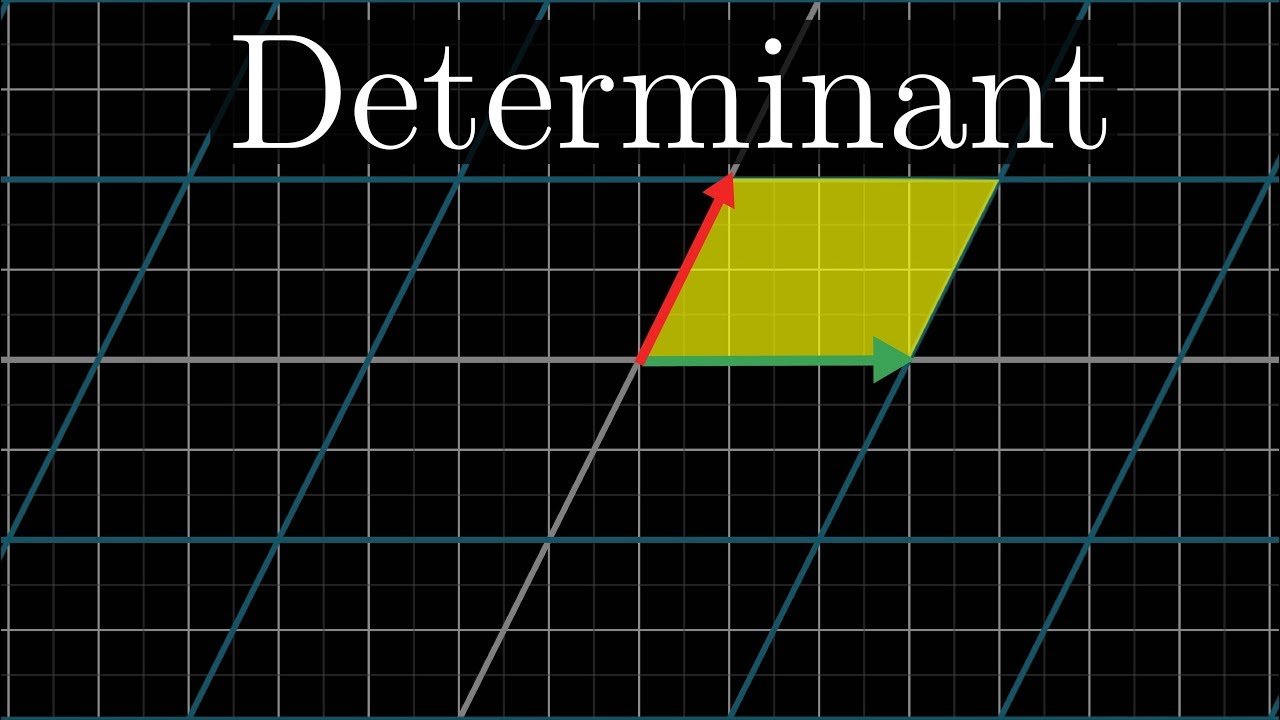
The determinant measures how much volumes change during a transformation.
Help fund future projects: https://www.patreon.com/3blue1brown
An equally valuable form of support is to simply share some of the videos.
Home page: https://www.3blue1brown.com/
Full series: http://3b1b.co/eola
Future series like this are funded by the community, throug...
solid horizon
signal granite
also just studying linear algebra but doesnt a det = 0 correspond with the space...
Yes it does
safe radishBOT
@solid horizon Has your question been resolved?
safe radishBOT
Channel closed
Closed due to timeout
Use .reopen if this was a mistake.
Please take a minute to participate in [our survey](#changelog message) if you haven't already!
solid horizon
.reopen
safe radishBOT
✅
solid horizon
Anyone?
safe radishBOT
@solid horizon Has your question been resolved?
solid horizon
I <@&286206848099549185>
plucky elk
solid horizon
I <@&286206848099549185>
do you have a new question?
solid horizon
no
plucky elk
solid horizon
ad-bc?
you got your answer here
plucky elk
what are you asking then
solid horizon
how does a matrix effect the distance between two parrallel lines?
how would you compute it
plucky elk
solid horizon
how does a matrix effect the distance between two parrallel lines?
Affect how? What parallel lines and what matrix are you talking about?
You need an equation to talk about to answer your question
solid horizon
2x2 matrix as in scale the distance as a multiplier
plucky elk
solid horizon
2x2 matrix as in scale the distance as a multiplier
Do you have an example 2x2 to talk about? What about parallel lines?
solid horizon
x=1 and x=0
any matrice
the point is i want a general formulae
individual computations are not the problem
plucky elk
solid horizon
the point is i want a general formulae
General formula for what
plucky elk
solid horizon
x=1 and x=0
These are two vertical lines. How do you want the matrix to interact with them
solid horizon
plucky elk
General formula for what
how a matrix effect distance between parrallel lines
solid horizon
plucky elk
These are two vertical lines. How do you want the matrix to interact with them
matrix preserves parrallel lines but can change the distance between them, how does it change it?
plucky elk
solid horizon
how a matrix effect distance between parrallel lines
Affect how? You still haven't given an equation
solid horizon
for example
plucky elk
solid horizon
matrix preserves parrallel lines but can change the distance between them, how d...
Preserve how? How is the 2x2 matrix interacting with parallel lines?
solid horizon
[2 0
0 1] will double the distance between some parrallel lines
plucky elk
solid horizon
[2 0
0 1] will double the distance between some parrallel lines
Where are the parallel lines here
You need an equation
Can you write an equation down?
solid horizon
all parrallel lines i think that are not perpenicular to the y axis
solid horizon
plucky elk
Can you write an equation down?
no
plucky elk
Then there's nothing to talk about
solid horizon
idk how to put it in an equation
plucky elk
You're trying to mix two concepts together without anything mathematical
solid horizon
do you not understand what im asking or is what im asking impossible to solve?
plucky elk
Matrices operate on vectors, review that
I don't even know if you understand what you're asking since you can't even give an example of an equation
solid horizon
solid horizon
[2 0
0 1] will double the distance between some parrallel lines
is this not an example?
plucky elk
You gave two vertical lines and a 2x2 matrix, but no way of them interacting
solid horizon
multiplying every point on the line?
plucky elk
solid horizon
is this not an example?
You claim it doubles, but no equation
solid horizon
by the matrix
plucky elk
Try to think through what you want and work through some equations down
solid horizon
ok
plucky elk
Maybe drawing a picture what you mean will help
safe radishBOT
@solid horizon Has your question been resolved?
 stable fjord
.close
safe radishBOT
Channel closed
Closed due to timeout
Use .reopen if this was a mistake.
Please take a minute to participate in [our survey](#changelog message) if you haven't already!
Available help channel!
Send your question here to claim the channel.
Remember:
• Ask your math question in a clear, concise manner.
• Show your work, and if possible, explain where you are stuck.
• After 15 minutes, feel free to ping <@&286206848099549185>.
• Type the command .close to free the channel when you're done.
• Be polite and have a nice day!
Read #❓how-to-get-help for further information on how to ask a good question, and about conduct in the question channels.
stable fjord
Can someone help me with the first question
 safe radishBOT
stable fjord
Can someone help me with the first question
stable fjord
safe radishBOT
stable fjord
Can someone help me with the first question
stable fjord
Someone
 ionic brook
 ionic brook
what did you do so far
safe radishBOT
@stable fjord Has your question been resolved?
safe radishBOT
Channel closed
Closed due to timeout
Use .reopen if this was a mistake.
Please take a minute to participate in [our survey](#changelog message) if you haven't already!
safe radishBOT
Available help channel!
Send your question here to claim the channel.
Remember:
• Ask your math question in a clear, concise manner.
• Show your work, and if possible, explain where you are stuck.
• After 15 minutes, feel free to ping <@&286206848099549185>.
• Type the command .close to free the channel when you're done.
• Be polite and have a nice day!
Read #❓how-to-get-help for further information on how to ask a good question, and about conduct in the question channels.
 sonic dagger
 safe radishBOT
sonic dagger
sonic dagger
safe radishBOT
sonic dagger
sonic dagger
Hey this isn't really a question about how to solve this, but
Is it important to know how to actually evaluate e^x in terms of ln?
I have just been doing the integral and using a calculator
If it's actually gonna come back to bite me I can stop
 heavy frost
sonic dagger
Is it important to know how to actually evaluate e^x in terms of ln?
heavy frost
sonic dagger
Is it important to know how to actually evaluate e^x in terms of ln?
Wym?
sonic dagger
heavy frost
Wym?
so basically you take the integral then evaluate it as e^(ln36)/2 - e^(ln9)/2
Is it important for later calc to actually be able to do that by hand
because I have no fucking clue what those numbers are
apparently the answer is 6, which i got by calculator
 halcyon cliff
I would say every operation is important to take by hand until you're confident about what you're doing
Your doubt is how to do it by hand?
sonic dagger
halcyon cliff
I would say every operation is important to take by hand until you're confident ...
I agree but I'm in a heavily condensed version of cal 2 and I have to triage a lot
Yeah
I get how to take the integral, just not how to evaluate it without a calculator
halcyon cliff
when you do e^((1/2)*ln(36)) at the calculator, do you see any similarities on the answer you get?
sonic dagger
not that I can think of
halcyon cliff
to start of, ln(x) and e^x are inverse functions
halcyon cliff
Ok, so from this it can be said that ln(e^x)=x and e^(ln(x))=x
I don't quite know how to explain this accurately as english isn't my main language
But since you have the 1/2 on the e^x argument
When substituting for ln
that will turn out to be a power
hence, a square root
Get it?
sonic dagger
I'll keep that on hand for my tool bag, I appreciate the help of both of you
That was less complicated than I thought it would be
tbh
.close
safe radishBOT
Channel closed
Closed by @sonic dagger
Use .reopen if this was a mistake.
Please take a minute to participate in [our survey](#changelog message) if you haven't already!
safe radishBOT
Available help channel!
Send your question here to claim the channel.
Remember:
• Ask your math question in a clear, concise manner.
• Show your work, and if possible, explain where you are stuck.
• After 15 minutes, feel free to ping <@&286206848099549185>.
• Type the command .close to free the channel when you're done.
• Be polite and have a nice day!
Read #❓how-to-get-help for further information on how to ask a good question, and about conduct in the question channels.
Please don't occupy multiple help channels.
Channel closed
Closed due to the original message being deleted
Please take a minute to participate in [our survey](#changelog message) if you haven't already!
Available help channel!
Send your question here to claim the channel.
Remember:
• Ask your math question in a clear, concise manner.
• Show your work, and if possible, explain where you are stuck.
• After 15 minutes, feel free to ping <@&286206848099549185>.
• Type the command .close to free the channel when you're done.
• Be polite and have a nice day!
Read #❓how-to-get-help for further information on how to ask a good question, and about conduct in the question channels.
 warm river
i know that b is 1.035, but how do u find the a value?

 worthy hemlock
warm river
i know that b is 1.035, but how do u find the a value?
worthy hemlock
warm river
i know that b is 1.035, but how do u find the a value?
If x = 0, for the first year, what would a be?
warm river
worthy hemlock
If x = 0, for the first year, what would a be?
it'd be 3810 then?
tyy
.close
safe radishBOT
Channel closed
Closed by @warm river
Use .reopen if this was a mistake.
Please take a minute to participate in [our survey](#changelog message) if you haven't already!
Available help channel!
Send your question here to claim the channel.
Remember:
• Ask your math question in a clear, concise manner.
• Show your work, and if possible, explain where you are stuck.
• After 15 minutes, feel free to ping <@&286206848099549185>.
• Type the command .close to free the channel when you're done.
• Be polite and have a nice day!
Read #❓how-to-get-help for further information on how to ask a good question, and about conduct in the question channels.
 lean otter
i really need help
 safe radishBOT
lean otter
i really need help
final halo
safe radishBOT
lean otter
i really need help
final halo
What have you tried
lean otter
final halo
What have you tried
i havent
 frank niche
Then try something. People are not here to do your work.
But we can help you.
This question is all computation. Try reviewing how long division works.
Actually synthetic division works well for this problem.
Try that.
safe radishBOT
@lean otter Has your question been resolved?
Channel closed
Closed by @keen talon
Use .reopen if this was a mistake.
Please take a minute to participate in [our survey](#changelog message) if you haven't already!
safe radishBOT
Available help channel!
Send your question here to claim the channel.
Remember:
• Ask your math question in a clear, concise manner.
• Show your work, and if possible, explain where you are stuck.
• After 15 minutes, feel free to ping <@&286206848099549185>.
• Type the command .close to free the channel when you're done.
• Be polite and have a nice day!
Read #❓how-to-get-help for further information on how to ask a good question, and about conduct in the question channels.
lean otter
 safe radishBOT
lean otter
lean otter
safe radishBOT
lean otter
lean otter
How they did it can u explain?
 spice grove
If you use some other variable for 3^m for the time being. That is a, it would be, a - 1 + 2a wouldn't it?
lean otter
Yeah
 cobalt parrot
sub a back in
safe radishBOT
Channel closed
Closed by @last rose
Use .reopen if this was a mistake.
Please take a minute to participate in [our survey](#changelog message) if you haven't already!
Available help channel!
Send your question here to claim the channel.
Remember:
• Ask your math question in a clear, concise manner.
• Show your work, and if possible, explain where you are stuck.
• After 15 minutes, feel free to ping <@&286206848099549185>.
• Type the command .close to free the channel when you're done.
• Be polite and have a nice day!
Read #❓how-to-get-help for further information on how to ask a good question, and about conduct in the question channels.
 potent roost
According to my conjecture 175 is the only positive integer that is equal to 5 times the product of its digits. It is true for the first billion integers. I need help trying to prove or disprove this somehow 🗿
safe radishBOT
potent roost
According to my conjecture 175 is the only positive integer that is equal to 5 t...
potent roost

Someone mentioned before that it can be proved using bounds, that after a certain number the number is always greater than the product of its digits
I mean I can already see it for 3 digit numbers

 delicate sierra
well the intuition is there right?
nvm I have no idea how to do this either
sorry xd
potent roost
np
delicate sierra
I was thinking maybe you can start from 4 digits
because (9+9+9+9)*5 is still less than 4 digit
and the number thereafter grows faster
potent roost
sum? its product
potent roost
5*(9*9*9)
delicate sierra
then I mean
that's 9^3
for a 3 digit number
the hundreds are 10^3
now for a 4 digit number
potent roost
10^n > 5*9^n
 delicate sierra
so n > log base 10/9 (5) is the n-digits when the product of number times 5 is no longer larger than the number itself?
and using a computer, just check for every number up until the first n+1 digits
potent roost
,w log base 10/9 (5)
flat frigateBOT

 Requested by Swas.py#7370
potent roost
Requested by Swas.py#7370
potent roost
yeah alright
 potent roost
so after 16 digits its always greater
potent roost
16 digits = 10 million billion?
potent roost
I dont think my pc can go further than 100 billion 💀
so manually verifying is ruled out
potent roost
delicate sierra
maybe there's a tighter bound
is there?
potent roost
hmm what could that be
delicate sierra
well to have the sum of its product times 5 equal to itself
potent roost
sum?
flat frigateBOT
Azzurala
 delicate sierra
I got there in the end
potent roost
🤕
delicate sierra
so if you divide everything by 5
potent roost
flat frigate
**Azzurala**
alright
delicate sierra
then
wait let's bound this
$5 \prod_{k=0}^{n} a_k = \sum_{k=0}^{n} a_k 10^k\le 10 \prod_{k=0}^{n} a_k$
flat frigateBOT
Azzurala
 potent roost
mhm
flat frigateBOT
Azzurala
 delicate sierra
(sometimes I hate discord formatting)
delicate sierra
so we boudn it again
max{a_k} = 9
so
$\sum_{k=0}^{n} a_k 10^{k-1}\le 9^n$
oops we just returned to square 1
flat frigateBOT
Azzurala
 potent roost
💀
potent roost
thanks, its fine you did help
we've limited it to 10^16 integers
anything we can do to prove it in that range 
can we find any restrictions on the digits apart from the last digit being 5
potent roost
potent roost
yeah alright
@full zephyr so we found that from n=16, 10^n > 5*9^n
what can we do now
checking 10^16 numbers isn't feasible
delicate sierra
please ping me if you found something new
I'm interested in this problem as well
 full zephyr
potent roost
<@884904554037141576> so we found that from n=16, 10^n > 5*9^n
full zephyr
potent roost
<@884904554037141576> so we found that from n=16, 10^n > 5*9^n
Yeah this is the sort of thing I had in mind
But I think the bound might actually be weaker than that
potent roost
delicate sierra
please ping me if you found something new
alright
full zephyr
I would’ve thought we’d be going for 10^(n-1) > 5*9^n
potent roost
yeah its actually that
delicate sierra
oh true
full zephyr
And that works out to like 37 I think
potent roost
full zephyr
Not very friendly
delicate sierra
full zephyr
And that works out to like 37 I think
fucking lovely lmao
potent roost
that makes things worse 
full zephyr
Yeah but maybe we can greatly alter that if we just find some helpful conditions
Have you found any conditions so far?
potent roost
Nope, only the trivial, last digit is 5
full zephyr
Yeah that doesn’t change the bound very much lmao
potent roost
what other restrictions are there?
full zephyr
Yea I’ll have a think
At the very least we can remove a 9 and replace it with a 5 I think
Since 5 is certainly a digit
In the bound
delicate sierra
o that makes the bound smaller
potent roost
only 31
delicate sierra
,w (log base 10/9 25) + 1
flat frigateBOT

 Requested by Azzurala#6257
potent roost
full zephyr
Requested by Azzurala#6257
potent roost
full zephyr
Yeah but the promising thing here
With just that simple condition the bound dropped by like 6 orders of magnitude
delicate sierra
I'd love to be able to find at least 4 similar simple condiitons
full zephyr
That bound multiplied the RHS by 5/9
Another similar bound would drop it dramatically
Imagine we had 10^(n-1) and 9^(n-1) we’d be done, that won’t happen for obvious reasons but we don’t need that much
Just gotta find some stuff though
Problem is the bound has to be kinda large
potent roost
hmm
even if we lower the bound, we'll still need to find a way to prove it inside that bound
I dont see it dropping to 10^12 or something
full zephyr
Why don’t we look at the 10^(n-1)
If we look at some n we might be able to find a way to change that to something better
As an example, 0 can’t be a digit so the number’s at least 111111…
If we ignore 0 as a case
potent roost
we should ignore 0 yeah
full zephyr
That’s a geometric series and that might change it, probably not by THAT much though
delicate sierra
yea was gonna say something about geometric series
if anything it makes the code more efficient
so there is that
full zephyr
Yeah I mean let’s compute it and see the new bound
I think it’ll only improve it by one or two orders of magnitude but might as well see what we have
Ok I’ve got something
potent roost
What's that 🤔
full zephyr
I think I’ve found a bound for which 1 can’t be a digit in the number
Suppose 1 was a digit in the number, we can then use the same inequality but dividing by 9 on the RHS
And it doesn’t work for n >= 11 in this case
potent roost
10^n-1 > 25*9^n-2 ?
full zephyr
Yeah
potent roost
full zephyr
And it doesn’t work for n >= 11 in this case
what does this mean
full zephyr
Hence for n >= 11 the number is at least 22222… since we already know no 0s, and now no 1s
Thinking about it this bound might not do THAT much but it’s a decent constriction
full zephyr
potent roost
what does this mean <:hmmCat:831508801646755850>
There are no 1s if the number has 11 or more digits
delicate sierra
full zephyr
And it doesn’t work for n >= 11 in this case
why wouldn’t this work though
like why isn’t that allowed
full zephyr
Having a 1?
potent roost
full zephyr
There are no 1s if the number has 11 or more digits
why?
delicate sierra
yea liek I get your “same equality by divide 9 on RHS”
but how does that lead to a contradiction for n>=11
full zephyr
When you solve the inequality you get n >= 10.7 or so, so if the number had 11 or more digits and has a 1, the number is strictly greater than its product
Which contradicts the numbers we’re looking for
potent roost
Ah I get it alright
potent roost
so for n >= 11 the number has to be atleast 222....
full zephyr
Yep
potent roost
can we use the same logic for 2 as a digit
full zephyr
We can repeat the same argument although it might get less helpful
Yeah
Let’s see what n ends up as
delicate sierra
not too useful
full zephyr

delicate sierra
sadge
potent roost
bad parsing
full zephyr
Come one wolfram
potent roost
not clean 💀

 potent roost
bruh
full zephyr
Wolfram really wants us to do this manually
delicate sierra
we going negative now
full zephyr
Hold on let me pull out the calculator
potent roost
,w log base 10/9 (50/81) + 1
flat frigateBOT
 Requested by Swas.py#7370
full zephyr
Requested by Swas.py#7370
full zephyr
Oh so that’s it
flat frigateBOT
 Requested by Azzurala#6257
delicate sierra
Requested by Azzurala#6257
delicate sierra
10^(n-1) = 10^n / 10
full zephyr
delicate sierra
,w logbase 10/9 (500/81)
It would have to be 500/810 in this case
Used n-1 for 9 and n for 10
delicate sierra
a
full zephyr
I think it tells us nothing
‘If the number has a 2, then n >= -3, so if the number has a 2, it’s a number  ‘
‘
full zephyr
Gonna have to find something else
At least we can find a bound using the geometric series 2^1 + 2^2 + … + 2^n
potent roost
has this ever been done before? I can't find anything related to this on google
full zephyr
No idea
potent roost
full zephyr
At least we can find a bound using the geometric series 2^1 + 2^2 + … + 2^n
how do we do that
full zephyr
potent roost
how do we do that
Get the closed form for the sum and replace 10^(n-1) with that
Well it’s just 2^(n+1) - 2 I guess
full zephyr
Hold on let’s see
,w 10^(n-1) > 50*9^(n-2)
This is the actual bound for 2 I think
Pretty sure there was an error by a factor of 9 in the last one

 full zephyr
More reasonable
potent roost
hmm
flat frigateBOT

 Requested by dk.dkn#6601
full zephyr
Requested by dk.dkn#6601
full zephyr
Wow thanks wolfram
It’s because of the -2
Desmos?
Ah I see it’s impossible
In this case LHS is strictly less than RHS
flat frigateBOT
 Requested by dk.dkn#6601
potent roost
Requested by dk.dkn#6601
potent roost
nice
full zephyr
So it has no 2s for n >= 24
potent roost
full zephyr
And 31 yea because of the 5 instead of 9
this yeah
,w (10^n -1)/9 > 25*9^(n-1)
flat frigateBOT
 Requested by Swas.py#7370
potent roost
Requested by Swas.py#7370
potent roost
this was for 1?
full zephyr
I think we’re actually using the worse conditions
Because we found it could have no 2s for n >= 18
full zephyr
flat frigate
Here
potent roost
hmm
full zephyr
The n >= 11 was the right one for 1
Ah wait nvm
We can combine them
For 2, 18 =< n =<23
And for 1, 1 1 =< n =< 31
potent roost
what is this range? the range where we cant have 1 and 2?
full zephyr
The range we can
potent roost
alright
full zephyr
But that seems to suggest the range for 3, 4 and so on will just get smaller and smaller
Which doesn’t seem to coincide with 175 being possible
In fact that contradicts the bound for 1 so I guess it’s wrong hold on
full zephyr
potent roost
what is this range? the range where we cant have 1 and 2?
Oh nvm you were right it’s this
The range we can’t
flat frigateBOT
 Requested by Swas.py#7370
potent roost
Requested by Swas.py#7370
potent roost
,w 3(10^n -1)/9 > 75*9^(n-2)
flat frigateBOT
 Requested by Swas.py#7370
potent roost
Requested by Swas.py#7370
potent roost

full zephyr
potent roost
,w 3(10^n -1)/9 > 75*9^(n-2)
We normally did this with 25*9^(n-1) on the RHS
flat frigateBOT
 Requested by Swas.py#7370
potent roost
Requested by Swas.py#7370
potent roost
yeah this means this the range is 21 < n < 23 now
 hearty egret
full zephyr
hearty egret
full zephyr
Yeah
 full zephyr
Actually I think the bounds I wrote said less than they could
Idk why I did an intersection
potent roost
hmm
full zephyr
Because we know it can’t have a 1 for n >= 11
And that’s it for that bound
I think
Which is at least good information because we’re only looking as this sort of range anyway
And the n >= 31 I think is just a general bound we found
What is the region of computational viability
Around n <= 12?
full zephyr
potent roost
im gonna be back in 15 mins
Alright
safe radishBOT
@potent roost Has your question been resolved?
potent roost
okay i'm back
full zephyr
,w 10^(n-1) + 510^(n-2) > 259^(n-1)

 full zephyr
Not that helpful
potent roost
hmm
full zephyr
Bound for the second half of any n
We definitely should find a different approach
Gotta get thinking
potent roost
full zephyr
We definitely should find a different approach
yeah
potent roost
got anything?
full zephyr
potent roost
got anything?
Alright so I’ve read a proof for the impossibility of what we’re looking for without the 5
So a number being equal to the product of its digits, ignoring single digits
I’ll try to outline it
Let us denote the digital product of m, dp(m), and let the number of digits be n
For n = 2, m = 10a + b, and dp(m) = ab < 10a since b < 10
And 10a <= 10a + b <= m
So dp(m) < m which is a contradiction
Now in general
Suppose we have some m such that dp(m) = m, we remove the last digit and call the new integer m’
m’ <= m/10, since we’ve taken the floor of m
Also dp(m’) >= m/9 since we cannot divide dp(m) by more than 9 to produce dp(m’)
m/9 > m/10 >= m’
So dp(m’) > m’
In fact I think the whole 2-digit thing was unnecessary
potent roost
don't mind me I read that as contradiction
full zephyr
They got dp(m’) >= m’ but I don’t think that’s necessary
And then they basically reduced it to 2-digits
full zephyr
potent roost
don't mind me I read that as contradiction
But it was meant to say contradiction
potent roost
lmao ok
full zephyr
If dp(m) = m then surely dp(m) is not < m
full zephyr
Yea and the whole 2-digit thing can be emitted I think, I recited it because the proof I read did, but I don’t think it’s necessary
But it’s still useful
full zephyr
potent roost
so this is the proof of dp without the 5
And yea
So basically where I’m at is incorporating the 5
So we start with 5dp(m) = m
And m’ < m/10 still holds
Haven’t fully done the next step though
I have a kinda unhelpful version of it
Or kinda confusing at least
potent roost
hmm
I dont think we'll get anywhere with it cuz 175 is one such number
maybe we should let m > 175
potent roost
Hmm
potent roost
full zephyr
It’ll be harder and idk if it’ll work
in this case dp(m') = dp(m)/5
full zephyr
But if, say, we could reduce stuff down to 4 digits or something we’d be good
Or just prove it for n >= 4
potent roost
since the last digit is 5
full zephyr
potent roost
in this case dp(m') = dp(m)/5
Yes this is good actually
For example the above proof fails if n = 1 but that’s fine
potent roost
hmm
yeah
for n >= 4 is fine
we already did that proof for n=3
m = 25dp(m')
wait I think I did it maybe
nvm
also m = 10m' + 5 @full zephyr
potent roost
potent roost
m = 25dp(m')
doesn't this mean the number has to be a multiple of 25?
that reduces computation
full zephyr
potent roost
doesn't this mean the number has to be a multiple of 25?
Wait why is this the case?
What if m = 5
potent roost
full zephyr
What if m = 5
for m >= 25
full zephyr
How’d you come up with that result
potent roost
dp(m) is m/5
idk why I have this written in my notes
💀
wait it is
5dp(m') = dp(m)
and dp(m) = m/5
so 5dp(m') = m/5
or m = 25dp(m')
potent roost
potent roost
dp(m) is m/5
this was our assumption
full zephyr
Ah I see
potent roost
full zephyr
Wait do you mean dp(m’) = dp(m)/5
we found this because the last digit was 5
5dp(m) = m is our assumption
full zephyr
Yep
For some reason I thought we were saying in general dp(m) = m/5
But yea see the sad thing is
full zephyr
potent roost
so it has to be a multiple of 25
We knew this
potent roost
full zephyr
We knew this
wait when
full zephyr
We were doing this whole thing with 25*9^(n-1) on the RHS
Because 5 is a digit, and it’s the digital product multiplied by 5
potent roost
ah yes 🤦♀️
full zephyr
It’s helpful to have it in that form though if we go down proving it in this dp way
potent roost
that means the second last digit must be either 2 or 7
dp(m'') = 2dp(m') or dp(m'') = 7dp(m')
full zephyr
Yeah
full zephyr
potent roost
dp(m'') = 2dp(m') or dp(m'') = 7dp(m')
Or the other way around at least
2dp(m’’) = dp(m’) and the same for the other one
Wishing thinking here:
potent roost
oh yeah its the otherway
full zephyr
What if we could reduce all relevant cases to dp(m^(n’)) = m^(n’)
Like because we know dp(n) ≠ n for non-single digit numbers
full zephyr
potent roost
dp(m'') = 2dp(m') or dp(m'') = 7dp(m')
So if we did this kinda thing and always got 1 at some point it’d work
No clue if that has any chance of working
potent roost
full zephyr
What if we could reduce all relevant cases to dp(m^(n’)) = m^(n’)
that's big brain
so either m=50dp(m'') or m=175dp(m'')
but we know 175 satisfies m and it isn't a multiple of 50 means that m has to be 175dp(m'')
so m is a multiple of 175
full zephyr
Yeah since it doesn’t have 0 as a digit
That makes our bound originally slightly better btw
,w 10^(n-1) > 175*9^(n-2)

 potent roost
wait this means 3rd last digit has to be 1
potent roost
no wait
full zephyr
Idk the test for divisibility by 175 but 350
potent roost
yeah we can't deduce anything about the 3rd last digit
third last digit of multiples of 175 are all over the place

so we can't go further than this
potent roost
potent roost
third last digit of multiples of 175 are all over the place
these are the mutliples of 175 that end with 75
full zephyr
Not helpful though, 1 8 5 2 9 6 3 0 7 4 1 8 5 …
full zephyr
potent roost
these are the mutliples of 175 that end with 75
Ah I see yeah
potent roost
1 8 5 2 9 6 3 0 7 4 repeating
full zephyr
Yea
potent roost
but thats not useful
at all
all we know for sure is the number ends with 75 and is a multiple of 175
full zephyr
Yeah
potent roost
potent roost
all we know for sure is the number ends with 75 and is a multiple of 175
@delicate sierra here's your ping
potent roost
flat frigate
10^29 huh
m = 175dp(m'')
If we can prove m/175 > dp(m'')
we might be able to do it
full zephyr
That would work, and it has to be invalid for m = 0, 175 ofc
potent roost
yeah
for dp(m'') > 1
75dp(m'') = dp(m)
dp(m'') = dp(m)/75
dp(m) = m/5
dp(m'') = m/375
m/175 > m/375
did we do it?
@full zephyr I think we did it
but this is valid for m = 175
full zephyr
This is too nice
full zephyr
potent roost
75dp(m'') = dp(m)
It think this should be 175
full zephyr
Oh yeah whoops
full zephyr
Wait
potent roost
my brain wont function anymore
full zephyr
No I think it’s 35
potent roost
35?
full zephyr
potent roost
We cant prove:
m/175 > dp(m'')
m/5 > dp(m)
because our assumption was they are equal
we have to contradict it somehow
full zephyr
Yeah
 analog flare
Id say you just gota prove 9n*5 < 99999.... n times
Like we know for a 10 digit number sum of its digits * 5 wont be 10 digit
potent roost
product not sum
analog flare
Oh product
potent roost
did 10^12
1 trillion
only 175
nowhere close to our bound of 10^31 though 💀
alright its not just any multiple of 175 its only 4n+1th multiple of 175
full zephyr
^29 now at least
potent roost
potent roost
alright its not just any multiple of 175 its only 4n+1th multiple of 175
like 1, 5, 9 and so on
full zephyr
Not even then I guess
potent roost
when
full zephyr
I deleted my message, basically I said ‘not divisible by 2 even’
Not realising it ends in 5
potent roost
mhm
full zephyr
So yea 4n + 1 th multiple of 175
analog flare
potent roost
third last digit of multiples of 175 are all over the place
It cannot have an even digit
Because the the number itself would be even
But its not since it ends with a 5
So eliminate that
Go with 1 , 3 ,5 ,7 only
Oh yall got that already
Well nvm
potent roost
analog flare
It cannot have an even digit
ah yes this makes it much better
why not 9
@full zephyr I've got to go to sleep rn, we can continue this tmrw, i'll close this one for now
.close
safe radishBOT
Channel closed
Closed by @potent roost
Use .reopen if this was a mistake.
Please take a minute to participate in [our survey](#changelog message) if you haven't already!
Available help channel!
Send your question here to claim the channel.
Remember:
• Ask your math question in a clear, concise manner.
• Show your work, and if possible, explain where you are stuck.
• After 15 minutes, feel free to ping <@&286206848099549185>.
• Type the command .close to free the channel when you're done.
• Be polite and have a nice day!
Read #❓how-to-get-help for further information on how to ask a good question, and about conduct in the question channels.
full zephyr
potent roost
<@884904554037141576> I've got to go to sleep rn, we can continue this tmrw, i'l...
Yeah alright, do you wanna move to dms until then
safe radishBOT
full zephyr
Yeah alright, do you wanna move to dms until then
full zephyr
.close
safe radishBOT
Channel closed
Closed by @full zephyr
Use .reopen if this was a mistake.
Please take a minute to participate in [our survey](#changelog message) if you haven't already!
Available help channel!
Send your question here to claim the channel.
Remember:
• Ask your math question in a clear, concise manner.
• Show your work, and if possible, explain where you are stuck.
• After 15 minutes, feel free to ping <@&286206848099549185>.
• Type the command .close to free the channel when you're done.
• Be polite and have a nice day!
Read #❓how-to-get-help for further information on how to ask a good question, and about conduct in the question channels.
 subtle yew
So I know that $0<|x-a|<\delta \implies |f(x)-L|<\epsilon$ when the limit is $L$ as $x$ approaches $a$
safe radishBOT
subtle yew
So I know that $0<|x-a|<\delta \implies |f(x)-L|<\epsilon$ when the limit is $L$...
flat frigateBOT
🙛𝕍ѳrtєx🙙
 subtle yew

Here it doesn't have a limit
but how would we prove that it doesnt?
like intuitively here i kind of get how there isn't a value within Delta of A that is "encapsulated" by the square
 subtle yew
oh wait
So what the Epsilon Delta Definition is saying is that there isn't an $L$ such that $|f(x)-L|<\epsilon$?
(in the graph above)
or am i confusing something
flat frigateBOT
🙛𝕍ѳrtєx🙙

 slender garnet
subtle yew
slender garnet
subtle yew
sorry, i can't help with this, but what's this app?
subtle yew
it's an example in a 3B1B video
slender garnet
oh
plucky elk
subtle yew
but how would we prove that it doesnt?
You prove it by finding applying the contrapositive/negation of the definition of continuous. So in this case finding an epsilon for which no delta ...
subtle yew
flat frigate
**🙛𝕍ѳrtєx🙙**
so is this logic correct?
that there isn't an L for which the equation is true, so there isn't a Limit?
ionic brook
The limit of $f(x)$ as $x$ goes to a equals $L$ if:
For all $\epsilon>0$, there exists $\delta>0$ such that for all real $x$, if $0<\lvert x-a\rvert<\delta\Rightarrow\lvert f(x)-L\rvert<\epsilon$
flat frigateBOT
lirmirit
 subtle yew
👍
subtle yew
"If, for all $\epsilon>0,$ there exists $\delta>0$ such that if $x$ is within $\delta$ of $a$ (with $x\ne a$), then $f(x)$ is within $\epsilon$ of $L$"
flat frigateBOT
🙛𝕍ѳrtєx🙙
 ionic brook
flat frigate
**🙛𝕍ѳrtєx🙙**
ionic brook
flat frigate
**🙛𝕍ѳrtєx🙙**
this is the definition for saying the function has a limit at a (which is L)
the negation of that would give us the function does not have a limit at a (for all L)
subtle yew
What i was thinking was that if there was a number $L$ that satisfied $\lvert f(x)-L\rvert<\epsilon,$ then $L$ would be the limit, but there isn't a number $L$ that works in this graph, so therefore there is no limit
flat frigateBOT
🙛𝕍ѳrtєx🙙
 ionic brook
yes, that's the general idea
subtle yew
im thinking more of the converse ig
alright this sort of makes sense now
thank you both!
.close
safe radishBOT
Channel closed
Closed by @subtle yew
Use .reopen if this was a mistake.
Please take a minute to participate in [our survey](#changelog message) if you haven't already!
Available help channel!
Send your question here to claim the channel.
Remember:
• Ask your math question in a clear, concise manner.
• Show your work, and if possible, explain where you are stuck.
• After 15 minutes, feel free to ping <@&286206848099549185>.
• Type the command .close to free the channel when you're done.
• Be polite and have a nice day!
Read #❓how-to-get-help for further information on how to ask a good question, and about conduct in the question channels.
delicate sierra
potent roost
all we know for sure is the number ends with 75 and is a multiple of 175
i see :o
safe radishBOT
delicate sierra
i see :o
delicate sierra
oh well it's the best we coild do lol
safe radishBOT
@delicate sierra Has your question been resolved?
safe radishBOT
Channel closed
Closed due to timeout
Use .reopen if this was a mistake.
Please take a minute to participate in [our survey](#changelog message) if you haven't already!
Available help channel!
Send your question here to claim the channel.
Remember:
• Ask your math question in a clear, concise manner.
• Show your work, and if possible, explain where you are stuck.
• After 15 minutes, feel free to ping <@&286206848099549185>.
• Type the command .close to free the channel when you're done.
• Be polite and have a nice day!
Read #❓how-to-get-help for further information on how to ask a good question, and about conduct in the question channels.
 junior hollow
hello, can you please help me with this derivative
y = (4x+2)/(x^2-4)
safe radishBOT
junior hollow
hello, can you please help me with this derivative
y = (4x+2)/(x^2-4)
junior hollow
could you please check if i did everything right
using the quotient rule

<@&286206848099549185>
 flat frigateBOT

 Requested by Toby#2275
junior hollow
lean otter
everything above the red line is correct
Requested by Toby#2275
junior hollow
lean otter
everything above the red line is correct
So at what point should I stop differentiating?
.close
safe radishBOT
Channel closed
Closed by @junior hollow
Use .reopen if this was a mistake.
Please take a minute to participate in [our survey](#changelog message) if you haven't already!
safe radishBOT
Available help channel!
Send your question here to claim the channel.
Remember:
• Ask your math question in a clear, concise manner.
• Show your work, and if possible, explain where you are stuck.
• After 15 minutes, feel free to ping <@&286206848099549185>.
• Type the command .close to free the channel when you're done.
• Be polite and have a nice day!
Read #❓how-to-get-help for further information on how to ask a good question, and about conduct in the question channels.
 little marlin
Does it matter if I cancel out the X over here or not?
little marlin

 stoic dune
I don't see a way to cancel x
You'd have to be able to factor x from the top, and factor x from the bottom
little marlin
Would this be wrong?
 stoic dune
Yep. Need to cancel x from every term
safe radishBOT
Channel closed
Closed by @little marlin
Use .reopen if this was a mistake.
Please take a minute to participate in [our survey](#changelog message) if you haven't already!
Available help channel!
Send your question here to claim the channel.
Remember:
• Ask your math question in a clear, concise manner.
• Show your work, and if possible, explain where you are stuck.
• After 15 minutes, feel free to ping <@&286206848099549185>.
• Type the command .close to free the channel when you're done.
• Be polite and have a nice day!
Read #❓how-to-get-help for further information on how to ask a good question, and about conduct in the question channels.
 arctic stone
 safe radishBOT
arctic stone
plucky elk
arctic stone
safe radishBOT
arctic stone
plucky elk
arctic stone
what's your question
arctic stone
I dont even know what to do. Usually the slope intercept form is I plug in random like 0,1,2 for x
but with this his answer they are isolated to the right and have no relation to any of that
plucky elk
arctic stone
I dont even know what to do. Usually the slope intercept form is I plug in rando...
you're given a point and a slope.
Call the point $(x_1, y_1)$ and slope $m$. Then the equation of the line is
$(y-y_1) = m(x-x_1)$

 plucky elk
It's called point slope form
https://www.mathsisfun.com/algebra/line-equation-point-slope.html
then you get your answer that way
plucky elk
plucky elk
you're given a point and a slope.
you have to use algebra to solve for the slope from your given information
safe radishBOT
@arctic stone Has your question been resolved?
arctic stone
so the equation would look like y-(-4)==1/2(x-(-2))
plucky elk
arctic stone
so the equation would look like y-(-4)==1/2(x-(-2))
how did you get your slope
arctic stone
from x
plucky elk
arctic stone
from x
show your steps
worthy hemlock
You want the given equation in slope intercept form, then use the point to find the proper intercept.
Here's a video for the second part
https://www.youtube.com/watch?v=7raBhvLheh4&ab_channel=HCCMathHelp

Finding the equation of a line parallel to another line. This video is provided by the Learning Assistance Center of Howard Community College. For more math videos and exercises, go to HCCMathHelp.com.
arctic stone
plucky elk
show your steps
it came about to a bunch of fractions and no where close to the solution
BUT if plug in x from the points as slope then it works
plucky elk
arctic stone
it came about to a bunch of fractions and no where close to the solution
this sounds wrong. show your steps
arctic stone
plucky elk
this sounds wrong. show your steps
It sounds wrong to me too because I've learned so far that slope comes from X so it should be -1/2
 safe radishBOT
@arctic stone Has your question been resolved?
Channel closed
Closed by @arctic stone
Use .reopen if this was a mistake.
Please take a minute to participate in [our survey](#changelog message) if you haven't already!
Available help channel!
Send your question here to claim the channel.
Remember:
• Ask your math question in a clear, concise manner.
• Show your work, and if possible, explain where you are stuck.
• After 15 minutes, feel free to ping <@&286206848099549185>.
• Type the command .close to free the channel when you're done.
• Be polite and have a nice day!
Read #❓how-to-get-help for further information on how to ask a good question, and about conduct in the question channels.
 vagrant sand
There are 1000 people in a hall. One person had his hand painted. Every minute everyone shake their hand with someone else. How much time is needed to paint all the hands? What is the best scenario? What is the worst scenario?
safe radishBOT
vagrant sand
```There are 1000 people in a hall. One person had his hand painted. Every minut...
flat frigateBOT

 Requested by illuminator3#0001
vagrant sand
Requested by illuminator3#0001
vagrant sand
so about 10 minutes
lean chasm
because that's if they only shake their hands with new people
vagrant sand
true
lean chasm
what if they shake their hands with people they've already shaked?
vagrant sand
word
vagrant sand
can we even calculate the time for that?
the worst case scenario is if the people with painted hands shake their hands with people who already have painted hands
lean chasm
yes
and if they only do that
for eternity
so the worst case is that it's gonna take an indefinite amount of time
vagrant sand
word ty
vagrant sand
lean chasm
,wolf log2(1000)
is there anyway to solve for log without calc?
lean chasm
vagrant sand
is there anyway to solve for log without calc?
plug in random values and see what you get
safe radishBOT
@vagrant sand Has your question been resolved?
safe radishBOT
Channel closed
Closed due to timeout
Use .reopen if this was a mistake.
Please take a minute to participate in [our survey](#changelog message) if you haven't already!
Available help channel!
Send your question here to claim the channel.
Remember:
• Ask your math question in a clear, concise manner.
• Show your work, and if possible, explain where you are stuck.
• After 15 minutes, feel free to ping <@&286206848099549185>.
• Type the command .close to free the channel when you're done.
• Be polite and have a nice day!
Read #❓how-to-get-help for further information on how to ask a good question, and about conduct in the question channels.
 cinder breach
Need some help in few questions but I need to use specific formula's only
safe radishBOT
cinder breach
Need some help in few questions but I need to use specific formula's only
cinder breach

 lean otter
well a pyramid has four faces, so the surface area is the sum of all four faces (first formula on your sheet). Then find the area of each of the four triangles
lean otter
base is b, height is h
 lean otter
for the frontmost triangle, yes
cinder breach
Ight and then I just devide it by 2?
lean otter
yup
then you have to find the area of the other three triangles
then add them all up
cinder breach
Wait what there are more?
lean otter
yeah, there are four faces
lean otter
there's a bunch of right angles at the back
cinder breach
Ah
lean otter
