
#help-23
1 messages · Page 354 of 1
 drowsy slate
x intercept?
 hard crest
are you familiar with the form of (x, y) for writing a point?
drowsy slate
yes yes
hard crest
okay
drowsy slate
im srry for not using it
hard crest
what is the blue point, in that notation?
drowsy slate
(4.9,0)
hard crest
perfect
okay, so since the parabola goes through that point, if we plug that point into our parabola equation then it must be true
so we can use that to solve for a
drowsy slate
this is like the easist math on here i was going through all the servers
hard crest
here's our parabola equation again
$y = ax^2 + 9.8$
 flat frigateBOT
bug
 hard crest
and we can plug in x = 4.9 and y = 0 to that
drowsy slate
ok
hard crest
and solve for a. Can you do that?
drowsy slate
yes wait
hard crest
,calc 9.8 / (4.9^2)
flat frigateBOT
Result:
0.40816326530612
kinda feel like you might have a sign error though
drowsy slate
wdym
hard crest
0 = a(4.9)^2 + 9.8
-9.8 = 24.01a
-0.41 = a
also, the parabola is concave down so we know the x^2 coefficient should be negative
hard crest
we should be just about done here. let's put that value of a back into our parabola equation
drowsy slate
hard crest
also, the parabola is concave down so we know the x^2 coefficient should be nega...
so is it y=-0.41x^2?
hard crest
you appear to have lost an h
drowsy slate
ahh shi-
hard crest
y = -0.41x^2 + 9.8
the funny thing here is that we started with vertex form but this is also standard form
hard crest
(that's because it's symmetric around the y axis. if it wasn't, you'd have to expand a square. not a big deal)
hard crest
.close
 safe radishBOT
Channel closed
Closed by @hard crest
Use .reopen if this was a mistake.
drowsy slate
.close
safe radishBOT
 Available help channel!
Send your question here to claim the channel.
Remember:
• Ask your math question in a clear, concise manner.
• Show your work, and if possible, explain where you are stuck.
• Do not immediately ping people or roles. After 15 minutes, feel free to ping <@&286206848099549185> once.
• Type the command .close to free the channel when you're done.
• Be polite and have a nice day!
Read #❓how-to-get-help for further information on how to ask a good question, and about conduct in the question channels.
 frozen comet
hi, im a little confused on what it means when im finding the area under the curve.. i have the points for m and n, i know i need to find the integrals with the limits of the x points for both but i dont understand how it works. to put it simply, i know how to get the answer but i want to understand why it works so i can remember it.
 safe radishBOT
frozen comet
hi, im a little confused on what it means when im finding the area under the cur...
frozen comet
safe radishBOT
frozen comet
hi, im a little confused on what it means when im finding the area under the cur...
frozen comet
i dont understand how yellow-blue= the grey


 prisma wren
Cause you misdrew blue
prisma wren
blue is the area UNDER the parabola
the intergral is always the area under a curve, never above
frozen comet
like this?
 prisma wren
yep
frozen comet
makes so much more sense
lol i knew it was something simple i wasnt getting
thanks a million
.close
safe radishBOT
Channel closed
Closed by @frozen comet
Use .reopen if this was a mistake.
safe radishBOT
Available help channel!
Send your question here to claim the channel.
Remember:
• Ask your math question in a clear, concise manner.
• Show your work, and if possible, explain where you are stuck.
• Do not immediately ping people or roles. After 15 minutes, feel free to ping <@&286206848099549185> once.
• Type the command .close to free the channel when you're done.
• Be polite and have a nice day!
Read #❓how-to-get-help for further information on how to ask a good question, and about conduct in the question channels.
 smoky whale
 safe radishBOT
smoky whale
safe radishBOT
smoky whale
 stoic saddle
!status
safe radishBOT
What step are you on?
1. I don't know where to begin.
2. I have begun but got stuck midway.
3. I got an answer but I was told that it's wrong.
4. I got an answer and would like my work checked.
5. I have a question about someone else's work/solution.
6. I have completed the problem and don't need help anymore. Thank you.
7. None of the above
also the epi is just extra
smoky whale
safe radish
```
What step are you on?
1. I don't know where to begin.
2. I have begun but go...
4
smoky whale
i got 50
smoky whale
 fierce nimbus
your answer and your steps, too
fierce nimbus
your answer and your steps, too
k wait
 granite pollen
i got 50 aswell
safe radishBOT
Channel closed
Closed by @smoky whale
Use .reopen if this was a mistake.
Available help channel!
Send your question here to claim the channel.
Remember:
• Ask your math question in a clear, concise manner.
• Show your work, and if possible, explain where you are stuck.
• Do not immediately ping people or roles. After 15 minutes, feel free to ping <@&286206848099549185> once.
• Type the command .close to free the channel when you're done.
• Be polite and have a nice day!
Read #❓how-to-get-help for further information on how to ask a good question, and about conduct in the question channels.
 steep magnet
 safe radishBOT
steep magnet
steep magnet
safe radishBOT
steep magnet
steep magnet
I need to find the limit with hopitals or whatever its called
derivative of numerator is sin(x)
derivative of denom is 2x
sin(x)/2x
sin(0)/2(0)
 languid ermine
dont forget your limit
 near atlas
steep magnet
sin(x)/2x
near atlas
steep magnet
sin(x)/2x
apply again
languid ermine
yes
languid ermine
as many times as needed c:
safe radishBOT
Channel closed
Closed by @steep magnet
Use .reopen if this was a mistake.
near atlas
steep magnet
Can I apply infinitely times?
as long as denominator does not go to 0
 loud wren
steep magnet
sin(x)/2x
loud wren
steep magnet
sin(x)/2x
hmm if you remember there’s a known limit for x->0 sin(x)/x
but this is me being technical haha
Don’t worry about it, spamming L’H is completely fine in an informal context
 restive niche
near atlas
as long as denominator does not go to 0
restive niche
near atlas
as long as denominator does not go to 0
denominator literally goes to 0 in sin(x)/2x
what you mean is you can apply it in 0/0 or inf/inf forms only
near atlas
restive niche
denominator literally goes to 0 in sin(x)/2x
i meant as you keep differentiating. i should have said it a different way. i apologize for that
safe radishBOT
Available help channel!
Send your question here to claim the channel.
Remember:
• Ask your math question in a clear, concise manner.
• Show your work, and if possible, explain where you are stuck.
• Do not immediately ping people or roles. After 15 minutes, feel free to ping <@&286206848099549185> once.
• Type the command .close to free the channel when you're done.
• Be polite and have a nice day!
Read #❓how-to-get-help for further information on how to ask a good question, and about conduct in the question channels.
 quasi zodiac
I want to rearrange this table in a way that all 6 columns add up to 36 and all rows add up to 18 (they already do)
1 2 4 3 5 3
2 1 4 3 5 3
1 4 2 3 5 3
1 2 5 3 4 3
2 1 5 3 4 3
1 2 5 3 4 3
1 4 5 3 2 3
4 1 5 3 2 3
1 5 4 3 2 3
2 4 5 3 1 3
4 2 5 3 1 3
2 5 4 3 1 3
you can rearrange by shifting, flipping or both
-example of rotating 1 2 4 3 5 3 (first row) becomes 5 3 1 2 4 3 (shifted 2 to the right)
-example of flipping 1 2 4 3 5 3 (first row) becomes 3 5 3 4 2 1 (flipped)
-example of both 1 2 4 3 5 3 (first row) becomes 4 2 1 3 5 3 (flipped (into 3 5 3 4 2 1) then shifted 2 to the right)
PD: all these 12 rows are different from each other no matter how much you flip or shift them, so they are always unique
a maybe possible tactic would be to make it so each column contains two 1s, two 2s, four 3s, two 4s and two 5s, since each row already contains half that amount of each number so it balances out on it's own
 desert juniper
!original
safe radishBOT
Please show the original problem, exactly as it was stated to you, with the entire original context. A picture or screenshot is best. If the original problem is not in English, then post it anyway! The additional context might still be helpful. Do your best to provide a translation.
@quasi zodiac Has your question been resolved?
quasi zodiac
desert juniper
!original
quasi zodiac
desert juniper
!original
Its thecnically an original question
This was my first request, but since it was declared impossible by some sources, i wanted extended the search into more
the principal idea was to get a 12 by 6 table that contained any numbers as long as all 12 were different no matter how much you flip or rotate them.
it seemed too tight or impossible on the original post so i made it more flexible with these values
If it is impossible too, i would like to know the solution with the lowest possible numbers
safe radishBOT
@quasi zodiac Has your question been resolved?
 tardy mango



Write and run your Python code using our online compiler. Enjoy additional features like code sharing, dark mode, and support for multiple programming languages.
safe radishBOT
If you are done with this channel, please mark your problem as solved by typing .close
safe radishBOT
@quasi zodiac Has your question been resolved?
quasi zodiac
well that specific table is impossible, noticed something in the pattern.
its impossible to evenly distribute the 3s that way since they will bunch up eventually in the table
.close
safe radishBOT
Channel closed
Closed by @quasi zodiac
Use .reopen if this was a mistake.
Available help channel!
Send your question here to claim the channel.
Remember:
• Ask your math question in a clear, concise manner.
• Show your work, and if possible, explain where you are stuck.
• Do not immediately ping people or roles. After 15 minutes, feel free to ping <@&286206848099549185> once.
• Type the command .close to free the channel when you're done.
• Be polite and have a nice day!
Read #❓how-to-get-help for further information on how to ask a good question, and about conduct in the question channels.
 fresh gate
Hey guys so this is a piece of text from Boyd Convex Optimization. So I'm trying to understand/prove the statement given here but I'm not able to do so. Can someone help? GPT is giving garbage too or maybe correct me if I'm wrong.

 safe radishBOT
fresh gate
Hey guys so this is a piece of text from Boyd Convex Optimization. So I'm tryin...
fresh gate
safe radishBOT
fresh gate
Hey guys so this is a piece of text from Boyd Convex Optimization. So I'm tryin...
fresh gate
<@&286206848099549185>
safe radishBOT
@fresh gate Has your question been resolved?
safe radishBOT
@fresh gate Has your question been resolved?
safe radishBOT
@fresh gate Has your question been resolved?
Channel closed
Closed by @fresh gate
Use .reopen if this was a mistake.
Available help channel!
Send your question here to claim the channel.
Remember:
• Ask your math question in a clear, concise manner.
• Show your work, and if possible, explain where you are stuck.
• Do not immediately ping people or roles. After 15 minutes, feel free to ping <@&286206848099549185> once.
• Type the command .close to free the channel when you're done.
• Be polite and have a nice day!
Read #❓how-to-get-help for further information on how to ask a good question, and about conduct in the question channels.
 frozen quarry
Is i) a function?
 safe radishBOT
frozen quarry
Is i) a function?
safe radishBOT
frozen quarry
Is i) a function?
 plucky elk
Most quadratics in y are not functions
plucky elk
frozen quarry
What subject isn’t making it a function?
For one x value, there are two y values. Solve for x and factor
 safe radishBOT
@frozen quarry Has your question been resolved?
safe radishBOT
Channel closed
Closed by @frozen quarry
Use .reopen if this was a mistake.
 potent cradle
safe radishBOT
Available help channel!
potent cradle
safe radishBOT
Available help channel!
Send your question here to claim the channel.
Remember:
• Ask your math question in a clear, concise manner.
• Show your work, and if possible, explain where you are stuck.
• Do not immediately ping people or roles. After 15 minutes, feel free to ping <@&286206848099549185> once.
• Type the command .close to free the channel when you're done.
• Be polite and have a nice day!
Read #❓how-to-get-help for further information on how to ask a good question, and about conduct in the question channels.
 ornate pike
cevap
safe radishBOT
ornate pike
cevap
ornate pike
31
 quick crater
?
 quasi timber
 ornate pike
no
 hollow heart
can u help me plaease
safe radishBOT
hollow heart
can u help me plaease
To ask for mathematics help on this server, please open your own help channel or help thread. See #❓how-to-get-help for instructions.
ornate pike
.close
safe radishBOT
Channel closed
Closed by @ornate pike
Use .reopen if this was a mistake.
quick crater
hollow heart
can u help me plaease
make a proper help channel first, post it in #help-28
(or any channel in the "available" section)
safe radishBOT
Available help channel!
Send your question here to claim the channel.
Remember:
• Ask your math question in a clear, concise manner.
• Show your work, and if possible, explain where you are stuck.
• Do not immediately ping people or roles. After 15 minutes, feel free to ping <@&286206848099549185> once.
• Type the command .close to free the channel when you're done.
• Be polite and have a nice day!
Read #❓how-to-get-help for further information on how to ask a good question, and about conduct in the question channels.
 crude storm
I'm working on getting the slope of the derivative of cos(xy)=y-1 at (pi/2, 1)
My process is as follows
-sin(xy)((x)'(y)+x(y)')=dy/dx+❌ then further derive terms to
-sin(xy)(y+(dy/dx))=dy/dx then distributive property for
-ysin(xy)-(dy/dx)(sin(xy))=dy/dx then get the derivative slopes on the same side for
-ysin(xy)=(dy/dx)+(dy/dx)sin(xy) then backwards distributive property for
-ysin(xy)=(dy/dx)(1+sin(xy))
so my final equation is (-ysin(xy)/(1+sin(xy))
Plugging in these coordinates, all the sins and the individual y become 1's, leading to an answer of -1/2 but that's not a given answer.
What am I doing wrong?
safe radishBOT
crude storm
I'm working on getting the slope of the derivative of cos(xy)=y-1 at (pi/2, 1)
M...
@crude storm Has your question been resolved?
 vapid scarab
crude storm
I'm working on getting the slope of the derivative of cos(xy)=y-1 at (pi/2, 1)
M...
vapid scarab
crude storm
I'm working on getting the slope of the derivative of cos(xy)=y-1 at (pi/2, 1)
M...
"slope of the derivate"?
so the second derivative?
also is this a parametric function or just a function in two variables
crude storm
wdym 1st vs second derivative and what does parametric function mean?
vapid scarab
crude storm
wdym 1st vs second derivative and what does parametric function mean?
Slope of a line, at at particular point, is defined as the derivative, so you saying slope of the derivative would mean:
slope of the line that is the derivative
or derivative of the derivative
or, second derivative
vapid scarab
crude storm
wdym 1st vs second derivative and what does parametric function mean?
ah if ya dont know what that is then nvm
crude storm
vapid scarab
Slope of a line, at at particular point, is defined as the derivative, so you sa...
OH wait yeah im just doing the derivative
this is an implicit function if that helps
vapid scarab
crude storm
OH wait yeah im just doing the derivative
this is an implicit function if that h...
oki
do you know partial derivatives?
crude storm
crude storm
I'm working on getting the slope of the derivative of cos(xy)=y-1 at (pi/2, 1)
M...
so at what step in this process did I first go wrong?
partial?
vapid scarab
yes, they kinda make it easier
vapid scarab
crude storm
is it just changing gears partway through?
heavens no
its by ignoring all variables and considering them as constants that you are NOT differentiating wrt
crude storm
vapid scarab
its by ignoring all variables and considering them as constants that you are NOT...
i wasn't taught that so I doubt I'd need to use it
vapid scarab
hmm okay, tho it does make things easier
vapid scarab
crude storm
I'm working on getting the slope of the derivative of cos(xy)=y-1 at (pi/2, 1)
M...
your answers wrong
at the second line
crude storm
the second line?
vapid scarab
crude storm
the second line?
yup
vapid scarab
 safe radishBOT
Channel closed
Closed by @crude storm
Use .reopen if this was a mistake.
safe radishBOT
Available help channel!
Send your question here to claim the channel.
Remember:
• Ask your math question in a clear, concise manner.
• Show your work, and if possible, explain where you are stuck.
• Do not immediately ping people or roles. After 15 minutes, feel free to ping <@&286206848099549185> once.
• Type the command .close to free the channel when you're done.
• Be polite and have a nice day!
Read #❓how-to-get-help for further information on how to ask a good question, and about conduct in the question channels.
 exotic charm
can i get a hint for part c showing completeness
 safe radishBOT
exotic charm
can i get a hint for part c showing completeness
exotic charm
safe radishBOT
exotic charm
can i get a hint for part c showing completeness
exotic charm
ik i have to show cauchy implies convergent but im still stuck
safe radishBOT
@exotic charm Has your question been resolved?
safe radishBOT
@exotic charm Has your question been resolved?
safe radishBOT
@exotic charm Has your question been resolved?
safe radishBOT
Channel closed
Closed due to timeout
Use .reopen if this was a mistake.
Available help channel!
Send your question here to claim the channel.
Remember:
• Ask your math question in a clear, concise manner.
• Show your work, and if possible, explain where you are stuck.
• Do not immediately ping people or roles. After 15 minutes, feel free to ping <@&286206848099549185> once.
• Type the command .close to free the channel when you're done.
• Be polite and have a nice day!
Read #❓how-to-get-help for further information on how to ask a good question, and about conduct in the question channels.
 pseudo beacon
Let $m>1$ be an integer and $a$, $b$, $c$ be three
complex numbers such that $a+b+c=0$ and $a^m+b^m+c^m=0$.
Prove that two of $a$, $b$, $c$ have the same magnitude.
safe radishBOT
pseudo beacon
Let $m>1$ be an integer and $a$, $b$, $c$ be three
complex numbers such that $...
flat frigateBOT
bean
 pseudo beacon
I am stuck since i feel like all the information i found is useless and wont lead to a solution
i have tested stuff like newtons sums or geometric interpretations of the problem
See that $ab+bc+ac=0$ means that they are cube roots of unity so we can just let $ab+bc+ac=1$. Then just call $p(n)=a^n+b^n+c^n$. let $k=abc$. Then if we just calculate the first few numbers we with the recursion $p(n+3)=xp(n)-p(n+1)$ obtained from $(y-a)(y-b)(y-c)=y^3+y-x$ having roots $a,b,c$\
$p(0)=3, p(1)=0, p(2)=-2, p(3)=3x, p(4)=2, p(5)=-5x, p(6)=3x^2-2...$ didnt feel like writing out but we can observe that when $n=3m$ the leading term would be $3x^m$. Then if $n=3m+1$ the leading term would be $\frac{m(3m+1)k^{m-1}}{2},$ and for $n=3m+2, -(3m+2)k^m$
flat frigateBOT
bean
 pseudo beacon
just some stuff i wrote out near the end can be done by a very simple induction
i feel like the polynomials that are created in the recursion only have real roots, (what i have seen writing more of them out) and that would finish the problem since a^2+b^2+c^2=-2 would follow which must have two of the same magnitude
safe radishBOT
@pseudo beacon Has your question been resolved?
pseudo beacon
<@&286206848099549185>
safe radishBOT
@pseudo beacon Has your question been resolved?
 split kayak
pseudo beacon
Let $m>1$ be an integer and $a$, $b$, $c$ be three
complex numbers such that $...
split kayak
pseudo beacon
Let $m>1$ be an integer and $a$, $b$, $c$ be three
complex numbers such that $...
I feel like this problem can be thought of as geometry / vectors.
okay, using euler's

 split kayak
Given how we represent Complex Numbers in the form of (a,b) over a Cartesian Plane, we can also associate all these as if they were vectors.
From that point of view:
Imagine you set an arbitrary vector at some random angle (we will use our coordinates with respect to this vector)

We know two things, the vertical of the two other vectors has to add up to the opposite of V1, and their horizontals has to cancel out.
 errant rapids
Oh is this just similar triangles
split kayak
errant rapids
Oh is this just similar triangles
Not quite yet though
split kayak
This also sets an axis of "simetry", both vectors can be to the left or right of v1, cause if not, they horizontals wont cancel.

From here we got these two cases
Now, what does happen when we do z^m?
One. 1 Unless r = 1, the modulus changes
2. the vectors rotate
given:
$z^m= \left(re^{\theta i}\right)^m = r^m e^{\theta\cdot m i}$
flat frigateBOT
 split kayak
The first one is clearly possible, fun enough, doing ^m keeps simetry over a different set of axis rotated around 90 degrees
We have to show that the second one isnt possible to keep the balance in
 pseudo beacon
Yo i dont think this is getting anywhere
I know vectors in this context but i just dont think this representation would be particularly useful in writing the proof
split kayak
You can most probably translate it down to the eulers notation
Which, tbh, i was already checking
pseudo beacon
Ive thought of a method for continuing my approach
But like its kind of weird
Its comparing the between every third polynomial in terms of x and seeing how the roots they have alternate which polynomial it comes from
split kayak
if i have to give some input, the polar form idea is arguably the easiest
You can solve for when a is strictly in the negative imaginary axis and then argue for similarity under rotational simetry
split kayak
split kayak
The first one is clearly possible, fun enough, doing ^m keeps simetry over a dif...
like this:
pseudo beacon
No
split kayak
why not
pseudo beacon
Similarity would not work
split kayak
Okay, clarification, ">why you think it wouldnt work"
if $a+b+c = 0$, then
$(a+b+c)\cdot i^{\alpha}$ = 0
flat frigateBOT
 split kayak
and multiplication by some power of i defines rotation in the complex
pseudo beacon
Ok the whole figure isnt rotated the same angle
pseudo beacon
I know what you are saying
This would not be an easy solve this would not simplify the problem still
split kayak
flat frigate
You saying that a, b and c dont rotate the same angle?
pseudo beacon
No bruh
This would not be such a simple solution there are many cases you have to account for with this approach
Having this simple representation isnt any real progress
Ive tried that
The problem is from ELMO shortlist a8
split kayak
pseudo beacon
This would not be such a simple solution there are many cases you have to accoun...
2 cases, quite literally
pseudo beacon
split kayak
2 cases, quite literally
Then solve it
split kayak
goddam i was writing with pen and my app crashed, ill text it, lmao
safe radishBOT
@pseudo beacon Has your question been resolved?
safe radishBOT
Channel closed
Closed due to timeout
Use .reopen if this was a mistake.
Available help channel!
Send your question here to claim the channel.
Remember:
• Ask your math question in a clear, concise manner.
• Show your work, and if possible, explain where you are stuck.
• Do not immediately ping people or roles. After 15 minutes, feel free to ping <@&286206848099549185> once.
• Type the command .close to free the channel when you're done.
• Be polite and have a nice day!
Read #❓how-to-get-help for further information on how to ask a good question, and about conduct in the question channels.
 thin lion


 hasty monolith
No it’s not sorry
thin lion
wait yea I forgot I need to define F and P also
hasty monolith
Yeah
thin lion
alright hold on
hasty monolith
What app are you using
thin lion
 thin lion
hasty monolith
What app are you using
thin lion
hasty monolith
What app are you using
good notes 5
I’m a bit confused on the sample space
Cause I initially assume it was just {H,T}
Since those are the only 2 outcomes
wait I get it
.close
safe radishBOT
Channel closed
Closed by @thin lion
Use .reopen if this was a mistake.
safe radishBOT
Available help channel!
Send your question here to claim the channel.
Remember:
• Ask your math question in a clear, concise manner.
• Show your work, and if possible, explain where you are stuck.
• Do not immediately ping people or roles. After 15 minutes, feel free to ping <@&286206848099549185> once.
• Type the command .close to free the channel when you're done.
• Be polite and have a nice day!
Read #❓how-to-get-help for further information on how to ask a good question, and about conduct in the question channels.
 mortal thicket
how do i solve
 safe radishBOT
mortal thicket
how do i solve
mortal thicket
safe radishBOT
mortal thicket
how do i solve
mortal thicket
ik how to solve second order linear inhomogenous using associated quadratic and so on
 vagrant ice
there's a homogenous solution whose characteristic equation is $r^3 + 4r = 0$
flat frigateBOT
south
 mortal thicket
so my roots are 0 and +/- 2i
vagrant ice
and then you would guess $y_p = ax^5 + bx^4 + cx^3 + dx^2 + ex + f$ for the particular solution
flat frigateBOT
south
 mortal thicket
what do i do with my roots
for second order i just memorise what to sub them in to depending on what i got
mortal thicket
flat frigate
**south**
also why poly of def 5 when the equation has deg 3
vagrant ice
mortal thicket
what do i do with my roots
right, so are you familiar with how $c_1 e^{2ix} + c_2 e^{-2ix}$ turns into $c_1' \cos 2x + c_2' \sin 2x$?
flat frigateBOT
south
 vagrant ice
mortal thicket
also why poly of def 5 when the equation has deg 3
vagrant ice
mortal thicket
also why poly of def 5 when the equation has deg 3
when you take the third derivative of x^5, you get an x^2 term
so you need a polynomial with that degree
mortal thicket
vagrant ice
right, so are you familiar with how $c_1 e^{2ix} + c_2 e^{-2ix}$ turns into $c_1...
eulers equation right?
vagrant ice
mortal thicket
eulers equation right?
yeah, it comes from that
mortal thicket
vagrant ice
when you take the third derivative of x^5, you get an x^2 term
oh
i was taught to just take that degree
for second order
if the right has an x^2 poly, i should just take ax^2 + bx + c
vagrant ice
mortal thicket
if the right has an x^2 poly, i should just take ax^2 + bx + c
oh I think I guessed too many terms
mortal thicket
vagrant ice
yeah, it comes from that
so for my roots what do i do?
vagrant ice
yeah you actually just guess a cubic, my bad
well, this is also a repeated case where you have e^0 = constant coming from the homogeneous solution
so that's why you don't guess a quadratic here
mortal thicket
vagrant ice
yeah you actually just guess a cubic, my bad
well, this is also a repeated case...
so do i multiple my guess by another x?
vagrant ice
you have to go one power up
vagrant ice
mortal thicket
so do i multiple my guess by another x?
yes
flat frigateBOT
Big Chicken
 vagrant ice
mortal thicket
do i get $c_1 e^{2ix} + c_2 e^{-2ix} + c_3e^{0}$
vagrant ice
mortal thicket
do i get $c_1 e^{2ix} + c_2 e^{-2ix} + c_3e^{0}$
yep!
(usually we use cos(2x) and sin(2x) but this is fine)
vagrant ice
mortal thicket
so do i multiple my guess by another x?
and then from this you'd guess $y_p = ax^3 + bx^2 + cx$
flat frigateBOT
south
 mortal thicket
ok yeah
split kayak
Quick question, is this asking for a solution or the general one.
mortal thicket
general
so for my homogenous
can i leave it in that form
do i haev to simply it into the harmonic form>
split kayak
if it asks for A solution
then this is pretty basic stuff
like, you can recur to the derivative of polynomials
mortal thicket
split kayak
if it asks for A solution
when it says a solution
do i just supply the inhomogenous part
split kayak
A solution means at least 1,
usually DEs have infinite > which would require the general solution
mortal thicket
right so how do i give one
split kayak
For exactly one, the whole process is much simpler tbh
mortal thicket
how so
split kayak
We can do whatever we want as long as the derivatives match the solution we give:
$y''' + 4y' = 3x^2 + 2x + 3$
We will assume y to be a polynomial. We should mind what degree it has.
Given that the smallest derivative is 1st order, that means that the original has 1 degree more than our result
flat frigateBOT
 split kayak
the form of a generic 3rd degree polynomial is
$ax^3 + bx^2 + cx + d$
flat frigateBOT
 mortal thicket
so a 5th deg poly?
split kayak
mortal thicket
so a 5th deg poly?
The result is 2nd degree
split kayak
degree means the exponent of most order
in our result we have quadratic
so we will assume y to be cubic
flat frigateBOT
 split kayak
You can work them out on your own if you doubt why but ill just give them straight:
$$y' = 3ax^2 + 2bx + c$$
$$y''' = 6a$$
flat frigateBOT
 mortal thicket
then i just sove for a b c right
split kayak
yes, you add them up as your equation tells you, and find the coefficients
mortal thicket
am not already doing that for general solution?
split kayak
kinda, the process is obviously related, but the results and methods are usually more elaborated and require more knowledge
both on DEs and in general algebraic methods.
mortal thicket
ok
split kayak
thats why we get happy when they ask for a unique solution
split kayak
nope, that gives the whole solution
mortal thicket
i thought a solution is homogenoyus part + inhomogenous part
also can i write my homogenous part like
 split kayak
depends on the equation, but given that we can write any solution we want as long as it satisfies, this particular case is quite easy
mortal thicket
ok
but for my general i add the homogenous part with its unsolved coefficiant right?
split kayak
yes, again, thats why i asked if they want A solution or the general one
mortal thicket
mortal thicket
also can i write my homogenous part like
?
i miswrote it tho
there should be a cos instead of a sin next to the B and a closing bracket
because this is what i was taught for second order homogenous solutions
 mortal thicket
so can i just combine the solution where i get the complex conjugate and the real distinct root
and add them
so i would get $e^{\alphax}(Acos(\betax) + Bsin(\beta*x)) + Ce^{0}$
flat frigateBOT
Big Chicken
 mortal thicket
cause the form $c_1 e^{2ix} + c_2 e^{-2ix} + c_3e^{0}$ is ugly with the complex number
flat frigateBOT
Big Chicken
 safe radishBOT
@mortal thicket Has your question been resolved?
safe radishBOT
Channel closed
Closed due to timeout
Use .reopen if this was a mistake.
Available help channel!
Send your question here to claim the channel.
Remember:
• Ask your math question in a clear, concise manner.
• Show your work, and if possible, explain where you are stuck.
• Do not immediately ping people or roles. After 15 minutes, feel free to ping <@&286206848099549185> once.
• Type the command .close to free the channel when you're done.
• Be polite and have a nice day!
Read #❓how-to-get-help for further information on how to ask a good question, and about conduct in the question channels.
 thorny kelp
hi if by squeeze theorem, we get that the upper limit tends to 0, can we safely say that the lower bound limit is just 0
safe radishBOT
thorny kelp
hi if by squeeze theorem, we get that the upper limit tends to 0, can we safely ...
 cedar widget
!xy
safe radishBOT
Please show the original problem, exactly as it was stated to you, with the entire original context. A picture or screenshot is best. If the original problem is not in English, then post it anyway! The additional context might still be helpful. Do your best to provide a translation.
thorny kelp
like if i got f(x)<=g(x) where g(x) has a limit to infinity of 0
can i just say f(x)>=0
 shy totem
thorny kelp
hi if by squeeze theorem, we get that the upper limit tends to 0, can we safely ...
shy totem
thorny kelp
hi if by squeeze theorem, we get that the upper limit tends to 0, can we safely ...
not necessarily. The lower bound might be tending to a negative number
shy totem
thorny kelp
can i just say f(x)>=0
no, but we can say f(x) ≤ 0 as x tends to infinity (obviously)
shy totem
what is the exact question that you were asked?
thorny kelp
just like in general
shy totem
thorny kelp
just like in general
i see
you cannot conclude anything about the lower bound of f(x) then
oh, what you can say is...
f(x) ≥ -infinity
safe radishBOT
@thorny kelp Has your question been resolved?
safe radishBOT
Channel closed
Closed due to timeout
Use .reopen if this was a mistake.
Available help channel!
Send your question here to claim the channel.
Remember:
• Ask your math question in a clear, concise manner.
• Show your work, and if possible, explain where you are stuck.
• Do not immediately ping people or roles. After 15 minutes, feel free to ping <@&286206848099549185> once.
• Type the command .close to free the channel when you're done.
• Be polite and have a nice day!
Read #❓how-to-get-help for further information on how to ask a good question, and about conduct in the question channels.
 hearty oyster
Im following an optimization tutorial by the ochem tutor and this part is confusing me, its probably a silly question sorry if it is but why isnt it also 2y? https://youtu.be/lx8RcYcYVuU?t=3271

This calculus video explains how to solve optimization problems. It explains how to solve the fence along the river problem, how to calculate the minimum distance between a point and a line, and how to maximize area while minimizing perimeter as in the case of fencing problems.
Get The Rest of the Video on Patreon:
https://bit.ly/41WNmI9
Dire...
safe radishBOT
hearty oyster
Im following an optimization tutorial by the ochem tutor and this part is confus...
hearty oyster
i put the timestamp of the part im stuck on u just have to click the vid
 fading mural
What makes you think it's 2y
hearty oyster
there are two rectangles
fading mural
hearty oyster
there are two rectangles

You meant the orange one and the cyan one here?
hearty oyster
yes
fading mural
Okay so what's the area of the orange one
hearty oyster
xy
fading mural
and the other?
hearty oyster
xy?
hearty oyster
yea that is what he got
hearty oyster
i see
fading mural
np
hearty oyster
.close
safe radishBOT
Channel closed
Closed by @hearty oyster
Use .reopen if this was a mistake.
safe radishBOT
Available help channel!
Send your question here to claim the channel.
Remember:
• Ask your math question in a clear, concise manner.
• Show your work, and if possible, explain where you are stuck.
• Do not immediately ping people or roles. After 15 minutes, feel free to ping <@&286206848099549185> once.
• Type the command .close to free the channel when you're done.
• Be polite and have a nice day!
Read #❓how-to-get-help for further information on how to ask a good question, and about conduct in the question channels.
 zinc lintel
A circle is given with two distinct secant lines drawn from an external point P. One secant intersects the circle at points A and B in that order as one moves toward the circle from P. The other secant intersects the circle at points C and D in that order from P. All points A,B,C,D lie on the circle. You are told that the measure of ∠APC is equal to the measure of ∠APD. Using only geometric principles that hold for all circles—such as inscribed angle relationships, similar triangles, and properties of intersecting chords—prove a relationship that must always hold between the directed lengths PA,PB,PC, and PD. Your proof should: Establish at least one pair of similar triangles created by intersections of the secants with the circle. Explain why the angle relationships guaranteeing similarity must hold for any pair of secants drawn from the same external point. Use the similarity to derive a proportionality involving the products of segments formed along each secant. Conclude with a general statement describing the invariant quantity determined by the external point P and the circle. You must justify each step using circle theorems, triangle similarity criteria, or other accepted geometric principles.
safe radishBOT
zinc lintel
A circle is given with two distinct secant lines drawn from an external point P....
zinc lintel
<@&286206848099549185>
 low echo
zinc lintel
A circle is given with two distinct secant lines drawn from an external point P....
low echo
zinc lintel
A circle is given with two distinct secant lines drawn from an external point P....
That's a long question
zinc lintel
low echo
That's a long question
its a proof lmao
low echo
zinc lintel
its a proof lmao
I didn't read it yet
 empty forge
zinc lintel
its a proof lmao
empty forge
zinc lintel
its a proof lmao
i dont think many people here will help you with proofs
zinc lintel
so this channel is usless
empty forge
There might be people that can help with this stuff
its just proofs are different from answering a problem
you have to you know write it out clear and consiely
zinc lintel
i did fr thre question
 covert field
zinc lintel
A circle is given with two distinct secant lines drawn from an external point P....
covert field
zinc lintel
A circle is given with two distinct secant lines drawn from an external point P....
This is just the intersecting secant theorem
I might have the proof written somewhere
Brb
zinc lintel
alrught
covert field
 zinc lintel
alrught thanks is this all the proof
covert field
Yes
safe radishBOT
Channel closed
Closed by @zinc lintel
Use .reopen if this was a mistake.
safe radishBOT
Available help channel!
Send your question here to claim the channel.
Remember:
• Ask your math question in a clear, concise manner.
• Show your work, and if possible, explain where you are stuck.
• Do not immediately ping people or roles. After 15 minutes, feel free to ping <@&286206848099549185> once.
• Type the command .close to free the channel when you're done.
• Be polite and have a nice day!
Read #❓how-to-get-help for further information on how to ask a good question, and about conduct in the question channels.
safe radishBOT
Channel closed
Closed by @atomic sedge
Use .reopen if this was a mistake.
Available help channel!
Send your question here to claim the channel.
Remember:
• Ask your math question in a clear, concise manner.
• Show your work, and if possible, explain where you are stuck.
• Do not immediately ping people or roles. After 15 minutes, feel free to ping <@&286206848099549185> once.
• Type the command .close to free the channel when you're done.
• Be polite and have a nice day!
Read #❓how-to-get-help for further information on how to ask a good question, and about conduct in the question channels.
 spiral saddle
 safe radishBOT
spiral saddle
flat frigateBOT
safe radishBOT
spiral saddle
flat frigateBOT
Renato
 spiral saddle
no, its from my first semester intro to proofs class
 atomic sedge
flat frigate
**Renato**
atomic sedge
flat frigate
**Renato**
Do you know fermats theorem that a^p always leaves remainder same as a when divided by p
 gritty pasture
atomic sedge
Do you know fermats theorem that a^p always leaves remainder same as a when divi...
gritty pasture
atomic sedge
Do you know fermats theorem that a^p always leaves remainder same as a when divi...
fermats little theorem?
atomic sedge
Also notice how the last term is 12p so that's automatically gonr
atomic sedge
gritty pasture
fermats little theorem?
Ye
spiral saddle
atomic sedge
Do you know fermats theorem that a^p always leaves remainder same as a when divi...
no i don't
care to elaborate?
spiral saddle
!noans
safe radishBOT
The purpose of this server is to help you learn, not to hand out answers. Do not ask someone to give you the answer directly.
spiral saddle
you just spoiled me the answer
spiral saddle
idk what fermats is neither who he is
atomic sedge
spiral saddle
idk what fermats is neither who he is
I just said it's a^p-a always divisible by p
So take 3^7-3 this is divisible by 7
spiral saddle
what is the definition of fermats
empty forge
spiral saddle
what is the definition of fermats
have you learned modular equations bf?
spiral saddle
sure
empty forge
bro have you learned it or not?
empty forge
You said sure 💀
atomic sedge
spiral saddle
what is the definition of fermats
It's a theorem no definition
I alr told you the statement given a prime p and some integer a
Then a^p-a is divisible by p
empty forge
some ppl say sure and have no clue what the hell the stuff is 🥀
spiral saddle
,, a^p - a \equiv 0 \pmod{p}
flat frigateBOT
Renato
 atomic sedge
flat frigate
**Renato**
atomic sedge
flat frigate
**Renato**
Yeah
spiral saddle
doesnt make any sense whatsoever for me
atomic sedge
spiral saddle
doesnt make any sense whatsoever for me
Huuh
It literally just says a^p-a is divisible by p
See let's take p=3
a=2
Now 2^3-2= 6
Which is divisible by 3
atomic sedge
spiral saddle
its coincidental
No it's not
empty forge
spiral saddle
its coincidental
bro its a proven theorem 💀
spiral saddle
lets assume little fermats is right and his theorem works, then what?
 fathom jewel
let's assume a proven theorem works (just in case)
 safe radishBOT
@spiral saddle Has your question been resolved?
empty forge
@spiral saddle We want to solve for when 6p divides that equation
since 6 = 2 x 3 we first check if that equation is divisible by 2 and 3
spiral saddle
ok, now what
empty forge
idk
empty forge
K im back
so when we can rewrite the equation in modulo 2
so 17 ≡ 1 (mod 2)
45 ≡ 1, 374 ≡ 0, and 12 p ≡ 0
This means every term (when simplified) is even and so the equation ≡ 0 (mod 2)
So for any p the equation is divisible by 2
Now we see if the equation is divisible by 3
we get 17 ≡ 2 mod 3, 45 ≡ 0 mod 3 and so is 12, and -374 ≡ 1 mod 3
so we have the equation is ≡ to 2x2^(p+1)
this simplifies too 2^(p+2) +1
we then have 2^(p+2) ≡ to -1 which is same as 2 and we find that if p is odd then p is divisible by 3 while if p is even (which means 2) it is not divisible by 3
this means p=2 is excluded
@spiral saddle
Do you get this?
safe radishBOT
@spiral saddle Has your question been resolved?
empty forge
@spiral saddle do you get what I said above ?
safe radishBOT
@spiral saddle Has your question been resolved?
safe radishBOT
Channel closed
Closed by @spiral saddle
Use .reopen if this was a mistake.
Available help channel!
Send your question here to claim the channel.
Remember:
• Ask your math question in a clear, concise manner.
• Show your work, and if possible, explain where you are stuck.
• Do not immediately ping people or roles. After 15 minutes, feel free to ping <@&286206848099549185> once.
• Type the command .close to free the channel when you're done.
• Be polite and have a nice day!
Read #❓how-to-get-help for further information on how to ask a good question, and about conduct in the question channels.
 dusky knot
i found the asnwer -36.23 but its saying im wrong can someone help

 safe radishBOT
dusky knot
i found the asnwer -36.23 but its saying im wrong can someone help
safe radishBOT
dusky knot
i found the asnwer -36.23 but its saying im wrong can someone help
@dusky knot Has your question been resolved?
safe radishBOT
Channel closed
Closed due to timeout
Use .reopen if this was a mistake.
Available help channel!
Send your question here to claim the channel.
Remember:
• Ask your math question in a clear, concise manner.
• Show your work, and if possible, explain where you are stuck.
• Do not immediately ping people or roles. After 15 minutes, feel free to ping <@&286206848099549185> once.
• Type the command .close to free the channel when you're done.
• Be polite and have a nice day!
Read #❓how-to-get-help for further information on how to ask a good question, and about conduct in the question channels.
safe radishBOT
Please don't occupy multiple help channels.
Channel closed
Channel closed due to the original message being deleted.
If you did not intend to do this, please open a new help channel,
as this action is irreversible, and this channel may abruptly lock.
safe radishBOT
Available help channel!
Send your question here to claim the channel.
Remember:
• Ask your math question in a clear, concise manner.
• Show your work, and if possible, explain where you are stuck.
• Do not immediately ping people or roles. After 15 minutes, feel free to ping <@&286206848099549185> once.
• Type the command .close to free the channel when you're done.
• Be polite and have a nice day!
Read #❓how-to-get-help for further information on how to ask a good question, and about conduct in the question channels.
 supple locust
Can -2pi * sin(2pi x) be factored into 2pi (-1 * sin(x)) ?
supple locust
Ooh, neat. Thanks.
Additional question, if you don't mind.
The reason I wanted to factor out 2pi in the first place is because I'm looking for the 0 of f'(c), which is -2pi sin(2pi x) .
 junior raven
you just need to find the zeros of the sine function
supple locust
junior raven
you just need to find the zeros of the sine function
Wouldn't that just be 0 and Pi?
For f(x) = sin(x).
 undone burrow
supple locust
Can -2pi * sin(2pi x) be factored into 2pi (-1 * sin(x)) ?
undone burrow
supple locust
Can -2pi * sin(2pi x) be factored into 2pi (-1 * sin(x)) ?
wait, no, that doesn't make sense
one has a period of 1 and other is 2pi
supple locust
Okay, that's huge. Thank you.
👍
Alright, I checked with my HW answer key. The 0 is supposed to be 1/4.
supple locust
junior raven
that isnt a zero for your function
Huh.
Sure thing. It's a bit long, though.
Apply Mean Value Theorem to find all points 0 < c < 1 such that f(1) - f(0) = f'(c)(1 - 0) for f(x) = cos(2pi x).
junior raven
the answer is c = 1/4?
supple locust
Since f(1) is equal to f(0), and f(1) - f(0) must be equal to 0, I figured that f'(c) would make the most sense being 0 as well.
junior raven
yes thats right
supple locust
junior raven
the answer is c = 1/4?
Yeah, but you said it was wrong.
supple locust
I checked in Desmos, and one of the f'(x) turning points was 1/4.
supple locust
supple locust
Apply *Mean Value Theorem* to find all points 0 < c < 1 such that f(1) - f(0)...
I fixed a typo.
It should be f(x) = cos(2pi x).
supple locust
supple locust
It should be f(x) = cos(2pi x).
Whose first derivative is -2pi sin(2pi x).
Oh, if it's pertinent, I did apply the Mean Value Theorem as best I could.
f'(c) = f(b) - f(a) / b - a so I plugged things in to get f'(c) = 1 - 1 / 1 - 0, which got me 0.
f(0) = cos(2pi x) =1 and f(1) = cos(2pi x) = 1.
junior raven
yes
supple locust
Oh, I'm the world's biggest dumbass.
I didn't need to find the zero of f'(c) because I could've just used the MVT. Welp, sorry for wasting your time.
I hope you have a wonderful rest-of-your-day.
Now to find all points 0 < c < 1...
.close
safe radishBOT
Channel closed
Closed by @supple locust
Use .reopen if this was a mistake.
Available help channel!
Send your question here to claim the channel.
Remember:
• Ask your math question in a clear, concise manner.
• Show your work, and if possible, explain where you are stuck.
• Do not immediately ping people or roles. After 15 minutes, feel free to ping <@&286206848099549185> once.
• Type the command .close to free the channel when you're done.
• Be polite and have a nice day!
Read #❓how-to-get-help for further information on how to ask a good question, and about conduct in the question channels.
 sour wigeon
 safe radishBOT
sour wigeon
flat frigateBOT
safe radishBOT
sour wigeon
flat frigateBOT
Prathmesh
 stoic saddle
how do you convert odd numbers to even numbers
rather how do you convert natural numbers to even numbers
sour wigeon
2n?
sour wigeon
by multiplying 1/2^4
sour wigeon
$\beta = \frac{\pi^4}{(90)(16)}$
flat frigateBOT
Prathmesh
 stoic saddle
so thats it
sour wigeon
what about alpha?
stoic saddle
put it into the equation you already have
safe radishBOT
Channel closed
Closed by @sour wigeon
Use .reopen if this was a mistake.
safe radishBOT
Available help channel!
Send your question here to claim the channel.
Remember:
• Ask your math question in a clear, concise manner.
• Show your work, and if possible, explain where you are stuck.
• Do not immediately ping people or roles. After 15 minutes, feel free to ping <@&286206848099549185> once.
• Type the command .close to free the channel when you're done.
• Be polite and have a nice day!
Read #❓how-to-get-help for further information on how to ask a good question, and about conduct in the question channels.
 tight orchid
I don't have a specific math problem I'm stuck on, I just need help understanding what radians are. I looked it up but I still don't think I fully understand it
safe radishBOT
tight orchid
I don't have a specific math problem I'm stuck on, I just need help understandin...
 zealous tundra
tight orchid
I don't have a specific math problem I'm stuck on, I just need help understandin...
zealous tundra
tight orchid
I don't have a specific math problem I'm stuck on, I just need help understandin...
radians as in angle?
tight orchid
Yeah
It's what we're learning right now but my teacher is making us learn it on our own and present it to the class this week
 versed wave
just like degree, it's a unit of angle measurement
 glacial cairn
Draw a circle of radius 1 and center O, and pick two points A and B on this circle that form an arc of length 1. The angle AOB measures 1 radian.
Since the circle's circumference is 2pi, the "full" angle (360º) measures 2pi radians
Then you can just scale all of that to apply to circles of different radii
tight orchid
glacial cairn
Draw a circle of radius 1 and center O, and pick two points A and B on this circ...
So do I pick points A and B since there could be different angles?
glacial cairn
?
tight orchid
I saw a thing where to get degrees to radians and radians to degrees, I would have to multiply degrees by pi/180 for radians. And multiply radians by 180/pi for degrees. We also got a worksheet that had angles like 290° and it said to calculate the radians
 open wedge
tight orchid
I don't have a specific math problem I'm stuck on, I just need help understandin...
open wedge
tight orchid
I don't have a specific math problem I'm stuck on, I just need help understandin...
do you know where radians come from?
tight orchid
No
open wedge
the point of radians here, is the angle
when you bend the radius of a circle to make a curve that fits the circumference
and since you can fit $2\pi$ of that around the circumference
flat frigateBOT
1 divided by 0 equals Infinity
 flat frigateBOT
1 divided by 0 equals Infinity
 open wedge
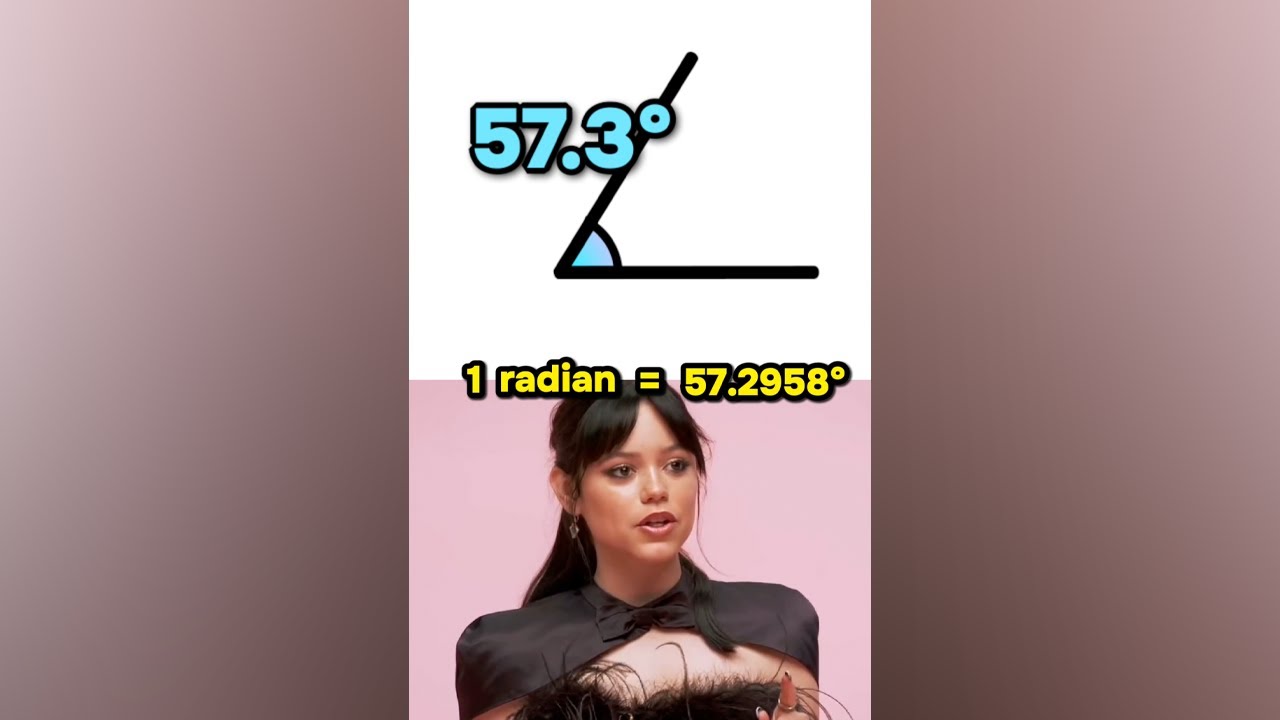
👉 Take our 2-minute Onlock survey - help shape the future of learning https://docs.google.com/forms/d/e/1FAIpQLSdCxHIRkgYpfoISxNkKJdWe57t2sS_XlIMs98CJmzQhov4zoA/viewform 🔥
👉 https://www.onlocklearning.com — the ultimate exam help platform.
🚨DISCLAIMER🚨: There’s no real audio/video of Jenna Ortega or Gordon Ramsay in this vid...
this video will help you understand better of it
@tight orchid
tight orchid
Ok, I'll look at it rn
Ok, I had to watch it twice to make sure. To find the amount of radians, it's basically seeing how many times the radius can fit in the same length as the circumference?
open wedge
tight orchid
Ok, I had to watch it twice to make sure. To find the amount of radians, it's ba...
yep
tight orchid
Ok, I understand it
open wedge
good
tight orchid
👍
open wedge
now prove that $\frac \pi 2$ radians is a right angle
flat frigateBOT
1 divided by 0 equals Infinity
 tight orchid
I have to go to my next class now, so can I do it once I'm in passing period? In like 50 mins
open wedge
alr
vagrant ice
open wedge
now prove that $\frac \pi 2$ radians is a right angle
you should say 'show that' instead of 'prove that'
open wedge
vagrant ice
you should say 'show that' instead of 'prove that'
alright
safe radishBOT
@tight orchid Has your question been resolved?
safe radishBOT
Channel closed
Closed due to timeout
Use .reopen if this was a mistake.
Available help channel!
Send your question here to claim the channel.
Remember:
• Ask your math question in a clear, concise manner.
• Show your work, and if possible, explain where you are stuck.
• Do not immediately ping people or roles. After 15 minutes, feel free to ping <@&286206848099549185> once.
• Type the command .close to free the channel when you're done.
• Be polite and have a nice day!
Read #❓how-to-get-help for further information on how to ask a good question, and about conduct in the question channels.
 lean nexus
I have no idea where to start, I mean row space is pertaining to non zero rows of a I think row reduced echelon of a matrix but that's all I got
 safe radishBOT
lean nexus
I have no idea where to start, I mean row space is pertaining to non zero rows o...
safe radishBOT
lean nexus
I have no idea where to start, I mean row space is pertaining to non zero rows o...
 peak estuary
if a vector x is in the row space of A, then x can be written as a linear combination of the rows of A
can x also be written as a linear combination of rows of B?
if yes that shows that the row space of A is a subset of the row space of B
then repeat in the other direction
lean nexus
peak estuary
if a vector x is in the row space of A, then x can be written as a linear combin...
well I've seen something what you're saying to similar except for columns of A but I think I'm thinking of something else like range
peak estuary
the range of A is the same as the column space of A
so that is indeed the same thing, just rows instead of columns
lean nexus
where did you get the idea of introducing a vector x
peak estuary
to show that two sets are the same you take an element from each set and show that it is in the other set
lean nexus
I know ran(A)={y: Ax=y, x in R^n} but what would be set for row(A)
peak estuary
peak estuary
if a vector x is in the row space of A, then x can be written as a linear combin...
but you should work with that description
lean nexus
i tried looking at the matrices by drawing it but still dont see a pattern

I'm assuming "kth row" is before the "mth" row
safe radishBOT
@lean nexus Has your question been resolved?
safe radishBOT
@lean nexus Has your question been resolved?
Channel closed
Closed by @lean nexus
Use .reopen if this was a mistake.
Available help channel!
Send your question here to claim the channel.
Remember:
• Ask your math question in a clear, concise manner.
• Show your work, and if possible, explain where you are stuck.
• Do not immediately ping people or roles. After 15 minutes, feel free to ping <@&286206848099549185> once.
• Type the command .close to free the channel when you're done.
• Be polite and have a nice day!
Read #❓how-to-get-help for further information on how to ask a good question, and about conduct in the question channels.
 swift salmon
Guys, what's wrong with my function?
 safe radishBOT
swift salmon
Guys, what's wrong with my function?
plucky elk
safe radishBOT
swift salmon
Guys, what's wrong with my function?
plucky elk
what does the error say
swift salmon
plucky elk
what does the error say
It does not say anything.
Wait lemme graph it somewhere else
 quasi bison
what happens if you mouse over the ⚠️ symbol
swift salmon
quasi bison
what happens if you mouse over the ⚠️ symbol
Oh It's okay I found graphed it.
Now I'm tryna see the limit as x approach 0 of this function we can define as R(x)
 swift salmon
quasi bison
with that sqrt(x-25) in?
swift salmon
quasi bison
with that sqrt(x-25) in?
Well yes, my work led me to the conclusion that the limit as x approaches 0 of R(x) is equal to 41.8
quasi bison
!xy
safe radishBOT
Please show the original problem, exactly as it was stated to you, with the entire original context. A picture or screenshot is best. If the original problem is not in English, then post it anyway! The additional context might still be helpful. Do your best to provide a translation.
quasi bison
we will not proceed any further until you show us the full original question
swift salmon
Ok.
y = \frac{\sqrt{x - 25} + \frac{2}{3x}}{\sqrt{x + 9} + \frac{3}{2x}}
$\lim_{x \to 0} \frac{\sqrt{x - 25} + \frac{2}{3x}}{\sqrt{x + 9} + \frac{3}{2x}}$
flat frigateBOT
GoldTrain
 quasi bison
are you 200% SURE that this is EXACTLY WHAT THE TEXTBOOK SAYS
 burnt notch
Send us a photo/screenshot of the exercise in the textbook
swift salmon
quasi bison
are you ***200% SURE*** that this is **EXACTLY WHAT THE TEXTBOOK SAYS**
I'm not using any textbook. I came up with this on the spot.
quasi bison
ok then your function is fucked up
its domain doesnt extend to 0
it's only defined for x ≥ 25
it makes zero sense to speak of its limit at x->0
swift salmon
quasi bison
it makes zero sense to speak of its limit at x->0
Isn't it still possible to factor it out & then do substition on it.
Cuz It seems possible for me.
quasi bison
it's possible to push symbols around on a page if you have like, ≤0 regard for what things mean
which it really sounds like that's the case
swift salmon
I see.
Does the value at which a limit is approaching needs to be part of the domain of a function?
quasi bison
it needs to be an accumulation point of the domain
which may or may not belong to the domain itself
swift salmon
Wdym?
quasi bison
but 0 is in fact not an accumulation pt of [25,+∞) anyway
swift salmon
quasi bison
but 0 is in fact _not_ an accumulation pt of [25,+∞) anyway
But you said which may or may not belong to the domain itself.
quasi bison
swift salmon
Wdym?
given a set X ⊆ R and a point a ∈ R, we say a is an accumulation point of X if:
any neighborhood of a has nonempty intersection with X \ {a}
quasi bison
swift salmon
But you said which may or may not belong to the domain itself.
ok and you decided to jump to conclusions before i was done yapping
swift salmon
quasi bison
given a set X ⊆ R and a point a ∈ R, we say _a is an accumulation point of X_ if...
Nonempty intersection with X \ {a}?
quasi bison
ok let me rephrase that
swift salmon
quasi bison
ok and you decided to jump to conclusions before i was done yapping
My bad, I thought you were done.
quasi bison
any open interval centered at a contains at least one point of X that's different from a itself.
that is what it means for a to be an accumulation pt of X
intuitively speaking, an accumulation point of X is a point that "can be approached" from within X, without stepping on the target pt itself
swift salmon
quasi bison
any open interval centered at _a_ contains at least one point of X that's differ...
So if we have an interval (3,7), and a = 4, the points centering a should be points of x that are part of the function of x but not a?
swift salmon
quasi bison
intuitively speaking, an accumulation point of X is a point that "can be approac...
Is that the epsilon-delta definition of a limit?
quasi bison
there's no function at all yet
quasi bison
swift salmon
Is that the epsilon-delta definition of a limit?
no
i think if you're going to self-study real analysis then you really should pick up a textbook and stop trying to be Euler II.
swift salmon
quasi bison
i think if you're going to self-study real analysis then you really should pick ...
I'm doing Calc 1 💀
swift salmon
quasi bison
i guess you dont need the full and technical definition
Of what? the accumulation point of X?
quasi bison
"accumulation point", yes.
for a function whose domain is an interval (which basically all functions you encounter will be),
one can speak of the limit at a point either inside the interval, or at either endpoint, and this is regardless of whether the domain includes that endpoint or not.
swift salmon
quasi bison
"accumulation point", yes.
Oh, Okay. What's the point of real analysis btw?
quasi bison
real analysis is basically calculus but more rigorous.
swift salmon
quasi bison
for a function whose domain is an **interval** (which basically all functions yo...
So, if my limit is approaching a point that is not inside the domain of the function, then it's not real?
swift salmon
quasi bison
real analysis is basically calculus but more rigorous.
What are its applications?
quasi bison
that question sounds as strange as asking "what are the applications of syntax" in English class.
swift salmon
quasi bison
that question sounds as strange as asking "what are the applications of syntax" ...
Could you explain how so?
quasi bison
analysis is a huge ass field in math
like higher math. uni level stuff
so asking about its "applications" is like
youll get either wishy washy bullshit or just nothing
swift salmon
quasi bison
youll get either wishy washy bullshit or just nothing
What?
swift salmon
quasi bison
analysis is a huge ass field in math
I'm asking about "real" analysis, not analysis. & analysis sounds like I'm going to write a 250 page about why 1 + 1 = 2.
quasi bison
analysis == real analysis
but ok like
yknow im gonna be honest
youve given off strong vibes of someone who doesnt wanna listen and instead will act self entitled or whatever
swift salmon
quasi bison
youve given off strong vibes of someone who doesnt wanna listen and instead will...
Oh, I see. My bad, then.
What does the Epsilon-Delta definition of a limit states?
.close
safe radishBOT
Channel closed
Closed by @swift salmon
Use .reopen if this was a mistake.
burnt notch
swift salmon
What does the Epsilon-Delta definition of a limit states?
Why don't you look it up by yourself first?
swift salmon
burnt notch
Why don't you look it up by yourself first?
I did, but still don't understand.
.close
burnt notch
swift salmon
I did, but still don't understand.
What of that didn't you I understand?
Vague questions deserve vague answers...
safe radishBOT
Available help channel!
Send your question here to claim the channel.
Remember:
• Ask your math question in a clear, concise manner.
• Show your work, and if possible, explain where you are stuck.
• Do not immediately ping people or roles. After 15 minutes, feel free to ping <@&286206848099549185> once.
• Type the command .close to free the channel when you're done.
• Be polite and have a nice day!
Read #❓how-to-get-help for further information on how to ask a good question, and about conduct in the question channels.
 mortal forge
any one has a good resource to study laplace transform
 vivid sparrow
mortal forge
any one has a good resource to study laplace transform
vivid sparrow
mortal forge
any one has a good resource to study laplace transform
Pauls notes for odes
mortal forge
thnx
vivid sparrow
In this chapter we introduce Laplace Transforms and how they are used to solve Initial Value Problems. With the introduction of Laplace Transforms we will not be able to solve some Initial Value Problems that we wouldn’t be able to solve otherwise. We will solve differential equations that involve Heaviside and Dirac Delta functions. We wi...
Professor Leonard om youtube has good understandable calc 3 lectures, he has a diffeqs playlist but I haven't watched it, it should have info about laplace transforms though
safe radishBOT
@mortal forge Has your question been resolved?
Channel closed
Closed by @mortal forge
Use .reopen if this was a mistake.
safe radishBOT
Available help channel!
Send your question here to claim the channel.
Remember:
• Ask your math question in a clear, concise manner.
• Show your work, and if possible, explain where you are stuck.
• Do not immediately ping people or roles. After 15 minutes, feel free to ping <@&286206848099549185> once.
• Type the command .close to free the channel when you're done.
• Be polite and have a nice day!
Read #❓how-to-get-help for further information on how to ask a good question, and about conduct in the question channels.
 haughty loom
For all n >= 1, prove 12^{n} - 5^{n} is divisible by 7.
I was able to use the rule of exponents to be able to split 12^{k} - 5^{k} into 12 * 12^{k} - 5 * 5^{k} but I'm not sure what to do next? Thank you. There's a trick that the professor showed us where you can split one of the numbers into two portions and then go from there, but I'm not sure how you'd apply it in this case? Thank you.


 safe radishBOT
haughty loom
> For all n >= 1, prove 12^{n} - 5^{n} is divisible by 7.
I was able to use the...
safe radishBOT
haughty loom
> For all n >= 1, prove 12^{n} - 5^{n} is divisible by 7.
I was able to use the...
 quiet plume
$12^{k+1} - 5^{k+1} = 12 \cdot 12^k - 5\cdot 5^k$, then yes split $12$ as $5 + 7$.
flat frigateBOT
Azyrashacorki
 haughty loom
quiet plume
$12^{k+1} - 5^{k+1} = 12 \cdot 12^k - 5\cdot 5^k$, then yes split $12$ as $5 + 7...
haughty loom
quiet plume
$12^{k+1} - 5^{k+1} = 12 \cdot 12^k - 5\cdot 5^k$, then yes split $12$ as $5 + 7...
Thank you. would this be right so far? Then you'd just replace 12^{k} - 5^{k} with 7m and you then proved it.
 quiet plume
The big fraction is wrong (if you really want to show that you've factored it by dividing through, you need a multiple of 5 popping out) .and you're better off using equality symbols rather than implications.
But the last thing you wrote is right.
 regal onyx
haughty loom
Thank you. would this be right so far? Then you'd just replace 12^{k} - 5^{k} wi...
regal onyx
haughty loom
Thank you. would this be right so far? Then you'd just replace 12^{k} - 5^{k} wi...
i just had my test on this tdy and for divisibility questions i found that it always works to do something like 12^k = 7m + 5^k and just sub. it will factor every time very nicely
haughty loom
Ok, let me fix that, wait, so you don't divide it by 5 to get it back out?
haughty loom
regal onyx
i just had my test on this tdy and for divisibility questions i found that it al...
Thanks for the info. I'll note this down.
To be frank I suck at this. 🤣
regal onyx
dw youll get better w practice
 wild cape
why did u write all the equal signs as implies?
haughty loom
Bad habit mainly, that was my bad. Doesn't make sense in this context, I'm just used to conditional statements for some reason. Thanks for pointing it out

Ok, does something like this work?

🤔 Feels like I'm missing a step. Hm. Something to do with the 12^{k} * 7?
Wait..
regal onyx
i think that shows pk+1 is true when pk is true
because ur final expression is divisible by 7
wild cape
u should finish at the form integer*7. what is that integer?
regal onyx
u should factor the final expression
haughty loom
I'm really bad at factoring so sorry about this, would I add 7 + 5 back to get 12, then factor 12 out?
regal onyx
so u get 7 * some integer
haughty loom
Ah ok, I get it.
You factor out the 7.
So 7(12^{k}+5m)?
?

Ah ok, sweet, thank you.
Does this look right to you guys? Again, thank you so much to the three of you

 regal onyx
idk how much ur teacher cares abt ur statements but i would write that since n=1 is true and n=k => n=k+1 is true, the result is proved by mathematical induction for all n >= 1
haughty loom
Ok, thank you guys, does this look correct?
 regal onyx
looks right to me
haughty loom
Ok, that sounds good, thanks a lot for checking this.
I just want to make sure for this question though that it looks right, if's still fine. 🙂

...Probably should just use = instead of \equiv, oops.
Ok, fixed that part. Do I have anything else wrong?
 regal onyx
how do u suppose 4i - 2 = 2n^2
haughty loom
I'm gonna be honest, I'm not entirely sure. I was trying to follow this example that the professor laid out. Aren't we supposed to sustitute values to check to see if they're equal?

Unless I'm misinterpretting here.
regal onyx
haughty loom
Unless I'm misinterpretting here.
yes a little
ur usually sub values from ur n=k assumption
haughty loom
regal onyx
yes a little
Alright, thank you for pointing that out.
regal onyx
4i-2=2n^2 doesn't work because its the sum of i=1 to n of 4i-2 that gives 2n^2
haughty loom
I see.
Wait...so how does the substitution work then? If we can't replace i with k.
regal onyx
when u make ur k assumption u get sum from i=1 to k of 4i-2. ur substituting the entire sigma
haughty loom
Also, thanks for your patience, really do appreciate it.
OH I SEE.
Ok, that makes sense.

So we're substituting the entire sigma with k, and then we have to prove that for the entire sigma, with k + 1, all of these cases work.
regal onyx
im not sure ik what u mean, but when u break down the sigma with k+1 into a sigma with k and the k+1 term, thats when u sub k+1 and show that it's equal to 2(k+1)^2
 haughty loom
regal onyx
im not sure ik what u mean, but when u break down the sigma with k+1 into a sigm...
haughty loom
regal onyx
im not sure ik what u mean, but when u break down the sigma with k+1 into a sigm...
Yea, I'm really bad at this. Ok, thank you for explaining. Because I'm not really good at understanding this, is it basically (k + 1) + ... + (4n = 2) - 2n^2? I've had a hard time understanding sigma well.
We're not really assuming anything then?

I hope this is right now?

 haughty loom
Wait, so we wouldn't care about the 4k+2?
regal onyx
once u add a conclusion sentence the proof works. though some equal signs make it a little confusing
regal onyx
haughty loom
Wait, so we wouldn't care about the 4k+2?
2k^2 + 4k + 2 = 2(k+1)^2 once factored
haughty loom
Oh, I see. So there's no need to even spread them out in the "Continuing the distribution" section?
regal onyx
honestly once u had 2k^2 + 4k + 2 = 2(k+1)^2 ur basically done because you've now proved that n=k+1 is true using the assumption n=k
u dont have to distribute or anything afterwards
haughty loom
Ok, let me just rewrite that then.
You highlighted the sigma, did I write that part wrong somehow?

Wait, just get rid of the entire sigma then?

Ok. Final version.

Again, really, thanks for the patience.
regal onyx
this is good. i would remove what i highlighted for clarity. and finally i would conclude with: "since the result is true for both n=1 and n=k+1 assuming n=k is true, the result is true for all integers n greater than or equal to one"

"since the result is true for both n=1 and n=k+1 assuming n=k is true, the result is true for all integers n greater than or equal to one" goes in place of since k is an integer, therefore, for all cases btw
haughty loom
regal onyx
"since the result is true for both n=1 and n=k+1 assuming n=k is true, the resul...
Thanks, I'll add that, here's the thing, he always wants us to mention that k's an integer for the final portion. Apparently he's trying to use it as a way to detect AI cheating. 🤷
regal onyx
oh lol then nvm haha
haughty loom
regal onyx
oh lol then nvm haha
Hahahahahah. It's fine. I added it anyways.

Also, is it fine if you check this final one too? And those should really be all. Again, really appreciate the help so far, mate. I just have to survive this class. 🙂

Actually, I added more of a clearer statement at the bottom.

Actually here, it's shorter.
 regal onyx
haughty loom
Actually here, it's shorter.
regal onyx
haughty loom
Actually here, it's shorter.
this look good

this part might be repeated
haughty loom
Oh crap, oops.
Thank you for catching that.
Ok

Ok, final version.

I'm just writing the distribution out because I suck at algebra, so I need to actually see what it looks like.
regal onyx
this looks right
haughty loom
regal onyx
this looks right
Ok. Thank you so much. I think I'm done for tonight then.
Have a good day/night, wherever you are. Again, really do appreciate the help.
.close
safe radishBOT
Channel closed
Closed by @haughty loom
Use .reopen if this was a mistake.
safe radishBOT
Available help channel!
Send your question here to claim the channel.
Remember:
• Ask your math question in a clear, concise manner.
• Show your work, and if possible, explain where you are stuck.
• Do not immediately ping people or roles. After 15 minutes, feel free to ping <@&286206848099549185> once.
• Type the command .close to free the channel when you're done.
• Be polite and have a nice day!
Read #❓how-to-get-help for further information on how to ask a good question, and about conduct in the question channels.
 sinful citrus
 safe radishBOT
sinful citrus
safe radishBOT
sinful citrus
 safe radishBOT
Channel closed
Closed by @sinful citrus
Use .reopen if this was a mistake.
safe radishBOT
Available help channel!
Send your question here to claim the channel.
Remember:
• Ask your math question in a clear, concise manner.
• Show your work, and if possible, explain where you are stuck.
• Do not immediately ping people or roles. After 15 minutes, feel free to ping <@&286206848099549185> once.
• Type the command .close to free the channel when you're done.
• Be polite and have a nice day!
Read #❓how-to-get-help for further information on how to ask a good question, and about conduct in the question channels.
 shell loom
 safe radishBOT
shell loom
shell loom
safe radishBOT
shell loom
shell loom
please solveeeeee im so stuckk
 rigid inlet
errant rapids
rigid inlet
errant rapids
Brother you asked the exact same ques but different numbers before
Try to understand the logic then at least not just the answers
safe radishBOT
@shell loom Has your question been resolved?
safe radishBOT
Channel closed
Closed due to timeout
Use .reopen if this was a mistake.
Available help channel!
Send your question here to claim the channel.
Remember:
• Ask your math question in a clear, concise manner.
• Show your work, and if possible, explain where you are stuck.
• Do not immediately ping people or roles. After 15 minutes, feel free to ping <@&286206848099549185> once.
• Type the command .close to free the channel when you're done.
• Be polite and have a nice day!
Read #❓how-to-get-help for further information on how to ask a good question, and about conduct in the question channels.
 dull sequoia
im currently looking at separation of variables to solve the heat equation, i dont get why we keep lambda = 0 when looking at the sine expansion of X(x)
safe radishBOT
dull sequoia
im currently looking at separation of variables to solve the heat equation, i do...
dull sequoia
since you already start this part by saying suppose lambda < 0, how can you then pick k \in \bZ such that lambda = 0?
safe radishBOT
@dull sequoia Has your question been resolved?
safe radishBOT
@dull sequoia Has your question been resolved?
Channel closed
Closed by @dull sequoia
Use .reopen if this was a mistake.
safe radishBOT
Available help channel!
Send your question here to claim the channel.
Remember:
• Ask your math question in a clear, concise manner.
• Show your work, and if possible, explain where you are stuck.
• Do not immediately ping people or roles. After 15 minutes, feel free to ping <@&286206848099549185> once.
• Type the command .close to free the channel when you're done.
• Be polite and have a nice day!
Read #❓how-to-get-help for further information on how to ask a good question, and about conduct in the question channels.
 south lynx
i need help with the first part of the question. i looked it up and one of the most common solutions was (a, b) R (c, d) iff a < c or (a = c and b < d) and it does make sense, but i cannot figure out how did we think of it? in general too, i am having trouble with coming up with examples of this topic
 safe radishBOT
south lynx
i need help with the first part of the question. i looked it up and one of the m...
dull sequoia
safe radishBOT
south lynx
i need help with the first part of the question. i looked it up and one of the m...
dull sequoia
i mean you want to compare 2 pairs of numbers
it's a lot like reading words on a page
in english you read top to bottom, left to right
as in, if 2 words are on the same column you read the top one first, if 2 words are in the same row you read the left one first
here you read the first entry first, compare them, if they are the same then compare the 2nd entries
south lynx
so like dictionary order?
 mortal sandal
Exactly
It's often called the lexicographic order
which I think is a fancy word for the same thing
south lynx
what other examples could be there for this question?
mortal sandal
If youve seen the diagonal paths trick
You can do that, basically bijecting to N and using that ordering
It's a little easier to see that that's a well-order
mortal sandal
Yeah the definition of well-order is a bit weird
safe radishBOT
Channel closed
Closed by @south lynx
Use .reopen if this was a mistake.
mortal sandal
No problem
safe radishBOT
Available help channel!
Send your question here to claim the channel.
Remember:
• Ask your math question in a clear, concise manner.
• Show your work, and if possible, explain where you are stuck.
• Do not immediately ping people or roles. After 15 minutes, feel free to ping <@&286206848099549185> once.
• Type the command .close to free the channel when you're done.
• Be polite and have a nice day!
Read #❓how-to-get-help for further information on how to ask a good question, and about conduct in the question channels.
 clever gale
A² = ?
hence A^n = ? for n ≥ 2?
 winged flare
you could alternatively cheat a bit and find det(A)
but try finding the pattern first
there are some other problems where the cell contents are not so simple
 ornate wyvern
winged flare
there are some other problems where the cell contents are not so simple
ornate wyvern
winged flare
there are some other problems where the cell contents are not so simple
a matrix is aka cell?
winged flare
no i meant it like the cells in a matrix
ornate wyvern
the elements right
winged flare
yeah
ornate wyvern
yea sure elements can b more difficult
clever gale
winged flare
you could alternatively cheat a bit and find det(A)
Hmm, what does that exactly do
ornate wyvern
!noans
safe radishBOT
The purpose of this server is to help you learn, not to hand out answers. Do not ask someone to give you the answer directly.
winged flare
ornate wyvern
!noans
well no shot you literally circled the answer
ornate wyvern
winged flare
well no shot you literally circled the answer
im not the OP
winged flare
oh
safe radishBOT
@west onyx Has your question been resolved?
Channel closed
Closed by @west onyx
Use .reopen if this was a mistake.
Available help channel!
Send your question here to claim the channel.
Remember:
• Ask your math question in a clear, concise manner.
• Show your work, and if possible, explain where you are stuck.
• Do not immediately ping people or roles. After 15 minutes, feel free to ping <@&286206848099549185> once.
• Type the command .close to free the channel when you're done.
• Be polite and have a nice day!
Read #❓how-to-get-help for further information on how to ask a good question, and about conduct in the question channels.
 hoary seal
heyy I understand perumation and combination definition but I am not able to see or visualise their difference
safe radishBOT
hoary seal
heyy I understand perumation and combination definition but I am not able to see...
hoary seal
can u possibly show me through an example, that might help
junior raven
order matters in permutation
hoary seal
yes
junior raven
2 scoops of 2 flavours
vanilla on top and chocolate below is not the same as vanilla below and choclate on top
but for combination
those two ice creams would be equivalent
 junior raven
so red blue green and green blue red are not the same in permutation
but they are the same in combination
hoary seal
yes I understand that but
 elder moss
hoary seal
elder moss
hoary seal
how many ways to choose red blue and green?
 austere goblet
hoary seal
I feel like something else I am missing
austere goblet
hoary seal
I feel like something else I am missing
how about, you explain what you know about permutations and combinations
in your own terms
then we'll check you
use whatever example you please
hoary seal
permutation is selection of items
but order matters
combination is the same but order does not matter
austere goblet
then suppose I have three coins. how many combinations of those three coins are there? how many permutations?
(call them A, B, C if you want to list them)
austere goblet
I asked two questions.
hoary seal
ABC - 1 combination
3! for permutation = 6 ways
burnt notch
Correct