#help-19
1 messages · Page 95 of 1
 mental wharf
mental wharf
mental wharf
do you know about the choose function
 autumn dove
No
mental wharf
its fine then
 mental wharf
this seems like a problem to teach the choose function
autumn dove
autumn dove
Can you explain why this is the formula? Apparently its the answer
mental wharf
lets say one of the endpoints is a_1
how many options are there for the other endpoint
mental wharf
it should be in terms of n
mental wharf
mental wharf
the first point can be connected to the second one, third one and so on
remember this
mental wharf
there are n-1 options because it can be connected to any of the other points
mental wharf
now instead of a_1 lets say it was a_2 or a_3
how many options are there for the other endpoint
autumn dove
N-1
autumn dove
N-1
mental wharf
not quite
autumn dove
N-2?
mental wharf
no
autumn dove
Uh
mental wharf
it could be a_1, a_2, a_3...a_n
autumn dove
So n options
mental wharf
yes
so we have n(n-1)
now, dont forget that we are counting both a_1a_2 and a_2a_1 as different segments but are they?
autumn dove
No
mental wharf
np
autumn dove
.close
 odd edgeBOT
Channel closed
Closed by @autumn dove
Use .reopen if this was a mistake.
 Available help channel!
Send your question here to claim the channel.
Remember:
• Ask your math question in a clear, concise manner.
• Show your work, and if possible, explain where you are stuck.
• After 15 minutes, feel free to ping <@&286206848099549185>.
• Type the command .close to free the channel when you're done.
• Be polite and have a nice day!
Read #❓how-to-get-help for further information on how to ask a good question, and about conduct in the question channels.
 signal oar
\begin{problem} Let $V$ be a $K$-vector space with $n = \dim V < \infty$, and $\varphi: V \to V$ linear. Let $\varphi$ be nilpotent and $d \in \mathbb N$ minimal with $\varphi^d = \underline 0$. Show that[
\operatorname{ker}(\varphi) \neq {0_V} \text{ and } \operatorname{image}(\varphi) \subsetneqq V.] \end{problem}
odd edgeBOT
signal oar
\begin{problem} Let $V$ be a $K$-vector space with $n = \dim V < \infty$, and $\...
signal oar

This seems similar to the one we did last time, @fresh ruin
So we just need to find something that makes phi zero, other than the 0 vector, right?
 fresh ruin
yea something akin to the eigenvalues being 0 for some eigenvector, not sure how to do it with less tools though
 echo ginkgo
signal oar
So we just need to find something that makes phi zero, other than the 0 vector, ...
echo ginkgo
signal oar
So we just need to find something that makes phi zero, other than the 0 vector, ...
well d is the minimal power such that phi^d = 0, what can you say about phi^(d-1) ?
signal oar
echo ginkgo
well d is the minimal power such that phi^d = 0, what can you say about phi^(d-1...
It is nonzero
echo ginkgo
yea
signal oar
echo ginkgo
yea
So, how does that help?
echo ginkgo
so there's a v such that phi^(d-1)(v) != 0
signal oar
Yeah
echo ginkgo
what's $\phi(\phi^{d-1}(v))$ then ?
 clever fjordBOT
aPlatypus

 signal oar
Thanks
signal oar
echo ginkgo
if you're lazy you could just use rank-nullity
Btw, regarding

I think I found this on MSE: https://math.stackexchange.com/questions/3918658/minimal-polynomial-product
And apparently this is wrong?
According to the comment
Or am I missing something
signal oar
echo ginkgo
yea that question seems broken
Are you saying the problem is correct or the answerer on MSE is correct?
signal oar
echo ginkgo
<@332561465405865985>
I assume you are saying the problem is wrong?
echo ginkgo
yes
 signal oar
echo ginkgo
what's $\phi(\phi^{d-1}(v))$ then ?
signal oar
echo ginkgo
what's $\phi(\phi^{d-1}(v))$ then ?
I assume we need something similar to this?
.close
odd edgeBOT
Channel closed
Closed by @signal oar
Use .reopen if this was a mistake.
odd edgeBOT
Available help channel!
Send your question here to claim the channel.
Remember:
• Ask your math question in a clear, concise manner.
• Show your work, and if possible, explain where you are stuck.
• After 15 minutes, feel free to ping <@&286206848099549185>.
• Type the command .close to free the channel when you're done.
• Be polite and have a nice day!
Read #❓how-to-get-help for further information on how to ask a good question, and about conduct in the question channels.
 celest aspen
can someone help me understand this question, dont get the square bracket formatting
odd edgeBOT
celest aspen
can someone help me understand this question, dont get the square bracket format...
celest aspen

 desert marlin
They’re just parenthesis
 ivory dock
The real question I guess is whether 3/n is part of the sum or not...
ivory dock
does it? I hate it when people don't use parenthesis with limits and cause confusion
same with sums and stuff
I guess it really depends on what notation op is used to by his teacher
celest aspen
ngl this is kind of confusing... 3/n is zero but k also approaches infinity, idk how to solve
this is a calc bc practice exam
but i never seen this format before
celest aspen
no clue, answer is 39
 signal quest
i would assume that 3/n is part of the sum, otherwise they would have just put it in front or not even have included it
well
you can kind of treat it like a constant and pull it out though'
ivory dock
ye lol
signal quest
maybe try pulling 3/n out and expanding
celest aspen
3/n makes every term zero at infinity
signal quest
yeah but its a sum, not a sequence
celest aspen
idk how to solve for the sum tho
celest aspen
it kind of looks like a power series which are pretty difficult to find the sum of
im also confused at how the limit part plays into the equation, like what is the difference between just having n at infinity
also as n approaches infinity each term is divided by infinity no matter what K you are on
so shouldnt it all be zero
nvm i found the limits of sum definition
signal quest
honestly
celest aspen
.close
odd edgeBOT
Channel closed
Closed by @celest aspen
Use .reopen if this was a mistake.
signal quest
this is reminding me of the integral definition
odd edgeBOT
Available help channel!
Send your question here to claim the channel.
Remember:
• Ask your math question in a clear, concise manner.
• Show your work, and if possible, explain where you are stuck.
• After 15 minutes, feel free to ping <@&286206848099549185>.
• Type the command .close to free the channel when you're done.
• Be polite and have a nice day!
Read #❓how-to-get-help for further information on how to ask a good question, and about conduct in the question channels.
 dapper glacier
how would i go about solving this?
 odd edgeBOT
dapper glacier
how would i go about solving this?
odd edgeBOT
dapper glacier
how would i go about solving this?
 crisp wadi
Start by expressing l in terms of k
odd edgeBOT
@dapper glacier Has your question been resolved?
 west merlin
i got it finally
line L can be seen as some line with form y=mx+b. where m is the slope and b is the y-intercept. L is tangent to y=e^x at (k, e^k). so their slopes must be the same at that point. thus m=y'(k).
and the y-intercept is given to you, 1/2
you should then have an equation for your line, with everything in place except for that value of k. you can find that by plugging in the point of intersection given (k, e^k) into the function of your line
you will need to use the lambert w function in order to solve the equation though
odd edgeBOT
Channel closed
Closed due to timeout
Use .reopen if this was a mistake.
odd edgeBOT
Available help channel!
Send your question here to claim the channel.
Remember:
• Ask your math question in a clear, concise manner.
• Show your work, and if possible, explain where you are stuck.
• After 15 minutes, feel free to ping <@&286206848099549185>.
• Type the command .close to free the channel when you're done.
• Be polite and have a nice day!
Read #❓how-to-get-help for further information on how to ask a good question, and about conduct in the question channels.
 eternal glade
when is this matrix diagonalizable? i got: either b,c=0 and every a or b,c!=0 and a is free to choose
 odd edgeBOT
eternal glade
when is this matrix diagonalizable? i got: either b,c=0 and every a or b,c!=0 an...
eternal glade
odd edgeBOT
eternal glade
when is this matrix diagonalizable? i got: either b,c=0 and every a or b,c!=0 an...
eternal glade
is this correct?
odd edgeBOT
@eternal glade Has your question been resolved?
 gray bronze
what is the difference between the two things you said? is every a different from a is free to choose?
echo ginkgo
b,c=0 / b,c!=0, you mean both are zero or both are non-zero right ?
@eternal glade
in that case, gg you're right
odd edgeBOT
Channel closed
Closed due to timeout
Use .reopen if this was a mistake.
Available help channel!
Send your question here to claim the channel.
Remember:
• Ask your math question in a clear, concise manner.
• Show your work, and if possible, explain where you are stuck.
• After 15 minutes, feel free to ping <@&286206848099549185>.
• Type the command .close to free the channel when you're done.
• Be polite and have a nice day!
Read #❓how-to-get-help for further information on how to ask a good question, and about conduct in the question channels.
 sharp flume
for finding antideriv
odd edgeBOT
sharp flume
for finding antideriv

 marsh nacelle
I would divide each term by sqrt(t)
what do you mean bring sqrt(t) out of denominator
sharp flume
cant you turn it into a negative expnonet?
 sharp flume
got it
marsh nacelle
Then you can integrate each part individually
odd edgeBOT
@sharp flume Has your question been resolved?
odd edgeBOT
Channel closed
Closed due to timeout
Use .reopen if this was a mistake.
Available help channel!
Send your question here to claim the channel.
Remember:
• Ask your math question in a clear, concise manner.
• Show your work, and if possible, explain where you are stuck.
• After 15 minutes, feel free to ping <@&286206848099549185>.
• Type the command .close to free the channel when you're done.
• Be polite and have a nice day!
Read #❓how-to-get-help for further information on how to ask a good question, and about conduct in the question channels.
 lavish frost
 odd edgeBOT
lavish frost
lavish frost
odd edgeBOT
lavish frost
lavish frost
how do you go about solving this
I know that when you get derivative of integral you basically replace t with x from the integral
and then apply chain rule if needed
 zinc glacier
you can imagine the integral is some function F such that F' = 1/(2+t^4)
by ftc, the integral is F(x^3)-F(x^2)
then you take the derivative of that and use chain rule
odd edgeBOT
@lavish frost Has your question been resolved?
lavish frost
I see
odd edgeBOT
Channel closed
Closed by @lavish frost
Use .reopen if this was a mistake.
Available help channel!
Send your question here to claim the channel.
Remember:
• Ask your math question in a clear, concise manner.
• Show your work, and if possible, explain where you are stuck.
• After 15 minutes, feel free to ping <@&286206848099549185>.
• Type the command .close to free the channel when you're done.
• Be polite and have a nice day!
Read #❓how-to-get-help for further information on how to ask a good question, and about conduct in the question channels.
 cedar geyser
how do i do a
 odd edgeBOT
cedar geyser
how do i do a
odd edgeBOT
cedar geyser
how do i do a
 signal halo
cedar geyser
how do i do a
signal halo
cedar geyser
how do i do a
Remember that the integral of f(x) is the area under the curve plus some constant
If it’s telling you the integral from -6 to 5 and you know the area under the curve there you can get the constant
And then you can use that constant to get the integral of the other section
cedar geyser
signal halo
If it’s telling you the integral from -6 to 5 and you know the area under the cu...
so the area from -6 to 5 is 7
cedar geyser
signal halo
And then you can use that constant to get the integral of the other section
how does that work tho
signal halo
cedar geyser
so the area from -6 to 5 is 7
No
The integral from -6 to 5 is 7
This is different from the area under the curve
cedar geyser
oh yeah
cedar geyser
signal halo
And then you can use that constant to get the integral of the other section
how do i use this to get the area of the other section?
signal halo
cedar geyser
how do i use this to get the area of the other section?
Because the constant stays the same
Basically it’ll be like this
Given integral = calculated area + c
You use those to solve for c
And then you will have unknown integral = calculated area + c
You can solve that cuz you will already know c
cedar geyser
signal halo
Because the constant stays the same
so c = 7
so given integral = ∫-6 -> -2f(x)dx
cedar geyser
signal halo
Given integral = calculated area + c
wdym calculated area?
signal halo
cedar geyser
wdym calculated area?
Like the area you have to calculate by looking at the graph and using geometry
cedar geyser
signal halo
Like the area you have to calculate by looking at the graph and using geometry
but how if im not given the -6 part of the graph
signal halo
cedar geyser
but how if im not given the -6 part of the graph
It says 2 lines segments and a semicircle make up the graph
So the line from -2 to 0 (which is -x-1) goes all the way to -6
cedar geyser
signal halo
So the line from -2 to 0 (which is -x-1) goes all the way to -6
on the answer tho they did something like this
 signal halo
cedar geyser
on the answer tho they did something like this
signal halo
cedar geyser
on the answer tho they did something like this
Oh yeah
Actually that’s the smarter way to do it
Then you only have to find the area under -2 to 5
cedar geyser
signal halo
Actually that’s the smarter way to do it
How’s does that work tho
I don’t understand how that works
signal halo
cedar geyser
How’s does that work tho
So by properties of integrals they are splitting it
Integral from -6 to 5 is equal to integral from -6 to -2 plus integral from -2 to 5
cedar geyser
Oh and because the upper and lower bound = each other this it is splittable
signal halo
Yeah
cedar geyser
Oh wait that actually makes sense
And then they moved the integral they solve for to the other side
signal halo
Yeah
cedar geyser
But how did they solve the area of the very right integral
signal halo
This only works in the case that the integrals share a start or endpoint tho
signal halo
cedar geyser
But how did they solve the area of the very right integral
Just by looking at the graph and finding the areas of the triangles and the semicircle
cedar geyser
signal halo
This only works in the case that the integrals share a start or endpoint tho
Wdym by that,
cedar geyser
signal halo
Just by looking at the graph and finding the areas of the triangles and the semi...
But from 2 to 5 the shape isn’t really a semi circle
odd edgeBOT
@cedar geyser Has your question been resolved?
odd edgeBOT
@cedar geyser Has your question been resolved?
odd edgeBOT
Channel closed
Closed due to timeout
Use .reopen if this was a mistake.
odd edgeBOT
Available help channel!
Send your question here to claim the channel.
Remember:
• Ask your math question in a clear, concise manner.
• Show your work, and if possible, explain where you are stuck.
• After 15 minutes, feel free to ping <@&286206848099549185>.
• Type the command .close to free the channel when you're done.
• Be polite and have a nice day!
Read #❓how-to-get-help for further information on how to ask a good question, and about conduct in the question channels.
 surreal mountain
Can someone check if this is right? Its different from the answers i see online but i dont get how its wrong. The question is find the equation of the plane passing through P( 3, 5, -1) and contains L : x = 4 - t , y = 2t - 1 , z = -3t
 odd edgeBOT
surreal mountain
Can someone check if this is right? Its different from the answers i see online ...
surreal mountain
odd edgeBOT
surreal mountain
Can someone check if this is right? Its different from the answers i see online ...
surreal mountain
I got vector v and point Q from the given line equation
Found vector PQ and crossed it with v to find the normal vector
odd edgeBOT
@surreal mountain Has your question been resolved?
odd edgeBOT
@surreal mountain Has your question been resolved?
odd edgeBOT
@surreal mountain Has your question been resolved?
odd edgeBOT
@surreal mountain Has your question been resolved?
odd edgeBOT
Channel closed
Closed due to timeout
Use .reopen if this was a mistake.
Available help channel!
Send your question here to claim the channel.
Remember:
• Ask your math question in a clear, concise manner.
• Show your work, and if possible, explain where you are stuck.
• After 15 minutes, feel free to ping <@&286206848099549185>.
• Type the command .close to free the channel when you're done.
• Be polite and have a nice day!
Read #❓how-to-get-help for further information on how to ask a good question, and about conduct in the question channels.
 sweet blade
 odd edgeBOT
sweet blade
odd edgeBOT
sweet blade
 blissful sonnet
hi
odd edgeBOT
@sweet blade Has your question been resolved?
odd edgeBOT
Channel closed
Closed due to timeout
Use .reopen if this was a mistake.
odd edgeBOT
Available help channel!
Send your question here to claim the channel.
Remember:
• Ask your math question in a clear, concise manner.
• Show your work, and if possible, explain where you are stuck.
• After 15 minutes, feel free to ping <@&286206848099549185>.
• Type the command .close to free the channel when you're done.
• Be polite and have a nice day!
Read #❓how-to-get-help for further information on how to ask a good question, and about conduct in the question channels.
 dry ice
Where do we get that (x+9) from? I can do the long division I just do not know how to do that part on the right and also what it means
 odd edgeBOT
dry ice
Where do we get that (x+9) from? I can do the long division I just do not know h...
odd edgeBOT
dry ice
Where do we get that (x+9) from? I can do the long division I just do not know h...
 viral forum
!help
odd edgeBOT
To ask for mathematics help on this server, please open your own help channel or help thread. See #❓how-to-get-help for instructions.
 nimble blaze
dry ice
nimble blaze
dry ice
thank you
odd edgeBOT
@dry ice Has your question been resolved?
odd edgeBOT
Channel closed
Closed due to timeout
Use .reopen if this was a mistake.
odd edgeBOT
Available help channel!
Send your question here to claim the channel.
Remember:
• Ask your math question in a clear, concise manner.
• Show your work, and if possible, explain where you are stuck.
• After 15 minutes, feel free to ping <@&286206848099549185>.
• Type the command .close to free the channel when you're done.
• Be polite and have a nice day!
Read #❓how-to-get-help for further information on how to ask a good question, and about conduct in the question channels.
 restive sparrow
Is the solution for dy/dx=y/x y=cx or y=c|x|
 molten vector
As far as i'm aware the mod x is only so that lnx is possible, I think as soon as you raise e to both sides you can remove it
restive sparrow
molten vector
As far as i'm aware the mod x is only so that lnx is possible, I think as soon a...
Ah
Photomath confused me
molten vector
Looked it up, you don't technically need it because whether x is positive or negative, this sign will be absorbed into the constant C
So theoretically yes you could add it there, but whether you do or don't, your constant will be positive or negative once you solve for it and will be correct either way
restive sparrow
molten vector
So theoretically yes you could add it there, but whether you do or don't, your c...
I see i see
Ty
.close
odd edgeBOT
Channel closed
Closed by @restive sparrow
Use .reopen if this was a mistake.
odd edgeBOT
Available help channel!
Send your question here to claim the channel.
Remember:
• Ask your math question in a clear, concise manner.
• Show your work, and if possible, explain where you are stuck.
• After 15 minutes, feel free to ping <@&286206848099549185>.
• Type the command .close to free the channel when you're done.
• Be polite and have a nice day!
Read #❓how-to-get-help for further information on how to ask a good question, and about conduct in the question channels.
 nova falcon
hello, it here i can ask for help ?
odd edgeBOT
nova falcon
hello, it here i can ask for help ?
nova falcon
ok ok so
 odd thunder
yea
 odd edgeBOT
@nova falcon Has your question been resolved?
nova falcon
<@&286206848099549185>
 fleet nest
Al Kashi @nova falcon
nova falcon
fleet nest
Al Kashi <@787996859649359906>
but how i deduce that the formule is a^2= b^2 + c^2 -2bc cos (Â) ?
with my last results
fleet nest
vect(BC)**2 = ||BC||**2 = a**2
nova falcon
ok ok and
fleet nest
show me what you found for 2 and 3
nova falcon
alors c'est en français donc
fleet nest
nova falcon
alors c'est en français donc
?
nova falcon
i write my results in french so
nova falcon
fleet nest
ça me pose pas de problème

roh
en gros pour la 2) j'ai utilisé la relation de Chasles
nova falcon
fleet nest
tu fais aucun effort mdrr
non mais arrh
nova falcon
nova falcon
en gros pour la 2) j'ai utilisé la relation de Chasles
pour prouver BC^2=BA^2 +AC^2 + 2(BA.AC), j'ai mis d'abord BC=BA+AC
fleet nest
nova falcon
pour prouver BC^2=BA^2 +AC^2 + 2(BA.AC), j'ai mis d'abord BC=BA+AC
ok ok
c'est ça
BA.AC = BAxACxcos(BA,AC)
nova falcon
puis j'ai mis le tout au carré car (u.v)^2= u^2.v^2 + 2(u.v)
nova falcon
fleet nest
t'es en quelle classe pour savoir ?
Première
fleet nest
ok ok ça va
si tu m'avais dit plus j'aurais eu peur
cos(BA, AC) = cos(AB, AC + pi)
= -cos(AB,AC)
nova falcon
puis la 3) j'ai utilisé la relation v=-u et la relation de chasles pour trouver -BA . AC/II ABII . II ACII
fleet nest
=-cos(A)
nova falcon
ok ok
fleet nest
nova falcon
ok ok
t'as capté ?
fleet nest
bah c'est fini là
fleet nest
nova falcon
j'ai capté
oui non ? ;-;
nova falcon
AAAAH ok ok c'est bon
fleet nest
B
odd edgeBOT
@nova falcon Has your question been resolved?
Channel closed
Closed by @nova falcon
Use .reopen if this was a mistake.
Available help channel!
Send your question here to claim the channel.
Remember:
• Ask your math question in a clear, concise manner.
• Show your work, and if possible, explain where you are stuck.
• After 15 minutes, feel free to ping <@&286206848099549185>.
• Type the command .close to free the channel when you're done.
• Be polite and have a nice day!
Read #❓how-to-get-help for further information on how to ask a good question, and about conduct in the question channels.
 subtle heron
Hi, can somebody help me understand how does a tomographic reconsturction works? So from what Ive understood, lets say that we have a scanner, that rotates 360 times to make one slice, for each slice we calculate a Radon transform which yields the intesity at such projection line and after the whole rotation cycle (360) we end up with a sinogram for that specific slice. My question is, why cant we just do the inverse radon transform to obtain a tomographic image?
odd edgeBOT
subtle heron
Hi, can somebody help me understand how does a tomographic reconsturction works?...
subtle heron
So if i understand it correctly, the process is: rotation -> radon transform which gives intensity going through specific projection line of tissue -> some process which is not inverse radon transform to construct a 2d image of all the instenities through the issue and then do this for whole object to have 3d model
odd edgeBOT
@subtle heron Has your question been resolved?
odd edgeBOT
@subtle heron Has your question been resolved?
odd edgeBOT
@subtle heron Has your question been resolved?
odd edgeBOT
Channel closed
Closed due to timeout
Use .reopen if this was a mistake.
Available help channel!
Send your question here to claim the channel.
Remember:
• Ask your math question in a clear, concise manner.
• Show your work, and if possible, explain where you are stuck.
• After 15 minutes, feel free to ping <@&286206848099549185>.
• Type the command .close to free the channel when you're done.
• Be polite and have a nice day!
Read #❓how-to-get-help for further information on how to ask a good question, and about conduct in the question channels.
 burnt dragon
Can someone please explain why this is true

 zinc venture
the water is increasing, but the rate at which the level of water (h) is slowing down, so the graph is concave down
zinc venture
the questiuon asks abt teh rate of h tho
zinc venture
the height is increasing, but it increases slower as the radius of the cone increases
yeaa
burnt dragon
so for every idk cm of h, it needs more time to fill up because surface is larger
zinc venture
think of the volumeof a cone and area of a circle
burnt dragon
okay i think ill just try to explain it in more peasant terms to myself otherwise my brain will blow up lol
but thanks for the help! i think i get it...maybe...probably 
 fringe rune
burnt dragon
okay i think ill just try to explain it in more peasant terms to myself otherwis...
fringe rune
burnt dragon
okay i think ill just try to explain it in more peasant terms to myself otherwis...
Let me type a solution
Ill show you how you can prove it
burnt dragon
oo okay thatd be great
zinc venture
burnt dragon
so for every idk cm of h, it needs more time to fill up because surface is large...
yah, u kindaaa got it here
fringe rune
$$\frac{dV}{dh} = \frac{2}{3} \cdot \pi * r$$
$$\frac{dh}{dt} = \frac{dh}{dV} * \frac{dV}{dt}$$
fringe rune
burnt dragon
dV/dt is the change in volume of water?
Wait sorry i typed it wrong
fringe rune
$$V = \frac{1}{3}\cdot\pir^2h$$
$$\frac{dV}{dh} = \frac{1}{3} \cdot\pir^2$$
$$\frac{dh}{dt} = \frac{dh}{dV} * \frac{dV}{dt}$$
$$\frac{dh}{dt} = \frac{3}{\pir^2} * \frac{dV}{dt} = \frac{3}{\pi*r^2} * k$$
clever fjordBOT
Melkor
 burnt dragon
fringe rune
therefore $$\int{dh} = \int \frac{3}{\pi*r^2}*k dt$$
clever fjordBOT
Melkor
 fringe rune
$h = \frac{3}{\pi*r^2}kt$
clever fjordBOT
Melkor
 burnt dragon
no its fine no worries
i dont think im actually supposed to know this so the explanation i got is okay
fringe rune
my brain has stopped working
burnt dragon
no fr same
 burnt dragon
oh
zinc venture
concave down
zinc venture
its derivative is a downwards slope

the derivative is the rate at which water is being added
its going down because there is a larger radius
i think this is right lol but im not rlly sure
zinc venture
👍 have good day
odd edgeBOT
Channel closed
Closed by @burnt dragon
Use .reopen if this was a mistake.
fringe rune
burnt dragon
thanks a lot of both of u!
hmm although im getting h proportional to t^1/3 or cube root of t
fringe rune
zinc venture
i dont get how you got this tho
fringe rune
fringe rune
hmm although im getting h proportional to t^1/3 or cube root of t
which is a concave down function since f'(t)>0 and f''(t)<0 for all t>0
odd edgeBOT
Available help channel!
Send your question here to claim the channel.
Remember:
• Ask your math question in a clear, concise manner.
• Show your work, and if possible, explain where you are stuck.
• After 15 minutes, feel free to ping <@&286206848099549185>.
• Type the command .close to free the channel when you're done.
• Be polite and have a nice day!
Read #❓how-to-get-help for further information on how to ask a good question, and about conduct in the question channels.
 flint shore
I did (1 + a/n)^n = e^a
with n+k and n+2k
then I got e^k/e^2k = e^-1 (e^-1 is the result of the equation ln(e³x) = 2
e^-k = e^-1 so I'd say the result is 1
but the paper says the result is -1
the paper could be wrong tho it wouldn't be the first time
 odd edgeBOT
flint shore
I did (1 + a/n)^n = e^a
with n+k and n+2k
then I got e^k/e^2k = e^-1 (e^-1 is th...
fringe rune
flint shore
I did (1 + a/n)^n = e^a
with n+k and n+2k
then I got e^k/e^2k = e^-1 (e^-1 is th...
odd edgeBOT
flint shore
I did (1 + a/n)^n = e^a
with n+k and n+2k
then I got e^k/e^2k = e^-1 (e^-1 is th...
fringe rune
flint shore
I did (1 + a/n)^n = e^a
with n+k and n+2k
then I got e^k/e^2k = e^-1 (e^-1 is th...
I got the same answer as you did
fringe rune
flint shore
so the paper ans is probably wrong
Yeah
fringe rune
flint shore
I'll show to my teacher tm thx
Nice nw
flint shore
.close
odd edgeBOT
Channel closed
Closed by @flint shore
Use .reopen if this was a mistake.
odd edgeBOT
Available help channel!
Send your question here to claim the channel.
Remember:
• Ask your math question in a clear, concise manner.
• Show your work, and if possible, explain where you are stuck.
• After 15 minutes, feel free to ping <@&286206848099549185>.
• Type the command .close to free the channel when you're done.
• Be polite and have a nice day!
Read #❓how-to-get-help for further information on how to ask a good question, and about conduct in the question channels.
 cobalt forge
how is the first picture not a redex

 odd edgeBOT
cobalt forge
how is the first picture not a redex
cobalt forge
odd edgeBOT
cobalt forge
how is the first picture not a redex
cobalt forge
the second picture is the whole term and the second picture is a part of it
when i look at the answer sheet they didnt count the term in the first picture as a redex, why can we not apply the outer x inside
odd edgeBOT
@cobalt forge Has your question been resolved?
odd edgeBOT
Channel closed
Closed due to timeout
Use .reopen if this was a mistake.
Available help channel!
Send your question here to claim the channel.
Remember:
• Ask your math question in a clear, concise manner.
• Show your work, and if possible, explain where you are stuck.
• After 15 minutes, feel free to ping <@&286206848099549185>.
• Type the command .close to free the channel when you're done.
• Be polite and have a nice day!
Read #❓how-to-get-help for further information on how to ask a good question, and about conduct in the question channels.
 digital nest
A 20N painting hangs on a nail in such a way that the supporting rope is at an angle of 60°. What is the stress in each segment of the rope?
odd edgeBOT
digital nest
A 20N painting hangs on a nail in such a way that the supporting rope is at an a...
 pastel orbit
digital nest
A 20N painting hangs on a nail in such a way that the supporting rope is at an a...
pastel orbit
digital nest
A 20N painting hangs on a nail in such a way that the supporting rope is at an a...
have you tried drawing a picture?
odd edgeBOT
@digital nest Has your question been resolved?
 odd edgeBOT
@digital nest Has your question been resolved?
odd edgeBOT
@digital nest Has your question been resolved?
odd edgeBOT
Channel closed
Closed due to timeout
Use .reopen if this was a mistake.
Available help channel!
Send your question here to claim the channel.
Remember:
• Ask your math question in a clear, concise manner.
• Show your work, and if possible, explain where you are stuck.
• After 15 minutes, feel free to ping <@&286206848099549185>.
• Type the command .close to free the channel when you're done.
• Be polite and have a nice day!
Read #❓how-to-get-help for further information on how to ask a good question, and about conduct in the question channels.
 copper raptor
how would i go about solving this problem? i know i’m supposed to use derivatives to solve this problem but i don’t know how i should apply derivatives to solve it
 odd edgeBOT
copper raptor
how would i go about solving this problem? i know i’m supposed to use derivative...
odd edgeBOT
copper raptor
how would i go about solving this problem? i know i’m supposed to use derivative...
 summer cradle
comic sans
 dense mirage
use the equation of a line y-y_1 = m(x-x_1), m is the derivative at A, and A=(x_0,y_0)
or whatever way you find the equation of a line with a point and the gradient
signal quest
summer cradle
comic sans
Peak math typesetting wym
odd edgeBOT
@copper raptor Has your question been resolved?
Channel closed
Closed by @copper raptor
Use .reopen if this was a mistake.
copper raptor
.reopen
odd edgeBOT
✅
copper raptor
dense mirage
use the equation of a line y-y_1 = m(x-x_1), m is the derivative at A, and A=(x_...
so for m im finding the derivative of the equation at A? how would i do that 😭
i don’t get how to find the derivative at a point 😭😭😭
 thick harness
you just need to find the derivative then plug in the x value the find the value of the derivative at the point
if that makes sense
odd edgeBOT
@copper raptor Has your question been resolved?
Channel closed
Closed by @copper raptor
Use .reopen if this was a mistake.
Available help channel!
Send your question here to claim the channel.
Remember:
• Ask your math question in a clear, concise manner.
• Show your work, and if possible, explain where you are stuck.
• After 15 minutes, feel free to ping <@&286206848099549185>.
• Type the command .close to free the channel when you're done.
• Be polite and have a nice day!
Read #❓how-to-get-help for further information on how to ask a good question, and about conduct in the question channels.
 naive python
is this correct?
 odd edgeBOT
naive python
is this correct?
odd edgeBOT
naive python
is this correct?
 half fulcrum
you just multiply the outside exponent with the inside exponents
naive python
so is it correct
 hushed gate
naive python
is this correct?
hushed gate
naive python
is this correct?
Wrong formula for good answer
naive python
i dont have to play with the denominators?
half fulcrum
it sould be 2^(2/3) * x^(6/12)
half fulcrum
yes
odd edgeBOT
Channel closed
Closed by @naive python
Use .reopen if this was a mistake.
odd edgeBOT
Available help channel!
Send your question here to claim the channel.
Remember:
• Ask your math question in a clear, concise manner.
• Show your work, and if possible, explain where you are stuck.
• After 15 minutes, feel free to ping <@&286206848099549185>.
• Type the command .close to free the channel when you're done.
• Be polite and have a nice day!
Read #❓how-to-get-help for further information on how to ask a good question, and about conduct in the question channels.
 clever violet
 odd edgeBOT
clever violet
clever violet
odd edgeBOT
clever violet
clever violet
how do i determine the coordinates/
odd edgeBOT
@clever violet Has your question been resolved?
clever violet
<@&286206848099549185>
clever violet
.close
odd edgeBOT
Channel closed
Closed by @clever violet
Use .reopen if this was a mistake.
odd edgeBOT
Available help channel!
Send your question here to claim the channel.
Remember:
• Ask your math question in a clear, concise manner.
• Show your work, and if possible, explain where you are stuck.
• After 15 minutes, feel free to ping <@&286206848099549185>.
• Type the command .close to free the channel when you're done.
• Be polite and have a nice day!
Read #❓how-to-get-help for further information on how to ask a good question, and about conduct in the question channels.
 formal crest
i need help understanidn on how to write the ned behaviour for NPV/x int
formal crest

i dont understand how we got what we got for 1/f(x) for the bottom part
i understand where we got the numbers but idk the rest
its unit recipricols btw
odd edgeBOT
@formal crest Has your question been resolved?
odd edgeBOT
Channel closed
Closed due to timeout
Use .reopen if this was a mistake.
Available help channel!
Send your question here to claim the channel.
Remember:
• Ask your math question in a clear, concise manner.
• Show your work, and if possible, explain where you are stuck.
• After 15 minutes, feel free to ping <@&286206848099549185>.
• Type the command .close to free the channel when you're done.
• Be polite and have a nice day!
Read #❓how-to-get-help for further information on how to ask a good question, and about conduct in the question channels.
 white flax
 odd edgeBOT
white flax
odd edgeBOT
white flax
 dusk lark
swap x and y
 dusk lark
so you get x = y^3+2y+3
white flax
dusk lark
so you get x = y^3+2y+3
yes
dusk lark
what do you have to do?
white flax
find the inverse

 dusk lark
thats the inverse ig?
white flax
derivative of the inverse

 empty cedar
white flax
empty cedar
white flax
 white flax
i just dk how to find the inverse
empty cedar
differentiate on both sides
dusk lark
white flax
do i need to use this formula or something? <@1206794487464992818>
yes
its smth like that
empty cedar
white flax
where did you get this?
its a property?
white flax
differentiate both sides of this?
 white flax
empty cedar
its a property?
white flax
empty cedar
its a property?
i haven't been taught it hmm
empty cedar
oh
white flax
white flax
differentiate both sides of this?
@empty cedar
empty cedar
yea
white flax
so find f'(x)?
empty cedar
no no
white flax
but then what lol
empty cedar
wait lemme send the image
white flax
ok
white flax
empty cedar
is the answer 1/5
yes
 feral solar
white flax
differentiate both sides of this?
feral solar
white flax
differentiate both sides of this?
no
use the sum rule
end with 3x^2+2 as the derivative of f(x)
white flax
oh i'm dumb
white flax
@empty cedar he legit just uses the definition of derviatives
white flax
feral solar
then get the inverse
no
white flax
feral solar
get the inverse of f(x)
you can't
white flax
that's the problem
white flax
feral solar
do you know how to get the inverse?
try it
white flax
feral solar
just say x=y^3+2y+3 and solve for x
solve for it then
empty cedar
that wont work
white flax
you can't lol
empty cedar
you can do it by the property of inverse and differentiate
 feral solar
wdym
empty cedar
 feral solar
you plug in the inverse
empty cedar
white flax
that's helpful though
its just saying f(x) = f(x)
empty cedar
thats what
white flax
empty cedar
you can do it by the property of inverse and differentiate
what is g(x) here?
empty cedar
white flax
what is g(x) here?
look at the first line
white flax
empty cedar
yeah because when you plug y into the inverse you get back x right?
okay that makes sense
white flax
hm
white flax
here wait here is the sample solution he wrote
he just guesses i think which is super strange
empty cedar
what 😭

 empty cedar
amazing 😭
empty cedar
yea
white flax
and gets -1
so (-1, 0) is on f(x)
then he just flips it for the inverse
so (0, -1) is on f'(x)
so f'(0)=-1
that's so stupid LMAO
ngl
empty cedar
that genius 😭
white flax
empty cedar
that genius 😭
it like works
just like tons of stuff to remember
😭
okay thanks man for the help
.close
odd edgeBOT
Channel closed
Closed by @white flax
Use .reopen if this was a mistake.
odd edgeBOT
Available help channel!
Send your question here to claim the channel.
Remember:
• Ask your math question in a clear, concise manner.
• Show your work, and if possible, explain where you are stuck.
• After 15 minutes, feel free to ping <@&286206848099549185>.
• Type the command .close to free the channel when you're done.
• Be polite and have a nice day!
Read #❓how-to-get-help for further information on how to ask a good question, and about conduct in the question channels.
 whole haven
hi, is this correct?
 odd edgeBOT
whole haven
hi, is this correct?
whole haven
odd edgeBOT
whole haven
hi, is this correct?
whole haven
A Norman window has the shape of a rectangle surmounted by a semicircle. If the perimeter of the window is 34 ft, express the area A of the window as a function of the width x of the window.
odd edgeBOT
@whole haven Has your question been resolved?
whole haven
.close
odd edgeBOT
Channel closed
Closed by @whole haven
Use .reopen if this was a mistake.
 boreal yacht
I can help
odd edgeBOT
Available help channel!
Send your question here to claim the channel.
Remember:
• Ask your math question in a clear, concise manner.
• Show your work, and if possible, explain where you are stuck.
• After 15 minutes, feel free to ping <@&286206848099549185>.
• Type the command .close to free the channel when you're done.
• Be polite and have a nice day!
Read #❓how-to-get-help for further information on how to ask a good question, and about conduct in the question channels.
boreal yacht
To express the area ( A ) of a Norman window as a function of the width ( x ), we need to consider both the rectangular and semicircular parts of the window.
Let’s denote:
( x ) as the width of the window (and also the diameter of the semicircle).
( y ) as the height of the rectangular part of the window.
( r = \frac{x}{2} ) as the radius of the semicircle.
The perimeter ( P ) of the window, which is the sum of the width of the rectangle, the height of the rectangle (twice since there are two sides), and the circumference of the semicircle, is given as 34 ft. Therefore, we have: [ P = x + 2y + \pi r ] [ 34 = x + 2y + \pi \frac{x}{2} ]
Now, we need to express ( y ) in terms of ( x ) using the perimeter equation: [ 2y = 34 - x - \pi \frac{x}{2} ] [ y = 17 - \frac{x}{2} - \frac{\pi x}{4} ]
The area ( A ) of the window is the sum of the area of the rectangle and the area of the semicircle: [ A = xy + \frac{1}{2} \pi r^2 ] [ A = x\left(17 - \frac{x}{2} - \frac{\pi x}{4}\right) + \frac{1}{2} \pi \left(\frac{x}{2}\right)^2 ]
Simplifying the expression, we get: [ A(x) = 17x - \frac{x^2}{2} - \frac{\pi x^2}{4} + \frac{\pi x^2}{8} ] [ A(x) = 17x - \frac{x^2}{2} - \frac{\pi x^2}{8} ]
So, the area ( A ) of the Norman window as a function of the width ( x ) is: [ A(x) = 17x - \frac{x^2}{2} - \frac{\pi x^2}{8} ]
This function will give you the area of the window for any given width ( x ), as long as the perimeter remains 34 ft. Remember, this is a simplified model and assumes the thickness of the window frame is negligible. If you need to account for the frame, additional adjustments would be necessary
odd edgeBOT
boreal yacht
To express the area ( A ) of a Norman window as a function of the width ( x ), w...
@boreal yacht Has your question been resolved?
odd edgeBOT
Channel closed
Closed due to timeout
Use .reopen if this was a mistake.
Available help channel!
Send your question here to claim the channel.
Remember:
• Ask your math question in a clear, concise manner.
• Show your work, and if possible, explain where you are stuck.
• After 15 minutes, feel free to ping <@&286206848099549185>.
• Type the command .close to free the channel when you're done.
• Be polite and have a nice day!
Read #❓how-to-get-help for further information on how to ask a good question, and about conduct in the question channels.
 raw trail
Why is the topologist sine curve connected but not path connected?
desert marlin
what's the dfn of path connected
raw trail
For two arbitrary points in S there is a continuous path connecting the two points that lie in S
desert marlin
keyword continuous

try proving there is not a continous path between these two points
desert marlin
idk just somewhere over there
raw trail
Yes I think
desert marlin
(0,0) I didn't read the axis
raw trail
Cuz it’s the y axis from -1 to 1
summer cradle
desert marlin
idk just somewhere over there
well every point over there is connected to the other green point 
desert marlin
summer cradle
well every point over there is connected to the other green point <:hmmge:115302...
(0,0)
ma;am
summer cradle

raw trail
Yeah intuitively it’s not path connected
But I’m not getting the connected part
Like why is it connected
desert marlin
summer cradle
<:bleakkekw:913344117981999125>
who in their right mind would make their axis not centered at (0,0). Insane only pedestrian mathematicians would do this
desert marlin
raw trail
Like why is it connected
what's the defn of connected
summer cradle
this isn’t super intuitive but the key is (0,0) is a limit point
desert marlin
raw trail
It cannot be broken into two open sets that is disjoint
okay, try proving that this cannot be broken into two open sets that are disjoint
and actually their closures are disjoint
raw trail
Yeah I’m not getting this part
I tried thinking about it
Like in the proof
I read other proofs
But I’m stuck
desert marlin
Show a proof you're not getting, and explain what's confusing you about a particular step
then we can help
raw trail
Well intuitively speaking it doesn’t make sense though
Cuz we r getting arbitrarily close to the y axis
Not touching it
But somehow it is commected
Connected
desert marlin
the reason is because any open set containing the points that are arbitrarily close as you say above
will contain within its closure, the origin
raw trail
Wait would you mind elaborating a bit
desert marlin
So suppose you can seperate this into two disjoint open sets A and B
such that Aclosure intersect B is empty, and Bclosure intersect A is empty
raw trail
Ok
desert marlin

very bad drawing of the scenario
but imagine anything like this
where the open sets are meeting at some points on the nice part of the curve
clearly this will fail

see the yellow and green lines
say yellow is A and contains everything to the left of that point
and the green is B and contains everything to the right of that point
Either
- we're missing a point in between yellow and green, as the sets are open
or
- yellow and green are the same point
in which case their intersections are not empty
so it fails if we try doing something like that
raw trail
Can you explain 1 plz
desert marlin
since the sets are open, they do not contain their boundary points
raw trail
Ohhh
desert marlin
so
this was the "easy" example to see anyways
because
clearly something is going on near the origin
right
raw trail
Yes
desert marlin
say we split it into A and B differently
such that A contains the origin, and say B contains everything else
raw trail
Ok
desert marlin
The closure of B
will include the origin
because as you said earlier
the curve oscillates arbitrarily close to the origin
which contradicts that B closure intersect A is empty
raw trail
Right and the origin is the limit point
desert marlin
yes
This was just like a very heuristic explanation and would not be a good proof
but that's why it is connected
raw trail
Ooooo
That’s cool
Would u mind if I add u as a friend
U r so smart
Like legit
Everyone I met today was super smart lol
desert marlin
Sure
odd edgeBOT
Channel closed
Closed by @raw trail
Use .reopen if this was a mistake.
summer cradle
raw trail
Everyone I met today was super smart lol
phew good thing you didn’t meet me
raw trail
summer cradle
phew good thing you didn’t meet me
U r smart lol
Super smart
Yup stop shaking ur head
It’s true
odd edgeBOT
Available help channel!
Send your question here to claim the channel.
Remember:
• Ask your math question in a clear, concise manner.
• Show your work, and if possible, explain where you are stuck.
• After 15 minutes, feel free to ping <@&286206848099549185>.
• Type the command .close to free the channel when you're done.
• Be polite and have a nice day!
Read #❓how-to-get-help for further information on how to ask a good question, and about conduct in the question channels.
 raw trail
Maybe consider it’s complement
 brittle notch
 wide crescent
help
wide crescent
help
in probability 'and' means u multiply probabilities
'or' means u add
now what is probability of getting 3?
@wide crescent
brittle notch
then what is the prob of getting odd number 2nd time?
brittle notch
brittle notch
in probability 'and' means u multiply probabilities
'or' means u add
..
is it and or or?
brittle notch
2/12 * 1/2
 brittle notch
wide crescent
got 1/12
brittle notch
wide crescent
got 1/12
yepp
odd edgeBOT
Channel closed
Closed by @wide crescent
Use .reopen if this was a mistake.
odd edgeBOT
Available help channel!
Send your question here to claim the channel.
Remember:
• Ask your math question in a clear, concise manner.
• Show your work, and if possible, explain where you are stuck.
• After 15 minutes, feel free to ping <@&286206848099549185>.
• Type the command .close to free the channel when you're done.
• Be polite and have a nice day!
Read #❓how-to-get-help for further information on how to ask a good question, and about conduct in the question channels.
Please don't occupy multiple help channels.
desert marlin
that's not allowed
 azure turtle
It's fine
New here
Or maybe we can just ping to warn them?
<@&268886789983436800> idk if I should ping or not
 viscid flint
.close
odd edgeBOT
Channel closed
Closed by @viscid flint
Use .reopen if this was a mistake.
odd edgeBOT
Available help channel!
Send your question here to claim the channel.
Remember:
• Ask your math question in a clear, concise manner.
• Show your work, and if possible, explain where you are stuck.
• After 15 minutes, feel free to ping <@&286206848099549185>.
• Type the command .close to free the channel when you're done.
• Be polite and have a nice day!
Read #❓how-to-get-help for further information on how to ask a good question, and about conduct in the question channels.
 cinder perch
what topic is this?
 odd edgeBOT
cinder perch
what topic is this?
odd edgeBOT
cinder perch
what topic is this?
 cold swift
alright
cold swift
it’s centered at 0
clever fjordBOT
y0shi
 cold swift
notice how it’s alternating signs
cinder perch
let me think
cinder perch
Yeah
Wait my laptop screen just died
Gimme a minute
I didn’t even see the - sign
ok its back
-1^(n)
right
cold swift
well yes it’s alternating
cinder perch
oh
cold swift
to get it to alternate
cinder perch
-ln6?
oh right
damn tahts cool
so for taylor series i just convert the stuff
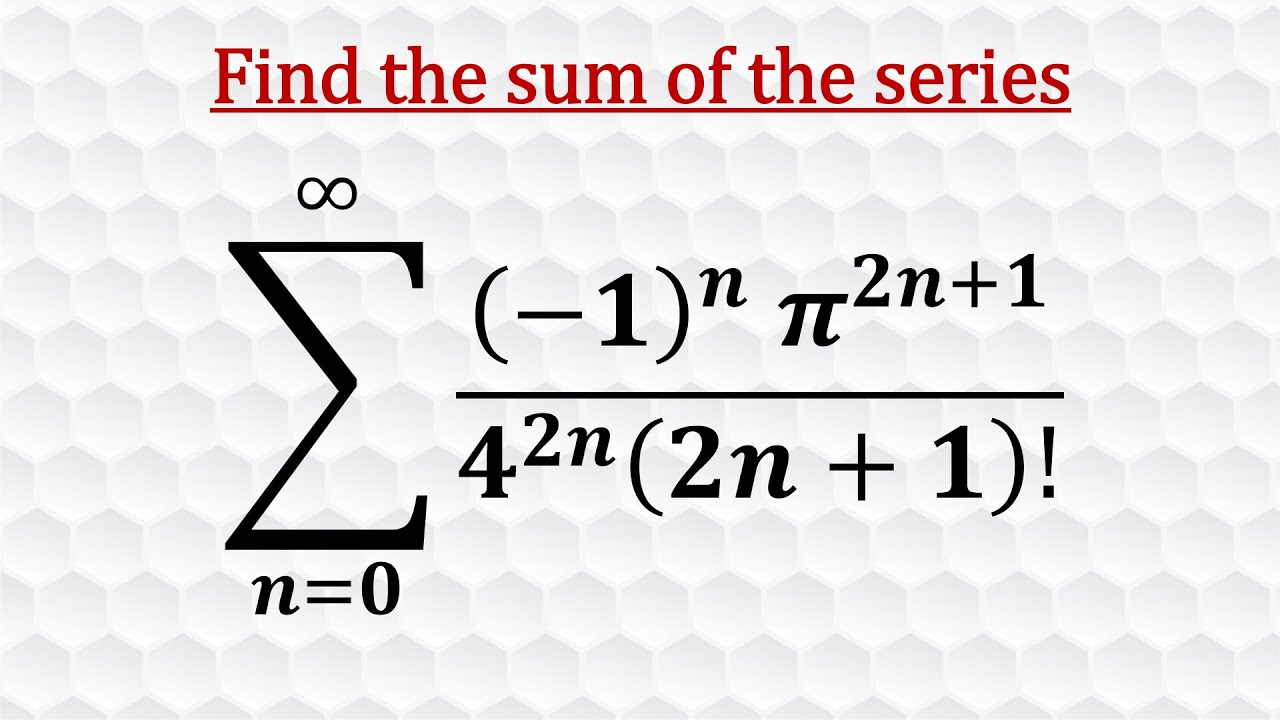
In this video, I showed how to find the sum of a given taylor series using the characteristics of known series
i watched this video from this guy
but it juts clicked
ty
cold swift
yeah
you just need to remember series representation for like sine cosine ln and e^x
and maybe the geometric series one too
cinder perch
ln?
i watched organic chem tutors
to start
so i tihnk i rember taht
0+1(x-c)^1/1!
if i remember
cold swift
it doesn’t have the factorial
 true garnet
 odd edgeBOT
@cinder perch Has your question been resolved?
odd edgeBOT
Channel closed
Closed due to timeout
Use .reopen if this was a mistake.
Available help channel!
Send your question here to claim the channel.
Remember:
• Ask your math question in a clear, concise manner.
• Show your work, and if possible, explain where you are stuck.
• After 15 minutes, feel free to ping <@&286206848099549185>.
• Type the command .close to free the channel when you're done.
• Be polite and have a nice day!
Read #❓how-to-get-help for further information on how to ask a good question, and about conduct in the question channels.
 finite palm
just started two variables functions can anyone explain why the level curves of f(x,y) = xy look the way they do. We learnt that you can find what a level curve looks like by setting f(x,y) to 0 but that doesnt seem to work
odd edgeBOT
finite palm
just started two variables functions can anyone explain why the level curves of ...
 fervent hawk
I'm not very familiar with the topic, but I hope I can help.
since when we plot the graph for f, we will usually set z=f(x,y)
so, setting f(x,y) to a constant 'a' is just saying that drawing a line on the plane z=a
where the line will be f(x,y)=a
fervent hawk
finite palm
just started two variables functions can anyone explain why the level curves of ...
which in such case, xy=a we have x=a/y
and for special 'a' such as 0
the line will be non very typical
while it still works
fervent hawk
finite palm
i couldnt wrap my head around it
it's alright, we've all been there
odd edgeBOT
Channel closed
Closed by @finite palm
Use .reopen if this was a mistake.
odd edgeBOT
✅
finite palm
Just started two variables graphs and having trouble sketching level curves and sketching the 3d graphs
u cant just post a messsage over mine
odd edgeBOT
@finite palm Has your question been resolved?
Channel closed
Closed by @finite palm
Use .reopen if this was a mistake.
Available help channel!
Send your question here to claim the channel.
Remember:
• Ask your math question in a clear, concise manner.
• Show your work, and if possible, explain where you are stuck.
• After 15 minutes, feel free to ping <@&286206848099549185>.
• Type the command .close to free the channel when you're done.
• Be polite and have a nice day!
Read #❓how-to-get-help for further information on how to ask a good question, and about conduct in the question channels.
 primal token
 odd edgeBOT
primal token
odd edgeBOT
primal token
 odd edgeBOT
@primal token Has your question been resolved?
odd edgeBOT
Channel closed
Closed due to timeout
Use .reopen if this was a mistake.
Available help channel!
Send your question here to claim the channel.
Remember:
• Ask your math question in a clear, concise manner.
• Show your work, and if possible, explain where you are stuck.
• After 15 minutes, feel free to ping <@&286206848099549185>.
• Type the command .close to free the channel when you're done.
• Be polite and have a nice day!
Read #❓how-to-get-help for further information on how to ask a good question, and about conduct in the question channels.
 fickle blaze
I need help with math
odd edgeBOT
fickle blaze
I need help with math
fickle blaze

I believe I need to work on the arrange
but I cant find all the one with my calculation
hello?
@icy vault are you still there?
okay
thanks for cooperation
.close
odd edgeBOT
Channel closed
Closed by @fickle blaze
Use .reopen if this was a mistake.
odd edgeBOT
Available help channel!
Send your question here to claim the channel.
Remember:
• Ask your math question in a clear, concise manner.
• Show your work, and if possible, explain where you are stuck.
• After 15 minutes, feel free to ping <@&286206848099549185>.
• Type the command .close to free the channel when you're done.
• Be polite and have a nice day!
Read #❓how-to-get-help for further information on how to ask a good question, and about conduct in the question channels.
 elfin warren
"Determine some values of α and β for which the line integral
I =....
becomes independent of the choice of integration path γ. Determine for these α and β:
(a) a potential Φ(x, y) to the field F(x, y), such that F(x, y) = ∇Φ(x, y);
(b) the value of I along some curve γ that runs from (0,0) to (1, 1) through I = Φ(1, 1) − Φ(0, 0) ;
(c) the value of I along the distance from (0,0) to (1, 1) by direct calculation"
 odd edgeBOT
elfin warren
"Determine some values of α and β for which the line integral
I =....
becomes ...
elfin warren
odd edgeBOT
elfin warren
"Determine some values of α and β for which the line integral
I =....
becomes ...
elfin warren
i dont really understand what i am supposed to do here
true garnet
same
elfin warren
haha
true garnet
sorry that was useless lol but i dont know the math or the language lol
elfin warren
its okay
odd edgeBOT
@elfin warren Has your question been resolved?
odd edgeBOT
@elfin warren Has your question been resolved?
odd edgeBOT
@elfin warren Has your question been resolved?
elfin warren
.close
odd edgeBOT
Channel closed
Closed by @elfin warren
Use .reopen if this was a mistake.
odd edgeBOT
Available help channel!
Send your question here to claim the channel.
Remember:
• Ask your math question in a clear, concise manner.
• Show your work, and if possible, explain where you are stuck.
• After 15 minutes, feel free to ping <@&286206848099549185>.
• Type the command .close to free the channel when you're done.
• Be polite and have a nice day!
Read #❓how-to-get-help for further information on how to ask a good question, and about conduct in the question channels.
 zenith mountain
Hello, I saw this question on a practice paper and couldn't figure it out, so here's my working out so far. I've labled the area of shape A and n, the area of shape B as n + 70, and i know if I can figure out the area of shape a, i can just square root it and add 4 since root n = Length of line on shape B - 4. I think the question might have smth to do with simultaneous questions but I cant figure it out. Its a calculator paper so i'll be able to use a calculator for the question.
 odd edgeBOT
zenith mountain
Hello, I saw this question on a practice paper and couldn't figure it out, so he...
ivory dock
odd edgeBOT
zenith mountain
Hello, I saw this question on a practice paper and couldn't figure it out, so he...
ivory dock
Hint : Write out all equations you can, for both surfaces of A and B, and then observe them as a system of equations
zenith mountain
Alright, thanks, give me a min or 2
oh, i think i got it
alr, so we know that n + 70 = L ^2 (where L is the length of one side on shape B)
and we also know that n = (b-4)^2, where n is the area of shape A and we get the (b-4) bit from on side on shape A being 4 less the one side on shape B
now we can rearrange both for n
ivory dock
Not quite right
ivory dock
maybe try to make your lettering a bit more clear
so we have shape A having sides a
and shape B having sides b
zenith mountain
oh, alr, ill edit it
ivory dock
as you said a^2 + 70 = b^2
so far so good
but what about the second equation?
It doesn't deal with surfaces, it deal with lengths, so there should be no squares involved in it
zenith mountain
i was thinking that since i have n = b^2 - 70, and the other equation, n = (b -4)^2, i could just expand out the second equation. This gives me n = b^2 - 8b + 16, and now since both are equal to n, i could make a new equation where b^2 - 70 = b^2 - 8b = 16
wait, that last = is suppose to be a +
ivory dock
the second equation is wrong
zenith mountain
srry, let me rewrite it
zenith mountain
alr, so then rn we have a^2 = b^2 - 70, and a^2 = (b-4)^2
ivory dock
ok, that second equation is wrong
now tell me, why does it have squares in it?
squares denote surface, that second equation stems from lengths
it should have no squares
zenith mountain
i was thinking that since a = b-4, i could rewrite it as a^2 = (b-4)^2, i wanna try to make the equations equal so i could just take away the b^2 from both and just rearrange for the value of b
yes
ivory dock
No need to square that
just plug in a in the first equation now
a = b-4
this, you have it
zenith mountain
alright, then for the first equation, we have a^2= b^2 - 70
if we plug in our value of a
we get (b-4)^2 = b^2 - 70
alr, now we expand out
ye
alr, so now we have b^2 - 8b +16 = b^2 - 70
we take away b^2 from both sides, leaving us with -8b +17 = -70?
oh yeah, srry, misclick
now we can just - 16 from both sides, giving us -8b = - 54
now we divide by -8
giving us b = 6.75
I think thats right, thats what i got when i did the working out, ima double check
oh, i added 16, i didnt take it away
that gives us-86
10.75
115.5625, but since it said 3sf, its 116 cm^2
alr, thanks to both of u, i appreciate it
.close
odd edgeBOT
Channel closed
Closed by @zenith mountain
Use .reopen if this was a mistake.
odd edgeBOT
Available help channel!
Send your question here to claim the channel.
Remember:
• Ask your math question in a clear, concise manner.
• Show your work, and if possible, explain where you are stuck.
• After 15 minutes, feel free to ping <@&286206848099549185>.
• Type the command .close to free the channel when you're done.
• Be polite and have a nice day!
Read #❓how-to-get-help for further information on how to ask a good question, and about conduct in the question channels.
 hearty kelp
 odd edgeBOT
hearty kelp
signal quest
odd edgeBOT
hearty kelp
signal quest
that seems reasonable
hearty kelp
thank you sm
signal quest
the domain from $(-{\infty}, 0)$ isn't defined
clever fjordBOT
Cyphercrit
 signal quest
@hearty kelp
wait
that says range lol
but your answer is still fine because the range never goes to infinity
 hearty kelp
signal quest
but your answer is still fine because the range never goes to infinity
hearty kelp
signal quest
but your answer is still fine because the range never goes to infinity
oh wait yeah ur right i was just going to say this
odd edgeBOT
@hearty kelp Has your question been resolved?
Channel closed
Closed by @hearty kelp
Use .reopen if this was a mistake.
Available help channel!
Send your question here to claim the channel.
Remember:
• Ask your math question in a clear, concise manner.
• Show your work, and if possible, explain where you are stuck.
• After 15 minutes, feel free to ping <@&286206848099549185>.
• Type the command .close to free the channel when you're done.
• Be polite and have a nice day!
Read #❓how-to-get-help for further information on how to ask a good question, and about conduct in the question channels.
hearty kelp
 odd edgeBOT
hearty kelp
ivory dock
odd edgeBOT
hearty kelp
ivory dock
ye
hearty kelp
ivory dock
ye
thanks for showing up does everything look good to u
ivory dock
ye
hearty kelp
it wouldnt be A right
hearty kelp
ivory dock
ye
was also thinking B
 slender plume
C?
hearty kelp
yeah
hearty kelp
slender plume
C?
yeah i was going with that
slender plume
What are those things caleld
ivory dock
Matrices
hearty kelp
hearty kelp
it wouldnt be A right
@ivory dock just to make sure
ivory dock
How long are you taking this quiz lol, ye you good
hearty kelp
ivory dock
How long are you taking this quiz lol, ye you good
man its a 15 question semester exam so im scared lool
ive been posting here all day
.cose
.close
odd edgeBOT
Channel closed
Closed by @hearty kelp
Use .reopen if this was a mistake.
odd edgeBOT
Available help channel!
Send your question here to claim the channel.
Remember:
• Ask your math question in a clear, concise manner.
• Show your work, and if possible, explain where you are stuck.
• After 15 minutes, feel free to ping <@&286206848099549185>.
• Type the command .close to free the channel when you're done.
• Be polite and have a nice day!
Read #❓how-to-get-help for further information on how to ask a good question, and about conduct in the question channels.
 tawny terrace
Why is y=0, when x approaches -∞?
 odd edgeBOT
tawny terrace
Why is y=0, when x approaches -∞?
odd edgeBOT
tawny terrace
Why is y=0, when x approaches -∞?
 torpid owl
because of the negative exponent
 ember oak
tawny terrace
Why is y=0, when x approaches -∞?
ember oak
tawny terrace
Why is y=0, when x approaches -∞?
As $x$ approaches $-\infty$, what does $-x^4$ approach?
clever fjordBOT
SWR
 tawny terrace
infinity no? you get basically (-1x)^4 which is (-1(-∞))^4
ember oak
tawny terrace
infinity no? you get basically (-1x)^4 which is (-1(-∞))^4
Okay, think about this: As $x\to\infty$, what does $x^4$ approach?
clever fjordBOT
SWR
 tawny terrace
infinity
ember oak
So if $x^4$ approaches $\infty$, what does $-x^4$ approach?
clever fjordBOT
SWR
 tawny terrace
negative infinity
ember oak
there you go
tawny terrace
yes but now I'm struggling to understand how -x^4 when it approaches -infinity, it's still -infinity
ember oak
Because you're basically doing $-(-\infty)^4$
clever fjordBOT
SWR
 odd edgeBOT
Channel closed
Closed by @tawny terrace
Use .reopen if this was a mistake.
odd edgeBOT
Available help channel!
Send your question here to claim the channel.
Remember:
• Ask your math question in a clear, concise manner.
• Show your work, and if possible, explain where you are stuck.
• After 15 minutes, feel free to ping <@&286206848099549185>.
• Type the command .close to free the channel when you're done.
• Be polite and have a nice day!
Read #❓how-to-get-help for further information on how to ask a good question, and about conduct in the question channels.
 sour basin
$\sqrt[6]{-8}$ how can i find the solutions with moivres theorem. I am not sure how to find r or the angle
odd edgeBOT
sour basin
$\sqrt[6]{-8}$ how can i find the solutions with moivres theorem. I am not sure ...
clever fjordBOT
Benschko

 sullen ferry
try writing the number as the root of a polynomial
 mortal trench
sour basin
$\sqrt[6]{-8}$ how can i find the solutions with moivres theorem. I am not sure ...
mortal trench
sour basin
$\sqrt[6]{-8}$ how can i find the solutions with moivres theorem. I am not sure ...
Hint: exponentiation distributes over multiplication
sour basin
so like this:
$\z^6+8=0$?
clever fjordBOT
Benschko
Compile Error! Click the  reaction for more information.
(You may edit your message to recompile.)
