#help-17
1 messages · Page 63 of 1
 vocal sleetBOT
 obtuse sierra
yep
 silk kindle
Hello!
where are you stuck? 🤔
notice that |T2| = |T1|
since the pulley is smooth, and it's in rest
obtuse sierra
yes, right?
obtuse sierra
then it is solved
silk kindle
you have the module, and the direction
vocal sleetBOT
Channel closed
Closed by @midnight nexus
Use .reopen if this was a mistake.
vocal sleetBOT
 Available help channel!
Send your question here to claim the channel.
Remember:
• Ask your math question in a clear, concise manner.
• Show your work, and if possible, explain where you are stuck.
• After 15 minutes, feel free to ping <@&286206848099549185>.
• Type the command .close to free the channel when you're done.
• Be polite and have a nice day!
Read #❓how-to-get-help for further information on how to ask a good question, and about conduct in the question channels.
 static mesa
i need help
 sharp lynx
.close
vocal sleetBOT
Channel closed
Closed by @sharp lynx
Use .reopen if this was a mistake.
static mesa
close
vocal sleetBOT
Available help channel!
Send your question here to claim the channel.
Remember:
• Ask your math question in a clear, concise manner.
• Show your work, and if possible, explain where you are stuck.
• After 15 minutes, feel free to ping <@&286206848099549185>.
• Type the command .close to free the channel when you're done.
• Be polite and have a nice day!
Read #❓how-to-get-help for further information on how to ask a good question, and about conduct in the question channels.
 drowsy solar
Hello
vocal sleetBOT
drowsy solar
Hello
 calm light
drowsy solar
calm light
drowsy solar
Can i ask can somebody help me to multiply in like box form
 tidal umbra
just ask gurl
tidal umbra
i can only help you if you will tell me what the question is?
tidal umbra
what is a box form? lol
drowsy solar
idk
like addition but like one number is on top and the other is on the bottom
but this is multipacation
did i spell that right lol
 drowsy solar
ya
tidal umbra
okay so, whers the problem?
tidal umbra
yeah but what step?
tidal umbra
nothing
drowsy solar
7 x 4?
tidal umbra
7 x 5
tidal umbra
which will be 35. you will write 5 on your paper and carry 3 on 4
vocal sleetBOT
@drowsy solar Has your question been resolved?
vocal sleetBOT
Channel closed
Closed due to timeout
Use .reopen if this was a mistake.
vocal sleetBOT
Available help channel!
Send your question here to claim the channel.
Remember:
• Ask your math question in a clear, concise manner.
• Show your work, and if possible, explain where you are stuck.
• After 15 minutes, feel free to ping <@&286206848099549185>.
• Type the command .close to free the channel when you're done.
• Be polite and have a nice day!
Read #❓how-to-get-help for further information on how to ask a good question, and about conduct in the question channels.
 vast shale
Can someone help me understand why adding the vectors ortogonally results in a vector of magnitude 1 5 
 vocal sleetBOT
vast shale
Can someone help me understand why adding the vectors ortogonally results in a v...
vast shale
vocal sleetBOT
vast shale
Can someone help me understand why adding the vectors ortogonally results in a v...
vast shale
I understand parallel = add
anti-parallel = subtract
but what is orthogonal
 worn bobcat
vast shale
Can someone help me understand why adding the vectors ortogonally results in a v...
worn bobcat
vast shale
Can someone help me understand why adding the vectors ortogonally results in a v...
The easiest way to form a vector with magnitude 1 is to have them in the anti-parallel fashion
vast shale
Yeah  I meant magnitude 5 sorry
worn bobcat
If you have them orthogonally then you can use the pythagorean theorem to figure out the length of the sum vector
and note that 3, 4, 5 is a pythagorean triple
vast shale
OOoo
I see
so the two vectors would be two sides of a triangle
Thank you
.close
vocal sleetBOT
Channel closed
Closed by @torpid horizon
Use .reopen if this was a mistake.
worn bobcat
np
vocal sleetBOT
Available help channel!
Send your question here to claim the channel.
Remember:
• Ask your math question in a clear, concise manner.
• Show your work, and if possible, explain where you are stuck.
• After 15 minutes, feel free to ping <@&286206848099549185>.
• Type the command .close to free the channel when you're done.
• Be polite and have a nice day!
Read #❓how-to-get-help for further information on how to ask a good question, and about conduct in the question channels.
 narrow latch
 vocal sleetBOT
narrow latch
narrow latch
vocal sleetBOT
narrow latch
narrow latch
i tried the hint but then everything just cancelled out when i subbed in z in terms of x and y
 boreal remnant
x+y+z = 12
minimize x^2+y^2+z^2
then z = 12-x-y
so then you have to minimize x^2+y^2+(12-x-y)^2
narrow latch
oh wait so are you saying to use the two constraints
so use the sum to get z
then use that to make it a function of two variables in the squares formula
vocal sleetBOT
@narrow latch Has your question been resolved?
narrow latch
i got an answer which is a minimum point
but when i subbed back in the point values to everything in terms of z, I got a sum that didn't make sense
vocal sleetBOT
@narrow latch Has your question been resolved?
Channel closed
Closed by @narrow latch
Use .reopen if this was a mistake.
Available help channel!
Send your question here to claim the channel.
Remember:
• Ask your math question in a clear, concise manner.
• Show your work, and if possible, explain where you are stuck.
• After 15 minutes, feel free to ping <@&286206848099549185>.
• Type the command .close to free the channel when you're done.
• Be polite and have a nice day!
Read #❓how-to-get-help for further information on how to ask a good question, and about conduct in the question channels.
 obsidian viper
 vocal sleetBOT
obsidian viper
vocal sleetBOT
obsidian viper
 thin vale
!status
vocal sleetBOT
What step are you on?
1. I don't know where to begin
2. I have begun but got stuck midway
3. I got an answer but I'm told it's wrong
4. I got an answer and would like my work checked
5. I have a question about someone else's worked solution
6. None of the above
1
thin vale
you don't know what those words mean?
obsidian viper
all i know is domain and range
thin vale
okay so why can't you begin on (i)
obsidian viper
negative infinity to negative two, negative two to infinity on domain
negative infinity to positive two, positive two to infinity on range
idk intercepts and that other stuff
thin vale
write it in different notation than that
write it in interval notation
worded, we can't tell if you mean open or closed intervals
x-intercepts are where something crosses the x-axis
y-intercepts are where something crosses the y-axis
obsidian viper
(−∞,−2) (−2,∞) domain
obsidian viper
obsidian viper
x int -3 y int 3?
^
thin vale
yes
obsidian viper
what bout asymptotes and intervals
thin vale
you tell me
obsidian viper
idk
thin vale
then google what those words mean
 golden sierra
obsidian viper
what bout asymptotes and intervals
golden sierra
obsidian viper
what bout asymptotes and intervals
Interval is (-1, 9] for example or (-inf, - 32]U(8, +inf) could be anything
To find intervals where it increases/decreases you need to find the derivative of the function and see where that 'new' function is positive and where it's negative. Positive means it increases, negative decreases.
Vertical asymptote are usually x = a, where a is usually a critical point in the domain, aka a point where the function is not defined. If lim_x->a± f(x) = ± inf then a is a vertical axis In other words, if f(x) for values a little greater or smaller approaches ±inf then it is a vertical axis.
Horizontal asymptotes y = b are when no matter how large or small x is (±inf) f(x) will never reach b
Idk if this is making any sense but yeah
vocal sleetBOT
@obsidian viper Has your question been resolved?
vocal sleetBOT
Channel closed
Closed due to timeout
Use .reopen if this was a mistake.
obsidian viper
.reopen
vocal sleetBOT
✅
obsidian viper
Horizontal is 2
Vertical is -2
As X increases Y decreases
Univserally
right
@golden sierra ?
obsidian viper
golden sierra
And yup, so for the whole domain the function decreases
so how would i write that? normalyy
golden sierra
obsidian viper
so how would i write that? normalyy
X belonging (-inf, - 2)U(-2, +inf) f(x) arrow pointing upwards
Downwards sorry
Idk I just write a bunch of arrows and stuff and professors are fine with it
vocal sleetBOT
@obsidian viper Has your question been resolved?
vocal sleetBOT
@obsidian viper Has your question been resolved?
 vocal sleetBOT
Channel closed
Closed by @obsidian viper
Use .reopen if this was a mistake.
Available help channel!
Send your question here to claim the channel.
Remember:
• Ask your math question in a clear, concise manner.
• Show your work, and if possible, explain where you are stuck.
• After 15 minutes, feel free to ping <@&286206848099549185>.
• Type the command .close to free the channel when you're done.
• Be polite and have a nice day!
Read #❓how-to-get-help for further information on how to ask a good question, and about conduct in the question channels.
vast shale
What is the probability that a poker hand contains a full house?
vast shale
So I have never played poker so I want someone to correct my idea of the game 
You can only have a hand of 5 cards at once, where the order matters
And a full house is when you have 3 cards of the same type and 2 from another?
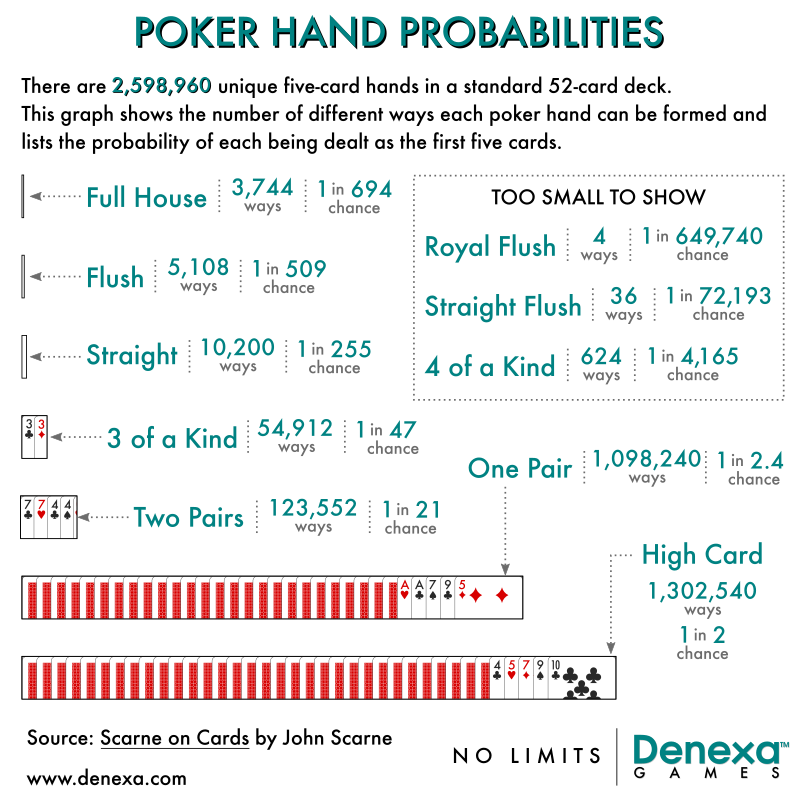

 regal bane
Note that order does not matter in your hand, you can rearrange it
vast shale
Wait how many total cards are ghere


 karmic imp
 flat whale
https://d1e4pidl3fu268.cloudfront.net/fbc620f5-e4e0-470b-9750-c6805750c99a/Decko...
flat whale
https://d1e4pidl3fu268.cloudfront.net/fbc620f5-e4e0-470b-9750-c6805750c99a/Decko...
This is a lie, there are 54 cards, you forgot the two jokers
regal bane
9 times out of 10, if someone is talking about poker, they mean Texas hold 'em, which gives you 7 cards and you take the best 5 to make your actual hand
vast shale
Hmm
regal bane
But the hands you can make are the same
 crimson jetty
I think the full house calculation is straightforward, but just remember for the other poker hands, it can be a bit more complicated. When counting pairs, do not count 2-pair, etc.
crimson jetty
vast shale
And a full house is when you have 3 cards of the same type and 2 from another?
its exactly this. 3 same rank, 2 another same rank
vast shale
So the number of hands containing a full house is [
\map P{13, 2} \cdot \map C{4,3} \cdot \map C{4,2}
]
 twin meteorBOT
 vast shale
I suppose?
vast shale
Permutations
vast shale
13!/11! Yeah
crimson jetty
I think I concur with your calculation...
,w number of full house hands
3744
wanna check it 
vast shale
Wait wait the logic doesn't quite make sense I just splurged out the math
crimson jetty
,calc 13 * 12 * 4 * 6
twin meteorBOT
Result:
3744
your math is correct tho lmao
crimson jetty
twin meteor
but yeah go on, what do u think doesnt make sense
vast shale
vast shale
And a full house is when you have 3 cards of the same type and 2 from another?
When I say the "same type"
Does this mean just like the same suite?
Like 3 spades and 2 hearts
vast shale
Okay
vast shale
 urban edge
E.g. 9 9 9 q q
urban edge
E.g. 9 9 9 q q
Do they need to have the same suite
crimson jetty
they cant
urban edge
Not possible
vast shale
Oh okay
So like
I think it makes sense now
P(13,2) we are picking the two ranks and ordering them
urban edge
Order matters
vast shale
Well the order of the hand after being put down matters from what I read
urban edge
Yes
vast shale
Oh wait like
urban edge
Oh yeah
crimson jetty
We are counting the number of full house hands
order does not matter with regards to this
urban edge
Which one has 3 and which one has 2
crimson jetty
bruh
crimson jetty
crimson jetty
why is it P and not C
i was asking for a reaason >.>
urban edge
Basically imagine we split the deck into their respective 4 card valyes
crimson jetty
cmon, lex can figure
urban edge
Oh ok
crimson jetty
Let's say we pick 9 and Q. That is 13 choose 2.
vast shale
Yeppie
crimson jetty
With regards to the full house hand, why are there '2 possibilities'
after choosing 9 and Q
(this has nothing to do with suits at this point)
crimson jetty
no that doesnt matter.
whether my hand is 99q9q or q9q99
its still a full house
(and the 3744 calculation counts it the same if its just a reordering of the 5 cards)
vast shale
Yeah I'm a bit lost on what makes it an ordering then
crimson jetty
The order of the cards in my hand dont matter
However, there is something to choose
Remember what a full house is:
3 cards of the same rank
2 cards of the same rank (different from above)
crimson jetty
vast shale
Well you could have chosen Q first and then 9
I guess you're "right" but like
😅 theres something explicit to describe
Q and 9 are your ranks but...
vast shale
Oh hmm I guess like
You could have
(QQQ)(22)
But equivalently you could have
(222)(QQ)
crimson jetty
yessss
vast shale
Is this the idea maybe?
crimson jetty
You are choosing which is the 3
and which is the 2
Thats why its P(13, 2) not C(13, 2)
Alternatively, you could write 2! . C(13, 2) . C(4, 3) . C(4, 2)
vast shale
Wait I get that, but can we talk about why choosing it wouldn't exactly work?
crimson jetty
?
crimson jetty
crimson jetty
Alternatively, you could write `2! . C(13, 2) . C(4, 3) . C(4, 2)`
it could work if u do this
- Choose 2 ranks.
C(13, 2) - Choose order for your 2 ranks. First will be 3 cards, other will be 2 cards.
2! - Choose suits for 3 cards.
C(4, 3) - Choose suits for 2 cards.
C(4, 2)
These are our 4 steps to creating a full house hand.
Convince yourself each step is independent to each other.
crimson jetty
crimson jetty
- Choose 2 ranks. `C(13, 2)`
- Choose order for your 2 ranks. First will be 3 ca...
tbh this wording is a little poor
best we make it 3 steps
- Choose 3 card rank. Choose 2 card rank.
P(13, 2) - Choose suits for 3 cards.
C(4, 3) - Choose suits for 2 cards.
C(4, 2)
vast shale
vast shale
(QQQ)(22)
But equivalently you could have
(222)(QQ)
The order matters in the sense that you have to account for both kind of order you get similar to here
crimson jetty
Back to the original question
crimson jetty
twin meteor
This is the number of full house hands
crimson jetty
vast shale
You can only have a hand of 5 cards at once, where the order matters
I don't understand this part
actually
Why do you say the order matters - is that part of your question sheet
vast shale
Nah I was just confirming what I thought was the case for how this stuff works
crimson jetty
no, order does not matter
Q9Q9Q is still a full house
and we consider it to be the 'same' full house if its just the same cards
===
So compute the probability (I'll leave that to u)
Then as a follow up question you should compute the number of 2-pair hands 
which is harder
vast shale
Hmm okay 
vast shale
Also discrete probability just seems like PNC but extra
vast shale
crimson jetty
2-pair:
- hand has 3 different ranks, and 2 of them appear twice.
Okay well
P(13,3) from the get go of course
vast shale
Wtf
crimson jetty
C(13, 3)
crimson jetty
then you need to think a bit
vast shale
I like when the logic I have been trying to build for the last 15 minutes completely collapses

crimson jetty
you see, in the first one u had 3 cards and 2 cards
but here we have 2 cards, 2 cards, 1 card.
3! ways doesnt cut it.
vast shale
So let's rationalise this
Okay let's just
Make this analogue to a string because life becomes easier that way
You have 5 positions to fill
Two of the positions need to be a certain kind, two of the other another certain kind, and the last another kind
You have a set of 13 to choose from
Hmm
So immediately choosing them alone would be C(13,2)*C(13,2)?
crimson jetty
thonk what
vast shale
Wait I'm confusing things
Rewind
Rewind
So you have three positions to fill
Consisting of what kinds you choose (the amount of cards doesn't matter yet)
crimson jetty
ranks 🙄
crimson jetty
vast shale
You can pick qp2 or pq2
i lit cant tell what qp2 means
crimson jetty
but then order would matter
all 3! orders
do you want it to?
Rather - if order matters, I would think about it later.
You need to choose 3 ranks from 13.
crimson jetty
I would say - unless you know order matters, assume it doesnt (as we progress)
crimson jetty
im going to sidetrack for one moment
for the full house
if order mattered in your hand
you just multiply by 5!
does that make sense?
you can shuffle at the end, which is 5! possibilities
vast shale
crimson jetty
you just multiply by 5!
Yes I mean [
P(n,p) = C(n,p)*P(p,p)
]
twin meteorBOT
 vast shale
Wait
vast shale
vast shale
I was thinking 13*12\*11?
Do we divide this by 3!?
 crimson jetty
2-pair:
- hand has 3 different ranks, and 2 of them appear twice.
XX YY Z
================================== - Choose 3 ranks.
C(13, 3) - .
- Assign suits.
C(4,2)*C(4,2)*C(4,1)
vast shale
crimson jetty
2-pair:
- hand has 3 different ranks, and 2 of them appear twice. `XX YY Z`
====...
Sorry came back
Had something
But
Okay so
It's first C(13,3) then you have to assign the suite for each?
So like
C(13,3)*C(4,2)*C(4,2)*C(4,1)
I'd imagine
crimson jetty
crimson jetty
2-pair:
- hand has 3 different ranks, and 2 of them appear twice. `XX YY Z`
====...
🙄
crimson jetty
crimson jetty
- Choose 2 ranks. `C(13, 2)`
- Choose order for your 2 ranks. First will be 3 ca...
youre missing one thing that was done here
vast shale
Choose the order
The hard part

Okay
Let's rationalise this
Hmm
Craaazy thought @crimson jetty
But wouldn't it be craaaaazy cool if we multiplied it by 8
wuld that work

crimson jetty
wtf does 8 even mean
crimson jetty
crimson jetty
You need to choose which is which
XX YY Z
vast shale
Yeah there are 6
crimson jetty
im claiming some are the same...
crimson jetty

vast shale
There you go
vast shale
Wot
crimson jetty
vast shale
XX YY Z
YY Z XX
XX Z YY
Z XX YY
YY XX YY
Z YY XX
youre missing some
and uve counted some multiple times
vast shale
Oh I see my mistake lmao
crimson jetty
crimson jetty
`YY ZZ X`
list them the same way as me
vast shale
YY ZZ X
XX YY Z
ZZ XX Y
YY XX Z
XX ZZ Y
ZZ YY X
crimson jetty
ok
I also ordered them this way... for reasons
XX YY Z
YY XX Z
XX ZZ Y
ZZ XX Y
YY ZZ X
ZZ YY X
But yeah, which ones are the same . . .
vast shale
You get it
crimson jetty
its because we cant distinguish between the pairs
all we care about is which rank is assigned the single card
crimson jetty
,w number of 2 pair hands
twin meteorBOT


 Requested by shuri2060
crimson jetty
Requested by shuri2060
crimson jetty
123552 hopefully
crimson jetty
vast shale
So we have to account for this indistinguishable factor
so you happy its x3?
2-pair:
- hand has 3 different ranks, and 2 of them appear twice.
XX YY Z
================================== - Choose 3 ranks.
C(13, 3) - Choose which rank is single.
3 - Assign suits.
C(4,2)*C(4,2)*C(4,1)
==================================
,w (13 choose 3) * 3 * 6 * 6 * 4
twin meteorBOT
 Requested by shuri2060
crimson jetty
Requested by shuri2060
crimson jetty
XX YY Z
YY XX Z
XX ZZ Y
ZZ XX Y
YY ZZ X
ZZ YY X
=====================
XX YY Z = YY XX Z
XX ZZ Y = ZZ XX Y
YY ZZ X = ZZ YY X
=====================
YY ZZ X
XX ZZ Y
XX YY Z
=====================
X = 2, Y = 8, Z = Q
22 88 Q
22 QQ 8
QQ 88 2
=====================
crimson jetty
crimson jetty
22 88 Q
22 QQ 8
QQ 88 2
These are the 3 different 'kinds' of 2 pair you can have with 2, 8, Q, not caring about suit.
you choose which rank goes in the single card.
The other 2 ranks are pairs.

Well I gtg, so I'll leave you with an exercise if you want:
3 of a kind:
- 3 ranks. 3 cards same rank, other 2 are different.
XXX Y Z
vast shale
Ohh I see 
crimson jetty
vast shale
Man probability wild
crimson jetty
combinatorics.
vast shale
But Ty I think I get it now
Just gonna speedrun some more stuff but it should be about it
.close
vocal sleetBOT
Channel closed
Closed by @warm widget
Use .reopen if this was a mistake.
Available help channel!
Send your question here to claim the channel.
Remember:
• Ask your math question in a clear, concise manner.
• Show your work, and if possible, explain where you are stuck.
• After 15 minutes, feel free to ping <@&286206848099549185>.
• Type the command .close to free the channel when you're done.
• Be polite and have a nice day!
Read #❓how-to-get-help for further information on how to ask a good question, and about conduct in the question channels.
 mossy geode
Hey, could somebody outline the general steps to my attached question? I know I have to implicitly differentiate and use the point-slope formula, just not sure exactly how to go about it.
vocal sleetBOT
mossy geode
Hey, could somebody outline the general steps to my attached question? I know I ...
mossy geode
 vocal sleetBOT
@mossy geode Has your question been resolved?
 pallid zenith
mossy geode
Hey, could somebody outline the general steps to my attached question? I know I ...
pallid zenith
mossy geode
Hey, could somebody outline the general steps to my attached question? I know I ...
@mossy geode well you dont have to differentiate implicity
you could just find each piece of the hyperbola
differentiate to get slope
then just substitution should get you the other number
vocal sleetBOT
Channel closed
Closed due to timeout
Use .reopen if this was a mistake.
Available help channel!
Send your question here to claim the channel.
Remember:
• Ask your math question in a clear, concise manner.
• Show your work, and if possible, explain where you are stuck.
• After 15 minutes, feel free to ping <@&286206848099549185>.
• Type the command .close to free the channel when you're done.
• Be polite and have a nice day!
Read #❓how-to-get-help for further information on how to ask a good question, and about conduct in the question channels.
vast shale
 vocal sleetBOT
vast shale
vast shale
vocal sleetBOT
vast shale
vast shale
I set up an equation and found the derivative for it but im confused on what i should do next
should I use the quadratic formula and then solve for the distance?
I'd recommend drawing a graph first, and also show what you have done so far
Hint: Pythagoras theorem
Would this be right for the derivative?

i think imma have to simplify next but idk
Okay I see I think your C is fine

I did that next
Would it be 1.9mi?

*1.197
Yep you got it
Okii, ty! :>
Also, for the cost should I just sub in 1.97 into the original equation?
Yes
tyty
I got $996,862.70, would that be right?
vast shale
vast shale
I got $996,862.70, would that be right?
Seems correct
,w 75000(8-18/sqrt(7))+100000sqrt((8-(8-18/sqrt(7)))^2 + 36)
twin meteorBOT

 vocal sleetBOT
Channel closed
Closed by @hushed condor
Use .reopen if this was a mistake.
Available help channel!
Send your question here to claim the channel.
Remember:
• Ask your math question in a clear, concise manner.
• Show your work, and if possible, explain where you are stuck.
• After 15 minutes, feel free to ping <@&286206848099549185>.
• Type the command .close to free the channel when you're done.
• Be polite and have a nice day!
Read #❓how-to-get-help for further information on how to ask a good question, and about conduct in the question channels.
vast shale
if a graph has any unit for the y axis and a count/number as the x denotated as n(all natural numbers). Then what would be the unit for the slope?
vocal sleetBOT
vast shale
if a graph has any unit for the y axis and a count/number as the x denotated as ...
vast shale
 mild flower
so like the y axis is feathers and the x axis is chickens?
mild flower
so like the y axis is feathers and the x axis is chickens?
hmm i was thinking like the y axis would be like diameter of hole in meters and the x is like the number of holes
mild flower
uh hmm i don't understand what you mean by that
vast shale
hmm ill send an example problem

 mild flower
ah ok so they're ordered in some way and the horizontal axis is the ring number
vast shale
yeah
im wondering if the slope would be in cm2 or cm2/n ring
something like that ig
mild flower
i think I'd probably say cm^2/ring if i were pressed about it
vocal sleetBOT
Channel closed
Closed by @normal mortar
Use .reopen if this was a mistake.
Available help channel!
Send your question here to claim the channel.
Remember:
• Ask your math question in a clear, concise manner.
• Show your work, and if possible, explain where you are stuck.
• After 15 minutes, feel free to ping <@&286206848099549185>.
• Type the command .close to free the channel when you're done.
• Be polite and have a nice day!
Read #❓how-to-get-help for further information on how to ask a good question, and about conduct in the question channels.
 paper depot
the plane extends infinitely by virtue of being a plane at all
vast shale
do you know what a plane is?
if you do
highlight plane BCH in one colour
and plane DEF in another
send picture
correct
do you notice how both planes touch the line segment E F
vocal sleetBOT
Channel closed
Closed by @slim fiber
Use .reopen if this was a mistake.
Available help channel!
Send your question here to claim the channel.
Remember:
• Ask your math question in a clear, concise manner.
• Show your work, and if possible, explain where you are stuck.
• After 15 minutes, feel free to ping <@&286206848099549185>.
• Type the command .close to free the channel when you're done.
• Be polite and have a nice day!
Read #❓how-to-get-help for further information on how to ask a good question, and about conduct in the question channels.
 glass tundra
 vocal sleetBOT
glass tundra
glass tundra
vocal sleetBOT
glass tundra
glass tundra
I dont have any idea how it goes from the step with -v' +(4/x)v = x^3 to everything else
I tried following steps that i learned earlier on how to solve linear ode but it doesn't give me anything like what is shown
<@&286206848099549185>
can anyone explain how to get to v(x) = cx^4 - x^4ln(x)
i've calculated u(x) to be x^4 so I know where that comes from but nothing else
vocal sleetBOT
@glass tundra Has your question been resolved?
 crude osprey
I have a question
Draw a circle with whose diameter is 10cm Find its radius
pls someone
 round plover
!help
vocal sleetBOT
Channel closed
Closed due to timeout
Use .reopen if this was a mistake.
vocal sleetBOT
Available help channel!
Send your question here to claim the channel.
Remember:
• Ask your math question in a clear, concise manner.
• Show your work, and if possible, explain where you are stuck.
• After 15 minutes, feel free to ping <@&286206848099549185>.
• Type the command .close to free the channel when you're done.
• Be polite and have a nice day!
Read #❓how-to-get-help for further information on how to ask a good question, and about conduct in the question channels.
 crimson pumice
how do you figure out the y intercept of this graph?


 viral copper
Which graph
crimson pumice
the red graph
viral copper
plug in x = 0
crimson pumice
that is the answer but I don't understand how they got y
viral copper
Oh the y axis, the x coordinate is 0
crimson pumice
viral copper
plug in x = 0
I would if I had the formula, I'm only given the graph
crimson pumice
crimson pumice
this is the original graph
viral copper
well the intercept would be f(1)
Which uh you can't know
For sure
Do you know how to compute integrals
viral copper
wait but we don't know if f is a polynomial
crimson pumice
this question is trying to access the skills of how well you can transform a graph without the equation
unless its those things where the answer shows extra info that you can't actually get
viral copper
I mean finding the equation of y = f(x) is easy enough assuming it's a degree 3 polynomial
crimson pumice
well its ceertain that the numbers are around (x+4)(x-3)x but the numbers are much more specific then meets the eye, I tried graphing it in desmos... It didn't work
if you can't figure it out its ok
viral copper
You need to include a scaling factor
ax(x - 3)(x + 4)
Solve for a using the maxima or minima
And see if it aligns
 vocal sleetBOT
@crimson pumice Has your question been resolved?
Channel closed
Closed by @crimson pumice
Use .reopen if this was a mistake.
Available help channel!
Send your question here to claim the channel.
Remember:
• Ask your math question in a clear, concise manner.
• Show your work, and if possible, explain where you are stuck.
• After 15 minutes, feel free to ping <@&286206848099549185>.
• Type the command .close to free the channel when you're done.
• Be polite and have a nice day!
Read #❓how-to-get-help for further information on how to ask a good question, and about conduct in the question channels.
 silver token
how would i go about starting this?
 vocal sleetBOT
silver token
how would i go about starting this?
silver token
vocal sleetBOT
silver token
how would i go about starting this?
silver token
not sure but it probably is linear equations
 proven garden
consider the equation in the form y=mx+b
 lilac plaza
Isn't this linear algebra though..?
proven garden
???
silver token
then y=9(3)+b?
lilac plaza
Where's y?
proven garden
m is the slope
silver token
proven garden
do you know what y=mx+b mean
yea
m being slope and b being y intercept
silver token
substitude?
proven garden
you don't know substitution?
silver token
oh i thought you meant something completely different
proven garden
it just mean plug in
 frosty gale
silver token
ok -18=b
frosty gale
silver token
ok -18=b
yes
silver token
..now what? we got the y intercept
frosty gale
yes
vocal sleetBOT
@silver token Has your question been resolved?
silver token
<@&286206848099549185>
 left crest
Can you tell me what is the general form of the slope intercept form
frosty gale
y=mx+c
left crest
So here what will be m = ?
silver token
left crest
So here what will be m = ?
m = 9
left crest
where m is the slope of the line
great and this line will pass thru (3,9) so can you tell me what will be b
silver token
they made me go through some computing and we ended with b=-18
is b=-18 correct? @left crest
left crest
Yes, now can you tell me the equation of the line
frosty gale
Yes
silver token
left crest
Yes, now can you tell me the equation of the line
no..? what do you mean by equation of the line?
y=9x-18?
left crest
Yes
Now take y on the same side as the x variable and take the constant on the other side
You will be it of the form Ax + By =C
silver token
so will it be 18=9x-y?
left crest
Yes,
Now tell me What is A, B and C
note that A, B and C are integers so they can be negative
silver token
A=9 B=(-1) C=18
left crest
Great, you got the answers.
vocal sleetBOT
Channel closed
Closed by @silver token
Use .reopen if this was a mistake.
Available help channel!
Send your question here to claim the channel.
Remember:
• Ask your math question in a clear, concise manner.
• Show your work, and if possible, explain where you are stuck.
• After 15 minutes, feel free to ping <@&286206848099549185>.
• Type the command .close to free the channel when you're done.
• Be polite and have a nice day!
Read #❓how-to-get-help for further information on how to ask a good question, and about conduct in the question channels.
 chilly oyster
HOw do you do 9-5y=10f/2
vocal sleetBOT
chilly oyster
HOw do you do 9-5y=10f/2
chilly oyster
and then the value of y is 0.2302149
 rugged orchid
Show the original question.
 civic otter
chilly oyster
and just find f
civic otter
chilly oyster
and just find f
Ahn that's a different thing
 honest ridge
chilly oyster
find f
honest ridge
chilly oyster
find f
In terms of y ?
chilly oyster
yes
 merry python
chilly oyster
HOw do you do 9-5y=10f/2
merry python
chilly oyster
HOw do you do 9-5y=10f/2
context of question? and source?
chilly oyster
my friend gave it
merry python
That was kinda expected
civic otter
Is it $$9 - 5y = \frac{10f}{2}$$?
twin meteorBOT
Alberto Z.
 chilly oyster
twin meteor
**Alberto Z.**
chilly oyster
twin meteor
**Alberto Z.**
thats the question
civic otter
chilly oyster
thats the question
Ok, you can first simplify the RHS @chilly oyster
civic otter
But can't you make your friend enter the chat instead of you telling him later how to solve it?
civic otter
No problem, it was only for him so that we can understand what he really nees help for
vocal sleetBOT
Channel closed
Closed by @chilly oyster
Use .reopen if this was a mistake.
frosty gale
twin meteor
**Alberto Z.**
y=-f+9/5
vocal sleetBOT
Available help channel!
Send your question here to claim the channel.
Remember:
• Ask your math question in a clear, concise manner.
• Show your work, and if possible, explain where you are stuck.
• After 15 minutes, feel free to ping <@&286206848099549185>.
• Type the command .close to free the channel when you're done.
• Be polite and have a nice day!
Read #❓how-to-get-help for further information on how to ask a good question, and about conduct in the question channels.
vast shale
what do they mean by $a_{pq}$
?
 vocal sleetBOT
vast shale
what do they mean by $a_{pq}$
?
twin meteorBOT
vocal sleetBOT
vast shale
what do they mean by $a_{pq}$
?
twin meteorBOT
bearcw

 solemn cape
It means that the index is the product between p and q
solemn cape
Yes
vocal sleetBOT
Channel closed
Closed by @dawn jolt
Use .reopen if this was a mistake.
Available help channel!
Send your question here to claim the channel.
Remember:
• Ask your math question in a clear, concise manner.
• Show your work, and if possible, explain where you are stuck.
• After 15 minutes, feel free to ping <@&286206848099549185>.
• Type the command .close to free the channel when you're done.
• Be polite and have a nice day!
Read #❓how-to-get-help for further information on how to ask a good question, and about conduct in the question channels.
 void relic
 vocal sleetBOT
void relic
void relic
vocal sleetBOT
void relic
void relic
At the end, why do they get the area as 1/2 r^2(2theta) instead of pi r^2 * 2theta
 dry lynx
the sector is (2theta)/(2pi) of the circle
so the area would be ((2theta)/(2pi))*pi r^2
simplifying gives us theta*r^2
which is what they got
dry lynx
no problem
void relic
.close
vocal sleetBOT
Channel closed
Closed by @void relic
Use .reopen if this was a mistake.
vocal sleetBOT
Available help channel!
Send your question here to claim the channel.
Remember:
• Ask your math question in a clear, concise manner.
• Show your work, and if possible, explain where you are stuck.
• After 15 minutes, feel free to ping <@&286206848099549185>.
• Type the command .close to free the channel when you're done.
• Be polite and have a nice day!
Read #❓how-to-get-help for further information on how to ask a good question, and about conduct in the question channels.
 visual drift
whats is pi for math? the symbol like this "n" but the head is in a straight line
vocal sleetBOT
visual drift
whats is pi for math? the symbol like this "n" but the head is in a straight lin...
 hidden kelp
visual drift
whats is pi for math? the symbol like this "n" but the head is in a straight lin...
hidden kelp
visual drift
whats is pi for math? the symbol like this "n" but the head is in a straight lin...
Pi is the ratio (fraction) of the circumference of a circle over its diameter

 rugged orchid
There are many ways to define pi
merry python
,w define pi
twin meteorBOT

 viral copper
rugged orchid
There are many ways to define pi
viral copper
rugged orchid
There are many ways to define pi
The area under the graph of (x^2 + 1)^(-1)
vocal sleetBOT
@visual drift Has your question been resolved?
 hybrid flicker
viral copper
The area under the graph of (x^2 + 1)^(-1) <:sotrue:826971355542192148>
hybrid flicker
viral copper
The area under the graph of (x^2 + 1)^(-1) <:sotrue:826971355542192148>
The only number such that, for the morphism $f:\begin{cases} (\bR,+)\longrightarrow (\bC^*,×)\
x\longmapsto e^{ix}\end{cases}, Ker(f) = 2\pi\bZ$
twin meteorBOT
rafilou2003
 vocal sleetBOT
Channel closed
Closed due to timeout
Use .reopen if this was a mistake.
vocal sleetBOT
Available help channel!
Send your question here to claim the channel.
Remember:
• Ask your math question in a clear, concise manner.
• Show your work, and if possible, explain where you are stuck.
• After 15 minutes, feel free to ping <@&286206848099549185>.
• Type the command .close to free the channel when you're done.
• Be polite and have a nice day!
Read #❓how-to-get-help for further information on how to ask a good question, and about conduct in the question channels.
vast shale
Write the trigonometric equation for the function with a period of 5, a low point of – 3 at x=1 and an amplitude of 7
vocal sleetBOT
vast shale
Write the trigonometric equation for the function with a period of 5, a low poin...
 silent folio
What have you got so far
mild flower
vast shale
7 sin(2pi/3(x)-3
you have unbalanced parentheses and it's making it hard to tell what you meant to say
 zinc quail
vast shale
7 sin(2pi/3(x)-3
zinc quail
vast shale
7 sin(2pi/3(x)-3
don't really get how you end up with this
first you'd start with the amplitude
sin(x) has an amplitude of 1, so 7sin(x) is correct
then you want a period of 5 instead of 2pi, so within sin mul by 2pi and div by 5
vast shale
yeah
vast shale
zinc quail
then you want a period of 5 instead of 2pi, so within sin mul by 2pi and div by ...
so it ouwld be 2pi/5
?
zinc quail
vast shale
so it ouwld be 2pi/5
ys
7sin(x*2pi/5)
and the last part is the displacement for the low point
the low point is at y=-3, but currently all low points are at -7
so we need to do +4
7sin(x*2pi/5)+4
vast shale
so that would be the equation?
zinc quail
and then we want to move it such that the low point is at x=1
vast shale
oh yea
vast shale
yeah
zinc quail
and it should be at 1
so you can move the entire graph by -2.75
how would you do that
@vast shale
zinc quail
if I give you the parabola x², how do you move the graph of the function to the left by 1?
zinc quail
(x+1)²
vast shale
yeah
zinc quail
same for the sin function
just in general, add/sub from the x value within the function
to move it left/right
so for -2.75
it becomes
7sin((x+2.75)*2pi/5)+4
done
zinc quail
wdym proper
vast shale
wouldn't it have to be a pi or in fractions?
zinc quail
no, whenever you move a graph, you sub/add from x as mentioned before, regardless where it is
e.g.

let this be f(x)
and if you want to move the graph of f(x) to the left by 1
you'd do
 vast shale
ohh okay
zinc quail
likewise for moving right -1
vast shale
yeah
vocal sleetBOT
@vast shale Has your question been resolved?
vocal sleetBOT
Channel closed
Closed due to timeout
Use .reopen if this was a mistake.
Available help channel!
Send your question here to claim the channel.
Remember:
• Ask your math question in a clear, concise manner.
• Show your work, and if possible, explain where you are stuck.
• After 15 minutes, feel free to ping <@&286206848099549185>.
• Type the command .close to free the channel when you're done.
• Be polite and have a nice day!
Read #❓how-to-get-help for further information on how to ask a good question, and about conduct in the question channels.
 bleak crow
If I reach the conclusion f(x)=f(9x)/9 in a functional equation problem, how can I move forward
vocal sleetBOT
bleak crow
If I reach the conclusion f(x)=f(9x)/9 in a functional equation problem, how can...
viral copper
meh just guess and check
bleak crow
I think f(x) = ax but idk how to prove it
 lavish matrix
bleak crow
If I reach the conclusion f(x)=f(9x)/9 in a functional equation problem, how can...
lavish matrix
bleak crow
If I reach the conclusion f(x)=f(9x)/9 in a functional equation problem, how can...
Does f have to be continuous?
bleak crow
yeah
vocal sleetBOT
@bleak crow Has your question been resolved?
 untold surge
You didn’t ask a full question. Like you didn’t give the domain of the function, and condition like whether it’s continuous or what. For example, f(x)=x when x is rational, =0 otherwise works
Or for any a/b, where a and b not divisible by 3, choose numbers c=c(a/b), d=d(a/b), f((a/b)(9^k))=(9^k)c(a/b), f((3a/b)(9^k))d(a/b), f(x)=0 when x is irrational works
bleak crow
Yeah I’m sorry
So the original problem is asking to find functions f R to R with the condition that f(f(x)+9y)=f(y)+9x+24y with x,y in R
I got to the conclusion that f(x)=f(9x)/9 and I assumed that f(x)=kx to finish the work but I need to prove it now
I couldn’t find anything tbh
This is the work that led me to that conclusion
 untold surge
f(9y)=f(y)+24y
Also f(9y)=9f(y)
8f(y)=24y
f(y)=3y
Done
Assuming your work is correct, I didn’t check
I checked, correct , your work
So we are done, f(x)=3x
vocal sleetBOT
Channel closed
Closed by @bleak crow
Use .reopen if this was a mistake.
vocal sleetBOT
Available help channel!
Send your question here to claim the channel.
Remember:
• Ask your math question in a clear, concise manner.
• Show your work, and if possible, explain where you are stuck.
• After 15 minutes, feel free to ping <@&286206848099549185>.
• Type the command .close to free the channel when you're done.
• Be polite and have a nice day!
Read #❓how-to-get-help for further information on how to ask a good question, and about conduct in the question channels.
 dim hollow
smallest possible value of f(x,y)=x^2+4x+y^2+5
vocal sleetBOT
dim hollow
smallest possible value of f(x,y)=x^2+4x+y^2+5
dry lynx
you just have to calculate the minimum value of x^2+4x+5
thin vale
because any nonzero value of y will make f(x,y) larger than if y=0
dim hollow
oh right cuz y^2 can only be 0 or more
dry lynx
yeah
dim hollow
.close
vocal sleetBOT
Channel closed
Closed by @dim hollow
Use .reopen if this was a mistake.
dim hollow
ty
dry lynx
no problem
vocal sleetBOT
Available help channel!
Send your question here to claim the channel.
Remember:
• Ask your math question in a clear, concise manner.
• Show your work, and if possible, explain where you are stuck.
• After 15 minutes, feel free to ping <@&286206848099549185>.
• Type the command .close to free the channel when you're done.
• Be polite and have a nice day!
Read #❓how-to-get-help for further information on how to ask a good question, and about conduct in the question channels.
 glass galleon
 vocal sleetBOT
glass galleon
vocal sleetBOT
glass galleon
 half rover
I'm looking ...
lavish matrix
glass galleon
am i right with everything here?
Yes
half rover
yes
 rain cedar
Yes
vocal sleetBOT
Channel closed
Closed by @glass galleon
Use .reopen if this was a mistake.
Available help channel!
Send your question here to claim the channel.
Remember:
• Ask your math question in a clear, concise manner.
• Show your work, and if possible, explain where you are stuck.
• After 15 minutes, feel free to ping <@&286206848099549185>.
• Type the command .close to free the channel when you're done.
• Be polite and have a nice day!
Read #❓how-to-get-help for further information on how to ask a good question, and about conduct in the question channels.
thin vale
 thin vale
To show that this sequence does not converge
would it suffice to say
if it converges, all subsequences of it converge to the same value
take the subsequence of x_k_n with k=3n = sin(n pi) = { 0, 0 , 0 , ... }
then take the subsequence of x_k_j with k=3/2 j = sin(n pi/2) = {1, 0, -1, 0, 1, ....}
which do not converge to the same value
so thus x_k does not converge
 brisk moss
something like that works yea
thin vale
sick

so
I am trying to show this converges to sqrt(2)/2
I've tried doing some algebra
which I can show if you want
but I just am not getting to anything useful

hi chartbit
here u go
let me know if u need a better pic
 dull bear
thin vale
hi chartbit
dull bear
thin vale
hi chartbit
Hi 
Do you have to do it directly from the definition of convergence, or are you allowed to use algebra of limits to do it?
thin vale
definition of convergence
I must show for all eps>0 there is a k in N such that for all k >= n |xk-L|<eps
so I am trying to simplify the x_k - sqrt(2)/2 so I can choose a k based on my epsilon
but it isn't getting any simpler
lol
brisk moss
austin hand reveal
dull bear
Damn, fair
thin vale
is atleast common denominators the right idea? I feel like that should be ok to start with
dull bear
That can make your life easier yea
Another thing is that if you can bound what you have above and then show that the "upper bound" will be less than epsilon, that might be easier
Larger numerator/smaller denom and all
thin vale
hmmm
dull bear
Still playing around with it tbf but that's the first idea I have haha
thin vale
I've got it to here without doing any bounding
$\left|\frac{(\sqrt{2k+1}-\sqrt{2k}+1)}{2\sqrt{k}+1}\right|$
twin meteorBOT
Austin

 burnt temple
thin vale
burnt temple
thin vale
Cant do much because in a hurry
But
You can pull out sqrt(2)
Sqrt(2k + 1) = sqrt(2)sqrt(k + 1/2)
And on rhs inside absolute value you got sqrt(2) 1/2
not sure if that helps
thin vale
that is what we started with
so
I don't think it does
ty Bishop
I keep getting stuck bounding it below something like sqrt(3)/2
lol
like duh
burnt temple
$\frac{\sqrt{2k + 1}}{2 \sqrt{k} + 1} - \frac{\sqrt{2}}{2} = \sqrt{2}( \frac{ \sqrt{k + \frac{1}{2}}}{2 \sqrt{k} + 1} - \frac{1}{2} )$ , let $a_n = 2$ , then given convergent $x_n$, $a_n \cdot x_n \to 2 \lim(x_n)$
twin meteorBOT
Bishop
 thin vale
what is the purpose of defining the an and from then on?
burnt temple
Wait
Couldnt we do the same for sqrt(2)
then pulling it out maybe would make sense
brb
dull bear
Oh yea think I've got a way at least, which seems to make life much easier
thin vale
💡
dull bear
We start off with
[
\abs{ \frac{ \sqrt{2k + 1} }{2 \sqrt{k} + 1} - \frac{1}{\sqrt{2}} } = \ldots = \frac{ \abs{ \sqrt{4k + 2} - (2\sqrt{k} + 1) } }{ \sqrt{2} \abs{ 2 \sqrt{k} + 1 } }
]
I'm pretty sure we have that for any $k\geq 1$
[
\abs{ \sqrt{4k + 2} - (2\sqrt{k} + 1) } = 2\sqrt{k} + 1 - \sqrt{4k + 2} = \sqrt{4k} + 1 - \sqrt{4k + 2}
]
and then working from there, you have that the above is bounded above by 1
twin meteorBOT
@dull bear
 dull bear
as $\sqrt{4k} \leq \sqrt{4k + 2}$ and all
twin meteorBOT
@dull bear
 dull bear
Doing a bit of manipulation with that gives you something that is much easier to show converges to zero
dull bear
As in show that $\abs{ \frac{ \sqrt{2k + 1} }{2 \sqrt{k} + 1} - \frac{1}{\sqrt{2}} }$ converges to zero by bounding that above and then using epsilon delta on the upper bound you find
twin meteorBOT
@dull bear
 dull bear
Which is the same thing as showing the sequence converges to that limit
burnt temple
$\frac{ \sqrt{k + \frac{1}{2}}}{2( \sqrt{k} + \frac{1}{2})}$ if we yy multiple by 2 it eliminate 2 so we get $| \frac{ \sqrt{k + \frac{1}{2}}}{ \sqrt{k} + \frac{1}{2}} - 1 | < \epsilon$
dull bear
thin vale
I've bounded it above by sqrt(3)/2 already
Better to bound the distance by something that depends on k tbf
Probably won't help a lot to bound it above by sqrt{3}/2
twin meteorBOT
Bishop
 dull bear
twin meteor
<@788085606483361802>
dull bear
twin meteor
<@788085606483361802>
Here you get the top line is gonna be at most $\frac{1}{\sqrt{2} \pqty{2\sqrt{k} + 1} }$
twin meteorBOT
@dull bear


 thin vale
untold surge
Multiply by 1/sqrt(k) on both above and below
thin vale
untold surge
Multiply by 1/sqrt(k) on both above and below
1 sec let me try this
yes I see howthis works
untold surge
Great
thin vale
because 1/sqrt(k) -> 0 as k to infinity
but
outside of conceptually
I still need to be able to choose a k(epsilon)
burnt temple
what
 river minnow
thin vale
I still need to be able to choose a k(epsilon)
river minnow
thin vale
I still need to be able to choose a k(epsilon)
Don't you mean delta?
thin vale
it doesn't suffice to just say oh those go to 0 so it is 1/sqrt(2)
thin vale
river minnow
Don't you mean delta?
no this is sequences
untold surge
This is existing result
a_k->a
non-zero b_k-> non-zero b
Then a_k/b_k ->a/b
thin vale
epsilon N proof
river minnow
thin vale
no this is sequences
Oh I misread your question
I thought you made an analogy between K and epsilon
untold surge
Your teacher still require proving things only using ε-N even in this stage? That will make things really miserable
thin vale
untold surge
This is existing result
a_k->a
non-zero b_k-> non-zero b
Then a_k/b_k ->a/b
I actually don't have this yet
but yes I am trying to do this with epsilon N
untold surge
How about you prove limit of multiplication equals multiplication of limits first, then use it…
thin vale
well I am allowed to do the multiplication in order to rewrite yes
but then I have
$$\left|\frac{\sqrt{2+\frac{1}{k}}}{2+\frac{1}{k}}-\frac{1}{\sqrt{2}}\right|$$
twin meteorBOT
Austin
 untold surge
thin vale
well I am allowed to do the multiplication in order to rewrite yes
untold surge
thin vale
well I am allowed to do the multiplication in order to rewrite yes
You said yourself, you can use the existing result, that is mul of lims=lim of mul
burnt temple
Nvm kinda dumb
thin vale
untold surge
You said yourself, you can use the existing result, that is mul of lims=lim of m...
what limits are you supposing we multiply here
untold surge
How about 1/b_n ->1/b when b_n ->b, if this is not allowed to use prove this first
burnt temple
sqrt(n) - 1 < n ?
untold surge
a_n/b_n=(a_n)(1/b_n)
thin vale
ohhhhh
wait I see I thin
think I get it
you are saying
show sqrt(2+1/k) -> sqrt(2)
show 2+1/k -> 2
burnt temple
Yess
burnt temple
He wanted you that understand
untold surge
2+1/sqrt(k)->2, yes
thin vale
gotcha
untold surge
Good
burnt temple
burnt temple
sqrt(n) - 1 < n ?
Wait but this the iinequality?
did i remember correctly
untold surge
This is a correct inequality.