#help-13
428200 messages · Page 432 of 429
 fluid fulcrum
 zinc mural

I got the two equations
x^2 + y^2 = 9
3x + 4y = 12
But every time i try and substitute x or y and try to solve i always get something really weird
So basically can someone find the points of intersection of
x^2 + y^2 = 9
3x + 4y = 12
With the answer being (0,3) or weird fraction
nvm got it
.close
 cedar kilnBOT
Channel closed
Closed by @zinc mural
Use .reopen if this was a mistake.
 Available help channel!
Send your question here to claim the channel.
Remember:
• Ask your math question in a clear, concise manner.
• Show your work, and if possible, explain where you are stuck.
• After 15 minutes, feel free to ping <@&286206848099549185>.
• Type the command .close to free the channel when you're done.
• Be polite and have a nice day!
Read #❓how-to-get-help for further information on how to ask a good question, and about conduct in the question channels.
 wraith blaze
just going to answer someone's question here.
cedar kilnBOT
wraith blaze
just going to answer someone's question here.
wraith blaze
wdym? in what context is knowing the "directions" of such curves useful?
cedar kilnBOT
Channel closed
Closed by @wraith blaze
Use .reopen if this was a mistake.
wraith blaze
wraith blaze
wdym? in what context is knowing the "directions" of such curves useful?
idk what you mean by assigning a "direction" to the boundary curve
cedar kilnBOT
Available help channel!
Send your question here to claim the channel.
Remember:
• Ask your math question in a clear, concise manner.
• Show your work, and if possible, explain where you are stuck.
• After 15 minutes, feel free to ping <@&286206848099549185>.
• Type the command .close to free the channel when you're done.
• Be polite and have a nice day!
Read #❓how-to-get-help for further information on how to ask a good question, and about conduct in the question channels.
 austere moat
Can any1 help here
cedar kilnBOT
austere moat
Can any1 help here
 cedar kilnBOT
@austere moat Has your question been resolved?
 violet flume
austere moat
is there a standard way to write the domain of a tangent function psl pls pls
violet flume
austere moat
is there a standard way to write the domain of a tangent function psl pls pls
can you write tan in terms of sine and cosine?
cedar kilnBOT
Channel closed
Closed due to timeout
Use .reopen if this was a mistake.
cedar kilnBOT
Available help channel!
Send your question here to claim the channel.
Remember:
• Ask your math question in a clear, concise manner.
• Show your work, and if possible, explain where you are stuck.
• After 15 minutes, feel free to ping <@&286206848099549185>.
• Type the command .close to free the channel when you're done.
• Be polite and have a nice day!
Read #❓how-to-get-help for further information on how to ask a good question, and about conduct in the question channels.
 mellow merlin
How do I show $0<x<1 \implies (1-x)^{n} \leq(1+n x)^{-1}$
 wraith daggerBOT
˞˞˞˞˞˞˞˞˞˞˞˞˞˞˞˞˞˞˞
 mellow merlin
Do I have to use induction or can I somehow show this with just bernoulli's inequality
cedar kilnBOT
@mellow merlin Has your question been resolved?
Channel closed
Closed by @mellow merlin
Use .reopen if this was a mistake.
cedar kilnBOT
Available help channel!
Send your question here to claim the channel.
Remember:
• Ask your math question in a clear, concise manner.
• Show your work, and if possible, explain where you are stuck.
• After 15 minutes, feel free to ping <@&286206848099549185>.
• Type the command .close to free the channel when you're done.
• Be polite and have a nice day!
Read #❓how-to-get-help for further information on how to ask a good question, and about conduct in the question channels.
 sinful badge
 cedar kilnBOT
sinful badge
sinful badge
cedar kilnBOT
sinful badge
sinful badge
I don't really understand the setup of the problem
Is the question asking me to find the height at which P has the given speed?
I don't think I have enough information for that
Shouldn't I also be given the mechanical energy, or the magnitude of the normal force?
I don't really know where to begin, there seems to be too many variables
And I also do not understand how the particle can move in horizontal circles at all, under the influence of gravity
 vapid charm
<@&286206848099549185>
What do you notice about the graphs of quadratic functions whose equations are of the form 𝑦 = (𝑥−ℎ)^2
cedar kilnBOT
@sinful badge Has your question been resolved?
vapid charm
Sorry
cedar kilnBOT
@sinful badge Has your question been resolved?
cedar kilnBOT
@sinful badge Has your question been resolved?
cedar kilnBOT
Channel closed
Closed by @sinful badge
Use .reopen if this was a mistake.
Available help channel!
Send your question here to claim the channel.
Remember:
• Ask your math question in a clear, concise manner.
• Show your work, and if possible, explain where you are stuck.
• After 15 minutes, feel free to ping <@&286206848099549185>.
• Type the command .close to free the channel when you're done.
• Be polite and have a nice day!
Read #❓how-to-get-help for further information on how to ask a good question, and about conduct in the question channels.
 crimson sedge
This is the question
 cedar kilnBOT
crimson sedge
This is the question
crimson sedge
cedar kilnBOT
crimson sedge
This is the question
crimson sedge
This is the solution
One in blue is confusing me

can anyone help me understand whats going on?
<@&286206848099549185>
 marsh pecan
crimson sedge
can anyone help me understand whats going on?
marsh pecan
crimson sedge
can anyone help me understand whats going on?
$(x+1)^n= 1+ nx + \frac{n(n-1)}{ 2!}x^2 + \frac{n(n-1)(n-2)}{3!}x^3\cdots$
wraith daggerBOT
james_ash_.
 crimson sedge
yeah, i know that but where did (-1)^r come from
and (r+1)(sqrt2x)^r
a = 1
b = sqrt2x
nvm, still doesnt make any sense
marsh pecan
you can also use the series for 1/(1+x)^2
crimson sedge
 marsh pecan
if the binomial coefficient is confusing
crimson sedge
im mega confused
im confused than before
my brain cells are
deducting
it seems not a lot of people know how to solve this question ._.
marsh pecan
sigh
$\frac{1}{(1+x)^{2}}=\sum_{n=0}^{\infty}x^{n}(-1)^{n}(1+n)$
wraith daggerBOT
james_ash_.

 cedar kilnBOT
@crimson sedge Has your question been resolved?
cedar kilnBOT
@crimson sedge Has your question been resolved?
cedar kilnBOT
@crimson sedge Has your question been resolved?
cedar kilnBOT
Channel closed
Closed due to timeout
Use .reopen if this was a mistake.
cedar kilnBOT
Available help channel!
Send your question here to claim the channel.
Remember:
• Ask your math question in a clear, concise manner.
• Show your work, and if possible, explain where you are stuck.
• After 15 minutes, feel free to ping <@&286206848099549185>.
• Type the command .close to free the channel when you're done.
• Be polite and have a nice day!
Read #❓how-to-get-help for further information on how to ask a good question, and about conduct in the question channels.
 wide swan
I have a really general question that I can't seem to find an answer for.
If I had the number sequence: 3, 5, 7... 19.
Is there a formula to find how many odd numbers there are?
cedar kilnBOT
wide swan
I have a really general question that I can't seem to find an answer for.
If I...
wide swan
wide swan
I have a really general question that I can't seem to find an answer for.
If I...
The full question is to add all the odd numbers from 3-19.
 dense wing
find the general term of the sequence, then set it equal to 19 and find n
wide swan
dense wing
find the general term of the sequence, then set it equal to 19 and find n
How would I do that?
For normal consecutive adding, I used: S=((1st + Last) x Number of Numbers)/2
dense wing
$a_n=a_1+(n-1)d$
wraith daggerBOT
Mosh
 dense wing
for arithmetic sequences
wide swan
dense wing
for arithmetic sequences
So,
An is number of numbers which is what I'm finding.
a1 is the first term.
n is the last term?
d is the amount of terms in total?
dense wing
no
a_n is the nth term
n is the index
d is the common difference.
a_1 likewise is the 1st term.
wide swan
How do I use it to find the amount of odd or even numbers?
dense wing
wdym
wide swan
D would be a difference of 2 in those cases right?
wide swan
The question is basically, add all the odd numbers from 3-19 inclusive.
wide swan
dense wing
what even numbers are you talking about?
If the question asked for even numbers, it would be the same D difference of 2 right?
wide swan
wraith dagger
**Mosh**
That's cleared. So now what term do I solve for when putting it into the original formula?
dense wing
you want n.
wide swan
Oh, ok, I'll try that.
wide swan
dense wing
you want n.
Yep, I got 9 which is correct when checking the long tedious listing way. Thanks for helping!
.close
cedar kilnBOT
Channel closed
Closed by @wide swan
Use .reopen if this was a mistake.
Available help channel!
Send your question here to claim the channel.
Remember:
• Ask your math question in a clear, concise manner.
• Show your work, and if possible, explain where you are stuck.
• After 15 minutes, feel free to ping <@&286206848099549185>.
• Type the command .close to free the channel when you're done.
• Be polite and have a nice day!
Read #❓how-to-get-help for further information on how to ask a good question, and about conduct in the question channels.
 cold tinsel
I forget how to do related rates. Can I get some help?

 obsidian coral
 near loom
Can someone help simplify √72 for me
near loom
Can someone help simplify √72 for me
Find the prime factorization of 72
near loom
 obsidian coral
So therefore, it's $$\sqrt{2 \cdot 2^2 \cdot 3^2}$$
wraith daggerBOT
dldh06
 obsidian coral
Correct?
near loom
yes ty
 glad kestrel
cold tinsel
I forget how to do related rates. Can I get some help?
glad kestrel
cold tinsel
I forget how to do related rates. Can I get some help?
what exactly do you need help on?
cold tinsel
figuring out where to go from writing dx/dt = dx/dh * dh/dt
obsidian coral
Factoring of $\sqrt{72}$
wraith daggerBOT
dldh06
 obsidian coral
Sorry
Didn't realize @near loom asked in an occupied channel
Meaning read #❓how-to-get-help
near loom
It was on the available for me sorry
 vivid bloom
Kapp
near loom
it was
cold tinsel
glad kestrel
what exactly do you need help on?
I know dh/dt is equal to 2 feet/sec, and the height against the wall when the bottom of the ladder is 5 feet away is 5 * root 5
glad kestrel
and what formula can you use to relate all 3 sides?
cold tinsel
pythagora
glad kestrel
right
cold tinsel
would i go to c'=2a + 2b for dx/dh?
glad kestrel
remember to differentiate implicitly
also try substituting your variables
10^2=h^2+x^2
cold tinsel
so i'd go to 10^2=2h*h' + 2x+x'?
glad kestrel
yes
and you also solved for h
so you have everything but dx/dt, which is what you're solving for
cold tinsel
because h was 5 root 5. Awesome, thanks a ton
glad kestrel
👍
cedar kilnBOT
@cold tinsel Has your question been resolved?
Channel closed
Closed by @cold tinsel
Use .reopen if this was a mistake.
Available help channel!
Send your question here to claim the channel.
Remember:
• Ask your math question in a clear, concise manner.
• Show your work, and if possible, explain where you are stuck.
• After 15 minutes, feel free to ping <@&286206848099549185>.
• Type the command .close to free the channel when you're done.
• Be polite and have a nice day!
Read #❓how-to-get-help for further information on how to ask a good question, and about conduct in the question channels.
 zinc blaze
 cedar kilnBOT
zinc blaze
zinc blaze
cedar kilnBOT
zinc blaze
zinc blaze
so, I'm pretty sure I got the right general solution to this ODE, but the thing about intervals of validity is that maybe the only discontinuity points are such that (x=-\dfrac{3y}{5})
wraith daggerBOT
SubGui
 zinc blaze
so we get that either (-\infty<x<-\dfrac{30^{\frac{2}{3}}}{5}), (-\dfrac{30^{\frac{2}{3}}}{5}<x<\dfrac{30^{\frac{2}{3}}}{5}) or (\dfrac{30^{\frac{2}{3}}}{5}<x<\infty) are contenders, but only the second contains the point (x=0) from the boundary condition
wraith daggerBOT
SubGui
 zinc blaze
is this the correct answer to the question or something else should have been done?
zinc blaze
wraith dagger
**SubGui**
(\pm) tho, typo here
wraith daggerBOT
SubGui
 zinc blaze
<@&286206848099549185>
cedar kilnBOT
@zinc blaze Has your question been resolved?
zinc blaze
.close
cedar kilnBOT
Channel closed
Closed by @zinc blaze
Use .reopen if this was a mistake.
cedar kilnBOT
Available help channel!
Send your question here to claim the channel.
Remember:
• Ask your math question in a clear, concise manner.
• Show your work, and if possible, explain where you are stuck.
• After 15 minutes, feel free to ping <@&286206848099549185>.
• Type the command .close to free the channel when you're done.
• Be polite and have a nice day!
Read #❓how-to-get-help for further information on how to ask a good question, and about conduct in the question channels.
 faint pendant
i gotta figure out the answer to this using this matrix as my help
 faint pendant

idk what it even means
how can i use this matrix to figure out a, b, c?
im assuming i have to find out what a, b, c are. a, b, c e R here
the question/task is to figure out that system of equations and to use the matrix i posted above as my help
cedar kilnBOT
@faint pendant Has your question been resolved?
 tropic oxide
can you post the original problem statement please
faint pendant
figure out with part a's solution the following system of equation's solution

in a) i have to find out the inverse matrix for that
faint pendant
faint pendant
and its this
tropic oxide
oh, so you just want to solve this system for x, y and z?
faint pendant
it tells me to solve the system in b) so i guess thats what its asking. i havent done a question like this before
even my teacher didnt show an example
and i somehow gotta use that inverse matrix too
tropic oxide
would you be able to do it if a, b and c were replaced with numbers
tropic oxide
go through the exact same motions as you would with numbers on the right-hand side
faint pendant
okay ill do that and see what i get
how does the inverse matrix play a part here?
this looks so messy
tropic oxide
let X = [x; y; z] and B = [a; b; c]
then your system can be written as AX = B
so X = A^-1 B
faint pendant
okay i understand what youre saying
cant a,b,c be any number here?
it will be diag(1) * B = B right
faint pendant
tropic oxide
go through the exact same motions as you would with numbers on the right-hand si...
what form should i get this into? if it was numbers i would get it into a form where x_3 = 3 for example. as soon as im able to solve it im done with the matrix
tropic oxide
faint pendant
cant a,b,c be any number here?
...yes, so what?
faint pendant
no isnt that the answer
i got mixed up
im lost here idk what to do tbh
when i start solving this like a,b,c would be any number this gets so messy
this is what i have atm. if a,b,c would be numbers here id find out what x_3 and then i could solve the rest

is this what u meant when u said to proceed like a,b,c are numbers?
tropic oxide
faint pendant
is this what u meant when u said to proceed like a,b,c are numbers?
yes, this is what i meant, but you also can and should simplify your expressions
c - a - 3(b-2a) can and should be simplified into 5a - 3b + c for example
faint pendant
yep. i just was lazy there and didnt wanna write out the whole thing again
so what now?
tropic oxide
how would you proceed if you had the last row read [0, 0, -1 | 42069]?
faint pendant
my z, x_3 would be -42069 and then id put that in the second row where i would have y, x_2 + 2 * x_3 = somenumbers
i would proceed like its a system of equations
tropic oxide
okay, so you have $z = -5a + 3b - c$
wraith daggerBOT
Ann
 faint pendant
yes
 faint pendant
is this the answer?
now that i look at it. if i put a,b,c = 1
its the same as the inverse matrix i got earlier
cedar kilnBOT
@faint pendant Has your question been resolved?
cedar kilnBOT
Channel closed
Closed due to timeout
Use .reopen if this was a mistake.
Available help channel!
Send your question here to claim the channel.
Remember:
• Ask your math question in a clear, concise manner.
• Show your work, and if possible, explain where you are stuck.
• After 15 minutes, feel free to ping <@&286206848099549185>.
• Type the command .close to free the channel when you're done.
• Be polite and have a nice day!
Read #❓how-to-get-help for further information on how to ask a good question, and about conduct in the question channels.
 tropic lotus
A metalsmith produced a trophy made of gold and silver for a sport competition. The weight of
the trophy is 1300g and it costs 1840€.
If the price of gold is 8€/g and the price of silver is 1.7€/g, how much gold and silver did the
metalsmith use for making the trophy?
cedar kilnBOT
tropic lotus
A metalsmith produced a trophy made of gold and silver for a sport competition. ...
tropic lotus
<@&286206848099549185>
 tiny marten
@tropic lotus here you need to start by assuming that for example x is the amount of grams used for gold
and y is the amount of grams used for silver
so x : gold grams
tropic lotus
yeah thats what i did
tropic lotus
x+y = 1300
tiny marten
then you construct the equations based on the information
that's right
second equation?
tropic lotus
and then i did 8x+1.7y = 1840
tropic lotus
but i have to solve this with substation
tiny marten
ok so did you try?
tropic lotus
yes
tiny marten
what have you tried?
tropic lotus
i substituted y as 1300-x
then i multiplied it by 1.7
which then gave me 8x + 2210-1.7x = 1840
adn then 6.3x + 2210 = 1840
6.3x = -370
and it gives me a negative number
tiny marten
interesting
tropic lotus
which is wrong
tiny marten
yes
 cedar kilnBOT
Channel closed
Closed by @tropic lotus
Use .reopen if this was a mistake.
Available help channel!
Send your question here to claim the channel.
Remember:
• Ask your math question in a clear, concise manner.
• Show your work, and if possible, explain where you are stuck.
• After 15 minutes, feel free to ping <@&286206848099549185>.
• Type the command .close to free the channel when you're done.
• Be polite and have a nice day!
Read #❓how-to-get-help for further information on how to ask a good question, and about conduct in the question channels.
 steel verge
i need help
cedar kilnBOT
steel verge
i need help
steel verge
 cedar kilnBOT
@steel verge Has your question been resolved?
steel verge
.close
cedar kilnBOT
Channel closed
Closed by @steel verge
Use .reopen if this was a mistake.
Available help channel!
Send your question here to claim the channel.
Remember:
• Ask your math question in a clear, concise manner.
• Show your work, and if possible, explain where you are stuck.
• After 15 minutes, feel free to ping <@&286206848099549185>.
• Type the command .close to free the channel when you're done.
• Be polite and have a nice day!
Read #❓how-to-get-help for further information on how to ask a good question, and about conduct in the question channels.
 stuck oyster
Let’s say I have a function that I determined the limit to exist thus the function is convergent, but how would I evaluate the convergent?
cedar kilnBOT
stuck oyster
Let’s say I have a function that I determined the limit to exist thus the functi...
 eager elk
what do you mean by "function is convergent"?
stuck oyster
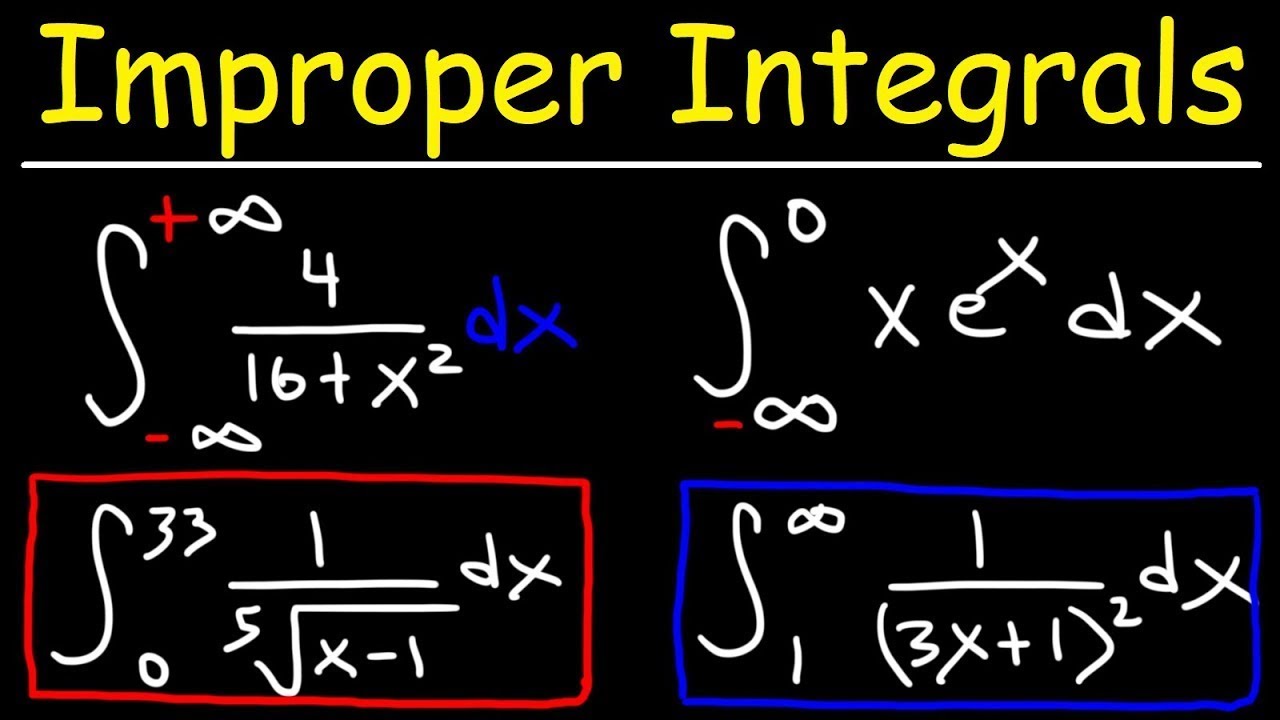
This calculus 2 video tutorial explains how to evaluate improper integrals. It explains how to determine if the integral is convergent or divergent by expressing the limit as it approaches infinity. It also explains how to determine if the integral is improper by identifying any vertical asymptotes or infinite discontinuites. This video conta...
that
The problem Im doing says "Determine whether each integral is convergent or divergent. Evaluate those that are convergent."
I determined that my integral function was convergent b/c limit of it exists
but idk how to evluate
dense wing
Yeah, integral not function
stuck oyster
Oh ok
eager elk
even if you show that the integral is convergent, it may not be obvious how to find the actual integral. bessel problem took years lol
stuck oyster
hm
dense wing
eager elk
even if you show that the integral is convergent, it may not be obvious how to f...
Bassel took me 2 seconds to write the answer to \s
stuck oyster
I found the limit to be -4
eager elk

 stuck oyster
yea we did
 floral thistle
yeah do that then
 floral thistle
u = 3-x, u+x = 3, x = 3-u, dx = -1 du,
oh you already did the integral oops
yeah that looks right
stuck oyster
yea and it tuned out to be convergent but I was asked to evluate it
How do I evaluate the convergent
floral thistle
you just did
stuck oyster
Oh...
floral thistle
it converges to 80
stuck oyster
Ahhh I see
floral thistle
although i don’t know if you would really use converge like that in this context
cedar kilnBOT
Channel closed
Closed by @stuck oyster
Use .reopen if this was a mistake.
Available help channel!
Send your question here to claim the channel.
Remember:
• Ask your math question in a clear, concise manner.
• Show your work, and if possible, explain where you are stuck.
• After 15 minutes, feel free to ping <@&286206848099549185>.
• Type the command .close to free the channel when you're done.
• Be polite and have a nice day!
Read #❓how-to-get-help for further information on how to ask a good question, and about conduct in the question channels.
 tropic plover
 cedar kilnBOT
tropic plover
tropic plover
cedar kilnBOT
tropic plover
tropic plover

 marble hemlock
is this from your test?
cedar kilnBOT
@tropic plover Has your question been resolved?
 white dawn
@tropic plover what is f(x)?
you need the definition of the function to figure it out
 cedar shale
white dawn
you need the definition of the function to figure it out
cedar shale
white dawn
you need the definition of the function to figure it out
that's the first image
white dawn
oh im dumb
since infinity plus or minus any real number is still infinity, then all of those +3s and stuff dont matter
so bascally its like infinity*infinity*infinity
as x approaches infinity
the same applies for negative infinity
however because negative times negative equals positive some of the negatives cancel out
so in the end you get that it approaches infinity in both cases
cedar shale
tropic plover
I'll add: A reference to the table on the left should be all the justification your instructor needs. Depending on the instructor you could multiply all the terms together for one large polynomial or just predict which form it will be anecdotally
 tropic plover
to solve that question do i have to make it a Simplest Form first?
cedar shale
tropic plover
to solve that question do i have to make it a Simplest Form first?
Not necessarily. By looking at this equation I can tell that the highest degree of the equation will be x^4 (by counting the exponents on the terms in parentheses) and that there are no negative signs that would flip the equation upside-down.
$f(x)=(x+3)^1+(x-1)^1+(x-4)^2$
cedar shale
You only need to know the general shape of the graph to know what it does at the end. A normal parabola of the form y=x^2 will always go up when you go left and will always go up when you go right.
I'm not sure what part of it you don't understand, can you explain further please
tropic plover
 cedar shale
tropic plover
i dont get like the end behavior
cedar shale
tropic plover
i dont get like the end behavior
Here's a graph that shows that the highest degree in a polynomial will determine end behavior. There are huge odd-degree negative terms but if you zoom out enough you can see that it goes up on both sides because the highest degree is even numbered with a positive coefficient.
 tropic plover
as x go + inf, y will also go +inf??
cedar shale
That's correct. You can actually see that by looking at which quadrant of the graph the ends of the lines end up in
tropic plover
so when x go - inf the y will also go -inf?
cedar shale
Correct. You don't have to graph the equation to see it. You can look at the highest degree and whether it's even or odd and positive or negative and you'll know its shape when you zoom out far enough
tropic plover
ohhh
cedar shale
You can play with these graphs in Desmos if you want to prove it to yourself
tropic plover
also how do i find the y intercept of the equation?
cedar shale
The Y-Intercept is when the equation touches the vertical line in the center of the plane, which is when x=0. So set X equal to 0 in the equation and solve for Y.
More formally, the y intercept is f(0)
tropic plover
-12 ?
cedar shale
That's correct
tropic plover
if they r talking about What are the zeros of the function are they talking about the values of x where f(x) = 0?
cedar shale
Yes
tropic plover
so in this case is going to be 3
cedar kilnBOT
@tropic plover Has your question been resolved?
tropic plover
how do i find the y for this one then?
 dense wing
What y?
tropic plover
intercept
 frail dune
do you have the formula of this function?
because you have the answer on the pic, don't you?
tropic plover
no i dont have the equation of the fuction
tropic plover
so 10 right
frail dune
I'd go with the point (0, 10), not just 10
but maybe that's what they expect you to do
not sure
tropic plover
if the question ask me What are the zeros of the function above?
how can i answer that
crimson sedge
zeros = solutions (x1,x2, whatever)
y intercept = whatever intersects the y axis
Vertex = (x,y)
just to name a few
wraith daggerBOT
Erzis エルジス
 frail dune
because $f(x_1)=f(x_2)=0$
wraith daggerBOT
Erzis エルジス
 frail dune
that's why zeros
frail dune
tropic plover
f(x1) = f(x2)=0?
yes, plug your x1 and x2 in
and you will see that for these x's function has value 0
and that's what we call zeros
tropic plover
-2,0
frail dune
yeah, that's one of the points
tropic plover
and 5,0
cedar kilnBOT
@tropic plover Has your question been resolved?
cedar kilnBOT
@tropic plover Has your question been resolved?
cedar kilnBOT
Channel closed
Closed due to timeout
Use .reopen if this was a mistake.
Available help channel!
Send your question here to claim the channel.
Remember:
• Ask your math question in a clear, concise manner.
• Show your work, and if possible, explain where you are stuck.
• After 15 minutes, feel free to ping <@&286206848099549185>.
• Type the command .close to free the channel when you're done.
• Be polite and have a nice day!
Read #❓how-to-get-help for further information on how to ask a good question, and about conduct in the question channels.
 sand dirge
To find the value of an absolute min or max we find the derivative of the OG function then we find the critical points and once we do that what do we do?
cedar kilnBOT
sand dirge
To find the value of an absolute min or max we find the derivative of the OG fun...
sand dirge
Should i plug in the critical points in the original function or the derivative of that function?
 main needle
original function
all you're seeing now is which heights are actually the highest/lowest
cedar kilnBOT
Channel closed
Closed by @sand dirge
Use .reopen if this was a mistake.
Available help channel!
Send your question here to claim the channel.
Remember:
• Ask your math question in a clear, concise manner.
• Show your work, and if possible, explain where you are stuck.
• After 15 minutes, feel free to ping <@&286206848099549185>.
• Type the command .close to free the channel when you're done.
• Be polite and have a nice day!
Read #❓how-to-get-help for further information on how to ask a good question, and about conduct in the question channels.
 inner oasis
Can anyone help me with this problem? I don't know how to work on it. "The path graph P on n vertices is the graph with vertices V = {1, 2, 3, . . . , n} and edges
E = {{i, i + 1} : 1 ≤i ≤n −1}. Prove that P is connected for all n."
cedar kilnBOT
inner oasis
Can anyone help me with this problem? I don't know how to work on it. "The path ...
@inner oasis Has your question been resolved?
 fair geyser
maybe you like do induction
inner oasis
i've tried induction but i couldn't figure it out
fair geyser
if 1, it's connected
if n+1 it's connected if it's a connected graph + a connected edge
inner oasis
can you elaborate more please?
inner oasis
hmm ive tried induction but it wasnt working out
fair geyser
i don't know what it's supposed to look like
it's obvious, induction is how you prove obvious things
but I don't know exactly what it should say
inner oasis
maybe im doing my induction wrong
fair geyser
basically n+1 graph has a part of it that's literally an n-graph
inner oasis
like the description of the edge clearly shows its connected
fair geyser
because the edges thing names the same edges, just stops one short
induction lets you prove that part is connected
then you explicitly can show that the last edge is connected to the part
inner oasis
okay ill try it that way
fair geyser
the only thing unclear is how you say "the edges thing names the same edges, just stops one short"
that's just intuitively how that notation works
inner oasis
ahh okay
fair geyser
i may be going in reverse btw
cedar kilnBOT
@inner oasis Has your question been resolved?
Channel closed
Closed by @inner oasis
Use .reopen if this was a mistake.
cedar kilnBOT
Available help channel!
Send your question here to claim the channel.
Remember:
• Ask your math question in a clear, concise manner.
• Show your work, and if possible, explain where you are stuck.
• After 15 minutes, feel free to ping <@&286206848099549185>.
• Type the command .close to free the channel when you're done.
• Be polite and have a nice day!
Read #❓how-to-get-help for further information on how to ask a good question, and about conduct in the question channels.
 north marsh
2:5 = 4:x (What's volume of X?) Ratio problem. I need help
obsidian coral
$$\frac{2}{5} = \frac{4}{x}$$
wraith daggerBOT
dldh06
 north marsh
what.
obsidian coral
Algebra, if you know that
north marsh
ah yes i do
obsidian coral
Find x
obsidian coral
No
north marsh
because 4 : x = 5:2, x : 4 = 2 : 5
obsidian coral
north marsh
2:5 = 4:x (What's volume of X?) Ratio problem. I need help
Written in the same format as this
north marsh
$$\frac{5}{2} = \frac{4][x}$$
wraith daggerBOT
Yetz.
$$\frac{5}{2} = \frac{4][x}$$
```Compilation error:```! Missing } inserted.
<inserted text>
                }
l.55 $$\frac{5}{2} = \frac{4][x}$
                                 $
I've inserted something that you may have forgotten.
(See the <inserted text> above.)
With luck, this will get me unwedged. But if you
really didn't forget anything, try typing `2' now; then
my insertion and my current dilemma will both disappear.``` wraith daggerBOT
Yetz.
Compile Error! Click the  reaction for more information.
(You may edit your message to recompile.)
 obsidian coral
If you want it your way, it's $$\frac{5}{2} = \frac{x}{4}$$
north marsh
$$\frac{5}{2} = \frac{4}{x}$
wraith daggerBOT
Yetz.
Compile Error! Click the reaction for more information.
(You may edit your message to recompile.)

dldh06
 obsidian coral
Don't ping people
crimson sedge
what
north marsh
north marsh
2:5 = 4:x (What's volume of X?) Ratio problem. I need help
help me
wit this
a
obsidian coral
You cross multiply
obsidian coral
No
wraith daggerBOT
dldh06
 obsidian coral
Then cross multiply
obsidian coral
No
north marsh
20/2
obsidian coral
So what's 20/2?
obsidian coral
So x equals?
north marsh
x equals 1
obsidian coral
Yes, so you rewrite as a fraction, $$\frac{5}{2} = \frac{x}{4}$$
wraith daggerBOT
dldh06
 obsidian coral
To find x
north marsh
ur saying it's gonna be 5/8?
north marsh
Idk, i suck.
hm
lemme try
x = 1.
soo
x and 4 will swap
and it'll be
4/1
5/2 x 4/1
20 / 2
obsidian coral
But what's 20/2?
obsidian coral
But what's 20/2?
obsidian coral
What does 20/2 result in?
obsidian coral
It's 10
north marsh
Oh it is 10
i was correct
woah
🤯
thanks for helping ig
the answer is 10
.close
cedar kilnBOT
Channel closed
Closed by @north marsh
Use .reopen if this was a mistake.
Available help channel!
Send your question here to claim the channel.
Remember:
• Ask your math question in a clear, concise manner.
• Show your work, and if possible, explain where you are stuck.
• After 15 minutes, feel free to ping <@&286206848099549185>.
• Type the command .close to free the channel when you're done.
• Be polite and have a nice day!
Read #❓how-to-get-help for further information on how to ask a good question, and about conduct in the question channels.
crimson sedge
im having trouble find where the derivative = 0
 crimson sedge
rn im at x*tan(x)=1
i made a mistake
its just tan(x)=1
and this equals pi over 4 ,would the other x value be 0?
<@&286206848099549185>
cedar kilnBOT
@crimson sedge Has your question been resolved?
crimson sedge
crimson sedge
rn im at x*tan(x)=1
what was your process in getting x*tan(x) = 1
that was an error
i forgot to simplify the x values in the derivative
what did you do to get tan(x) = 1
or i guess
what did you get for f'(x)
floral thistle
how do you get tan from sin(x)/x
crimson sedge

if you set this to 0 and multiply both sides by x^2, you get 0 = xcos(x) - sin(x)
adding sin to both sides yields sin(x) = xcos(x)
dividing by cos(x) gives you tan(x) = x
so i set the whole equation to 0 instead of just the numerator?
crimson sedge
crimson sedge
so i set the whole equation to 0 instead of just the numerator?
what do you mean by just the numerator
i thought a faction equaled 0 when the numerator was 0
crimson sedge
yes
that's because if you multiply both sides of the equation by the denominator of the fraction, the denominator goes away
**if the fraction is set equal to 0
crimson sedge
crimson sedge
so i set the whole equation to 0 instead of just the numerator?
so you can do either
i see

so my number line rn is 2pi.....pi/4.....0.....pi/4.....2pi
i dont understand how both parts of the interval are positive
on a number line, what you'd normally get is
-2pi.....-pi/4.....0.....pi/4.....2pi
but if you look at a graph of sinx/x, you get

its entirely symmetric, so the right side is just the left side but mirrored
so in your number line, you can just mirror the positive side (i.e. 0.....pi/4.....2pi)
which yields
2pi.....pi/4.....0.....pi/4.....2pi
oh ok
i used the test values -4pi/3 ,-pi/6 ,4pi/3 and pi/6 and got all positive intervals 
are you finding the intervals or are you just finding the values at -4pi/3 ,-pi/6 ,4pi/3 and pi/6?
the intervals
hmm
the slope should be negative at pi/6

i.e. the function is decreasing around pi/6
im getting positive
what was your answer

multiplying root 3 by pi is the same as 1.73205*3.14159, which is 5.44
5.44-6 yields a negative number
so (3 * {negative #})/pi^2 gives a negative number
oh i guess i was just being lazy 😔
sorry
no worries
it happens

my sign chart is -2pi (+) -pi/4 (+) 0 (-) pi/4 (-) 2pi
is this sign chart for locations on the y-x plane for f(x) or are they the slopes of the derivative?
slopes of the derivative
the function actually decreases and then increases from -2pi to -pi
where does pi come from?
pi is when the function crosses the x-axis
i.e. when y = sin(x)/x = 0
oh
so i dont need pi/4
so if i were to approach another rational function would i just set the original function equal to 0 instead of the derivative?
hmm i'm not sure how to get pi/4 (maybe that's where f changes concavity) but the function typically changes from decreasing to increasing or increasing to decreasing at critical points (i.e. when the derivative is 0)
oh no i just used -2pi and -pi to show that the function isn't only increasing in that interval
they were just the easiest points to use on a graph
sinx/x is an oscillating function, so just from a sketch of the function, you can see that the function decreases and then increases at some point between -2pi and -pi
crimson sedge
crimson sedge
the intervals would have to be from critical point to critical point
i still cant see how i would find pi using the derivative
yeah its a bit tricky since, if you set the derivative to 0, you get tanx - x = 0
which is a tough equation
https://www.mathworks.com/matlabcentral/answers/387944-trying-to-solve-a-tan-x-x-0-equation
Trying to solve a tan(x)-x=0 equation. Learn more about tan, solve, fzero, equation
newton even had a really complicated method to solving tanx - x = 0 (since it's a weird equation)
https://youtu.be/6ozQ9INV59s
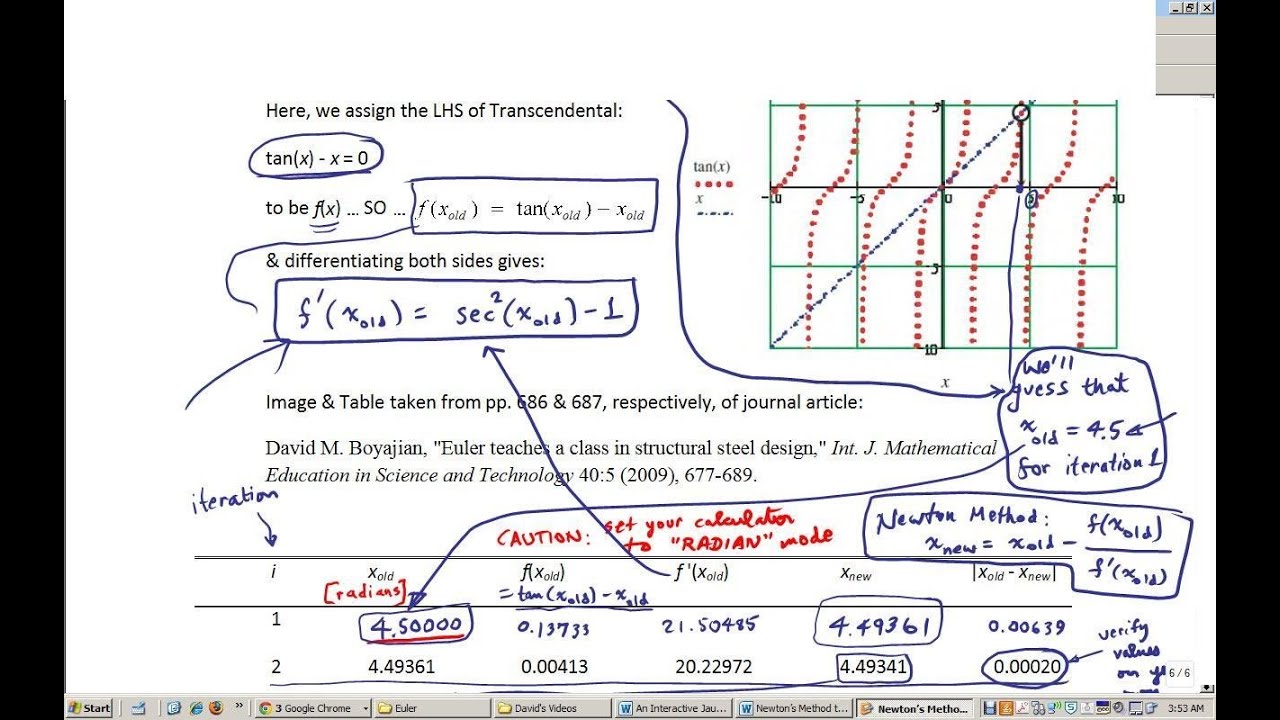
Transcendental equations involve functions which cannot be constructed algebraically (i.e. by a finite number of simple polynomials) -- in the present context our equation (tan(x) - x = 0) involves the trigonometric tangent function, which is formulated by an infinite power series. This equation results, for example, when attempting to find the ...
why is this on the homework
crimson sedge
.close ty bert for all the help
cedar kilnBOT
Channel closed
Closed by @thin prawn
Use .reopen if this was a mistake.
Available help channel!
Send your question here to claim the channel.
Remember:
• Ask your math question in a clear, concise manner.
• Show your work, and if possible, explain where you are stuck.
• After 15 minutes, feel free to ping <@&286206848099549185>.
• Type the command .close to free the channel when you're done.
• Be polite and have a nice day!
Read #❓how-to-get-help for further information on how to ask a good question, and about conduct in the question channels.
 torn atlas
 cedar kilnBOT
torn atlas
torn atlas
cedar kilnBOT
torn atlas
torn atlas
Can this problem be solved using partial fractions only? I showed it to a friend and he thinks there is a mistake in our problem set
tropic oxide
what are you asked for?
torn atlas
The indefinite integral
tropic oxide
okay
 tropic oxide
yes, this is expected
the numerator is higher degree than the denominator, so you need to write the fraction as the sum of a polynomial and a proper fraction
 tropic oxide
from here leave the x+3 alone and partial-fraction the (7x-6)/(x^2-3x+2) as normal
torn atlas
The second term, we will just find the integral using partial fractions as normal
Yep cool, thank u so much
cedar kilnBOT
@torn atlas Has your question been resolved?
cedar kilnBOT
Channel closed
Closed due to timeout
Use .reopen if this was a mistake.
Available help channel!
Send your question here to claim the channel.
Remember:
• Ask your math question in a clear, concise manner.
• Show your work, and if possible, explain where you are stuck.
• After 15 minutes, feel free to ping <@&286206848099549185>.
• Type the command .close to free the channel when you're done.
• Be polite and have a nice day!
Read #❓how-to-get-help for further information on how to ask a good question, and about conduct in the question channels.
 hidden summit
 cedar kilnBOT
hidden summit
hidden summit
cedar kilnBOT
hidden summit
hidden summit
what do i write there
 zinc mason
the test used to proof congruence i think
cedar kilnBOT
@hidden summit Has your question been resolved?
cedar kilnBOT
Channel closed
Closed due to timeout
Use .reopen if this was a mistake.
Available help channel!
Send your question here to claim the channel.
Remember:
• Ask your math question in a clear, concise manner.
• Show your work, and if possible, explain where you are stuck.
• After 15 minutes, feel free to ping <@&286206848099549185>.
• Type the command .close to free the channel when you're done.
• Be polite and have a nice day!
Read #❓how-to-get-help for further information on how to ask a good question, and about conduct in the question channels.
 tribal scroll
how to do this
 cedar kilnBOT
tribal scroll
how to do this
cedar kilnBOT
tribal scroll
how to do this
 elfin hemlock
Binomial theorem
tribal scroll
elfin hemlock
Binomial theorem
💀
ik but i've never done where the first bracket was ^2 or more
so idk how to start the question
tribal scroll
uh i still don't know how to start the question
elfin hemlock
Either look in your book or google binomial expansion of (x+y)^n (where your x is here x^2 and y is 1/x and n=3 for the first bracket)
tribal scroll
elfin hemlock
Either look in your book or google binomial expansion of (x+y)^n (where your x i...
i got the first bit down to 3Cr times x^6-3r
elfin hemlock
?
tribal scroll
elfin hemlock
?
 elfin hemlock
Yes now we only care about the constant term
So only 1 of those are a constant, figure out what it is
tribal scroll
elfin hemlock
Yes now we only care about the constant term
isn't constant term just x^0
so r = 2
elfin hemlock
Which gives the constant term?
tribal scroll
6-3r?
tribal scroll
3C2 = 3
tribal scroll
elfin hemlock
Now do the 2nd bracket
uh got r = 2
and constant term 24
then ig just 24 x 3 = 72
is that it?
elfin hemlock
Yes
cedar kilnBOT
@tribal scroll Has your question been resolved?
tribal scroll
elfin hemlock
Yes
thanks
cedar kilnBOT
Channel closed
Closed by @tribal scroll
Use .reopen if this was a mistake.
Available help channel!
Send your question here to claim the channel.
Remember:
• Ask your math question in a clear, concise manner.
• Show your work, and if possible, explain where you are stuck.
• After 15 minutes, feel free to ping <@&286206848099549185>.
• Type the command .close to free the channel when you're done.
• Be polite and have a nice day!
Read #❓how-to-get-help for further information on how to ask a good question, and about conduct in the question channels.
crimson sedge
 cedar kilnBOT
crimson sedge
https://media.discordapp.net/attachments/783653274616070145/907233287796293643/u...
crimson sedge
cedar kilnBOT
crimson sedge
https://media.discordapp.net/attachments/783653274616070145/907233287796293643/u...
crimson sedge
How do i find the a and b values here to try and solve using a^2-2ab+b^2
crimson sedge
why should I rewrite it as 1+2?
floral thistle
that turns it into a perfect square polynomial
 floral thistle
just so you know, if you know the approximate square root of 3 and 2 you can get the answer without doing any of this
yes
well not exactly
crimson sedge
floral thistle
just so you know, if you know the approximate square root of 3 and 2 you can get...
Does it help with other questions that have radicals?
 floral thistle
yeah
crimson sedge
so how do I decide what is a and b now?
I am quite bad at radicals since I havent really studied them yet.
floral thistle
notice that if you make the 2 negative when square rooting it the whole thing will be negative
crimson sedge
yeah
floral thistle
so the 1 will be negative instead
so it will be -1+sqrt2
or (sqrt2)-1
i assume that’s what they meant for b
crimson sedge
 floral thistle
no not like that
keep it in the form from before
you see how there was a minus sign in there right
floral thistle
the only way for that to happen is if one of the numbers in the first place was negative
before it got squared
floral thistle
when you square root it
crimson sedge
 floral thistle
not like that
i might not be phrasing this properly
so you have a minus sign there
crimson sedge
-1 or -2
floral thistle
notice that both (-a+b)^2 and (a-b)^2 get you something that looks like that
crimson sedge
yeah
floral thistle
you know what a and b will be
cedar kilnBOT
Channel closed
Closed by @naive veldt
Use .reopen if this was a mistake.
Available help channel!
Send your question here to claim the channel.
Remember:
• Ask your math question in a clear, concise manner.
• Show your work, and if possible, explain where you are stuck.
• After 15 minutes, feel free to ping <@&286206848099549185>.
• Type the command .close to free the channel when you're done.
• Be polite and have a nice day!
Read #❓how-to-get-help for further information on how to ask a good question, and about conduct in the question channels.
cedar kilnBOT
 radiant topaz
It's like 0.63×0.47p which have fought with weapon and 0.35p are total people who fought
Sorry for interruption
wraith daggerBOT
it's Sam
 radiant topaz
Ok
cedar kilnBOT
Channel closed
Closed by @rotund fjord
Use .reopen if this was a mistake.
Available help channel!
Send your question here to claim the channel.
Remember:
• Ask your math question in a clear, concise manner.
• Show your work, and if possible, explain where you are stuck.
• After 15 minutes, feel free to ping <@&286206848099549185>.
• Type the command .close to free the channel when you're done.
• Be polite and have a nice day!
Read #❓how-to-get-help for further information on how to ask a good question, and about conduct in the question channels.
 wanton wharf
hi, i want to know the lim of this. is there a lim? doesnt x-2 have only a 1 sided lim ?
 cedar kilnBOT
wanton wharf
hi, i want to know the lim of this. is there a lim? doesnt x-2 have only a 1 sid...
cedar kilnBOT
wanton wharf
hi, i want to know the lim of this. is there a lim? doesnt x-2 have only a 1 sid...
@wanton wharf Has your question been resolved?
wraith blaze
wanton wharf
hi, i want to know the lim of this. is there a lim? doesnt x-2 have only a 1 sid...
what is g(x), precisely? is it the function which the graph illustrates?
wanton wharf
yes
wraith blaze
indeed, both one-sided limits exist
wanton wharf
ok thanks
cedar kilnBOT
Channel closed
Closed by @wanton wharf
Use .reopen if this was a mistake.
Available help channel!
Send your question here to claim the channel.
Remember:
• Ask your math question in a clear, concise manner.
• Show your work, and if possible, explain where you are stuck.
• After 15 minutes, feel free to ping <@&286206848099549185>.
• Type the command .close to free the channel when you're done.
• Be polite and have a nice day!
Read #❓how-to-get-help for further information on how to ask a good question, and about conduct in the question channels.
cedar kilnBOT
cedar kilnBOT
@steep meadow Has your question been resolved?
 azure horizon
do you know what the discriminant is
cedar kilnBOT
@steep meadow Has your question been resolved?
cedar kilnBOT
Channel closed
Closed by @steep meadow
Use .reopen if this was a mistake.
Available help channel!
Send your question here to claim the channel.
Remember:
• Ask your math question in a clear, concise manner.
• Show your work, and if possible, explain where you are stuck.
• After 15 minutes, feel free to ping <@&286206848099549185>.
• Type the command .close to free the channel when you're done.
• Be polite and have a nice day!
Read #❓how-to-get-help for further information on how to ask a good question, and about conduct in the question channels.
 sand ether
Given $A+B+C=\pi$ and $a^2>b^2+c^2$ where a,b,c is sides of triangle. Show that $\sin(2A) + \sin(2B) + \sin(2C) + \sin2(B+C) + \sin2(A+C) + \sin2(A+B) = 0$
cedar kilnBOT
sand ether
Given $A+B+C=\pi$ and $a^2>b^2+c^2$ where a,b,c is sides of triangle. Show that ...
wraith daggerBOT
azeem321
 cedar kilnBOT
@sand ether Has your question been resolved?
sand ether
.close
cedar kilnBOT
Channel closed
Closed by @sand ether
Use .reopen if this was a mistake.
Available help channel!
Send your question here to claim the channel.
Remember:
• Ask your math question in a clear, concise manner.
• Show your work, and if possible, explain where you are stuck.
• After 15 minutes, feel free to ping <@&286206848099549185>.
• Type the command .close to free the channel when you're done.
• Be polite and have a nice day!
Read #❓how-to-get-help for further information on how to ask a good question, and about conduct in the question channels.
 glad harness
- a boy is standing on a slope with a gradient of 100% and throws a stone in the direction of the slope.
tion of the slope at a speed of 10m/s horizontally from himself. Determine
the horizontal component x of the throwing distance. Neglect the height
of the boy.
 cedar kilnBOT
glad harness
2. a boy is standing on a slope with a gradient of 100% and throws a stone in th...
glad harness
cedar kilnBOT
glad harness
2. a boy is standing on a slope with a gradient of 100% and throws a stone in th...
glad harness
Hi does anyone here have an approach how I can solve this task
Sorry, for German instruction
I translated as well as possible
cedar kilnBOT
@glad harness Has your question been resolved?
cedar kilnBOT
@glad harness Has your question been resolved?
 safe epoch
You need a x(t) Equation and a y(t) Equation. Solve x(t) for t and set it into y(t) you get y(x). Now you need to set y(x) = s(x) the Equation of the slope and solve it for x
cedar kilnBOT
@glad harness Has your question been resolved?
Channel closed
Closed by @glad harness
Use .reopen if this was a mistake.
Available help channel!
Send your question here to claim the channel.
Remember:
• Ask your math question in a clear, concise manner.
• Show your work, and if possible, explain where you are stuck.
• After 15 minutes, feel free to ping <@&286206848099549185>.
• Type the command .close to free the channel when you're done.
• Be polite and have a nice day!
Read #❓how-to-get-help for further information on how to ask a good question, and about conduct in the question channels.
crimson sedge
Hi! I came across the Lambert W function when trying to solve e^x = x + 1. I do understand how this works, and I know the real answers to this equation. So I get how W0 and W-1 work, but for complex solutions to x, I just don't get how (for example) W6 works. Is there a way I can imagine what this would look like - some pictures you know of? - So firstly, I'm asking for help understanding this and secondly, does this mean that there are infinite solutions for x? I mean the real solution for x=0. But for W6, I would get some complex number, for W7 another one etc... Or is this just a problem with the nature of this function, not being an elementary function? - Please go easy on me, I'm just a student and this is the first time, I ask a question here 😅
cedar kilnBOT
crimson sedge
Hi! I came across the Lambert W function when trying to solve e^x = x + 1. I do ...
@crimson sedge Has your question been resolved?
crimson sedge
<@&286206848099549185>
cedar kilnBOT
@crimson sedge Has your question been resolved?
cedar kilnBOT
@crimson sedge Has your question been resolved?
cedar kilnBOT
Channel closed
Closed due to timeout
Use .reopen if this was a mistake.
Available help channel!
Send your question here to claim the channel.
Remember:
• Ask your math question in a clear, concise manner.
• Show your work, and if possible, explain where you are stuck.
• After 15 minutes, feel free to ping <@&286206848099549185>.
• Type the command .close to free the channel when you're done.
• Be polite and have a nice day!
Read #❓how-to-get-help for further information on how to ask a good question, and about conduct in the question channels.
@south valve Has your question been resolved?
cedar kilnBOT
@south valve Has your question been resolved?
cedar kilnBOT
Channel closed
Closed due to timeout
Use .reopen if this was a mistake.
Available help channel!
Send your question here to claim the channel.
Remember:
• Ask your math question in a clear, concise manner.
• Show your work, and if possible, explain where you are stuck.
• After 15 minutes, feel free to ping <@&286206848099549185>.
• Type the command .close to free the channel when you're done.
• Be polite and have a nice day!
Read #❓how-to-get-help for further information on how to ask a good question, and about conduct in the question channels.
 turbid pilot
<@&286206848099549185>
 twilit depot
This seems like a test, such that helping you would be helping you cheat on this test
cedar kilnBOT
Channel closed
Closed due to the original message being deleted
cedar kilnBOT
Available help channel!
Send your question here to claim the channel.
Remember:
• Ask your math question in a clear, concise manner.
• Show your work, and if possible, explain where you are stuck.
• After 15 minutes, feel free to ping <@&286206848099549185>.
• Type the command .close to free the channel when you're done.
• Be polite and have a nice day!
Read #❓how-to-get-help for further information on how to ask a good question, and about conduct in the question channels.
 jade mulch
Hey i started soa cah toah or however it is and i missed the lessons and i don’t have any time on youtube and i just need a quick run down on how it works
cedar kilnBOT
jade mulch
Hey i started soa cah toah or however it is and i missed the lessons and i don’t...
 cedar kilnBOT
@jade mulch Has your question been resolved?
jade mulch
i don’t get it
floral thistle
make sure to set it to degrees
 warped escarp
jade mulch
i don’t get it
warped escarp
jade mulch
i don’t get it
Hello Friend lol, I recommend khan academy videos on trig, they are around 10 mins each but I just zoom through them on 2x speed. Maybe they will help you :D lmk how it goes!
jade mulch
warped escarp
Hello Friend lol, I recommend khan academy videos on trig, they are around 10 mi...
Ok
cedar kilnBOT
Channel closed
Closed due to timeout
Use .reopen if this was a mistake.
Available help channel!
Send your question here to claim the channel.
Remember:
• Ask your math question in a clear, concise manner.
• Show your work, and if possible, explain where you are stuck.
• After 15 minutes, feel free to ping <@&286206848099549185>.
• Type the command .close to free the channel when you're done.
• Be polite and have a nice day!
Read #❓how-to-get-help for further information on how to ask a good question, and about conduct in the question channels.
twilit depot
There were posts between the problem you posted and my response that have since been deleted. I was not referring to you with those comments
cedar kilnBOT
@south valve Has your question been resolved?
cedar kilnBOT
Channel closed
Closed due to timeout
Use .reopen if this was a mistake.
Available help channel!
Send your question here to claim the channel.
Remember:
• Ask your math question in a clear, concise manner.
• Show your work, and if possible, explain where you are stuck.
• After 15 minutes, feel free to ping <@&286206848099549185>.
• Type the command .close to free the channel when you're done.
• Be polite and have a nice day!
Read #❓how-to-get-help for further information on how to ask a good question, and about conduct in the question channels.
 calm sierra
currently struggling with this question. I do not know how to solve it nor do i even know what to do with the information gaven.
 cedar kilnBOT
calm sierra
currently struggling with this question. I do not know how to solve it nor do i ...
cedar kilnBOT
cedar kilnBOT
calm sierra
currently struggling with this question. I do not know how to solve it nor do i ...
cedar kilnBOT
@calm sierra Has your question been resolved?
Channel closed
Closed by @calm sierra
Use .reopen if this was a mistake.
Available help channel!
Send your question here to claim the channel.
Remember:
• Ask your math question in a clear, concise manner.
• Show your work, and if possible, explain where you are stuck.
• After 15 minutes, feel free to ping <@&286206848099549185>.
• Type the command .close to free the channel when you're done.
• Be polite and have a nice day!
Read #❓how-to-get-help for further information on how to ask a good question, and about conduct in the question channels.
crimson sedge
Is this series Converging or Diverging ?
What test should I use ?
 radiant topaz
crimson sedge
Is this series `Converging` or `Diverging` ?
What test should I use ?
radiant topaz
crimson sedge
Is this series `Converging` or `Diverging` ?
What test should I use ?
Yk ln(n)=<n
crimson sedge
Yeah , I know that , so ?
wraith daggerBOT
it's Sam
 radiant topaz
But add 0< before b_n
radiant topaz
crimson sedge
Yeah , I know that , so ?
Got anything yet?
crimson sedge
Using limit comparison test ( 1/(n)^1/2 ) ,
bn ( 1/(n+1)^1/2 ) is diverging , hence this test doesn't work .
https://cdn.discordapp.com/attachments/739351645510434817/907474600198287410/QQQQQQQQQQQQQ.PNG
 radiant topaz
crimson sedge
Using *limit comparison test* ( `1/(n)^1/2` ) ,
bn ( `1/(n+1)^1/2` ) is divergin...
radiant topaz
crimson sedge
Using *limit comparison test* ( `1/(n)^1/2` ) ,
bn ( `1/(n+1)^1/2` ) is divergin...
Yes
I think its diverging series so we need to find another diverging series which can be used in comparison test
What about limit comparison test
crimson sedge
IDK , I've tried everything but I might've missed something .
radiant topaz
Ok
cedar kilnBOT
@crimson sedge Has your question been resolved?
radiant topaz
crimson sedge
IDK , I've tried everything but I might've missed something .
Try limit comparison with 1/(n sqrt(n+1))
Oh but this one is convergent so it won't work
This question is so in between convergence and divergence
crimson sedge
<@&286206848099549185>
crimson sedge
I've tried integration by parts and using variable both didn't work
radiant topaz
$\textcolor{blue}{ \lim_{t \to \infty} \int_1^t \frac{ln(x)}{x\sqrt{x+1}} dx}$\
then substitute $u=ln(x) \Rightarrow du = \frac{1}{x} dx$\
So $\textcolor{red}{\lim_{t\to \infty} \int_0^t \frac{u}{\sqrt{e^u + 1}} du}$
wraith daggerBOT
it's Sam
 wraith daggerBOT


 Requested by it's Sam#5028
radiant topaz
Requested by it's Sam#5028
radiant topaz
,w integration ln(x)/(x sqrt(x+1)) dx from 0 to infty
wraith daggerBOT
 Requested by it's Sam#5028
crimson sedge
radiant topaz
Is this right so far?
Requested by it's Sam#5028
crimson sedge
radiant topaz
Is this right so far?
yes it is , but idk how to take the integral of that .
radiant topaz
That means I've done some wrong substitution
 ember geode
,w integral from 1 to infinity lnx/(xsqrt(x+1))
wraith daggerBOT

 Requested by Sneaky#0928
vivid bloom
Requested by Sneaky#0928
vivid bloom
hi mobile what test can you use ?
ember geode
you substituted right
vivid bloom
any kind ? p-test for example ?
vivid bloom
radiant topaz
Doesn't work
it does but, i dont know if he can use it
radiant topaz
vivid bloom
it does but, i dont know if he can use it
Which one
radiant topaz
Yes but what modifications
vivid bloom
if you apply it directly prob not
crimson sedge
vivid bloom
hi mobile what test can you use ?
Limit comparison test
Direct comparison test
Integral test
Ratio test
Root test
Limit of the summand
p-series test
Alternating series test
radiant topaz
It's okay if u say it here 
vivid bloom
what can you tell about this limit
$$ \lim_{n \to \infty} \frac{ln(n)}{n^{a}}$$ with $a>0$
wraith daggerBOT
BillyElKid
 radiant topaz
0 for a>1/2 I think
It will diverge when a is close to 0
Let me just check with wolfram
If you don't mind I'll do it here
,w lim n to infty ln(n)/n^(1/8)
crimson sedge
wraith dagger
**BillyElKid**
= 0
wraith daggerBOT
 Requested by it's Sam#5028
vivid bloom
crimson sedge
` = 0`
Requested by it's Sam#5028
vivid bloom
crimson sedge
` = 0`
nice
radiant topaz
This will be going to 0 for n^(1/4) too
Wow I actually thought this before but never bothered to check
vivid bloom
so this means that for a $n$ sufficiently large $$ln(n) \leq n^{a}$$ no ?
wraith daggerBOT
BillyElKid
 crimson sedge
wraith dagger
**BillyElKid**
crimson sedge
wraith dagger
**BillyElKid**
Yeah , so ?
radiant topaz
crimson sedge
Yeah , so ?
Think if you use n^(1/8) then what will you get in comparison test
And We have n^(3/2) in denominator
crimson sedge
radiant topaz
Think if you use n^(1/8) then what will you get in comparison test
By comparison test you mean
1) Direct comparison test
or
2) Limit comparison test
?
radiant topaz
crimson sedge
By comparison test you mean
`1) Direct comparison test`
or
`2) Limit comparison...
Direct
$\textcolor{red}{\displaystyle \sum_{n=1}^{\infty} \frac{ln(n)}{n\sqrt{n+1}} < \displaystyle \sum_{n=1}^{\infty} \frac{n^{1/8}}{n\sqrt{n+1}}}$
wraith daggerBOT
it's Sam
 crimson sedge
wraith dagger
**it's Sam**
crimson sedge
wraith dagger
**it's Sam**
n^(1/8) / n * n^1/2 is divergent
vivid bloom
be careful sam, remember that the inequality holds only for a $n$ sufficiently large
wraith daggerBOT
BillyElKid
 radiant topaz
vivid bloom
be careful sam, remember that the inequality holds only for a $n$ sufficiently ...
radiant topaz
vivid bloom
be careful sam, remember that the inequality holds only for a $n$ sufficiently ...
Ah yes it won't work for some initial values
vivid bloom
yes, but i see you got the idea
so i will let you finish with this guy, sorry for the intrusion tho
radiant topaz
crimson sedge
`n^(1/8) / n * n^1/2` is divergent
(3/2 - 1/8) = (12-1 /8) = 11/8 > 1
crimson sedge
ok
radiant topaz
vivid bloom
so i will let you finish with this guy, sorry for the intrusion tho
What do you think a method that will work without this drawback
Ik for sqrt(n) > ln(n) for all n>0
crimson sedge
vivid bloom
be careful sam, remember that the inequality holds only for a $n$ sufficiently ...
Does it matter if the inequality is true for example for n >= 100 ?
radiant topaz
crimson sedge
Does it matter if the inequality is true for example for n >= 100 ?
I think the sum in this case will be bounded if we add first 100 terms
$\textcolor{red}{\displaystyle \sum_{n=1}^{\infty} \frac{ln(n)}{n\sqrt{n+1}} < \displaystyle \sum_{n=1}^{k} \frac{ln(n)}{n\sqrt{n+1}} + \displaystyle \sum_{n=k+1}^{\infty} \frac{n^{1/8}}{n\sqrt{n+1}}}$
crimson sedge
radiant topaz
I think the sum in this case will be bounded if we add first 100 terms
I'm a bit confused about this , I wanted to do integral test for another example and then I asked teacher that the graph is descending after n = 2 , and she said that we can ignore the first time cause it won't effect whether the series is convergent or divergent , then I asked what if it is n = 1000 , and she said that's also fine , never understood why ?
wraith daggerBOT
it's Sam
 crimson sedge
wraith dagger
**it's Sam**
crimson sedge
wraith dagger
**it's Sam**
oh ok , so as long as k is finite , k can be as big as possible
radiant topaz
crimson sedge
oh ok , so as long as `k` is finite , `k` can be as big as possible
Yes

Mathematics Stack Exchange
I want to prove the following theorem:
Changing a finite number of terms in a series does not change whether or not it converges, although it may change the value of its sum if it does converge
...
Better explaination
Using cauchy criteria
crimson sedge
.close
cedar kilnBOT
Channel closed
Closed by @acoustic pilot
Use .reopen if this was a mistake.
cedar kilnBOT
Available help channel!
Send your question here to claim the channel.
Remember:
• Ask your math question in a clear, concise manner.
• Show your work, and if possible, explain where you are stuck.
• After 15 minutes, feel free to ping <@&286206848099549185>.
• Type the command .close to free the channel when you're done.
• Be polite and have a nice day!
Read #❓how-to-get-help for further information on how to ask a good question, and about conduct in the question channels.
 shy sorrel
 cedar kilnBOT
shy sorrel
crimson sedge
shy sorrel
cedar kilnBOT
shy sorrel
crimson sedge
shy sorrel
what are the lengths of BD and ED
cedar kilnBOT
@shy sorrel Has your question been resolved?
cedar kilnBOT
Channel closed
Closed due to timeout
Use .reopen if this was a mistake.
cedar kilnBOT
Available help channel!
Send your question here to claim the channel.
Remember:
• Ask your math question in a clear, concise manner.
• Show your work, and if possible, explain where you are stuck.
• After 15 minutes, feel free to ping <@&286206848099549185>.
• Type the command .close to free the channel when you're done.
• Be polite and have a nice day!
Read #❓how-to-get-help for further information on how to ask a good question, and about conduct in the question channels.
 brisk drum
 cedar kilnBOT
brisk drum
brisk drum
cedar kilnBOT
brisk drum
brisk drum
I'm stuck here, can anybody help me?
cedar kilnBOT
@brisk drum Has your question been resolved?
crimson sedge
brisk drum
let a=sqrt(2+sqrt(3))^x and b=sqrt(2-sqrt(3))^x
a+b=4
then multiple a*b you will get a specific value and get a system of equations then you will get your x
or
you could use fact that
$2-\sqrt{3}=\frac{1}{2+\sqrt{3}}}$
wraith daggerBOT
matth
Compile Error! Click the reaction for more information.
(You may edit your message to recompile.)
 cedar kilnBOT
Channel closed
Closed due to timeout
Use .reopen if this was a mistake.
crimson sedge
but you will still have to use substution
but either way works
aaa
@brisk drum
brisk drum
sorry i just got back
crimson sedge
type .reopen
cedar kilnBOT
Available help channel!
Send your question here to claim the channel.
Remember:
• Ask your math question in a clear, concise manner.
• Show your work, and if possible, explain where you are stuck.
• After 15 minutes, feel free to ping <@&286206848099549185>.
• Type the command .close to free the channel when you're done.
• Be polite and have a nice day!
Read #❓how-to-get-help for further information on how to ask a good question, and about conduct in the question channels.
cedar kilnBOT
crimson sedge
type .reopen
brisk drum
.reopen
cedar kilnBOT
Channel closed
Closed by @uncut hazel
Use .reopen if this was a mistake.
crimson sedge
write something after it closes
brisk drum
okay
crimson sedge
Help
.ask
go to other channel
How do i ask for uelp
go #help-4
How do i find the two other angles for a triangle with only 90degress
ok
brisk drum
alright. in the meantime, i saw ur messages
brisk drum
crimson sedge
$2-\sqrt{3}=\frac{1}{2+\sqrt{3}}}$
wont this give me (2+sqrt(3))^x + 1/ (2+sqrt(3))^x = 4
crimson sedge
do it with the first method
crimson sedge
 jovial parcel
so x can only be 2
jovial parcel
so x can only be 2
and -2 also
brisk drum
crimson sedge
do it with the first method
multiply a*b?
crimson sedge
yes
brisk drum
it should give me (2+sqrt(3))^2x right?
crimson sedge
no
brisk drum
ah wait, is it 1?
crimson sedge
yes
cedar kilnBOT
Available help channel!
Send your question here to claim the channel.
Remember:
• Ask your math question in a clear, concise manner.
• Show your work, and if possible, explain where you are stuck.
• After 15 minutes, feel free to ping <@&286206848099549185>.
• Type the command .close to free the channel when you're done.
• Be polite and have a nice day!
Read #❓how-to-get-help for further information on how to ask a good question, and about conduct in the question channels.
brisk drum
alright so now i can write it as system with { (2+sqrt(3)^x + (2-sqrt(3)^x = 4; (2+sqrt(3)^x+ *(2-sqrt(3)^x = 1}
cedar kilnBOT
brisk drum
alright so now i can write it as system with { (2+sqrt(3)^x + (2-sqrt(3)^x = 4; ...
crimson sedge
or a+b=4 a*b=1
brisk drum
yeah lol
crimson sedge
and you can solve that and get values for a and b
brisk drum
i get -1 and 1, so i assume x has to be 2