#help-13
1 messages · Page 396 of 1
 boreal grove
 rare schooner
@sleek drum question's problem. If there is enough of these mistakes yoou can possibly sue!
boreal grove
It's correct
 sleek drum
rare schooner
<@885738639584280617> question's problem. If there is enough of these mistakes y...
sleek drum
rare schooner
<@885738639584280617> question's problem. If there is enough of these mistakes y...
moneyyy
rare schooner
boreal grove
It's correct
nah. Check the question below
boreal grove
That's multiplication too
sleek drum
 rare schooner
boreal grove
That's multiplication too
rare schooner
boreal grove
That's multiplication too
Yes. Usually they stick to one form so i think it's more of a syntax mistake on their behalf
sleek drum
thats the example
 sullen cipher
sleek drum
sullen cipher
sleek drum
Multiplication
rare schooner
sleek drum
thats the example
anyways i think you should try the problem
think of a substitution you should do to that equation
sleek drum
ill try to do it as multiplication but im pretty sure ill mess up anyways
 green coral
rare schooner
<@885738639584280617> question's problem. If there is enough of these mistakes y...
green coral
rare schooner
<@885738639584280617> question's problem. If there is enough of these mistakes y...
you cant legally sue , however if the printing mistake is significant ( which here its not , and not a printing mistake either , both are acceptable ways) you can contact the publisher and they can send you a new copy
but there are no grounds to sue
rare schooner
green coral
you cant legally sue , however if the printing mistake is significant ( which he...
it's a joke 💔
sleek drum
green coral
you cant legally sue , however if the printing mistake is significant ( which he...
ill believe you since u have a red tie in your pfp
sleek drum
wym by substitution 💔
rare schooner
sleek drum
wym by substitution 💔
Do you understand the meaning of substitution?
sleek drum
(2^x)? ill take it as y
rare schooner
that means you replace a certain set of variables with a simpler one
sleek drum
rare schooner
Do you understand the meaning of substitution?
yes but not exactly in this context
sullen cipher
sleek drum
(2^x)? ill take it as y
Exactly
rare schooner
sleek drum
yes but not exactly in this context
do that with 2^x
sleek drum
rare schooner
that means you replace a certain set of variables with a simpler one
got it
rare schooner
yes
sleek drum
well give me a sec
in the example
it did mid term splitting
how would i do that if its multiply and not decimal
or am i wrong and it can still be done
sullen cipher
sleek drum
it did mid term splitting
U can do that with subbing
sleek drum
oh alright
rare schooner
sleek drum
how would i do that if its multiply and not decimal
in fact yoou cannot really solve in a neat way with it being decimals
sleek drum
should i make the 2^2x
2^2x2^x and then 4y
rare schooner
sleek drum
should i make the 2^2x
2^2x2^x and then 4y
nope
rare schooner
that's incorrect!!!
sullen cipher
$2^(2x)=(2^x)^2$
And
$5.2^×=5×2^x$
rare schooner
You should rewrite 2^(2x) so that it looks like a quadratic with the form a^2
god bless
rare schooner
sleek drum
do u guys know how to do this
its multiplication
sullen cipher
sleek drum
do u guys know how to do this
5.2^x=5×2^x
rare schooner

This math video tutorial focuses on solving exponential equations in quadratic form. It explains how to factor quadratic expressions and equations in exponential form by factoring by substitution. This video contains plenty of examples and practice problems. It's useful for students taking algebra 2, precalculus, or even college algebra. You...
watch this video
sullen cipher
sleek drum
alrighty 1 sec
It's gonna take more than that
rare schooner
organic chem saved my life back in high school
sleek drum
sullen cipher
It's gonna take more than that
im a quick learner trust
sleek drum
i get what im supposed to do
its just this smol little 2^2x i dont know how to expand
wait since the powered 2 and x are in multiply
we need to use brackets right?
oh i got it
thank you everyone
.close
😔
rare schooner
sleek drum
we need to use brackets right?
glad organic chem helped
 cedar kilnBOT
Channel closed
Closed by @sleek drum
Use .reopen if this was a mistake.
rare schooner
itll help more in the future!
sleek drum
yay
cedar kilnBOT
 Available help channel!
Send your question here to claim the channel.
Remember:
• Ask your math question in a clear, concise manner.
• Show your work, and if possible, explain where you are stuck.
• After 15 minutes, feel free to ping <@&286206848099549185>.
• Type the command .close to free the channel when you're done.
• Be polite and have a nice day!
Read #❓how-to-get-help for further information on how to ask a good question, and about conduct in the question channels.
 brisk lynx
I need help for:
Determine the value of x to three decimal places 2^x+1 = 3^2x-1
cedar kilnBOT
brisk lynx
I need help for:
Determine the value of x to three decimal places 2^x+1 = 3^2x-1
brisk lynx
How do I eliminate the 2 and 3?
 proven summit
do you know logarithims?
brisk lynx
Yrah
 opal hinge
$2^{x+1} = 3^{2x-1}$
 wraith daggerBOT
Alexis_Fx
 opal hinge
take log both side
proven summit
log both sides
brisk lynx
I'm studying it but I did search it and it gave me some like ln thinhs
brisk lynx
opal hinge
take log both side
Log both sides?
opal hinge
any base is fine
brisk lynx
Ok
proven summit
brisk lynx
I'm studying it but I did search it and it gave me some like ln thinhs
You can do with ln as well
ln is just when you have the base as e
opal hinge
ln is log base e
brisk lynx
Oooo
 fossil dawn
(also known as the natural log)
brisk lynx
So it's like:
Log(2^x-1) = log(3^2x-1)
opal hinge
yeah
proven summit
yeah now apply your log laws
brisk lynx
proven summit
yeah now apply your log laws
The law is log(a^b) = b for move the log(a)?
Wait so uhh
Log(2) = (2x-1)
Log(3)
Or
Wait no
Log(2) = (x-1)
Log(3) = (2x-1)?
opal hinge
$\log_{a}{b^c}=c\log_{a}{b}$
wraith daggerBOT
Alexis_Fx
 opal hinge
so for example $\log{2^3}=3\log{2}$
wraith daggerBOT
Alexis_Fx
 brisk lynx
Yes
brisk lynx
wraith dagger
**Alexis\_Fx**
Using this law?
opal hinge
yeah
brisk lynx
So is it:
(x+1) Log(2) = (2x - 1) log(3)
x log(2) + log(2) = 2x log(3) - log(3)
x log(2) - 2x log(3) = -log(3) - log(2)?
brisk lynx
opal hinge
idk if it's even the name
Yeah the name is sum law but I haven't learn about it
opal hinge
$\log(a)+\log(b)=\log(ab)$
wraith daggerBOT
Alexis_Fx
 brisk lynx
Knew about it
opal hinge
I think you are confused with $\log_{a}{b}\cdot \log_{b}{c}=\log_{a}{c}$
wraith daggerBOT
Alexis_Fx
 brisk lynx
Yes
brisk lynx
wraith dagger
**Alexis\_Fx**
Is this the previous law?
opal hinge
wraith dagger
**Alexis\_Fx**
you will need this to solve your problem
opal hinge
wraith dagger
**Alexis\_Fx**
not this one
brisk lynx
Ohhhh
brisk lynx
wraith dagger
**Alexis\_Fx**
So this is the important one
brisk lynx
wraith dagger
**Alexis\_Fx**
And this one too??
brisk lynx
brisk lynx
So is it:
(x+1) Log(2) = (2x - 1) log(3)
x log(2) + log(2) = 2x log(3) - log(3)
...
So this is wrong?
 opal hinge
seems like it
brisk lynx
brisk lynx
Is it better using this way or the log way?
brisk lynx
opal hinge
seems like it
I got x = 1,191 using log way
I'll use the log way instead
Thank you so much anyway
:DD
.close
cedar kilnBOT
Channel closed
Closed by @brisk lynx
Use .reopen if this was a mistake.
cedar kilnBOT
Available help channel!
Send your question here to claim the channel.
Remember:
• Ask your math question in a clear, concise manner.
• Show your work, and if possible, explain where you are stuck.
• After 15 minutes, feel free to ping <@&286206848099549185>.
• Type the command .close to free the channel when you're done.
• Be polite and have a nice day!
Read #❓how-to-get-help for further information on how to ask a good question, and about conduct in the question channels.
 pseudo merlin
can i pls have some help
cedar kilnBOT
pseudo merlin
can i pls have some help
 wraith daggerBOT
k

 slender ginkgo
@pseudo merlin
 slender ginkgo
Nicee
Now similar triangle
Can u get the smaller radius in terms of known variables

 slender ginkgo
[ V = \frac{\pi r^2 x^3}{h^2}]
wraith daggerBOT
k
 slender ginkgo
how do u get both dV/dt and dx/dt from this
pseudo merlin
i differentiate v to respect of x
slender ginkgo
not x
slender ginkgo
[ \frac{\dd V}{\dd \Large\mathbf{t}}]
pseudo merlin
how can we do to respect of t if theres no t
wraith daggerBOT
k
 slender ginkgo
pseudo merlin
how can we do to respect of t if theres no t
slender ginkgo
pseudo merlin
how can we do to respect of t if theres no t
chain rule
lhs, leave as is
rhs, use chain rule
[ \dv{t} f(x) = \frac{\dd f}{\dd x} \cdot \frac{\dd x}{\dd t}]
wraith daggerBOT
k

 slender ginkgo
ye thats the chain rule
slender ginkgo
wraith dagger
**k**
use it here
pseudo merlin
im kind of confused why i find dv/dt
pseudo merlin
yes im tryna find dx/dt so dont i need dx/dv and dv/dt
and i know dv/dt is 100k
1000k
pseudo merlin
because thats in litres and its in cms in the graphj
slender ginkgo
pseudo merlin
yes im tryna find dx/dt so dont i need dx/dv and dv/dt
differentiating both sides wrt t gives dx/dt on the rhs
slender ginkgo
pseudo merlin
1 litre = 1000cm^3
make sense
slender ginkgo
slender ginkgo
differentiating both sides wrt t gives dx/dt on the rhs
anyhow
this
 cedar kilnBOT
Channel closed
Closed by @pseudo merlin
Use .reopen if this was a mistake.
cedar kilnBOT
Available help channel!
Send your question here to claim the channel.
Remember:
• Ask your math question in a clear, concise manner.
• Show your work, and if possible, explain where you are stuck.
• After 15 minutes, feel free to ping <@&286206848099549185>.
• Type the command .close to free the channel when you're done.
• Be polite and have a nice day!
Read #❓how-to-get-help for further information on how to ask a good question, and about conduct in the question channels.
 crimson sedge
 cedar kilnBOT
crimson sedge
crimson sedge
cedar kilnBOT
crimson sedge
crimson sedge
!!!?????!?!???!?!??!?!?!?!??!?!
proven summit
!xy
cedar kilnBOT
Please show the original problem, exactly as it was stated to you, with the entire original context. A picture or screenshot is best. If the original problem is not in English, then post it anyway! The additional context might still be helpful. Do your best to provide a translation.
@crimson sedge Has your question been resolved?
cedar kilnBOT
Channel closed
Closed due to timeout
Use .reopen if this was a mistake.
cedar kilnBOT
Available help channel!
Send your question here to claim the channel.
Remember:
• Ask your math question in a clear, concise manner.
• Show your work, and if possible, explain where you are stuck.
• After 15 minutes, feel free to ping <@&286206848099549185>.
• Type the command .close to free the channel when you're done.
• Be polite and have a nice day!
Read #❓how-to-get-help for further information on how to ask a good question, and about conduct in the question channels.
 lunar spade
Can somebody explain me how to solve this question? Like I was able to eliminate x from the numerator by putting x=pi/4 -x and then adding them again but how do I simplify the denominator?
 cedar kilnBOT
lunar spade
Can somebody explain me how to solve this question? Like I was able to eliminate...
cedar kilnBOT
lunar spade
Can somebody explain me how to solve this question? Like I was able to eliminate...
 modern estuary
Write 1+cos(2x)=2cos^2(x) and sin(2x)=2sin(x)cos(x)
Then factor our a 2cos^2(x) from the denominator and substitute tan(x)=t
lunar spade
okay, just a minute.
thank you very much bro. appreciate it. This was easy!
Can you please tell me what to do in this one too? I was stuck on this one for half hour.

after eliminating x from numerator, I had no idea what to do. If you actually check by putting values of n like 1, the question becomes easy, but how to do in this form?
modern estuary
lunar spade
Can you please tell me what to do in this one too? I was stuck on this one for h...
After that split the integral as a sum of integrals [0,pi/2]+[pi/2,pi]+[pi,3pi/2]+[3pi/2,2pi]. For each of them make a substitution of x-kpi/2 so in each integral, the bounds become 0 to pi/2. Then add them all up and it should simplify to 1. If this doesnt work im afraid i dont have any other ideas
modern estuary
Ive seen enough of them to know the tricks
lunar spade
Damn! thats cool.
this is the last one istg.

after eliminating x I applied 2sinAcosB formula but then i am stuck on the term sin(cos2x)
 dreamy void
If you substitute u=2x you get the integral of sin(cos(u)) over [0,2π] which is 0 because of periodicity
lunar spade
yeah true. But i have a doubt that how do we know that the period is still 2pi? Cuz for example if we have sin(pi*x/3) then its period will be 6 and not 2pi.
dreamy void
Let f(x) = sin(cos(x)), then f(x) = f(x+2π) because sin(cos(x+2π)) = sin(cos(x))
modern estuary
You need to show that no smaller positive number works as well to claim that 2pi is a period
lunar spade
dreamy void
Let f(x) = sin(cos(x)), then f(x) = f(x+2π) because sin(cos(x+2π)) = sin(cos(x))
woahhh. Yeah I get it.
dreamy void
modern estuary
You need to show that no smaller positive number works as well to claim that 2pi...
Why would that be necessary here
modern estuary
I thought you were claiming that
dreamy void
We just need some period because of the bounds
modern estuary
Sure
cedar kilnBOT
Channel closed
Closed by @lunar spade
Use .reopen if this was a mistake.
Available help channel!
Send your question here to claim the channel.
Remember:
• Ask your math question in a clear, concise manner.
• Show your work, and if possible, explain where you are stuck.
• After 15 minutes, feel free to ping <@&286206848099549185>.
• Type the command .close to free the channel when you're done.
• Be polite and have a nice day!
Read #❓how-to-get-help for further information on how to ask a good question, and about conduct in the question channels.
 dusk pumice
Given a circle (O; 5 \text{ cm}) and AB is a chord of the circle. It is known that AB = 6cm
a) Calculate the distance from O to the chord AB.
cedar kilnBOT
dusk pumice
Given a circle (O; 5 \text{ cm}) and AB is a chord of the circle. It is known th...
opal hinge
!status
cedar kilnBOT
What step are you on?
1. I don't know where to begin.
2. I have begun but got stuck midway.
3. I got an answer but I was told that it's wrong.
4. I got an answer and would like my work checked.
5. I have a question about someone else's work/solution.
6. I have completed the problem and don't need help anymore. Thank you.
7. None of the above
Still here?
opal hinge
cedar kiln
```
What step are you on?
1. I don't know where to begin.
2. I have begun but go...
Answer this, not just react to my message
dusk pumice
cedar kiln
```
What step are you on?
1. I don't know where to begin.
2. I have begun but go...
Uh 2 ig
opal hinge
Okay show your work then
dusk pumice
I got AM = AB/2 = 6/ 2 =3 about that …
opal hinge
Have you made any diagrams yet?
dusk pumice
I Already
 opal hinge
Great, can you point out what segment is the distance between O and AB?
dusk pumice
OH is the perpendicular ?
opal hinge
OH is perpendicular to AB yes
opal hinge
opal hinge
Great, can you point out what segment is the distance between O and AB?
You haven't answered my question
dusk pumice
OH = 4 cm right?😓
Because
OH perpendicular with AB
H lies halfway between A and B
Ohhh
So it’s 4 cm
 dusk goblet
opal hinge
Yeah
dusk goblet
opal hinge
Yeah
happy birthday sir
opal hinge
dusk goblet
happy birthday sir
Tysm!
dusk goblet
you’re welcome
opal hinge
dusk pumice
So it’s 4 cm
If you don't have any questions, you will need to close this channel by typing .close
Welcome to mathcord btw
 left heart
opal hinge
Tysm!
left heart
opal hinge
Tysm!
lol its one of my closest friend's birthday today too
cedar kilnBOT
@dusk pumice Has your question been resolved?
dusk pumice
.close
cedar kilnBOT
Channel closed
Closed by @dusk pumice
Use .reopen if this was a mistake.
Available help channel!
Send your question here to claim the channel.
Remember:
• Ask your math question in a clear, concise manner.
• Show your work, and if possible, explain where you are stuck.
• After 15 minutes, feel free to ping <@&286206848099549185>.
• Type the command .close to free the channel when you're done.
• Be polite and have a nice day!
Read #❓how-to-get-help for further information on how to ask a good question, and about conduct in the question channels.
 rocky geode
how does it work.
 cedar kilnBOT
rocky geode
how does it work.
cedar kilnBOT
rocky geode
how does it work.
 upper laurel
AM-GM inequality?
rocky geode
i guess so
cedar kilnBOT
@rocky geode Has your question been resolved?
cedar kilnBOT
Channel closed
Closed due to timeout
Use .reopen if this was a mistake.
Available help channel!
Send your question here to claim the channel.
Remember:
• Ask your math question in a clear, concise manner.
• Show your work, and if possible, explain where you are stuck.
• After 15 minutes, feel free to ping <@&286206848099549185>.
• Type the command .close to free the channel when you're done.
• Be polite and have a nice day!
Read #❓how-to-get-help for further information on how to ask a good question, and about conduct in the question channels.
 low edge
Can someone explain this in layman's terms?
 cedar kilnBOT
low edge
Can someone explain this in layman's terms?
low edge
cedar kilnBOT
low edge
Can someone explain this in layman's terms?
low edge
I don't even understand how the coords of C are as they are
fossil dawn
A and B are really OA and OB, where O is the origin. agreed?
so to go from A to B, we can first go from A to O, then from O to B
!occupied
cedar kilnBOT
Someone else is already using this help channel. If you need help with a question, please open your own help channel/thread (see #❓how-to-get-help for instructions).
 frozen cedar
Oi
fossil dawn
sorry, you were a bit late hahah
fossil dawn
fossil dawn
so to go from A to B, we can first go from A to O, then from O to B
anyway, that means we take the negative of vector OA (aka AO), then take OB
that's exactly what's going on here - OB + AO
but since AO = -OA, we can also write it as OB + (-OA) = OB - OA
low edge
fossil dawn
that's exactly what's going on here - OB + AO
but since AO = -OA, we can also w...
ohhhhh I see
and whats happening in the ending?
fossil dawn
hm
oh wait then (6, 5, 2) is just the direction vector from A to B
so that means that we start at A, and then we add however many "copies" of the direction vector we want to stay on the line between A and B
since the direction vector points towards B, adding or subtracting multiples of this vector always makes us stay on the line connecting A and B
if we add, we head in the direction of B, and if we subtract we head in the other direction
t here is any real number, btw. you can check this equation by substituting t = 0 and t = 1 into the equation. the resulting vector should be A and B respectively
(please tell me i made sense)
low edge
fossil dawn
(please tell me i made sense)
if I understand it right, you mean that the endpoint of our vector will always land in the line AB?
sorry for the late replies, I'm in a car and really dizzy lol
fossil dawn
yes! well not necessarily in between A and B. but if we extend the line AB infinitely in both directions, that equation will always produce vectors that land on the line
for all real t*
not only are the vectors' endpoints on the line
but the whole vector will be on the line
both start and end
low edge
oh shit. I thought our vector started from origin
fossil dawn
but the equation itself is the line
low edge
lemme reread
fossil dawn
wait let me double check the last part
 wicked mantle

fossil dawn
low edge
oh shit. I thought our vector started from origin
my bad. all such vectors OX will have their start at the origin
but they will still all land on AB
cedar kilnBOT
@low edge Has your question been resolved?
low edge
fossil dawn
my bad. all such vectors OX will have their start at the origin
ohhhh okeoke
thank you for clarifying
cedar kilnBOT
Channel closed
Closed by @low edge
Use .reopen if this was a mistake.
Available help channel!
Send your question here to claim the channel.
Remember:
• Ask your math question in a clear, concise manner.
• Show your work, and if possible, explain where you are stuck.
• After 15 minutes, feel free to ping <@&286206848099549185>.
• Type the command .close to free the channel when you're done.
• Be polite and have a nice day!
Read #❓how-to-get-help for further information on how to ask a good question, and about conduct in the question channels.
 errant shell
 cedar kilnBOT
errant shell
errant shell
errant shell
cedar kilnBOT
errant shell
errant shell
errant shell
its more of a 3d visualization question but would love some help on this eitherway
opal hinge
If you have a sharp mind you could just imagine and count the hollow holes 
 opal basin
You could try doing it layer by layer working from the bottom up
If you have trouble visualizing
errant shell
what i did was , there will be a common section for all the tunnels in between, which will resemble a 2x2 cube, so that would be 8 cubes, other than that, each face is gonna have 2 cubes in general removed, that gives us 12 cubes , so then what i did was 64( the original amount of cubes ) - (8+12) which would give me 44
but the answer is 45
thats what im wondering where am i missing one
opal basin
Almost correct, but the inside isnt a 2x2x2 cube
errant shell
opal basin
Almost correct, but the inside isnt a 2x2x2 cube
is it not?
i meant not the entire inside, but a part of it will kind of resemble it, and the remaining empty parts we count it seperately because they will be starting from the face
opal basin
Yes, but the 2x2x2 cube hole in the middle does contain one filled cube
Try drawing the third layer from the bottom
errant shell
opal basin
Try drawing the third layer from the bottom
omg , yeah i didnt notice that one cube is being left
thats a good catch
thank you so much
.close
cedar kilnBOT
Channel closed
Closed by @errant shell
Use .reopen if this was a mistake.
cedar kilnBOT
Available help channel!
Send your question here to claim the channel.
Remember:
• Ask your math question in a clear, concise manner.
• Show your work, and if possible, explain where you are stuck.
• After 15 minutes, feel free to ping <@&286206848099549185>.
• Type the command .close to free the channel when you're done.
• Be polite and have a nice day!
Read #❓how-to-get-help for further information on how to ask a good question, and about conduct in the question channels.
 runic trout
so ive done part a), im very lost on part b)
i can see that the given inequality implies $u > M \tanh \qty(\frac M2 (\ln |x| +C))$
 cedar kilnBOT
runic trout
so ive done part a), im very lost on part b)
i can see that the given inequalit...
wraith daggerBOT
cedar kilnBOT
runic trout
so ive done part a), im very lost on part b)
i can see that the given inequalit...
wraith daggerBOT
魔法の💫kitty!
 runic trout
uhhh i was curious if $f(v) < 0$ places a restriction on $y$ such that $y > {2x\sqrt 3 \over 3}$
wraith daggerBOT
魔法の💫kitty!
 runic trout
and then maybe from that $x (-1 + M \tanh \qty(\frac M2(\ln |x| +C)) > 4x\sqrt 3$ but i couldnt see if that leads to anythin
wraith daggerBOT
魔法の💫kitty!
 runic trout
i can use CAS btw
maybe its useful to try integrating the seperable ODE myself- but i cant see a connection
.
cedar kilnBOT
@runic trout Has your question been resolved?
cedar kilnBOT
@runic trout Has your question been resolved?
 kindred rain
guys i have to score 100 on 100 in maths in class 10th boards so plz give me question pf grade 10
wicked mantle
kindred rain
guys i have to score 100 on 100 in maths in class 10th boards so plz give me que...
Hi, claim your own channel
#❓how-to-get-help
 charred coral
Any chemistry help forum
sullen cipher
charred coral
Any chemistry help forum
charred coral
Yes
cedar kilnBOT
@runic trout Has your question been resolved?
charred coral
Not at all
charred coral
Kindly share chemistry curriculum for USA college level chemistry
cedar kilnBOT
Someone else is already using this help channel. If you need help with a question, please open your own help channel/thread (see #❓how-to-get-help for instructions).

 cinder shard
Umm you would have to Google that mate, this is generally for math problems, and while I could and wouldn't mind helping with a Chem problem you need to state a specific problem for help
Also as Waes pointed out, I didnt notice at first but Kitty has this channel, post a specific question back up in a free help channel, not this one.
charred coral
Also can I get some students to join with me as a tutor at lower rate
 flint cape
brother go to #discussion
 cerulean sail
runic trout
maybe its useful to try integrating the seperable ODE myself- but i cant see a c...
cerulean sail
runic trout
maybe its useful to try integrating the seperable ODE myself- but i cant see a c...
(did you try integrating it in the end?)
charred coral
Can I get
cedar kilnBOT
Channel closed
Closed by @runic trout
Use .reopen if this was a mistake.
runic trout
.reopen
cedar kilnBOT
✅
 azure apex
runic trout
.reopen
azure apex
runic trout
.reopen
check gg thread lil bro
cedar kilnBOT
@runic trout Has your question been resolved?
Channel closed
Closed by @runic trout
Use .reopen if this was a mistake.
Available help channel!
Send your question here to claim the channel.
Remember:
• Ask your math question in a clear, concise manner.
• Show your work, and if possible, explain where you are stuck.
• After 15 minutes, feel free to ping <@&286206848099549185>.
• Type the command .close to free the channel when you're done.
• Be polite and have a nice day!
Read #❓how-to-get-help for further information on how to ask a good question, and about conduct in the question channels.
 severe sun
Assume we have a lake that is stocked with both bass and trout. Because both eat the
same food sources, they are competing for survival. Let 𝐵(𝑡) and 𝑇(𝑡) denote the bass
and trout populations, respectively, at time 𝑡. The rates of growth for bass and for trout are
estimated by the differential equations
𝑑𝐵
𝑑𝑡 = 𝐵(10 − 𝐵 − 𝑇), 𝐵(0) = 5
𝑑𝑇
𝑑𝑡 = 𝑇(15 − 𝐵 − 3𝑇), 𝑇(0) = 2.
Use Euler’s method with step size ∆𝑡 = 1 to estimate the solution curves from 0 ≤ 𝑡 ≤ 5
for
a) 𝐵(𝑡) versus 𝑡
b) 𝑇(𝑡) versus t.
cedar kilnBOT
severe sun
Assume we have a lake that is stocked with both bass and trout. Because both eat...
 native heath
.close
cedar kilnBOT
Channel closed
Closed by @native heath
Use .reopen if this was a mistake.
Available help channel!
Send your question here to claim the channel.
Remember:
• Ask your math question in a clear, concise manner.
• Show your work, and if possible, explain where you are stuck.
• After 15 minutes, feel free to ping <@&286206848099549185>.
• Type the command .close to free the channel when you're done.
• Be polite and have a nice day!
Read #❓how-to-get-help for further information on how to ask a good question, and about conduct in the question channels.
 dapper hazel
how this holds in a situation like this
 cedar kilnBOT
dapper hazel
how this holds in a situation like this
cedar kilnBOT
dapper hazel
how this holds in a situation like this

 earnest shuttle
hi
dapper hazel
dapper hazel
https://www.desmos.com/geometry/2sbgbkwaii
this happens when vectors don't share a quadrant and are in adjacent quadrants
 idle tusk
dapper hazel
how this holds in a situation like this
idle tusk
dapper hazel
how this holds in a situation like this
i'm confused, what exactly is the question?
dapper hazel
idle tusk
i'm confused, what exactly is the question?
you can't construct this for certain linear transformations
but ad-bc is a true determinant for all linear transformation
dapper hazel
dapper hazel
how this holds in a situation like this
*construct this
idle tusk
dapper hazel
(|a|+|b|)(|c|+|d|) - 2\*ac/2 - 2\*bd/2 and what about -2bc
why are you taking absolute values?
dapper hazel
idle tusk
why are you taking absolute values?
for area of the whole rectangle
 loud gyro
Arent the situations different in two cases? In the desmos figure, the ends of vectors are on the sides of the rectangle
dapper hazel
loud gyro
Arent the situations different in two cases? In the desmos figure, the ends of v...
but it still is a valid linear transformation
and you'd find its determinant just like any other 2d linear transformation
dapper hazel
idle tusk
why are you taking absolute values?
(a+(-b))(c+d) - 2*ac/2 - 2*(-b)d/2 -2*(-b)c
(a+(-b))(c+d) - ac - (-b)d -2(-b)c
ac + ad -bc -bd - ac - (-b)d +2bc
ad +bc
so like this?
dapper hazel
loud gyro
Arent the situations different in two cases? In the desmos figure, the ends of v...
so you'd need a different proof for those situation
loud gyro
dapper hazel
so you'd need a different proof for those situation
yea thats what I think, since the vectors are not the transformed sides of the rectangle in the second case
dapper hazel
can you help me come up with one
(a,c) is first vector
(b,d) is second vector
we need area of parallelogram formed by them when they are in adjacent quadrants
area of bounding box of the parallelogram - triangles those are outside the parallelogram
(|a|+|b|)(|c|+|d|) - 2*|a||c|/2 - 2*|b||d|/2
|a||c|+|a||d|+|b||c|+|b||d| - |a||c| - |b||d|
|a||d|+|b||c|
which is same as
(a+(-b))(c+d) - 2*ac/2 - 2*(-b)d/2 -2*(-b)c
(a+(-b))(c+d) - ac - (-b)d -2(-b)c
ac + ad -bc -bd - ac - (-b)d +2bc
ad +bc
hmmm
.close
cedar kilnBOT
Channel closed
Closed by @dapper hazel
Use .reopen if this was a mistake.
cedar kilnBOT
Available help channel!
Send your question here to claim the channel.
Remember:
• Ask your math question in a clear, concise manner.
• Show your work, and if possible, explain where you are stuck.
• After 15 minutes, feel free to ping <@&286206848099549185>.
• Type the command .close to free the channel when you're done.
• Be polite and have a nice day!
Read #❓how-to-get-help for further information on how to ask a good question, and about conduct in the question channels.
cedar kilnBOT
cedar kilnBOT
@limber seal Has your question been resolved?
cedar kilnBOT
@limber seal Has your question been resolved?
Channel closed
Channel closed due to the original message being deleted.
If you did not intend to do this, please open a new help channel,
as this action is irreversible, and this channel may abruptly lock.
Available help channel!
Send your question here to claim the channel.
Remember:
• Ask your math question in a clear, concise manner.
• Show your work, and if possible, explain where you are stuck.
• After 15 minutes, feel free to ping <@&286206848099549185>.
• Type the command .close to free the channel when you're done.
• Be polite and have a nice day!
Read #❓how-to-get-help for further information on how to ask a good question, and about conduct in the question channels.
 paper hornet
a, b, and c are all positive real numbers. Prove the following expression.
 cedar kilnBOT
paper hornet
a, b, and c are all positive real numbers. Prove the following expression.
paper hornet
cedar kilnBOT
paper hornet
a, b, and c are all positive real numbers. Prove the following expression.
paper hornet
is this the right tunnel?
idle tusk
paper hornet
is this the right tunnel?
yes
opal hinge
symmetrical, positive variables, probably use AM-GM
paper hornet
Whether it can be solved by using the idea of function tangents.
According to the concave and convex nature of the function.
f(x)>=/<=f'(x0)(x-x0)+f(x0)
paper hornet
opal hinge
symmetrical, positive variables, probably use AM-GM
Is it necessary to use AM-GM multiple times?
Or use the mean inequality locally.
opal hinge
paper hornet
Is it necessary to use AM-GM multiple times?
could be, i haven't try to solve it yet
well the obvious thing is the equality hold when a=b=c=1
$\sqrt[3]{\frac{a^2}{(b+c)^2}}+\sqrt[3]{\frac{(b+c)^2}{16}} \geq \sqrt[3]{\frac{a^2\cdot (b+c)^2}{16(b+c)^2}}$
wait no
wraith daggerBOT
Alexis_Fx
 opal hinge
hold on
paper hornet
wraith dagger
**Alexis\_Fx**
?。
paper hornet
paper hornet
f(x)>=/<=f'(x0)(x-x0)+f(x0)
this may be accessible
paper hornet
opal hinge
Damn it I don't have any pen with me
it doesn't matter
paper hornet
yeah that's true
 rough tulip
since the inequality is homogenous, wlog a+b+c=3. the inequality becomes
paper hornet
rough tulip
since the inequality is homogenous, wlog a+b+c=3. the inequality becomes
same as me
Due to the homogeneous formula.
 cerulean sail
,rccw
wraith daggerBOT
 cedar kilnBOT
@paper hornet Has your question been resolved?
cedar kilnBOT
Channel closed
Closed due to timeout
Use .reopen if this was a mistake.
cedar kilnBOT
Available help channel!
Send your question here to claim the channel.
Remember:
• Ask your math question in a clear, concise manner.
• Show your work, and if possible, explain where you are stuck.
• After 15 minutes, feel free to ping <@&286206848099549185>.
• Type the command .close to free the channel when you're done.
• Be polite and have a nice day!
Read #❓how-to-get-help for further information on how to ask a good question, and about conduct in the question channels.
 odd elbow
I need help calculating the moments of intertia of my system
proven summit
could you send an image of the problem?
 lyric widget
calculating a moment of inertia is the only type of physics problem I'll allow here
so you're lucky
 wintry yew
I’m from China, and while studying an English math book, I came across an English grammar problem. May I ask about it?
wintry yew
lyric widget
calculating a moment of inertia is the only type of physics problem I'll allow h...
Alright.
lyric widget
wintry yew
I’m from China, and while studying an English math book, I came across an Englis...
that is the only type of linguistics problem I'll allow here so please go ahead, but you should get your own help channel
or maybe ask it in #math-discussion or #discussion
odd elbow
lyric widget
calculating a moment of inertia is the only type of physics problem I'll allow h...
This is my system. Its modeled in solidworks and in real life and I want to calculate the moment of inertia of the whole thing
 lyric widget
nah I'm just joking, maybe someone knows how to use solidworks
I unfortunately do not. I might recommend YouTube tutorials
odd elbow
I mean i just dont know if solidworks is doing it accurately so i guess my next option is to do it by hand
lyric widget
you can approximate it by hand I guess
not my favorite thing to integrate because it's a spherical shape that's not at the origin
so I'm not sure how that would work to be totally honest
upper laurel
you could also try testing out simpler shapes and materials to see if the solidworks calculation lines up
cedar kilnBOT
@odd elbow Has your question been resolved?
Channel closed
Closed by @odd elbow
Use .reopen if this was a mistake.
Available help channel!
Send your question here to claim the channel.
Remember:
• Ask your math question in a clear, concise manner.
• Show your work, and if possible, explain where you are stuck.
• After 15 minutes, feel free to ping <@&286206848099549185>.
• Type the command .close to free the channel when you're done.
• Be polite and have a nice day!
Read #❓how-to-get-help for further information on how to ask a good question, and about conduct in the question channels.
 crude brook
??
proven summit
uh <@&268886789983436800>
cedar kilnBOT
Channel closed
Channel closed due to the original message being deleted.
If you did not intend to do this, please open a new help channel,
as this action is irreversible, and this channel may abruptly lock.
cedar kilnBOT
Available help channel!
Send your question here to claim the channel.
Remember:
• Ask your math question in a clear, concise manner.
• Show your work, and if possible, explain where you are stuck.
• After 15 minutes, feel free to ping <@&286206848099549185>.
• Type the command .close to free the channel when you're done.
• Be polite and have a nice day!
Read #❓how-to-get-help for further information on how to ask a good question, and about conduct in the question channels.
 tiny venture
 cedar kilnBOT
tiny venture
crimson sedge
cedar kilnBOT
tiny venture
crimson sedge
start by sin/cos
 hollow trail
can you show the triangle?
 hollow trail
ok it would be useful to start labeling sides
maybe choose one side to be length 1 (the hypotenuse would be easy since it's in the denominator)
tiny venture
hollow trail
maybe choose one side to be length 1 (the hypotenuse would be easy since it's in...
why 1?
hollow trail
well you have to choose a length of one of the sides and 1 is a convenient length
cedar kilnBOT
@tiny venture Has your question been resolved?
cedar kilnBOT
Channel closed
Closed due to timeout
Use .reopen if this was a mistake.
Available help channel!
Send your question here to claim the channel.
Remember:
• Ask your math question in a clear, concise manner.
• Show your work, and if possible, explain where you are stuck.
• After 15 minutes, feel free to ping <@&286206848099549185>.
• Type the command .close to free the channel when you're done.
• Be polite and have a nice day!
Read #❓how-to-get-help for further information on how to ask a good question, and about conduct in the question channels.
 serene beacon
So I’m trying to learn how to divide polynomials by binomials using long division, but I can’t get past the part in the picture. Is it not possible or am I missing something? I don’t know how to subtract 6x^3 from 12x^4, or if it’s even possible.
 cedar kilnBOT
serene beacon
So I’m trying to learn how to divide polynomials by binomials using long divisio...
cedar kilnBOT
serene beacon
So I’m trying to learn how to divide polynomials by binomials using long divisio...
 austere hull
i forgor what do u call this in english
serene beacon
Long division?
flint cape
austere hull
i forgor what do u call this in english
Algebraic division
A guide to understanding Algebraic Long Division, the dividing of polynominals.
flint cape
serene beacon
Long division?
Algebraic long division is another name (to compare it with "long division", the technique to divide one number by another)
serene beacon
austere hull
try it that way 12x^4+0x^3+0x^2+9x-35/2x+7
So I’d divide this dividend, but how do I find this dividend on my own?
austere hull
serene beacon
So I’d divide this dividend, but how do I find this dividend on my own?
u need to find the possible numbers so u can make ur division looks right
i suck at explaining things so ill show u a sample
$$\polylongdiv{8x^4 + 0x^3 + 0x^2 + 6x - 20}{4x + 5}$$
wraith daggerBOT
#1 shitmiss hater
 flint cape
austere hull
$$\polylongdiv{8x^4 + 0x^3 + 0x^2 + 6x - 20}{4x + 5}$$
flint cape
austere hull
$$\polylongdiv{8x^4 + 0x^3 + 0x^2 + 6x - 20}{4x + 5}$$
what the shit, that's a thing!?
austere hull
yeah
flint cape
well damn
serene beacon
wraith dagger
**\#1 shitmiss hater**
I’ll save this image and work through it, tysm :D
.close
cedar kilnBOT
Channel closed
Closed by @serene beacon
Use .reopen if this was a mistake.
cedar kilnBOT
Available help channel!
Send your question here to claim the channel.
Remember:
• Ask your math question in a clear, concise manner.
• Show your work, and if possible, explain where you are stuck.
• After 15 minutes, feel free to ping <@&286206848099549185>.
• Type the command .close to free the channel when you're done.
• Be polite and have a nice day!
Read #❓how-to-get-help for further information on how to ask a good question, and about conduct in the question channels.
 abstract onyx
need help on this cause i think the answer is 410 but its not here ???
 cedar kilnBOT
abstract onyx
need help on this cause i think the answer is 410 but its not here ???
cedar kilnBOT
abstract onyx
need help on this cause i think the answer is 410 but its not here ???
 flat mica
kind of a terrible graph
have you tried opening it in ms paint or similar and drawing vertical lines
it could be you are not reading it exactly because its very hard to estimate where the bars end
it's probably 400 unless you made a silly mistake
abstract onyx
i know but i did do everything i could
abstract onyx
425, 410, an 400 are my guesses tbh
abstract onyx
flat mica
also it's stupid to use two shades of purple for two groups
exactly
abstract onyx
i think im just gonna do 400 tbh i dont rlly have the time for it and i suck at graphs
flat mica
fwiw when i did it i got 390
flat mica
abstract onyx
i think im just gonna do 400 tbh i dont rlly have the time for it and i suck at ...
not your fault the graph sucks for two reasons

this is what youre supposed to do
put those lines there
abstract onyx
ohhhhh
abstract onyx
yeah ur righ t
flat mica
not YOU, its njot your job
abstract onyx
no cohesion either
abstract onyx
insanely confused abt this but i got 8 for my answer .......
 flat mica
do you know what a box and whisker plot is
flat mica
!noans
cedar kilnBOT
The purpose of this server is to help you learn, not to hand out answers. Do not ask someone to give you the answer directly.
flat mica
!nosols
cedar kilnBOT
As a helper, please do not give out answers that could be copied as a homework solution. Have the student work through the problem themselves and guide them along the way.
flat mica
you should know the notation
 tropic nova
so bascially the box there is the 25th percentile to the 75 percentile
flat mica
and the middle value is the 50th percentile, which is the median
and the smallest value is the minimum and the largest the maximum
tropic nova
the 2 dots at the extreme end show the smallest value and the largest value respectively
i hope u understand
 azure fog
can someone help wit this?
 tropic nova
put the question in an avaliable channel first
abstract onyx
azure fog
can someone help wit this?
did u multiply both sides?
azure fog
abstract onyx
did u multiply both sides?
i didnt start
abstract onyx
you have to multiply and divide both siddes but make sure u didivdde by 47
tropic nova
so like'
if we dont glue them together it should be 2K
so you can figure out the base area in terms of K
abstract onyx
i think? im nto rlly sure but i do have an idea of an answer for it
i think u solve for s aswell
.close
cedar kilnBOT
Channel closed
Closed by @abstract onyx
Use .reopen if this was a mistake.
cedar kilnBOT
Available help channel!
Send your question here to claim the channel.
Remember:
• Ask your math question in a clear, concise manner.
• Show your work, and if possible, explain where you are stuck.
• After 15 minutes, feel free to ping <@&286206848099549185>.
• Type the command .close to free the channel when you're done.
• Be polite and have a nice day!
Read #❓how-to-get-help for further information on how to ask a good question, and about conduct in the question channels.
 mossy pivot
i need help :( it looks like built like the product rule of logs but not really and i dont know how to start
 cedar kilnBOT
mossy pivot
i need help :( it looks like built like the product rule of logs but not really ...
dusk goblet
mossy pivot
i need help :( it looks like built like the product rule of logs but not really ...
cedar kilnBOT
mossy pivot
i need help :( it looks like built like the product rule of logs but not really ...
dusk goblet
mossy pivot
i need help :( it looks like built like the product rule of logs but not really ...
rewrite the rhs
 surreal cave
using product of logs 
dusk goblet
log of product
surreal cave
right mb
 rotund stratus
mossy pivot
i need help :( it looks like built like the product rule of logs but not really ...
rotund stratus
mossy pivot
i need help :( it looks like built like the product rule of logs but not really ...
What the flip
 mossy pivot
im not picking up
dusk goblet
log is injective or if you don’t know what that means just pretend it has base b and do b^ on both sides
it doesn’t matter what the base is
are you lost?
mossy pivot
a lil bit
 paper edge
mossy pivot
im not picking up
paper edge
mossy pivot
im not picking up
log with a certain base b is the unique function that satisfies b^(logx)=x
dusk goblet
if you had log_2(x) = 4 how would you solve for x?
mossy pivot
oh i did that earlier
dusk goblet
exponentials are the inverse functions of logs
surreal cave
also, since you know log(x) is an injective function log(x)=log(y) ==> x=y straight away
dusk goblet
you still don’t get it do you
mossy pivot
i dont think i wrote correctly how u get rid of the log could i uh get a lil more clarity on that so im writing it right
 dusk goblet
what’s the b above the x and the 7?
surreal cave
^b i think? 
dusk goblet
$b^{\log_b(x+7)} = b^{\log_b(7x)}$
wraith daggerBOT
knief
 dusk goblet
paper edge
log with a certain base b is the unique function that satisfies b^(logx)=x
dusk goblet
paper edge
log with a certain base b is the unique function that satisfies b^(logx)=x
but using this you see that x + 7 = 7x
mossy pivot
wraith dagger
**knief**
i see it but idk my brains lagging on how to set it up in that way
dusk goblet
well if x = y then b^x = b^y do you agree with that?
the exponential is a well defined function
mossy pivot
yes
dusk goblet
ok
so that’s exactly what we did here
log_b(x + 7) = log_b(7x)
so you can put them in the exponent so to speak of b
dusk goblet
dusk goblet
well if x = y then b^x = b^y do you agree with that?
as i did here
and use the fact they are inverse functions
b^(log_b(x)) = x
cedar kilnBOT
@mossy pivot Has your question been resolved?
cedar kilnBOT
Channel closed
Closed due to timeout
Use .reopen if this was a mistake.
Available help channel!
Send your question here to claim the channel.
Remember:
• Ask your math question in a clear, concise manner.
• Show your work, and if possible, explain where you are stuck.
• After 15 minutes, feel free to ping <@&286206848099549185>.
• Type the command .close to free the channel when you're done.
• Be polite and have a nice day!
Read #❓how-to-get-help for further information on how to ask a good question, and about conduct in the question channels.
 prisma wraith
i need help
cedar kilnBOT
prisma wraith
i need help
austere hull
prisma wraith
alr
 manic snow
!da2a
cedar kilnBOT
No need to ask “Can I ask…?” or “Does anyone know about…?”—it’s faster for everyone if you just ask your question! See https://dontasktoask.com/
prisma wraith
 austere hull
!status
cedar kilnBOT
What step are you on?
1. I don't know where to begin.
2. I have begun but got stuck midway.
3. I got an answer but I was told that it's wrong.
4. I got an answer and would like my work checked.
5. I have a question about someone else's work/solution.
6. I have completed the problem and don't need help anymore. Thank you.
7. None of the above
3
austere hull
show work
 silk gust
could you show your work?
prisma wraith
 prisma wraith
sorry bout that
fossil dawn
the row operations aren't notated properly and most of the steps don't even have the full matrix in there
not to mention the initial augmented matrix is not present
fossil dawn
do you know how to write out a matrix?
prisma wraith
just the coefficients right?
prisma wraith
1 1 1 | -5
1 -1 1 | 5
2 1 4 | 5
fossil dawn
don't forget to surround your matrix with big [brackets]
alright, looks good
now, do you know the general procedure to get this into a row echelon form?
fossil dawn
alright, so i trust you know how to do EROs (elementary row operations)
prisma wraith
its a bit confusing when i try to get it in that form while solving
fossil dawn
here's how you notate EROs cleanly
prisma wraith
the diagonal thing, right?
fossil dawn
i mean that's your end result yeah
but best if you describe what diagonal thing so i can confirm your understanding
prisma wraith
1 1 1
0 1 1
0 0 1
fossil dawn
ok the form is generally correct, but
1 x y
0 1 z
0 0 1
the values of x, y, and z here don't matter too much yet, since you will be back-substituting anyway
anyway
since you know how to do EROs and what row echelon form is
i'm going to show you how to notate all of the EROs cleanly
if you are:
a) scaling a row - use the top arrow
b) swapping two rows - use the middle arrow
c) row summing (multiple of one row added to another row) - use the bottom arrow

and always write out the full matrix after every step

yes, even the rows you did not change
and that's it
fossil dawn
yes, you do it step by step
prisma wraith
alr thanks
fossil dawn
if in doubt, here's a general algorithm to help you out
 cedar kilnBOT
Channel closed
Closed by @prisma wraith
Use .reopen if this was a mistake.
cedar kilnBOT
Available help channel!
Send your question here to claim the channel.
Remember:
• Ask your math question in a clear, concise manner.
• Show your work, and if possible, explain where you are stuck.
• After 15 minutes, feel free to ping <@&286206848099549185>.
• Type the command .close to free the channel when you're done.
• Be polite and have a nice day!
Read #❓how-to-get-help for further information on how to ask a good question, and about conduct in the question channels.
 stoic crystal
 cedar kilnBOT
stoic crystal
cedar kilnBOT
stoic crystal
 tulip stream
what is rightside of the equality?
 cedar kilnBOT
Channel closed
Closed by @stoic crystal
Use .reopen if this was a mistake.
cedar kilnBOT
Available help channel!
Send your question here to claim the channel.
Remember:
• Ask your math question in a clear, concise manner.
• Show your work, and if possible, explain where you are stuck.
• After 15 minutes, feel free to ping <@&286206848099549185>.
• Type the command .close to free the channel when you're done.
• Be polite and have a nice day!
Read #❓how-to-get-help for further information on how to ask a good question, and about conduct in the question channels.
 vapid birch
Does anyone know why the answer is 93.291 units^3? I got 16pi units^3 by trying a triple integral where z goes from 1 to 2-rcostheta, r goes from 0 to 4, and theta goes from 0 to 2pi.
 cedar kilnBOT
vapid birch
Does anyone know why the answer is 93.291 units^3? I got 16pi units^3 by trying ...
hollow trail
cedar kilnBOT
vapid birch
Does anyone know why the answer is 93.291 units^3? I got 16pi units^3 by trying ...
hollow trail
i would check the theta bounds on that
vapid birch
It wouldn't be the whole cylinder?
I feel like it is more than just theta bounds because the answer is larger than 16pi.
hollow trail
it might be useful to graph the given bounds on a 3d graphing calculator

 teal wedge
you can extend to 3d
vapid birch
But it seems like there are two parts to it
teal wedge
(And change the opacity)
cedar kilnBOT
@vapid birch Has your question been resolved?
Channel closed
Closed by @vapid birch
Use .reopen if this was a mistake.
Available help channel!
Send your question here to claim the channel.
Remember:
• Ask your math question in a clear, concise manner.
• Show your work, and if possible, explain where you are stuck.
• After 15 minutes, feel free to ping <@&286206848099549185>.
• Type the command .close to free the channel when you're done.
• Be polite and have a nice day!
Read #❓how-to-get-help for further information on how to ask a good question, and about conduct in the question channels.
 torn marsh
how can i answer this without decimal approximation
 fossil dawn
leave your answer as a surd i suppose
torn marsh
so 2/3* \sqrt{\left(2+1\right)^{3}}
torn marsh
so 2/3*sqrt(2+1)^3
wraith daggerBOT
𝙸𝚗𝚏𝚒𝚗𝚒𝚞𝚖³
 torn marsh
so 2/3*sqrt(2+1)^3
torn marsh
torn marsh
so 2/3*sqrt(2+1)^3
@fossil dawn
 sacred iron
torn marsh
<@497400463008727041>
sacred iron
torn marsh
<@497400463008727041>
Are our expressions equivalent?
torn marsh
so im not sure
sacred iron
torn marsh
so im not sure
I’m pretty sure they are
torn marsh
sacred iron
I’m pretty sure they are
ok yes it is
sacred iron
$=2\sqrt3$
wraith daggerBOT
𝙸𝚗𝚏𝚒𝚗𝚒𝚞𝚖³
 sacred iron
yeah
cedar kilnBOT
@torn marsh Has your question been resolved?
Channel closed
Closed by @torn marsh
Use .reopen if this was a mistake.
torn marsh
yes
cedar kilnBOT
Available help channel!
Send your question here to claim the channel.
Remember:
• Ask your math question in a clear, concise manner.
• Show your work, and if possible, explain where you are stuck.
• After 15 minutes, feel free to ping <@&286206848099549185>.
• Type the command .close to free the channel when you're done.
• Be polite and have a nice day!
Read #❓how-to-get-help for further information on how to ask a good question, and about conduct in the question channels.
 runic swallow
chat is this correct
 cedar kilnBOT
runic swallow
chat is this correct
fossil dawn
cedar kilnBOT
runic swallow
chat is this correct
fossil dawn
not according to PEMDAS
runic swallow
Thats what i was thinking :(
fossil dawn
this is also why we don't use that division sign lol
runic swallow
Is there a more accurate translation perchance 🥲
 restive oriole
🗿
 tropic oxide
runic swallow
chat is this correct
tropic oxide
runic swallow
chat is this correct
the wording is ambiguous
actually which way are we doing?
English to math, or math to English?
runic swallow
i was thinking the quotient of -h and 4 plus 14? Or is that too much of a stretch
runic swallow
tropic oxide
English to math, or math to English?
Can it be both?
I just saw the vid online
In the vid the guy did math to english
fossil dawn
runic swallow
i was thinking the quotient of -h and 4 plus 14? Or is that too much of a stretc...
this is also ambiguous as written
tropic oxide
can you link the vid
runic swallow
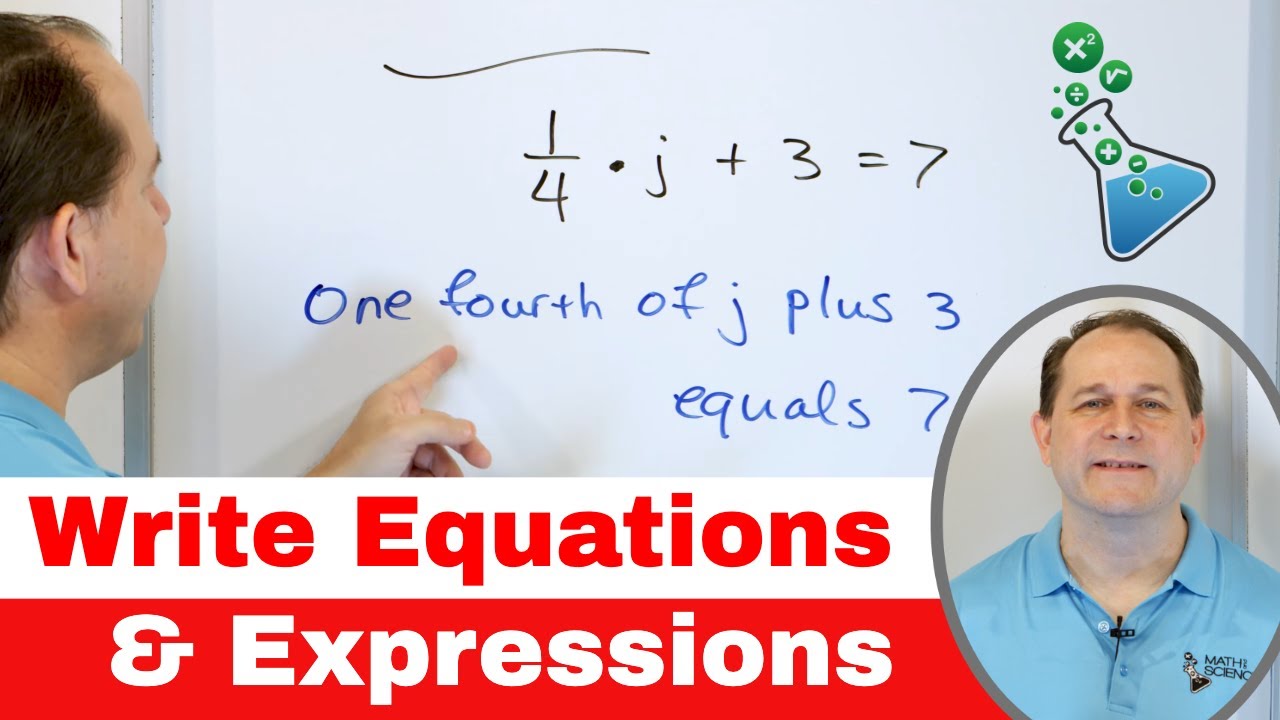
In this lesson, you will learn how to write algebraic expressions and equations in math. We will learn to read a sentence and translate it into a mathematical statement. An equation contains an equality or an equal sign, whereas an expression is a mathematical statement without an equal sign. By learning how to write equations and expressions...
fossil dawn
is it (-h)/(4+14), or (-h/4) + 14?
tropic oxide
runic swallow
In the vid the guy did math to english
in that case:
"the difference between 14 and the quotient of h and 4"
or "the difference between 14 and a quarter of h"
runic swallow
My math teacher is quite strict on the arrangement but she didnt give much examples so i tried finding a vid online 🙃
runic swallow
tropic oxide
in that case:
"the difference between 14 and the quotient of h and 4"
or "the di...
Ah i see, that makes more sense
I think thats all, thanksies
.close
cedar kilnBOT
Channel closed
Closed by @runic swallow
Use .reopen if this was a mistake.
Available help channel!
Send your question here to claim the channel.
Remember:
• Ask your math question in a clear, concise manner.
• Show your work, and if possible, explain where you are stuck.
• After 15 minutes, feel free to ping <@&286206848099549185>.
• Type the command .close to free the channel when you're done.
• Be polite and have a nice day!
Read #❓how-to-get-help for further information on how to ask a good question, and about conduct in the question channels.
lunar spade
Find the minimum value of the function $f(x) = 8^x + 1/8^x -4(4^x + 1/4^x)$ for all x in [R]
cedar kilnBOT
lunar spade
Find the minimum value of the function $f(x) = 8^x + 1/8^x -4(4^x + 1/4^x)$ for ...
wraith daggerBOT
Prathamesh

 dusky panther
can't you do derivatives?
lunar spade
yes
modern estuary
You can also express f in terms of t + 1/t, where t =2^x
lunar spade
I tried substituting $2^x=t$ and then differentiated it.
wraith daggerBOT
Prathamesh
 slender ginkgo
[ t^3 + t^{-3} - 4(t^2 + t^{-2})]
wraith daggerBOT
k
 lunar spade
this is what i did
 modern estuary
You can also express f in terms of t + 1/t, where t =2^x
modern estuary
modern estuary
You can also express f in terms of t + 1/t, where t =2^x
If you let s = t+1/t, you can write t^3+1/t^3 -4(t^2+1/t^2) = s^3-7s^2 - 3s +14
Minimising the cubic is easy, and then you can solve for t then x
lunar spade
modern estuary
If you let s = t+1/t, you can write t^3+1/t^3 -4(t^2+1/t^2) = s^3-7s^2 - 3s +14
yea and then I can easliy differentiate it. But after I differentiate it and find out the minimum value for s, do i have to put it in s= t+ 1/t?
modern estuary
Yes
wraith daggerBOT
Prathamesh
 lunar spade
wraith dagger
**Prathamesh**
lunar spade
wraith dagger
**Prathamesh**
but the answer of this question is -10. and when i put s= 3 in this equation i get -10.
modern estuary
Oh, they want the minimum value of the function
lunar spade
yes
modern estuary
Not the x for which the minimum achieved
lunar spade
yea
modern estuary
lunar spade
minima of this equation is at s= 3
So you are done here
cedar kilnBOT
Channel closed
Closed by @lunar spade
Use .reopen if this was a mistake.
cedar kilnBOT
Available help channel!
Send your question here to claim the channel.
Remember:
• Ask your math question in a clear, concise manner.
• Show your work, and if possible, explain where you are stuck.
• After 15 minutes, feel free to ping <@&286206848099549185>.
• Type the command .close to free the channel when you're done.
• Be polite and have a nice day!
Read #❓how-to-get-help for further information on how to ask a good question, and about conduct in the question channels.
torn marsh
Did I do this integration wrong
 cedar kilnBOT
torn marsh
Did I do this integration wrong
fossil dawn
cedar kilnBOT
torn marsh
Did I do this integration wrong
fossil dawn
only the x has the -1 power, but you brought the 4 along with it to the denom
 cedar kilnBOT
Channel closed
Closed by @torn marsh
Use .reopen if this was a mistake.
cedar kilnBOT
Available help channel!
Send your question here to claim the channel.
Remember:
• Ask your math question in a clear, concise manner.
• Show your work, and if possible, explain where you are stuck.
• After 15 minutes, feel free to ping <@&286206848099549185>.
• Type the command .close to free the channel when you're done.
• Be polite and have a nice day!
Read #❓how-to-get-help for further information on how to ask a good question, and about conduct in the question channels.
 limber shard
Does anyone know how I can approach this?
For fixed $n \in \mathbb{N}$, let $Y_{1}, \ldots, Y_{n}$ be independent random variables such that $Y_{i} \sim X_{i}^{2}$ for $i \in{1, \ldots, n}$. Prove that:
$$
\sum_{i=1}^{n} Y_{i} \sim X_{n(n+1) / 2}^{2}
$$
cedar kilnBOT
limber shard
Does anyone know how I can approach this?
For fixed $n \in \mathbb{N}$, let $Y_{...
wraith daggerBOT
stormcloud
 cedar kilnBOT
@limber shard Has your question been resolved?
 royal finch
Maybe I am just misreading something, but that looks like you are trying to prove that the sum of chi-squared random variables is again chi-squared or something else entirely, but you are missing words and that statement just makes no sense as written to me.
limber shard
hmm I think it's a valid problem statement
royal finch
I disagree because if you take n = 2, you are asking to prove that Y_1 + Y_2 has the same distribution as X_3^2. What is X_3? You never define the distribution of X_i and you don't even have that Y_3 = X_3^2 because the Y_i's are only defined up to n = 2.
limber shard
X_i is chi-squared
royal finch
This really wasn't a valid problem statement if you don't explain that your X_i^2 are chi-squared and use X's instead of chi's. But anyway this should be a straightforward exercise using MGFs.
cedar kilnBOT
@limber shard Has your question been resolved?
cedar kilnBOT
Channel closed
Closed due to timeout
Use .reopen if this was a mistake.
cedar kilnBOT
Available help channel!
Send your question here to claim the channel.
Remember:
• Ask your math question in a clear, concise manner.
• Show your work, and if possible, explain where you are stuck.
• After 15 minutes, feel free to ping <@&286206848099549185>.
• Type the command .close to free the channel when you're done.
• Be polite and have a nice day!
Read #❓how-to-get-help for further information on how to ask a good question, and about conduct in the question channels.
 spark mist
Determine the positive integers a, b that satisfy
b² | a³
b-1 | a-1
spark mist
i only get case where a = b^(x+1)-b^(x)+b
for all x interger except 0
x < -1 wont work except b = 1
i havent check case where x = 0
cinder shard
ok i dont do these problems often but ill just scribble on some paper and report back
spark mist
spark mist
for all x interger except 0
for this case i get b = 2 and 3 and a = 2b
we can let a = bn-n+1 from a=1 mod b-1
then (bn-n+1)^3 = 0 mod b^2
then we will get ((n-1)^2)(3bn-n+1) = 0 mod b^2
from here we get n-1 = b^x for any x
cinder shard
yeah im not sure mate, ill wait & see if anyone else can help
ill try but im not practised with these problems, if i do solve ill come back
spark mist
3b(n-1)+1 = 0 mod b^2 then n = ab-1/3b + 1 checking for divisibility we only get b = 1 here
.close
cedar kilnBOT
Channel closed
Closed by @spark mist
Use .reopen if this was a mistake.
cinder shard
Did you solve it?
spark mist
cinder shard
Did you solve it?
yeah
cedar kilnBOT
Available help channel!
Send your question here to claim the channel.
Remember:
• Ask your math question in a clear, concise manner.
• Show your work, and if possible, explain where you are stuck.
• After 15 minutes, feel free to ping <@&286206848099549185>.
• Type the command .close to free the channel when you're done.
• Be polite and have a nice day!
Read #❓how-to-get-help for further information on how to ask a good question, and about conduct in the question channels.
 native flax
I’m solving ixl questions for free
cedar kilnBOT
native flax
I’m solving ixl questions for free
native flax
🥱
austere hull
ixl?
dusky panther
why should I care? @native flax
 pastel vault
.close
cedar kilnBOT
Channel closed
Closed by @pastel vault
Use .reopen if this was a mistake.
pastel vault
native flax
I’m solving ixl questions for free
pls don't misuse the help channels
cedar kilnBOT
Available help channel!
Send your question here to claim the channel.
Remember:
• Ask your math question in a clear, concise manner.
• Show your work, and if possible, explain where you are stuck.
• After 15 minutes, feel free to ping <@&286206848099549185>.
• Type the command .close to free the channel when you're done.
• Be polite and have a nice day!
Read #❓how-to-get-help for further information on how to ask a good question, and about conduct in the question channels.
stoic crystal
 cedar kilnBOT
stoic crystal
stoic crystal
cedar kilnBOT
stoic crystal
stoic crystal
how to prove it?
stoic crystal
is it possible to do a direct proof by simplifying rhs until we get to lhs?
 void sand
idts?
idle tusk
stoic crystal
is it possible to do a direct proof by simplifying rhs until we get to lhs?
what kind of simplification do you suggest?
void sand
maybe it's possible by some trick I haven't thought of, but double inclusion is very standard here
I doubt there's any simplification you can do though
idle tusk
idle tusk
what kind of simplification do you suggest?
it seems like the only thing you can do here is the very thing you are trying to prove
void sand
you should become familiar with double inclusion as a proof technique for set equality
simplifying entire sets to turn them into each other quickly becomes impossible as the sets become more complex
tropic oxide
void sand
you should become familiar with double inclusion as a proof technique for set eq...
well he's posted like 30 problems involving it one way or the other over this week
void sand
I've noticed
he's gotta nail it down though
or else there'll be issues down the line 
idle tusk
with enough time and effort...
tropic oxide
tropic oxide
well he's posted like 30 problems involving it one way or the other over this we...
for legal reasons this is not intended as defamation of character
stoic crystal
guys can someone give me a hint of how to start with the left inclusion
I always struggle with the double inclusion proofs
stoic crystal
,, (A \cup B) \cross C \subseteq (A \cross C) \cup (B \cross C)
wraith daggerBOT
Renato
 stoic crystal
idle tusk
you take some arbitary x from the lhs set right
stoic crystal
idle tusk
you take some arbitary x from the lhs set right
take (x,y) in (AuB)xC, then I need to prove that its in either (AxC) or (BxC)
idle tusk
stoic crystal
take (x,y) in (AuB)xC, then I need to prove that its in either (AxC) or (BxC)
yes
stoic crystal
stoic crystal
take (x,y) in (AuB)xC, then I need to prove that its in either (AxC) or (BxC)
@idle tusk
or both?
both aswell
?
stoic crystal
the union includes both
stoic crystal
(AxC) n (BxC) subseteq (AxC) U (BxC)
stoic crystal
idle tusk
okay you need to prove that its in (AxC) or (BxC)
how?
stoic crystal
take $(x,y) \in (A \cup B) \times C$
wraith daggerBOT
Renato
 idle tusk
don't write out full solutions
idle tusk
all good, i was just trying to guide Renato step-by-step
paper edge
 snow lake
Can you explain why?
snow lake
Can you explain why?
We want the guy to reach the conclusion by himself
snow lake
Ah my badddd
idle tusk
stoic crystal
take $(x,y) \in (A \cup B) \times C$
now, what do you know about y?
cerulean sail
snow lake
Can you explain why?
Server philosophy is that things are learned better by guiding people to get to solutions themselves, rather than giving out the solution in full 
paper edge
The purpose of this is more-so to give him hints so he can get there
stoic crystal
how is y in C and x in AuB?
idle tusk
stoic crystal
how is y in C and x in AuB?
wdym "how"
snow lake
I deleted it 🫡
paper edge
stoic crystal
how is y in C and x in AuB?
Definition of Cartesian product
idle tusk
stoic crystal
how is y in C and x in AuB?
it's pretty much by definition
stoic crystal
lets revise the definition of cartesian product

take $(x,y) \in (A \cup B) \times C$ then $x \in (A \cup B)$ and $y \in C$
wraith daggerBOT
Renato
 stoic crystal
how to prove (x,y) is in (AxC) U (BxC)
cerulean sail
Keep cooking  if x is in the union of A and B, then...?
stoic crystal
if $x \in (A \cup B)$ then $x \in A$ or $x \in B$
i dont think complement helps here
wraith daggerBOT
Renato
 idle tusk
yes!!!
stoic crystal
take $(x,y) \in (A \cup B) \times C\$ then $x \in (A \cup B)$ and $y \in C\$ if $x \in (A \cup B)$ then $x \in A$ or $x \in B$
wraith daggerBOT
Renato
 idle tusk
all good so far
paper edge
Also, in case it helps you, you can also think of the union as the smallest set containing both A and B
And the intersection as the biggest contained in both A and B
Sometimes this can help with intuition
cerulean sail
(what happens if x is contained in A?)
stoic crystal
either (x in A and y in C) or (x in B and y in C)
cerulean sail
Those are true statements, what do those imply for (x, y) for each case?
stoic crystal
A x C := {(x,y) : x in A, y in C}
stoic crystal
stoic crystal
either (x in A and y in C) or (x in B and y in C)
either ((x,y) is in AxC) or ((x,y) is in BxC)
take $(x,y) \in (A \cup B) \times C\$ then $x \in (A \cup B)$ and $y \in C\$ if $x \in (A \cup B)$ then $x \in A$ or $x \in B\$
so theres two possibilities: $\(x \in A$ and $y \in C)$ or $(x \in B$ and $y \in C)\$ thus $(x,y) \in (A \cross C) \cup (B \cross C)$
wraith daggerBOT
Renato
 stoic crystal
I appreciate the help with the right inclusion, can I receive some help for the left inclusion?
idle tusk
it's almost an identical argument but in reverse
stoic crystal
$(A \cross C) \cup (B \cross C) \subseteq (A \cup B) \cross C \$ take $(x,y) \in (A \cross C) \cup (B \cross C)$ then $\ (x \in A$ and $y \in C)$ or $(x \in B$ and $y \in C)\$ which is equivalent to $(y \in C $ and $ x \in A \cup B)\$ which is exactly the definition of $\ (A \cup B) \cross C = {(x,y) \mid x \in (A \cup B), y \in C}$
wraith daggerBOT
Renato
 stoic crystal
i think that should be enough, no?
well, I didnt proved that one is the subset of the other
i just showed the equality holds
maybe im tripping . . .
.solved
cedar kilnBOT
Channel closed
Closed by @stoic crystal
Use .reopen if this was a mistake.
cedar kilnBOT
Available help channel!
Send your question here to claim the channel.
Remember:
• Ask your math question in a clear, concise manner.
• Show your work, and if possible, explain where you are stuck.
• After 15 minutes, feel free to ping <@&286206848099549185>.
• Type the command .close to free the channel when you're done.
• Be polite and have a nice day!
Read #❓how-to-get-help for further information on how to ask a good question, and about conduct in the question channels.
 fiery dew
 tropic oxide
!status
cedar kilnBOT
What step are you on?
1. I don't know where to begin.
2. I have begun but got stuck midway.
3. I got an answer but I was told that it's wrong.
4. I got an answer and would like my work checked.
5. I have a question about someone else's work/solution.
6. I have completed the problem and don't need help anymore. Thank you.
7. None of the above
1
 raven shard
 fiery dew
raven shard
fiery dew
raven shard
What is the purpose of adding the green line?
fiery dew
raven shard
What should I do from here?
raven shard
you can solve for all the new segments