#help-13
1 messages · Page 240 of 1
 tidal leaf
2x? i really don't know?
 crimson sedge
yeah
it is 2x
-2x + 2x = (-2+2)x = 0x = 0
that's the idea happening here
so adding 2x to both sides gets you what?
tidal leaf
0?
 wraith daggerBOT
 crimson sedge
that's what we are doing
like we said -2x + 2x = 0
sooo
[
3 - 2x = x \Iff 3 -2x \c b{+2x} = x \c b{+2x}\Iff 3 = x + 2x
]
wraith daggerBOT
 crimson sedge
so now, what is x + 2x?
tidal leaf
3x?
tidal leaf
i don't know, im sorry
crimson sedge
like
you got 3x
you wanna turn it into x
what do u do to achieve that
what operation transforms 3x to x
tidal leaf
subtracting by 3x?
crimson sedge
no that will get u 0
ok you would need to divide both sides by 3
3x/3 = x
right?
tidal leaf
yeah?
tidal leaf
x
crimson sedge
equals to?
tidal leaf
1?
tidal leaf
im sorry that took so long
crimson sedge
it's alright but take it as a wake up call that you should probably practice a lot more. Try giving Khan academy's videos about like-terms a watch
they'll help
crimson sedge
volleyball?
 cedar kilnBOT
Channel closed
Closed by @tidal leaf
Use .reopen if this was a mistake.
 Available help channel!
Send your question here to claim the channel.
Remember:
• Ask your math question in a clear, concise manner.
• Show your work, and if possible, explain where you are stuck.
• After 15 minutes, feel free to ping <@&286206848099549185>.
• Type the command .close to free the channel when you're done.
• Be polite and have a nice day!
Read #❓how-to-get-help for further information on how to ask a good question, and about conduct in the question channels.
 wind nexus
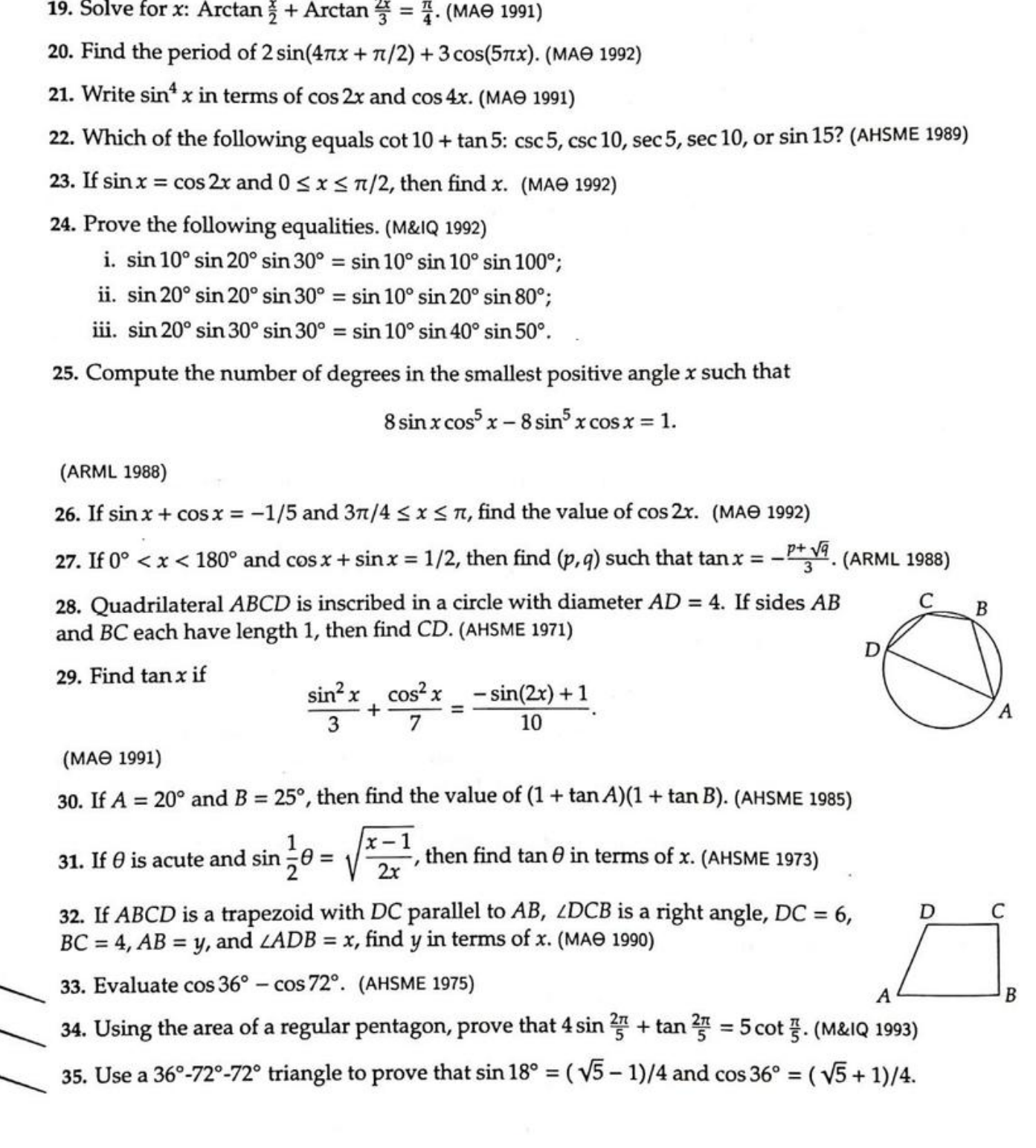
Hi, not sure if this is the right place to ask since I'm not asking about a particular question but more about how to self-study effectively. I just got back to math and I'm trying to work through AOPS v2 but on chapter 2 I'm running into back to back problems that stump me.
This is what the problems look like: https://i.imgur.com/fdq2dmc.png
I solved 14-21, 21 already took me a while.
For problems 22-25, I worked on them for a bit but basically gave up and skipped them without looking up an answer. I was hoping to get a better grasp of things then get back to them. But took a quick glance at 26 and I'm probably gonna have to skip that one as well... I'm starting to think if I keep going this way I'll skip through the whole book.
How do I balance struggling with a problem vs skipping it vs looking up help vs looking up the answer and trying to understand it fully? I don't want to "spoil" the answers for myself then lose the practice problem but I'm not getting any better at solving these problems out of thin air...
 cedar kilnBOT
wind nexus
Hi, not sure if this is the right place to ask since I'm not asking about a part...
cedar kilnBOT
wind nexus
Hi, not sure if this is the right place to ask since I'm not asking about a part...
 silent finch
This is also a problem I’ve been having, and I think the best way to deal with it is to really think about each problem and take your time
Because the solutions will usually use tools you already know, it’s just that you didn’t think of doing it a particular way
wind nexus
how much time do you give yourself per problem?
silent finch
If I face a hard problem I usually will skip it and think about it throughout the day
Like let’s try #26
What are you thinking of doing at first?
wraith daggerBOT
nchoosek
 silent finch
Yep that makes sense
Is there any way to simplify it though?
The cos^2 or sin^2 looks like it could be dealt with
To leave an expression in terms of only sin or cos
wind nexus
well it's also either $2cos^{2}(x) -1 or 1 - 2sin^{2}(x)$
wraith daggerBOT
nchoosek
 wind nexus
but they still have the ^2
silent finch
Yeah so that motivates us to solve for either sin or cos
Or sin^2 or cos^2
So how can we get squared terms with sin(x)+cos(x)=-1/5
wind nexus
$sin^{2}(x) = \frac{1}{25} + \frac{2cos(x)}{5} + cos^{2}(x)$
wraith daggerBOT
nchoosek
 wind nexus
well left side is equal to 1
and if we subtract that 1 from the left on the right we get 2cos^2(x) - 1 which is equal to cos(2x)
so -2cos(x)/5 - 1/25 is equal to cos(2x)
but I'm not sure if we're really any closer 😅
I also got 5cos2x = sin x - cos x
silent finch
You can solve for cos(x)
wind nexus
oh... right... algebra
instead of doing what I did and bringing in the unworkable cos(2x) xd
well it's either 7/25 or -7/25 but I can't figure out if it's positive or negative
I figured it was the negative one since 2x is in the fourth quadrant and we're looking for the cosine
but turns out it was the positive and tbh I still don't know why🤷♂️
oh my dumbass should have started thinking about the quadrants when getting the answer for what cos x is not after cos(2x) lol
welp this shit took me 40 minutes with hints and I still made a sign error in the end
D:
thanks for the help @silent finch
.close
cedar kilnBOT
Channel closed
Closed by @wind nexus
Use .reopen if this was a mistake.
cedar kilnBOT
Available help channel!
Send your question here to claim the channel.
Remember:
• Ask your math question in a clear, concise manner.
• Show your work, and if possible, explain where you are stuck.
• After 15 minutes, feel free to ping <@&286206848099549185>.
• Type the command .close to free the channel when you're done.
• Be polite and have a nice day!
Read #❓how-to-get-help for further information on how to ask a good question, and about conduct in the question channels.
 inner flax
 cedar kilnBOT
inner flax
cedar kilnBOT
inner flax
 raw gulch
very well, now introduce it as sum of three integrals
he noticed, that such a trick, like he did, helped him to in the secodn integral
inner flax
what was the trick??
inner flax
???
 lapis pollen
inner flax
what was the trick??
lapis pollen
inner flax
what was the trick??
he broke up the 3 from 3 + 2x^2 into 2 + 1
oops
my bad
didn't mean to reply to that
but
anyways
inner flax
all good
lapis pollen
he broke up 3 + 2x^2 as 2 + 1 to get 1 + 2 + 2x^2
he then grouped 2+2x^2 and factored out the 2
to get 1 + 2(1+x^2)
raw gulch
$\int_{0}^{1}\frac{dx}{x^{2}+1}+\int_{0}^{1}2dx+\int_{0}^{1}cos\frac{\pi\text{}x}{2}dx$
wraith daggerBOT
Joanna Angel
 raw gulch
can you see it now ?
MIDDLE
INTEGRAL
IS
SUEPR EASY
yoru professor knew it
and used his triock
to achieve it
trick = method = noticement
lapis pollen
ohhh I get it now
I see the trick
once he got 1 + 2(x^2 + 1), he broke up the first fraction into two, to get:
(1/(x^2 + 1)) + (2(x^2 + 1)/(x^2 + 1)
and the x^2 + 1 cancelled out
 humble karma
It's really just a clever way to rewrite the numerator, but in general, whenever you have the same degree polynomial on the numerator/denominator, you can do something similar (or long division, you'd get the same).
inner flax
Im still lost
inner flax
lapis pollen
once he got 1 + 2(x^2 + 1), he broke up the first fraction into two, to get:
(1...
I understood that part
im saying how he got the numerator of the first fraction into the second
humble karma
Do you agree that they are the same numerator but just rewritten in a different way?
inner flax
I see it
lapis pollen
lapis pollen
he broke up 3 + 2x^2 as 2 + 1 to get 1 + 2 + 2x^2
ye its this
cedar kilnBOT
Channel closed
Closed by @inner flax
Use .reopen if this was a mistake.
cedar kilnBOT
Available help channel!
Send your question here to claim the channel.
Remember:
• Ask your math question in a clear, concise manner.
• Show your work, and if possible, explain where you are stuck.
• After 15 minutes, feel free to ping <@&286206848099549185>.
• Type the command .close to free the channel when you're done.
• Be polite and have a nice day!
Read #❓how-to-get-help for further information on how to ask a good question, and about conduct in the question channels.
 jovial eagle
what does | mean? given a function f(x) and 3 coordinate points

 wanton sail
jovial eagle
what does ``|`` mean? given a function f(x) and 3 coordinate points
wanton sail
jovial eagle
what does ``|`` mean? given a function f(x) and 3 coordinate points
can you give an example of where you saw this?
jovial eagle
wanton sail
can you give an example of where you saw this?
so given function f(x) and 3 points with the condition and these points create a right triangle, so i need to determine u so that the area of that triangle is max
 wanton sail
It's probably just meant to be a comma
jovial eagle
im not asking for a hint right now, im trying to understand what the symbol means
wanton sail
(0, 0) (u, 0) (u, f(u))
So that the x-coordinate of the first point is 0 and the y-coordinate of the first point is 0
And then the x-coordinate of the second point is u and the y-coordinate of the second point is 0
And so on
cedar kilnBOT
Channel closed
Closed by @jovial eagle
Use .reopen if this was a mistake.
Available help channel!
Send your question here to claim the channel.
Remember:
• Ask your math question in a clear, concise manner.
• Show your work, and if possible, explain where you are stuck.
• After 15 minutes, feel free to ping <@&286206848099549185>.
• Type the command .close to free the channel when you're done.
• Be polite and have a nice day!
Read #❓how-to-get-help for further information on how to ask a good question, and about conduct in the question channels.
 hoary wedge
not rlly a math question more physics but why do larger wavelengths diffract more than smaller wavelengths?
cedar kilnBOT
hoary wedge
not rlly a math question more physics but why do larger wavelengths diffract mor...
hoary wedge
also can somebody check if my reasoning for why smaller openings diffract more than larger openings:
Waves passing through a smaller opening will diffract more than larger openings because the margin to pass through is much smaller, forcing the waves to fit through.
 dire geode
hoary wedge
not rlly a math question more physics but why do larger wavelengths diffract mor...
dire geode
hoary wedge
not rlly a math question more physics but why do larger wavelengths diffract mor...
#old-network for physics server
hoary wedge
dire geode
<#406129911992942593> for physics server
that server is so dead
im sorry
ive asked like 5 questions there and have only been responded to once
dire geode
hoary wedge
im sorry
Doesn't mean you should occupy a math help channel
hoary wedge
.close
cedar kilnBOT
Channel closed
Closed by @hoary wedge
Use .reopen if this was a mistake.
dire geode
hoary wedge
seen so many ppl do this and i get called out 4 it
I call out plenty
wanton sail
Physics Qs are okay if they're primarily mathematics; this question isn't mathematical at all though
cedar kilnBOT
Available help channel!
Send your question here to claim the channel.
Remember:
• Ask your math question in a clear, concise manner.
• Show your work, and if possible, explain where you are stuck.
• After 15 minutes, feel free to ping <@&286206848099549185>.
• Type the command .close to free the channel when you're done.
• Be polite and have a nice day!
Read #❓how-to-get-help for further information on how to ask a good question, and about conduct in the question channels.
 versed fulcrum
Hello
cedar kilnBOT
versed fulcrum
Hello
versed fulcrum
I sort of don't understand the concept of dot product and cross product
People explain it's to show how long the two vectors are for dot product
But isn't that basically vector subtraction?

 flint plinth
loosely speaking, the dot product is measuing how much "shadow" a casts on b, or vice versa
versed fulcrum
 versed fulcrum
flint plinth
loosely speaking, the dot product is measuing how much "shadow" a casts on b, or...
versed fulcrum
flint plinth
loosely speaking, the dot product is measuing how much "shadow" a casts on b, or...
The distance of the gray dotted line here?
flint plinth
what does the grey dotted line signify, it's not connected to the tip of the blue vector, what is it connected to?
versed fulcrum
Or the distance between the origin and where the gray dotted line intersects with blue vector
versed fulcrum
flint plinth
what does the grey dotted line signify, it's not connected to the tip of the blu...
The dot product?
flint plinth
if it's meant to be at a right angle to the blue vector, then it's related to the dot product but isn't the dot product
flint plinth
if we call the pink vector a and the blue vector b, then the grey vector would be something like
a - (a dot b)b/norm(b)
where the second term is the projection of a onto b
crimson sedge
versed fulcrum
Or the distance between the origin and where the gray dotted line intersects wit...
Rather that, yes. But it then has to be multiplied by the length of the blue vector
 mighty shuttle
essentially the dot product is the projection of one vector onto another
versed fulcrum
I never understood what projection meant
crimson sedge
@versed fulcrum You know, if what you're looking for is intuition then you might be interested in 3blue1brown's linear algebra series
mighty shuttle
versed fulcrum
I never understood what projection meant
 versed fulcrum
What's the difference between projection and dot product?
versed fulcrum
mighty shuttle
Oh this make sense
versed fulcrum
versed fulcrum
What's the difference between projection and dot product?
But my question still holds
versed fulcrum
mighty shuttle
So this explains why dot products are scalar
mighty shuttle
the projection is a*b/|b| unless I'm mistaken
versed fulcrum
icic
mighty shuttle
where * is the dot product
versed fulcrum
•
mighty shuttle
yeah sorry, didn't know how to type that
crimson sedge
@versed fulcrum I don't know whether you're interested in video form math but here is link to the video series:
https://www.youtube.com/watch?v=kjBOesZCoqc&list=PL0-GT3co4r2y2YErbmuJw2L5tW4Ew2O5B

Home page: https://www.3blue1brown.com/
This introduces the "Essence of linear algebra" series, aimed at animating the geometric intuitions underlying many of the topics taught in a standard linear algebra course.
Error corrections:
- At one point I mistakenly allude to calculators using the Taylor expansion of sine for its computations, when i...
mighty shuttle
versed fulcrum
What about cross product?
that gives an output vector perpendicular to the other two
versed fulcrum
Thank you
versed fulcrum
mighty shuttle
that gives an output vector perpendicular to the other two
How long tho
versed fulcrum
mighty shuttle
that gives an output vector perpendicular to the other two
Oh that's why there are terms like into the page and out of the page
mighty shuttle
versed fulcrum
How long tho
magnitude of $|a||b| sin(\theta)$
wraith daggerBOT
Why am. I here
 versed fulcrum
mighty shuttle
magnitude of $|a||b| sin(\theta)$
versed fulcrum
mighty shuttle
magnitude of $|a||b| sin(\theta)$
This plus direction?
mighty shuttle
where $\theta$ is the angle between vectors a and b
wraith daggerBOT
Why am. I here
 mighty shuttle
versed fulcrum
This plus direction?
mighty shuttle
versed fulcrum
This plus direction?
this is just the magnitude so it's always positive
or 0
mighty shuttle
versed fulcrum
How do you know whether it goes into the page or out of the page?
the right hand rule
 mighty shuttle

In mathematics and physics, the right-hand rule is a convention and a mnemonic for deciding the orientation of axes in three-dimensional space. It is a convenient method for determining the direction of the cross product of two vectors.
There are two ways of applying the right hand rule. The first one is conventionally called the Right hand rule...
versed fulcrum
Oh okay
mighty shuttle
versed fulcrum
Depending on the perspective
we use the right handed coordinate system by convention
versed fulcrum
What does eigenvalues do
mighty shuttle
out of and into the page depends on perspective, yes
versed fulcrum
mighty shuttle
we use the right handed coordinate system by convention
Gotcha
mighty shuttle
versed fulcrum
What does eigenvalues do
I haven't studied that yet, so I can't help, sorry
cedar kilnBOT
Channel closed
Closed by @versed fulcrum
Use .reopen if this was a mistake.
Available help channel!
Send your question here to claim the channel.
Remember:
• Ask your math question in a clear, concise manner.
• Show your work, and if possible, explain where you are stuck.
• After 15 minutes, feel free to ping <@&286206848099549185>.
• Type the command .close to free the channel when you're done.
• Be polite and have a nice day!
Read #❓how-to-get-help for further information on how to ask a good question, and about conduct in the question channels.
 sharp kestrel
 cedar kilnBOT
sharp kestrel
sharp kestrel
cedar kilnBOT
sharp kestrel
sharp kestrel
Is this correct?
 dire thorn
Show work
sharp kestrel
1/2pi(2)^2
dire thorn
Is that it?
dire thorn
Hate to break it to you but 1/2pi(2)^2 does not equal 1/16pi
So that makes no sense
!noans
cedar kilnBOT
The purpose of this server is to help you learn, not to hand out answers. Do not ask someone to give you the answer directly.
dire thorn
Show an actual attempt
sharp kestrel
.close
cedar kilnBOT
Channel closed
Closed by @sharp kestrel
Use .reopen if this was a mistake.
dire thorn
Rip
cedar kilnBOT
Available help channel!
Send your question here to claim the channel.
Remember:
• Ask your math question in a clear, concise manner.
• Show your work, and if possible, explain where you are stuck.
• After 15 minutes, feel free to ping <@&286206848099549185>.
• Type the command .close to free the channel when you're done.
• Be polite and have a nice day!
Read #❓how-to-get-help for further information on how to ask a good question, and about conduct in the question channels.
 turbid prism
what did I do wrong
 cedar kilnBOT
turbid prism
what did I do wrong
cedar kilnBOT
turbid prism
what did I do wrong
 warped coyote
turbid prism
what did I do wrong
warped coyote
turbid prism
what did I do wrong
Maximum at x=0 is not met
 cedar kilnBOT
Channel closed
Closed by @turbid prism
Use .reopen if this was a mistake.
Available help channel!
Send your question here to claim the channel.
Remember:
• Ask your math question in a clear, concise manner.
• Show your work, and if possible, explain where you are stuck.
• After 15 minutes, feel free to ping <@&286206848099549185>.
• Type the command .close to free the channel when you're done.
• Be polite and have a nice day!
Read #❓how-to-get-help for further information on how to ask a good question, and about conduct in the question channels.
 solemn bronze
A wheel with a radius of 14 inches rotates at a speed of 0.2 radians/seconds. What is the linear speed, v?
cedar kilnBOT
solemn bronze
A wheel with a radius of 14 inches rotates at a speed of 0.2 radians/seconds. Wh...
cedar kilnBOT
What step are you on?
1. I don't know where to begin.
2. I have begun but got stuck midway.
3. I got an answer but I was told that it's wrong.
4. I got an answer and would like my work checked.
5. I have a question about someone else's work/solution.
6. I have completed the problem and don't need help anymore. Thank you.
7. None of the above
btw, "A wheel of 14 inches" is ambiguous, does that mean radius or diameter or something else?
solemn bronze
oops its the radius sorry
im assuming the linear speed would be 0.2 rad/sec
but im not sure
 tropic oxide
no,
if it's in radians per second, it's an angular speed.
do you know the relationship between angular speed and linear speed?
solemn bronze
they are related in that v=r(angular speed)?
tropic oxide
yes
solemn bronze
and angular speed=v/r
tropic oxide
$v = r \omega$ is how that's usually phrased.
wraith daggerBOT
Ann
 tropic oxide
anyway you yourself just stated the formula you need.
solemn bronze
but how would i find the angular speed without knowing the linear speed
tropic oxide
you have it backwards
you know the angular speed (omega)
you want the linear speed (v)
solemn bronze
so the angular speed would be 0.2 rad/sec?
so angular speed is always in radian per second?
tropic oxide
not always
angular speed is <angle unit> per <time unit>
one commonish one is RPM, which stands for revolutions per minute
tropic oxide
units!
solemn bronze
2.8 rad/sec?
tropic oxide
wrong units.
linear speed isn't measured in radians per second.
what units was your radius given in?
tropic oxide
yes.
cedar kilnBOT
@solemn bronze Has your question been resolved?
cedar kilnBOT
Channel closed
Closed due to timeout
Use .reopen if this was a mistake.
cedar kilnBOT
Available help channel!
Send your question here to claim the channel.
Remember:
• Ask your math question in a clear, concise manner.
• Show your work, and if possible, explain where you are stuck.
• After 15 minutes, feel free to ping <@&286206848099549185>.
• Type the command .close to free the channel when you're done.
• Be polite and have a nice day!
Read #❓how-to-get-help for further information on how to ask a good question, and about conduct in the question channels.
 smoky prairie
hey guyss, i need help
 cedar kilnBOT
smoky prairie
hey guyss, i need help
smoky prairie
cedar kilnBOT
smoky prairie
hey guyss, i need help
smoky prairie
how do i factor this if i dont have anything that can add up to -2, while having a product of 2 at the same time?
 candid mason
smoky prairie
how do i factor this if i dont have anything that can add up to -2, while having...
candid mason
smoky prairie
how do i factor this if i dont have anything that can add up to -2, while having...
??? There are no conditions for factoring. Remember a(b+c) = ab + ac.
For your case end up with fractional coefficients for x and a fractional constant term
smoky prairie
so how would i end up with a fraction?
candid mason
So what is -2 /12 * 12
smoky prairie
-24/12 or -2
candid mason
-2. Basically anytime you have a/b * b that is just equal to a. A fraction is an expression of division and division is the opposite of multiplication. So basically the /b * b cancel each other out.
Now you have 12 out. You need to find the value of c such that. 12(cx) = -2x. The solution to this is just c = -2/12
smoky prairie
candid mason
Now you have 12 out. You need to find the value of c such that. 12(cx) = -2x. Th...
im a bit lost
where will i use -2/12
candid mason
So you need to find the values of c1 and c2 such that 12(x^2 +c1 * x + c2) = 12x^2 - 2x + 2
smoky prairie
yup so how do i get c1 and c2?
smoky prairie
candid mason
So you need to find the values of c1 and c2 such that 12(x^2 +c1 * x + c2) = 12x...
i use -2/12 there?
i clueless
candid mason
smoky prairie
yup so how do i get c1 and c2?
You are using a(b+c) = ab + ac. This distributive law. What you want to do is equate the coefficients.
candid mason
Suppose we cx + b = 2x + 9. What are the values of c and b
smoky prairie
2 AND 9
smoky prairie
candid mason
So you need to find the values of c1 and c2 such that 12(x^2 +c1 * x + c2) = 12x...
i'd jst get 12(x^2-2+2)
candid mason
smoky prairie
i'd jst get 12(x^2-2+2)
Expand something is basically rwmoving the brackets if you a(b+c) if you expand that you will get ab+ ac.
So how do you expand 12(x^2 +c1 * x + c2)
smoky prairie
candid mason
So how do you expand 12(x^2 +c1 * x + c2)
12x^2+12x+12
candid mason
Yes but you have remove the c1 and c2 for some reason.
12x^2 +12 * c1 * x + 12 * c2
Since 12x^2 +12 * c1 * x + 12 * c2 = 12x^2 - 2x + 2
From there you equate the coefficients
And that will be the answer to your question
I have to go unfortunately
Bye
cedar kilnBOT
@smoky prairie Has your question been resolved?
Channel closed
Closed by @smoky prairie
Use .reopen if this was a mistake.
cedar kilnBOT
Available help channel!
Send your question here to claim the channel.
Remember:
• Ask your math question in a clear, concise manner.
• Show your work, and if possible, explain where you are stuck.
• After 15 minutes, feel free to ping <@&286206848099549185>.
• Type the command .close to free the channel when you're done.
• Be polite and have a nice day!
Read #❓how-to-get-help for further information on how to ask a good question, and about conduct in the question channels.
 crimson hornet
Would anyone be able to help me figure out how to solve this?
 mighty shuttle
can you find the electric field between the two plates?
hint:- It's a parallel plate capacitor
crimson hornet
Would it be E = V/d
mighty shuttle
yes
crimson hornet
Oh ok so I would probably be using Fe = Fg?
mighty shuttle
correct
crimson hornet
Oh okay thanks I’ll try it from that
@mighty shuttle if you don’t mind, could I ask you another question?
mighty shuttle
crimson hornet
<@796939110815629322> if you don’t mind, could I ask you another question?
sure
 mighty shuttle
think about how you would achive this
btw
are you cheating on a test, no right?
crimson hornet
Nah this is just homework questions
mighty shuttle
hint:- ||qvb=qE||
crimson hornet
I’m just kind of confused on how I would find the direction of the magnetic field
mighty shuttle
it would be perpenddcular to the elctric field
crimson hornet
Cause I know that the electric field is up so would it just be down?
Oh okay, how would I know on what direction it is perpendicular?
mighty shuttle
find it using the right hand rule
think about the direction of the force due to the electric field
and hence in what direction must the force due to the magnetic field act
ok, gtg . ATB
cedar kilnBOT
Channel closed
Closed by @crimson hornet
Use .reopen if this was a mistake.
Available help channel!
Send your question here to claim the channel.
Remember:
• Ask your math question in a clear, concise manner.
• Show your work, and if possible, explain where you are stuck.
• After 15 minutes, feel free to ping <@&286206848099549185>.
• Type the command .close to free the channel when you're done.
• Be polite and have a nice day!
Read #❓how-to-get-help for further information on how to ask a good question, and about conduct in the question channels.
 half elk
Hi
cedar kilnBOT
half elk
Hi
half elk
So I was reading this paper, can you explain why off-diagonal values are 0

I am not sure if I had it right, so please point out if there's any mistakes
 proud torrent
it shouldn't be hard to see why that element is zero if you just look at it
 cedar kilnBOT
@half elk Has your question been resolved?
half elk
proud torrent
it shouldn't be hard to see why that element is zero if you just look at it
But can't it be a band matrix?
proud torrent
diagonal matrices are banded
half elk
I mean, for a 1<i<m and 1<j<n=m and i ≠ j J_w(i, j) being non zero
proud torrent
proud torrent
it shouldn't be hard to see why that element is zero if you just look at it
if you write down what element on the position (2,3) looks like you'll quickly see it's zero just like this one
and same thing applies to any other element on position (i,j) with i != j
 cedar kilnBOT
Channel closed
Closed by @half elk
Use .reopen if this was a mistake.
Available help channel!
Send your question here to claim the channel.
Remember:
• Ask your math question in a clear, concise manner.
• Show your work, and if possible, explain where you are stuck.
• After 15 minutes, feel free to ping <@&286206848099549185>.
• Type the command .close to free the channel when you're done.
• Be polite and have a nice day!
Read #❓how-to-get-help for further information on how to ask a good question, and about conduct in the question channels.
 craggy stratus
Quick question on formality
cedar kilnBOT
craggy stratus
Quick question on formality
craggy stratus
When I'm doing partial fraction decomposition (?), should I still use the integrate symbol?

As in in the A/(x-1) + B/(x+1) step, should there be a integral symbol and a dx there too?
 dapper sail
bro idk much about integration im only 14
but i think you dont need to
you're comparing both sides to find value of A and B right
craggy stratus
dapper sail
you're comparing both sides to find value of A and B right
bro im kind of a wing-it math guy so im not entirely sure what im doing
but yes i believe that is the case
like we have 1/(x-1)(x+1)
and we want to find out what the coefficients are for each fraction(?) in order to get the nominator
each parenthesis
dapper sail
yes right
 distant jacinth
Yeah, without the integral symbol, the equality is not correct.
The two sides are not equal.
 dapper sail
ahh like that
 nova snow
yes remove the integral symbol and it will be correct
dapper sail
what if you remove the integral and dx from the left side
distant jacinth
That's fine.
craggy stratus
@nova snow so remove the integral symbol on the left?
nova snow
You don’t have to
but it will still be correct
or if you want to keep it
You have to put the Partial fractions as an integrand
craggy stratus
im sorry mate im a swede so english isn't my native language and when it comes to math it's chaos to try and understand the english terms
integrand?
nova snow
1/(x-1)(x+1) = A/(x-1) + B/(x+1) is how I would do it
dapper sail
nova snow
1/(x-1)(x+1) = A/(x-1) + B/(x+1) is how I would do it
yeah
or you can just do (x+1) - (x-1) in numerator
and then divide the whole thing by 2
craggy stratus
nova snow
1/(x-1)(x+1) = A/(x-1) + B/(x+1) is how I would do it
so remove the integralsymbol and the dx then?
dapper sail
precisely
nova snow
craggy stratus
integrand?
Integrand is the stuff inside the integral, for example
the integral of f(x) dx
the stuff between the integral sign and the dx
is the integrand
craggy stratus

does this look correct then?
sorry for the occasionally small writing q.q
Is it "ok" to start writing downwards if its a continuation of the same step?
ah so either I need to not have the integral sign at all for that step, or I need to have it for both of them?
distant jacinth
You can write downwards, as long as it is clear where you are continuing from.
And yes, this equality is wrong:
 craggy stratus
so in this case it's ok?
 nova snow
I wouldn’t use an equal sign there to write your PFD stuff
craggy stratus
like this?
craggy stratus
i have so much issues with when to use equal vs implication vs equivalency signs :((
so after the 1/x^2-1 dx just write PFD: and then continue doing that?
distant jacinth
Ah, the English word is "implication".
nova snow
craggy stratus
so after the 1/x^2-1 dx just write PFD: and then continue doing that?
Yes that’s one way
craggy stratus
 distant jacinth
And no, an implication can only be used between statements. The integral itself is not a statement.
distant jacinth
That's biimplications (or equivalences, yes).
craggy stratus
which is stupid because that's literally the direct translation
well that makes more sense
last question then
when should I use
=
vs
=>
vs
<=>
?
 nova snow
craggy stratus
nova snow
craggy stratus
If and only if
craggy stratus
Because as you can see our professors use the biimplications here and last time I tried to do it during a test (which the logic that you use them if you can go from equation A to equation B)
this is what happened:

don't remember the exact question but it was smth like prove that ln(a^b) is the same as b*ln(a)
and then the b part was some graphing stuff
distant jacinth
You can only use => or <=> between statements. A statement is something that is true or false.
 nova snow
craggy stratus
nova snow
craggy stratus
Don’t use the symbol “if and only if” when what you really mean to say is equals “=“
craggy stratus
but isn't that what they're doing here
distant jacinth
What you did wrong was to put <=> between log(8^x) and something else, because "log(8^x)" is not a statement. It has no truth value.
craggy stratus
if it's the way that you say it is then it makes a lot more sense for me
yes but for me you can go from log(8^x) to xlog8 and you can go from xlog8 to log(8^x)
but isn't that what's happening in the image I sent above?
they say 5x+4 = A(x+2)^2 + B(x-1)(x+2) + C(x-1)
distant jacinth
craggy stratus
This is fine, because the top is an equation, which is a statement. It is either true or false. That statement is equivalent to the next line and so on.
 craggy stratus
so how should I have expressed it in order for it to make sense?
2log8^x = 3
<=> x2log8 = 3?
distant jacinth
craggy stratus
yes but for me you can go from log(8^x) to xlog8 and you can go from xlog8 to lo...
Yeah, and log(8^x) is equal to xlog(8), so here you can use log(8^x) = xlog(8), because they are the same thing.
distant jacinth
craggy stratus
<=> x2log8 = 3?
Yes, this is ok.
craggy stratus
ok so the dumb way to explain it to me then is
i should only use <=> or => with an equation afterwards?
that has a = in it?
so it becomes a statement?
distant jacinth
Yeah, sort of. That is a good rule of thumb anyway.
The reason why I said "statement" instead of "equation" is that you can have <=> and => between all kinds of things, as long as they are statements. Another example is inequalities.
Like
x + 5 < 7
<=> x < 2
craggy stratus
makes sense
i'll try to remember and use that in the future and hopefully I won't end up with tons of questionmarks followed by "what?" written out on my papers XD
distant jacinth
Yeah, you can tell that his circles became increasingly more aggressive as he corrected your hand-in. 😆
craggy stratus
thanks a ton! i might open a few more threads while going through this old exam so see you soon :P take care! <3
.close
cedar kilnBOT
Channel closed
Closed by @craggy stratus
Use .reopen if this was a mistake.
Available help channel!
Send your question here to claim the channel.
Remember:
• Ask your math question in a clear, concise manner.
• Show your work, and if possible, explain where you are stuck.
• After 15 minutes, feel free to ping <@&286206848099549185>.
• Type the command .close to free the channel when you're done.
• Be polite and have a nice day!
Read #❓how-to-get-help for further information on how to ask a good question, and about conduct in the question channels.
 hybrid ravine
Im studing for an olympiad and this came in the past papers, how do i solve this?
 cedar kilnBOT
hybrid ravine
Im studing for an olympiad and this came in the past papers, how do i solve this...
cedar kilnBOT
hybrid ravine
Im studing for an olympiad and this came in the past papers, how do i solve this...
 raven shard
hybrid ravine
Im studing for an olympiad and this came in the past papers, how do i solve this...
raven shard
hybrid ravine
Im studing for an olympiad and this came in the past papers, how do i solve this...
what progress have you made so far? have you drawn a diagram?
hybrid ravine
I tried to but I don’t understand the question completely
raven shard
which part?
hybrid ravine
The ending part. Can’t the degree change depending on how you fold it?
raven shard
no
there is only one way to fold the page along DP such that A lands on MN
the crucial idea here is that you fold along DP, meaning you can't fold it however you want
hybrid ravine
But then how does that help us find ADP
raven shard
this is where having a diagram would come in handy
while it may not be obvious now, once you draw something you can visualize what's going on more easily
 cedar kilnBOT
Channel closed
Closed by @hybrid ravine
Use .reopen if this was a mistake.
raven shard
welcome
cedar kilnBOT
Available help channel!
Send your question here to claim the channel.
Remember:
• Ask your math question in a clear, concise manner.
• Show your work, and if possible, explain where you are stuck.
• After 15 minutes, feel free to ping <@&286206848099549185>.
• Type the command .close to free the channel when you're done.
• Be polite and have a nice day!
Read #❓how-to-get-help for further information on how to ask a good question, and about conduct in the question channels.
 junior stratus
 cedar kilnBOT
junior stratus
junior stratus
cedar kilnBOT
junior stratus
junior stratus
.close
cedar kilnBOT
Channel closed
Closed by @junior stratus
Use .reopen if this was a mistake.
Available help channel!
Send your question here to claim the channel.
Remember:
• Ask your math question in a clear, concise manner.
• Show your work, and if possible, explain where you are stuck.
• After 15 minutes, feel free to ping <@&286206848099549185>.
• Type the command .close to free the channel when you're done.
• Be polite and have a nice day!
Read #❓how-to-get-help for further information on how to ask a good question, and about conduct in the question channels.
 tardy barn
Heya, I have a problem that says I have to express the very top expression in terms of cos x, am i doing this right?
 cedar kilnBOT
tardy barn
Heya, I have a problem that says I have to express the very top expression in te...
tardy barn
tardy barn
Heya, I have a problem that says I have to express the very top expression in te...
cedar kilnBOT
tardy barn
Heya, I have a problem that says I have to express the very top expression in te...
tardy barn
tardy barn
Heya, I have a problem that says I have to express the very top expression in te...
i think the very bottom part can still be simplified or some sort
i just dont know how
LCD?
tardy barn
 idle tusk
combine into one fraction
idle tusk
combine into one fraction
did i do it right?

it shows a different graph or i just did it wrong xd
 idle tusk
tardy barn
did i do it right?
idle tusk
tardy barn
did i do it right?
you are missing parentheses around (1+sin(x))
tardy barn
oh wait its correct now haha
 wraith daggerBOT
artemetra
 tardy barn
i think the denominator is difference of two squares?
 idle tusk
what is 1-sin^2(x) equal to?
tardy barn
idle tusk
what is 1-sin^2(x) equal to?
do i combine the one in the numerator?
wraith daggerBOT
artemetra
 tardy barn
now i think i need to do something with the numerator? since its kinda messy lol
 idle tusk
mhm
factor out cos(x)
on the numerator
on the numerator you have $(\cos(x))(\text{thing})+(\cos(x))(\text{thing2})$
wraith daggerBOT
artemetra
 idle tusk
so factor out cos(x)
idle tusk
tardy barn
now i think i need to do something with the numerator? since its kinda messy lol
to get $(\cos(x))(\text{thing}+\text{thing2})$
wraith daggerBOT
artemetra

 idle tusk
tardy barn
idle tusk
tardy barn
mhm
tardy barn
do i do something with the sin?
wraith daggerBOT
artemetra
 idle tusk
which you can for sure simplify
 cedar kilnBOT
Channel closed
Closed by @tardy barn
Use .reopen if this was a mistake.
Available help channel!
Send your question here to claim the channel.
Remember:
• Ask your math question in a clear, concise manner.
• Show your work, and if possible, explain where you are stuck.
• After 15 minutes, feel free to ping <@&286206848099549185>.
• Type the command .close to free the channel when you're done.
• Be polite and have a nice day!
Read #❓how-to-get-help for further information on how to ask a good question, and about conduct in the question channels.
wind nexus
I don't understand this https://i.imgur.com/pb5VY5G.png
 wind nexus
A and B are coordinates, how do you multiply a coordinate by X
oh I guess X is a coordinate as well since it says points X but I still don't understand multiplying coordinates together
x with x y with y?
idle tusk
probably
wind nexus
does this question click for you? I even know the answer I still don't get it
 limber marsh
what no, AX the length of the line segment from A to X here
limber marsh
wind nexus
it looks like freakin A * x^2
i made this mistake before, so no worries
cedar kilnBOT
Channel closed
Closed by @wind nexus
Use .reopen if this was a mistake.
Available help channel!
Send your question here to claim the channel.
Remember:
• Ask your math question in a clear, concise manner.
• Show your work, and if possible, explain where you are stuck.
• After 15 minutes, feel free to ping <@&286206848099549185>.
• Type the command .close to free the channel when you're done.
• Be polite and have a nice day!
Read #❓how-to-get-help for further information on how to ask a good question, and about conduct in the question channels.
 restive rover
My head is already smoking from trying to solve this.I have different ideas for this but i feel like i need some clarity cause i mightve lost important thoughts in process
 cedar kilnBOT
restive rover
My head is already smoking from trying to solve this.I have different ideas for ...
restive rover
cedar kilnBOT
restive rover
My head is already smoking from trying to solve this.I have different ideas for ...
restive rover
Imagine a m x n Matrix A and we take 2 J which cardinality is between 1 and n.And for the number of elements in J we create a matrix consisting of the colums index of a which are in J (so between 1 and n).
So to make it simple if J is {1,..,i} the new matrix A_J consists of the first i colums of A so its a m x i Matrix
and it is to us to prove the statement including these ranks for every J_1 and J_2
the tip they gave us is that we can use the dimension formula from linear algebra
but i dont know how i can show that x <= y in this statement
cedar kilnBOT
@restive rover Has your question been resolved?
cedar kilnBOT
@restive rover Has your question been resolved?
cedar kilnBOT
@restive rover Has your question been resolved?
cedar kilnBOT
@restive rover Has your question been resolved?
cedar kilnBOT
Channel closed
Closed due to timeout
Use .reopen if this was a mistake.
cedar kilnBOT
Available help channel!
Send your question here to claim the channel.
Remember:
• Ask your math question in a clear, concise manner.
• Show your work, and if possible, explain where you are stuck.
• After 15 minutes, feel free to ping <@&286206848099549185>.
• Type the command .close to free the channel when you're done.
• Be polite and have a nice day!
Read #❓how-to-get-help for further information on how to ask a good question, and about conduct in the question channels.
 marble ermine
hello
cedar kilnBOT
marble ermine
hello
marble ermine
$f(x) = \begin{cases}
1, & \text{if } x \geq 0 \
0, & \text{otherwise}
\end{cases}
$
wraith daggerBOT
lilisworld.
 marble ermine
is f continuous or discontinuous at 0? So it is discontinuous but
i dont know how to do the epsilon delta proof, i tried to check if it was continuous on R+ and R- and on R- i don't how how to show that the delta does not exist
 solid juniper
what does continuous at 0 mean? then what does not continuous at 0 mean?
marble ermine
$\forall \epsilon > 0, \exists \delta > 0 : \forall x \in \mathbb{R}, |x| < \delta \implies 1 < \epsilon$
wraith daggerBOT
lilisworld.
 marble ermine
on R-
that is on R- but if it is on R then
$\forall \epsilon > 0, \exists \delta > 0 : \forall x \in \mathbb{R}, |x| < \delta \implies |f(x) - 1 | < \epsilon$
wraith daggerBOT
lilisworld.
 marble ermine
or do i not solve it like that? i need to do in on R even if its expression is different on R+ and R-?
solid juniper
what are you trying to do?
marble ermine
i want to know if the definition works for all epsilon and x
solid juniper
wraith dagger
**lilisworld.**
this has some issues
solid juniper
the probably bigger issue is the 1 < epsilon
solid juniper
ok before we even talk about that, what are you trying to do?
marble ermine
since idk if it is continuous or not, im going to check if the definition is true on R+ and R- at 0
uhm
solid juniper
weird way to say whatever you’re trying to say (probably something about left and right continuity)
solid juniper
personally i wouldn’t even bother thinking about left and right continuity, but you can do it like that
marble ermine
do you mean that you would just find a contradiction?
marble ermine
yes
solid juniper
write it out (with the point being 0)
marble ermine
$\forall \epsilon > 0, \exists \delta > 0 : \forall x \in \mathbb{R}, |x| < \delta \implies |f(x) - 1 | < \epsilon$
wraith daggerBOT
lilisworld.
 marble ermine
wait
$\exists \epsilon > 0, \forall \delta > 0 : \exists x \in \mathbb{R}, |x| < \delta and |f(x) - 1 | \geq \epsilon$
marble ermine
and instead of implies
solid juniper
yep
wraith daggerBOT
lilisworld.
 marble ermine
and now what do i do
solid juniper
so we want to show there is an epsilon with a property
part of that property is that |f(x)-1| >= epsilon for some x
marble ermine
yes
solid juniper
what are the possible values of f(x)-1?
marble ermine
0 and -1
solid juniper
yea so possible values of |f(x)-1| are 0 and 1
solid juniper
solid juniper
part of that property is that |f(x)-1| >= epsilon for some x
sooo no epsilon over 1 will help here
and all the epsilons less than or equal to 1 should be “the same”
as in like
if one of them works for the proof so should the rest
marble ermine
so if i take epsilon is 1/2, i need to find x such that |x|< delta and |f(x) - 1| >= epsilon. I can take x = ?? for ex?
ah uhmmmm ok i see thannks
.close
cedar kilnBOT
Channel closed
Closed by @marble ermine
Use .reopen if this was a mistake.
Available help channel!
Send your question here to claim the channel.
Remember:
• Ask your math question in a clear, concise manner.
• Show your work, and if possible, explain where you are stuck.
• After 15 minutes, feel free to ping <@&286206848099549185>.
• Type the command .close to free the channel when you're done.
• Be polite and have a nice day!
Read #❓how-to-get-help for further information on how to ask a good question, and about conduct in the question channels.
crimson sedge
How do I solve this:
lnx+x-1<0
cedar kilnBOT
crimson sedge
How do I solve this:
lnx+x-1<0
raw gulch
crimson sedge
How do I solve this:
lnx+x-1<0
consider the function f(x) = lnx + x - 1, note that it is continuous and differentiable for x > 0, and examine the monotonicity of f, then you will deduce something about your inequality
crimson sedge
.close
cedar kilnBOT
Channel closed
Closed by @vivid ginkgo
Use .reopen if this was a mistake.
Available help channel!
Send your question here to claim the channel.
Remember:
• Ask your math question in a clear, concise manner.
• Show your work, and if possible, explain where you are stuck.
• After 15 minutes, feel free to ping <@&286206848099549185>.
• Type the command .close to free the channel when you're done.
• Be polite and have a nice day!
Read #❓how-to-get-help for further information on how to ask a good question, and about conduct in the question channels.
 clever crow
say I have a weighted coin that has a 10% chance of landing heads and a 90% change of landing tails
I flip the coin 10^6 times,
whats the probability I get at least 1000 heads or 1000 tails in a row?
how would I find this?
cedar kilnBOT
clever crow
say I have a weighted coin that has a 10% chance of landing heads and a 90% chan...
clever crow
I dont need to be precise, a rough estimate would do
 fair geyser
you can be preicse, there's two cases, either it happened for the first time at the last moment, or you already had the streak
it's like fibonacci
clever crow
fair geyser
you can be preicse, there's two cases, either it happened for the first time at ...
can you elaborate? I didnt understand
fair geyser
i'm writing the code

if we're looking for a streak of 3 heads and there was 7 flips
X X X T H H H where XXX doesn't have a streak
X X X X X X O where XXX has a streak
these are mutually exclusive and cover all options where we get a streak
the first option has probability of [1 − F(n−4)] × P(THHH) and the second is just F(n−1)
cedar kilnBOT
@clever crow Has your question been resolved?
cedar kilnBOT
@clever crow Has your question been resolved?
cedar kilnBOT
Channel closed
Closed due to timeout
Use .reopen if this was a mistake.
Available help channel!
Send your question here to claim the channel.
Remember:
• Ask your math question in a clear, concise manner.
• Show your work, and if possible, explain where you are stuck.
• After 15 minutes, feel free to ping <@&286206848099549185>.
• Type the command .close to free the channel when you're done.
• Be polite and have a nice day!
Read #❓how-to-get-help for further information on how to ask a good question, and about conduct in the question channels.
 faint yarrow
How do I do #1
 cedar kilnBOT
faint yarrow
How do I do #1
faint yarrow
cedar kilnBOT
faint yarrow
How do I do #1
faint yarrow
from doing synthetic division it seems like writing the linear factors means i would just do x(x+1) but when i multiply those two I get x^2+x so x^4(x+1)? is that the linera factors?
idk
.close
cedar kilnBOT
Channel closed
Closed by @faint yarrow
Use .reopen if this was a mistake.
Available help channel!
Send your question here to claim the channel.
Remember:
• Ask your math question in a clear, concise manner.
• Show your work, and if possible, explain where you are stuck.
• After 15 minutes, feel free to ping <@&286206848099549185>.
• Type the command .close to free the channel when you're done.
• Be polite and have a nice day!
Read #❓how-to-get-help for further information on how to ask a good question, and about conduct in the question channels.
 formal pasture
 cedar kilnBOT
formal pasture
cedar kilnBOT
formal pasture
 hollow trail
i don't see anything obviously wrong. remember at the end, that's still an equation (with the other side = 0) which you can solve using methods for solving quadratics
cedar kilnBOT
@formal pasture Has your question been resolved?
formal pasture
.close
cedar kilnBOT
Channel closed
Closed by @formal pasture
Use .reopen if this was a mistake.
Available help channel!
Send your question here to claim the channel.
Remember:
• Ask your math question in a clear, concise manner.
• Show your work, and if possible, explain where you are stuck.
• After 15 minutes, feel free to ping <@&286206848099549185>.
• Type the command .close to free the channel when you're done.
• Be polite and have a nice day!
Read #❓how-to-get-help for further information on how to ask a good question, and about conduct in the question channels.
 mild sail
 mild sail
if im square rooting both sides
im getting rid of the ^2
or does it not work because i would be doing sqrt(theta)
cedar kilnBOT
@mild sail Has your question been resolved?
 velvet mortar
cedar kilnBOT
velvet mortar
cedar kilnBOT
Channel closed
Closed due to timeout
Use .reopen if this was a mistake.
Available help channel!
Send your question here to claim the channel.
Remember:
• Ask your math question in a clear, concise manner.
• Show your work, and if possible, explain where you are stuck.
• After 15 minutes, feel free to ping <@&286206848099549185>.
• Type the command .close to free the channel when you're done.
• Be polite and have a nice day!
Read #❓how-to-get-help for further information on how to ask a good question, and about conduct in the question channels.
 kindred hornet
how would i do this?
 cedar kilnBOT
kindred hornet
how would i do this?
raw gulch
kindred hornet
how would i do this?
cedar kilnBOT
kindred hornet
how would i do this?
raw gulch
kindred hornet
how would i do this?
$\text{you have to deduce that:}\\\frac{pq}{1\cdot 2\cdot _{\cdots }\cdot \left( p-1 \right)}=\frac{a}{b},\text{ }\text{ }q\in \mathbb{N}$
wraith daggerBOT
Joanna Angel
 raw gulch
kindred hornet
how would i do this?
raw gulch
kindred hornet
how would i do this?
it is little bit time-consuming 🙂
kindred hornet
ah
kindred hornet
wraith dagger
**Joanna Angel**
so use lcm basically?
raw gulch
kindred hornet
so use lcm basically?
do you ask about the continuation of what I have written? or how I ve deduced it ?
raw gulch
you know, the ending is simple, you need to use proportions, and then think about what p will be the divisor, but to get to what I wrote, you need to transform your sum appropriately, you need to come up with an idea for grouping words
terms*
i show you one line:
$\frac{1}{1}+\frac{1}{2}+{\cdots }+\frac{1}{p-1}=\\=\left( \frac{1}{1}+\frac{1}{p-1} \right)+\left( \frac{1}{2}+\frac{1}{p-2} \right)+{\cdots }+\left( \frac{1}{\frac{p-1}{2}}+\frac{1}{\frac{p+1}{2}} \right)=_{\cdots }etc$
wraith daggerBOT
Joanna Angel
 raw gulch
we must rememebr here, that p is an odd number since p >2
I don't want to take away the pleasure of thinking about it,
kindred hornet
oh i think i see
kindred hornet
raw gulch
$\frac{1}{1}+\frac{1}{2}+_{\cdots }+\frac{1}{p-1}=\\\\=\left( \frac{1}{1}+\frac{...
im kinda confused with how you got the pairings
raw gulch
kindred hornet
im kinda confused with how you got the pairings
that needs time to come up, i agree ))
cedar kilnBOT
@kindred hornet Has your question been resolved?
kindred hornet
raw gulch
that needs time to come up, i agree ))
i evaluated the expressions and im still confused
raw gulch
kindred hornet
i evaluated the expressions and im still confused
$\frac{1}{1}+\frac{1}{2}+{\cdots }+\frac{1}{p-1}=\\=\left( \frac{1}{1}+\frac{1}{p-1} \right)+\left( \frac{1}{2}+\frac{1}{p-2} \right)+{\cdots }+\left( \frac{1}{\frac{p-1}{2}}+\frac{1}{\frac{p+1}{2}} \right)=\\=\frac{p}{1\cdot \left( p-1 \right)}+\frac{p}{2\cdot \left( p-1 \right)}+_{\cdots }+\frac{p}{\frac{p-1}{2}\cdot \frac{p+1}{2}}=$
wraith daggerBOT
Joanna Angel
 kindred hornet
yeah thats what i got
raw gulch
kindred hornet
yeah thats what i got
reach form of one fraction
 pale arch
 kindred hornet
raw gulch
reach form of one fraction
kindred hornet
kindred hornet
raw gulch
reach form of one fraction
with lcm i assume?
raw gulch
kindred hornet
with lcm i assume?
yes) you know, eng is not my native, so soemtimes i need to think ab expression ))
so finally you get what i wrote at the beginning
$\frac{1}{1}+\frac{1}{2}+{\cdots }+\frac{1}{p-1}=\\=\left( \frac{1}{1}+\frac{1}{p-1} \right)+\left( \frac{1}{2}+\frac{1}{p-2} \right)+{\cdots }+\left( \frac{1}{\frac{p-1}{2}}+\frac{1}{\frac{p+1}{2}} \right)=\\=\frac{p}{1\cdot \left( p-1 \right)}+\frac{p}{2\cdot \left( p-1 \right)}+_{\cdots }+\frac{p}{\frac{p-1}{2}\cdot \frac{p+1}{2}}=\\=\frac{pq}{1\cdot 2\cdot _{\cdots }\cdot \left( p-1 \right)}$
wraith daggerBOT
Joanna Angel
 raw gulch
q is just notation for natural number here
raw gulch
yw 🙂
cedar kilnBOT
@kindred hornet Has your question been resolved?
kindred hornet
.close
cedar kilnBOT
Channel closed
Closed by @kindred hornet
Use .reopen if this was a mistake.
Available help channel!
Send your question here to claim the channel.
Remember:
• Ask your math question in a clear, concise manner.
• Show your work, and if possible, explain where you are stuck.
• After 15 minutes, feel free to ping <@&286206848099549185>.
• Type the command .close to free the channel when you're done.
• Be polite and have a nice day!
Read #❓how-to-get-help for further information on how to ask a good question, and about conduct in the question channels.
 tender cape
 cedar kilnBOT
tender cape
tender cape
cedar kilnBOT
tender cape
tender cape
How do I even do this
warped coyote
tender cape
How do I even do this
Get a common denominator, simplify, then solve
tender cape
How do I get a common denominator?
warped coyote
Multiply by a convenient ‘1’
tender cape
what ?
warped coyote
How do you normally make a common denominator 1/2+1/3 ?
 warped coyote
Yeah, you could do that, better yet what if you had 1/2+1/6
warped coyote
Or multiply 1/2 by 3/3
tender cape
why
 civic eagle
do you have to keep it rational?
warped coyote
Because 3/3=1 so it doesn’t change the value
warped coyote
But you can add them together
civic eagle
just cancel all fractions by multiplying by 2v^2
2v^2 has both 2v and v^2 as factors
warped coyote
That also works
civic eagle
trivial after that
 civic eagle
how so
warped coyote
You don’t have to
 tender cape
how is 2v^2 a common term?
civic eagle
$2v^{2}\cdot\frac{1}{2v}=\frac{2v^{2}}{2v}=v$
wraith daggerBOT
b0ngl0rd
 civic eagle
is that what you're talking about?
tender cape
no ?
civic eagle
?
tender cape
 civic eagle
yeah, thats what i just illustrated with the latex
distribute 2v^2 to the fraction and thats the result
civic eagle
yes, it will cancel the fraction and result in v
tender cape
tender cape
cuz they’re sorta common terms
but is it cuz it’s not raised to the second power
civic eagle
$\frac{v^{2}}{v}=v^{\left(2-1\right)}=v$
wraith daggerBOT
b0ngl0rd
 civic eagle
all this means is that when we multiplied we had an extra factor of v
in comparison to the denominator that is
2v^2 and 2v
tender cape
I still don’t understand
but it might be what I said earlier
It can’t factor a solo v if it’s not raised to the second power
civic eagle
???
tender cape
so confused
civic eagle
im not sure where your confusion is. you mentioned the RHS with 1/2v, and i explained the result of the multiplication by 2v^2 to cancel the fractions
tender cape
oh my goodness I’m so frustrated
tender cape
wraith dagger
**b0ngl0rd**
yeah I kinda get this now
cuz you multiply the 2v^2 with the 1 on top
Which cancels to make v
BUT
Wouldn’t that cancel the 2v denominator ?
tender cape
civic eagle
And how did you even get 2v+6?
god this is so annoying to learn
nothing’s clicking
cedar kilnBOT
@tender cape Has your question been resolved?
cedar kilnBOT
Channel closed
Closed due to timeout
Use .reopen if this was a mistake.
Available help channel!
Send your question here to claim the channel.
Remember:
• Ask your math question in a clear, concise manner.
• Show your work, and if possible, explain where you are stuck.
• After 15 minutes, feel free to ping <@&286206848099549185>.
• Type the command .close to free the channel when you're done.
• Be polite and have a nice day!
Read #❓how-to-get-help for further information on how to ask a good question, and about conduct in the question channels.
 restive pawn
I need help with algebraic linear equations
cedar kilnBOT
restive pawn
I need help with algebraic linear equations
restive pawn
No determining if the segments are parallel perpendicular or neither to each other
 bronze scaffold
Look at the slope
restive pawn
There is no slope and I know how to determine it but I’m tired as crap
 dark hollow
restive pawn
No determining if the segments are parallel perpendicular or neither to each oth...
dark hollow
restive pawn
No determining if the segments are parallel perpendicular or neither to each oth...
parallel if slope is equivalent perpendicular if slope is negative reciprocal of the other
bronze scaffold
Otherwise if the slope of the second line is a negative reciprocal of the other one
Then it's perpendicular
restive pawn
Thank you
cedar kilnBOT
@restive pawn Has your question been resolved?
Channel closed
Closed by @restive pawn
Use .reopen if this was a mistake.
cedar kilnBOT
Available help channel!
Send your question here to claim the channel.
Remember:
• Ask your math question in a clear, concise manner.
• Show your work, and if possible, explain where you are stuck.
• After 15 minutes, feel free to ping <@&286206848099549185>.
• Type the command .close to free the channel when you're done.
• Be polite and have a nice day!
Read #❓how-to-get-help for further information on how to ask a good question, and about conduct in the question channels.
craggy stratus
 cedar kilnBOT
craggy stratus
craggy stratus
cedar kilnBOT
craggy stratus
craggy stratus
Decide for which alpha that's part of the real numbers(?) the following generalized integral is convergent
So first off I need to find the primitive function to e^-alpha*x cos(x) dx
I tried to attack this in a few different ways without any major success and therefore I have two questions that I've completely forgotten
dark hollow
use integration by parts
dark hollow
since its cyclic it’ll repeat once and then u get it
craggy stratus
does it become ln(5*5)+ln(3) = ln(28)
or would it be ln (5*5+3) = ln(28)
Like I think I have an idea that should work
dark hollow
second one if ur applying ln to both sides
craggy stratus
ok so you take the entire thing in the side raised to ln?
so what would happen with ln^(e^-ax*cos(x))?
wouldn't the ln and the e cancel?
so we get -alpha *x *cos(x)?
craggy stratus
the idea that I had is that if I can say
that the integral of f(x) = F(x)
then I should be able to say that the ln(f(x)) = ln(F(x)
or?
like without actually knowing that the inside is 
because then I can get the -alpha out
and suddenly we just have x*cos(x) inside of the integral
and then it's a lot easier to do integration by steps
because we find the primitive to cos(x), aka sin(x)
so we get
ln(-alpha*(xsinx-cos(x)))
so
ln(xsinx*alpha-cos(x)*alpha)
dark hollow
i dont think u can bring the ln inside integral though
dark hollow
did u try integration by parts
 sturdy rose
craggy stratus
sturdy rose
craggy stratus
skip or simplify integrals involving trig functions multiplied by exponentials
craggy stratus
i did try it yesterday but it felt like a long tedious process that I wasn't feeling down for
sturdy rose
would this apply
craggy stratus
i think the issue is that you're not getting "more" parts
so if you call e^-axcos(x) I(x) after integrating by parts so that we get back to e^-axcos(x) we'd still just have 1 I(x)
craggy stratus
@sturdy rose i thought about this as well but i wasn't sure if we can take any e^x and call it cos(x)+isin(x) if there's no i in the exponent
sturdy rose
craggy stratus
<@645275087313960970> i thought about this as well but i wasn't sure if we can t...
hm
craggy stratus
dark hollow
then move it
yes but won't they cancel each other?
i think my professor said you could only do that if before the cycled I(x) integral you'd have a constant bigger/smaller than 1
because we start with 1 I(x) so if we cycle through and get 1 more I(x) and move it over they'll just cancel 
cedar kilnBOT
@craggy stratus Has your question been resolved?
 sacred heath
umm thats harrrd broo
dark hollow
wait
does comparison theorem work
shouldnt e^-ax always be greater than or equal to e^-ax(cos(x)
bc cosx goes from -1 to 1
craggy stratus
i think what naxtisy sent is what's supposed to be done

this is the answer

which looks very close to this
im just not sure what happened to the constant attached to cos and sin
or maybe they put them in the wrong order
ah yeah
a is alpha in this case
but im still not sure why this works
like e^ix is cos(x)+isin(x)
but there you have the i to tell you that it's a complex number
and the i goes before the sin
now the alpha (which is where "i" normally would be) goes before cos..
.close
cedar kilnBOT
Channel closed
Closed by @craggy stratus
Use .reopen if this was a mistake.
Available help channel!
Send your question here to claim the channel.
Remember:
• Ask your math question in a clear, concise manner.
• Show your work, and if possible, explain where you are stuck.
• After 15 minutes, feel free to ping <@&286206848099549185>.
• Type the command .close to free the channel when you're done.
• Be polite and have a nice day!
Read #❓how-to-get-help for further information on how to ask a good question, and about conduct in the question channels.
 glossy notch
quick question, can someone let me know what the line above z1 - z2 means? thank you
cedar kilnBOT
glossy notch
quick question, can someone let me know what the line above z1 - z2 means? thank...
glossy notch
 glossy notch
so like z1 + z2?
craggy stratus
imma be honest im not sure
 fallen moat
glossy notch
so like z1 + z2?
fallen moat
glossy notch
so like z1 + z2?
nope
craggy stratus
but i think you can split it up to conjugate of z1 - conjugate of z2
is that correct? @fallen moat
 slate lintel
complex conjugate is pretty important. I'm sure your book went over it in a previous chapter, you should review that
glossy notch
would ((8+i) - (3+2i)) be right?
sacred heath
glossy notch
what grade are u in
glossy notch
1st year uni
glossy notch
slate lintel
complex conjugate is pretty important. I'm sure your book went over it in a prev...
bro the book is literally garbage, the uni professors write the books themselves and in the middle of explaining they just say "this part will be explained in class"
???????
slate lintel

slate lintel
most people see it in algebra ii or so
so vaguely 9th - 11th
but
like I said this book really should define it too lol (ik you said it was bad)
like my complex analysis book which goes into a lot of depth starts out with like "here is a + bi" and "this is how adding and multiplying works"
glossy notch
slate lintel
like my complex analysis book which goes into a lot of depth starts out with lik...
i wish bro im in compsci and they just started and assumed we all just knew all the math and all the programming
glossy notch
 fading narwhal
You can also find it in linear algebra done right 4th edition
fading narwhal
You can also find it in linear algebra done right 4th edition
oh nice ill check that out rn
also quick question very dumb but would ((8+i) - (3+2i)) simplify to (8 + i - 3 + 2i)?
fading narwhal
glossy notch
oh nice ill check that out rn
Check beginning of ch 4
glossy notch
?
 fallen moat
glossy notch
also quick question very dumb but would ((8+i) - (3+2i)) simplify to (8 + i - ...
fallen moat
glossy notch
also quick question very dumb but would ((8+i) - (3+2i)) simplify to (8 + i - ...
it's
8+i-3-2i
slate lintel
you can treat the i like you would treat x
except that you can also replace i² with (-1)
so distributive law and stuff still apply
 mild sundial
glossy notch
also quick question very dumb but would ((8+i) - (3+2i)) simplify to (8 + i - ...
mild sundial
glossy notch
also quick question very dumb but would ((8+i) - (3+2i)) simplify to (8 + i - ...
there's a parentheses in b/w so the sign would apply to both the elements
glossy notch
ohhh right right thank you guys
glossy notch
glossy notch
and for b) would i use anything from part a or is it just part b of the question
sorry didnt realize b isnt in the screenshot

 fierce plaza
glossy notch
fierce plaza
glossy notch
it wont be necessary
slate lintel
completely unrelated questions as far as I can see
cedar kilnBOT
@glossy notch Has your question been resolved?
Channel closed
Closed by @glossy notch
Use .reopen if this was a mistake.
glossy notch
.reopen
cedar kilnBOT
✅


 marsh lake
glossy notch
marsh lake
glossy notch
answer should be correct
glossy notch
great thank you:)
cedar kilnBOT
@glossy notch Has your question been resolved?
Channel closed
Closed by @glossy notch
Use .reopen if this was a mistake.
Available help channel!
Send your question here to claim the channel.
Remember:
• Ask your math question in a clear, concise manner.
• Show your work, and if possible, explain where you are stuck.
• After 15 minutes, feel free to ping <@&286206848099549185>.
• Type the command .close to free the channel when you're done.
• Be polite and have a nice day!
Read #❓how-to-get-help for further information on how to ask a good question, and about conduct in the question channels.
 tawny garden
 cedar kilnBOT
tawny garden
tawny garden
cedar kilnBOT
tawny garden
tawny garden
Does anyone now how to do third one
 undone epoch
Is it $$\frac{2^{-1}-3^{-2}}{4^{-2}}$$
wraith daggerBOT
Good
 tawny garden
Yes
undone epoch
Try to expand every terms.
 vestal hedge
tawny garden
Does anyone now how to do third one
vestal hedge
tawny garden
Does anyone now how to do third one
But whats the question?
 viscid mason
Just simple fractions
tawny garden
There is no question
vestal hedge
Ah my bad it says =? I thought its = 7
viscid mason
then