#help-13
1 messages · Page 166 of 1
 teal magnet
 cedar kilnBOT
Channel closed
Closed by @teal magnet
Use .reopen if this was a mistake.
 Available help channel!
Send your question here to claim the channel.
Remember:
• Ask your math question in a clear, concise manner.
• Show your work, and if possible, explain where you are stuck.
• After 15 minutes, feel free to ping <@&286206848099549185>.
• Type the command .close to free the channel when you're done.
• Be polite and have a nice day!
Read #❓how-to-get-help for further information on how to ask a good question, and about conduct in the question channels.
 next spruce
the topic is factoring perfect square trinomials and I'm learning it from a ppt. What happened to 20ab?
cedar kilnBOT
next spruce
the topic is factoring perfect square trinomials and I'm learning it from a ppt....
next spruce

 dusk finch
x^2 + 2xy + y^2 = (x + y)^2
in this case, 20ab is the 2xy
4a^2 = (2a)^2, 25b^2 = (5b)^2 and 20ab = 2*(2a)*(2b), so overall it's equal to
(2a)^2 + 2*(2a)*(5b) + (5b)^2
= (2a + 5b)^2
cedar kilnBOT
Channel closed
Closed by @next spruce
Use .reopen if this was a mistake.
Available help channel!
Send your question here to claim the channel.
Remember:
• Ask your math question in a clear, concise manner.
• Show your work, and if possible, explain where you are stuck.
• After 15 minutes, feel free to ping <@&286206848099549185>.
• Type the command .close to free the channel when you're done.
• Be polite and have a nice day!
Read #❓how-to-get-help for further information on how to ask a good question, and about conduct in the question channels.
 spring coyote
P(A_) with line above A is probability that A wont happen = 1 - P(A)
dusk finch
can you show the original question
spring coyote
Probability that family has Personal computer is event A, 0.53 . It has laptop (event B) = 0.42. It has both is 0.25
P(B|A) = 0.47 =/= P(B) = 0.42 which proves they are dependent
dusk finch
yeah
spring coyote
so question was
whats proability we pick a household that has no PC and no Laptop
so I assume its 1 - P(A) - P(B)
0.05
dusk finch
so if probability of having computer was 0.5 and laptop 0.5 as well, would the probability of having no PC and no Laptop be 1-0.5-0.5 = 0?
Try something different, since this doesnt work well
dusk finch
No, see my point above? If the probabilites were 0.5 and 0.5, then it would be impossible to not have laptop and not have PC
Try calculating P(not A) and P(not B)
then P((not A) and (not B))
and keep in mind they are not independent
so you cant just multiply them
dusk finch
It was just a random example showing that your calculation method doesnt make sense
because if 50% of families have computer and 50% have laptop, then it's not true that 100% - 50% - 50% = 0% have nor computer, nor laptop
dusk finch
dusk finch
Try calculating P(not A) and P(not B)
Just try doing this instead
dusk finch
try using venn diagrams
Just fill out the missing areas, alternatively you can use inclusion exclusion
 cedar kilnBOT
@spring coyote Has your question been resolved?
cedar kilnBOT
Channel closed
Closed due to timeout
Use .reopen if this was a mistake.
Available help channel!
Send your question here to claim the channel.
Remember:
• Ask your math question in a clear, concise manner.
• Show your work, and if possible, explain where you are stuck.
• After 15 minutes, feel free to ping <@&286206848099549185>.
• Type the command .close to free the channel when you're done.
• Be polite and have a nice day!
Read #❓how-to-get-help for further information on how to ask a good question, and about conduct in the question channels.
 paper gull

 cedar kilnBOT
paper gull
paper gull
cedar kilnBOT
paper gull
paper gull

This is what I've done so far to solve this question...
I need help with part C (without giving the answer), and i've also posted how I got the ans. to part A and B
By the way
_--------
 stiff totem
when you measure the distance between a point and a plane, you want to measure perpendicular to the plane
paper gull
right, and taking that into consideration
what i've thought of is
point P is given, so i can make a vector equation of line passing through it
with direction vector as coefficients of the cartesian form of the plane equation
and then i find the intersection by substituting the line into the plane equation.
i then take the distance between the 2 points
but there's a little problem
Since the coordinates of point P is given as x_0, y_0 and z_0
it will make me waste a full page or something
i want to do it in a shorter way if possible
stiff totem
you could normalise the direction vector so that the parameter is exactly the distance travelled
then start from P and see how large you need to make the parameter until you hit the plane
but your orginal way works
paper gull
so i take the unit vector ?
stiff totem
yeah
paper gull
divide by its magnitude 3?
paper gull
stiff totem
then start from P and see how large you need to make the parameter until you hit...
so you mean i try for different values of the parameter?
paper gull
hmmmmmmmmmm
okkkkk
ill give it a try just cause i've never done this, even if it is slower
paper gull
stiff totem
P + t(2/3, -2/3, 1/3)
oh, i shouldve asked earlier, how will i know when i reach the plane?
since P is given as unknown constants
stiff totem
it reaches the plane when the three components of the vector satisfy the plane equation
I didn't mean to literally vary t, because P is in unknowns, as you say
but you can plug in the points into the plane equation
so 2(x0 + t2/3) - 2(y0 - t2/3) + 1(z0 + t/3) = 0
and solve for t in terms of x0, y0, and z0
paper gull
ok. And the absolute value symbols, i need to argue with words saying distance is an absolute measure?
to justify it being equal to the given expression
stiff totem
yeah
remember that t is positive in the direction of (2,-2,1)
so if the plane is on the other side of P than that direction
that'll give a negative displacement
paper gull
stiff totem
remember that t is positive in the direction of (2,-2,1)
isn't it the other way around?
but i get the point anyway
stiff totem
it's P + t(2,-2,1) right?
it'll be positive in the direction of (2,-2,1)
since that's the direction the vector goes as you increase t
stiff totem
ah right
paper gull
ok, this approach is much better. Really i should stop and visualize myself but i dont have the time rn 😭
thanks @stiff totem !
.close
cedar kilnBOT
Channel closed
Closed by @paper gull
Use .reopen if this was a mistake.
Available help channel!
Send your question here to claim the channel.
Remember:
• Ask your math question in a clear, concise manner.
• Show your work, and if possible, explain where you are stuck.
• After 15 minutes, feel free to ping <@&286206848099549185>.
• Type the command .close to free the channel when you're done.
• Be polite and have a nice day!
Read #❓how-to-get-help for further information on how to ask a good question, and about conduct in the question channels.
 steady wind
how to find the intersection of sin2x=cot2x?
cedar kilnBOT
steady wind
how to find the intersection of sin2x=cot2x?
 south tundra
If you multiply both sides by sin(2x) and use a certain trig identity, the equation turns into a quadratic in cos(2x)
steady wind
sin^2(2x)=cos2x?
south tundra
Yes
steady wind
sin^2(2x)=1-2sin^2(x)
south tundra
No, you are confusing it with cos(2x) = 1 - 2sin^2(x)
Replace sin^2(2x) with 1 - cos^2(2x)
And move everything to one side
What do you get?
south tundra
+cos2x *
Yeah
Before solving this, would be nice to check if the quadratic has any solutions at all
Try computing the discriminant
Ah it's positive
steady wind
5?
south tundra
Discriminant is 5 yeah, so there may be two solutions to this
Try solving the quadratic equation now
steady wind
so cos2x=(-1+sqrt5)/2 or (-1-sqrt5)/2
then i go 2x=cos^-1((-1+sqrt5)/2) or cos^-1(-1-sqrt5)/2?
but it asks for a point of intersection
after i get my two x values i can compute in using one of the functions? either one should work since they are intersecting
thus i get my x and y coords
.close
cedar kilnBOT
Channel closed
Closed by @steady wind
Use .reopen if this was a mistake.
Available help channel!
Send your question here to claim the channel.
Remember:
• Ask your math question in a clear, concise manner.
• Show your work, and if possible, explain where you are stuck.
• After 15 minutes, feel free to ping <@&286206848099549185>.
• Type the command .close to free the channel when you're done.
• Be polite and have a nice day!
Read #❓how-to-get-help for further information on how to ask a good question, and about conduct in the question channels.

 tropic oxide
Original Message Deleted
You deleted your original post. The channel will abruptly close and possibly lock. (This is irreversible).
Please claim a new channel and do NOT delete the first message of any future channel you claim.
 native lagoon
 unreal zinc
the answer is A, you first sub in x=-1 and x=2 to get 2, we know that they intersect at these points so these coordinates also represent points on line l so you just make a linear equation
and then you found out that m=-2, answer A
cedar kilnBOT
As a helper, please do not give out answers that could be copied as a homework solution. Have the student work through the problem themselves and guide them along the way.
 junior dome
oh you aint a helper
unreal zinc
tropic oxide
# Original Message Deleted
```
You deleted your original post. The channel will ...
Mb sorry
tropic oxide
junior dome
oh you aint a helper
it applies to everyone not just peolpe with the helper role
tropic oxide
the role just subscribes you to a pingstorm
"helper" as in "anybody who helps" not "person bearing the Helper" role
you may notice i lack it
this is on purpose
unreal zinc
native lagoon
the answer is A, you first sub in x=-1 and x=2 to get 2, we know that they inter...
Thanks btw
 native lagoon
i am getting crapped on rn for helping someone smh
that aint a bannable word right
tropic oxide
you are not being crapped on.
nor shit on, nor wailed on, etc.
you are simply being reminded of how things work around here.
unreal zinc
It’s just warning
native lagoon
unreal zinc
It’s just warning
you just stabbed me in the back
unreal zinc
native lagoon
you just stabbed me in the back
Man I just asked a question it’s your choice that you told me the answer
cedar kilnBOT
Available help channel!
Send your question here to claim the channel.
Remember:
• Ask your math question in a clear, concise manner.
• Show your work, and if possible, explain where you are stuck.
• After 15 minutes, feel free to ping <@&286206848099549185>.
• Type the command .close to free the channel when you're done.
• Be polite and have a nice day!
Read #❓how-to-get-help for further information on how to ask a good question, and about conduct in the question channels.
native lagoon
unreal zinc
Man I just asked a question it’s your choice that you told me the answer
get your head outta ur bum, i was being nice, no need to be an ass
unreal zinc
native lagoon
get your head outta ur bum, i was being nice, no need to be an ass
I wasn’t being mean, I did what I supposed to do
Alr let’s end this argument
unreal zinc
Close this channel btw
native lagoon
.close
cedar kilnBOT
Channel closed
Closed by @native lagoon
Use .reopen if this was a mistake.
native lagoon
pce
cedar kilnBOT
Available help channel!
Send your question here to claim the channel.
Remember:
• Ask your math question in a clear, concise manner.
• Show your work, and if possible, explain where you are stuck.
• After 15 minutes, feel free to ping <@&286206848099549185>.
• Type the command .close to free the channel when you're done.
• Be polite and have a nice day!
Read #❓how-to-get-help for further information on how to ask a good question, and about conduct in the question channels.
 wheat moss
a line is inclined at theta degrees to the x-z plane
and at phi degrees to the x-y plane
if you are positioned somewhere along +z, looking in the negative z direction
how long does the line appear, if its actual length was 'a'
i thought the apparent length might be sqrt[ (sin(theta) * a)^2 + (sin(phi) * cos(theta) * a)^2 ] but that doesn't seem to be right
cedar kilnBOT
wheat moss
a line is inclined at theta degrees to the x-z plane
and at phi degrees to the x...
wheat moss
.close
cedar kilnBOT
Channel closed
Closed by @wheat moss
Use .reopen if this was a mistake.
Available help channel!
Send your question here to claim the channel.
Remember:
• Ask your math question in a clear, concise manner.
• Show your work, and if possible, explain where you are stuck.
• After 15 minutes, feel free to ping <@&286206848099549185>.
• Type the command .close to free the channel when you're done.
• Be polite and have a nice day!
Read #❓how-to-get-help for further information on how to ask a good question, and about conduct in the question channels.
dusk finch
will the ping work when you edit it?
junior dome
они покажут путь <@&268886789983436800>
cedar kilnBOT
Channel closed
Closed by @wanton sail
Use .reopen if this was a mistake.
 wanton sail
banned them anyways
cedar kilnBOT
Available help channel!
Send your question here to claim the channel.
Remember:
• Ask your math question in a clear, concise manner.
• Show your work, and if possible, explain where you are stuck.
• After 15 minutes, feel free to ping <@&286206848099549185>.
• Type the command .close to free the channel when you're done.
• Be polite and have a nice day!
Read #❓how-to-get-help for further information on how to ask a good question, and about conduct in the question channels.
 carmine hare
 cedar kilnBOT
carmine hare
carmine hare
cedar kilnBOT
carmine hare
carmine hare
idk how to do this
 lunar lynx
Do you know what is mean defined as?
carmine hare
yes
lunar lynx
What's that?
lunar lynx
Average is just sum of all observations divided by number of observation. Right?
lunar lynx
carmine hare
summation of fx by summation of f
Right.
So, aren't you already given summation of observation?
carmine hare
idk what is w
lunar lynx
carmine hare
31
No. That's number of observation.
carmine hare
n=summation of f
lunar lynx
n always denotes number of observation/number of data points/sum of frequencies.
carmine hare
yes
lunar lynx
carmine hare
n=summation of f
If f is frequency, only then.
carmine hare
yes f is that
lunar lynx
you are also given summation of f(x).
carmine hare
where
lunar lynx
What do you think $\sum {z}$ is ?
carmine hare
summation of random something
 wraith daggerBOT
Enemagneto
 lunar lynx
carmine hare
summation of random something
lunar lynx
carmine hare
summation of random something
Not random something. 🤦♂️
What is z in your question ?
It's summation of z values.
carmine hare
wind speed
lunar lynx
Really?
What do you make of Z = (W-3)/2 ?
lunar lynx
carmine hare
its only in the formula
Yes, so it's a metric defined for wind values.
lunar lynx
For example, we can say that Temperature of any day is z, where z = (w-3)/2
Similarly, z is any metric.
Its exact name doesn't matter.
lunar lynx
Yes. So, for every wind speed w, z is defined via the formula given.
carmine hare
how will I understand it if the case was different
lunar lynx
carmine hare
how will I understand it if the case was different
Different how?
lunar lynx
What's your issue with this question ?
carmine hare
Im newer to this type of questions anyway so fx is z
then was is fx^2
and it said coded data
carmine hare
carmine hare
then was is fx^2
to calculate sigma
lunar lynx
Coded in the sense that you can assume z to be an encoding function. Basically, whenever you give a w value to your function, it returns a z value which is just like a coded version of w-value.
As, for every w-value, there is a unique z value.
That's what they meant. z value is being obtained from w-values using the z definition.
Let's say w=3
For this, we have z = (w-3)/2 = (3-3)/2 = 0
So, z=0 is just a coded value of w=3.
You won't get z as 0 for any other w value.
carmine hare
we do trial and error?
lunar lynx
Also, given a z, you can always go back and find w value.
lunar lynx
carmine hare
we do trial and error?
No. Why would we do that?
I'm just trying to explain via example.
carmine hare
ok so i calculated mean
lunar lynx
I was explaining what encoding means.
carmine hare
oh
lunar lynx
Now, since n is 31, you have thirty one values of w.
carmine hare
how 13
carmine hare
lunar lynx
Now, since n is 31, you have thirty one values of w.
13
carmine hare
ok
lunar lynx
lunar lynx
Z value was calculated and you were directly given sum of z values.
makes sense?
carmine hare
so put 31 in w>?
carmine hare
so what is the value of w
lunar lynx
Something like this:
Day Wind speed
1 5
2 12
3 9
.
.
.
30 17
31 4
Values are only exemplary.
THEY AREN'T ACTUAL VALUES IN YOUR QUESTION.
carmine hare
idk how the wind speed will be from day 1 to day 31
carmine hare
cant even average because idk the values
lunar lynx
Also, i have given an example.
They don't necessarily have to be day wise even.
They might be 31 readings taken 5 minutes apart.
Or anything for that matter.
I just gave you an example.
lunar lynx
Firstly, to ensure that you understood all that i said - Calculate z value when w = 9.
carmine hare
sigma=root over varaince
carmine hare
lunar lynx
Firstly, to ensure that you understood all that i said - Calculate z value when ...
yes
lunar lynx
Calculate z value when w = 9.
carmine hare
lunar lynx
Calculate z value when w = 9.
3
carmine hare
106/31
lunar lynx
carmine hare
what is sigma
It signifies summation.
lunar lynx
Oh. That sigma.
carmine hare
yes that
wraith daggerBOT
Enemagneto
 carmine hare
idk what is this
lunar lynx
It also represents standard deviation, I think.
I have only seen S or SD usually though.
carmine hare
what is Szz
lunar lynx
carmine hare
what is Szz
Let me confirm. a moment.
Ah. It's standard deviation only.
So, you have standard deviation for z.
That's all you need to solve it for w now.
lunar lynx
S stands for SD only. 🤦♂️
lunar lynx
You shouldn't be so recalcitrant about your terminology. Statistics has bunch of different terminology for same stuff.
lunar lynx
carmine hare
Sz^2
Lol. No
carmine hare
what is Szz and Sz
lunar lynx
Okay. Alright. New development - S is standard deviation. But Sz and Szz might be different. I'm unable to find anything substantial on internet.
carmine hare
I hate Statistics
lunar lynx

reddit
1 vote and 8 comments so far on Reddit
They aren't sure either.
@carmine hare Tell me what you think it is. We can move ahead with that one.
 lunar lynx
So Szz is sum of squares of (Zi -Zmean) ?
carmine hare
n is 31
wraith daggerBOT
 lunar lynx
Let me know when you are done.
carmine hare
 lunar lynx
So, to find mean of w, we need $\sum w$.
wraith daggerBOT
Enemagneto
 lunar lynx
We have $\sum z$.
wraith daggerBOT
Enemagneto
 lunar lynx
$$\sum z$$ $$=\sum \frac{w-3}{2}$$
$$= \sum \frac{w}{2} - \sum\frac{3}{2}$$
wraith daggerBOT
Enemagneto
 lunar lynx
@carmine hare That should be enough to work it out. Try
carmine hare
I dont understand
lunar lynx
carmine hare
I dont understand
Which part?
carmine hare
wraith dagger
**Enemagneto**
this
interms of w
oh ik summation of z
wait
can you cacel sigma?
lunar lynx
What do you mean by "cancel sigma"?
lunar lynx
carmine hare
interms of w
I just put value of z from the function.
carmine hare
idk but Sigma w/2 - sigma 3/2 = 106
lunar lynx
carmine hare
idk but Sigma w/2 - sigma 3/2 = 106
Yes. That's correct.
Now, just simplify to find $\sum w$.
carmine hare
now there is sigma
wraith daggerBOT
Enemagneto
 lunar lynx
I have to go. Be back in 5 minutes roughly.
carmine hare
how to simplify this
lunar lynx
carmine hare
how to simplify this
Well, firstly, $\sum \frac{w}{2} = \frac{1}{2}\sum w$.
wraith daggerBOT
Enemagneto
 lunar lynx
You don't need to remove the sigma for w one. You need the value of Sigma(w).
To find mean.
For the $\sum (3/2)$, use definition of sigma.
wraith daggerBOT
Enemagneto
 cedar kilnBOT
@carmine hare Has your question been resolved?
cedar kilnBOT
@carmine hare Has your question been resolved?
cedar kilnBOT
Channel closed
Closed due to timeout
Use .reopen if this was a mistake.
cedar kilnBOT
Available help channel!
Send your question here to claim the channel.
Remember:
• Ask your math question in a clear, concise manner.
• Show your work, and if possible, explain where you are stuck.
• After 15 minutes, feel free to ping <@&286206848099549185>.
• Type the command .close to free the channel when you're done.
• Be polite and have a nice day!
Read #❓how-to-get-help for further information on how to ask a good question, and about conduct in the question channels.
 limber snow
How would I prove its injective
 cedar kilnBOT
limber snow
How would I prove its injective
cedar kilnBOT
limber snow
How would I prove its injective
 upper abyss
Hey calc
As was said, this is basically impossible to do it this way
You want to show that N×N is countable, and so every equivalence relation over N is countable
limber snow
Is there no other way because Ann was helpin me earlier with that and it seemed so confusing
wait
I just prove that N x N is countable?
and thats good enoiugh?
 mental trail
An equivalence relation is a subset of N×N, and so if you prove that N×N is countable, the proof is over
upper abyss
There's an easy diagonal method to show that the Cartesian product of any two countable sets is countable
I'm trying to look it up atm
mental trail
Yes, but here's a more rigorous proof
upper abyss
But you've likely covered it in class
limber snow
ye we did the diagnol thing to prove that |(0, 1)| = |R|
upper abyss
Different diagonal proof lol
mental trail
If you do the 'diagonal argument', you still have to construct the function which is complicated to show. However, consider $f:\begin{cases}\bN × \bN \longrightarrow \bN \ (m,n) \longmapsto 2^m(2n+1) - 1 \end{cases}$
upper abyss
There's a few ig
wraith daggerBOT
rafilou2003
 limber snow
Could I like list all of the pairs in a way where the nth pair contains all the pairs whos elements summed up return n
wait no fuck that wont work because 0 isnt a natural
limber snow
wraith dagger
**rafilou2003**
how did u come up
wit
2^m(2n + 1) - 1
oh wait could I
mental trail
Oh is 0 not a natural integer for you ? You poor thing
 crimson delta
mental trail
An equivalence relation is a subset of N×N, and so if you prove that N×N is coun...
crimson delta
mental trail
An equivalence relation is a subset of N×N, and so if you prove that N×N is coun...
(you also have to show that an equivalence relation on N cant be a finite set)
limber snow
limber snow
Could I like list all of the pairs in a way where the nth pair contains all the ...
do this but where the sum of them returns n + 1
limber snow
mental trail
Oh is 0 not a natural integer for you ? You poor thing
ye not in this course
but this is what im thinking
lets say
mental trail
Okay so :
Consider $f:\begin{cases}\bN × \bN \longrightarrow \bN \ (m,n) \longmapsto 2^{m-1}(2n-1)\end{cases}$
upper abyss
This is my argument, but applied to fractions. It's easy to change this to N×N though
 wraith daggerBOT
rafilou2003
 limber snow
1st pair = (1, 1) => 1 + 1 = 2
2nd pair = (1, 2), (2, 1) => 1 + 2 = 3
3rd pair = (1, 3), (3, 1), (2, 2) => 1 + 3 = 4 and 2 + 2 = 4
..
uptil n
where the nth will contain pairs that sum upto n + 1
wait is that even right
limber snow
wraith dagger
**rafilou2003**
I dont get how u came up with that doe
2^(m - 1)(2n -1)
of what
mental trail
Yeah this is factoring by 2 as much as possible
For every natural integer, you take the biggest power of 2 that divides it
So you can write this power of 2 as 2^(m-1)
And what you're left with has to be an odd number, which can be written as 2n - 1
mental trail
limber snow
1st pair = (1, 1) => 1 + 1 = 2
2nd pair = (1, 2), (2, 1) => 1 + 2 = 3
3rd pair =...
Also, if you want another bijection that relies on this technique you used by regrouping all couples that have the same sum :
$f:\begin{cases}\bN × \bN \longrightarrow \bN \ (m,n) \longmapsto \frac{(n+m-2)(n+m-1)}{2} + n \end{cases}$
wraith daggerBOT
rafilou2003
 limber snow
ah
mental trail
Oops I made a small mistake in the function
mental trail
I'll rewrite this second one in a few moment
mental trail
Yes the first one I know works
limber snow
and now I prove that its bijective right
mental trail
Yes
upper abyss
It's definitely good to get a few ways to prove this. I disagree that mine is not rigorous, and I personally believe that the function is trivial to create with my method.
Just can't be written in a f(x) = ... manner, which is not important to the proof
mental trail
wraith dagger
**rafilou2003**
It can be written, here it is
upper abyss
With the diagonal argument, I mean
mental trail
upper abyss
This is my argument, but applied to fractions. It's easy to change this to N×N t...
Yeah this is the diagonal argument It's not quite the same as this but you just reverse everything so that every diagonal is read from left to right
upper abyss
Or keep it the same as that haha
limber snow
but how would I use the diagnol in my proof like do I just draw that out and say that every pair could be counted starting at (1, 2) then (1, 2) then (2, 1) then (1, 3) then (2, 2) and then (3, 1) ....
mental trail
This is where some profs will not like the drawing of the diagonal argument as proof
upper abyss
Imo, your class has already proven that the Cartesian product of any two countable sets is countable, and probably used the diagonal argument to prove it
limber snow
oh wait lol I j remebered we could use anything thats proved in class for free
mental trail
I know that a lot of profs don't like the diagonal argument without an explicit bijection because I made an entire course on set theory and countability and my "supervisor" specifically told me not to allow proofs by drawing 
limber snow
so if this question was to appear on my tests i could just say that since we know cartesian product of two sets is countable then N x N is countable n done lol
upper abyss
Mind you, I am not in your class so I can't be SURE this happened
limber snow
ye ik but i remember we proved it
also rafilou how would I prove the surjectivity
Im stuck on that
mental trail
The surjectivity is not that important, but if you want it : just remember that for a natural integer N, the set ${m\in \bN, 2^{m-1}|N}$ is bounded
Latex bot has failed us :(
I'll copy and paste it again, hopefully latex bot will wake u0
limber snow
also one more thing
after proving that
N x N is countable
how would I relate it to the question
stiff totem
mental trail
The surjectivity is not that important, but if you want it : just remember that ...
it's because there's a space before the last $
limber snow
that |e_1| = |e_2|
wraith daggerBOT
rafilou2003
 mental trail
Thanks
Ok so after saying that N×N is countable, the next step is to show that an equivalence relation over N is infinite
After that, since an equivalence relation is a subset of N×N, it will be countable
limber snow
mental trail
Ok so after saying that N×N is countable, the next step is to show that an equiv...
wth how do I prove that
Ive never seen anything like that in my book
mental trail
Use one of the properties of equivalence relations :)
If you wanna guess, you have 1 chance out of 3 to get it right
mental trail
Yes!
limber snow
how so
mental trail
Can you tell me what reflexivity is over $E_1 \subseteq \bN^2$?
wraith daggerBOT
rafilou2003
 limber snow
(a, a) in E_1 => (a, a) in N^2 ?
limber snow
and N is infinite so its infinite?
mental trail
Yes
mental trail
Yes
If you're interested in similar exercises over countability, I can hand you over my exercise sheet
limber snow
yes pls
mental trail
Alr I'll hand it to you in DMs
cedar kilnBOT
Channel closed
Closed by @limber snow
Use .reopen if this was a mistake.
limber snow
.reopen
cedar kilnBOT
✅
 mental trail
(Already Answered in DMs)
cedar kilnBOT
@limber snow Has your question been resolved?
Channel closed
Closed by @limber snow
Use .reopen if this was a mistake.
Available help channel!
Send your question here to claim the channel.
Remember:
• Ask your math question in a clear, concise manner.
• Show your work, and if possible, explain where you are stuck.
• After 15 minutes, feel free to ping <@&286206848099549185>.
• Type the command .close to free the channel when you're done.
• Be polite and have a nice day!
Read #❓how-to-get-help for further information on how to ask a good question, and about conduct in the question channels.
 calm totem
So this is a solution my prof posted on an example about the summation of series. I can follow what he does fine until the middle section where he plugs in the values of n but its divided by 2.
 cedar kilnBOT
calm totem
So this is a solution my prof posted on an example about the summation of series...
calm totem
cedar kilnBOT
calm totem
So this is a solution my prof posted on an example about the summation of series...
calm totem
We're supposed to use this formula but its divided by 6 instead of 2. And why is the 2x10 turned into 200?

 calm totem
I've been trying to understand where I went wrong but the more I think about it, the more I want to say he made an error
 autumn fox
The summation of k from k = 1 to n is n(n + 1)/2, so they might have mixed up those two in terms of the denominator
calm totem
That makes sense. And how would u explain the 2x10 turning into 200?
autumn fox
My best bet is that your professor was tired when doing the calculations
cedar kilnBOT
Channel closed
Closed by @calm totem
Use .reopen if this was a mistake.
cedar kilnBOT
Available help channel!
Send your question here to claim the channel.
Remember:
• Ask your math question in a clear, concise manner.
• Show your work, and if possible, explain where you are stuck.
• After 15 minutes, feel free to ping <@&286206848099549185>.
• Type the command .close to free the channel when you're done.
• Be polite and have a nice day!
Read #❓how-to-get-help for further information on how to ask a good question, and about conduct in the question channels.
 fervent crag
is this a proper evolution? or did i mess a step up.
2(x^2 +4x -12) = 0
2(x^2 +4x + (4/2)^2 - 12) - 8 = 0
cedar kilnBOT
fervent crag
is this a proper evolution? or did i mess a step up.
2(x^2 +4x -12) = 0
2(x^2 ...
fervent crag
i am trying to make it into vector form
 crimson sedge
fervent crag
is this a proper evolution? or did i mess a step up.
2(x^2 +4x -12) = 0
2(x^2 ...
crimson sedge
fervent crag
is this a proper evolution? or did i mess a step up.
2(x^2 +4x -12) = 0
2(x^2 ...
evolution?
crimson sedge
fervent crag
i am trying to make it into vector form
vector form?
wanton sail
.close
cedar kilnBOT
Channel closed
Closed by @wanton sail
Use .reopen if this was a mistake.
wanton sail
(user got muted)
cedar kilnBOT
Available help channel!
Send your question here to claim the channel.
Remember:
• Ask your math question in a clear, concise manner.
• Show your work, and if possible, explain where you are stuck.
• After 15 minutes, feel free to ping <@&286206848099549185>.
• Type the command .close to free the channel when you're done.
• Be polite and have a nice day!
Read #❓how-to-get-help for further information on how to ask a good question, and about conduct in the question channels.
 oblique raven
sorry im copyrighting lolmao
cedar kilnBOT
oblique raven
sorry im copyrighting lolmao
cedar kilnBOT
Channel closed
Closed by @oblique raven
Use .reopen if this was a mistake.
Available help channel!
Send your question here to claim the channel.
Remember:
• Ask your math question in a clear, concise manner.
• Show your work, and if possible, explain where you are stuck.
• After 15 minutes, feel free to ping <@&286206848099549185>.
• Type the command .close to free the channel when you're done.
• Be polite and have a nice day!
Read #❓how-to-get-help for further information on how to ask a good question, and about conduct in the question channels.
 hoary chasm
oblique raven
sorry im copyrighting lolmao
hoary chasm
oblique raven
sorry im copyrighting lolmao
What
cedar kilnBOT
hoary chasm
What
hoary chasm
.close
cedar kilnBOT
Channel closed
Closed by @hoary chasm
Use .reopen if this was a mistake.
Available help channel!
Send your question here to claim the channel.
Remember:
• Ask your math question in a clear, concise manner.
• Show your work, and if possible, explain where you are stuck.
• After 15 minutes, feel free to ping <@&286206848099549185>.
• Type the command .close to free the channel when you're done.
• Be polite and have a nice day!
Read #❓how-to-get-help for further information on how to ask a good question, and about conduct in the question channels.
 mild carbon
i need help with an inference question
cedar kilnBOT
mild carbon
i need help with an inference question
 cedar kilnBOT
@mild carbon Has your question been resolved?
crimson sedge
<@&286206848099549185>
cedar kilnBOT
Channel closed
Closed due to timeout
Use .reopen if this was a mistake.
cedar kilnBOT
Available help channel!
Send your question here to claim the channel.
Remember:
• Ask your math question in a clear, concise manner.
• Show your work, and if possible, explain where you are stuck.
• After 15 minutes, feel free to ping <@&286206848099549185>.
• Type the command .close to free the channel when you're done.
• Be polite and have a nice day!
Read #❓how-to-get-help for further information on how to ask a good question, and about conduct in the question channels.
 exotic tartan
hey i need help for something idk if this is the right channel for that but the question goes like this, find a problem in your day-to-day life that you can solve For example,
suppose you are coordinating a youth group event to make sub sandwiches to sell as a fundraiser. You might have tuna subs, regular subs, and vegetarian subs. Some of the
ingredients will be used in several or all three types, while other ingredients will be unique to one kind of sub. use set theory to think through how many portions of each ingredient you
will need.
cedar kilnBOT
exotic tartan
hey i need help for something idk if this is the right channel for that but the ...
 jade charm
Uh I'm not sure if set theory is the thing you want here
tropic oxide
instructions that conflict with the problem 🤡
"use a hammer to dig out a hole in the ground"
exotic tartan
wtf
cedar kilnBOT
@exotic tartan Has your question been resolved?
cedar kilnBOT
@exotic tartan Has your question been resolved?
cedar kilnBOT
Channel closed
Closed due to timeout
Use .reopen if this was a mistake.
Available help channel!
Send your question here to claim the channel.
Remember:
• Ask your math question in a clear, concise manner.
• Show your work, and if possible, explain where you are stuck.
• After 15 minutes, feel free to ping <@&286206848099549185>.
• Type the command .close to free the channel when you're done.
• Be polite and have a nice day!
Read #❓how-to-get-help for further information on how to ask a good question, and about conduct in the question channels.
 rotund vigil
Is the answer right ?
 cedar kilnBOT
rotund vigil
Is the answer right ?
cedar kilnBOT
rotund vigil
Is the answer right ?
 vague rapids
seems right
cedar kilnBOT
@rotund vigil Has your question been resolved?
cedar kilnBOT
Channel closed
Closed due to timeout
Use .reopen if this was a mistake.
Available help channel!
Send your question here to claim the channel.
Remember:
• Ask your math question in a clear, concise manner.
• Show your work, and if possible, explain where you are stuck.
• After 15 minutes, feel free to ping <@&286206848099549185>.
• Type the command .close to free the channel when you're done.
• Be polite and have a nice day!
Read #❓how-to-get-help for further information on how to ask a good question, and about conduct in the question channels.
 iron dagger
The angle of depression from the top of a 20m building to a worker standing on the ground below is 40 degreees. Find the distance of the worker from the base of the building to 2 decimal places
cedar kilnBOT
iron dagger
The angle of depression from the top of a 20m building to a worker standing on t...
iron dagger
I'm so confused, how would i work out the distance from base to worker?
 exotic furnace
Draw a figure first
 exotic furnace
We assume the worker is a point
Because the worker is clearly not significantly tall compared to the building
iron dagger
exotic furnace
Because the worker is clearly not significantly tall compared to the building
ok but then it says find the distance of the worker from the BASE of the building? how does that make sense?
nvm i figured it out thx for ur help anyway!
!close
.close
cedar kilnBOT
Channel closed
Closed by @iron dagger
Use .reopen if this was a mistake.
Available help channel!
Send your question here to claim the channel.
Remember:
• Ask your math question in a clear, concise manner.
• Show your work, and if possible, explain where you are stuck.
• After 15 minutes, feel free to ping <@&286206848099549185>.
• Type the command .close to free the channel when you're done.
• Be polite and have a nice day!
Read #❓how-to-get-help for further information on how to ask a good question, and about conduct in the question channels.
 dim tiger
 dim tiger
how is the number of deleted rows and columns deleted from the original matrix to obtain the minor M k
shouldnt the minor M be a kxk matrix
because it is obtained by choosing k rows and k columns then the elements consisting these rows and columns will be the elements of the minor M
 celest ledge
Yeah so it’s a mistake
celest ledge
Go ahead
dim tiger

how is rotating 180 deg about principle diagonal change the angle with the row from $\alpha$ to $90-\alpha$
wraith daggerBOT
calculus is fun
 celest ledge
No idea, I don’t think transposition is a rotation at all, in my mind it’s a reflection
dim tiger

the x-axis is the row the grey line is the principle axis of equaton y=-x the red line is th segment joining 2 elements of the matrix anf the brown segment is the result of rotation
is this rotation correct ?
celest ledge
I don’t know, sorry I can’t help you, I just don’t think transposition is a rotation at all. To me it’s like reflection by the line y=-x
dim tiger
oh ok but i mean if i am willing to just rotate the red segment 180 deg about y=-x in general will the result of rotation be the brown segment ?
celest ledge
I understand rotation by an angle. I have no idea what rotation about a line means
cedar kilnBOT
Channel closed
Closed by @dim tiger
Use .reopen if this was a mistake.
Available help channel!
Send your question here to claim the channel.
Remember:
• Ask your math question in a clear, concise manner.
• Show your work, and if possible, explain where you are stuck.
• After 15 minutes, feel free to ping <@&286206848099549185>.
• Type the command .close to free the channel when you're done.
• Be polite and have a nice day!
Read #❓how-to-get-help for further information on how to ask a good question, and about conduct in the question channels.
 keen nova
i want to ask some prob v basic questions about factorization in hope that it can make me do it more intuitively
cedar kilnBOT
keen nova
i want to ask some prob v basic questions about factorization in hope that it ca...
keen nova
$x^4 + 3x^3 + 2x^2 = x^2(x^2 + 3x + 2)$
wraith daggerBOT
marty
 keen nova
$x^4 + 3x^3 + 2^2 = x^2(x^2 + 3x) + 2^2$ ?
wraith daggerBOT
marty

 vagrant elbow
*yes but that doesn't get you anywhere
keen nova
no, the idea is that if 2x^2 instead was 2^2
vagrant elbow
There's no x^2 term
keen nova
and thus x^2 is no longer a common factor of 2x^2
is it then no longer possible to factor at all
keen nova
so to factor, the common factor needs to apply to all terms of the polynomial
vagrant elbow
We'd be unsure of that
keen nova
unsure if it is possible to factor?
wraith daggerBOT


 Requested by neonperseus
keen nova
Requested by neonperseus
keen nova
yes so you effectively try to factor by 1 which is obv the same as it was
because 1 is the only common factor
of all the terms
 magic solar
well just because all terms dont have a common factor does not mean it isnt factorable
vagrant elbow
keen nova
unsure if it is possible to factor?
Yeah sorry I was hit with a lagspike
keen nova
magic solar
well just because all terms dont have a common factor does not mean it isnt fact...
and to investigate if it is factorable you do what?
vagrant elbow
you hope and pray
vagrant elbow
and throw in a few small integers
magic solar
mostly just visually obvious, or yeah sub in some numbers which equate that to 0
usually integers or else too tedious
vagrant elbow
If you have something like $x^6 - 3x^3 +2$ you can sub $x^3 = y$ and continue factoring
wraith daggerBOT
NEON
 vagrant elbow
y^2 - 3y + 2
keen nova
right
wraith daggerBOT
marty
 keen nova
still
vagrant elbow
You know how to factorize a quadratic surely
keen nova
2 has no common factors
oh
shit
yeah
okay
yes i know but this is the type of stuff i dont think about doing
how did you think of that, i want to understand better
wraith daggerBOT
NEON
 vagrant elbow
This is still factorable
vagrant elbow
keen nova
how did you think of that, i want to understand better
It's just noticing the powers you'll get used to it
vagrant elbow
wraith dagger
**NEON**
Note how the sum of the coefficients is 0
It implies y - 1 is a factor
which means you can long divide
keen nova
vagrant elbow
Note how the sum of the coefficients is 0
i would not think of that
keen nova
vagrant elbow
It implies y - 1 is a factor
and why
vagrant elbow
it's the first thing you should do when working with powers higher than 2
vagrant elbow
keen nova
and why
Well substitute y = 1 and see what happens
For a polynomial $P(x)$, the remainder upon dividing by $x - r$ is $P(r)$, by the remainder theorem, if this remainder is 0, i.e. $P(r) = 0$, it implies that $r$ is a root of $P(x)$.
wraith daggerBOT
NEON
 vagrant elbow
Which means it can be expressed as $(x - r)Q(x)$ for some polynomial $Q(x)$ which can be found using long division.
wraith daggerBOT
NEON
 crimson sedge
add and subtract y^2 works too
vagrant elbow
2y^2 I think
keen nova
there are many things here i need to intuitively understand, even when you say long division i need to make sure i know 100% what you mean by that
vagrant elbow
Polynomial division?
Synthetic division?
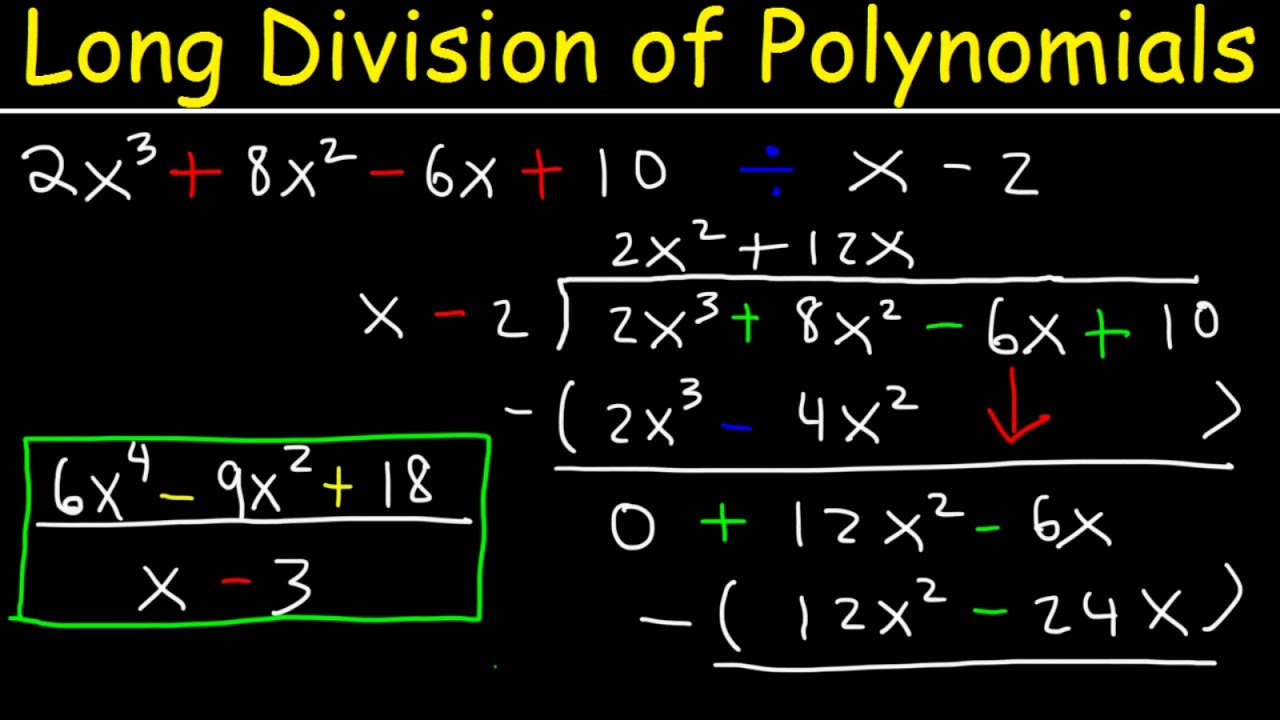
This video tutorial explains how to perform long division of polynomials with remainder and with missing terms. It's explains how to do long division easily and it provides the step by step process to get it done. Basically, there are 3 steps that you have to repeat. 1. Divide 2. Multiply 3. Subtract This video contains plenty of ex...
vagrant elbow
lol
vagrant elbow
vagrant elbow
This is still factorable
If it hasn't been taught to you, then you can safely ignore everything after this point
I explained it since you said you wanted methods of factorization
keen nova
the extent of my knowledge is apparently "look for common factors, if none, don't factorize". And factorizing quadratics ik how to do mostly, but i never think of it
keen nova
wraith dagger
**NEON**
but for this example
i was trying to do it while we spoke and i couldn't get it right first try. I tried with
$(y-1)(y^2+2)$
wraith daggerBOT
marty
 keen nova
but thats wrong
we want to get y^3 and 3y and 2. How can i think of this to solve quickly
crimson sedge
try adding and subtracting y^2 and it becomes quite straightforward
keen nova
what do you mean by that exactly
keen nova
wraith dagger
**NEON**
adding y^2 to this?
crimson sedge
adding and subtracting the same term has no effect on the equation, but it may help you in factorization
keen nova
i still cant see it
wraith daggerBOT
marty
 crimson sedge
keen nova
i still cant see it
crimson sedge
keen nova
i still cant see it
rearrange it and split -3y into -y and -2y
$$y^3-y^2+y^2-y-2y+2$$
wraith daggerBOT
dimpledoink
 cedar kilnBOT
@keen nova Has your question been resolved?
keen nova
theres some knowledge im lacking because still i cant see
i dont see a common factor of 1 term, so obviously it has to be of at least 2 terms. But idk how to look for that
should i do polynomial division of y + 2?
crimson sedge
you can either do y-1 or y+2
keen nova
so
the strategy is to find the common factor aside from the constant/non-factorable term, then add the non-factorable term
so y is the common factor, plus 2, the non-factorable term
then do long division
crimson sedge
ok that doesnt always work
keen nova
ok well
at least i managed to do it now
so long division is cool
i never did it before
do you have any tips in finding what polynomial to divide with
crimson sedge
wraith dagger
**dimpledoink**
once you have something that looks like this you can try and start "pairing" the terms
like y^3-y^2 is one pair, y^2-y is another, and -2y+2 is another
then you take the common factors out which here would be y^2 in the first pair, y in the second and -2 in the third (not +2)
and you end up with something like this $$y^2(y-1)+y(y-1)-2(y-1)$$
$$y^2(y-1)+y(y-1)-2(y-1)$$
wraith daggerBOT
dimpledoink
 crimson sedge
now the pairing is not always going to work out, and if it doesnt, try rearranging and splitting terms in different ways
you'd ask why -2 and not +2, and that's because we need the same terms in the parentheses so we can divide by the same term
if you took +2 as the common factor in the last pair you would've ended up with something like
$$y^2(y-1)+y(y-1)+2(1-y)$$
wraith daggerBOT
dimpledoink
 crimson sedge
wraith dagger
**dimpledoink**
crimson sedge
wraith dagger
**dimpledoink**
after this just divide by y-1, and you get a normal quadratic equation which is easily factorized
keen nova
for these type of examples its v easy, ik 12 is a sum and 32 is a product, so find compatible numbers

so when i hear "how to factorize a quadratic" this is what i imagine
can i relate this somehow with what you're now saying
crimson sedge
have you been taught the quadratic formula yet
crimson sedge
ok that's the easiest way to factorize a quadratic
use the quadratic formula and find the roots
crimson sedge
whatever the roots are, you flip the sign
for example, in the above example, the roots will be 8 and 4
and then you flip the sign and get -8 and -4
and then add x to both and get x-8 and x-4
essentially reverse engineer the factors using the roots, normally you'd find the factors of the quadratic, equate each of them to zero, and then find the roots
cedar kilnBOT
Channel closed
Closed by @keen nova
Use .reopen if this was a mistake.
Available help channel!
Send your question here to claim the channel.
Remember:
• Ask your math question in a clear, concise manner.
• Show your work, and if possible, explain where you are stuck.
• After 15 minutes, feel free to ping <@&286206848099549185>.
• Type the command .close to free the channel when you're done.
• Be polite and have a nice day!
Read #❓how-to-get-help for further information on how to ask a good question, and about conduct in the question channels.
 plucky barn
How do I solve this?
 cedar kilnBOT
plucky barn
How do I solve this?
tropic oxide
cedar kilnBOT
plucky barn
How do I solve this?
tropic oxide
what does $n = 2x - 13$ have to do with the line above?
wraith daggerBOT
Ann
 tropic oxide
as far as i can read, the top line says: $$(h^{-1} \circ h)(b) = ; ?$$ please confirm whether i have read it correctly
wraith daggerBOT
Ann
 mental trail
Well, what do you know about functions composed with their reciprocal
stiff totem
yes, a function and its inverse cancel out like that (kind of by definition)
I think you have a sign error on h^-1 though
cedar kilnBOT
@plucky barn Has your question been resolved?
Channel closed
Closed by @plucky barn
Use .reopen if this was a mistake.
Available help channel!
Send your question here to claim the channel.
Remember:
• Ask your math question in a clear, concise manner.
• Show your work, and if possible, explain where you are stuck.
• After 15 minutes, feel free to ping <@&286206848099549185>.
• Type the command .close to free the channel when you're done.
• Be polite and have a nice day!
Read #❓how-to-get-help for further information on how to ask a good question, and about conduct in the question channels.
 tidal wasp
 cedar kilnBOT
tidal wasp
mental trail
cedar kilnBOT
tidal wasp
mental trail
!status
cedar kilnBOT
What step are you on?
1. I don't know where to begin
2. I have begun but got stuck midway
3. I got an answer but I'm told it's wrong
4. I got an answer and would like my work checked
5. I have a question about someone else's worked solution
6. None of the above
1
mental trail
have you tried computing directional derivatives ?
tidal wasp
mental trail
have you tried computing directional derivatives ?
yes
but the function at 0,0 is just 0
mental trail
yes but the directional derivative might not be 0
have you tried computing the derivative with $y = \lambda x$ ?
tidal wasp
mental trail
yes but the directional derivative might not be 0
teh gradient vector would be (0,0)?
wraith daggerBOT
rafilou2003
 tidal wasp
wraith dagger
**rafilou2003**
tidal wasp
wraith dagger
**rafilou2003**
what?
mental trail
tidal wasp
teh gradient vector would be (0,0)?
the gradient is not 0 I think
tidal wasp
mental trail
the gradient is not 0 I think
what do you get when you differentiate 0?
mental trail
tidal wasp
what do you get when you differentiate 0?
aight, bet with a counterexample
tidal wasp
the partial derivative would just be 0
mental trail
Let $g(x) = x$ the function over the real numbers $\bR$
wraith daggerBOT
rafilou2003
 mental trail
$g(0) = 0$ right ?
wraith daggerBOT
rafilou2003
 tidal wasp
yeah
mental trail
what about $g'(0)$ ?
wraith daggerBOT
rafilou2003
 tidal wasp
may or may not be 0
wraith daggerBOT
rafilou2003
 tidal wasp
how?
mental trail
what's the derivative of x
tidal wasp
1
tidal wasp
but how do you know that the function is g(x) = x
mental trail
because I created it that way to show you a counterexample
mental trail
So f(x,y) = 0 doesn't imply the gradient is 0
tidal wasp
mental trail
So f(x,y) = 0 doesn't imply the gradient is 0
i see
so what can i do here?
mental trail
The way the directional derivative works, is that if you want for example a derivative along the vector (1,2), then you let (x,y) = (1t, 2t) and you compute f'(t)
so in our example :
if we have $(x,y) = (1t, 2t)$, then f(x,y) = ...
wraith daggerBOT
rafilou2003
 tidal wasp
$\frac{2t^3}{t^2+16t^4}$
wraith daggerBOT
Bedsheat
 tidal wasp
?
mental trail
you got it!
mental trail
wraith dagger
**Bedsheat**
And then to find the directional derivative from the vector (1,2), you just differentiate that
tidal wasp
would the derivitive of that be $\frac{2-32t^2}{1+256t^2}$
wraith daggerBOT
Bedsheat
 mental trail
you're differentiating a quotient
tidal wasp
mental trail
you're differentiating a quotient
yeah i used the quotient rule
then cancled out t^4
mental trail
at the denominator I think is (1+16t^2)^2
tidal wasp
mental trail
at the denominator I think is (1+16t^2)^2
but the denominator is t^2+16t^4
did you cancel it out?
at the start?
wraith daggerBOT
rafilou2003
 tidal wasp
mental trail
cancel by t^2 before differentiating
tidal wasp
mental trail
cancel by t^2 before differentiating
i see i did that before differentiating
mental trail
differentiates into $\frac{2 + 32t^2 - 64t^2}{(1+16t^2)^2} = \frac{2-32t^2}{(1+16t^2)^2}$
tidal wasp
should it not be -32t and not -32t^2
mental trail
Oh lemme correct that
wraith daggerBOT
rafilou2003
 mental trail
because -2t * 32t
tidal wasp
right
mental trail
This is well defined in 0 and values 2, so $D_{(1,2)}f(0,0) = 2$
wraith daggerBOT
rafilou2003
 wraith daggerBOT
rafilou2003
 mental trail
and not 2t^3
but it's alright, the derivative is just multiplied by 2
and so $D_{(1,2)}f(0,0) = 4$
wraith daggerBOT
rafilou2003
 tidal wasp
mental trail
and not 2t^3
tidal wasp
mental trail
and not 2t^3
how
the function is xy^2
t*2t^2
ohhhhhh
right
bruh
i see
wraith daggerBOT
rafilou2003
 mental trail
we're still left to prove that in the general case
so now we just have to do the same thing but with $(x,y) = (u_1t,u_2t)$ with $(u_1,u_2)$ a unit vector as the question suggests
wraith daggerBOT
rafilou2003
 mental trail
Now that we know exactly what to do (and we've done it before) it should go faster
So what's $f(u_1t,u_2t)$ ?
wraith daggerBOT
rafilou2003
 tidal wasp
lemme do it
mental trail
I'll be away for the next 10 mins, if you're stuck sometime in between you can ping helpers
tidal wasp
mental trail
I'll be away for the next 10 mins, if you're stuck sometime in between you can p...
k thx!
$f(u_1t,u_2t)=\frac{u_1u_2^2t^3}{u_1^2t^2+u_2^4t^4}$
wraith daggerBOT
Bedsheat
 tidal wasp
$f'(u_1t,u_2t)=\frac{-u_1^3u_2^2-2u_1u_2^6t^2}{(u_1^2+u_2^$t^2)^2}$
wraith daggerBOT
Bedsheat
 tidal wasp
idk i messed up somewhere
i think its $\frac{u_1^3u_2^2-u_1u_2^6t^2}{(u_1^2 + u_2^4t^2)^2}$
mental trail
the denominator should be $(u_1^2 + u_2^4t^2)^2$
wraith daggerBOT
rafilou2003
 tidal wasp
okay i think this time im correct
tidal wasp
mental trail
the denominator should be $(u_1^2 + u_2^4t^2)^2$
it is tho isnt it?
ho wait
mental trail
(a+b)^2 ?
tidal wasp
its whole square
mental trail
yes
this is not the first time I see someone writing (a+b)^2 = a^2 + b^2 so I don't judge ;)
wraith daggerBOT
Bedsheat
 tidal wasp
sure is
mental trail
almost
tidal wasp
bruhhhh
tidal wasp
0,0
tidal wasp
its not defined at the point 0
mental trail
so let's assume $u_1 \neq 0$
wraith daggerBOT
rafilou2003
 mental trail
in that case, what is $D_{(u_1,u_2)}f(0,0)$?
wraith daggerBOT
rafilou2003
 tidal wasp
$\frac{u_1^3u_2^2}{u_1^4} = \frac{u_2^2}{u_1}$
mental trail
yes, and simplified ?
wraith daggerBOT
Bedsheat
 mental trail
👍
tidal wasp
phew
mental trail
Alright so which ones do we now know is true/false ?
mental trail
tidal wasp
I'll just do this for myself
tidal wasp
mental trail
I'll just do this for myself
alr
mental trail
"the maximum of directional derivatives occurs in the direction of the vector (5,5)"
yes there is no maximum !
can you see why?
tidal wasp
mental trail
can you see why?
yeah i can
the higher u_2 and closer to 0 u_1 is the more the value of hte directional derivitive
mental trail
yes that's kinda the idea
though you do have to be careful, since $(u_1,u_2)$ is a unit vector you have that $u_1^2 + u_2^2 = 1$
wraith daggerBOT
rafilou2003
 tidal wasp
ohhhhh
mental trail
So while we can't make u_2 "bigger and bigger" as it's bounded by 1, we can make u_1 closer and closer to 0
mental trail
alright, now left with the statement about tangent lines
cedar kilnBOT
@tidal wasp Has your question been resolved?
cedar kilnBOT
@tidal wasp Has your question been resolved?
Channel closed
Closed by @tidal wasp
Use .reopen if this was a mistake.
cedar kilnBOT
Available help channel!
Send your question here to claim the channel.
Remember:
• Ask your math question in a clear, concise manner.
• Show your work, and if possible, explain where you are stuck.
• After 15 minutes, feel free to ping <@&286206848099549185>.
• Type the command .close to free the channel when you're done.
• Be polite and have a nice day!
Read #❓how-to-get-help for further information on how to ask a good question, and about conduct in the question channels.
 noble perch
how do i identify the pivot columns
 cedar kilnBOT
noble perch
how do i identify the pivot columns
noble perch
cedar kilnBOT
noble perch
how do i identify the pivot columns
noble perch
im confused because row 2 eliminates row 3 so im not sure if columns 2 and 3 count as pivot colums along with column 1
 royal loom
continue row reducing
right now you have a 2 along the diagonal
a zero row from row reduction tells you that one of your columns of your matrix is linearly dependent on the other two. i.e you will not have full rank, or full pivot columns (you won't have all 3)
noble perch
royal loom
a zero row from row reduction tells you that one of your columns of your matrix ...
oh okay
i didn't know that
noble perch
royal loom
a zero row from row reduction tells you that one of your columns of your matrix ...
im having trouble understanding why (1,2,0) is linearly dependent on (1,0,0) and (0,1,0)
royal loom
<1,2,0>= 1 * <1,0,0> + 2 * <0,1,0>
it can be represented as a linear combination of the other two
noble perch
ohhhh
royal loom
therefore it is linearly dependent on them
but
that is not the take away you should be getting from your row reduction
noble perch
yeah
royal loom
which is in the first column
so column 1 is a pivot column
what is the pivot of row 2?
noble perch
i wanna say 2
royal loom
yes
2 is the first nonzero element in row 2
so it is the pivot
and 2 is in which column?
noble perch
second column
noble perch
oh
this makes a lot of sense now
so im also asked to find the column and row space
royal loom
the column space, is the space spanned by the columns
do you know what I mean by "spanned"?
noble perch
royal loom
do you know what I mean by "spanned"?
yeah it means a set in which the vectors are linear combos of each other