#help-10
1 messages · Page 432 of 1
 tepid pilot

 mortal mason
no worries !
tepid pilot
.close
 obtuse pebbleBOT
Channel closed
Closed by @tepid pilot
Use .reopen if this was a mistake.
obtuse pebbleBOT
 Available help channel!
Send your question here to claim the channel.
Remember:
• Ask your math question in a clear, concise manner.
• Show your work, and if possible, explain where you are stuck.
• After 15 minutes, feel free to ping <@&286206848099549185>.
• Type the command .close to free the channel when you're done.
• Be polite and have a nice day!
Read #❓how-to-get-help for further information on how to ask a good question, and about conduct in the question channels.
 candid vessel
i got it into polar coordinates and i got 2sin(theta)cos(theta) but i dont understand what it means by describe level curves
 obtuse pebbleBOT
candid vessel
i got it into polar coordinates and i got 2sin(theta)cos(theta) but i dont under...
obtuse pebbleBOT
obtuse pebbleBOT
candid vessel
i got it into polar coordinates and i got 2sin(theta)cos(theta) but i dont under...
obtuse pebbleBOT
@candid vessel Has your question been resolved?
candid vessel
i dont really understand
obtuse pebbleBOT
@candid vessel Has your question been resolved?
obtuse pebbleBOT
@candid vessel Has your question been resolved?
Channel closed
Closed by @candid vessel
Use .reopen if this was a mistake.
Available help channel!
Send your question here to claim the channel.
Remember:
• Ask your math question in a clear, concise manner.
• Show your work, and if possible, explain where you are stuck.
• After 15 minutes, feel free to ping <@&286206848099549185>.
• Type the command .close to free the channel when you're done.
• Be polite and have a nice day!
Read #❓how-to-get-help for further information on how to ask a good question, and about conduct in the question channels.
 civic bone
am i misunderstanding this
obtuse pebbleBOT
civic bone
am i misunderstanding this
civic bone
or is (a) equivalent to asking for null space of the (1 -3 4 0) matrix

well, a basis of the null space
which would then be (3, 1, 0, 0) and (-4, 0, 1, 0)
but that is not correct
so where am i wrong
 shut lagoon
obtuse pebbleBOT
shut lagoon
obtuse pebbleBOT
@civic bone Has your question been resolved?
obtuse pebbleBOT
Channel closed
Closed by @civic bone
Use .reopen if this was a mistake.
Available help channel!
Send your question here to claim the channel.
Remember:
• Ask your math question in a clear, concise manner.
• Show your work, and if possible, explain where you are stuck.
• After 15 minutes, feel free to ping <@&286206848099549185>.
• Type the command .close to free the channel when you're done.
• Be polite and have a nice day!
Read #❓how-to-get-help for further information on how to ask a good question, and about conduct in the question channels.
 steel lagoon
how do i know if this has
infinite solutions
or one solution
 obtuse pebbleBOT
steel lagoon
how do i know if this has
**infinite solutions**
or **one solution**
obtuse pebbleBOT
steel lagoon
how do i know if this has
**infinite solutions**
or **one solution**
 viral blade
well if you don't need to worry about the possibility of their being zero solutions then you can check the determinant
ignoring the bottom row
but it shouldn't be too hard to see the top equation will always give you exactly one solution for x_1
so just check the middle one to see how many solutions for x_2 there are
steel lagoon
viral blade
well if you don't need to worry about the possibility of their being zero soluti...
what do you mean by checking the middle one
viral blade
the middle equation
steel lagoon
set it equal to rhs?
steel lagoon
viral blade
well
so should i calculate the determinant the 2x2
viral blade
no that's overkill and only works if you know there's no cases with zero solutions
which i realize you do not in fact know that now despite your initial message
steel lagoon
viral blade
no that's overkill and only works if you know there's no cases with zero solutio...
sorry im lost what did you mean by this then
steel lagoon
viral blade
well if you don't need to worry about the possibility of their being zero soluti...
^
viral blade
you need to worry about the possibility of their being zero solutions
so checking determinant won't work
steel lagoon
viral blade
you need to worry about the possibility of their being zero solutions
should i set R2 = 0
and then plug the values into the right side to see if its consistent or not
steel lagoon
viral blade
i'm not 100% confident you know why you're doing that
youre right
i dont fully get it
im doing it kind of mechanically, if it works for other problems thats good
obtuse pebbleBOT
@steel lagoon Has your question been resolved?
steel lagoon
viral blade
probably makes it easier to visualize
i see, thanks
obtuse pebbleBOT
Channel closed
Closed by @steel lagoon
Use .reopen if this was a mistake.
obtuse pebbleBOT
Available help channel!
Send your question here to claim the channel.
Remember:
• Ask your math question in a clear, concise manner.
• Show your work, and if possible, explain where you are stuck.
• After 15 minutes, feel free to ping <@&286206848099549185>.
• Type the command .close to free the channel when you're done.
• Be polite and have a nice day!
Read #❓how-to-get-help for further information on how to ask a good question, and about conduct in the question channels.
 small shard
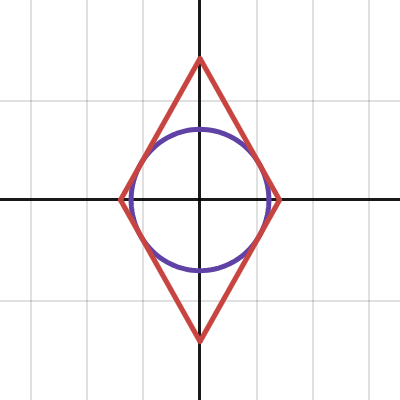
why does this hold for ellipsis and circles? Its weird because the accumulated y on either side of this point x on a quarter ellipse is b/2. Why does an equilateral triangle appear?
https://www.desmos.com/calculator/ogeq0vnjev
 obtuse pebbleBOT
small shard
why does this hold for ellipsis and circles? Its weird because the accumulated y...
obtuse pebbleBOT
small shard
why does this hold for ellipsis and circles? Its weird because the accumulated y...
 warm shaleBOT
hikari
 small shard
$$x = \frac{a \cdot \sqrt{3}}{2}, \quad y = \frac{b}{2}$$
warm shaleBOT
hikari
 small shard
warm shale
**hikari**
small shard
warm shale
**hikari**
This was an error on my part, the next latex is correct.
obtuse pebbleBOT
@small shard Has your question been resolved?
Channel closed
Closed by @small shard
Use .reopen if this was a mistake.
Available help channel!
Send your question here to claim the channel.
Remember:
• Ask your math question in a clear, concise manner.
• Show your work, and if possible, explain where you are stuck.
• After 15 minutes, feel free to ping <@&286206848099549185>.
• Type the command .close to free the channel when you're done.
• Be polite and have a nice day!
Read #❓how-to-get-help for further information on how to ask a good question, and about conduct in the question channels.
 radiant marsh
 obtuse pebbleBOT
radiant marsh
radiant marsh
obtuse pebbleBOT
radiant marsh
radiant marsh
I'm not sure if this is in the right direction

or do I do mod5 only to the final result
 kind hawk
well the nice thing about modulo is that you can take mod whenever you want
for addition and multiplication
radiant marsh
kind hawk
well the nice thing about modulo is that you can take mod whenever you want
do I have to do modulo only once in this example?
as in (a^5 + (b^5+c^5))mod5
kind hawk
whether you do a^5 + (b^5 + c^5 mod 5)^5 mod 5 or a^5+(b^5+c^5)^5 mod 5 doesnt matter
its the same result
radiant marsh
oh okay
so far I'm getting the impression that it is a field
do I have to prove all the 12 conditions one by one?
kind hawk
those conditions only involving multiplication clearly hold cause the multiplication isnt changed
but there is something different to notice here which will save you a lot of time
radiant marsh
kind hawk
but there is something different to notice here which will save you a lot of tim...
is it about a + 0 = a
say a = 5, 5^5 + 0 mod 5 = 0, but a is 5
am I right?
radiant marsh
ah
radiant marsh
kind hawk
but there is something different to notice here which will save you a lot of tim...
what is there to notice
I'm guessing it's related to one of the conditions
but they all seem to be true
radiant marsh
I didn't test them all yet but bruteforcing seems like the only way
kind hawk
ok
kind hawk
have you tested the one for showing that zero is the additive identity yet?
radiant marsh
radiant marsh
is it about a + 0 = a
that's what I mentioned here though
kind hawk
but then you wrote something about a being 5
maybe you meant what I mean or not
what I mean is the following: a^5=a in Z_5
kind hawk
thats the thing you have to check
that a^5+0^5=a
and 0^5 is clearly 0
so you just have to check a^5=a for every a
radiant marsh
shouldn't it be a^5 = a^5?
kind hawk
no
radiant marsh
so I should check if a^5 mod 5 = a for every a?
kind hawk
you have to show that $a+0=a$ for every $a\in\bZ_5$, aka $a^5+_50^5=a$ for every $a\in\bZ_5$
warm shaleBOT
Denascite
 radiant marsh
yeah
0^5 + 0^5 mod5 = 0
1^5 + 0^5 mod 5 = 1
2^5 + 0^5 mod 5 = 2
3^5 + 0^5 mod 5 = 3
4^5 + 0^5 mod 5 = 4
kind hawk
good
so along the way we notice that a^5=a for every a
because the zero doesnt end up doing anything
radiant marsh
yeah
kind hawk
but that means the new addition is just the same as the old addition
you are adding a^5 and b^5 which are the same as a and b
radiant marsh
ohhhhhhhhhhhhhhhhhhhhhhhhhh
wait not oh
so we showed that this condition is true
but what does that help
does it mean that a^5 + b^5 is the same as a+b?
yeah it does
so it's (a+b)mod5
can I use that to prove that it's a field without proving each condition? Say something like it's a field because it's known that for (a+b)mod5 we already know that it's a field in Z_5
sorry if I'm wording it badly, I'm learning it in a different language
kind hawk
yes
its the exact same as the old one
as soon as you have shown that a^5=a for all a
obtuse pebbleBOT
@radiant marsh Has your question been resolved?
radiant marsh
radiant marsh
0^5 + 0^5 mod5 = 0
1^5 + 0^5 mod 5 = 1
2^5 + 0^5 mod 5 = 2
3^5 + 0^5 mod 5 = 3
...
ok so for my proof I proved that (a^5)mod5= a for all a in Z_5 by writing this and wrote that since (a^5)mod5 = a we get normal addition
radiant marsh
kind hawk
as soon as you have shown that a^5=a for all a
but how do I tie that into explaining why that makes Z_5 a field
kind hawk
like you just wrote
radiant marsh
kind hawk
like you just wrote
saying that it's normal addition mod 5 is enough to prove that Z_5 is a field?
kind hawk
well presumably you proved before that Z_5 is a field with the normal addition and multiplication
radiant marsh
kind hawk
well presumably you proved before that Z_5 is a field with the normal addition a...
as in a previous question?
radiant marsh
maybe, I don't remember
kind hawk
look through your notes
radiant marsh
I'll gaslight my professor into thinking that we have proven it before
anyways thanks, I really didn't wanna bruteforce it and you saved me
.close
obtuse pebbleBOT
Channel closed
Closed by @radiant marsh
Use .reopen if this was a mistake.
Available help channel!
Send your question here to claim the channel.
Remember:
• Ask your math question in a clear, concise manner.
• Show your work, and if possible, explain where you are stuck.
• After 15 minutes, feel free to ping <@&286206848099549185>.
• Type the command .close to free the channel when you're done.
• Be polite and have a nice day!
Read #❓how-to-get-help for further information on how to ask a good question, and about conduct in the question channels.
 primal hatch
Hello, for part B, are there any ways to solve this without trial and error? This is what I have currently where I'm plugging in b/a until I get an answer of 0 and the only method we've been taught as far as I'm aware

 obtuse pebbleBOT
primal hatch
Hello, for part B, are there any ways to solve this without trial and error? Thi...
obtuse pebbleBOT
primal hatch
Hello, for part B, are there any ways to solve this without trial and error? Thi...
 full musk
You could factor maybe?
primal hatch
How else could you find the factors tho?
The only reason I got the first factor was through trial and error
I have answer but I don't know how to do without trial and error for b)
Yes
It just wants to substitute that as an equation to solve for x
So part a) got theta = pi
Now just substitute theta as that equation so the whole equation = pi
That fits within the domain yeah
Yeah I got that part, I just don't know how to find factors without getting the factors of 252 over the factors of 12 and substituting them into the equation until it equals to 0
Yeah, I don't even know what she means by "concepts we've learned" cuz I even specifically asked her if there was any way to solve those types of equations during the lesson in case of a test and she said no
obtuse pebbleBOT
@primal hatch Has your question been resolved?
primal hatch
Just need another person to verify that there's actually no other way to solve it other than trial and error 🙏
obtuse pebbleBOT
@primal hatch Has your question been resolved?
obtuse pebbleBOT
@primal hatch Has your question been resolved?
Channel closed
Closed by @primal hatch
Use .reopen if this was a mistake.
Available help channel!
Send your question here to claim the channel.
Remember:
• Ask your math question in a clear, concise manner.
• Show your work, and if possible, explain where you are stuck.
• After 15 minutes, feel free to ping <@&286206848099549185>.
• Type the command .close to free the channel when you're done.
• Be polite and have a nice day!
Read #❓how-to-get-help for further information on how to ask a good question, and about conduct in the question channels.
Channel closed
Channel closed due to the original message being deleted.
If you did not intend to do this, please open a new help channel,
as this action is irreversible, and this channel may abruptly lock.
obtuse pebbleBOT
Available help channel!
Send your question here to claim the channel.
Remember:
• Ask your math question in a clear, concise manner.
• Show your work, and if possible, explain where you are stuck.
• After 15 minutes, feel free to ping <@&286206848099549185>.
• Type the command .close to free the channel when you're done.
• Be polite and have a nice day!
Read #❓how-to-get-help for further information on how to ask a good question, and about conduct in the question channels.
 timid silo
Can somebody do favour me in this?
 obtuse pebbleBOT
timid silo
Can somebody do favour me in this?
obtuse pebbleBOT
timid silo
Can somebody do favour me in this?
 velvet rover
what are you supposed to do?
timid silo
velvet rover
what are you supposed to do?
Can u explain me how they do solve this question?
obtuse pebbleBOT
@timid silo Has your question been resolved?
timid silo
Iss equation ko maximize krna h
Samajh gyiiin..
Range
Sunn mene yeh theta kisi value nikali then
Aayi
Theta aaya pie/4
And alpha is 3 pie/4 , 7pie/4 .. Is it sahi? If yk?
obtuse pebbleBOT
@timid silo Has your question been resolved?
obtuse pebbleBOT
@timid silo Has your question been resolved?
Channel closed
Closed by @foggy nexus
Use .reopen if this was a mistake.
Available help channel!
Send your question here to claim the channel.
Remember:
• Ask your math question in a clear, concise manner.
• Show your work, and if possible, explain where you are stuck.
• After 15 minutes, feel free to ping <@&286206848099549185>.
• Type the command .close to free the channel when you're done.
• Be polite and have a nice day!
Read #❓how-to-get-help for further information on how to ask a good question, and about conduct in the question channels.
 slender acorn
help pls
obtuse pebbleBOT
slender acorn
help pls
slender acorn
As Paťo walked through the door, he slammed his guitar against the doorjamb. Later on, when
he checked the damage, he noticed that one of the strings was tuned exactly a semitone higher
than the original frequency. Since the string was already due for replacement before that, Pato
figured he could kill two birds with one stone.
He decided to tightly and firmly wind a new layer of wire onto the string in the shape of
a helix. How thick of a wire, made from the same material, does he need to buy to retune
the string to its original frequency? The problematic string had a thickness of 1.1 mm at the
start. Assume equal temperament tuning and that the tension in the string remains unchanged
during this manipulation. Consider the string both in its original state and after the wire has
been wound, as a homogeneous circular right cylinder.
 high flax
Could you help with question 30 and how to solve it

 tardy epoch
,rccw
warm shaleBOT
 obtuse pebbleBOT
@slender acorn Has your question been resolved?
obtuse pebbleBOT
Channel closed
Closed due to timeout
Use .reopen if this was a mistake.
obtuse pebbleBOT
Available help channel!
Send your question here to claim the channel.
Remember:
• Ask your math question in a clear, concise manner.
• Show your work, and if possible, explain where you are stuck.
• After 15 minutes, feel free to ping <@&286206848099549185>.
• Type the command .close to free the channel when you're done.
• Be polite and have a nice day!
Read #❓how-to-get-help for further information on how to ask a good question, and about conduct in the question channels.
 teal coral
what is horizontal asymptote of f(x) = x-cos(x) / x
obtuse pebbleBOT
teal coral
what is horizontal asymptote of f(x) = x-cos(x) / x
 short spire
teal coral
what is horizontal asymptote of f(x) = x-cos(x) / x
short spire
teal coral
what is horizontal asymptote of f(x) = x-cos(x) / x
so youre assuming a horizontal asymptote exists or?
teal coral
well really its find the limit as x approaches infinity of that function
short spire
well, what have u tried?
teal coral
i tried saying that its 1 since the rate of x on top and bottom are equal
but when graphing it says that there's no horizontala asymptote
short spire
so youre saying the limit as x approches infinty is 1?
teal coral
yes
short spire
bcuz it looks like it might?
short spire
teal coral
i tried saying that its 1 since the rate of x on top and bottom are equal
this reasoning is weak
teal coral
well what do you think
short spire
so since we're apporching x -> infty
then it's fine to consider when x > 0
now recall that cos(x) is bounded by -1 and 1, right?
short spire
oops didnt notice u responded
teal coral
yes
short spire
then we have that -cos(x) >= 1
so since x > 0, then our expression x - cos(x)/x must be bounded below by x - 1/x
teal coral
yes
short spire
We can infact do better actually to really drive across the point that this does not have a limit
so do you recall that cos(x) <= x, when x large enough?
teal coral
wait it doesn't exist
short spire
teal coral
wait it doesn't exist
yeah, why would it?
teal coral
because squeeze theorem states it does
short spire
nope
show ur reasoning
i can show that x - cos(x)/x is bounded below by x - 1 for x large enough
but x-1 is unbounded
so x - cos(x)/x approches infty as x goes to infty
teal coral
the limit of x-1/x is 1 and the limit of x+1/x is one
short spire
huh?
teal coral
so therefore x-cos(x)/x = 1
short spire
thats really bad
teal coral
.close
obtuse pebbleBOT
Channel closed
Closed by @teal coral
Use .reopen if this was a mistake.
 ebon lark
Bullying the poor dude off of the channel
 short spire
It was not meant to them but to the poor explanation
ebon lark
Either way it comes off as degrading
short spire
Im on the spectrum so i have a hard time seeing my tone trhough text (or others), nothing personal meant
sorry!
 turbid marlin
ur completely fine, thats not bullying at all
you couldve been more clear and said "the explanation is really bad"
but otherwise nah u didnt do anything wrong
obtuse pebbleBOT
Available help channel!
Send your question here to claim the channel.
Remember:
• Ask your math question in a clear, concise manner.
• Show your work, and if possible, explain where you are stuck.
• After 15 minutes, feel free to ping <@&286206848099549185>.
• Type the command .close to free the channel when you're done.
• Be polite and have a nice day!
Read #❓how-to-get-help for further information on how to ask a good question, and about conduct in the question channels.
 ebon zephyr
 obtuse pebbleBOT
ebon zephyr
ebon zephyr
obtuse pebbleBOT
ebon zephyr
ebon zephyr
im blanking out i understood how to get the answer to a
but now i have no clue how to use my calculator to plot the grap
i tried y= with the formula
obtuse pebbleBOT
@ebon zephyr Has your question been resolved?
ebon zephyr
<@&286206848099549185>
obtuse pebbleBOT
Channel closed
Closed by @ebon zephyr
Use .reopen if this was a mistake.
obtuse pebbleBOT
Available help channel!
Send your question here to claim the channel.
Remember:
• Ask your math question in a clear, concise manner.
• Show your work, and if possible, explain where you are stuck.
• After 15 minutes, feel free to ping <@&286206848099549185>.
• Type the command .close to free the channel when you're done.
• Be polite and have a nice day!
Read #❓how-to-get-help for further information on how to ask a good question, and about conduct in the question channels.
 worldly bolt
I need help with this
 obtuse pebbleBOT
worldly bolt
I need help with this
viral blade
obtuse pebbleBOT
worldly bolt
I need help with this
viral blade
Can you find tan(120) and tan(45)?
worldly bolt
Oh wrong question. It should be tan(80) instead of tan(120) and tan(20) instead of tan(45)

 rocky pelican
this is tan compound angle
worldly bolt
I was trying to use sum and differences identities
viral blade
well that is the tan(a+b) formula with specific values plugged in
worldly bolt
So tan(100)
viral blade
right
worldly bolt
Oh ok for some reason it wasn’t letting me write it that way but now it’s working. Pretty sure it was just a technical issue
Thanks!
.close
obtuse pebbleBOT
Channel closed
Closed by @worldly bolt
Use .reopen if this was a mistake.
viral blade
Np
obtuse pebbleBOT
Available help channel!
Send your question here to claim the channel.
Remember:
• Ask your math question in a clear, concise manner.
• Show your work, and if possible, explain where you are stuck.
• After 15 minutes, feel free to ping <@&286206848099549185>.
• Type the command .close to free the channel when you're done.
• Be polite and have a nice day!
Read #❓how-to-get-help for further information on how to ask a good question, and about conduct in the question channels.
 pale tusk
Was there something off with the substitution, or did I make a mistake with sin(4x)?

 obtuse pebbleBOT
pale tusk
Was there something off with the substitution, or did I make a mistake with sin(...
obtuse pebbleBOT
pale tusk
Was there something off with the substitution, or did I make a mistake with sin(...
 plain stag
1024/120 =/= 256/15
pale tusk
It was 128/15
 azure oriole
how
plain stag
marvellous
pale tusk
.close
obtuse pebbleBOT
Channel closed
Closed by @pale tusk
Use .reopen if this was a mistake.
obtuse pebbleBOT
Available help channel!
Send your question here to claim the channel.
Remember:
• Ask your math question in a clear, concise manner.
• Show your work, and if possible, explain where you are stuck.
• After 15 minutes, feel free to ping <@&286206848099549185>.
• Type the command .close to free the channel when you're done.
• Be polite and have a nice day!
Read #❓how-to-get-help for further information on how to ask a good question, and about conduct in the question channels.
 acoustic reef
43 I am getting -1/2
 obtuse pebbleBOT
acoustic reef
43 I am getting -1/2
obtuse pebbleBOT
obtuse pebbleBOT
acoustic reef
43 I am getting -1/2
obtuse pebbleBOT
Channel closed
Closed by @acoustic reef
Use .reopen if this was a mistake.
obtuse pebbleBOT
Available help channel!
Send your question here to claim the channel.
Remember:
• Ask your math question in a clear, concise manner.
• Show your work, and if possible, explain where you are stuck.
• After 15 minutes, feel free to ping <@&286206848099549185>.
• Type the command .close to free the channel when you're done.
• Be polite and have a nice day!
Read #❓how-to-get-help for further information on how to ask a good question, and about conduct in the question channels.
 vivid bone
Why is Phi equal to the limit of the angle SQP as h --> 0?
obtuse pebbleBOT
vivid bone
Why is Phi equal to the limit of the angle SQP as h --> 0?
vivid bone

 quick totem
vivid bone
Why is Phi equal to the limit of the angle SQP as h --> 0?
quick totem
vivid bone
Why is Phi equal to the limit of the angle SQP as h --> 0?
I guess it is because then Q-->P and that's exactly the definition of tangent line as a limiting position of the line QP.
vivid bone
I get that Q --> P, but I don't understand what you mean by the definition of a tangent line as the limiting position of the line QP
obtuse pebbleBOT
@vivid bone Has your question been resolved?
obtuse pebbleBOT
@vivid bone Has your question been resolved?
vivid bone
<@&286206848099549185>
obtuse pebbleBOT
@vivid bone Has your question been resolved?
obtuse pebbleBOT
@vivid bone Has your question been resolved?
obtuse pebbleBOT
Channel closed
Closed due to timeout
Use .reopen if this was a mistake.
Available help channel!
Send your question here to claim the channel.
Remember:
• Ask your math question in a clear, concise manner.
• Show your work, and if possible, explain where you are stuck.
• After 15 minutes, feel free to ping <@&286206848099549185>.
• Type the command .close to free the channel when you're done.
• Be polite and have a nice day!
Read #❓how-to-get-help for further information on how to ask a good question, and about conduct in the question channels.
 simple pelican
i dont know what integrals are
 obtuse pebbleBOT
simple pelican
i dont know what integrals are
obtuse pebbleBOT
simple pelican
i dont know what integrals are
 dusk mirage
simple pelican
i dont know what integrals are
dusk mirage
simple pelican
i dont know what integrals are
Is this homework or something?
simple pelican
IXL
simple pelican
well i have to do it so
 arctic axle
lol
dusk mirage
Just learn it on khan academy or somewhere else first
simple pelican
what is that sign at the beginning and what do i do with it
dusk mirage
Its an integral sign, it means finding the area under the curve or finding the antiderivative
simple pelican
so would i take 1/2x and get rid of the exponent then do the top of the weird sign - the fraction then put in the bottom?
 simple pelican
my student teacher ;/
dusk mirage
You suould not be doing this without a sound understanding of integrals
Completely pointless
simple pelican
simple pelican
so would i take 1/2x and get rid of the exponent then do the top of the weird si...
?
arctic axle
like
ur student teacher should not be assigning you calculus questions
if you don't know calculus
simple pelican
i just kinow power rule and derivitives
arctic axle
we cannot teach you this in less than an hour
timid silo
simple pelican
i just kinow power rule and derivitives
Maybe go on YouTube and search for a video regarding integrals
simple pelican
simple pelican
so would i take 1/2x and get rid of the exponent then do the top of the weird si...
would this be right ntho
dusk mirage
simple pelican
would this be right ntho
No
timid silo
simple pelican
so khan academy is money
No
Its free
Actually useful
Or u can also try watching the organic chemistry tutor on these calculus concepts i think he teaches them quite well
dusk mirage
simple pelican
ill pay someone to teach me
The internet is free
Asking for help here is free
No need to pay anyone
 sudden aspen
hi
simple pelican
hi
sudden aspen
what’s up
sudden aspen
simple pelican
i dont know what integrals are
Integrals are also known as the anti derivative which can find the accumulation of change if applied
or areas
sudden aspen
you know what a derivative is, correct?
sudden aspen
So what’s the derivative of ln(x)?
simple pelican
i can find like level 1 derivatives
sudden aspen
alright then we’re taking a too big of a step
let’s back up real quick
What math class are you currently taking right now?
sudden aspen
I would say be very proficient in derivatives first before attempting to do integrals
simple pelican
i have to do it so
sudden aspen
you are required to learn integrals now?
simple pelican
not required but it was given
dusk mirage
Tell them you want to fully do differentiation first
It’s only understandable to introduce integrals at this point if the goal is to give brief overviews of topics but clearly as you re being asked specific calculation questions this isn’t the case
sudden aspen
Once you get to u substitution and beyond, it starts to become revolved around derivatives
If you want to learn calculus properly, I would suggest learning it in this order:
Limits
Derivatives
Applications of Derivatives
Integrals
Applications of Integrals
Differential Equations
Vector, Polar, Parametric Calculus
Infinite Series
dusk mirage
Make sure you know algebra and trig properly first, you need to be sound with logarithms, double angle rules, trig identities etc.
Trig is very important especially for integration
 modern pecan
Know your inverse trig functions and hyperbolic functions
dusk mirage
I would say hyperbolics come in the middle of the course
sudden aspen
dusk mirage
Make sure you know algebra and trig properly first, you need to be sound with lo...
(so basically take precalculus)
modern pecan
Take ap calc ab
dusk mirage
sudden aspen
(so basically take precalculus)
exactly
modern pecan
For basic knowledge
dusk mirage
hyperbolics are pretty much never a calc prereq
sudden aspen
When do you ever use hyperbolics
modern pecan
I ask that question everyday
arctic axle
they show up sometimes
modern pecan
But it's trauma
dusk mirage
sudden aspen
When do you ever use hyperbolics
are you asking for real world applications?
arctic axle
$\sinh(x) = \frac{e^x - e^{-x}}{2}$
warm shaleBOT
rain
 sudden aspen
idek conic sections 💀
dusk mirage
If so then its used in activation functions in AI
modern pecan
How did you get that
dusk mirage
modern pecan
How did you get that
Thats how its defined
arctic axle
it's the definition 💀
dusk mirage
tex
warm shaleBOT
rain
 dusk mirage
sudden aspen
dusk mirage
sudden aspen
is latex only used for discord
dusk mirage
sudden aspen
is latex only used for discord
No
latex is the standard for technical writing
arctic axle
latex is how professional scientists write their papers
sudden aspen
would that look good on a college application
dusk mirage
@simple pelican Can you close this
arctic axle
sure, but it'd be a small factor
dusk mirage
its off topic now
dusk mirage
sudden aspen
would that look good on a college application
eh not really
arctic axle
talk in discussion
dusk mirage
its just a touch at the end
modern pecan
Interesting
dusk mirage
kinda pointless in HS though, Ive only used it for technical essays (which you dont do much of) and some proofs
obtuse pebbleBOT
@simple pelican Has your question been resolved?
obtuse pebbleBOT
@simple pelican Has your question been resolved?
obtuse pebbleBOT
Channel closed
Closed due to timeout
Use .reopen if this was a mistake.
Available help channel!
Send your question here to claim the channel.
Remember:
• Ask your math question in a clear, concise manner.
• Show your work, and if possible, explain where you are stuck.
• After 15 minutes, feel free to ping <@&286206848099549185>.
• Type the command .close to free the channel when you're done.
• Be polite and have a nice day!
Read #❓how-to-get-help for further information on how to ask a good question, and about conduct in the question channels.
 late cradle
Hi
obtuse pebbleBOT
late cradle
Hi
late cradle
I’m really stumped on 7b and have no idea how to do it

Is the acceleration same for both objects
 dawn quail
Well if it didn’t tell you don’t worry about it
late cradle
alr ill try do the problem disregarding friction
modern pecan
late cradle
I’m really stumped on 7b and have no idea how to do it
you have to use a matrix
late cradle

 ancient drift
late cradle
I’m really stumped on 7b and have no idea how to do it
ancient drift
late cradle
I’m really stumped on 7b and have no idea how to do it
Take the car and ball as a system
modern pecan
lemme show u an example problem
ancient drift
With the ball exerting a force of 500n on the system
modern pecan
oh ok
late cradle
just send it
modern pecan
its solved
late cradle


 late cradle
ye
modern pecan
so force of friction wouldnt be there
but othere than that thats how u would solve an atwood problem
late cradle
whats different if there is frction?
modern pecan
u got a force going in the opposite direction of the acceleration
so now ur acceleration is different
you would need to use a sum of forces
late cradle
ahh ok
modern pecan
but if u had friction they would give you the coefficient of friction
so if there is no coefficient u can assume there is no friction
modern pecan
the car was in neutral
so free to move
its a different story if the car was in brake
late cradle
the word play is unreal in these questions
modern pecan
fr
late cradle
if im being honest he onlyever gave us one atwood practice problem
modern pecan
are u guys learning with friction?
late cradle
so i doubt he would put somehting like that on the test
modern pecan
if so i can send a bunch of my old problems
late cradle
modern pecan
are u guys learning with friction?
ye we are
modern pecan

it gives u the answers so you can check your work
its not word problem
but it will give you practice with fbd
late cradle
These are the last type of problems I gotta review

 late cradle
modern pecan
but it will give you practice with fbd
late cradle
modern pecan
but it will give you practice with fbd
ok ty
obtuse pebbleBOT
@late cradle Has your question been resolved?
Channel closed
Closed by @late cradle
Use .reopen if this was a mistake.
obtuse pebbleBOT
Available help channel!
Send your question here to claim the channel.
Remember:
• Ask your math question in a clear, concise manner.
• Show your work, and if possible, explain where you are stuck.
• After 15 minutes, feel free to ping <@&286206848099549185>.
• Type the command .close to free the channel when you're done.
• Be polite and have a nice day!
Read #❓how-to-get-help for further information on how to ask a good question, and about conduct in the question channels.
 shadow dagger
Why is the function here increasing from (-inf.,3) and (0,inf) and decreasing (-3,0)

 obtuse pebbleBOT
shadow dagger
Why is the function here increasing from (-inf.,3) and (0,inf) and decreasing (-...
shadow dagger
obtuse pebbleBOT
shadow dagger
Why is the function here increasing from (-inf.,3) and (0,inf) and decreasing (-...
shadow dagger
like this example

The Y is going down as x increases so I would think it would be decreasing until -1.5

 opaque dome
Wth
shadow dagger
does it being a derivative effect it?
opaque dome
Oh this is f'
Well
if f' is positive then f increase
If f' negative then f decrease
shadow dagger
oh
opaque dome
Thats how they got it
shadow dagger
so different rules for a derivative?
opaque dome
shadow dagger
like this example
No deal with this
shadow dagger
I see
opaque dome
You compare derivative to x axis
shadow dagger
oh yeah that makes sense
well not actually
but I just needed the rule explained
thank you!
opaque dome
opaque dome
If f' negative then f decrease
Here is the only thing you need
Youre welcome
shadow dagger
.close
obtuse pebbleBOT
Channel closed
Closed by @shadow dagger
Use .reopen if this was a mistake.
obtuse pebbleBOT
Available help channel!
Send your question here to claim the channel.
Remember:
• Ask your math question in a clear, concise manner.
• Show your work, and if possible, explain where you are stuck.
• After 15 minutes, feel free to ping <@&286206848099549185>.
• Type the command .close to free the channel when you're done.
• Be polite and have a nice day!
Read #❓how-to-get-help for further information on how to ask a good question, and about conduct in the question channels.
 wintry atlas
Can I ask how I can get the value of x
 obtuse pebbleBOT
wintry atlas
Can I ask how I can get the value of x
obtuse pebbleBOT
wintry atlas
Can I ask how I can get the value of x
@wintry atlas Has your question been resolved?
 sinful widget
@wintry atlas Taking the square root of 336, which is 336 = 4(81)
x = 4sqrroot(21)
obtuse pebbleBOT
@wintry atlas Has your question been resolved?
obtuse pebbleBOT
Channel closed
Closed due to timeout
Use .reopen if this was a mistake.
Available help channel!
Send your question here to claim the channel.
Remember:
• Ask your math question in a clear, concise manner.
• Show your work, and if possible, explain where you are stuck.
• After 15 minutes, feel free to ping <@&286206848099549185>.
• Type the command .close to free the channel when you're done.
• Be polite and have a nice day!
Read #❓how-to-get-help for further information on how to ask a good question, and about conduct in the question channels.
 viscid kelp
 obtuse pebbleBOT
viscid kelp
viscid kelp
obtuse pebbleBOT
viscid kelp
viscid kelp
How should I simplify this?
obtuse pebbleBOT
@viscid kelp Has your question been resolved?
obtuse pebbleBOT
Channel closed
Closed due to timeout
Use .reopen if this was a mistake.
obtuse pebbleBOT
Available help channel!
Send your question here to claim the channel.
Remember:
• Ask your math question in a clear, concise manner.
• Show your work, and if possible, explain where you are stuck.
• After 15 minutes, feel free to ping <@&286206848099549185>.
• Type the command .close to free the channel when you're done.
• Be polite and have a nice day!
Read #❓how-to-get-help for further information on how to ask a good question, and about conduct in the question channels.
 novel siren
can anyone explain why this is 10
 obtuse pebbleBOT
novel siren
can anyone explain why this is 10
novel siren
obtuse pebbleBOT
novel siren
can anyone explain why this is 10
novel siren
i got the vertical velocity is 15
from $\frac{2(v_{oy})}{g} = 3$
and in this setting $g = 10 \frac{m}{s^2}$
warm shaleBOT
aOsodP
 warm shaleBOT
aOsodP

 worn yoke
warm shale
**aOsodP**
worn yoke
warm shale
**aOsodP**
could you explain where you got that formula from?
novel siren
its in the f=ma booklet
since it took 1 second to get to h1
and h1 and h2 are 1 second apart
it should take 1 second to land, giving 3 seconds of total flight time
worn yoke
ok so the 3 is the flight time, right
novel siren
yes
worn yoke
novel siren
since d=vt
that's only true if there's no acceleration
novel siren
oh
so wait then the initial velocity, v0 would be 15
then using kinematics equation:
x = v0t + 1/2(-10)(t)^2
(15)(1) + (1/2)(-10)
15 - 5 = 10
novel siren
worn yoke
that's only true if there's no acceleration
Oh okay that makes sense
so that would be true if we are talking about horizontal velocity
oh okay thank you!
.close
obtuse pebbleBOT
Channel closed
Closed by @novel siren
Use .reopen if this was a mistake.
obtuse pebbleBOT
Available help channel!
Send your question here to claim the channel.
Remember:
• Ask your math question in a clear, concise manner.
• Show your work, and if possible, explain where you are stuck.
• After 15 minutes, feel free to ping <@&286206848099549185>.
• Type the command .close to free the channel when you're done.
• Be polite and have a nice day!
Read #❓how-to-get-help for further information on how to ask a good question, and about conduct in the question channels.
 fleet sierra
I need to solve this non linear equation system the easiest and simplest way posible
 obtuse pebbleBOT
fleet sierra
I need to solve this non linear equation system the easiest and simplest way pos...
fleet sierra
obtuse pebbleBOT
fleet sierra
I need to solve this non linear equation system the easiest and simplest way pos...
fleet sierra
!status
obtuse pebbleBOT
What step are you on?
1. I don't know where to begin.
2. I have begun but got stuck midway.
3. I got an answer but I was told that it's wrong.
4. I got an answer and would like my work checked.
5. I have a question about someone else's work/solution.
6. I have completed the problem and don't need help anymore. Thank you.
7. None of the above
1
fleet sierra
Ok let me try that
 polar fossil
actually don't factor difference of squares, you'll have a 5 on the right
but once you subtract the equations you should be able to do it with little problem
fleet sierra
After the substraction, the operation is supposed to be like this?:
X^2 = 9
(X-4)^2 = 4
polar fossil
no
,tex
\begin{align*}
\blue{x^2+y^2} &= \blue{9} \
\red{(x-4)^2+y^2}&=\red{4} \
\blue{x^2 + y^2} \red{- (x-4)^2 - y^2} &= \blue{9} \red{- 4}
\end{align*}
fleet sierra
what
warm shaleBOT
Хейли
 polar fossil
we take the first eqn and subtract the second
this should be familiar from solving linear equations
warm shaleBOT
A brief description and guide on how to use me was sent to your DMs!
Please use ,list to see a list of all my commands, and ,help cmd to get detailed help on a command!
fleet sierra
the result of x should be 2.625?
fleet sierra
rn im looking for the value of y to check
obtuse pebbleBOT
@fleet sierra Has your question been resolved?
fleet sierra
still on it
ok it isnt working y is 2.524 876 234 590 52 and when i resolve on the first equation it doesnt give me the 9
neither the 4 in the second one
what i did was with the linear equation expand the parentheses with binomial theorem
then resolve the equation as usal
at the end i divided 21/8 and it gave me 2.625
ok wait if i use the fractions it works
,close
.close
obtuse pebbleBOT
Channel closed
Closed by @fleet sierra
Use .reopen if this was a mistake.
fleet sierra
@polar fossiltysm
obtuse pebbleBOT
Available help channel!
Send your question here to claim the channel.
Remember:
• Ask your math question in a clear, concise manner.
• Show your work, and if possible, explain where you are stuck.
• After 15 minutes, feel free to ping <@&286206848099549185>.
• Type the command .close to free the channel when you're done.
• Be polite and have a nice day!
Read #❓how-to-get-help for further information on how to ask a good question, and about conduct in the question channels.
 median summit
i have to determine the domain, codomain, period, symmetry and sign of the following function y = 2sin(2x), in the interval [-π/2 ; π/2] i already determinated the domain but i dont know how to determinate the codomain
obtuse pebbleBOT
median summit
i have to determine the domain, codomain, period, symmetry and sign of the follo...
median summit
i have a test today im soo cooked help😭
 glad briar
Ok so how do we approach the codomain of a function? For me it’s often helpful to visualize
@median summit
median summit
i think i would try to visualize the circumference
median summit
glad briar
<@764504741245353994>
sry for late replay
glad briar
What values does sin(2x) take on the domain?
glad briar
right that would be the domain of sin(2x) but I'm asking what values sin(2x) reaches inside that interval. Basically what is the codomain of sin(2x) here?
or if thats too much of a leap, what would the values of sin(x) be in that interval?
median summit
ehm bc of the fomdamentals of the sin it has to be in -1;1
median summit
yes
glad briar
So what happens when I multiply the x inside sin(x) by 2?
What does this change about the sin function
median summit
ehm it change smt on the domain?
glad briar
the domain is fixed here
median summit
i mean on the x axis
glad briar
we are always talking about -pi/2 to pi/2
what is the period of sin(x) without any changes?
glad briar
yeah what about sin(2x)? 🙂
median summit
median summit
2pi
double of it?
glad briar
its actually the opposite
so the bigger I scale x by, the faster the sin wave is going to oscillate
think about what happens to x on the interval -pi to pi when I scale it by 2
glad briar
what do you mean by that?
glad briar
ok lets take a step back. First the question was what is the codomain of 2sin(2x) right?
We can talk about the period in a sec
median summit
okk thxx
glad briar
so you said that sin(2x) goes from -1 to 1 on that interval
median summit
yea
glad briar
can it be bigger than 1 or less than -1?
median summit
sin(2x) cant but if i moltiply everthing with 2 the interval doubles
median summit
-2;2 oh okk
median summit
i can get it by my self i think but i have a question
glad briar
yeah shoot
median summit
to determinate the sign of that function i have to solve like 2sin(2x)>0 to see where its positive right?
glad briar
yeah that would give you the values of x where sin(2x) is positive
it can be hard to solve that in some cases but thats the idea
median summit
oh okk
let me try to see if i get the period
give me 2 mn
oh okk i got it
thxx a lot @glad briar
glad briar
great!
obtuse pebbleBOT
Channel closed
Closed by @median summit
Use .reopen if this was a mistake.
obtuse pebbleBOT
Available help channel!
Send your question here to claim the channel.
Remember:
• Ask your math question in a clear, concise manner.
• Show your work, and if possible, explain where you are stuck.
• After 15 minutes, feel free to ping <@&286206848099549185>.
• Type the command .close to free the channel when you're done.
• Be polite and have a nice day!
Read #❓how-to-get-help for further information on how to ask a good question, and about conduct in the question channels.
 umbral furnace
yo i need help with maths hw
obtuse pebbleBOT
umbral furnace
yo i need help with maths hw
umbral furnace
its
question 14


i alr used the substitution
but like
idk how to implement the Reimann Zeta function to the leftover part
some transformation
: (
obtuse pebbleBOT
@umbral furnace Has your question been resolved?
umbral furnace
<@&286206848099549185>
: (
@dapper bloom
ok imma just go sleep man
its like 3am
no one tryna help out
obtuse pebbleBOT
@umbral furnace Has your question been resolved?
obtuse pebbleBOT
Channel closed
Closed due to timeout
Use .reopen if this was a mistake.
obtuse pebbleBOT
Available help channel!
Send your question here to claim the channel.
Remember:
• Ask your math question in a clear, concise manner.
• Show your work, and if possible, explain where you are stuck.
• After 15 minutes, feel free to ping <@&286206848099549185>.
• Type the command .close to free the channel when you're done.
• Be polite and have a nice day!
Read #❓how-to-get-help for further information on how to ask a good question, and about conduct in the question channels.
 burnt light
there's 4 people. when you add their ages up 2 and 2, you get:
5, 11, 13, 14, 16, 22
obtuse pebbleBOT
burnt light
there's 4 people. when you add their ages up 2 and 2, you get:
5, 11, 13, 14, 16...
burnt light
what is the age of the next oldest?
lets label them A, B, C and D, A being the oldest
A+B must be 22 and C+D must be 5
and so A+C must be 16 and B+D must be 11
ok so:
5=C+D
11=B+D
13=
14=
16=A+C
22=A+B
now there is A+D and B+C left
of which i am unsure of
however i am also unsure of if i need this information and if it is even obtainable
I can do ranges
so i am now lost
 arctic bloom
burnt light
there's 4 people. when you add their ages up 2 and 2, you get:
5, 11, 13, 14, 16...
arctic bloom
burnt light
there's 4 people. when you add their ages up 2 and 2, you get:
5, 11, 13, 14, 16...
when you add their ages up 2 and 2 ?? i dont really get this part
 obtuse pebbleBOT
@burnt light Has your question been resolved?
obtuse pebbleBOT
Channel closed
Closed due to timeout
Use .reopen if this was a mistake.
obtuse pebbleBOT
Available help channel!
Send your question here to claim the channel.
Remember:
• Ask your math question in a clear, concise manner.
• Show your work, and if possible, explain where you are stuck.
• After 15 minutes, feel free to ping <@&286206848099549185>.
• Type the command .close to free the channel when you're done.
• Be polite and have a nice day!
Read #❓how-to-get-help for further information on how to ask a good question, and about conduct in the question channels.
 hollow cloak
i kinda need help with a question:
prove that f(x)=x-sqrt(x^2+1) is 1-1, Df=R.
i cant do f(x1)=f(x2) neither do it with
obtuse pebbleBOT
hollow cloak
i kinda need help with a question:
prove that f(x)=x-sqrt(x^2+1) is 1-1, Df=R.
...
quick totem
hollow cloak
i kinda need help with a question:
prove that f(x)=x-sqrt(x^2+1) is 1-1, Df=R.
...
find derivative and show it is >0
 floral void
Suppose f(x1)=f(x2)
x1 - sqrt(x1^2+1) = x2 - sqrt(x1^2+1)
(x1-x2) = sqrt(x1^2 + 1) - sqrt(x2^2+1) = (x1+x2)(x1-x2)/(sqrt+sqrt)
(x1-x2)(1-(x1+x2))/(sqrt+sqrt)=0
(x1-x2)(1-(x1+x2)) = 0
x1 = x2 or x1+x2 = 1
quick totem
if x<0 it is obviously positive
hollow cloak
floral void
Suppose f(x1)=f(x2)
x1 - sqrt(x1^2+1) = x2 - sqrt(x1^2+1)
(x1-x2) = sqrt(x1^2 +...
hm lemme look at it
hollow cloak
floral void
Suppose f(x1)=f(x2)
x1 - sqrt(x1^2+1) = x2 - sqrt(x1^2+1)
(x1-x2) = sqrt(x1^2 +...
and how do we deny that x1 isnt x2-1
 floral void
Np ;p
hollow cloak
.close
obtuse pebbleBOT
Channel closed
Closed by @hollow cloak
Use .reopen if this was a mistake.
obtuse pebbleBOT
Available help channel!
Send your question here to claim the channel.
Remember:
• Ask your math question in a clear, concise manner.
• Show your work, and if possible, explain where you are stuck.
• After 15 minutes, feel free to ping <@&286206848099549185>.
• Type the command .close to free the channel when you're done.
• Be polite and have a nice day!
Read #❓how-to-get-help for further information on how to ask a good question, and about conduct in the question channels.
 quiet quartz
How do I do the third one?
 obtuse pebbleBOT
quiet quartz
How do I do the third one?
obtuse pebbleBOT
quiet quartz
How do I do the third one?
 clear cosmos
quiet quartz
How do I do the third one?
clear cosmos
quiet quartz
How do I do the third one?
Do you know where the a+b , an and a goes right?
Like how ab is c or -15 in your case
Nvm
I confused myself
quiet quartz
clear cosmos
Like how ab is c or -15 in your case
Yeah I think ik what your talking about
 azure wraith
I’m tripping
quiet quartz
💀
azure wraith
It’s gonna be
azure wraith
azure wraith
U can find that using -b/a
This
clear cosmos
Your supposed to remember couple of formulas for these question
azure wraith
clear cosmos
Like how ab is c or -15 in your case
And this
clear cosmos
And those equations will definitely use b.i and equate it to 16/4 or just 4
The quartic equation was like hell when proving
It goes along something like this
clear cosmos
clear cosmos
The quartic equation was like hell when proving
For your question ^ not this
(a+b)^2 - 2ab
I think
Has to be it
Sub your values in
And equate it to 16/4
@quiet quartz
(-1/k)^2 - 2(-15/k). =16/4
Solve for k now
1/k2 +30/k.
= (1+30k)/k^2 =4
1+30k = 4k^2
It’s a quadratic
I’m sure you can solve it @quiet quartz
quiet quartz
clear cosmos
(-1/k)^2 - 2(-15/k). =16/4
This makes sense
clear cosmos
4k^2 -30k-1 =0
clear cosmos
quiet quartz
This makes sense
What about the other lines?
Question solved then…
Cya
quiet quartz
Ty
clear cosmos
Np
quiet quartz
.close
obtuse pebbleBOT
Channel closed
Closed by @quiet quartz
Use .reopen if this was a mistake.
Available help channel!
Send your question here to claim the channel.
Remember:
• Ask your math question in a clear, concise manner.
• Show your work, and if possible, explain where you are stuck.
• After 15 minutes, feel free to ping <@&286206848099549185>.
• Type the command .close to free the channel when you're done.
• Be polite and have a nice day!
Read #❓how-to-get-help for further information on how to ask a good question, and about conduct in the question channels.
 cold brook
can someone help me verify if my solution is right or worng?
 obtuse pebbleBOT
cold brook
can someone help me verify if my solution is right or worng?
cold brook
obtuse pebbleBOT
cold brook
can someone help me verify if my solution is right or worng?
cold brook
i am getting the divergence as
3/2 ( x^2 + y^2 + z^2 ) = 3/2(r^2)
in spherical
the volume element is equal to
r^2 sin theta dr dtheta d phi
and then i just solve this integral

 dark stirrup
Since this is mentioning $\partial V$, does it want you to use Divergence theorem?
warm shaleBOT
SWR
 dark stirrup
cold brook
dark stirrup
cold brook
@cold brook yes. That's all correct.
I can't quite read your integral, but I'll trust it is correct since everything else you said was without error
cold brook
dark stirrup
I can't quite read your integral, but I'll trust it is correct since everything ...
its basically r^4 sin theta dr dtheta d phi with limits being
0 to a, 0 to pi and 0 to 2pi. all of this multiplied with 3/2
dark stirrup
yeah that sounds right then
obtuse pebbleBOT
Channel closed
Closed by @cold brook
Use .reopen if this was a mistake.
obtuse pebbleBOT
Available help channel!
Send your question here to claim the channel.
Remember:
• Ask your math question in a clear, concise manner.
• Show your work, and if possible, explain where you are stuck.
• After 15 minutes, feel free to ping <@&286206848099549185>.
• Type the command .close to free the channel when you're done.
• Be polite and have a nice day!
Read #❓how-to-get-help for further information on how to ask a good question, and about conduct in the question channels.
 languid gulch
The solution for the first part is wrong. Could they be asking in terms of x,y,s, and t?
 obtuse pebbleBOT
languid gulch
The solution for the first part is wrong. Could they be asking in terms of x,y,s...
obtuse pebbleBOT
languid gulch
The solution for the first part is wrong. Could they be asking in terms of x,y,s...
 obtuse pebbleBOT
@languid gulch Has your question been resolved?
obtuse pebbleBOT
@languid gulch Has your question been resolved?
obtuse pebbleBOT
Channel closed
Closed due to timeout
Use .reopen if this was a mistake.
obtuse pebbleBOT
Available help channel!
Send your question here to claim the channel.
Remember:
• Ask your math question in a clear, concise manner.
• Show your work, and if possible, explain where you are stuck.
• After 15 minutes, feel free to ping <@&286206848099549185>.
• Type the command .close to free the channel when you're done.
• Be polite and have a nice day!
Read #❓how-to-get-help for further information on how to ask a good question, and about conduct in the question channels.
 lucid basin
Suppose a robot moves from x,y coordinates (0.5 meter , 0.5 meter) to (0.65 meter, 0.7 meter). What would the angular rotation in radians be for each motor? Spool radius is 0.0045 meter. Base is 1.4 meter.
obtuse pebbleBOT
lucid basin
Suppose a robot moves from x,y coordinates (0.5 meter , 0.5 meter) to (0.65 mete...
@lucid basin Has your question been resolved?
obtuse pebbleBOT
Channel closed
Closed due to timeout
Use .reopen if this was a mistake.
Available help channel!
Send your question here to claim the channel.
Remember:
• Ask your math question in a clear, concise manner.
• Show your work, and if possible, explain where you are stuck.
• After 15 minutes, feel free to ping <@&286206848099549185>.
• Type the command .close to free the channel when you're done.
• Be polite and have a nice day!
Read #❓how-to-get-help for further information on how to ask a good question, and about conduct in the question channels.
 gilded hinge
 obtuse pebbleBOT
gilded hinge
gilded hinge
obtuse pebbleBOT
gilded hinge
gilded hinge
May I ask how to get the height of isosceles triangle PQS
Is PS the height of the triangle?
 cedar mantle
can you make what we can assume clear here?
so are we assuming triangle PQS is isosceles?
and are we assuming triangle PQR is isosceles?
 tawny fog
gilded hinge
tawny fog
gilded hinge
The question is very unclear and needs more information
Can't evaluate with just a figure
gilded hinge
It was given that PQR is isosceles, I have also figured out with the given in the question that PQ = PR = 39 and each side of SQR is also 39
This is the question In the diagram, PQR is isosceles with PQ = PR = 39, and SQR is equilateral with side length 39. Find the area of PQS.
I know that to get the area I need base times height / 2
But I'm not sure if the height is PS itself
gilded hinge
Yes
tawny fog
tawny fog
You have the height and the base of Triangle PQR
Find the area of PQR from this
timid silo
PQR is equilateral
tawny fog
You can observe that triangle PSQ and PSR are congruent therefore
2PSQ(area)+PSR(area)=Area(SQR)
You have PSR and SQR you can do this by yourself
timid silo
This is not possible.
 woven wasp
Hello, I need help creating an equation, So we have a webshop. We want to sell items on a marketplace. We want to have 7% profit on the sales from the overall price, but the marketplace takes 11% fee on sellings, from the overall price. How we can describe what price we should sell the items? Thanks for any help.
tawny fog
timid silo
PQR is equilateral
Isosceles
gilded hinge
tawny fog
You can observe that triangle PSQ and PSR are congruent therefore
2PSQ(area)+PS...
May I ask why does it need to be 2PSQ?
tawny fog
woven wasp
Hello, I need help creating an equation, So we have a webshop. We want to sell i...
woven wasp
oh sorry
timid silo
SQR being equilateral implies that angle SQR = 60 deg
PQ = QR = PR = 39 implies that PQR is equilateral too.
Since angle PQR = angle SQR, the diagram is not correct and QS lies ON PQ.
tawny fog
gilded hinge
May I ask why does it need to be 2PSQ?
See PSQ+PSR+SQR=PQR(in terms of area ofc)
And area of PSR and PSQ area equal (congruent)
Therefore
You can right 2PSQ
tawny fog
timid silo
SQR being equilateral implies that angle SQR = 60 deg
PQ = QR = PR = 39 implies ...
Yeah
@gilded hinge actually can you give me the statement of the problem
tawny fog
timid silo
SQR being equilateral implies that angle SQR = 60 deg
PQ = QR = PR = 39 implies ...
I think you have done something wrong cuz she is right
timid silo
!xy
obtuse pebbleBOT
Please show the original problem, exactly as it was stated to you, with the entire original context. A picture or screenshot is best. If the original problem is not in English, then post it anyway! The additional context might still be helpful. Do your best to provide a translation.
 tawny fog
Wth
gilded hinge
Only number 3
tawny fog
No like SQR is an equilateral triangle then SQ=QR=SR=PQ=PQ=QR and then the both triangles are equal 💀
And both the triangle coincide
Triangles*
gilded hinge
I'm sorry and that means..
tawny fog
The question is I'm pretty sure it's wrong
tawny fog
Yep
gilded hinge
Ok thank you
tawny fog
Welcome
gilded hinge
.close
obtuse pebbleBOT
Channel closed
Closed by @gilded hinge
Use .reopen if this was a mistake.
obtuse pebbleBOT
Available help channel!
Send your question here to claim the channel.
Remember:
• Ask your math question in a clear, concise manner.
• Show your work, and if possible, explain where you are stuck.
• After 15 minutes, feel free to ping <@&286206848099549185>.
• Type the command .close to free the channel when you're done.
• Be polite and have a nice day!
Read #❓how-to-get-help for further information on how to ask a good question, and about conduct in the question channels.
 obtuse pebbleBOT
 stoic token
stoic token
stoic token
i have to check using SSS criteria if triangles are similar
I used the SSS criteria and got ratios as AC/PQ = 2/3, AB/PR = 2/3, BC/QR = 3/2
and this proves that the triangles are not similar please help me if I am correct
basically, I have doubt if I did it correctly
cedar mantle
um
i don't see anything wrong in your reasoning here
this shows that triangle ABC isn't similar to PRQ
however
if you want to show that triangle ABC isn't similar to PQR
then you would need to look at AB/PQ, AC/PR, and BC/QR instead
stoic token
y ?
cedar mantle
stoic token
.
ok so basically you currently are "assigning" AC to PQ, AB to PR, and BC to QR
technically, it is possible that a different "configuration" allows the triangles to be similar
where the sides in ABC correspond to different sides in PQR
stoic token
yeah, I understand what you are saying to me that there can be different configuration that can lead to the triangles being similar here but what I wanted to clarify is let's see if ratio is in my case as 3/2 which seems as if it is not properly turned that's why I had a little doubt
stoic token
cedar mantle
where the sides in ABC correspond to different sides in PQR
.
can you tell me, please? What is the general rule of thumb to you Know assign corresponding sides to each other in triangles
like can you give sort of steps on how to check all possibilities?
obtuse pebbleBOT
Channel closed
Closed by @stoic token
Use .reopen if this was a mistake.
obtuse pebbleBOT
Available help channel!
Send your question here to claim the channel.
Remember:
• Ask your math question in a clear, concise manner.
• Show your work, and if possible, explain where you are stuck.
• After 15 minutes, feel free to ping <@&286206848099549185>.
• Type the command .close to free the channel when you're done.
• Be polite and have a nice day!
Read #❓how-to-get-help for further information on how to ask a good question, and about conduct in the question channels.
 loud shell
What theorem is this
 obtuse pebbleBOT
loud shell
What theorem is this
tardy epoch
obtuse pebbleBOT
loud shell
What theorem is this
tardy epoch
parseval or plancherel
obtuse pebbleBOT
@loud shell Has your question been resolved?
obtuse pebbleBOT
Channel closed
Closed due to timeout
Use .reopen if this was a mistake.
Available help channel!
Send your question here to claim the channel.
Remember:
• Ask your math question in a clear, concise manner.
• Show your work, and if possible, explain where you are stuck.
• After 15 minutes, feel free to ping <@&286206848099549185>.
• Type the command .close to free the channel when you're done.
• Be polite and have a nice day!
Read #❓how-to-get-help for further information on how to ask a good question, and about conduct in the question channels.
 inland dagger
can anyone suggest me a resource which has problems about integrals
obtuse pebbleBOT
inland dagger
can anyone suggest me a resource which has problems about integrals
inland dagger
theoretical problems which are proof based
 pulsar terrace
what kind of integrals
cedar mantle
spivak?
pulsar terrace
Welcome to my math notes site. Contained in this site are the notes (free and downloadable) that I use to teach Algebra, Calculus (I, II and III) as well as Differential Equations at Lamar University. The notes contain the usual topics that are taught in those courses as well as a few extra topics that I decided to include just because I wante...
inland dagger
pulsar terrace
what kind of integrals
for example something on the same flavour of
prove cauchy schwarz ineq in the integral form
pulsar terrace
inland dagger
prove cauchy schwarz ineq in the integral form
chat gpt could prob help
i mean have u tried googling
what u need
inland dagger
pulsar terrace
https://tutorial.math.lamar.edu/
this is like calc material i need problems for analysis
inland dagger
pulsar terrace
i mean have u tried googling
i tried but i thought someone has a great analysis II problem book
inland dagger
cedar mantle
spivak?
thanks i'll check that out
cedar mantle
inland dagger
i tried but i thought someone has a great analysis II problem book
oh for analysis
um highly recommend rudin
inland dagger
yeah but it's very hard to follow
and i need something which is problem pased
b
.close
obtuse pebbleBOT
Channel closed
Closed by @inland dagger
Use .reopen if this was a mistake.
obtuse pebbleBOT
Available help channel!
Send your question here to claim the channel.
Remember:
• Ask your math question in a clear, concise manner.
• Show your work, and if possible, explain where you are stuck.
• After 15 minutes, feel free to ping <@&286206848099549185>.
• Type the command .close to free the channel when you're done.
• Be polite and have a nice day!
Read #❓how-to-get-help for further information on how to ask a good question, and about conduct in the question channels.
 robust moon
 obtuse pebbleBOT
robust moon
robust moon
obtuse pebbleBOT
robust moon
robust moon
Second part of this question is writing it as a linear expression and I'm wondering how much farther down/simplified I need to go

 woeful edge
robust moon
woeful edge
robust moon
r u saying 45 is the gcd of 1575 and 220?
robust moon
I'm saying 35 is, yes
woeful edge
35?
robust moon
it's 45 isn't it
woeful edge
i dont even understand ur reasoning to it
woeful edge
robust moon
it's 45 isn't it
not even close
pulsar terrace
gcd means greatest common denom?
woeful edge
pulsar terrace
gcd means greatest common denom?
yes
pulsar terrace
is it not just 5
robust moon
No
woeful edge
pulsar terrace
is it not just 5
yes
robust moon
what
woeful edge
robust moon
No
lmao
ill help u get there dw
first, ur given 1575 and 220
which one is bigger?
robust moon
1575
robust moon
1575 / 220 = Mod 7 R 35
woeful edge
now were gonna keep doing euclidean divisions until we reach a remaining of 0
woeful edge
woeful edge
js say 1575 = 7×220 + 35
do yk the divisor and the remaining in this division?
robust moon
the divisor is the remainder, isn't it
woeful edge
no
divisor is what u divided by, remainder is usually the one with the "+"
in the expression
its what remains
after dividing a number
so if u consider the euclidean division of a by b:
a = bq+r
a is the dividend
b is the divisor
q is the quotient
r is the remainder
(note: r is greater or equal to 0 and stricly less than b, 0=<r<b)
if i confused u, say so
woeful edge
ok lets say
we wanna do the euclidean division of 21 by 6
we get
21 = 6×3 + 3
yes?
robust moon
3 with a remainder of - ye
woeful edge
yes