Channel closed
Closed due to timeout
Use .reopen if this was a mistake.
1 messages · Page 270 of 1
 obtuse pebbleBOT
Closed due to timeout
Use .reopen if this was a mistake.
obtuse pebbleBOT
 Available help channel!
Send your question here to claim the channel.
Remember:
• Ask your math question in a clear, concise manner.
• Show your work, and if possible, explain where you are stuck.
• After 15 minutes, feel free to ping <@&286206848099549185>.
• Type the command .close to free the channel when you're done.
• Be polite and have a nice day!
Read #❓how-to-get-help for further information on how to ask a good question, and about conduct in the question channels.
 shadow lava
 obtuse pebbleBOT
shadow lava
obtuse pebbleBOT
shadow lava
 royal basin
,w simplify (4/(x-1) - 2/(6x-3)) * (x-1)^4 * (2x-1)^(1/3) - (-2(x-1)^4/(3(2x-1)^(1/3)) + 4(x-1)^3/(2x-1)^(1/3))
 warm shaleBOT
Failed to get a response from Wolfram Alpha.
If the problem persists, please contact support.
royal basin
boooooo
,w simplify (4/(x-1) - 2/(6x-3)) * (x-1)^4 * (2x-1)^(1/3)
oh i misread a 4/3 as if it were 1/3 oops
ok but yes these appear to be equal on manual inspection
obtuse pebbleBOT
Closed by @shadow lava
Use .reopen if this was a mistake.
Available help channel!
Send your question here to claim the channel.
Remember:
• Ask your math question in a clear, concise manner.
• Show your work, and if possible, explain where you are stuck.
• After 15 minutes, feel free to ping <@&286206848099549185>.
• Type the command .close to free the channel when you're done.
• Be polite and have a nice day!
Read #❓how-to-get-help for further information on how to ask a good question, and about conduct in the question channels.
 hard edge
expression for the sum of the following harmonic sequence 1/1+1/2+1/3+1/4+...+1/n
obtuse pebbleBOT
hard edge
expression for the sum of the following harmonic sequence 1/1+1/2+1/3+1/4+...+1/...
hard edge
My answer is summation from x=1 to n of n!/x all divided by n!
 sage geode
You want the closed form or rewrite that using sigma notation?
hard edge
sage geode
You want the closed form or rewrite that using sigma notation?
either works
just want to confirm my answer
sage geode
hard edge
My answer is summation from x=1 to n of n!/x all divided by n!
So $\frac{\sum_{x=1}^n \frac{n!}x}{n!}$?
warm shaleBOT
A Lonely Bean
 sage geode
 I mean, sure, but that's kinda pointless
The n! cancels out and you are left with how you would normally express it
$\sum_{k=1}^n\frac1k$
hard edge
oh I did it it for fun
warm shaleBOT
A Lonely Bean
 hard edge
oh shit
why didnt I think of that
do you know any other challenging harmornic sequences
or are they all preaty easy
hard edge
sure
hard edge
yeah
 timid silo
Idkwhy ot is taking so long to upload


Best of luck
Idont have any specific question for HP
But these are few you will find good for practicing AP,GP,HP all together
obtuse pebbleBOT
@hard edge Has your question been resolved?
obtuse pebbleBOT
Closed due to timeout
Use .reopen if this was a mistake.
Available help channel!
Send your question here to claim the channel.
Remember:
• Ask your math question in a clear, concise manner.
• Show your work, and if possible, explain where you are stuck.
• After 15 minutes, feel free to ping <@&286206848099549185>.
• Type the command .close to free the channel when you're done.
• Be polite and have a nice day!
Read #❓how-to-get-help for further information on how to ask a good question, and about conduct in the question channels.
 spice chasm
$\int_{-1}^1 \frac{dx}{x}$
obtuse pebbleBOT
spice chasm
$\int_{-1}^1 \frac{dx}{x}$
warm shaleBOT
Jash
 spice chasm
is it 0 or undefined
 tacit scarab
I think it's undefined
 forest sinew
yea you got a gigantic spike there
spice chasm
tacit scarab
I think it's undefined
but dx/x is odd function so by symmetry the ∫=0
forest sinew
spice chasm
but dx/x is odd function so by symmetry the ∫=0
this property relies on the absence of asymptotes
i think
tacit scarab
so the improper integral diverges
spice chasm
,w ∫ from -1 to 1 of dx/x
warm shaleBOT


 Requested by jashxdlol
tacit scarab
Requested by jashxdlol
tacit scarab
there's something called Cauchy principal value
obtuse pebbleBOT
Closed by @spice chasm
Use .reopen if this was a mistake.
Available help channel!
Send your question here to claim the channel.
Remember:
• Ask your math question in a clear, concise manner.
• Show your work, and if possible, explain where you are stuck.
• After 15 minutes, feel free to ping <@&286206848099549185>.
• Type the command .close to free the channel when you're done.
• Be polite and have a nice day!
Read #❓how-to-get-help for further information on how to ask a good question, and about conduct in the question channels.
shadow lava
 obtuse pebbleBOT
shadow lava
obtuse pebbleBOT
shadow lava
 glossy basalt
 shadow lava
so mine is correct?
i can treat numerator leading - as (-1)
and denominator leading - as (-1)?
so they cancel each other out?
shadow lava
glossy basalt
ty for checking
glossy basalt
-2x-1/x= -(2x+1/x)
shadow lava
I thought the leading - would cancel each other out, rather than distribute to everything
i can treat numerator leading - as (-1) and denominator leading - as (-1)?
glossy basalt
-1/y-cos(y) = -(1/y-cos(y))
glossy basalt
shadow lava
`i can treat numerator leading - as (-1)
and denominator leading - as (-1)?`
nah, the so called leading - doesn't make much sense here
shadow lava
are you sure about this?
 glossy basalt
like i can easily flip the terms
glossy basalt
shadow lava
are you sure about this?
yes
glossy basalt
shadow lava
`i can treat numerator leading - as (-1)
and denominator leading - as (-1)?`
who taught you this?
feels weird man
$\frac{-2x-\frac1x}{-\frac1y-\cos(y)}=\frac{-\left(2x+\frac1x\right)}{-\left(\frac1y+\cos(y)\right)}=$
warm shaleBOT
Biscuity
 shadow lava
(-2x - 1/x) = (2x + 1/x)??
glossy basalt
$\frac{-2x-\frac1x}{-\frac1y-\cos(y)}=\frac{-\left(2x+\frac1x\right)}{-\left(\frac1y+\cos(y)\right)}=\frac{2x+\frac1x}{\frac1y+\cos(y)}$
shadow lava
warm shale
**Biscuity**
so then you cancel the - after this
warm shaleBOT
Biscuity
 shadow lava
treat - as (-1)
shadow lava
glossy basalt
who taught you this?
so i was right, but i forgot to distribute first
shadow lava
glossy basalt
you can't just cancel the "leading negative"
that's what you are doing here tho
 glossy basalt
i am factoring out
shadow lava
treating them as (-1)/(-1)
glossy basalt
so that it becomes a single term
glossy basalt
shadow lava
but then the negatives cancel afterwards
yes
shadow lava
OK
understood now, ty
every time i see a negative in front of numerator or denominator i will factor it out first
seems like a good habit to get into
i prefer addition over subtraction
or, if it's just a single - in front
i will treat it as subtraction to the entire fraction
ty for the help
.close
obtuse pebbleBOT
Closed by @shadow lava
Use .reopen if this was a mistake.
obtuse pebbleBOT
Available help channel!
Send your question here to claim the channel.
Remember:
• Ask your math question in a clear, concise manner.
• Show your work, and if possible, explain where you are stuck.
• After 15 minutes, feel free to ping <@&286206848099549185>.
• Type the command .close to free the channel when you're done.
• Be polite and have a nice day!
Read #❓how-to-get-help for further information on how to ask a good question, and about conduct in the question channels.
 sudden siren
is this a linear homogenous recurrence relation ? can i solve it? i am not getting quadratic charateristic equation
 obtuse pebbleBOT
sudden siren
is this a linear homogenous recurrence relation ? can i solve it? i am not getti...
tacit scarab
obtuse pebbleBOT
sudden siren
is this a linear homogenous recurrence relation ? can i solve it? i am not getti...
tacit scarab
It's not homogeneous so try to turn it into one
obtuse pebbleBOT
@sudden siren Has your question been resolved?
obtuse pebbleBOT
Closed due to timeout
Use .reopen if this was a mistake.
Available help channel!
Send your question here to claim the channel.
Remember:
• Ask your math question in a clear, concise manner.
• Show your work, and if possible, explain where you are stuck.
• After 15 minutes, feel free to ping <@&286206848099549185>.
• Type the command .close to free the channel when you're done.
• Be polite and have a nice day!
Read #❓how-to-get-help for further information on how to ask a good question, and about conduct in the question channels.
timid silo
i think the a part is correct, but im having some trouble in the b one. My intuition is that it's false, but don't know the proof

 obtuse pebbleBOT
timid silo
i think the a part is correct, but im having some trouble in the b one. My intui...
timid silo
obtuse pebbleBOT
timid silo
i think the a part is correct, but im having some trouble in the b one. My intui...
timid silo
<@&286206848099549185>
obtuse pebbleBOT
@timid silo Has your question been resolved?
 fathom flicker
@astral aurora
timid silo
another arjun lol
 viscid gull
For a), does it say "differentiable for all c in (a, b)" or "differentiable for a c in (a, b)"
I'm asking cus the answer to that determines if ur right or not :p
But tbh for a problem like this I'd say l'hôpitals goes against the spirit either way 🙃
For b (and for a/alternate way to do a)) hint is: differentiable at c implies continuous at c
@timid silo
obtuse pebbleBOT
@timid silo Has your question been resolved?
timid silo
viscid gull
For a), does it say "differentiable for all c in (a, b)" or "differentiable for ...
i mean i'm not sure but when i read it again i think it's saying for all c in (a,b)
timid silo
viscid gull
But tbh for a problem like this I'd say l'hôpitals goes against the spirit eithe...
how so?
viscid gull
Cus it's super simple relative to the proof of lhopitals
I'll just go ahead and tell u the alternate way of doing a
timid silo
viscid gull
I'll just go ahead and tell u the alternate way of doing a
sure, that'd be of great help
viscid gull
f(c) defined cus continuous at c
So just add by -f(c) + f(c)
In the numerator I mean
timid silo
Ohh wait lemme try that
so you're trying to manipulate the fraction to the limit definition of a derivative right?
i'm getting something like f(c+h)-f(c)+f(h)/2h whereas the limit should be f(c+h)-f(c)/h if im not mistaken right?
basically we want to show that lim h tends to 0 f(c+h)-f(c)/h exists?
viscid gull
one is (f(c +h) - f(c))/h*1/2, the other will be (f(c) - f(c - h))/h*1/2. Second one needs some further modification
like plug in for h = -h
Which u can do cus lim h -> 0 and lim -h ->0 are equal
timid silo
viscid gull
one is (f(c +h) - f(c))/h\*1/2, the other will be (f(c) - f(c - h))/h\*1/2. Seco...
didn't quite understand this :( how'd u get those eqns
viscid gull
I just split up the numerator
timid silo
OHH okok gotcha
gimme a sec i'll try it

smth like this right? but now we have to show that these limits exist
viscid gull
They exist cus ur assuming differentiable at c
timid silo
like if they did it would be 2f'(c) which would be offset by the 2h in the denominator of the first question
viscid gull
yeah
timid silo
viscid gull
They exist cus ur assuming differentiable at c
Oh yea and differentiability implies continuity
viscid gull
Well u just need that to know that f(c) actually exists
Otherwise can't add and subtract by it :p
But from there the problem statement assumes it's differentiable at c at least
timid silo
viscid gull
Otherwise can't add and subtract by it :p
ohh right that's true xd
viscid gull
So by definition of f'(c) and assumption those limits exist
timid silo
ok that makes sm more sense now
i mean the l hopital works i think but it's much more of a brute force. this seems like a "nicer" solution
viscid gull
yeah plus if this is for like a real analysis class
I figure stuff about differentiability would come before l'hôpitals rule but idk what ur class is like
timid silo
viscid gull
I figure stuff about differentiability would come before l'hôpitals rule but idk...
(it is and it did come before that haha)
viscid gull
oh noice
timid silo
i've just started basically, first sem
what ab part b, i believe it would be false right?
viscid gull
ye
timid silo
so the reasoning would be that i can't split it up since i don't know for sure if f(c) exists or not, since it's not given to us. therefore there's no way to prove if the limit derivative
exists*
viscid gull
yeh p much, if f(c) doesn't exist to begin with then the derivative can't exist either
but it's possible f(x) could exist all around a neighborhood centered at c
timid silo
cool that makes sense. So in general if the limit derivative exists, is the function always differentiable and is the derivative always equal to f'(c)?
timid silo
viscid gull
but it's possible f(x) could exist all around a neighborhood centered at c
right, but it won't be true for all c belongs to (a,b)
viscid gull
Oh f(x) could be differentiable for all x in (a, b) besides c too even, like just think x^2 for instance and remove say x= 0, differentiable in say (-1,1) not including 0
timid silo
viscid gull
Yup
cool so sometimes if a questions asks to prove if f(X) is differentiable i can prove it by the limit derivative. (alternatively i can also check if f'(x) is continuous)
viscid gull
f'(x) being continuous is stronger than derivative existing
Derivative can exist and not be continuous
Tryna think of an example tho
timid silo
viscid gull
Oh f(x) could be differentiable for all x in (a, b) besides c too even, like jus...
oh? but then how do i disprove part b formally?
viscid gull
u can invoke the limit definition again
timid silo
viscid gull
f'(x) being continuous is stronger than derivative existing
what do you mean by "Stronger"? don't both imply differentiability
viscid gull
u need f(c) to even express the limit
timid silo
viscid gull
u need f(c) to even express the limit
which we don't know exists right
viscid gull
timid silo
what do you mean by "Stronger"? don't both imply differentiability
As in there are functions that are differentiable at a point but whose derivative is not continuous
viscid gull
timid silo
which we don't know exists right
Well to prove it false u just need a counterexample
So like give a function whose limit in b exists but not differentiable at that c
timid silo
viscid gull
As in there are functions that are differentiable at a point but whose derivativ...
that's true, so f'(x) being continuous tells us more than just the limit def
viscid gull
ye
timid silo
viscid gull
So like give a function whose limit in b exists but not differentiable at that c
aight gotcha
timid silo
viscid gull
So like give a function whose limit in b exists but not differentiable at that c
wait exists in b?
viscid gull
In part b) they mention the limit of (f(c + h) - f(c - h))/(2h)
so a function such that that limit exists
viscid gull
yeah that could work
Although continuous is also weaker than differentiability :p
but |x| works
timid silo
viscid gull
Although continuous is also weaker than differentiability :p
haha yea
viscid gull
https://math.stackexchange.com/questions/292275/discontinuous-derivative also got an example of a discontinuous derivative if ur curious

Could someone give an example of a ‘very’ discontinuous derivative? I myself can only come up with examples where the derivative is discontinuous at only one point. I am assuming the function is real-
timid silo
viscid gull
https://math.stackexchange.com/questions/292275/discontinuous-derivative also go...
ohh cool!! i'll check it out :)
thank you so so much
viscid gull
np
timid silo
(might have a surprise quiz tom so just checking this question lol)
viscid gull
rip lol
timid silo
anyways tyy, i'll close the channel lol
viscid gull
Cya
obtuse pebbleBOT
Closed by @scenic vigil
Use .reopen if this was a mistake.
Available help channel!
Send your question here to claim the channel.
Remember:
• Ask your math question in a clear, concise manner.
• Show your work, and if possible, explain where you are stuck.
• After 15 minutes, feel free to ping <@&286206848099549185>.
• Type the command .close to free the channel when you're done.
• Be polite and have a nice day!
Read #❓how-to-get-help for further information on how to ask a good question, and about conduct in the question channels.
 mental cipher
 obtuse pebbleBOT
mental cipher
mental cipher
obtuse pebbleBOT
mental cipher
mental cipher
Hey guys I don't understand why when its expanded it multiplied by 1/(x+5)^2+4) ?
Everything is okay
else*
.close
obtuse pebbleBOT
Closed by @mental cipher
Use .reopen if this was a mistake.
obtuse pebbleBOT
Available help channel!
Send your question here to claim the channel.
Remember:
• Ask your math question in a clear, concise manner.
• Show your work, and if possible, explain where you are stuck.
• After 15 minutes, feel free to ping <@&286206848099549185>.
• Type the command .close to free the channel when you're done.
• Be polite and have a nice day!
Read #❓how-to-get-help for further information on how to ask a good question, and about conduct in the question channels.
 cunning summit
Can someone identify an exponential function that will have an ascent of less than or equal to 45 degrees.
obtuse pebbleBOT
cunning summit
Can someone identify an exponential function that will have an ascent of less th...
 kind hawk
what exactly do you mean. exponential functions grow quicker and quicker
cunning summit
like the angle of the exponential
kind hawk
angle where
cunning summit

what would be the function for the blue line to be angled at 45 degrees
/
the ascent is currently greater than 45 degrees, what would the function have to be to be less than or equal to 45 degrees
like the slope
kind hawk
the slope at which point
cunning summit
no particular point just the slope itself
kind hawk
that makes no sense
the slope is changing
the slope at x=0 is completely different from the slope at x=1
cunning summit
im basically doing an assignment and im trynna do a piecewise function and on function is an exponential that stops at a height of 50 metres and then stops for the next function

<@&286206848099549185>
obtuse pebbleBOT
Closed by @cunning summit
Use .reopen if this was a mistake.
Available help channel!
Send your question here to claim the channel.
Remember:
• Ask your math question in a clear, concise manner.
• Show your work, and if possible, explain where you are stuck.
• After 15 minutes, feel free to ping <@&286206848099549185>.
• Type the command .close to free the channel when you're done.
• Be polite and have a nice day!
Read #❓how-to-get-help for further information on how to ask a good question, and about conduct in the question channels.
 gaunt walrus
 obtuse pebbleBOT
gaunt walrus
gaunt walrus
obtuse pebbleBOT
gaunt walrus
gaunt walrus
Can I do it with curve sketching, if yes, how?
Or is there any ways to do it efficiently?
 viral stratus
Yo @gaunt walrus
gaunt walrus
hi?
kind hawk
your set notation for C_1 is a bit off, the a,b,c should not be in the set, they should be fixed before
gaunt walrus
oh ys, lol
kind hawk
straight lines intersect once if they are not parallel
so I am not sure I understand the question
gaunt walrus
oh...
Ok, I will rewrite the question again for a bit clear
Would it be more clear, @kind hawk?
 gaunt walrus
viral stratus
Yo <@976460665571135608>
gaunt walrus
viral stratus
Yo <@976460665571135608>
So... are u going to help or... u just want to say hi?
kind hawk
I am still not sure what you mean with another intercept point
they are orthogonal, they intersect exactly once
do you want to find that point
kind hawk
actually they arent orthogonal. L_2 also passes through alpha
I suppose thats what you are supposed to notice
 ancient solar
 gaunt walrus
Maybe like this, idk
kind hawk
well they both go through the turning point so they intersect there
from where do you have this problem
!original
obtuse pebbleBOT
Please show the original problem, exactly as it was stated to you. A picture or screenshot is best.
If the original problem is not in English, then post it anyway! The additional context might still help helpers help you. Do your best to translate.
gaunt walrus
gaunt walrus
Would it be more clear, <@132304137583984641>?
This alr the original problem
that my friend created a first version, then I created the second version
gaunt walrus
gaunt walrus
Would it be more clear, <@132304137583984641>?
and this is the second version
kind hawk
so you wrote them yourself?
gaunt walrus
Yes
kind hawk
ok
gaunt walrus
Actually, ik the answer, but am not sure I can do it in a 'formal way'
like sketching the curve
kind hawk
you cant know the answer because the problem so far doesnt make sense
what are you trying to write
gaunt walrus
Why it doesn't make sense?
viral stratus
Real quick can u tell the ans sorry to disturb
kind hawk
because the lines are supposed to be orthogonal, but they cant be given the conditions set on them
kind hawk
viral stratus
Real quick can u tell the ans sorry to disturb
!help
obtuse pebbleBOT
viral stratus
Real quick can u tell the ans sorry to disturb
To ask for mathematics help on this server, please open your own help channel or help thread. See #❓how-to-get-help for instructions.
viral stratus
 gaunt walrus
bruh, create a channel dude
gaunt walrus
kind hawk
because the lines are supposed to be orthogonal, but they cant be given the cond...
let me give u the original one
viral stratus
Pls man
ancient solar
 gaunt walrus
This is the original question
kind hawk
again, is this what your friend wrote?
gaunt walrus
Yes
kind hawk
its faulty
gaunt walrus
HUH
gaunt walrus
viral stratus
Yo
WAIT, LET ME FINISH MY QUESTION FIRST
kind hawk
viral stratus
Help me out man
get lost
kind hawk
get your own channel
gaunt walrus
kind hawk
if you plug x_1 into L_2 then you get 0
how???
viral stratus
Na man
kind hawk
all the stuff just cancels nicely
viral stratus
Na cuz if the con a is to con c then con d
kind hawk
yes
gaunt walrus
viral stratus
Na cuz if the con a is to con c then con d
what is con???
viral stratus
Idk
gaunt walrus
kind hawk
yes
So... the question is unsolvable? right?
kind hawk
thats what I have been saying
obtuse pebbleBOT
Closed by @gaunt walrus
Use .reopen if this was a mistake.
Available help channel!
Send your question here to claim the channel.
Remember:
• Ask your math question in a clear, concise manner.
• Show your work, and if possible, explain where you are stuck.
• After 15 minutes, feel free to ping <@&286206848099549185>.
• Type the command .close to free the channel when you're done.
• Be polite and have a nice day!
Read #❓how-to-get-help for further information on how to ask a good question, and about conduct in the question channels.
 clever palm
 obtuse pebbleBOT
clever palm
clever palm
obtuse pebbleBOT
clever palm
clever palm
Guys can you help me with this
 tepid mountain
so it wants the addition , subtraction, multiplication and division between each two functions
you want to say that you can't do them or what do you want exactly
@clever palm
tepid mountain
all of them or there are some specific thing that you couldn't do
clever palm
All of them(
tepid mountain
https://www.khanacademy.org/math/algebra2
watch unit 1 and unit 4 in this link

The Algebra 2 course, often taught in the 11th grade, covers Polynomials; Complex Numbers; Rational Exponents; Exponential and Logarithmic Functions; Trigonometric Functions; Transformations of Functions; Rational Functions; and continuing the work with Equations and Modeling from previous grades. Khan Academy's Algebra 2 course is built to deli...
@clever palm
Until you watch the units and learn how to do them
Don't forget to close the channel using .closeThen if you still have problmes solving it open another channel and ask them again
clever palm
.close
obtuse pebbleBOT
Closed by @clever palm
Use .reopen if this was a mistake.
Available help channel!
Send your question here to claim the channel.
Remember:
• Ask your math question in a clear, concise manner.
• Show your work, and if possible, explain where you are stuck.
• After 15 minutes, feel free to ping <@&286206848099549185>.
• Type the command .close to free the channel when you're done.
• Be polite and have a nice day!
Read #❓how-to-get-help for further information on how to ask a good question, and about conduct in the question channels.
 crimson axle
I figured out the answer is y ln (y) but why isn't it correct?
 crimson axle
I even tried plugging y = e^e^x into y lny
 drowsy burrow
You first apply ln to both sides
drowsy burrow
And on lhs you get e^x Times lnx e which is just 1
 balmy mortar
crimson axle
I figured out the answer is y ln (y) but why isn't it correct?
balmy mortar
crimson axle
I figured out the answer is y ln (y) but why isn't it correct?
no one can point out why its wrong without seeing your working
crimson axle
balmy mortar
Let u = e^x
Okay okay okay...
Wait, I'll give it
if y = e^e^x,
then x = ln(lny)
let lny = u
so x = lnu
dx/du = 1/u = 1/lny and then take the reciprocal
balmy mortar
Ok i see where ur going and dont see any immediate problems
but the question implicitly wants that derivative in terms of x
There is no need to flip the equation around to apply the chain rule
balmy mortar
balmy mortar
Let u = e^x
this should be your first step
crimson axle
...and then plug definition of y
balmy mortar
I think try do it the intended way
to get the correct answer
and from there you can poke around at your old attempt
and see whats wrong
crimson axle
To be honest, I don't know the intended way
balmy mortar
I gave it...
crimson axle
What I am doing is the intended way from my perspective 💀
balmy mortar
balmy mortar
Let u = e^x
.
balmy mortar
Please show.
crimson axle
wait
balmy mortar
also y ln y sounds correct
balmy mortar
crimson axle
And I got all the way to e^((e^x) + x)
this does not.
im not sure, not having done it myself and not having seen your working.
crimson axle
oh wait
I think with your way I'm getting y * e ^ x
WHICH IS STILL WRONG

(╯°□°)╯︵ ┻━┻
balmy mortar
balmy mortar
but the question implicitly wants that derivative in terms of x
Do you not understand
the answer must all be in terms of x
no y
crimson axle
And now I'm realizing it's the same thing I got to before, which is just:
(e^e^x) * (e^x)
And yes, bro
That is literally what I did, and have been trying to tell you
;---;
I substituted y in y lny
balmy mortar
crimson axle
And now I'm realizing it's the same thing I got to before, which is just:
(e^e^x...
You have not once said this answer up until now
which I do reckon is correct.
crimson axle
bro...
balmy mortar
And I havent seen your working either
crimson axle
balmy mortar
You have not once said this answer up until now
bro...
#help-10 message
balmy mortar
So like i cant verify for sure its right, but im pretty sure it is
crimson axle
;---;
balmy mortar
crimson axle
And I got all the way to e^((e^x) + x)
this
balmy mortar
crimson axle
And now I'm realizing it's the same thing I got to before, which is just:
(e^e^x...
is certainly not equal to this
balmy mortar

crimson axle
unless I'm wrong
balmy mortar
,w e^(e^x)+x = (e^e^x)(e^x)
warm shaleBOT

 Requested by shuri2060
crimson axle
Requested by shuri2060
crimson axle
Oh, right, accidental single line parenthesis
crimson axle
There, now it's the same
warm shaleBOT
 Requested by shuri2060
balmy mortar
Requested by shuri2060
balmy mortar
I never disagreed that this was the right answer
youve just never said it until now
crimson axle
uhh
 balmy mortar
If theres an issue with your online system, report it to the teacher
crimson axle
balmy mortar
youve just never said it until now
No, I did. I just typed it wrong because I missed a pair of brackets
So I'll accept that much
For that, my bad
 frank dome
crimson axle
uhh
frank dome
crimson axle
uhh
write it as e^x * e^(e^x) maybe?
crimson axle
So I guess we just assume it's a problem with the site
 crimson axle
frank dome
write it as e^x * e^(e^x) maybe?
crimson axle
frank dome
write it as e^x * e^(e^x) maybe?
lemme try real quick
WHAT

I must be going crazy cuz I literally tried that
Maybe I wrote it the other way around that was the problem
Welp
Thanks, guys <3
Good to know I'm not crazy lmao
.close
obtuse pebbleBOT
Closed by @crimson axle
Use .reopen if this was a mistake.
Available help channel!
Send your question here to claim the channel.
Remember:
• Ask your math question in a clear, concise manner.
• Show your work, and if possible, explain where you are stuck.
• After 15 minutes, feel free to ping <@&286206848099549185>.
• Type the command .close to free the channel when you're done.
• Be polite and have a nice day!
Read #❓how-to-get-help for further information on how to ask a good question, and about conduct in the question channels.
 manic sparrow
can someone please break down this
 obtuse pebbleBOT
manic sparrow
can someone please break down this
manic sparrow
obtuse pebbleBOT
manic sparrow
can someone please break down this
manic sparrow
1/2√C = 2/8
but then we divide the 2 on the left with on the right?
after that iam kind of just lost
royal basin
and then they did the "cross multiplication" thing
or to put it another way they multiplied both sides by sqrt(c) * 4
 high lily
and then succumbed to laziness and trash notation practices

that should've been an arrow
or better to just write the resultant equation on a new line
manic sparrow
wait so 1/1*√C = 2/4
both sides are multiplied by √C*4?
right side becomes 2*√C
left = 1/4 ?.....
high lily
no
high lily
yes
obtuse pebbleBOT
Closed by @manic sparrow
Use .reopen if this was a mistake.
Available help channel!
Send your question here to claim the channel.
Remember:
• Ask your math question in a clear, concise manner.
• Show your work, and if possible, explain where you are stuck.
• After 15 minutes, feel free to ping <@&286206848099549185>.
• Type the command .close to free the channel when you're done.
• Be polite and have a nice day!
Read #❓how-to-get-help for further information on how to ask a good question, and about conduct in the question channels.
 quartz blaze
How to solve?????????? homowork is asking for two possible degree measure. (0,2pie)
2cos^2(x)=-cos(x) and 2cos 2X - sinX -1 = 0
obtuse pebbleBOT
quartz blaze
How to solve?????????? homowork is asking for two possible degree measure. (0,2p...
 wintry fable
1 . quadratic
2. cos2x = 2cos^2(x) -1 and turn cos^2(x) into 1-sin^2(x) for a quad
royal basin
uhh
quartz blaze
i am having trouble comphrehending stuff
royal basin
is doing this stuff in the morning an option
quartz blaze
no
royal basin
cause like 2AM is one of the wost hours to do math
worst*
anyway, you can put u = cos(x) and that turns the first equation into a quadratic in u
quartz blaze
OH
royal basin
and you can do almost the same but put u = sin(x) instead
and you need the double angle identity for cos
to make cos(2x) into 1 - 2sin^2(x)
quartz blaze
i think my professor wants it to not be quadratic
quartz blaze
wintry fable
1 . quadratic
2. cos2x = 2cos^2(x) -1 and turn cos^2(x) into 1-sin^2(x) for a qu...
so it turns into this

here's the examples he gave out
wintry fable
same thing
royal basin
quartz blaze
i think my professor wants it to not be quadratic
why would he not...
wintry fable
3rd one is
quartz blaze
my head hurts i woke up at 8am so i have realistically 2 hour before i just pass out
ok
2cos^2(x)=-cos(x)
Cos(x)+2cos(x)=0
Cos(x)(2cos(x)+1)=0
Cos(x)(2cos(x)+1)=0
2cos(x)=-1 (transpose)
Cos(x)=-1/2
is that correct
wintry fable
cosx = 0 also exists
obtuse pebbleBOT
@quartz blaze Has your question been resolved?
obtuse pebbleBOT
@quartz blaze Has your question been resolved?
quartz blaze
no but it's cool. I got a cup of coffee and a donut and answered it
sorry to the people who had to help me with that.
all good now tho
obtuse pebbleBOT
@quartz blaze Has your question been resolved?
Closed by @quartz blaze
Use .reopen if this was a mistake.
Available help channel!
Send your question here to claim the channel.
Remember:
• Ask your math question in a clear, concise manner.
• Show your work, and if possible, explain where you are stuck.
• After 15 minutes, feel free to ping <@&286206848099549185>.
• Type the command .close to free the channel when you're done.
• Be polite and have a nice day!
Read #❓how-to-get-help for further information on how to ask a good question, and about conduct in the question channels.
 dull light
 obtuse pebbleBOT
dull light
dull light
obtuse pebbleBOT
dull light
dull light
it says my second interval/ set is wrong, so (2,5) is wrong but when i only enter one it says i need multiple intervals
and im not sure what else it could be
obtuse pebbleBOT
Closed by @dull light
Use .reopen if this was a mistake.
Available help channel!
Send your question here to claim the channel.
Remember:
• Ask your math question in a clear, concise manner.
• Show your work, and if possible, explain where you are stuck.
• After 15 minutes, feel free to ping <@&286206848099549185>.
• Type the command .close to free the channel when you're done.
• Be polite and have a nice day!
Read #❓how-to-get-help for further information on how to ask a good question, and about conduct in the question channels.
obtuse pebbleBOT
@timid silo Has your question been resolved?
 midnight lake
hi
 sacred barn
what's the actual question?
some solid of revolution?
That's your work
You need to post the question itself
ohh, that
midnight lake
...
sacred barn
Are you allowed to use a calculator for this problem?
oh, then it's relatively simple.
You will need to approximate the roots of the polynomial you got
in [0,2]
You can graph it and zoom in on the area where it crosses the x-axis
If you have a TI-80 series
If not, you can guess a root and then refine your guess until the equation is satisfied
You could also try to factor the polynomial to find an exact solution
I don't see an obvious mistake
Wolfram alpha did it, but I wouldn't have been able to come up with it on my own
, w 20a^3-3a^5=77/32
warm shaleBOT

 Requested by xenophon3511
sacred barn
Requested by xenophon3511
sacred barn
There's one exact solution
obtuse pebbleBOT
Closed by @tough ridge
Use .reopen if this was a mistake.
Available help channel!
Send your question here to claim the channel.
Remember:
• Ask your math question in a clear, concise manner.
• Show your work, and if possible, explain where you are stuck.
• After 15 minutes, feel free to ping <@&286206848099549185>.
• Type the command .close to free the channel when you're done.
• Be polite and have a nice day!
Read #❓how-to-get-help for further information on how to ask a good question, and about conduct in the question channels.
timid silo
 obtuse pebbleBOT
timid silo
timid silo
obtuse pebbleBOT
timid silo
timid silo
Am I on the right path? What's the next step
Internet suggests reduction formula but I'm not sure what that is
obtuse pebbleBOT
@timid silo Has your question been resolved?
obtuse pebbleBOT
Closed due to timeout
Use .reopen if this was a mistake.
Available help channel!
Send your question here to claim the channel.
Remember:
• Ask your math question in a clear, concise manner.
• Show your work, and if possible, explain where you are stuck.
• After 15 minutes, feel free to ping <@&286206848099549185>.
• Type the command .close to free the channel when you're done.
• Be polite and have a nice day!
Read #❓how-to-get-help for further information on how to ask a good question, and about conduct in the question channels.
 brittle cove
 obtuse pebbleBOT
brittle cove
obtuse pebbleBOT
brittle cove
Please don't occupy multiple help channels.
@brittle cove Has your question been resolved?
brittle cove
No
 pulsar quarry
@brittle cove close this channel pls
brittle cove
How do I do that
pulsar quarry
@brittle cove .close
brittle cove
.close
obtuse pebbleBOT
Closed by @brittle cove
Use .reopen if this was a mistake.
Available help channel!
Send your question here to claim the channel.
Remember:
• Ask your math question in a clear, concise manner.
• Show your work, and if possible, explain where you are stuck.
• After 15 minutes, feel free to ping <@&286206848099549185>.
• Type the command .close to free the channel when you're done.
• Be polite and have a nice day!
Read #❓how-to-get-help for further information on how to ask a good question, and about conduct in the question channels.
 south pawn
 obtuse pebbleBOT
south pawn
south pawn
obtuse pebbleBOT
south pawn
south pawn
 kind hawk
can you rearrange the first equation to get I = A*something?
south pawn
i got A(-A-2)=I
implying that (-A-2) is the inverse
but i dont think it proves anything
thats the second part of the question
(of the first question)
kind hawk
why shouldnt it prove anything
south pawn
oh i see it does
nvm
yeah im stupid
i dont understand the second question at all though
kind hawk
thats what happens when you plug A into the polynomial, yes
kind hawk
yes
obtuse pebbleBOT
Closed by @south pawn
Use .reopen if this was a mistake.
Available help channel!
Send your question here to claim the channel.
Remember:
• Ask your math question in a clear, concise manner.
• Show your work, and if possible, explain where you are stuck.
• After 15 minutes, feel free to ping <@&286206848099549185>.
• Type the command .close to free the channel when you're done.
• Be polite and have a nice day!
Read #❓how-to-get-help for further information on how to ask a good question, and about conduct in the question channels.
 noble kindle
How do we find the codomain of complex functions?
obtuse pebbleBOT
noble kindle
How do we find the codomain of complex functions?
obtuse pebbleBOT
Closed by @noble kindle
Use .reopen if this was a mistake.
Available help channel!
Send your question here to claim the channel.
Remember:
• Ask your math question in a clear, concise manner.
• Show your work, and if possible, explain where you are stuck.
• After 15 minutes, feel free to ping <@&286206848099549185>.
• Type the command .close to free the channel when you're done.
• Be polite and have a nice day!
Read #❓how-to-get-help for further information on how to ask a good question, and about conduct in the question channels.
 tall pawn
how do i prove that for any n - natural number 10^n + 18n - 28 is divisible by 27?
obtuse pebbleBOT
tall pawn
how do i prove that for any n - natural number 10^n + 18n - 28 is divisible by 2...
tall pawn
i get to the step of replacing it with k then k+1 then i have no idea what to do
 polar fossil
write 18(k+1) as 18k + 18, and do a similar thing for the exponential term
tall pawn
im left with 10 * 10^k + 18k +18 - 28, making it 10 * 10^k + 18k - 10 doesnt really do anything
im stuck lol
 frozen thistle
rearrange terms to try to find the original expression
tall pawn
i'm struggling to do that
i know in the end im supposed to end up with the original expression multiplied by something, right? but im stuck on rearranging the terms
frozen thistle
not necessarily multiplied
but regardless, remember that you can add and substract terms so long as their sum equals 0
tall pawn
could you help me do that here..?
tall pawn
subtract 18 then add 18?
that leaves us with 10*10^k + 18k - 28 + 18, but its not like i can use the origianl expression to prove this yet
so what now
tall pawn
doesnt it already
frozen thistle
yeah but its multiplied by 10, we want just one of it
tall pawn
yeah, of course
but like
how do i go about doing that
i dont see anythign that can be factored out
frozen thistle
can u tell me what multiplication is
tall pawn
repeated addition?
frozen thistle
yep
frozen thistle
exactly
tall pawn
and hten
were left with 9 * 10^k + (stuff thats divisible by 27 from the origianl expression) + 18
and then we gotta prove 9 * 10^k +18 is divisible by 27
right?
tall pawn
yup
frozen thistle
and that's it!
tall pawn
thanks a lot lol
the individual steps are very easy but i just can't think of what i have to do, if that makes sense
 clever pier
frozen thistle
exactly
clever pier
frozen thistle
exactly
I didn't even consider that. Fun problem.
frozen thistle
with these questions you just need to do a lot of them
build up experience with manipulating expressions
frozen thistle
tall pawn
thanks a lot lol
glad i could help
tall pawn
frozen thistle
with these questions you just need to do a lot of them
im trying lol, every problem that i end up solving, it definitely feels like i couldve solved it entirely by myself at the end, and then the next problem i get just stumps me lol
.close
obtuse pebbleBOT
Closed by @tall pawn
Use .reopen if this was a mistake.
Available help channel!
Send your question here to claim the channel.
Remember:
• Ask your math question in a clear, concise manner.
• Show your work, and if possible, explain where you are stuck.
• After 15 minutes, feel free to ping <@&286206848099549185>.
• Type the command .close to free the channel when you're done.
• Be polite and have a nice day!
Read #❓how-to-get-help for further information on how to ask a good question, and about conduct in the question channels.
 sage heart
Why cos alpha is between 1 and -1? Why we can't make this sphere 2 or more?
 obtuse pebbleBOT
sage heart
Why cos alpha is between 1 and -1? Why we can't make this sphere 2 or more?
sage geode
obtuse pebbleBOT
sage heart
Why cos alpha is between 1 and -1? Why we can't make this sphere 2 or more?
sage geode
Cosine and sine are defined to be x and y coordinates respectively of points on the unit circle
I.e., the circle centered at the origin with radius 1
sage heart
but why that radius is maximum 1?
sage geode
It's defined like that
obtuse pebbleBOT
Closed by @sage heart
Use .reopen if this was a mistake.
Available help channel!
Send your question here to claim the channel.
Remember:
• Ask your math question in a clear, concise manner.
• Show your work, and if possible, explain where you are stuck.
• After 15 minutes, feel free to ping <@&286206848099549185>.
• Type the command .close to free the channel when you're done.
• Be polite and have a nice day!
Read #❓how-to-get-help for further information on how to ask a good question, and about conduct in the question channels.
 toxic jackal
how does the first line become the second line??
 obtuse pebbleBOT
toxic jackal
how does the first line become the second line??
pulsar quarry
obtuse pebbleBOT
toxic jackal
how does the first line become the second line??
pulsar quarry
just multiplication
obtuse pebbleBOT
@toxic jackal Has your question been resolved?
toxic jackal
.close
obtuse pebbleBOT
Closed by @toxic jackal
Use .reopen if this was a mistake.
Available help channel!
Send your question here to claim the channel.
Remember:
• Ask your math question in a clear, concise manner.
• Show your work, and if possible, explain where you are stuck.
• After 15 minutes, feel free to ping <@&286206848099549185>.
• Type the command .close to free the channel when you're done.
• Be polite and have a nice day!
Read #❓how-to-get-help for further information on how to ask a good question, and about conduct in the question channels.
 limpid scarab
 obtuse pebbleBOT
limpid scarab
limpid scarab
obtuse pebbleBOT
limpid scarab
limpid scarab
Why this is -sin(1)/2 and not sin(1)/2?
I don't understand why WolframAlpha ignores the -x² and assumes x²
$\int_{0}^{1}-x\cos{(-x^2)}\textup{dx}$
warm shaleBOT
Menezes

 austere hound
cos(n) == cos(-n) i guess
the sign doesn't really matter
unless im missing something
limpid scarab
That's really strange for me, because -sin(1/2) != sin(1/2).
polar fossil
,w graph cos(x)
warm shaleBOT

 Requested by kitten.in.a.teacup
limpid scarab
Requested by kitten.in.a.teacup
limpid scarab
,w graph cos(-x)
warm shaleBOT

 Requested by vinimenezes.
viscid gull
Requested by vinimenezes.
viscid gull
,w graph cos(x^2)
warm shaleBOT

 Requested by 992qqoloy#6930
viscid gull
Requested by 992qqoloy#6930
viscid gull
,w int_{0}^{1}-xcos{(-x^2)}dx
warm shaleBOT
Wolfram Alpha doesn't understand your query!
Perhaps try rephrasing your question?
Click here to refine your query online
Requested by 992qqoloy#6930
obtuse pebbleBOT
@limpid scarab Has your question been resolved?
Closed by @limpid scarab
Use .reopen if this was a mistake.
Available help channel!
Send your question here to claim the channel.
Remember:
• Ask your math question in a clear, concise manner.
• Show your work, and if possible, explain where you are stuck.
• After 15 minutes, feel free to ping <@&286206848099549185>.
• Type the command .close to free the channel when you're done.
• Be polite and have a nice day!
Read #❓how-to-get-help for further information on how to ask a good question, and about conduct in the question channels.
 rustic fern
 obtuse pebbleBOT
rustic fern
obtuse pebbleBOT
rustic fern
 wispy wadi
C U D = C U A U B = E yes
obtuse pebbleBOT
@rustic fern Has your question been resolved?
rustic fern
 wispy wadi
well that's exactly what I was saying above
C n D = (A U B) n C
and (A U B) n C = (A n C) U (B n C)
lot of ways to prove it, Venn diagram, logic, etc
wispy wadi
yes, of course
if A and C happen, and A and B happen, then A, B, C have happenned
both expressions exactly mean that the 3 happen
obtuse pebbleBOT
@rustic fern Has your question been resolved?
obtuse pebbleBOT
Closed due to timeout
Use .reopen if this was a mistake.
obtuse pebbleBOT
Available help channel!
Send your question here to claim the channel.
Remember:
• Ask your math question in a clear, concise manner.
• Show your work, and if possible, explain where you are stuck.
• After 15 minutes, feel free to ping <@&286206848099549185>.
• Type the command .close to free the channel when you're done.
• Be polite and have a nice day!
Read #❓how-to-get-help for further information on how to ask a good question, and about conduct in the question channels.
spice chasm
why does $\lim_{x\to 0}\sqrt{x}=0$?
obtuse pebbleBOT
spice chasm
why does $\lim_{x\to 0}\sqrt{x}=0$?
warm shaleBOT
Jash
 spice chasm
and not DNE
 spark trout
that's because $\sqrt{0} \ exists \ and \sqrt{0}=0$
warm shaleBOT
xbr
 spice chasm
spark trout
that's because $\sqrt{0} \ exists \ and \sqrt{0}=0$
spice chasm
spark trout
that's because $\sqrt{0} \ exists \ and \sqrt{0}=0$
but $\lim_{x\to 0^{-}}\sqrt{x}\neq \lim_{x\to 0^{+}}\sqrt{x}$
warm shaleBOT
Jash
 high lily
you can't approach from the left so you don't even consider that
you consider both one sided limits if you can approach from both sides
here for sqrt(x), you can only apporach 0 from the right, thus
lum as x→0 sqrt(x) = lim as x→0^+ sqrt(x)
obtuse pebbleBOT
@spice chasm Has your question been resolved?
Closed by @spice chasm
Use .reopen if this was a mistake.
Available help channel!
Send your question here to claim the channel.
Remember:
• Ask your math question in a clear, concise manner.
• Show your work, and if possible, explain where you are stuck.
• After 15 minutes, feel free to ping <@&286206848099549185>.
• Type the command .close to free the channel when you're done.
• Be polite and have a nice day!
Read #❓how-to-get-help for further information on how to ask a good question, and about conduct in the question channels.
 wraith kettle
hello
obtuse pebbleBOT
wraith kettle
hello
wraith kettle
how am i meant to solve D?

everything else has work and D has none, so it has to be something simple
 stark linden
12500 = 25000e^-.1t
wraith kettle
i have to solve that for t?
stark linden
i think
obtuse pebbleBOT
@wraith kettle Has your question been resolved?
Closed by @wraith kettle
Use .reopen if this was a mistake.
Available help channel!
Send your question here to claim the channel.
Remember:
• Ask your math question in a clear, concise manner.
• Show your work, and if possible, explain where you are stuck.
• After 15 minutes, feel free to ping <@&286206848099549185>.
• Type the command .close to free the channel when you're done.
• Be polite and have a nice day!
Read #❓how-to-get-help for further information on how to ask a good question, and about conduct in the question channels.
 honest flicker
 obtuse pebbleBOT
honest flicker
honest flicker
obtuse pebbleBOT
honest flicker
honest flicker
What does deep mean
 remote dune
 honest flicker
remote dune
honest flicker
remote dune
Plz check my answer
remote dune
ye
obtuse pebbleBOT
Closed by @honest flicker
Use .reopen if this was a mistake.
Available help channel!
Send your question here to claim the channel.
Remember:
• Ask your math question in a clear, concise manner.
• Show your work, and if possible, explain where you are stuck.
• After 15 minutes, feel free to ping <@&286206848099549185>.
• Type the command .close to free the channel when you're done.
• Be polite and have a nice day!
Read #❓how-to-get-help for further information on how to ask a good question, and about conduct in the question channels.
 loud sand
i don’t know if i’m doing it right

 obtuse pebbleBOT
loud sand
i don’t know if i’m doing it right
loud sand
obtuse pebbleBOT
loud sand
i don’t know if i’m doing it right
loud sand
and i don’t know what definitions, postulates etc to put on the right side
i’m just rlly confused
<@&286206848099549185>
obtuse pebbleBOT
@loud sand Has your question been resolved?
obtuse pebbleBOT
Closed due to timeout
Use .reopen if this was a mistake.
Available help channel!
Send your question here to claim the channel.
Remember:
• Ask your math question in a clear, concise manner.
• Show your work, and if possible, explain where you are stuck.
• After 15 minutes, feel free to ping <@&286206848099549185>.
• Type the command .close to free the channel when you're done.
• Be polite and have a nice day!
Read #❓how-to-get-help for further information on how to ask a good question, and about conduct in the question channels.
 viscid vessel
Can ayone explain how to do this easily
 obtuse pebbleBOT
viscid vessel
Can ayone explain how to do this easily
obtuse pebbleBOT
viscid vessel
Can ayone explain how to do this easily
@viscid vessel Has your question been resolved?
obtuse pebbleBOT
@viscid vessel Has your question been resolved?
obtuse pebbleBOT
@viscid vessel Has your question been resolved?
Closed by @viscid vessel
Use .reopen if this was a mistake.
Available help channel!
Send your question here to claim the channel.
Remember:
• Ask your math question in a clear, concise manner.
• Show your work, and if possible, explain where you are stuck.
• After 15 minutes, feel free to ping <@&286206848099549185>.
• Type the command .close to free the channel when you're done.
• Be polite and have a nice day!
Read #❓how-to-get-help for further information on how to ask a good question, and about conduct in the question channels.
 frozen talon
what would be the derivative of y=tanθ
obtuse pebbleBOT
frozen talon
what would be the derivative of y=tanθ
 violet sentinel
yep!
frozen talon
okay then how would i solve it

i get dy/dt = sec^2θ * dθ/dt
then i get sec^θ * 3in/sec
now what
OH WAIT
I GOT IT
violet sentinel
seem like you're on the right track 🙂
frozen talon
violet sentinel
seem like you're on the right track 🙂
yess tyty
violet sentinel
yep it's 4 🙂
obtuse pebbleBOT
Closed by @frozen talon
Use .reopen if this was a mistake.
obtuse pebbleBOT
Available help channel!
Send your question here to claim the channel.
Remember:
• Ask your math question in a clear, concise manner.
• Show your work, and if possible, explain where you are stuck.
• After 15 minutes, feel free to ping <@&286206848099549185>.
• Type the command .close to free the channel when you're done.
• Be polite and have a nice day!
Read #❓how-to-get-help for further information on how to ask a good question, and about conduct in the question channels.
 fiery elbow
Im confused on why this is wrong, I used the MVT theorm for integrals which states that f(c)=the integral from a to b of f(x)dx over b-a, and when I solve I get 1/25 but apparently thats not right, am I doing something wrong?
 obtuse pebbleBOT
fiery elbow
Im confused on why this is wrong, I used the MVT theorm for integrals which stat...
obtuse pebbleBOT
fiery elbow
Im confused on why this is wrong, I used the MVT theorm for integrals which stat...
@fiery elbow Has your question been resolved?
Closed by @fiery elbow
Use .reopen if this was a mistake.
Available help channel!
Send your question here to claim the channel.
Remember:
• Ask your math question in a clear, concise manner.
• Show your work, and if possible, explain where you are stuck.
• After 15 minutes, feel free to ping <@&286206848099549185>.
• Type the command .close to free the channel when you're done.
• Be polite and have a nice day!
Read #❓how-to-get-help for further information on how to ask a good question, and about conduct in the question channels.
 vast depot
how do i simplify it
 obtuse pebbleBOT
vast depot
how do i simplify it
hard edge
obtuse pebbleBOT
vast depot
how do i simplify it
hard edge
sqrt(12) * (4+2sqrt(2)) all divided by 3 * sqrt(12) * sqrt(12)
or simplify the sqrt(12) to 2sqrt(3)
then multiply everything by sqrt of 3
 wary trout
vast depot
i dont add 4 + 2 first?
wary trout
vast depot
i dont add 4 + 2 first?
do the sqrt 12 first
hard edge
which you do by multiplying the top and the bottom by the radical
wary trout
no simplify 12 first
obtuse pebbleBOT
Closed by @vast depot
Use .reopen if this was a mistake.
Available help channel!
Send your question here to claim the channel.
Remember:
• Ask your math question in a clear, concise manner.
• Show your work, and if possible, explain where you are stuck.
• After 15 minutes, feel free to ping <@&286206848099549185>.
• Type the command .close to free the channel when you're done.
• Be polite and have a nice day!
Read #❓how-to-get-help for further information on how to ask a good question, and about conduct in the question channels.
timid silo
hello
obtuse pebbleBOT
timid silo
hello
timid silo

Can anyone help me with this?
Im stuck once I put the limit in its place
please
i forgot alot of calc 2 but cant u u-sub u=-3x?
i mean e^-3x
then ur u-bounds will be from e^-9 to 0
idk how rigourous that is, i know ur meant to take the limit of some variable as it tends to infinity and use that to replace ur infinity bound, but I think the u-sub will work tbh
I have to make the bottom u right?
alright im gonna try it
hopefully it works
I hope I dont have to sleep very late
appreciate it
obtuse pebbleBOT
@timid silo Has your question been resolved?
obtuse pebbleBOT
Closed due to timeout
Use .reopen if this was a mistake.
Available help channel!
Send your question here to claim the channel.
Remember:
• Ask your math question in a clear, concise manner.
• Show your work, and if possible, explain where you are stuck.
• After 15 minutes, feel free to ping <@&286206848099549185>.
• Type the command .close to free the channel when you're done.
• Be polite and have a nice day!
Read #❓how-to-get-help for further information on how to ask a good question, and about conduct in the question channels.
 keen wolf
I posted in the math forum but didn’t know I was supposed to put it here lol
obtuse pebbleBOT
keen wolf
I posted in the math forum but didn’t know I was supposed to put it here lol
keen wolf
Anyone able to help me with this one?

 tardy epoch
,rotate
warm shaleBOT
 obtuse pebbleBOT
@keen wolf Has your question been resolved?
royal basin
@keen wolf do you know your way around equations of straight lines in general
keen wolf
royal basin
<@899316457719095296> do you know your way around equations of straight lines in...
Unfortunately not
royal basin

This Algebra video tutorial provides a basic introduction into linear equations. It discusses the three forms of a linear equation - the point slope form, the slope intercept form, and the standard form of the equation. This video explains how to calculate the slope of a line that passes through two points and how to graph a linear equation in...
might wanna give this a watch then
keen wolf
royal basin
https://www.youtube.com/watch?v=Ft2_QtXAnh8
Thank you
I appreciate it
Is there anything else I should watch?
royal basin
well generally "equations of straight lines" is a good thing to search on youtubee
youtube*
there's also khanacademy where you can both watch vids and practice
keen wolf
I’ll probably end up doing that becuase I’m gonna have to take calc next semester
😭😭
Thank u
royal basin
...what grade are you in
that you don't know anything about linear equations on the plane
keen wolf
I’m a freshman in college I had a hard time struggling with math in high school so I’m retaking it :\
obtuse pebbleBOT
Closed due to timeout
Use .reopen if this was a mistake.
Available help channel!
Send your question here to claim the channel.
Remember:
• Ask your math question in a clear, concise manner.
• Show your work, and if possible, explain where you are stuck.
• After 15 minutes, feel free to ping <@&286206848099549185>.
• Type the command .close to free the channel when you're done.
• Be polite and have a nice day!
Read #❓how-to-get-help for further information on how to ask a good question, and about conduct in the question channels.
 charred grotto
 obtuse pebbleBOT
charred grotto
charred grotto
obtuse pebbleBOT
charred grotto
charred grotto
a little help
obtuse pebbleBOT
@charred grotto Has your question been resolved?
obtuse pebbleBOT
@charred grotto Has your question been resolved?
obtuse pebbleBOT
Closed due to timeout
Use .reopen if this was a mistake.
obtuse pebbleBOT
Available help channel!
Send your question here to claim the channel.
Remember:
• Ask your math question in a clear, concise manner.
• Show your work, and if possible, explain where you are stuck.
• After 15 minutes, feel free to ping <@&286206848099549185>.
• Type the command .close to free the channel when you're done.
• Be polite and have a nice day!
Read #❓how-to-get-help for further information on how to ask a good question, and about conduct in the question channels.
 delicate relic
If vector v is orthogonal to every vector in a set s = {v1, ......, vk}, prove that v is orthogonal to any vector in span(s)
obtuse pebbleBOT
delicate relic
If vector v is orthogonal to every vector in a set s = {v1, ......, vk}, prove t...
delicate relic
how would i do this?
 pseudo swift
you got some ideas or not at all ? @delicate relic
delicate relic
v and any vector in span(s)
pseudo swift
that's one of them
pseudo swift
delicate relic
a linear combination
yeah take some lin combo of vectors of S
show that <v, the lin combo> = 0
obtuse pebbleBOT
Closed by @delicate relic
Use .reopen if this was a mistake.
obtuse pebbleBOT
Available help channel!
Send your question here to claim the channel.
Remember:
• Ask your math question in a clear, concise manner.
• Show your work, and if possible, explain where you are stuck.
• After 15 minutes, feel free to ping <@&286206848099549185>.
• Type the command .close to free the channel when you're done.
• Be polite and have a nice day!
Read #❓how-to-get-help for further information on how to ask a good question, and about conduct in the question channels.
 agile vigil
why cant
 obtuse pebbleBOT
agile vigil
why cant
agile vigil
obtuse pebbleBOT
agile vigil
why cant
agile vigil
be written as
 royal basin
ln(a-b) is not equal to ln(a)-ln(b)
obtuse pebbleBOT
Closed by @agile vigil
Use .reopen if this was a mistake.
Available help channel!
Send your question here to claim the channel.
Remember:
• Ask your math question in a clear, concise manner.
• Show your work, and if possible, explain where you are stuck.
• After 15 minutes, feel free to ping <@&286206848099549185>.
• Type the command .close to free the channel when you're done.
• Be polite and have a nice day!
Read #❓how-to-get-help for further information on how to ask a good question, and about conduct in the question channels.
 trim lark
<@&286206848099549185>
obtuse pebbleBOT
trim lark
<@&286206848099549185>
trim lark
could someone please help me understand what quadradics are
 unreal dew
So a quadratic is any function
In the form ax^2+bx+c
So it could even be x^2-7 with there being no c
obtuse pebbleBOT
trim lark
<@&286206848099549185>
Please only use the <@&286206848099549185> ping once if your question has not been answered for 15 minutes. Please do not ping or DM individual users about your question.
unreal dew
(C being equal to 0)
If you were to draw a quadratic
It’s always a curve
Curve is called a parabola
And when it’s positive it’s u shaped and when it’s negative it’s n shaped
obtuse pebbleBOT
Closed by @trim lark
Use .reopen if this was a mistake.
obtuse pebbleBOT
Available help channel!
Send your question here to claim the channel.
Remember:
• Ask your math question in a clear, concise manner.
• Show your work, and if possible, explain where you are stuck.
• After 15 minutes, feel free to ping <@&286206848099549185>.
• Type the command .close to free the channel when you're done.
• Be polite and have a nice day!
Read #❓how-to-get-help for further information on how to ask a good question, and about conduct in the question channels.
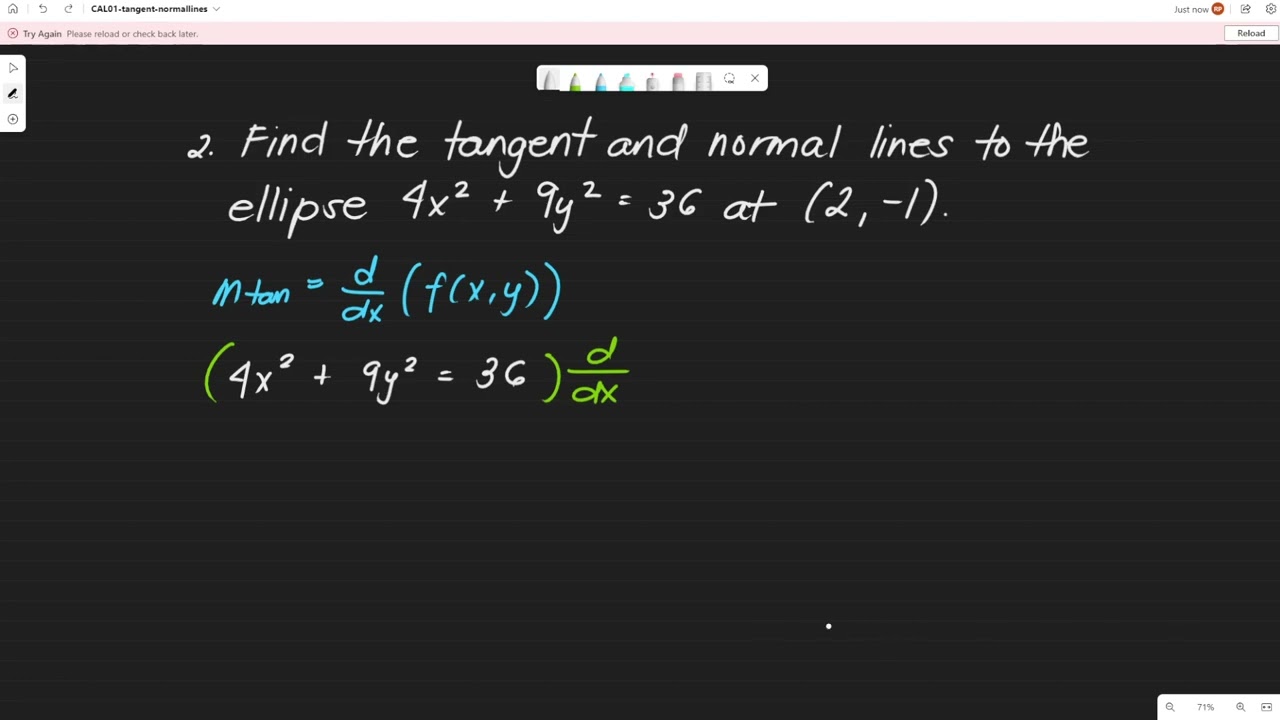
 hot wing
how do I start solving this?
 obtuse pebbleBOT
hot wing
how do I start solving this?
hot wing
obtuse pebbleBOT
hot wing
how do I start solving this?
hot wing
when getting the tangent line of an equation I know to get the m first
which is the d/dx (equation) | x=x_'
but in this case I was not given a coordinate
 obtuse pebbleBOT
@hot wing Has your question been resolved?
hot wing
<@&286206848099549185>
 fluid holly
hmmm,have u ever thought to use geometric knowledge or the question isn't allow u to do that?
hot wing
fluid holly
hmmm,have u ever thought to use geometric knowledge or the question isn't allow ...
I have no geometric knowledge

let me send what I have rn
fluid holly
hot wing
I have no geometric knowledge
anyway,all tangent line of one circle (x-a)^2+(y-b)^2=r^2 can be written as cosθ(x-a)+sinθ(y-b)=r^2
hot wing
 fluid holly
u can use....some way to prove that and figure out the property of θ
hot wing
I think that's going too far from our lesson
fluid holly
hot wing
I think that's going too far from our lesson
i mean,u can use this formula to solve this
hot wing
having that formula I still don't know how to use it
fluid holly
or u can just write a line like 2x-y=k and seeing k as an unknown parameter
and use the formula to calculate the distance between point and line,make it the radius of this circle,and solve that equation
have u learnt analytic geometry?
hot wing
no I think
fluid holly
oh
hot wing
I'm in calculus rn
fluid holly
all right
hot wing
this is my reference video
the prof gave us example on how to get the tangent
and working with parallel and implicit
but not all combined
hot wing
fluid holly
i don't know ur learning calculus
oh are you learning calculus?
fluid holly
yes
hot wing
ocakes
fluid holly
but I'm kinda confused
hot wing
on what tho
fluid holly
isn't analytic geometry the content of pre-calculus?
fluid holly
ok
fluid holly
oh wait
hot wing
I got the same with uyou
fluid holly
hold up
fluid holly
fluid holly
the slope of these two tangent line is -2,not 2


 uneven palm


 subtle sinew