#help-10
1 messages · Page 240 of 1
 cosmic cliff
 obtuse pebbleBOT
cosmic cliff
What’s the proof for the divisibility rule for 3?(that a number is divisible by ...
cosmic cliff
obtuse pebbleBOT
cosmic cliff
What’s the proof for the divisibility rule for 3?(that a number is divisible by ...
cosmic cliff
“In base 10” means like, if the number is 1532=1000.1 + 100.5 + 10.3 + 2?
 elfin burrow
yes
cosmic cliff
Oh so it’s like
10, 100, 1000 etc are always not divisible by 3(due to them always leaving a remainder), so what divisibility by 3 in this case relies on are the digits left?(in this case 1, 5, 3, 2)?
elfin burrow
cosmic cliff
10, 100, 1000 etc are always not divisible by 3(due to them always leaving a rem...
yes, but more specifically 10, 100, 1000 all have a residue of 1 modulo 3
cosmic cliff
Yes but why is that important?
As in, why do we care what the remainder is? Isn’t it enough that there is some remainder?
*when divided by 3
Oh I think I kinda get it
And then when we’re left with just the digits, why exactly does adding them up give us the result?
elfin burrow
cosmic cliff
As in, why do we care what the remainder is? Isn’t it enough that there is *some...
did you see the link
cosmic cliff
Is it because it’d usually be 1000.1/3 + 100.5/3 + 10.3/3 + 2/3 but since we can now neglect the 10,100, 1000, we’re left with just 1/3 + 5/3 + 3/3 + 2/3 which equals (1+5+3+2)/3?
cosmic cliff
elfin burrow
did you see the link
Oh shoot yeah, my bad for not seeing the message immediately
elfin burrow
$$N = a_k \cdot 10^k + a_{k-1} \cdot 10^{k-1} + \cdots + a_1 \cdot 10^1 + a_0 \cdot 10^0$$ Noting that $10 \equiv 1 \pmod 3 \implies 10^k \equiv 1^k \equiv 1 \pmod 3$, we get
\begin{align*}
N &\equiv a_k 1^k + a_{k-1} 1^{k-1} + \cdots + a_1 1^1 + a_0 \
&\equiv a_k + a_{k-1} + \cdots + a_1 + a_0 \pmod{3}
\end{align*}
cosmic cliff
Yeah thanks
elfin burrow
so adding up the digits gives you the residue of N modulo 3
 warm shaleBOT
tushar
 obtuse pebbleBOT
@cosmic cliff Has your question been resolved?
Channel closed
Closed by @cosmic cliff
Use .reopen if this was a mistake.
 Available help channel!
Send your question here to claim the channel.
Remember:
• Ask your math question in a clear, concise manner.
• Show your work, and if possible, explain where you are stuck.
• After 15 minutes, feel free to ping <@&286206848099549185>.
• Type the command .close to free the channel when you're done.
• Be polite and have a nice day!
Read #❓how-to-get-help for further information on how to ask a good question, and about conduct in the question channels.
 soft pond
hey, i need help
 obtuse pebbleBOT
soft pond
hey, i need help
soft pond
obtuse pebbleBOT
soft pond
hey, i need help
soft pond
It says that i have to rewrite the following expressions into a product of 2 2-led quantities.
The one on top is an example
 polar fossil
do you understand that example?
polar fossil
do you understand how to go the other way, from (x-3)(x+3) to x²-9?
soft pond
yes
polar fossil
okay. try changing that 3 for something else, like 4. What do you get?
so what happens if you do (x-4)(x+4)
soft pond
x²-16
polar fossil
yep, do you see the pattern? if not, try 5
soft pond
So from what I understand right now is that the answer to number 1) is (x-1)(x+1)?
polar fossil
yep!
this is called difference of perfect squares because you have something of the form a² - b²
obtuse pebbleBOT
Channel closed
Closed by @soft pond
Use .reopen if this was a mistake.
Available help channel!
Send your question here to claim the channel.
Remember:
• Ask your math question in a clear, concise manner.
• Show your work, and if possible, explain where you are stuck.
• After 15 minutes, feel free to ping <@&286206848099549185>.
• Type the command .close to free the channel when you're done.
• Be polite and have a nice day!
Read #❓how-to-get-help for further information on how to ask a good question, and about conduct in the question channels.
 smoky solar
not entirely sure how to divide this properly... anyone?
 obtuse pebbleBOT
smoky solar
not entirely sure how to divide this properly... anyone?
obtuse pebbleBOT
smoky solar
not entirely sure how to divide this properly... anyone?
 harsh remnant
Have you heard of long division
harsh remnant
Then let's apply it here
 nocturne minnow
smoky solar
not entirely sure how to divide this properly... anyone?
nocturne minnow
smoky solar
not entirely sure how to divide this properly... anyone?
This is a more intense verison of long division, aka polynomial long division
 undone quartz
smoky solar
not entirely sure how to divide this properly... anyone?
undone quartz
smoky solar
not entirely sure how to divide this properly... anyone?

synthetic division is much easier and simpler to use
nocturne minnow
undone quartz
You understand that synthetic division is a shortcut to long division, right?
They should learn long division first, before getting into synthetic division
obtuse pebbleBOT
@smoky solar Has your question been resolved?
undone quartz

More resources available at www.misterwootube.com
obtuse pebbleBOT
Channel closed
Closed due to timeout
Use .reopen if this was a mistake.
Available help channel!
Send your question here to claim the channel.
Remember:
• Ask your math question in a clear, concise manner.
• Show your work, and if possible, explain where you are stuck.
• After 15 minutes, feel free to ping <@&286206848099549185>.
• Type the command .close to free the channel when you're done.
• Be polite and have a nice day!
Read #❓how-to-get-help for further information on how to ask a good question, and about conduct in the question channels.
 torn nimbus
Hi
obtuse pebbleBOT
torn nimbus
Hi
torn nimbus
I I want a help
 teal turret
send ur question
 errant lark

harsh remnant
Ask away
 versed stratus
torn nimbus
I I want a help
versed stratus
torn nimbus
I I want a help
Ask, and you shall receive help from someone
obtuse pebbleBOT
@torn nimbus Has your question been resolved?
obtuse pebbleBOT
Channel closed
Closed due to timeout
Use .reopen if this was a mistake.
Available help channel!
Send your question here to claim the channel.
Remember:
• Ask your math question in a clear, concise manner.
• Show your work, and if possible, explain where you are stuck.
• After 15 minutes, feel free to ping <@&286206848099549185>.
• Type the command .close to free the channel when you're done.
• Be polite and have a nice day!
Read #❓how-to-get-help for further information on how to ask a good question, and about conduct in the question channels.
 vestal pawn
Soo i'm making a game and it has some six sided dice that two players roll. Each dice has 4 results of A and 2 results of B. Each result of B cancels one A and vice versa. Player One is trying to roll As and has a 4/6 chance to roll an A on each dice. Player Two is trying to roll Bs and has 2/6 change to roll a B. If all the dice would cancel out (2 As and 2 Bs) Player Two rolling Bs wins. How do you calculate the probability of player A winning with 4 (or n) amount of dice. With one or two dice it seem doable to calculate by hand. But the game rolls 4 dice and i have no idea how to do it...
obtuse pebbleBOT
vestal pawn
Soo i'm making a game and it has some six sided dice that two players roll. Each...
@vestal pawn Has your question been resolved?
obtuse pebbleBOT
@vestal pawn Has your question been resolved?
 gilded needle
vestal pawn
Soo i'm making a game and it has some six sided dice that two players roll. Each...
gilded needle
vestal pawn
Soo i'm making a game and it has some six sided dice that two players roll. Each...
there may be a short cut, but the brute force approach would be something like
Let $A_1$ = number of $A$'s rolled by player $1$;
Let $B_2$ = number of $B$'s rolled by player $2$;
Player $A$ wins if $A_1 > B_2$.
Then:
$P(A_1 > B_2) = \sum_{k=0}^4 P(A_1 > B_2 | B_2 = k)P(B_2 = k) = \sum_{k=0}^4 P(A_1 > k)P(B_2 = k)$
warm shaleBOT
Bungo
 obtuse pebbleBOT
@vestal pawn Has your question been resolved?
Channel closed
Closed by @vestal pawn
Use .reopen if this was a mistake.
obtuse pebbleBOT
Available help channel!
Send your question here to claim the channel.
Remember:
• Ask your math question in a clear, concise manner.
• Show your work, and if possible, explain where you are stuck.
• After 15 minutes, feel free to ping <@&286206848099549185>.
• Type the command .close to free the channel when you're done.
• Be polite and have a nice day!
Read #❓how-to-get-help for further information on how to ask a good question, and about conduct in the question channels.
 timid silo
can anyone solve this 1
11
1000
+
859
1000
2:
145
1000
+
170
1000
3:
1
56
1000
+
581
1000
4:
175
1000
+
806
1000
5:
316
1000
+
816
1000
6:
735
1000
+
958
1000
7:
860
1000
+
914
1000
8:
1
164
1000
- 1
239
1000
=
9:
232
1000
- 1
12
1000
=
10:
475
1000
+
107
1000
obtuse pebbleBOT
timid silo
can anyone solve this 1
11
1000
+
859
1000
=
2:
145
1000
+
170
10...
Please don't occupy multiple help channels.
obtuse pebbleBOT
Channel closed
Closed by @frosty river
Use .reopen if this was a mistake.
Available help channel!
Send your question here to claim the channel.
Remember:
• Ask your math question in a clear, concise manner.
• Show your work, and if possible, explain where you are stuck.
• After 15 minutes, feel free to ping <@&286206848099549185>.
• Type the command .close to free the channel when you're done.
• Be polite and have a nice day!
Read #❓how-to-get-help for further information on how to ask a good question, and about conduct in the question channels.
 inland thicket
 obtuse pebbleBOT
inland thicket
inland thicket
obtuse pebbleBOT
inland thicket
inland thicket
guys whot is this
mistake?
they put 6 instead of 4?
divide all by 6
how is it possible they make such a enormous mistake?
 tardy epoch
yea there's a mistake
inland thicket
😮
 fossil crag
I think the correct final line is $L(y) = \Big( \frac{y}{4} \Big)⁶$
warm shaleBOT
rafilou2003
 fossil crag
Based on what is above
obtuse pebbleBOT
@inland thicket Has your question been resolved?
inland thicket
‼️
obtuse pebbleBOT
Channel closed
Closed by @inland thicket
Use .reopen if this was a mistake.
Available help channel!
Send your question here to claim the channel.
Remember:
• Ask your math question in a clear, concise manner.
• Show your work, and if possible, explain where you are stuck.
• After 15 minutes, feel free to ping <@&286206848099549185>.
• Type the command .close to free the channel when you're done.
• Be polite and have a nice day!
Read #❓how-to-get-help for further information on how to ask a good question, and about conduct in the question channels.
 gleaming bolt
how to solve this: Find all functions f: R→R such that
f(x + y) + f(x − y) = f(x) + 6xy^2 + x^3
for any real x, y.
obtuse pebbleBOT
gleaming bolt
how to solve this: Find all functions f: R→R such that
f(x + y) + f(x − y) = f(...
gleaming bolt
i tried an i find f(0) =0 replacing x and y for 0
and f(x)=x^3
but i dont know how to atack more the problem
tardy epoch
Did you do y = x
gleaming bolt
yes but i dont see clearly where that goes
 thin mirage
a
 warm canopy
gleaming bolt
and f(x)=x^3
warm canopy
gleaming bolt
and f(x)=x^3
this is just it no?
gleaming bolt
yes?
i really dont know where functional ecuations ends
just whit that x i can say i find it for every x and y?
warm canopy
the only function that satisfies the y=0 equation is x^3, so thats the only function you need to check
gleaming bolt
so are the y's negligible for all real x's?
 frosty river
What @warm canopy says is that the condition implies f(x)=x³. But you need to check if f(x)=x³ implies the condition.
gleaming bolt
oooh
warm canopy
yeah checking y=0 tells you that the only possible function is x^3
frosty river
. close together
obtuse pebbleBOT
Channel closed
Closed by @gleaming bolt
Use .reopen if this was a mistake.
Available help channel!
Send your question here to claim the channel.
Remember:
• Ask your math question in a clear, concise manner.
• Show your work, and if possible, explain where you are stuck.
• After 15 minutes, feel free to ping <@&286206848099549185>.
• Type the command .close to free the channel when you're done.
• Be polite and have a nice day!
Read #❓how-to-get-help for further information on how to ask a good question, and about conduct in the question channels.
 kindred lily
Anyone need help with basic algebra?
obtuse pebbleBOT
kindred lily
Anyone need help with basic algebra?
obtuse pebbleBOT
Channel closed
Closed by @forest sinew
Use .reopen if this was a mistake.
kindred lily
,reopen
 forest sinew
its with a period
kindred lily
.reopen
obtuse pebbleBOT
✅
forest sinew
these channels are for people looking for help
just watch the channels if you wanna help ppl
kindred lily
?
 frosty river
.close
obtuse pebbleBOT
Channel closed
Closed by @frosty river
Use .reopen if this was a mistake.
kindred lily
.close
forest sinew

obtuse pebbleBOT
Available help channel!
Send your question here to claim the channel.
Remember:
• Ask your math question in a clear, concise manner.
• Show your work, and if possible, explain where you are stuck.
• After 15 minutes, feel free to ping <@&286206848099549185>.
• Type the command .close to free the channel when you're done.
• Be polite and have a nice day!
Read #❓how-to-get-help for further information on how to ask a good question, and about conduct in the question channels.
gleaming bolt
Find all functions f: R{0}→R such that
xf(x) + 2xf(− x) =− 1
for all reals x≠0.
obtuse pebbleBOT
gleaming bolt
Find all functions f: R\{0}→R such that
xf(x) + 2xf(− x) =− 1
for all reals x≠0...
gleaming bolt
im having some problems with the algebra i think
i tried replaceing x=x^2
and then x^2 again for y or x
 brave bramble
gleaming bolt
brave bramble
gleaming bolt
ill try
wow that change feels like magic
jajajajajaj crazy
thankssssss
.close
obtuse pebbleBOT
Channel closed
Closed by @gleaming bolt
Use .reopen if this was a mistake.
Available help channel!
Send your question here to claim the channel.
Remember:
• Ask your math question in a clear, concise manner.
• Show your work, and if possible, explain where you are stuck.
• After 15 minutes, feel free to ping <@&286206848099549185>.
• Type the command .close to free the channel when you're done.
• Be polite and have a nice day!
Read #❓how-to-get-help for further information on how to ask a good question, and about conduct in the question channels.
 hollow magnet
hello how does this work?
 obtuse pebbleBOT
hollow magnet
hello how does this work?
nocturne minnow
hollow magnet
hello how does this work?
obtuse pebbleBOT
hollow magnet
hello how does this work?
nocturne minnow
hollow magnet
hello how does this work?
What exactly are you confused about?
hollow magnet
how did they get X=2
nocturne minnow
Do you see the steps that got there?
hollow magnet
I do but I don't understand
undone quartz
hollow magnet
I do but I don't understand
we want to find the value of x alone here
but he has a coefficient 3 with it and a 6 being added to it
we want to isolate that x so that hes alone on the L.H.S (Left Hand Side)
nocturne minnow
hollow magnet
I do but I don't understand
Do you know PEMDAS?
undone quartz
nocturne minnow
Do you know PEMDAS?
or BODMAS
hollow magnet
nocturne minnow
Do you know PEMDAS?
Im not familiar with algebra
nocturne minnow
Have you heard of order of operations?
hollow magnet
I took it in high school but I dont remember much
hollow magnet
nocturne minnow
Have you heard of order of operations?
I have
nocturne minnow
Then you should know PEMDAS/BODMAS
Parentheses, Exponents, Multiplication, Division, Addition, Subtraction
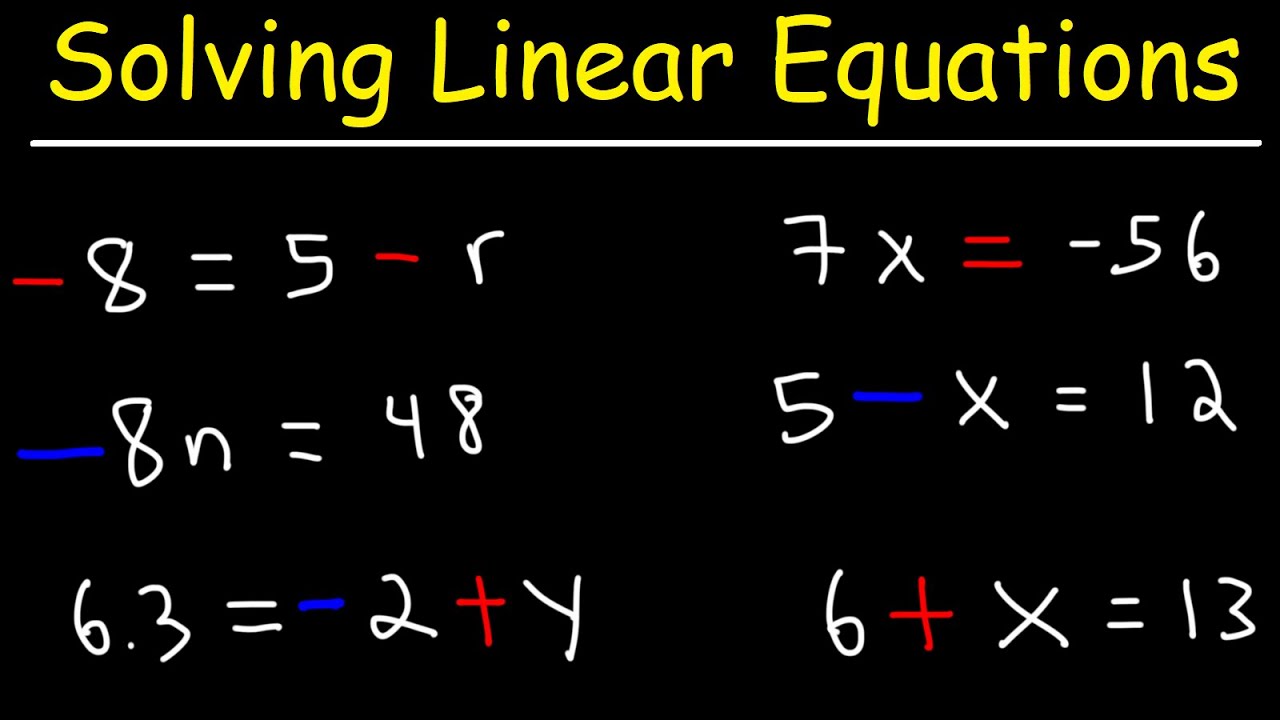
This algebra video explains how to solve linear equations. It contains plenty of examples and practice problems.
Get The Full 1 Hour Video on Patreon:
https://www.patreon.com/MathScienceTutor
Direct Link to The Full Video:
https://bit.ly/3jxdfbE
Algebra Review:
https://www.video-tutor.net/algebra-for-beginners-basic-introduction.html
Ful...
undone quartz
nocturne minnow
Then you should know PEMDAS/BODMAS
Parentheses, Exponents, Multiplication, Divis...
theres a debate that PEMDAS fails on some cases and BODMAS is superior but I dont wanna get him into that
hollow magnet
I never was a math person
nocturne minnow
nocturne minnow
And I suggest this
https://www.youtube.com/watch?v=7DPWeBszNSM&ab_channel=TheOrg...
.
undone quartz
hollow magnet
hello how does this work?
well for your problem you just want to isolate x on the left side alone, how can you do that
nocturne minnow
I still suggest that video if you are having trouble understanding
hollow magnet
Im currently watching it
nocturne minnow
hollow magnet
I never was a math person
The reason why I brought up order of operations, is that when you are simplifying expressions, you apply PEMDAS, but if you were solving for a variable, you do the reverse of PEMDAS, in that case SADMEP
hollow magnet
is there a voice channel to talk about this?
nocturne minnow
No
 nocturne minnow
Did you watch that video?
hollow magnet
It looks like she took the 6 and subtracted it from its self and the 12
then she moved th 3X down
hollow magnet
nocturne minnow
Did you watch that video?
Some parts of it
hollow magnet
is it okay for me to take 20 minutes of your time?
nocturne minnow
Wdym
hollow magnet
the video is 20 minutes
nocturne minnow
Okay and?
There are other people on this server who can help too, you don't need specifically me
hollow magnet
okay sorry
nocturne minnow
hollow magnet
the video is 20 minutes
Watch it then come back if you still don't understand what your teacher did
nocturne minnow
hollow magnet
well thank you
Do you understand now?
obtuse pebbleBOT
@hollow magnet Has your question been resolved?
obtuse pebbleBOT
Channel closed
Closed due to timeout
Use .reopen if this was a mistake.
obtuse pebbleBOT
Available help channel!
Send your question here to claim the channel.
Remember:
• Ask your math question in a clear, concise manner.
• Show your work, and if possible, explain where you are stuck.
• After 15 minutes, feel free to ping <@&286206848099549185>.
• Type the command .close to free the channel when you're done.
• Be polite and have a nice day!
Read #❓how-to-get-help for further information on how to ask a good question, and about conduct in the question channels.
 sage dagger
What does it mean when it asks for the equation of a tangent at ** insert x,y**
obtuse pebbleBOT
sage dagger
What does it mean when it asks for the equation of a tangent at ** insert x,y**
sage dagger
I forgot so I take the derivative
use y-y1=m(x-x1)
Then substitute my x and y points right
 brazen viper
Yup, exactly.
It might be a bit tricky to find dy/dx (and hence m) if the equation is implicit, but that's how you approach the problem
obtuse pebbleBOT
Channel closed
Closed by @sage dagger
Use .reopen if this was a mistake.
Available help channel!
Send your question here to claim the channel.
Remember:
• Ask your math question in a clear, concise manner.
• Show your work, and if possible, explain where you are stuck.
• After 15 minutes, feel free to ping <@&286206848099549185>.
• Type the command .close to free the channel when you're done.
• Be polite and have a nice day!
Read #❓how-to-get-help for further information on how to ask a good question, and about conduct in the question channels.
 sick fulcrum
plz help
 obtuse pebbleBOT
sick fulcrum
plz help
obtuse pebbleBOT
sick fulcrum
plz help
 glacial obsidian
!status
obtuse pebbleBOT
What step are you on?
1. I don't know where to begin
2. I have begun but got stuck midway
3. I got an answer but I'm told it's wrong
4. I got an answer and would like my work checked
5. I have a question about someone else's worked solution
6. None of the above
Well, first, what is the period of the function?
timid silo
nocturne minnow
You understand that synthetic division is a shortcut to long division, right?
You're so wrong
timid silo
sick fulcrum
plz help
What is x
I believe Q2 is asking you to transform tan(x) in a way that you get the below graph
You do know how function transformations work right?
obtuse pebbleBOT
@sick fulcrum Has your question been resolved?
obtuse pebbleBOT
Channel closed
Closed due to timeout
Use .reopen if this was a mistake.
Available help channel!
Send your question here to claim the channel.
Remember:
• Ask your math question in a clear, concise manner.
• Show your work, and if possible, explain where you are stuck.
• After 15 minutes, feel free to ping <@&286206848099549185>.
• Type the command .close to free the channel when you're done.
• Be polite and have a nice day!
Read #❓how-to-get-help for further information on how to ask a good question, and about conduct in the question channels.
 viscid tulip
I was trying to calculate estimated progress possible to achieve in event in one game. Basically u gain some currency during event, and u can buy 3 different types of items with it. Lets call them **bronze **/ **silver **/ gold. Each type of item has 5 levels, and can be obtained by opening a container that costs 50 for bronze, 70 for silver and 100 for gold. Getting one of 26 combinations of items allows u to open the chest and get some reward. The thing is that container has items of 4 levels with following chances to get:
lvl | chance
1 | 58%
2 | 24%
3 | 12%
4 | 6%
- U can merge two items of lvl-1 to get one item of lvl-2, or two items of lvl-2 to get one item of lvl-3 and so on, but u can not divide
lvl Nitem into twolvl N-1items. - lvl-5 can not be obtained from container, only by merging two lvl-4 items. So like lvl-4 is 8 lvl-1 merged, or 4 lvl-2 merged, or 2 lvl-3 merged.
- Whenever u open the container and get an item, that's not the one u need for combination, it just stays on some board and can be used later for another combination.
I tried to calculate the cost of each item lvl and came up with this:
1x0.58 + 2x0.24 + 4x0.12 + 8x0.06 = 2.02 level 1 items each turn at a cost of 50 for bronze, so with an effective cost of 50/2.02 = 24.75 per lvl-1 item, with each higher level being double the effective cost of the previous level. But im not sure about it and think i missed something
obtuse pebbleBOT
viscid tulip
I was trying to calculate estimated progress possible to achieve in event in one...
obtuse pebbleBOT
@viscid tulip Has your question been resolved?
viscid tulip
<@&286206848099549185>
obtuse pebbleBOT
@viscid tulip Has your question been resolved?
obtuse pebbleBOT
@viscid tulip Has your question been resolved?
brazen viper
@viscid tulip as far as your analysis is concerned, as long as things actually are as presented it seems solid, I just have a question about the differences between the bronze silver and gold containers, which you mentioned briefly but then glossed over.
obtuse pebbleBOT
Channel closed
Closed due to timeout
Use .reopen if this was a mistake.
Available help channel!
Send your question here to claim the channel.
Remember:
• Ask your math question in a clear, concise manner.
• Show your work, and if possible, explain where you are stuck.
• After 15 minutes, feel free to ping <@&286206848099549185>.
• Type the command .close to free the channel when you're done.
• Be polite and have a nice day!
Read #❓how-to-get-help for further information on how to ask a good question, and about conduct in the question channels.
 upbeat valley
for this question im trying to apply extreme value theorem
 upbeat valley
by defining a function $g$ with same rule as $f$ but different domain
warm shaleBOT
TheWhiteShadow
 upbeat valley
so let $k>0$ such that $f(x) \geq f(0)$ for all $|x| > k$
warm shaleBOT
TheWhiteShadow
 warm shaleBOT
TheWhiteShadow

 royal basin
upbeat valley
for this question im trying to apply extreme value theorem
royal basin
upbeat valley
for this question im trying to apply extreme value theorem
you want to show that f attains its maximum value
upbeat valley
upbeat valley
so let $k>0$ such that $f(x) \geq f(0)$ for all $|x| > k$
this works since f converges to 0
royal basin
ok yeah sure what you did works
you could have also written g : [-1,1] -> R given by g(x) = f(tanh^-1(x)) for x in (-1,1) and g(±1) = 0
also you want |f(x)| <= f(0) and to assume wlog that f(0)>0
upbeat valley
wait how does that work?
where did tanh come from?
also is that phrase "since $f$ converges to $0$ from both side" correct?
warm shaleBOT
TheWhiteShadow
 upbeat valley
warm shale
**TheWhiteShadow**
upbeat valley
warm shale
**TheWhiteShadow**
for this argument
obtuse pebbleBOT
@upbeat valley Has your question been resolved?
obtuse pebbleBOT
@upbeat valley Has your question been resolved?
obtuse pebbleBOT
@upbeat valley Has your question been resolved?
obtuse pebbleBOT
Channel closed
Closed due to timeout
Use .reopen if this was a mistake.
upbeat valley
.reopen
obtuse pebbleBOT
✅
 obtuse pebbleBOT
@upbeat valley Has your question been resolved?
obtuse pebbleBOT
Channel closed
Closed due to timeout
Use .reopen if this was a mistake.
Available help channel!
Send your question here to claim the channel.
Remember:
• Ask your math question in a clear, concise manner.
• Show your work, and if possible, explain where you are stuck.
• After 15 minutes, feel free to ping <@&286206848099549185>.
• Type the command .close to free the channel when you're done.
• Be polite and have a nice day!
Read #❓how-to-get-help for further information on how to ask a good question, and about conduct in the question channels.
timid silo
 obtuse pebbleBOT
timid silo
royal basin
obtuse pebbleBOT
timid silo
royal basin
,rccw
warm shaleBOT
 obtuse pebbleBOT
@timid silo Has your question been resolved?
timid silo
<@&286206848099549185>
 wet moss
you want to graph y = sqrt(4-x^2)?
timid silo
Yeah
wet moss
try and rearrange to get the x and y on the same side
timid silo
Y^2 + X^2 - 4 = 0
wet moss
put the 4 onto the other side
wet moss
you dont need to do that here
timid silo
Oh ok
wet moss
but that equation is in the form of some sort of shape
wet moss
you added in a 2xy randomly
wet moss
that would give x^2 - y^2 instead of x^2 + y^2
are you familiar with the standard equation of a circle?
timid silo
wet moss
are you familiar with the standard equation of a circle?
X^2+y^2=1 ?
wet moss
that would be a circle, with radius 1
timid silo
Oh
wet moss
at the beginning you squared both sides so it would give the full circle
remember that a square root is a function and only outputs positive values
wet moss
np
obtuse pebbleBOT
Channel closed
Closed by @silent basin
Use .reopen if this was a mistake.
Available help channel!
Send your question here to claim the channel.
Remember:
• Ask your math question in a clear, concise manner.
• Show your work, and if possible, explain where you are stuck.
• After 15 minutes, feel free to ping <@&286206848099549185>.
• Type the command .close to free the channel when you're done.
• Be polite and have a nice day!
Read #❓how-to-get-help for further information on how to ask a good question, and about conduct in the question channels.
 fossil spoke
 obtuse pebbleBOT
fossil spoke
obtuse pebbleBOT
fossil spoke
What step are you on?
1. I don't know where to begin
2. I have begun but got stuck midway
3. I got an answer but I'm told it's wrong
4. I got an answer and would like my work checked
5. I have a question about someone else's worked solution
6. None of the above
not sure how to expand a fractional binomial
 nimble ledge
try multiplying by the conjugate of the second thing in the denominator
fossil spoke
whats the conjugate
nimble ledge
$\sqrt[4]{k}-\sqrt[4]{k+1}$
warm shaleBOT
Toblerone
 obtuse pebbleBOT
Channel closed
Closed by @fossil spoke
Use .reopen if this was a mistake.
Available help channel!
Send your question here to claim the channel.
Remember:
• Ask your math question in a clear, concise manner.
• Show your work, and if possible, explain where you are stuck.
• After 15 minutes, feel free to ping <@&286206848099549185>.
• Type the command .close to free the channel when you're done.
• Be polite and have a nice day!
Read #❓how-to-get-help for further information on how to ask a good question, and about conduct in the question channels.
 raw hinge
Hi, just wanna make sure, lets say I have $v = x^2 + 1$ and I want to get the speed at $x = 2m$ also I know that then $v = 5\frac{m}{s}$ so can I use it that accelaration is $\frac{\Delta v}{\Delta t}$ and that velocity is $\frac{\Delta x}{\Delta t}$ and like do two different deritives to get it?
obtuse pebbleBOT
raw hinge
Hi, just wanna make sure, lets say I have $v = x^2 + 1$ and I want to get the sp...
warm shaleBOT
Shachar
 raw hinge
something like $a = \frac{\Delta v}{\Delta t} \Rightarrow a = 2x\frac{\Delta x}{\Delta t} \Rightarrow a = 2xv$
warm shaleBOT
Shachar

 night igloo
It's called the chain rule, but yes, it seems legit
obtuse pebbleBOT
@raw hinge Has your question been resolved?
obtuse pebbleBOT
Channel closed
Closed by @raw hinge
Use .reopen if this was a mistake.
Available help channel!
Send your question here to claim the channel.
Remember:
• Ask your math question in a clear, concise manner.
• Show your work, and if possible, explain where you are stuck.
• After 15 minutes, feel free to ping <@&286206848099549185>.
• Type the command .close to free the channel when you're done.
• Be polite and have a nice day!
Read #❓how-to-get-help for further information on how to ask a good question, and about conduct in the question channels.
 timber pine
A 10-m long industrial ladder is leaning against a wall on a building site. The top of the ladder starts to slip down the wall at a rate of 0.5ms^-1. Determine how fast the foot of the ladder is moving along the ground when it is 6m from the wall
obtuse pebbleBOT
timber pine
A 10-m long industrial ladder is leaning against a wall on a building site. The ...
timber pine
i got 0.375ms^-1, but the answer is 0.667
obtuse pebbleBOT
Show your work, and if possible, explain where you are stuck.
timber pine
 timber pine
 trim portal
Did you plug in 6 to the dW/dL?
trim portal
Did you plug in 6 to the dW/dL?
6/8
trim portal
$\frac{dW}{dL}=\frac{L}{\sqrt{100-L^{2}}}$
warm shaleBOT
EmilyIsAlwaysRight
 trim portal
is this what you had?
trim portal
why 6 and why 8?
timber pine
W = 6, L = 8
trim portal
How did you calculate dW/dL
trim portal
timber pine
W = 6, L = 8
W/L isnt the same as dW/dL
you gotta calculate dW/dL first
find relation between W and L using pythagoras
and then calculate dW/dL
trim portal
timber pine
W = 6, L = 8
you are calculating dW/dL, so it might be better to express the relation as W = something something L
timber pine
oh
trim portal
so then you take d/dL of both sides and on the left side you will have dW/dL and on the right side you will just simply calculate derivative
timber pine
wait do i start with dW/dt = dW/dL * dL/dt?
trim portal
timber pine
wait do i start with dW/dt = dW/dL * dL/dt?
This is a good start, you are trying to find dW/dT and you know dL/dt
the issue is that you dont know dW/dL, so you need to calculate that
timber pine
yep
timber pine
mhm
trim portal
now you can either use implicit differentiation
or rearrange it to have W on one side and everything else on the other
you can choose either of those options
timber pine
So idifferentiate sqrt(100-L^2)?
trim portal
yep
timber pine
OHH
trim portal
and that will give you dW/dL
trim portal
yw
timber pine
.close
obtuse pebbleBOT
Channel closed
Closed by @timber pine
Use .reopen if this was a mistake.
Available help channel!
Send your question here to claim the channel.
Remember:
• Ask your math question in a clear, concise manner.
• Show your work, and if possible, explain where you are stuck.
• After 15 minutes, feel free to ping <@&286206848099549185>.
• Type the command .close to free the channel when you're done.
• Be polite and have a nice day!
Read #❓how-to-get-help for further information on how to ask a good question, and about conduct in the question channels.
 ornate stirrup
Can someone help me with b and c please?
 obtuse pebbleBOT
ornate stirrup
Can someone help me with b and c please?
obtuse pebbleBOT
ornate stirrup
Can someone help me with b and c please?
 steel parcel
ornate stirrup
Can someone help me with b and c please?
steel parcel
ornate stirrup
Can someone help me with b and c please?
there is symmetry around x=3
(2,7) -> (4,7)
(1,4) -> (5,4) etc
what can you then say about f(7)?
ornate stirrup
It’s x by 3?
steel parcel
wdym?
ornate stirrup
You multiply 3 and 7?
steel parcel
no
ornate stirrup
Then what can I do?
 ornate stirrup
Okay…
steel parcel
(2,7) is part of one of the horizontal lines which maps to the other side
ornate stirrup
Okay…
steel parcel

if (2,7) reflected across x = 3 yields (4,7)
and (1,4) reflected across x = 3 yields (3,4)
what can you say about (0, -1) when it is reflected across x = 3?
ornate stirrup
(0,1)
steel parcel
so when we are reflecting across x = ?, only the x values get changed
lemme explain it another way
let’s go back to (2,7)
because we are reflecting across x = 3, we know that it takes 1 unit to get to x = 3 from x = 2 (x value of (2,7))
does that seem fine so far?
if we are reflecting across x = 3, we will add 1 to x = 3 to get to the other side, therefore (4,7)
1 unit both sides

now for (1,4), it will take 2 units to get to x = 3 from x = 1 (x value of (1,4))
if we add 2 units to x = 3, we get 5
therefore (5, 4)
 ornate stirrup
So it would be 6,7
steel parcel
now let’s try doing (0, -1) again, if it takes ?? units to get to x = 3 from the x value of (0, -1) then
we therefore get (3 + ??, -1)
steel parcel
ornate stirrup
So it would be 6,7
close, it would be 6
oh sorry i didn’t see that the question said f(7) i thought it said f(6)
to find f(7) you can find the equation of the parabola:
if the turning point is at (3,8)
we can do y = a(x-3)^2 + 8
now let’s sub in a point to find a
(0, -1) is the easiest
-1 = a(-3)^2 + 8
-9 = 9a
therefore a = -1
therefore y = -(x-3)^2 + 8
to find f(7), we can simply evaluate y(7)
@ornate stirrup do you want to have a go
ornate stirrup
I’m in class now I can’t
steel parcel
ok have a go when you are free
obtuse pebbleBOT
@ornate stirrup Has your question been resolved?
obtuse pebbleBOT
Channel closed
Closed due to timeout
Use .reopen if this was a mistake.
Available help channel!
Send your question here to claim the channel.
Remember:
• Ask your math question in a clear, concise manner.
• Show your work, and if possible, explain where you are stuck.
• After 15 minutes, feel free to ping <@&286206848099549185>.
• Type the command .close to free the channel when you're done.
• Be polite and have a nice day!
Read #❓how-to-get-help for further information on how to ask a good question, and about conduct in the question channels.
 gusty bobcat
can someone solve this please
 obtuse pebbleBOT
gusty bobcat
can someone solve this please
obtuse pebbleBOT
gusty bobcat
can someone solve this please
 glossy basalt
did you consider telescoping?
obtuse pebbleBOT
@gusty bobcat Has your question been resolved?
Channel closed
Closed by @gusty bobcat
Use .reopen if this was a mistake.
Available help channel!
Send your question here to claim the channel.
Remember:
• Ask your math question in a clear, concise manner.
• Show your work, and if possible, explain where you are stuck.
• After 15 minutes, feel free to ping <@&286206848099549185>.
• Type the command .close to free the channel when you're done.
• Be polite and have a nice day!
Read #❓how-to-get-help for further information on how to ask a good question, and about conduct in the question channels.
 meager gale
im having trouble with this problem and problems of this type
 meager gale
:o hi riku
harsh remnant
Named and unnamed..?
meager gale
yea idk what thats about
i mean it doesnt have to be this specific problem this is just the one given to me, how do i do combinatorics with constraints
like
 hidden garnet
meager gale
:o hi riku
hidden garnet
meager gale
:o hi riku
hello 
meager gale
damn u green
hidden garnet
yes
meager gale
pika did u forgive me yet
meager gale
hidden garnet
yes
also are these types of problems HS level?
i never learned them with constraints
hidden garnet
kinda
I don't exactly get what naned unnamed means here but if you number the people it's different than not naming people
I don't exactly get how naming groups affect this
meager gale
lemme see if i can find a better one i was working on that is similar
but not a vague problem

like this one
2^n - 1 is the number of nonempty subsets
ig
so
1/5
uh
;-;
 compact shadow
meager gale
compact shadow
meager gale
$=\sum_{0 \leq a < b \leq 4}2^{2(b-a)-1}=\sum_{1 \leq r \leq 4}\sum_{0 \leq a,b \leq 4, b-a=r}2^{2(b-a)-1}=\sum_{1 \leq r \leq 4}(4-r+1)2^{2r-1}$
warm shaleBOT
Cogwheels of the mind
 obtuse pebbleBOT
@meager gale Has your question been resolved?
meager gale
;-;
compact shadow
I don’t know which part you still don’t understand
And for your original question:
Named: 12!/(3!)^4
Unnamed: named/4!
compact shadow
warm shale
**Cogwheels of the mind**
$=\frac{5}{2}(\frac{4^{n+1}-1}{4-1}-1)-\frac{4^{n}}{2(1-\frac{1}{4})}(n+1-\frac{1-(\frac{1}{4})^{n+1}}{1-\frac{1}{4}})$
warm shaleBOT
Cogwheels of the mind
 compact shadow
Plug in n=4
compact shadow
You get it or not
If no reply which part you don’t understand
I’ve never seen anyone whose problem is resolved by doing nothing
$=\sum_{0 \leq a < b \leq 4}2^{2(b-a)-1}=\sum_{1 \leq r \leq 4}\sum_{0 \leq a,b \leq 4, b-a=r}2^{2(b-a)-1}=\sum_{1 \leq r \leq 4}(4-r+1)2^{2r-1}=[\frac{5}{2}(\frac{4^{n+1}-1}{4-1}-1)-\frac{4^{n}}{2(1-\frac{1}{4})}(n+1-\frac{1-(\frac{1}{4})^{n+1}}{1-\frac{1}{4}})]_{n=4}$
warm shaleBOT
Cogwheels of the mind
 obtuse pebbleBOT
@meager gale Has your question been resolved?
Channel closed
Closed by @meager gale
Use .reopen if this was a mistake.
obtuse pebbleBOT
Available help channel!
Send your question here to claim the channel.
Remember:
• Ask your math question in a clear, concise manner.
• Show your work, and if possible, explain where you are stuck.
• After 15 minutes, feel free to ping <@&286206848099549185>.
• Type the command .close to free the channel when you're done.
• Be polite and have a nice day!
Read #❓how-to-get-help for further information on how to ask a good question, and about conduct in the question channels.
 barren nest
 obtuse pebbleBOT
barren nest
barren nest
obtuse pebbleBOT
barren nest
barren nest
I need help with the second problem. I can't find the general pattern of this series
 wet nebula
Very weird 😄
wet nebula
😮
 cinder lintel
But its
Inconsistent
Lmao
Ok its triplrts and the fractions value is increasing
wet nebula
But why 15,17 is there and not 8,17 then?
Because if 3,5 and 4,5 are there, one could argue that 8,17 should be there too
barren nest
How do you write the general term
nimble ledge
is part a relevant?
barren nest
How can part a be related it's a completely different topic
nimble ledge
idk, you haven't shown it in your screenshot
barren nest
The main problem is "test the convergence of the series .." that i need help with
Only that
nimble ledge
I was just making sure that we arent missing any context
barren nest
We aren't missing any
 hot sonnet
I've noticed that
den = num + 1
when num is even
den = num + 2
when num is odd
Anyway, we still don't know the sequence of numerators
 fiery olive
Can you show just to make sure? This looks so weird that these two questions are part of the same letter (b)
hot sonnet
And probably it isn't enough with the info we have
nimble ledge
hot sonnet
I've noticed that
den = num + 1
when num is even
den = num + 2
when num is odd
spotting a pattern from a sample size of two is a bit dodgy
hot sonnet
Yes
There's not enough info
probably
Yeah it could be anything
I've seen at least 2 patterns now that make the sequence
barren nest
The whole question paper

See if you can find any correlation between that and another problems
nimble ledge
$\sum\frac{n^2-1}{n^2+1} x^n$
warm shaleBOT
Toblerone
 barren nest
Hmmmm this makes sensee
Ok now going further what test should i apply
Think i got it. Thanks for the help
.close
obtuse pebbleBOT
Channel closed
Closed by @barren nest
Use .reopen if this was a mistake.
Available help channel!
Send your question here to claim the channel.
Remember:
• Ask your math question in a clear, concise manner.
• Show your work, and if possible, explain where you are stuck.
• After 15 minutes, feel free to ping <@&286206848099549185>.
• Type the command .close to free the channel when you're done.
• Be polite and have a nice day!
Read #❓how-to-get-help for further information on how to ask a good question, and about conduct in the question channels.
 heavy tulip
19x - 13x * 34x + 124x
obtuse pebbleBOT
heavy tulip
19x - 13x * 34x + 124x
 ripe terrace
Also don't use x for multiplication
 shadow tangle
use " * " instead
harsh remnant
!status
obtuse pebbleBOT
What step are you on?
1. I don't know where to begin
2. I have begun but got stuck midway
3. I got an answer but I'm told it's wrong
4. I got an answer and would like my work checked
5. I have a question about someone else's worked solution
6. None of the above
1
shadow tangle
shadow tangle
what are you supposed to do with that?
.
im just going to go off of the basis that your simplifying, you can use the order of operations
heavy tulip
?
shadow tangle
do you know what the order of operations are?
heavy tulip
Sadly no.
shadow tangle
ok, the order of operations dictate in which order you do standard operations like +, -, *, and / ("/" means divide btw)
P-parenthesis
E-exponents
M-multiplication (multiplication and division should be done from left to right)
D-division
A-addition
S-subtraction
heavy tulip
So how can that help me in this problem?
shadow tangle
we'll what operation we do first
in this case we shall multiply first because multiplications comes before addition/subtraction
heavy tulip
Alright.
obtuse pebbleBOT
@heavy tulip Has your question been resolved?
obtuse pebbleBOT
Channel closed
Closed due to timeout
Use .reopen if this was a mistake.
Available help channel!
Send your question here to claim the channel.
Remember:
• Ask your math question in a clear, concise manner.
• Show your work, and if possible, explain where you are stuck.
• After 15 minutes, feel free to ping <@&286206848099549185>.
• Type the command .close to free the channel when you're done.
• Be polite and have a nice day!
Read #❓how-to-get-help for further information on how to ask a good question, and about conduct in the question channels.
 dire peak
hello ppl. i have a very tiny question; what kind of formulas is this? like the name of them so i can learn about them.
 obtuse pebbleBOT
dire peak
hello ppl. i have a very tiny question; what kind of formulas is this? like the ...
tardy epoch
dire peak
hello ppl. i have a very tiny question; what kind of formulas is this? like the ...
obtuse pebbleBOT
dire peak
hello ppl. i have a very tiny question; what kind of formulas is this? like the ...
tardy epoch
dire peak
hello ppl. i have a very tiny question; what kind of formulas is this? like the ...
In mathematics, a norm is a function from a real or complex vector space to the non-negative real numbers that behaves in certain ways like the distance from the origin: it commutes with scaling, obeys a form of the triangle inequality, and is zero only at the origin. In particular, the Euclidean distance in a Euclidean space is defined by a nor...
dire peak
tardy epoch
https://en.wikipedia.org/wiki/Norm_(mathematics)
norm? that's it?
 hollow dove
that's specifically the Euclidean norm, or L2 norm
tardy epoch
that's what the wiki says yes
hollow dove
but that's the type of function yes
 solar trellis
dire peak
hello ppl. i have a very tiny question; what kind of formulas is this? like the ...
solar trellis
dire peak
hello ppl. i have a very tiny question; what kind of formulas is this? like the ...
this is a definition btw not rlly a "formula"
dire peak
solar trellis
this is a definition btw not rlly a "formula"
ouh
then the formula is when i fill the symbols with their values?
solar trellis
i would consider a formula something general you derive but it's just semantics
dire peak
solar trellis
i would consider a formula something general you derive but it's just semantics
hmmmmm
okay, thanks
.close
obtuse pebbleBOT
Channel closed
Closed by @dire peak
Use .reopen if this was a mistake.
obtuse pebbleBOT
Available help channel!
Send your question here to claim the channel.
Remember:
• Ask your math question in a clear, concise manner.
• Show your work, and if possible, explain where you are stuck.
• After 15 minutes, feel free to ping <@&286206848099549185>.
• Type the command .close to free the channel when you're done.
• Be polite and have a nice day!
Read #❓how-to-get-help for further information on how to ask a good question, and about conduct in the question channels.
 deft sun
why does adding Aij(-1)^i+j times the Determinant of the matrix after taking out i and j, gives the Determinant?
like how does that align with the geometrical meaning of Determinants
(sry for bad english + terminolegy)
obtuse pebbleBOT
deft sun
why does adding Aij(-1)^i+j times the Determinant of the matrix after taking out...
deft sun
I know how to use it I just wanna know why it works
no need for a proof just an simple explanation
deft sun
deft sun
why does adding Aij(-1)^i+j times the Determinant of the matrix after taking out...
 tardy epoch
what does "taking out i and j" mean
obtuse pebbleBOT
Channel closed
Closed by @deft sun
Use .reopen if this was a mistake.
obtuse pebbleBOT
Available help channel!
Send your question here to claim the channel.
Remember:
• Ask your math question in a clear, concise manner.
• Show your work, and if possible, explain where you are stuck.
• After 15 minutes, feel free to ping <@&286206848099549185>.
• Type the command .close to free the channel when you're done.
• Be polite and have a nice day!
Read #❓how-to-get-help for further information on how to ask a good question, and about conduct in the question channels.
 rotund monolith
How do you get the angle (in radians) of two points on the unit circle, and get the nearest compass direction?
Specifically, the first point (C) will always be (0,1); the East direction.
For context, this is being used in a program for calculating collision angles.
I used the following to get an angle, but it returns the same result (NW) for points A and B on the unit circle (because of asin's domain I think):
angle = 2 * arcsin(0.5 * |√((C.x² - A.x²)+(C.y² - A.y²))| / radius)
How would I change this formula around to get the angle for A (SW) instead of B (NW)?
 obtuse pebbleBOT
rotund monolith
How do you get the angle (in radians) of two points on the unit circle, and get ...
obtuse pebbleBOT
rotund monolith
How do you get the angle (in radians) of two points on the unit circle, and get ...
 spring trail
How do you get the angle (in radians) of two points on the unit circle || Wont simple trig be enough
you have constant hypotenuse just knowing the x or y coordinate should do it right?
rotund monolith
like adding pi if y is negative?
spring trail
might be a stupid question but im assuming this "compass direction" thing excludes the cardinal directions...
spring trail
rotund monolith
like adding pi if y is negative?
ofc not y would u do that u want the direction dont u?
rotund monolith
the direction is calculated from the angle, in radians
so I assume I could fix the result from arcsin with a conditional addition...
I'd much rather fix my trig though
spring trail
answer me first; compass direction = cardinal + intercardinals?
rotund monolith
yes
spring trail
i dont have a coding base but u can have something like an if function to compare and sort those out; probably what ur already doing right?
how abt u write a code to check ur outputs; ask it to compute arcsin(-1)
rotund monolith
I don't really understand,
are you saying that my inputs to arcsin aren't including the bottom hemispheres?
spring trail
idk what u r working with
i thought maybe ur code returns pi/4 for arcsin(-1)
if u r certain it doesnt we can check some other stuff
angle = 2 * arcsin(0.5 * |√((C.x² - A.x²)+(C.y² - A.y²))| / radius)
rotund monolith
the input can't be negative one based on that function line because distance is always positive, right?
spring trail
btw i might just understand ur formula if u like write it out and explain ur variables
spring trail
rotund monolith
the input can't be negative one based on that function line because distance is ...
even to the left of the origin?
rotund monolith
spring trail
btw i might just understand ur formula if u like write it out and explain ur var...
let angle = 2.0 * (0.5 * (C.distance(A) / radius)).asin();
if code is easier
euclidean distance is always positive, I thought
spring trail
 spring trail
rotund monolith
euclidean distance is always positive, I thought
spring trail
rotund monolith
euclidean distance is always positive, I thought
ah it is
angle from origin right?
rotund monolith
I'm looking for the angle between a line pointing "East" and a line pointing towards "A"
spring trail
so the x-axis
rotund monolith
yeah, the angle starts from x = 1
rotund monolith
yes
spring trail
wow thats so convenient now isnt it
rotund monolith
yes(?)
spring trail
first where are u getting that 2 from
and u are getting like only a magnitude(?) of that angle. if u know the standard convention for angles u'd know that u'll be adding pi to that. code it such that when the y coordinate of your point is negative or at (-1,0), it adds pi to the angle
rotund monolith
I'll have to map the origin to 0 then somehow to make that if statement, it's very much not (0,0) in practice
spring trail
now that i look at it your formula is just wrong; mind if i make one for u
rotund monolith
go for it
 rotund monolith
so change h from C.distance(A) to sqrt((x-1)^2 + y^2), and change asin(h/r) to atan(y/(1-h))?
let me know if I misread something
rotund monolith
oh, so just atan(y/(1-x))
I'll try it out
rotund monolith
not sure, it wasn't working so I thought maybe it was only half the angle I needed
with the 2, it gave me the correct results for North, East, North-East, and North-West
spring trail
k checking it is all thats left
@rotund monolith im going to bed; ping and let me know if it works
rotund monolith
mkay
it's giving me a lot of weird behavior but I can't tell if it's the code or math, I'll return later if it's the latter
spring trail
the maths is extremely simple imo
 storm spade
spring trail
storm spade
spring trail
your handwriting is sick ngl
rotund monolith
spring trail
the maths is extremely simple imo
I guess I don't understand how atan(y/(1-x)) doesn't refer to the bottom triangle's theta instead of the one I'm looking for (scribbled on above)
 spring trail
storm spade
your handwriting is sick ngl
spring trail
storm spade
your handwriting is sick ngl
pretty much the worst in my class but its gone thru quite a lot of improvement ig
spring trail
rotund monolith
I guess I don't understand how `atan(y/(1-x))` doesn't refer to the bottom trian...
oh it does
for when the y is negative
thats y u need to add that pi
if y is positive
then that "scribbled angle" is directly given
by the formula
rotund monolith
oh, missed that
thanks
will have to map the position of the origin to (0,0) then
spring trail
idk what that is but try it out ig
rotund monolith
is it supposed to give me a value over 2pi?
rotund monolith
origin: (-36.6496,4.1300607), point: (-40,4)
(output here is angle=6.375190734863281)
(x and y might be flipped here because the game engine is weird)
spring trail
origin (where u measure the coordinates from)
should be 0,0
our C from where we measure the angle was set at 1,0
rotund monolith
that's where the weird mapping to 0,0 comes from yeah
spring trail
and the point -40,4 does not even lie on the unit circle(maybe it doesnt need to? i'll check)
yeah it doesnt
spring trail
rotund monolith
that's where the weird mapping to 0,0 comes from yeah
well if u can explain that to me maybe i could help otherwise im useless
and drowsy
rotund monolith
the points are translations from the true origin, but if you add the distance between the points to the x value, it creates a circle with both A (point) and C (origin's x + radius) on it
spring trail
yeah it does indeed
if they are translations
the part where angle is calculated is probably okay
u need to revise the part where u need to decide to add pi or not
the if y is negative thing no longer holds true
ahhh wait
the formula need to be redone as well
spring trail
well those were the sides of our triangle but now idk what they are
u want me to redo it with a false origin at (a,b)?
rotund monolith
sure
spring trail
@rotund monolith
we still considering that unit circle?
or not
seems like u are considering it
origin: (-36.6496,4.1300607), point: (-40,4)
rotund monolith
spring trail
seems like u are considering it
not sure, probably not
spring trail

(a,b) is our false origin
thats a unit circle
and C is (a+1,b)
is that the angle you want
rotund monolith
well A won't be on the same circle as C if C is (a+1,b), right?
since the distance isn't guaranteed to be 1
spring trail
yeah it wont
okayyyyyy
now we want C to lie on the same circle as that A lies on
and it has to have its center at (a,b)
right?
rotund monolith
it makes the trig easier, doesn't it?
spring trail
idk
i'll do anything u want
just make the question clear
so yes?
Also the line joining the false origin and C
I'm assuming it parallel to the x-axis
tell me if thats a problem
rotund monolith
spring trail
I'm assuming it parallel to the x-axis
yeah, it should be
East is absolute, there's no rotation
rotund monolith
yep

 rotund monolith
cool, I'll try that
if it doesn't work I'll ask in the game engine's help server instead
thanks an g'night :>
rotund monolith
.close
obtuse pebbleBOT
Channel closed
Closed by @rotund monolith
Use .reopen if this was a mistake.
 obtuse pebbleBOT
Available help channel!
obtuse pebbleBOT
Available help channel!
Send your question here to claim the channel.
Remember:
• Ask your math question in a clear, concise manner.
• Show your work, and if possible, explain where you are stuck.
• After 15 minutes, feel free to ping <@&286206848099549185>.
• Type the command .close to free the channel when you're done.
• Be polite and have a nice day!
Read #❓how-to-get-help for further information on how to ask a good question, and about conduct in the question channels.
 spice chasm
does scalar have a magnitude and direction
obtuse pebbleBOT
spice chasm
does scalar have a magnitude and direction
spice chasm
oh
spice chasm
 cloud igloo
Only magnitude
cloud igloo
Only magnitude
does speed
spice chasm
does velocity
spring trail
cloud igloo
Speed is a scalar quantity
quantity?
 dire plinth
spice chasm
does velocity
dire plinth
spice chasm
does velocity
its a vector so it has magnitude and direction
spring trail
spice chasm
does velocity
it does; velocity is a vector and defines both direction and magnitude
spice chasm
oh ok
cloud igloo
spring trail
quantity?
Yeah my bad you know what I mean
spring trail
not someone who's trying to learn
 scarlet gale
Velocity is a vector, so it has magnitude and direction. Speed is like velocity, but with no direction.
spice chasm
scarlet gale
Velocity is a vector, so it has magnitude and direction. Speed is like velocity,...
speed is |velocity| right
scarlet gale
spice chasm
speed is |velocity| right
Yes.
spice chasm
that means that velocity= plus or minus speed tho
scarlet gale
spice chasm
does scalar have a magnitude and direction
Scalars are the same sort of thing that components are. Like if you have a velocity vector of (3, 5, 1) or something, scalars are like the 3 or the 5 or the 1.
They're not vectors.
spice chasm
oh
scarlet gale
That's why you can do scalar multiplication like 7(3, 5, 1) and you can multiply the scalar by all the components because it's the same sort of thing as the components.
So, you get (21, 35, 7) with that.
 runic void
scarlet gale
runic void
scarlet gale
No.
obtuse pebbleBOT
@spice chasm Has your question been resolved?
Channel closed
Closed by @spice chasm
Use .reopen if this was a mistake.
Available help channel!
Send your question here to claim the channel.
Remember:
• Ask your math question in a clear, concise manner.
• Show your work, and if possible, explain where you are stuck.
• After 15 minutes, feel free to ping <@&286206848099549185>.
• Type the command .close to free the channel when you're done.
• Be polite and have a nice day!
Read #❓how-to-get-help for further information on how to ask a good question, and about conduct in the question channels.
 hidden compass
spice chasm
that means that velocity= plus or minus speed tho
hidden compass
spice chasm
that means that velocity= plus or minus speed tho
Nope... Velocity (which is a vector) can't be the same as ±speed (which is a scalar) @spice chasm
obtuse pebbleBOT
hidden compass
Nope... Velocity (which is a vector) can't be the same as ±speed (which is a sca...
 worn yoke
that can be used in 1-dimensional systems where the sign represents direction
hidden compass
Yes but that's a particular case
obtuse pebbleBOT
@hidden compass Has your question been resolved?
hidden compass
.close
obtuse pebbleBOT
Channel closed
Closed by @hidden compass
Use .reopen if this was a mistake.
Available help channel!
Send your question here to claim the channel.
Remember:
• Ask your math question in a clear, concise manner.
• Show your work, and if possible, explain where you are stuck.
• After 15 minutes, feel free to ping <@&286206848099549185>.
• Type the command .close to free the channel when you're done.
• Be polite and have a nice day!
Read #❓how-to-get-help for further information on how to ask a good question, and about conduct in the question channels.
 hallow thicket
So I'm not exactly the smartest with math, but basically, I was trying to explain to someone the other day how a decreasing multiplier that never hits exactly 1 could be used to make an infinitely growing number that grows more every time, but slower over time. The way my autistic brain thought of to explain it was that say you have A, B and C, and they are points on the road. You've driven 100 miles to arrive at A, so A is 100 miles in. B is at 250 miles, and C is at 500 miles. The difference between A and B is a 2.5x increase (100 to 250) but the increase from B to C is only 2x (250 to 500). So therefore, it will take longer to get to the next point than it took to get to the current point, but the amount it increases by will always be less. It's really difficult for me to explain so I came up with a slightly different solution.
I used the reciprocal function shown in the attached image to create a graph (also attached) that sharply decreases and slows down but never reaches exactly 1, only nears it infinitely. I used 16/x instead of 1/x to smooth it out a little more. But now, I believe I need to use this function as a multiplier for a second graph. So for example 1 on the X axis is 17 on the Y axis here, and 2 on the X is 9 on the Y, 3 is 6.3333... etc. I want to be able to take the Y value at each X point along the curve, and use it as a multiplier for another equation, so it resembles the same sort of result in my distance analogy from earlier. So the first time you drove, you'd drive 17x whatever you did before, and the next time you drove would be 9x the previous distance, than 6.333x, etc.
I hope this made sense, and how could I make that work?

 obtuse pebbleBOT
hallow thicket
So I'm not exactly the smartest with math, but basically, I was trying to explai...
hallow thicket
obtuse pebbleBOT
hallow thicket
So I'm not exactly the smartest with math, but basically, I was trying to explai...
hallow thicket
I do apolozie if my explanation is hard to understand, I am autistic so a lot of times I end up explaining something in a way that makes perfect sense to me, but everyone else is confused lol.
obtuse pebbleBOT
@hallow thicket Has your question been resolved?
 grizzled shore
hallow thicket
So I'm not exactly the smartest with math, but basically, I was trying to explai...
grizzled shore
hallow thicket
So I'm not exactly the smartest with math, but basically, I was trying to explai...
What’s the other function you want to use this multiplier on?
hallow thicket
Well see that's what I'm trying to figure out. I basically want to take a value, say Z, and multiply it by that function I created, and then loop that. So each successive time you run it, it takes the next value from the function I made, and uses it to multiply Z. So if Z is 100, then the first point on my function is 17, and that would be 1700. Then you'd take 1700, and the second value, which is 9, and you'd get 15,300, and it just keeps increasing to give you a curve
If that makes any sense
grizzled shore
Ok let’s call the function you have f
hallow thicket
I figure the function I need is likely quite simple, I just don't know enough to figure it out XD
Alright that works
grizzled shore
f takes an input and gives some output
f also keeps track of the current “iteration”
So we have some input x, i, and output f(x, i)
i representing the iteration we are on
hallow thicket
Okay that makes sense
grizzled shore
Let’s call the function on x as g
So we want f(x, 1) = g(x)*(1+16/x)
f(x, 2) = g(x)*(2+16/x)
f(x, 3) = g(x)*(3+16/x)
Like this?
Or did you want
f(x, 2) = f(x, 1)*(2+16/x)
f(x, 3) = f(x, 2)*(3+16/x)
hallow thicket
Tbh, I don't know enough mathematics to say what those do. I'm trying my best to learn this because I want to figure out how to actually make this work, but I don't really know what either of those will look like if I plotted them out
So if we take f, my function, and put a point at the Y axis value that's exactly in line with each whole number on the X axis. So X = 1 has a Y value of 17, then X = 2 has a Y value of 9, etc. Each time the whole function (that I have yet to create) runs, X is incremented one and the value there is pulled. So the first time you run it, it's 17. The next time is 9, etc. That is used as the multiple for a third value, to create an end result, which we then could plot on a graph. So running the entire equation one time, with the third value being say 10, would give us 170. Then if you simply run it again, you get 1530, etc
That might be an easier description of what I'm trying to make
If you just kept running that function you'd be able to plot it's output numbers to get a graph from it
So the first time you run that entire function, X = 1 would define the first run, therefore Y would equal 170. The second run, X = 2, would give you a Y value of 1530, and so on
I'm just trying to figure out what the equation that does that would look like so I can put it into like... idk Desmos or something to get a graph of it, if that's even possible
obtuse pebbleBOT
@hallow thicket Has your question been resolved?
obtuse pebbleBOT
Channel closed
Closed due to timeout
Use .reopen if this was a mistake.
obtuse pebbleBOT
Available help channel!
Send your question here to claim the channel.
Remember:
• Ask your math question in a clear, concise manner.
• Show your work, and if possible, explain where you are stuck.
• After 15 minutes, feel free to ping <@&286206848099549185>.
• Type the command .close to free the channel when you're done.
• Be polite and have a nice day!
Read #❓how-to-get-help for further information on how to ask a good question, and about conduct in the question channels.
 manic sorrel
Let A be a 4x4 matrix, and let vector b and vector c be two vectors in R4. We are told that the system A(vector)x = (vector)b has a unique solution. What can you say about the number of solutions of the system A(vector)x = (vector)c?
I know that for A(vector)x to have a solution, vector x must have 4 components otherwise the two vectors are incompatible. My line of thought is that if vector b, with 4 components, has 1 unique solution, then similarly vector c, having four components, would have one unique solution, but that seems too simple and I think I'm missing something
obtuse pebbleBOT
manic sorrel
Let A be a 4x4 matrix, and let vector b and vector c be two vectors in R4. We ar...
manic sorrel
Although I am assuming that R4 is just the notation for the plane the vector exists in, aka the vector has 4 components
since I'm not familiar with the notation
gilded needle
R^4 just means the set of 4-dimensional vectors with real entries
manic sorrel
okay, meaning the vector has 4 components?
gilded needle
manic sorrel
okay, meaning the vector has 4 components?
yes
you're somewhat on the right track
there are actually two possibilities for Ax = c
if there is a solution then it's unique
the other possibility is that there is no solution
manic sorrel
okay gotcha. so that's really it? no other fancy business?
i just don't feel satisfied with my explanation
or i guess, how to show work for this
@gilded needle sorry for pinging, but you seem to understand the content and I'm not too sure how to show work for this
obtuse pebbleBOT
@manic sorrel Has your question been resolved?
manic sorrel
.close
obtuse pebbleBOT
Channel closed
Closed by @manic sorrel
Use .reopen if this was a mistake.
Available help channel!
Send your question here to claim the channel.
Remember:
• Ask your math question in a clear, concise manner.
• Show your work, and if possible, explain where you are stuck.
• After 15 minutes, feel free to ping <@&286206848099549185>.
• Type the command .close to free the channel when you're done.
• Be polite and have a nice day!
Read #❓how-to-get-help for further information on how to ask a good question, and about conduct in the question channels.
 plush quarry
anything wrong with this solution, I think they forgot minus sign
 tardy epoch
Show the original problem
 tardy epoch
I don't see where a - sign would come from
plush quarry
when I swap limits of integration, ought to add the minus sign
seem I got a mistake
tardy epoch
That's cancelled by the x' minus sign
 tardy epoch
plush quarry
anything wrong with this solution, I think they forgot minus sign
tardy epoch
plush quarry
anything wrong with this solution, I think they forgot minus sign
I think you're right
They just tacked on the integrand knowing which would be positive
Since surface area is a positive number
plush quarry
I also assumed that the surface area was positive from the start.
However, I still remember to use the minus sign mechanically haha
forget it
thank u @tardy epoch
.close
obtuse pebbleBOT
Channel closed
Closed by @plush quarry
Use .reopen if this was a mistake.
Available help channel!
Send your question here to claim the channel.
Remember:
• Ask your math question in a clear, concise manner.
• Show your work, and if possible, explain where you are stuck.
• After 15 minutes, feel free to ping <@&286206848099549185>.
• Type the command .close to free the channel when you're done.
• Be polite and have a nice day!
Read #❓how-to-get-help for further information on how to ask a good question, and about conduct in the question channels.
 crisp wren
A fair coin is flipped three times.
X= no of heads in each trial
All possible outcomes= 8
Find the probability of all the possible values of the random variable X.
X=0, X=1, X=2, etc
How do I solve this using permutations?
obtuse pebbleBOT
crisp wren
A fair coin is flipped three times.
X= no of heads in each trial
All possible ou...
@crisp wren Has your question been resolved?
crisp wren
also
 obtuse pebbleBOT
@crisp wren Has your question been resolved?
errant lark
crisp wren
A fair coin is flipped three times.
X= no of heads in each trial
All possible ou...
X = 0 means that no. of heads in that trial is zero. That is, you tossed a coin 3 times and it didn't land head any time.
Since basic definition of probability is just (number of favourable outcomes)/(total number of outcomes), you are supposed to find how many total different outcomes are possible when you toss a coin 3 times.
Then you should find that in how many of those ways, do you get head exactly zero times?
Then you have P(X=0). Similarly, go for others.
crisp wren
errant lark
X = 0 means that no. of heads in that trial is zero. That is, you tossed a coin ...
how do we apply the permutations formula for this?
also, the coin is tossed three times
errant lark
crisp wren
how do we apply the permutations formula for this?
also, the coin is tossed thre...
Yeah. Fixed that. Don't try to go by the formula exactly. Use your intuition.
You have already figured out that there are total 8 outcomes.
Now, find that in how many of those outcomes, do you get heads exactly zero times?
Also, your typical Ncr formula won't work here as it is designed to discard the ordering, so just try to do it intuitively.
 tepid mountain
crisp wren
A fair coin is flipped three times.
X= no of heads in each trial
All possible ou...
tepid mountain
crisp wren
A fair coin is flipped three times.
X= no of heads in each trial
All possible ou...
First I think that can be solved using combination not permutations
For the $X = 0$
$$\binom{3}{0} = 1$$
For $X=1$
$$\binom{3}{1} = 3$$
For $X=2$
$$\binom{3}{2} = 3$$
For $X=3$
$$\binom{3}{3} = 1$$
warm shaleBOT
Sherif Player
 tepid mountain
Because here we don't care about the order of the coins we get
We just care about the ways we can get 'number' of heads
tepid mountain
crisp wren
also
And here you know about normal distribution right ?
obtuse pebbleBOT
@crisp wren Has your question been resolved?
obtuse pebbleBOT
Channel closed
Closed due to timeout
Use .reopen if this was a mistake.
Available help channel!
Send your question here to claim the channel.
Remember:
• Ask your math question in a clear, concise manner.
• Show your work, and if possible, explain where you are stuck.
• After 15 minutes, feel free to ping <@&286206848099549185>.
• Type the command .close to free the channel when you're done.
• Be polite and have a nice day!
Read #❓how-to-get-help for further information on how to ask a good question, and about conduct in the question channels.
 clear kraken
 obtuse pebbleBOT
clear kraken
clear kraken
obtuse pebbleBOT
clear kraken
clear kraken
how do you prove this statement?
the inverse*
I am not familliar with the structure of a claim being "P => q1 OR q2 OR q3 OR ... OR qn"
do I do ... induction?
but I have a final case
n= m2-m1
 restive pendant
I guess we can just think of it as m1k
k being an integer
well does m2| a-b+m1k? If m1|a-b
:)
obtuse pebbleBOT
@clear kraken Has your question been resolved?
obtuse pebbleBOT
Channel closed
Closed due to timeout
Use .reopen if this was a mistake.
Available help channel!
Send your question here to claim the channel.
Remember:
• Ask your math question in a clear, concise manner.
• Show your work, and if possible, explain where you are stuck.
• After 15 minutes, feel free to ping <@&286206848099549185>.
• Type the command .close to free the channel when you're done.
• Be polite and have a nice day!
Read #❓how-to-get-help for further information on how to ask a good question, and about conduct in the question channels.
 hoary kindle
is it possible to turn the equation below into the one above?
 elfin burrow
get the terms with x over to one side and factor
hoary kindle
which side should i move over
 proper kelp
There’s no point in doing that
hoary kindle
then it becomes xtan60-7/xtan30?
glossy basalt
looks like a fun question
xtan30°=xtan60°-7
first, we can minus both sides by "xtan60°" to get:
xtan30°-xtan60°=xtan60°-7-xtan60°
glossy basalt
hoary kindle
then it becomes xtan60-7/xtan30?
and then we will have
xtan30°-xtan60°=-7
you can treat this as a start
hoary kindle
glossy basalt
and then we will have
xtan30°-xtan60°=-7
wait would u mind explaning the process of this
glossy basalt
sure
e.g.
when we have
3x=2x-1
we can minus x on both sides to get
3x-2x=2x-1-2x
it's something like that
and the right hand side, the 2x will be cancelled out since
2x-2x = 0
so we get
3x-2x=-1
glossy basalt
yea
glossy basalt
hoary kindle
im talking abt how to solve the xtan60-7/xtan30
where does this come from?
glossy basalt
yea, it's wrong
hoary kindle
oh mb
glossy basalt
you can start again from
xtan30°=xtan60°-7
you may also try out my method on subtracting xtan60°
hoary kindle
i think i know how to solve this
once u subtract the xtan 60
u factor out x right
glossy basalt
yep
hoary kindle
then swap the -7 and x?
hoary kindle
yep
hoary kindle
yepyep
glossy basalt
next, your turn
 karmic shadow
factor out the minus
hoary kindle
so then it's -(7/tan30 + tan60)?
glossy basalt
nah
glossy basalt
glossy basalt
or you can multiply both numerator and denominator by -1
try this way then
hoary kindle
wouldnt it be tan30 + tan60 cus negative root 3 multiplied by -1 = root 3
karmic shadow
-(tan30-tan60) = tan60 - tan30
glossy basalt
it's like e.g.
3-5 = -(5-3)
but not
-(3+5)
glossy basalt
hoary kindle
whoopsies
it's okay~
karmic shadow
hoary kindle
whoopsies
all g
hoary kindle
thx guys
obtuse pebbleBOT
@hoary kindle Has your question been resolved?
Channel closed
Closed by @hoary kindle
Use .reopen if this was a mistake.
obtuse pebbleBOT
Available help channel!
Send your question here to claim the channel.
Remember:
• Ask your math question in a clear, concise manner.
• Show your work, and if possible, explain where you are stuck.
• After 15 minutes, feel free to ping <@&286206848099549185>.
• Type the command .close to free the channel when you're done.
• Be polite and have a nice day!
Read #❓how-to-get-help for further information on how to ask a good question, and about conduct in the question channels.
obtuse pebbleBOT
harsh remnant
Should I put the number for "p" as negative or?
Obviously this is a quadratic formula and p should be negative originally
glossy basalt
it depends on your q and s, but yea, it can be negative
wet moss
not quite -6
harsh remnant
wet moss
not quite -6
Why not?
I didn't calculate fully, but according to your statement, I guess the numerator and denominator simplify?
I'll solve it first ig
.close
obtuse pebbleBOT
Channel closed
Closed by @harsh remnant
Use .reopen if this was a mistake.
Available help channel!
Send your question here to claim the channel.
Remember:
• Ask your math question in a clear, concise manner.
• Show your work, and if possible, explain where you are stuck.
• After 15 minutes, feel free to ping <@&286206848099549185>.
• Type the command .close to free the channel when you're done.
• Be polite and have a nice day!
Read #❓how-to-get-help for further information on how to ask a good question, and about conduct in the question channels.
 crimson thistle
i have this eqaution i wanna make look like y=-2x
 obtuse pebbleBOT
crimson thistle
i have this eqaution i wanna make look like y=-2x
obtuse pebbleBOT
crimson thistle
i have this eqaution i wanna make look like y=-2x
 harsh remnant
?
harsh remnant
Do you understand that any power to 1 equals 1
 hardy ginkgo
which grade u in red
harsh remnant
Of course, you're going to get a straight line
harsh remnant
hardy ginkgo
which grade u in red
#chill for personal inquiries
crimson thistle
crimson thistle
i have this eqaution i wanna make look like y=-2x
this is expenatiol function i want it look like y=-2x
crimson thistle
hardy ginkgo
which grade u in red
12 advance function
harsh remnant
Ontario curriculum I assume?
harsh remnant
Oh Jesus Ontario....
harsh remnant
Don't apply to U of T
crimson thistle
i hate this assignment so much im tryna make bicycle in desmos using these function and im stuck for like hours
 harsh remnant
crimson thistle
this is expenatiol function i want it look like y=-2x
harsh remnant
crimson thistle
this is expenatiol function i want it look like y=-2x
However, I believe you will need another x to fulfill that equality
crimson thistle
could you please give me example
harsh remnant
$-2\left(1\right)^{x}x$
warm shaleBOT
LE SSERAFIM
 obtuse pebbleBOT
Channel closed
Closed by @crimson thistle
Use .reopen if this was a mistake.
Available help channel!
Send your question here to claim the channel.
Remember:
• Ask your math question in a clear, concise manner.
• Show your work, and if possible, explain where you are stuck.
• After 15 minutes, feel free to ping <@&286206848099549185>.
• Type the command .close to free the channel when you're done.
• Be polite and have a nice day!
Read #❓how-to-get-help for further information on how to ask a good question, and about conduct in the question channels.
 high furnace
i need help with similarity of triangles questions
obtuse pebbleBOT
high furnace
i need help with similarity of triangles questions


 rotund rune
,rccw
warm shaleBOT
 harsh remnant
!status
obtuse pebbleBOT
What step are you on?
1. I don't know where to begin
2. I have begun but got stuck midway
3. I got an answer but I'm told it's wrong
4. I got an answer and would like my work checked
5. I have a question about someone else's worked solution
6. None of the above
!show
obtuse pebbleBOT
Show your work, and if possible, explain where you are stuck.
harsh remnant
Draw out the diagram first, if that helps
high furnace
the diagram is right there alr