
#help-10
1 messages · Page 225 of 1
 halcyon hull
 wooden cipher
Still quadratic
 oblique nebula
halcyon hull
but here, none of the cases of y is equal to x^2
oblique nebula
halcyon hull
but here, none of the cases of y is equal to x^2
exactly
halcyon hull
but its definitely quadratic since it had the same y value twice
wooden cipher
Are you familiar with nth order differences?
halcyon hull
wooden cipher
Are you familiar with nth order differences?
never heard of that
wooden cipher
<@&268886789983436800> @sullen drum
halcyon hull
why my channel though
wooden cipher
It happens
halcyon hull
i guess we just wait
oblique nebula
Tough
halcyon hull
ill solve something else in the meantime
 slim cove
Thanks
wooden cipher
Love ya eric ❤️
wooden cipher
So linear quadratics have a fixed first order differences
That is, if you look at the difference between two terms, they are the same
oblique nebula
Oh, and garlic, sorry for the translation errors, our Polish "quadratics" are y = x^2 only, we have a different name for these
wooden cipher

The bottom one is linear because they are all +1
Note that the one on top is not linear because the differences are different

However, if we go one layer further, we get all -2

This is the second order difference (aka the difference of differences) and they are all the same
If we have this, we know its a quadratic
halcyon hull
ohhh i see
wooden cipher
Err no
halcyon hull
yeah mb lol
wooden cipher
Quadratics dont have the same gradient all over
Thats where calculus comes in, idk if you know calculus
wooden cipher
I have to go now, hope that helps!
wooden cipher
Aight cya
halcyon hull
.close
 obtuse pebbleBOT
Channel closed
Closed by @halcyon hull
Use .reopen if this was a mistake.
 Available help channel!
Send your question here to claim the channel.
Remember:
• Ask your math question in a clear, concise manner.
• Show your work, and if possible, explain where you are stuck.
• After 15 minutes, feel free to ping <@&286206848099549185>.
• Type the command .close to free the channel when you're done.
• Be polite and have a nice day!
Read #❓how-to-get-help for further information on how to ask a good question, and about conduct in the question channels.
 timid silo
 obtuse pebbleBOT
timid silo
obtuse pebbleBOT
timid silo
 fathom flicker
Brandon H
timid silo
$$ \frac{2}{1+x^2}$$ is $$ 2\frac{d}{dx} arctan(x)$$
 warm shaleBOT
Brandon H

 haughty coyote
fathom flicker
Brandon H
haughty coyote
fathom flicker
Brandon H
huh
timid silo
I have no idea what anything else is in thsi problem
haughty coyote
timid silo
$$ \frac{2}{1+x^2}$$ is $$ 2\frac{d}{dx} arctan(x)$$
if you want. Kind of overcomplicated imo
timid silo
what does g(1) =5 have to do with this?
timid silo
idk how to integrate g'(x)
fathom flicker
use the initial condition
haughty coyote
haughty coyote
if you want. Kind of overcomplicated imo
try finding what you need to compute f'(1)
haughty coyote
fathom flicker
integrate
overcomplicated
timid silo
$$f'(x) = \frac{1}{g(x)} g'(x)$$
warm shaleBOT
Brandon H
 fathom flicker
haughty coyote
overcomplicated
fathom flicker
haughty coyote
overcomplicated
oh right, I didn't see the tan( ) XD
haughty coyote
so what's f'(1) ?
 warm shaleBOT
Brandon H

 timid silo
it asked for rounding
 haughty coyote
yeah then do
 bad habit i guess
obtuse pebbleBOT
bad habit i guess
obtuse pebbleBOT
Channel closed
Closed by @west valve
Use .reopen if this was a mistake.
timid silo
It's not evne possible 
 obtuse pebbleBOT
Available help channel!
obtuse pebbleBOT
Available help channel!
Send your question here to claim the channel.
Remember:
• Ask your math question in a clear, concise manner.
• Show your work, and if possible, explain where you are stuck.
• After 15 minutes, feel free to ping <@&286206848099549185>.
• Type the command .close to free the channel when you're done.
• Be polite and have a nice day!
Read #❓how-to-get-help for further information on how to ask a good question, and about conduct in the question channels.
 deep prawn
Can someone help me

 obtuse pebbleBOT
deep prawn
Can someone help me
timid silo
deep prawn
Can someone help me
obtuse pebbleBOT
deep prawn
Can someone help me
timid silo
deep prawn
Can someone help me
What do you need help with?
obtuse pebbleBOT
@deep prawn Has your question been resolved?
obtuse pebbleBOT
Channel closed
Closed due to timeout
Use .reopen if this was a mistake.
Available help channel!
Send your question here to claim the channel.
Remember:
• Ask your math question in a clear, concise manner.
• Show your work, and if possible, explain where you are stuck.
• After 15 minutes, feel free to ping <@&286206848099549185>.
• Type the command .close to free the channel when you're done.
• Be polite and have a nice day!
Read #❓how-to-get-help for further information on how to ask a good question, and about conduct in the question channels.
 surreal junco
i solved a question about the tangent line of a multivariable function at a certain point but i'm not sure if it's correct, it seemed odd for some reason. Is it possible for someone to check it? Thanks in advance. Here is the steps i did:
obtuse pebbleBOT
surreal junco
i solved a question about the tangent line of a multivariable function at a cert...
surreal junco
 obtuse pebbleBOT
@surreal junco Has your question been resolved?
surreal junco
<@&286206848099549185>
surreal junco
.close
obtuse pebbleBOT
Channel closed
Closed by @surreal junco
Use .reopen if this was a mistake.
obtuse pebbleBOT
Available help channel!
Send your question here to claim the channel.
Remember:
• Ask your math question in a clear, concise manner.
• Show your work, and if possible, explain where you are stuck.
• After 15 minutes, feel free to ping <@&286206848099549185>.
• Type the command .close to free the channel when you're done.
• Be polite and have a nice day!
Read #❓how-to-get-help for further information on how to ask a good question, and about conduct in the question channels.
 fallow rampart
Trig identities. Does question b make sense?
 obtuse pebbleBOT
fallow rampart
Trig identities. Does question b make sense?
obtuse pebbleBOT
fallow rampart
Trig identities. Does question b make sense?
 native inlet
fallow rampart
Trig identities. Does question b make sense?
native inlet
fallow rampart
Trig identities. Does question b make sense?
you could also take a geometric approach and construct a right triangle then find the missing side using the Pythag theorem and find tan that way! :) this way also works
fallow rampart
Awesome 🙂 that’s what I was just taught rn so i just wanna see if I got the answer correct
(Also if you may know of a source I can use online to verify these so I don’t have to bug y’all lol)
 static furnace
don't forget that cos(theta) would be plus minus 40/41, but since theta is in Q1, it has to be plus 40/41
native inlet
fallow rampart
(Also if you may know of a source I can use online to verify these so I don’t ha...
https://www.wolframalpha.com/ W|A is always the way to go!

Wolfram|Alpha brings expert-level knowledge and capabilities to the broadest possible range of people—spanning all professions and education levels.
fallow rampart
static furnace
don't forget that cos(theta) would be plus minus 40/41, but since theta is in Q1...
OH yaaa
native inlet
static furnace
don't forget that cos(theta) would be plus minus 40/41, but since theta is in Q1...
also its a good thing for the radical
fallow rampart
Yes I do have to remind myself of which quadrant it’s in. I kept having that issue in the last chapter
native inlet
that's why I like using the right triangles to do these type of questions
cause if a negative shows up
just make that side negative on the triangle :)
obtuse pebbleBOT
Channel closed
Closed by @fallow rampart
Use .reopen if this was a mistake.
native inlet
fallow rampart
Ty for the help

fallow rampart
.reopen
obtuse pebbleBOT
✅
native inlet
fallow rampart
.reopen

fallow rampart
static furnace
don't forget that cos(theta) would be plus minus 40/41, but since theta is in Q1...
Actually I wanna double check. So if this was in q3 for instance, then I’d make sin negative at the beginning?
or would it still just make the final result positive since tan is positive in q3 as well?
native inlet
fallow rampart
or would it still just make the final result positive since tan is positive in q...
this is why I like the triangle approach  I myself get messed up with the quadrant negative/positive business of trig function but I'm sure Wumbo has a good answer
fallow rampart
Lol
static furnace
if the angle was in q3, then sin theta would have been negative to begin with, yes. the resulting tangent would be positive however because both sin and cos are negative in q3
fallow rampart
Do you have a video link for me to see about this method? I don't think I've seen that before.
static furnace
the triangle approach?
fallow rampart
Ya
Also duh I forget that theta means it is an angle of a triangle
in the...unit circle?
static furnace
theta is usually just a general symbol used for any angle
fallow rampart
Ah okay but trig is just focused on triangles
static furnace
at its core, yes
fallow rampart
 static furnace
even when we're doing circle stuff, you can break the coordinates down into triangles whose base is the x-axis
so unit circles
fallow rampart
Okay thank y'all again :))
static furnace
i dont really thing about the positives and negatives of the trig functions in terms of quadrant, but more in terms of the unit circle. i know that the sin of an angle is correlated with the y-axis, and the cosine is correlated with the x-axis
so if the angle is in q1, then its y coordinate and sine will be positive, and the x coordinate and cosine will be positive
fallow rampart
I think I am having a hard time visualizing these equations as triangles and I'm going at it from like an algebraic approach because that is what I'm comfortable with
so I would like to understand that aspect more
native inlet
fallow rampart
I think I am having a hard time visualizing these equations as triangles and I'm...
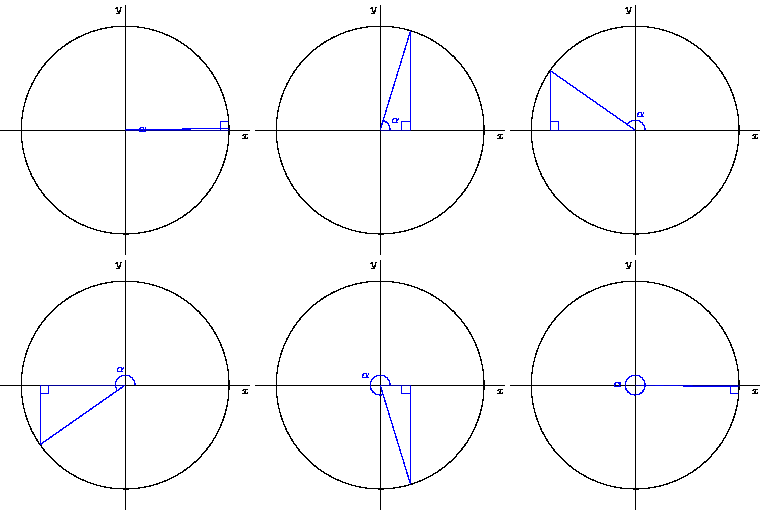
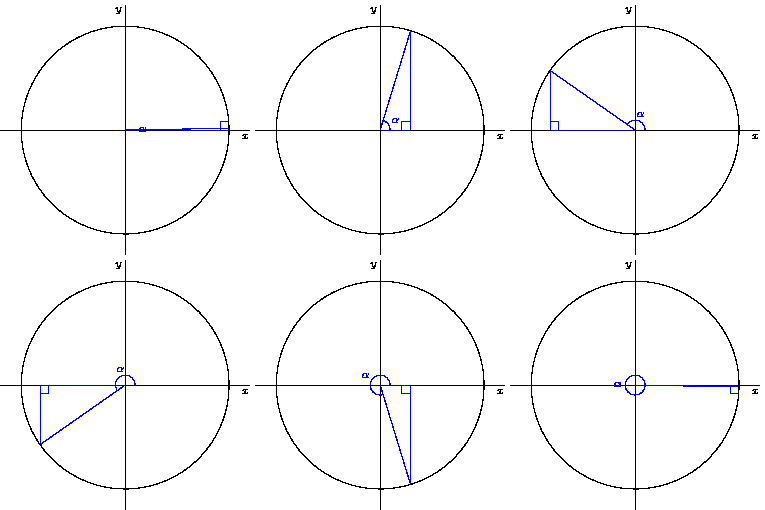
cosine the length of the side of the triangle on the x-axis
sin is the length on the y-axis
not this is ONLY for the unit circle
where radius=1
fallow rampart
so when it says cos(th)=4/5 then that means the x coordinate is 4/5?
fallow rampart
 native inlet
 polar fossil
if it's on a unit circle
polar fossil
if it's on a unit circle
I added a few up arrows to this in case you missed the point: trig functions are defined on the unit circle, I have seen many people make that mistake
fallow rampart
and in trig rn i am assuming it is on unit circle because that is what I'm being taught?
native inlet
fallow rampart
and in trig rn i am assuming it is on unit circle because that is what I'm being...
ik but just down the road remember that :) that's all I'm saying
polar fossil
they're tricky concepts, and it's a mix of learning how to use these things and learning wtf they actually mean
they feed into each other
and a lot of historical baggage particularly surrounding the way we name things
fallow rampart
very helpful people. I'm gonna tell your manager to give you a gold star today
lol ty
.close
obtuse pebbleBOT
Channel closed
Closed by @fallow rampart
Use .reopen if this was a mistake.
native inlet
polar fossil
and a lot of historical baggage particularly surrounding the way we name things
but they were smart people so they probably had a reason and you probably know but I don't
obtuse pebbleBOT
Available help channel!
Send your question here to claim the channel.
Remember:
• Ask your math question in a clear, concise manner.
• Show your work, and if possible, explain where you are stuck.
• After 15 minutes, feel free to ping <@&286206848099549185>.
• Type the command .close to free the channel when you're done.
• Be polite and have a nice day!
Read #❓how-to-get-help for further information on how to ask a good question, and about conduct in the question channels.
Channel closed
Closed due to the original message being deleted
Available help channel!
Send your question here to claim the channel.
Remember:
• Ask your math question in a clear, concise manner.
• Show your work, and if possible, explain where you are stuck.
• After 15 minutes, feel free to ping <@&286206848099549185>.
• Type the command .close to free the channel when you're done.
• Be polite and have a nice day!
Read #❓how-to-get-help for further information on how to ask a good question, and about conduct in the question channels.
 glossy grove
How is cot(270+theta) = tan(-theta) ?
obtuse pebbleBOT
glossy grove
How is cot(270+theta) = tan(-theta) ?
glossy grove
Do I first assume theta is an acute angle
 candid yarrow
You can use the definition of cot and tan with compound angle identities
glossy grove
I know cot(theta) = tan(90-theta)
Do I assume cot(270+theta) is in 4th quadrant
therefore basic angle is cot(-theta)
candid yarrow
glossy grove
Do I assume cot(270+theta) is in 4th quadrant
You don’t need to
candid yarrow
glossy grove
I know cot(theta) = tan(90-theta)
You can use this
obtuse pebbleBOT
@glossy grove Has your question been resolved?
obtuse pebbleBOT
Channel closed
Closed due to timeout
Use .reopen if this was a mistake.
Available help channel!
Send your question here to claim the channel.
Remember:
• Ask your math question in a clear, concise manner.
• Show your work, and if possible, explain where you are stuck.
• After 15 minutes, feel free to ping <@&286206848099549185>.
• Type the command .close to free the channel when you're done.
• Be polite and have a nice day!
Read #❓how-to-get-help for further information on how to ask a good question, and about conduct in the question channels.
 lilac rivet
I did this a while ago but I forgot how to set up the bounds.
 lilac rivet
pi is the correct answer
So for theta bound it is obviously 0 to 2pi since there are no restrictions
candid yarrow
have you tried converting to spherical coordinates
lilac rivet
candid yarrow
have you tried converting to spherical coordinates
well it is a spherical problem
lilac rivet
candid yarrow
have you tried converting to spherical coordinates
ok nevermind I think I am sort of there
so phi is 0 to pi/3 if you set z=2 to rho you get pi/3
so you have the eqn 2=rho cosphi
you can move cosphi over
then you get the lower bound for rho
alright
.close
obtuse pebbleBOT
Channel closed
Closed by @lilac rivet
Use .reopen if this was a mistake.
Available help channel!
Send your question here to claim the channel.
Remember:
• Ask your math question in a clear, concise manner.
• Show your work, and if possible, explain where you are stuck.
• After 15 minutes, feel free to ping <@&286206848099549185>.
• Type the command .close to free the channel when you're done.
• Be polite and have a nice day!
Read #❓how-to-get-help for further information on how to ask a good question, and about conduct in the question channels.
 forest glade
- If a polygon can be divided into 5 triangles when the diagonals are drawn from one of its
vertices, how many sides does the polygon have?
obtuse pebbleBOT
forest glade
1. If a polygon can be divided into 5 triangles when the diagonals are drawn fro...
forest glade
State the formula you are using.
Set up an equation or show work.
solve
obtuse pebbleBOT
forest glade
1. If a polygon can be divided into 5 triangles when the diagonals are drawn fro...
What step are you on?
1. I don't know where to begin
2. I have begun but got stuck midway
3. I got an answer but I'm told it's wrong
4. I got an answer and would like my work checked
5. I have a question about someone else's worked solution
6. None of the above
i have an sort of answer
its going to have 5 sides its a pentagon
but that seems like common sense
idk what formula i would use
candid yarrow
forest glade
its going to have 5 sides its a pentagon
have you actually tried dividing it up into 5 triangles?
candid yarrow
forest glade
but that seems like common sense
if common sense is enough, you don’t need to use a formula
candid yarrow
forest glade
its going to have 5 sides its a pentagon
if you think it is a pentagon, then can you draw a pentagon, then divide it into 5 triangles using its diagonals?
obtuse pebbleBOT
@forest glade Has your question been resolved?
candid yarrow
do you know what a diagonal is
forest glade
no
candid yarrow
the red line
 candid yarrow
forest glade
its going to have 5 sides its a pentagon
candid yarrow
forest glade
its going to have 5 sides its a pentagon
can you draw it now?
obtuse pebbleBOT
@forest glade Has your question been resolved?
obtuse pebbleBOT
Channel closed
Closed due to timeout
Use .reopen if this was a mistake.
Available help channel!
Send your question here to claim the channel.
Remember:
• Ask your math question in a clear, concise manner.
• Show your work, and if possible, explain where you are stuck.
• After 15 minutes, feel free to ping <@&286206848099549185>.
• Type the command .close to free the channel when you're done.
• Be polite and have a nice day!
Read #❓how-to-get-help for further information on how to ask a good question, and about conduct in the question channels.
 old glacier
in the picture, the light shoot to the right small parabola and return in the same route, why it doesn't reflect like the left parabola
 obtuse pebbleBOT
old glacier
in the picture, the light shoot to the right small parabola and return in the sa...
obtuse pebbleBOT
old glacier
in the picture, the light shoot to the right small parabola and return in the sa...
 pulsar quarry
its because of the change in focal length of the mirrors
and the placement too
see
in the case of right concave mirror
the bulb is placed on its centre of curvature
and the bulb is placed on the focus of the left concave mirror
and there is a simple thing
that if light is incident on a concave mirror from focus, its will get reflected and propagate parallel to the principal axis (left case)
and if light is incident in the alignment to the centre of curvature, its will follow back its path (rught case)
does that help you @old glacier ?
old glacier
i'm understanding these
oh, thank you
i got that
the difference of focus point and center point
.close
obtuse pebbleBOT
Channel closed
Closed by @old glacier
Use .reopen if this was a mistake.
Available help channel!
Send your question here to claim the channel.
Remember:
• Ask your math question in a clear, concise manner.
• Show your work, and if possible, explain where you are stuck.
• After 15 minutes, feel free to ping <@&286206848099549185>.
• Type the command .close to free the channel when you're done.
• Be polite and have a nice day!
Read #❓how-to-get-help for further information on how to ask a good question, and about conduct in the question channels.
forest glade
can someone walk me through how to do this?
 obtuse pebbleBOT
forest glade
can someone walk me through how to do this?
forest glade
obtuse pebbleBOT
forest glade
can someone walk me through how to do this?
forest glade
yeah
 wet moss
Are you allowed to assume GK = HJ?
wet moss
That’s where I was going, maybe using angles instead of sides
pulsar quarry
GJ=GJ (common side)
angle KGJ= angle HJG
angle HGJ = angle KJG
byt ASA congruence rule
GH=KJ
hence prove
you get it?
pulsar quarry
pulsar quarry
angle KGJ= angle HJG
but we can only say this if we know gk and hj are given parallel
forest glade
if we dont know?
pulsar quarry
then i dont think so, we''ll we able to prove it
there must be some realtion given
which grade does it belong to?
@forest glade
forest glade
mhm
pulsar quarry
@forest glade so in pallelogram
opp sides are parallel
so by alternatee interior angle
pulsar quarry
pulsar quarry
angle KGJ= angle HJG
angle KGJ= angle HJG
angle HGJ = angle KJG
and with common side
apply
asa congruence
and GH=KJ
proved
you get it now?
obtuse pebbleBOT
Channel closed
Closed by @forest glade
Use .reopen if this was a mistake.
obtuse pebbleBOT
Available help channel!
Send your question here to claim the channel.
Remember:
• Ask your math question in a clear, concise manner.
• Show your work, and if possible, explain where you are stuck.
• After 15 minutes, feel free to ping <@&286206848099549185>.
• Type the command .close to free the channel when you're done.
• Be polite and have a nice day!
Read #❓how-to-get-help for further information on how to ask a good question, and about conduct in the question channels.
 vocal verge
 obtuse pebbleBOT
vocal verge
vocal verge
obtuse pebbleBOT
vocal verge
vocal verge
How does this person know that they need to rationalize the numerator?
Or can this only be known through trial and error?
vocal verge
 tacit scarab
most of the times rationalizing helps
tacit scarab
most of the times rationalizing helps
How do u know u need to rationalize the numerator straight away?
 zenith spade
I mean, typically you’d check if direct sub works
If it’s a real number, you’re done
If it’s undefined, you’re also done - your limit DNE
But if it’s indeterminate (e.g. 0/0), that’s when you need to do something extra
vocal verge
Cuz we only rationalize the denominator mostly
vocal verge
zenith spade
I mean, typically you’d check if direct sub works
If it’s a real number, you’re ...
Ah so it's though trial n error, then determine whether to rationalize the numerator
zenith spade
Also, you only rationalize if there are roots around
vocal verge
Ye
zenith spade
Square roots are most common, but any root can be rationalized in the right circumstance
vocal verge
Ik how to rationalize... just dk how one can rationalize the numerator without going through trial n error
zenith spade
I mean, depending on the expression, you could mental the direct sub trial
Like here, it’s not hard to see that it would hit 0/0
Which is indeterminate
vocal verge
Ye doing it mentally is still considered going through trial n error haha
Aight thanks pals :)
.close
obtuse pebbleBOT
Channel closed
Closed by @vocal verge
Use .reopen if this was a mistake.
Available help channel!
Send your question here to claim the channel.
Remember:
• Ask your math question in a clear, concise manner.
• Show your work, and if possible, explain where you are stuck.
• After 15 minutes, feel free to ping <@&286206848099549185>.
• Type the command .close to free the channel when you're done.
• Be polite and have a nice day!
Read #❓how-to-get-help for further information on how to ask a good question, and about conduct in the question channels.
 vestal breach
okay i am not understanding how these are the correct answers. someone please explain.
 obtuse pebbleBOT
vestal breach
okay i am not understanding how these are the correct answers. someone please ex...
obtuse pebbleBOT
vestal breach
okay i am not understanding how these are the correct answers. someone please ex...
 hidden compass
Well, when does the sin give -√3/2?
vestal breach
at 135 and 225
 plucky rivet
Is sin negative in 2nd region?!
plucky rivet
225° and 315° are odd multiples of 45°, careful
vestal breach
yes
plucky rivet
They would give $$\pm \frac{1}{\sqrt{2} }$$
warm shaleBOT
Cyrenux
 vestal breach
howd you get that
plucky rivet
You got the reduction of angles wrongly
Do you know that $$\sin { (x + 180°) }= - \sin x $$
Oops ignore
vestal breach
alright
warm shaleBOT
Cyrenux
 vestal breach
yeah
plucky rivet
warm shale
**Cyrenux**
@vestal breach do you know this property?
vestal breach
yes
plucky rivet
find a $x$ value where $$\sin x = \frac{ \sqrt 3}{2} $$ then reduce by 180° to find where its negative
warm shaleBOT
Cyrenux
 plucky rivet
Also reminder that:
$$\sin {( 360^\circ - x) } = -\sin x $$
warm shaleBOT
Cyrenux
 plucky rivet
Nice we got degree symbol now
vestal breach
i see yeah
plucky rivet
Use these two reduction formulas
Do you know which value of $x$ satisfies
$$\sin x = \frac{\sqrt{3}}{2} $$
warm shaleBOT
Cyrenux
 vestal breach
60 right?
vestal breach
idk how to put the degrees lol
plucky rivet
60 is in radians
While 60° is in degrees
But yeah its trivial that we are only using degrees currently
vestal breach
i see
plucky rivet
plucky rivet
60 is in radians
While 60° is in degrees
Off topic but this is REALLY necessary.
$\sin {4} < 0$
While $\sin {(4^\circ )} > 0 $
warm shaleBOT
Cyrenux
 plucky rivet
vestal breach
60 right?
plucky rivet
vestal breach
60 right?
Back to our topic, add 180° to 60°
vestal breach
240°
plucky rivet
Yes
But we found $$\sin {x} = \frac{\sqrt 3}{2}$$
,we know that $x= 240^\circ$ but we want to find 2$\theta$ of $$\sin {2 \theta} = \frac{\sqrt{3}}{2} $$
We can just $$x=2 \theta$$ to find our desired value
warm shaleBOT
Cyrenux
 plucky rivet
we already know that $x=240^\circ$ so lets just $$240^\circ =2 \theta$$
warm shaleBOT
Cyrenux
 plucky rivet
Do the same thing but extract 60° from 360°
obtuse pebbleBOT
Channel closed
Closed by @vestal breach
Use .reopen if this was a mistake.
Available help channel!
Send your question here to claim the channel.
Remember:
• Ask your math question in a clear, concise manner.
• Show your work, and if possible, explain where you are stuck.
• After 15 minutes, feel free to ping <@&286206848099549185>.
• Type the command .close to free the channel when you're done.
• Be polite and have a nice day!
Read #❓how-to-get-help for further information on how to ask a good question, and about conduct in the question channels.
 craggy valve
help pls
obtuse pebbleBOT
craggy valve
help pls
craggy valve
Write down the rule for the graph with these axes intercepts. Write the rule in the form 𝑎𝑥+𝑏𝑦=𝑑
.
a.
(0,4)
and (4,0)
hidden compass
Substitute those points into the equation
 royal basin
you don't for now
craggy valve
like simultaneous equations
craggy valve
ah ok thanks
hidden compass
craggy valve
how do you know what a and b and d are
You have to find them, that's why we have to substitute
craggy valve
.close
obtuse pebbleBOT
Channel closed
Closed by @craggy valve
Use .reopen if this was a mistake.
craggy valve
.reopen
obtuse pebbleBOT
✅
craggy valve
wait hold
i got like 4b = d
and 4a = d
and then like a = d/4?
so its d/4x + d/4y = d?
obtuse pebbleBOT
@craggy valve Has your question been resolved?
Channel closed
Closed by @craggy valve
Use .reopen if this was a mistake.
Available help channel!
Send your question here to claim the channel.
Remember:
• Ask your math question in a clear, concise manner.
• Show your work, and if possible, explain where you are stuck.
• After 15 minutes, feel free to ping <@&286206848099549185>.
• Type the command .close to free the channel when you're done.
• Be polite and have a nice day!
Read #❓how-to-get-help for further information on how to ask a good question, and about conduct in the question channels.
hidden compass
craggy valve
so its d/4x + d/4y = d?
Yes, now you can divide everything by d
obtuse pebbleBOT
hidden compass
Yes, now you can divide everything by d
candid yarrow
.close
obtuse pebbleBOT
Channel closed
Closed by @candid yarrow
Use .reopen if this was a mistake.
Available help channel!
Send your question here to claim the channel.
Remember:
• Ask your math question in a clear, concise manner.
• Show your work, and if possible, explain where you are stuck.
• After 15 minutes, feel free to ping <@&286206848099549185>.
• Type the command .close to free the channel when you're done.
• Be polite and have a nice day!
Read #❓how-to-get-help for further information on how to ask a good question, and about conduct in the question channels.
 graceful wind
 obtuse pebbleBOT
graceful wind
graceful wind
obtuse pebbleBOT
graceful wind
graceful wind
im so confused
candid yarrow
graceful wind
im so confused
about what?
graceful wind
idk what that even asking
i guessed true and it was correct but
my brain is not working
obtuse pebbleBOT
@graceful wind Has your question been resolved?
obtuse pebbleBOT
Channel closed
Closed due to timeout
Use .reopen if this was a mistake.
Available help channel!
Send your question here to claim the channel.
Remember:
• Ask your math question in a clear, concise manner.
• Show your work, and if possible, explain where you are stuck.
• After 15 minutes, feel free to ping <@&286206848099549185>.
• Type the command .close to free the channel when you're done.
• Be polite and have a nice day!
Read #❓how-to-get-help for further information on how to ask a good question, and about conduct in the question channels.
 slate kayak
how to integrate this?
obtuse pebbleBOT
slate kayak
how to integrate this?

 tight thunder
do you HAVE to use integration?
slate kayak
 slate kayak
tight thunder
do you HAVE to use integration?
slate kayak
tight thunder
do you HAVE to use integration?
no i guess but that's what i'm doing
tight thunder
Yes but then its a weird center
But sure
can you tell me the equation of your leftmost circle?
slate kayak
it looks intuitive to me so ig we could work with that
slate kayak
tight thunder
But sure
 tight thunder
Let's try to integrate it if you don't know how
tight thunder
Do you wanna do it in a normal way?
slate kayak
integration upper - lower or something is what's involved ig
tight thunder
slate kayak
integration upper - lower or something is what's involved ig
Correct you'll need that
tight thunder
Do you know how to integrate things though
slate kayak
yes
tight thunder
trig sub will be required for this
warm shaleBOT
hiii
 slate kayak
not really a proper integral now
tight thunder
Not quite
slate kayak
since we have to sub for y
slate kayak
tight thunder
Not quite
oh
tight thunder
Right erm
slate kayak
can i get the expression?
tight thunder
This is why I said you should put the first circle at the origin
could you move your diagram
to make it easier
slate kayak
i could but why can't we just work with this?
tight thunder
Okay fine if you insist
slate kayak
thanks
tight thunder
take your left circle and rearrange in the form y = f(x)
Make sure when you square root it its the positive bit because we are looking at the top area here
That will leave you with a semicircle
slate kayak
makes sense
tight thunder
could you do that for me?

 tight thunder
Should be (x+0.5)² on the inside
tight thunder
but anyways yes that's right
warm shaleBOT
hiii
 tight thunder
Now we will make use of symmetry right, so That's the bottom boundary of our area
what's our top boundary?
 slate kayak
yes
tight thunder
Which bounds our area from the underside
slate kayak
my problem was how to restrict it only to that part
tight thunder
Yeah so hopefully you can do it...? just wanna make sure though
slate kayak
wait can do what? 😭
slate kayak
i don't think so
tight thunder
why not
tight thunder
okay lets continue
slate kayak
you want me to use
the right circle
and then use the y= f(x) we got from the left circle
sub it in
tight thunder
you can but I wouldn't
slate kayak
then integrate?
tight thunder
No
slate kayak
tight thunder
you can but I wouldn't
o
tight thunder
you remember you told me (which is correct) to find the area it's integrate upper - lower
slate kayak
symmetry is cool but wouldn't we be overcounting?
slate kayak
tight thunder
you remember you told me (which is correct) to find the area it's integrate uppe...
indeed
tight thunder
Not if you see what we will be doing
slate kayak
okay fair
tight thunder
what that means is
integrate (equation for upper boundary) - (equation for lower boundary)
slate kayak
well upper boundary is 1
tight thunder
We have the equation for the lower boundary
tight thunder
slate kayak
i mean y = 0.5
Good
So whats your final equation that you're putting in the integral?
slate kayak
oh yeah i guess my initial hunch was right then? I just had it in two variables so i guess we converted it into one
tight thunder
Yes
tight thunder
warm shale
**hiii**
But you just did it in a weird way where if you subbed y back in here you're just gonna get 0 = 0 while doing so
slate kayak
warm shale
**hiii**
it would be this but we change the circle equation stuff i put with what we had of y= f(x)
and then we integrate wrt y?
slate kayak
tight thunder
But you just did it in a weird way where if you subbed y back in here you're jus...
o lol
true
tight thunder
No, wrt x
tight thunder
No worries
slate kayak
,, \int_{-0.5} ^ {\frac 12 (\sqrt3 - 1)} (0.5 - \sqrt{1 - (x-0.5)^2} - 0.5} \text{dy}
whoops
tight thunder
whAT
slate kayak
wait lol
tight thunder
😂
 robust sleet
Well that's easy
warm shaleBOT
hiii
Compile Error! Click the  reaction for more information.
(You may edit your message to recompile.)
 robust sleet
That's easier
tight thunder
robust sleet
Well that's easy
You're not helping by just saying "it's easy"
slate kayak
,, \int_{-0.5} ^ {\frac 12 (\sqrt3 - 1)} \qty(0.5 - \sqrt{1 - (x-0.5)^2} - 0.5) \text{ dx}
okay there we go
i think
tight thunder
Notice how the integrand (the stuff inside the integral) is in terms of x
that's why it's wrt x and not wrt y
warm shaleBOT
hiii
 tight thunder
Dw and therefore the bounds are wrong as well
tight thunder
The bottom bound is right... the top bound isnt
tight thunder
Yes
wet moss
this seems a bit overcomplicated
slate kayak
,, \int_{-0.5} ^ {0} \qty(0.5 - \sqrt{1 - (x-0.5)^2} - 0.5) \text{ dx}
warm shaleBOT
hiii
 tight thunder
wet moss
this seems a bit overcomplicated
tight thunder
wet moss
this seems a bit overcomplicated
He wanted to do it using an integral
Great now remember because of symmetry we have to multiply by 2
slate kayak
yeah i wanted to do it with an integral
wet moss
dont choose to punish yourself
tight thunder
And also the signs in the integral are wrong
slate kayak
yeah that makes sense
and if we're not multiply by 2
we can just repeat the process with the right curve?
tight thunder
Yeah but I wouldn't do that haha you've punished yourself enough
slate kayak
*we're not mulyiplying by 2
tight thunder
fix the signs in the square root
and also add brackets because there's a sign flip due to 0.5 -
tight thunder
😅
slate kayak
but okay i just wanted to know how to set it up
,, 2 \cdot \int_{-0.5} ^ {0} \qty(0.5 - \sqrt{1 - (x-0.5)^2} - 0.5) \text{ dx}
this would be the final answer ig?
tight thunder
No youve just revived a bunch of errors that you fixed
tight thunder
Look at the top bound lol
warm shaleBOT
hiii
 tight thunder
and also... again there's sign errors in the integral
tight thunder
0.5 - sqrt(1-(x**+**0.5)^2)) + 0.5
slate kayak
,, 2 \cdot \int_{-0.5} ^ {0} \qty(0.5 - \sqrt{1 - (x+0.5)^2} + 0.5) \text{ dx}
warm shaleBOT
hiii
 slate kayak
tight thunder
0.5 - sqrt(1-(x**+**0.5)^2)) **+** 0.5
slate kayak
tight thunder
0.5 - sqrt(1-(x**+**0.5)^2)) **+** 0.5
ah right 😭 it was a domino effect thing
slate kayak
we just worked with the wrong
thing from the start
and forgot about it lol
okay okay i get it
tight thunder
Not really
slate kayak
,w \int_{-0.5} ^ {0} \qty(0.5 - \sqrt{1 - (x+0.5)^2} + 0.5) \text{ dx}
wet moss
its correct so its calm
warm shaleBOT

Wolfram Alpha doesn't understand your query!
Perhaps try rephrasing your question?
Click here to refine your query online
 Requested by hii288
slate kayak
wet moss
its correct so its calm
Requested by hii288
slate kayak
wet moss
its correct so its calm
lol
tight thunder
A u sub followed by a trig sub kills the integral
slate kayak
tight thunder
0.5 - sqrt(1-(x**+**0.5)^2)) **+** 0.5
here
0.5 - sqrt(1-(x+0.5)^2)) - 0.5
unless i'm blind
tight thunder
no because as I said you should've had brackets
you should've written 0.5 - (sqrt(...) - 0.5)
Which turns into 0.5 - sqrt(...) + 0.5
tight thunder
Dw lol
tight thunder
Yw
slate kayak
if possible lol
wet moss
yeah much easier
slate kayak
slate kayak
this is the question
side length is 1
obv the radius of the circle is 1
wet moss
equalatral triangle fixes everything
tight thunder
Draw in the equilateral triangle and hopefully you'll see it
tight thunder
No? there's a place to draw an equilateral triangle that makes the most sense here
 wet moss
yeah
wet moss
think of any sectors
wet moss
yeah
slate kayak
what about it?
oh wait
you want to find the area of the big piece
so that you can get rid of the double counting
tight thunder
Imagine ur making a cookie with that shape
slate kayak
right?
tight thunder
How are you gonna cut it out of those lines in an easy way so you can find the area
tight thunder
Mmm
slate kayak
mmm
slate kayak
it'd be area of square - area of circle *2 + the area of the equilateral + sector
unless i'm doing it the long way
wet moss
no need for circles
wet moss
not required
slate kayak
what am i supposed to do then
 wet moss
they are the sectors
slate kayak
wet moss
they are the sectors
hmm okay
area of triangle is sqrt(3)/4
area of the full sector itself is pi/4
wet moss
dont think of it as the area of the full quarter circle
try and find the angle required to find the area of the sector
slate kayak
oh bruh
slate kayak
wet moss
try and find the angle required to find the area of the sector
i see now
i'm blind smh
so it's two sectors
with 30 degree
wet moss
yeah
 slate kayak
wet moss
me when i do the integral instead
slate kayak
wet moss
me when i do the integral instead
facts facts lol
definign coordinate system and setting up the integral > finding area of equilateral triangle + two sectors
but hmm wait
where did you get the intuition to draw an equilateral triangle
wet moss
hope
that it would turn it into something better
i just saw the overlap of 2 circles and i thought there must be some bullshit construction proof to say that the intersection makes an equilateral triangle
obtuse pebbleBOT
@slate kayak Has your question been resolved?
obtuse pebbleBOT
Channel closed
Closed due to timeout
Use .reopen if this was a mistake.
Available help channel!
Send your question here to claim the channel.
Remember:
• Ask your math question in a clear, concise manner.
• Show your work, and if possible, explain where you are stuck.
• After 15 minutes, feel free to ping <@&286206848099549185>.
• Type the command .close to free the channel when you're done.
• Be polite and have a nice day!
Read #❓how-to-get-help for further information on how to ask a good question, and about conduct in the question channels.
 willow acorn
Not sure how to end up with numbers from this, I’ve gotten this far so far
 obtuse pebbleBOT
willow acorn
Not sure how to end up with numbers from this, I’ve gotten this far so far
tight thunder
obtuse pebbleBOT
willow acorn
Not sure how to end up with numbers from this, I’ve gotten this far so far
tight thunder
Note that these two have different bounds
 willow acorn
Yeah
tight thunder
Ah
willow acorn
Is there anything I can do about it? Like change it?
tight thunder
Recall that
$$\int_a^c = \int_a^b + \int_b^c$$ assuming $a<b<c$
warm shaleBOT
Im you
 tight thunder
Use that to your advantage
willow acorn
warm shale
**Im you**
It is?
slate kayak
wet moss
i just saw the overlap of 2 circles and i thought there must be some bullshit co...
okay thanks
willow acorn
Why?
slate kayak
and thanks to you too @tight thunder
tight thunder
Yw @slate kayak
Think about what an integral is
Well it measures the area under f right
if you measure from a to c
willow acorn
Oh yeah ok that makes sense
tight thunder
:))
willow acorn
thanks 🙏
tight thunder
yw!
obtuse pebbleBOT
Channel closed
Closed by @willow acorn
Use .reopen if this was a mistake.
Available help channel!
Send your question here to claim the channel.
Remember:
• Ask your math question in a clear, concise manner.
• Show your work, and if possible, explain where you are stuck.
• After 15 minutes, feel free to ping <@&286206848099549185>.
• Type the command .close to free the channel when you're done.
• Be polite and have a nice day!
Read #❓how-to-get-help for further information on how to ask a good question, and about conduct in the question channels.
 frail coral
A ray of light is travelling is travelling from air to water. What is the angle of incidence in air, if angle of refraction in water is 45
obtuse pebbleBOT
frail coral
A ray of light is travelling is travelling from air to water. What is the angle ...
royal basin
!status
obtuse pebbleBOT
What step are you on?
1. I don't know where to begin
2. I have begun but got stuck midway
3. I got an answer but I'm told it's wrong
4. I got an answer and would like my work checked
5. I have a question about someone else's worked solution
6. None of the above
 novel grotto
What laws/formulas do you know regarding refraction angles and things like that
royal basin
do you know snell's law?
novel grotto
ah
royal basin
ah fuck, guess i spoiled it
novel grotto
What Ann said
frail coral
wdym?
frail coral
royal basin
do you know snell's law?
sini/sinr=n2/n1
royal basin
ok that looks correct
are you able to use snell's law to find the angle of incidence based on the data given?
obtuse pebbleBOT
@frail coral Has your question been resolved?
Channel closed
Closed by @frail coral
Use .reopen if this was a mistake.
Available help channel!
Send your question here to claim the channel.
Remember:
• Ask your math question in a clear, concise manner.
• Show your work, and if possible, explain where you are stuck.
• After 15 minutes, feel free to ping <@&286206848099549185>.
• Type the command .close to free the channel when you're done.
• Be polite and have a nice day!
Read #❓how-to-get-help for further information on how to ask a good question, and about conduct in the question channels.
 tardy gull
does someone know how use a "graphing utility" to create a line of best fit
obtuse pebbleBOT
tardy gull
does someone know how use a "graphing utility" to create a line of best fit
tardy gull
for a function
tight thunder
Ermmm
If you have a graphing calculator
you should be able to enter points and construct a line of regression
that will be your line of best fit
obtuse pebbleBOT
Channel closed
Closed by @tardy gull
Use .reopen if this was a mistake.
obtuse pebbleBOT
Available help channel!
Send your question here to claim the channel.
Remember:
• Ask your math question in a clear, concise manner.
• Show your work, and if possible, explain where you are stuck.
• After 15 minutes, feel free to ping <@&286206848099549185>.
• Type the command .close to free the channel when you're done.
• Be polite and have a nice day!
Read #❓how-to-get-help for further information on how to ask a good question, and about conduct in the question channels.
slate kayak
 obtuse pebbleBOT
slate kayak
slate kayak
obtuse pebbleBOT
slate kayak
slate kayak
i found a "trick" that mentions any multiples of 3 can be expressed as multiplication of 3 consecutive numbers
i'm assuming i use that trick here?
(x-1)(x)(x+1)
then i chose the answers by just adding multiples of 3 to either the left term or the right term
idk how that makes them consecutive though lol
slate kayak
yeah i just added (x-1 + 3) but and changed the other one as well with some multiples of 3
it gave me the right answer
but sounds like bs
slate kayak
 kind hawk
do you know about modulo
kind hawk
do you know about modulo
very little actually
but i could try to understand if you're willing to show me
kind hawk
ok no worries, we dont explicitly need it
kind hawk
I did?
slate kayak
and then someone showed me seiving
slate kayak
kind hawk
I did?
yeah
so i know those type of stuffs i guess
but i haven't taken a course per se
kind hawk
ok we just need a very basic statement here tho
every integer x is either of the form 3k, 3k+1 or 3k+2
slate kayak
right
kind hawk
which we can plug into those expressions up there
if we plug in 3k for x, we quickly see that it is a multiple of 3
slate kayak
kind hawk
every integer x is either of the form 3k, 3k+1 or 3k+2
wait if i'm understanding this right
you can express any integer
in one of those ways?
kind hawk
yes
slate kayak
oh yeah makes sense
kind hawk
every integer is either a multiple of 3, 1 more than a multiple of 3 or 2 more
slate kayak
n = x (mod 3) but then x is any integer less than 3
slate kayak
kind hawk
every integer is either a multiple of 3, 1 more than a multiple of 3 or 2 more
hmm okay fair
obtuse pebbleBOT
@slate kayak Has your question been resolved?
obtuse pebbleBOT
Channel closed
Closed due to timeout
Use .reopen if this was a mistake.
Available help channel!
Send your question here to claim the channel.
Remember:
• Ask your math question in a clear, concise manner.
• Show your work, and if possible, explain where you are stuck.
• After 15 minutes, feel free to ping <@&286206848099549185>.
• Type the command .close to free the channel when you're done.
• Be polite and have a nice day!
Read #❓how-to-get-help for further information on how to ask a good question, and about conduct in the question channels.


 tawny fog
Ncert class 10
pulsar quarry
okay
 sage geode
If something is done in 2 hours, then it means that per one hour you do 1/2 of that, right?
tawny fog
Yes
sage geode
Same thing here
tawny fog
75/8+8/75=1?
sage geode
If you multiply them
royal basin
well
 frank monolith
unitary method
royal basin
say a tap fills the tank in 2 hours
tawny fog
Ok
royal basin
would you agree or disagree that the tap delivers 1/2 of a tank worth of water per hour
tawny fog
I would agree
royal basin
and in general, a tap that fills the tank in x hours has an output rate of 1/x tanks/hour
obtuse pebbleBOT
Channel closed
Closed by @tawny fog
Use .reopen if this was a mistake.
Available help channel!
Send your question here to claim the channel.
Remember:
• Ask your math question in a clear, concise manner.
• Show your work, and if possible, explain where you are stuck.
• After 15 minutes, feel free to ping <@&286206848099549185>.
• Type the command .close to free the channel when you're done.
• Be polite and have a nice day!
Read #❓how-to-get-help for further information on how to ask a good question, and about conduct in the question channels.
 gray zinc
So im confused with this problem
 obtuse pebbleBOT
gray zinc
So im confused with this problem
gray zinc
obtuse pebbleBOT
gray zinc
So im confused with this problem
gray zinc
I tried to figure out what to do this morning with this information from yesterdays help: ' You need to use trigonometry in right triangles to find beta, however you tried to sum the angles when the triangle containing theta is an obtuse triangle, which means that the formula you used for theta is wrong'
but i dont know can someone guide me please thank you
wet moss
i would just say 100/d
gray zinc
why just 100/d? ik its part of the solution but in what way do i use it?
 wet moss
is the correct answer the one shown in the box?
 prisma pasture
@wet moss told you the answer
if tan(β)=100/d
So you can find β using arctan(100/d)
100
The pedestal is within the 100
wet moss
it says including the pedestal
prisma pasture
@gray zinc are you here?
gray zinc
prisma pasture
<@709554679247405126> are you here?
yes im here im review my work thank you!
timid silo
Is this a related rates problem?
gray zinc
timid silo
Is this a related rates problem?
"optimization with the emphasis on setting up the functions to be optimized (as opposed to being given the function)"
gray zinc
prisma pasture
<@709554679247405126> are you here?
got it thank you!
@wet moss thank you!
.close
obtuse pebbleBOT
Channel closed
Closed by @gray zinc
Use .reopen if this was a mistake.
Available help channel!
Send your question here to claim the channel.
Remember:
• Ask your math question in a clear, concise manner.
• Show your work, and if possible, explain where you are stuck.
• After 15 minutes, feel free to ping <@&286206848099549185>.
• Type the command .close to free the channel when you're done.
• Be polite and have a nice day!
Read #❓how-to-get-help for further information on how to ask a good question, and about conduct in the question channels.
 viral tree
 obtuse pebbleBOT
viral tree
viral tree
obtuse pebbleBOT
viral tree
viral tree
I don't know how to start
 versed stratus
what's the question?
viral tree
how do I find x1 , x2 and y1 , y2
royal basin
you have this system of equations to solve
you may start by writing down the equation 2x^2 + 6x - 14 = -2x^2 + 10x - 6
there's multiple different ways you could think about getting to it from the starting two, but i am not gonna go into detail on that unless explicitly asked.
viral tree
do I want to add the 2 equations to get rid of the 2x squared?
viral tree
so 4x^2-4x-8=0
timid silo
viral tree
do I want to add the 2 equations to get rid of the 2x squared?
See you first need to find a x or a y , so try eliminating one of them
timid silo
viral tree
so 4x^2-4x-8=0
Yep that's the easiest way to get rid of y
You could have also subtracted the equations to get the same value
royal basin
viral tree
so 4x^2-4x-8=0
yes keep going
recommend dividing both sides by 4 before continuing -- not fatal if you choose not to do that, but may make your life easier
viral tree
1 moment im writing it on paper
I have a mistake some where for y2=

I think its because y2= 2* (-1)^2
I had it right the first time but then erased the parentheses

so x1= 2 , x2= -1
y1= 6 , y2= -18
royal basin
well you chose not to make your life simpler when you could've, for one.
that's why you got your x's wrong the first time round
royal basin
viral tree
this is correct, just checked with desmos
viral tree
.close
obtuse pebbleBOT
Channel closed
Closed by @viral tree
Use .reopen if this was a mistake.
Available help channel!
Send your question here to claim the channel.
Remember:
• Ask your math question in a clear, concise manner.
• Show your work, and if possible, explain where you are stuck.
• After 15 minutes, feel free to ping <@&286206848099549185>.
• Type the command .close to free the channel when you're done.
• Be polite and have a nice day!
Read #❓how-to-get-help for further information on how to ask a good question, and about conduct in the question channels.
 obtuse meadow
if we have a a(n) = (n/6)(sin(6/n))
obtuse pebbleBOT
obtuse meadow
if we have a a(n) = (n/6)(sin(6/n))
obtuse meadow
Why isnt limit n->infinity
not 0?
n/6 = infinity and then we have sin(6/n) where sin(0) = 0 right
and 0 * infinity would just be 0?
hidden compass
Make a substitution, t = 6/n
It is an indeterminate form 0/0, hence the result is not 0 (a priori)
 knotty crow
 timid silo
obtuse meadow
n/6 * sin(t)
timid silo
obtuse meadow
n/6 * sin(t)
n/6 is just 1/t
obtuse meadow
so I’d have to figure out sin(t)/t
kind hawk
all different limits
obtuse meadow
I see
So I just derive it with substitution
Ok I got the answer, thanks for the help guys
.close
obtuse pebbleBOT
Channel closed
Closed by @obtuse meadow
Use .reopen if this was a mistake.
Available help channel!
Send your question here to claim the channel.
Remember:
• Ask your math question in a clear, concise manner.
• Show your work, and if possible, explain where you are stuck.
• After 15 minutes, feel free to ping <@&286206848099549185>.
• Type the command .close to free the channel when you're done.
• Be polite and have a nice day!
Read #❓how-to-get-help for further information on how to ask a good question, and about conduct in the question channels.
 vague mural
Im learning how to find work done on path in a conservative vector field and had a question about the way the formula was explained to me. So essentially i was given the explanation below for why the integral of F(x,y,z) wrt dr = g(b)-g(a),
But I don't understand why we can replace (x,y,z) by r, arent we plugging in a vector at that point which is impossible?
obtuse pebbleBOT
vague mural
Im learning how to find work done on path in a conservative vector field and had...
vague mural
$\int^b_a F(x,y,z)dr=\int^b_a \nabla g(x,y,z)dr=\int^b_a \nabla g(r)dr=g(b)-g(a)$
warm shaleBOT
SnowZillin
 obtuse pebbleBOT
@vague mural Has your question been resolved?
 tardy epoch
vague mural
Im learning how to find work done on path in a conservative vector field and had...
tardy epoch
vague mural
Im learning how to find work done on path in a conservative vector field and had...
what do you mean "at that point which is impossible" ?
do you have some textbook claiming something you'd like clarified
vague mural
riemann i dont think you can help me
tardy epoch
vague mural
riemann i dont think you can help me
why
you're right. your question isn't even clear at the moment
vague mural
everytime i talk to you it takes an hour to get a answer that i barely understand
id rather keep my hour and keep my confusion
tardy epoch
uh that's probably because it takes that long to get you to ask a question that makes sense
but if you insist
☮️
obtuse pebbleBOT
Channel closed
Closed by @vague mural
Use .reopen if this was a mistake.
Available help channel!
Send your question here to claim the channel.
Remember:
• Ask your math question in a clear, concise manner.
• Show your work, and if possible, explain where you are stuck.
• After 15 minutes, feel free to ping <@&286206848099549185>.
• Type the command .close to free the channel when you're done.
• Be polite and have a nice day!
Read #❓how-to-get-help for further information on how to ask a good question, and about conduct in the question channels.
 fringe trellis
When we're trying to find the area between the curves between two points of a function. Do we take the difference or the sum of the total amount from both points?
obtuse pebbleBOT
fringe trellis
When we're trying to find the area between the curves between two points of a fu...
tardy epoch
which one makes more sense to you
fringe trellis
tardy epoch
which one makes more sense to you
The difference because it's the area between curves
So u would subtract the surrounding areas
But idk if I'm saying the correct thing
fringe trellis
tardy epoch
which one makes more sense to you
So is it correct then?
tardy epoch
fringe trellis
The difference because it's the area between curves
yes
fringe trellis
tardy epoch
yes
So hypothetically, if I made an equation like x^2 - 2x and found the area between the curves from x = -1 to x = 2, it could be 0?
tardy epoch
what two curves exactly?
no, area between two curves is not always the same as the integral
the integral is the signed area meaning the area underneath the x-axis counts as negative
depending on the question, you have to modify the sign
timid silo

timid silo
fringe trellis
When we're trying to find the area between the curves between two points of a fu...
Bigger one - smaller one
obtuse pebbleBOT
@fringe trellis Has your question been resolved?
timid silo
Basically you wantthe area that satisfies $$x^{2} \le y \le 2x$$
warm shaleBOT
Brandon H
 fringe trellis
tardy epoch
what two curves exactly?
fringe trellis
tardy epoch
what two curves exactly?
The thing I just mentioned, along with the x-axis
obtuse pebbleBOT
@fringe trellis Has your question been resolved?
fringe trellis
.close
obtuse pebbleBOT
Channel closed
Closed by @fringe trellis
Use .reopen if this was a mistake.
Available help channel!
Send your question here to claim the channel.
Remember:
• Ask your math question in a clear, concise manner.
• Show your work, and if possible, explain where you are stuck.
• After 15 minutes, feel free to ping <@&286206848099549185>.
• Type the command .close to free the channel when you're done.
• Be polite and have a nice day!
Read #❓how-to-get-help for further information on how to ask a good question, and about conduct in the question channels.
forest glade
howd i do?
 obtuse pebbleBOT
forest glade
howd i do?
obtuse pebbleBOT
forest glade
howd i do?
 errant lark
 obtuse pebbleBOT
@forest glade Has your question been resolved?
Channel closed
Closed by @forest glade
Use .reopen if this was a mistake.
Available help channel!
Send your question here to claim the channel.
Remember:
• Ask your math question in a clear, concise manner.
• Show your work, and if possible, explain where you are stuck.
• After 15 minutes, feel free to ping <@&286206848099549185>.
• Type the command .close to free the channel when you're done.
• Be polite and have a nice day!
Read #❓how-to-get-help for further information on how to ask a good question, and about conduct in the question channels.
timid silo
$\lim _{x\to :-3^+}\left(x+3\right)ln\left(x+3\right)$ I am trying to do this excercise, I can ask help here?
obtuse pebbleBOT
timid silo
$\lim _{x\to :-3^+}\left(x+3\right)ln\left(x+3\right)$ I am trying to do this e...
warm shaleBOT
Kangaroo

 thin pawn
timid silo
$\lim _{x\to :-3^+}\left(x+3\right)ln\left(x+3\right)$ I am trying to do this e...
thin pawn
timid silo
$\lim _{x\to :-3^+}\left(x+3\right)ln\left(x+3\right)$ I am trying to do this e...
Of course! What have you tried thus far?
 nocturne minnow
timid silo
$\lim _{x\to :-3^+}\left(x+3\right)ln\left(x+3\right)$ I am trying to do this e...
nocturne minnow
timid silo
$\lim _{x\to :-3^+}\left(x+3\right)ln\left(x+3\right)$ I am trying to do this e...
No I'm stealing this room
obtuse pebbleBOT
@timid silo Has your question been resolved?
obtuse pebbleBOT
Channel closed
Closed due to timeout
Use .reopen if this was a mistake.
Available help channel!
Send your question here to claim the channel.
Remember:
• Ask your math question in a clear, concise manner.
• Show your work, and if possible, explain where you are stuck.
• After 15 minutes, feel free to ping <@&286206848099549185>.
• Type the command .close to free the channel when you're done.
• Be polite and have a nice day!
Read #❓how-to-get-help for further information on how to ask a good question, and about conduct in the question channels.
 chrome crypt
 obtuse pebbleBOT
chrome crypt
tardy epoch
obtuse pebbleBOT
chrome crypt
tardy epoch
use sin^2 + cos^2 = 1
chrome crypt
I am not done with my question, please wait a second kindly.
My question is when trying to solve limits algebraically using the limit laws, I am coming across times when its evaluating correctly and incorrectly. This has left me stumbled and wondering is there a solid way to determine whether or not the limit laws will work when solving a question?
tardy epoch
you just do more problems
limit laws always work when the assumptions are true
did you verify the assumptions before using them?
chrome crypt
What do you mean by verifying the assumption?
tardy epoch
do you know what assumptions limit laws make?
chrome crypt
Nope.
tardy epoch
that's the core problem
chrome crypt
Ahhhh.
tardy epoch
,tex .limit rules
warm shaleBOT
riemann
 tardy epoch
first row. to clarify, L and M must be real numbers
tardy epoch
any textbook will say the same thing