#help-10
1 messages · Page 215 of 1
 silent thorn
 woeful folio
Never learnt differentiate
silent thorn
woeful folio
I can’t
obviously
its a cubic functiom
if you dont know calculus, the easiest way is to plot points kn the graph
on*
woeful folio
Alright I’ll do that if it comes in the exam
Help with a

<@&286206848099549185>
Cosine Rule?
 cosmic quest
woeful folio
<@&286206848099549185>
cosmic quest
woeful folio
<@&286206848099549185>
tan = Opp./ Adj. tan(38deg) * 6.4cm = CB , isnt it?
woeful folio
cosmic quest
tan = Opp./ Adj. tan(38deg) * 6.4cm = CB , isnt it?
Cos = adj/hyp
cosmic quest
i meant tan lol mb
cosmic quest
woeful folio
But what’s the Adjacent?
6.4cm, no?
cosmic quest
Make DCB its own triangle, 10.9 is longest so its hypotenuse, 6.4 is adjacent
woeful folio
Yep
So whatever is longest is always hypotenuse?
How will you find Angle ADB??
Isn’t it 90?
Cause it’s right angled
cosmic quest
Unless it has a square to mark it as a 90° then it isnt 90°
woeful folio
135??
cosmic quest
180 - (38+45) = 97
cosmic quest
Angle D, u add 45 and 35, then since u have to add angle D to make it 180° u just subtract 45+35 from 180
woeful folio
Alright
AD is 10.9
So it’s a isosceles?
If it’s a isosceles then it’ll be 180-45-45 which is 90
So it’s a right angle
And using that I can find AB
But bro @cosmic quest @keen garnet
How do I find the area of this trapezium?
Is 1/2(a+b)h
I don’t have height
@cosmic quest @keen garnet
<@&286206848099549185>
cosmic quest
Disregard what i said before, use only trig
woeful folio
Ok
How do I find area?
Do you think it’s possible if I find Area of both Triangles using 1/2abSinC and add the two together to get the area?
Damn no help bro
But thanks
.close
 obtuse pebbleBOT
Channel closed
Closed by @woeful folio
Use .reopen if this was a mistake.
 Available help channel!
Send your question here to claim the channel.
Remember:
• Ask your math question in a clear, concise manner.
• Show your work, and if possible, explain where you are stuck.
• After 15 minutes, feel free to ping <@&286206848099549185>.
• Type the command .close to free the channel when you're done.
• Be polite and have a nice day!
Read #❓how-to-get-help for further information on how to ask a good question, and about conduct in the question channels.
 rigid lintel
 obtuse pebbleBOT
rigid lintel
rigid lintel
obtuse pebbleBOT
rigid lintel
rigid lintel
somehow i am stuck on proving NH is closed under the operation
i have proved the rest
suppose x, y in NH with x = nh and y = n'h'
then nhn'h' .... therefore nhn'h' is in NH
i guess i could show hn'h' is in H
ah
.close
obtuse pebbleBOT
Channel closed
Closed by @rigid lintel
Use .reopen if this was a mistake.
Available help channel!
Send your question here to claim the channel.
Remember:
• Ask your math question in a clear, concise manner.
• Show your work, and if possible, explain where you are stuck.
• After 15 minutes, feel free to ping <@&286206848099549185>.
• Type the command .close to free the channel when you're done.
• Be polite and have a nice day!
Read #❓how-to-get-help for further information on how to ask a good question, and about conduct in the question channels.
 modest pine
anyone know about p/q
obtuse pebbleBOT
modest pine
anyone know about p/q
modest pine
when solving polynomials
ive been looking for resources online but can't get back to it
i just know you can divide all factors of p by all factors of q to get all possible factors of a polynomial with biggest degree term p and smallest degree q
but cant remember exactly if it was p/q or q/p
or if the biggest degree was p or q
and vice verse
a
nvm found one
.close
obtuse pebbleBOT
Channel closed
Closed by @modest pine
Use .reopen if this was a mistake.
obtuse pebbleBOT
Available help channel!
Send your question here to claim the channel.
Remember:
• Ask your math question in a clear, concise manner.
• Show your work, and if possible, explain where you are stuck.
• After 15 minutes, feel free to ping <@&286206848099549185>.
• Type the command .close to free the channel when you're done.
• Be polite and have a nice day!
Read #❓how-to-get-help for further information on how to ask a good question, and about conduct in the question channels.
 pure walrus
I created an operation that is relevant to some work I'm doing and i'm trying to figure out how to express it in terms of absolute values. The way it works is that for two positive numbers or one positive and one negative, the output is the sum of the absolute values, but for two negative numbers, the result is the positive difference of the absolute values.
For example:
1◇2 = |1|+|2| = |1+2| = 3
-1◇2 = |-1|+|2| = |(-1)-(2)| = 3
-1◇-2 = |(-1)-(-2)| = 1
obtuse pebbleBOT
pure walrus
I created an operation that is relevant to some work I'm doing and i'm trying to...
 tardy epoch
Do you have a question
pure walrus
How do I express the operation in terms of addition, subtraction, and absolute values
without having to define it case by case
tardy epoch
If you're gonna define an operation, you have to cover all the cases
pure walrus
It's an operation over all real numbers, and I did cover all the cases
It's a commutative operation
and -a◇b = a◇-b = a◇b
tardy epoch
pure walrus
How do I express the operation in terms of addition, subtraction, and absolute v...
Then you did do this already?
pure walrus
tardy epoch
Then you did do this already?
I did it case by case, but I'd like a universal expression
tardy epoch
What do you mean universal expression
Absolute value is already case by case
,tex .abs def
 warm shaleBOT
rie.mann
 pure walrus
I'd like a single expression in terms of addition, subtrraction, and absolute value where I can plug the numbers in and get the result of the operation
I guess if other operations are necessary like multiplication and division that's ok, but I assumed that they wouldnt be required
tardy epoch
Doesn't sound possible
 polar fossil
abs value can also be defined as $|x| = \sqrt {x^2}$ if you want it to, so maybe you can do something similar
warm shaleBOT
Hayley
 polar fossil
but it's going to be painful
obtuse pebbleBOT
@pure walrus Has your question been resolved?
pure walrus
You could actually think about the case of a◇b where a and b are both positive as the exception
because for all other cases a◇b = |a-b|
 novel grotto
max{x,y}+sgn(max{x,y})*min{x,y}?
i don't think it can be expressed elementarily
seeing as the ++ and -- cases are different
probably have to use sgn or max min
uh it doesn't really work for 0 issit?
obtuse pebbleBOT
@pure walrus Has your question been resolved?
obtuse pebbleBOT
Channel closed
Closed due to timeout
Use .reopen if this was a mistake.
Available help channel!
Send your question here to claim the channel.
Remember:
• Ask your math question in a clear, concise manner.
• Show your work, and if possible, explain where you are stuck.
• After 15 minutes, feel free to ping <@&286206848099549185>.
• Type the command .close to free the channel when you're done.
• Be polite and have a nice day!
Read #❓how-to-get-help for further information on how to ask a good question, and about conduct in the question channels.
 sharp tundra
the text book instructs taht I use the ratio test to find convergence or divergence for this series. when i use the ratio test i use l'hopitals to get a convergent answer, however the correct answer is that its divergent.
 obtuse pebbleBOT
sharp tundra
the text book instructs taht I use the ratio test to find convergence or diverge...
obtuse pebbleBOT
sharp tundra
the text book instructs taht I use the ratio test to find convergence or diverge...
 ruby path
$\lim_{n \to \infty} \frac{(-1)^n \left ( \frac 32 \right )^{n + 1} \frac{1}{(n + 1)^3}}{(-1)^{n - 1} \left ( \frac 32 \right )^n \frac{1}{n^3}}$
Honestly I give up
warm shaleBOT
neonperseus

 brisk matrix
sharp tundra
the text book instructs taht I use the ratio test to find convergence or diverge...
brisk matrix
sharp tundra
the text book instructs taht I use the ratio test to find convergence or diverge...
!show
obtuse pebbleBOT
sharp tundra
the text book instructs taht I use the ratio test to find convergence or diverge...
Show your work, and if possible, explain where you are stuck.
@sharp tundra Has your question been resolved?
sharp tundra

this is what i have
oh i forgot the abs but i still regarded that in my work
@ruby path @brisk matrix (sorry for the ping)
 shrewd wasp
$\lim {n \rightarrow \infty}\left|\frac{\frac{(-1)^{(n+1)-1} 3^{n+1}}{2^{n+1}(n+1)^3}}{\frac{(-1)^{n-1} 3^n}{2^n n^3}}\right| = \lim{n \rightarrow \infty} \frac{3}{2}\left| \frac{n^3}{(n+1)^3}\right| = \frac{3\left(\left|\lim _{n \rightarrow \infty} \frac{n^3}{(n+1)^3}\right|\right)}{2} = \frac{3\left|\lim _{n \rightarrow \infty} \frac{1}{1+\frac{1}{n}}{ }^3\right|}{2} = \frac{3}{2} > 1$ thus the series divergent. You can also use limit or root test.
warm shaleBOT
adzetto
 obtuse pebbleBOT
Channel closed
Closed by @sharp tundra
Use .reopen if this was a mistake.
Available help channel!
Send your question here to claim the channel.
Remember:
• Ask your math question in a clear, concise manner.
• Show your work, and if possible, explain where you are stuck.
• After 15 minutes, feel free to ping <@&286206848099549185>.
• Type the command .close to free the channel when you're done.
• Be polite and have a nice day!
Read #❓how-to-get-help for further information on how to ask a good question, and about conduct in the question channels.
 opaque galleon
(multivariable calculus) when you can solve a limit by just plugging in, do you still have to prove using epsilon delta definition?
obtuse pebbleBOT
opaque galleon
(multivariable calculus) when you can solve a limit by just plugging in, do you ...
opaque galleon
$
\lim_{(x,y) \to (1,0)} \frac{4x-y}{\sin y -1}
$
casiofx991exz
 tardy epoch
Seems fine
warm shaleBOT
casiofx991exz
 opaque galleon
So I can't just plugin
what am I supposed to do?
oh wait I can
nvm
do all techniques from calc 1 apply?
like multiplying conjugate
etc
factoring
tardy epoch
opaque galleon
do all techniques from calc 1 apply?
Sure
obtuse pebbleBOT
@opaque galleon Has your question been resolved?
Channel closed
Closed by @opaque galleon
Use .reopen if this was a mistake.
obtuse pebbleBOT
Available help channel!
Send your question here to claim the channel.
Remember:
• Ask your math question in a clear, concise manner.
• Show your work, and if possible, explain where you are stuck.
• After 15 minutes, feel free to ping <@&286206848099549185>.
• Type the command .close to free the channel when you're done.
• Be polite and have a nice day!
Read #❓how-to-get-help for further information on how to ask a good question, and about conduct in the question channels.
 outer idol
So apparently for problem c (subquestion ii ))is wrong
 obtuse pebbleBOT
outer idol
So apparently for problem c (subquestion **ii** ))is wrong
outer idol
obtuse pebbleBOT
outer idol
So apparently for problem c (subquestion **ii** ))is wrong
outer idol
my final answer I got was 17.4 (2 d.p.)
outer idol
 timid silo
What will be the value of p?
timid silo
What will be the value of p?
should be p = 208/26
outer idol
is it correct?
timid silo
Its 8 thank you
outer idol
np
timid silo
What?
timid silo
The value of p is 8 ?
timid silo
Am I correct?
timid silo
Ok man sorry
outer idol
timid silo
Ok man sorry
it's fine
 sour jacinth
Whats the question?
outer idol
outer idol
my final answer I got was 17.4 (2 d.p.)
here
my working out is
\ 1/3 * π ( 2^2 * 5 - 1^2 * 2/3 * 5) /
sour jacinth
I think you need to find r2 also
sour jacinth
Whats the value of r2 then?
You see in the figure r2 is the base radius
And probably bigger than the upper one
Sorry
sour jacinth
How did you get 1 btw
outer idol
so
sour jacinth
outer idol
I thought r1 is the base radius?
Yes you are right
outer idol
when I tried to solve for problem c (subquestion i)
outer idol
 outer idol
sour jacinth
Do you know about trigonometry?
outer idol
sour jacinth
Do you know about trigonometry?
Yes
sour jacinth
Or you have proven part a right??
Then you just put the values and find r2
R2 is not 1 ig
outer idol
outer idol
The answer is correct
sour jacinth
outer idol
The answer is correct
Okay
outer idol
But when I used the 1 for subquestion (or call it subproblem) ii I got it wrong
sour jacinth
Find r2 bro
For both cases respectively
Like for case 1 you get r2 as 0.2 i think
sour jacinth
Okay
sour jacinth
Using the a part or trigonometry
sour jacinth
You have already proven r1/r2= h1/h2
outer idol
Yes
 obtuse pebbleBOT
@outer idol Has your question been resolved?
obtuse pebbleBOT
Channel closed
Closed due to timeout
Use .reopen if this was a mistake.
Available help channel!
Send your question here to claim the channel.
Remember:
• Ask your math question in a clear, concise manner.
• Show your work, and if possible, explain where you are stuck.
• After 15 minutes, feel free to ping <@&286206848099549185>.
• Type the command .close to free the channel when you're done.
• Be polite and have a nice day!
Read #❓how-to-get-help for further information on how to ask a good question, and about conduct in the question channels.
 mossy bridge
Why is $\int_0^{\infty } te^(-2022t)$ divergent
obtuse pebbleBOT
mossy bridge
Why is $\int_0^{\infty } te^(-2022t)$ divergent
mossy bridge
approches infinity right
 sage geode
I am talking about the latex code, put {} instead of ()
brisk matrix
mossy bridge
approches infinity right
did you try computing it
sage geode
And who told you that it diverges 
warm shaleBOT
Snow
 mossy bridge
The problem
tardy epoch
mossy bridge
I figured it out!
What did you figure out
 royal basin
let the record state $\int_0^{+\infty} te^{-2022t} \dd{t}$ is in fact NOT divergent.
warm shaleBOT
Ann
 mossy bridge
The problem asked to either evaluate or show that it's divergent
I just evaluated
.close
obtuse pebbleBOT
Channel closed
Closed by @mossy bridge
Use .reopen if this was a mistake.
Available help channel!
Send your question here to claim the channel.
Remember:
• Ask your math question in a clear, concise manner.
• Show your work, and if possible, explain where you are stuck.
• After 15 minutes, feel free to ping <@&286206848099549185>.
• Type the command .close to free the channel when you're done.
• Be polite and have a nice day!
Read #❓how-to-get-help for further information on how to ask a good question, and about conduct in the question channels.
 calm dust
Part (b)…help 😨
 obtuse pebbleBOT
calm dust
Part (b)…help 😨
obtuse pebbleBOT
calm dust
Part (b)…help 😨
 plain stag
What's the definition of unit step function you've been given?
obtuse pebbleBOT
@calm dust Has your question been resolved?
 dapper wren
Why is the function not continuous at x=0?
 plain stag
dapper wren
plain stag
dapper wren
Oh thanks!
obtuse pebbleBOT
Channel closed
Closed due to timeout
Use .reopen if this was a mistake.
Available help channel!
Send your question here to claim the channel.
Remember:
• Ask your math question in a clear, concise manner.
• Show your work, and if possible, explain where you are stuck.
• After 15 minutes, feel free to ping <@&286206848099549185>.
• Type the command .close to free the channel when you're done.
• Be polite and have a nice day!
Read #❓how-to-get-help for further information on how to ask a good question, and about conduct in the question channels.
timid silo
Find all pairs (a,b) such that
$GCD(a,b) > \frac{a+b}{3}$
obtuse pebbleBOT
timid silo
Find all pairs (a,b) such that
$GCD(a,b) > \frac{a+b}{3}$
warm shaleBOT
remington123

 chrome crypt
dapper wren
Why is the function not continuous at x=0?
chrome crypt
dapper wren
Why is the function not continuous at x=0?
there is no discontinuity.
timid silo
Can someone help?
You can WLOG assume that a\leq b. Now cpnsider two cases:
Case 1: b is a multiple of a . This will mean that the GCD(a,b)=a. You can move some things around and get an inequality involving a and b. Because b is a multiple of a there are only a few possibilities.
Case 2: b is not a multiple of a. In this case GCD(a, b) is at most a/2 because it cant be a and it has to divide a. Now you can make a stronger innequality and move some things around to get an inequality involving a and b.
If you want further help ping me
warm shaleBOT
alonelybean
 timid silo
Thats also a smart way of doing it
obtuse pebbleBOT
@fierce mango Has your question been resolved?
obtuse pebbleBOT
Channel closed
Closed due to timeout
Use .reopen if this was a mistake.
obtuse pebbleBOT
Available help channel!
Send your question here to claim the channel.
Remember:
• Ask your math question in a clear, concise manner.
• Show your work, and if possible, explain where you are stuck.
• After 15 minutes, feel free to ping <@&286206848099549185>.
• Type the command .close to free the channel when you're done.
• Be polite and have a nice day!
Read #❓how-to-get-help for further information on how to ask a good question, and about conduct in the question channels.
warm shaleBOT
1shero1

 vapid hamlet
A more verbose way to write it is y'(x) = g(y(x)) h(x), as y depends on x.
warm shaleBOT
1shero1
 warm shaleBOT
zanarcane
 vapid hamlet
No, what you wrote doesn't make sense
because you would be concatenating two real numbers g(x) and f(x) instead of two functions g and f
anyways, there are plenty of examples for separable ordinary differential equations
y'(x) = x y(x)
obtuse pebbleBOT
Channel closed
Closed by @leaden rampart
Use .reopen if this was a mistake.
Available help channel!
Send your question here to claim the channel.
Remember:
• Ask your math question in a clear, concise manner.
• Show your work, and if possible, explain where you are stuck.
• After 15 minutes, feel free to ping <@&286206848099549185>.
• Type the command .close to free the channel when you're done.
• Be polite and have a nice day!
Read #❓how-to-get-help for further information on how to ask a good question, and about conduct in the question channels.
 granite notch
I want to transform x (or x + d) such that this limit is equal to 2/pi
 obtuse pebbleBOT
granite notch
I want to transform x (or x + d) such that this limit is equal to 2/pi
granite notch
obtuse pebbleBOT
granite notch
I want to transform x (or x + d) such that this limit is equal to 2/pi
granite notch
for context, this limit models the density of points on the perimeter of a parametric shape
I want to change x, the input variable for my parametric equation so that the points have a fixed density around the perimeter while keeping the range of x that completes the shape the same
this is what I want to fix
 obtuse pebbleBOT
@granite notch Has your question been resolved?
obtuse pebbleBOT
@granite notch Has your question been resolved?
obtuse pebbleBOT
@granite notch Has your question been resolved?
obtuse pebbleBOT
Channel closed
Closed due to timeout
Use .reopen if this was a mistake.
obtuse pebbleBOT
Available help channel!
Send your question here to claim the channel.
Remember:
• Ask your math question in a clear, concise manner.
• Show your work, and if possible, explain where you are stuck.
• After 15 minutes, feel free to ping <@&286206848099549185>.
• Type the command .close to free the channel when you're done.
• Be polite and have a nice day!
Read #❓how-to-get-help for further information on how to ask a good question, and about conduct in the question channels.
 frosty fractal
 obtuse pebbleBOT
frosty fractal
frosty fractal
obtuse pebbleBOT
frosty fractal
frosty fractal
How are you supposed to figure out the angle from due north here? I look in the guide and see that it is tangent
and tan = 1/4
seems like one of those questions I am genuinely not supposed to be able to answer without a calculator
.close
obtuse pebbleBOT
Channel closed
Closed by @frosty fractal
Use .reopen if this was a mistake.
Available help channel!
Send your question here to claim the channel.
Remember:
• Ask your math question in a clear, concise manner.
• Show your work, and if possible, explain where you are stuck.
• After 15 minutes, feel free to ping <@&286206848099549185>.
• Type the command .close to free the channel when you're done.
• Be polite and have a nice day!
Read #❓how-to-get-help for further information on how to ask a good question, and about conduct in the question channels.
 twin oracle
Hello
obtuse pebbleBOT
twin oracle
Hello
twin oracle

I need help with 123
It says to find an equation for plane that contains line p and touches sphere S
Sry line l
I checked to see if line touches the sphere but i get no real solutions there
royal basin
there should be two such planes, right?
"jednačine" means equations, plural
i think
anyway hm
so your line l goes through the point (0,1,1) and its direction vector is (5,6,-2)
royal basin
twin oracle
I checked to see if line touches the sphere but i get no real solutions there
yeah that makes sense. if you got any real solutions it would mean the line crosses the sphere, and so any plane going through said line could never be tangent...
twin oracle
So there are 2 planes
royal basin
trying to think of the best way to approach this from a computational standpoint, and drawing a blank...
twin oracle
I was thinking maybe becouse of rotation of line i cant know for sure that there are 2
twin oracle
I had the idea that line in one plane that touches the sphere is paralel to the line l
And their difference should be some constant
royal basin
hmm...
i think that'll do us no good
ok so here is the plan i came up with
which is certainly very time and energy consuming
and i think there are better ways to do it which i simply cannot see right now
ok fuck i got lost in it myself
- denote the center of the sphere with C = (2,-2,2), and the direction vector of line l with d = (5,6,-2).
- express line l in parametric form as x = 5t, y = 1+6t, z = 1-2t
- find the point on l closest to C, call it A
and at this point i am also stuck
it all feels so close yet so far
i am getting some mental images here but getting lost on how to calculate them
twin oracle
Soo if you find an equation of line on from a to c, is it to complicated to use that line as radius for a circle that will intercept the sphere at 2 points we need?
royal basin
it's a circle in R^3...
i mean sure you can find the equation of line AC but how will that help lol
twin oracle
So vector of that line perpendicular to vector d, and distance from AC, is it the same distance from line to those points?
If it is, then i have onenpoint, its distance and that it is on sphere
Distance from line
Forget the vector thing its irrelevant
obtuse pebbleBOT
@twin oracle Has your question been resolved?
obtuse pebbleBOT
@twin oracle Has your question been resolved?
twin oracle
So anyone got an idea?
obtuse pebbleBOT
@twin oracle Has your question been resolved?
obtuse pebbleBOT
@twin oracle Has your question been resolved?
 civic socket
can you translate it as english?
twin oracle
twin oracle
It says to find an equation for plane that contains line p and touches sphere S
.
shrewd wasp
twin oracle
-The line $(l)$ can be written in parametric form as $x = 5t$, $y = 6t + 1$, and $z = -2t + 1$.
-The sphere $(S)$ has center at $(2, -2, 2)$ and radius $r = 3$.
-The equation of a plane can be written in the form $Ax + By + Cz + D = 0$, where $A$, $B$, $C$, and $D$ are constants, and $A^2 + B^2 + C^2 \neq 0$.
The plane we're looking for is tangent to the sphere, which means it intersects the sphere at exactly one point. The distance from a point $(x_0, y_0, z_0)$ to the line $(l)$ is given by the formula:
$$
d = \frac{|Ax_0 + By_0 + Cz_0 + D|}{\sqrt{A^2 + B^2 + C^2}}
$$
where $A$, $B$, and $C$ are the direction numbers of the line, and $D$ is the y-intercept. In this case, $A = 5$, $B = 6$, and $C = -2$ (direction vector of line), and the point $(x_0, y_0, z_0)$ is the center of the sphere, $(2, -2, 2)$.
We can solve for $D$ by setting the distance equal to the radius of the sphere, $3$, and solving for $D$. Then, the equation of the plane will be $5x + 6y - 2z + D = 0$.
warm shaleBOT
adzetto
 shrewd wasp
,w solve |52 + 6(-2) - 2*2 + D| / sqrt(5^2 + 6^2 + (-2)^2) = 3 for D over real numbers
warm shaleBOT


 Requested by adzetto#0
shrewd wasp
Requested by adzetto#0
shrewd wasp
So, the equations of the planes are: $5x + 6y - 2z + 6 - 3\sqrt{65} = 0$ and $5x + 6y - 2z + 6 + 3\sqrt{65} = 0$.
warm shaleBOT
adzetto
 twin oracle
So im confused on the part how can we use componenlts of direction vector of line as coeficients for the plane
Difference of those 2 planes is a constant, which implies that they are parallel. So how can 2 parallel planes contain the same line
I think they can only contain a point from the line
shrewd wasp
twin oracle
Difference of those 2 planes is a constant, which implies that they are parallel...
Sorry for the late answer. I think I misunderstood the question, but if the plane contains the line it can never be tangent to the sphere. So the line is perpendicular to the plane, and we need to change the question or change the line equation.
 twin oracle
im not sure about that
i think that picture in mind for question is that given line is the intercept of the to planes we seek
and we know that those planes are tangent to the sphere and their intercept is the lihne
now taht also could be the solution but im not sure that is the right intrepetation
shrewd wasp
twin oracle
i think that picture in mind for question is that given line is the intercept of...
Wow. If one were to consider the statement you made, it presents a highly thought-provoking inquiry. I have not yet discovered a refined solution; however, I will present a more algebraic approach. The procedure I employ involves determining the normal line for a given point on the sphere and subsequently normalising it. This can be achieved by utilising the coordinates of the point on the sphere, as well as the coordinates of two points lying on the line. By doing so, it becomes possible to ascertain the normal vector to the plane formed by these points, with respect to the points on the sphere. Subsequently, the point can be made distinct by intersecting the plane and the sphere and equating its discriminant to zero, or by formulating an additional equation for the distance between the point $(2,-2,2)$ and the centre point, and subsequently solving the system of equations involving three unknowns. I have discovered two planes as follows:
$$2x-2y-z+3=0, \quad -2x+y-2z+1=0$$

 warm shaleBOT
adzetto
 obtuse pebbleBOT
@twin oracle Has your question been resolved?
 tall tusk
royal basin
ok fuck i got lost in it myself
tall tusk
royal basin
ok fuck i got lost in it myself
oh fuck!
obtuse pebbleBOT
Channel closed
Closed due to timeout
Use .reopen if this was a mistake.
Available help channel!
Send your question here to claim the channel.
Remember:
• Ask your math question in a clear, concise manner.
• Show your work, and if possible, explain where you are stuck.
• After 15 minutes, feel free to ping <@&286206848099549185>.
• Type the command .close to free the channel when you're done.
• Be polite and have a nice day!
Read #❓how-to-get-help for further information on how to ask a good question, and about conduct in the question channels.
 spice path
 obtuse pebbleBOT
spice path
obtuse pebbleBOT
obtuse pebbleBOT
spice path
obtuse pebbleBOT
Channel closed
Closed by @spice path
Use .reopen if this was a mistake.
Available help channel!
Send your question here to claim the channel.
Remember:
• Ask your math question in a clear, concise manner.
• Show your work, and if possible, explain where you are stuck.
• After 15 minutes, feel free to ping <@&286206848099549185>.
• Type the command .close to free the channel when you're done.
• Be polite and have a nice day!
Read #❓how-to-get-help for further information on how to ask a good question, and about conduct in the question channels.
 trim pumice
mean value theorem for integrals to find c
f(x) = 16 sec^2(x), [-pi/4, pi/4]
obtuse pebbleBOT
trim pumice
mean value theorem for integrals to find c
f(x) = 16 sec^2(x), [-pi/4, pi/4]
trim pumice
so 16sec^2(pi/4)-16sec^2(-pi/4) = 32-32 = 0
 hollow schooner
where u getting stuck?
 urban patrol
trim pumice
so 16sec^2(pi/4)-16sec^2(-pi/4) = 32-32 = 0
urban patrol
trim pumice
so 16sec^2(pi/4)-16sec^2(-pi/4) = 32-32 = 0
?? how does this imply that 0 = (pi/2)sec^2(x)
you just found the secant line
urban patrol
MVT for integrals is finding the average value
trim pumice
i can't format it
integral [b,a] f(x)dx = (b-a)(f(c))
integral [b,a] f(x)dx = 16sec^2(pi/4)-16sec^2(-pi/4) = 32-32 = 0
urban patrol
$\int^{b}_{a} f(x)dx=(b-a)(f(c))$
warm shaleBOT
Arctic
 trim pumice
(b-a)(f(c)) = (pi/4-(-pi/4))(sec^2(x) = pi/2(sec^2(x)
urban patrol
$\int^b_a f(x)dx = 16sec^2(pi/4)-16sec^2(-pi/4) = 32-32 = 0$
warm shaleBOT
Arctic
 trim pumice
well 8pi(sec^2(x) doesn't make a difference but my mistake
urban patrol
,w integrate 16sec^2(x)
warm shaleBOT

 Requested by Arctic#1647
urban patrol
Requested by Arctic#1647
urban patrol

trim pumice
but we aren't integrating that side of the equation
urban patrol
what
wdym that side of the equation
you dont know f(c) thats what the integral is for
trim pumice
so 16tan(pi/4)-16tan(-pi/4)=8pi(sec^2(x))?
urban patrol
$f(c)\neq f(x)$
warm shaleBOT
Arctic
 trim pumice
so 16tan(pi/4)-16tan(-pi/4)=8pi(sec^2(c))
urban patrol
yes
obtuse pebbleBOT
@trim pumice Has your question been resolved?
obtuse pebbleBOT
Channel closed
Closed due to timeout
Use .reopen if this was a mistake.
Available help channel!
Send your question here to claim the channel.
Remember:
• Ask your math question in a clear, concise manner.
• Show your work, and if possible, explain where you are stuck.
• After 15 minutes, feel free to ping <@&286206848099549185>.
• Type the command .close to free the channel when you're done.
• Be polite and have a nice day!
Read #❓how-to-get-help for further information on how to ask a good question, and about conduct in the question channels.
urban patrol
 obtuse pebbleBOT
urban patrol
urban patrol
obtuse pebbleBOT
urban patrol
urban patrol
would i just set A equal to the zero vector?
brisk matrix
oh haha yeah
brisk matrix
what does that mean
obtuse pebbleBOT
Channel closed
Closed by @urban patrol
Use .reopen if this was a mistake.
Available help channel!
Send your question here to claim the channel.
Remember:
• Ask your math question in a clear, concise manner.
• Show your work, and if possible, explain where you are stuck.
• After 15 minutes, feel free to ping <@&286206848099549185>.
• Type the command .close to free the channel when you're done.
• Be polite and have a nice day!
Read #❓how-to-get-help for further information on how to ask a good question, and about conduct in the question channels.
 plain halo
is it possible to do this q with lhospital? i can do it using limit chain rule but i cant find much info/practice qs
i managed to get to $e^{\frac{6}{({ln{1+\frac{2}{x}})^2}(x^2+2x)}$ but not sure how to cancel the bottom of the fraction in the power
 obtuse pebbleBOT
plain halo
is it possible to do this q with lhospital? i can do it using limit chain rule b...
warm shaleBOT
obtuse pebbleBOT
plain halo
is it possible to do this q with lhospital? i can do it using limit chain rule b...
warm shaleBOT
cylo_was_taken
Compile Error! Click the  reaction for more information.
(You may edit your message to recompile.)
 timid silo
Can you not use the limit definition of e?
[
\lim_{x\to \infty}\parens{\parens{1+\f2 x}^x}^3 \
\parens{\lim_{x\to \infty} \parens{1+\f2 x}^x}^3
]
warm shaleBOT
 timid silo
Intuitive from there I gues
plain halo
oh i did not know about this lol, im still not quite sure how that simplifies to a 6? do u just multiply the 2 by the 3

 plain halo
ah okay that makes sense, thank you :)
obtuse pebbleBOT
@plain halo Has your question been resolved?
obtuse pebbleBOT
Channel closed
Closed due to timeout
Use .reopen if this was a mistake.
obtuse pebbleBOT
Available help channel!
Send your question here to claim the channel.
Remember:
• Ask your math question in a clear, concise manner.
• Show your work, and if possible, explain where you are stuck.
• After 15 minutes, feel free to ping <@&286206848099549185>.
• Type the command .close to free the channel when you're done.
• Be polite and have a nice day!
Read #❓how-to-get-help for further information on how to ask a good question, and about conduct in the question channels.
 steady patrol
 obtuse pebbleBOT
steady patrol
obtuse pebbleBOT
steady patrol
 grizzled shore
 balmy nymph


 severe depot
is 12 v: TRIANGLES, beginning and ending with a consonant?
steady patrol
yep
severe depot
for the first letter: 6 possibilities (T, R, N, G, L or S)
steady patrol
ok so 6!
severe depot
for the last one, 5 (same but you already have one at the beginning)
bruh
no
and then you can choose from the others for the remaining letters
steady patrol
severe depot
for the last one, 5 (same but you already have one at the beginning)
wat
severe depot
steady patrol
6 × 7! × 5 = 151,200
yes
severe depot
steady patrol
wat
last one has to be a consonant, so either T, R, N, G, L or S, but you already have one of those at the beginning, so one of those isn't available anymore, therefore not 6 but 5
timid silo
steady patrol
what did you use to take this photo 😭
severe depot
if you have T at the front, you can't have a T at the back, TRIANGLES only has one T
steady patrol
dawg i had to take a pic on my ohone send it to myself on messanger (no discord on phone) download it on my pc and sednd it
steady patrol
severe depot
if you have T at the front, you can't have a T at the back, TRIANGLES only has o...
but like
it said arranged
severe depot
arranging is just using the letters of TRIANGLES here
steady patrol
like in my mind im thinking one of the possible arrangments can be ttttttttt
severe depot
no we're talking about words that use the letters of TRIANGLES
so one T, one R, etc
steady patrol
next is tttttttr
aha
wait
is this question stupid
compared to othera asked on this server
others*
severe depot
don't compare yourself, i've seen people ask what y * y is and i've seen the most complicated differential equations
everything is allowed and your question is definitely not stupid
severe depot
lmao
steady patrol
sexually btw
severe depot
welcome 😌
severe depot
i
steady patrol
13 b
steady patrol
steady patrol
dawg i had to take a pic on my ohone send it to myself on messanger (no discord ...
ok lemme do this all over again

there
b
steady patrol
yea
severe depot
i and ii are pretty similar
steady patrol
iii looks hard
severe depot
do you know what n! means
severe depot
yes
steady patrol
factorial basically
severe depot
so it's n * (n-1) * (n-2)...
severe depot
to 1 but yes
severe depot
severe depot
if you have n!, you can also write it as n * (n-1)!
can you understand
steady patrol
rlly?
steady patrol
OH YEA
steady patrol
severe depot
bruh
what
steady patrol
severe depot
LHS: = 7 * 6 * 5 * 4 * 3 * 2 * 1
RHS = 7 * 6 * 5 * 4 * 3 * 2 * 1
wait what
im so confused
severe depot
could you try (i) now
steady patrol
ok
severe depot
oh yeah that's uh shitty
 severe depot
it's n(n-1)!
severe depot
the solution to (i) yes
steady patrol
im too smart smh
severe depot
fr
severe depot
steady patrol
nono first u replace the 1s with n!
steady patrol
the wat
severe depot
it's a distributive property lol
steady patrol
wtf
severe depot
severe depot
it's n!/(n-1)! - n!/n!
this is very doable right
severe depot
lmk your solution
severe depot
no
severe depot
yes that's 1
severe depot
so we have n!/(n-1)! - 1
severe depot
yes i'm just trash at typing
steady patrol
yep
severe depot
remember what you could write n! as
steady patrol
n!/(n-1)! is just n
severe depot
yes
severe depot
so n-1
severe depot
yes
severe depot
indeed
severe depot
huh? no
steady patrol
i wanna kms
severe depot
wait lemme work it out for u on paper brb

 steady patrol
OOOHOOHHHHHHHHHHHHHHHHH
severe depot
kdkfjdkfj
steady patrol
i thought u literally just spawned n! out of nowhere and repolaced it with the 1s
steady patrol
yea i was confused lolll
severe depot
sorry i explained it badly
steady patrol
its fine dude ur doing great
severe depot
do understand that it's n-1 as the solution now
steady patrol
yep
severe depot
💅
severe depot
yea there's always ppl around to help
obtuse pebbleBOT
Channel closed
Closed by @steady patrol
Use .reopen if this was a mistake.
Available help channel!
Send your question here to claim the channel.
Remember:
• Ask your math question in a clear, concise manner.
• Show your work, and if possible, explain where you are stuck.
• After 15 minutes, feel free to ping <@&286206848099549185>.
• Type the command .close to free the channel when you're done.
• Be polite and have a nice day!
Read #❓how-to-get-help for further information on how to ask a good question, and about conduct in the question channels.
timid silo
The stick drops and breaks at a random point distributed uniformly across the length. What is the expected length of the smaller part?
obtuse pebbleBOT
timid silo
The stick drops and breaks at a random point distributed uniformly across the le...
timid silo
.close
obtuse pebbleBOT
Channel closed
Closed by @carmine wagon
Use .reopen if this was a mistake.
Available help channel!
Send your question here to claim the channel.
Remember:
• Ask your math question in a clear, concise manner.
• Show your work, and if possible, explain where you are stuck.
• After 15 minutes, feel free to ping <@&286206848099549185>.
• Type the command .close to free the channel when you're done.
• Be polite and have a nice day!
Read #❓how-to-get-help for further information on how to ask a good question, and about conduct in the question channels.
 nimble harbor
the farthest i've got to writing a proof for this is that i've figured out that an even number n with k amount of divisors can be written as: n = 2((1 x n) + (2 x n/2) + ... + (k/2 x 2n/k))/k, i don't know how to progress beyond that
 obtuse pebbleBOT
nimble harbor
the farthest i've got to writing a proof for this is that i've figured out that ...
obtuse pebbleBOT
nimble harbor
the farthest i've got to writing a proof for this is that i've figured out that ...
 jagged falcon
Okay, think about it like this, what are the possible even divisors of a? Like any even divisor would be of the form 2^n*k, where k is odd, right? What is the maximum possible value of n?
obtuse pebbleBOT
@nimble harbor Has your question been resolved?
obtuse pebbleBOT
Channel closed
Closed due to timeout
Use .reopen if this was a mistake.
Available help channel!
Send your question here to claim the channel.
Remember:
• Ask your math question in a clear, concise manner.
• Show your work, and if possible, explain where you are stuck.
• After 15 minutes, feel free to ping <@&286206848099549185>.
• Type the command .close to free the channel when you're done.
• Be polite and have a nice day!
Read #❓how-to-get-help for further information on how to ask a good question, and about conduct in the question channels.
 karmic hedge
 obtuse pebbleBOT
karmic hedge
https://i.imgur.com/emHXNQu.png
karmic hedge
obtuse pebbleBOT
karmic hedge
https://i.imgur.com/emHXNQu.png
karmic hedge
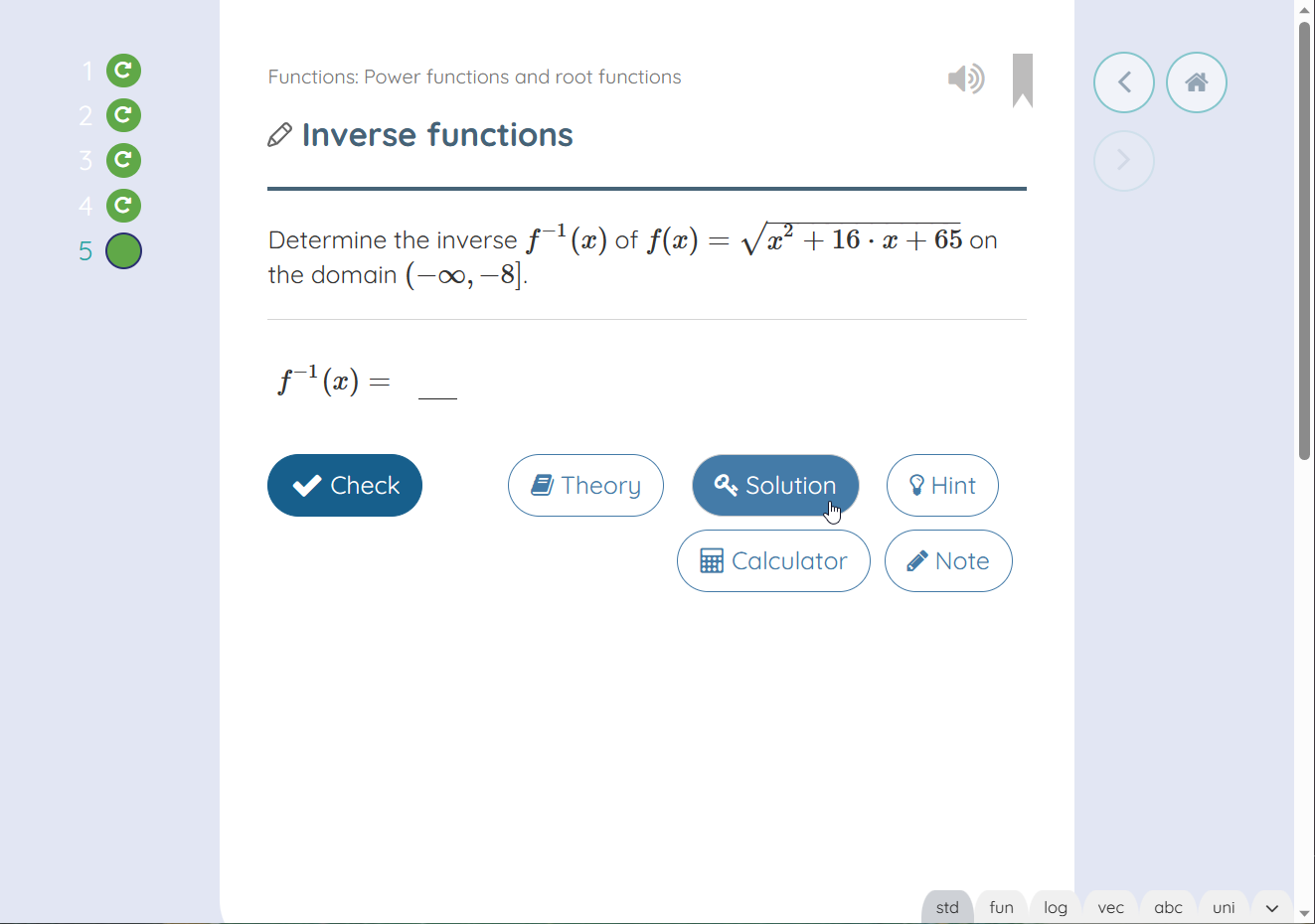
Not really sure what to do here
y^2 = x^2 + 16x + 65
I tried the quadratic formula but I got a negative in the discriminant
 warm canopy
I remind you of this #help-0 message
obtuse pebbleBOT
Channel closed
Closed by @karmic hedge
Use .reopen if this was a mistake.
karmic hedge
.reopen
obtuse pebbleBOT
✅
karmic hedge
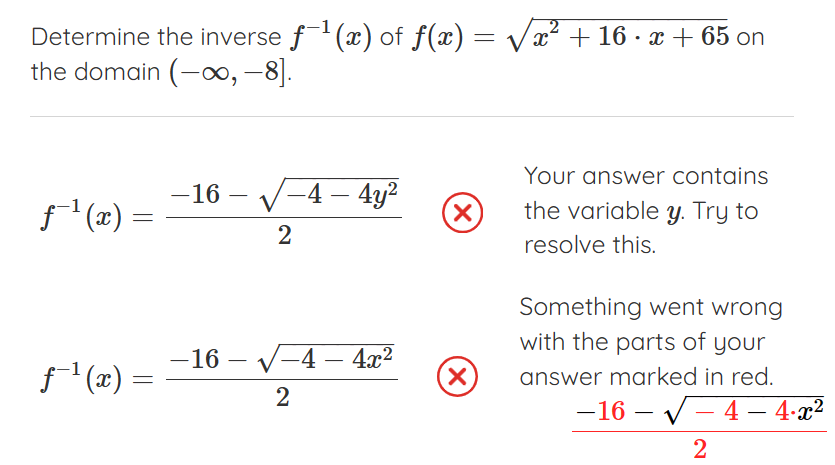
Not really sure what I did wrong here
I did quadratic formula with a = 1, b = 16 and c = (65 - y^2)
Yep sorry thats what I did
my bad haha
Oh wait no I didnt
I think thats the problem 1 moment
Yes youre right it is haha
Thank you!
❤️
.close
obtuse pebbleBOT
Channel closed
Closed by @karmic hedge
Use .reopen if this was a mistake.
Available help channel!
Send your question here to claim the channel.
Remember:
• Ask your math question in a clear, concise manner.
• Show your work, and if possible, explain where you are stuck.
• After 15 minutes, feel free to ping <@&286206848099549185>.
• Type the command .close to free the channel when you're done.
• Be polite and have a nice day!
Read #❓how-to-get-help for further information on how to ask a good question, and about conduct in the question channels.
nimble harbor
jagged falcon
Okay, think about it like this, what are the possible even divisors of a? Like a...
sorry for the late respond, if 'a' is divisible by 4, then the maximum value for n is infinite, if 'a' is only divisible by 2, then the maximum value for n is 1
obtuse pebbleBOT
nimble harbor
sorry for the late respond, if 'a' is divisible by 4, then the maximum value for...
@nimble harbor Has your question been resolved?
 errant lark
nimble harbor
the farthest i've got to writing a proof for this is that i've figured out that ...
errant lark
nimble harbor
the farthest i've got to writing a proof for this is that i've figured out that ...
Am i missing something here?
Since a is only divisible by 2 and not 4 : it will have only one 2 in its factorisation.
Basically,
$a = 2 * ( p1^{k1} * p2^{k2} * ... )$
where pi's are odd primes.
So, every even divisor of a must be of form 2*q where q is odd. Now, since there is a one-one relationship between even and odd divisors - they must be equal in number.
To see it more properly - You take any odd divisor which will be having different powers(not more than pi has in the factorisation) of pi's.
for this divisor - 2 * (this odd divisor) is a factor.
warm shaleBOT
.enemagneto
 obtuse pebbleBOT
@nimble harbor Has your question been resolved?
jagged falcon
nimble harbor
sorry for the late respond, if 'a' is divisible by 4, then the maximum value for...
Yes, so any even divisor of a must be of the form 2k, where k is odd. If 2k is a divisor, then so is k, which is odd. Hence for every even divisor of a, we have a unique odd divisor of a.
Similary, say k is an odd divisor of a. Then k<=a/2. Now k is an odd divisor, 2 is a divisor, hence 2k is a divisor of a, which is even. So for every odd divisor, we have a unique even divisor of a.
So we have a bijective correspondence between even and odd divisors of a, hence they must be equal in number.
@nimble harbor
obtuse pebbleBOT
Channel closed
Closed due to timeout
Use .reopen if this was a mistake.
Available help channel!
Send your question here to claim the channel.
Remember:
• Ask your math question in a clear, concise manner.
• Show your work, and if possible, explain where you are stuck.
• After 15 minutes, feel free to ping <@&286206848099549185>.
• Type the command .close to free the channel when you're done.
• Be polite and have a nice day!
Read #❓how-to-get-help for further information on how to ask a good question, and about conduct in the question channels.
 merry laurel
 obtuse pebbleBOT
merry laurel
novel grotto
merry laurel
Possible or not
obtuse pebbleBOT
merry laurel
novel grotto
merry laurel
Possible or not
it is possible for both
novel grotto
,texsp first one is consider ||$\frac{d}{dx}(ln(e^x+1))$||
warm shaleBOT
orthogonal_1
 novel grotto
second one is kind of similar
obtuse pebbleBOT
@merry laurel Has your question been resolved?
Channel closed
Closed by @merry laurel
Use .reopen if this was a mistake.
Available help channel!
Send your question here to claim the channel.
Remember:
• Ask your math question in a clear, concise manner.
• Show your work, and if possible, explain where you are stuck.
• After 15 minutes, feel free to ping <@&286206848099549185>.
• Type the command .close to free the channel when you're done.
• Be polite and have a nice day!
Read #❓how-to-get-help for further information on how to ask a good question, and about conduct in the question channels.
 buoyant bear
i am getting -34 plz help
 obtuse pebbleBOT
buoyant bear
i am getting -34 plz help
obtuse pebbleBOT
buoyant bear
i am getting -34 plz help
Show your work, and if possible, explain where you are stuck.
buoyant bear
man i am not stuck i am getting wrong ans
timid silo
show your working
timid silo
sketch out what you've done by typing then
buoyant bear
so i considered a fxn x^3+ax^2+bx+c
then i do the diffentiation for the first time
and get
3x^2+2ax+b
=a
and put value of 1
and so on
6x+a=b
value i put was 2
and then
6=c
and the coffecient i got was
a=-9,b=-6,c=6
timid silo
buoyant bear
=a
why is the first derivative =a?
ah nvm, read your next line
your reasoning looks fine
timid silo
buoyant bear
man i am not stuck i am getting wrong ans
whats the actual answer?
buoyant bear
8
timid silo
,w solve 3+2a+b=a, 12+a=b
warm shaleBOT

 Requested by toby____#0
timid silo
Requested by toby____#0
timid silo
nice 
obtuse pebbleBOT
Channel closed
Closed by @buoyant bear
Use .reopen if this was a mistake.
Available help channel!
Send your question here to claim the channel.
Remember:
• Ask your math question in a clear, concise manner.
• Show your work, and if possible, explain where you are stuck.
• After 15 minutes, feel free to ping <@&286206848099549185>.
• Type the command .close to free the channel when you're done.
• Be polite and have a nice day!
Read #❓how-to-get-help for further information on how to ask a good question, and about conduct in the question channels.
 hearty pendant
this is all solution and i cant get the ssecond step wand what is done after
 obtuse pebbleBOT
hearty pendant
this is all solution and i cant get the ssecond step wand what is done after
jagged falcon
obtuse pebbleBOT
hearty pendant
this is all solution and i cant get the ssecond step wand what is done after
jagged falcon
You are dividing both sides by (1-x)^n to get (1-x)^2(n-r) on RHS, they just expanded that to (1+x^2-2x)^(n-r)
 bold carbon
is this not just binomial expansion or smth
hearty pendant
yes
bold carbon
so couldnt u just use the expansion formula and apply it here
hearty pendant
how
bold carbon
here
hearty pendant
can u tell what happened in third step
bold carbon
ok\
maybe
but here is binom exp

Bing
Intelligent search from Bing makes it easier to quickly find what you’re looking for and rewards you.
please dont question me using bing lol
anyay
also
 granite quartz
WHAT.
obtuse pebbleBOT
@hearty pendant Has your question been resolved?
Channel closed
Closed by @hearty pendant
Use .reopen if this was a mistake.
Available help channel!
Send your question here to claim the channel.
Remember:
• Ask your math question in a clear, concise manner.
• Show your work, and if possible, explain where you are stuck.
• After 15 minutes, feel free to ping <@&286206848099549185>.
• Type the command .close to free the channel when you're done.
• Be polite and have a nice day!
Read #❓how-to-get-help for further information on how to ask a good question, and about conduct in the question channels.
 obsidian wren
I need help writing a two column proof for this question, and i have completelyyy no clue how to start this or prove the final result. Please help.
obtuse pebbleBOT
obsidian wren
I need help writing a two column proof for this question, and i have completelyy...
obsidian wren
 jagged falcon
Do you know about similar triangles?
obsidian wren
yes i have learned about them
jagged falcon
Yeah, so try switching PR to the denominator in RHS
obsidian wren
i get the fact that rs and qs and pr and rt are proportional
and the triangles are similair by sas similarity theorem
cause verticle angles theorem also mean angle r is same for both
but i dont know where to go after that
jagged falcon
obsidian wren
and the triangles are similair by sas similarity theorem
What triangles exactly now?
obsidian wren
prq and srt
jagged falcon
Yeah, so what can you say about angles RPQ and RTS?
jagged falcon
PRQ and TRS are similar, right?
obsidian wren
oh yea cause the triangles are similair
jagged falcon
So how are angles RPQ and RTS related?
jagged falcon
I meant the ANGLES
obsidian wren
sry for making you angry
jagged falcon
I'm not angry
obsidian wren
but the angles are what congruent?
jagged falcon
Angles are equal
obsidian wren
isnt congruent and equal the same thing?
obsidian wren
yes
jagged falcon
So can you see why the lines PQ and ST are parallel now?
obsidian wren
nope
jagged falcon
Line PT intercepts PQ and ST, and subtebds equal angles on the opposite sides of the lines PQ and ST. That means PQ and ST must be parallel
obsidian wren
intersects could also mean it just touches it at a point right?
jagged falcon
Yes
obsidian wren
what is subtebds? or what di dyou mean by that?
obsidian wren
ok the only problem is what would i put for reason in the proof
like what theorem postulate
i wrote the given
the verticle angles theorem
the sas similarity theorem
jagged falcon
Angles RPQ and RTS are equal, hence the lines are parallel. If you are using similar triangles, this statement need not be proven. I can give you a proof if you are curious, but you can simply write this statement without proof in the solution.
jagged falcon
I don't remember the theorem name exactly, but you don't need to prove it
jagged falcon
obsidian wren
in the proof would i say: <RPQ=<RTS
This
Angles are not congruent, triangles are. Congruency is involved when there's some partition using some relation, there needs to be congruency classes.
obsidian wren
ok so for the reason of them equal i write corresponding angles of similair triangles are congruent?
jagged falcon
Yes
obsidian wren
jagged falcon
Angles RPQ and RTS are equal, hence the lines are parallel. If you are using sim...
can you give the proof?
i am curious
jagged falcon
Okay, wait.
obsidian wren
so ummm any idea
jagged falcon

You do not need to prove this in your solution. If you are upto similar triangles, it is assumed that you already know this statement.
obsidian wren
so can i just say if both angles are equal the lines need to be parallel?
because i need to provide a reason
jagged falcon
obsidian wren
so can i just say if both angles are equal the lines need to be parallel?
Yes
obtuse pebbleBOT
Channel closed
Closed by @obsidian wren
Use .reopen if this was a mistake.
Available help channel!
Send your question here to claim the channel.
Remember:
• Ask your math question in a clear, concise manner.
• Show your work, and if possible, explain where you are stuck.
• After 15 minutes, feel free to ping <@&286206848099549185>.
• Type the command .close to free the channel when you're done.
• Be polite and have a nice day!
Read #❓how-to-get-help for further information on how to ask a good question, and about conduct in the question channels.
 kindred oasis
I'm working on multivariable calculus, Green's Theorem to be specific. C is a circle of radius 2, centered at the origin, so the textbook solves the integral using polar coordinates. Shouldn't it be r^2 instead of r^3 on the second line? x^2+y^2=r^2, right? It's just the textbook that is wrong or am I missing something? Thanks
 obtuse pebbleBOT
kindred oasis
I'm working on multivariable calculus, Green's Theorem to be specific. C is a ci...
obtuse pebbleBOT
kindred oasis
I'm working on multivariable calculus, Green's Theorem to be specific. C is a ci...
 pseudo swift
kindred oasis
I'm working on multivariable calculus, Green's Theorem to be specific. C is a ci...
pseudo swift
kindred oasis
I'm working on multivariable calculus, Green's Theorem to be specific. C is a ci...
it's from the change of coordinates from cartesian to polar
dA = r dr d(theta)
kindred oasis
pseudo swift
dA = r dr d(theta)
Oh ok, now I understand! Sorry, haven't used polar coordinates in a while... Thanks for the help, really appreciate it
.close
obtuse pebbleBOT
Channel closed
Closed by @kindred oasis
Use .reopen if this was a mistake.
Available help channel!
Send your question here to claim the channel.
Remember:
• Ask your math question in a clear, concise manner.
• Show your work, and if possible, explain where you are stuck.
• After 15 minutes, feel free to ping <@&286206848099549185>.
• Type the command .close to free the channel when you're done.
• Be polite and have a nice day!
Read #❓how-to-get-help for further information on how to ask a good question, and about conduct in the question channels.
 serene falcon
Can some ecplain what to do
 obtuse pebbleBOT
serene falcon
Can some ecplain what to do
serene falcon
obtuse pebbleBOT
serene falcon
Can some ecplain what to do
serene falcon
I translated it from a assingment in my book
obtuse pebbleBOT
@serene falcon Has your question been resolved?
 night glacier
serene falcon
Can some ecplain what to do
night glacier
serene falcon
Can some ecplain what to do
are you sure thats the full question
serene falcon
first i had to determine the belances and determine if they are stable or instable
i did that
and now this is the next question
pseudo swift
serene falcon
first i had to determine the belances and determine if they are stable or instab...
the equilibria you mean
what did you get then ?
serene falcon
 pseudo swift
sounds right yes
are you able to represent what the equilibria and the the stability means geometrically ?
serene falcon
stability says if it goes in to the equilibria or from the equilibria. stable means to the equilibria and unstable means goes away from equilibria
pseudo swift
serene falcon
so it goes to infinity
that's the idea yes
pseudo swift
serene falcon
for example y=-3 than it goes to 1 right?
indeed
pseudo swift
alr
serene falcon

whole different subject, but i was able to ditermine c
but now i have to fill in y(4)
but i'm struggling with that
this is the assignment. it is in dutch but they want me to determine y(4) exactly

but i'm really struggling with the y(4) part as you see in the bottum
pseudo swift
you should prolly find y as a function of t first
instead of keeping the y^(-3/2) form
I mean you could
it's a bit of a pain though


 pseudo swift
well how do you cancel that ^(-3/2) ?
serene falcon
yeah i don't know. because normally i when y^c = x is y = csqrt(x)
but that does not work with this
pseudo swift
serene falcon
yeah i don't know. because normally i when y^c = x is y = csqrt(x)
ah you mean $\sqrt[c]{x}$
warm shaleBOT
_aplatypus
 serene falcon
yeah and i need to calculate exactly so no decimals
and that gives a real weird answer
if you understand what i mean
pseudo swift
it will still be valid as an exact answer though
even if you have that -3/2 th root
serene falcon
ah but i can fill it in, and give as answer 4^(-3/2)
pseudo swift
yes
pseudo swift
you can simplify that though
serene falcon
as 4*sqrt4
pseudo swift
wait 4^(-3/2) ?
serene falcon
ow wait
pseudo swift
how did you get it ?
the exponent seems weird here
i'd expect ^(-2/3) if anything
serene falcon
 serene falcon
ah yeah i see, why does it flip?
pseudo swift
-3/2 * -2/3 = 1
so (y^(-3/2))^(-2/3) = 4^(-2/3)
therefore $y^{\left(-\frac32\right)\left(-\frac23\right)} = 4^{-\frac23}$
warm shaleBOT
_aplatypus
 pseudo swift
so y^1 = 4^(-2/3)
serene falcon
ah oke. can we simplify 4^(-2/3) into a fraction or is that not possible
so y=4^(2/3)
pseudo swift
it's less pretty than 4^-3/2 unfortunately
serene falcon
pseudo swift
it's less pretty than 4^-3/2 unfortunately
ah allright
thnx for your help!
this is the answer given, but shouldn't it be y(4)=4^(-2/3)

for the complete answer
obtuse pebbleBOT
Channel closed
Closed by @serene falcon
Use .reopen if this was a mistake.
obtuse pebbleBOT
Available help channel!
Send your question here to claim the channel.
Remember:
• Ask your math question in a clear, concise manner.
• Show your work, and if possible, explain where you are stuck.
• After 15 minutes, feel free to ping <@&286206848099549185>.
• Type the command .close to free the channel when you're done.
• Be polite and have a nice day!
Read #❓how-to-get-help for further information on how to ask a good question, and about conduct in the question channels.
 frozen jolt
How do I solve this? (the answer needs to be in the form of pi, and radicals if there are any)
 obtuse pebbleBOT
frozen jolt
How do I solve this? (the answer needs to be in the form of pi, and radicals if ...
obtuse pebbleBOT
frozen jolt
How do I solve this? (the answer needs to be in the form of pi, and radicals if ...
 raw hinge
$sec(x) = \frac{1}{cos(x)}$
warm shaleBOT
_shachar

 severe reef
frozen jolt
How do I solve this? (the answer needs to be in the form of pi, and radicals if ...
severe reef
frozen jolt
How do I solve this? (the answer needs to be in the form of pi, and radicals if ...
9π=8π+π
frozen jolt
so one revolution
severe reef
So it's just 1/√2,1/√2
frozen jolt
oh gotcha
severe reef
Always try to break the numerator in terms of multiples of the denominator in such problems
severe reef
I mean this isn't something exclusive to trig but yeah
frozen jolt
specifically unit of circle
frozen jolt
severe reef
I mean this isn't something exclusive to trig but yeah
so basically, when doing unit of circle, i noticed there are common coordinates based on the revolutions, so it would be a good idea to memorize the ones on this circle?
