#help-10
1 messages · Page 97 of 1
 obtuse pebbleBOT
Channel closed
Closed by @final girder
Use .reopen if this was a mistake.
 nocturne minnow
 final girder
Trusting the process is insane
final girder
Trusting the process is insane
And doing one step at a time
Notice how you did one step at a time instead of skipping multiple steps
obtuse pebbleBOT
 Available help channel!
Send your question here to claim the channel.
Remember:
• Ask your math question in a clear, concise manner.
• Show your work, and if possible, explain where you are stuck.
• After 15 minutes, feel free to ping <@&286206848099549185>.
• Type the command .close to free the channel when you're done.
• Be polite and have a nice day!
Read #❓how-to-get-help for further information on how to ask a good question, and about conduct in the question channels.
final girder
there is more hard math to be done
obtuse pebbleBOT
final girder
there is more hard math to be done

 warm shaleBOT
Homebound
 final girder
so we must get this back into its original form
first
lets get d back into original form
so
wait
step by step
just going backwards
$$ -((x+3)^2 +2) $$
what now
warm shaleBOT
Homebound

 teal turret
warm shale
**Homebound**
teal turret
warm shale
**Homebound**
Expand and simplify w this
final girder
yea
teal turret
There’s no difference between those 2 expressions
 teal turret
Bruh
teal turret
Yea I figured
final girder
$$-(x+4)^2-5$$
warm shaleBOT
Homebound
 warm shaleBOT
Homebound
 final girder
wait
i dont need the whole think including -5 in brackets right? @teal turret
cause thats only multiplying the (x+c)^2 term
not the -5 constant
teal turret
It’d have to be +5 if u wanted everything in parenth right
teal turret
lol
final girder
so can i keep -5 out the brackets?
final girder
which i am NOT doing
final girder
so -8 and -11 is what i got
teal turret
No
teal turret
So did u keep the -5 out of the parentheses
warm shaleBOT
Homebound

 frigid robin
whats hommebound?
teal turret
This is the same part u got wrong from the last problem, this step
The distribution of the -
warm shaleBOT
Homebound
 warm shaleBOT
Homebound
 final girder
$$-x^2 -8x - 11$$
warm shaleBOT
Homebound
 teal turret
👎
final girder
how
nocturne minnow
-16 - 5
teal turret
Ye
teal turret
yep
final girder
2023
I ENDED 2022 DOING A MATHS QUESTION
THIS IS THE YEAR THE PROJECT GOES BAMNG
LETS GOOOOOOOOOOOOO
obtuse pebbleBOT
Channel closed
Closed by @final girder
Use .reopen if this was a mistake.
Available help channel!
Send your question here to claim the channel.
Remember:
• Ask your math question in a clear, concise manner.
• Show your work, and if possible, explain where you are stuck.
• After 15 minutes, feel free to ping <@&286206848099549185>.
• Type the command .close to free the channel when you're done.
• Be polite and have a nice day!
Read #❓how-to-get-help for further information on how to ask a good question, and about conduct in the question channels.
frigid robin
final girder
I ENDED 2022 DOING A MATHS QUESTION
nice
obtuse pebbleBOT
frigid robin
nice
 thick oracle
😂
obtuse pebbleBOT
@frigid robin Has your question been resolved?
obtuse pebbleBOT
Channel closed
Closed due to timeout
Use .reopen if this was a mistake.
Available help channel!
Send your question here to claim the channel.
Remember:
• Ask your math question in a clear, concise manner.
• Show your work, and if possible, explain where you are stuck.
• After 15 minutes, feel free to ping <@&286206848099549185>.
• Type the command .close to free the channel when you're done.
• Be polite and have a nice day!
Read #❓how-to-get-help for further information on how to ask a good question, and about conduct in the question channels.
obtuse pebbleBOT
frigid robin
no
 fierce lagoon
Bruh
 wooden cipher
whats your question?
nocturne minnow
frigid robin
no
• Show your work, and if possible, explain where you are stuck.```If you don't have question, then close the channel and open a channel when you actually have a question
fierce lagoon
Send this man to the dungeon where he will rot for all eternity!!!!
nocturne minnow
frigid robin
I have resolved my own question
Then close the channel since you're not properly using it
fierce lagoon
.close
obtuse pebbleBOT
Channel closed
Closed by @fierce lagoon
Use .reopen if this was a mistake.
frigid robin
how to close?
fierce lagoon
This has to be the biggest bruh moemnt
frigid robin
nocturne minnow
Then close the channel since you're not properly using it
How do I close the channel?
nocturne minnow
It was closed by someone else
frigid robin
Oh ok
nocturne minnow
obtuse pebble
If you see this, you are good
frigid robin
But it still has my name next to it
 little warren
frigid robin
But it still has my name next to it
little warren
frigid robin
But it still has my name next to it
dw it will close
frigid robin
Ok
nocturne minnow
It takes a few minutes to fully close
frigid robin
oh ok thanks guys
obtuse pebbleBOT
Available help channel!
Send your question here to claim the channel.
Remember:
• Ask your math question in a clear, concise manner.
• Show your work, and if possible, explain where you are stuck.
• After 15 minutes, feel free to ping <@&286206848099549185>.
• Type the command .close to free the channel when you're done.
• Be polite and have a nice day!
Read #❓how-to-get-help for further information on how to ask a good question, and about conduct in the question channels.
 desert finch
when f(1/n) = 1 and f(-1/n) = -1 , show that the limit f(x) when x approaches 0 doesnot exist
how do i do that exacly ?
obtuse pebbleBOT
desert finch
when f(1/n) = 1 and f(-1/n) = -1 , show that the limit f(x) when x approaches 0...
fierce lagoon
What happens when n -> infinity
desert finch
it approaches 0
fierce lagoon
So essentially when you take |n| -> infinity, you get f(0) = 1 and -1
But then
Like
Hell breaks loose then
 lament tartan
desert finch
when f(1/n) = 1 and f(-1/n) = -1 , show that the limit f(x) when x approaches 0...
lament tartan
desert finch
when f(1/n) = 1 and f(-1/n) = -1 , show that the limit f(x) when x approaches 0...
There is a discontinuity yes
So when you take the limit from both sides
It doesn't match up
I.e. the limit doesn't exist
At x = 0, the point of the discontinuity
 fierce lagoon
Prob to do with squeeze
desert finch
so let me get this right
 quaint glen
desert finch
quaint glen
desert finch
Its a known result that if lim_{x \to a} f(x)=L, then lim_{n \to \infty} f(a_n)=L for any sequence a_n that goes to a
So, if we can find two sequences that go to zero along which the function has different limits, that would contradict this result
desert finch
quaint glen
Its a known result that if lim_{x \to a} f(x)=L, then lim\_{n \to \infty} f(a_n)...
could u type this one in latex , i donot really umderstand it
quaint glen
Its a known result that if $\lim_{x \to a} f(x)=L$, then $\lim_{n \to \infty} f(a_n)=L$ for any sequence $a_n \to a$
lament tartan
Just take the limit from both sides, of f(x) as x approaches 0, by taking the inner limit as n approaches infinity
warm shaleBOT
Sneaky
 lament tartan
A discontinuity is defined as where limits as approached from both sides are unequal
desert finch
oh okay i understand now thank you very much both of you
obtuse pebbleBOT
@desert finch Has your question been resolved?
Channel closed
Closed by @desert finch
Use .reopen if this was a mistake.
Available help channel!
Send your question here to claim the channel.
Remember:
• Ask your math question in a clear, concise manner.
• Show your work, and if possible, explain where you are stuck.
• After 15 minutes, feel free to ping <@&286206848099549185>.
• Type the command .close to free the channel when you're done.
• Be polite and have a nice day!
Read #❓how-to-get-help for further information on how to ask a good question, and about conduct in the question channels.
 untold cave
Is the following a correct approach to $(\cosh(x+iy))^i$?
$$\cosh(x+iy) = \cosh x \cos y + i \sinh x \sin y$$\
Thus, in polar form
$$\cosh(x+iy)=\sqrt{\cosh^2 x \cos^2 y + \sinh^2 x \sin^2 y} \ \text{exp}(i\tan^{-1}(\tanh x \tan y)).$$\
So $$\ln(\cosh(x+iy))=\ln(\sqrt{\cosh^2 x \cos^2 y +\ i \sinh^2 x \sin^2 y})+i\tan^{-1}(\tanh x \tan y).$$
Therefore we can use $(\cosh(x+iy))^i=e^{i\ln(cosh(x+iy))}$ and that should be it.
obtuse pebbleBOT
untold cave
Is the following a correct approach to $(\cosh(x+iy))^i$?
$$\cosh(x+iy) = \cos...
warm shaleBOT
𝙹o
 obtuse pebbleBOT
@untold cave Has your question been resolved?
 brave bramble
Should be what? What's the question?
 trail cloak
The question is about whether the method used has any flaws or not
obtuse pebbleBOT
Channel closed
Closed due to timeout
Use .reopen if this was a mistake.
Available help channel!
Send your question here to claim the channel.
Remember:
• Ask your math question in a clear, concise manner.
• Show your work, and if possible, explain where you are stuck.
• After 15 minutes, feel free to ping <@&286206848099549185>.
• Type the command .close to free the channel when you're done.
• Be polite and have a nice day!
Read #❓how-to-get-help for further information on how to ask a good question, and about conduct in the question channels.
 raw coral
 raw coral
is this correct
raw coral
i changed it to y=mx+b
if it was parralel it will be the same
if perpendicular it will be inversed
its none
thanks
.close
obtuse pebbleBOT
Channel closed
Closed by @raw coral
Use .reopen if this was a mistake.
obtuse pebbleBOT
Available help channel!
Send your question here to claim the channel.
Remember:
• Ask your math question in a clear, concise manner.
• Show your work, and if possible, explain where you are stuck.
• After 15 minutes, feel free to ping <@&286206848099549185>.
• Type the command .close to free the channel when you're done.
• Be polite and have a nice day!
Read #❓how-to-get-help for further information on how to ask a good question, and about conduct in the question channels.
 robust sierra
I’m kinda stumped with the following proof. I understand the idea and how it works and all, but I just can’t seem to wrap my head around where the (b-a)/3 value came from for epsilon. It just seem extremely random, how could I have come up with it if I had been coming up with the proof myself?
 obtuse pebbleBOT
robust sierra
I’m kinda stumped with the following proof. I understand the idea and how it wor...
obtuse pebbleBOT
robust sierra
I’m kinda stumped with the following proof. I understand the idea and how it wor...
 viral blade
Probably doing the proof backwards
Maybe even starting with just arbitrary delta and seeing which epsilon it guarantees
 unreal musk
Weird way they've done it there tbh
 gleaming ridge
robust sierra
I’m kinda stumped with the following proof. I understand the idea and how it wor...
gleaming ridge
robust sierra
I’m kinda stumped with the following proof. I understand the idea and how it wor...
The point here is that if they are not the same you want a value of epsilon that would result in a contradiction since you assumed a != b
choosing e = |b - a|/something makes sense
Although, the further proof is weird ngl
robust sierra
Alright thank you guys
they did give a second proof for that one iirc
using the triangle inequality
.close
obtuse pebbleBOT
Channel closed
Closed by @robust sierra
Use .reopen if this was a mistake.
Available help channel!
Send your question here to claim the channel.
Remember:
• Ask your math question in a clear, concise manner.
• Show your work, and if possible, explain where you are stuck.
• After 15 minutes, feel free to ping <@&286206848099549185>.
• Type the command .close to free the channel when you're done.
• Be polite and have a nice day!
Read #❓how-to-get-help for further information on how to ask a good question, and about conduct in the question channels.
 valid crown
I'd like to have a formula for function along a curve "if doable", for example cosine along exponent, where cosine is non deformed in respect to exponent, has same amplitude and period
obtuse pebbleBOT
valid crown
I'd like to have a formula for function along a curve "if doable", for example c...

 dark stirrup
It would have to be parametric
valid crown
I can measure length of a function for constant period
dark stirrup
this is a differential geometry question as you need to know the curvature of the exponent
valid crown
and create perpendicular in any point to map points correctly
but here is a little problem
for any x, I can easily map only previous points
at this point, is this still possible to map properly a point for x without iterative methods?
valid crown
dark stirrup
this is a differential geometry question as you need to know the curvature of th...
so, make a tangent, then perpendicular and mapping
but that doesn't guarantee a formula in terms f(x)
dark stirrup
valid crown
but that doesn't guarantee a formula in terms f(x)
You almost certainly cannot
Hence why it needs to be parametric
 viral blade
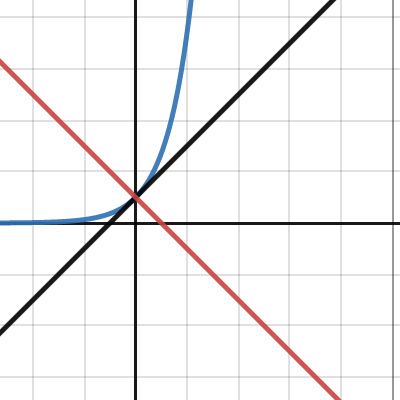
e^x gets more and more vertical
So you want a wavy line going straight up that passes the vertical line test?
 lost tree
like this?
 valid crown
lost tree
like this?
valid crown
lost tree
like this?
no
Like I drew
here cosine is symmetrical to y=0 axis
I want it to be symmetrical to y = e^x curve
your only holds for constant period

 versed turret
They want cos along exp
viral blade
e^t arc length differential is sqrt(1+e^2t) hmm
and slope is e^t
x = t + cos(t)sin(arctan(e^t))
y = e^t + cos(t)cos(arctan(e^t))
this won't be good but maybe it's failures can be improved
 valid crown
viral blade
this won't be good but maybe it's failures can be improved
valid crown
viral blade
this won't be good but maybe it's failures can be improved
length function is taking much time to compute
versed turret
Don't know how useful it is, but the function's average along exp will equal exp
viral blade
length function?
For your solution I assume
Do you think t = ln(tan(u)) is too optimistic lol
if it is try integral calculator .com maybe
 warm shaleBOT
monikanicity
 lost tree
 viral blade
Desmos doesn't recognize the prime symbol
valid crown
viral blade
Desmos doesn't recognize the prime symbol
it does, look for tangent a normal with a for slider
lost tree
no
valid crown
oh ok
lost tree

 lost tree
yeah but
valid crown
 wild swallow
Could you share a code please?
wild swallow
i mean you could technically wrap any graph around it
lost tree
at least itll look kinda less vertical near the origin

 tardy epoch
wild swallow
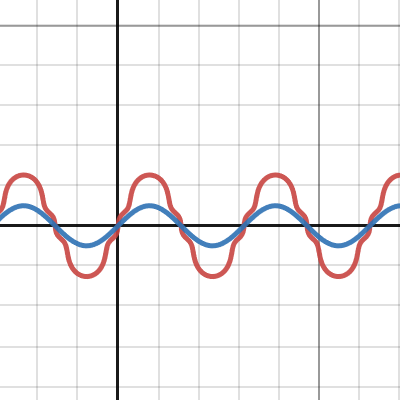
heres a funky wave
tardy epoch
wild swallow
heres a funky wave
Make one that says 2023

 untold scaffold
wave that wavy wave with more waves
viral blade
Make an anime girl next
wild swallow

Desmos
valid crown
wild swallow
https://www.desmos.com/calculator/1t527gkhlz
this one is static to just e^x
I'll try to generalize
valid crown
viral blade
Make an anime girl next
 valid crown
yeah
viral blade
Particularly computers are bad with double integrals lol
Which, nesting the function twice you were somehow doing I think
idk
valid crown
welp, I got also this from some time ago, it doesn't hold constant amplitude but it works fast

Desmos
nontheless I couldn't reverse engineer this to find out why it doesn't work for linears (y=x) and fix amplitude
 viral blade
Nah u need to get rid of the f(t) in the g(t) expression lol
Idk maybe not
That screws with the period ig
 wild swallow


 wild swallow

viral blade
i have an idea
valid crown
circular function and fourier series for "one to rule them all" ?
 valid crown
meh, just add step by step
valid crown
can't wait to
valid crown
lost tree
i just realized this was wrong
I pasted reworked formula
lost tree
this is crrect
 valid crown
valid crown
valid crown
here
wild swallow

lost tree
valid crown
I pasted reworked formula
oh
valid crown
lost tree
this is crrect
almost
tardy epoch
e^(1/10) lmao
wild swallow
wild swallow
https://www.desmos.com/calculator/c0mluctqlb
this already calculates the required graph in general
valid crown
your period is not constant
lost tree
valid crown
your period is not constant
oh
valid crown
lost tree
oh
I denoted fe as function along which curve is drawn
fc drawn curve
fl length of fe
valid crown
wild swallow
this already calculates the required graph in general
call me dumb but where do I enter 2nd function?
 wild swallow
what second function
 versed turret
.close?
valid crown

tardy epoch
viral blade
https://www.desmos.com/calculator/yinfer1vjw
Bookmark this to the server
viral blade
nah someone needs to @everyone for this
valid crown
welp, thanks to everyone invested, happy new year
tardy epoch
How long do desmos links last for
valid crown
.close
obtuse pebbleBOT
Channel closed
Closed by @valid crown
Use .reopen if this was a mistake.
viral blade
252 million years
wild swallow
tardy epoch
How long do desmos links last for
forever
obtuse pebbleBOT
Available help channel!
Send your question here to claim the channel.
Remember:
• Ask your math question in a clear, concise manner.
• Show your work, and if possible, explain where you are stuck.
• After 15 minutes, feel free to ping <@&286206848099549185>.
• Type the command .close to free the channel when you're done.
• Be polite and have a nice day!
Read #❓how-to-get-help for further information on how to ask a good question, and about conduct in the question channels.
 rapid cove
how do i solve this: 2cos(x)+2cos(2x)=0
obtuse pebbleBOT
rapid cove
how do i solve this: 2cos(x)+2cos(2x)=0
 sage geode
Use double angle identity for cosine (preferably the one where sine is absent)
rapid cove
👍 thx
obtuse pebbleBOT
@rapid cove Has your question been resolved?
Channel closed
Closed by @rapid cove
Use .reopen if this was a mistake.
Available help channel!
Send your question here to claim the channel.
Remember:
• Ask your math question in a clear, concise manner.
• Show your work, and if possible, explain where you are stuck.
• After 15 minutes, feel free to ping <@&286206848099549185>.
• Type the command .close to free the channel when you're done.
• Be polite and have a nice day!
Read #❓how-to-get-help for further information on how to ask a good question, and about conduct in the question channels.
 timid silo
what are the steps to graphing this?
 obtuse pebbleBOT
timid silo
what are the steps to graphing this?
warm shaleBOT
obtuse pebbleBOT
timid silo
what are the steps to graphing this?
warm shaleBOT
_____
 obtuse pebbleBOT
@timid silo Has your question been resolved?
viral blade
What happens when you plug in +-2 for x?
timid silo
<@&286206848099549185>
 cloud berry
do you know how to graph sec(x)
timid silo
cloud berry
do you know how to graph sec(x)
I know how it looks
obtuse pebbleBOT
@timid silo Has your question been resolved?
obtuse pebbleBOT
Channel closed
Closed due to timeout
Use .reopen if this was a mistake.
Available help channel!
Send your question here to claim the channel.
Remember:
• Ask your math question in a clear, concise manner.
• Show your work, and if possible, explain where you are stuck.
• After 15 minutes, feel free to ping <@&286206848099549185>.
• Type the command .close to free the channel when you're done.
• Be polite and have a nice day!
Read #❓how-to-get-help for further information on how to ask a good question, and about conduct in the question channels.
 hollow sail
Hi can someone help me with b5
 obtuse pebbleBOT
hollow sail
Hi can someone help me with b5
obtuse pebbleBOT
hollow sail
Hi can someone help me with b5
 plain stag
what about it are you having trouble with?
obtuse pebbleBOT
Channel closed
Closed by @hollow sail
Use .reopen if this was a mistake.
Available help channel!
Send your question here to claim the channel.
Remember:
• Ask your math question in a clear, concise manner.
• Show your work, and if possible, explain where you are stuck.
• After 15 minutes, feel free to ping <@&286206848099549185>.
• Type the command .close to free the channel when you're done.
• Be polite and have a nice day!
Read #❓how-to-get-help for further information on how to ask a good question, and about conduct in the question channels.
 hexed stirrup
hi i need help
obtuse pebbleBOT
hexed stirrup
hi i need help
 dim bobcat
lol isn't that the same question which you asked earlier
hexed stirrup
where you get
hexed stirrup
dim bobcat
lol isn't that the same question which you asked earlier
yes it is
dim bobcat
Ask the doubt directly
hexed stirrup
$(z-7)+xy(z-7)$
warm shaleBOT
Rock Man
 warm shaleBOT
Rock Man
 hexed stirrup
warm shale
**Rock Man**
hexed stirrup
warm shale
**Rock Man**
@dim bobcat this step i didnt understood
dim bobcat
You know about this property that ab+ac = a(b+c)?
dim bobcat
Dosen't matter
hexed stirrup
i dont know about the formulas
hexed stirrup
uh?
dim bobcat
(z-7) is acting like a there
hexed stirrup
dim bobcat
(z-7) is acting like a there
oh
dim bobcat
Common in both terms
 royal shard
Shouldnt it be +xy?
royal shard
Ah ok
hexed stirrup
ok
dim bobcat
ab+ ad can be written as a(b+d)
Just like it
z-7+7xy-xyz
=(z-7)-xy(z-7)
=(z-7)(1-xy)
hexed stirrup
okay so in this solution where i have doubt is
as you wrote z-7-xy(z-7)
i didnt understood how did you write xy(z-7)=1-xy
how this?
@dim bobcat
dim bobcat
I took (z-7) common just like i took a common in above one
I didn't write 1-xy in place of xy(z-7)
dim bobcat
We don't solve anything
hexed stirrup
to get answer as (1-xy)
dim bobcat
We take common
Because we have to factorise
There's no equation here that we have to solve
You agree that ab+ ad= a(b+d)?
hexed stirrup
dim bobcat
You agree that ab+ ad= a(b+d)?
i dont even know bcuz we just started the chapter like 2 days back
!
dim bobcat
dim bobcat
You agree that ab+ ad= a(b+d)?
?
dim bobcat
Ok
ab+ad= a(b+d)
This is called distributive property of addition
Which is used above
obtuse pebbleBOT
Channel closed
Closed by @hexed stirrup
Use .reopen if this was a mistake.
hexed stirrup
.reopen
obtuse pebbleBOT
✅
dim bobcat
lol
hexed stirrup
dim bobcat
lol
i need it for sometime
dim bobcat
What else do you have to ask bro
hexed stirrup
if i may get another doubt
hexed stirrup
dim bobcat
What else do you have to ask bro
i may get bcuz i am currently solving
hexed stirrup
dim bobcat
That one clear?
yeah my mom explained it to me
dim bobcat
What mistake were you making earlier
hexed stirrup
not knowing how to solve
obtuse pebbleBOT
@hexed stirrup Has your question been resolved?
obtuse pebbleBOT
Channel closed
Closed due to timeout
Use .reopen if this was a mistake.
Available help channel!
Send your question here to claim the channel.
Remember:
• Ask your math question in a clear, concise manner.
• Show your work, and if possible, explain where you are stuck.
• After 15 minutes, feel free to ping <@&286206848099549185>.
• Type the command .close to free the channel when you're done.
• Be polite and have a nice day!
Read #❓how-to-get-help for further information on how to ask a good question, and about conduct in the question channels.
 wild orbit
 obtuse pebbleBOT
wild orbit
wild orbit
obtuse pebbleBOT
wild orbit
wild orbit
31/pi is the final answer, can someone help
obtuse pebbleBOT
@wild orbit Has your question been resolved?
 stable rain
,rccw
warm shaleBOT
 wild orbit
stable rain
im only seeing a phi but why does it end with dphi dtheta
wild orbit
stable rain
im only seeing a phi but why does it end with dphi dtheta
Its a spherical integral
 stable rain
eh
idk but
i guess the integral is not dependent on theta so we can just treat it as a constant 2 pi outside
we can split the integral into 2 bits but idk how to do the um
cos 3phi sin phi
probably convert cos 3phi to trig with just phi
then int
obtuse pebbleBOT
@wild orbit Has your question been resolved?
wild orbit
stable rain
then int
Would u get the answer as 31 pi/6
stable rain
idk
wild orbit
stable rain
probably convert cos 3phi to trig with just phi
I dont understsnd this ,can u like wtite it down or smth?
wild orbit
stable rain
no idk how to do it
👍
wild orbit
Looka like someone else have to come in , i eill wait for some time...
stable rain
cos)A+B) = ...
wild orbit
stable rain
sin(A+B) = ...
Oh
wild orbit
stable rain
yea mayb try it
Hmm,what about integration by parts?
wild orbit
stable rain
also u can just try integral calculator to check
Yea i used symbolab
wild orbit
I shuld be getting 31 pi /6
wild orbit
stable rain
idk how to do
👍
wild orbit
stable rain
n im out
Have fun
wild orbit
Will wait some time to see if anyone else will try to help ,otherwise will close the channel ig
obtuse pebbleBOT
Channel closed
Closed by @wild orbit
Use .reopen if this was a mistake.
Available help channel!
Send your question here to claim the channel.
Remember:
• Ask your math question in a clear, concise manner.
• Show your work, and if possible, explain where you are stuck.
• After 15 minutes, feel free to ping <@&286206848099549185>.
• Type the command .close to free the channel when you're done.
• Be polite and have a nice day!
Read #❓how-to-get-help for further information on how to ask a good question, and about conduct in the question channels.
 cobalt kiln
 obtuse pebbleBOT
cobalt kiln
https://cdn.discordapp.com/attachments/423244559682764800/1058545751745114222/im...
cobalt kiln
obtuse pebbleBOT
cobalt kiln
https://cdn.discordapp.com/attachments/423244559682764800/1058545751745114222/im...
cobalt kiln
I have done letter b, can anyone check my proof? Btw, it should be a+c/b+d, there's an error

 obtuse pebbleBOT
@cobalt kiln Has your question been resolved?
obtuse pebbleBOT
@cobalt kiln Has your question been resolved?
 icy badge
@cobalt kiln how did you justify that a/b < c/d?? Your proof is okay apart from this. Check for the case that c/d < a/b
show that for both of these inequalities a + c/ b + d is between a/b and c/d
cobalt kiln
@icy badge You don't need to justify it, you begin with it as your definition/assumption. And yes, I was thinking the same thing about whether I should do c/d < a/b to show that it goes both ways. Did you see the second part of my paper?
I think I will say as a note that if you do c/d < a/b, you end up with a+c/b+d also between them, With the same exact procedure as the first one
icy badge
cobalt kiln
I think I will say as a note that if you do c/d < a/b, you end up with a+c/b+d a...
then, great. Make sure you state that you assume that a/b < c/d not just "such that" it sounds like you are changing the problem
cobalt kiln
icy badge
then, great. Make sure you state that you assume that a/b < c/d not just "such t...
Oh ok, yes. English is not my first language and I don't usually write proofs, so this is really my first time doing this. What about the second part, is it any good? Thanks
icy badge
cobalt kiln
Oh ok, yes. English is not my first language and I don't usually write proofs, s...
looks good to me, great job
cobalt kiln
ok thanks, btw wait a minute just going to check something
icy badge
what kind of proof did you do?
you should know
like a direct proof? contradiction? contrapositive?
cobalt kiln
This is contradiction here
icy badge
im testing u
icy badge
cobalt kiln
This is contradiction here
very nice
icy badge
that's fine
cobalt kiln
Meaning, I don't know all other proof techniques
Btw, I did c/d < a/b and it also works. Although, if you establish that a/b < c/d is set in, do you really need to put the inverse? I mean, this would be changing the number line to something else, even though it also works. I think one would suffice no?
icy badge
cobalt kiln
Btw, I did c/d < a/b and it also works. Although, if you establish that a/b < c/...
yes, that suffices. Just say that by symmetry, the case or the assumption that c/d < a/b leads the same result regardless
you have to cover all cases.
you covered the a/b < c/d case, but what a bout the c/d < a/b case?
just say it checks out using same argument but different variable names
cobalt kiln
Yes, I guess I lose nothing doing such a thing also
Btw, I did letter c, do you want to check it?
icy badge
no thanks
cobalt kiln
Ok, thanks again for the help btw
obtuse pebbleBOT
@cobalt kiln Has your question been resolved?
cobalt kiln
dark stirrup
In part b, you wrote ad-bc=+1
The minus one is done at the end, I gave -1 also
The -(ad-bc) part
dark stirrup
Nah that's not how it goes
ad-bc=+-1
It could be either
Neither should be disregarded
cobalt kiln
wait im not following you
dark stirrup
It's possible that ad-bc=-1
cobalt kiln
ok, so writing +- instead should do the trick then right
cobalt kiln
The minus is already given in the second part, so I only have to write the + to take into account this also
cobalt kiln
oh i understand now why you inverted the signs
it's because - * +1 and -1 * -1, which gives at the end -+1
@dark stirrup Is that right?
dark stirrup
Yes exactly
obtuse pebbleBOT
@cobalt kiln Has your question been resolved?
obtuse pebbleBOT
Channel closed
Closed by @celest lagoon
Use .reopen if this was a mistake.
obtuse pebbleBOT
Available help channel!
Send your question here to claim the channel.
Remember:
• Ask your math question in a clear, concise manner.
• Show your work, and if possible, explain where you are stuck.
• After 15 minutes, feel free to ping <@&286206848099549185>.
• Type the command .close to free the channel when you're done.
• Be polite and have a nice day!
Read #❓how-to-get-help for further information on how to ask a good question, and about conduct in the question channels.
 surreal grotto
\begin{align}
&\text{Prove that,}
&\frac{(x^2+1)(y^2+1)(z^2+1)}{xyz} \geq 8\
&\end{align}
warm shaleBOT
Mushfiqur
 surreal grotto
For any positive real numbers
 rigid lintel
warm shaleBOT
rigid lintel
warm shaleBOT
Gijs

 slate zephyr
surreal grotto
\begin{align}
&\text{Prove that,}
&\frac{(x^2+1)(y^2+1)(z^2+1)}{xyz} \geq 8\\
&\...
slate zephyr
surreal grotto
\begin{align}
&\text{Prove that,}
&\frac{(x^2+1)(y^2+1)(z^2+1)}{xyz} \geq 8\\
&\...
Proof first that ((x²+1)/x) >= 2
obtuse pebbleBOT
Available help channel!
Send your question here to claim the channel.
Remember:
• Ask your math question in a clear, concise manner.
• Show your work, and if possible, explain where you are stuck.
• After 15 minutes, feel free to ping <@&286206848099549185>.
• Type the command .close to free the channel when you're done.
• Be polite and have a nice day!
Read #❓how-to-get-help for further information on how to ask a good question, and about conduct in the question channels.
cobalt kiln
obtuse pebbleBOT
cobalt kiln
https://cdn.discordapp.com/attachments/423244559682764800/1058545751745114222/im...
 dark stirrup
mediant, not median
dark stirrup
"first" mediant implies multiple. I'd write "given mediant" instead.
 cobalt kiln
dark stirrup
"first" mediant implies multiple. I'd write "given mediant" instead.
cobalt kiln
dark stirrup
"first" mediant implies multiple. I'd write "given mediant" instead.
What I meant by "first mediant" was the one which you obtain by doing a+c/b+d, because you can still subvide your line into other mediants
dark stirrup
Yeah I know what you meant
But saying "first mediant" implies that a/b and c/d have multiple mediants
It's just a clarity thing
dark stirrup
What word is this
 cobalt kiln
its numerator is
dark stirrup
what about here?
 cobalt kiln
wait a minute let me think about this
yes so, as far as I remember, since this is a distance, which is located between a/b and c/d, you know it is going to have some quantity, right?
If it was zero, this means it would be equal to a/b or c/d
when we assume e/f is between those two fractions
dark stirrup
cobalt kiln
yes so, as far as I remember, since this is a distance, which is located between...
It's weak wording, mathematically, but it makes sense.
yes
cobalt kiln
How would you write it in words?
dark stirrup
Something like this
 cobalt kiln
yes ok
I should have specified e/f > a/b and e/f<c/d
and done that it stays superior to 0 in mathematical terms
dark stirrup
Your proof is correct up to this point

This indeed is a true statement
But it does not mean that f has no upper bound
Showing what the lower bound is does not mean that it has no upper bound
cobalt kiln
dark stirrup
Showing what the lower bound is does not mean that it has no upper bound
oh ok, thanks for mentioning this. To be honest, I did consider this case but I was not sure how to interpret my result. I assumed my original statement "disappeared"
btw, just to be clear I'm following, you'Re saying that f < b+d is my upper bound, right?
dark stirrup
yes
As a hint
Consider c/d-e/f
You let d1=e/f-a/b
So let d2=c/d-e/f
It must be true that d1+d2=c/d-a/b
cobalt kiln
Ok, thanks, I'll try to derive the rest of the proof by myself and hopefully my head will "click"
dark stirrup
good luck
obtuse pebbleBOT
@cobalt kiln Has your question been resolved?
cobalt kiln

Ok, so I obtain this final result. I think the first one, -f <=d+b can be disregarded since we are only working with positive values of f here in general, based on what the problem stated
So we only take a look at the second part, with the positive values, and we obtain a contradiction
@dark stirrup is my reasoning correct?
obtuse pebbleBOT
@cobalt kiln Has your question been resolved?
cobalt kiln
dark stirrup
you're finally done
So, I was right to exclude the first one based on what I said?
dark stirrup
yes
cobalt kiln
Thanks again
man, what a problem this was
Take into account it is my first time doing this
dark stirrup
You can generalize to consider negative fractions, but it's just the same result with extra work
Yeah it was a non-trivial problem
cobalt kiln
While I'm happy I solved it, I'm kinda realizing that this pushed and showed the extent on my knowledge
So I'm not sure of how to feel about this, besides that I need to work on myself
Btw, like I already told you, I did not check the paper which I sent you guys after the first time
So everything depended on what my head gave me and what i remembered
And yes, I inspired myself from it, but this is not a problem as long as I don't look at it while doing the problem and I furnish the detials of my steps, right?
The reasoning
dark stirrup
self-learning is a self-discipline
This is a hard problem algebra wise
doable, but hard
cobalt kiln
dark stirrup
doable, but hard
At the same time, I feel like I have grown from this and learned a lot, just from one problem. Btw, do you still want to see my final paper for letter c or you trust that I shall write a good thing?
cobalt kiln
ok thanks again. Btw out of curiosity, do you study math at uni?
cobalt kiln
undergraduate you mean?
cobalt kiln
I always wondered something when stuyding math at school
since you have to take a number of classes, and you end up piling stuff, how do you manage to find all these tricks in such a short amount of time?
How did you "survive"
like, one week you have to solve some problems, and obviously next week you also shall have to do so
dark stirrup
experience
cobalt kiln
Do you really manage to find the tricks or you jsut have to take some hits sometimes?
dark stirrup
"doing" is the best teacher
cobalt kiln
yes, but you have 1 week for example to solve x problem, with the other classes
dark stirrup
I mean, there are no set "rules" to solving problem
But, there are patterns that can be learned
How well you learn them really depends on the person
Some people have a talent
Some don't
If you're doing it in your free time, you have the capacity to develop it
cobalt kiln
So you indeed have to learn some patterns to make this an effective thing
dark stirrup
Yes
And the more you do, the more patterns you learn
It'll help your problem solving
cobalt kiln
yes, thanks. At the same time, the cosntant time pressure is really an unpleasent thing
I'm "scared" that this will kill my joy
cobalt kiln
dark stirrup
If you're doing it in your free time, you have the capacity to develop it
what did you mean here?
dark stirrup
If you're learning math on your own, you should be able to develop a talent for it since you seem to enjoy it enough
cobalt kiln
dark stirrup
If you're learning math on your own, you should be able to develop a talent for ...
ah yes, I get your point. Even someone who has a thing for something has to work to become better
nothing comes for free
It was really pleasant talking with you, and you were right to stand on your position in the face of adversity. This is my original error when doing this problem : I considered the upper-bound option, but since I wanted to really solve this problem, I let my bias disregard this option
I was self-deceiving myself
cobalt kiln
I'm really happy you still did not go with the flow, since this would have put me in the error. Truth is better
Thanks again and good night!
dark stirrup
good night
cobalt kiln
.close
obtuse pebbleBOT
Channel closed
Closed by @cobalt kiln
Use .reopen if this was a mistake.
Available help channel!
Send your question here to claim the channel.
Remember:
• Ask your math question in a clear, concise manner.
• Show your work, and if possible, explain where you are stuck.
• After 15 minutes, feel free to ping <@&286206848099549185>.
• Type the command .close to free the channel when you're done.
• Be polite and have a nice day!
Read #❓how-to-get-help for further information on how to ask a good question, and about conduct in the question channels.
 median thicket
i need help
 obtuse pebbleBOT
median thicket
i need help
median thicket
obtuse pebbleBOT
median thicket
i need help
median thicket
Hello?
 meager mantle
hi
ok so
mnp congruent tus
angle mnp = tus
mnp = 180- (142+24) = 180-166 =14
2x-50 = 14
or 2x = 64
su = np (cpct)
2x-y= 13
64-y = 13
y=51
obtuse pebbleBOT
@median thicket Has your question been resolved?
 earnest elk
Archi don’t give out the whole solution
obtuse pebbleBOT
Channel closed
Closed by @median thicket
Use .reopen if this was a mistake.
obtuse pebbleBOT
Available help channel!
Send your question here to claim the channel.
Remember:
• Ask your math question in a clear, concise manner.
• Show your work, and if possible, explain where you are stuck.
• After 15 minutes, feel free to ping <@&286206848099549185>.
• Type the command .close to free the channel when you're done.
• Be polite and have a nice day!
Read #❓how-to-get-help for further information on how to ask a good question, and about conduct in the question channels.
 delicate lion
 obtuse pebbleBOT
delicate lion
delicate lion
obtuse pebbleBOT
delicate lion
delicate lion
In this example, we have 2 free variables in the Ax = b. But why x2 and x4?
Thank you
gleaming ridge
Basically, the variables corresponding to the pivots are what forms the space of solutions rest form the free variables
I am not sure if this is just convention or if there's an actual theory behind this
delicate lion
gleaming ridge
Basically, the variables corresponding to the pivots are what forms the space of...
I don't know why x1 and x3 are pivots too.
If pivot means a diagonal components that contains non-zero values,
In this example, you can add row 1 to row 2, then component(1,1) and component(2,2) will be non-zero pivots.
That means column 1,2 is pivot column
gleaming ridge
I think by definition pivot means the first non-zero entry in row reduced form
So, the corresponding pivot variables are x1 and x3
delicate lion
I see. That's clear. Thank you @gleaming ridge
delicate lion
.close
obtuse pebbleBOT
Channel closed
Closed by @delicate lion
Use .reopen if this was a mistake.
Available help channel!
Send your question here to claim the channel.
Remember:
• Ask your math question in a clear, concise manner.
• Show your work, and if possible, explain where you are stuck.
• After 15 minutes, feel free to ping <@&286206848099549185>.
• Type the command .close to free the channel when you're done.
• Be polite and have a nice day!
Read #❓how-to-get-help for further information on how to ask a good question, and about conduct in the question channels.
 queen mica
Can someone hint how to start this
obtuse pebbleBOT
queen mica
Can someone hint how to start this
queen mica
 versed turret
In general, if you have a function, how would you try finding its maximum/minimum points?
 jaunty goblet
u can find the minimum point
queen mica
 kind hawk
Set it equal to 0
kind hawk
Set it equal to 0
and solve for x or?
kind hawk
Yes
queen mica
Okay i'll try that
Im not sure how to solve for x, as i end up with x^3=-250, and i cant change it so that it would =x as i cant have negative square roots
kind hawk
Show your work
queen mica
 versed turret
You need to find the derivative first
queen mica
oksy
 violet kiln
step 1
queen mica
i got, f'(x) = 2x-250x^-2
queen mica
Okay
queen mica
queen mica
when i set it equal to zero, i got this
violet kiln
show me
oh
since you cant have negative answer
there are no critical points
that's that
you done
queen mica
?
queen mica
Yes
violet kiln
wait
there is A critical point
you can have a critical point where there is an asymtote
since the derivative is undefined at 0
that's your critical point
queen mica
I tried finding the derivative
violet kiln
can you give me f(x)
queen mica
But i ended up with f'(x) = 2x-250x^-2
queen mica
yea
violet kiln
ok
let me graph it
there are 2 critical points
let me solve
ill let you know when i'm done
queen mica
okay
queen mica
huh
violet kiln
is it x≥0 or x>0
queen mica
0>
violet kiln
so x=0 is NOT a critical point
queen mica
Okay
violet kiln
so the only critical point is x=5sqrt5
violet kiln
no no no
queen mica
no?
queen mica
yea yea
violet kiln
so we set 2x-250/x equal to zero
let's divide by two
so we get x-125/x = 0
add 125/x on both sides
x=125/x
multiply by x
x^2=125
take the square root
x= √125 or -√125
we exclude -√125 because it's less than 0
we can simplify x=√125 to x= 5√5
that's what you get
queen mica
But do i leave it at 5root5
violet kiln
yes
queen mica
violet kiln
or you were using the wrong function
Probably
violet kiln
you were getting f'(x)=2x+250/x
which implies f(x)=x^2+250ln(x)
but you said f(x)=x^2-250lnx
so you were differentiating incorrectley
queen mica
i wasnt sure how to move the x without making it negative, i get it now
you made it much clearer
violet kiln
it was fun helping you
queen mica
Just one last thing,
queen mica
The answer scheme says "x=5 minimises the area" im not sure what that means
 violet kiln
i think your teacher is referencing the area under the curve
can you show me the question
no. 12
 violet kiln
ok let me see
i got confused
nvm sry
let me take a look of this
take the derivative
set it to zero
A'=2x-250/x^2
set it to 0
2x-250/x^2 = 0
divide by two
x-250/x^2=0
x=250/x^2
x^3=250
x=cbrt(250)
simplify the cube root to get x=5cbrt(2)
no i made a mistake
when you divide by two you get x-125/x^2 = 0
let me restart
A=x^2 + 250/x
A'=2x - 250/x^2
set it to zero
2x-250/x^2 = 0
divide by 2
x-125/x^2 = 0
add 125/x^2 on both sides
x=125/x^2
multiply by x^2 on both sides
x^3 = 125
take the cube root
you get x=5
because the cube root of 125 is 5
so that's the answer
x=5
queen mica
.close
obtuse pebbleBOT
Channel closed
Closed by @queen mica
Use .reopen if this was a mistake.
Available help channel!
Send your question here to claim the channel.
Remember:
• Ask your math question in a clear, concise manner.
• Show your work, and if possible, explain where you are stuck.
• After 15 minutes, feel free to ping <@&286206848099549185>.
• Type the command .close to free the channel when you're done.
• Be polite and have a nice day!
Read #❓how-to-get-help for further information on how to ask a good question, and about conduct in the question channels.
 young solar
 obtuse pebbleBOT
young solar
young solar
obtuse pebbleBOT
young solar
young solar
The result is supposed to be infinite but I get 0 instead
And I have no idea where the error is
 cold linden
i found the mistake
 slow cairn
The limit doesn't even exist
cold linden
-sqrt3 times sqrt 3 is not -9
cold linden
young solar
The result is supposed to be infinite but I get 0 instead
And I have no idea wh...
and then if you put 2 in the variable x you get a 0 in the denominator
young solar
cold linden
-sqrt3 times sqrt 3 is not -9
OH
but then what about the numerator?
It still becomes 0/0
cold linden
yeah it means you the answer to the limit is still hidden in this formula
young solar
slow cairn
The limit doesn't even exist
It’s because I am supposed to find the point of discontinuity
young solar
cold linden
yeah it means you the answer to the limit is still hidden in this formula
I should have a number that is not 0 in the numerator so that lim n/0 = infinite
But I already rationalised and,,,I am not sure how else to rationalize it
little warren
 limited developments and bam good bye limits
young solar
maybe I should have multiplied the numerator and denominator with rad(x-2) instead??
young solar
young solar
maybe I should have multiplied the numerator and denominator with rad(x-2) inste...
But I still would get 0/0 in the end…
young solar
I have no idea on how else to solve it though
The other solution would be to simplify something but
They are radicals
😭
 tawny fog
I got a result where numerator is 3 and denominator is 0 then it can be equal to infinity right?
cold linden
tawny fog
I got a result where numerator is 3 and denominator is 0 then it can be equal to...
yes and how did you exactly do it?


 tawny fog
cold linden
yes and how did you exactly do it?
tawny fog
cold linden
yes and how did you exactly do it?
$\frac{\dv {x} (\sqrt{x-2})}{\dv {x} (\sqrt{x²-1}-\sqrt{3})}$
warm shaleBOT
Arnab Pal
 tawny fog
Could simplify that first
cold linden
i wonder if you could do it in a different way than l'hôpital
tawny fog
Well I don't know about any alternative methods actually
Only this thing popped into my mind
Seeing one hint
cold linden
like what if l'hôpital doesn't work
cold linden
in this situation yes
but what if you got a limit where l'hôpital used doesn't work?
tawny fog
Well then there would be so many complications
You could simplify
The expression
Or you could apply some theories of series
Like tylor series
Another great example will be this
$\lim_{x\to \infty}{(1-\frac{a}{n})^n}=e^{an}$
warm shaleBOT
Arnab Pal
 tawny fog
warm shale
**Arnab Pal**
tawny fog
warm shale
**Arnab Pal**
Well @young solar I think you should use this
L'hôpital
To get your answer
young solar
tawny fog
L'hôpital
I can’t
I still didn’t do it in the math program
So I can’t use things my math teacher still has to teach
tawny fog
Well I am 14 not I am learning all of these stuff so I don't know that advance calculus sometimes if you can't use L'hôpital then it would be complicated@cold linden
tawny fog
young solar
I still didn’t do it in the math program
So I can’t use things my math teacher ...
Ohh 🥲
cold linden
have you learned this online or?
tawny fog
Online
violet kiln
warm shale
**Arnab Pal**
where is the x term in the limit
tawny fog
warm shale
**Arnab Pal**
n tends to infty
 atomic bobcat
cold linden
but what if you got a limit where l'hôpital used doesn't work?
atomic bobcat
cold linden
but what if you got a limit where l'hôpital used doesn't work?
use sequence?
tawny fog
atomic bobcat
use sequence?
Yupp
young solar
tawny fog
Well I am 14 not I am learning all of these stuff so I don't know that advance c...
Yeah I know :, )
But my math teacher dislikes if we use derivates when
- he still needs to teach us
- these exercises are “””simple””” so they are meant to be solved and used without derivates
A classmate of mine did all the exercises with hopital and the teacher said that those exercises don’t count because they were supposed to be done without derivates😭
cold linden
so no derivates?
atomic bobcat
yeah you should avoid l hopital if you are learning to solve questions
young solar
cold linden
so no derivates?
Yeah 😢
cold linden
i don't know how to else solve this
young solar
🥲
In the meanwhile can I ask you where did you learn derivates and hopital?
This is the only exercise that I couldn’t do so far
So maybe I should at least solve it like you did and then ask the teacher how else to do it (so that at least I can say I did solve the exercise somehow😭)