#serious-discussion
1 messages · Page 306 of 1
 rocky shuttle
 quasi jettyBOT
Please show the original problem, exactly as it was stated to you, with the entire original context. A picture or screenshot is best. If the original problem is not in English, then post it anyway! The additional context might still be helpful. Do your best to provide a translation.
rocky shuttle
what it means to apply xy
 scarlet mango
thats not even an equation
 torpid bay
or is it gprod wraith?
 zealous garden
torpid bay
or is it gprod wraith?
zealous garden
torpid bay
or is it gprod wraith?
It's all wrong don't do this
torpid bay
$x\wedge x = 0, x\wedge y = -y\wedge x$
 fathom swallowBOT
Yeatte
 scarlet mango
fathom swallow
**Yeatte**
scarlet mango
fathom swallow
**Yeatte**
that makes sense
zealous garden
$xy$ transforms $v$ as $(xy)^{-1}v(xy)$
fathom swallowBOT
wraithlord_kojima
 torpid bay
oh that thing yeah
scarlet mango
fathom swallow
**wraithlord\_kojima**
that looks like linear algebra
zealous garden
Let me finish this job and I'll tell you what's what kids
scarlet mango
I'm actually so invested and I am not even sure if I know where this is all going
torpid bay
man I forgot too
scarlet mango
I didnt even know GA was a thing till a few hours ago
zealous garden
We'll hopefully achieve a derivation of the sandwich product between arbitrary versors in arbitrary geometric algebras over arbitrary Fields
scarlet mango
theres a sandwich product???
zealous garden
scarlet mango
theres a sandwich product???
Yummy innit
scarlet mango
zealous garden
We'll hopefully achieve a derivation of the sandwich product between arbitrary v...
in the next episode
zealous garden
scarlet mango
I'm actually so invested and I am not even sure if I know where this is all goin...
It's going straight to the heart of physics
scarlet mango
please ping me if you have the time to explain all of that
zealous garden
Unironically
zealous garden
scarlet mango
please ping me if you have the time to explain all of that
I'm hoping to free up in like 4 minutes here
scarlet mango
zealous garden
~~It's going straight to the heart of physics~~
thats a really cool cliffhanger
zealous garden
Shouldn't take long to explain the mirrors
scarlet mango
dont underestimate me
torpid bay
while wraith is gone I'll go back to quaternions >:)
zealous garden
Trust, we start with relatively few definitions and like 2 intuitions
scarlet mango
my powers of doubting till I understand everything are immense
scarlet mango
torpid bay
while wraith is gone I'll go back to quaternions >:)
okeokeoke
start from beginning
torpid bay
I forget the beginning tho 
scarlet mango
hahahah
pick somewhere and start there
any new knowledge is fine
ill prolly backtrack with questions abt everything
torpid bay
really tho, wraith will do a much better job of explaining Geometric Algebra
scarlet mango
It's fine, you can try your way
torpid bay
I only have a small bit of knowledge about it because I needed it for cursed physics euqations
scarlet mango
torpid bay
I only have a small bit of knowledge about it because I needed it for cursed phy...
thats really cool to me
there isnt even a channel in the mathcord for it
torpid bay
do you know cross product? it's where I needed to end up using it in 3D
scarlet mango
torpid bay
do you know cross product? it's where I needed to end up using it in 3D
yessss
like i×j= k and stuff
I learnt abt it few days ago. relearned actually but ye
torpid bay
the cross product works in 3D, as it takes two vectors and gives back the vector that is perpendicular to the 2
however, in 4D, you don't have just 1 vecctor perpendicular to i and j vectors, you have many more
scarlet mango
torpid bay
the cross product works in 3D, as it takes two vectors and gives back the vector...
and there is always one unique vector that is perpendicular to any two vectors?
torpid bay
yep
scarlet mango
torpid bay
however, in 4D, you don't have just 1 vecctor perpendicular to i and j vectors, ...
ahhh I see
rocky shuttle
scarlet mango
and there is always one unique vector that is perpendicular to any two vectors?
unique up to scaling
torpid bay
natrually, if we want to work in 4D using things similar enough to the cross pdocut, we need osmthing new
this occured when I was working with derivatives using time, x,y and z isntead of just x,y,z
scarlet mango
torpid bay
natrually, if we want to work in 4D using things similar enough to the cross pdo...
something that gives out a unique result
torpid bay
yes
scarlet mango
torpid bay
this occured when I was working with derivatives using time, x,y and z isntead o...
I see I see
And what is the answer to that?
do we just one up the conditions to be met?
torpid bay
the wedge product acts quite similar to the cross product
scarlet mango
torpid bay
the wedge product acts quite similar to the cross product
but it stays in the same plane when wedging two vectors, no?
torpid bay
yes
scarlet mango
how is it any similar then?
torpid bay
$i\times j = -j\times i = k \ x\wedge y = -y\wedge x$
fathom swallowBOT
Yeatte
 scarlet mango
hmm
torpid bay
in this case rather than another thing k, we just leave it as and think of the thing as a 2-blade on its own
zealous garden
Alright I am present
torpid bay

rocky shuttle
Hi present, I'm zan.
scarlet mango
torpid bay
in this case rather than another thing k, we just leave it as and think of the t...
I don't get that
torpid bay
let's let wraith do it
scarlet mango
okeokeoke
torpid bay
the wege is not entirely the same as the cross, as we ignored the existsnce of 1-blades vs 2-blades tho
zealous garden
Let us begin with a vectorspace V over a field F, for motivation we will look at examples from R^3 and R^4. We equip this space with a symmetric bilinear form, examples will use the Euclidean dot product and perhaps a minkowski interval
torpid bay
^
zealous garden
Any questions so far
scarlet mango
yes
lemme think of them
what does it mean to equip a space with a bilinear form?
and a symmetric at that
zealous garden
Excellent question, it means that we have a Bilinear form, a map that takes two vectors and gives a scalar, and if you make either argument constant it is linear in the other
Symmetric means that it is commutative
So B(u,v)=B(v,u)
This is essentially what defines lengths and angles
Two vectors are perpendicular or orthogonal if B(u,v)=0
The squared length of a vector is B(v,v)
scarlet mango
zealous garden
Two vectors are perpendicular or orthogonal if B(u,v)=0
huhhhh
zealous garden
This is a Definition
rocky shuttle
scarlet mango
huhhhh
you can think of it as the dot product
zealous garden
That's what orthogonal means
scarlet mango
is it because they end up in the same place?
scarlet mango
rocky shuttle
you can think of it as the dot product
yes, is that the same thing?
zealous garden
The dot product is an example of what were talking about
The easy ubiquitous example
rocky shuttle
scarlet mango
yes, is that the same thing?
the dot product is a particular symmetric bilinear form, yeah
zealous garden
Everything else can be derived by say flipping the sign on some terms of the dot product, or ignoring some terms
scarlet mango
hmm I see
zealous garden
x^2-y^2, throw away z^2 for example
For a less trivial one
So yes the dot product is your motivating example
Think about dot products in 3D
rocky shuttle
oh, you don't even assume non-degeneracy
zealous garden
rocky shuttle
oh, you don't even assume non-degeneracy
No need
scarlet mango
zealous garden
Think about dot products in 3D
thats not so easy for me
zealous garden
Let $v$ be a vector s.t. $B(v,v)\neq 0$, there is a subspace $U<V$ s.t. $u\in U \iff B(u,v)=0$
fathom swallowBOT
wraithlord_kojima
 scarlet mango
so anything that takes two vectors, and spits out a scalar has a bilinear form?
zealous garden
scarlet mango
so anything that takes two vectors, and spits out a scalar has a bilinear form?
It has to be linear in either argument
Or in other words, distributive property
(Plus commutes with scalars)
rocky shuttle
zealous garden
Let $v$ be a vector s.t. $B(v,v)\neq 0$, there is a subspace $U<V$ s.t. $u\in U ...
sure (this is where non-degeneracy comes in  )
)
torpid bay
 ill be back later
zealous garden
zealous garden
Let $v$ be a vector s.t. $B(v,v)\neq 0$, there is a subspace $U<V$ s.t. $u\in U ...
This is the orthogonal complement to $v$
fathom swallowBOT
wraithlord_kojima
 scarlet mango
torpid bay
<:pandapopcorn:616252654175256579> ill be back later <:catthumbsup:6145401887475...
scarlet mango
torpid bay
<:pandapopcorn:616252654175256579> ill be back later <:catthumbsup:6145401887475...
okeoke have fun whatever youre doing
zealous garden
Taking inspiration from the Euclidean plane, and using that B(v,v) is the squared length of v, it may be easy to see that
$P_v(u)=B(u,v)\frac{v}{B(v,v)}$ is the projection of $u$ onto $v$
fathom swallowBOT
wraithlord_kojima
 zealous garden
Do you see this?
scarlet mango
zealous garden
Do you see this?
not really
I'm too much of a rookie to keep up with your definitions sorry
zealous garden
zealous garden
Taking inspiration from the Euclidean plane, and using that B(v,v) is the square...
One may use that the dot product B(a,b) is equal to |a||b| cosθ
Sad, we'll pare it back then
So if I want to project one vector onto another, do you know how the dot product does it?
zealous garden
zealous garden
One may use that the dot product B(a,b) is equal to |a|\|b| cosθ
This
scarlet mango
uhm
zealous garden
Then the angle between them is 0, its just the product of vector lengths
When the angle between them is 90 degrees, its 0
scarlet mango
what does it mean to project a vector unto another?
zealous garden
scarlet mango
what does it mean to project a vector unto another?
Obie
scarlet mango
zealous garden
When the angle between them is 90 degrees, its 0
yes I understand that
scarlet mango
zealous garden
Then the angle between them is 0, its just the product of vector lengths
this too
scarlet mango
zealous garden
Orthogonal projection
like we do in geometry?
scarlet mango
okay sure
zealous garden
So like P_x(x+y)=x
scarlet mango
so the projection of i to j, dotted with j is 0
No
sorry
bad examlle
take i and j to be non perpendicular
lol
zealous garden
So check it out the dot product between two vectors u,v; projects the vector onto the other and multiplies their lengths
So we need to get rid of the length of the vector we want to project onto, so it doesn't stretch it out, right?
scarlet mango
I think
zealous garden
So we want to say $P_v(u)=(u\cdot v) v$
Where $\norm{v} = 1$ right?
fathom swallowBOT
wraithlord_kojima
 scarlet mango
how do we achieve that
zealous garden
Wdym
zealous garden
AHAHAHAHAA
scarlet mango
HEYYYY
zealous garden
That's the catch!
scarlet mango
I am still learning linear algebra intro stuff
zealous garden
If we have a good nice well behaved metric vectorspace, like the dot product we were using earlier
And the reals
We can just say v=v/||v||
scarlet mango
that looks like the vector unit
zealous garden
And ||v||=sqrt(B(v,v))
scarlet mango
unit vector or something*
zealous garden
Yeah
That's what it is
The issue is you need to take a square root
And you need B(v,v) to be positive
scarlet mango
zealous garden
We can just say v=v/|\|v|\|
why can we just say that tho lol
zealous garden
scarlet mango
why can we just say that tho lol
You take some x that doesn't satisfy it, then make v=x/||x||
Then v satisfies it cus it's already normalized
But you can't do these normalization shenanigans in an arbitrary metric vectorspace over arbitrary fields so we need a slight change
$(u\cdot v)v$
whenever we can't normalize $v$, ends up with TWO extra factors of $\norm{v}$ which means $\norm{v}^2$
fathom swallowBOT
wraithlord_kojima
 zealous garden
Which we CAN get without taking roots or caring about signs
 scarlet mango
HUH
zealous garden
Generally speaking, a unit vector might not even exist
Like in a rational vectorspace
But
So we have $P_v(u)= B(u,v)\frac{v}{B(v,v)}$
As $B(u,v)=u\cdot v$ and $B(v,v)=\norm{v}^2$
fathom swallowBOT
wraithlord_kojima
 zealous garden
Because $B(u,v)v$ is $B(v,v)$ too big
fathom swallowBOT
wraithlord_kojima
 zealous garden
$(u\cdot v)v$
whenever we can't normalize $v$, ends up with TWO extra factors ...
zealous garden
zealous garden
$(u\cdot v)v$
whenever we can't normalize $v$, ends up with TWO extra factors ...
.
This also works when B(v,v)<0, as happens in spacetime
scarlet mango
this is so fucked up
zealous garden
Isn't it
scarlet mango
I have another question!!!!
zealous garden
But you can project now!
zealous garden
scarlet mango
I have another question!!!!
Yeah?
scarlet mango
zealous garden
But you can project now!
no I can't
zealous garden
We're moving towards the quaternions slowly but surely
zealous garden
scarlet mango
no I can't<:KEK:586240877358350341>
Do you not get the formula?
scarlet mango
fathom swallow
**wraithlord\_kojima**
how tf do we go from not being able do normalize v, to ending up with TWO factors of |v|]?
zealous garden
scarlet mango
how tf do we go from not being able do normalize v, to ending up with TWO factor...
So v=x/|x| right
scarlet mango
zealous garden
Do you not get the formula?
If you see what books I'm reading you'll be surprised my head hasnt exploded yet
scarlet mango
scarlet mango
If you see what books I'm reading you'll be surprised my head hasnt exploded yet
in terms of difference of skill
scarlet mango
zealous garden
So v=x/|x| right
yes
zealous garden
So x= |x| v
Then B(u, x) x = B(u, |x|v)|x|v= |x|^2 B(u,v)v
Divide by |x|^2
Relabel x to v
Add a hat to the artist formerly known as v
scarlet mango
zealous garden
Then B(u, x) x = B(u, |x|v)|x|v= |x|^2 B(u,v)v
how did we just pull out the scalar?
zealous garden
Excellent, next step we define a Clifford Algebra, or Geometric Algebra
scarlet mango

zealous garden
You need a vectorspace V, and a symmetric bilinear form B, like we were just talking about
Then you say, we can multiply vectors
scarlet mango
true
zealous garden
BUT, whenever I see v^2, replace it with B(v,v)
So let's see some consequences of this
Let x,y be orthogonal vectors, so B(x,y)=0. Then (x+y)^2=x^2 + xy + yx + y^2 = x^2 + y^2 + xy + yx
scarlet mango
lemme decipher this
scarlet mango
zealous garden
Let x,y be orthogonal vectors, so B(x,y)=0. Then (x+y)^2=x^2 + xy + yx + y^2 = x...
how did you just multiply x and y without a dot or a cross or whatever?
zealous garden
scarlet mango
how did you just multiply x and y without a dot or a cross or whatever?
That's the geometric product, the Clifford product
The multiplication where x^2=B(x,x) and we say little to nothing else
zealous garden
zealous garden
Let x,y be orthogonal vectors, so B(x,y)=0. Then (x+y)^2=x^2 + xy + yx + y^2 = x...
By Pythagorean theorem, this is equal to x^2+y^2
scarlet mango
we had the length of x, squared in our previous proof
zealous garden
Which implies xy+yx=0->xy=-yx
zealous garden
scarlet mango
we had the length of x, squared in our previous proof
Correct
|x|^2=x^2=B(x,x)
This is going to be key to our simplification
zealous garden
zealous garden
Let x,y be orthogonal vectors, so B(x,y)=0. Then (x+y)^2=x^2 + xy + yx + y^2 = x...
I was going to make a point here about the wedge product and how it falls out but we dont need it actually
scarlet mango
zealous garden
|x|^2=x^2=B(x,x)
huhhhhh
zealous garden
scarlet mango
huhhhhh
This is by definition
Both of those are defined to be B(x,x)
scarlet mango
zealous garden
By Pythagorean theorem, this is equal to x^2+y^2
yes that, I understand thank goddd
zealous garden
Here's what's up
B(x,x)=x^2, so x/B(x,x) = x/x^2, which is x^-1
So we can rewrite our projection formula again!
P_v(u)=B(u,v)/v
scarlet mango
What even was our projection formula
zealous garden
And this one works everywhere
zealous garden
zealous garden
P_v(u)=B(u,v)/v
For now it's this
scarlet mango
ohhh
zealous garden
We can also define (a•b)=B(a,b) to simplify stuff
But do you already see how its getting easier?
zealous garden
HAHAHA
scarlet mango
brother
zealous garden
You don't think (u•v)/v is easy?
scarlet mango
like
what does it mean????
ya know
you have no idea what a headache this shit gives me
scarlet mango
zealous garden
You don't think (u•v)/v is easy?
like, why is this our projection formula to begin with?
zealous garden
scarlet mango
like, why is this our projection formula to begin with?
Well we started with B(u,v)v with |v|=1 right
scarlet mango
yes
zealous garden
We then showed that |v| can't be 1 sometimes, so we had to figure out a slightly different form for longer or shorter v, right
scarlet mango
never noticed that but ok lol
zealous garden
Well I didn't show you a counter example just said they exist
So take the rational plane, Q^2, and look at the subspace spanned by (1,1) so pairs of rational numbers of the form (q,q)
Notice there is no vector of length 1
In particular such a vector would have q=sqrt(1/2) which is not rational
So it's not in the rational vectorspace we were looking at
scarlet mango
zealous garden
So take the rational plane, Q^2, and look at the subspace spanned by (1,1) so pa...
how am I supposed to visualize this
zealous garden
scarlet mango
how am I supposed to visualize this<:kekw:752021756650455061>
The rational points of the plane
This is standard geometry
scarlet mango
zealous garden
So it's not in the rational vectorspace we were looking at
wait so this was a counter example that you didnt provide earlier?
zealous garden
It means that there are triangles with rational sidelengths that are similar to triangles with irrational side lengths and longest side length=1
zealous garden
scarlet mango
wait so this was a counter example that you didnt provide earlier?
Yes
An example of why we can't normalize
We might not have the number we need to normalize with!
scarlet mango
zealous garden
It means that there are triangles with rational sidelengths that are similar to ...
how is that the result omg lol
zealous garden
Another example is imagine B(v,v)=-1, we have no imaginary unit in the reals to "normalize" with
scarlet mango
actually, a better question would be; how do we fix this problem? but you can answer both
zealous garden
scarlet mango
how is that the result omg lol
Well consider the special case of an orthogonal basis of Q^2, then we can form right triangles with rational sidelengths. The hypotenuse is the longest side and the norm of the vector. So if we scale such that the hypotenuse is unit length, the sidelengths are no longer rational
zealous garden
scarlet mango
actually, a better question would be; how do we fix this problem? but you can an...
By not normalizing, or more specifically not taking square roots which begins the mess
And divide by the squared length
scarlet mango
zealous garden
Well consider the special case of an orthogonal basis of Q^2, then we can form r...
now thats true af
scarlet mango
zealous garden
And divide by the squared length
how doth that help?
zealous garden
scarlet mango
how doth that help?
It corrects for the stretching done by not getting to normalize v
scarlet mango
zealous garden
It corrects for the stretching done by not getting to normalize v
I see
zealous garden
Since we use the stretched v twice, it will stretch by the square of its magnitude
So we cancel this out
Now it turns out, that v divided norm v^2, is equal to v^2 by our little definitions up there
x^2=B(x,x) if you remember
scarlet mango
zealous garden
Since we use the stretched v twice, it will stretch by the square of its magnitu...
why do we use it twice?
zealous garden
So x * x/B(x,x)=B(x,x)/B(x,x)=1
zealous garden
scarlet mango
why do we use it twice?<:meowdy:1211089139550920895>
Look at the projection
B(u,v)v
scarlet mango
zealous garden
Now it turns out, that v divided norm v^2, is equal to v^2 by our little definit...
what does v divided norm v^2 even mean?
zealous garden
scarlet mango
what does v divided norm v^2 even mean?
x/B(x,x)
We divide it by the square of its length
So shrink it if its big, expand it if its small
That way if it was shrinking vectors before, it stretches them out now
scarlet mango
zealous garden
So shrink it if its big, expand it if its small
I get that part
zealous garden
So we say B(u,v)v^-1, so the two v's stretch in opposite ways but still represent the same direction on the same line
And the stretches correct eachother, the same as if you had a unit v and used our first formula
scarlet mango
zealous garden
So we say B(u,v)v^-1, so the two v's stretch in opposite ways but still represen...
how how how how
I'm so sorry for the brain rot
I'm not crashing out, just sayin
zealous garden
Lmfao
scarlet mango
zealous garden
And the stretches correct eachother, the same as if you had a unit v and used ou...
I understand how it works in a similar function. I just dont get that previous chat
scarlet mango
zealous garden
So we say B(u,v)v^-1, so the two v's stretch in opposite ways but still represen...
I dont get why this is true
zealous garden
If so ignore
zealous garden
Yes
So now earlier I told you about the orthogonal complement of a vector do you remember
The set of vectors that have a dot product of 0 with your chosen vector, the orthogonal complement
scarlet mango
zealous garden
So now earlier I told you about the orthogonal complement of a vector do you rem...
scarlet mango
zealous garden
The set of vectors that have a dot product of 0 with your chosen vector, the ort...
so the orthogonal complement is a set of vectors?
zealous garden
This is the same thing as the hyperplane orthogonal to the vector. Now I pause for example
zealous garden
scarlet mango
so the orthogonal complement is a set of vectors?
Yes
Example, the y axis is the orthogonal complement of (any vector on) the x axis
The X,Y plane is the orthogonal complement to the Z axis
The present moment is the orthogonal complement to the forward arrow of time
Get it?
scarlet mango
zealous garden
The present moment is the orthogonal complement to the forward arrow of time
HUH
scarlet mango
lmao
zealous garden
It's to help you understand so if you dont get it, move on preferably
As it is not the point, merely beside it
Anyways
scarlet mango
I understood the other two
zealous garden
So let's say you look at a mirror, you are looking along the vector that is the orthogonal complement of the mirror, a normal vector right
We dont even care if its unit, just orthogonal
How do you reflect a vector u across the mirror represented with normal n?
Can you see it?
scarlet mango
what do you mean "reflect"?
zealous garden
I mean that every point on the mirror should be unchanged, distances should be preserved, and if you were on one side of the mirror before, you're on the other now
Flipping across a line
Right?
scarlet mango
yes(?)
zealous garden
Alright so can you guess how to reflect a vector u across the mirror normal to n, or v, or whatever you wanna call it
If I tell you that you use the projections we just discussed
scarlet mango
first of all
we are implying that a mirror has actually something on the other side
like mirror dimension
zealous garden
 scarlet mango
celeste and shi
zealous garden
We are just using the reflectional symmetries of space to talk about transformations on space
scarlet mango
I prefer the mirror world
zealous garden
It turns out that EVERY distance preserving transformation is made up of reflections
Rotations, translations, screw motions, it's all about composing mirrors on mirrors
So this is the first step
Reflecting through 1 mirror
You can get philosophical if you really wish
But no such statements are concretely implied unfortunately
scarlet mango
no man I wanna get mathematical
scarlet mango
how tf is that a theorem lmao
zealous garden
zealous garden
Rotations, translations, screw motions, it's all about composing mirrors on mirr...
It's true
Try it out
Play with your left hand and right hand
Imagine mirrors between them
Reflect them around
scarlet mango
how do i even do that lmfao
zealous garden
Notice how reflections through intersecting mirrors rotates your hand around the axis
Just do it lol
Put your hand out
scarlet mango
alright
zealous garden
Put your arm out as a mirror
zealous garden
Move your opposite hand to the opposite side, as your first hand takes the place of the arm
 vivid halo

 zealous garden
I'm grabbing the gif
scarlet mango
pause man pause
how do I put my hand out while using my arm as a mirror
like
what?
as you can see I'm not a very bright individual
zealous garden
So put your hand out, somewhere
Now choose where you want a mirror to be, place your other arm there as a bar to mark it
scarlet mango
palm down, up, sideways?
zealous garden
Any way you want
scarlet mango
alright
zealous garden
zealous garden
Now choose where you want a mirror to be, place your other arm there as a bar to...
.
scarlet mango
I have chosen my mirror
zealous garden
Now in one motion you
- put the opposite hand (the one on the arm acting as a mirror), on the other side of the mirror, facing the first hand like a reflection would
- make the first hand take the place of the mirror, to mark your spot still
Can you do this?
It's not the easiest but if you can strongly visualize the mirrors you're using as you do it, it works out
scarlet mango
So i mirror one hand, then the other
zealous garden
Yes
Two reflections
Notice how your hand just rotates around where the mirrors would meet
Or if they would never meet (parallel), your hand translates in a straight line
scarlet mango
zealous garden
Notice how your hand just rotates around where the mirrors would meet
how the?
when did we have two mirrors
zealous garden
Is that amazement or confusion
scarlet mango
latter
zealous garden
scarlet mango
when did we have two mirrors<:catglasses:1037770587235434567>
I said do it twice
scarlet mango
and do I visualize all 4 things?
the two hands, and the two reflections
like
Idk man
I feel stupid lmao
 scarlet mango
I know I am, its just not cool to feel it too
zealous garden
Not perfect illustration
scarlet mango
zealous garden
THATS NOT WHAT YOU TOLD ME TO DO
Im calm btw
so
whats the black and white line?
 restive salmon
Wordle 1522 4/6*
⬜⬜🟨⬜⬜
🟩⬜⬜⬜⬜
🟩⬜⬜🟩🟩
🟩🟩🟩🟩🟩
ah @heady pagoda
zealous garden
scarlet mango
THATS NOT WHAT YOU TOLD ME TO DO
Yes it is
zealous garden
scarlet mango
whats the black and white line?
Two different mirrors
scarlet mango
zealous garden
Two different mirrors
okay, and could you explain what each other curve is?
and the two spots ofc
I'm sorry. I've been at this for 5 hours now, and visualizing things has never been my strong suit
I did warn you of my incompetence
zealous garden
So given the blue point as a vector, and a vector for the black line, what is the yellow point
zealous garden
scarlet mango
okay, and could you explain what each other curve is?
Color coded curves to show you step by step
Anyways the answer is, you subtract twice the projection onto the normal
scarlet mango
zealous garden
So given the blue point as a vector, and a vector for the black line, what is th...
if we entered the magical realm of mirror world it would be the reflection of the blue and the green point (?)
wtf
So far out
zealous garden
 scarlet mango
zealous garden
scarlet mango
zealous garden
blue and yellow are obviously reflections of each other
zealous garden
zealous garden
You see Y=B+G, G=-2 P_N(B), Y = B - 2 P_N(B) is the reflection of B through N
Right?
zealous garden
scarlet mango
G is equal to -2(projection of B)??
Twice projection of B onto N
scarlet mango
what is N?
zealous garden
zealous garden
$R_v(u)=u-2 P_v(u)$
fathom swallowBOT
wraithlord_kojima
 zealous garden
u is a vector, v is a vector. Specifically we take v to represent its orthogonal complement
We can actually take both of them to represent their orthogonal complements and get the same result
scarlet mango
can we stick to the simpler one
zealous garden
So the reflection of u THROUGH v, is u minus twice the projection of u ONTO v
Wdym
This is the same thing
zealous garden
Yeah we're summarizing and writing it up before we move on to the next piece
Questions shoot
zealous garden
zealous garden
u is the blue arrow, v is the black arrow
scarlet mango
yes thank you
zealous garden
R_v(u) is the yellow arrow
scarlet mango
waitttt are we in 3D?
zealous garden
Shhh, doesn't matter actually
scarlet mango
because u and v arent perp
zealous garden
I'm drawing the picture in 2D
scarlet mango
so we must be in 3D
zealous garden
But this equation we're working on holds in any dimension
No this example is in 2D
u and v dont need to be perp
This is general
scarlet mango
oh true sorry
 heady pagoda
restive salmon
Wordle 1522 4/6*
⬜⬜🟨⬜⬜
🟩⬜⬜⬜⬜
🟩⬜⬜🟩🟩
🟩🟩🟩🟩🟩
ah <@1356349617436098562>
heady pagoda
restive salmon
Wordle 1522 4/6*
⬜⬜🟨⬜⬜
🟩⬜⬜⬜⬜
🟩⬜⬜🟩🟩
🟩🟩🟩🟩🟩
ah <@1356349617436098562>
sorry my internet is getting hammered out of shape give me a moment
scarlet mango
so the projection of u thru v is the blue arrow? or is it the green one
I love how you expected me to be able to sniff this out using my hands lmfao
zealous garden
scarlet mango
so the projection of u thru v is the blue arrow? or is it the green one<:meowdy:...
The projection of u onto v is HALF the green arrow
restive salmon
heady pagoda
sorry my internet is getting hammered out of shape give me a moment
Ahh its alright
scarlet mango
zealous garden
The projection of u onto v is HALF the green arrow
I seeeee lemme check it out again i think i get it lol
I SEE IT NOW
I see it I see it I see it
zealous garden
Based!!
scarlet mango
hahah its basic subtraction lmao
zealous garden
Ready for the next step?
scarlet mango
no but lets go
zealous garden
Lmfao love the spirit
So armed with this formula for a reflection through v, we're missing one crucial identity for the geometric product uv
scarlet mango
the geometric product is based on the fact that x² = |x|² right?
zealous garden
Specifically, we have uv + vu = 2B(u,v)
zealous garden
scarlet mango
the geometric product is based on the fact that x² = |x|² right?
Yep
Some call this the contraction axiom
Vectors square to scalars
scarlet mango
zealous garden
Vectors square to scalars
I mean i dont understand the reasoning behind this but ok
scarlet mango
zealous garden
Specifically, we have uv + vu = 2B(u,v)
so uv=vu
zealous garden
It's one of those "because magic happens" things for now
zealous garden
scarlet mango
so uv=vu
Nope!
heady pagoda
restive salmon
Ahh its alright
Wordle 1522 3/6*
⬛🟩⬛🟨⬛
⬛🟩🟨⬛🟩
🟩🟩🟩🟩🟩
zealous garden
So we can split uv into two terms
restive salmon
heady pagoda
Wordle 1522 3/6*
⬛🟩⬛🟨⬛
⬛🟩🟨⬛🟩
🟩🟩🟩🟩🟩
I liked it alot better when ur internet was hammered
scarlet mango
zealous garden
[u,v]=uv-vu and {u,v}=uv+vu
what does this even mean? like, what is the difference between {} and []. and what does the comma in between u and v mean?
zealous garden
zealous garden
[u,v]=uv-vu and {u,v}=uv+vu
Swap u,v; you'll see that [u,v]=-[v,u]
{u,v}={v,u}
zealous garden
scarlet mango
what does this even mean? like, what is the difference between {} and []. and wh...
It's a function thing, those are definitions
scarlet mango
so, do both these things just hold true? and how do we even use them here?
scarlet mango
okeoke
zealous garden
You can eventually break it down into uv=u•v+u \wedge v
scarlet mango
and we magically derive that uv+vu = 2B(u,v)
zealous garden
scarlet mango
and we magically derive that uv+vu = 2B(u,v)
Yep, because the dot product commutes, and the wedge doesn't
So we end up with twice the dot product
scarlet mango
interesting
zealous garden
I forget how to derive it exactly but I'm sure it's stupid simple and comes from squaring (u+v) or something
scarlet mango
so the reason uv is not vu is the wedge?
zealous garden
Essentially yes
scarlet mango
whoaaaa i get it
zealous garden
So the wedge product falls out of the geometric product
Where the dot product is 0
Look at this
If u^2=0 for all vectors, then
(u+v)^2=u^2+uv+vu+v^2=uv+vu=0
But we only have that to simplify
We can't say anything else about uv and vu except, uv=-vu
This is the wedge product
So u^v = - v^u
This encodes span!
scarlet mango
zealous garden
If u^2=0 for all vectors, then
(u+v)^2=u^2+uv+vu+v^2=uv+vu=0
why did u^2 and v² just vanish both?
torpid bay
u^u = 0
zealous garden
scarlet mango
why did u^2 and v² just vanish both?
We take the dot product where everything measures to 0
Remember how I said sometimes we can throw away components from pythagoras?
This is then
So B(u,v)=0 for all u,v
This turns the geometric product into the exterior product
scarlet mango
wtf man
scarlet mango
this is serious manipulation
zealous garden
But the point is that it is hiding inside of the algebra we are trying to figure out
Sometimes we use it to make things easier
But uv+vu=2B(u,v) okay
Are we okay with this
Can we move on
scarlet mango
zealous garden
So B(u,v)=0 for all u,v
youve defined this B function to be both a dot product and a GP if im not mistaken. Which one is it now lol
zealous garden
scarlet mango
youve defined this B function to be both a dot product and a GP if im not mistak...
No, no it is not
scarlet mango
zealous garden
But uv+vu=2B(u,v) okay
I'm ok with this, yes
zealous garden
But in the special special case that you multiply a vector with itself, they look the same
scarlet mango
lmao alright
zealous garden
The dot product and B are the same, for vectors
The GP and dot product are the same if you SQUARE a vector
scarlet mango
yup
zealous garden
scarlet mango
I'm ok with this, yes
So we can actually plug this in
Look at our reflections from before
scarlet mango
where do I plug it in at?
zealous garden
$R_v(u)=u-2P_v(u)=u-2B(u,v)/v=u-(uv+vu)/v=u-uv/v - vu/v= -vu/v$
fathom swallowBOT
wraithlord_kojima
 zealous garden
Or in other words, $R_v(u)=-vuv^{-1}$
fathom swallowBOT
wraithlord_kojima
 zealous garden
This is the reflection through a mirror right
scarlet mango
fathom swallow
**wraithlord\_kojima**
yes I agree
zealous garden
Now witness as I reflect through TWO mirrors, to rotate around their intersection like I showed you earlier
zealous garden
This works for that too dont worry
Parallel mirrors intersect "at infinity"
Translations are rotations around an axis infinitely far away
It works out
scarlet mango
thats so cursed
zealous garden
$R_v(R_u(w))=-v(-uwu^{-1})v^{-1}=vuwu^{-1}v^{-1}=(vu)w(vu)^{-1}=:R_{uv}(u)$
fathom swallowBOT
wraithlord_kojima
 zealous garden
So this is a rotation,
$R_{uv}(x)=(vu)x(vu)^{-1}$
fathom swallowBOT
wraithlord_kojima
 scarlet mango
fathom swallow
**wraithlord\_kojima**
scarlet mango
fathom swallow
**wraithlord\_kojima**
hmmmm I see
I mean i have no idea why that means to rotate
zealous garden
Yes you do
scarlet mango
they'd just go up and down?
scarlet mango
zealous garden
Yes you do
zealous garden
So we now took our math for reflecting, did it twice
scarlet mango
the reflection of the reflection is a rotation
zealous garden
It is simple yes? Come come
zealous garden
What questions do you have
zealous garden
Or are you just fried for the second
scarlet mango
wut
zealous garden
Yeah man, reflect twice and you rotate
scarlet mango
scarlet mango
reflection of reflection
i just dont know how to logically define this
zealous garden
zealous garden
.
torpid bay
reflection of reflection comes up in other areas as well, i hadn't seen this projection stuff before
zealous garden
Call it a bireflection
scarlet mango
zealous garden
.
thats just a few lines and curves to me lmfao
zealous garden
Or 2-reflection
scarlet mango
wait
zealous garden
I'm not sure what you meant by that exactly lol
scarlet mango
like
we pass thru one mirror
and then we pass thru the other
yeah my shape doesnt make sense
but like
we reflect thru the first
and the reflection is reflected thru the second
isnt just one reflection a rotation?
torpid bay
nah
scarlet mango
yeah im wrong
torpid bay
its two
zealous garden
 torpid bay
two reflections always gives a rotation
scarlet mango
I just dont get why
torpid bay
it may be helpful to draw arrows on those dots then
zealous garden
It's kinda definitional
Like two reflections can technically give things you wouldnt initially call a rotation
Like a lorentz boost
Or a translation
scarlet mango
zealous garden
i mean doesnt that mean that R is reflected thru G and then Y is reflected thru Blue?
torpid bay
two circular relfects then ig
zealous garden
But we can use all the math for rotations, nearly, for them as well. So we call them rotations too
zealous garden
scarlet mango
i mean doesnt that mean that R is reflected thru G and then Y is reflected thru ...
Sure, I intended the other order but you can read it in either direction
scarlet mango
zealous garden
Sure, I intended the other order but you can read it in either direction
so if we leave it at the first step isnt it at least a half rotation?
zealous garden
No just a reflection
To cut the rotation in half, cut the angle of the mirrors in half
scarlet mango
wait lemme as this a lil differently
does rotation mean exactly what springs to mind in a pleb like me?
zealous garden
Yes
scarlet mango
HUHHH
zealous garden
Yes this is how you rotate things with GA
Which, BTW, includes quaternions!
qxq^-1!!!
scarlet mango
I will never understand how one reflection isnt enough to rotate something
zealous garden
scarlet mango
I will never understand how one reflection isnt enough to rotate something
That's what your hand was meant to illustrate
scarlet mango
zealous garden
`qxq^-1`!!!
i dont think I'd survive if i asked what this means again lol
zealous garden
If you only reflect once, its the wrong hand
scarlet mango
yeah can you explain how to do it with my hands actually?
so, the two mirrors, i just imagine them without having to keep my arms in their place?
zealous garden
zealous garden
Look at the pictures on there
zealous garden
scarlet mango
so, the two mirrors, i just imagine them without having to keep my arms in their...
Sure
scarlet mango
if I were in a room
with these two mirrors
and I stood exactly where our first vector is
and looked at the direction of it
would i see myself rotated?
zealous garden
The direction of what
scarlet mango
idk the mirrors direction
zealous garden
If you look at the mirror, you see yourself standing where you would be after a reflection through the mirror
scarlet mango
at any point except their intersection
scarlet mango
zealous garden
If you look at the mirror, you see yourself standing where you would be after a ...
well, its not just one mirror. my reflection would be reflected thru the other mirror too
zealous garden
IRL, you wouldnt be able to see this because the mirror is blocking your vision
But, the mirror you would theoretically see his reflection through the second mirror
scarlet mango
but if the mirror doesnt block my vision then its not a mirror lullulululul
zealous garden
And this second reflection is a rotated you
scarlet mango
alright and then
i would see myself looking back at me?
how would it work?
so weird
lemme see the photos
I saw some weird shit
which one is our thing?
btw disregard my previous theory
wait actually
i might understand now
so
say im looking straight at a mirror
but of course its not our normal mirror
so I look at myself looking back at me
and that i guess doesnt count as me having rotated yet
zealous garden
Fig 1, Fig 2, Fig 7 are the most relevant so far
scarlet mango
alright
zealous garden
I'll let you digest all this, maybe another time I'll show you how to generalize this for any l-versor V and general multivector U
zealous garden
Essentially
scarlet mango
zealous garden
I'll let you digest all this, maybe another time I'll show you how to generalize...
yeah in a couple years
zealous garden
LMFAO
scarlet mango
but with even one axis of symmetry we can rotate shit
torpid bay
zealous garden
scarlet mango
but with even one axis of symmetry we can rotate shit
No you can't?
scarlet mango
zealous garden
LMFAO
brother i am still learning analytic geometry
zealous garden
Look at the circle, rotational symmetry implies infinite axes of symmetry
scarlet mango
zealous garden
No you can't?
but ive heard the term being uttered before
zealous garden
Rotational axis is different
Although, it is an axis, and rotations are symmetries.... but not in the way you were clearly just using the terminology
Alternatively we add an "axis" of symmetry at the center of the circle?
scarlet mango
so now we are strictly talking reflections
zealous garden
Yes so just reflections across lines, the usual elementary idea of axis of symmetry
scarlet mango
so in the figs shown
we start from the right and end up on the right again correct?
zealous garden
Yeah, they're numbered and labeled so you can see the order of operations
scarlet mango
ohhh didnt see that lol
hmmmm
something is clicking up there
i can see now why it wouldnt work with one mirror
zealous garden
So yeah, we get all of the symmetries of the infinite Euclidean plane out of this ordeal
scarlet mango
zealous garden
So yeah, we get all of the symmetries of the infinite Euclidean plane out of thi...
how tf do we infer that?
zealous garden
We know how to reflect the mirrors, which is that basic idea of axis of symmetry, and the other symmetries are built out of these reflections (Cartan-Dieudonne Theorem)
scarlet mango
this is so hardcore man
so
so
so
can you now
give me an example
where this knowledge is used?
because I honestly think I get it now
I feel like the whiplash guy
zealous garden
Hmmmm
What do you mean by an example of this knowledge being used exactly
Multiple ways I could interpret that
zealous garden
Applications tend to make just of some other facts I don't want to pull in too crazily... but I have an idea
scarlet mango
I'm listening
scarlet mango
oh god
zealous garden
This will let you sidestep not quite knowing some subtleties I do believe
It's a calculator
scarlet mango
how does it work?
zealous garden
My recommendation is simple, you should draw a coordinate plane and some triangles and lines on it, try reflecting or rotating some around, with equations
zealous garden
scarlet mango
how does it work?
It explains the syntax right there, you put in your equation and it gives you the answer
This way I dont have to talk you through the general notion of the geometric product
As you end up with entities that you haven't met yet as intermediaries in your calculations
It's like how the imaginary numbers show up in the cubic formula even when all roots are real
scarlet mango
i feel like youre like 200 years older than me man
zealous garden
zealous garden
My recommendation is simple, you should draw a coordinate plane and some triangl...
Once you do one or two you should have a feel for it, be convinced of it, and probably never want to do such things by hand again
scarlet mango
zealous garden
Once you do one or two you should have a feel for it, be convinced of it, and pr...
literally
can i ask; what level of maths is this?
like what kinda background doth one need?
zealous garden
Uhhhh
torpid bay
zealous garden
Well I took a somewhat circuitous route in effort of a level of generality and rigor that most sources actually won't go for
scarlet mango
zealous garden
Well I took a somewhat circuitous route in effort of a level of generality and r...
youre a different kind of beast
zealous garden
There are introductions for high schoolers
scarlet mango
NAHHHH
zealous garden
Much simpler than what we covered
As well as introductions assuming you know LA, or tensors
scarlet mango
brother i struggle at deriving the ellipse equation and they doing reflections in high school?
zealous garden
Or introductions that teach the LA you need
zealous garden
scarlet mango
brother i struggle at deriving the ellipse equation and they doing reflections i...
LMFAOOO
scarlet mango
no fr tho this is some nice stuff
ive never learnt anything advanced like this
obv idk what their use is
but who cares
thank you for sacrificing your precious time
zealous garden
No problem
scarlet mango
ice been here 6 hrs now
zealous garden
Hey
torpid bay
scarlet mango
zealous garden

While the projection formula for vectors is well-known, in geometric algebra, this formula works for any geometric object!
Discord: https://discord.gg/3Zj59zA2Rg
Patreon: https://www.patreon.com/sudgylacmoe
Patreon Supporters:
David Johnston
Jason Killian
jerrud
p11
Richard Penner
Rosario
trb
zealous garden
zealous garden
https://youtube.com/shorts/DmWJBrFIwqQ?si=s_nxw9Bfu-z8fkFi
Check out these shorts bro
Lovely lovely stuff
scarlet mango
zealous garden
Check out these shorts bro
alright alright thanks
scarlet mango
yeatte ask your questions its my turn to sit and eat popcorn watching you fry your brain
huhhh
not fair
this was such a humbling experience man
anyways
zealous garden

In this short, I give a geometric explanation for a formula relating the inner product to the length of vectors. This formula can be useful theoretically, but it reveals some interesting geometric ideas as well.
Discord: https://discord.gg/3Zj59zA2Rg
Patreon: https://www.patreon.com/sudgylacmoe
Patreon Supporters:
Christoph Kovacs
David John...
Last one
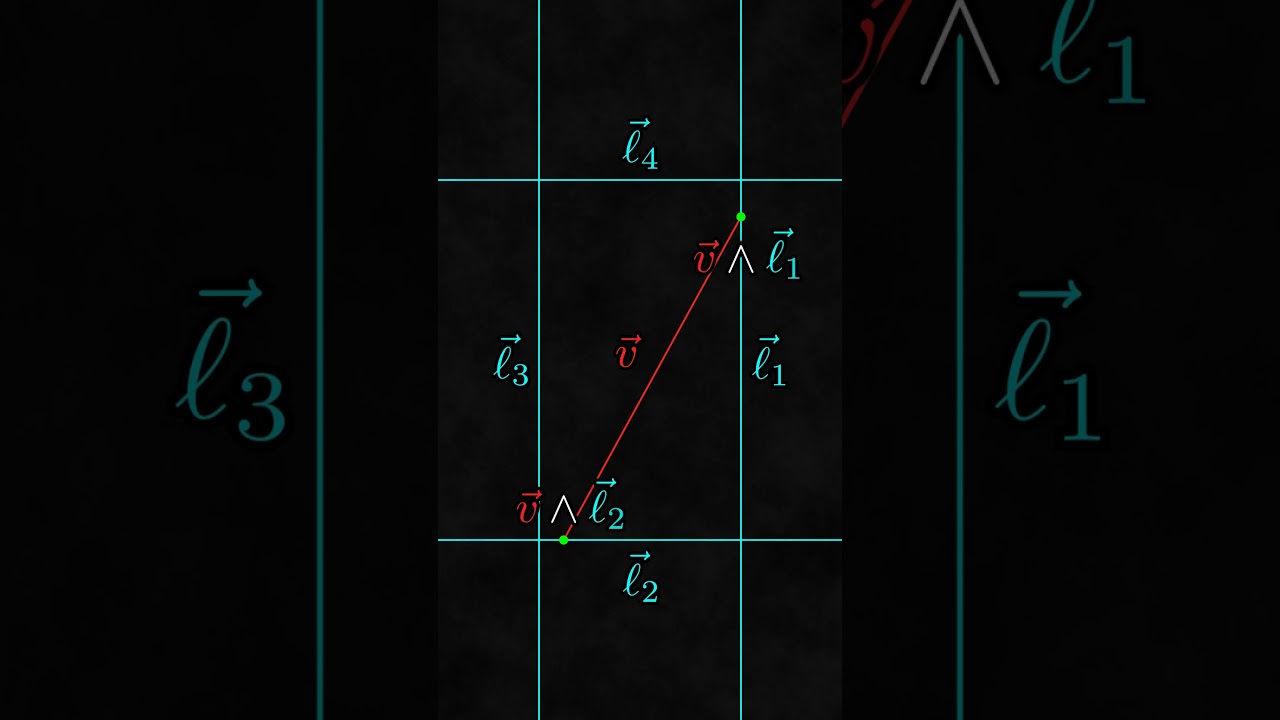
In this short, I describe how to draw lines in PGA. I had to solve this problem myself when making the animations for the swift introduction to PGA, and I thought it was interesting enough to share here.
Discord: https://discord.gg/3Zj59zA2Rg
Patreon: https://www.patreon.com/sudgylacmoe
Patreon Supporters:
Christoph Kovacs
David Johnston
Jas...
zealous garden
torpid bay
ah yeah that was my question
What was the question
zealous garden
scarlet mango
this was such a humbling experience man
Ah I appreciate it
torpid bay
I was gonna ask about the spcifics of v^-1 and what this means specifically. and then i didn't quite look all the way up but
in the (uv+vu)/v, v is a vector or is it the magnitude?
mag right?
zealous garden
torpid bay
in the (uv+vu)/v, v is a vector or is it the magnitude?
A vector
 warm gull
wait so someone very helpful told me Calculus involves algebra, functions, coordinate geometry, indices and logarithms, sequences and series, limits, trigonometry. im not good with sequences, series, i havent studied limits yet, and in trig i only know the 6 trig functions, and unit circle am i good guys?
torpid bay
the bottom one too?
zealous garden
Yeah, v^2=B(v,v)->v*(v/B(v,v))=1
zealous garden
torpid bay
the bottom one too?
so v^-1=v/B(v,v)
zealous garden
Yes
torpid bay
ahh ok ye, I dind't see that part hm
in sudgylacmoe vids I saw $e^{\frac{-I\theta}{2}}we^{\frac{I\theta}{2}}$, this is just another way of writing it yeah?
for rotation formula
fathom swallowBOT
Yeatte
 zealous garden
Yes
That uses different parameters from my approach, but better ones arguably
However I didn't want to explain bivector exponentials
torpid bay
you said two reflection didn't give a hyperbolic rotation, is there some other object when applied twice that give hyperbolic rotation?
zealous garden


Next time we explain the above memes, heretofore referred to as Figure 1 and Figure A
torpid bay
it really is such a great meme
say
I want something like
$\partial _i \wedge \Psi_j$
that's valid, right?
fathom swallowBOT
Yeatte
 torpid bay
 im looking to turn my 3 vector formulation of EM into a 4-vector one using geo vectors
it just refers to the index of a vector with coefficients of partial operators
torpid bay
g radient
 fathom swallowBOT
 torpid bay
elecromanteteong ye
zealous garden
Curl does generalize yes
It's the same thing as the exterior derivative tbf
Divergence also generalizes
Same thing as the interior derivative (codifferential, not interior product)
 undone pike
interesting
torpid bay
ah so it is the same hm
I never got to post this when we were talking about reflections but
$r \circ r = r \ m \circ r = m \ r \circ m = m \ m \circ m = r$
I got this when figuring out symmetries of stuff
torpid bay
$\sum_{n=0}^{\infty}{n \choose -x}=\frac{\sin(x\pi)}{x\pi}\sum_{k=0}^{\infty}{\frac{k!x!}{(x+k)!}$ hm
undone pike
$r \circ r = r \ m \circ r = m \ r \circ m = m \ m \circ m = r$
fathom swallowBOT
back to ginger

 chilly lynx
how do i get better at understanding word problems?
zealous garden
torpid bay
$r \circ r = r \\ m \circ r = m \\ r \circ m = m \\ m \circ m = r$
Wtf is that
fathom swallowBOT
Yeatte
Compile Error! Click the  reaction for more information.
(You may edit your message to recompile.)
 undone pike
ror = rmor = mrom = mmom = r
torpid bay
$r \circ r = r \ m \circ r = m \ r \circ m = m \ m \circ m = r$
fathom swallowBOT
Yeatte
 torpid bay
composition of rotations and reflections(mirrors)
 burnt ledge
mom = r
undone pike
correct
torpid bay
tho it's kinda a weird little thing I got with factorials 
undone pike
torpid bay
composition of rotations and reflections(mirrors)
oh interesting
why is mor = rom = m?
rotation + reflection = just reflection?
torpid bay
well, I just manually calculated a bunch of rotations and symmetries and thats what happeened
undone pike
oh that is true i guess
undone pike
cool
torpid bay
I think you can prove it by knowing r o r = r, and each operation unique (at least for nice cases), so r o m must not be any of the known symmetries, and all r are gotten to by r of r, r o m must get all the mirrors
I didn't account for something more general than a symmetry like a group, so this logic works fine for normal symmetries
zealous garden
torpid bay
composition of rotations and reflections(mirrors)
Yes
zealous garden
undone pike
rotation + reflection = just reflection?
Only in O(2)
torpid bay
$\sum_{n=0}^{\infty}{n \choose x}=\frac{\sin(x\pi)}{x\pi}\sum_{k=0}^{\infty}{ {{x-k} \choose {k}}^{-1}}$
zealous garden
Otherwise you get a trireflection
It's a reflection in the sense that a rotation is, though also improper (changes handedness)
Rotoreflections are the name
undone pike
zealous garden
Only in O(2)
rightt
fathom swallowBOT
Yeatte
 zealous garden
However it is a reflection in the sense of being an odd k-reflection
undone pike
zealous garden
Rotoreflections are the name
interesting!
zealous garden
Rotations generalize to the Even k-reflections, forming a subgroup
So all reflection is O(p,q,r), all Even reflections is SO(p,q,r)
undone pike
now i'm not sure if i'm following :p
torpid bay
rotate o mirror = mirror, and rotate + mirror = rotoreflect in the generalization right?
zealous garden
Yes it's just addition of k
torpid bay
undone pike
zealous garden
Orthogonal groups
yes
i think
i know the groups corresponding to orthogonal matrices
zealous garden
do you know what it means
what an orthogonal map is
nevermind matrices, see if you can do it without saying something about matrix representations
 velvet dagger
If you're not sure, try out some of this problem set
undone pike
zealous garden
what an orthogonal map is
i'm not sure
i was gonna say a linear transformation
velvet dagger
Specifically 1, 2, 6, and 7
undone pike
a real one that just "reorients axes"
zealous garden
an orthogonal map is one that preserves a (the) dot product
undone pike
velvet dagger
Specifically 1, 2, 6, and 7
these are making sense, thank you 👍
yes
but i don't recognize the notation O/SO(p,q,r)
zealous garden
O is the Orthogonal Group, SO is the Special Orthogonal Group
specifically the ones preserving real symmetric bilinear forms of inertia p,q,r
the linear maps on R^p+q+r satisfying B(u,v)= B(Tu, Tv) where, given a """""nice""""" basis, B(v,v) is positive for p vectors, negative for q vectors, and 0 for r vectors
undone pike
zealous garden
specifically the ones preserving real symmetric bilinear forms of inertia p,q,r
interestingg
this is the part i didn't know
zealous garden
you can also say it's the isometries of R^p,q,r onto itself
though strictly speaking, with r neq 0, I've only covered the weak orthogonal groups when talking about reflections
zealous garden
zealous garden
the linear maps on R^p+q+r satisfying B(u,v)= B(Tu, Tv) where, given a """""nice...
as the weak orthogonal group is the subgroup of the orthogonal group which leaves null vectors (B(v,v)=0) invariant, as opposed to doing whatever it wants with them like the definition here implies
zealous garden
yes you can
undone pike
like say in minkowski space
zealous garden
O+(n,0,1)=E(n)
SO+(3,1) is the lorentz group yeah
SO+(3,1,1) is the poincare group!
zealous garden
SO+(3,1) is also the group containing special conformal transformations of the plane (or sphere ig)
undone pike
that is interesting
zealous garden
the Orthogonal groups are quite an interesting family of Lie Groups
undone pike
i'm not sure how to view the poincare group as a linear transformation, since it includes translations
 latent edge
zealous garden
the Orthogonal groups are quite an interesting family of Lie Groups
latent edge
zealous garden
the Orthogonal groups are quite an interesting family of Lie Groups
I hate orthogonal groups ngl
zealous garden
many subfamilies as well. O(n,0,0)=O(0,n,0) for your Orthogonal Maps, O+(n,0,1), O(n+1,0,0) and O(n,1,0) can all do projective geometry
zealous garden
latent edge
I hate orthogonal groups ngl
I hate number theory so we'll call it even
also looks like I need homology or number theory or some shit to finish my classification of metric vectorspaces wtf
is this something easily available? Does anyone know how to enumerate the isomorphism classes of metric vectorspaces over a Field?
zealous garden
zealous garden
many subfamilies as well. O(n,0,0)=O(0,n,0) for your Orthogonal Maps, O+(n,0,1),...
O(n,1) and O(1,n) for spacetimes
O(p+1,q+1,r) for conformalization
latent edge
zealous garden
I hate number theory so we'll call it even
I like Lie groups/algebras
velvet dagger
undone pike
these are making sense, thank you 👍
Yup, once you go through these you get a good image about what orthogonal and unitary maps mean geometrically
latent edge
orthogonal ones tend to mess it up
velvet dagger
As opposed to just matrices
zealous garden
latent edge
orthogonal ones tend to mess it up
Why
What about the complex orthogonal maps dami
No love for O(n,C) huh
Tsk tsk tsk
velvet dagger
HAH I don't think much about O(n,C)
zealous garden
tbh I'd have been stunlocked if you did
undone pike
velvet dagger
Yup, once you go through these you get a good image about what orthogonal and un...
what class is this problem set from? :p
velvet dagger
Analysis, but a very esoteric analysis class
 limber thunder
i love esoteric classes
 elfin smelt
i love klasse orthogonal theory
torpid bay
$\sum_{n=0}^{\infty}{n \choose -x}=\frac{\sin(x\pi)}{x\pi}\sum_{k=0}^{\infty}{\frac{k!x!}{(x+k)!}$ hm
zealous garden
elfin smelt
i love klasse orthogonal theory
What?
 deft tide
Whats ᵽᵉ − ᵽᵉ − ᵽ = ᵽ(ᵉ − ᵼ) ᵉ + ᵽ + ᵽ = ᵽ + ᵽᵉ − ᵉ − ᵽ = ᵉ − ᵽ − ᵽ − ᵽᵉ + ᵽ = − ᵽᵉ + ᵽ - ᵽ + ᵽ = ᵉ + ᵽ - ᵽᵉ − ᵽᵉ − ᵽ = ᵽ(ᵉ − ᵼ) ᵉ + ᵽ + ᵽ = ᵽ - ᵽ
undone pike
velvet dagger
Analysis, but a very esoteric analysis class
interesting
zealous garden
deft tide
Whats ᵽᵉ − ᵽᵉ − ᵽ = ᵽ(ᵉ − ᵼ) ᵉ + ᵽ + ᵽ = ᵽ + ᵽᵉ − ᵉ − ᵽ = ᵉ − ᵽ − ᵽ − ᵽᵉ + ᵽ = −...
I thought I saw this appear in 5 different channels at the same time
My bad mods
deft tide
Because I said that in them
deft tide
It's 2?
zealous garden
Still don't do that homie
deft tide
What is the answer
zealous garden
!help
quasi jettyBOT
To ask for mathematics help on this server, please open your own help channel or help thread. See #❓how-to-get-help for instructions.
zealous garden
deft tide
Whats ᵽᵉ − ᵽᵉ − ᵽ = ᵽ(ᵉ − ᵼ) ᵉ + ᵽ + ᵽ = ᵽ + ᵽᵉ − ᵉ − ᵽ = ᵉ − ᵽ − ᵽ − ᵽᵉ + ᵽ = −...
But tbf this looks like gibberish
 soft nymph
 nimble sparrow
guys how long does it take for an average men
nimble sparrow
guys how long does it take for an average men
Wdym
nimble sparrow
??
nimble sparrow
soft nymph
Wdym
are you answering my question with another question?
soft nymph
nimble sparrow
are you answering my question with another question?
No
I just dont understand u question
What do u mean
How long does it tske average man for what
nimble sparrow
soft nymph
How long does it tske average man for what
i mean say if a man is in mid 20s?
like around 24to 26 idk?
 calm vessel
The chat reads like a stroke 😵💫
 real shell

 calm wolf
where can I discuss stuff on analytic number theory if I want to get insights? I'm working on a paper relating prime number sequences to roots of L functions using a method called spectroscopy where you construct a corresponding theta function (ie \theta(x)=\sum_{p_i\leq x} where p_i's have some property from the sequence) then finding the error term from that and taking the fourier transform, where the peaks correspond to the roots of L functions related to the sequence
 ocean robin
maybe you could look in #advanced-number-theory ?