
#events
1 messages · Page 1 of 1 (latest)
 dusty ermine
 brazen wrenBOT
@dusty ermine <@&817929024893616129>
 wild hornet
Would anyone be interested in a talk pertaining to finite Blaschke products on August 15th at 18:00 UTC+2 on Discord? They’re a pretty interesting type of complex function with unexpected connections to a lot of different areas of mathematics. The talk wouldn’t be too formal in the sense that I’d give very few proofs and would focus on a broader overview. Prereqs are some basic knowledge of complex analysis (not much more needed than knowing what an analytic function is, though knowledge of mobius transformations would be appreciated) and undergrad linear algebra knowledge. Some group theory, projective geometry, and topology might be mentioned at the end depending on time constraints.
!talks
brazen wrenBOT
@wild hornet <@&817929024893616129>
wild hornet
Just to remind everyone interested that the talk will be starting in 15 minutes! I'll be in the advanced mathematics channel in 5m
!talks
brazen wrenBOT
@wild hornet <@&817929024893616129>
wild hornet
Here are the slides from the presentation as promised
 icy goblet
<@&268886804013383681> <@&817929229181386773> I've updated the guidelines for posting here, please re-read the pinned post.
dusty ermine
Hello everyone, I am just here to announce that the famous "characteristic classes" by Milnor and Stasheff has been LaTeX'd by the TeXromancers: https://aareyanmanzoor.github.io/assets/books/characteristic-classes.pdf . Please feel free to share with your peers/students and to dm me if you find typos etc.
!talk
brazen wrenBOT
<@&817929024893616129>
 bold badge
Dear all high schoolers who are interested in mathematics:
Do you want to test your mathematical abilities and potentially win cool prizes? Have I got the news for you: the University of Pennsylvania is planning to hold its second ever annual mathematics contest on March 18th, 2023! We're holding both in-person and online options so that people anywhere can compete in the contest—winners will get medals and mathematical books. We'll also be having beginner, intermediate, and advanced levels, so everyone will be able to get something out of the contest, ranging from complete beginners to people who have plenty of experience up their belt! The plan is to have both an individual round and then a team-based round so that you can have a good time with your friends as well! If you're interested in participating, please fill out this form so that we can get a planned headcount for how many people want to participate, and we'll also add you to the mailing list so that we can remind you once the official registration form comes out. Cheers!
https://forms.gle/4bRtmnLnQuYsc6Vn7
Note: We are planning to offer the contest both in English and (hopefully) in Spanish for greater accessibility.

Google Docs
This form is not binding. This is to get an idea of what kind of students are interested in our contest. The information in this form will not determine your level of exam, but please be sincere. We will send the official registration site around November.
icy goblet
<@&268886804013383681> <@&817929229181386773> I am once again asking for you to read the pinned post regarding how to announce stuff here.
bold badge
Update on the Penn Math Contest: We have opened registration, so please fill out the following registration form by Saturday, February 18th (we will likely extend this deadline to Saturday, February 25th). We sent this form out earlier over email, but it seems that many people did not see it, so we are also announcing it here. If you filled out our interest form, thank you for expressing your interest, and please fill out this registration form so that we can confirm that you are participating and so that we have the necessary details (which level of the contest you want to take, whether you want to take it online or in-person, etc.)! We will also send out a reminder email to everyone who filled out the interest form. Thank you!
2023 Registration Form: https://forms.gle/4amELcN1cMrHn6N5A
Our website: https://sites.google.com/view/pennmathcontest/home
Also, follow us on Instagram at @pennmathcontest!
Access Google Forms with a personal Google account or Google Workspace account (for business use).

Update 1/14/2023
We've released the registration form for the 2nd annual Penn Math Contest for 2023. The official date is March 18th, 2023. We will be hosting both the in-person and online components as expected. See the registration form below and note the information provided in the FAQ section
 viral temple
We are starting a measure theory reading group! We will be closely following Folland's "real analysis - modern techniques and applications". If you are interested, please read the info document below in full for instructions on how to join.
Note that all group members are expected to attend a weekly meeting every saturday at around 7PM UTC (should be <t:1676746800:t> in your time zone) where some group's member (changed everytime) presents. There will also be homework problems that'll be graded by @dusty ermine ! So, please, only join if you are sure you can showcase some baselevel of commitment.
dusty ermine
viral temple
We are starting a measure theory reading group! We will be closely following Fol...
yep I am supervising this group, limited sits left, so check it out as soon as you can!
 cedar spade
I'm doing an impromptu Pi Day talk!
Title: Gamma and Pi
Time: March 14th, 12:00 PM Eastern / 4:00 PM GMT
Location: https://nyu.zoom.us/j/96502716546
Abstract: Ever wonder what the factorial of 1/2 is? We'll introduce the Gamma function, an extension of the factorial. We'll explore the function a little, and then prove Stirling's famous approximation for n!. Along the way, we'll see some important tools in analysis and a few surprise appearances from pi.
Prerequisites: Integral calculus. Multivariable calculus and real analysis could be helpful but not required.
Event link: https://discord.gg/math?event=1085050938563248129
!talks
brazen wrenBOT
<@&817929024893616129>
cedar spade
cedar spade
I'm doing an impromptu Pi Day talk!
Title: Gamma and Pi
Time: March 14th, 12...
Starting in a few minutes!
!talks
brazen wrenBOT
<@&817929024893616129>
cedar spade
Thanks for coming! It was messy but fun, just like the formula in the method of steepest descent. I plan to make a separate recording and post it here in a few days.
cedar spade
cedar spade
I'm doing an impromptu Pi Day talk!
Title: Gamma and Pi
Time: March 14th, 12...
Hi all, I've made and posted a recording of my Pi Day 2023 talk. It's split into chapters so that you can skip to parts you missed. Sorry for the delay in making this recording!
https://www.youtube.com/watch?v=ZsGbqxKTMPM

This is a recording of a talk given to the Mathematics Discord on Pi Day 2023.
Abstract: Ever wonder what the factorial of 1/2 is? We'll introduce the Gamma function, an extension of the factorial. We'll explore the function a little, and then prove Stirling's famous approximation for n!. Along the way, we'll see some important tools in ana...
brazen wrenBOT
<@&817929024893616129>
 frank warren
We are starting an abstract algebra reading group! The primary textbook will be "Basic Algebra" by Knapp, with more beginner-friendly books such as "Abstract Algebra" by Judson and "Linear Algebra" by Jim Hefferon as supplements. Note that Knapp starts with linear algebra before abstract algebra.
We plan to at least cover the undergraduate (UG) abstract algebra syllabus (this includes linear algebra). We'll cover Chapter 1 and 2 (linear algebra), then chapters 4.1 to 7 (group theory), another chapter of linear algebra, and finally rings, modules, fields, and Galois theory. Of course, we can cover more if time permits, we'll be flexible with that.
If any of this sounds interesting or you just want to take a peek, feel free to check the books as all of them are freely available from their respective authors' websites. There will be weekly meetings and homework problem sets managed by @bold badge. Note that it is highly recommended that you should be comfortable with proof writing. To get a feel for proofs, read up to proposition 1.2 in Knapp and then fill out the form to confirm your participation (updated form to include timing info)- ~~https://forms.gle/MWyq2dK3k7Cv3mT49~~
frank warren
Update: We're starting the group today. In a few hours, I'll send Discord invites to everyone who has been accepted. We'll then discuss the meeting timings when everyone is available. The Week 1 assignment is already active, and it's due on the 21st of this month.
I'll keep the group form open until the end of this week. Too many people have already joined so sadly we can't take any more CLOSED without exceptions
Also, if you're interested in volunteering to help, even occasionally, you're more than welcome to join the group. Just mention it in the remarks section of the form. Thanks for the help!
 hollow sundial
Interdisciplinary Summer School 2023 in Valencia (Spain) 24-28 July
This summer… learn about mathematics, evolutionary biology, computation, philosophy of science, literature and physics… enjoy beach parties, art jam sessions, mind-bending debates, local cuisine and nightlife. All of this, and more, in the scenic city of Valencia, situated on the Mediterranean coast of Spain.
https://semf.org.es/school2023/
Places are limited, be sure to follow the link above and register to secure your spot early. Participation is free, online attendance is possible and there are a number of sponsored accommodation places available for those willing to travel to Valencia (an excellent location, minutes away from the School venue, and within walking distance of the beach and the city centre).
The aim of this event is to gather a group of young researchers, creators and students that engage in a very unique intellectual environment while attending talks and short courses by leading figures. Anyone in an undergraduate program or higher will be able to follow most of the courses offered; talks will be accessible to a general public. Here is a handful of speakers and topics covered:
David Spivak (MIT) - Category Theory Applied to Scientific Interdisciplinarity
Michael Levin (Tufts University) - Evolution, Basal Cognition and Regenerative Medicine
Jonathan Gorard (University of Cardiff) - Computation, Causality and Compositionality
Stephen Wolfram (Wolfram Research) - Computational 2nd Law of Thermodynamics
Irida Altman (ETH Zurich) - Literary Aspects of Mathematics
Milena Ivanova (University of Cambridge) - Aesthetics of Science
We look forward to welcoming you in Valencia or online soon!
Ask me ( @hollow sundial ) any questions you may have!
 sick lantern
Hello everyone! We will be doing a reading group on functional analysis following roughly Walter Rudin's book "Functional Analysis" in parallel with other references when necessary. The prerequisites to this course are fluency in measure theory and knowledge of basic complex analysis. If you are lacking the prerequisites you are free to audit the reading group but do let me know beforehand. If you are interested please read the following document in full and fill out the Google Form attached inside afterwards.
 stiff jasper
📚 Advanced Calculus Reading Group! 📚 (Begins 8/6/2023)
Are you passionate about mathematics and eager to dive deeper into the world of advanced calculus? Join our Advanced Calculus reading group where we'll be exploring the fascinating topics from "Advanced Calculus" by Folland.
🔍 What we'll cover: Euclidean Spaces, Limits and Continuity, Sequences, Completeness, Compactness, Connectedness, Uniform Continuity, Differentiability in one and several variables, and the Chain Rule.
We plan to start with Chapter 1 and sections 1.1-2.3 of the textbook, but we're flexible and may explore more if time permits!
📆 Weekly Meetings: We'll meet two times weekly starting the week of 8/6/23 via Zoom. Sessions will take place using a flipped-classroom model. The first meeting of the week will discuss the previous assigned chapters and start work on questions, and the second meeting will wrap up any remaining questions/doubts.
📖 Access the Textbook: To get started, access the "Advanced Calculus" textbook by Folland through this Google Form: https://docs.google.com/forms/d/e/1FAIpQLSd5RVHi9hn0_rk3uV2wqps5CxSw7Ii5atev7eVvUFz76I8zoQ/viewform
💡 Recommended Prerequisites: To make the most of this study group, we highly recommend participants be comfortable with basic calculus and linear algebra.
👨🏫 Organizers:
Our group is organized by @stiff jasper. Don't miss this opportunity to deepen your understanding of advanced calculus and explore fascinating applications! Sign up through the Google Form link or contact @stiff jasper for any inquiries.

Google Docs
A 6 week study group covering sections 1.1 - 2.3 of "Advanced Calculus" by Gerald Folland. http://site.iugaza.edu.ps/mashker/files/Gerald_B._Folland-Advanced_Calculus-Pearson_2001_1.pdf
bold badge
Hello everyone! Message from @ancient tundra:
Dear members of the mathematics discord,
Me alongside another member of this server (@fast merlin) have decided to start an online mathematics reading group in Dummit and Foote's Abstract Algebra. We will cover chapters 1-6 (all of group theory), and upon request, we will strongly consider covering more of the chapters (ring theory, modules, vector spaces, field and Galois theory, etc.).
Please DM me or @fast merlin if you would like further information and if you are interested.
Please also note that we will not cover Chapter 0 (Preliminaries). We will proceed with Chapter 1, the start of Group Theory. The hard prerequisites for this course are some linear algebra and set theory. This book starts from 0.
Feel free to DM me at any time regarding this.
Best regards,
@ancient tundra
DM either @ancient tundra or @fast merlin if you're interested!
bold badge
Message from @placid kelp
I want to share along an opportunity to hear more about math research/experiences! You guys should sign up since they will prob be very helpful for you!
Want to learn about high school math research? If so, come to MathROCs 2023! The Math Research Outreach Conference (MathROCs) was created in 2020 by PRIMES students in order to share our experience as high schoolers doing math research with younger students. We aim to begin to answer the question "what is math research?" by sharing some of the fun math we've learned, and interacting with you in a panel and Q+A. In this year's event, 16 individuals/groups will present their research on September 3rd and 10th, from 3:30 to 6:30 p.m. EST. We'll also host a panel/Q+A discussion during the last hour on both days. Attached is a poster with registration information and more details. Please feel free to reach out with any questions, and we hope to see you soon! (Note that registration is non-binding: you don't have to come on both days, nor do you have to stay for the whole time. We'll send you the link to join the Zoom using the email that you enter in the form.)
https://drive.google.com/file/d/1ogs5RS0l1y9ggQ_UUFRfxe1I7SBSsHEG/view?usp=sharing
Google Docs
 frank orchid
I've decided to give a spontaneous talk on tuesday!
Title: Tarski's High School Algebra Problem
Time: Tuesday 31st Oct, 4:00 PM Eastern/ 8:00PM GMT
Location: https://upenn.zoom.us/j/8737431442
Abstract: In high school, we all learned algebraic rules for simplifying expressions regarding (positive) integers and the standard operations of addition, multiplication and exponentiation. In the 1960s, Tarski asked if these rules are sufficient to derive all possible identities on positive integers.
In this talk we will explore nonstandard models satisfying the so-called 'High School Identities', as well as answer Tarski's original question, and discuss the finite axiomatisation of identities of positive integers.
Prerequisites: High school Algebra and mathematical maturity
Event link: https://discord.gg/math?event=1168236270196113488
Zoom Video
Zoom is the leader in modern enterprise video communications, with an easy, reliable cloud platform for video and audio conferencing, chat, and webinars across mobile, desktop, and room systems. Zoom Rooms is the original software-based conference room solution used around the world in board, conference, huddle, and training rooms, as well as ex...
!talks
brazen wrenBOT
<@&817929024893616129>
frank orchid
Starting in 30 minutes! The talk will not be recorded live, but a recorded version will hopefully be up on youtube in the next few days
!talks
brazen wrenBOT
<@&817929024893616129>
frank orchid
Thanks for attending everyone! Here are the talk slides and the list of sources I used for this talk (I could not, unfortunately, find wilkie's original paper anywhere online):
Tarski's High School Identities - S.Burris, 1993
The Saga of High School Identities - S.Burris and K.Yeats, 2002 (This is a more updated and more in-depth version of the first paper listed)
Equational Theory of Positive Numbers with Exponentiation is not finitely axiomatizable - R.Gurevič, 1990
Equational Theory of Positive Numbers with Exponentiation - R.Gurevič, 1985
frank orchid
Recording of the talk is now available on my youtube channel:
https://youtu.be/7h3uGE73RW0
In addition, a fellow grad student was able to find Wilkie's original paper, and I elaborate on this in the video as well, so for those curious check it out (Link to the paper in the description)

Recorded version of a lecture I gave at the University of Pennsylvania and also in the mathematics discord (discord.gg/math).
Bibliography:
Tarski's High School Identities - S.Burris, 1993
The Saga of High School Identities - S.Burris and K.Yeats, 2002 (This is a more updated and more in-depth version of the first paper listed)
Equational Th...
!talks
brazen wrenBOT
<@&817929024893616129>
bold badge
Message from @odd junco:
Hello, some of you may know me. In the past few months, there's been a bit of an uptick in young, especially highschool aged mathematicians in discussy with an interest in studying advanced mathematics. As such, I want to run a seminar on Walter Rudin's Principals of Mathematical Analysis. This will be a reading seminar; We will alternate between me presenting the text and everyone else presenting on the solutions to exercises that I assign. The reason for this is twofold: First, real analysis is one of the most fundamental subjects in math, and I'm not sure if there's a working mathematician anywhere in the world who doesn't know analysis at least at this level. Second, being able to present on mathematical material is one of the most important soft skills that a mathematician can have in their arsenal.
Anyone interested in signing up will not be going at it alone; I'll be available to offer instruction on any topics that you're stuck on, and to help answer questions about your topic in advance of your presentations. The goal is to create a supportive, stress-free environment where you can focus on developing both your analysis and presentation skills.
The only mathematical prerequisite is a willingness to learn. That said, some familiarity with the basics of calculus and of proof-writing would be helpful. Beyond that, access to a microphone and some method of presenting would be required given the format.
The timeline is as follows: Signup will be going from now until Jan 1st. In January, we will try to determine times when we can meet, hopefully aiming for twice a week - once for me to give the lecture, and once for everyone else to present solutions to selected problems. Furthermore, I will try to host an "office hour" at least once a week, as well as "read-alongs" where I stream the text and people can read it and ask questions on it.
Please fill out this form if you are interested in signing up: https://forms.gle/ZR47NAKfoEJD6T5G7

Google Docs
 ancient tundra
Hello I am Alex and I am starting a reading group on Introductory Combinatorics. The topics here are very good to learn and the overall course can really work as a solid introduction to proof based math. It can also serve as a good refreshing course after having done some amount of analysis and algebra. There aren't any strict pre-requisites besides the ability to read and write proofs. We are mostly looking for motivated undergraduates and advanced high school students who can come in and work through the course material which involves doing the problem sets, discussing ideas, etc.
The way the reading group is structured is that we would follow this course https://ocw.mit.edu/courses/18-314-combinatorial-analysis-fall-2014/ and that involves reading and engaging with the text and working out the problem sets assigned roughly every week. After one submits the pset, some seasoned people would have a look at it and provide feedback on the proofs which would help the users refine their chops.
But most importantly, the reading group would foster conversations and discussions about topics which would help in passively absorbing a lot of math and would also motivate the members to engage with the material. Weekly voice chat sessions would be arranged. Community driven learning is the primary objective of this group. In the terms of the math itself, the assigned exercises should provide enough meat to chew on and over the course of 13-14 weeks my hope is that we accumulate a good handle or facility with the material presented in the course.
Fill up the google form given below if you are interested. Invites would be sent out shortly.
https://forms.gle/wUNqTQD3BqDoz7WF9
bold badge
Hey everyone,
After the success of last year's contest, we are now happy to announce that the third annual Penn Math Contest will be hosted on March 16th, 2024, and instructions to sign up are below! You can either participate virtually over Zoom or in-person at the University of Pennsylvania campus in Philadelphia, and any high schooler (or younger) is eligible. We have three different levels (beginners, intermediate, and advanced), so people at any level are welcome, from people who have never done a math contest before to people who are experienced veterans. We have both an individual and a team round, so encourage your friends to join and form a team together, or make new friends by getting randomly paired on a team. The contest is entirely free of charge. Fill out this registration form if you're interested, and check out our website (which will soon be updated with details about this year's contest) for more info! The deadline for registration is February 22nd, 2024.
If you know any other people or math groups that would be interested, please share this message around! For any questions/concerns, please feel free to email us at pennmathcontest@gmail.com or DM me.
Eric Tao
Penn Math Contest, Co-president
sick lantern
Hey everyone! We will be doing a reading group on the theory of linear partial differential equations following Evans PDE book in parallel with other references when necessary (mainly Taylor 1). The prerequisites to this group are knowledge of functional analysis, Lebesgue integration on R^n and multi-variable calculus (Stokes-Green theorem). If you are lacking the prerequisites, you are free to audit the reading group, but please let me know beforehand. If you are interested please read the following document in full and fill out the Google Form attached inside afterwards. We will be starting at the start of march.
 quaint mulch
Hello, I was interested in running a reading group on the model theory of differential fields. This would not be a directed reading seminar, but rather a more collaborative reading (as I myself am no expert on this topic). As currently planned, we would follow a document of lecture notes over approximately 2-3 months. The prerequisites appear to be well within undergraduate level, but it will certainly assume some aspects of algebra (rings, prime ideals, some modules) and model theory (I saw up to quantifier elimination being assumed). If necessary, a review of some prerequisites on the model side is doable.
Target audience: (Upper?) Undergraduate level in math, especially interested in model theory and differentials or derivations.
Planned coverage: Differential and differential closed fields, model theoretic aspects thereof, some differential Galois theory.
Apparent Prerequisites: Basics of rings, ideals, modules. Some model theory, including quantifier elimination (but reviewing as necessary is possible).
Planned dates: From around the start or mid March and lasting 8-12 weeks, depending on pace and necessary review.
How to join: See attached form: https://forms.gle/6gSFJqiRGTpSixbr6 Closed 
bold badge
bold badge
Hey everyone,
After the success of last year's contest, we are now happy to ann...
Update: The registration deadline for the Penn Math Contest has been extended to March 9th. Sign up soon!
bold badge
Hello everyone! Here is a message from @hazy trench:
The Queen's Mathematics Summer School (June 17-21, 2024) is open to undergraduate and Masters students who are interested in spending one week learning exciting, cutting-edge mathematics on the beautiful campus of Queen's University by the shores of Lake Ontario. There will be three courses, each with 9 hours of lecture time over the week.
Course A: Scalar Conservation Laws
Instructor: Maria Teresa Chiri (Queen's University)
Hyperbolic PDEs, Hamilton-Jacobi, applications to vehicular trafficCourse B: Topics in Machine Learning
Instructor: Bahman Gharesifard (Queen's University and UCLA)
Temporal difference learning, non-convex optimization, sample complexityCourse C: Topology of Maps Between Curves
Instructor: Mike Roth (Queen's University)
Polynomial solutions to polynomial equations, genera, elliptic curvesLimited funding is available for on-campus accommodations.
Apply here: https://mast.queensu.ca/~qmss24/
Queen's Mathematics Summer School 2024
stiff jasper
📚 Explore Complex Analysis! 📚 (Begins <t:1710825660:D>)
Are you interested in Complex Analysis but not sure where to begin? Join our Complex Analysis reading group where we'll be exploring the fascinating topics from "Complex Analysis" by Stein & Shakarchi.
🔍 What we'll cover: Complex numbers and the complex plane, convergence, sets in the complex plane, functions on the complex plane, holomorphic functions, power series, integration along curves, Goursat's theorem, Cauchy's integral formulas...
We plan to start with Chapter 1 and Chapters 2-3 of the textbook, but we're flexible and may explore more if time permits!
📆 Weekly Meetings:
We'll meet 1-2 times weekly via Zoom. Sessions will take place using a flipped-classroom model. The first meeting of the week will discuss the previous assigned chapters and start work on questions, and the second meeting will wrap up any remaining questions/doubts.
💡 Recommended Prerequisites:
To make the most of this study group, we highly recommend participants be comfortable with basic calculus, introductory real analysis and linear algebra.
👨🏫 Organizers:
This group is organized by @stiff jasper. Sign up through the Google Form or contact @stiff jasper with any questions!
https://docs.google.com/forms/d/e/1FAIpQLSdqdpF_Fh5PDm6I4D6DEnjKr-R9WP5kwHaF67Eyxv7y-gCdDw/viewform?usp=sf_link

Google Docs
A study group covering Chapters 1 - 3 of "Complex Analysis" by Stein & Shakarchi.
quaint mulch
Hello, I was interested in running a reading group on the book Combinatorial Set Theory, by Lorenz Halbeisen. As currently planned, we would follow the text as written, but we may jump around a bit to cover certain points out of order.
Forcing as a technique has been very useful in mathematics, from proving independence results (such as Whitehead’s problem) and proving certain foundational hypotheses imply (un)desirable things, to more grounded results about separable quotients of Banach algebras or computability of things around analytic subsets of R. There are may perspectives one can take on forcing, and for this text we’ll be focusing on the combinatorial POV as well as combinatorics appearing in other forms through set theory (such as ultrafilters).
Target audience: (Early?) undergraduate level in math, interested in set theory and/or infinitary combinatorics.
Planned coverage: Some earlier set theory, Ramsey’s theorem, forcings, and some particularly nice classes of ultrafilters.
Prerequisites: Some basic set theory would be ideal, chapters 1-3 of the book cover relevant bits. There should not be anything heavy in prerequisites.
Planned dates: From around May 17th and lasting a handful of months. No particular “end” point of the text is set in stone, but we plan to go at least including Ramsey ultrafilters and forcing.
How to join: See attached form: https://forms.gle/XXku4wAz3qEQsiAh7
cedar spade
Talk Announcement
Hi all, I will be giving a talk this Friday over Zoom.
Time: <t:1719590400:F> (this time is in YOUR timezone. It's at 12:00 PM EST)
Location: https://nyu.zoom.us/j/96201824133
Title: The Legacy of Lax Pairs: Part 1
Abstract: I'll introduce a useful idea for studying special dynamical systems called the Lax pair: dL/dt = [L, A]. Matrix differential equations of this form arise all over classical and quantum mechanics, Hamiltonian dynamics, and symplectic geometry. They often give us completely integrable dynamical systems, whose conserved quantities enable magical properties.
In Part 1, we'll look at Lax pairs for 3 systems in classical mechanics and prove that Lax pairs are "isospectral."
In Part 2, we'll introduce the basic math of quantum mechanics and see an important Lax pair arise.
In Part 3, we'll see the beautiful consequences in modern research of some Lax pairs in disguise: important PDEs like the nonlinear Schrodinger equation and the KdV equation.
Prerequisites: Part 1: Linear algebra and ordinary differential equations. High school physics would help.
I plan to have Parts 2 and 3 in the following weeks and will announce them separately. I plan to record the talks for those who can't make it. Hope you come!
brazen wrenBOT
<@&817929024893616129>
 whole sorrel
SEMF Interdisciplinary Summer School 2024 in Valencia (Spain) and online 22-26 July
This summer… learn about computation, evolutionary biology, physics, philosophy of science, literature and mathematics… enjoy beach parties, art jam sessions, mind-bending debates, local cuisine and nightlife. All of this, and more, in the scenic city of Valencia, situated on the Mediterranean coast of Spain.
https://semf.org.es/school2024/
Onsite places are limited and registrations end on June 30, so be sure to follow the link above and register to secure your spot early. Participants in the SEMF Interdisciplinary School travelling to Valencia get access to sponsored accommodation at a reduced price and in an excellent location, minutes away from the School venue, and within walking distance of the beach and the city centre.
The aim of this event is to gather a group of young researchers, creators and students that engage in a very unique intellectual environment while attending talks and short courses by leading figures. Here is a handful of speakers and topics covered:
· **Computational Evolution **(Stephen Wolfram)
· Monads and Operads in Category Theory (J. Peter May)
· **Notions of Structure in Mathematics **(Carlos Zapata, Elena Isasi)
· Bayesianism: Philosophy and Practice (Edward Eriksson)
· Literary Aspects of Mathematics (Irida Altman)
We encourage participants to attend in person but remote free online attendance is also possible, you can choose your modality when registering in the link above.
We look forward to welcoming you in Valencia or online soon!
The SEMF team
Explore many traditionally distant disciplines while socializing with like-minded peers in a dynamic and creative environment.
cedar spade
cedar spade
**Talk Announcement**
Hi all, I will be giving a talk this Friday over Zoom.
*...
Thanks to everyone who came to Part 1! I'll prepare a recording / set of notes and post them in the next few days. I expect to do Part 2 next Friday, but I'll announce it officially next week.
cedar spade
cedar spade
**Talk Announcement**
Hi all, I will be giving a talk this Friday over Zoom.
*...
Hi all! Here is the recording of Part 1:
https://www.youtube.com/watch?v=o_PIk_VdcVw
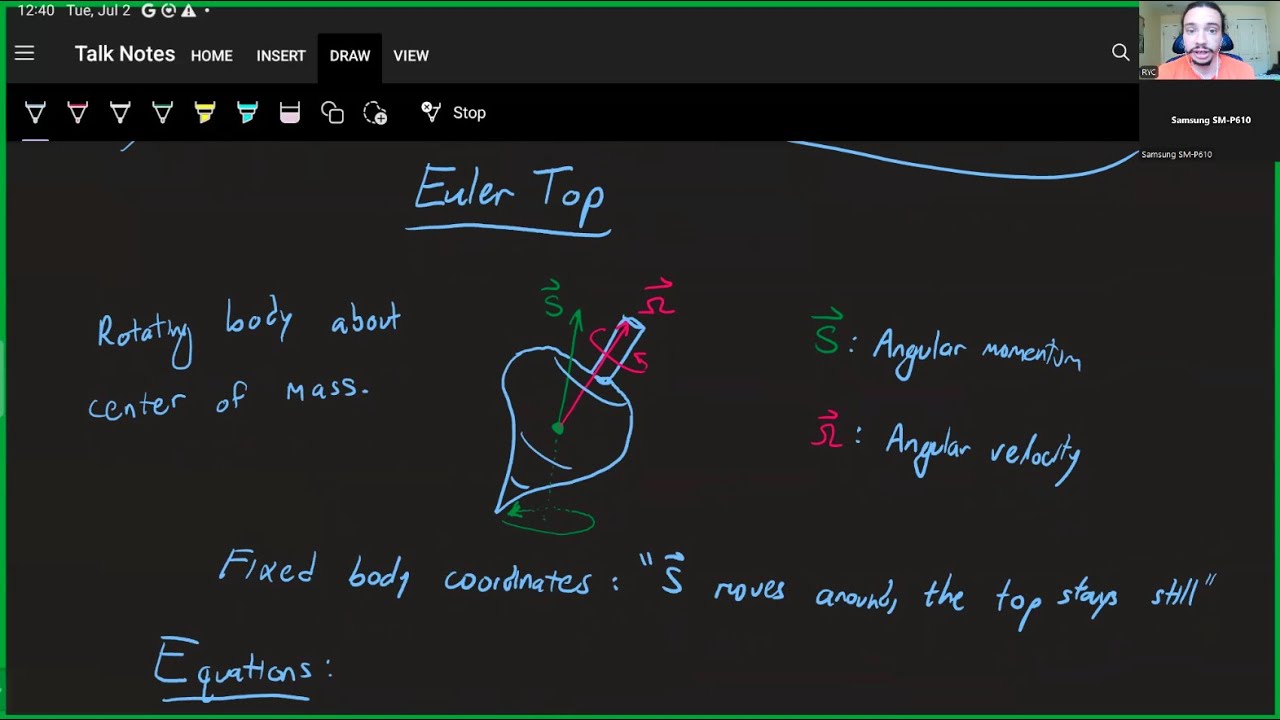
This is a recording of a talk given in the Math Discord on June 28th 2024. This is Part 1 of a 3 part talk on the mathematics and physics of Lax pairs. This talk covers the simple harmonic oscillator, isospectrality, and the Euler top.
brazen wrenBOT
cedar spade
Hi all! Here is the recording of Part 1:
https://www.youtube.com/watch?v=o_PIk_...
<@&817929024893616129>
 quaint marten
Hello, I am starting a real analysis reading group. Our objective is to explore concepts in real analysis through collective reading and discussion.
- Planned topics: The topics we plan to cover include sequences and series, convergence tests, metric spaces, continuity, differentiability, the Riemann integral, and Taylor series.
- Textbook: A textbook is not set yet, but some options are Terence Tao's Analysis I and II, Carother's Real Analysis, and Rudin's Principles of Mathematical Analysis.
- Format: We plan to make a discord server to discuss and meet every other Sunday. Members will read assigned chapters before each meeting, and then during the meetings, we will engage in discussions and share questions and insights. Optionally, we may have guest speakers, online lectures, or problem-solving sessions. We encourage active participation, respectful dialogue, and open-mindedness.
- Joining the group: Participation is open to all interested individuals. Sign up using this form, and introduce yourself and your background in mathematics. You will receive meeting invitations and updates via my Discord account.
 sick lantern
Hey everyone,
Due to popular demand, @viral temple and I are hosting a seminar on measure theory on Discord next month. The prerequisites are basic knowledge of set theory, real analysis, and linear algebra. If you are interested, please read the attached PDF in full and submit the Google form included. There will also be a prerequisites problem sheet attached inside; please send your solutions to my DM within the next 4 weeks.
We will be starting in early September. Don’t hesitate to contact me or DarQ if you have any further inquiries.
Edit: Sorry folks, but there is a small issue with problem 6 part 2, so the question has been changed to the following
Let a_n be an arbitrary positive real sequence such that a_n < e for each n.
Find a positive real sequence b_n such that the sum of a_nb_n < e.
ancient tundra
@quaint mulch and I are organizing an introductory model theory reading group. We will follow mostly the book Hodges, Model Theory. Every week we will assign a section of the book for reading, and one of the members will do a presentation about it (You don't have to present if you don't want to, but you are encouraged to). We will start in a few days, depending on the availability of everyone.
DM me if you are interested in joining.
 willow pecan
Want to learn about high school math research?
If so, come to MathROCs 2024! The **Math Research Outreach Conference (MathROCs) **was created in 2020 by MIT PRIMES students in order to share our experience as high schoolers doing math (and adjacent fields like biology, CS, and physics) research with younger students. We aim to begin to answer the question "what is math research?" by sharing some of the fun math we've learned, and interacting with you in a panel and Q+A.
In this year's event, 11 individuals/groups will present their research on** September 8rd and 15th, from 3:30 to 6:00 p.m. EST.** We'll also host a panel/Q+A discussion during the last hour on both days. Attached is a poster with registration information and more details. Please feel free to reach out with any questions, and we hope to see you soon! (Note that registration is non-binding: you don't have to come on both days, nor do you have to stay for the whole time. We'll send you the link to join the Zoom using the email that you enter in the form.)
https://drive.google.com/file/d/1x2MnniNH1msrEASJkqM9lhuObWFURQzc/view?usp=sharing
registration form link: https://forms.gle/KQo4biSFUGiydFzaA
Google Docs

Google Docs
Please fill out this form to register to attend MathROCs 2024, which will be held September 8th and 15th, 3:30 - 6:00 PM EDT! Math Research Outreach Conference (MathROCs) is a MIT-PRIMES student-run online conference, which includes student research presentations (on math, computer science, and computational biology) and Q&A.
Zoom links will be...
ancient tundra
Dear mathematics community,
We would like to start an introductory Abstract Algebra reading group for those who are interested in the subject and want to have a good start, or those who wants to start to get familiar with the topic, or those who already knows some Abstract Algebra and wants to have an advantageous discussion about it
The reading group will be based on the book Algebra by Artin and Benedict Gross's lectures on that book, unfortunately the lectures doesn't cover all the book, but we will supplement it.
The reading group will work like that:
Firstly we as a group will read the assigned reading and we can see the lecture on that specific reading part.
Secondly someone from us will get assigned the role of explaining the reading we had and the notes he has written and these notes will get collected to be in a set of notes for the whole book made by us, and the person's explanation will get recorded and posted for further needing.
NOTE: the record will be just a voice record along with the screenshare of the presentation for your privacy, and if you would like, you can participate without presenting. Just contact me.
if anyone would like to volunteer extra notes/explanations/help will be very welcomed, and his contributions will get recorded too.
This will come very helpful when we get to the parts that is not explained in the lectures.
You are expected to prepare and read on your own the stuff that is easy for you to understand, and you are expected to participate and to be ready when assigned a specific task
You are advised to look at the material before deciding to contact me for participation to know if you are ready for it
Benedict Gross' Lectures: https://www.youtube.com/playlist?list=PLelIK3uylPMGzHBuR3hLMHrYfMqWWsmx5
Artin Algebra (can be found online)
But generally, the recommended prerequisites for this course are Linear Algebra and basic logic and familiarity with proofs.
If you want to participate please contact me in https://discord.gg/4X4d4qbZ9q

YouTube
Algebra is the language of modern mathematics. This course introduces students to that language through a study of groups, group actions, vector spaces, line...
 acoustic relic
Hey all! @quaint mulch and I will be giving lectures on mathematical logic and model theory here on mathcord. We will begin with a series of lectures on mathematical logic, and then progress to model theory.
Technical details
The lectures will be given on a weekly basis at Mondays 3:00 pm EST on the #1055201711679082516, starting next week on the 21st.
Our lectures will be split into two parts: lectures on mathematical logic, and then lectures on model theory.
I will begin with the lectures, afterward I will hand off to @quaint mulch for the more advanced topics in model theory.
What is mathematical logic and model theory?
Mathematical logic, broadly, is the mathematical study of logical statements. It studies how certain statements can be phrased, satisfied, and manipulated. It studies the objects which satisfy these statements and relations between them.
Model theory is a subfield of mathematical logic defined by Professor Wilfrid Hodges as "the study of the construction and classification of structures within specified classes of structures", and Professor David Marker defines it as "a branch of mathematical logic where we study mathematical structures by considering the first-order sentences (statements) true in those structures and the sets definable by first-order formulas (statements)".
Both of these definitions shine light on what distinguishes model theory from other subfields of mathematical logic: a focus on structures rather than formulas (like in proof theory).
What will we be covering?
This is an incomplete list, we will hopefully get to touch on more topics in model theory, but currently we will cover:
- Propositional Logic
- First-Order Logic
- Proofs
- Compactness
- ZFC
- Different types of theories
- Quantifier elimination
- EF-Games
- Ultraproducts
- Types
Prerequisites
- Naive set theory (eg. cardinalities & AoC)
- Group theory
- Mathematical maturity!
acoustic relic
Thank you to everyone who participated in the first lecture, I hope to see you next week as well!
Attached are my lecture notes for the first two weeks (the second week's are not edited, so there may be issues with them), as well as the first week's problem set.
There is no deadline for the problem set, you can submit via email or DM @ancient tundra anytime, but I will release a solution in a week.
Thanks again!
(Note to everyone looking at the pset, in question 7 it should be "without assuming V is countable")
acoustic relic
acoustic relic
Hey all! <@218876477146398720> and I will be giving lectures on mathematical log...
Hey everyone! A recording of the first lecture can be found here:
https://www.youtube.com/watch?v=KHtxvEj471s
(I wasn't able to record, so the recording is thanks to @gilded otter, hopefully this will be fixed by next week)
 bold badge
If you've been in the server for a while, you may have seen my yearly announcements about the Penn Math Contest. This year, I am happy to announce that in addition to our usual March contest, we are piloting a Penn Girls' Math Contest on November 23rd for female and gender-minority high school students! The goal of the contest is to promote interest in mathematics among groups that have been historically excluded from the field on the basis of gender. The contest is free to attend, either virtually over Zoom or in-person at the University of Pennsylvania campus, and lunch is provided if you attend in-person. The contest has a mix of easier and harder questions, so every student can get something out of it no matter their mathematical ability.
If you are a female or gender-minority high school student that would be interested in attending, please fill out the following form by November 16th: https://forms.gle/rJrFj28P4ZRy6zt8A Middle school students are also welcome, but the contest problems will be at a high school level. Otherwise, stay tuned for an update about registering for our March contest! If you have any questions, check out our website at https://sites.google.com/view/pennmathcontest/home and feel free to DM me. Thank you.
Access Google Forms with a personal Google account or Google Workspace account (for business use).

The Philly Math Contest (PMC) at Penn is a completely student-run competition that aims to get high schoolers engaged in math and create an inclusive community full of fun and challenging experiences! Our team is made up of students at the University of Pennsylvania who want to spread a love of
acoustic relic
Hey all! @frank orchid and I will be giving a lecture series on abstract algebra (similar to the ongoing series on mathematical logic and model theory). We hope to cover group theory, ring theory, field/Galois theory, and more advanced topics as well.
Technical details
The lectures will be given on a weekly basis on thursdays at 18:00 UTC on the #1055201711679082516 channel, starting this thursday (the 31st).
We will start with group theory, and then progress on to more advanced topics.
I will start with the lectures, and once we get to more advanced topics, I will hand off to ShiN.
What is abstract algebra?
To give a wholly unhelpful answer, abstract algebra is the study of algebraic structures. More concretely, abstract algebra looks at how we can take problems in other fields of math (for example, geometry) and abstract them as much as possible. For example, the study of symmetries of an object can be abstracted to give us the notion of a group, which will be discussed in our lectures. We can also look at the classic operations we know on objects like Z and R, and abstract them. This motivates a lot of abstract algebra.
Abstract algebra is a tool which all modern mathematicians must know, as it is used and can be applied to numerous mathematical fields. Moreso, it can be applied to fields outside of math, like cryptography. Abstract algebra is one of the key pillars of modern mathematics.
What will we be covering?
Currently we have planned only the outline for the group theory portion of this series. This will be sufficient for the first 2-3 months of the series.
- The definition of a group
- Homomorphisms and the isomorphism theorems
- The symmetric group
- Group actions
- Simple groups
- Sylow's theorems
- The classification of finitely generated Abelian groups
Prerequisites
We will assume that the participants know high school algebra, as well as some rudimentary knowledge of naive set theory (set operations, functions).
acoustic relic
acoustic relic
Hey everyone! A recording of the first lecture can be found here:
https://www.yo...
Hey everone! A recording of the second lecture can be found here:
https://www.youtube.com/watch?v=3he6bs7yvU8
And attached is the second problem set and lecture notes. The solution to the first problem set will be sent next week (remember that there is no deadline for submissions!)
 acoustic relic
Hey all! Thanks for coming to the third lecture in the mathematical logic and model theory series. Attached are the lecture notes, third problem set, and solution to the first problem set (for problems 6+7 see https://arxiv.org/pdf/1108.5171).
The recording for the lecture can be found here: https://www.youtube.com/watch?v=eoMrS1qXwRA
See you all next week!
 acoustic relic
Unfortunately I have to cancel today's lecture on abstract algebra. Sorry for the short notice. I hope to see you all next week!
 celest quiver
Hello everyone,
My name is Bryan Penfound and I am the Department Lead at Okanagan College in Canada. I will be helping to host a reading group on Linear Algebra, and the group is looking for people interested in both learning and presenting on selected topics. Tentatively starting in December, depending on interest.
Roughly each week, selected topics from Friedberg's Linear Algebra text will be assigned. A call for presenters will go out to the group, and if anyone has interest in making a presentation to the group, they can volunteer to do so. Presentations for those learning are typically held in Discord, with a livestream redirect to Twitch. They can be as short/long as needed to convey the main ideas; most are about 1.0 to 1.5 hours long, and are scheduled at the presenter's convenience. Presentations are then uploaded to YouTube in case anyone misses the presentation.
Our tentative curriculum can be found here:
https://docs.google.com/spreadsheets/d/13MWQi8VzdBiKIZdpTDSapC8TTQVer62s-tv-5_mUnwg/edit?gid=0#gid=0
Resources will include:
YouTube video lectures
https://www.youtube.com/watch?v=rcziCrf08Vs&list=PLOROtRhtegr4HyXIIHKHketOm2k3JWSpK
Textbook
Linear Algebra (4th edition) - Friedberg, Insel & Spence
Twitch Problem Solving Sessions:
Connect with other students from around the world on Twitch to discuss mathematics! Problem-solving sessions will be hosted by Pencenter & eToThe2iPi, and begin mid-January. Students with regular attendance can apply to get a certificate of completion from the instructors.
If you are interested in attending for learning, interested in presenting, or have questions in general, please reach out to me directly via DM anytime.
Looking forward to sharing some linear algebra with you.
-Bryan (AKA: Pencenter)
 wind moat
Disclaimer: The mathematics discord is not affiliated with any servers linked in this announcement.
Resources
Lectures: https://www.youtube.com/playlist?list=PLelIK3uylPMGzHBuR3hLMHrYfMqWWsmx5
Notes and problem sets: https://drive.google.com/drive/folders/14DUapA_MSgEUg1WAMkV0NZrNYAoL1jbV?usp=drive_link
Previous recordings: https://www.youtube.com/playlist?list=PLAnMUWvdF29TQMndqa8PkiY70XxPhb1dd

YouTube
Algebra is the language of modern mathematics. This course introduces students to that language through a study of groups, group actions, vector spaces, line...

YouTube
The reading group: https://discord. gg/4X4d4qbZ9q (remove the space) Benedict Gross' lectures: https://www.youtube.com/playlist?list=PLelIK3uylPMGzHBuR3hLMHr...
Abstract Algebra reading group announcement
We have decided to merge with another introductory Abstract Algebra reading group that has been running on the Simple Group server. They have been working through Michael Artin’s Algebra (1st ed.) and following publicly available lectures from Harvard’s Math 122 (“Algebra I”)
Disclaimer: The mathematics discord is not affiliated with any servers linked in this announcement.
Note: Following the merger, the Simple Group server ( https://discord.gg/tVfqU8vpzF ) will be the base of operations for this reading group— lectures will be held here, but participants should join Simple Group for access to dedicated reading group channels.
For participants
- At the beginning of each month, a weekly schedule material will be announced to #events.
- Before the week’s group meeting, read the assigned material for participation in the discussion.
- Meetings will be held weekly in #1055201711679082516. If you cannot join live, presentations will be recorded.
- After each meeting, problems will be posted in #1317307081535000606. Look at these problems and solve them to the best of your ability.
- Extra notes/explanations/help are welcomed! You will be posted and rewarded for your effort.
For presenters
- As a participant, you can sign up to be a presenter using this google form, that is, to lead the meeting for a particular week. This is typically done the month in advance.
- If selected, you must be a member of the Simple Group server for organizational purposes.
- In Simple Group, presenters will work with each other and the organizers to decide what will be discussed in the next month.
Current progress
We have finished section 5.4. If you followed the main reading group you will be able to follow. We will probably start here around January
resources are in the message above
 celest quiver
Hello Everyone,
📣 We are excited to announce another reading course in Real Analysis, with a focus on Calculus topics. Using Abbot, Spivak, and Michael Penn’s lecture series as resources, our goal is to explore the concepts of sequences, limits, continuity, derivatives, series, Riemann integration and the Fundamental Theorem of Calculus from an analysis viewpoint over the span of roughly 12 weeks (first presentation date still TBD). This course will also spend some time during the first couple weeks covering Logic & Proof Techniques so that any student with foundational knowledge of high school Precalculus can attend and make sense of the world of Analysis. After attending this course, students will have the foundational knowledge to study additional topics in Real Analysis, Complex Analysis and Topology.
😸 If that wasn’t enough already - we will be running an exploratory Calculus course in-parallel to our introductory course in Real Analysis! Hosted on Twitch by Pencenter and TalosTeaches, we will spend time every Sunday looking at the fundamental concepts of Calculus while answering viewer questions. For those unsure if jumping directly into Real Analysis is the way to go, this will be a more traditional approach to learning Calculus concepts. This course will be accessible to everyone, and we will begin reviewing some of the prerequisite knowledge this Sunday January 12th. This content is perfect for those of you taking Calculus this semester at your college / university.
👩🏫 To see the curriculum in full click here: https://docs.google.com/spreadsheets/d/1G5EbtQ5AU6gu16uAS5lzEZ5lDBjzVe46dR_yLGBK6Y8/edit?usp=sharing
We are looking for both interested learners and interested presenters. Presenters ideally would have already taken a Real Analysis or Logic/Proofs course at the undergraduate level, or show strong competence in the language and structure of formal mathematics.
📑 For more information, or to express interest in attending / presenting, please DM @celest quiver directly.
 limpid sigil
And hello, Mathcord!
I will be giving a talk on my research. This is a version of the talk I will be giving next week at Emporia State University, Kansas.
Title: Arithmetical Properties of F-series; or, How to 3-adically Integrate a 5-adic Function
Time: Saturday, March 22 at 6 pm PST / 9 pm EST
Location: https://zoom.us/j/96242748767?pwd=GKfahtfaEKH4AmF2vNou83zno3Lras.1
Abstract: Let p and q be distinct primes, and K a global field. An F-series is a kind of function from the ring of p-adic integers to the ring of formal power series over K in finitely many indeterminates, originally discovered by M.C. Siegel in his 2022 doctoral dissertation. By identifying the indeterminates with a choice of elements of K^x, one can realize F-series as measures on Z_p taking values in various completions of K. They have fascinating properties. F-series can converge q-adically at almost every point in Z_p, yet be integrable ell-adically for some ell ≠ p,q. Their Fourier analytic properties are sensitive to the ell-adic absolute values of points in families of algebraic varieties. They can even be thought of as generalized de Rham curves. We will introduce F-series and discuss the problems and possibilities latent in their geometry.
Target Audience / Prerequisites: Though the talk is primarily aimed at the graduate level or above, undergraduates (and people doing work of that level) are encouraged to attend, as the presentation will be almost entirely self-contained, though it will help if you know what the following are: p-adic numbers, places of a global/number field, Pontryagin duality.
The talk should last about 45 minutes, not counting audience Q&A.
See you there!
Zoom Video
Zoom is the leader in modern enterprise video communications, with an easy, reliable cloud platform for video and audio conferencing, chat, and webinars across mobile, desktop, and room systems. Zoom Rooms is the original software-based conference room solution used around the world in board, conference, huddle, and training rooms, as well as ex...
sick lantern
Hey folks, I’m considering giving a talk on the theory of distributions next month and wanted to gauge interest. The goal is to give a brief overview and historical background on how distributions generalize functions and classical differentiation, explain why they’re important in mathematics and other fields, and discuss their role in defining weak solutions of partial differential equations.
I’ll aim to make it as accessible as possible—prerequisites are real analysis and multivariable calculus. Some basic measure theory and functional analysis would help, but it’s not necessary.
Would anyone be interested in attending? React with  if you are.
brazen wrenBOT
<@&817929024893616129>
limpid sigil
limpid sigil
And hello, Mathcord!
I will be giving a talk on my research. This is a version ...
Thanks, everyone, for a wonderful talk!
Here is a recording of my talk, and all of its delicious Collatz-adjacent details:
https://zoom.us/rec/share/ZZv_-6pLiRvaTlIB-Xh_LhlFArI6l2BmWurA6WiWic4QFCmB0_i1OL0zOXpgAHeJ.1bP9jm8ncExh6X7l
Passcode: xNG4*8y+
I have also attached the note packet that I have prepared to accompany the talk.

Zoom
Zoom is the leader in modern enterprise video communications, with an easy, reliable cloud platform for video and audio conferencing, chat, and webinars across mobile, desktop, and room systems. Zoom Rooms is the original software-based conference room solution used around the world in board, conference, huddle, and training rooms, as well as ex...
sick lantern
Event: A Brief introduction to the Theory of Distributions
Time: <t:1745074800:F> [This should be in your local time]
Location: Google Meet
Meeting link: https://meet.google.com/ksj-pqzn-vyh
Event link: https://discord.gg/math?event=1354790328955179170
Description:
The theory of distributions, developed by Laurent Schwartz in the 1940s, is considered a great mathematical achievement of the twentieth century. There are several reasons for introducing the concept of distribution. Some of them are purely physical (even experimental) reasons, while others are more mathematical ones; these latter, on the one hand, consist of giving meaning to some objects manipulated in physics, as for example the mysterious Dirac "function" introduced by Dirac (1929). This theory now plays a central role in partial differential equations.
I’ll start with the vibrating string problem, which motivates the need for a weaker concept of solutions. From there, we will introduce the basics of distribution theory through a discussion of the famous Dirac delta "function", as well as discuss its importance and applications. This "function" has been misunderstood for many years in maths and physics, so we'll need some tools to make sense of what it really is. Finally if time allows it, we’ll talk about weak solutions of PDEs using a real example from shock waves in conservation laws.
Prerequisites: The only real prerequisites are real analysis, multivariable calculus, and knowing the definition of a differential equation and a linear map. Some measure theory and functional analysis is a bonus, but not necessary.
Remark: This talk is not about probability distributions. We'll be discussing Schwarz distributions in the context of partial differential equations.
brazen wrenBOT
<@&817929024893616129>
sick lantern
sick lantern
Event: **A Brief introduction to the Theory of Distributions**
Time: <t:17450748...
Starting in 10 minutes!
sick lantern
sick lantern
Event: **A Brief introduction to the Theory of Distributions**
Time: <t:17450748...
Thanks for everyone who attended here are the slides from the presentation! A recording will be uploaded in the near future.
 bright crane
Save the date & pre-register for the Intercollegiate Math Tournament — the first in-person, team-based undergraduate math competition — at Columbia University on 2/28/26!
ICMT is a 501(c)(3) nonprofit organization run by Columbia graduate students and former organizers of high school math tournaments such as the Berkeley Math Tournament, Stanford Math Tournament, Harvard–MIT Math Tournament, and more.
Undergraduate students of all levels of experience are invited to compete; Division A contains problems of similar difficulty to the Putnam for experienced contestants, while Division B is more beginner-friendly. The contest will consist of three exciting rounds, information about which can be found on the website.
Website & Sample Problems: https://intercollegiatemathtournament.org/
Pre-registration Form: https://ic.mt/register
If you have any questions or are a graduate student interested in being involved in problem-writing, please email us at team@intercollegiatemathtournament.org.
Intercollegiate Math Tournament

Google Docs
Thank you for your interest in competing in ICMT! Run by graduate students and alumni from the Berkeley, Stanford, and Harvard–MIT Math Tournaments, ICMT is an independent nonprofit organization that aims to spread the spirit of mathematical competition to undergraduate students around the world.
ICMT is an in-person team-based contest; team...
 craggy pecan
Interdisciplinary Summer School 2025, Valencia (Spain) 13-20 July | Registrations Open!
What is time? How does agency manifest across different substrates? How can we explore unknown unknowns? Come join an intellectual vacation in the Mediterranean city of Valencia on 13-20 July where you will be able to delve into these questions alongside a vibrant group of like-minded participants from a wide range of disciplines.
Find all the information about the event, including the registration link, here:
https://semf.org.es/school2025/
Here are some of the confirmed speakers:
Jacob Barandes (Harvard University)
Anna Panagiotou (The Cynefin Company)
Michael Levin (Tufts University)
Josha Bach (Liquid AI)
Cecilia Tham (Futurity Systems)
Maximilian Schich (Tallinn University)
…and many more!
Places are limited! Be sure to follow the link above and register to secure your spot early. Participants of the Interdisciplinary School travelling to Valencia get access to sponsored accommodation at a reduced price and in an excellent location, minutes away from the School venue, and within walking distance of the beach and the city centre.
If you have any questions, please do not hesitate to get in touch with the organizers by sending an email to contact@semf.org.es.

Explore many traditionally distant disciplines while socializing with like-minded peers in a dynamic and creative environment.
 astral badge
📚 Group Theory Study Group - Starting 11/08/2025
Join us for an 8-week collaborative journey through group theory!
I'm organizing a study group to work through A. Zee's "Group Theory in a Nutshell for Physicists" over the next 2 months.
Whether you're curious about symmetries in physics or want to understand the mathematical structures underlying quantum mechanics, this is a great opportunity to learn together.
📋 Details
Book: Group Theory in a Nutshell for Physicists by Anthony Zee
Duration: 8 weeks
Commitment: Weekly 2-hour group sessions + ~10 hours individual study
Group size: 3-5 people (first come, first served)
We also accept guests!
icy goblet
What is this?
This is the channel for organizing and announcing various events related to Mathematics, conducted by members of our server.
If you would like to be notified about talks/lectures/seminars/etc, you can self-assign the <@&817929024893616129> role using the button in #info, or with with ,iam talks in #bots.
For instructions on how and what to announce here, see https://mathematics.gg/events-guidelines
 ember compass
Talk: Fibers, Spheres, and the Serre Spectral Sequence
To start things off: I'd like to give a talk with a focus on introducing people to the Serre Spectral Sequence and, more importantly, how to use it to compute things in Topology.
The general idea would be that I would introduce the Serre SS, blackbox some useful theorems from topology, and then prove a result about p-torsion in the homotopy groups of spheres that involves all three important basic parts of a Spectral Sequence computation: degree-based phenomena, multiple "pages" of important data, and one explicit computation of a differential.
Prereqs: I don't think I can define homotopy groups or singular homology, so it would be good to come in knowing what those are. An understanding of exact sequences and very basic homological algebra would also be good.
Time: Next Saturday at noon central time (this message was sent at ~6pm central time)
Please react below if you'd be interested.
👍 = would attend.
I probably will only really give the talk if I get >5 thumbs up (mine doesnt count) but if someone really wants to hear it I could be persuaded with less.
Hope to see you then!
 candid jackal
I'll give a talk after Max about the history of monstrous moonshine and describe a bit about where we've come since. Then I'll talk about my work on a certain extension of the problem and why we care. I will only assume some basic group theory like normal subgroups and group homomorphisms
ember compass
Here's my recorded talk. Slides are in the video description (I didn't have time to fix a typo or two, I noted them on the scribbled version. I've sent Zoph his talk to do with as he pleases. https://www.youtube.com/watch?v=vsy8OY_0Er8
Casual talk given to an audience of friends. I tried to make sure I did not miss any technicalities, but I am human! Please feel free to reach out or comment on any errors you find.
Original slides:
https://drive.google.com/file/d/1aeg4yJ4c1hQkoyEhCAUvvd0-7SWgrqWK/view?usp=sharing
Slides with Annotations:
https://drive.google.com/file/d/1aBtr7...
candid jackal
Here's the recording of my talk, let me know if you have any questions! https://drive.google.com/file/d/1QO7yoCTIxZleQ_HU6_Eozofb8vPv4kPs/view?usp=sharing

Google Drive
 delicate cave
Talk: The Navier-Stokes Equations and Poiseuille and Womersley Flow
Abstract: I will be discussing the Navier-Stokes equations, briefly discussing where they come from, before looking at Poiseuille and Womersley flow, two specific flow scenarios where we can exactly solve the Navier-Stokes equations. These are motivated by the problem of modeling blood flow.
Prereqs: Familiarity with multivariable calculus is the main one. Most of the math done in the talk will be pretty straightforward and I will try to make it as accessible as possible. Having seen Fourier series before will help for the last bit of the talk.
Time: Saturday, March 20th, 11 am Pacific time/2 pm Eastern/6 pm GMT. The talk should last roughly an hour, but may vary based on questions.
brazen wrenBOT
@icy goblet <@&817929024893616129>
 lunar juniper
Talk: The Fundamental Theorem of Calculus
I will prove the theorem for Riemann integrals. The goal is to prove this at a level that is accessible for highschoolers/early university students who have not taken real analysis (like me). So there would not be any epsilon-delta (other things may be blackboxed similarly), but instead I would try for visual motivations for the proof, using very basic diagrams that assume the most convenient conditions.
Prereqs: All you need is to have seen integration and differentiation in some form, it would help to have already seen the statement of this theorem as well as other theorems like the mean value theorem. (ok I kinda lied it would also help if you have seen the squeeze/sandwich theorem, properties of integrals, and know how telescoping sums work)
Time: Saturday March 27, 2:00 PM Eastern/ 1:00 PM Central/ 6:00 PM GMT, and this talk should take upwards of 1 hour to 2 hours tops.
I will be using Zoom and I am not really sure if you need to have an account or anything, I might update this message if I learn anything new. See you then! (I will post the link when we get closer)
I will record the talk and post it on YouTube when it concludes; additionally, I will post the slides and the link to the video here afterward.
brazen wrenBOT
@mighty eagle <@&817929024893616129>
delicate cave
!talks Starting soon!
brazen wrenBOT
@delicate cave <@&817929024893616129>
delicate cave
As promised, here are the slides
lunar juniper
lunar juniper
Talk: The Fundamental Theorem of Calculus
I will prove the theorem for Riemann ...
Here is the video recording as well as both versions of the slides.
the video recording: https://www.youtube.com/watch?v=l4GO-n-2ETQ
annotated slides: https://drive.google.com/file/d/1LYJB1rUSaZIv3ItGmoDRoatF1RMPjM-j/view?usp=sharing
slides without annotations: https://drive.google.com/file/d/1rj6jWpytVA4sEzsZpGVCPC3nQ7nJI_nQ/view?usp=sharing
This was my first talk I presented over Zoom to some people. We talked about the parts of the theorem and proved some parts.
annotated slides: https://drive.google.com/file/d/1LYJB1rUSaZIv3ItGmoDRoatF1RMPjM-j/view?usp=sharing
slides without annotations: https://drive.google.com/file/d/1rj6jWpytVA4sEzsZpGVCPC3nQ7nJI_nQ/view?usp=sharing

Google Docs

Google Docs
delicate cave
Talk: Solving Ax=b
Abstract: How does one solve a system of linear equations? This is a surprisingly deep question that has driven decades of research in numerical linear algebra. In this talk, I will present a brief overview of the various methods, where they apply, and how they compare.
Prereqs: Linear algebra is essential. A first course in linear algebra should be sufficient background. Previous experience with floating point might make some things easier but is less important. Towards the end, some pde knowledge will come up, but is not essential.
brazen wrenBOT
@tender echo <@&817929024893616129>
 heavy turtle
Talk: An Introduction to Mathematical Logic
Abstract: What are we talking about in #foundations? I'll first introduce some notation and basic concepts in logic such as soundness, consistency, and completeness, as well the idea of a model. In the second half, I will walk through some important theorems, namely Gödel's Completeness Theorem, and the Compactness Theorem. Then I will present some interesting applications of the compactness theorem, before (time-permitting) closing off with a small discussion of Gödel's Incompleteness Theorems and (possibly) the Löweinheim-Skolem Theorem.
Prereqs: Basic knowledge of first-order/predicate logic is all that is required.
Time: Saturday April 24th, 1pm Eastern (Toronto time). The talk should be 1.5 - 2 hours.
I'll also record it and post slides.
Please react if you'll be attending! 
Recording: https://youtu.be/-uW8WyzBhds
!talks

Slides: https://www.dropbox.com/s/37m71uzbjubcli9/Jesse Intro to Logic Slides.pdf?dl=0
From talk given to Math discord on April 24
brazen wrenBOT
@heavy turtle <@&817929024893616129>
ember compass
Hi Everyone I made an (unofficial) shared calendar for these talks, which has Jesse's for now and I will add Angetenar's once he finalizes a time, and any future talks will be added once they are discussed here.
Google Calendar link: https://calendar.google.com/calendar/u/0?cid=Y18zbjl2dnRyY2VhNnA5NjZwMm1yZDA4NnNpa0Bncm91cC5jYWxlbmRhci5nb29nbGUuY29t
In iCal format: https://calendar.google.com/calendar/ical/c_3n9vvtrcea6p966p2mrd086sik%40group.calendar.google.com/public/basic.ics
Please let me know if you would like another export format.
With Google's free online calendar, it’s easy to keep track of life’s important events all in one place.
brazen wrenBOT
@tender echo <@&817929024893616129>
brazen wrenBOT
@delicate cave <@&817929024893616129>
delicate cave
As promised, here are the slides. Additionally, here are 64 (whoops) pages about conjugate gradient: https://www.cs.cmu.edu/~quake-papers/painless-conjugate-gradient.pdf
 rose temple
Talk: On Multivariate Numerical Integration, Lattices and Groups 🧊
Abstract:
I will try to just introduce a few super-basic motivations of why we want to integrate numerically, and specifically focus on so called Lattice Rules, which are symmetric grids which can be used as a "sampling strategy" for integrating certain functions. Since Lattices themselves and some of the proofs I try to present touch on some basic group theoretical concepts, I would also like to give a very brief introduction to basic group theory. I will present some proofs on some error bounds and try to show a lot of interactive material written up as a jupyter notebook.
Prerecs 🤔
It's good if you know about integration as a concept, but essentially we will treat it more like averaging functions over the unit-cube and think about them less calculus-y and more numerically. We will talk a little about Fourier Series, so knowing those might help you with intuition. But I will try to answer questions (which I can't promise I have an answer to tho). 〰️
Time ⏰ :
Sunday, 6th of June, 15:30 European Central Time.
I'd be really happy to see/hear you there. 👋
Edit: There is no Sunday 5th of June, so let's make it the 6th. 
!talks
brazen wrenBOT
@rose temple <@&817929024893616129>
lunar juniper
Talk: The Inverse Laplace Transform
I will go over some properties of the inverse Laplace transform as well as go over the integral definition for the inverse transform. The goal is to show that there is a "formula" for the inverse that is different from just using the lookup table in reverse, but that there are some details to consider. I will not go over too many of these details, and will mostly provide a cursory look into what the inverse transform integral is and how to compute it.
Prereqs: A first course in differential equations and a first course in complex variables (introductory complex analysis, sometimes even advertised for engineers to take). The former would have showed you how to apply the Laplace transform to solve various basic differential equations, and the latter would have showed you the Cauchy integral theorem, Cauchy integral formula, and the residue theorem, as well as their applications in solving some integrals. (A word of warning: I will not be an expert by any means since I am still very much new to these topics)
Time: Saturday June 19, 4:00 PM Eastern/ 3:00 PM Central/ 8:00 PM GMT, and this talk should take upwards of 1 hour to 2 hours tops. (hopefully this date does not change)
I will be using Zoom (you do not need to have an account). See you then! (I will post the link when we get closer)
I will record the talk and post it on YouTube when it concludes; additionally, I will post the slides and the link to the video here afterwards. !talks
brazen wrenBOT
@lunar juniper <@&817929024893616129>
ember compass
Would people be interested in a talk series (probably not worth only doing one) on the history and basic setup of the stable homotopy groups of spheres problem and some computations related to it? I'd start with an assumption of like basic module theory and topology, introduce spectra and spectral sequences (names unrelated) and then spend some time talking about why the problem is hard and also what tricks have been done to compute stuff (theres a lot)
 tender echo
<@&817929024893616129> feedback wanted
ember compass
Posted on behalf of @lime whale: Would people be interested in a talk on the Yoneda Lemma on Tue, June 8th?
As part of a local tradition to celebrate the so called “Yoneda appreciation day”, I will continue what I did last year and hold a talk in front of my friends. It concerns a self-contained exposition and proof of the Yoneda Lemma, that doesn't require any knowledge of category theory.
Since it's going to be digital either way, I was wondering whether it would be worthwhile to make it public.
tender echo
<@&817929024893616129> anotha one
delicate cave
Posted on behalf of @lime whale:
Good evening (UTC+2)!
In hopes of having found a good time, I'd like to announce the talk+get-together for the Yoneda appreciation day[0] at 2021-06-08, 7pm UTC+2 (i.e. CEST), which would amount to 12pm CDT.
The BBB link is https://bbb.agdsn.de/der-juy-3ge-0pq.
The talk will be in English, and attempts to both be accessible for people who don't know what a category is, as well as those who know, and have already seen some mathematical structures.
If you already know what a category is, I hope to provide you with a self-contained, intuitive proof[1].
If you know the Yoneda Lemma inside out, just join with a beverage of your choice, lean back, and appreciate its beauty.
I expect there to be some people who know significantly more about category theory than me. It's an attempt to combine a fun tradition with some education about one of the fundamental points of interest in category theory. I hope to have a light, open-ended conversation at the end, if enough people are interested.
[0] https://twitter.com/korenchkin/status/1137337465541451776
brazen wrenBOT
@lunar juniper <@&817929024893616129>
brazen wrenBOT
@ocean pike <@&817929024893616129>
 ocean pike
Talk by @lime whale starting soon!
 worldly anvil
Hello everyone of the mathematics discord server! You are invited to a one time special event about the connections between art and math. Join us for a hour of Mathematics fun! Topics discussed will range from fractals ans their fascinating properties to generative art. Learn about the golden ratio in sunflowers, non-Euclidean geometry in art and so much more.
When is it?
June 12th (Saturday) 7:30 PM PDT
June 13th (Sunday) 08:00 AM IST
Where is it?
Online! All you need to do is sign up and you'll receive an invite to add the zoom event to your calendar.
Sign up page:
https://lu.ma/wn53tpi1
!talks

What is it?
Math... Boring right? Well, let us change that view for you!
Join us on Saturday, June 12th, 7:30 PM PDT for an hour and explore the beautiful connections between math and art. From...
brazen wrenBOT
@worldly anvil <@&817929024893616129>
brazen wrenBOT
@mighty eagle <@&817929024893616129>
lunar juniper
lunar juniper
Talk: The Inverse Laplace Transform
I will go over some properties of the inver...
Here is the video recording as well as both versions of the slides.
the video recording: https://youtu.be/20Xbrit2chw
annotated slides: https://drive.google.com/file/d/1yWbG04xUdrcgLCVANVSrRVIL_cYTruID/view?usp=sharing
slides without annotations: https://drive.google.com/file/d/1bMVaK-tj5Y2CGtn3LOA5Klpcrj8eyVQE/view?usp=sharing

This was my second talk I presented over Zoom to some people. We talked about how you can compute the inverse Laplace transform using the Bromwich integral as well as going over a few other theorems from complex analysis mildly.
annotated slides: https://drive.google.com/file/d/1yWbG04xUdrcgLCVANVSrRVIL_cYTruID/view?usp=sharing
slides without ...

Google Docs

Google Docs
ember compass
Okay talk on stability and spectra sunday at noon CA time be there or be square
ember compass
!talks
brazen wrenBOT
@ember compass <@&817929024893616129>
ember compass
Talk is in 4 hours !talks
brazen wrenBOT
@ember compass <@&817929024893616129>
ember compass
Talk is in 20min
https://uchicago.zoom.us/j/9152083861?pwd=K1lGdDVwZ3d4VWdrZ1o3cHQzYXZvdz09 !talks (sorry for spam <3)
Zoom Video
Zoom is the leader in modern enterprise video communications, with an easy, reliable cloud platform for video and audio conferencing, chat, and webinars across mobile, desktop, and room systems. Zoom Rooms is the original software-based conference room solution used around the world in board, conference, huddle, and training rooms, as well as ex...
brazen wrenBOT
@ember compass <@&817929024893616129>
ember compass
Another talk on Sunday at noon CA time about cohomology theories, spectra, and the Steenrod algebra. Will also post the last talk links after I get home from a road trip
brazen wrenBOT
@delicate cave <@&817929024893616129>
ember compass
Talk canceled due to lack of interest
delicate cave
Would people be interested in a talk walking through a paper on geophysical fluid dynamics?
brazen wrenBOT
@delicate cave <@&817929024893616129>
brazen wrenBOT
@lunar juniper <@&817929024893616129>
cedar spade
Title: Dynamical Donuts
Abstract: We will analyze the dynamics of the the torus, which split into two strikingly different behaviors. This will lead us to the world of translation surfaces and dilation surfaces which answer questions about billiards and illumination. Finally, we will look at the dynamics of the dilation torus, where exotic behaviors and fractals will pop up.
Prerequisites: Mostly just high school algebra and geometry, but if you've seen some analysis that could be helpful.
Time and location: Saturday, Oct 23rd, 12pm-1pm Eastern. Zoom link: https://nyu.zoom.us/j/95011317804
brazen wrenBOT
@cedar spade <@&817929024893616129>
brazen wrenBOT
@ancient tundra <@&817929024893616129>
brazen wrenBOT
@ancient tundra <@&817929024893616129>
cedar spade
cedar spade
Title: Dynamical Donuts
Abstract: We will analyze the dynamics of the the tor...
Hi all! Reminder that my talk starts in an hour and a half! Hope you can make it  The zoom link is https://nyu.zoom.us/j/95011317804
Zoom Video
Zoom is the leader in modern enterprise video communications, with an easy, reliable cloud platform for video and audio conferencing, chat, and webinars across mobile, desktop, and room systems. Zoom Rooms is the original software-based conference room solution used around the world in board, conference, huddle, and training rooms, as well as ex...
brazen wrenBOT
@cedar spade <@&817929024893616129>
cedar spade
We'll start in 15 minutes! Until then I'll be playing some cool related videos over the Zoom (we'll talk about them when the talk actually begins).
 eager sentinel
I'm going to give a talk this weekend
Title: Complete Regular Dessins in Genus One
Abstract: A map is an embedding of a graph into a topological surface such that the complement of the image is a union of topological disks. A regular map is one that exhibits the maximal amount of symmetry, that is, the automorphism group of the map acts transitively on flags. In 1985, James and Jones classified complete regular maps, i.e. regular maps where the underlying graph is complete \cite{jamesjones:1985}. The first goal of my talk is to give a brief overview of this story and in particular review Biggs' construction of complete regular maps as Cayley maps associated to finite fields.
Given any map, one obtains a dessin by taking the bipartification of the underlying graph and embedding that into the surface. Dessins associated to complete regular maps will be called \emph{complete regular dessins} in my talk. After reviewing the basic theory of dessins, I will introduce the main question of my talk: can one obtain an explicit model for the Riemann surface underlying a complete regular dessin as an algebraic curve over $\mathbb{\overline{Q}}$? What about the its Belyi function as a rational map down to $\mathbb{P}^1(\mathbb{C})$? In this talk I will explain how to obtain such an affine model for the complete regular dessin $K_5$ embedded in the torus. In the process, we will be led to consider airithmetic in the Gaussian integers, uniformization of elliptic curves, Galois theory of function fields and Weierstrass $\wp$ functions.
Time: Oct 31, 2021 11:00 AM Eastern Time .
brazen wrenBOT
@delicate cave <@&817929024893616129>
cedar spade
cedar spade
Title: Dynamical Donuts
Abstract: We will analyze the dynamics of the the tor...
Hello all, here is a youtube recording I made of my talk in case you weren't able to make it. Enjoy!
https://www.youtube.com/watch?v=f7yyA2-Bnxc

This is a recording of a talk given to the Discord Science Network Mathematics Server.
Title: Dynamical Donuts
Abstract: We will analyze the dynamics of the the torus, which split into two strikingly different behaviors. This will lead us to the world of translation surfaces and dilation surfaces which answer questions about billiards and i...
brazen wrenBOT
@cedar spade <@&817929024893616129>
eager sentinel
!talks
brazen wrenBOT
@eager sentinel <@&817929024893616129>
eager sentinel
My talk will begin is approx. 2 hrs from now.
!talks
brazen wrenBOT
@eager sentinel <@&817929024893616129>
eager sentinel
My talk starts in 15 minutes 😬
brazen wrenBOT
@ancient tundra <@&817929024893616129>
 green crown
I will be giving a talk very soon, I don't think very many people will be able to understand the contents but there are certainly a handful of people who may be interested.
Title: Formal Smoothness of Schemes
Abstract: I will introduce the concepts of formal smoothness for algebras and schemes. I will then prove that formally smooth maps of locally Noetherian schemes are flat, a deep result due to Grothendieck. Most of the talk will be commutative algebra, a knowledge of scheme theory is not strictly required, but an understanding of commutative algebra is. One will have to be familiar with topics such as I-adic topologies, flatness, exactness, localization, etc. The proof will have minimal black boxes with the exception of the Cohen Structure Theorem which characterizes complete local Noetherian rings, the proof will crucially rely on this deep result. I will introduce the necessary parts of the Cohen Structure Theorem without proof as the theorem itself is quite an involved theorem and falls outside of the scope of the talk. To my knowledge the proof of the algebra result has no translation to English.
This talk is not going to be friendly for the general audience, this is a very specialized topic.
Time: November 13 (Saturday) 12:00 PST / 3:00 EST
tender echo
<@&817929024893616129>
green crown
I’ve worked through all the material, scheme theory is not really needed. To understand the statement of the theorem requires not much more than an understanding of the definitions involved, but the vast majority of the talk is commutative algebra, so if you want to see some commutative algebra feel free to come out and just ignore the small discussion of schemes
green crown
My talk will begin in 15 minutes. I thought it easiest for everyone if I held it inside the server so I will be giving it in the #mathematics voice channel.
!talks
brazen wrenBOT
@green crown <@&817929024893616129>
green crown
Talk beginning!
 wicked drift
Hey everyone! I recently learned of a whole branch of calculus called geometric calculus, which is essentially a multiplicative counterpart to the calculus we all know and love (or hate). I would like to do a talk on this because it is very interesting (imo), fairly unknown among people, and doesn't have a lot of prerequisites. All you need to be familiar with is derivatives and integrals!
I know a lot of the talks on this server are about weird nonsensical gibberish so hopefully this is an opportunity for those of us that are normal to understand something for once. If you would be interested in a talk like this, add a reaction below! :)
!talks
brazen wrenBOT
@wicked drift <@&817929024893616129>
brazen wrenBOT
@wicked drift <@&817929024893616129>
wicked drift
Thanks for the insane amount of people that are already interested! Someone wanted me to make a calendar invite for this event, so if you want to download it, you can go ahead and do that
wicked drift
Hey everyone, unfortunately my internet is down so I will have to reschedule the talk for either later today or tomorrow. I will keep you guys updated !talks
brazen wrenBOT
@wicked drift <@&817929024893616129>
wicked drift
Update: The talk will be at 2 pm EST today (in about 50 minutes) !talks
brazen wrenBOT
@wicked drift <@&817929024893616129>
wicked drift
Hey everyone, event is starting in 10 minutes. Please note that up to 25 people can watch the screenshare at once, so I might hold the same talk again at 4 pm EST as well
Geometric calculus talk starting now! !talks
brazen wrenBOT
@wicked drift <@&817929024893616129>
wicked drift
Thank you guys so much for attending the event! Here is the presentation: https://docs.google.com/presentation/d/1t9mR-_aTKHorlrSka46YPegJVVjIJpLe9fjFsDGt23E/edit?usp=sharing
On the last slide I linked the Wikipedia article and my YouTube video on this topic.
Create a new presentation and edit with others at the same time. Get stuff done with or without an internet connection. Use Slides to edit PowerPoint files. Free from Google.
I know a limited amount of people were able to view the screenshare, so if you want me to do this same talk at 4 pm, react below :) !talks
brazen wrenBOT
@wicked drift <@&817929024893616129>
wicked drift
I will be doing another talk on the same topic (geometric calculus) in about 30 minutes (4 pm EST) for those who couldn't attend earlier because of the screenshare limitation. If you already watched, you can watch again, but there will be no new content presented. https://discord.gg/math?event=911715194269470720 !talks
brazen wrenBOT
@wicked drift <@&817929024893616129>
wicked drift
Talk #2 starting now! !talks
brazen wrenBOT
@wicked drift <@&817929024893616129>
wicked drift
Thank you so much for attending everyone! Combined we had over 100 people which is insane for my first talk, I will definitely do more in the future :)
brazen wrenBOT
@ancient tundra <@&817929024893616129>
cedar spade
Hey all, what would be the interest in a short completely introductory LaTeX workshop? ONLY react 👍 if you would attend something like this. This would be geared towards complete beginners who want to start typing up their math homeworks, not for people who want any kind of advanced LaTeX technique. I would give this in about a week if there's interest.
I can also just record this if folks would rather have it in that form: React 🎥 if you'd prefer a recording. !talks
brazen wrenBOT
@cedar spade <@&817929024893616129>
cedar spade
Event: LaTeX Beginner's Workshop
Time: 12-1 PM (Noon) Eastern Time, Saturday, January 22nd
Location: Zoom link https://nyu.zoom.us/j/91852254791
Description:
I will give a 30 minute interactive introduction to the basics of using LaTeX and Overleaf in order to type up math papers/homeworks.
Afterwards, I will spend some time introducing useful resources and tools for formatting and will open up the space for anyone to ask questions / troubleshoot.
The workshop is intended for complete beginners who have either never heard of LaTeX, or want to understand how to use Texit in the server and how to type up mathematical documents.
If you're experienced, feel free to join and help people to troubleshoot in the chat!
This is a great skill to learn for the new semester! Even if you don't need to type your homeworks, it's best to get familiar with LaTeX early.
I will post a link to the slides before the workshop as a reference, and I intend to make a separate recording of the workshop at a later date which I will post here.
Event link: https://discord.gg/math?event=931935602503450755
brazen wrenBOT
@cedar spade <@&817929024893616129>
cedar spade
Hey all! Reminder that the workshop will be starting in about 30 minutes!
brazen wrenBOT
@cedar spade <@&817929024893616129>
cedar spade
Here is a link to the slides for those who want to follow along:
https://docs.google.com/presentation/d/1HsmNIN9acY6rYQwOYPJ97NS8dzxbdRFT-UKJqLvNYKI/edit?usp=sharing

Google Docs
Workshop RYC Mathematics Discord January 22nd, 2022
cedar spade
Thanks everyone who attended! I'll create a recording in the next few days and post it here.
cedar spade
Hey everyone, if you couldn't make the LaTeX workshop or you want to review any part of it, I've created a separate recording here: https://youtu.be/CSjVUbVGlA8
It's split into chapters so that you can jump around. The content is the same as in the live workshop.
This is a recording of a workshop given to the Mathematics Discord server.
I give a 30 minute interactive introduction to the absolute basics of using LaTeX and Overleaf in order to type up math papers/homeworks. Afterwards, I spend some time introducing useful resources and tools for formatting.
The workshop is intended for complete beginner...
brazen wrenBOT
@cedar spade <@&817929024893616129>
green crown
Event: Limits and approximation in Algebra
Time: 12 PST, 3 EST, Thursday, Feb 3rd
Location: Zoom, I will send a link at the time of the event.
Description:
One of the guiding principles in analysis is that of approximation, even the simple concept of a derivative gives a way to approximate a function by linear functions. A common technique used is to prove things for certain nice classes of functions (piecewise linear, polynomial, etc.) and show that these can approximate continuous, smooth, etc. functions well enough to let us extend the result to a larger class of functions.
In algebra however, it seems hard to approximate things due to the more rigid and discrete nature of the objects. What would it even mean to approximate 3 viewed as an element of the integers? The closest we can possibly get to 3 is one away, via the numbers 2 or 4. As it turns out, we can approximate algebraic objects, both on an individual level like you would with functions in analysis, in addition to the algebraic objects themselves (the rings, groups, etc.). I will introduce an example of the latter, showing how we can approximate large objects (non-finitely generated) with finitely generated objects, and show how we can use this to reduce a problem to proving something only for finitely generated objects.
Along the way we will also show how we can approximate non-Noetherian rings with Noetherian rings, and I will try to illustrate why this is good via algebraic geometry. Non-Noetherian objects behave in very bad ways which may go against our geometric intuition, so replacing non-Notherian objects with Noetherian objects becomes a very useful technique.
Prerequisites:
There should be relatively few hard prerequisites, technically only a knowledge of what a commutative ring is probably the only thing required, but there are some things it would be beneficial to know.
-Familiarity with ring theory and modules.
-Knowledge of the tensor product.
-Familiarity with algebraic geometry.
My hope is to make this as accessible as I can, unlike the last talk I gave. So if you know maybe a year's worth of algebra but got scared off because of my previous talk, I encourage you to try to attend!
https://discord.gg/math?event=937529735167217675
brazen wrenBOT
@cedar spade <@&817929024893616129>
green crown
My talk begins very soon. Here is a zoom link https://washington.zoom.us/j/7420229197
Zoom Video
Zoom is the leader in modern enterprise video communications, with an easy, reliable cloud platform for video and audio conferencing, chat, and webinars across mobile, desktop, and room systems. Zoom Rooms is the original software-based conference room solution used around the world in board, conference, huddle, and training rooms, as well as ex...
lunar juniper
!talks
brazen wrenBOT
@lunar juniper <@&817929024893616129>
green crown
So, uh, I can't figure out how to turn on the chat, lol, so I'm sorry. we'll just use the same link as before
brazen wrenBOT
@lunar juniper <@&817929024893616129>
 mossy lintel
Hey, I’m thinking about giving a talk about the preliminaries of Optimal Transport sometime next month while I finish drafting my honors thesis. Optimal transport is a problem of most efficiently sending resources from one location to another, and its applications can be found in many fields, including, but not limited to: PDEs, data science, and geodesics. The prerequisites for this talk would be some basic measure/probability theory and functional analysis. If you’d be interested, only react with 👍.
I’d structure it with: problem formulation, kantorovich duality, and briefly touch upon the p-Wasserstein metric and its applications.
lunar juniper
!talks
brazen wrenBOT
@lunar juniper <@&817929024893616129>
mossy lintel
Event: Optimal Transport Preliminaries (and p-Wasserstein Metric/applications as time permits)
Time: February 25th 3-4:00pm (or 4:30pm) EST
Location: Zoom
Zoom link: https://nyu.zoom.us/j/95537650598
Event link: https://discord.gg/math?event=941032906300751883
Description:
In the 18th century, a problem was created about the best way to transport munitions to battlefields in Napoleonic France. This problem, now called optimal transportation, has shown useful in many fields of mathematics, from PDEs (partial differential equations) to image processing and machine learning.
In the most simple terms, the optimal transport problem is just that-what is the optimal way to transport particles from a location to a destination. Typically, we call these methods transport maps/plans. That being said, it has quite interesting mathematical consequences.
I’ll first introduce optimal transport and its original formulation by Gaspard Monge. This formulation is quite nice in practical applications as it attempts to find the path of lowest cost, but this presents issues in analysis settings because of strict existence requirements.
To combat these issues, I’ll introduce the formulation of Leonid Kantorovich. This formulation is a relaxation of the Monge formulation which typically admits an optimal transport plan given that the cost function is well behaved (convex, usually). This formulation also admits a duality argument which I’ll sketch the proof for.
So now what? How do we use it?
From here, I’ll touch upon, as time permits, these formulations as a distance metric (called the p-Wasserstein Metric) which has wide applications. Of these, I will touch upon the motivation of optimal transport for gradient flows.
Prerequisites: some intro measure/probability theory and intro functional analysis is required. For gradient flows, basic PDEs knowledge is helpful, we will be looking at the continuity equation.
!talks
Zoom Video
Zoom is the leader in modern enterprise video communications, with an easy, reliable cloud platform for video and audio conferencing, chat, and webinars across mobile, desktop, and room systems. Zoom Rooms is the original software-based conference room solution used around the world in board, conference, huddle, and training rooms, as well as ex...
brazen wrenBOT
@mossy lintel <@&817929024893616129>
mossy lintel
Hey everyone, this is a reminder that in roughly 15 minutes, my talk will begin :) The zoom link is here:
https://nyu.zoom.us/j/95537650598
!talks
Zoom Video
Zoom is the leader in modern enterprise video communications, with an easy, reliable cloud platform for video and audio conferencing, chat, and webinars across mobile, desktop, and room systems. Zoom Rooms is the original software-based conference room solution used around the world in board, conference, huddle, and training rooms, as well as ex...
brazen wrenBOT
@mossy lintel <@&817929024893616129>
brazen wrenBOT
@wicked drift <@&817929024893616129>
mossy lintel
https://www.youtube.com/watch?v=oiBzH1c6qJ4
For those of you who were unable to attend my talk on Friday, here is a recording I made. It's a little faster than my original talk, and I added a little bit more to Kantorovich Duality (don't worry, this is just done to incorporate the discussion that I had during and after the talk when I took questions so you aren't missing many new details). Feel free to message me with any questions you may have. I've also included the slides in pdf form.
!talks
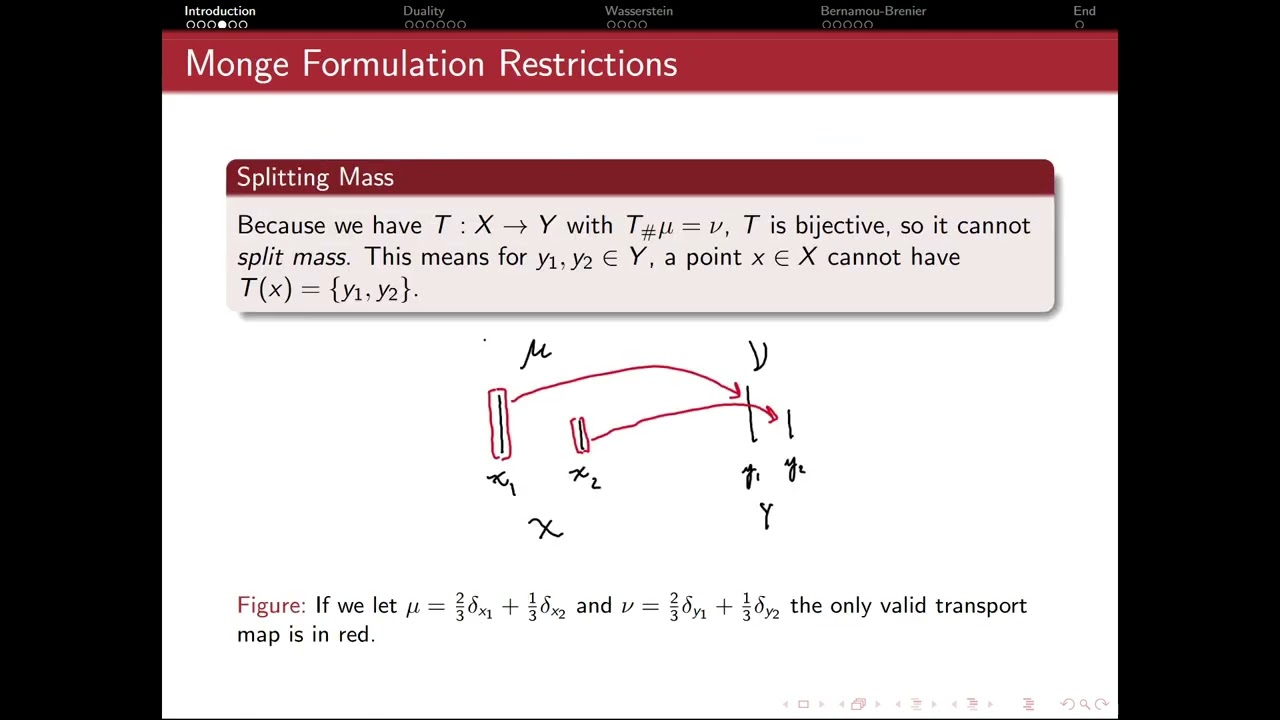 brazen wrenBOT
@mossy lintel <@&817929024893616129>
wicked drift
Hey everyone, unfortunately something came up and I can not do the talk this weekend or the next, so I rescheduled the talk for Saturday, March 19.
mods please don't type the talk command
wicked drift
Concatenation talk starts in 1 hour !talks
brazen wrenBOT
@wicked drift <@&817929024893616129>
wicked drift
Concatenation talk is starting shortly! Join the Mathematics voice channel now! !talks
brazen wrenBOT
@wicked drift <@&817929024893616129>
wicked drift
Thanks for attending my talk everyone! Here are the slides in case you were curious or you missed it: https://docs.google.com/presentation/d/1vxolq84GG2fC-cn7aaNGzX4S3a_eZjI6aTbH8OHByFE/edit?usp=sharing
On Slide 37, there is a link to a Desmos graph of the concatenation of two functions. On Slide 72, there is a link to my YouTube playlist on this topic if you are interested. Thanks again for attending!
 frank orchid
Would people be interested in an introductory talk presenting an elegant proof through graph theory of the Amitsur-Levitzki Theorem, a fundamental theorem in the theory of matrices and polynomial identities? Only prerequisite knowledge necessary is a very basic understanding of matrices, permutations and graphs. I will try and make the talk as accessible as possible.
!talks
brazen wrenBOT
@frank orchid <@&817929024893616129>
ember compass
I think this is going to be pretty niche but some people expressed interest so I want to get a more accurate headcount. I am thinking of running a sort of reading seminar this summer covering introductory stable homotopy theory, loosely following Adams's famous "Blue Book" Stable Homotopy Theory and Generalized Homology. You could think of this as a follow up to a (graduate?) algebraic topology course taught out of say Hatcher. The only other prereqs that would be helpful are of course abstract algebra, some homological algebra, and some category theory (but not much). If you're concerned about prereqs feel free to DM me and we can see if I can recommend some reading for you to look at before the summer to get up to speed. I am not sure when it would be in the Summer, probably starting sometime in like July.
The structure would be that there would be weekly assigned reading, with a talk each week on the relevant material. The talks would be given by the participants (not me), and each participant would ideally give at least one talk. I think this is the best way to learn in this type of seminar. Give 📘 react below if interested, this is still noncommittal. I'm gonna tag some people I've discussed this with, sorry if I forgot anyone. @thorny rock @reef barn @frank orchid @bold lotus @buoyant marlin
frank orchid
Event: A Graph-Theoretic Proof of The Amitsur-Levitzki Theorem
Time: April 9th 12:00pm EST
Location: Zoom
Zoom link: https://technion.zoom.us/j/92055768468?pwd=bnlwbkVWQUNjSXlFSWVjSWRUOE0xdz09
Event link: https://discord.gg/math?event=958671475735396422
Description:
The Amitsur-Levitzki Theorem, proven in 1950, is a remarkable cornerstone in the theory of polynomial identities and the theory of matrix algebras (And more generally, Central Simple Algebras and Azumaya Algebras). It concerns a 'Generalised Commutator' function of sorts called the standard polynomial, and claims that, for a suitable number of matrices of a given dimension, the result is always zero. The original proof, however, is quite cumbersome, and somewhat of a direct verification.
Since then, several proofs, some more elegant than others, have been given. Some examples are that of Rosset (1964) using the Exterior Algebra, of Kostant (1958) using Lie Algebra Cohomology, and of Procesi (2015), showing that the Standard Polynomial is intimately related to the Cayley-Hamilton theorem in a suitable setting.
We shall, however, present perhaps the most accessible proof by Swan (1963), using no more than elementary graph theory, and in the process proving a theorem in its own right on eulerian paths in connected graphs.
Prerequisites:
While a general knowledge of basic graph theory would be recommended, we will cover all that is needed in the talk, so the only real prerequisites are a general knowledge of matrices (What they are and how they multiply), and mathematical maturity. As a result, the talk will be accessible to most everybody at the highschool/first year university level.
!talks
Zoom Video
Zoom is the leader in modern enterprise video communications, with an easy, reliable cloud platform for video and audio conferencing, chat, and webinars across mobile, desktop, and room systems. Zoom Rooms is the original software-based conference room solution used around the world in board, conference, huddle, and training rooms, as well as ex...
brazen wrenBOT
@frank orchid <@&817929024893616129>
frank orchid
frank orchid
Event: A Graph-Theoretic Proof of The Amitsur-Levitzki Theorem
Time: April 9th 1...
Hi, Just a reminder that the talk starts in 30 minutes !talks
brazen wrenBOT
@frank orchid <@&817929024893616129>
frank orchid
Talk is starting! https://technion.zoom.us/j/92055768468?pwd=bnlwbkVWQUNjSXlFSWVjSWRUOE0xdz09 !talks
Zoom Video
Zoom is the leader in modern enterprise video communications, with an easy, reliable cloud platform for video and audio conferencing, chat, and webinars across mobile, desktop, and room systems. Zoom Rooms is the original software-based conference room solution used around the world in board, conference, huddle, and training rooms, as well as ex...
brazen wrenBOT
@frank orchid <@&817929024893616129>
frank orchid
Thank you to everyone who came! I had a great time and you guys asked great questions
Slides from the talk
ember compass
We are going to do a blue book reading seminar this summer! For details about the event, please read the attached draft syllabus. If you are interested in joining the reading group, please read the syllabus in full and then join the discord server for the seminar. Prerequisites are essentially some basic category theory and a full course on algebraic topology in e.g. hatcher, covering spaces, CW complexes, singular (co)homology, and homotopy groups. If you are severely lacking in the prerequisites you are welcome to join, but please let me know so that I can prioritize the talks for other people. Please try to join the discord and complete all of the action items in the discord server before the end of the month at the latest.
 jade fractal
@dusty ermine @fiery coyote @jagged idol @frank orchid @gaunt nebula @bold lotus @mossy lintel @half sequoia @velvet falcon @reef barn @thorny rock @light ether @flint haven @ruby wagon @jovial narwhal @tribal dew @soft pelican @green crown @prime grail @viral temple @buoyant marlin I tried to find everyone who reacted and had not changed their nickname substantially sorry if I missed anyone
(reposted from MaxJ)
 swift oxide
Would people be interested in an introductory talk presenting an alternative detailed classification of SU(2),SO(3) irreps and their application in physics like addition of angular momenta, Clebsch-Gordan decomposition, Spherical Harmonics from the point of view of Compact Lie group theory? Namely, we would not refer at all to the corresponding Lie algebras to construct the irreps, as it often is done in literature. The talk would be mostly self-contained.
!talks @talks
brazen wrenBOT
@swift oxide <@&817929024893616129>
swift oxide
To fix the weekend/day of the talk: when would it fit for most people? There will be a later poll for the exact time.
🗞️ :June 10-12
🥊 : June 17-19
 : June 24-26
swift oxide
!talks
brazen wrenBOT
@swift oxide <@&817929024893616129>
 sick pilot
Hey everyone! I'm organizing a group reading and a place for discussions to happen on the book "Seven Sketches in Compositionality: An Invitation to Applied Category Theory" (https://arxiv.org/pdf/1803.05316.pdf). This book offers a highly accessible tour of what important topics in category theory can do and ideas on how to apply them to real world situations. The intended audience is diverse and just about anyone can find something they want out of this book which includes anyone such as a motivated highschooler interested in logic, machine learning researchers, computer scientists, or math enthusiasts in general. One of the main motivations for the book's authors is to make this abstract nonsense accessible both to do good by solving societal problems and bringing under represented minorities into the math world.
If any of this sounds interesting or you are unsure take a look at the preface and table of contents of the book to give you an idea of what to look forward to. One last note is I'm also working on the structure of the server to make it as accessible for future reference so if you do not have time for the group meetings or need more time to read the book it will not be super detrimental to miss the official group reading part!
brazen wrenBOT
@cedar spade <@&817929024893616129>
swift oxide
swift oxide
To fix the weekend/day of the talk: when would it fit for most people? There wil...
Time has come! This weekend I would present the SU(2)/SO(3) irreps talk. What time would it fit you?
👛 - Satuday,25 June 17:00 CET
🗞️ - Saturday, 25 June 19:00 CET
🥔 - Saturday, 25 June 21:00 CET
 - Saturday, 25 June 15:00 CET
🥊- Saturday, 25 June 18:00
 - Friday,24 June 17:00 CET
 - Friday 24June 19:00 CET
 - Friday 24 June 21:00 CET
 - Friday, 24 June 15:00 CET
 - Friday, 24 June 18:00
 - Sunday,26 June 17:00 CET
 - Sunday 26 June 19:00 CET
 - Sundary, 26 June 21:00 CET
brazen wrenBOT
@swift oxide <@&817929024893616129>
dusty ermine
Hey, so I have an idea for a community project. I am sure all of you have encountered pre-latex books, which all have terrible typesetting. So I want to make a group in this server with the goal of LaTeXing a book. The first one I want to do is Frank Adam's "Stable Homotopy and generalized homology", the so called blue book.
I want to make this a community project, so lets say people take a small subsection and latex it up, and in sum we have a latex'd up book. I have an overleaf, dm me and ill give it. We will discuss and make decisions in a thread in#point-set-topology. Check the pins in it to get caught up.
this is the book, hopefully it is clear why a retyping is needed:
https://people.math.rochester.edu/faculty/doug/otherpapers/Adams-SHGH.pdf
Understanding some topology/algebra would be benificial as you could spot errors easier, and also gain from latexing this. But this is not strictly required, and you can just ask for clarification from me
brazen wrenBOT
@cedar spade <@&817929024893616129>
brazen wrenBOT
@swift oxide <@&817929024893616129>
swift oxide
This is the handout of today's talk. Any type of feedback regarding the style and/or any typos/mistakes is highly welcome!
swift oxide
Or here are the slides, which are a little bit less detailed, but still very followable:
dusty ermine
dusty ermine
Hey, so I have an idea for a community project. I am sure all of you have encoun...
Hello everyone, as you people might recall I was organizing this project to latex up this old book, adams blue book. I am proud to announce that due to the community effort, it has been done!
here is a link: https://people.math.rochester.edu/faculty/doug/otherpapers/Adams-SHGH-latex.pdf
This latex project is now going to be a parmanent thing, we are currently doing hicks "notes on differential geometry". We plan to grow and do more books (and maybe even branch out to things like translations if possible). Dm me if you want to join the group's server and assist. people who latex, can draw up diagrams or are willing to proofread are all welcomed!
 mighty eagle
!talks
brazen wrenBOT
@mighty eagle <@&817929024893616129>