#book-recommendations
1 messages · Page 203 of 1
 runic hatch
 sage python
I think the point he's trying to make is that the mere presence of illegal things on a site does not make the whole site illegal. If so, then Google Drive would be illegal by virtue of drives which contain pirated materials
runic hatch
Ah makes sense
 gray gazelle
but, even downloading copyrighted material is illegal
 molten wave
are we talking specific law of a specific country
or general common practices?
and/or morals, which are a completely different thing
 calm crane
do you really care about downloading copyrighted material being illegal
just download it
ofc if you found it useful you can find ways to help author or smt by like buying actual book
 dapper root
Send the author 10 bucks in the mail for their 100 dollar textbook, bet that’s about as much as they’d get for it anyway
calm crane
10 is probably more thsn they will get
dapper root
I was trying to be optimistic
calm crane
is 10% a reasonable rate or high/low for books
dapper root
It wouldn’t surprise me
calm crane
id assume 1% is like ok
calm crane
honestly for most things publicity is better than getting like $1
dapper root
Don’t imagine graduate math books see more than like... 10,000 copies sold ever
6k for writing a whole ass textbook seems not that great
calm crane
i dont imagine the authors rlly think about how much money they make either tbh
dapper root
¯_(ツ)_/¯
It takes a ton of time and detracts from being able to do research and shit
calm crane
trutru
dapper root
I think it has to offer at least a certain level of monetary benefit to offset opportunity cost
Unless universities / academia as a whole values a good textbook equally as much as good research
In which case I guess it can sort of be treated as ones job through the university
Tho again, I think most graduate textbooks come from “I wanted to see a textbook like ____ and there were gaps, so I made it”
So idk, I could see it going any direction lol
calm crane
yea in like prefaces a lot is like there isnt good books here so im going to be the one who makes a good book
seems like quite often they usually use materials from classes they taught as well?
dapper root
Yeah that’s a trend I’ve noticed too but that’s kinda necessary I think
If you haven’t taught a course on it then it seems really hard to know what to cram in a textbook and have exercises to draw from, etc
calm crane
yea
gray gazelle
@gray gazelle https://b-ok.org/
Electronic library. Download books free. Finding books | B–OK. Download books for free. Find books
also good one
and i recommend to get an e-reader
cuz else you'll fall asleep whilst reading on ur monitor
@gray gazelle Thanks
Also true, I'm hoping to save up for an e-reader
u'll save lots of money getting an e-reader than buying books
I need one that can display math books
cuz u can just get the pdfs on there
Do you have any recommendations?
no cuz i dont have one
hahahahahahaha
I'm also saving up
😂
but I heard it's less tiring for ur eyes and such
:kek:
Like when I'm about to sleep I always want to read u know
Same
when I was reading it on my monitor
after like 3 pages
I was like ugh
ima sleep
now I'm reading physical books
I can get up to 20-30 pages
- the smell of the book oml
Yeah
That's why I also save up for books
@gray gazelle what kind of books do you read?
gray gazelle
U can also get Springer paperpacks for like 30dollars
Not too expensive
@gray gazelle what's that?
Paperbacks, look up Springer mycopy
i googled it
this?
wth
oh
it's a maths book xD
calm crane
you can get dubious copies from like taobao
 smoky surge
is it possible to study topology in an applied sense?
i dont even know if that question makes sense
 zinc basalt
something something topological superconductors
smoky surge
so thats what im actual interested in is topology for data science
dose anyone know of any good resources for studying that
 valid moth
Ye look intl TDA
into
Topological data analysis
Also @sweet lotus what's your favorite intro AT book
Opinions seem to vary wildly per persom
n
Like dami with rotman or something versus max with uhhhh hatcher iirc
sage python
I wouldn't say Rotman's my favorite, I just think it's the best easy book
tom Dieck seems real nice too
Also Ultraproduct wanna head over to #advanced-number-theory and see if I'm being kinda smoothbrain rn?
 granite sluice
Topology has applications in data science, quantum computing, artificial sensing and economics.
@sweet lotus I'm really unconvinced that persistent homology TDA is an "application." Most of the papers that I've seen use it seem really kinda :\ ...
"look we calculated this homology group of data! we wildly speculate that this homology group is the true bit of information that data scientists have long awaited all hail Ayasdi!"
 granite sluice
Maybe I'm being a bit of an applied snob -- applying tools to a real world problem is not an application (in my mind) unless one actually solves a problem or it leads to insight.
Math has lots of applications, crypto, optimization, geometry processing, signal processing, ML, etc. Topology idk. I saw a presentation once about using Persistent homology to calculate Hausdorff dimension -- that was pretty neat.
but ofc you'd want some reason to calculate Hausdorff dimension. (Of something like the support of the distribution you are sampling from, don't remember the details.)
I don't think its impossible that TDA won't ever be useful, but I'm just annoyed at the hype/success ratio.
and also its super unclear what homology groups in the data 'mean' if anything.
beyond 0-homology as another clustering algorithm
/rant
smoky surge
hype in ML is really crazy because it all seems like its about getting a model that is.1% better
 hearty steppe
A lot of the theoretical math being worked out these days seems more relevant towards theoretical physics or theoretical chemistry which may apply to dense STEM fields like molecular biology, neuroscience, maybe to some degree complexity of ecosystems. Unless you want to do some extreme precision calculations that may mean anything in engineering? I am not sure.
But a lot of the theoretical stuff that seems recent and has no immediate application may be insightful for research related stuff.
neuroscience is definitely a field that is expanding its taste for theoretical mathematics.
you already have applied homology being used in understanding synaptic networks as an example
 flint forge
This is not always true
If your data has a clear Hn generator
You probably are seeing some ‘gap’ in your obersvations that could be important
For example if you compute H1 of a hurricane youd find the eye of the storm
granite sluice
The hurricane thing is a good example and seems plausible.
Although you can already get it by clustering on the complement of the hurricane.
It's more accurate to say that I'm not sure what a homology group of high dimensional feature vectors means. Part of this is because there doesn't seem to be a good null model.
Although there's some research on that.
Here's a discussion between people much smarter than me: https://quomodocumque.wordpress.com/2015/11/11/bobrowsky-kahle-skraba-on-the-null-hypothesis-in-persistent-homology/
probably outdated at this point
Ultra's point about the map and territory is good, although it's my understanding that in those applications I listed, the problem predated the tool. E.g. communication over channels predated Shannon and coding theory, classification predated Vapnik and learning theory, secure communication predated Shannon (again) and RSA, optimization has been a problem forever, ... with TDA it seems more like a tool in search of a problem.
Tools in search of problems have had success, of course, and I certainly don't think people shouldn't study TDA stuff. I wonder how much of the branding as 'applied math' has to do with pure topology people looking down their nose at the interesting new pure math questions raised by persistent stuff. I think it would make more sense for people to study it because its a neat idea -- and discover if maybe there are applications, after all. ... Rather than (somewhat dishonestly, in my opinion) saying that they are studying it because they believe it has great untapped applications for curing cancer/saving america/understanding the brain.
(Algebraic statistics left me with a similar kind of flavor, tbh. Okay its neat that one can calculate the cohomology of the complex points of this variety defined by generalizing an important statistical model.... but why should any statistician care??)
In both cases I've talked to people doing insane fancy stuff with TDA or Algebraic Statistics, when it seems like standard tools in convex optimization basically already solve the applied problem (better stronger faster, etc.)
gray gazelle
@gray gazelle what kind of books do you read?
@gray gazelle I mean on my computer I only read papers and math books, but on paper I also read fiction. It really depends. If I can't wait to go to the library I'll just read a fiction book online.
granite sluice
One of the comments on the blog post I linked, which is worth extracting:
"2) In general, I think a very productive analytical pipeline is: take populations of filtered objects with some sort of ground-truth labels, compute persistence diagrams, extract features (how? Lots of ways, all very different, and we need much more theory!), and then “do machine-learning.” The brain artery paper is one (small) example of this pipeline, I think. A bunch of other folks are exploring signal analysis applications where the filtered objects are signal snippets (more precisely, functions f: I \to R and you then filter I by sublevel sets of f). The features you get from zero-dim persistence on this seem to given really interesting conclusions, and the features are clearly very different than things you’d get from, say, fourier or wavelet analysis. I don’t way to say “better,” but I think “different” is clear, and I think using them in combination will bear a lot of fruit."
This sounds reasonable to me and has for a while, but I personally have not heard (personally) of this (yet) bearing fruit. Which is not at all to say that it won't at some point. "doing machine learning" is exactly the right thing to do with "mysterious features that we don't know how to interpret," anyway.
Anyway this is obviously just one of those (mostly irrational, but rationalized) ideological opinions I have.
Usually when people say "entire field is stupid," they are wrong.
I'm very carefully avoiding saying that, but that's how I feel. Those emotions color my rationalizations, even though I can recognize on a different cognitive level that they are wrong. I'll leave my rant up mostly because I'd be interested in having a conversation with someone more knowledgeable than I am about this topic.
 marble solar
The topologists have been waiting around for a long time
Locked away in the chamber
The king fears revolt
granite sluice
Yeah, and there are all sorts of poorly defined 'understand the data' type of questions like 'anomaly detection' that TDA could be helpful for.
 sleek python
The topologists are always waiting
granite sluice
There are already a lot of tools that exist for those problems though. It's unclear what TDA does that the other ones don't. But yeah I agree that if someone finds it interesting to build a new tool, even before applications are clear, that should be encouraged (especially if it leads to interesting math, which TDA does).
I don't really understand your point about VC dimension et al.
@sweet lotus VC dimension specifically or the 'problems preceding the tools' kind of thing?
This puts it a lot better than I could.
 granite sluice
imo empirical source can also mean something like understanding the properties of the integers (or homotopy groups of sphere?), so I don't think so...
I'm not sure what Neumann had in mind. Time to find that paper I guess.
granite sluice
"In other words, at a great distance from its empirical source, or after much "abstract" inbreeding, a mathematical subject is in danger of degeneration. At the inception the style is usually classical; when it shows signs of becoming baroque, then the danger signal is up. It would be easy to give examples, to trace specific evolutions into the baroque and the very high baroque, but this, again, would be too technical.
In any event, whenever this stage is reached, the only remedy seems to me to be the rejuvenating return to the source: the re-injection of more or less directly empirical ideas. I am convinced that this was a necessary condition to conserve the freshness and the vitality of the subject and that this will remain equally true in the future." 😦 we have been denied von Neumann's thoughts on this matter.
granite sluice
lol someone asked on stackexchange: https://hsm.stackexchange.com/questions/11913/did-john-von-neumann-hate-pure-mathematics-that-became-too-abstract
this pay walled essay by Peter Lax seems to also discuss this quotation: https://www.sciencedirect.com/science/article/pii/S0168202408701255
Lax writes: "In the middle of our century, a time of resurgence of the human spirit
following the conclusion of the second World War, a fierce fight broke out
for the soul of mathematics. The purists, championed by Bourbaki, claimed
that so many branches are budding and blooming today that mathematics will
develop autonomously, with no need for input from the real world; applied
mathematicians thought otherwise; their view was represented most forcefully
by v. Neumann. He concluded his article “The Mathematician”*, with these
words: [quotation above from von Neumann]...
... V. Neumann had very definite ideas where many of these empirical ideas might be coming from. In a talk at Montreal delivered in 1946**, when fast electronic computers were merely figments of his imagination, he said: “We could, of course, continue to mention still other examples to justify our contention that many branches of both pure and applied mathematics are in great need of computing instruments to break the present stalemate created by the failure of the purely analytical approach to non-linear problems. Instead we conclude by remarking that really efficient high-speed computing devices may, in the field of nonlinear partial differential equations as well as in many other fields which are now difficult or entirely denied of access, provide us with those heuristic hints which are needed in all parts of mathematics for genuine progress. In the specific case of fluid dynamics these hints have not been forthcoming for the last two generations from the pure intuition of mathematicians, although a great deal of first-class mathematical effort has been expended in attempts to break the deadlock in that field. To the extent to which such hints arose at all (and that was much less than one might desire), they originated in a type of physical experimentation which is really computing. We can now make computing so much more efficient, fast and flexible that it should be possible to use the new computers to supply the needed heuristic hints. This should ultimately lead to important analytical advances”.
No specific answer to what Neumann considers degenerate but a nice reminder from von Neumann to use computers in your research. That's a moral I can get behind.
 strange osprey
Is rudin's analysis books good?
sage python
I like Baby Rudin a lot
 lost fjord
From what I hear it is
sage python
I don't know the other two, I think Big Rudin is the standard for its subject but that there are better alternatives (e.g. Folland, Bass)
lost fjord
But I also hear it is quite difficult
sage python
Grandpa Rudin and up idk at all
strange osprey
Yes
I am just looking for Christmas gifts to myself
And I wanted an analysis book
So yea
lost fjord
Aww
strange osprey
I also want a differential geometry book, is there any good ones?
lost fjord
Idk why but when you phrase gifting yourself smth for Christmas, I felt sad for some reason
marble solar
I like Spivak comprehensive
strange osprey
On diff geo?
 slender sphinx
What is your background Physwiz
strange osprey
Wdym
strange osprey
High school? I'm just self learning stuff.
strange osprey
Oh okay, i have done elementary calculus and almost finished with linear algebra
gray gazelle
highschool
spivak diffgeo
 strange osprey
I should be beginning multi variable calc soon
slender sphinx
I'd suggest you continue onto calculus 2 and 3
marble solar
I thought the name implied like
gray gazelle
moonbears tryna kill a man lmao
strange osprey
Okie
slender sphinx
calc 3 is basically Multivariable
analysis and diff geo are too beyond your current background
strange osprey
Alright
Analysis and diff geo are just tools to help me in physics
What about diff equations?
slender sphinx
after calculus
marble solar
Boyce and diPrima
strange osprey
Okie
marble solar
How much calculus do you really need to know?
slender sphinx
and I agree with moonbears for the book
marble solar
Just y'know fuck it
slender sphinx

strange osprey
So I need to finish multivariable calc first?
marble solar
you need to finish calc 2
In order to fully understand what's going on
in differential equations
strange osprey
Like improper integrals and stuff?
marble solar
Improper integrals, series, hard integrals
using all kinds of tricks, polar coordinates
gray gazelle
diffy q is important in diffgeo
gray gazelle
feels like it to me
valid moth
before you do DG
gray gazelle
tbh i havent needed much more than like, existence and uniqueness theorems
valid moth
you should at least know calc 3
for instance I do not yet know calc 3
I will learn it from ISM
 tight crag
Yeah existence and uniqueness is the money maker
sage python
You might wanna know smooth dependence
gray gazelle
that too
sage python
On the basepoint
valid moth
let me just depend on you for a lil bit then dami
valid moth
gabe learned calc 3 from ISM
gray gazelle
calc 3 is two facts:
- partials of C^2 commute
- inverse/implicit function theorems
sage python
Why do you ask?
valid moth
i am doing the gabe route
i am depending on you dami
to learn about smooth dependence
sage python
Alright I'll give you the problem to do
lost fjord
Ok but do you know calc 69
gray gazelle
sage python
It'll take too long to find here
But it's a 5 part problem
Showing smooth dependence of the trajectory on the basepoint
Also wow I should sleep soon
 tribal kernel
calc 3 is two facts:
- partials of C^2 commute
- inverse/implicit function theorems
Honestly pretty important and not a bad summary
But I would add Stoke's theorem to that
tribal kernel
Lol I knew one guy who tried to teach calc 3 with diff forms
The students did not like him
marble solar
Not learning calc 3 with diff. forms
tribal kernel
It was like a 90% engineering students class
sage python
Them engineers finna git lernt
 broken meadow
😔 my calc 3 professor was so annoyed when someone asked him if we were allowed to treat ds/dt as a fraction
valid moth
Yes
broken meadow
and went on a whole ass rant about how they teach differential forms wrong
from calc 1 upward
sage python
"Consider the cotangent bundle of the real numbers"
tribal kernel
Lol
broken meadow
cursed
 dense pewter
you're only allowed to treat ds/dt as a fraction if you know what you're doing, and if you have to ask about it, then you don't know what you're doing
broken meadow
he was more talking about how they should motivate prime notation as like taking the derivative but then using dy and dx to be like the components of a part of the tangent line (like a vector ig)
heh i see buncho
sage python
Oh yeah I still need to actually finish the last bit of that section
Basically it defined an automorphic representation
And then we're showing that the actions of U(g), O(2,R), and GL(2,A_{finite}) preserve the space of cusp forms
 humble gyro
I want to read my first math book, any recommendations?
sage python
Uh, what's your math level and what do you want out of math?
humble gyro
I want cool and interesting Ideas and I done math up to linear algebra and muli var calc
sage python
Does proof-based math sound appealing to you? Have you encountered any proofs before?
humble gyro
yea I done some things on my own with proofs but nothing too advanced
sage python
Combinatorics might be fun if you don't have a particular topic you're trying to learn
humble gyro
yea Ill give it a try, what book do you recommend on the topic?
strange osprey
Proofs are pain ;-;
 timber mesa
physicist
checks out
strange osprey
Mostly algebraic proofs, those are okay to deal with. But proofs from Linear alegbra is just suicidal.
strange osprey
Just regular algebra
lost fjord
The only thing that comes to mind for regular alg proofs is deriving quad formula and possibly trig stuff (but this isn’t really alg imo)
I see you poco 👀
strange osprey
But is it okay if I ask now about the diff geo and diff equations books? I just want to finalise what books I'll take for christmas.
strange osprey
Fuck it I'll research it myself
valid moth
Maybe try @humble gyro https://www.springer.com/gp/book/9783030008307
The book provides a theoretical background for several topics in combinatorial mathematics, such as enumerative combinatorics (including partitions and Burnside's lemma), magic and Latin squares, graph theory, extremal combinatorics, mathematical games and elementary probabili...
humble gyro
I will check it out thanks
humble gyro
Yea I saw that being the first book that appeared when I searched so I think it's a good starting book, thanks for the reccomendation.
valid moth
Go read his book then :hwadan:
broken meadow
uh ill just take his class maybe idk
 languid wedge
Diego hosted a spaghetti dinner for the soccer team. He made 6 boxes of spaghetti to feed the 20 people that came. Next time, 50 people are coming! How many boxes of spaghetti should Diego buy to feed all those people? Explain or show your reasoning.
 fast portal

tribal kernel
Yo wrong channel my dude
fast portal
I think you might wanna look at #❓how-to-get-help
 steel viper
@strange osprey I think you should probably get comfortable with proving before reading a diff geo book
tribal kernel
But for real, figure out how many boxes of spaghetti each person needs by dividing, then multiply by the new number of people
steel viper
at least a mathematical one lol maybe theres a proofless "for physics" one or something
fast portal
I recommend the velleman if you want an intro to proof books
valid moth
@steel viper And also maybe a calc 3 book first
As I think phys has said they don't know calc 3 yet
gray gazelle
My school have a sovietic math book and I required it! >:)
valid moth
How do you say field in portuguese
As in the math term
Corpo?
Ah yes
Corpo or campo apparently
broken meadow
campo makes sense
valid moth
Body is how it is in a lot of languages
Like german / french / spanish
Like loch was saying about field jokes in germany
"An element of my lower body..."
broken meadow
lol
 toxic stump
has anyone tried this book on logic
It is like some study notes that became a book but it's popular
by Jesper Carlström
gray gazelle
book on what
 karmic thorn
Has anyone read "Proof and the Art of Mathematics" by J.D.Hamkins? It's contents seem interesting, but I'd like to know if it's worth buying(can't Libgen this one :3)
 hasty turret
Strang
gray gazelle
ok...
hasty turret
Or you can watch his lectures on youtube
gray gazelle
yeah thx
 tranquil edge
@gray gazelle uh one that like sums up p much alg I, Trig, NT, and Stat
doesn't have to be all in one book
gray gazelle
Anyone here a good abstract algebra book recommendation?
slender sphinx
Artin's Abstract Algebra
First few chapters are skippable if you learned abstract linear algebra before
gray gazelle
thanks
karmic thorn
Has anyone read "Proof and the Art of Mathematics" by J.D.Hamkins? Its contents seem interesting, but I'd like to know if it's worth buying(can't Libgen this one :3)
gray gazelle
libgen, ha
gray gazelle
artin is nice
 robust palm
Has anyone read "Proof and the Art of Mathematics" by J.D.Hamkins? It's contents seem interesting, but I'd like to know if it's worth buying(can't Libgen this one :3)
@karmic thorn there exist books you can't libgen!?
karmic thorn
@robust palm This is a first for me haha
flint forge
if you have a covincing reason
you could always just ask JDH for a copy
he seems kinda chill
karmic thorn
I'm guessing the book is already rather inexpensive by first-world standards
But if it's a good book, I don't mind spending extra bucks to get a physical copy.
tribal kernel
Anyone here a good abstract algebra book recommendation?
Check the pinned message. There’s a pretty good rundown of what algebra books are worth your time 🙂
Although I personally enjoy Aluffi but maybe because I’m dumb
steel viper
lol
@flint forge someone should type up a big ass post on the best AT textbooks like damis on algebra textbooks
wink wink nudge nudge
what are the candidates anyway
flint forge
Oh and massey
tribal kernel
Jacobson is good
steel viper
jacobson is good i think
flint forge
Ive come to really like DF
steel viper
DF is so boring to read tho
tribal kernel
My algebraic topology professor really liked his first series
flint forge
Huh?
tribal kernel
Jacobson I mean
steel viper
he has two algebra books max
steel viper
two volumes
steel viper
oh those
tribal kernel
And Basic 1&2
She really liked lectures
Very classical approach though. No categories or diagrams
Lol yeah
I dunno if this is the right place for that though
DF is cool, I use it as extra reference
flint forge
Tbh i feel like if you want to learn group theory
Just watch rudenkos lectures
I am admittedly a Rudenko fanboy
 civic carbon
I do not know of this Rudenko!
flint forge
Hes a postdoc/lecturer at uchicago
Hes only recently started posting
But his videos have insane production quality lol
Im only a fanboy bc i know him irl
civic carbon
I would beg people if they are going to post videos that they at the very least fast forward through them writing.
flint forge
Eh it depends for me
I think its actually@kinda helpful to have things written down slowly
For sufficiently advanced math
And talked through as its done
Idk why
civic carbon
the "say three words write three words" pattern is really jarring to me, and I've tried to get better about not using it even in in person lectures.
I do love the glass whiteboard for Rudenko's videos
flint forge
It only bothers me if like
They repeat it a bunch to buy time
Like fucking sal khan
I agree that daniil could probably tighten it up
But maybe the minimal editing makes it feel more like a real lecture?
civic carbon
I think one should always acknowledge the strengths and weaknesses of the medium. Just like when you make a movie of a book.
I'm trying to figure out how Rudenko is even doing this technically. Is he writing backwards?
civic carbon
Sheet of glass plus mirror image the video? Does taht do it? My visualization game is not up to this challenge haha
my video editor believes that is what is happening, particularly since in the video he is writing with his left hand, but most likely that is his right hand.
karmic thorn
Are you people talking about LightBoard?
flint forge
Yes
civic carbon
It looks like we are!
https://www.youtube.com/watch?v=ZB6UrEFgcdo Here is a How To.
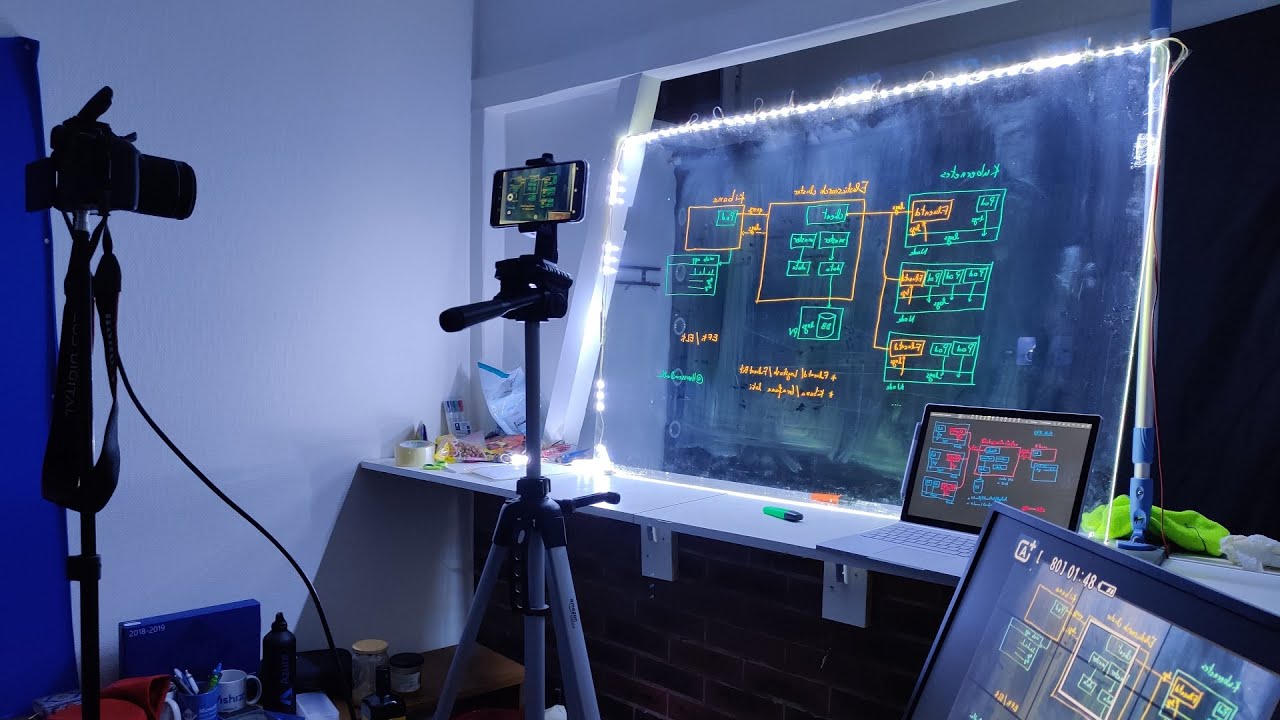
This is the setup for recording videos using the Lightboard
hearty steppe
I didn’t realize how much space those boards take up. They’re pretty big
 velvet briar
They have to be I suppose, that's person-sized
hearty steppe
So any sheet of plexiglass will do?
 wraith plover
Is there any book you can suggest me that will help me to do huge calculations using only fingers instead of relying only calculators? For example, I want to do 45634 x 2342 in my finger. I wanted some suggestions or books on how to learn it.
velvet briar
Why not learn to do it mentally? There's lots of books for that
wraith plover
I just want to train myself in mental math using fingers. I am not good at math. But I am trying hard to be better at mathematics.
velvet briar
Hah I mean I'm quite good at math but can't multiply two digit numbers together, much less four digit numbers
I'm not certain of a book for mental math using fingers. I should look up a book on how to use an abacus though
 pulsar aurora
Fastest way to calculate in math is use a computer to do it all. 😉
 buoyant spire
https://mitpress.mit.edu/books/street-fighting-mathematics
You might find this book (and it's related course on MIT OCW) useful

The MIT Press
An antidote to mathematical rigor mortis, teaching how to guess answers without needing a proof or an exact calculation.
In problem solving, as in street fighting, rules are for fools: do whatever works—don't just stand there! Yet we often fear an unjustified l...
The pdf for it should be available under the "open access" tab in the store page
 tawdry flicker
whats a good analysis book for someone who doesnt study math at uni and just wants to learn
please easy to understand ones hhh
marble solar
Spivak Calculus is the first go to
Despite its nay-sayers
More readable, less technical than the more heavy duty analysis books
And better than the "lighter" analysis ones
tawdry flicker
wait is spivak's calc just calc or analysis?
marble solar
Spivak's Calculus
If you can do every exercise in that book
You're probably ready for grad real analysis
(Albeit you need some linear algebra + topology, but shhh)
marble solar
You should know calculus
tawdry flicker
well yes
marble solar
Going in
tawdry flicker
but what other than that
marble solar
For spivak's calculus? Being a little bit comfortable with proofs can be a huge help
tawdry flicker
ive never done proofs
i mean yeah other than "prove sin(soimething)=ln(whatever)" stuff, ive done nothing
marble solar
Spivak will take it slow
and teach you how to prove things
People will say go read some intro to proofs thing
I disagree with that sentiment
velvet briar
I like Levin's "Discrete mathematics" for the proof methods and for some set theory, easy and fast book
Lol good timing of course
marble solar
Well, he's trying to learn some analysis
But isn't comfortable with proofs, so the best thing is Spivak's Calculus which proves things, slowly
While covering the basics of analysis
2 stones, 1 bird
tawdry flicker
let me see if its available in libgen, just checked it its not available in my country
well i mean "Calculus On Manifolds: A Modern Approach To Classical Theorems Of Advanced Calculus" by spivak was available
velvet briar
Spivak? I'd be surprised if you can't get it off Google
tawdry flicker
but idk if its the same book
velvet briar
No it's not haha
marble solar
No that's not the same book
tawdry flicker
nvm bdkjfh
marble solar
That one is "light" reading
tawdry flicker
this book kinda looks like your basic calculus book with some extra spice
tawdry flicker
let me see
gray gazelle
 do as many exercises from spivak calc on manifolds as you can
including the wrong ones
marble solar
Yeah, I think 3-35 scarred me @gray gazelle
tawdry flicker
you know what im kinda in love with the problems on this one
not boring at all unlike every other calc book
marble solar
Starred ones mean it gets used later for spivak calc on manifolds TTerra
gray gazelle
ik
marble solar
it doesn't mean harder
Ok
Some ppl don't remember that stuff
Yes, Hellfire, the exercises can get ridiculous in spivak's calculus
tawdry flicker
Starred ones mean it gets used later for spivak calc on manifolds TTerra
@marble solar wait wdym by this
marble solar
That's not really relevant to you, but in Spivak's Calculus book the starred problems mean HARD
In spivak's calculus on manifolds they mean the result is used in future development of the subject
So it's a good idea to do those problems to fully understand what's being said in later readings
tawdry flicker
Tell me how many you can complete
hey btw about how many i can complete, most of the chapters not much but chapter 4 in conic sections one i can almost complete every single one
probably because ive been doing planet orbit problems for the last year since astronomy
but yes
they're fun
thank you for the recommendation hhh
marble solar
No worries, haha
Lots of people get offended when you tell them to read spivak's calculus
tawdry flicker
why LOL
marble solar
so I just say look at the exercises, tell me how that goes
well cuz they think they know calculus
and they don't
Calculus is hard
I don't know why people pretend it's not
tawdry flicker
tbh i never read a calc book before they all looked really boring to me i just kinda guessed some stuff off from blackpenredpen videos but im by no means good at calc
gray gazelle
*math is hard
tawdry flicker
^^^
marble solar
yeah, but a lot of math people will be like
gray gazelle
bro do rudin
 quick hornet
You think calculus is hard! Wait till multiplication
i tried 3 * 6 the other day but i coudnt figure it out
 brittle latch
subjective question but thoughts on folland vs spivak for calculus
two different math professors whom i both respect recommended each to me separately for a review of calculus
i finished calc 3 fall 2019 semester but i feel like i didnt retain enough so i wanna review
brittle latch
i mean as long as it engages my calculus muscles im open to it
im still figuring out my approach to studying completely from a textbook but i looked at the first chapter of folland and realizing i had nearly forgotten what cauchy shwarz is i got flashbacks to finals week lol
marble solar
lol
Spivak's Calculus on manifolds will be engaging many muscles, but I recommend it
It's "light" reading
brittle latch
define light
brittle latch
oh shit i thought i'd found it online but that pdf is 640 pages 💀
brittle latch
ohhhhhhhhhhhhh
i'll assume this is it
do you have any experience/thoughts on folland though?
 proven mountain
Could you recommend some highschool books on thermal?
I know I does not directly concern math, but still I require it
hearty steppe
If you think calculus is hard, wait until you reach real analysis
brittle latch
was that @ me...?
valid moth
I wonder what subject has the longest average textbook length
flint forge
Modern AG?
valid moth
Does something like HoTT have long books
 sinful yacht
Does anyone know where I could snag a copy of "Sneaking a Look at God's Cards" in pdf form?
I have heard stellar reviews however I cannot find it anywhere
flint forge
libgen?
sinful yacht
I thought to go there, and didn't get any results because I missed an apostrophe, haha. All is well now @flint forge
 grizzled meteor
heloooo, im tryin to self study analysis. im using bartle and sherbert- and my objective for this month is to study sequences and series. i have a few questions
-
should i refer baby rudin? i get the popularity behind the book but the notations are kinda outdated imo.
-
is there any lecture notes i can follow? my uni kinda sucks, my analysis teacher was a bully :'(
thanks!
please ping me @grizzled meteor , i tend to miss messages otherwise
valid moth
@grizzled meteor
why refer to rudin
try pugh or abott if you want
or just the lecture notes
you don't really need more than one book
assigned book + some lecture notes seems sufficient
grizzled meteor
ah yes i agree, dont wanna burden myself
uh i checked the lecture notes- it seems like a textbook lmao
do you know of a material that's more...intimate?
valid moth
.... 😳
valid moth
no that's good word use
When the evening is spread out against the sky
Like a patient etherised upon a table``` ts eliotTHE PDF IS CALLED INTROREALANAL wow thats very intimate
seriously tho, you have been a big help. thank you!
valid moth
np
gray gazelle
lmao intimate
 pine igloo

tribal kernel
My favorite classical analysis book is Marsden and Hoffman, but Bartle and Sherbert is also good
 wind canyon
I just ordered some Art of Problem Solving books
😄
I like math, and heard they are pretty good
valid moth
They can be pretty good! Have fun
 wooden sparrow
I just ordered some Art of Problem Solving books
@wind canyon bruh did you buy them?
 long bear
then use the other versions
wind canyon
They have a like online version on their website + physical copy
long bear
lol
wind canyon
I got prealgebra and algebra ones first
long bear
art of problem solving: free download. Ebooks library. On-line books store on Z-Library | B–OK. Download books for free. Find books
wind canyon
I think that if I get a bit better at math, and can feel very confident, that I might like being like a math teacher or a private math tutor
long bear
I suppose for future reference
You can use sites like libgen.rs to get most books for free
long bear
fair enough
wind canyon
Hopefully these books contribute greatly to me getting better
wooden sparrow
I am done with prealgebra, almost done with intro to algebra now
wind canyon
with art of problem solving?
wooden sparrow
Yes, they're good
Basically the book guides you through a course by asking to solve problems
I find that a very good way to teach myself
wind canyon
I personally really wanted to try them, because 3b1b I think said he learned from those once upon a time
and his channel is very good
plus other recommendations
wooden sparrow
3b1b endorses brilliant.org too, but the premium version sucks
wind canyon
and I looked through the online of pre-algebra and it looks like they give you a lot of neat info and ways to look at
things
wind canyon
Yeah that's a good approach
I plan on reading through pre-algebra during this semester, and doing a lot from that, and maybe over winter break read through the algebra
I have a lot of freetime
wooden sparrow
same here
wind canyon
I'm currently in calc 2, I presume I can go something like
prealgebra > algebra > intermediate algebra > Precalc > calc
within about 1.5 years
wooden sparrow
Yeah I'm thinking about the same thing
wind canyon
the rest I would probably go through at some point
wooden sparrow
But I also want to go through number theory and counting and probability
marble solar
Number Theory
wind canyon
first
wooden sparrow
But if there are better books for those subjects, I'll try them
wind canyon
idk
marble solar
bleck
wooden sparrow
Why though?
wind canyon
I wonder if I should buy the problem solving series
I know they are technically geared for competition math
marble solar
I agree with TTerra here
wooden sparrow
@gray gazelle what's yuck about analysis or geometry?
gray gazelle

wind canyon
It's kinda funny, the more I go through math, the more I like it.
In high school I would've never thought that I'd like math, I didn't even get past trig in high school
gray gazelle
read what i wrote a little more carefully
long bear
lol
wind canyon
@gray gazelle what's yuck about analysis or geometry?
@wooden sparrow He's saying anything but those are yuck
wooden sparrow
Ohh sorru
long bear
anything that isn't
wooden sparrow
Sorry*
long bear
 gray gazelle
counting
probability
number theory
all three subsumed by the subfield of cs known as "developing calculators"
wooden sparrow
read what i wrote a little more carefully
@gray gazelle sorry mate, kinda having very sleepy eyes now
long bear
wind canyon
huh I just did some quick math
If I can manage to read and understand about 20 pages of math per day
from the whole series of those text books
 wind canyon
then I should finish in about 250 days
gray gazelle
why are you posting legosi in #book-recommendations
long bear
Sorry, I'll post a better version
wind canyon
20 pages a day should be pretty managable
gray gazelle
i don't know what kind of books the ones you're mentioning are
but 20 pages in a day sounds like a lot
wind canyon
Art of Problem Solving series
nothing too complex, just kind of like review and brushing up, and maybe learning some new things
the only subject I wouldn't know anything much on is geometry so that'll be a bit slower
It's just a tenative estimate anyway
I like reading, and learning, and I have a lot of freetime
I've read through like so many books since covid started
wooden sparrow
I've read through like so many books since covid started
@wind canyon that's nice mate
Keep going
tribal kernel
Whoa yeah except probability cause probability is a lot of analysis now
 median sleet
Just here for an opinion, what's the best calculus textbook you've ever encountered?
median sleet
I'll check it out, thanks!
timber mesa
tbh I don't know of a good "first" calculus book, but I second Spivak as a second
median sleet
Just checked out the table of content
I'm not starting from scratch so it's perfect
gray gazelle
What do you think about Spivak's calculus on manifolds?
Is it good as a second book for analysis 2
quick hornet
it's the standard, assuming you know some topology going in, but it's famously very problem-oriented and can be tricky
munkres' analysis on manifolds covers basically the same material but in twice the length
which sounds like a bad thing, but lets it fit in a lot more pictures and exposition
and can help you get a clearer picture for "the broader picture"
while the problem-oriented approach can be valuable for learning, it can also lead to getting stuck on technicalities and thinking twiddly little equations and details are more important than they are
and that's the impression i get from a lot of people's experience with spivak's calc on manifolds
that said, it has some very good problems and is a very efficient treatment of the course
so YMMV
gray gazelle
Atm I don't even know a full definition of a topological space xd
But I guess it would be alright if I dive in, then search what im missing right
 warm socket
how are you guys allowed to react in this channel
I can't put snark reactions
I'm missing on all the fun
 gray gazelle
Which one?
timber mesa
I tackled Spivak's Calc in Manifolds without a previous topology course and did fine. It's self-contained and you don't need to know a ton except for some intuition maybe
gray gazelle
That's some great news
 turbid zenith
Problems and solutions
(solutions not necessary)
on Set theory, mappings and relations
(currently taking this math course which starts from fundamental stuff we've already studied before but with harder exercises/problems)
(So I'd like a problems and solutions book with more difficult problems)
perhaps ones involving sigmoid algebras, filters, coverings...etc
 flat osprey
"set theory, mappings, and relations"
This is very vague. You could be asking for an intro to proofs book or a graduate seminar
gray gazelle
uwu araragi-kun :3
turbid zenith
I'm asking for a book like Clark's elements of abstract algebra
Wazzup Godel !!!
(got to the school)
(I flubbed my exams but still managed to get in ;"3 )
gray gazelle
niceeee I knew you'd get in
turbid zenith
: D
gray gazelle
whats the name of the course?
gray gazelle
OwO
turbid zenith
("classes préparatoires pour les grandes écoles d'ingenieurs")
gray gazelle

turbid zenith
we basically have 36 math chapters per year
now we're in set theory, relations and mappings
 gray gazelle
wait doesnt prepa have like recommended books for those chapters?
that fit curriculum
turbid zenith
wait doesnt prepa have like recommended books for those chapters?
@gray gazelle yeah... but I don't have any rn :""
and couldn't find 'em online
and the school library has been emptied out of math books 0.0
gray gazelle

gray gazelle
theres one book in my schools library that theres only one copy of and someone was supposed to return it like a year ago
turbid zenith
owfers
gray gazelle
ive been checking every month
hasty turret
Libgen
gray gazelle
yeah 😦
hasty turret
Obv
turbid zenith
our class can only use it once per week and it's during school hours
gray gazelle
thats super limited
gray gazelle
we need to order online and come to the library the next day to borrow them
turbid zenith
I picked up this math book and it only had 15 problems
10 of which I'd already seen before..
gray gazelle
oh nyoo
turbid zenith
:"
gray gazelle
maybe youre just prepared
turbid zenith
maybe I'm not : )
gray gazelle
you are!!!
turbid zenith
uk how our exams do be like....
gray gazelle
oh cant you find last years exams?
turbid zenith
NOPE !!
gray gazelle
WHY
gray gazelle
like you need to return them after youre done?
turbid zenith
yep
gray gazelle
o o f
turbid zenith
yeah...
gray gazelle
I keep all my exams just in case a year below needs some
gray gazelle
or when I have to retake soem courses :(
turbid zenith
never thought of doing that
:""""""
or when I have to retake soem courses :(
@gray gazelle oooowf
at least you can retake
:""
gray gazelle
can't you?
turbid zenith
nope
first year can't
second year can't retake a single course
you have to repeat
(you phoq first year up you're out)
gray gazelle
what kind of courses do you have in your first year?
turbid zenith
erm
we have maths [fundamentals to abstract algebra, polynomials ...etc]
(in the second year I think there is functional analysis nd topology..etc)
physics
gray gazelle
oh so ure just starting?
turbid zenith
engineering and computer science
translation
english and french
oh so ure just starting?
@gray gazelle yep
gray gazelle
good luck
turbid zenith
well
gray gazelle
you can do it!!
gray gazelle
wdym
turbid zenith
they're just repeating it
cuz we have in our class people who didn't study it
(physics people)
and to serve as a reminder and make u get used to the system there
gray gazelle
wait so I dont get itt, you're just fresh out of high school? And youve had this kind of math in high school?
turbid zenith
yep
gray gazelle
0_o
turbid zenith
we have a maths specialization thingy in high school :""
2nd and 3rd year
but people who specialize in math
gray gazelle
are nerds?
flat osprey
Where are you from
gray gazelle
wHAt
flat osprey
Wow
turbid zenith
wHAt
@gray gazelle and you have to specialize in maths
gray gazelle
or else...
gray gazelle
I c
turbid zenith
which is stoopid
gray gazelle
physics is trash tho right
gray gazelle
:3
turbid zenith
I like physics
I understand the lecture nd shm!te
but the problems tho 😐
I always phoq something up
gray gazelle
😔 believing in empirical science 😔
turbid zenith
:""
gray gazelle
le phoque
turbid zenith
oui, indeed it is le phoque
I can make sense of the world simply by thinking
@flat osprey no
flat osprey
Watch me
turbid zenith
okay
gray gazelle
I can make sense of the world simply by thinking
@flat osprey no
flat osprey
Watch me
gray gazelle
okay
flat osprey
Just did
hasty turret
The proof by interpretive dance
turbid zenith
wut
flat osprey
Doing it rn
gray gazelle
hasty turret
Therefore they are
flat osprey
Descartes is cringe
hasty turret
Descartes is
gray gazelle
ᵘʷᵘ
oh frick
ᵘʷᵘ
ᵘʷᵘ ᵘʷᵘ ᵘʷᵘ ᵘʷᵘ ᵘʷᵘ
ᵘʷᵘ
ᵘʷᵘ
frick sorry guys
                                 ᵘʷᵘ ᵘʷᵘ
                                                    ᵘʷᵘ ᵘʷᵘ              ᵘʷᵘ ᵘʷᵘ
                        sorry im dropping
            ᵘʷᵘ

                         my uwus all over the

   ᵘʷᵘ
                                                                               place  ᵘʷᵘ
ᵘʷᵘ
ᵘʷᵘ
sorry
İdiots
turbid zenith
steal
hasty turret
ᵘʷᵘ
oh frick
ᵘʷᵘ
ᵘʷᵘ ᵘʷᵘ ᵘʷᵘ ᵘʷᵘ ᵘʷᵘ
ᵘʷᵘ
ᵘʷᵘ
frick sorry guys
                                 ᵘʷᵘ ᵘʷᵘ
                                                    ᵘʷᵘ ᵘʷᵘ              ᵘʷᵘ ᵘʷᵘ
                        sorry im dropping
            ᵘʷᵘ

                         my uwus all over the

   ᵘʷᵘ
                                                                               place  ᵘʷᵘ
ᵘʷᵘ
ᵘʷᵘ
sorry.
İdiots
@gray gazelle explain
flat osprey
Ï
flat osprey
Be nice
turbid zenith
mÏ=k i l l m e
gray gazelle
long bear
what the fuck
gray gazelle
I bet you draw anime characters on the side of your notebook -.-
turbid zenith
I bet you draw anime characters o the side of your notebook -.-
@gray gazelle I can't draw 😦
gray gazelle
l’m memory shampıon
turbid zenith
found a really noice resource
for our maths
the problem
is that it's in french
:"|
gray gazelle
so?
turbid zenith
anyways here it is :
gray gazelle
Then remember how to spell champion.
@sweet lotus l’m not english l dont speak englısh
turbid zenith
Site d'Alain Troesch,
professeur de mathématiques en CPGE
gray gazelle
you speak french tho right
turbid zenith
no just sharing
 glossy pendant
google translate the entire thinglmao
turbid zenith
who is turkish
hasty turret
Hi turkish,I am drunk
gray gazelle
Hi turkish,I am drunk
@hasty turret yes it is obvious that you are drunk
Im lookin at exercises arararararagi
hasty turret
Hi not turkish
turbid zenith
Im lookin at exercises arararararagi
@gray gazelle btw
so
in our maths textbook last year
at the end of every chapter there was a discovery problem
and one of them
was posed in l'X
:"]
gray gazelle
what is I'X
I don't understand
I don’t understand
@gray gazelle are you idiot
yes
Okay
@turbid zenith yo wdym I'X
gray gazelle
oh
turbid zenith
idk
gray gazelle
I memorized 20,000 digits of the pi number
turbid zenith
just found it amusing
I memorized 20,000 digits of the pi number
@gray gazelle daym
but can you
calculate
with those 20,000 digits though ?
:"
turbid zenith
(jk it's still impressive mate)
gray gazelle
lol araragi he's lying
turbid zenith
(I have the memory of a goldfish ;"3 respecc for you bruv ! )
lol araragi he's lying
@gray gazelle oh
brain ded noises
gray gazelle
with those 20,000 digits though? I memorized these 20,000 steps in 5 hours, but don't worry, there are methods, it has nothing to do with intelligence.
turbid zenith
steps ?
gray gazelle
this technique is called the majory system. I memorize 80 digits, you give letters to numbers with this method.
80 digits per minute
turbid zenith
but why? :"
gray gazelle
That is a good question which has no answer 
gray gazelle
but why? :”
@turbid zenith This method makes it easier for us to memorize phone numbers and improves the memory part of our brain, the hippocampus
Ve çok eğlenceli insanın kendine güvenmesini sağlıyor
gray gazelle
Fun fact
It is totally legal for US merchants to sell international versions of textbooks as decided by the Supreme Court in 2013 https://en.wikipedia.org/wiki/Kirtsaeng_v._John_Wiley_%26_Sons,_Inc
So if a professor working in the claws of a textbook company tries to intimidate you into buying the textbook at full price unnecessarily (I've seen it happen, "Don't you know this is illegal?? If you don't buy the full price US print version iLL rEpOrT yOu!"), do not be afraid, they are grifting and lying
tribal kernel
Shoot has anyone here actually been told that?
gray gazelle
my buddy's engineering prof told him that xd