#book-recommendations
1 messages · Page 197 of 1
 steel viper
 karmic thorn
I don't like Linear Algebra for some weird reason
I wish I never have to study it lmao
karmic thorn
Matrices, vector spaces and stuff
steel viper
some of which are much less interesting than others
karmic thorn
I like the approach starting off with vector space axioms though; I might pursue it once I finish introductory abstract algebra
steel viper
you should learn linear algebra before starting abstract
do artin
it combines them
karmic thorn
Artin's too terse
steel viper
but most abstract alg textbooks will assume some familiarity w/ linear
 hasty turret
define "linear algebra" here
@steel viper abelian groups with field action
steel viper
monkaS
karmic thorn
I have Gallian's text, it doesn't assume any background in Linear Algebra
 karmic thorn
What? It's good! XD
 quartz pawn
Yea Artin assumes some familiarity with LA i feel
 karmic thorn
Lol I'll just stick with Terry and Gallian for now; I'll come back to Topology latersss
 valid moth
they should make one that assumes a bit too much familiarity and call it the step-book
 serene crater
I like the approach starting off with vector space axioms though; I might pursue it once I finish introductory abstract algebra
@karmic thorn I recommend you Halmos 'finite-dimensional vector spaces'
karmic thorn
Cool, I'll check it out!
 gray gazelle
Does anyone have "Elementary Linear Algebra, Applications Version" the 12th Edition? I tried to look on libgen but I didn't find the 12th edition
 broken meadow
did you try searching by isbn
broken meadow
F
 trim narwhal
Is Thomas better than Stewart for starting Calculus?
 golden bear
Almost every college uses Stewart. @trim narwhal
But choose whichever is cheaper for you to purchase
 hearty steppe
I think most colleges use Stewart and some use Larson. They’re similar in the amount of problem sets you get. Maybe a bit more with Stewart.
Use Professor Leonard Youtube Channel to learn while doing problems out of the book
 pulsar aurora
My college uses neither
 tulip pawn
We used Spivak's Calculus, but I don't think that's really for learning Calculus, more for proofs. I've heard of Stewart being standard though
gray gazelle
If it isn't, it's close to being one
Overall, a pretty good text for teaching yourself from
 reef talon
any great precalculus textbooks?
 wooden sparrow
AOPS seems to be a good option 
reef talon
I looked up Math stack exchange and found Precalculus Mathematics in a Nutshell
reef talon
I think AOPS is too hard for me @wooden sparrow 😅
reef talon
yeah me too, I checked out the first few pages
wooden sparrow
Okayy
reef talon
I think the textbook from open stax is a great resource to start
wooden sparrow
Yeah they're not bad
 remote bobcat
What's the best measure theory textbook?
My measure theory course doesn't have a specific textbook but I want to make sure I use a good one for reference
gray gazelle
can someone recommend a book for Functions and Graphs, for aptitude.
 limpid gazelle
I'm currently reading "Real Analysis for Graduate Students Measure and Integration Theory" by Bass, and I think that book is pretty good. Also heard that Stein, Tao, Folland, and Bogachev are good
@remote bobcat
remote bobcat
Awesome thanks!
 marble solar
Stein gang all the way
 reef heron

CNN
Eighty-one Nobel Prize winners endorsed Joe Biden for president in an open letter on Wednesday, citing the former vice president's "willingness to listen to experts" and his "deep appreciation for using science to find solutions."
 crystal spade
Hi I'm doing GCSE higher edexcel paper for 2021 and I haven't worked in around 6 months due to the lock down and I have forgot 90% of the topics I learnt before even tho I hadn't covered all the topics
Is this book good and does it cover all the topics?
 hidden abyss
you should try and understand the topics, not memorize, so that you dont forget that much
however, the way schools teach maths isnt great
hearty steppe
Most people in US are screwed in public education honestly. Unless your parents have money
gray gazelle
I think lots of people say education in their own country is bad and worse than others
marble solar
Well it's easy to criticize what's going wrong than see what's going right/has been improved
hearty steppe
Everything pretty much goes right when your born with a silver spoon in your mouth.
 long bear
It's called investing all your skill points into luck
I'm pretty sure the original statement
Most people in US are screwed in public education honestly. Unless your parents have money
karmic thorn
Does anyone know of good references for Euclidean Geometry(not analytic, the polygons and circle stuff with their theorems/proofs)? I'm out of high school but I never really got a grip over Euclidean geometry, and want to brush up to get some idea with proof writing.
 marble rock
if you want an idea with proof writing
you should get a proofs textbook
instead of learning euclidean geometry for its sake
if you want euclidiean geometry you can try the olympiad stuff
by evan chen
karmic thorn
I looked at Chen, I'm not exactly looking for olympiad stuff
Mostly the basics, working from basic postulates to the way up.
marble rock
try euclidean geometry: a first course
karmic thorn
Aight, I'll look at that. Thanks!
hearty steppe
Some people just get proof writing I guess and don't have to go through a whole proofs book. I don't understand those people personally. I'm thinking they all have comp math experience.
gray gazelle
I don’t think anyone gets it overnight
hasty turret
Olympiad experience, prob
hearty steppe
thats what comp math is
 slender sphinx
what no
hasty turret
I don't get why you need an entire book to learn "how to prove things"
Can't you just learn it by looking at some math proofs?
hearty steppe
no
its not that easy
kids in grade school spent years doing olympiad and their own extracurricular spare time learning this stuff before majoring in math when they got into college. I'm talking about the kids that score on the top of the curve and immediately go to grad school.
slender sphinx
what
hearty steppe
those are the ones that "get it" when they freshmen in college lol
slender sphinx
In my opinion, proofs are a lot less scary than one might expect
Intuitively, they are just a logical extension of how we think
People may find difficulty with the "rigor" and formalness of proofs, but that comes with practice
hearty steppe
yea but it gets more complicated than that when you do proof problems. I'm speaking from personal experience
slender sphinx
Yeah, and I speak from mine
hearty steppe
definitely but that doesn't happen overnight
slender sphinx
I never claimed it happens instantly
hasty turret
Neither did I
long bear
I don't get why you need an entire book to learn "how to prove things"
Can't you just learn it by looking at some math proofs?
@hasty turret
regarding that
From my minimal experience with proofs, I'd imagine just looking at proofs and trying to learn it just from their structure would be analogous to looking at a game of chess and figuring out the rules
It would be a longer process than being explained the rules up front
but again
really
hasty turret
Ok,That came off in a bad way
I meant,You would learn proofs eventually if you are exposed to proofs enough
long bear
I'd now like to try it lol
What do you mean by exposed to proofs enough? As in being exposed to several "conjectures" and proving them? Or do you mean analyzing proofs and studying their structure and building an intuition from that analysis
hasty turret
Yea,The latter
Ask yourself what the author does or what motivates the said set of steps
long bear
Interesting
hasty turret
For example,Take a look at the Contradiction proof of irrationality of √2. A natural approach would be to ask if √2 is rational and ask what would that fact imply
long bear
Well, I'm not quite through the meat of Vellemans book, but that actually sounds like a really fun approach
hearty steppe
The point is you have to practice to really get it. Maybe there are some people that can just get it.
Like actually work through a proofs book
hasty turret
Any math textbook would force you to get good at proofs
 shadow nebula
what about height
and uh other genetic things
I'm saying "you have to practice to really get it" is not true for genetic things
long bear
Danny Andrews the lad @shadow nebula
shadow nebula
what did the lad do this time
long bear
Well uh, there's going to be a multi-billion dollar class action by all the businesses that have been shut down for such extended periods of time because of Danny
hearty steppe
What exactly is your point
I'm just speaking to regard of spending time studying something to understand it
I like to be very explicit about it honestly cause people like myself can miss between the lines of what other people say
Maybe some people don't need to use a proofs book to understand proofs, but it has been my strategy so far to use a proofs book and it has helped immensely. That is all I'm really getting at here.
 vernal compass
@karmic thorn A Course in Geometry: Plane and Solid by Weeks and Adkins, published 1982 by Bates Pub. Co., is a very proof-centric intro-to-Euclidean-geometry textbook which starts at the most basic postulates
karmic thorn
Thanks!! I'll check it out for sure.
vernal compass
You're welcome 😄
 sweet anchor
Can someone recommend some good sources from where I can learn abstract algebra?
long bear
Dummit and Foote: the default, nice coverage but wordy in a bad way. This is where I learned most of my ring and field/Galois theory (though I mostly went off lectures). In principle could be done without serious LA but the jury is out on whether that's a good idea.
Artin: The objectively correct entry point for most people. Does a good job at showing you algebra is cool, and doesn't assume any linear algebra background (like I'm pretty sure he defines a matrix lol).
Jacobson: Extremely clean writing, my personal favorite. Covers an interesting set of topics. For this you want some LA
Herstein: Clean writing, good for group theory in particular but kinda deficient elsewhere. Uses x(f) instead of f(x), so you'll have to unlearn it which is a pain in the ass (though I get the point). This is where I learned GT.
Hungerford: I've seen it described as a "watered down rewrite" (presumably of Lang?). Seems clean. Probably a book for which you want LA going in
Lang: The king, good writing but probably a bit too efficient to be a viable first pass
Aluffi: Category memes (which can be good or bad), kinda slow, bad exercises
Challenger Approaching - Knapp: seems like Artin but with a lot more coverage, very promising
@sage python
(sorry for tag)
I took a look at this list and chose lang lol
but ya, choose your poison according to this lol @sweet anchor
sweet anchor
Alright, thank you @long bear
long bear
thank daminark
he curated the list
I merely saw this one day and decided to take note of this for when I go down the algebra rabbit hole
oh it's in pins
smh
all this time i've been searching "Lang the king" lol
 idle blade
@sweet anchor Hungerford is really a nice and tight one as a standard graduate textbook
sweet anchor
@idle blade I will try it then.
crystal spade
Is the Collins edexcel higher maths book good?
gray gazelle
Is the Collins edexcel higher maths book good?
@crystal spade the bible is
gray gazelle
god is always 100%
hearty steppe
I would go with Pinter and Fraleigh if your starting to learn Abstract Algebra. They’re working out great for me so far
serene crater
To those who read it, how long do you think does it take to finish Halmos 'finite-dimonesional vector spaces'? Doing about 3/4 of the exercises?
 radiant basalt
Hey guys, I'd like to know how y'all consume math books ? Like do you solve it from cover to cover and read everything, or make notes ? Just wanna have some different perspectives on this.
slender sphinx
I do take notes, but rarely review them
The act of taking them help me
I do latex solutions to textbook problems I solve
I won't say I solve every problem in every book though
Granted my current learning is just out of self interest, not for any class or something
marble solar
The only ppl that go through a book cover to cover solving almost every problem are i) PhD students preparing for Quals/Orals or ii) ppl getting paid to write solutions
I made a rule to try 2/3rds of problems, actually solve 1/3rd to 1/2 of the problems
I think that rule has served me well
radiant basalt
Granted my current learning is just out of self interest, not for any class or something
@slender sphinx I'm pretty much in the same direction
hearty steppe
Yea I follow same strategy myself. The only time I work out more problems is if I’m struggling a bit with the concept and I need to work through a little more to understand different scenarios of problem sets
Velleman has probably been the only case where I go through almost 90% of the problems but there’s a perfect number of problems per section
radiant basalt
I made a rule to try 2/3rds of problems, actually solve 1/3rd to 1/2 of the problems
@marble solar That's interesting...was that rule like something that you realized should work, after solving a lot of problems ?
marble solar
I asked myself the question "How can I get the gist of what the text is saying, while getting some exercises done without wasting a lot of time trying to get every last one"
and I just decided to do about that
hearty steppe
Just skip the problems that seem too easy to you
radiant basalt
and I just decided to do about that
@marble solar that does make sense.
How about proofs, how do you deal with them ? do them yourself or just read them and then apply them lemma to the problem, without deriving yourself ?
marble solar
Some ppl say that reading the theorem and trying to figure out the proof is a good way to learn
I tried to do this with Rudin, but he was much too slick for me
I don't think I've ever been really able to do this unless I've been pretty familiar with the concepts already
e.g. I'm reading a PDE book now and I've been able to prove some of the theorems without looking at anything
hearty steppe
Do you feel like going back to Rudin after spending time with other analysis books works?
marble solar
No I just hate Rudin
hearty steppe
I think it’s important to have a good analysis foundation if your going to dig into graduate level texts anyway. Personally working on that lol
marble solar
Yeah, that's definitely true. But every time I try a text by Rudin
It just ends up feeling alien to me
hearty steppe
I might look for more accessible Linear Algebra texts tbh
I started reading Intro to LA by Lang, so far so good. I like something with examples of concepts and not too much formalism for now
 weak fossil
Hello. I'm from Sweden and for certain reasons I'm studying from English textbooks. Swedish math syllabus in all HS math classes is really all over the place and it's always really difficult to find an equivalent resource. I'm currently in a class which I pretty much have all the necessary material for (which took some time to figure out) and I'm almost done with it too, thanks to prof. Leonard's work. I must now go into Pre-calc with Trigonometry by prof. Leonard's course order, but in to prepare for the math class that I'm going to start in Januray it seems like I need something else. The class is going to include the subjects listed bellow (forgive the AI translation, but not knowing the names of the concepts in English unfortunately deems this to be my best attempt).
Someone told me this is a mix of high school Trigonometry, calc 1 and calc 2. Should I just find 3 textbooks and learn them respectively one after another? Selecting the correct resource is the absolute most important thing for my self-studying. If I have a text which I can follow I really study amazingly. Otherwise I'm really lost. Please aid me in this task and help me select a textbook that would not only help me ace the upcoming class but also be the right step on the path towards understanding all of calc, linear algebra, probability and stats.
The cosine theorem
Area theorem
Sinus theorem
Trigonometric relationships
The Unity Circle
Basic trigonometric concepts
Problem solving with integrals
The fundamental theorem of the integral calculus
integral calculation
integral calculation with primitive function
area under the graph
integrals
Primitive functions
second derivative
optimization problem
asymptote
maximum and minimum value
suburban derivative
growing or declining
extreme points and extreme values
the equation of the tangent
derivatives of polynomials
limit
change ratio
 quasi remnant
is anyone familiar with the book "The Art of Mathematics: Coffee Time in Memphis" ? what base knowledge do you need to do the questions in the book?
karmic thorn
@weak fossil I've used Thomas' Calculus, 14th ed. and it seems to cover everything you're looking for, and beyond. I found the book to be nice; the exposition is clear and there are lots of practice problems, as well as decent coverage of the underlying theory.
weak fossil
Thanks Manan!
 hollow current
@weak fossil Thomas calc is not bad, but I would suggest read some analysis book
weak fossil
analysis_
hollow current
i mean many analysis book do what calc does, but more solidly
hollow current
well, i mean thomas calculus is not bad in the sense that it will provide you computational instruments
ah ok
for precalc i guess it would be fine
weak fossil
great
weak fossil
would this book you linked explain the aforementioned topics?
hasty turret
Is there a difference between a calculus book and a analysis book?
hollow current
calculus is lighter
much lighter
@weak fossil optimization problem - what exactly you mean here? what is also suburban derivative?
and i do not remember thomas covering trig a lot
he covers, but not so much
weak fossil
sorry bro but this is as much as i can tell u myself
i dont know the names of the topics in english to begin with
so its all i can give u from translating the swedish syllabus
hollow current
maybe you will give name in swedish?
weak fossil
maybe they meant first derivative

If you're really interested here is a playlist with the entirety of the syllabus of that class
@karmic thorn Thanks for the recommendation dude. My absolute favorite teacher prof. Leonard has full courses on calc 1 2 and 3 and he uses 13th ed of the book! I'm stooooked
Now to find pre-calc resource to bridge the gap..
karmic thorn
Great :)
 stable bloom
can anyone recommend a game theory book? especially for single player games
 flint forge
Do you mean game theory like
The formal math subject
Or game theory like advice on how to play games
Single player games arent huge in the former normally
hearty steppe
Wdym Ultra
slender sphinx
@quick hornet I'm 1-1 chessboxing myself
hearty steppe
It sounded kinda deep lol
stable bloom
i guess single player games is basically decision theory
shadow nebula
there's a part of me I can beat tho :)
valid moth
your feet
shadow nebula
yep, want pics?
valid moth
you can send them to gabe for quality control first
 faint charm
what do you all think of early transcendentals?
 obsidian valley
 vapid dagger
Which book should I read for proofs given I don't have any experience with them and my end goal is to study Abstract Algebra (Thomas W. Judson).
I have narrowed it down to either Sets, Logic, Computation of Open Logic Project or either How To Prove It by Velleman but can't decide any further because I really don't know what should learn in proofs as a pre-requisite for Abstract Algebra
Thank You
vapid dagger
Yes, just completed the first chapter. While doing the back exercises I realised that I know the theory used in solution but I don't know how to start or formulate the proof.
Once I read the solutions, I be like "how come I didn't thought of that"
 stray veldt
then read a bit of velleman, but generally you pick up proofs by doing proofs
and proofs in abstract algebra have a different "flavor" than proofs in say elementary set theory
karmic thorn
Once I read the solutions, I be like "how come I didn't thought of that"
That's me 90% of the time.
gray gazelle
Is there a good linear algebra book? (except Axler)
stray veldt
linear algebra done wrong is also decent for a first class
marble rock
hoffman kunze
stray veldt
and ofc hoffman kunze
gray gazelle
finite dimensional vector spaces? Isn't it too advanced for an intro?
wooden sparrow
Any suggestions for introduction to number theory?
gray gazelle
@marble rock k thanks
wooden sparrow
Thanks I'll check it :)
karmic thorn
Any suggestions for introduction to number theory?
I guess Burton's Elementary Number Theory is neat.
gray gazelle
Also +1 for burton from me but I’m sure Silverman is good too
 fathom monolith
Favorite pop math books? I’m looking for biographies but I’ll take any suggestion
marble solar
Love & Math - Ed Frenkel
flint forge
higher topos theory
hearty steppe
Janich was fine for me for 2 chapters then I switched to Lang
 quick hornet
is road to reality just pop math for actual math students
hearty steppe
Kunze and Treil a bit too formal for me right now
gray gazelle
are you still reading rudin?
stray veldt
i enjoyed both the erdos and perelman biography, even though they are regarded as bad
serene crater
finite dimensional vector spaces? Isn't it too advanced for an intro?
@gray gazelle I'm reading it as first literature (i had some exposure to numerical linear algebra) and in my opinion it's a really good read and extremely well structured. Of course, some sections are harder than others, but overall doable.
radiant basalt
Favorite pop math books? I’m looking for biographies but I’ll take any suggestion
@fathom monolith
I want to be a Mathematician - An Automathography
~ Paul Halmos
marble rock
mathematicain apology
 hollow scaffold
Hey, I'm a 11th grade student and I'm self learning maths. What book would you recommend I use to self learn? I'm looking at something which will cover trig, inverse trig, logarithms, limits and derivatives
limpid gazelle
Stewart’s calculus probably
quick hornet
does stewart not assume knowledge of trigonometry?
hearty steppe
There is a whole precalc Section but I never looked at it
marble rock
no
he begins with it
or not begins with it but
is gentle when introducing calculus on trig functions
 deft owl
does anyone know how is 42points math academy
hollow scaffold
I'll check it out. Thanks
Has anyone used elementary linear algebra by Howard Anton?
hearty steppe
No I haven’t. I’m using Into to LA by Lang atm. I switched from LA by Janich and Linear Algebra Done Wrong by Treil
My formal understanding of math rigor is not on par yet for Janich or Treil tbh
hollow scaffold
I'm trying to find a good book to self learn linear algebra. But there are so many recommendations. Dk which one to use
hearty steppe
I’ll go back to Janich and Treil tho but not atm
Try Lang, I just started it but so far I like its approach
I got up to Chapter 3 in Janich and then it just went over my head
long bear
i like intro to la by lang as well
hearty steppe
And Treil is substantially a bit harder than Janich
Just so you know
Just a bit tho
I think Linear Algebra is traditionally approached assuming the students have some knowledge with proofs. Least old school texts tend to be that way? Idk why.
hollow scaffold
I'll try Lang. Thanks
long bear
i think it goes
hasty turret
Well, Because they didn't have these proof books
hearty steppe
Linear Algebra is still relatively elementary at intro level anyway but I think a lot of old school authors treat it like a bridge like with analysis
hasty turret
They assumed it is natural,ig
hearty steppe
I can see Linear Algebra being part of the bridge of transition to higher math
Eventually it gets high level
hasty turret
Depends on the book you are using
Some books might be "higher" math, while others might be "lower" math
hearty steppe
The problem I have with some books like Hoffman-Kunze especially is just the amount and level of rigor involved.
I am new to reading math rigor like this coming from a CS background
 buoyant spire
I haven't read this textbook in its entirety, but you may find it useful
The online version includes a couple of nifty visuals and tools
 devout crow
Hey, can someone suggest me a good book on constructing proofs.
I want to learn the basic proving techniques
 tropic lion
What do you guys think is the best book for learning real analysis (both single variable and multivariable)?
tropic lion
I don't think I'll need to learn multivariable that much though
but I'll check it out
marble rock
then yea go ahead read ruddin
its the gold standard
it was a bit tough for me
but if u power through u will benefit significantly
marble rock
yea its the go-to book to learn real analysis cold
hasty turret
Libgen
tropic lion
I could try to become a pirate
eh I think about getting it. I'm not planning on learning analysis until december but when I do start I want to have good study material
marble solar
Multivariable is best done by Spivak Calculus on Manifolds
gray gazelle
agree
marble solar
Single variable has a lot of good options, Rudin, Apostol, Pugh, Tao, etc.
It's simply a matter of taste at that point
I'm partial to Pugh
wooden sparrow
Terry made a book on single variable calculus?
 acoustic pelican
I think its about analysis
hasty turret
Ofc
wooden sparrow
Ohh
tropic lion
Looking through that book I think I understand now why analysis is so difficult
marble solar
It's very easy to ask very difficult questions
Does there exist a function that is continuous everywhere but differentiable nowhere?
 heavy barn
Can all even numbers greater than 3 be written as the sum of two primes?
hidden abyss

gray gazelle
a few
 past yew
I think we can just do a proof by exhaustion
marble solar
12 = 7 + 5
past yew
yeah just keep going, you’re almost there
marble solar
Woahhh
 dense pewter
I'm convinced
gray gazelle

marble solar
Type it in then
past yew
Where at?
marble solar
Anywhere
past yew
.iam advanced
marble solar
,
past yew
,iam advanced
 hasty eagleBOT
Your roles have been updated!
past yew
Nice
Ok now that I’m advanced I can prove this conjecture by exhaustion
it will be quite a long paper though
24=13+11
26=13+13
...
😆
limpid gazelle
 why are you guys in #book-recommendations tho
past yew
y not
we’re discussing a topic which a book no one will read will be published about xd
Goldspock conjecture
 brittle latch
tropic lion
brittle latch
tropic lion
proof by "It's true every time we check"
 unreal copper
Proof by intimidation is the best way to prove something
 civic carbon
the nice thing about proof by intimidation is that unlike other, lesser proof methods, it even works on things that aren't true.
 sage python
It's even more powerful!
quick hornet
proof by just adding an axiom
as a side bonus: if you use this proof technique enough, eventually you dont need to use it anymore
!!!
thats some good bang-for-your-buck right there
the contradiction is what i was implying, yes
although "just start working in true arithmetic" is also tempting
and a valid interpretation of "enough"
not necessarily
i work exclusively in inconsistent logics
not paraconsistent ofc, inconsistent
i dont tell this to the journals i'm submitting to though
see if they figure it out
sage python
Gotta make sure the editors are on their toes
valid moth
yep, I know that's why sometimes there are mistakes in your work dami
you're just trying to see if your profs are alert
shadow nebula
was namington testing us in math discussion by applying integration by parts on a composition?
quick hornet
wdym
multiplication by x/x is an application of id (at least as far as integration goes)
and similar for other common "integration tricks"
addition of 0, etc.
shadow nebula
sorry I don't see how this is multiplication by x/x :(

 quiet remnant
Hello, I'm a professional programmer with 10 years of experience. However I do not have any education. I dropped out of high school. (My programming knowledge is self thought.) I want to learn math on a master's degree level. I know I can get up to the high school level with https://khanacademy.org/ but I don't know what should I read after that? I like to read the "classics" I mean books that everyone knows and are really fundamental.

Khan Academy
Learn for free about math, art, computer programming, economics, physics, chemistry, biology, medicine, finance, history, and more. Khan Academy is a nonprofit with the mission of providing a free, world-class education for anyone, anywhere.
wooden sparrow
@quiet remnant Khan academy goes a little more than highschool right?
You have lessons till differential equations
stray veldt
it depends how you do diffeqs
wooden sparrow
Bruh
Differential equations and linear algebra is taught in our second semester of college. High school peaks at single variable calculus and intro to probability
 green kelp
im in middle school and im starting differential :)
steel viper
nice i guess lol
steel viper

hasty turret

quiet remnant
@wooden sparrow yeah khan academy goes up to basic college level but it's aimed at elementary to high school level.
wooden sparrow
Okayy
quiet remnant
so any suggestions?
stray veldt
just learn up to high school level, then read an analysis and a linear algebra book
long bear
@wooden sparrow specialist mathematics in year 12 covers differential equations
obviously not to the depth of a course of a college student
long bear
similar to how our vector calculus isn't quite as rigorous as the vector calc a college student does
wooden sparrow
I didn't know that 
long bear
but that's spesh lol
 prisma snow
im in middle school and im starting differential :)
And we can only hope he means differetial equations and not differential geometry
wooden sparrow
didn't wolfram learn topology at 12 lol
Bruh
long bear
As a young child, Wolfram had difficulties learning arithmetic. At the age of 12, he wrote a directory of physics. By age 14, he had written three books on particle physics.
Thats all it says on his wikipedia
steel viper
if you're in middle school and doing diff geo i feel genuinely bad for you
no child deserves to be corrupted that young
stray veldt
why does the internet hate diffgeo so much
steel viper
ugly
long bear
🦵
stray veldt
thats a matter of opinion
long bear
do you like it?
steel viper
ugly.
wooden sparrow
Two are different things?
long bear
what
wooden sparrow
I didn't know
 sudden kindle
Yo
long bear
two of what things
wooden sparrow
Topology and geometry
sudden kindle
What would happen if I murdered someone
wooden sparrow
I thought one is a subtopic
 deep dirge
@sudden kindle depends if you get caught
long bear
kekw
sudden kindle
I feel like everyone gets caught
long bear
why are you asking?
sudden kindle
I had a dream I murdered someone
gray gazelle
Hi I'm looking for something to read in my free time, when I'm not doing my university math
I'm starting 2nd year of undergrad from october
I will be doing multivar analysis (analysis 2) and group theory and a bit of classical and differential geometry
this one is a nice book
Thanks, I'll give it a try
Did anyone read this?
Nah don't read any of that
Any book that claims to teach you how to think is nonsense
Find a hobby or something
I want that hobby to be mathy
Do you know how to program
Yeah I did competitive programming
But idk
I don't like computers too much
Reading math books won't teach you anything
You need to do mathematics
I know that ofc
I'm looking for a side thing to work on
You could learn every known proof of quadratic reciprocity
hasty turret
Or every proof of fermat's little theorem
gray gazelle
But quadratic reciprocity is actually beautiful, and I'm someone who doesn't experience the feeling of beauty often
Hm so doing random proofs
Seems like a good idea
hasty turret
Beauty as in aesthetic beauty?
hasty turret
Or work on unsolved problems
You might even solve them
If not,You would still learn something new
 lost fjord
@gray gazelle would you like one now?
gray gazelle
Either no one cares about them or they're effectively impossible
With the current theory
hasty turret
Well,People do solve "unsolved" problems almost every year
gray gazelle
@gray gazelle would you like one now?
@lost fjord from october
lost fjord
?
gray gazelle
@gray gazelle do you know the statement of quadratic reciprocity at least?
So many people graduate a math degree and don't it's crazy
Nop
lost fjord
actually scrolling up this will be a little too trivial for you and I regret interrupting your convo. sorry
gray gazelle
You should rectify that @gray gazelle
Seriously learn the proof with Gauss sums
It's elementary number theory and you should know it
Alright
Also you should learn as much linear algebra as possible
Every waking moment of your life
Can you explain to me what the determinant of a linear transformation is?
What about an eigenvalue or eigenvectors?
These are some more fundamental things that people graduate without a real understand of
Also useful in analysis and differentiatial geometry
Especially for multivariate analysis
A lot of undergrads think they know linear algebra but they in fact do not
quartz pawn
It's funny cause I'm reading a graduate textbook called "The Linear Algebra and that Beginning Graduate student should know" lol. It's made specifically for this.
deft owl
what is 3x-90y=x^y
gray gazelle
That's not an answerable question
quartz pawn
^
gray gazelle
It's an equation
quartz pawn
I wouldn't know how to answer that in an explicit formula in of one variables in terms of the other
You would just be the set of ordered pairs that satisfy that relationship. You may want to check out an online graphing calcultor or something and start plotting values.
like fix y and then allow x to vary or something .
if you fix it then it's a polynomial in x.
flint forge
I genuinely have no idea what quadratic reciprocity is
sudden kindle
It takes two numbers and tells you if the first is a square mod the second
flint forge
Why does it have such a silly name
sudden kindle
Because it says the first number being a square mod the second is equivalent to knowing if the second is a square mod the first
Hence quadratic (square) reciprocity (switching roles of the first and second number)
flint forge
I see
 sullen field
quadratic reciprocity is based
stray veldt
quadratic reciprocity tells you more though, you can figure out for which primes a given number a is a square in Z/(p)
and the real interesting stuff starts when you study it's connection to cyclotomic fields
which is the "motivation" for class field theory
which is ofc one of the biggest research endeavours in modern mathematics
(langlands)
sullen field
Can you elaborate a bit on cyclotomic fields? I've done galois theory but i don't know what you're meaning
stray veldt
In number theory, the law of quadratic reciprocity, like the Pythagorean theorem, has lent itself to an unusual number of proofs. Several hundred proofs of the law of quadratic reciprocity have been found.
stray veldt
actually langlands himself thought quadratic reciprocity is just some curiosity
especially since the elementary proofs are
well
bad
 dapper root
Isn’t quadratic reciprocity some special case of some big boy thing?
stray veldt
there are higher / more general reciprocity laws
sudden kindle
@stray veldt explain Artin reciprocity pls
gray gazelle
Does anyone know the best high school geometry textbook to master high school geometry?
wooden sparrow
AOPS has a book on high school geometry, but I don't know if it's for everyone
civic carbon
@sudden kindle The paper "What is a reciprocity law?" is highly recommended if you want an intuitive understanding of the higher math at play here.
gray gazelle
Can you guys help me plz, I’m a cs major and I enjoy theoretical math but I have a hard time with understanding applications, specifically in statistics and combinatorics. Do you guys know any good books that are easy to understand for stats and combinatorics( preferably computations related)
 smoky surge
this might not be the right place for this but for anyone with experience in ML i am trying to decide between two books: Mathematics for Machine Learning or Linear Algebra and Learning from Data which in yalls opinion?
long bear
aight
so in pins
the list dami curated
with all the algebra books
says lang is too efficient for a first pass
Is this the case with his introductory linear algebra book?
smoky surge
this is a different LA i think
long bear
as well as the linear algebra that comes after that one
hearty steppe
Lang has two books
smoky surge
and this isnt my first past
quick hornet
lang has like 40 books
long bear
lol
hearty steppe
One is Intro to LA and the other LA
But he has grad text for LA too I think
But he has grad text for LA too I think
long bear
I was asking for myself but i realized you were asking about LA
hearty steppe
I’m actually reading Lang’s Intro to LA rn and recommend it
Not to be confused with his other undergrad LA book which is titled Linear Algebra
long bear
yeah
so from my understanding
there are three books in that series
but then there is also the massive Algebra book he wrote
I assume dami was talking about the one part of the series
since apparently the other one is massive
like 900 words lol
sage python
Wait huh
When I said Lang was king or what?
I was talking huge Lang, the one that's just titled "Algebra"
That's the king of algebra books but it's too much for a beginner
Idk Lang's linear algebra books tbh
long bear
900 pages I meant lol
quick hornet
but it's german, so each word is as long as a page.
 white pebble

steel viper
an algebra book where every word is just aufheben stylized a different way
long bear
every character takes up one page.
weak fossil
Can you recommend a really good pre-calculus book?
karmic thorn
Lmao you still haven't decided on one?
I'd say grab any book you can, and make sure you understand its contents
You can fill in the gaps on the move
weak fossil
im doing other things before I start doing precalc its quite annoying
im losing my mind actually but its fine 😄
weak fossil
I have it too, and the fact that it's so long got me to reconsider
I'm also a bit discouraged that the chapters I thought I've learned in previous courses of intermediate alg, like u know, just the basics, blitzer teaches in a way that exposes things I didn't know before
terminology etc
wooden sparrow
Someone here once said that you can't go that wrong with books till high school standard
weak fossil
should I just work all the chapters from A to Z regardless of what I studied before?
flint forge
My normal strategy is this
Read a chapter
Do 3-5 exercises
If yoy can do them all move on
If you cant, keep doing them until you can get 3-5 right in a row
wooden sparrow
Also if you can re-derive something after going through it, that's a good sign
weak fossil
Good advice I'll try that. I always do too many lol
weak fossil
Yeah I'll pick the last ones
trim narwhal
I would suggest you to do that. It could happen that there is something you don't know hidden in a long chapter. I know it's boring, but if you do the good exercises you'll be fine
weak fossil
Can you also recommend something to learn this:
Geometry
The concept of curve, the equation of a straight line and a parabola and how analytical geometry connects geometric and algebraic concepts.
Use of basic classical theorems in geometry about similarity, congruence and angles.
Relationships and change
I suppose Khan Academy is the answer here?
I dunno if I can trust that site, some say its amazing some say its their worst mistake ever learning from there
weak fossil
Thanks, and since you guys are so helpful, stepping outside of the resources topic, Im wondering about something
Ive been studying several hours a day every day since May, its the first time I study like this so maybe im just inexperienced
What the fk is up with this frustration when something makes no sense like fr
its so draining
hm, well, i guess thats just something one has to figure out on their own
flint forge
Thats a pretty natural part of studying
weak fossil
i didnt know that lol
karmic thorn
A few hard exercises is worth more than 20 easy ones
I guess 20 easy exercises are also worth the effort; part of the reason why I didn't find calculus daunting at school is because I had practised loads of easy algebra/trigonometry problems. Then somehow simplification techniques were just ingrained in my brain, and I didn't struggle with them in calculus.
hasty turret
Hopefully,not all 20 such questions are the same with different numbers
karmic thorn
Certainly not. That'll be a waste of time.
But 20 questions, maybe disguised in different forms are a lot better.
weak fossil
Honestly I agree with both Ted and max. I used to do 150 problems per section, like just all of the problems
And the reps made me just do them automatically
Though now I might just do a few of the hardest ones when im revising the old chapters
flint forge
Be wary of diminishing returns
At some point doing an extra problem probably just isnt worth it
karmic thorn
I'd say solve some of the easier ones first; if you're getting them right without issues, jump to the tougher ones.
prisma snow
Who has time for this?
marble solar
You do this over several years Luna
There are math books I used 6 years ago with problems I still can't solve
Every now and then I'll pull it out and try to make progress
smoky surge
So i am trying to decide between two books: Mathematics for Machine Learning or Linear Algebra and Learning from Data which in yalls opinion?
not sure if anyone here is familar with either
limpid gazelle
Both 
smoky surge
hahahah ok im also taking classes which would you recommended first?
hearty steppe
Who are the authors?
 warm glen
dapper root
warm glen
dapper root
never heard of it
gray gazelle
Does anyone have suggestions for textbooks on (a) real analysis and (b) differential equations (ordinary and/or partial) that have a "modern" style to them (with colorful illustrations, lots of practice problems, solutions at the back of the textbook, etc.)?
I'm looking for books that are in the "style" of Larson Calculus 10e and Stewart Calculus 8e - those sorts of books.
Please ping me if you have any really good suggestions.
 solemn mantle
Anyone know whether I should buy Schneier’s applied cryptography
quartz pawn
Yea
limpid gazelle
👀
solemn mantle
It’s 30 bucks though, you sure lol
limpid gazelle
after discovering libgen you will never be the same
quartz pawn
if you like physical copies, sure.
Library Genesis is a scientific community targeting collection of books on natural science disciplines and engineering.
if that's what you're looking for.
solemn mantle
Yeah
I’m not sure which edition/volume I should read
Any ideas
Wow that’s kinda op
gray gazelle
Does anyone know of any modern style real analysis or differential equations texts?
Books in the style of high school / undergrad calculus textbooks like Larson and Stewart
limpid gazelle
I think Stephen Abbott's "Understanding Analysis" fits your description. It's a basic intro analysis book
gray gazelle
does it have colorful pictures?
sage python
I feel like analysis books are far more likely to have pictures than colorful pictures
Since the point would be less wao fancyyy and more, this helps you visualize what's up
limpid gazelle
I mean it does have pictures
Like most analysis books
Well except for Rudin lol
But those pictures are not colorful
gray gazelle
well as long as they're high quality
limpid gazelle
I think they are of high quality
Also as you move farther you should produce these kind of pictures yourself
Either mentally, on a piece of paper, or using some sort of program
sage python
Yeah, the pictures mainly serve a purpose of trying to give you an idea of what the formal stuff you're saying "means" in a... squishy way for lack of a better term?
lost fjord
If that doesn't work out, the alternative would be to simply buy a pack of crayons and color those textbook diagrams yourself
limpid gazelle
@ Category theory
hasty turret
Pretty sure, graphing them on a program would be better
You would be able to change and experiment,as much as you want
limpid gazelle
Being able to mentally visualize it is important as well
gray gazelle
i mean im pretty bad at visualizing functions in 3d tho
hasty turret
Before that, you need to play around a bit
limpid gazelle
That's just basically <t,t^2,t^3> where t≥0
gray gazelle
😳
but still how'd u draw that tho
like, that makes more sense to visualize
but drawing in 3D is so HARD 😡
limpid gazelle
well you see looking at it from the xy plane it will be a porabola
looking it from the xz plane will be the y=x^3 curve
gray gazelle
yea i was considering just drawing traces LOL but the book wanted an actual 3D drawing 😭
also, do u have any good ODEs or PDEs book suggestions?
I have Morris and Tenenbaum's ODEs, but it's not illustrated much
long bear
hello
gray gazelle
henlo
lost fjord
there is a download for a book on diffeqs pinned in #multivariable-calculus
gray gazelle
is it colorful and "modern-style" tho
lost fjord
Yes actually
limpid gazelle
Actually
If you want pictures
You can check out Schaum's outline
It's a collection of many math textbooks
All of them are in the style of hs textbooks
With many illustrations
They have most of the undergrad material I think
limpid gazelle
Yes
lost fjord
yw ig
limpid gazelle
Tbh I wouldn't say they are great textbooks tho, but they are good for problems and illustrations I guess
lost fjord
I want to learn ode's in more depth the future since I liked playing around with the simpler versions of them
also it seems to have a lot of cool applications
gray gazelle
whoever with helper role?
long bear
heresy
gray gazelle
welp ive downloaded too many things from libgen at once
and its not letting me download more books ;-p;
gotta wait 25 mins ;-;
sage python
Just do what I do and don't draw things in 3D 🙃
lost fjord
mfw desmos 3d graphing calc
gray gazelle
honestly desmos needs to get 3d into it
hearty steppe
I second Abbott. Abbott is great and very visual
lost fjord
I used to hold the hot take that geogebra was better than desmos
which it kinda still is for plotting geo on cartesian plane
but for everything else ig desmos takes the cake
it seems more versatile
and kinda has a community built around it
 granite ferry
anyone read "A Concrete Approach to Abstract Algebra" by W. W. Sawyer ?
solemn mantle
@granite ferry I haven’t, but I was considering reading it. It looks like it’s a pretty casual-type style
smoky surge
So i am trying to decide between two books: Mathematics for Machine Learning or Linear Algebra and Learning from Data has anyone here gone through them? Which would you recommended?
granite ferry
@solemn mantle I've just been reading the sample ebook, I like the goals behind the book, appears laid out reasonably well
 granite ferry
interesting examples so far and it has a unique way of laying out concepts that I was not seeing at all in "Abstract Algebra" by Dummit and Foote
idk
I don't condone downloading books for free. The effort is valuable enough to deserve payment. @long bear
long bear
alright
flint forge
Thats a bad argument
granite ferry
However ever, if an author chooses to give his wirtings away for free, then fine
long bear
why not download it, give it a try, and then delete it immediately after
long bear
yeah
flint forge
Downloading books doesnt hurt the mathematicians
granite ferry
royalties
flint forge
They dont get them
long bear

flint forge
The standard in math lit is that you only get paid to write it
hasty turret
Do you get paid well?
granite ferry
Interesting and I'm certain that is always the case.
granite ferry
I'm not sure I agree that downloading books doesn't hurt the mathematician. Perhaps not directly, but if the publishers are not making as much they may not pay as much in the way you suggest?
granite ferry
technically I am downloaded it after I pay for it
long bear
what's the effect on the author?
granite ferry
ok so, it may not directly effect the author who wrote the book, however ever if over time a large number of us only use free copies, is it not possible that the revenue from book sales for the publishers would effect future book deals?
long bear
Has this movement started?
granite ferry
thus, less revenue for the mathematicians trying to sell the books
has it started? movement? people have been pirating books since scanners were invented
even before that haha
long bear
Precisely.
gray gazelle
Lol people been pirating since the printing press was invented
long bear
I mean, I get the idea, grains of sands make pile
granite ferry
assuming the continuation of book deals, does not discount the possibility of the overall decrease in mathematicians payment over time
long bear
But we're talking about a dessert worth of grains of sand.
granite ferry
So the number of math books is so great that the number of books pirated is so low that the effect on revenue is negligable?
gray gazelle
One thing to also factor in, people who would have never payed for it may now cite it or recommend it to others
granite ferry
I like to keep things simple. Book are good, read more of them.
Yes this is clearly an over generalization and assuming many factors.
long bear
the number of people pirating books is so great that one person not pirating a book wouldn't make such a huge difference on the "revenue" of authors
granite ferry
yea I mean the logic appears associative
 molten wave
In a lot of publications in science, the author doesn't get shit from the publisher
gray gazelle
in fact often the author has to pay to publish
molten wave
Books are kind of special but not many people write what are technically published as "books"
Unless we're talking baby maths
granite ferry
Very interesting. Actually no, it's sad. It's really sad.
Science is lacking the glory it deserves.
molten wave
If youve ever been asked to pay to see an article in some science journal... 0% of that goes to the author
granite ferry
Yes I did actually know that.
Instead of downloading them, we should make a group book share where we loan them out to each other for free. Then limit the amount of loaned books based on the actual number of physical copies owned.
or perhaps some sort of book sharing where you only pay shipping
molten wave
you mean physical books
granite ferry
anonymity would be preferred
granite ferry
I don't mean annonmous shipping per se
granite ferry
everyone would post a book they want to share to the site .... the end user looks through the "library" ... picks a book or books ... puts in their address and pays the shipping cost ... then the owner of the books sends it off with the end users address
the annonmyity would just be protection from having a bunch of public addresses on the "library page" to be scrapped
member only access
idk, more details need to be worked out obviously
long bear
libgen gang
granite ferry
illegal to share books? wtf is a library for?
marble solar
They have licenses to do so
granite ferry
ok how about we "rent" them out
marble solar
If you have anything that's centralized with a sort of vertical organization then you can pin it exactly on the organizers
Usually these things have horizontal organizations so if one goes down more pop up
smoky surge
is anyone here familiar with Mathematics for Machine Learning or Linear Algebra and Learning from Data? I want to go through one but i cant decide which
granite ferry
my job is analyst/data scientist so yes
smoky surge
which would you recommend?
 smoky surge
yea lol
granite ferry
I have not read those so unfortunately I do not feel right giving advice.
granite ferry
I personally find ML much more interesting
smoky surge
I think Linear Algebra and Learning from Data is suppose to provide the LA side of deep learning
gray gazelle
oh LA and learning from data is strang
nice
i havent read that one but his other textbooks were usually pretty good
gray gazelle
yeah if you like an author's style, probably worth trying another
what aspect of deep learning are you wanting though
smoky surge
thats the problem i dont know
i kinda want to start with a high level overview then move from there
gray gazelle
do you have exposure to ML or anything AI?
smoky surge
basic stuff
hearty steppe
Be very good at linear algebra and you should be ok for the most part
smoky surge
i.e. basic neural nets
and @hearty steppe i went through strangs first and 70% of axler
i would say i feel pretty solid about my LA
gray gazelle
that was the standard reference people were giving for DL a year or two ago: https://www.deeplearningbook.org/
hearty steppe
I’m going thru Lang’s intro to LA atm
gray gazelle
i mean like how applied? like you just want to implement a project with it or just less theoretical?
smoky surge
less theorectical
or more focused on the applications
especially the practice problems i would like to be more trying to solve a problem than proving something
smoky surge
yea i think looking at strangs practice problems it looks like that
but the other book is a good resource because my prob theory is needs some strengthign tbh
and that can give me some stuff to focus on
gray gazelle
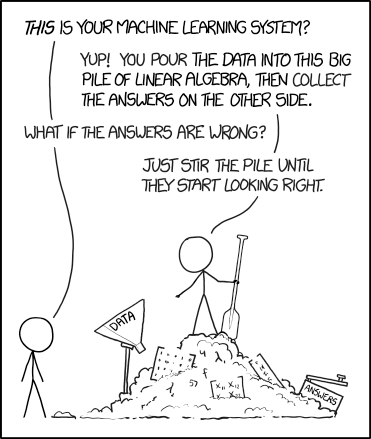
The pile gets soaked with data and starts to get mushy over time, so it's technically recurrent.
hearty steppe
I feel like if you spent enough time working with tensors, you’ll be ok
Did you try the 100 page machine learning book?
smoky surge
@hearty steppe no whats the name?
is that it?
yep googled it hahahah
that kinda of stuff always makes me a bit wary tho
 graceful glen
There is a book on group theory, by American Mathematical Society, has rubik's cubes drawn near its title.. not too long.. around 100 pages.. I can't remeber its name .. it was for basics.. i liked its approach.. but can't find now. Please help !!!!🙏 🙏
quick hornet
perhaps An Elementary Introduction to Group Theory by Charkani?
graceful glen
No.. it's pdf was available online
like directly in google search
Got it. Visual Group Theory by Nathan Carter. Thanks anyway ,@quick hornet 🙂
graceful glen
which one ?
perhaps An Elementary Introduction to Group Theory by Charkani?
This is good too 🙂
gray gazelle
An Illustrated Theory Of Numbers
steel viper
the rubiks cube group is disappointingly ugly
granite ferry
@solemn mantle I paid the $10 for the kindle version last night when I was done with the sample (worth it for darkmode alone lol). That looks like a scanned copy of the original text from 1959 though which is crazy.
long bear

granite ferry
@smoky surge If you are looking to solve practical "real world" machine learning problems there is always kaggle.com competitions and such. Even if you just want to play around with some real world data, kaggle has enough massive data sets where you will be entertained for years. If you are looking to solve problems at the cutting edge of model design and manual creation of models that is a whole other area. There is a lot of research conducted around model design/layout/types of layers/activation functions/numbers of "neurons" used/gradient decent and other such optimizations all used to solve various types of problems and explore how some designs are more effective than other for different reasons.
 remote jewel
Beginner in math as well. I read several chapters from "Visual Group Theory" and while its aimed at high schoolers to give an intuitive overview of group theory, I found its lack of rigor really confusing, so I ditched it and started studying from a rigorous book in abstract algebra and it cleared the confusion up.
granite ferry
Gotcha. Yea so currently i'm reading: " A Concrete Approach to Linear Algebra" - W. W. Sayer; For more of a "light" reading before I go to sleep. "Abstract Algebra: Theory and Applications" - Thomas W. Judson; as my primary read during the day, and source of exercises to do. Then I also have the lecture notes from here: https://ocw.mit.edu/courses/mathematics/18-703-modern-algebra-spring-2013/ which I find very useful so far.

MIT OpenCourseWare
This undergraduate course focuses on traditional algebra topics that have found greatest application in science and engineering as well as in mathematics.
I also have "Abstract Algebra, 3rd Edition" - Dummit and Foote ... which is apparently the classic goto book but it was a little deep for me personally. For now at least. I'm still trying to catch back up where I left off years ago.
smoky surge
@smoky surge If you are looking to solve practical "real world" machine learning problems there is always kaggle.com competitions and such. Even if you just want to play around with some real world data, kaggle has enough massive data sets where you will be entertained for years. If you are looking to solve problems at the cutting edge of model design and manual creation of models that is a whole other area. There is a lot of research conducted around model design/layout/types of layers/activation functions/numbers of "neurons" used/gradient decent and other such optimizations all used to solve various types of problems and explore how some designs are more effective than other for different reasons.
@granite ferry So im actually interested in using "ML" to help with diagnosing mental health disorders but I hate treating models as black boxes so while I dont necessarily want to be creating new models I want to have the capability if need be
not sure if that makes sense
granite ferry
Yea that makes sense. You are looking to have some more transparency into the models themselves? is that what you mean?
So that you may design them yourself.
wooden sparrow
But won't involving neural networks in machine learning make it virtually impossible to understand?
granite ferry
I would not say "impossible" at all.
There has been a lot of work in the area of understanding what the models, specifically each layer of a model is actually doing.
wooden sparrow
Ohh that's nice
granite ferry
And a lot of work in the area of design such as this LSTM (long short term memory) model which has applications in time series analysis
smoky surge
Yea exactly
granite ferry
The tools used to design these such as Keras/Tensorflow have abstracted away most of the actually maths needed to design/experiment with these types of designs.
smoky surge
i dont necessarily want to be just designing models but if I need to I want to be able to understand when and how
does that make sense?
granite ferry
Yes I agree. First principals thinking can be beneficial in most areas.
smoky surge
yea exactly
granite ferry
There are certainly limits though. I personally find myself in "analysis paralysis" to often. Where i'm researching/reading much more than just doing/making something.
smoky surge
yea i guess id just have to be cognizant of that Im not at that point yep but i could see that happening
hearty steppe
Part of the "analysis paralysis" is simply just learning more until you have developed concept fluency to navigate the waters.
limpid gazelle
@sage python is the second half of Bass's Real analysis for graduate students just functional analysis?
granite ferry
@hearty steppe yes that is absolutely true, however you can also easily branch out down tangents that are far enough away from the original scope of the problem where they eventually become irrelevant
thus, time is spent wastefully analyzing instead of applying topics already learned
If everyone spent all of their time researching and reading only, problems would not ever get solved in a lifetime. It's not like you can just instantly transfer knowledge gained in a lifetime to another person (not yet anyway, #neuralink #elonmusk) lol
Does anyone else struggle with balancing between having loose associations and concrete connections between ideas?
lol
trim narwhal
So I'm reading Spivak, and I'm enjoying it very much. The only problem is the exercises: many of them are quite difficult, and it takes a long time to solve them, however I would really like to go on with Calculus. Can I go on and go back to the exercises later or should I do the exercises before moving on to the next chapter?
hearty steppe
Try doing calculus problems out of a book like Stewart
gray gazelle
you dont have to do them all, especially in a book like spivak
some books put results essential for later chapters in the exercises with the expectation that you'll do them
but spivak does not iirc
hearty steppe
Also Paul’s online notes
sage python
@limpid gazelle Yeah I think starting chapter 15 or 16 it starts moving away from straight measure theory
 narrow dragon
is anyone here familiar with davenport's multiplicative number theory?
limpid gazelle
Alright
sage python
Not personally but I know that the class here on analytic NT used that as its textbook
narrow dragon
I'm around 60 pages in, it is well on its way to becoming the best NT book I've read
sage python
Nice, given that my area is shaping up to be analytic number theory I should prob look at it lmao
narrow dragon
so I'd recommend that to anyone interested in analytic nt
haha go for it
i had to re learn some complex analysis though, was a bit rusty
sage python
Makes sense lol. What kinda stuff are you learning in there now?
sage python
Wait have you guys not known about this? I'm like n% a harmonic analyst now
narrow dragon
dirichlet's class number formula and stuff currently
quick hornet
i vaguely knew that but i figured
you would see the light
but it seems youve fallen deeper into the darkness
analysis is a cult
marble solar
Analysis > Other Fields
sage python
I mean I started off as an analyst, like for most of my 4 undergrad I was very much into algebra but way better at analysis than at most other subjects
narrow dragon
the main purpose in algebra is to prove theorems about number theory