#book-recommendations
1 messages · Page 73 of 1
 violet shuttle
 quick hornet
that behaviour is a subset of disappearing yes
 placid oriole
the algebra of the baldor is a good book?
quick hornet
not sure this server has many spanish speaking users unfortunately
 molten mason
placid oriole
the algebra of the baldor is a good book?
molten mason
placid oriole
the algebra of the baldor is a good book?
Sí
 trail hemlock
placid oriole
the algebra of the baldor is a good book?
trail hemlock
placid oriole
the algebra of the baldor is a good book?
well according to math sorcerer's review its a really good algebra book
and he is a fluent spanish speaker so i would say yes
molten mason
trail hemlock
and he is a fluent spanish speaker so i would say yes
Really? I did not know that
The book is fairly popular, and quite a few people in this server have or are using it.
trail hemlock
molten mason
Really? I did not know that
https://www.youtube.com/channel/UCWXTWXKpkDk7LJfurtPHb6Q
https://www.youtube.com/watch?v=kNFMoj0_Gnw

YouTube
¡Hola! Soy el Hechicero Matemático(The Math Sorcerer). Este es mi canal de YouTube en español. ¡Gracias por visitar mi canal!
Mira mis cursos: https://mathsorcerer.com
Mi página de Patreon: https://www.patreon.com/themathsorcerer
Done a través de PayPal: https://paypal.com/donate/?cmd=_s-xclick&hosted_button_id=7XNKUGJUENSYU
Mi página de GoF...
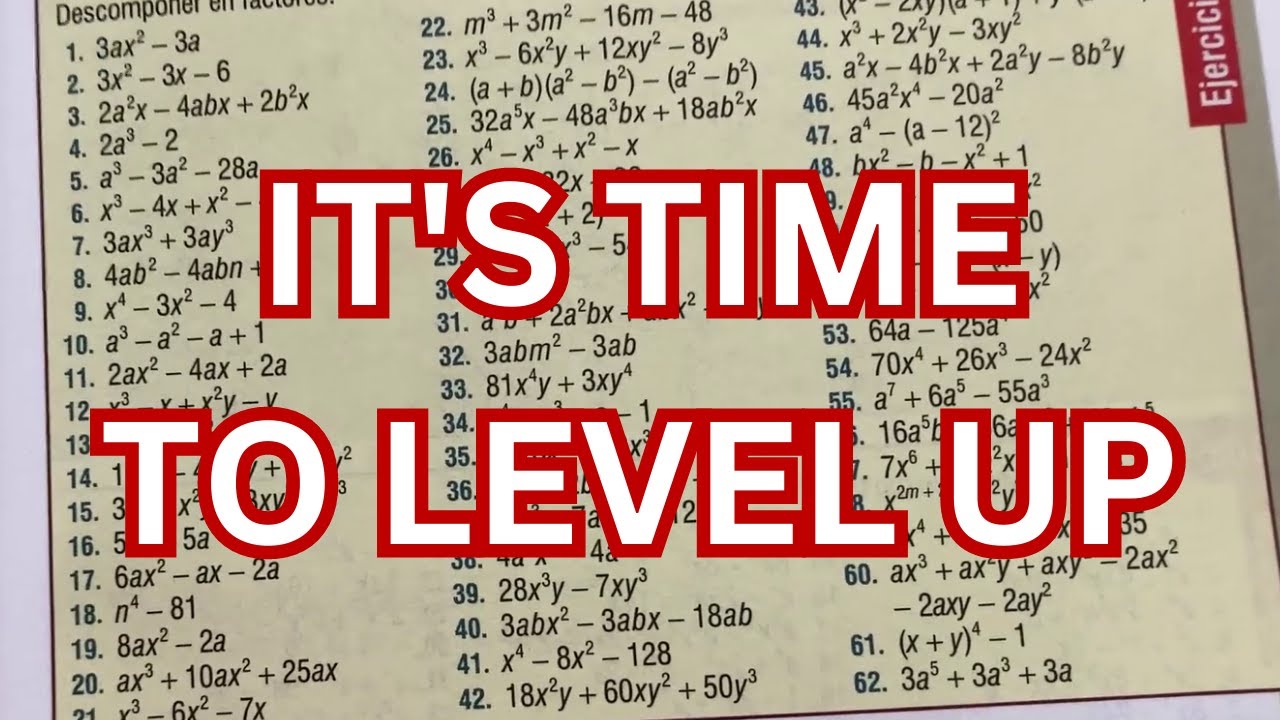
This book is still actually being used today all over the world in various Spanish speaking countries. It is probably the most popular Algebra book ever written in Spanish. Originally published in 1941 in this video I will show you the legendary "Algebra Baldor". It has really tough problems and answers to every single problem.
Here it is: http...
molten mason
This feels illegal. Like a whole section of lore just got unlocked.
molten mason
trail hemlock
https://www.youtube.com/channel/UCWXTWXKpkDk7LJfurtPHb6Q
https://www.youtube.com...
That book review lmao
"It has the hardest math problems ever for an algebra book"
Based Cuba 
trail hemlock
molten mason
This feels illegal. Like a whole section of lore just got unlocked.
wait til you hear abt the fitness arc
math sorcerer getting buff arc
molten mason
trail hemlock
math sorcerer getting buff arc
That should be everyone's arc
molten mason
wdym, how do you not know world history, you're part of history, and you live in this world
trail hemlock
molten mason
wdym, how do you not know world history, you're part of history, and you live in...
what da hell are historical thinking skills
violet shuttle
i never took ap world history
trail hemlock
lucky
 coarse arrow
I looked at it but it doesn't look like an introductory book and I have just completed highschool and graph theory is a fascinating subject to me so idk
violet shuttle
trail hemlock
lucky
i had a choice
 tribal crow
I took world history (we didn't have AP) and I liked it a lot!
molten mason
trail hemlock
what da hell are historical thinking skills
Lmao I looked this up. What the hell
I've never taken a single AP course
trail hemlock
tribal crow
I took world history (we didn't have AP) and I liked it a lot!
material is interesting
leq and dbq is hard
well i guess only leq
dbq is easy
violet shuttle
$\leq$
 hasty eagleBOT
Xela
 trail hemlock
😭
violet shuttle
order theory is very hard yes
tribal crow
molten mason
I've never taken a single AP course <:catking:812386361297862747>
mfw when I didn't have a choice 
trail hemlock
violet shuttle
order theory is very hard yes
✨ triangle inequality ✨
tribal crow
tribal crow
mfw when I didn't have a choice <:devastation:898725325335298088>
my hs didn't do AP (they discarded it in 2016)
violet shuttle
trail hemlock
✨ triangle inequality ✨
no order theory
trail hemlock
real analysis try not to spam triangle inequality challenge (impossible)
violet shuttle
dcpo
molten mason
coarse arrow
I looked at it but it doesn't look like an introductory book and I have just com...
The books builds up from the basics. Try and give it a shot.
violet shuttle
no not c3po
 fresh skiff
Hello!
Which of the following books is more friendly for the first course in probability?
Sheldon Ross
Or
Blitzstein
 versed cipher
trail hemlock
im currently on "dont fail the ap world history exam" arc
versed cipher
trail hemlock
im currently on "dont fail the ap world history exam" arc
same but with ap euro
 heady juniper
Anyone have a recommendation for a good resource (book, website, or video) specifically dedicated to handling matrix operations better? For example, I regularly get a little mixed up when doing Gaussian Elimination. I know how to do it, but I know that I'm not efficient. I'm doing unnecessary operations that get the right answer, but with extra steps. Which means more steps for simple arithmetic mistakes, etc.
Any good resource for strategies to solve them more systematically, prettier, patterns, etc.? Basically, totally computational.
 remote sparrow
fresh skiff
Hello!
Which of the following books is more friendly for the first course in pro...
remote sparrow
fresh skiff
Hello!
Which of the following books is more friendly for the first course in pro...
blitzstein
he also has a website

Statistics 110: Probability
fresh skiff
remote sparrow
blitzstein
Oh understood.
I was thinking that Sheldon Ross's book is friendly.
Thank you so much for your help and this link.
remote sparrow
heady juniper
Anyone have a recommendation for a good resource (book, website, or video) speci...
maybe look at Linear Algebra: Step by Step by kuldeep singh
there are complete solutions on the companion website, as well as brief solutions in the back
 thorny tangle
Anybody have a book recommendation that covers philosophy of math and how it relates to logic and proofs? Specifically, written down for the laymen person?
 wheat trout
thorny tangle
Anybody have a book recommendation that covers philosophy of math and how it rel...
wheat trout
thorny tangle
Anybody have a book recommendation that covers philosophy of math and how it rel...
You may look at this.
trail hemlock
versed cipher
same but with ap euro
fuckkk that shit
 spring jacinth
hey, does anyone here have any suggestsions for out of print or rare books i might want to check out from my university library? maybe something like this: https://www.reddit.com/r/math/comments/7yj2us/what_is_your_favorite_secret_out_of_print_math/
 gray gazelle
tribal crow
my hs didn't do AP (they discarded it in 2016)
gray gazelle
tribal crow
my hs didn't do AP (they discarded it in 2016)
based
 next condor
thorny tangle
Anybody have a book recommendation that covers philosophy of math and how it rel...
next condor
thorny tangle
Anybody have a book recommendation that covers philosophy of math and how it rel...
I have "Lectures on the Philosophy of Mathematics" by Joel David Hamkins and I really like it.
Professor Hambiks works at the intersection of philosophy of mathematics, set theory, and mathematical logic, and he extensively discusses proofs and logic. He also has a great blog at substack called "infinitely more".
in his substack blog, look for the post's series "A Panorama of Logic"
His recent posts have been discussing the "theory of truth," which I believe converges with yours objectives.
 earnest wolf
If anyone is interested, that's how I ended up doing it (for Apple addicts)
No need for any extra software at all 
 next condor
thorny tangle
Anybody have a book recommendation that covers philosophy of math and how it rel...
next condor
thorny tangle
Anybody have a book recommendation that covers philosophy of math and how it rel...
I also have the book "The Story of Proof: Logic and the History of Mathematics," which I haven't read yet because I'm not prepared for it, but it seems to be a good source for understanding the evolution of the concept of "mathematical proof" and the tools that pretentiously legitimize it.
 novel obsidian
Does anyone have any recommendations for any short basic ring theory notes? something similar to j.s. milnes group theory notes is what I'm looking for
heady juniper
remote sparrow
maybe look at *Linear Algebra: Step by Step* by kuldeep singh
I'll take a look at it. Thank you.
 oak hazel
any recommendations for something related to the stock market?
I liked "The Big Short", so I want something similar
gray gazelle
oak hazel
I liked "The Big Short", so I want something similar
How to Make Money in Stocks by William O'Neal
birkshire hathoway reports are also good to read
warren buffett said the language of business is accounting and you can't know which business is winning if you can't understand their balance sheet income statement and cash flow statement
if you don't want to spend a lot of time on the economy and stocks you might as well just invest in s&p500, many people including warren buffet believe you can't beat the market
 graceful moon
Just like read tea leaves and your horoscope and you’ll do basically as well as you would after learning all the analysis anyway
 woven quail
are there any textbook that takes more "geometry/topology" approaches for linear algebra?
gray gazelle
graceful moon
Just like read tea leaves and your horoscope and you’ll do basically as well as ...
yea idk why people do
remote sparrow
next condor
I have "Lectures on the Philosophy of Mathematics" by Joel David Hamkins and I r...
YouTube
This is a lecture series on the philosophy of mathematics given at Oxford University in Michaelmas Term 2020 by Joel David Hamkins, Professor of Logic. The l...


there is a playlist following his book
@thorny tangle
remote sparrow
next condor
I also have the book "The Story of Proof: Logic and the History of Mathematics,"...
this book is good
thorny tangle
remote sparrow
<@943001552774397962>
Thank you!
 orchid echo
can anyone give a good recommendation for learning some commutative algebra?
I know Atiyah and MacDonald is (one of )the standard textbook but I'm curious if there are any others. I'm also interested in understanding more what the point of learning it would be. I was told that after a course in abstract algebra one of the reasonable things to study next is commutative algebra. From there where might I go next/what topics should I be looking to get a good understanding of
 gray jungle
algebraic number theory ofcourse
violet shuttle
algebraic geometry
 maiden glen
I NEED good group theory books. May multiple people please suggest something I may read?
orchid echo
Armstrong is alright
Dummit and Foote is good too for the basics
Aluffi's undergrad and grad textbooks are both fantastic as well at an undergrad level
I'm not sure if there are any grad group theory only textbooks
maiden glen
orchid echo
I'm not sure if there are any grad group theory only textbooks
implying that there exist books that contain group theory "Explanations" on the graduate level, I want those too.
gray jungle
maiden glen
I NEED good group theory books. May multiple people please suggest something I m...
i like "The theory of finite groups" by Hans Kurzweil
graceful moon
orchid echo
can anyone give a good recommendation for learning some commutative algebra?
I’m currently working through Cox Little and Osheas book, it’s decent but quite slow, and (according to one of my lecturers) proves a much less general case of everything for the first few chapters even through the more general proof is the same, and is seemingly scared of the algebra
So he wrote like a 40 page introduction for the commutative algebra course here which in his mind is better. I’m not far enough in to really comment, but it seems like a fair criticism based on what I have read.
Other than that, he and a few others I’ve seen have recommended Miles Reid’s book. It’s much more terse than IVA is (which really might not be bad) and more pure maths focused (IVA, spends a decent bit of time on the computational angles) but I haven’t personally done more than skim it
orchid echo
maiden glen
implying that there exist books that contain group theory "Explanations" on the ...
I don't know anything but at that level you are usually looking for groups with a particular behaviour (amenable, residually finite, surjunctive (these are so cool)). At least at my school the first graduate abstract algebra course follows Aluffi so you can probably find explanations of group theory concepts at the grad level there as well. I think the book recommended above is also good
 crimson leaf
maiden glen
implying that there exist books that contain group theory "Explanations" on the ...
crimson leaf
maiden glen
implying that there exist books that contain group theory "Explanations" on the ...
Check Milne's notes
maiden glen
orchid echo
Dummit and Foote is good too for the basics
what do i need as prerequisites to read this?
orchid echo
maiden glen
what do i need as prerequisites to read this?
Not much to be honest, it would be good to know some linear algebra since matrices make good examples of groups
Also good for grounding some intuition
maiden glen
ok, so i read something like ladr first?
orchid echo
But strictly speaking you don’t need linear algebra
orchid echo
maiden glen
ok, so i read something like ladr first?
I think this would be helpful
graceful moon
maiden glen
ok, so i read something like ladr first?
That’s the usual path yeah, but you could do D&F first, you just might not get some examples
orchid echo
That’s just my opinion though
A lot of stuff you do in algebra is similar to what you do in linear algebra. Define objects, look at maps, explore the properties of those maps, sub objects etc
Most group things have linear algebra counter parts (morally speaking) that can be helpful for guiding intuition at first
But you probably could just start reading dummit and Foote
maiden glen
are you sure that there's nothing else i may need before reading this book?
(Excluding the obvious; undergraduate school "algebra", calculus, etc.)
orchid echo
Not to the best of my knowledge/memory
Another decent introductory group theory book is by Armstrong
It’s at an undergraduate level
And it’s just group theory
It is very slow (even compared to dummit and Foote)
remote sparrow
orchid echo
I'm not sure if there are any grad group theory only textbooks

SpringerLink
graceful moon
If you want an all in 1 book artin works, I’ve heard it’s linear algebra isn’t great but it is there
remote sparrow
the material in this book might already be contained in various editions of Advanced Modern Algebra by rotman though
orchid echo
remote sparrow
https://link.springer.com/book/10.1007/978-1-4612-4176-8
This is neat
Thank you
maiden glen
remote sparrow
https://link.springer.com/book/10.1007/978-1-4612-4176-8
thank you
 loud cradle
orchid echo
I'm not sure if there are any grad group theory only textbooks
loud cradle
orchid echo
I'm not sure if there are any grad group theory only textbooks
this one is excellent for finite groups https://bookstore.ams.org/gsm-92
maiden glen
loud cradle
this one is excellent for finite groups https://bookstore.ams.org/gsm-92
thank you
maiden glen
crimson leaf
Check Milne's notes
thank you aswell
graceful moon
remote sparrow
https://link.springer.com/book/10.1007/978-1-4612-4176-8
That’s the book my group theory course next semester is based on, good to see it’s recommended
By the one and only sour drop, resident recommender, no less
 foggy relic
orchid echo
I'm not sure if there are any grad group theory only textbooks
foggy relic
orchid echo
I'm not sure if there are any grad group theory only textbooks
Lang pt 1
 vocal violet
any easier books than basic mathematics by lang or is that easiest
remote sparrow
most precalculus books
 tacit walrus
any competition prep books for high schoolers?
tacit walrus
like precollege competitions in university?
 dapper fossil
any books for intro counting/euclids etc
gray gazelle
I would like to suggest combinatorics through guided discovery by kenneth bogart, it's lovely and very fluid for anyone looking for a first book in combinatorics https://bogart.openmathbooks.org/pdf/ctgd.pdf
gray gazelle
dapper fossil
any books for intro counting/euclids etc
the book below is good for intro counting.
next condor
gray gazelle
I would like to suggest combinatorics through guided discovery by kenneth bogart...
It seems really great 👀
 main hill
Hello there! Does somebody know where I can find the sullivan's precalculus books? I'm thinking about some older editions (from the 80's or 90's) because the new ones are too colorful for me and filled with some random shit like baloon photos or graphical calutlators output which greatly helps me not to focus. I'm looking for something better. Tried archive org and see there are some older versions but sadly those books are not available to be borrowed. There is a note "Book available to patrons with print disabilities." I once even made a donation hoping that this will grant me a rank of patron and be able to borrow these books but that didn't work out. 😦
 hallow oriole
gray gazelle
I would like to suggest combinatorics through guided discovery by kenneth bogart...
hallow oriole
gray gazelle
I would like to suggest combinatorics through guided discovery by kenneth bogart...
oh, really interesting
it seems to miss a good amount of topics sadly but otherwise i really like it
gray gazelle
I would love if somone suggested a second more advanced (maybe even graduate level) combinatorics book and the required pre-requisites to study it.
 wise dew
hey, guys! I kinda want to buy generating functionoly. do you guys recommend it for someone in high school?
oh, what a pair of questions, sathya :)
gray gazelle
wise dew
oh, what a pair of questions, sathya :)
🙂
gray gazelle
wise dew
hey, guys! I kinda want to buy generating functionoly. do you guys recommend it ...
somone here can correct me if I'm wrong but it looks like the last parts require a little complex analysis?
wise dew
yeah, I'm pretty sure it does, actually
but I would just skip that last part
now, if the rest of the book used calculus, then it's an impossibility for me to study
 flat marten
Does anyone have any curt concise multivariable calculus textbooks? I'm vaguely familiar with the ideas and terminology I just need theorems and proofs (although I won't complain about nice exercises) and im sick of "introductory" textbooks
 ancient mist
Here are some concise textbooks on multivariable calculus:
-
"Vector Calculus" by Jerrold E. Marsden and Anthony J. Tromba: This textbook provides a clear and concise introduction to multivariable calculus, emphasizing both the geometric intuition and mathematical rigor.
-
"Multivariable Calculus" by James Stewart: Stewart's textbook offers a balanced approach to multivariable calculus with concise explanations, examples, and exercises.
-
"Multivariable Mathematics" by Theodore Shifrin and Joel R. Hass: This book covers multivariable calculus in a concise yet comprehensive manner, suitable for students with a solid foundation in calculus.
-
"Calculus: Early Transcendentals" by Soo T. Tan: Tan's textbook presents multivariable calculus concepts in a straightforward and concise manner, making it suitable for self-study or as a supplement to classroom instruction.
-
"Multivariable Calculus: Concepts and Contexts" by James Stewart: Another concise offering from Stewart, this textbook focuses on conceptual understanding and real-world applications of multivariable calculus, making it accessible and engaging for students.
 dim sierra
ChatGPT?! LOL
flat marten
Lmao Marsden is not concise
dim sierra
flat marten
Lmao Marsden is *not* concise
This dude just used ChatGPT lmao
dim sierra
What kinda MVC r u familiar with, like do you know implicit or inverse function theorem
flat marten
Perhaps? I might not know them by name
dim sierra
do you wanna learn the more rigorous MVC or just master the undergraduate material
flat marten
I just need undergrad stuff so I can pass calc and get back to algebra
dim sierra
yeah honestly i dont rlly have a recommendation
flat marten
Idk... The lecture notes at my uni are pitiful and the books the recommend are almost as bad
flat marten
Lel
Yeah I literally haven't been able to find anything that isn't either introductory or just straight up diff geo
Which I'd love to do at some point but don't have the time to master before exams
dim sierra
check out https://tutorial.math.lamar.edu this maybe
each of the notes are pretty concise
dim sierra
oh mb
 heavy pelican
@flat marten if you want a shit treatment, Rudin "Principles of Mathematical Analysis" ch 9,10
there's nothing better if you want to just learn the bare minimum to pass the course
The best book by a long shot is Shifrin. Next in the list of my favorites is Duistermaat-Kolk's two volume tome. Of course, neither are concise.
flat marten
i think at this point shifrin is my best option, rudin/tao are too threadbare sadly
gray gazelle
wise dew
hey, guys! I kinda want to buy generating functionoly. do you guys recommend it ...
If you have previous experience with some basic combinatorics (and power series), go for it. Also, the book is available for free (digitally) through the author's site
gray gazelle
wise dew
now, if the rest of the book used calculus, then it's an impossibility for me to...
It doesn't directly use calculus, but it assumes familiarity with power series, which involves some calculus. It might be tricky to get through if you haven't seen them previously
gray gazelle
If you’re interested in combinatorics, there are lots of good introductory books on it
trail hemlock
heavy pelican
<@331147383570300928> if you want a shit treatment, Rudin "Principles of Mathema...
we love to hate on rudin
gray gazelle
flat marten
Does anyone have any curt concise multivariable calculus textbooks? I'm vaguely ...
Calculus on Manifolds, maybe?
remote sparrow
flat marten
Does anyone have any curt concise multivariable calculus textbooks? I'm vaguely ...
hallow oriole
ancient mist
Here are some concise textbooks on multivariable calculus:
1. "Vector Calculus"...
!nogpt
 hybrid sparrowBOT
ancient mist
Here are some concise textbooks on multivariable calculus:
1. "Vector Calculus"...
hybrid sparrowBOT
ancient mist
Here are some concise textbooks on multivariable calculus:
1. "Vector Calculus"...
Please do not trust ChatGPT or similar AI tools for mathematical tasks, as they often generate output which "sounds correct" but has numerous factual or logical errors. Use of these AI tools to answer other people's help questions is strictly against server rules (see #rules).
hallow oriole
i wouldnt call most of these "concise"
 ocean mulch
heavy pelican
<@331147383570300928> if you want a shit treatment, Rudin "Principles of Mathema...
ocean mulch
heavy pelican
<@331147383570300928> if you want a shit treatment, Rudin "Principles of Mathema...
cough Bourbaki cough
 sacred sorrel
Which book is the best for learn how to prove something in mathematics?
graceful moon
sacred sorrel
Which book is the best for learn how to prove something in mathematics?
There’s a book called how to prove it by velleman that I’ve seen recommended (haven’t personally read it, but people say it’s decent)
There’s also a concise introduction to pure mathematics by Liebeck which is ok
Overall I’d recommend just picking up an introductory book in like linear algebra analysis or “discrete maths” and learning as you go
Why is it that you’re looking to learn proofs? Do you have a specific goal in mind?
sacred sorrel
It's because I'm in the maths course, and I really want to know how to prove a proposition before seeing the book solution
And thanks for those books recommendations
graceful moon
sacred sorrel
It's because I'm in the maths course, and I really want to know how to prove a p...
I’d personally recommend just getting a book for the specific topic you’re learning
The mechanics of a proof are usually pretty simple, the hard part is familiarity with the tricks of that subject, and your own understanding of the material
And you’ll only really improve that by more exposure to that subject area
trail hemlock
ancient mist
Here are some concise textbooks on multivariable calculus:
1. "Vector Calculus"...
i wouldn’t call a james strwart textbook concise. chatgpt does ig
trail hemlock
flat marten
Does anyone have any curt concise multivariable calculus textbooks? I'm vaguely ...
spivak calculus on manifolds 
earnest wolf
ancient mist
Here are some concise textbooks on multivariable calculus:
1. "Vector Calculus"...
imo gpt-generated advice should be moderated and removed
earnest wolf
flat marten
Does anyone have any curt concise multivariable calculus textbooks? I'm vaguely ...
hm, check out Zorich and/or Tao (vol 2)
trail hemlock
earnest wolf
imo gpt-generated advice should be moderated and removed
!nogot
!nogpt
hybrid sparrowBOT
Please do not trust ChatGPT or similar AI tools for mathematical tasks, as they often generate output which "sounds correct" but has numerous factual or logical errors. Use of these AI tools to answer other people's help questions is strictly against server rules (see #rules).
trail hemlock
earnest wolf
hm, check out Zorich and/or Tao (vol 2)
really? is tao vol2 good as a first intro to multi?
 sick river
Is asking for books on a topic really a mathematical task though?
flat marten
trail hemlock
really? is tao vol2 good as a first intro to multi?
this isnt a first intro lmao thats the whole point
also tao/rudin are both nice but too threadbare
sadly
ill check out zorich
sacred sorrel
graceful moon
I’d personally recommend just getting a book for the specific topic you’re learn...
Thanks for the advice :)
gray gazelle
sick river
Is asking for books on a topic really a mathematical task though?
It is a mathematical task if the books are related to mathematical concepts
GPT also can’t read the book and give advices like how a person would
graceful moon
sick river
Is asking for books on a topic really a mathematical task though?
You just quoting GPT isn’t adding anything, anyone can do that
And you clearly don’t have the prerequisite knowledge to check the output it gives you so in general you shouldn’t be using GPT for it
Like it’s not worth anything if you can’t sense check the output, because it doesn’t think, most of what it spits out is nonsense
trail hemlock
flat marten
this isnt a first intro lmao thats the whole point
i meant for me
trail hemlock
graceful moon
You just quoting GPT isn’t adding anything, anyone can do that
And you clearly ...
i dont think he was the one who used chatgpt
graceful moon
Oh oops, my point is the same though
flat marten
trail hemlock
i meant for me
ohhh sorry i cant read lmao
graceful moon
Stewart’s calculus is the standard choice at a lot of places, there’s PDFs online
The openstax calculus books are also free and apparently decent
orchid echo
openstax is pretty good
trail hemlock
 worldly garden
pdf preferably cus im broke
worldly garden
pdf preferably cus im broke
https://schtschenok.github.io/calculus-made-easy/
this is a good one
pdf is here: https://www.gutenberg.org/ebooks/33283
Project Gutenberg
Free kindle book and epub digitized and proofread by volunteers.
 reef escarp
are there any books focused on helping you build the intuition to approach problems? i am not looking for a 400-page book, rather something short.
remote sparrow
reef escarp
are there any books focused on helping you build the intuition to approach probl...

How to Solve It: A New Aspect of Mathematical Method (Princeton Science Library, 34)
 slender wasp
flat marten
i think at this point shifrin is my best option, rudin/tao are too threadbare sa...
slender wasp
flat marten
i think at this point shifrin is my best option, rudin/tao are too threadbare sa...
Also, Shifrin course lecture videos (2 semesters worth) are on youtube.
 fresh thicket
Does anyone have recommendations for a introductory abstract algebra textbook that also helps with learning proofs
Or maybe 1 of each
& please ping if you reply
 robust portal
Is the course Introduction to Mathematical Thinking (on Coursera by Stanford University) worth it? I’m a 10th grader and I’ve found it pretty challenging, even at the start
 signal swift
gray gazelle
signal swift
gray gazelle
What are the prerequisites for Qing Liu’s Algebraic Geometry and Arithmetic Curves?
earnest wolf
is there like a computation-based book (like calculus is to real analysis) on complex analysis?
I want to learn some computation techniques to work with Möbius transformations (aka linear fractional transformations)
 prime oak
opinions on conway's complex analysis?
 formal bronze
fresh thicket
Does anyone have recommendations for a introductory abstract algebra textbook th...
formal bronze
fresh thicket
Does anyone have recommendations for a introductory abstract algebra textbook th...
Dummit and Foote is a good introductory textbook for abstract algebra
fresh thicket
formal bronze
Dummit and Foote is a good introductory textbook for abstract algebra
Ok thank you
remote sparrow
prime oak
opinions on conway's complex analysis?
have you looked at pins?
 mortal mountain
is mathematical circle a good book?
remote sparrow
fresh thicket
Does anyone have recommendations for a introductory abstract algebra textbook th...
remote sparrow
earnest wolf
is there like a computation-based book (like calculus is to real analysis) on co...
Complex Analysis for Mathematics and Engineering by mathews and howell
trail hemlock
remote sparrow
https://www.amazon.com/How-Solve-Mathematical-Princeton-Science/dp/069111966X
omg i LOVE this book
fresh thicket
remote sparrow
https://discord.com/channels/268882317391429632/716264872018706443/1210706872236...
Thank you and if you don't mind, which one would you say is more "beginner friendly" for the proofs or is it safe to assume they are all on the same level
 iron tangle
mortal mountain
is mathematical circle a good book?
iron tangle
mortal mountain
is mathematical circle a good book?
Havent read that first hand but i have heard that the problems are extremely good even for olympiad level preparations
fresh skiff
any one please provide material in real analysis! (abbott)! if anyone has, Also if possible is there some university course on real analysis and the book of abbott. I am asking for university course bcz i will solve the assignements and exams and homework
i will appreciate thank you
remote sparrow
fresh thicket
Thank you and if you don't mind, which one would you say is more "beginner frien...
pinter, judson, and saracino are the most beginner-friendly, but they're all good
remote sparrow
fresh skiff
any one please provide material in real analysis! (abbott)! if anyone has, Also ...
fresh skiff
remote sparrow
https://discord.com/channels/268882317391429632/716264872018706443/1194887868666...
Ah thank you so much. Sorry for asking the same question for a couple of time
gray gazelle
remote sparrow
https://www.amazon.com/How-Solve-Mathematical-Princeton-Science/dp/069111966X
do these work
remote sparrow
gray gazelle
do these work
only the reader can say
many people found it worked for them though
gray gazelle
remote sparrow
many people found it worked for them though
i see i wonder if they'd be better than just learning more math
 lusty ermine
which book explains completeness axiom easily
remote sparrow
lusty ermine
which book explains completeness axiom easily
abbott
trail hemlock
lusty ermine
which book explains completeness axiom easily
why you look sm like sour drop
 round shore
gray gazelle
What are the prerequisites for Qing Liu’s Algebraic Geometry and Arithmetic Curv...
round shore
gray gazelle
What are the prerequisites for Qing Liu’s Algebraic Geometry and Arithmetic Curv...
Not much in fact. Basic commutative algebra (ideals, noetherian rings ,PID etc and modules) and you'll be fine. Iirc Liu even recalls tensor products so you don't need much. You can learn the necessary commutative algebra for the rest of the book in the meantime. Like, at some point you'll need to know what a Dedekind ring is, but you'll learn then.
Also Liu has made the choice to make a category theory-free book (to show that it is possible lol) so you don't even need that
 dapper root
Kind of an L-decision IMO
But there’s a niche for that
Preach to the capacities of the people
round shore
Yeah I don't really get it but that's the argument he gave
violet shuttle
undergrads, i hear, get scared by the ⊗ symbol
round shore
Postgrads too 🥶
dapper root
I never struggled with the tensor product tbh
Maybe I was just lucky
There’s some random times it surprises me, but I already have the expectations that it will do that at times, and know in which situations things can get kinda funky
But I feel like once you learn a few of the basic rules you get really far just combining those
round shore
Yeah, master the formal rules and you're good. But sometimes you have to do +/- explicit computations, eg: when you first learn them, something like Z/nZ ⊗ Z/mZ
But in practice the basic properties suffice
dapper root
round shore
Yeah, master the formal rules and you're good. But sometimes you have to do +/- ...
I mean this too gets subsumed
This is an application of M (x) R/I = M/IM
gray gazelle
violet shuttle
undergrads, i hear, get scared by the ⊗ symbol
I first encountered it in Halmos, and his definition of it is confusing as hell
violet shuttle
dapper root
I never struggled with the tensor product tbh
i struggled with the definition for a little because the first one on the wiki page was not good
once i saw "all things of the form v \otimes w such that \otimes is bilinear" it was easy going
round shore
Once you understand the proof of the existence you understand it all I think
"ok let's quotient by everything such that this thing becomes bilinear"
violet shuttle
round shore
Yeah, master the formal rules and you're good. But sometimes you have to do +/- ...
oh yes these things do get me and likewise the clebsch gordon/plethysm problem but i meant just like the utter basics
violet shuttle
round shore
"ok let's quotient by everything such that this thing becomes bilinear"
yeah but you can also explain it to someone that doesn't understand quotients yet
not rigorously sure
but you can indeed teach how it works to a nonrigorous la class
the only thing being missed being existence
heady juniper
Anyone know if there's a good lecture series on competitive math? Usually the most I see is someone going over random problems, but it's not structured in any way. I'm obviously working through books as well, but it's nice to have a lecture series.
lusty ermine
trail hemlock
why you look sm like sour drop
similar anime pictures I guess, not sure.
remote sparrow
heady juniper
Anyone know if there's a good lecture series on competitive math? Usually the mo...
next best thing is watching evan chen's streams: https://web.evanchen.cc/videos.html
they're obviously very unstructured
gray gazelle
Does anyone have book recommendations for a 13 year old who is turning 14?
gray gazelle
gray gazelle
Does anyone have book recommendations for a 13 year old who is turning 14?
That depends on what you want to learn about
gray gazelle
gray gazelle
That depends on what you want to learn about
Im more into sci-fi books
idk which one is a good one tho
Dune maybe?
 noble swan
anyone has a good precalc textbook ?
gray gazelle
noble swan
anyone has a good precalc textbook ?
Basic Mathematics, Lang
noble swan
mmh
trail hemlock
gray gazelle
Does anyone have book recommendations for a 13 year old who is turning 14?
baby rudin
trail hemlock
trail hemlock
baby rudin <:sotrue:826971355542192148>
jk but 20000 leagues under the sea is a fire book
gray gazelle
trail hemlock
baby rudin <:sotrue:826971355542192148>
alr
trail hemlock
gray gazelle
alr
i was just kidding abt that one
gray gazelle
trail hemlock
i was just kidding abt that one
when i searched it up i saw some kids books lol
gray gazelle
trail hemlock
enders game, fahrenheit 451, asimov’s foundation series,
ive heard of enders game
trail hemlock
it’s good you should check it out
i read those books when i was 13-14 and i enjoyed them, you might as well
trail hemlock
👍
earnest wolf
gray gazelle
Im more into sci-fi books
i'd strongly suggest to read Sumon's series called «Hyperion Cantos». Those are four relatively thick books
Honestly, this is one of the greatest books I've read recently
It's mainly sci-fi, but I wouldn't say it's a 'conventional sci-fi'. He managed to include thriller, romance and many more into one piece
gray gazelle
Sounds Interesting.
earnest wolf
gray gazelle
when i searched it up i saw some kids books lol
the full name is
«Harry Potter and the Principles of Mathematical Analysis» by Rudin ||</jk>||

gray gazelle
earnest wolf
Lmao
violet shuttle
earnest wolf
but like you could do this to anything and it's not funny
it's not like the name matches particularly well
gray gazelle
violet shuttle
but like you could do this to anything and it's not funny
“Harry Potter and the Elements of Algebraic Geometry”
violet shuttle
earnest wolf
again the only neat part here was the font
trail hemlock
earnest wolf
new jk Rowling pseudonym just dropped?
earnest wolf
violet shuttle
again the only neat part here was the font
ig it sounds fun to me bc the title is very reminiscent of the suffering I've experienced while (trying) to read it 
it's like stress-induced laughter ig
violet shuttle
harry potter made you suffer?
violet shuttle
really giving me mixed messages here
earnest wolf
like, 'the principles' part suggests that you have to navigate thru the hell of rudin's 'ways'
but maybe that's just me
 pale scarab
gray gazelle
Basic Mathematics, Lang
pale scarab
gray gazelle
Basic Mathematics, Lang
It actually doesn't cover a lot of topics.
I think Sheldon axlers precalculus book is one of the better ones. It also has problems at all levels which is good for self study, along with full solutions to many of them.
earnest wolf
anyway, trying to explain why a joke is funny to someone means completely destroying the joke 
earnest wolf
violet shuttle
really giving me mixed messages here
I mean, I wasn't trying to make fun of you.
Just said it in a way that I liked 
violet shuttle
earnest wolf
like, 'the principles' part suggests that you have to navigate thru the hell of ...
what
violet shuttle
earnest wolf
I mean, I wasn't trying to make fun of you.
Just said it in a way that I liked...
what?
violet shuttle
earnest wolf
anyway, trying to explain why a joke is funny to someone means completely destro...
what??
earnest wolf

Video title: Directed by Robert B. Weide
Copyrighted content: Frolic - Killer Tracks
Claimed by: AdRev for a 3rd Party
molten mason
earnest wolf
_exactly_
What 
molten mason
gray gazelle
“Harry Potter and the Elements of Algebraic Geometry”
This was peak humor
remote sparrow
Harry Potter and Basic Mathematics by Serge Lang
can i get a 
wait wait i have an even better one
Harry Potter and Calculus: Early Transcendentals by james stewart
amazing
praise my cleverness
molten mason
Those weren't as good tbh but A for effort 
violet shuttle
all of these are fucking terrible you all get F-'s
molten mason
Harry Potter and the Detestation of Xela
trail hemlock
Harry potter and calculus for the practical man wizard
gray gazelle
by Aluffi*
 twilit siren
does anyone have any good resources/textbooks on learning complex analysis
also a good intro to statistics (uni level) cuz i wanna refresh myself
gray gazelle
twilit siren
does anyone have any good resources/textbooks on learning complex analysis
twilit siren
gray gazelle
https://discord.com/channels/268882317391429632/716264872018706443/8182623959980...
thank u!
 crude sage
Harry Potter and the Rising Sea: Foundations of Algebraic Geometry
 vital bane
Harry Potter and Ricci flow with surgery on three-manifolds
reef escarp
what are some good science fiction books with politics? (something that has unique plot)
flat marten
What about leviathan wakes and the expanse series?
Or basically any Ian M Banks book will do too
There's tau zero which has internal ship politics
But imo the expanse has the best space politics
Avasarala 🫶
 ruby prism
Hey guys recommend me a book for quantum physics i am complete beginner
graceful moon
ruby prism
Hey guys recommend me a book for quantum physics i am complete beginner
What maths do you know
ruby prism
graceful moon
What maths do you know
i know basic maths
but i will learn linear algebra ,abstract algebra and calculus too
graceful moon
So you know like basic DEs and linear algebra?
If not you’ll need to learn those first before you can really do much with quantum mechanics
ruby prism
graceful moon
So you know like basic DEs and linear algebra?
idk what is linear algebra
gray gazelle
ruby prism
idk what is linear algebra
Google is free
ruby prism
gray gazelle
Google is free
i know
graceful moon
Then you’re definitely not ready for quantum physics, you’ll need to learn those first
Use the search function or look at the pins in here for recommendations
Differential equations and linear algebra are just unavoidable prereqs, some group theory is helpful but like you can mostly ignore that
ruby prism
graceful moon
Differential equations and linear algebra are just unavoidable prereqs, some gro...
so i have to learn linear algebra and calculus first?
graceful moon
Yes
Tensor products are key to like quantum computing problems and you can’t understand tensors if you don’t have a solid grounding in linear algebra
Similarly for quantum mechanics, you need to understand mechanics hence you need to understand differential equations
ruby prism
ok
dapper root
THE TENSOR PRODUCT IS ESSENTIAL TO THE EXISTENCE OF BLACK HOLES
 versed coral
can someone give me any advice on trigonometry? like i dont understand this thing and idk where im doing wrong tbh
 pliant wadi
Harry Potter and the Prisoner of Abstract Algebra
Harry Potter and the companion to analysis
Harry Potter and the Calculus on Manifolds
pliant wadi
versed coral
can someone give me any advice on trigonometry? like i dont understand this thin...
what sort of problems are you stuck on?
 violet ore
hey i looking to self teach myself calculus
can anyone recommend me some good books to do so
violet shuttle
graceful moon
If not you’ll need to learn those first before you can really do much with quant...
false
I mean true but
Shankar will teach you
violet shuttle
ruby prism
but i will learn linear algebra ,abstract algebra and calculus too
you need calculus. after that just pick up Shankar's Principles of Quantum Mechanics. He will teach you linear algebra.
graceful moon
I mean if you don’t know calculus or linear algebra you should not be starting quantum physics imo
violet shuttle
Shankar will teach you the linear algebra.
It worked for me when I had only known multivariable calculus and some lagrangiand
graceful moon
That’s possible yeah, it’s not a book I’ve seen or used, but im personally of the opinion that it would be better to get a solid foundation in these things rather than just trying to pick up what you might need as you go
violet shuttle
Shankar gives you good foundation
ruby prism
violet shuttle
you need calculus. after that just pick up Shankar's Principles of Quantum Mecha...
Ok , btw what I need for calculus ?
ruby prism
violet shuttle
you need to know calculus
What knowledge I need for calculus?
violet shuttle
violet shuttle
Shankar gives you good foundation
(except for his explanation of tensor products)
violet shuttle
ruby prism
What knowledge I need for calculus?
I don't understand
Oh
Learn basic algebra
ruby prism
violet shuttle
I don't understand
See I need calculus knowledge and linear algebra knowledge for quantum physics, right? But what I need to learn calculus?
violet shuttle
basic algebra
graceful moon
Just basic highschool algebra and knowledge of functions really
ruby prism
violet shuttle
Learn basic algebra
a+b² stuff?
ruby prism
Ok , Where I can learn calculus from ?
 scarlet pewter
ruby prism
Ok , Where I can learn calculus from ?
scarlet pewter
ruby prism
Ok , Where I can learn calculus from ?
Khan Acadamy
YouTube
A calc textbook
violet shuttle
paul's online math notes
a calc textbook, of which one can find recs in pins probs
 hearty steppe
Anyone heard of this book? https://link.springer.com/book/10.1007/978-3-030-61871-1

SpringerLink
Definitely trying to take advantage of the best linear algebra, abstract algebra, and measure theory/probability gems I can find. Figured I’d ask about it here. Just found out this book existed and not sure anyone here worked through it yet
violet shuttle
hearty steppe
Anyone heard of this book? https://link.springer.com/book/10.1007/978-3-030-6187...
kallenberg?
shankar will teach you it
 high heath
violet shuttle
paul's online math notes
high heath
violet shuttle
paul's online math notes
This is amazing
violet shuttle
indeed
graceful moon
Sure, I wasn’t really getting at a full course but knowing some mechanics matters and that requires you to know how to solve some DEs and seperable PDEs
violet shuttle
graceful moon
Sure, I wasn’t really getting at a full course but knowing some mechanics matter...
I don't think Shankar solves a single PDE.
This is a very popular graduate quantum mechanics textbook.
graceful moon
The Schrödinger EQ doesn’t appear anywhere in a QM book?
graceful moon
Also this person doesn’t know calculus recommending them a graduate QM book is not helpful
graceful moon
Yeah I mean seperable PDEs are really just ODEs but still
violet shuttle
graceful moon
Also this person doesn’t know calculus recommending them a graduate QM book is n...
Correct. But once you know about partial derivatives it's a great choice.
violet shuttle
graceful moon
Yeah I mean seperable PDEs are really just ODEs but still
yeah that's why I was like "what?" because in my mind I had casually conflated them
versed coral
pliant wadi
what sort of problems are you stuck on?
well the thing is i know the majority of the things or at least i suppose i know but its so hard to graph the functions and like today i tested myself on my own and im stuck on exercises. but when i do a quick revise or check my notes for a second i can continue but i dont want this
i actually want to learn
i suppose i need practice
im doin pre calc atm
trigonometry chapter in the pre calc book makes me this mad and i dont even wanna think of uni so i gotta fix this
remote sparrow
hearty steppe
Anyone heard of this book? https://link.springer.com/book/10.1007/978-3-030-6187...
according to the statistics server, it's better as a reference than something you should learn from the first time
 timber copper
yeah kallenberg is good if you already know the subject lol
hearty steppe
Is Kallenberg comparable to certain texts that come to mind?
Im imagining it’s one of those inconsistent exposition based books that has its moments
hallow oriole
remote sparrow
according to the statistics server, it's better as a reference than something yo...
any chance u can dm me an inv btw
remote sparrow
hallow oriole
any chance u can dm me an inv btw
it's publicly discoverable
hallow oriole
oh, nice
remote sparrow
just type "Statistics"
violet shuttle
any chance someone could dm me an invite to the math server
molten mason
violet shuttle
any chance someone could dm me an invite to the math server
...this server?
violet shuttle
that's the joke yes
gray gazelle
there are other servers
molten mason
Xela...makes... jokes?
gray gazelle
molten mason
Xela...makes... jokes? <:bleakkekw:913344117981999125>
xela talking about smth other than adv math?!
hallow oriole
violet shuttle
any chance someone could dm me an invite to the math server
no chance at all sorry
violet shuttle
gray gazelle
xela talking about smth other than adv math?!
physics
programming
what a friend of mine calls "schizoposting"
idk how one gets into math research besides asking profs. what do you want to do?
i note the lack of advanced math. you have real analysis and linear algebra (at what level is the linear algebra?)
so what math do you want to do?
order? things are really unordered early on.
normally the "basics" include a course in algebra (up to galois), topology and algebraic topology, real analysis with measure theory, complex analysis, differential geometry
I'm not familiar with any courses in linear algebra as I originally learnt it from a quantum mechanics textbook. Is it rigorous?
Nope
Oh. You'll want to rigorify
Would you say you are mathematically mature?
You have real analysis on there
Mathematical maturity is more important to any of these subjects than already knowing any of the others
Pick something and go with it is my recommendation
If you like analysis more, learn complex analysis or measure theory stuff
If you want to do differential geometry you can do what i did and try to beeline to Stokes
If you want to learn why quintics can't be solved in radicals, learn algebra
I don't see why any of them would be different in this regard
Just grab books until you find one you like
gray gazelle
violet shuttle
If you want to learn why quintics can't be solved in radicals, learn algebra
actually do you know a link to the reasoning, i've always wanted to understand why
violet shuttle
gray gazelle
actually do you know a link to the reasoning, i've always wanted to understand w...
Lang.
I can explain much of the proof
violet shuttle
Or even just the sketch
That's what I mean
The point is that if your galois group is solvable, then you can do it via extensions that are cyclic
Hilbert's theorem 90 lets us characterize cyclic extensions as long as we have an nth root of unity
gray gazelle
ok
violet shuttle
So the point is that any extension with solvable galois group is a subfield of an extension obtained by, at each step, adjoining (for n coprime to the characterstic) either an nth root of unity, an nth root of an element in the previous step, or a solution to X^p+X+a (i may have fucked this poly up)
Hilbert's theorem 90 is actually representation theoretic

MathOverflow
I only know of one proof of Hilbert 90, which is very smart if not magical. See for example http://hilbertthm90.wordpress.com/2008/12/11/hilberts-theorem-90the-math/
Does anyone know of a more int...
So suppose L/K cyclic order n with galois group generated by \sigma
Well yeah, do you know how to read a proof, would you have some idea of how to go about proving something, can you understand definitions? Another way to put it is that for someone with mathematical maturity you can just give them the proof in enough detail and they'll eventually understand it
It's like they already know English
violet shuttle
violet shuttle
So suppose L/K cyclic order n with galois group generated by \sigma
Now suppose the field norm N(a) = 1
define \tau(b)=a\sigma(b).
this is a K-linear map L->L
we see that \tau^n = multiplication by N(a) = id
This means that we have a representation of \Z/n\Z on L.
Thus we can look at the projector onto the trivial subspace
1/n (1+\tau + \tau^2 + ... \tau^{n-1})
One then proves this is nonzero.
Now the proof actually still works with p = char but this way of thinking about it doesn't quite work
which is weird and i don't entirely get it
now, the point is that this provides us the X^n-a thing when there's an nth root of unity
crude sage
Does anyone happen to know any sources with worked examples of proving non-regularness/non-context-freeness using the relevant pumping lemmas?
gray gazelle
crude sage
Does anyone happen to know any sources with worked examples of proving non-regul...
Sipser has several examples for each
crude sage
Thanks!
violet shuttle
uh since N(\zeta^{-1})=1 so \exists b : \sigma(b) = b \zeta
now uh \sigma(b^n)=\sigma(b)^n=b^n
so b^n is fixed by the galois group
violet shuttle
gray gazelle
ok
so \sigma(b)^n-b^n
ritht point is
\sigma(b) is a root
and b^n is actually in the base field
and so obviously the other parts of the field extension come from the conjugates of \sigma(b) which are also roots
and you can manage to do similar with the trace and X^p-X-a
Does this make sense?
violet shuttle
you, the esteemed chmonkey, don't need to read it to understand
remote sparrow
crude sage
Does anyone happen to know any sources with worked examples of proving non-regul...

MIT OpenCourseWare
This course emphasizes computability and computational complexity theory. Topics include regular and context-free languages, decidable and undecidable problems, reducibility, recursive function theory, time and space measures on computation, completeness, hierarchy theorems, inherently complex problems, oracles, probabilistic computation, and in...
there might be additional worked examples in the lecture videos and notes
crude sage
remote sparrow
https://ocw.mit.edu/courses/18-404j-theory-of-computation-fall-2020/
Thanks you!
remote sparrow
he wrote the book that eigenpuppet mentioned btw
 burnt mauve
Hello I am college student writing my papers and I need the help of a profsssor. My paper specializes in prime number distribution randomized.
crude sage
I see, neat
burnt mauve
However because of my young age it is unlikely that some professors accept my thesis
Any advice from anybody
molten mason
No this isn't the right channel. #serious-discussion would probably be the best starting point for in-depth convo, maybe #advanced-lounge . Then pop into here for books.
"Math research" is a wild field. What you need to do research in set theory would be very different than math for signal procressing.
There's always room for more Linear Algebra, it also seems like you haven't done Abstract Algebra. You can check the pinned messages in this channel as a starting point for books in those two fields.
molten mason
burnt mauve
Hello I am college student writing my papers and I need the help of a profsssor....
This is the book recommendation chat. Are you looking for books on writing a paper? A book on prime numbers? What book do you need.
If you don't need a book then this is not the correct chat and ask elsewhere.
 slender cargo
Key difference is that Abbott sticks purely to the real line. Rudin introduces metric spaces and complex numbers, which generalize some of the material in his book more than Abbott. Also Rudin's book is more terse and supposedly has harder exercises.
slender cargo
Oh... the messages are gone
molten mason
I'll ask for them. They were all Googleable but one was appropriate here:
Differences between Abbot and Rudin
lusty ermine
it*
trail hemlock
theres no objective best book
try tudin
if its too terse and you cant undersand it, move to abbott
 remote ginkgo
Browder.
 heady ember
remote sparrow
> tudin
heady ember
remote sparrow
> tudin
Damn it you sniped me ||by exactly five hours ||
 rigid folio
Hello, I am currently studying math and I am struggling with distributions. Are there any books that contains lots of practice questions with written explanations? Specifically I want to practice Geometric, Gamma, Erlang, and Poisson distributions. Thank you!
lusty ermine

A Complete Solution Guide to Principles of Mathematical Analysis
Should i read pma with solution guide or without?
Are in general solution guides a good idea?
trail hemlock
lusty ermine
Should i read pma with solution guide or without?
without
don’t ruin it
problems are v fun
 remote vortex
lusty ermine
Should i read pma with solution guide or without?
remote vortex
lusty ermine
Should i read pma with solution guide or without?
My view is that you shouldn't read PMA at all if you're just starting out, I'd recommend Abbott much more.
slender cargo
Rudin seems like it would be really hard to self-study from, particularly if you do not have much prior experience with proofs.
remote vortex
Absolutely
 small stirrup
hey any pre university book for trigno and algebra
 marsh ingot
slender cargo
Rudin seems like it would be *really* hard to self-study from, particularly if y...
marsh ingot
slender cargo
Rudin seems like it would be *really* hard to self-study from, particularly if y...
Fr fr
small stirrup
ayo
small stirrup
small stirrup
hey any pre university book for trigno and algebra
ayo
pliant wadi
versed coral
trigonometry chapter in the pre calc book makes me this mad and i dont even wann...
Darn, sounds rough
There's this pretty little book that I loved when I was a junior in highschool
Titled 'Play with graphs'
You can try looking through it
Trigonometry at that level is all about practice.
Hang in there it'd get better, trust me.
Don't think about University, take one step at a time.
pliant wadi
small stirrup
hey any pre university book for trigno and algebra
Idk trigo but try Hall and Knight's for algebra?
Oh S.L Loney has a book on trigonometry....I think? Never used it but you can look through it maybe.
I used some recs from AoPS back in the day. Look through the website, you'd find fun stuff.
small stirrup
@pliant wadi thanks man
 narrow relic
lusty ermine
Are in general solution guides a good idea?
narrow relic
lusty ermine
Are in general solution guides a good idea?
They're a bad idea and are not necessary if the book is written well.
 lone wave
Can you guys recommend me a playlist on YouTube about soild geometry
reef escarp
are there any good books(preferably short) on introduction to proofs? i see a lot of books spending 40 to 50 pages on very basic set theory, when they could have just introduced it in a few pages. (i am just not really a big fan of reading 600 pages)
 pseudo bramble
reef escarp
are there any good books(preferably short) on introduction to proofs? i see a lo...
pseudo bramble
reef escarp
are there any good books(preferably short) on introduction to proofs? i see a lo...
I agree. I am also having issues with set theory. I kind of dont understand the ven diagrams of sets and how they find the area to shade.
lusty ermine
books for order theory?
graceful moon
reef escarp
are there any good books(preferably short) on introduction to proofs? i see a lo...
What is it that you’re struggling with? I tend to think it’s better to just pick up an introductory textbook in whatever subject you’re doing and pick it up as you go
By and large the hard part of proofs is knowing the tricks and ideas of that field not like knowing what induction or contradiction are
remote sparrow
lusty ermine
books for order theory?

Ordered structures have been increasingly recognized in recent years due to an explosion of interest in theoretical computer science and all areas of discrete mathematics. This book covers areas such as ordered sets and lattices. A key feature of ordered sets, one which is emphasized in the text,...

SpringerLink
lusty ermine
damn
its kinda advanced but i’ll take it
the first one i mean
i will check the second later
violet shuttle
the one thing that seems neat: all non modular lattices are not modular because they contain one of two basic nonmodular lattices
likewise for some strengthening of modular
kinda like the thing for nonplanar
 still panther
violet shuttle
the one thing that seems neat: all non modular lattices are not modular because ...
still panther
violet shuttle
the one thing that seems neat: all non modular lattices are not modular because ...
one of two? i thought all nonmodular contain N5
still panther
remote sparrow
https://www.amazon.com/Introduction-Lattices-Order-B-Davey/dp/0521784514
I would also try birkhoffs lattice theory book, personally i found the very casual and leisurely pace of "introduction" to be insufferable
reef escarp
graceful moon
What is it that you’re struggling with? I tend to think it’s better to just pick...
i am just looking to enhance my math skills, i dont want to study any particular topic currently, just mess around with proofs.
fresh skiff
A Problem Book in Real Analysis by Mohamed A. Khamsi
Is this suitable to use as a supplement for problems for Abbott?
graceful moon
reef escarp
i am just looking to enhance my math skills, i dont want to study any particular...
A concise introduction to pure mathematics by liebeck could be worth a look
 tawny crater
looking for an analysis textbook that discusses arzela-ascoli theorem. Baby rudin kinda does it but it feels like an aside
versed coral
pliant wadi
Hang in there it'd get better, trust me.
Thanks a lot dude
 grand thistle
tawny crater
looking for an analysis textbook that discusses arzela-ascoli theorem. Baby rudi...
grand thistle
tawny crater
looking for an analysis textbook that discusses arzela-ascoli theorem. Baby rudi...
maybe big rudin?
remote vortex
Papa Rudin doesn't mention Arzela-Ascoli.
Folland does briefly, takes up about two pages
Royden devotes a similar amount of space to it
grand thistle
remote vortex
Papa Rudin doesn't mention Arzela-Ascoli.
it does, refer to thm 11.28
 rich sun
what should i compare it to?
grand thistle
rich sun
what should i compare it to? <:catgiggle:912459497954500659>
lmaoo mb wrong terminology
remote vortex
grand thistle
it does, refer to thm 11.28
My version of Papa Rudin doesn't even have thm 11.28
grand thistle
remote vortex
My version of Papa Rudin doesn't even have thm 11.28
oh what i have the third version of papa rudin
 remote vortex
Oh yes
Still, that's even less than in PMA
So I can't think of any book that discussed Arzela-Ascoli in depth
Maybe there isn't much depth to be discussed, it's just a nice theorem about when a family of functions is precompact.
 vast jackal
graceful moon
vast jackal
graceful moon
I think my metric spaces book spends a page or 2 on it, I’m not sure how much there is to say about it
Which could be utterly ignorant btw, it wasn’t really used in my course it could maybe be a massively deep theorem and I don’t realise
narrow relic
reef escarp
i am just looking to enhance my math skills, i dont want to study any particular...
I would check out Chapters 1-5 of this online book: http://intrologic.stanford.edu/public/chapters.php
You can integrate the set stuff on your own, I wouldn't worry too much about the "formality" of that.
 pliant karma
complex analysis (random word to check my roles)
fresh skiff
fresh skiff
A Problem Book in Real Analysis by Mohamed A. Khamsi
Is this suitable to use as...
anyone please
gray jungle
remote vortex
Maybe there isn't much depth to be discussed, it's just a nice theorem about whe...
epsilon of room briefly discuss why its useful in PDEs, tbf most useful applications of the theorem are not simple.
 forest forum
I want an algebraic number thry book to read after I’m done with a commutative algebra course and reading Marcus on the level and with same focus of langs algebraic nt but with exercises. Any recommendations?
hallow oriole
fresh skiff
A Problem Book in Real Analysis by Mohamed A. Khamsi
Is this suitable to use as...
it's probably fine, i wouldn't stress about what your exact choice is too much
fresh skiff
hallow oriole
it's probably fine, i wouldn't stress about what your exact choice is too much
Oh ok got it. Thank you
 serene vine
hallow oriole
tf u doin here
serene vine
hallow oriole
tf u doin here
I’ve been self-studying a lot more recently. Figured some outside help may be of use.
fresh skiff
Btw is there any book suggestion to learn LaTeX. Maybe in particular Amsart class
hallow oriole
you can learn latex by doing it
hallow oriole
hallow oriole
best of luck
see u around tho
fresh skiff
hallow oriole
you can learn latex by doing it
But I am facing issues.
Like attaching local pdf ( downloadable)
serene vine
Yes, I’ll see you. Goodbye for now, val.
hallow oriole
byeeeeee
hallow oriole
fresh skiff
But I am facing issues.
Like attaching local pdf ( downloadable)
ah
is this in overleaf?
fresh skiff
Yes
hallow oriole
hmm
https://stackoverflow.com/a/2739710
this may work

Stack Overflow
I am trying to insert a PDF or doc file as an appendix in my LaTeX file. Do you know how I can do this?
fresh skiff
hallow oriole
> https://stackoverflow.com/a/2739710
this may work
Isn't it including the pdf?
But i am looking for a way to attach a file (pdf).
Such that if I click the link the desired pdf opens
 honest bluff
does anyone have a reccomendation for a calculus book for people who are beginers ( i only know how to find derivatives of functions)
lusty ermine
you mean beginner like pre calculus or calculus
maybe thomas calculus is a decent choice
fresh skiff
I have already taken a course of discreet mathematics. But due to low quality education, I have learnt 5 − 10% if subject as compared to a standard undergraduate student.
So i wanna study the subject again as a beginner.
I found the following book on internet
"A course in combinatorics
Book by Jacobus Hendricus van Lint"
Is it suitable for beginners? If not then any recommendations for beginners please.
lusty ermine
I heard rosen is used for discrete math, is it any good?
 slim crescent
I would appreciate any book that covers the fundamentals of computation, not necessarily a coding book, but things like ALUs, multiplexers, CPUs, GPUs, etc
doesn't necessarily have to be super academic
im mostly just looking for a good read
remote sparrow
fresh skiff
I have already taken a course of discreet mathematics. But due to low quality ed...

The first half of the book walks the reader through methods of counting, both direct elementary methods and the more advanced method of generating functions. Then, in the second half of the book, the reader learns how to apply these methods to fascinating objects, such as graphs, designs, random ...
remote sparrow
lusty ermine
I heard rosen is used for discrete math, is it any good?
it's fine
earnest wolf
slim crescent
I would appreciate any book that covers the fundamentals of computation, not nec...
tannenbaum?
I mean, unless you want to really dive into this şħĩț all the way, like, x86 architecture instructions, CUDA, or how to physically make an ALU, you are much better off with just watching some youtube videos
they will give you almost identical big picture in much shorter time frame
slim crescent
earnest wolf
I mean, unless you want to really dive into this şħĩț all the way, like, x86 arc...
hm, do you have any specific channels in mind?
i actually just found a lecture series
slim crescent
earnest wolf
I mean, unless you want to really dive into this şħĩț all the way, like, x86 arc...
appreciate it, might look at books later too, ill keep it in mind
earnest wolf
slim crescent
appreciate it, might look at books later too, ill keep it in mind
i mean, try both and see what you like more
violet shuttle
still panther
one of two? i thought all nonmodular contain N5
yes i think that's what i mean
if you can name it then you are right and i am wrong
violet shuttle
grand thistle
it does, refer to thm 11.28
so just like baby rudin he doesn't fucking give you the name?
grand thistle
violet shuttle
so just like baby rudin he doesn't fucking give you the name?
wdym look at the screenshot it has the name
trail hemlock
wait ppl actually read beyong chapter 7
 deep moat
Any good math books that I can read - specifically those that're part in contests' and olypiads? epub or pdf files are good.
I think I can already handle the problem solving from here haha.
narrow relic
remote sparrow
a classic review of ahlfors
Haha:
Pivotal concepts are treated awkwardly in a rushed, conversational jumble that is rather like talking to a jet-lagged researching professor during office hours on a Friday afternoon minutes before he needs to catch a train.
 velvet flume
fresh skiff
Btw is there any book suggestion to learn LaTeX. Maybe in particular Amsart clas...
velvet flume
fresh skiff
Btw is there any book suggestion to learn LaTeX. Maybe in particular Amsart clas...
There are many PDFs regarding latex. They are available online. I mainly use the latex stack exchange community. You may check this book https://link.springer.com/book/10.1007/978-3-319-47831-9
SpringerLink
 civic python
Does anyone have any recommendations for books on probability and statistics that is not too deep/heavy but also does not shy away from real analysis. I covered a large part of baby rudin and the book i'm currently invested in makes no attempt to connect real analysis and probability & statistics. I have not covered measure theory though.
 brazen grove
any fun and historical course book for abstract algebra ? especially one that tells why the definitions were chosen the way they are chosen
remote sparrow
civic python
Does anyone have any recommendations for books on probability and statistics tha...
have a look at grimmett/stirzaker for probability and casella/berger for mathematical statistics
note that grimmett and stirzaker have a companion volume that i believe has more problems (and some problems repeated in the main text so that they are technically independent of each other) and solutions
however i do want to let you know that there are gentle measure-theoretic treatments of probability, e.g. rosenthal
i believe rosenthal develops the requisite measure theory
 mild rover
remote sparrow
a classic review of ahlfors
mild rover
remote sparrow
a classic review of ahlfors
Exceptionally well-written lmao
 cyan epoch
Hey all, I wanted to ask if anyone had any recommendations to sources or books on logic that they found helpful to them? Particularly concerning natural deduction proofs, semantic tableau and or sequent calculus. Any help is greatly appreciated! 🙂
pliant wadi
Any book recs for an introduction to Non-Archimidean geometry?
round shore
pliant wadi
Any book recs for an introduction to Non-Archimidean geometry?
Do you have any AG background
For a short introduction to rigid -analytic theory, there is a course by Ben Heuer
For adic spaces, Sophie Morel course is good too. You can also check Huber's original articles (same for Tate)
For the more recent approach, a go-to is Scholze-Weinstein "p adic geometry"
pliant wadi
round shore
Do you have any AG background
Nope
pliant wadi
round shore
That might complicated then
I have pretty much all preliminaries for AG tho

Maybe that's where I should start ig....
Thanks anyways!
round shore
I don't know how reasonable it is to directly learn non-arch geometry, but you can always check lol
pliant wadi
round shore
I don't know how reasonable it is to directly learn non-arch geometry, but you c...
Oh yea I just went to a talk on it
I found some of the stuff pretty amazing
round shore
What was the talk about precisely?
round shore
Oh I see
pliant wadi
I thought maybe I could check it out
pliant wadi
round shore
What was the talk about precisely?
Oh one sec here's some part of the abstract:
....begin with an introduction to non-Archimedean fields and their properties. Further, we will introduce the notions of rigid analytic spaces, formal schemes and Adic spaces which are spaces over non-Archimedean fields relevant to Arithmetic Geometry.
remote sparrow
cyan epoch
Hey all, I wanted to ask if anyone had any recommendations to sources or books o...
are you looking for introductory material?
mild rover
I would want to ask about recommendations about Statistics. I need an advanced textbook that is self contained, I haven't got much down but would like to challenge myself with the difficulty of the book.
 graceful onyx
cyan epoch
Hey all, I wanted to ask if anyone had any recommendations to sources or books o...
graceful onyx
cyan epoch
Hey all, I wanted to ask if anyone had any recommendations to sources or books o...
American Mathematical Society has pretty descriptive textbooks on logic and proofs
graceful onyx
mild rover
I would want to ask about recommendations about Statistics. I need an advanced t...
Have any prerequisite knowledge of calc or linear algebra?
hallow oriole
remote sparrow
note that grimmett and stirzaker have a companion volume that i believe has more...
@subtle violet are you gonna do those too
 subtle violet
hallow oriole
<@212294460808101890> are you gonna do those too <:sotrue:826971355542192148>
subtle violet
hallow oriole
<@212294460808101890> are you gonna do those too <:sotrue:826971355542192148>
if it’s the “one thousand problems in probability”, I already own it. though I thought it was the same problems as the textbook
just with solutions and without the reading
subtle violet
hallow oriole
that sounds awful
i think it’s for people who already know probability and need to practice for interviews/exams/stuff
or for people who own the main textbook and need the solutions
 upper plover
narrow relic
Haha:
> Pivotal concepts are treated awkwardly in a rushed, conversational jumbl...
upper plover
narrow relic
Haha:
> Pivotal concepts are treated awkwardly in a rushed, conversational jumbl...
LOL
hallow oriole
But Ahlfors often manages terseness without elegance and hand-waving without intuition. It's breath-taking -- how does he do it? He couldn't have typed the book in the dark because there are very few typos, so it must be some special skill one acquires through life-long study of the Obscure Arts.
this review is great btw lmao
remote sparrow
cyan epoch
Hey all, I wanted to ask if anyone had any recommendations to sources or books o...
van dalen uses a natural deduction system
you can look on https://logicmatters.net/tyl/ for other books related to your query

A Study Guide A re-titled, expanded version of the old Teach Yourself Logic study guide. This is a book length guide to the main topics and some suitable texts either for teaching yourself logic by individual self-study, or to supplement a university course. You only need to read just the first half-dozen pages to see […]
 trim kayak
Hey guys. Haven't been here in awhile. I'm not looking for recommendation but rather a suggestion. I have so many math books and pdfs that I've found that I want to read through and learn more about. I also have A LOT of professional development and teaching books I want to get through too. I plan to read alot over the summer. This may be subjective, but how do I even get through all of these books? I'm afraid to read more than one at a time as I may get confused. I'm learning about topics and want to apply the info without forgetting where I read it and where it came from.
trail hemlock
take a lot of notes
and do all the practice problems
i think thats the only way to really fully remmever smth
slender wasp
brazen grove
any fun and historical course book for abstract algebra ? especially one that te...
Elements of Algebra by Stillwell
molten mason
slender wasp
Elements of Algebra by Stillwell
Good book, along with Elements of Number Theory
trim kayak
@trail hemlock What about all of the books that don't involve math problems? I want to read through alot of those too.
crude sage
Looking for a book for a friend. I've seen it recommended here before. It's called something like a physicist's introduction to topology, groups, and geometry (one of those three may have been replaced with "symmetry"). I've heard it's well-written
heady ember
trim kayak
<@761252615370965002> What about all of the books that don't involve math proble...
If you want to learn, exercises are essential.
trim kayak
@heady ember I understand that. What about my PD books that don't have math problems?
heady ember
Oh I thought you meant math books
 limber moat
trail hemlock
trim kayak
<@761252615370965002> What about all of the books that don't involve math proble...
limber moat
trail hemlock
trim kayak
<@761252615370965002> What about all of the books that don't involve math proble...
just write down all the stuff you think is important
at the very least, you will remember it for future reference
 sullen kernel
can anyone recommend me books for A/As level maths since I am going to die due to me learning late the A math since my school dont provide them but im joining it
gray gazelle
trim kayak
<@560392234952818688> I understand that. What about my PD books that don't have ...
reef escarp
does anyone have a vulkan book thats updated to vulkan 1.3 and goes in depth about everything?
i could read the spec, but eh
cyan epoch
remote sparrow
van dalen uses a natural deduction system
Thank you so much!
remote sparrow
see pins
fresh skiff
remote sparrow
https://www.amazon.com/Walk-Through-Combinatorics-Introduction-Enumeration/dp/98...
Ah wao this book contains bunch of exercise questions
fresh skiff
velvet flume
There are many PDFs regarding latex. They are available online. I mainly use the...
Thank you so much, really amazing and easy to read book.
 brazen lake
Anyone know good books for category theory and representation theory
brazen lake
Thanks
brazen lake
lusty ermine
Book with easy proof exercises and examples
How to Prove It: A Structured Approach
Book by Daniel J. Velleman
 stray veldt
there is also a book called "proofs from the book" or something that showcases a few standard proofs that are considered very beautiful
velleman is more heavy (too heavy in my opinion) on the basic set theory stuff
its kinda annoying
brazen lake
stray veldt
velleman is more heavy (too heavy in my opinion) on the basic set theory stuff
I'd agree with you there
 desert moat
I wanna self-study some math before starting a math bachelor. Does anyone have recommendations for books/topics I should go over? I started working on the Book of Proof by Richard Hammack a while ago and am thinking about looking into Elementary Number Theory by Gareth A. Jones and J. Mary Jones. Is this a good point to start my math journey or should I look into different books or topics all together?
 twilit nacelle
desert moat
I wanna self-study some math before starting a math bachelor. Does anyone have r...
twilit nacelle
desert moat
I wanna self-study some math before starting a math bachelor. Does anyone have r...
Higher Algebra, Barnard and Child. Covers a decent range of algebra topics with an emphasis on proofs
slender cargo
desert moat
I wanna self-study some math before starting a math bachelor. Does anyone have r...
That seems like a good start to me! I'm not sure about the Number Theory book, but I think getting an earlier grasp on Elementary Number Theory can only be helpful. Did you go through Introductory Calculus?
desert moat
twilit nacelle
Higher Algebra, Barnard and Child. Covers a decent range of algebra topics with ...
Thank you! I'll definitely check that out
desert moat
slender cargo
That seems like a good start to me! I'm not sure about the Number Theory book, b...
I learned some calculus in high school
Could for sure brush up on it though
slender cargo
desert moat
I learned some calculus in high school
My only other thought, if your college accepts transfer credits for Calculus, is to maybe take Calculus courses over the summer so you don't have to do them at the university. I'm not sure if that's the best use of your time but that's something to consider.
desert moat
slender cargo
My only other thought, if your college accepts transfer credits for Calculus, is...
My college does not seem to offer that option ): Is Calculus in college generally something that is harder to get a grasp on?
slender cargo
desert moat
My college does not seem to offer that option ): Is Calculus in college generall...
Nope! It's the same as high school, unless you're taking an Honors version. I think going more through Book of Proof or Elementary Number Theory would be your best option then.
(I'm speaking from a U.S.-perspective. Calculus can mean something a tad different in other countries.)
desert moat
slender cargo
Nope! It's the same as high school, unless you're taking an Honors version. I th...
What's an Honors version?
slender cargo
desert moat
What's an Honors version?
An Honors version would focus more on why Calculus works, as opposed to simply applying Calculus. So, a (much) higher emphasis on proofs.
In high school Calculus classes you learn the integral and are then told to go integrate a lot of functions. In an Honors Calculus class you would be given a lot more emphasis on how integration actually works.
desert moat
slender cargo
An Honors version would focus more on why Calculus works, as opposed to simply a...
Yeah, fom what I can tell the courses will more likely resemble the Honor version in the US with a focus on theoretical foundations etc. and less application.
slender cargo
desert moat
Yeah, fom what I can tell the courses will more likely resemble the Honor versio...
Oh, excellent! Then I think continuing to work through Book of Proof will be the best option.
desert moat
slender cargo
Oh, excellent! Then I think continuing to work through Book of Proof will be the...
Great! Thank you!
remote sparrow
brazen lake
Anyone know good books for category theory and representation theory
Standard references for category theory are Awodey, Leinster, McLane, Riehl, and Simmons.
brazen lake
remote sparrow
Standard references for category theory are Awodey, Leinster, McLane, Riehl, and...
Thanks
molten mason
Much-awaited... by whom in this chat?
remote vortex
<@&268886789983436800> Is this kind of thing fine?
 fallow cypress
Banned for advertising
trail hemlock
molten mason
Much-awaited... by whom in this chat?
by me of course
mild rover
graceful onyx
Have any prerequisite knowledge of calc or linear algebra?
Yeah I have studied both calc and linear algebra
crude sage
I'm trying to convince my mathematical physics friend to read Spivak's Calculus on Manifolds with me. Does anyone have any words of advice for him?
tribal crow
crude sage
I'm trying to convince my mathematical physics friend to read Spivak's Calculus ...
well, why does he not want to?
it might have nothing to do with the book :p
crude sage
He is choosing between many books
tribal crow
what else is he considering?
crude sage
Some basic group theory, CFT, maybe measure theory?
I just thought that mathphys people are into DG and a "how do I do lots of kinds of integrals in R3" course isn't all that great as your only background
Though apparently that will get you through the electricity and magnetism course
tribal crow
I'm certainly not qualified to say anything about this lol (I'm reading CoM myself soon)
perhaps someone else can say a few things?
heady ember
desert moat
I wanna self-study some math before starting a math bachelor. Does anyone have r...
I don't think an intro to proofs book is necessary, if you know the basics --- conditional/biconditional statements, basic quantifiers, etc.
You can probably jump straight into a (proof-based) linear algebra book (e.g. Linear Algebra by Friedberg, Insel, Spence), or intro analysis (e.g. Understanding Analysis by Abbott 🤖, or Mathematical Analysis: A Concise Introduction by Bernd Schroder).
Both Abbott and Schroder should be excellent picks for someone new to proofs. Similarly for FIS, as its quite pedantic and many of its exercises are very doable.
Pros and cons of Schroder: #book-recommendations message
heady ember
tribal crow
I'm certainly not qualified to say anything about this lol (I'm reading CoM myse...
Why did you choose COM? Just curious
tribal crow
the primary reason would probably be the fact that I have an analysis course which uses CoM next year lmao
another reason would probably be it's short length; I, being foolish as usual, subconciously believe that a shorter book means that I can learn the subject faster or something
besides those two reasons, I've also been recommended the book by a few, both on and off this server
heady ember
Ah I see
I wonder if I can get through enough Schroder to avoid taking a class in multivariable calculus (the handwavy one) in uni.
gray gazelle
heady ember
I wonder if I can get through enough Schroder to avoid taking a class in multiva...
Well, it is quite required for most degrees in STEM and on a state level in the US, excluding private schools of course so even if you know proof-based Multivariable on the level of Spivak, I doubt you'd just never have to take it
heady ember
I see :c
Just curious: Why though? If a student has learnt multvariable analysis, surely mvc shouldn't be a big problem for them?
gray gazelle
is anyone familiar with Halmos' Finite Dimensional Vector Spaces?
I have a reasonable math maturity and want to teach myself Linear Algebra over the summer.
is it too advanced or should I go with something like Hoffman Kunze?
and btw I dislike Friedberg and can't seem to progress in it
desert moat
heady ember
I don't think an intro to proofs book is necessary, if you know the basics --- c...
Thank you very much! To be honest do not know any of the basics. I'll for sure look up those concepts though and see if I can handle some of the books you mentioned.
desert moat
gray gazelle
I think I find this quite illuminating than your average intro proofs book
Awesome, thanks!
stray veldt
gray gazelle
is anyone familiar with Halmos' *Finite Dimensional Vector Spaces*?
pretty good intro book but iirc some of the terminology is a bit outdated
probably on the level of hoffmann kunze tbh
 royal remnant
I need a book recommendation for DE's (ODE's specifically)
graceful moon
Boyce di Prima and Mede is a solid enough and pretty standard introduction
royal remnant
graceful moon
Boyce di Prima and Mede is a solid enough and pretty standard introduction
Neat
This?
 lusty ermine
is this any good "problems in real and functional analysis", by torchinsky?
graceful moon
royal remnant
This?
Yes, there’s about 47 editions but they’re largely the same
royal remnant
graceful moon
Yes, there’s about 47 editions but they’re largely the same
Neat
lusty ermine
damn
formal bronze
royal remnant
I need a book recommendation for DE's (ODE's specifically)
'Differential Equations and Dynamical Systems' by Perko is a good introductory book
royal remnant
formal bronze
'Differential Equations and Dynamical Systems' by Perko is a good introductory b...
Uuhhh I don't think I understand this
 vital bane
royal remnant
Uuhhh I don't think I understand this
vital bane
royal remnant
Uuhhh I don't think I understand this
lol you should probably mention that you want a non-rigorous computation oriented books, or else people will throw arnold ODEs at you
royal remnant
vital bane
lol you should probably mention that you want a non-rigorous computation oriente...
Arnold ODE's  ?
?
formal bronze
vital bane
lol you should probably mention that you want a non-rigorous computation oriente...
Yes, one would presume that someone asking for a book on ODEs is familiar with the required topics in linear algebra
formal bronze
royal remnant
Uuhhh I don't think I understand this
Then I guess this book isn't the right one for you at this moment
gray gazelle
hey guys
can someone please suggest a good calc 2 practice book ?
all books i've found are trivial and silly
gray gazelle
vital bane
integration?
yup
vital bane
then I know the perfect book
gray gazelle
vital bane
then I know the perfect book
Nice
what's its name?
vital bane
 gray gazelle
vital bane
gray gazelle
vital bane
thx
imma try it
vital bane
gray gazelle
Nice
what's its name?
it's name you ask?
"Inside Interesting Integrals
A Collection of Sneaky Tricks, Sly Substitutions, and Numerous Other Stupendously Clever, Awesomely Wicked, and Devilishly Seductive Maneuvers for Computing Nearly 200 Perplexing Definite Integrals From Physics, Engineering, and Mathematics (Plus 60 Challenge Problems with Complete, Detailed Solutions)"
I'm not even kidding that's the actual name of the book
 gray gazelle
vital bane
I'm not even kidding that's the actual name of the book <:sotrue:826971355542192...
gray gazelle
vital bane
I'm not even kidding that's the actual name of the book <:sotrue:826971355542192...
XDDDDDDDDDDD
thx btw
fresh skiff
vital bane
lol you should probably mention that you want a non-rigorous computation oriente...
tbh yesterday i took a view of this book, damn everything was going above from my head even i have taken ODEs course upto series solution lol
vital bane
yea it's supposed to be challenging
since they're all "Interesting integrals"
oh nvm you're talking about that book 
fresh skiff
vital bane
<:KEK:586240877358350341> yea it's supposed to be challenging
yes it was (the book)
vital bane
yes I suppose it is, since it's a pure math book
fresh skiff
vital bane
oh nvm you're talking about that book <:uponthewitnessing:1204923968096706581>
yes lol (odes by arnold)
vital bane
so automatically assumes like real analysis and linear algebra at the very least
though it's very interesting!
since he introduces group theoretic stuff
and manifolds
fresh skiff
vital bane
so automatically assumes like real analysis and linear algebra at the very least
ah and currently i am studying analysis from abbott (still on chapter 2)
fresh skiff
vital bane
and manifolds
wow seems like it will be challenging.
i am crious to read it but have no proper background
vital bane
fresh skiff
ah and currently i am studying analysis from abbott (still on chapter 2)
Abbott gang!
I just started chapter 4
fresh skiff
yes abbott
fresh skiff
vital bane
I just started chapter 4
oh wow, doing selfstudy?
vital bane
yeess
fresh skiff
same (in university TA has been completed the real analysis 1 course lol)
 opal spear
abbott mentioned 
im on chap 3!
slender cargo
vital bane
yeess
I thought you were in college now? Just studying it before you take the class?
vital bane
slender cargo
I thought you were in college now? Just studying it before you take the class?
I'm in a very bad college so I have to teach myself because only a few profs in my college know their stuff
the whole system is very bad, you can't really expect to learn anything besides "marks = good"
slender cargo
vital bane
I'm in a very bad college so I have to teach myself because only a few profs in ...
Oh gotcha
You got this 
vital bane
opal spear
abbott mentioned <:eyeszoom:586895208273412107>
im on chap 3!
Yoo niceee
chapter 3 is very fun!
slender cargo
I'm at the tail end of my Real Analysis class and have been using Bartle Sherbert + Jay Cummings
vital bane
especially the last section on Baire's theorem
vital bane
slender cargo
I'm at the tail end of my Real Analysis class and have been using Bartle Sherber...
Noicee
fresh skiff
opal spear
abbott mentioned <:eyeszoom:586895208273412107>
im on chap 3!
👀 ch 2 here
 calm dew
can anyone recommend a website or a book to practice linear algebra?
 void acorn
um for website
aops
on alcumus
or like
cemc waterloo courseware?
idk abt book tho
 fleet glen
Can you guys suggest a cheap affordable calculus book?
opal spear
fresh skiff
👀 ch 2 here
awesome, i actually got pretty burnt out with that one
opal spear
fleet glen
Can you guys suggest a cheap affordable calculus book?
There are less than legal ways to obtain pretty much any calculus textbook 
gray gazelle
taking grad linear algebra next semester potentially, and rly interested in numerical linear algebra. Is there any numerical linear algebra textbooks i could take that would also help prepare me for grad linear algebra next semester? To be clear taking a theory based grad linear algebra class, but just like numerical stuff on the side for fun. so it would be cool if I could find a book that would prepare me for both
I'm already familiar with the basics of numerical methods i guess also. took a class on undergraduate numerical linear algebra , though it was pretty surface level
gray gazelle
gray gazelle
taking grad linear algebra next semester potentially, and rly interested in nume...
This seems standard:
https://www.amazon.com/Numerical-Linear-Algebra-Lloyd-Trefethen/dp/0898713617
tyy
slender cargo
fleet glen
Can you guys suggest a cheap affordable calculus book?
This book is free online. It is very old (1912) but John Baez of UC Riverside highly recommends it. It gets straight to the point; only about 212 pages long. I haven't read it, but it's supposedly good.
remote sparrow
gray gazelle
is it too advanced or should I go with something like Hoffman Kunze?
if you can't progress with friedberg, you might not fare much better with hoffman kunze. have a look at these recommendations: #book-recommendations message
trail hemlock
!introcalc
this must become a command
theres like 90 peple per day asking for intro to calc books
gray gazelle
gray gazelle
is anyone familiar with Halmos' *Finite Dimensional Vector Spaces*?
Halmos is very concise, you should have seen either computational linear algebra & abstract algebra or a more simple course in abstract linear algebra before reading it
 coarse osprey
Hi there! Someone out here that if, don't mind to, would like to talk with me in DM's? I'm a student from Argentina of "systems engineering", and I would love to hear about some books and comparisons between my country and yours. I fundamentally study from English-speaking books, so if you know books in this language that would be nice!
gray gazelle
gray gazelle
is anyone familiar with Halmos' *Finite Dimensional Vector Spaces*?
Great book, I learned both LA and proof writing by reading it
lusty ermine
which book cover how to find absolute extrema of a function on a closed interval?
Also i wanted to ask, is Terrence tao anal 1 and 2 a good read?
 vale bloom
What is the best book for all algebra? I’m thinking of getting Algebra I or II for dummies because it comes with workbooks in certain bundles
quick hornet
lusty ermine
which book cover how to find absolute extrema of a function on a closed interval...
do you have conditions on the function? because in general this is a very hard problem and falls under the realm of mathematical optimization and global search
but if you know that its "well behaved" in a certain sense (e.g. differentiable a.e. with a "reasonable" number of extrema) then it should be covered in any calculus textbook's chapter on optimization/the first derivative test
find all the relative extrema by solving for the values that make the derivative 0 (or the jacobian determinant 0, etc.)
and then take the max (wrt your metric)
quick hornet
lusty ermine
Also i wanted to ask, is Terrence tao anal 1 and 2 a good read?
it's fine, i think it suffers from pretty severe pacing problems
it spends a lot of time sauntering about on the early "easy" stuff like the construction of ℕ and ℝ
and then the treatment of the actual analysis topics is fairly rushed
i think this is because it's also meant to serve as a first introduction to proofs/rigorous mathematics
so it starts slow to give students time to get their feet wet
but it still results in the actual content feeling a bit crammed IMO
i think spivak does that job better, though admittedly with a bit less depth
the actual writing of the book is fine though
i will say that i sometimes get a... condescending vibe from the prose
but that might just be me idk
also IIRC the exercises are overly easy
quick hornet
vale bloom
What is the best book for all algebra? I’m thinking of getting Algebra I or II f...
whats your background and what do you want to learn? "all algebra" is kind of vague lmao
are you studying for an exam? or to catch up on knowledge for a future course? etc
vale bloom
I am a high school student who has fallen down in grade exclusively because of a lack of understanding of algebra
Trigonometry and Physics aren’t a big problem for me, but Algebra makes me fall behind
I want to know it and love it so I don’t feel swamped or like I’ll fail when I get to university
My main goal is to be well versed in algebra to the point needed prior to taking engineering in university
lusty ermine
quick hornet
i think this is because it's also meant to serve as a first introduction to proo...
Is tao’s anal 2 too hard for someone fresh out of highschool?
I will give a read to taos anal 1
Seems good
 naive cove
Hey guys, are there any good pre algebra/algerbra workbooks with many exercises?
vale bloom
naive cove
Hey guys, are there any good pre algebra/algerbra workbooks with many exercises?
I also would like an answer to this
slender cargo
quick hornet
it spends a lot of time sauntering about on the early "easy" stuff like the cons...
After going through a construction of R with Goldrei's book, and finishing up the introductory real analysis sequence at my school, I now think it's odd to put the construction of R at the beginning. I just don't think a student would recognize why constructing R would be worthwhile if they don't see why the least upper bound property is important, over many examples. And I feel like it leads to a rushed treatment of Cauchy sequences without seeing them in other contexts. Just imo. I'm still only doing undergraduate math and have only glanced at his book.
remote sparrow
lusty ermine
Is tao’s anal 2 too hard for someone fresh out of highschool?
they're supposed to be read sequentially.
lusty ermine
Sorry
slender cargo
lusty ermine
Is tao’s anal 2 too hard for someone fresh out of highschool?
Yeah, you will not understand Tao's Analysis 2 if you do not go through his first book.
lusty ermine
Sorry
remote sparrow
slender cargo
After going through a construction of R with Goldrei's book, and finishing up th...
I can agree that for most students, the construction of R (and of number systems in general) is not critical to teach. Most students aren't very concerned with whether something really exists, and a "specification" approach has the advantage that you are explicitly told what properties that you need to care about. Doing a construction first can obscure this.
slender cargo
remote sparrow
I can agree that for most students, the construction of R (and of number systems...
Yep. 100% agree.
Rudin knew what he was doing lol
remote sparrow
slender cargo
Rudin knew what he was doing lol
in the first two editions, he did the construction first
in the third edition, he remarked that he moved them to an appendix for pedagogical reasons
royal remnant
Could I get a different book recommendation? Usually, this book is jumping to conclusions and I do not like that.
I want a book that teaches you DE's, and this book down here doesn't...meet the criteria really.
 tribal crow
Arnold’s Ordinary Differential Equations
royal remnant
tribal crow
Arnold’s *Ordinary Differential Equations* <:sotrue:826971355542192148>
... I've heard that's complicated
 tribal crow
I guess Neamesis was right
royal remnant
xD
tribal crow
idk many ODEs books, perhaps someone else can help you?
royal remnant
tribal crow
idk many ODEs books, perhaps someone else can help you?
What I'm specifically looking for is an DE book that guides you, from basic to complex
and, well... Hightens your understanding and problem solving
remote sparrow
royal remnant
Could I get a different book recommendation? Usually, this book is jumping to co...
try supplementing boyce and diprima with these notes
alternatively, you could read tenenbaum and pollard
royal remnant
remote sparrow
try supplementing boyce and diprima with these notes
Do you mean, like
combining?
royal remnant
remote sparrow
alternatively, you could read tenenbaum and pollard
Wait hold on, what am I sacrificing if I choose either of these?
remote sparrow
linear algebra doesn't really figure in tenenbaum, and the wronskian is introduced pretty late
remote sparrow
royal remnant
Do you mean, like
yeah
royal remnant
remote sparrow
yeah
I think I could use the notes to help me here, yes
royal remnant
remote sparrow
https://discord.com/channels/268882317391429632/716264872018706443/1223331677816...
Oh cool
vale bloom
Anyone able to find a 2 in 1 textbook workbook bundle for Algebra II? I can’t seem to find it
lusty ermine
are you looking for highschool algebra?
maybe openstax algebra 2 is decent, at least is free.
slender cargo
Oh I keep forgetting about OpenStax. That should just keep getting recommended here. It's free!
vale bloom
lusty ermine
are you looking for highschool algebra?
Yeah, I just like having the books so I don’t have to go online for the information
trail hemlock
lusty ermine
Is tao’s anal 2 too hard for someone fresh out of highschool?
tao's analysis I and II are very approachable for someone in HS imo.
gray gazelle
lusty ermine
Is tao’s anal 2 too hard for someone fresh out of highschool?
If you know calculus and what inf and sup and the epsilon-delta definition of continuity, you can read rudin
lusty ermine
I know inf sup, lower boud, upper bounds but I cant read rudin since I dont know how to proof
exactly
epsi delta or any kind of proof I dont know
gray gazelle
You can learn proofs by doing them
A proof is really just like hey use the tools you have, without breaking their conditions, to show this problem
It's more of a way of thinking than a class you take in my opinion
 abstract copper
Baby Rudin for intro is probably not a good idea
trail hemlock
use abbotts analysis for real handholding
 marble solar
royal remnant
Could I get a different book recommendation? Usually, this book is jumping to co...
marble solar
royal remnant
Could I get a different book recommendation? Usually, this book is jumping to co...
I fail to see the issue with this book. What is your issue? What is the book?
 hexed warren
is Linear Algebra and its Applications by Gilbert Strang a good intro book for lin alg?
tribal crow
hexed warren
is Linear Algebra and its Applications by Gilbert Strang a good intro book for l...
if you want to focus on computational linear algebra, I hear it's a good source
if you want something more theoretical, check out
#book-recommendations message
hexed warren
hmm, I think that's what im looking for, considering I want to learn the basics before jumping into something like machine learning. Thanks for the input!
hexed warren
tribal crow
if you want something more theoretical, check out
https://discord.com/channels/2...
this very helpful, ty!
also by computational do you mean focusing more on the calculation and applied aspect of lin alg as opposed to a more theoretical overview?
tribal crow
yeah
hexed warren
got it
 balmy crown
I'll be taking discrete math this summer. Does anyone have any book reccomendations for it?
I just finished foundations of mathematics course so I've read through Book of Proofs and Introduction to Abstract Math
 rigid forge
Same, I am looking for a introduction to discrete mathematics book.
royal remnant
marble solar
I fail to see the issue with this book. What is your issue? What is the book?
The issue is, the book jumps around to conclusions without explaining how they got to a certain step in the first place. Then, when it does explain it doesn't get to the point, in other words, there's too much text and babbling.
Paul's notes are more optimal for pedagogical learning here. You can see how he teaches you how to do every step, instead of making massive jumps that throw you off.

 vital bane
this kinda stuff is classic, we need a thread in #「the-obsidian-twink-jesus」 just for posting screenshots like this
naive cove
Hey guys are there any good books with many excercises mostly to train foundations like fractions, exponents, roots, algebraic manipulation etc?
vital bane
rigid forge
Same, I am looking for a introduction to discrete mathematics book.
"concrete mathematics" is a good book