#math-pedagogy
1 messages · Page 44 of 1
 meager bronze
the worst I've seen wasn't just bad algebra, it was like... bad understanding of what algebra does. I had a student who on an exam made some algebra mistake like (a+b)/a = 1 + b because you "cancel the a's"
we talked about how that wasn't valid algebra
2 weeks later, they made the exact same mistake, and when I asked them about it, they said "oh I only thought that was wrong for derivative problems, I thought it would still be okay for integral problems" (or whatever the topics were)
and it made me realize how hard this student was making things for themselves. the idea that you had to memorize separate algebraic identities for different kinds of problems is just like, wow
the student just didn't have the mathematical background to realize how crazy that was. they had a basic ability to move symbols around, but previous teachers never really told them the purpose of what they were doing
it was always just "here are the rules"
 obtuse widget
I mean, clearly it was not rule to cancel stuff like this
 next relic
this is the reason why I have 2 units on algebraic manipulations on my pc
just. for. this.
 indigo grotto
yeah and the "here are the rules" is just such a horrible teaching practice 😦
 winged urchin
There is one occasion where a math "trick" if you will... works at a highschool or lower setting but isn't as true later on... And I wonder whether it leads to some confusion. That is... substitutions.
Where you can say since sin^2(x) + cos^2(x) = 1
so therefore
sin^2(banana) + cos^2(banana) = 1. But you can't do the same with derivative/integral rules
meager bronze
yeah gemini that's a good one, in my experience students don't even realize that you can substitute like that
at all
next relic
Speaking of "confusing tricks", two negatives makes a positive.
meager bronze
like you write cos^2(x+1) + sin^2(x+1) and they don't eralize that that's just equal to 1
although the "bad subtitutions" in derivatives I do see all the time
haha
f(x) = x^2, so f(2) = 4, so f'(2) = d/dx 4 = 0
next relic
👏 
winged urchin
It's funny how quickly they get it if I write the identity differently
Like even if I've written on the page sin^2(x) + cos^2(x) = 1 they might be confused with your example
But if I write that same thing but instead of x's I write just... empty boxes
Like the fill-in-the-blank style thing on some tests
I actually find that 'clicks' for them more
meager bronze
oh nice
yeah I've used the empty box approach for derivatives and integrals and stuff before
but never for stuff like that
I'll try that
obtuse widget
yes, putting blank box instead of x clicks very fast, I remember it myself how quickly it clicked for me learning chain rule
obtuse widget
I think the reason is that x is seen as specific variable instead of argument
and explaining it with substitution is longer and more complicated
 strange bronze
my concern there is that
are students really learning how substitution works?
like this "blank box" approach might work as a band-aid fix but
it just delays or sidesteps the student having to actually learn what "for all x" means
meager bronze
I think you use the blank box approach to emphasize what "for all x" means
like, you can say "when we say for all x, it means the x is like a blank canvas that anything can go in. think of it like a box. [then go on talking about boxes for a bit]"
if you're doing some examples like with trig identities or chain rule or whatever
I think you can even say "I'm going to do this example with the box but then go back to just using x, but remember that the x can stand for anything"
next relic
It can potentially be inappropriate, let's say, taking the derivative of a sequence/series.
winged urchin
I think that's certainly a valid concern (C'est l'Ennui's comment). I think it is 'better' to have a more fundamental understanding... but I think there is a presumption there that they should learn that more fundamental reason at their current level.
Like.. to draw an analogy. Students learn about elements, then electrons/protons/neutrons, etc. But we don't expect them to learn quantum physics to more fundamentally understand how elements can exist
next relic
It depends on the level we're teaching.
If we're talking about grade 10 science, you don't need to be too precise.
However, more importantly, the nature of science is different from maths.
For science you have to use more complex ideas to explain the simpler ones.
For maths it's different. You need to reinvest the concepts you've learned in order to learn new concepts.
Personally I think using a blank box would create a misconception further down the line.
winged urchin
I think there will always be little niche things that could throw off an understanding
Yes, and I don't know how well you can address that
Like with my example... of sin^2(banana) + cos^2(banana) = 1
I didn't say what banana was
If banana was a vector then we're in trouble
if I substitute
sin^2(sqrt(x)+sqrt(x-1)) + cos^2(sqrt(x)+sqrt(x-1)) = 1
Then I'm also in trouble
Can we always delve into all the little niche cases without fear of losing the plot of whatever we're explaining?
next relic
I think one of the ways we can 'fix' this is telling them, 'x' is a number therefore '2x' is a number and '69x-3' is also a number.
winged urchin
A common one here I encounter is sqrt(x^2) being replaced with x without discussion of what the sign of x was
next relic
That's something we have to tackle head-on.
Right off the bat when you introduce sqrt(x^2), you write |x|.
Go on a short narrative on why it's the case.
Once it has become a misconception (probably the scenario most of us deals with), it's much harder to fix.
Though I'd insist on proper mathematical notations when I'm tutoring them.
winged urchin
My preference usually when they try to use an incorrect equation is to get them to evaluate it for values I know will show them the mistake =p
Like LHS and RHS at x=-1 for instance
next relic
And I hope by doing that they'd eventually get it.
Oh, and that too. ;p
Give them a counterexample.
winged urchin
I sometimes will talk about what the equal sign means. And how in cases with identities we REALLY mean the triple lined sign
To touch on correct mathematical notation
next relic
That's something I take really seriously.
Arrows and double head arrows when solving equations.
Just the tiny details that will not only make their work more mathematically accurate but also build their character when they're older.
You'll never know. ;p
winged urchin
Yeah, that's true. Like when a student writes something like...
f(x) = (sin(x)+1)^2
<= (1+1)^2
<= 2^2
<= 4
Just a small thing that bugs me.
I try to emphasize how math can be read as a sentence
And if you're reading the last few lines you'd be saying 2^2 is less than or equal to 4
Which I suppose is true, sure but come on =p
But again, how far into these little niche areas do you want to go in a given setting right?
You get a little too mathematically pedantic and maybe the student feels like everything they write is wrong and lose confidence
Or maybe you go too far off on a tangent and what could've been a relatively straightforward explanation becomes convoluted and messy
next relic
Honestly, if I'm tutoring a student (as in fixing their gaps) I wouldn't be too bothered with notations. It has to be built up over time.
I have to be kinda strict with notations (or broadly mathematical communication) because in Quebec 20% of each extended response question/20% of the problem solving task is allotted for communicating mathematically.
 acoustic ridge

In this thread I will collect my thoughts and the ideas of others that are related to the observation that "there is huge potential to invent more effective explanatory media."
 Twitter
winged urchin
Twitter
winged urchin
Very interesting
Thanks for bringingt this to our attention. Are you the one who posted these?
Id be quite interested in what an honest attempt at such a resource might look like
acoustic ridge
no, I am not Jakob Schwichtenberg,
 turbid zenith

 next relic
MOOD.
 quasi musk
I know I'm in the minority here, but I actually prefer one big high stakes test than quizzes spread out every week
I get a lot of stress keeping track of quizzes/exams/hw and the less there is the better I feel, even if the big one is like 40% of my grade
turbid zenith
I'm gonna be giving one big final exam at the end of my college algebra class
But it's only going to affect the +/- status of the base grade
 faint yarrow
For my Calc classes this semester I did most of the exams online autograded, but then had them turn in the final handwritten. I generally think tests offer the clearest indication of where a class as a whole is, but I'm a big believer in very generous test dropping policies.
turbid zenith
^ That's what I'm going to try to use revisions for
https://rtalbert.org/specs-grading-iteration-winner/ Something like this

Robert Talbert, Ph.D.
In January 2015, I launched my first attempt at specifications grading. This semester, I think I finally have something that works.
faint yarrow
Yeah, I've done some of this. I really dig the idea, and think particularly as automated homework systems improve there will be a lot of helpful work that can be done with this style.
quasi musk
I've heard that test dropping policies on average lower students grades
I've had several professors cite this as a reason for not dropping an entire test
faint yarrow
Interesting, I have definitely not found this to be the case. In my upper level classes I like to drop half a test instead of a whole one.
(mostly because I tend to have three tests instead of five)
quasi musk
What my profs would do, say there's three tests
Your worst test is worth 10% less of you grade
and your best test is worth 10% more
Than what it normally says in the syllabus
faint yarrow
yeah, that's morally speaking the same thing I do in upper level courses.
quasi musk
Do you believe that works better?
I think it does, because some students will say "It's ok, I'll just have this whole test dropped and study for the next one"
But the next test is predicated on the one they didn't bother studying for
faint yarrow
I've found that at my institution calculus students basically never say "I'm going to deliberately not prepare for this test since I can drop it anyway." I think that is a student culture thing, and I could certainly see that happening more at other institutions.
quasi musk
I started out at a CC and did my BS at a good public school
And I've personally seen it a lot, but that is up to student culture
faint yarrow
But you identify completely correctly that the core of the problem is that students always respond to the incentives you present them, and grading systems that are more forgiving tend to provide incentives that do not align with good progress. That is one huge benefit of spec grading.
quasi musk
Do you use this in all the courses you teach?
faint yarrow
I've only toyed with it s ofar
obtuse widget
I had one math class which covered 5 topics to quite shallow level. Each one had pass/fail test. The final grade was how many tests one passed and 3 is the lowest passing. I think around 20% of students has taken attitude of "well, I passed 3, wont attempt more"
quasi musk
I just finished my MS in math, so I'm applying now for lecturing/cc positions
It's a shame that the market and funding on all levels have taken a huge dip 😦
faint yarrow
I think there is a delicate art in how much of the generosity you reveal ahead of time. It's a balnce of helping students with anxiety by reassuring them that even if they did poorly on the first test they can turn it around, while not making the good students feel "Eh, I already know enough to pass, no need to do this whole integration part"
next relic
In our gchem course, the original breakdown is 50% for 3 tests, 25% final, 10% quizzes and 15% labs. My gchem prof told us about alternating grading scheme for tests (lowest 10%, 20% for the other tests) before we wrote the 3rd test, and alternating grading scheme for the course (37.5% final, 12.5% each test) the week before finals.
Gave us enough time to prepare for the test and to settle down the students with anxiety.
 stark pine
I mean I'd still argue that high weight for tests is no justification for cheating. High weight tests are a problem, sure, but cheating isn't the solution
turbid zenith
It shouldn't be. But it often is.
stark pine
it puts honest students at a disadvantage (if there's any sort of curve/grade bins), it devalues the degree, it disrespects the professor, and it stops you from learning anything
meager bronze
I don't think anyone here is saying students should cheat.....
stark pine
I'm not reading this as encouraging it, but excusing it
meager bronze
still no
an explanation is not an excuse
ultra-high-stakes tests do make students more likely to cheat. if you tell them "this 90-minute period is going to determine the grade that goes on your transcript", students are simply more likely to do whatever it takes to get that grade
not all of them will
stark pine
I guess more accurately I'd say my issue is that this explanation takes the blame off the students
meager bronze
it definitely doesn't, it just says that we as teachers can take steps to create an environment where students aren't as tempted to cheat
which is absolutely true
if you throw 10 people into a cage and give them a gun and say "only one of you is getting out of here alive", then people are going to kill each other. does this situation excuse the inevitable murders? no, it doesn't
what we should be doing is asking ourselves why it's necessary to put those people in those conditions in the first place
that example is of course a different situation, but I think the idea is the same
stark pine
that's an excellent analogy. I misunderstood the initial claim
that absolutely makes sense to me
meager bronze
ah, i'm glad :)
stark pine
One of my friends at a nearby recently got an email from a professor where the prof basically said he blamed himself for students cheating, because ~10% of the class did, despite having an open book exam that could only raise your grade (if you got below your current mark, it was 0 weight), and I was worried it was one of those situations
but asking how you can tempt fewer people into cheating is an excellent question
meager bronze
ah, yeah, that's an interesting situation
winged urchin
What does it say though when students will cheat in very low or no stack situations?
Like if a teacher says you have homework to do but isn't graded or worth like... less than a percent?
meager bronze
certainly the "high vs low stakes" spectrum is not the only factor
winged urchin
And they still cheat off classmates?
meager bronze
I think it really does come down to motivation
stark pine
yeah, that's exactly what I was getting at when I misunderstood lol. Teachers can do everything right, and some students will still cheat
meager bronze
and I think the instructor can shape student motivation to an extent
yeah, that's true
I think homework is sort of in a weird place
because so many students just see it as like
some dumb busy work that they have to do
and they don't erally see it as a part of learning
but I don't think that's how most teachers see homework
One thing I try to do (and idk if it helps or not) is explicitly connect the homework to what we do in class, the quizzes, and exams
next relic
well if you have 80 webwork problems in an assignment it's mostly busy work
meager bronze
yes so I'd say that's a bad system
stark pine
My combinatorics class is doing an excellent approach this term. Each of {midterm 1, midterm 2, assignments} are weighted at 33%, counting the top 2 out of 3. The worst assignment is then dropped, and the 3 assignments so far have all been fewer than 5 questions
it means you can't lower your grade by turning in a shitty assignment
but you can get feedback on what's wrong with your proof
obtuse widget
not related to original claim, but I think using system which incentives cheating makes students a little less guilty. Like in "perfectly broken" system I wouldn't put any blame on student, while in "perfect" system I would place 100% blame on student. All systems falls somewhere in between.
meager bronze
but like, I'll tell people "one of your homework questions is going to be this, so be on the lookout" or "please take a look at this homework question before next class so you'll be prepared for teh discussion", or I'll tell them that I'm taking homework questions to put on the quizzes or exams
oh that's nice
yeah tha'ts what homework should be -- trying out new ideas and getting feedback on them from someone with more expertise
I also like to put "exploratory" questions on homework
meager bronze
like "go read this section of this wikipedia page. how does this connect with what we've done in class? what are your thoughts?"
or when we were talking about integrals and derivatives for the first time, someone asked in class what the time-integral of position was
which is a great question -- nobody ever really talks about it, but it has a name! "absement"
so I gave them a hw question -- go read about absement and come up with an example of how it might be useful
why might someone care about it
etc
I think my students generally apprecaite those kinds of things
next relic
For sure.
stark pine
I guarantee you they do, speaking as a student
next relic
My calc 2 course is just purely computational. Really sad.
meager bronze
that sucks :(
next relic
50-something trig sub integrals.
meager bronze
oof
next relic
No wonder kids use integral calculator.
I need like what? 5-10 MAX to understand the method.
'slower' students need like 20, let's say.
The remaining 30 is just busy work.
 crude osprey
At the school I work at, we teach math to students of various ages (from middle-school age to undergrad, mostly) across the world online and assign them problems which require them to cohesively construct a solution to a problem we give them -- the idea being that we want to install writing-skills and a mathematical voice in young individuals and is often we encounter plagiarism for said problems.
Typically, once we slap them with a 0 we found most of the students begin writing original solutions.
Honestly, I think that encouragement of ethics is a large factor of preventing cheating -- we don't mark them for plagiarism if they cite their source--it's something we encourage--and explain what they took but still dock points.
meager bronze
ah I love "mathematical voice"
crude osprey
That and realization that cheating itself typically carries huge penalties.
next relic
Interesting.
stark pine
my calc 3 class right now has a 10% grade for participation, and it's led to some really interesting discussions on piazza. Some highlights
- Can every vector space be covered with a countable union of open balls?
- Is math discovered or invented?
- Why can't the radius of a closed ball be 0?
Can a set be neither open nor closed? can it be both?
meager bronze
oohh cool
stark pine
our prof took 3 quiz questions from it
meager bronze
do you use piazza in class?
stark pine
it's a strictly online term
meager bronze
I've never used it before
oh okay
oh yeah I guess I knew that haha
since it is for everyone
is it something that gets used like during synchronous discussions
or like over the course of the week you check back and respond to posts
stark pine
it's a forum type thing
meager bronze
ah cool
did the instructor come up with those questions or did students?
(sorry for asking so many questions, this just sounds like a really cool idea and I might steal it hahaha)
stark pine
students did!
so piazza is just a discussion forum website
you can anonymously or nonymously? is that a thing? post questions, which can then be answered by instructors and peers
meager bronze
hahahaha
nonymously
I like that
that sounds really cool
also those questions are great!
I would be so excited if my students came up with those kidns of questions
which is not to say that they don't
just that I don't really have a medium for seeing those kidns of things
next relic
I lowkey wish we had a more theory-based course.
stark pine
this is what the website looks like
I've clicked on a random question
on the left hand side, you can see a set of all questions
meager bronze
my favorite thing to do in the classroom though is like, go off on tangents when students ask really good questions
next relic
That's the BEST.
stark pine
in this case, we were defining $C_{00}$ as vector space of all sequences that are eventually entirely zero
 burnt vesselBOT
Nicholas:
stark pine
over R
next relic
Sadly most calc 2 students in my class either a) sleeping, b) napping, or c) don't bother showing up, including myself.
Our calc 2 prof is just bad.
meager bronze
ah nicholas that's really fun, yeah I should definitely do something like this
crude osprey
That's unfortunate
next relic
I ended up watching prof leonard, which is not really great at understanding but at least get your job done.
My linalg prof, however, is way better.
crude osprey
You kinda screwed if your linalg prof is bad 
next relic
I mean, again, it's like maths for science students.
BSc kind of thing.
For maths maths.
stark pine
@meager bronze this is one example. The prof did end up putting a similar question on the second assignment, so just by actively monitoring discussion, you could get a headstart
there are a lot of really interesting conversations that go on, both inside and outside the scope of the course material
which is leading to students doing a lot of extra reading and stuff, because the extra questions are genuinely cool. All that's caused this is the promise of 10% of the final grade
meager bronze
ah okay
do you find that you ever feel like you have to post something just to get the grade?
 rigid thistle
i like piazza too
meager bronze
or is the fact that you can get (quick?) answers to questions motivation enough
stark pine
there isn't much grade pressure from this prof. It's an advanced section of the class with like 30 students? so he's curving the average to an A, since 30 students out of the hundreds who take calc 3 is a statistical blip lmao. It's a sort of reward for sticking with the hard version ig
so there isn't much mark pressure
stark pine
most questions seem to be motivated by genuine interest, which may also come from the self-selected student pool
meager bronze
mhm
stark pine
sorry, that got very off topic 😅
meager bronze
no this is great stuff
I'll think about how to use piazza in the future
I like promoting student-to-student engagement
stark pine
it's the go-to for all of my classes. There's an option for private posts, which you can do to post your proofs (or questions in general) and get them checked by instructors, and it's how we're supposed to ask for assignments to be regraded
meager bronze
so like, only the instructor can see the private posts
stark pine
yeah
stark pine
hmmmmm
students have the option to be anonymous, and most do, so there isn't really much community
right now, I mostly identify people by writing style like "oh hey guy who uses too many commas asked a good question", which is far from ideal. Instructors can always see who posted, but still
meager bronze
hahaha
yeah I see what you mean and why that is a drawback, I just thought your description of comma guy was funny
winged urchin
That's probably worth the freedom to not feel judged though I guess
stark pine
yeah. that's also what private posts are for
instructors can make private posts public, but I've seen it happen like twice
the issue is, sometimes you lose good discussion because someone is worried their question is dumb, when it's genuinely insightful
stark pine
someone asked a super insightful question, the prof made it public because it was similar to a future assignment question
prof couldn't answer it, but students were free to discuss
winged urchin
But surely they could've discussed the question without revealing the author?
stark pine
private post = only instructors can read it
 wispy slate
Hey, which book would you all use if you wanted to teach someone maths from the beginning? I am thinking about Basic Mathematics by Lange
meager bronze
that's a tall order
winged urchin
From the beginning?
meager bronze
I'd probably go to khan academy
winged urchin
"the beginning" is uhhh not well defined
stark pine
there was also a case where someone saw a flaw in a quiz question, but thought it may have been an intentional trick, so made the post private to not help others cheat. IT was a genuine mistake, prof made the post public, all was well
crude osprey
Hey, which book would you all use if you wanted to teach someone maths from the beginning? I am thinking about Basic Mathematics by Lange
Well it depends -- is the person a high-performing student?
Also what does "from the beginning mean"
stark pine
Is this book supplementing something, or intended to be independent?
 lament wraith
How do you guys feel about asking a class if they've seen "some material" before at the beginning of a class
I know that we do it with good intentions, just trying to gauge background knowledge to teach as best as we can, but
I feel like it can happen that the part of the class that has seen the material before just says yes, and everyone else remains silent due to feeling bad for not knowing it
Or like if you have everyone in the class but one person say yes, do you still use the material in the class even though that one student may not understand and then just have them catch up later?
It feels like this can be discouraging to the students who don't know the material because they then feel like they should
winged urchin
I feel like it's generally unhelpful, yeah
Like... Even in a small class of like 10-20 students you still might get some shy people who don't wanna out themselves
One professor I had did a sort of skills assessment thing at the beginning of the semester. people got to take a sheet home and say how they felt about various areas of math
indigo grotto
if you ask and someone actually has the guts to admit they don't understand something you should actually explain
asking a question like that implies (or at least it should) that you care if people can follow or not
and if they can't you should adapt to that
winged urchin
That's true
Additionally, self reporting is potentially unreliable really
Might say they know something but lack some fundamental skill involved or oppositely, underrate themselves when they actually do know wrll
obtuse widget
the chance that out of 20 people all have seen the same "some material" feels minuscule for me
lament wraith
I mean, if it's taught in a prerequisite course
obtuse widget
If this is case I think I would prefer like 5-10 minute quick quiz
not graded or anything
From my experience people who are not really interested in subject forget a lot after few week break
next relic
^^
I'd give them a 5-10 min quiz.
More like 5, just a single question on the prereq topic you wanna check.
(a) you have the data of the entire class, not making dodgy decisions based on few bright students.
(b) it's a chance for them to retrieve what they remember from the prereq course, cause we only remember the most important content.
(c) you don't risk going on and on about a topic that students know absolutely nothing/very limited.
 terse scarab
what can you even test in 5-10 minutes
next relic
I mean, depending on the topic.
We're not measuring students' achievements.
Purely a baseline test.
Quiz, rather.
Give them a power series or a maclaurin expansion or whatever.
Doesn't take that long.
Maybe I'm treating it like a high school course.
But you can do a lot with 10 minutes.
 round robin
maybe like sketch out how you would prove xxx
faint yarrow
I think what you can absolutely do in 10 minutes is let the students see if they know what is going on or not.
next relic
You don't even need to collect their 'quiz'. If they're struggling with something they're supposed to know and considered prereq in your class, it's an indication for them that they need to start revising.
faint yarrow
Yup. Alternatively, you call it a quiz, collect it, grade it, hand it back, and count it as a miniscule part of their grade.
I think we've all had the experience of nodding along in a lecture being like "yes, that makes sense. That too. Uh huh" and then sitting down to do the most basic calculation and being like "actually, I have no idea what is going on at all"
next relic
You only know if they've learned something when you give them a pencil and a piece of paper.
stark pine
@lament wraith could you instead end a lecture with "next lecture will use material [xyz] so make sure you're comfortable with it. I'll be happy to answer any questions about it in office hours [abc]"
then the students understand the expectation is that they know it going into the next lecture, but nobody needs to admit that they don't know it now
next relic
You can also give them time to think and go over the material [xyz] slowly in the lecture. Pauses are important because they get to reflect what the prof just did.
It ultimately depends on the students you're teaching.
If you teach a course for maths majors, then Nicholas's advice is great.
If students need a better incentive, then tell them you're gonna quiz them on the material at the beginning of lecture.
It's pretty quick to mark, cause it only has one question. Besides, they either know it or they don't, so you don't have to give them too much time.
 ionic dagger
I dunno. I think for Pre-Cal and beyond, the student has to be self-motivated with appropriate help from the instructor. I think an ungraded / completion grade pre-lecture problem set with answers would be fine. Both the good "book" and good problem set can come from the internet since it won't be formally graded.
Somewhat tangent: I dunno how it is at other colleges, most of the faculty were happy to answer questions for other teachers' classes when allowed. Finding help wasn't a problem (scheduling around work, family, etc.). Anyway, I think a problem set would set the direction and content the professor wants.
 placid mantle
Thoughts on supervised programs involving students tutoring other students?
stark pine
@placid mantle I can answer from the perspective of a student and a tutor, although not an instructor. I think it's excellent for several reasons. First of all, the way that students explain things is often different from how teachers explain things, and that provides a valuable new perspective. Sometimes it takes three different explanations before one 'clicks'. Second, explaining material to someone else is an amazing learning tool. Even the worst-performing students understand some part of the material, and explaining that part can reinforce both their confidence and their understanding thereof. You can't explain something you don't understand.
Concerns would be that shyer students may not be comfortable enough to open up, and that sometimes someone overestimates their own capacity and explains shit wrong. I still think it's a really good idea, but again, I'm a student + tutor, not an instructor?
 jade warren
Peer study groups are probably the most effective way to learn anything...assuming no one is both very confident and persuasive AND wrong
faint yarrow
unfortunately I have observed non-positive correlation between confidence and skill.
But it can be very positive, especially if you choose which students other students talk to.
One of my colleagues is big on having students do work while he watches, and then telling a student who got the right answer to go help a student who did not
(I cannot manage the chaos of something like that)
but it is super effective
next relic
(confidence and skill: Dunning-Kruger effect would like to have a word.)
jade warren
unfortunately I have observed non-positive correlation between confidence and skill.
@faint yarrow
I have observed lack of correlation entirely between those two, but not a generally negative correlation
faint yarrow
by "non-positive" I was specifically including the possibility that it was 0
I'm really not sure
 brazen pendant
could you instead end a lecture with "next lecture will use material [xyz] so make sure you're comfortable with it. I'll be happy to answer any questions about it in office hours [abc]"
in my experience, a lot of students either don’t have the courage to admit they don’t understand something, don’t have the courage (or have too much pride) to ask someone for help or simply don’t recognize that they didn’t understand something
the small quizzes that were mentioned at least fix the last issue to an extent, whereas open office hours probably don’t do much about it
from what I’ve seen in classes, the only students who ever walk up to the professor to ask questions are those I’d already consider to be somewhat good; at least half the questions asked during breaks aren’t “could you explain this again” but rather follow-up questions
even in linear algebra, where the professor was incredibly good and involved pedagogically (she is one of the people who educate high school teachers, was a high school teacher herself, and generally does a lot of outreach as well. and held really good classes, and did everything she could to engage with the class and get people to ask questions)
 storm hill
\begin{center}
\begin{tikzpicture}
burnt vesselBOT
dinosauce異體字:
Compile Error! Click the  reaction for details. (You may edit your message)
storm hill

brazen pendant
one represents a fixed (but not specified) point, the other represents a point we consider variable in this expression. in terms of e.g. graphing it in geogebra, the x₀ would be a point we set in the definitions to be 5 (for example), while the x gets a slider assigned to it since we conceptualize it as a thing that changes
 trim violet
the difference between x and x0 is x-x0
brazen pendant
there is in a sense no real difference between the two but we kinda view the expression m(x-x₀) to be a function in x
while m and x₀ are two arbitrary constants
turbid zenith
So really the issue is that students don't really get the difference between an "unspecified constant" and a "variable".
trim violet
I would say the usual interpretation of that formula is to treat x and y as variables and m, x0 and y0 as parameters to get the equation of the line of slope m passing through (x0,y0)
brazen pendant
and I mean in a way they’re right to not get the difference because on some low level there really isn’t a difference
trim violet
syntaxically there is no difference
brazen pendant
x0 = 5
m = 2
def f(x):
    return m*(x0-x)
this is how I think of it
turbid zenith
What's the difference between a "variable" and a "parameter"?
brazen pendant
you can still change x0 in the code
to anything you’d want
but we consider it fixed for the purposes of the function f
turbid zenith
Well, the distinction has to be important somehow
brazen pendant
of course that example probably confuses further because you might suddenly end up with a student writing 5 instead of x₀
turbid zenith
Because I get plenty of students I tutor who think they need to "plug something in" not just for x₀ and y₀ but also x and y
And it seems arbitrary to them
brazen pendant
well one way to think about it perhaps is that if you plug in stuff everywhere you end up with just a number. but we want to study how that output changes specifically if we vary that one parameter we called x
I absolutely see why the confusion arises though because well, variables are variables, where’s the difference? in this case, if f(x,x₀,m) = m(x₀-x) we just care to study the function f(•,x₀,m)
we could just as easily study what happens when we vary the other parameters
and as for why x and not x₀… because for some reason x₀ is the common name given to a basepoint
I hope I’ll have a good answer to this issue in, say, 5–10 years time, when it becomes relevant to me
 unreal ledge
I agree that, at the high school level, there is no difference in that x0 and x can each represent anything they want, and can also be completely unrelated
"We define x0 as ______"
"We define x as ______"
It's a coincidence they look so similar, don't think too hard about it
There's underlines on my blanks
The idea that x is allowed to vary and x0 is not, is by no means rigorous until calculus, perhaps. Even then it's ehh
Even calculus tries to avoid talking about this. The derivative is a limit, nothing is really changing here.
 sharp herald
So what are we discussing about right now? I think the pedagogy really... is terrible atm.
strange bronze
"the pedagogy" of?
 willow scaffold
sad that they generally don't introduce the term locus when doing equations of lines.
 granite whale
It's a shame that we hide a lot of language early on.
lament wraith
such as?
 feral vector
I would say the matter is more about practice rather than a crystal clear intuitive definition. Even if we were to specify in the most clear language the difference between x and x₀, the familiarity with the distinction would mostly rest upon how often the concept is practiced rather than how easily the concept is being recalled.
As such, instead of trying to find intuitive explanations, I would think that it is much better to devise exercises make the students solve them so they can just "accept" that the (x₀,y₀) is nothing more than a given point.
As how I have seen, the problem usually resides in students overestimating the difficulty of the concept (presumably because of the presence of a subscript) and thus it doesn't cross their mind that (x₀,y₀) is simply a given point and nothing more.
next relic
(x0, y0) is a point on the line. When you plug x0 into the equation, you get the corresponding value of y0. (one of the ways I think you can use to avoid the confusion is calling the point (a, b) or something else.)
Constant vs variable: let's say you have a function f(x) = 2x^2 + 4x + m.
x is the input, f(x) is the output.
m is a constant because you can't "plug in" the value of m into f(x).
You have to stress that early on, otherwise misconceptions will keep building on top of misconceptions.
@turbid zenith that's my 2 cents.
In a lot of curriculum, teachers don't spend enough time talking about notations and what that means because they are afraid their students don't get the point of the lesson.
Even worse when it comes to the states, because they cover SO MUCH CONTENT in a year at the surface level.
obtuse widget
I think explanation in terms of parameters and variables like Unreadable explains is very good.
There's no fundamental difference between x and m,x_0, y_0. just looking at the equation, they are all some unknowns.
However if we treat the x and y as variables and rest as parameters we obtain equation which has specific geometrical meaning useful for analysis. and obtaining this equation is what we are interested in because we can do stuff with it etc.
Why x, y have special treatment? why not name them differently? it's just traditional notation without deeper meaning, it can be renamed however you want. However for consistency we just stick with x, y.
turbid zenith
@next relic I like your idea of putting it in terms of functions.
next relic
I hope it helps!
turbid zenith
Indeed. :3
Also I'm participating in a two-day Zoom conference today and tomorrow about mastery grading
turbid zenith
faint yarrow
There's always one student who on the final shows me they really got it, even if they got there late
next relic
A good example would be NCEA.
tl;dr: each student is assessed on a set of standards at Achieved/Merit/Excellence.
Instead of using numerical grades, they use A/M/E to indicate final level of achievement at the point of assessment, usually at the end of the year.
Personally I prefer that approach, because
a) the grade clearly indicates what a student is able to do and unable to do.
b) students are not heavily penalised if they make an error on easier questions, because the more challenging ones already assess the skills required to solve the easier ones.
You might want to take a look at NCEA Level 3 Calculus papers.
Complex numbers, differentiation, integration.
Instead of docking marks off for errors, they use positive marking - what has the student achieved?
That being said, you might run the risk that the Excellence-level items do not fully assess content from the entire achievement standard.
(You can tell I'm a BIG fan of NCEA.)
turbid zenith
Yeah, you have to be careful with making sure you can give students opportunities to present evidence of that level
next relic
Let's take a look at one of their exams in 2019.
Exam: https://www.nzqa.govt.nz/nqfdocs/ncea-resource/exams/2019/91578-exm-2019.pdf
Mark scheme: https://www.nzqa.govt.nz/nqfdocs/ncea-resource/schedules/2019/91578-ass-2019.pdf
Generally, the first 2 parts of each question is achieved, the next 2 is merit and the last part is excellence.
In merit and excellence-level questions there are opportunities for students to get an achieved, in the form of partial credits.
The best thing about NCEA is that you get an Excellence because you are able to solve excellence-level questions, not because you accumulate marks from easier questions and answer 1 out of the 3 E questions correctly.
It can be really challenging if the course doesn't have clearly defined objectives.
stark pine
@turbid zenith how do you go about testing mastery? not royal you but like how do you personally test mastery in an effective way?
turbid zenith
What I'm planning on doing is asking questions that require students to both do calculations and explain their thinking
And then grade their responses holistically on a simple 3-tier scale and give feedback where appropriate
faint yarrow
There are many things I like about this, and I use it for somethings. My biggest fear with implementing it wholesale is that it would encourage a view of mathematics as rote memorization. I'm guessing, though, that that fear is misplaced?
willow scaffold
what was the time limit for that? 2hrs?
next relic
@faint yarrow personally, I don't think so. It really depends on the course you're teaching. All concepts can be assessed at any level. It's up to you to determine the difficulty of the concept being tested.
For topics like related rates, memorising the method wouldn't get you anywhere if you can't solve the problem.
I'd recommend a 4-tier scale instead of a 3-tier.
More space for differentiation, more details in each tier, better indication of what a student is capable of doing.
 frigid crest

James Tanton, Global Math Project founder and MAA Mathematician-at-Large
 manic sparrow
Hi guys I got a 56 on my first calc III exam
I don't know what to do
anytips
I really need a B+ in this class
 tepid citrus
Wrong channel; Ask in #math-discussion or #discussion @manic sparrow
 cosmic bough
damn, asks a question in a channel full of maths teachers and not a single person can teach the man calculus 😔
strange bronze
how sad
 timber relic
thank you maxim
very big
Hi guys I got a 56 on my first calc III exam
I don't know what to do
anytips
I really need a B+ in this class
@manic sparrow have you tried to B positive?
 loud dirge
B+ you die
granite whale
If things don't go well you could try to C the bright side of things.
winged urchin
You're A troublemaker doctorkelp
rigid thistle
just stop with the bad pun chain, this isn't reddit
cosmic bough
@timber relic uhh could you not dox my name on a public discord server.......
 next pumice
I presume then your name is Epic Guy?
4227 is the last four digits of your social security
turbid zenith
https://twitter.com/KiranABacche/status/1271506957212348417
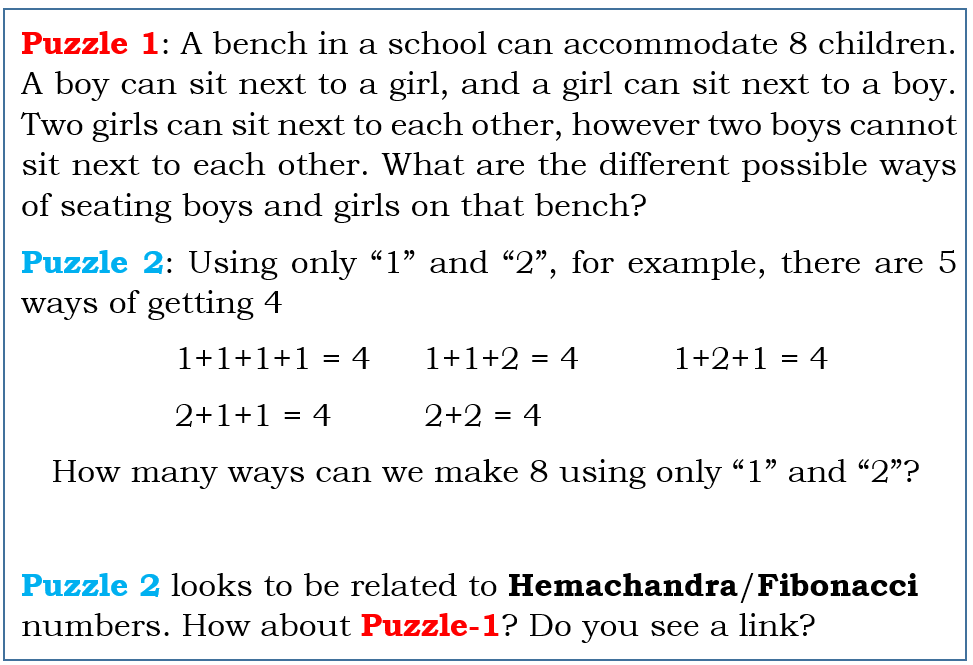
What's wrong with this picture? 🤔

#math #puzzle @jamestanton @dhimathorg @GlobalMathProj
Fun with #Hemachandra / #Fibonacci Numbers.
 Twitter
rigid thistle
Twitter
rigid thistle
what's wrong?
turbid zenith
"I support gay marriage as long as both chicks are hot" — Number Theory Edition 😛
(But seriously, the idea that boys can't sit next to each other is pretty dumb)
rigid thistle
oh lmao
turbid zenith
Hope is not lost! You CAN teach students about number theory without perpetuating harmful ideas what boys should and shouldn't do. 😛
strange bronze
everyone knows number theory is the most misandrist subject
turbid zenith
It's also a great subject for continuing to introduce students to female mathematicians.
I have a friend who gives a talk every year about Fermat's Last Theorem to gifted high schoolers at a summer program
And when he mentions Sophie Germain, there are always a number of students who have never heard of a famous female mathematician
rigid thistle
tbh, the puzzle just gave a set of rules, i don't take anything from that set of rules except for their mathematical value
turbid zenith
I get that. And I've seen some excellent formulations of the same problem in different ways.
But I've found myself thinking a lot recently about the messages we send students.
turbid zenith
(Maybe that's amplified by seeing a math question for 2nd grade that was essentially "how many more slaves does the master need to buy for the plantation"... yikes)
rigid thistle
well yeah those are kinda extreme...
strange bronze
that is one of the more tone-deaf ways i've seen to try to "unify the curriculum"
turbid zenith
turbid zenith
I know right
rigid thistle
people in charge of writing those should be fired and be shamed upon
round robin
those were actual problems given to kids wtf?
 woven hedge
Some people are common sense blind, so I'm sure
I'll try to find them right now
Fortunately I can't find them as they're from recalled books
 boreal yacht
the first one with the boys sitting next to each other is not even obviously homophobic to me, but im not convinced that the slavery questions were really given to students. Its just far too ridiculous to be true lmao.
winged urchin
Eh, even if the first example is far less in your face it could still spur the question from a student as to "why" the question has that framing. And given that you could easily craft problems that don't involve sexuality, gender, or anything else personal that could, even at a remote chance, cause someone to question themselves, then what's the loss?
woven hedge
I looked up the questions and assuming the articles had real parent testimonials, they are (were) unfortunately real
When I write math problems for things I usually don’t like including names and I’ll stick to neutral nouns as descriptors. Never used the word slave though. Don’t think I will.
next relic
There's a pretty interesting research on why girls do worse on questions about fashion and boys do worse on questions about sport.
So yeah I think it's a good idea to stick to neutral nouns.
But honestly, can't you just use another context that's less discriminating?
next relic
Re: they are influenced by their subject knowledge instead of the info given in the questions. @ ariana
round robin
time to try it
gives ||calorie counting qn||
people solves it instantly
 next relic
This article considers the move in mathematics education, away from abstract calculations and toward 'mathematics in context', particularly in relation ...
@ john @ ariana @ publius
 lofty garden
Hey so I am hoping to one day become a high school math teacher and I in fact only have one year left of college and a short class to get my license before I can start teaching. My issue though is that I have very very bad handwriting. However, considering that most high schools don't ever really teach above calc 1, would it be viable for me to just make powerpoints for everything? Or how should I approach this?
faint yarrow
How much time have you spent writing on a whiteboard? A lot of people I know with terrible handwriting have much better writing on a whiteboard.
trim violet
I don't think powerpoints only is viable
you will always have to answer questions and show how to solve exercises and stuff
brazen pendant
not only that, but writing on the blackboard naturally forces you to not go too fast
if you do everything with slides you might fall into a trap of going too fast and losing your students
meager bronze
yeah I agree
also people are really bad at reading slides
whenever you put text on slides, people will read the text and ignore what you say
brazen pendant
depending on the technology available in whatever school you end up at one potential possibility would be projecting a tablet screen and getting a note-taking program that has handwriting stabilization
meager bronze
like, without fail
also they will just mindlessly copy down what was written on the powerpoint (which they can still do with a whiteboard but they have to focus a little more to do so)
brazen pendant
and don’t forget the good old “wait I just noticed this equation here is wrong”
which will happen
your notes will have mistakes
indigo grotto
i mean handwriting is something you can work on
you're older now so you should have better muscle control than when you learned writing, so just practice
brazen pendant
true
it may be easier to deliberately write a new writing style than trying to improve the one you’re used to
especially if you’re used to a cursive style cause those have a tendency to be hard to read anyway
could always go for an all-caps font, those are at least pretty much always readable, even if they’re not as ergonomic to write
willow scaffold
buy a standing whiteboard and practice
next relic
I strongly against powerpoints. You want to think out loud for students to follow your thought process. It also leaves you more flexibility in case someone has a great idea that you haven't thought of. And most importantly, you don't have to spend hours making slides.
Win-win.
@lofty garden
To save time, you can type the questions ahead of time, but don't spend hours typing the working out.
It isn't worth it.
willow scaffold
I mean it's not like your just playing the ppt and walking away.
Ur still meant to explain what's going on
how's smart board tech these days?
last I looked into it, low accuracy and laggy
rigid thistle
my last personal experience with powerpoints was great because my prof. was already really familiar with it (she is disabled and cannot write for long)
next relic
Slides are reusable, but I don't see the benefit of typing up all the work while you can spend that time thinking about the examples you're gonna give to the kids.
faint yarrow
I certainly improvise a lot in ways I could not with slides. My lecture notes usually have 1.5 - 2.0 times the material I will have time to cover, and I play by ear what things I should do more examples of because students seem confused, etc.
(there are some things where I"ll even make up more examples if it is relevant, although that definitely works better for some things than for others)
next relic
At the high school level, however, I don't think there's that much content to be covered. :p
Besides you get to see your students at least 2-3 times a week, you have a better understanding of the strongest/weakest students in the group, the pace that they're comfortable with, who need extra help and what not.
faint yarrow
but I definitely recommend typed lecture notes, because they are so easy to revise.
but I don't use slides unless I'm giving a technical talk or a job talk
willow scaffold
I mean I'm against worked solutions in PowerPoints.
mainly meant to be for theory
with maybe 1-2 short examples.
while actual questions should definitely be explained live
from scratch
faint yarrow
there are a lot of effective ways to lecture, and it will depend a lot on your own style. But I totally agree with the earlier point that, especially when you're new, writing on the board makes you pace yourself much better.
faint yarrow
Aww, that's sweet! I'm always happy to talk about it
turbid zenith
I would like to add that if you're teaching high school hopefully you're spending most of your time not lecturing but having students be doing math :)
PowerPoints can be great ways to organize that and they dont take nearly as long if their point is to organize the flow of class rather just vomit up information
 crude halo
yeah we are jsut given a book with theory and the teacher will explain it once and then we do exercises based on theory
thats i gues how everyone does it in high school
 halcyon light
im tutoring a yr 7 student and when given this, she was confused about why **-3(-**8/6)= **+**8/2, specifically the positive negative parts
she reasoned that -3 means subtract 3 as a verb rather it meaning a negative no as well. does anyone have tips on how to explain this?
cosmic bough
@halcyon light is she comfortable with the idea of negative numbers being things in their own right, rather than just subtraction?
halcyon light
hmm im not entirely sure, but that might be the area where she's confused. if i put it as -1+2, she'd know how to do that
im sure she understands -ve no.s on a number line
 tawdry venture
multiplication here has higher priority
wispy slate
It helped me in high school to imagine "-3" as "+(-3)". If you explicitly make those distinctions the parsing of the syntax will be a lot more structured and confusion will be low. (As with other definitions I think the confusion stems from teaching purely by examples)
halcyon light
ahh, so doing that helped since it separated the -3 into it's own term in a way?
not sure how to phrase
but i think i get what you mean
wispy slate
Yes by writing it the long way it helped to parse what was written. I mean we don't even think about it but this is something that needs to be practised until it just happens automatically (and you can do the shortcuts quickly).
halcyon light
makes sense! thanks for the tip, i'll start incoporating that into my teaching
wispy slate
is it too radical to suggest giving a proper proof of why a negative times a negative is a positive to explain why -3(-8/6)= +8/2
halcyon light
she understands why a -ve times a -ve = +ve
was mostly confused about the uhh function of the - in different locations
wispy slate
-ve * -ve = +ve ?
wispy slate
oh
lol
(Also note that I am not a teacher, this is just something that helped me personally)
halcyon light
yea no worries, it's still helpful to get a student's insight
different ways of understanding = better understanding imo
and different ways of teaching/explaining
wispy slate
what do you mean with the negative in different locations?
halcyon light
for example, the negative in the previous example. i guess having the negatives in those locations confused her
wispy slate
how is that not a standard negative times negative form like the general one you wrote after?
halcyon light
it's not different but i suspect the brackets confused her
i think maybe often seeing - and + separating terms in an expression led her to associate those with addition and subtraction, rather than thinking of them attached to the number itself?
and not seeing -3(-8/6) as -3 x -8/6
i'll try to rexplain it to her next lesson
wispy slate
((That's not multiplication that's just inverses))
indigo grotto
yeah but multiplication is something that tends to be easier to understand than inverse at that age
making the -1 implicit allows them to use it to perform calculations
halcyon light
oh, i forgot to thank y'all
i'll explain it to her using all of those methods when i see her next
thanks!
 nimble monolith

feral vector
Is there some counterintuitive result which isn't very complex so as to require lengthy conversation but sufficiently complex that it doesn't seem trivially true such that it could be used to motivate someone who need to know some useful/intriguing-to-layman results math might have produced?
I usually go with the Fixed point theorem, using the "Oh if u stir coffee, there is always some point fixed" (not really true but meh).
In the same spirit, can someone point to similar results which fit the above description?
faint yarrow
I really like "Which primes can be written as the sum of two squares"
wispy slate
"On every party there are at least two guests who know the same amout of people there"
brazen pendant
"On every party there are at least two guests who know the same amout of people there"
is knowing symmetrical? cause otherwise a two-person party where A knows B but B doesn’t know A would be a counterexample
and it definitely happens to me that people know me but I have no clue who they are
I suppose it has to be taken to be symmetrical, otherwise the party where person n knows persons 1, …, (n-1) would always be a counterexample
that, or we’re assuming people don’t go to parties where they know literally no one but then that happens too
I suppose it would be less confusing to write it as “is friends with” rather than “know” because that would more reasonably be assumed to be transitive
 tidal drum
Uhhh
You wouldn’t have met them
I’m sure some people know of you you don’t know
Or know you, even
wispy slate
@brazen pendant uh let's say they are friends that's what I meant
And don't tell me friendship isn't symmetric 
jade warren
@wispy slate “has met” could work as well, just in case someone comes in with the “one thinks they are friends but the other doesn’t...like dinner for shmucks”
ionic dagger
Sort of along these lines: The SoCal area has at least 30 non-bald people with the same number of hairs on their head.
|| Max human hairs on head from biology is 500K. The SoCal area has 23M. Minus epsilons and deltas and other baldies -- 15M left. By pigeon hole principle here's at least 30 people with the same number of hairs on their head from the leftover. ||
 slate turtle
Does anyone else feel somewhat guilty or dishonest when playing the role of a tutor, and the tutee doesn't attempt your examples / engage in the intermediate steps of a problem they present, so you cave and explain it?
I'm grappling with the fact that I can't force someone to put effort into working something out while trying to encourage engagement, and it feels like I'm encouraging bad behavior whenever they just up and say "I don't know" etc. and I just outright share the logic behind whatever it is I wanted them to do
Then if I do share that logic, I feel as though either they aren't held accountable for following along and just waiting for the end result, or I'm only serving to make them comfortable with listening to someone working stuff out, rather than getting them acclimated to working stuff out themselves
It's just odd, I've had good experiences with people who mutually engage with me, and the people who don't engage usually either leave me hanging (in text) or I feel like the whole exchange is fruitless, excessive hand-holding
 manic totem
It is definitely difficult for tutor to teach when the tutee doesn't have any tendency to learn or even, to finish the so called Homework.
Most of my students in my tutor sessions have very low motivation to learn and most of them just wanna finish their homework by "copying" answers.
I think the most important thing is not to teach these students anything that can taken from books, but rather try to improve their learning motivation and boost their self-esteem since they usually get bad academic results as they don't want to learn even if they are very young.
ionic dagger
I've had some experiences like that. And you have to remember some of the stuff that goes on in HS kids' lives. They have to sit through a paid tutor. They have to keep their grades up basically because their parents and/or the government says so. They may also be lacking in prereqs and supporting knowledge. I mean there was only one time when I tried to push back a bit. This kid was obviously smart. He purposely had me and another language tutor scheduled AT THE SAME TIME so one of us had to leave. That's just cunning. He had a sick relative he had to take care of and other "baggage". I finally had to say to him honestly ... I know you're going through a lot but I can teach you this stuff. Still, I'm not going to fight you to do it. That's your battle with the system in general. We had 3 more sessions until he quit, but I considered it a partial victory. But yeah there's only so much you can do.
manic totem
I have to remind myself that we teachers/tutor is impossible help everyone we met. In my first few years of teaching, I always strive for the best and push myself too hard.
It is always a challenge for me to keep a balance between what I can do and what students need.
feral vector
One thing that has helped me in the past is explaining completely to them a similar problem and then asking them to apply the same techniques in the original problem.
faint yarrow
A lot of it depends on setting, but it is indeed very difficult. With students wh oare motivated enough to not do the work, they'll just keep looking until they find someone who won't make them think.
But a lot of students are sort of on the borderline, where if you nudge them you can get them to form better questions
But I find it is really really important to make sure students know the difference between "I do not know where to start" and "I do not know what the quesiton is asking"
 wise onyx
That's a good point to consider
quasi musk
What I usually do is turn the question back on the student, I was in slightly different setting where I tutored in a college tutoring center (so it was free for students). I had a bit of power to tell students to get out their notes
I was specifically told not to teach students new techniques/tricks, only to go through with what their instructors/professors wanted
Anytime students didn't want to work or learn I basically just said "I'm here to help you help yourself, I can't do this for you. You have to have you book/notes/questions ready for me. I have a lot of students to tend to at once and if you're not ready for me and someone else is then I'm obligated to go help the student who is ready"
It helped create an atmosphere where students were more engaged than when I tutored privately
(Part of the reason why I prefer a college center over private tutoring)
faint yarrow
Yeah, the more power you ahve, the more you can help the students shift their mindset. I highly recommend making students learn to use an index.
Students need to learn to take the knowledge that is available. I've gotten in a habit that if a student emails me a question, and I have to google the answer, I send them a reply telling them what I googled, rather than the answer.
wise onyx
For me personally, lecturing without examples is a bad time.
faint yarrow
It is hard to emphasize examples enough
 kind salmon
Students need to learn to take the knowledge that is available. I've gotten in a habit that if a student emails me a question, and I have to google the answer, I send them a reply telling them what I googled, rather than the answer.
@faint yarrow try this next time https://lmgtfy.com/?q=what+is+the+answer+to+life+the+universe+and+everything
For all those people who find it more convenient to bother you with their question rather than search it for themselves.
faint yarrow
Oh yeah, I know the tool, but I think that is overly hostile to do to a student
kind salmon
maybe. but maybe some need exactly that. your choice 😉
kind salmon
examples are way better if they make sense for the student. the more there are, the harder it is to give a suitable indivudal example for everyone
brazen pendant
if anyone ever sends me a lmgtfy link I will immediately assume they are very much too full of themselves
tawdry venture
to those who teach linalg
how do yall get over the hurdle of people being confused at problems like "prove blah blah is a subspace of blah"
quasi musk
Speaking from a TA/tutor perspective I usually ask "well what do you know about subspaces"
And if they say they don't, I ask them to get their book or notes out
In general I try to get the students to do as much of it themselves as they possibly can
(if they're very timid/not responsive I'll ease up, but let them know they'll be doing more the next time)
brazen pendant
I’m gonna be supervising the study center (space where first year students can study in groups and ask questions to TAs) next semester cause they were too incompetent to not try and assign me a job I couldn’t take despite me having clearly marked the times I can’t work on my application
I suspect I’ll get to answer a lot of those questions
never had to work with first semester students so far
 rapid kettle
yep i think it is nice practice
u improve ur skills of explaining
and ur own understanding of subject
 drowsy burrow
Can anyone say which app/device used to scribe this following Algebraic Topology course:
http://www.math.wsu.edu/faculty/bkrishna/FilesMath524/F19/LecNotes/welcome.html
 modern harness
@drowsy burrow Hard to tell, it could have been anything. You could make notes like that with microsoft word or any word processor that supports note taking. It could also be any note taking app for a tablet. I will say, they definitely do have access to either a tablet or a drawing tablet to create it
wise onyx
I love the idea of answering "Why is X" before answering "What is X" during lectures
I'm gonna try to implement it more in my lectures
Example
"Why is a group?"
To abstract the notion of symmetry.
Vs
"What is a group?"
Four axioms which achieve the above goal.
faint yarrow
Yes, I think "What is this tool for?" is something I try to emphasize in teaching, and sometimes it requires a lot of reflection because it is not often written down.
tidal drum
I can’t help but feel sometimes some names really don’t convey any content and it would be much better served with a different name, but everyone’s already called it that for so long it’s impossible to change
I had a prof who would point that out and say “I’d name it this...” but then say that you just have to deal with like... 20 different things being called normal
faint yarrow
I usually say what I would call something
but the only one I actually use is "listable"
because the fact that people don't agree what countable means is incredibly annoying.
turbid zenith
"Why is X" ... totally stealing this
faint yarrow
(and more specifically, the analysis book I use where it comes up uses the wrong definition of countable()
turbid zenith
That was such a nice concise way of putting it
Today was the first time I made the slightest bit of progress understanding what the hell a sheaf is
Why are those kinds of descriptions so hard to find
faint yarrow
I think particularly for grad students it is helpful to talk about what a definition is trying to capture, and how it succeeds and fails at doing so, and what other things you might try.
turbid zenith
I want to do that even for my undergrads
faint yarrow
I waaaaaaant to, but I find a lot of times it goes over the head. Depending on the thing. I'm more inclined at that level to say "This is a tool for talking about htis kind of thing"
For sheafs, I recommend Miranda, btw. If you understand the sheaf of holomorphic functions on C, almost everything falls into place.
(and if you replace C with the Riemann Sphere than you're golden)
turbid zenith
What's the title of the Miranda book
faint yarrow
Algebraic Curves and RIemann Surfaces
trim violet
it's a good book
faint yarrow
it took a long time for me to understand a germ is a power series expansion. I really wish I had had a course out of Miranda before a "real" algebraic geometyr course
trim violet
a power series with a positive radius of convergence
faint yarrow
well yeah, by "is" I really meant "what should I be picturing"
frigid crest
Hello. Can anyone tell me a standard hourly rate of pay for private online math tutors?
strange bronze
Depends on their education level and what they're teaching
wise onyx
$0
turbid zenith
Really depends what you're doing, yeah
I charge $50 an hour for GRE Math Subject Test tutoring for example, though I probably could get more? But I try to keep it reasonable
frigid crest
Alright, thank you.
stark pine
@frigid crest my university has a tutor service. I browsed the rates for a bit for standard undergrad courses. the tutors with masters are consistently asking for 20-25, and the ones with PHD's are asking for 20-30. The current undergrads are asking 15-20. Harder classes tend to have higher rates, easier classes with more tutors tend to have lower rates. I only checked about 5 classes at my university, rates vary hugely by location and currency
frigid crest
I'll have to make a formula to calculate rates.
ionic dagger
Maybe someone needs to know such a formula due to a class project. ... irony ... sorry 🙂
faint yarrow
Related story: When I was an undergrad, I was an officer in the math club, and one of our activities was to form a list of students offering tutoring services. I didn't want to do tutoring, but I also thought the optics would be bad if I did not list myself, so I just picked what seemed to me an absurdly high dollar amount of $50 an hour. I figured in this way that no one would pick me, especially since the typical rates were around $15.
However, I did not take into account the fact that consumers, when given no other options, us price as a signal of quality. And so many took the fact that I charged an outrageous amount to mean that I must be the best, so I ended up doing a lot of tutoring for no other reason than I charged an outlandish amount.
 unborn heart
Nice lol
faint yarrow
I wish I could say it was intentionally planned haha
stark pine
@faint yarrow haha I did something similar in hs, but it was intentional; I knew a lot of very rich kids, and I could ask their parents for large sums of money in payment and they always said yes
quasi musk
@stark pine those rates are very low for people with masters/PhDs. I know people that charge upwards of 100-200/hour
But it all depends on the area. If you're in an uppity place you can get away with charging more. Zeta points out that if you purposefully charge a lower rate students might think you're somehow "worse". Lots of private tutoring companies charge 50-75/hr
Usually colleges have free tutoring services for their students on campus ~ so if your target is them you have to lower your rate and demonstrate that you offer something that they cannot get at the free-service
That could be playing into the unusually low rates
strange bronze
also online tutoring tends to go for a bit less overall
maybe 5-10 dollars an hour less
though current evvents might have changed this
stark pine
@quasi musk this is directed to the average uni student, who cannot afford $100-200 per hour lol
of course it'll vary
this is what they are offering openly. Most people who charge higher are tutoring for specialized tests, have exceptional qualifications, or have a target demographic of rich kids
wispy slate
@turbid zenith yo youre a teacher right?
wispy slate
do you see when students cheat?
wispy slate
out of curiosity, but do you let them cheat or you take their exam away?
and also, do you see them using phones or just some cheatsheet
turbid zenith
Okay correction
I've noticed what seems to be cheating after the fact
I had two students in one of my class I was pretty sure were cheating based on similar responses, so I separated them afterward
I don't think phones or unauthorized cheatsheets are really feasible with where I was but if I saw them I would definitely take them up
I know I'm going to have more of an issue this upcoming semester though because everything's online
So mostly I'm just rethinking the role of tests right now.
wispy slate
yeah, one of my profs this semester just cancelled all the tests and just gave us a long list of hard problems, which we could talk about to each other and had like a month for them. It decided about an entry mark, but you had to pass an oral exam anyways which could make your grade lower/better.
I think it was probably the best form, since Im sure many people cheated on the online exams
turbid zenith
I'm looking at creating a grading system where tests are optional. 🙂 They're just one of multiple ways to earn "XP" that really only count toward your plus/minus modifier.
While the bulk of your grade is determined by problem sets and autogenerated stuff on WebAssign.
wispy slate
Btw, are you 100% sure everythings going to be onlince next sem?
turbid zenith
For my school yes.
They gave the profs choice whether they wanted to conduct each of their classes either online or hybrid
I chose online in a haertbeat
wispy slate
Why?
turbid zenith
Safety.
wispy slate
Is hybrid half online half normal?
turbid zenith
Yeah. Some students come into class, the rest tune in via video
turbid zenith
That just sounds like running a two-ring circus. I have no desire to do that.
wispy slate
I wish my classes will start normally from october
turbid zenith
I'm hoping for a vaccine so I can get back to in person teaching without worrying about getting myself or the people I live with sick.
wispy slate
I suppose lectures will be online, but normal classes NEED to be face to face in a classroom imo
yeah
turbid zenith
Social distancing really puts a damper on the kind of class I like to run
Lots of group work and discussion, not just students sitting and listening to me lecture at the board
faint yarrow
we're supposedly doing in person classes
bu I'm not super optimsitic it is really going to happen
meager bronze
I think my institution is also looking at a hybrid model
for calculus, the main lectures are all going to be entirely online
and the discussion sections will be half in-person and half online
so like, if you can/want to attend an in-person session, theyw ill be there
but if you can't/don't want to then there will also be online synchronous ones
(as opposed to the online asynchronous "main" lectures)
 ebon grotto
my school is planning to have both hybrid and online classes in the fall, as Ashura described
this summer is online-only, and the cheating is rampant
 cedar fable
My school has officially announced all math courses will be online in the fall
Along with some other departments (physics, cs, psych, philosophy, and more). I think the more. I think 99% of courses are online (each course says whether it's online, I just haven't gone through them all)
faint yarrow
given the current trend, I think it's pretty unlikely. But colleges have such a financial stake in on campus classes the incentives will be to just kill a few hundred people to make it happen.
wispy slate
I want normal classes. My uni haven't said anthing official how the classes are going to look yet. Such a fucked up situation, making a lot of students' decisions a gamble.
Excuse my language.
faint yarrow
I would love that, I fear "normal classes" is not one of the options on the table. "abnormal classes in person" and "abnormal but safer classes online" are the options, sadly.
frigid crest
@cedar fable How large is your school?
cedar fable
46,000 students
strange bronze
as much as i hate to say it, i do think online classes are the better option
for the reason that in-person classes are de facto constructive dismissal of the elderly and immunocompromised
like i cant frame in-person classes in this climate in any way that isnt just blatant ageism and ableism
maybe a mixture would be more appropriate, with both profs and students knowing going in whether their class will be in-person or online
and profs not being under any obligation (stated or otherwise) to teach any class in-person
but i dont really trust administrations to handle this smoothly
meager bronze
yeah nami I've heard that many institutions are giving individual instructors the option of like
are they comfortable teaching in-person or not
my institution gave me that choice
but also like it's hard to say now because who knows how things will look in a couple months
strange bronze
yeah i mean part of my concern there is
you know academia culture
i'm scared of staff who "sacrifice" things by doing in-person classes being regarded more "highly"
like you know how schools churn through adjuncts
and how they dredge up old ass shit for tenure decisions
i'm worried that not volunteering for in-person classes will be looked down upon
even if theres a totally valid reason (e.g. lives with elderly family, immunocompromised, whatever)
idk, maybe my concerns are overly paranoid
meager bronze
honestly like I'm more worried about institutions asking people to do unpaid labor to prepare for this
like I've been in contact with a coupel of people at my new institution as they're preparing for teaching in the fall
and they're only paid a 9-month salary
they're supposed to get summers off to do whatever they want
but they're being asked to work over the summer to help get ready for fall
and I'm pretty sure they're not getting paid for it
stark pine
here, classes are online, with profs running option in-person stuff that isn't mandatory/doesn't give an advantage. If you're in the area, you want to see the prof, and the prof allows it, you can do in person office hours, but everything needs to be available digitally
it's a huge advantage for immunocompromised people, international students who can't get in, and people who have elderly relatives
meager bronze
another thing that I've heard especially younger faculty worrying about is like, who technically owns the digital content that instructors create for online classes
like, if I make a series of video lectures for my class (for the students who can't come to the live meetings), the university owns that content, not me
so what kinds of things could they do with that without my permission
tawdry venture
do yall think this would be appropriate for a precalculus class?
Suppose f is a rational function with two vertical asymptotes. Show, by means of a sketch or otherwise, that f cannot be one-to-one.
I'd say so?
It's not that beyond their understanding of rational functions.
Although it'd fit calc 1 better I think.
meager bronze
yeah I think it would be appropriate, assuming they know what one-to-one means
(it's been a long time since I've interacted with the precalculus curriculum and I don't remember if one-to-one is a standard precalculus topic or not)
wispy slate
no i don't think so
indigo grotto
🤔
meager bronze
I mean it's certainly something that could be introduced
like, they're familiar with the vertical line test
you could call this the "horizontal line test"
wispy slate
i don't even think i was taught the horizontal line test in calc, let alone pre calc
meager bronze
okay, but what I'm saying is that they could be taught it that way and they would be able to understand it
unreal ledge
I do think "invertible" was taught as the horizontal line test in my precalc
So you could go with that
turbid zenith
I think one-to-one is definitely taught in precalc.
But then again it depends where.
 dusky elbow
@tawdry venture Some precalc classes would have the horizontal line test and "one-to-one", but that kind of question strikes me as really tough for the vast majority of precalc students who have mainly been brought up with more calculation based stuff. If you have an honors precalc class that has emphasized reasoning about stuff then maybe it could be appropriate, at least as a bonus problem
 wide latch
i didnt learn what one-to-one means in precalc
turbid zenith
What we're getting at here is this
Nobody can decide what the fuck goes in precalc
It's where everything that wasn't learned in Algebra II gets shoved
turbid zenith
Where I teach they have different names for the classes and it at least kinda makes sense
They have "Introduction to Functions" and "Advanced Functions" instead of "College Algebra" and "Precalculus"
The former is how functions work in general (including 1-1 and onto), plus linear, quadratic, polynomial, rational, exponential, and logarithmic functions
The latter goes into trig functions (and trig in general), inverse trig, parametric, and polar functions, plus conic sections
ionic dagger
Absolute value and radical too! 🙂
turbid zenith
Oh yeah we'll probably hit those as well but our book doesn't do as much with radical functions for whatever reason. Or at least there's not much of a section dedicated to them.
Come to think of it, I wonder why not.
indigo grotto
🤔
turbid zenith
We're using Stewart's Precalculus for both.
(Oh well, more to think about for when I finally write my own Precalc book.)
ionic dagger
radicals are just sideways "half" parabolas. shrug.
winged urchin
For Ann's question... is it a problem that the domain isn't stated?
Like... a rational function 'could' be one-to-one if the domain was (a,b) where a and b were the two vertical asymptotes
I'm trying to think of counter points to that...
Is it somehow not a rational function if the domain is restricted in this way? In that other values of x could certainly be evaluated if we look at the expression for the rational function
faint yarrow
I'm fond of asking students to explain why a function can't have more than two horizontal asymptotes
I would not want to read/grade the solutions to the one-to-one question, but it would be great to have students discuss with their neighbor in class, and then discuss as a group.
stark pine
@turbid zenith are you a fellow canadian? cause we have functions and advanced functions here
stark pine
this is what we have here! the "locally developed/applied/academic" refer to 3 different streams, which different students will pursue. The "university" courses are for students who want to go to university, and the "college" courses are for students who want to go to college
the course titles are very descriptive of what you do
unreal ledge
Yaya everywhere in Ontario does this system
dusky elbow
@winged urchin In precalc and calc we usually take maximal domains of definition.
faint yarrow
I know in grad school someone said in their education a great deal of time had been spent talking about how to interpret equations like ln(x^2)=2ln(x) where the domains don't match
[Which is something I, even now, would not want to answer questions about]
winged urchin
To dirib, I agree in so far as if there is one of those (usually) multiple part questions like...
- State the domain of the functions
a. f(x) = sqrt(x^2-1)
b. g(x) = ...
I would invariably answer with the widest possible domain.... And in looking things up I see this is the definition on Wikipedia as well. So I suppose even though my thought was there isn't a 'unique' domain, by the definition there is a unique domain.
I was thinking specifically about when we restrict domains for say... trig functions or the square root. I'm positive I've seen like... consider x^2 for x>=0 or sin(x) for -pi/2 to pi/2.
There is a weird subtle nature to this I think... Since that looks like a different domain but I suppose it's a misuse of the word domain?
I'm not entirely sure how to think about this kind of distinction
As a tutor, would I be comfortable with a student saying that we're considering a domain of x>=0 for x^2 if we want to define an inverse?
I feel like that's correct in spirit but I suppose not by definition
But then these little subtle pieces are what say... true/false questions typically will catch students out on
And while I suppose you'd want to say we're actually considering a restriction of the domain and this is not the domain itself? Or perhaps that the thing we're discussing the domain about is not x^2 but rather sqrt(x^2) = x
Or not even that... rather... sqrt(x) (Actually not even this. It is more closely related to saying that the 'domain' of sqrt(x^2)=x is x>=0 but it's not technically a domain is it?)
But I also find that if one tries to be too technical that students sometimes fail to learn and then you have an unclear optimization problem
Do you be a little less technically correct if it ultimately helps the student learn more?
ionic dagger
1/x is a rational function that's 1-1 except at x = 0.
I mean if I had my way I'd make every student learn everything that was taught 70 years ago before hand-held & graphing calculators AND learn the the necessary skills that today's workforce requires calculator-wise, but that's the stuff of dreams. There just isn't enough time. Unless we break up math like the sciences or implement co-classes.
turbid zenith
@stark pine Is there any way I can see what's covered in those classes? 😮
That's really interesting.
stark pine
http://www.edu.gov.on.ca/eng/curriculum/secondary/math910curr.pdf this covers the grade 9 and 10 stuff. "Locally developed" is developed locally (ie by individual schools), usually at a much lower level for struggling students, so I'm fairly sure there's not a standardized syllabus. http://www.edu.gov.on.ca/eng/curriculum/secondary/math1112currb.pdf this covers the grade 11 and 12 stuff
these aren't the most modern ones, but they're the only ones I can find
turbid zenith
That's perfectly fine.
I'm always interested to see how other countries than the USA structure their math curricula.
A little sad to see that "Applied" is just a lesser version of "Academic"
Always thought it would be interesting to have an "Applied" track that goes over just as much stuff but goes in a different direction if that makes sense
stark pine
I mean from my understanding, the main differences are in how the things are taught and the type of question
in the academic stream, you're assessed in 4 categories. knowledge&understanding, Thinking&inquiry, communication and application. A thinking an inquiry question will be more to the effect of "prove this", or at a lower level, "try to identify a pattern" or something. An application question in the exponential unit would be balancing a checkbook; you'd be given a loan of some size, and asked to calculate the payments, then balance a monthly budget around that (actual assignment I had to do)
applied will have more weight assigned to the "application" category, so fewer topics are covered, since real world uses for the concepts are covered more
academic covers more content, since there's more of a focus on the thinking/inquiry , so there's more of a focus on new content, and theoretically, on students exploring content themselves
how much either of those things happen depends a ton on teacher quality ofc, but that's how it theoretically works
@turbid zenith
honestly, most of the stigma surrounding applied comes from the student body itself. Most teachers will encourage you to take applied classes if its right for you - if you're intending to go to college instead of university, for example. However, I noticed there was implicitly a lot of looking down on people in applied classes
unreal ledge
Agreed, I do notice in Ontario there's a strange combination of "college is the best option for many people" and "you're not reaching your full potential by going to college"
turbid zenith
Okay so um
Here, "college" and "university" are synonyms
What's the differencec there?
faint yarrow
usually universities give PhDs and colleges do not
though it is not super consistent
unreal ledge
Oh haha. College teaches applications and job specific skills.
University teaches acedemic studies
Which, sadly, is not a thing I really understood when applying to uni
faint yarrow
a lot of times colleges are "liberal arts colleges" which are a fairly specific model for learning
stark pine
@faint yarrow that is not the only difference here
@turbid zenith college teaches specifically workplace prep. an electrician or plumber would go to college. An accountant could go to either a college or a university, depending on how much of the theory of finance vs practical accounting they want to learn. any trades, management positions, business positions, and many other fields exist at college
in general, university is seen as a place to learn a subject, college is ap lace that prepares you for a specific workplace or career
faint yarrow
Is that UK?
dusky elbow
@turbid zenith Also in the US, a university might contain several "colleges" which are kind of like large departments. Like a university could have a college of science for the math and physics and chemistry and biology depertments
turbid zenith
True, I'd forgotten that.
But I had a feeling that was a different meaning in this case.
I know in Spanish "colegio" is high school for example.
next relic
I hope I didn't miss the convo on Canadian curriculum. :')
In Ontario, as Nicholas mentioned earlier, college is different from uni, hence you have separate university (U series courses) and college-prep (C series courses).
In grade 11, both streams take Functions 3M (a mix of U and C).
stark pine
yeah andrew that's what sparked the discussion haha
ashura asked the difference between the college and university stream
next relic
Applied stream starting grade 9 is a pretty bad idea though.
Because applied 9 often leads to three years of workplace maths.
Which is kinda concerning?
acoustic ridge

i get a lot of questions about how to make math vids...
my workflow is so byzantine, it's not worth writing up.
but...for those making vids for fall semester in a hurry: a thread of advice...
/1
Twitter
 uneven idol
guys in canada ontario they're making it so there's no applied or academic courses. the students will all just have the same course

Toronto
The Ontario government plans to stop its Grade 9 “applied” and “academic” track streaming, a spokesperson for the ministry of education confirmed Monday.
quasi musk
Yeah ask California how that turned out
Basically the AP classes took the role of the academic track, there's a regular track and a remedial track
They got rid the "track system" in CA only for it to be unofficially re-instated
stark pine
they aren't getting rid of them @uneven idol , read the article. they are specifically ending it in grade 9
@quasi musk they're still keeping the track in grade 10/11/12, just giving kids a year of high school before they need to pick, and trying to decrease the frequency of kids being pressured into a specific stream
especially in grade 11/12, where you're choosing if you wanna go towards college or university
stark pine
nope; the idea is just that kids at poorer elementary schools are often pressure to pick the 'easier' track when they go into high school
because right now, you need to pick the track before high school. The academic track can still lead to college or university, but in almost all cases, the applied track only leads to college
quasi musk
Does Canada have a community college system
I think that's been great for California's upward social mobility
You get in just by applying
stark pine
no, but school isn't as expensive, and we have OSAP
yeah, some colleges here are like that, and a couple universities as well. OSAP (ontario student aid program) is also excellent if you aren't too high earning. But yeah colleges are a great place to go.
quasi musk
If you can't afford school in the US you can usually find some federal government grant to pay for most of it
stark pine
here, in case you aren't familiar, colleges offer degrees and education which are more focused on application
quasi musk
If you're at a public institution that is
stark pine
ie a plumber/electrician goes to college
quasi musk
I'll have to look more into the English Commonwealth systems
stark pine
applying for OSAP (and grant money in general) is ridiculously easy here
quasi musk
FASFA is notoriously hard to apply for, but once you do it once it's not that bad to do it again
quasi musk
I got grants to pay for CC, uni, and MS
stark pine
the aid for students is 1250/month if you're working but earning under a threshold, or if you're looking for a job
2000/month if you have dependents
and you can earn up to 5k over the summer for volunteering at a hospital or in an elder care facility
and applying is literally three buttons
quasi musk
Jesus
stark pine
I got the money direct deposited within 2 days
quasi musk
That is insane
stark pine
took me less than 5 minutes to apply
quasi musk
Each school here has their own local programs that you have to apply for
stark pine
in general though, Canada is pretty good at giving students decent aid
quasi musk
And usually you have to write an essay on why you need it
Like CalFresh is a grocery stipend every month
Only for the CSUs
stark pine
to be clear, that aid is only COVID related. There is also excellent normal aid, but it's slightly harder to get
quasi musk
Oh ok
stark pine
it's student specific COVID aid for at least 4 months?
the OSAP exists all the time, and is pretty easy to get too
schools here also give automatic entrance scholarships based on grades
ok so I just went into an estimate calculator
someone with divorced parents who's primary parent earns 60k/year would get about half their tuition in grants, and the rest as a loan
https://www.ontario.ca/page/osap-ontario-student-assistance-program you can get estimates here
next relic
I strongly agree that gr9 applied should be abolished.
You don't help kids by lowering the bars.
In fact you're widening the gap at such a young age, which is a shame.
Also most provinces start setting students in grade 10.
In BC you have foundations and precalc 10/workplace 10, in Quebec you have science maths (SN)/technico-science (TS, only offered at some schools) and cultural (CST).
stark pine
especially because kids who pick applied are statistically way more likely to stay there, even if it isn't there. Also, iirc, the fail rate went down in grade 9 and 10 english when some schools made everyone take academic. If you tell kids they aren't smart and can't handle difficult classes, surprise surprise it doesn't go well
next relic
Once you're in the applied stream you'd stay in applied stream, because you need to take a bridge course to get "back" to academic.
 mild salmon
I need some help. I have a friend who is a college student and does not study math, but recently had started to take an interest in it. And she asked me to teach her math. I really like teaching math so I agreed. But, she wants to start from the absolute basics, and I'm not sure where I should start for that. Usually I teach kids highschool level stuff, so I've never taught that basic stuff.
So I'd like some resources to do that, like mainly a roadmap. Like an ordered listing of topics. Thank you
rigid thistle
what's the last math course she took and did she do well?
if no, then review, if yes, then move on to the next topic, i'm guessing somewhere around calculus
next relic
First off, you wanna have an idea of where she's currently at.
Are her numbers skills strong?
Can she work with exponents/indices?
Start with algebra 1/grade 9 maths and go up from there.
"absolute basics" is pretty vague.
winged urchin
You can also get them to do a practice test and see where they struggle
mild salmon
@rigid thistle She last studied in grade 10 and did not do well. I think that is roughly equivalent to algebra 1 in US
I’ve thought maybe I should start from prealgebra, which website would be good? For my own learning I like khan academy, but a lot of that is videos, I’d prefer some text based resource that I can quickly glace over and know what topics to teach
@next relic She’s very close to zero on a lot of those skills. Say I wanna start from algebra 1, where can I find questions etc for that?
next relic
I'm more familiar with the Canadian system, but you can look for states exams.
mild salmon
yeah that’ll be fine, I dont care about country, we’re just studying for fun
next relic
Secondly, I think you should give her a test on number skills.
Weak number skills usually lead to weak algebra skills.
next relic

QuestionBank.CA
Past BC Provincial Exams Practice Questions & Answers for Grades 10, 11, 12 English, Math, Biology, Chemistry, Physics
We rarely release provincial exams.
Especially Quebec.
But that's besides the point.
next relic
Do the questions yourself to check that they are appropriate.
though BC maths isn't that hard either
 vestal coral
Hi everyone! I'm helping spearhead an initiative called the Educational Nonprofit Coalition where we connect nonprofits focused in education together to allow them to share resources and ideas. We have our second meet and greet today at 9pm EST at https://harvard.zoom.us/my/coviz. It's really low-key and mainly consists of brainstorming and resource sharing. Let me know if you are interested!
ionic dagger
... very very snarkily ... Harvard doesn't need my help. Trust me I've applied. jk
turbid zenith

What should an "A" mean? Doing everything that's expected correctly? Or is that a "B", and an "A" requires somehow going "above and beyond"?
Why? Please elaborate in replies!
Twitter
Poll! Please consider responding/sharing
stark pine
@turbid zenith Could you specify a little?
Like ie what consists of "above and beyond". If an assignment has 10 questions, and you answer all 10 questions perfectly and clearly, have you gone "above and beyond"?
turbid zenith
I left it deliberately vague specifically because questions like that are exactly the right questions.
I've been seeing a lot of back-and-forth on certain groups I'm in about what an A "should mean".
It's also probably related to whether you think everyone getting an "A" in a class means something's right or something's wrong.
 civic tree