#math-pedagogy
1 messages · Page 5 of 1
 turbid zenith
And then in the next section defined a topological space, noting that the definition of open sets is built to take those things we like and hold onto them
 south vigil
Oh hey that's a good way of doing it
turbid zenith
I agree with you, it’s a MUCH more effective way to do things.
Another example is I have a book on abstract algebra that has you play with “algebraic systems” in general first before it defines groups and rings — You play around with examples of sets with various operations to see what properties you get, and then say “Hey when we have this particularly useful collection of properties, we call it a group/ring”
The traditional way seems to be:
- Set out the completely sanitized definition right at the beginning, with all the caveats that keep the weird edge cases at bay specified up front
- Maybe give some motivation for why that’s the definition, but not always
- Examples
- if you’re lucky, applications as an afterthought (this applies mostly to things like calculus etc)
I would argue that a lot of students would be better off if things were done pretty much in the opposite order. Actually just gave a talk to that effect.
 cosmic ibex
I agree that giving motivation is crucial, but I'm not sure I agree the reader should be burdened with trying to absorb the motivation without yet knowing what it's the motivation for (unless they cheat and read ahead so they can understand the motivation).
My experience when I read sources that present a long sprawling discussion before they deign to tell me what the concept they're aiming for is, is that I get extremely annoyed at it. I end up shouting impatiently, scanning ahead until I find the darn definition, and then jump back to the start to see if all the sprawl actually helps me understand it, now that I have a mental framework for reading that discussion and know what to look for.
south vigil
Hmm, although that's valid, I will point out that what you're saying is that it's annoying more than that it's ineffective, right?
Well, maybe not. You're also saying that being informed on what the explanation is for helps you figure out what to build a framework of
Okay, I can see that
south vigil
turbid zenith
I would argue that a lot of students would be better off if things were done pre...
What I hate is that number two is the most important one
Well, numbers one and two are
 winter phoenix
can anyone help with logical math?
south vigil
I think with abstract math, the correct approach is to build up an intuitive explanation to motivate the reasoning you will do, and then use your experience with rigor to make that reasoning work
But I also worry that because that second part can be applied without the first, i.e. deriving things rigorously without a motivated approach, it's a skill that gets overemphasized
turbid zenith
I guess it depends on what you’re trying to do
Some people wanna just cut to the chase
south vigil
But that only works for solving problems, not understanding math
The chase isn't answering textbook questions, it's knowing what's going on
turbid zenith
I think if you’re already “drinking the Kool-Aid” as it were you can handle having the motivation come second
But for students who are still getting a good feel for why math matters, I think leading up to the definition often seems to be what works
south vigil
turbid zenith
I think if you’re already “drinking the Kool-Aid” as it were you can handle havi...
Of course you can handle it. You just shouldn't
You can just define random bullshit as axioms, and as long as they're consistent hey you got math
cosmic ibex
I find it very inefficient to deal with motivation without knowing what it is the text is supposed to motivate.
south vigil
That's valid
But my problem is that the motivation is so often underemphasized in the extreme
Despite being the whole point
You can get VERY far in math just by being good at manipulating rules
cosmic ibex
That's a different problem from whether there's a definition in front of the motivation you're lacking.
south vigil
Sure, but that's my actual problem
cosmic ibex
I can totally get on board with wanting motivation.
south vigil
The reason I said something different is because I had to think out loud to realize what it actually was
cosmic ibex
The worst is when there's a long, ambling, chatty exposition of something where it never gets quite clear whether they're describing a motivating special case, or a typical example, or actually general truths about the mystery concepts -- and then suddenly, with nary a paragraph break, the text says "... and this is then known as a left-handed semi-simple antimorphism" and jumps directly into discussing applications and further generalizations. Without ever deigning to state a self-contained definition.
south vigil
Yeah that can be bad
 fallow siren
I had a few grade 9 students who would stop mid sentence to complain about not knowing what a word meant despite the fact that the sentence they were reading was defining that word. It was baffling to me. There were other issues though.
turbid zenith
cosmic ibex
The worst is when there's a long, ambling, chatty exposition of something where ...
This is useful. I’m definitely gonna have to make sure I’m not doing that when I do things.
 elder venture
I'd not like a full page of motivation only like a single paragraph.
 tardy ember
imo it... depends somewhat on what the thing being defined actually is
if it's "curvature", the reader probably already knows at least somewhat what that is, you can just point out that that's what's being defined, then define it, then maybe say something about why that has anything to do with curvature if it's not already obvious
if it's "a category", that probably isn't a concept the reader is already familiar with (unless they already know the definition), so i'd say more like, give the definition, talk about it a bit, give some of the easy examples (Set, abstract algebra), that kind of thing - it makes sense imo to give the formalism first here because they don't already have intuition for what a category is supposed to be (or at least not explicitly enough to easily point at)
if it's "a monad", then uh, i have no idea, i know what those are but i have no idea how to explain it
south vigil
A monad is an entirely fictional concept that exists purely to stroke the egos of those who think they understand it
 long pelican
It's interesting to note how guides to monads aimed toward programmers are much more understandable than ones from a mathematical viewpoint
cosmic ibex
In the former case you have the luxury of being able to assume that objects have elements without needing to apologize. :-D
(And "parameterized type" feels a lot more concrete to the programming side of my brain than "endofunctor" does to my mathematician side ... never mind that the former doesn't in itself imply anything about functoriality; it does provide a nice mental scaffolding for organizing one's understanding).
 vagrant meadow
cosmic ibex
My experience when I read sources that present a long sprawling discussion befor...
vagrant meadow
cosmic ibex
My experience when I read sources that present a long sprawling discussion befor...
i know it's hard to say in general, as i imagine the answer is different for different concepts, but how much definition and discussion would you say should precede the motivation?
for example, i'm toying with the idea of introducing linear transformations to students who only really know calculus using the examples of derivatives and integrals to motivate linearity (for an intro to linear algebra).
cosmic ibex
From a personal and subjective point of view, I believe I would prefer learning from a text that always starts by showing me a technical definition. It might then very well need to immediately admit something like "the first time around, this definition looks impenetrable and/or unmotivated" and dive into some motivation, discussion, and examples. Or even "half of the words in this definition will be unknown to you yet, so we'll need to spend 10 pages of defining auxiliary concepts before it even makes sense". I still feel it will be easier to internalize those auxiliary concepts when I've seen a context they're going to fit into.
Or, hmm, perhaps I should moderate that -- I can live with some text coming before the definition saying, e.g.
Our next task is to define the concept of blablabla, which tries to make precise the vague notation of such-and-such. For example how do we distinguish between things like [...] and [...] where one seems to obey a principle of [...]? It turns out that it works well to define: [DEFINITION]
But I'd like to at least know the name and a high-level "type" of what we're working towards, rather than just see a cavalcade of random examples of something unknown, and only afterwards be told what I ought to have noticed about them.
vagrant meadow
cosmic ibex
From a personal and subjective point of view, I believe I would prefer learning ...
that's fair. personally, i agree. but i've found that as someone who best understands through abstraction, there's a big divide between the explanations that make sense to me vs most other students. that divide just seems to grow larger and larger the more i tutor, as well.
i think my worry is that by showing the "scary" technical definition too soon, their eyes will glaze over and they'll just give up trying to understand. however... putting the goal up-front also contextualizes the motivation, which can make it more effective in the end.
tysm for your perspective 🙂
 distant fractal
Supposing I have 2 extra classes and no more content (and I am already dedicating time to review), what would be a good topic to discuss in a Calculus 1 class?
I could just do some calc 2 topics, like integration by parts
Or I could do something more fun
 shadow flower
maybe show them that their intuition can be wrong with the divergence of the harmonic series
I was always interested in that when I was in highschool
 austere inlet
honestly I see no reason for it other than "it's a small, easy to remember set of axioms that covers a lot of examples we care about" -- it can definitely seem unmotivated if defined without any context so I agree with that point of view. Documents that skip the fluff and go straight to a definition are good when you're an experienced mathematician but perhaps not so much for undergrad teaching.
exactly, in mathematics it is often the case that a definition appears precisely because there's useful instances or examples of it beforehand; in the case of point-set topology the "family of open sets with funky properties" wasn't even the first definition of a topological space -- instead the first proposed definitions modeled some notion of "closeness" through accumulation points or neighborhood bases: https://hsm.stackexchange.com/a/8415
in my experience some students benefit a lot from being given some motivation or context for the abstract definitions, though I do agree that such an introduction should be clear and concise
vagrant meadow
distant fractal
I could just do some calc 2 topics, like integration by parts
personally, i think Taylor series are "simple" enough that a calc 1 student can understand them. getting a brief exposure so that seed can grow between now and when they formally learn them is helpful imo.
||but I'm also biased bc i love Taylor series||
i watched the 3b1b Taylor series video before I took calc 2 and it made a huge difference for me. by the time we started them it was already super intuitive to me.
but i also second the harmonic series idea
shadow flower
taylor series was my next suggestion bc the idea of that when i was first exposed to it was also mind blowing
everything is an infinite polynomial
 pastel horizon
Been a while since I posted here but what do we think about AI and the future it will have? It's definitely a very powerful tool for teachers, takes a big load off planning but we also have to consider ways we can ensure students understand the material without cheating
For me when Co Pilot drops that's just gonna be such an awesome tool to have for delivering lessons
 zenith slate
I've certainly seen a lot of hype regarding the use of AI to help with planning but I've yet to see anyone actually incorporate existing tools into their planning workflow. I plan a lot of lessons for high school mathematics and fail to really envisage how I could leverage AI in any meaningful way beyond perhaps problem generation (but this is rarely a bottleneck for me). More important to me is content sequencing and differentiation - I'm not sure how amenable these types of problems are to an AI-oriented approach, at present.
What would be a real game changer would be actually good OCR tech that can decipher awful student handwriting 
long pelican
I don't think AI is at the point where it's better than me at anything I do for my complex variables class, from planning a lecture to creating problems. Especially creating problems. This week (the final week of the semester) I'm planning lectures on the Gamma function and the Riemann zeta function out of Ahlfors and I would be very surprised if AI could give me something meaningful on those topics that I can't already come up with
zenith slate
A particular application I have seen that is effective is generating individualised homework problem sets - my school already uses a service that provides this and it's been remarkably successful, at least in terms of student engagement.
Yeah I think the likelihood that AI will make meaningful changes to university pedagogy in the near future is slim
long pelican
Is AI capable yet of generating problems beyond routine textbook exercises or vague mind-overloading real world problems?
zenith slate
No - but what it can do is provide problems at a difficulty level appropriate for the student
long pelican
up to the difficulty of the hardest routine textbook problem, I presume?
zenith slate
In terms of differentiation this is a massive improvement over anything remotely practical for a HS teacher
zenith slate
long pelican
up to the difficulty of the hardest routine textbook problem, I presume?
Yes
I mean the particular service we use also has a kind of gamification built-in - students can earn points for completing problems and studying in their own time that they can cash in for rewards at school
This isn't AI related, but a very neat application of tech
Homework completion rates have gone through the roof
While the problems students are getting may be fairly boilerplate, at least students who would have never done their homework in the past are now actually doing math problems regularly
I think it's things along these lines - perhaps you'd call them lessons learned from the nightmare of the Internet and social media and its conditioning of young people toward getting Internet points - that have the potential to have a huge impact
Take the addictive qualities of being online and apply it to education
zenith slate
Yeah
I mean just the differentiation alone is a game changer
Good stuff
No child left behind but it actually works for every child lmao
Also the fact that online homework just gets marked by the algorithm is nice 😉
long pelican
The one semester I used Webwork I had so many emails reporting wrong answers that were actually correct and I had to fix the code every time -_-
turbid zenith
That's why I've been coding all mine from the start this semester lol
I have one left to do
 quasi musk
long pelican
I don't think AI is at the point where it's better than me at anything I do for ...
quasi musk
long pelican
I don't think AI is at the point where it's better than me at anything I do for ...
Any chance to sneak in dirichlet's theorem on arithmetic progression?
 tepid smelt
I have not used chatgpt much recently but I enjoyed having students find errors it would make on problems. It can present solutions that sound convincing but have obvious errors that are not easily spotted by HS students.
pastel horizon
zenith slate
Also the fact that online homework just gets marked by the algorithm is nice 😉
Only a matter of time before online homework gets replaced with an AI tutor
Obviously the GPT model wouldn't be enough but with a more specialised model you could have something that can potentially deliver the material, identify misconceptions, tailor questions to attack the misconceptions and also scaffold/ provide challenge appropriately
Also having something that could just scan written work would be insane too
pastel horizon
zenith slate
While the problems students are getting may be fairly boilerplate, at least stud...
So one idea I would have is to make use of diagnostic questions.
If you can provide an AI with some generic diagnostic questions for some topics and then train it with appropriate follow ups based on the responses then you'll end up with a pretty accurate assessment tool that can rapidly personalise a student's learning.
Currently it's just a generic system that recommends questions based on what they got wrong rather than why they got it wrong
zenith slate
Yeah I think the tech has a lot of potential, but it's not clear at this point what the hard limits of language models like GPT actually are. It could well be the case that the kind of thing you are proposing is simply not feasible with current models
I think teachers would also be loathe to hand over the reigns quite so much, at least for the foreseeable future. Nevermind what parents would think about teachers handing their kids over to learn from some mysterious AI!
Doubtless things like this are being worked on, though
long pelican
quasi musk
Any chance to sneak in dirichlet's theorem on arithmetic progression?
Unlikely 😦
quasi musk
It's ok, my complex analysis prof. talked about it briefly. Then the next term when I did my MS, I was taking a class where the main goal was to understand the proof of Dirichlet's Theorem
It was kind of cool
 rain rain
I know a lot if ppl hate Tao’s analysis books but I really like the way he teaches
long pelican
What are the top reasons some people hate them? I don't know much about them
rain rain
I think it’s painfully slow/obvious sometimes, even for me, but I love how he builds motivation and provides so many counterexamples to show why it’s important to build things up rigorously
Well afaik it’s because he uses a bunch of terminology that only he uses and he goes way out of the way to build things
Like to introduce the limit he makes up an operation LIM and spends forever working with that before he shows that it’s equivalent to a limit 
But the only reason I’m mentioning this is because I recently started diffgeo and I hate how the material is presented
And I’ve had that problem with a lot of other math books too
It’s just definitions and theorems vomited at you and you’re expected to stick with them until they come together and you see why you needed them in the first place
Earlier today I was complaining about this and someone explained why we needed those defns and how they tied into our original goal/chapter topic
And it made everything so so so much easier to understand and appreciate
I just wish that was more common practice, motivating concepts and giving a precursor to what machinery & objects you’ll learn about and why you learn about them before actually diving into the material
 cold trench
rain rain
It’s just definitions and theorems vomited at you and you’re expected to stick w...
cold trench
rain rain
It’s just definitions and theorems vomited at you and you’re expected to stick w...
this is what makes math books unreadable to me
quasi musk
rain rain
I know a lot if ppl hate Tao’s analysis books but I really like the way he teach...
There's this idea in math education that you should just move as fast as possible from wherever you are to the more interesting stuff to research
rain rain
I think it’s important to get to the meat of the material without taking too long
I came to study analysis, not learn about the construction of the integers
But I think there’s a balance too where people go too fast and it just feels like you’re thrown into a maze and you don’t see the end until you spend a couple hours being lost in it first
rain rain
cold trench
this is what makes math books unreadable to me
Me too
rain rain
rain rain
But I think there’s a balance too where people go too fast and it just feels lik...
Especially for books claiming to be introductions or undergraduate texts or whatever
Exposing students to these concepts for the first time
Like I don’t think a first-time learner gives a shit about all these weird specific definitions and concepts & abstractions used in later research, they’re not even going to do research for a while
It’s daunting, silly, and stupid. Just help me build the skills to get a foundation in the subject before I go on to more advanced texts in the future
rain rain
rain rain
It’s just definitions and theorems vomited at you and you’re expected to stick w...
I feel like this is completely acceptable for advanced texts
The readers have the mathematical maturity, patience, and years of intuition & experience to see why these concepts are (or could be) important, and it would be a waste of their time to not get into the crazy stuff immediately (which is what they came for, what they’re prepared for)
But for a lower level book it just feels like I’m listening to someone just stroke their ego to how much more they know & understand than me 
 fathom furnace
rain rain
But for a lower level book it just feels like I’m listening to someone just stro...
fathom furnace
rain rain
But for a lower level book it just feels like I’m listening to someone just stro...
definitely me when im reading through my abstract algebra book
 cloud zealot
has anyone used Topology Through Inquiry by michael starbird and francis su in a classroom setting? if so, how successful were you?
 kindred stag
Oh I had that used in one of my classes.
Terrible book actually one of the worst class experiences I have ever had.
granted this was for an algebraic topology class, maybe the beginning of the book was better
cloud zealot
kindred stag
Terrible book actually one of the worst class experiences I have ever had.
may i ask why you felt the book was bad? also, i was more interested in an instructor's point of view. i'd be interested if their perspective was influenced by the resources from the book's website here: https://math.hmc.edu/su/topology-through-inquiry/.
 wide ice
long pelican
I don't think AI is at the point where it's better than me at anything I do for ...
wide ice
long pelican
I don't think AI is at the point where it's better than me at anything I do for ...
Maybe Lindelof's conjecture? Just something not so mainstream as RH.
long pelican
wide ice
Maybe Lindelof's conjecture? Just something not so mainstream as RH.
I'm not sure what you are replying to
wide ice
Oh, I thought you were thinking about something to talk about that would be relevant to Riemann's zeta function
long pelican
For context, these are undergraduates the majority of whose mathematical knowledge is pretty limited
wide ice
I'm an undergrad myself, and I'm pretty sure I don't know much either :D.
I mean, if you can construct analytical continuation and Riemann's zeta, then it's straightforward to give a few words on Lindelof, and how stupid-looking it is
wide ice
tardy ember
if it's "a monad", then uh, i have no idea, i know what those are but i have no ...
"monad is a monoid in the category of endofunctors"
That's the only phrase I remember from Functional Programming class. Still don't know what it means, it's crazy that we didn't have a class on category before
In this case, I think it's best to bring some examples from Functional Programming. Maybe some quick intro to lambda calculus.
Otherwise, I have no idea how one can understand what's going on with all these arrows
 empty gull
cloud zealot
may i ask why you felt the book was bad? also, i was more interested in an instr...
empty gull
cloud zealot
may i ask why you felt the book was bad? also, i was more interested in an instr...
I also highly dislike the book (as a student tho that probably says some stuff about how instructors might see their class react to it)
Personally I'm generally not a fan of the "all the theorems are left as an exercise" style because, while i understand where they're coming from, personally i see that reading through some important theorems is in of itself an important pedagogical step to growing as a mathematician because it allows you to see and understand how somebody else attacked a problem and managed to get it (i.e. this is how at least i learned a lot of proof techniques and approaches)
Not to mention that a lot of theorems feature highly non trivial approaches that might frustrate some students (as well it took the mathematicians who originally proved these statements who knows how long to crack the problem)
cloud zealot
interesting, and maybe it leaves less time for exercises that show facets of a certain theorem or extend them
 pure coral
topology is one of those things that requires tons of examples and applications (talking about pure ones like zariski)
but too many books in general treat it as a game
and also it’d be WAY more useful to go over structures that use the notion of locality like sheaves, than to spend a bridge too many lectures on weird topological properties
pure coral
wide ice
"monad is a monoid in the category of endofunctors"
yeah all that gobbledygook makes sense only when monads are treated as (associative) algebraic theories whose terms are points within a category (like elements of sets, values of types, etc) - a similar example is how a monoid in the category of vector spaces is just a vector space with sensical enough multiplication, such as R^3 with the cross product
for example, the list monad gives the ways to build expressions for any monoid, a way to promote values to expressions (the unit map A -> [A]), a way to reduce nested expressions into a non-nested expression (the join map [[A]] -> [A]); then, a map [A] -> A can be treated as an evaluation scheme for a specific monoid
e.g., if A is a type of numbers, the map [A] -> A could just add those numbers together, or it could multiply, etc
what the laws say is that if you have a nested list, there’s a canonical way to use your evaluation map on nested lists [[A]] that is associative, e.g., sum of [[3,4],5] == sum of [3,[4,5]], just like how (3+4)+5 == 3+(4+5), and furthermore, you could also just unnest the list first and then evaluate, so sum of [[3,4],5] == sum of [3,[4,5]] == sum of [3,4,5], just like how expressions like 3+4+5 make sense despite addition being a binary operation
 wispy slate

Working through the abstract and introduction of the Rosetta Stone paper!!
long pelican
26 years later, we’re in the same place
long pelican
Something important I think the writer misses is that there are approaches besides the approach of rote problem types and the approach of theory. I see introductory calculus class as training students to be able to come up with (to us, easy) mathematical insights on one's own. You learn and remember math a lot more effectively if you can do something on it by yourself. Both the rote problem types approach and pure theory approach very much fail at that, especially if the theory approach encourages students to memorize proofs
tepid smelt
Can anyone give me a high school student friendly reason why techniques we teach to solve systems in three variables or more works? I feel they understood why elimination and substitution work for two variables but are not quite understanding with three variables. I think I just confused them today and ended up focusing more on just getting techniques down and doing a few applications like finding the equation of a parabola given three points and some word problems.
 winged urchin
Wait what techniques are you talking about?
The parabola example you mention. Like you can give ax^2 + bx + c as the general parabola and plug there points into that and get a system of 3 equations in 3 unknowns. You can totally solve that for the unknowns using substitution or elimination
But I suppose you mean like... Filling in some of the missing pieces like noticing oh my y-intercept is 6 so the c is 6! Or hey I can find the vertex and then oh hey if I go between the vertex and this point I know I see the x changes by like.. 2 and the y changes by 8. Oh that's twice the change we would expect so a=2
Or maybe more natural than that last one would be to start out writing it in vertex form then once you know the vertex you actually know two unknowns and only need the vertical magnification parameter
If it is those kinds of ideas then I think it's mostly just shortcuts. I would point to how most students find the equation of a line. They usually find the slope and plug that in then plug in a point to find the y-int
You could totally just plug both points into your favourite general linear equation and get a system to solve
It's just we use the 'shortcut' of being able to tell what the slope is and where that goes in a certain form of the linear equation
quasi musk
tepid smelt
Can anyone give me a high school student friendly reason why techniques we teach...
You can visualize three planes intersecting
cloud zealot
has anyone ever uploaded lecture videos to go with spivak or apostol's calculus books? or at least, videos for a course similar in level to those books?
 devout fable
cloud zealot
has anyone ever uploaded lecture videos to go with spivak or apostol's calculus ...
devout fable
cloud zealot
has anyone ever uploaded lecture videos to go with spivak or apostol's calculus ...
unlikely, they don't see much use, if any
at least in the us
however, there are plenty of analysis lecture series on youtube
 tall jungle
cloud zealot
has anyone ever uploaded lecture videos to go with spivak or apostol's calculus ...
tall jungle
cloud zealot
has anyone ever uploaded lecture videos to go with spivak or apostol's calculus ...
i havent found any, they prolly not popularly used
 tall bone
rain rain
I think it’s painfully slow/obvious sometimes, even for me, but I love how he bu...
tall bone
rain rain
I think it’s painfully slow/obvious sometimes, even for me, but I love how he bu...
If I might ask, would the books be suitable for someone who knows analysis but is just trying to brush up on the details? Or would they be too slow for that?
devout fable
tall bone
If I might ask, would the books be suitable for someone who knows analysis but i...
in my humble opinion, if you want to brush up on the details, a good option is just to read higher level texts
They assume you already know introductory analysis, so you will be forced to recall (or revisit) the details.
fathom furnace
so this has been a burning question. i have some statistics students at rhe place i tutor at and theyre bright kids but they ask some questions about an intuitive meaning behind distributions and their shapes. i never was one to get heavily into statistics; do you guys have any tips on how to describe a “feeling” for certain probability distribution functions and why we can integrate pdfs times x over their interval to get the expected value and such?
or is it even worth to discuss with students about an intuitive feeling behind statistics
shadow flower
the sum of xf(x) is the expected value. think like rolling two dice and summing them. adding up every possible combination of xf(x) gives the expected value of that, 3.
that’s how it makes sense to me at-least, but i’m not sure if that’s completely sound or what you were looking for
devout fable
fathom furnace
or is it even worth to discuss with students about an intuitive feeling behind s...
my feeling is that stuff like this is stuff you come to realize on your own after having more experience
which seems to be the mainstream pedagological view as well...not sure if it's right or not but that's my exp
fathom furnace
gotcha gotcha
i wasnt sure if i should try and lead them into some intuitive thinking, or assure them that if they come across it later on and have some more experience, then they'll just intuitively understand it from there
devout fable
i guess its always frustrating to do stuff and symbol mash
something thats always interested me is what on earth is an average?
 unkempt hound
 rose trellis
I think of expectation as the average but when the process is stochastic
 viral parcel
in teaching upper undergraduate/graduate classes (e.g., proof-intensive classes), what are the pros and cons of using a slideshow presentation (e.g., beamer) vs writing it out by hand (e.g., whiteboard, chalk, paper on projector, etc)?
 unborn osprey
fathom furnace
so this has been a burning question. i have some statistics students at rhe plac...
unborn osprey
fathom furnace
so this has been a burning question. i have some statistics students at rhe plac...
different probability distributions represent different things, so the answer to your first question depends on what they’re learning. as for your second, i assume they understand why the expectation of a discrete random variable X should be given by E(X) = sum_x Prob(X=x)x, so why not just point out that pdfs are just the replacement for “Prob(X=x)” when X is a continuous random variable?
pure coral
fathom furnace
so this has been a burning question. i have some statistics students at rhe plac...
the algebraist in me would say focus on reasoning with random variables as well as the distributions themselves
the concept of a random variable comes from the elementary concept of "a value depending on a context", which is simply a function Contexts -> Values - for example, sometimes we might just want the context itself (identity function), we want to payout $x if we hit a blackjack, etc
and even though you might not know what that context might be, you can still do things on the value (since f(x)+g(x) = (f+g)(x), etc.) as long as the context remains stable
the thing that makes random variables special is just that we know the model generating the context
unborn osprey
pure coral
the thing that makes random variables special is just that we know the model gen...
what???
pure coral
unborn osprey
what???
well "know" as in up to how much we know about the overlying probability space
unborn osprey
which is typically absolutely nothing, no?
i don’t think it’s possible to overstate how different our understanding of the world would be if we knew anything about the underlying mechanisms that govern the “randomness” of the phenomena we can successfully model with statistics.
pure coral
that's an epistemological problem
probability spaces (and measure spaces in general) are ultimately a model that we can make certain deductions about, and it doesn't matter how real that model is or how that model came to be for the idea i'm alluding to here, which is that they give more information than a bare set so (measurable) maps from probability spaces are enriched with that information as well
it's just another example of the important theme of studying relative objects (maps to or from an object) in addition to just the objects themselves
and even if (all) models are wrong, it's still useful to have a formalism for working with values that depend on our model
wispy slate
Hello mathematicians! I felt like math pedagogy was the best place to ask this, but if it's not, let me know.
I'm writing a philosophy paper about the physics of motion, that I eventually want to submit to an academic journal. I've mostly figured out what I want to say, but if I can find a certain equation of motion it implies, the paper would become significantly more powerful. Unfortunately, my skills from university have more or less rusted to death: I can take derivates, and some integration, but I've mostly lost the rest. (To be fair, I was never a great student to begin with.)
I'd like to ask for help. However, I'm barred from having my work show up online if I'm going to be allowed to post in the journal I'm targeting. I'd rather not post the question in public on the help-forum.
Any recommendations on how I can go about seeking help? Or where on this discord channel I should go?
cosmic ibex
Definitely not #math-pedagogy -- perhaps #math-discussion, but if you can't show the mathematics you want help about, it feels unlikely you can get much useful response. (And if you can show stuff, it might still be more productive to find a physics server instead; see #old-network).
cloud zealot
What are your thoughts on eliminating calculus from high school altogether and replacing it with something like linear algebra, discrete math, elementary number theory, elementary graph theory, elementary combinatorics, intro to proofs, etc.? This could prepare students for more rigor in their university calculus class, which seems like a better place to do calculus anyway.
quasi musk
I don't think it's a good idea for a number of reasons. Calculus seems to be a natural culmination of middle school and high school mathematics. From what I've seen in helping students with "Math for Liberal Arts" or "Math for Elementary school teachers" they tend to struggle significantly more than if they just took a college algebra class
There are certain colleges and universities that teach discrete math before calculus; but the level of abstraction tends to be a lot lower
A lot of probability, statistics, permutations, combinations, and other discrete math topics tend to be taught in a way that emphasizes calculator usage over understanding
And this makes sense, since many ideas in probability and statistics are well-modeled by tools of the trade in calculus
quasi musk
cloud zealot
What are your thoughts on eliminating calculus from high school altogether and r...
Another argument is that the more you fragment the HS education system, the harder it is to cross check pre-requisites. Parents and students often get confused on existing math pathways ~ making multiple choices at each level can be confusing
You can see this with schools that implement an Integrated Math curriculum vs the Standard Alg. 1, Geo, Alg.2/Trig, Pre-Calc, Calc pipeline
In theory everything gets covered, but in practice it makes for tough going
long pelican
cloud zealot
What are your thoughts on eliminating calculus from high school altogether and r...
I'm not sure of the answer yet but what I do know is that the content being traded off wouldn't be my main concern. What I really care about is how likely students are to get genuine mathematical thinking experience in the class instead of being trained in procedures. Every class you listed has the potential to devolve into procedure training with the wrong incentives. Calculus in high school right now is procedure training, especially AP calculus (exceptions in a few schools here and there). An example where even proofs became procedures: I had a student in Calc 2 last semester who went to high school in France and the school she attended was big on proofs... except all that happened was that the teachers simply had students memorize dozens of proofs.
 hard fog
i keep pronouncing this channel as purgatory
pure coral
cloud zealot
What are your thoughts on eliminating calculus from high school altogether and r...
i'd say a course in basic representational techniques, like sets, functions, definition of the different number systems, and then time permitting, maybe a bit on algebraic structures like rings
now there's still the problem of solving how awful some university calculus classes are
but while calculus is probably more useful in the short term, diving straight into calculus without even defining things like functions or multi dimensional spaces properly is a loan against your future as early as multivariable calculus class
cloud zealot
quasi musk
I don't think it's a good idea for a number of reasons. Calculus seems to be a n...
is it that calculus is a natural culmination of middle and high school math, or is it that the curriculum is designed to culminate with calculus? i'm not entirely confident in my knowledge of the history of math pedagogy, but wasn't there a push to get to calculus sooner to keep up with the soviets?
quasi musk
It's a good question, but I'm firmly in the camp that things like Trig, Geometry, Algebra have a natural culmination in Calculus
Algebra you measure slope a lot, in Geometry you look at Circles, Triangles, Tangents, Secants, Trig you look at sines, cosines, etc.
These are all of the basics of learning applied math. Most of the physics & chemistry is based on that
You can restructure the math curriculum to culminate somewhere else, but I don't think it will be as natural a progression as that package
Have you looked into new math of the 60s-70s?
quasi musk
For whatever reason it seems that students do better with Calculus before Linear Algebra
long pelican
I get the impression teachers emphasized all the wrong things about abstractions due to not understanding what it's about or what it's for, more so than that the books themselves had too much abstraction
e.g. being pedantic about vocabulary
"Numeral for a number vs. the number"
quasi musk
Another potential issue with messing the current Math Curriculum is that if teachers are already struggling to teach the standard curriculum
cloud zealot
long pelican
I'm not sure of the answer yet but what I do know is that the content being trad...
can you explain why this is specifically more of a concern for high school than with college?
quasi musk
long pelican
I'm not sure of the answer yet but what I do know is that the content being trad...
I call AP Calculus fast-food Calc
cloud zealot
quasi musk
For whatever reason it seems that students do better with Calculus before Linear...
maybe in calculus you can still depend on intuitive pictures and heuristics and still walk away knowing what's going on
linear algebra you have to know what a function is i guess
quasi musk
What's more is that a lot of very important examples in linear algebra come from calculus
cloud zealot
most people at that point still think of functions as formulas of numbers rather than as rules
long pelican
cloud zealot
can you explain why this is specifically more of a concern for high school than ...
I'm not sure exactly what you're asking, but I can say some things and hopefully I answer it somewhere.
- Math classes are often better in college. A bigger fraction of college professors than high school teachers can show what it's like to genuinely do math. (Of course not all of them, sadly)
- If you're taught that math is procedures for 12 years, it is harder to change your mind during 1 semester of trying
cloud zealot
moonbears have you ever taken a look at hung hsi-wu's books on pre-college math? what do you think?
long pelican
- The reason I'm less concerned about content is because I find students pick up on requisite content extremely fast once they look at math the right way, and conversely people who look at math the wrong way suffer eternally in math no matter if they're very strong in algebra muscle memory or not
quasi musk
cloud zealot
moonbears have you ever taken a look at hung hsi-wu's books on pre-college math?...
I haven't looked at this largely due to not having much time to do so. I already Teach roughly 40 hrs/week, and my free time largely went to learning new math
long pelican
Kiran Kedlaya once said in an interview that being a math major is like having a superpower (in how you think). The high school math curriculum should at the very least show that thinking mathematically is a superpower
hard fog
Would be nice. But the kids all seem to gravitate towards dash 3 math anyway
 meager bronze
long pelican
I'm not sure exactly what you're asking, but I can say some things and hopefully...
meager bronze
long pelican
I'm not sure exactly what you're asking, but I can say some things and hopefully...
Point #2 is so unfortunate but so true :(
So many students approach each new math class as just “here is a new set of arcane rules to memorize”
wide ice
Some of my folks are graduating with a Math degree but still see Maths as a bunch of rules
Can't blame them. Every single test leading to uni (and GRE for grad) is on rule memorisation and application anyway.
It also doesn't help that outside Math major, other branches of science are taught math as sets of rules.
David Gieseker said
We've been having a lot of trouble with scientists, in particular life scientists. They are teaching calculus by radically dumbing it down. E.g. no trig, a half page on the chain rule, .... and very weak exams.
https://www.dam.brown.edu/people/mumford/blog/2014/Grothendieck.html
And I think I can say the same for Physics and Engineering major
Truth is, physics folks I know learned how to apply Green's theorem without knowing what it means. We learned how to solve ODEs 2 years before studying them systematically.
winged urchin
I think the lack of interactivity is a part of the problem here too
Like biology? You can go out and look at insects, animals, see how they move and all that.
Physics you can build bridges or egg dropping things. You can experiment! Same with chemistry. Do some cool experiments with safe chemicals ahah
But what does math have? Interactive applets? Students just... Fooling around on their calculator?
Most of the time they just have a teacher telling them they've veered off track because RULES
And I think it feels somehow more demeaning to 'explore' simple math
Like if a student forgets how to add fractions Id wager they will feel some amount of shame and might be discouraged from asking or even feeling like they can explore it
I'm sure we've all been too embarrassed to ask one question or another because it feels too simple or we should already know it
cough IMPOSTER SYNDROME cough
I also definitely remember times in my mathematical career where I didn't feel I had the 'time' to convince myself properly of something
Assignment is due in less than an hour and you found a way to get the answer they want but you can't find anything saying that that's 'ok'
So you just do it and hope its not logically inconsistent
And then have essentially just memorized something that might not even be right
 pallid night
meager bronze
So many students approach each new math class as just “here is a new set of arca...
pallid night
meager bronze
So many students approach each new math class as just “here is a new set of arca...
The only thing that changed my attitude to this was discovering maths ideas on my own (eg deriving Maclaurin series before it was taught, and writing a Conjecture in algebraic geometry before I realised what it actually was and realising none of my teachers knew either)
And I've seen the effects of the arcane rules approach when tutoring my cousin in stats recently
viral parcel
that reminds me of this talk:
https://youtu.be/UOuxo6SA8Uc
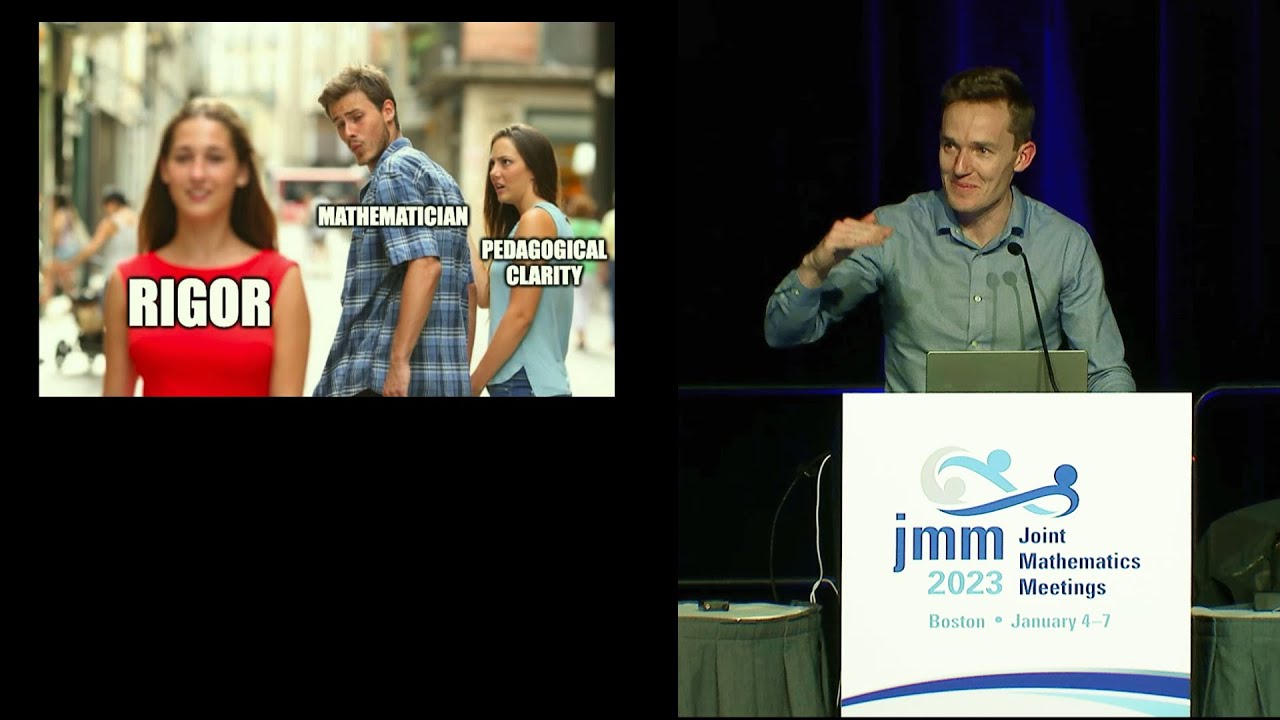
What steps can the math community make to improve its communication?
Delivered Thursday, January 5 at the 2023 Joint Mathematics Meetings in Boston, MA.
Reposted here with permission from the AMS
Correction at 50:24 – The measure of transferability score for Class B (3.1) and that for Class A (5.4) should be swapped.
Podcast mentioned in the Q...
he presents some cool studies in here about productive failure or something like that
tepid smelt
wide ice
Truth is, physics folks I know learned how to apply Green's theorem without know...
I feel it's wrong but also know many people in engineering or other applied fields who think like this and do fine.
I feel this is true in software engineering also where many do fine memorizing techniques without understanding what is going on.
So is it wrong if it works for so many people?
cold trench
I personally believe that you should try to understand how things you use work, but if it's not necessary to do your job, then it doesn't matter
wide ice
Whenever you learn something new, pay attention to the way you learn it
Profs usually forget how difficult it is to learn the topic that they're now so familiar with. They tend to explain the way they would explain to a colleague, not a student.
pastel horizon
winged urchin
Most of the time they just have a teacher telling them they've veered off track ...
I think this usually happens because the teacher is not confident enough in exploring alternative approaches
What would you suggest to make it more interactive or independent? This is something people upstairs are trying to get teachers in all subjects to do.
But it seems risky to have them self study and come to the completely wrong conclusions
wide ice
It's not easy actually. Self studying, especially maths, requires a certain level of maturity.
In programs for gifted students, what happens is students get hard problems, but not really high level. Number theory, Euclidean geometry, and combinatorics are great examples. It teaches how to think and how to be creative in maths. (yes, creativity is something that can be taught, to a certain level).
But not all math teachers are familiar with olympiad stuff though. Many are not even comfortable with combinatorics or inequalities.
pastel horizon
I'm currently teaching it to engineering students and a lot of them "just want to pass"
wide ice
Teaching what specifically?
pastel horizon
Calc, matrices, complex numbers, stats, etc
It's quite stripped down tbh but the thing is not many are even interested in the deeper theory
wide ice
You don't have to go that deep to show something interesting
pastel horizon
Well what you and I find interesting some of them won't lol
wide ice
Well, can you give a topic? and I'll try to find something very basic but interesting
pastel horizon
Like e.g. Explaining how matrices are used in video games
It's more like a "huh that's neat" more than anything deeply inspiring
wide ice
Students need a lot of motivation, or else they won't care about that topic. A normal student has like, idk, 10 subjects? If they can drop anything, they will
You kinda need to blow their minds first, before getting their attention
wide ice
pastel horizon
Like e.g. Explaining how matrices are used in video games
Well, true, matrices are not so interesting when you only wanna do video games :D. It's not the main uses anyway, even in CS.
To many, matrices are just a short-hand notation
pastel horizon
I think a problem is there's a culture of "getting people to pass" which makes it harder to instil critical thinking
wide ice
pastel horizon
I think a problem is there's a culture of "getting people to pass" which makes i...
Well, when you have 10 subjects to pass, you won't like pondering on any topic anymore.
wide ice
I excelled when I did my thesis, because I had only one problem to think about, and I would learn anything I need to solve it.
pastel horizon
It's a vocational qual which means they're constantly hammered with coursework
wide ice
Now that I came back to classes, even Math is distasteful
pastel horizon
Another problem is you get a set of students that signed on expecting it to be 100% practical and then they get maths
wide ice
pastel horizon
It's a vocational qual which means they're constantly hammered with coursework
I think a good approach will be to give them one huge project in the beginning of the semester, then teach them everything they need to make it work.
That way, students see connections between subjects, and why they need all of them
pastel horizon
I'm hoping I can move up to the degree level course anyway which will be interesting
When I say degree level. It's basically courses for people that will struggle in a traditional uni environment. So smaller groups, more personalised support and more vocational rather than academic
pastel horizon
wide ice
I think a good approach will be to give them one huge project in the beginning o...
I think it would be a great idea but sadly i don't think it really fits with the qualification body
wide ice
pastel horizon
I think it would be a great idea but sadly i don't think it really fits with the...
Huh, but it's engineering, no? I thought ppl would like a more hands-on approach
pastel horizon
The hands on things they do is like super practical skills like welding
Even then the assessment for welding is just them doing a "simple" weld
wide ice
Ohhh, that kind of engineering
I was thinking of modelling/designing/simulation/etc. Even they don't like math anyway.
pastel horizon
Yeah
On the more technical courses they would have an appreciation at least for how it links
For a lot of the students it's like "yeah do I really need calculus to weld this?" lmao
Tbf a lot of the settings will probably have some sort of mathematical reasoning but they just read it from a table anyway
wide ice
pastel horizon
Tbf a lot of the settings will probably have some sort of mathematical reasoning...
There was a study I think, I heard it from a friend doing finance. When they introduced computers to finance worlds, they found out that traders and brokers did much better than those formulae and models, even though the theory predicted otherwise.
Reading it from a table enough of times, and you don't need calculus anymore 😄
wide ice
pastel horizon
For a lot of the students it's like "yeah do I really need calculus to weld this...
Totally get this. I thought the same about Humanities subjects. I'm still trying to appreciate them, but it's hard when it's not really relevant.
pastel horizon
wide ice
There was a study I think, I heard it from a friend doing finance. When they int...
Something about masters know when they can break the rules
Lol just imagine what English teachers are feeling. They can't even say it helps them to write job applications because "chat gpt can do it for me"
wide ice
This is why I hate Supply and Demand curve so badly. There are things that you cannot put into a curve.
wide ice
pastel horizon
Lol just imagine what English teachers are feeling. They can't even say it helps...
I guess we will find a way, but I don't see how
Well, we managed when calculators came around. Not like we would fail this time
pastel horizon
I'm not scared tbh. Some students you can literally give all the answers to and they still fail
pastel horizon
The funniest thing is when they copy but they somehow manage to copy the most dubious answer that's completely wrong
It's like Chinese whispers
wide ice
I feel this convo is a bit off #math-pedagogy already 😄
pastel horizon
I think it's relevant 😉
How to develop their critical thinking so they don't copy stupid answers 😂
 tawdry venture
in what order would y'all suggest teaching quadratics?
right now i have a tutoring student who knows square roots and the null factor law, and is thus able to solve equations where one of the terms has zero coefficient. so far i have decided to introduce him to completing the square.
i'm not sure whether it would've been better to talk about vieta first
cloud zealot
tawdry venture
in what order would y'all suggest teaching quadratics?
right now i have a tutor...
Po-Shen Loh is a social entrepreneur and inventor, working across the spectrum of mathematics, education, and healthcare, all around the world. He is a math professor at Carnegie Mellon University, and the national coach of the USA International Mathematical Olympiad team. He has pioneered innovations ranging from a scalable way to learn challen...

arXiv.org
This article provides a simple proof of the quadratic formula, which also
produces an efficient and natural method for solving general quadratic
equations. The derivation is computationally light and conceptually natural,
and has the potential to demystify quadratic equations for students worldwide.
you might find this interesting
tawdry venture
oh sure yes i did kind of come close to this
 zinc cipher
Not sure if this is related to #math-pedagogy but I thought I'd try to start a conversation here. I'm currently taking integral calculus and I've noticed that lacking critical thinking skills as it pertains to the logic beyond the theory is causing me to struggle. I think this may be somewhat related to performance anxiety as when I sit down to work problems I must first calm my mind in order to focus.
I've managed to develop critical thinking skills in other areas, so I believe that my performance anxiety is mostly related to math. I struggled with math, but managed above average grades. However, I always felt that my logical thinking in math and general quantitative skills lagged behind all other abilities. Now that I have returned to study math, I'd like to know how to improve my critical thinking aside from working problem sets. Is there a way to develop the mathematical intuition that I lack?
wispy slate
zinc cipher
Not sure if this is related to <#541382507656904704> but I thought I'd try to st...
Keep failing forward. Challenge yourself FOR yourself, not to be competitive or compare yourself. Just knowledge for the sake of knowledge. Get a book on a subject matter within math that you're personally interested in knowing.... something that's not too difficult for where you are, but still a challenge. Go through the book cover to cover reading everything & doing every problem. By the end of the book youll have more CONFIDENCE in your ability to work with math & understand math. The CAPABILITY is within you even now. The ONLY issue is your ability to see it & tap in when you need to. So work through a book over the summer (or whatever season is coming up for you) and gain some more confidence in it.
There's much too much math out there for any of us to truly become a master of it all. So add some focus to what you want to focus on into your life - make it enjoyable. That will allow you to relax your defenses to it so you can begin to build a new belief system around what you can & cannot do. Because again - the skills are already within you. You just gotta tap in. Hope this helped at all!
zinc cipher
Ok, I'll try the approach you suggested. I appreciate your reply.
wispy slate
No problem. It's what I did myself. I used to struggle with math and it felt so unnatural until I got a math book and went through it myself. I gained confidence & now I have a math degree.
zinc cipher
I'm going to be taking discrete math this summer, so maybe I'll find something related.
zinc cipher
wispy slate
No problem. It's what I did myself. I used to struggle with math and it felt so ...
That's great to hear.
wispy slate
Yep something to help you prepare for that class so when its time to take it, youll have complete understanding of the foundations and be able to keep up in your class and even excel if you want.
zinc cipher
Ok
pure coral
zinc cipher
Not sure if this is related to <#541382507656904704> but I thought I'd try to st...
for integration... well, other than "funny rectangles under graph", a lot of the intuition really comes once you learn the different approaches to integration. for now, you want to expose yourself to as many examples of the two basic integration maneuvers of integration by parts and substitution as possible, and not just to compute integrals, but also to turn complicated integrals into simpler ones
this is for the future probably, but it's often worth revisiting the basics later on to see what new approaches you have for old concepts. for example, there's the lebesgue integral which is the definition of the integral most congruent to the "area under a curve" intuition (because to define the lebesgue integral, you first have to define areas, volumes, etc rigorously now), and there's also differential forms which give you an algebraic tool to work with integrands and put the dx stuff on a rigorous footing
tepid smelt
wispy slate
Keep failing forward. Challenge yourself FOR yourself, not to be competitive or ...
What I find frustrating is that students often don't like to be challenged. I find they get angry when they have to think through a problem that could have multiple approaches. I find that because they have been trained with math as a recipe of ideas they really don't know how to handle what doing math is really like..
 white forum
wispy slate
Keep failing forward. Challenge yourself FOR yourself, not to be competitive or ...
white forum
wispy slate
Keep failing forward. Challenge yourself FOR yourself, not to be competitive or ...
This was a great response!
white forum
tepid smelt
What I find frustrating is that students often don't like to be challenged. I fi...
I think that this feeling also comes from the fact that most math students face in a classroom is graded. If they have to take multiple attempts to think through a problem, getting an attempt wrong and moving on to a different method isn't so easy when you might lose points from your grade if you started with the wrong method. So students dislike questions where the path isn't clear, because they could get them wrong a few times before figuring them out
long pelican
Fun and informative story: this semester I uncovered two cheaters who both used a service like https://www.monorean.com/en
I wonder if anyone here is familiar with students using this. No other math professor (except maybe one) in my department is even aware of this. It seems to be the next cheating rampage that is happening under our noses
Wireless hidden earpiece for exam and cheating camera. Spy earpiece for cheating on tests. Wireless earpiece for phone
They're both seniors who need this class to graduate as well 😆
wispy slate
How they gonna pay hundreds of dollars and still get caught 🤦 how did they make it so far enough to become seniors in the first place?
long pelican
I feel like they're both rich enough not to care about the hundreds of dollars
One of them certainly seems to get coaching in political threats because he mentioned he felt "racially profiled" in an email
wispy slate
I can't with these people, I don't think I'll ever understand a cheaters thought process.
 acoustic mulch
what i have seen college seems to not care if you cheat kinda wish teachers care more
they are allowing kids who are not educated to go to the real world and fuck everything up
cold trench
acoustic mulch
what i have seen college seems to not care if you cheat kinda wish teachers care...
in my university professors will likely fail you if you cheat and then you'll have serious repercussions with the university, I thought this was standard
long pelican
The sad thing about my situation is that hard evidence of cheating is hard to present when it's dictation from a professional rather than plagiarism or copying off another student
cold trench
guess that's the point
shadow flower
how did you catch him?
long pelican
(I had him sit in the front) never did any scratch work anywhere yet wrote clean textbook-like proofs first try, combined with multiple errors that could only be explained as dictation errors
also never came to class, and did no homeworks
rain rain
Do y'all think there's any benefit to just reading a book and attempting informal proofs as a way to build mathematical maturity?
quasi musk
rain rain
Do y'all think there's any benefit to just reading a book and attempting informa...
You don't always have to work rigorously on proofs to learn something
rain rain
I agree but I’m also worried about overrelying on my intuition and not verifying that intuition is actually technically accurate (at least for the most part)
quasi musk
Many times I just read books or papers for background knowledge while only writing notes on the margin, or half-attempting problems
rain rain
So I just go on with the wrong understanding of whatever I read because I didn’t take the time to thoroughly explore the objects I’m learning about
quasi musk
There'll be plenty of times in classes to correct your intuition
The only way to get a better understanding or to make sure you don't have the wrong solution is to have someone who already knows help you out
rain rain
Yeah issue is I won’t be taking any classes (or at least not for a long while), I’ll be learning purely math on my own/on the Internet
So no classes to force myself to learn correctly, just gotta chat with others and learn as I go
quasi musk
I think that's the best that you can do
winged urchin
Try contest problems at your grade level
Those are fun and if you find yourself seriously stuck or not knowing notation then look it up
white forum
long pelican
Fun and informative story: this semester I uncovered two cheaters who both used ...
I feel like I am on my colleges watchlist after clicking that link
cold trench
been there done that
 tribal tiger
long pelican
Fun and informative story: this semester I uncovered two cheaters who both used ...
tribal tiger
long pelican
Fun and informative story: this semester I uncovered two cheaters who both used ...
This could probably be worked around by a student dedicated enough but would having students turn off their phones fix this?
I'm also curious as to how the person on the other end knows the questions I guess you say them into the microphone?
long pelican
tribal tiger
This could probably be worked around by a student dedicated enough but would hav...
I believe the technology is advanced enough that you don't need phones or even wifi to do this communication. The person on the other end gets the questions via a hidden camera in, for example, a mechanical pencil, a pen, or a button on their shirt
If done properly, it's basically undetectable unless you bring some high tech scanner equipment yourself or they make multiple incriminating transcription errors (which is what happened in this case)
 lethal leaf
damn that's crazy
I'm also surprised it's just openly advertised as a cheating thing
I would have expected some attempt at a fake secondary use case
how did you find the second person @long pelican
ok the person receiving the info, you found diction errors
I presume the second person was the person doing the dictating?
how did you find that?
long pelican
I can't find the second person, it could be anywhere around the world
long pelican
Yeah!
lethal leaf
jeez
tribal tiger
Did they both make the same mistakes?
tribal tiger
Oh wow
That's pretty big
Like that shows you know nothing about what you're cheating on
lethal leaf
renewable singularities, as opposed to singularities created from fossil fuels
 sour geode
what is amth pedagogy?
tribal tiger
Read the description
 wide torrent
at uoft and Ubc the consequences for that kind of stuff are very strict
usually a suspension for a year and a zero for that class + it goes on your record
pallid night
long pelican
"renewable singularities" is one
Is this supposed to be a complex analysis course ?
How does one expect to be believed that they know complex proofs off the back of their head but don't know what a removable singularity is.
Sincerely,
Student cramming for a Complex Analysis exam tomorrow
long pelican
pallid night
Is this supposed to be a complex analysis course ?
How does one expect to be be...
Haha exactly, and good luck!
pallid night
long pelican
(I had him sit in the front) never did any scratch work anywhere yet wrote clean...
Do you have a logic to how you seat students for exams ?
Like, do you have certain things you watch for that are indicators they are more likely to try to cheat ?
long pelican
I noticed things on the first exam (where I didn’t make any seating requests)
wide torrent
long pelican
Fun and informative story: this semester I uncovered two cheaters who both used ...
how were you able to catch them, if you don't mind sharing? Those could easily pass as earring studs
I saw you say that they couldn't write out their work but how did you manage to spot the device?
long pelican
wide torrent
how were you able to catch them, if you don't mind sharing? Those could easily p...
No, I didn't catch them that way. It's pretty much undetectable unless I want to break some personal privacy laws
wide torrent
oof
They might be able to get away with it then since there's no hard evidence
;/
wide torrent
how someone would get to yr4 math and cheat is beyond me
long pelican
Lots of money
austere inlet
- the pandemic years I guess, my impression is that a lot of people have normalized cheating even more since then
if they're seniors they probably passed their freshman and sophomore courses in '20 and '21 resp.
austere inlet
austere inlet
+ the pandemic years I guess, my impression is that a lot of people have normali...
I say this purely because I've heard of cheating instances a lot more often from profs. and friends since then
pallid night
pallid night
Sincerely,
Student cramming for a Complex Analysis exam tomorrow
This exam was seemingly kinda hard 💀
The questions were either completely trivial, really hard or conceptually obvious but sloggy.
pallid night
wide torrent
how someone would get to yr4 math and cheat is beyond me
Because they got through Y1-3 by cheating
long pelican
Agreed
vagrant meadow
was sort of talking about this in #linear-algebra yesterday about how most courses use real vector spaces and always use real scalars and then (only sometimes) halfway through surprise students with letting scalars be complex and then they have to redefine the dot product. but why not just use F from the start, let most of the examples use F=R, and then talk more specifically about R and C when you get to inner products? is F just too scary to lower division students?
i don't think you have to rigorously define a field to use the word. i feel like you can just explain it as "scalars we can add, subtract, multiply, and divide. like the real, complex, and rational numbers".
most students aren't overly concerned with intense rigor. maybe they'd appreciate not having to redefine things over and over just because you're introducing different types of scalars? idk what do y'all think
devout fable
vagrant meadow
was sort of talking about this in <#540211747613704221> yesterday about how most...
My course completely ignored complex numbers
vagrant meadow
devout fable
My course completely ignored complex numbers
see and i really kind of hate that tbh. because i think the complex stuff in linear algebra (hermitian/unitary matrices) are really cool and interesting.
devout fable
I guess so far with what I’ve encountered in mathematics, I’ve never needed to work with complex vector spaces. Sure you can always talk about what should be taught in a course, but at the end of the day I don’t really think it makes much impact on students future academic careers
 light garnet
vagrant meadow
see and i really kind of hate that tbh. because i think the complex stuff in lin...
light garnet
vagrant meadow
see and i really kind of hate that tbh. because i think the complex stuff in lin...
Mine did too. Furthermore, there's a trend these days of only talking about R or the n x n matrix with entries in R and maybe superficially go through vector spaces (maybe verify something is a subspace, for example). I know plenty of courses that omit the inner product space material, too
devout fable
Yep that’s exactly what mine did
vagrant meadow
devout fable
I guess so far with what I’ve encountered in mathematics, I’ve never needed to w...
but at the end of the day I don’t really think it makes much impact on students future academic careers
what about people who want to study linear algebra and complex vector spaces 🙃
light garnet
vagrant meadow
most students aren't overly concerned with intense rigor. maybe they'd appreciat...
I have personally found that intro LA textbooks that people widely use to try to introduce things in generality do a poor job at it... let me find that example
I didn't realize until I took abstract algebra that this problem I got in my LA class was just poor notation
 devout fable
vagrant meadow
> but at the end of the day I don’t really think it makes much impact on student...
devout fable
vagrant meadow
> but at the end of the day I don’t really think it makes much impact on student...
Is that me?… I do find myself needing to learn random matrix theory and some stat physics right now 🤷♀️
Unless you mean people who want to study it for the sake of studying it and not some ulterior goal. Then fair, I don’t have a good response
vagrant meadow
kind of both
devout fable
light garnet
This makes my eyes hurt
light garnet
vagrant meadow
was sort of talking about this in <#540211747613704221> yesterday about how most...
Also, one general comment I'd like to make is the reason I observe most people struggle with vector spaces is because they haven't been taught how to deal with axioms, theorems, proofs, and the like. When you've gone through the motions of just learning computational tricks for 3-4 semesters of calculus without really thinking about what your computations precisely mean, it's not surprising
light garnet
devout fable
This makes my eyes hurt
Yeah, this was a "challenge" problem that my LA professor gave us
devout fable
Well you do think about what your computations mean, just not deal with the abstraction
vagrant meadow
light garnet
honestly that's probably my favorite example of a vector space. i like it quite a bit actually
devout fable
Even as someone who just finished third year of undergrad I still find abstraction awkward and not quite making sense until I get to use it a lot
vagrant meadow
light garnet
Also, one general comment I'd like to make is the reason I observe most people s...
but i get what you mean. usually LA is the first intro to proofs.
light garnet
But yeah, especially these days (keep in mind, I was in school 10 years ago), when someone tells me they've taken "LA," I have to dig to know if they've done a proof-based LA or a computation-based LA where they're just programming stuff into MATLAB
vagrant meadow
i feel like generally the hardest part of LA (why most people struggle with it) is a combination of it being their first intro to proofs and just a generally poor approach to teaching it. like there's too much of a focus on matrices and rref rather than linear transformations. students don't know what they hell they're doing, what a matrix actually tells them, or why it matters
devout fable
I didn’t even learn eigen decomposition from LA course
Now it’s the only thing from LA I use haha
vagrant meadow
"wife decomposition" LOL sorry that's just so funny to me
vagrant meadow
devout fable
I didn’t even learn eigen decomposition from LA course
wtf you didn't learn eigendecomp in LA?
devout fable
Apple auto correct 😩
light garnet
vagrant meadow
wtf you didn't learn eigendecomp in LA?
I didn't either, was forced to learn it as well as SVD in grad school
as well as the Woodbury formula and the Cholesky factorization
vagrant meadow
wait like... seriously? no eigenvectors/diagonalization??
light garnet
vagrant meadow
wait like... seriously? no eigenvectors/diagonalization??
They would teach you the definitions and end it there
That's it
devout fable
I mean they might have taught it to us…but I never actually learned it
light garnet
Maybe show some really basic results
I definitely didn't learn eigendecomposition, SVD, Woodbury, or Cholesky in LA, and it wasn't until grad school in stats that I was forced to learn them
vagrant meadow
light garnet
I definitely didn't learn eigendecomposition, SVD, Woodbury, or Cholesky in LA, ...
i sort of get the latter three. that is sort of more suited to a numerical linear course. i was lucky and got to sit in and tutor for a class where the prof's goal was to teach SVD. that was an extremely interesting course.
pallid night
light garnet
I definitely didn't learn eigendecomposition, SVD, Woodbury, or Cholesky in LA, ...
QR, Eigen and Singular are the ones I've done after two full linear algebra courses
wide ice
devout fable
Well I don’t think cholesky or woodbury is standard anywhere
It is for me
I did almost everything in basic LA because of numerical stuff. Eigen, Cholesky, SVD, LU, Gauss-Seidel, Jacobi, etc.
But nothing suuppppeeeerrr theoretical, just basic stuff.
vagrant meadow
wide ice
I did almost everything in basic LA because of numerical stuff. Eigen, Cholesky,...
hmmm i suppose that is an interesting point. the main application of linear algebra tends to be in numerical analysis and programming. and those are really important concepts in those fields.
maybe i'm too caught up in a very theoretical approach to linear algebra.
though, my goal is to teach linear algebra alongside ODEs, so i guess the theory is kind of the main point in that context...
wide ice
It can be numerical too, and ppl like it better when they can do stuff with it, not just proving.
I am pretty sure the only reason I still remember all of this is because I once coded them myself
pure coral
vagrant meadow
was sort of talking about this in <#540211747613704221> yesterday about how most...
i like going beyond R and C and considering finite fields as well
and even modules should be covered as well i think
vagrant meadow
pure coral
i like going beyond R and C and considering finite fields as well
yeah agreed! i feel like real vector spaces are just too small a fraction of what linear algebra can offer.
there are so many other fields out there
pallid night
vagrant meadow
there are so many other fields out there
I remember a feedback quote a lecturer of mine wrote ...
"Some of you still think the real numbers are more real than other fields"
vagrant meadow
pallid night
I remember a feedback quote a lecturer of mine wrote ...
"Some of you still thi...
LOL i love that so much
pallid night
vagrant meadow
LOL i love that so much
He's infamous for writing up some rather savage general exam feedback scripts
cloud zealot
meckes is an introductory linear algebra textbook that works over arbitrary fields
it tries to give attention to both theoretical and applied people
maybe some of you might find this book interesting?
fwiw john baez wrote a very favorable review of this book
pure coral
cloud zealot
maybe some of you might find this book interesting?
i glanced at it and it's basically better axler for me
pure coral
vagrant meadow
yeah agreed! i feel like real vector spaces are just too small a fraction of wha...
yeah, especially when not even considering real dual spaces which are incredibly important compared to how little attention they get
plus i think there needs to be more emphasis on studying the whole family of abelian structures in general (abelian groups, modules, abelian-valued sheaves), and when they are the right theory for a problem, such as when you are studying objects that can be "scaled" by some action of a monoid and gluing doesn't mean much more than just taking multiple objects together
an elementary example would be that when counting how many apples are in multiple buckets, you can count them in any order, and as long as you count all the buckets once, you'll get the same result always – no coincidence that Z is abelian. or as another example, what an eigenvector really represents is a subspace where the linear map is just an action of a field, which means that when studying the linear map on those subspaces, we can use the field's nice properties like completeness which allows us to do calculus, perhaps also algebraic closure, etc
 stoic radish
How would you recommend teaching/giving advice for hs level math (mostly computational)? Sometimes i feel a bit frustrated not teaching the theory as i feel like it makes it easier but they don't really need to know it. I also feel like telling them to just do problems until they get it is a bit of a cop out although that is what helped me ace my classes in highschool. For example, a lot of people who come to me for help struggle a lot with basic lin alg concepts like matrix multiplication and row reduction (finite math class). Now i dont go all the way into linear maps, but they dont even learn the notion of a pivot and barely understand leading 1s past the fact that "there is a 1 there." I feel like once they get that row reduction is very simple but im wondering if it would be better to spare the 30 mins teaching that and instead just work through and explain sample problems
pure coral
stoic radish
How would you recommend teaching/giving advice for hs level math (mostly computa...
it's a good approach to teach inductively rather than deductively: you first start with worked example problems that illustrate a concept, then you give the student a chance to induce the general concept you're leading them to with clever questions
the big issue isn't really general knowledge as much as how difficult it can be to apply the right knowledge to problems
as usually how things are taught is that we immediately start categorizing knowledge before actually filling that category with concrete examples, but that's an issue since to solve a problem, the student has to have associated the features of the problem to the relevant knowledge
vagrant meadow
stoic radish
How would you recommend teaching/giving advice for hs level math (mostly computa...
yeaaaah i mean i totally agree and empathize with what you're saying. and if the student is super motivated, maybe showing them some advanced concepts can really inspire them (i know i personally would have loved that, but that's also why i send messages in this channel). but those kind of students aren't usually in tutoring very often. 
most students couldn't care less about the theory or tricks that would make things easier. trying or offering can sometimes even spook them because they're worried they might get docked points on an exam for using a technique their teacher didn't teach them. most of the time, they just want to know the minimum amount of knowledge/practice so that they can pass. that's also personally frustrating to me, and that's why i don't like tutoring high school, and i don't plan to become a high school teacher lol
telling them to just practice might feel like a cop out (to both you and them), but that's partially because they're subconsciously hoping that there is some magic trick to becoming proficient at math. the hard truth is that competence comes with practice.
i will say there is value in conceptual knowledge. exclusively practicing, without knowing what the hell you're doing or why, is not super effective. but then there's the issue of "do they actually want or care to know". and you can lead a horse to water, but you can't make it drink.
i work as a tutor at a community college, and i've also done tutoring for high school students. what's interesting is that the college students are far more motivated than the high school ones. i think because the college students know they need help, and come in for tutoring. whereas the high school students usually don't even care or want a tutor, and their parents are just forcing them to work with one. so that's also a factor in how receptive or not they are to advice and help.
 drowsy otter
I am a Maths tutor currently tutoring someone online. This student is 10 years old and having trouble with division below the 12 times table, and I would like to be able to teach them how to, for example, figure out 30 / 5. I was advised to teach it visually as opposed to mentally, but I have no idea how to. Do any of you have any ideas how to visually teach division? The student is reluctant to learn, but it's likely that they just do not understand. They see the point in multiplication, but not division. Thank you guys.
quasi musk
drowsy otter
I am a Maths tutor currently tutoring someone online. This student is 10 years o...
You can try phrasing it like a multiplication problem
5 times a number is 30, what's my number?
You can also try drawing out something of length 30, dividing it into 5 pieces
How long should each piece be?
etc.
drowsy otter
To do it visually, I could make like a circular pie, and attach a value to that pie.
For example, 30, so how big is each piece if all 5 pieces are the same, etc?
Hopefully, the student will realise that it's "5 times what equals 30" and answer 6. Does that sound like a good solution?
austere inlet
drowsy otter
To do it visually, I could make like a circular pie, and attach a value to that ...
I think using the analogy of diving a group of 30 objects (marbles, candies whatever) between e.g. 5 friends is more natural than just assigning a value to a circular pie. The numbers and the need to perform division arise naturally in the first problem and not so much in the second -- a pie analogy might work best to emphasize e.g. what it means to take 1/5, or 20% of something. Just my thoughts
or things like if I'm splitting a $30 bill between 5 friends, how much should each person pay
drowsy otter
I think using these "natural" analogies are indeed a better idea than my pie idea. I shall incorporate those examples into the word problems (which I do already).
drowsy otter
Thank you very much, you two.
vagrant meadow
finding a homogeneous + a particular solution is a concept that appears in both linear algebra and in solving linear differential equations.
in a course that teaches both, which of the two is it more natural to come up in first? would introducing that concept be more concrete in diff eqs, and then that intuition serves the student when they are solving Ax=b in linear algebra?
or would it be better for the linear algebra concept to lend itself to intuition for why you need both to solve a diff eq?
i suppose in general, there are a lot of linear algebra applications to solving linear odes. originally, i thought learning the linear first and seeing them as applications would be the most helpful, but now i'm thinking that there's far more motivation in a concrete differential equations application that could then serve to make the more abstract linear algebra concepts stick.
meager bronze
starting with linear equations makes more sense to me. students are already familiar with the idea of solving a system of linear equations; solving 2x2 and 3x3 systems is a skill typically taught in high school algebra
wide ice
I would do both in parallel
I would first teach simple ODEs first, then transforms the higher order ODEs into matrix form. That gives a good motivation to study LA.
Then you can teach LA while occasionally coming back to ODEs.
The idea is great, but a bit too much just to solve linear system. Doesn't feel natural to me.
Also all these eigenvalue thing-ies, if you will cover it, make best sense in the context of Hartman-Grobman theorem
And seeing how dynamical system "flows" is far more visually appealing than watching some abstract characteristic equations.
empty gull
I hold the view that when students learn how proofs work in math it would be immensely helpful to perhaps first have a mandatory first order logic course where you learn how proofs work in a more friendly environment where things are more streamlined
I'm unsure if this is how intro to proof classes are usually structures (but some people mentioned learning how to prove from Rudin which seems inhumane)
I had a first order logic class my Junior year of HS (mandatory too!) and I believe it helped me a lot to have better intuition and just generally keep track of things when doing proofs
winged urchin
I definitely feel like first order logic could be taught at the highschool level
I even show it to some of my brighter elementary school kids I tutor
hard fog
drowsy otter
I am a Maths tutor currently tutoring someone online. This student is 10 years o...
You could help him find appropriate ways to approach a problem. As 30 is a multiple of 10 he can start there. 30/10 = 3. If 102 =5 then 30/5 = 23
 covert hearth
winged urchin
I definitely feel like first order logic could be taught at the highschool level
covert hearth
winged urchin
I definitely feel like first order logic could be taught at the highschool level
I definitely got FOL taught at the hs level
well at least predicate calculus
cosmic ibex
It's common to teach the symbolism of quantifiers and common logical connectives at a fairly early stage, but I'm somewhat skeptical that you were also taught either a formalization of FOL semantics or a formal proof system for it.
empty gull
cosmic ibex
It's common to teach the _symbolism_ of quantifiers and common logical connectiv...
We didn't develop FOL semantics rigorously (tho we did talk abt FOL semantics) and we were taught natural deduction which is ig a formal enough proof system?
cosmic ibex
Right, I'll accept that as a formal proof system. :-)
Teaching that in high school sound uncommon, though.
empty gull
(tbh I'm not too much into foundations so I don't really know what would constitute a formal proof system lol)
empty gull
cosmic ibex
Teaching that in high school sound uncommon, though.
Yeah here's an example of like a solution sheet for a hw we did

I feel like it was logic methods class rather than developing everything like super rigorously like I image mathematical logic classes do it
cosmic ibex
Ugh, Fitch notation.
empty gull
lol I got too used it now everything else looks awful to me
pastel horizon
Copying the answer for another assignment which was reprinted with different numbers because that person copied has got to take first prize for the dumbest thing a student has done
long pelican
I've had that too 🤣
pastel horizon
And yet they insist "oh no I didn't copy or collude with anyone" lmao
pallid night
pastel horizon
Copying the answer for another assignment which was reprinted with different num...
What about using an online Chinese Remainder Theorem calculator and writing down the exact steps given by the calculator ?
Or ... copying a stackexchange proof ?
(All in open book online setting)
pastel horizon
Guessing you never taught the things they regurgitated lol
I wouldn't even care about that provided they could actually explain the steps. Usually they can't and it's like "right do it my way then"
pallid night
pastel horizon
I wouldn't even care about that provided they could actually explain the steps. ...
Oh this person couldn't explain the CRT steps.
They'd have got away with it if they hadn't written down the steps as well cos they didn't have to submit rough work, only a general outline of their final solution
vagrant meadow
pastel horizon
Also this is about pedagogy
 dreamy moat
ayuda
meager bronze
!help
 coral copperBOT
Please read #❓how-to-get-help
 tawny laurel
how useful is a graduate math degree if you dont intend on teaching? (finance or something as a career as well? <assuming u have some finance background like a minor or some internship experience>)
empty gull
tawny laurel
how useful is a graduate math degree if you dont intend on teaching? (finance or...
the higher the degree the more hireable you are generally
i don't think you can do much with just a math bachelors
tawny laurel
empty gull
the higher the degree the more hireable you are generally
i see, thanks
lethal leaf
empty gull
i don't think you can do much with just a math bachelors
You can if you have other skills
I would also say that if you get a math graduate degree you also need to still have other skills
(not really a pedagogy discussion tho)
winged urchin
I do believe math is one of the more flexible degrees in that it applies to many other different areas and even just learning more of how to critically think is important
But I don't have the most experience with the job market even though I do have a PhD. I just chose to be a tutor after school and am happy enough aha
But that falls into the teaching category I suppose
light garnet
tawny laurel
how useful is a graduate math degree if you dont intend on teaching? (finance or...
If you intend on entering the job market and even somewhat using your skills that you accumulate during your degree, you cannot avoid programming
Note that I have a very US-centric perspective on this, so this may not apply if you're outside the US
light garnet
winged urchin
I do believe math is one of the more flexible degrees in that it applies to many...
My view of the US job market is the following: employers aren't paying people to "think." They want people to hit the ground running on day 1 and deliver.
turbid zenith
Not so much math pedagogy as much as teaching practice in general... What do y'all think of the idea of letting students see their letters of recommendation I write for them?
meager bronze
is there a specific issue you're thinknig about? like ethically? i don't see any problems with that
as long as the fact that they are going to see it doesn't influence how you write it
covert hearth
light garnet
My view of the US job market is the following: employers aren't paying people to...
100% true
If you want to think you have to take the risk yourself
If you want to found a startup on VC money, then you can think about cryptography theory all you want
But if you want to work for example for google, what you gotta do is grind similar problems to the ones you'll work there
🙂 🙁
shadow flower
I would have loved to see the letters that were wrote for me but my advisor (who was writing one of the three) said that if i had requested to read the letters that it may alter what is written in it so i chose not to read them
so i agree i think you should let students read them but be really cautious on writing anything different because of that
wide ice
Maybe ask the student first. I was also asked if I wanted to see the reclet for me, and I said no, saying I trust the prof to write their best.
Imo the practice for reclet is you only ask profs whom you know for certain that they can and will write good things about you. If a prof can't write good about you, they will say so and say no already. Writing what good things is up to prof's call, and seeing the reclet doesn't change anything: you can't just read the reclet and say "Oh btw, I want to mention this and that." It's ordering the prof, quite disrespectful imo.
Reclet is supposed to be prof's impression of the student. If they forget something, so be it. If they want to recall impression because it's a long time ago, they will ask. Some profs require a one-to-one meeting/sending resume for this.
cold trench
shadow flower
I would have loved to see the letters that were wrote for me but my advisor (who...
"may alter what is written" is a respectful way of saying there's something he wants to say behind your back
 unkempt glen
.
shadow flower
cold trench
"may alter what is written" is a respectful way of saying there's something he w...
what do you mean? something that he would put in my letter that he would leave out if he knew i was going to read it?
shadow flower
I hope he was being general with it. I never considered that though. I asked him why program would let the writer know that the letter would be read by the student and he thought about it and said that what he said 🤷♀️
 pale wasp
Sometimes there's confidential information about other people (eg comparisons) in the letters
It is standard for students to not supposed to be able to see their rec letters
Employers reading the letter may view the letter as less genuine if they know the student could see the letter
vagrant meadow
pale wasp
Employers reading the letter may view the letter as less genuine if they know th...
i was able to see one of my letters and it really boosted my confidence and motivation to succeed. but i thought something like this would be the reason not to ask for them. i assume there's just more honesty if the writer knows the student won't read it. bc of that i've never asked to read any of my letters.
if i ever write one, i'd never let a student i couldn't write a strong letter for read it (though idk if i'd agree to write one in the first place if that was the case). but if i was writing a really good one, maybe i'd let them. but it also might be safer just to always say "no".
turbid zenith

I've been playing around a good bit with @OpenAI's #ChatGPT, and I'm continually astounded by what it can do.
So I've decided to fully embrace it and integrate it to help me become a better mathematics teacher.
🧵 [1]

 Twitter
·
light garnet
turbid zenith
https://twitter.com/solidangles/status/1661864327232512003
Twitter
·
light garnet
turbid zenith
https://twitter.com/solidangles/status/1661864327232512003
This was a conversation I had with ChatGPT


 light garnet
turbid zenith
Also, GPT-3.5 or 4?
light garnet
turbid zenith
Also, GPT-3.5 or 4?
Think it may have been 3.5. I'll give 4 a shot sometime
vagrant meadow
turbid zenith
i think this is right. it's easy to point and laugh when it make a fool of itself rather than genuinely consider using it as a tool. for example, it has helped me realize a number of complicated coding projects, even though i'm new to python coding.
i think there is great potential to have it summarize, simplify, and explain mathematical concepts for students (with supervision). it's really quite excellent with language, the things it says sound good, but you just have to be able to keep an eye out for when the content is lacking or incorrect. with proper guidance--that is, not just trying to lead it into saying something wrong--i can see genuine applications to education.
that said, the danger of a novice using it can lead to a blind leading the blind situation. there have been cases where i've asked it math questions and thought "damn, if i didn't know this subject as well as i do, i would totally have believed that this nonsense proof/explanation was valid". supervision is key, i think.
turbid zenith
light garnet
Think it may have been 3.5. I'll give 4 a shot sometime
Already one step ahead of you.

 vapid herald
Someone asked me to explain determinant. I'm going to explain how it's a signed scale factor of the volume of the parallelpiped with basis vectors for sides under the transformation. Should I include any equivalent definitions? This is a premed student in computational linear algebra course.
cosmic ibex
I don't think I'd consider it a full explanation unless it also mentions some other elementary properties of the determinant (a polynomial in the matrix entries; nonzero iff the matrix is invertible; determinant of product is product of determinants; invariant under basis changes; etc).
vagrant meadow
vapid herald
Someone asked me to explain determinant. I'm going to explain how it's a signed...
cofactor expansion i think would be good. but any of the other defs (permutation def, multilinear in the rows/cols or however Artin defines it in his Algebra text) are pretty unnecessary and confusing.
but it's good to do it in terms of volume/area i think.
vapid herald
I talked about the invertibility criterion and they were able to explain why it's true so I consider it a win
wide ice
determinant is one of those things that go infinitely deep 😄
 snow shoal
Thoughts on what’s worked for a flipped classroom? I’m going to be student teaching 9th grade for fall and I’m pretty unfamiliar with a flipped classroom environment. Just wanted to ask if there’s anything that stuck out to y’all as working well and stuff that didn’t
Also they use “kagan cooperative strategies,” but I’ve never heard of him
quasi musk
snow shoal
Thoughts on what’s worked for a flipped classroom? I’m going to be student teach...
You have to have a way of holding students accountable for getting students to actually do the work
Many students in 9th grade don't know how to read a math book
vagrant meadow
quasi musk
Many students in 9th grade don't know how to read a math book
has anyone here had any success with a flipped classroom situation? i feel like this, or just general lack of motivation in students, results in it being a disaster every time. i don't think I've heard any positive experiences with it.
zenith slate
I've certainly never had any success with anything like the flipped approach
I could see it working for older students in fairly small groups
The model is predicated on the idea that students will self-study the material prior to the session and kids in 9th grade aren't exactly fantastic at this
As for the Kagan stuff... it's a nebulous set of "models" that are mostly communicated via expensive books and workshops
It's the usual "revolutionary" teaching bs that comes with a hefty price tag and absolutely no evidentiary basis
snow shoal
zenith slate
It's the usual "revolutionary" teaching bs that comes with a hefty price tag and...
That’s mostly what I felt like I was seeing lol
zenith slate
Sure there will be studies that show it works but you'll invariably find that the only place it's been tested is in small classrooms of kids with wealthy parents at expensive private schools
Pedagogy is absolutely chock full of pseudoscientific garbage
snow shoal
Yep, that’s something I’ve noticed a lot lol
zenith slate
In any case a student-led approach can certainly work depending on the group but it is very important that the instructor still enforces a rigid structure
Why are you teaching a flipped classroom?
zenith slate
snow shoal
Thoughts on what’s worked for a flipped classroom? I’m going to be student teach...
And what do you mean by "student teaching"
quasi musk
vagrant meadow
has anyone here had any success with a flipped classroom situation? i feel like ...
It worked really well in a graduate class I took with 2 other friends and the professor was teaching us his research area
but outside of that I haven't seen it work very well
pure coral
snow shoal
Thoughts on what’s worked for a flipped classroom? I’m going to be student teach...
it's definitely going to be difficult for grade 9s, being able to effectively self study requires good executive functioning skills which grade 9s aren't going to be the epitome of lol
i guess the main value is that, provided the students review the material a few days before the class on that material, it gives them spaced practice on elaborating on it
and versus lectures, the students have time to process the information, whereas in a lecture where they might be more focused on copying notes down
but you'd need really good instructional materials as the students would not be able to ask questions, and also certain students might not have a great environment for studying at home
i think your main priority should be to enrich the content and provide new perspectives that their (probably) badly-written textbooks won't give - i assume that your grade 9 class is going over some basic algebra stuff, and i think you should try to make a link to geometry as much as possible, e.g., perhaps illustrate how solutions of equations relate to geometry, or how functions can be treated globally as transformations of space instead as locally on points
snow shoal
zenith slate
And what do you mean by "student teaching"
At the end of my degree is a semester internship where I work with a teacher full time (it’s in Texas if that helps)
I usually call it clinical teaching, but somebody yesterday said it was confusing lmao, can’t win no matter what I call it 😆
snow shoal
pure coral
i think your main priority should be to enrich the content and provide new persp...
That all sounds good, for what it’s worth it seems like a fairy high performing school, so I’m not too worried about the instructional material being toooo far out of reach
What I AM really worried about has already kinda been mentioned. Do students have the proper foundation to learn how to be accountable for their own actions, and if not (which will almost certainly be the case) how do I support them.
I think that’s the main thing I’ll be looking at during the semester tbh
We’ll see the quality of the instructional materials. And differentiating’s going to be big because this school more than others has literally every combination of age, race, sex, socioeconomic status. It’ll be interesting
Sorry for off topic, it’s way past my bed time. Yeah, Geometry reach would probably be useful for students who work better in that kind of stuff or high achieving students
snow shoal
zenith slate
Why are you teaching a flipped classroom?
Not my choice. It’s the school I’m interning at to be certified
Didn’t get to pick the school either. I would have preferred a school that uses minimal technology but that’s just my preference
pure coral
snow shoal
What I AM really worried about has already kinda been mentioned. Do students hav...
i’d say set high expectations as it is too easy to be lax, the students don’t have the maturity to see that the stuff they’re learning is important yet even if you try to show why, so unfortunately you are going to have to be more of a drill sergeant and less of a coach
but don’t copy their screaming and swearing ofc, manifest it in the content and tests
pure coral
snow shoal
We’ll see the quality of the instructional materials. And differentiating’s goin...
with a flipped classroom, a minor benefit is you could vary the amount of support given in the materials for each student
of course have a few things each student has to go over, but for the struggling students, you could give them more examples to study, while for those who aren’t struggling, you could instead give them exercises to apply and integrate their knowledge
frequent low-stakes practice tests are good not only intrinsically, but also to see how well each student is doing so you can tailor the material to their skill level
tawdry venture
does anyone else find the terminology "mathematical induction" vs. "strong induction" awkward
wide ice
Not really, no
"mathematical" is a redundant adjective, because induction has its usual meaning beyond math
But "induction" vs "strong induction" are clear to me
tribal tiger
I never really got why you wouldn't use strong induction if such a case exist I think that'd be good to teach as well
snow shoal
mkay, that's all been really helpful, thank you @pure coral, @zenith slate, and @quasi musk for your thoughts 
tawdry venture
wide ice
But "induction" vs "strong induction" are clear to me
so what do you do when you need to contrast induction vs strong induction
do you call the former "weak induction" or "induction induction"
wide ice
When I say "induction", it means the classical induction, proving P(n+1) from P(n)
To me there are "induction" and "strong induction". If no one says "strong", i'll assume it's not "strong induction"
🤷
vagrant meadow
tribal tiger
I never really got why you wouldn't use strong induction if such a case exist I ...
I'm curious about this too. wouldn't it be simpler to only have strong induction? i feel like that's a naive question, but the difference in assumptions doesn't seem large enough to me for it to be that big a loss
wide ice
It's a matter of taste :D. There are ppl who always use strong induction because why not, it's good to have something extra. I tend to use what is absolutely necessary: if the proof doesn't call for strong induction, I won't use it.
Both methods are equally strong. Just that one is more convenient in some cases.
Fyi, there's also something called "backward induction" 😄
It was the usual elementary, high school way to prove Cauchy-Schwartz inequality.
A very powerful idea though.
tardy ember
well there are some types of object where it's harder to define what "strong induction" actually is
but if we're talking about natural numbers then yeah strong induction does kind of just give you more so there isn't any case where induction works and strong induction doesn't
wide ice
Actually, there is one. I just remembered
It's the contrapositive form of induction. You show that if there's a counter example for P(n+1), then there's also one for P(n), i.e. !P(n+1) => !P(n).
As crazy as it sounds, there are problems where this is the only feasible formulation. I can't imagine doing them with strong induction.
vagrant meadow
wide ice
It's a matter of taste :D. There are ppl who always use strong induction because...
i figured that was going to be the general reason. like "minimum necessary force" or something.
vagrant meadow
wide ice
It's the contrapositive form of induction. You show that if there's a counter ex...
ah that's interesting
tardy ember
wide ice
As crazy as it sounds, there are problems where this is the only feasible formul...
if there's a counterexample for P(n), there's also a counterexample for P(k) for some k < n
wide ice
I can't recall any exact statements rn, but I do recall it was very hairy to do that for those problems.
tardy ember
let k = n - 1
wide ice
I know, technically they are equivalent. I just can't recall why I recall it that way.
Must have been some reasons 😄 I forgot a lot of things already
pallid night
turbid zenith
Not so much math pedagogy as much as teaching practice in general... What do y'a...
Good to ensure there aren't any inaccuracies
vagrant meadow
kind of a pedagogical question. in abstract algebra we use \langle and \rangle to denote generation. like <a,b> for the subgroup/ideal generated by a and b. in linear algebra, we have the analogous concept of span and subspaces, but we often reserve \langle \rangle for inner products. what would you think of a linear algebra textbook or course that uses \langle \rangle for span and something else for inner products (maybe brackets [v,w])?
one reason i kind of like the idea is that it's easier to write. i've seen linear algebra professors write things like F^2={e1,e2} when they actually mean F^2=span{e1,e2}. why not just do F^2=<e1,e2>?
 bright karma
I like the idea of using something else for inner products. Square brackets sound off, they are always anticommutative to me. Maybe (v, w)?
This often is used for bilinear forms
g(v, w) or h(v, w) is very standard but its a lot to write
Angle brackets should be span and generation, yes
vagrant meadow
bright karma
I like the idea of using something else for inner products. Square brackets soun...
Square brackets sound off, they are always anticommutative to me
okay cool this is why i wanted to ask in here because there's a lot of math i haven't seen. which context are you referring to here for square brackets where they are anticommutative? my goal would be for the notation to be as connected to other fields of math as possible.
(v,w) could definitely work. i was a bit hesitant bc we already use () for vectors, but i'm open to it
bright karma
One thing to be careful about. Often angle brackets denote free generation especially in the context of group presentations
I like vectors to be column vectors, in square parentheses
Or even row vectors in square parentheses, I think that is quite acceptable
bright karma
vagrant meadow
> Square brackets sound off, they are always anticommutative to me
okay cool thi...
Square brackets usually denote commutators of matrices (or other similar objects). For two matrices, A and B, [A, B] = AB - BA
See “Lie bracket”
vagrant meadow
bright karma
Square brackets usually denote commutators of matrices (or other similar objects...
oh DUH. yeah i can't believe i forgot about that i've spent so much time with commutators 😭
lethal leaf
wide ice
It's a matter of taste :D. There are ppl who always use strong induction because...
there's a CS prof at my school who goes to the extreme of "if they use normal induction, rather than strong induction, take off points"
I don't get it but eh
pure coral
vagrant meadow
kind of a pedagogical question. in abstract algebra we use `\langle` and `\rangl...
i think the most important thing is to qualify the notation with words as much as possible, saying “the inner product <a,b>” or “the ideal (p,q)” removes any ambiguity
it would resolve a lot of problems with readers understanding notation, if the author isn’t allergic to words and narratives
vagrant meadow
pure coral
it would resolve a lot of problems with readers understanding notation, if the a...
this. especially in linear algebra, i see it as a really engaging narrative. but it's taught in such a dry and unintuitive way most of the time. so much emphasis on computation and matrices, and students don't even know what the heck they're doing.
cloud zealot
pure coral
it would resolve a lot of problems with readers understanding notation, if the a...
but symbols save space on paper!


less space taken on words = more efficient communication!
wide ice
Sure buddy
 lethal leaf
cloud zealot
but symbols save space on paper!
lethal leaf
cloud zealot
but symbols save space on paper!
This is what I try to tell people in the discrete math class I'm a TA for
Also half the time they themselves (at this stage) are bad at parsing symbols into English
So idk why they try to go the other way
pure coral
vagrant meadow
this. especially in linear algebra, i see it as a really engaging narrative. but...
yes exactly! linear algebra should be the story of how all the rules that seem overwhelming at first make reasoning with linear maps trivial, and it’s such a shame a lot of that is hidden under bad textbooks, unnecessary matrices, confusing notation, etc
winged urchin
I find a lot of students don't even realize what a statement like "the velocity v(t) ... " Is trying to say. Especially when it's even just a little more dense than that
Mind you when I was a student I wanted to put commas like "the velocity, v(t), ... "
Because it is kinda like that... In the same way youd say "the cashier, Bob, helped me with the bagging"
pure coral
and i think also linear algebra textbooks should be describing the absolute pain of solving problems that can be solved with linear algebra without linear algebra, and then show how linear algebra deals with it almost like magic
winged urchin
But my supervisors never liked the commas aha
pure coral
it’s only fitting that a mathematician came up with “eureka”
winged urchin
pure coral
and i think also linear algebra textbooks should be describing the absolute pain...
Yeah! I've often thought this kind of approach could actually be good for students.
Really show them why it's whatever technique they are learning is useful
Although it could backfire I think if the student thinks you just wasted their time or something aha
pure coral
winged urchin
Mind you when I was a student I wanted to put commas like "the velocity, v(t), ....
haha sometimes i like the commas as well, it just seems off in certain contexts to not have the commas
pure coral
winged urchin
Although it could backfire I think if the student thinks you just wasted their t...
it could be slightly worse for the higher performing students but i think the average performing ones will appreciate a good story
just depends on the storyteller though lol
one thing from the little i read from grothendieck’s works is that he definitely knows how to tell a story, and how to convince people that the old ways are not it
vagrant meadow
pure coral
and i think also linear algebra textbooks should be describing the absolute pain...
absolutely! trying to think of some examples
winged urchin
pure coral
it could be slightly worse for the higher performing students but i think the av...
Where else could we use awfully tedious calculation to motivate why we have the thing we're gonna talk about in class aga
Make em add 17's together 14 times before you introduce multiplication? Ahah
Oh oh if we have a bunch of temperatures in say F but want C you could make em do the conversion for each data point then show them how you could write it generally as an equation
Conveniently that also introduces the idea of inverses somewhat too
vagrant meadow
winged urchin
Where else could we use awfully tedious calculation to motivate why we have the ...
differentiate (2x+5)^6 by expanding and then teach the chain rule 😆
pure coral
vagrant meadow
absolutely! trying to think of some examples
i love the example of computing fibonacci numbers, where you can find the nth fibonacci number by diagonalizing the map (x, y) |-> (x+y, x)
can also show how it relates to two common techniques they'll see in their math journey over and over again: solving a problem by working in a bigger space with additional properties (even though fibonacci numbers are integers, in this case, we solve it by working in the reals instead), and solving a problem on the entire space by solving it on smaller spaces and then patching those spaces together (in this case, we take subspaces where the map is just an action by a scalar, then we "glue" these spaces together with the direct sum)
devout fable
linear algebra is one of those things you first learn for the sake of learning it. So many things are hard to learn and tend to become forgotten or learned poorly. Then as you progress in your studies, you are forced to pick stuff up
pure coral
winged urchin
Make em add 17's together 14 times before you introduce multiplication? Ahah
haha, the darker the storm the brighter the sky though 😄
pure coral
devout fable
linear algebra is one of those things you first learn for the sake of learning i...
to an extent yeah, linear algebra isn't the worst field to introduce to someone just starting since it's already so useful on its own, but it becomes even more useful with the tools of topology
(but a lot of math would be an isolated abyss without topology)
devout fable
i think you are just a topologist
pure coral
ehhh i mean a lot of math is about gluing nice objects in not so nice ways, manifolds for example are just smashing euclidean vector spaces together into one unholy amalgam
topology by itself is pretty lame though
wide ice
vagrant meadow
absolutely! trying to think of some examples
one of the prime examples is counting all-pair shortest paths.
aka Floyd-Warshall algorithm
You can really see how matrix multiplication stands out.
wispy slate

meager bronze

 barren plover
wide ice
aka Floyd-Warshall algorithm
barren plover
wide ice
aka Floyd-Warshall algorithm
I don't think Floyd-Warshall is matrix multiplication based? It does this with dynamic programming.
Are you thinking of Seidel's algorithm maybe?
I could be mistaken, there are so many algorithm names 
wide ice
barren plover
I don't think Floyd-Warshall is matrix multiplication based? It does this with d...
There are two interpretations. Dynamic programming one is what is usually taught first.
But there's also the matrix interpretation: basically you see the dp function as the power of the (weighted) adjacency matrix.
This has some applications. Some intermediate-hard problems in competitive programming arise from this interpretation.
I didn't know about Seidel's one, but it's pretty similar ngl
wide ice
wide ice
But there's also the matrix interpretation: basically you see the dp function as...
With respect to the tropical ring, of course
Other than that, maybe the simplest example can be computing the number of paths of given length between any two nodes
 quartz lake
 tawny slate
This is a question that I have found very meaningful to answer relative to pedagogy, so I will post it here, but let me know if it can also belong anywhere else so I can post there too for exposure.
What are examples of higher math informing more foundational math?
Examples of what I'm talking about:
- fundamental theorem of arithmetic
- fundamental theorem of algebra
- "If x>y>0 and a>0, then x^a > y^a."
These ideas are used everywhere in not only direct applications and problem solving, but also help shape intuition as we teach them. I prefer these answers because they are implicitly used far more than we may realize, and their proofs are a lot more complex than we probably expect. The third one is particularly subtle in my opinion.
Technically acceptable but not great answers:
- Pythagorean theorem
While it is often introduced before students are able to formalize an understanding of a proof, there are many very elementary proofs that require minimal prerequisites, and a proof of this can be given to even very young students in just a few minutes. - "pi and e are transcendental."
It doesn't require super high powered math to prove, but it is certainly not trivial, but what makes this answer not great is the fact that it is not applicable in many problems. - Fermat's last theorem
Better than the previous two, but still not a commonly used concept. However, it is very simple to explain and can trivialize many hard problems, so it's fine
Other answers I will also accept include a little bit of math history, where some realization about math changes the way we approach and teach math, such as the way we write numbers or our selection of an axiomatic system. This kind of stuff ultimately still does shape our understanding of math from a pedagogy perspective. HOW we select our axioms is the kind of answer I would like, but in the context of this question I'm not interested in the particular axioms individually (unless there is some broader context that makes it interesting)
please ping me if anyone has any responses
cloud zealot
tawny slate
This is a question that I have found very meaningful to answer relative to pedag...
maybe completeness of the reals <=> intermediate value theorem
for calculus anyway
wide ice
Pigeonhole principle, easy
This one alone starts the whole study of degree of transcendence. It's strikingly simple, intuitive, and powerful
Other than that, maybe Jordan's curve theorem. It's the butter of topology, and the proof is much more complicated than anyone would imagine. The intuition is clear tho.
winged urchin

What do y'all think of this question and 'answer'? Ahah
I'll refrain from commenting to see what you notice
From a student I was helping today
tawdry venture
i can't tell if that symbol is meant to be an a or a 9

t_10 = 10 + (a)(5) or t_10 = 10 + (9)(5)
winged urchin
Ahaha it's a 9 but that's hardly the worst part of this question/answer duo imo =p
I mean I suppose saying it's a 9 is obvious and infact i don't 'know' that the teacher meant a 9
Now I'm more curious whether anyone will see the same problems with it that I do. Maybe I'm crazy aha
I'm out for the night but I'll say what my comments on it are in the morning and see if anyone says anything more by then ^^
tawdry venture
i mean theres the elephant in the room of the student confusing (in their notation) t_10 with \sum[1,10] t_i
tardy ember
the question is... pretty ambiguous
first question: does "10 cm in the 1st second, 15 cm in the 2nd second, 20 cm in the 3rd second, and so on" mean that's the amount added in that second, or the total amount by the end of that second
you can tell it's the total amount because 10 + 15 + 20 + 25 + 30 + 35 + 40 + 45 + 50 + 55 is too large for the given answers but still
second question: is the initial 10 cm included in these totals or not
if it is, then no rainwater happened in the 1st second; if it isn't, twice as much rainwater happened in the 1st second as all the other seconds
the answers this produces are 55 and 65 which are both in the list
if you interpret it as being included in the totals, and to explain why the 1st second is seemingly an anomaly assume that this 10 cm reading is from the beginning of the 1st second, then you get an answer of 60, which is what there is at the beginning of the 11th second, which is after 10 seconds
 rancid hull
is it a good idea to avoid using "scary" terminology for people new to the subject at hand? scary as in, terms that either make a very simple concept sound deeper than it is, or things that have an unfair reputation for being more complex than they are
at least until they're comfortable with the idea the word refers to
ex., Monads in Haskell are a lot simpler (to me) than i felt they were while i was still trying to understand them. they are also infamous for being one of the first hurdles of learning Haskell, and i feel like hearing that as a beginner builds up the idea to be way more difficult than it is. in general, i've been trying to sneak past possible preconceptions that people may have.
wide ice
It's good to present the terminology, but you also should say that it's not as fancy as it sounds
"Monads are monoids in the category of endofunctors" is a good meme. I passed the course, but I'm pretty sure I don't know monads, mainly because no one explained what it is essentially
winged urchin
tardy ember
if you interpret it as being included in the totals, and to explain why the 1st ...
Woo! I think your points pretty much cover my grief with the question and answer.
I didn't even think of your last point about the beginning of the nth second versus the end.
I differed in that I assumed that the 10cm initially there and the 10cm of rainwater that accumulated in the first second were different. The 10cm initially there isnt necessarily the rainwater that's falling in my head. But that is additional confusion!
My main grief was the insinuation of needing to sum up the terms rather than just get the 10th term. And it's such a subtle difference in the wording but unfortunate
10cm of rainwater falling in the first second seems to talk about how much is falling.. well.. within that time interval.
They could've phrased it as... 10cm of rainwater has fallen by the first second. Then 15cm of rainwater has fallen by the second second... This would be more accurate to the answer imo
And then yeah the initial water present really is confusing too.. it's either forgotten by the question creator or it is somehow really just that 10cm that falls in the first second? But then why even mention the amount initially there. You'd just say... 10cm falls in the first second..
By the by, the question before this was a falling rock problem where it falls a fixed amount every second ahah. Another bad problem in that it's actually teaching the linear fallacy most people assume where if something takes x to do y then it takes 2x to do 2y
And INITIALLY when I read that problem I also thought it might be a sum problem by the wording (and it felt better since it's at least more realistic) but unfortunately it was just a rock falling like... 5 ft per second every second onwards. No mention of terminal velocity or that of course
On a teaching note, I did find my tutoring was perhaps a little confusing for the student in these questions because I was communicating these errors and giving them the different perspectives on what it could be asking
What would you do if a student you are tutoring gives you a question like this where you're not even entirely sure how to interpret the wording?
Do you try to explain yourself to the student and show them how you're reading possibly different interpretations? Do you just give them an explanation for the interpretation that seems most likely at their grade level?
tawny slate
i would just say it's badly worded and move on
pure coral
rancid hull
ex., Monads in Haskell are a lot simpler (to me) than i felt they were while i w...
it's a lot easier to introduce a bunch of examples and ask the reader to induce any similarities between them
than to have them deduce the meaning of your definitions
before haskell, monads were already a vast generalization of algebraic structures (even more general than lawvere theories, which encompassed stuff like groups, rings, modules, etc), and no wonder why the average haskell student will be tearing their hair out haha trying to understand the full definition
winged urchin
Hey everyone, just curious if anyone knows of any pdf textbooks you think are good for a student going into grade 9 next year but wanting to get ahead of the curve. I have a couple I'm aware of but figured I'd check in here to see if anyone has anything they think is particularly stellar
This grade 9 in canada I suppose I should say
 cursive elbow
Depends what they want to get ahead in I'd say. If they just want to get ahead curriculum-wise I'd probably just recommend them to search for the most commonly used book in their province/territory and just start reading that. One small caveat if they're in Ontario is that they probably won't be able to find a pdf for a textbook corresponding to the most recent curriculum changes moving to a destreamed grade 9 course, but I can't imagine they'd be severely disadvantaged from reading a slightly older book.
If they think that mathematics is something they might like to study going forward and want to get ahead in the bigger picture, then perhaps they'd want to check out "A Concise Introduction to Pure Mathematics" by Martin Liebeck. The intended audience are those who already know some high school mathematics, so it may be slightly out of the student's range right now. If they're a driven student though, then it could be something to dive into.
pure coral
winged urchin
Hey everyone, just curious if anyone knows of any pdf textbooks you think are go...
https://algebra.axler.net is a good book if they’re really advanced
it says “college algebra” but for non math majors that just need a review of high school algebra
grade 9 should only go up to the 3rd chapter
you could use this same book all the way up to grade 11 i think
or even grade 12 if you supplement it with a bit of stuff on derivatives
 next relic
winged urchin
This grade 9 in canada I suppose I should say
next relic
winged urchin
This grade 9 in canada I suppose I should say
If you want to go a lil adventurous I'd recommend grade 9 textbooks from Quebec. Totally not biased :p
This is because I've noticed Quebec likes to throw more involved questions on exams and this in turn influences the questions they include in textbooks.
vagrant meadow
winged urchin
This grade 9 in canada I suppose I should say
is grade 9 math in canada standard? in the US the math class that 9th graders take is not always the same. like at my high school some go into basic algebra, geometry, or algebra ii depending on how they scored on the placement exam.
next relic
Each province has their own course (or courses) but iirc we start having different courses in the same grade starting grade 10.
(Apart from Ontario, but they're moving away from applied stream in grade 9)
Starting grade 10 some provinces start splitting - we have, in Quebec, for example - CST for the weaker students, TS at some schools and SN for the strongest peeps who plan to do maths-related programs in cegep.
 robust mauve
Has anyone here tried teaching via online videos (e.g. YouTube)? I'm trying to plan out into-level Calculus and Physics series with the Manim animation software. The plan was to use the AP CollegeBoard curriculum to guide content, but I was wondering if anyone has some advice for content development (or even original curriculum design), style, or really anything in that area.
vagrant meadow
next relic
Each province has their own course (or course**s**) but iirc we start having dif...
oh interesting. yeah sometimes we start splitting as soon as grade 7.
next relic
A typical split you'd see is, say, precalculus 11/12 and foundations 11/12.
Precalc is targetted at students who want to pursue STEM, foundations for those who just want to do some further maths and non-stem majors (say, business?)
(ofc many students opted for precalc anyway bc they don't know what they'll study in uni)
We also have workplace maths 11/12, aiming at students who really cba with more math and just want to know enough to be a functional adult.
Frankly some topics in workplace should make its place to the more traditional precalc course, but eh.
winged urchin
Thank you everyone for the recommendations! They helped a lot. I don't quite think the student is advanced enough for your suggestion lucid but I've saved it anyway in case I have a talented student aha
And thanks for answering that question Andrew. That's what I see in BC as well and of course the Canada government site explains it similarly ^°
 silver marsh
Hi, I'm currently in the running to teach an upper level HS math course this fall in the US. I'll have to be working on my certification during the year, and I was wondering if there were any posts/pins about resources for new teachers? I've been researching various comments/advice from reddit teachers and was curious if the math discord had any tips on what to expect/what to avoid.
cold trench
tips (not a professional): include as many activities as possible to keep students engaged and let them see & experience the importance of what they are learning; also don't hand feed them everything, have discussions with them and lead them to their own conclusions through socratic questioning
also as a professional student myself, please don't give excessive amounts of homework if you can control it, give the amount that's necessary and you can provide extra (optional) questions so people can study from them
and relate to them as much as you can, little comments like "guys I know it's monday but just bear with me for a bit" may not be the most professional but students will probably like that, idk how to explain it but it shows you're a person too
(the last one is minor but things like that can go a long way)
also rehearse your lessons but do not expect them to go perfectly, always have some extra time dedicated to answering questions or giving additional instruction in situations where the students still don't get it
and don't lecture for long periods of time uninterrupted, include those activities I mentioned periodically throughout the lesson and try to make your lessons more heavily activity-based when possible
definitely depends on the course and topic but some experimenting will help you get there
to everyone else, pls add more or correct me as I'm not a professional
pure coral
silver marsh
Hi, I'm currently in the running to teach an upper level HS math course this fal...
your hands are probably going to be tied due to the curriculum and varying student interest
silver marsh
The principal gave me the impression she wants me to “reinvent” the curriculum and that I’d be pretty hands on with it (state standards for the topic are written well and it doesn’t seem that awkward, but I might be naive on that end)
Ill make sure I’m prepared for that though and lower expectations on how free/involved I can get
 gleaming flame
Throughout the history of this channel, I've seen alot of debates/discussion on framing questions, talking about education standards, and the curriculum and so forth...
Has this channel actually found and agreed upon certain things are pedagogically useful?
A compendium or list of such findings/agreements might be worth making if this is the case.
silver marsh
cold trench
tips (not a professional): include as many activities as possible to keep studen...
The students are probably going to be seniors. I’m thinking about doing a weekly format where the front of the week is lecture on topics (max 30 min at a time), the middle is discussion on example problems/problem solving/applications, and the end is a quiz to gauge where the students are with the topic we just covered.
On HW’s, I’m thinking of adopting a thing my physics dept head would do on his HW’s where students would write their own question and solve it using methods learned in that section
silver marsh
cold trench
also as a professional student myself, please don't give excessive amounts of ho...
Thinking about doing biweekly problem sets and having them due on Mondays. That way they have an extra weekend to work on hw if needed. During the week, planning on making any warmup type assignments being something that you could do in 15 min based on the last lesson and also giving them 5 min at the start of class to finish up the work.
If they can’t figure out how to budget time for 15 minutes to work on something afterschool, in the morning, at home room, or at lunch, then they’re struggling with time management and I’d rather them realize that early on before they’re juniors in college panicking about it.
My physics department tried this, but in a flipped classroom way where you had to read ahead to solve the problems and that’s assbackwards imo
silver marsh
gleaming flame
Throughout the history of this channel, I've seen alot of debates/discussion on ...
I was surprised there wasn’t a pinned message about it here
wide ice
silver marsh
On HW’s, I’m thinking of adopting a thing my physics dept head would do on his H...
That'd require some creativity there, not everyone is that interested in Math, r u sure it's a good idea?
wide ice
gleaming flame
Throughout the history of this channel, I've seen alot of debates/discussion on ...
Pedagogy is a, uhmmm, spicy topic. A lot of times there are wildly different approaches, and they are all right with good execution. I feel like it's a matter of taste.
silver marsh
wide ice
That'd require some creativity there, not everyone is that interested in Math, r...
The class is on calculus, so it “might” work out starting midway into the course. I know the principal mentioned she wanted applications to be a major component of the class
Based on what you mentioned, I should probably avoid having them do that until the end of the year as a bigger project thing out of a pool I provide
gleaming flame
wide ice
Pedagogy is a, uhmmm, spicy topic. A lot of times there are wildly different app...
Even subjective topics usually have some consensus on some general principles to facilitate good teaching.
At the very least, shouldn't there atleast be some written record of many of the more popular approaches?
wide ice
silver marsh
Based on what you mentioned, I should probably avoid having them do that until t...
On the contrary, Idt you should leave it till the end. Making problems is a skill, and not an easy one to learn. I'd suggest to start small early and go bigger as time passes.
So from changing parameters, tweaking random hypotheses here and there, and maybe ending with making up some easy corollaries. You can make up a lot of easy "theorems" this way.
 fading aspen
cold trench
tips (not a professional): include as many activities as possible to keep studen...
fading aspen
cold trench
tips (not a professional): include as many activities as possible to keep studen...
I totally agree with making the students go into journey of finding the solution/understanding a new concept is beneficial. I had bad teachers during high school and I wish I had teachers who were passionate about their subject and also care about their students and not just give them excessive amount of homework without further explanation.
silver marsh
wide ice
On the contrary, Idt you should leave it till the end. Making problems is a skil...
I think that’s solid advice.
silver marsh
fading aspen
I totally agree with making the students go into journey of finding the solution...
From what I’ve read online, a ton of homework also means a ton to grade so I definitely don’t want to overdo it lol
fading aspen
silver marsh
From what I’ve read online, a ton of homework also means a ton to grade so I def...
The funny part is they used to tell me that they will give extra grades for doing extra homework, but nobody did that really except for one student. And do you know who failed the class? Yup, the student who did all the homework (he did not get any extra grades whatsoever).
silver marsh
I almost had a stroke reading that lmao
If the class was like just 10-20 students, then making hw exceptions for extra points would be maybe ok. But if you’re handling ~100 of students, no wonder it didn’t happen
cold trench
silver marsh
On HW’s, I’m thinking of adopting a thing my physics dept head would do on his H...
oh this is really good, just make sure they don't write a trivial problem
light garnet
silver marsh
Hi, I'm currently in the running to teach an upper level HS math course this fal...
I'm honestly surprised that none of these points have been mentioned, so I'll mention them here: I used to teach at a community college and keep in touch with many of my former colleagues.
- Do not assume that your students have the prerequisites down. Standards enforcement has essentially become nonexistent since COVID; at the community college level, for example, plenty of people are entering the college equivalent of AP statistics without understanding what a percent is (and I have seen these people hang out on homework websites).
- Do not assume that your students will follow deadlines. For example, it has become more common to, in practice, make "the day before grades are due" the deadline for homework assignments (without explicitly telling this to students). My former department chair had to do just this with several of his students for a relatively advanced statistical modeling course.
- When switching roles in the classroom (i.e., student to teacher), you have to get used to silence when asking if any of the students have questions. Some people suggest rewording "Do you have any questions?" as suggested at https://lifehacker.com/what-to-ask-kinds-instead-of-do-you-have-any-questions-1828681418:
Instead of asking, “Do you have any questions?” Sasser started asking “What questions do you have?” That helped. But then she went a step further and gave the instruction: “Ask me two questions.” And that had a major impact.
I never had a chance to try this out, but something to take into account.
In general, do not be surprised if you find yourself having to spend time pestering your students to catch up.
I both taught in the year prior to COVID and a year into the pandemic: it became very clear to me when the pandemic began that disengagement from my course increased, students were waiting until the very last minute and would not ask me questions on their assignments even though I was kindly pestering them to do so about 2-3 times/week, and students frankly fell off my radar. I tried contacting them every way I could think of, short of knocking at their door. Retention at the college level is a massive issue; at the high school level, a similar concept is reflected in dropout rates, but both are substantially lagging indicators (usually 1-2 years before data are reported).
silver marsh
The implied longer deadline for assignments seems like a good idea in practice and I'll definitely bring that up with the principal/mentor about if that's something the school has done in the past.
Something I've been considering is doing a pretest on skills that were prerequisite for the course. I don't think I need to have the students do geometric proofs, but algebra 2/precalc level material before entering the calc course and maybe spacing out time in the first month to address weak points
pastel horizon
Yeah you always want to assess them to start with in some way
For assignments I would take the approach of having strict deadlines for whatever they need to pass and let them do higher grade stuff in their own time
And hammer them from the start to have passed it. that way even if they leave things until the last minute at least they've already passed
And you've done the bare minimum your management team wanted
Not sure how the US system works but this approach is best for the way it's structured in the UK
pure coral
silver marsh
The principal gave me the impression she wants me to “reinvent” the curriculum a...
if you have the freedom to deviate from the curriculum, that’s good
i feel like a very very underrated topic is going over how to think about math in general
how math is taught, there’s this false impression that math is just about problems and definitions and theorems, when there is a ton that goes into representing mathematical ideas
for example, concepts like affine spaces did not just fall out of trees, but instead came after serious thought about what our natural view of “space” is
light garnet
silver marsh
Something I've been considering is doing a pretest on skills that were prerequis...
Be very careful about how this is received. It's one thing to do this for a college course: students may simply unenroll and enroll in a lower-level course. But it's a completely different thing when you're doing this for a high school with a more-or-less extremely tightly structured curriculum
(and you'll have to deal with the parents in your case as well)
light garnet
pure coral
for example, concepts like affine spaces did not just fall out of trees, but ins...
My experience is that this is an issue with math pedagogy in general; people are more than happy to present definitions, theorems, etc. - but very few (and you can see this in the textbooks) care to talk about historical developments and the way these concepts were developed
With fields like statistics in particular, you get people citing rules of thumb without knowing where the rationale for them came from
pure coral
light garnet
My experience is that this is an issue with math pedagogy in general; people are...
yeah exactly! and a huge example of that has to be how point-set topology is taught, what should be an engaging narrative about the meaning of “close” and “local” is instead a cacophony of definitions that don’t make sense if one doesn’t understand the idea in the first place
light garnet
I learned basic point-set topology over a month because I had to between semesters. I wish I could be more interested in the subject, but I don't have time to read through Munkres
I annoy my former academic colleagues in computer science and data science about the same thing. Analogously, you can't just teach someone how to code by just presenting clean code to them and expecting them to replicate it.
pure coral
light garnet
I annoy my former academic colleagues in computer science and data science about...
yeah a lot of cs papers tend to be borderline unreadable
pastel horizon
light garnet
Be *very* careful about how this is received. It's one thing to do this for a co...
Is it not standard to do a baseline assessment if they're transitioning into high school?
light garnet
pastel horizon
Is it not standard to do a baseline assessment if they're transitioning into hig...
In my experience, no
light garnet
It should also be emphasized that it is generally not in the interest of high schools to hold students back, even if their performance is low: the primary thing I notice schools love to brag about at every level is the graduation rate
pastel horizon
In the UK they get setted which means you can provide a proportionate level of support or challenge to each group
pastel horizon
light garnet
It should also be emphasized that it is generally not in the interest of high sc...
Of course, you want to boost stats by having a high pass rate
With ours you get externally written exams. So some schools will kick out students that are at risk of failing if it's sixth form or recommend they drop down to a lower level qualification in high school.
For courses that are practical/assessed internally it's almost impossible for a student to fail unless they literally make no effort
silver marsh
light garnet
Be *very* careful about how this is received. It's one thing to do this for a co...
Would it be wise to keep the results of the pretest to myself and then adjust the course accordingly? I’m guessing that this could end up being a massive blow to a student’s ego/parent lashing out
light garnet
silver marsh
Would it be wise to keep the results of the pretest to myself and then adjust th...
That's one possible strategy, I suppose, but you do have people inevitably asking how they will score. You could try basically giving participation points
pastel horizon
There's nothing wrong with giving scores back. Just emphasize it's an informal test that doesn't count towards the grade
wide ice
silver marsh
Would it be wise to keep the results of the pretest to myself and then adjust th...
It's not for the final grade. And sooner or later they will have to accept with how much they know and work from there anyway.
pure coral
silver marsh
Would it be wise to keep the results of the pretest to myself and then adjust th...
you'd do some students favors by knocking their ego down a peg
kidding aside, frequent low-stakes tests are incredibly effective not only to see how well students are doing, but also to make them recall the material a second time
you might not only wanna do a pretest, but perhaps even a short weekly one worth around 1% or so
at the cost of being a bit disingenious, you could even frame it as "bonus marks" then just make the final exam super hard or something (personal opinion is please don't do this, but that's my emotions talking LOL)
silver marsh
pure coral
kidding aside, frequent low-stakes tests are incredibly effective not only to se...
That sounds like what quizzes should be tbh
Thinking of having extra credit + dropping lowest scores so that the average student who takes initiative to do more/do better gets full points for it/has a better shot at an A
I’d much rather have a student have a quiz average of 80 if that means they can get 95’s on exams, and I’ve always felt like quiz questions I missed always stuck with me prior to the exam
vagrant meadow
silver marsh
Thinking of having extra credit + dropping lowest scores so that the average stu...
i really like extra credit opportunities. i have a prof who would often cover stuff and say "for extra credit, prove this", or include tough but cool proofs on hws. i dont see why that can't apply to HS
lethal leaf
I think dropping lowest HW + lowest quiz is a good policy
or at least allow for the retake of one quiz
 inland ferry
Most of the math classes I've taken have dropped the lowest HW
For people who take way too many classes this can really remove a lot of stress which is really nice
vagrant meadow
replacing a lowest exam/quiz score with the final is also a good policy. maybe even better than just dropping imo
but you can use both
cold trench
dropping lowest exam score altogether is something I've seen in one or two of my college classes but imo that's excessive
meager bronze
If you dont want to drop, you can also add more weight to exams with better scores
For example
Lowest exam: 10%
Second lowest exam: 15%
Best exam: 20%
This is kinda in between “drop the lowest” and “all exams are weighted equally”
empty gull
for an anecdote on this subject
My grad algebra class had an incredible grading scheme
HW: 25%, midterm: 25%, Final: 50%
Or you can drop the midterm and have a 75% final lmao
actually the most stressful tests I ever took knowing how much they play into my grade
cold trench
meager bronze
Lowest exam: 10%
Second lowest exam: 15%
Best exam: 20%
oh yes I've seen this too, I think that's a good idea
tawdry venture
got a student who's looking to touch up on math up to and including 1st year of his uni. from talking to him today i decided that we would do well to begin with trigonometry
anyone got some example worksheets they could share, or maybe some pointers for how to design homework for him?
right now we're talking like, Basics basics. soh-cah-toa and shit.
pastel horizon
Corbettmaths is your go to
winged urchin
Honestly I've spent an hour or two with some students just reviewing the unit circle
I'd show them the idea that cos/sin/tan represent the horizontal/vertical/slope of the point with that given angle
Ask them a few simple questions like if my angle was this then where would the point be? Gooddd then what is the horizontal/vertical/slope blah blah and try to really cement that understanding of what the trig functions can represent on the unit circle
Then get into the idea of multiple solutions and perhaps talk about simply solving trig equations and again tying in the unit circle
 twilit arrow
What is the best place to learn math for a high school student?
 timid topaz
twilit arrow
What is the best place to learn math for a high school student?
timid topaz
twilit arrow
What is the best place to learn math for a high school student?
What kind of math are you looking to learn?
twilit arrow
I'm a first year high school student so calculus and trigonometry and such
timid topaz
oh nice, it kindof depends how you like to learn stuff, personally if I'm learning something brand new in math I look on Youtube for actual course lectures and follow along with a pen and paper like I'm actually taking the class. There's also Kahnacademy they have really great intro/high school level math stuff. When it comes to books or lecture notes I typically google actual courses online and see if they have lecture notes/pdf available, exercises with solutions, stuff like that, and even better if there are lectures on Youtube you can follow along with
twilit arrow
thank you for the advice
timid topaz
np!
 sharp nimbus
I asked this in math educators stack exchange but didn't get an answer so I'm going to post this here as well.
I am a pre-university student who wants to help students with Algebra 1 and 2 in high school. I am curious to how the curriculum was built and what the goal of teaching both algebra 1 and 2 might be. I am comfortable with Algebra, I just never understood why the two classes are structured the way they are. I would like to know this more (and review the curriculum of the two) and see how I can help with students taking the course. My math background is college algebra, trig, and calc 1 and I am fairly decent at solving algebraic equations.
pastel horizon
Haha, yeah usually when you dive deep you'll realise it doesn't actually make sense
sharp nimbus
pastel horizon
Haha, yeah usually when you dive deep you'll realise it doesn't actually make se...
For me, I found that college algebra alone did most of the work when it came to teaching algebra. Alg 1 and 2 felt more like practicing how to solve algebraic equations than anything. Seems more like algebra prep since I didn't truly understand why algebraic graphs looked the way they did until college algebra. It just tied all the loose strings together from alg 1 and 2.
pastel horizon
College algebra exists because they know what high school algebra is like
So they reteach it to their standards
Sometimes they have a good reason for doing things a certain way if you ask someone more experienced but what I found in my institute was the people that originally designed the resources really didn't have a clue how to sequence it so I just did my own thing
sharp nimbus
pastel horizon
Sometimes they have a good reason for doing things a certain way if you ask some...
So you teach at a college?
 solar sparrow
im a 16 year old tutor, i teach highschool students uptill 12th grade. Does anyone with more experience have tips for me. (note: i primarily tutor struggling students)
 twin shell
can you be more precise about your situation
solar sparrow
twin shell
can you be more precise about your situation
of course, which pieces information are you seeking specifically so i can directly answer to your needs?
twin shell
what subjects are your students learning
what topics are they struggling with at present
have you observed a history of difficulty with certain kinds of problems
do your students have trouble focusing on their work
solar sparrow
twin shell
what subjects are your students learning
what topics are they struggling with a...
1)ussually trigonometry, algebra 2, calculus AB, and calc BC with one student
- ussually algebra 2 is the most challenging for them
- problems which require modern day applications (in our school we do math in german which isnt our native lang so there is a language barrier for some students which makes these types of problems harder for them.)
- becuase im eigther the same age or even younger in some cases sometimes they dont respect my authority and try to distrupt the lesson.
twin shell
I would recommend not thinking about “authority”
socioemotional learning tells us this isn’t a good way to get your students to listen to you
you need to build trust with your students
try asking, for example, “how’s your day?” “have you been doing anything fun lately?” “how’s your family?”
solar sparrow
twin shell
I would recommend not thinking about “authority”
socioemotional learning tells u...
i mean authority by they would sometimes just directly ask to not do a lesson
or just keep it half as long
should i accept that?
sharp nimbus
solar sparrow
2) ussually algebra 2 is the most challenging for them
I have some experience helping with Algebra 2. Usually the students I worked with will just get simple stuff wrong like distributing and working with rationals so I work them with their. On the note of factoring quadratics, I try to approach the subject with understanding what it means to factor and why we set things to zero (but this was my situation since our teacher didn't teach anything about the intuition of factoring, and just taught us how to do it).
I like to talk about the history of certain things we cover in math to make it more interesting and engaging but it usually makes the session longer and some students won't care in the end.
sharp nimbus
twin shell
I would recommend not thinking about “authority”
socioemotional learning tells u...
^This. U need to build a relationship with ur students (not in like a loving way) or else you are just another tutor for them.
solar sparrow
sharp nimbus
^This. U need to build a relationship with ur students (not in like a loving way...
ussually they are already my friends, but thats why they dont take me serşously
i tutored a 19 year old once and it was very challenging beeing 3 years younger for example
sharp nimbus
solar sparrow
should i accept that?
Its up to you. Why do you tutor those students? What are your goals?
sharp nimbus
solar sparrow
ussually they are already my friends, but thats why they dont take me serşously
Ah I see
sharp nimbus
solar sparrow
i tutored a 19 year old once and it was very challenging beeing 3 years younger...
Im in a similar situation. Im finishing up calc 1 right now and everyone at my college is older than me and I try to help them but its kind of frustrating that they say "Oh ur just really smart I wish I were like u" comments.
solar sparrow
sharp nimbus
Its up to you. Why do you tutor those students? What are your goals?
firstly financial needs, secondly teachers highly encourage me to do so because they dont have time to go that slow to be able to explain in a way some student can understand
solar sparrow
sharp nimbus
Im in a similar situation. Im finishing up calc 1 right now and everyone at my c...
it really is
if you need help with calc 2 or 3 im here btw
sharp nimbus
solar sparrow
firstly financial needs, secondly teachers highly encourage me to do so because ...
I see. For me, I kind of gave up on the financial needs (I wanted to tutor for money) but soon realized that people here aren't really willing to pay and its hard to find someone wanting a tutor for alg 2 or anything highschool. I honestly loved algebra 1, and 2 because I started watching 3b1b and Eddie woo and I loved the way they taught maths so I wanted to do the same with my peers. I don't worry about time much (a lot of the time they either fail or succeed anyways) so I just encourage them with where they currently are, point out their critical misses in their calculations, and show them why.
I was helping out an Alg 1 student and he kept missing the part where you isolate x by dividing the coefficients to the other side. I would suggest looking for where they make mistakes and help them their as well as show them a few examples going through the problems and they should be able to finish the homework etc on their own.
sharp nimbus
solar sparrow
if you need help with calc 2 or 3 im here btw
Thanks that's cool to know since I will be taking calc 2 in a few weeks
solar sparrow
sharp nimbus
I was helping out an Alg 1 student and he kept missing the part where you isolat...
makes sense
solar sparrow
sharp nimbus
Thanks that's cool to know since I will be taking calc 2 in a few weeks
its nothing someone interested in math cant handle, cant say the same for calc 4 tho its a nightmare
sharp nimbus
Calc 4? Is that diffeq?
solar sparrow
sharp nimbus
Calc 4? Is that diffeq?
vector calculus
solar sparrow
first time in my life i literally needed to give up bcs it was so hard to comprehend
sharp nimbus
I want to move onto real variables/analysis after calc 3 honestly
sharp nimbus
solar sparrow
first time in my life i literally needed to give up bcs it was so hard to compre...
Wow. Sounds hard lol
sharp nimbus
Same with calc 2. I just went through Prof Daves series on calculus 2 and just did the problems as I went.
solar sparrow
sharp nimbus
Same with calc 2. I just went through Prof Daves series on calculus 2 and just d...
wait ur in college right, how old are you?
sharp nimbus
18 I just graduated highschool
solar sparrow
sharp nimbus
18 I just graduated highschool
thats nice!!!
sharp nimbus
Im taking summer classes at my local community college.
Thx :D
How bout u
I find it interesting that u are doing calc 4 at 16 since that's when I was doing algebra 2 lol.
Actually, that's when I first looked into limits and got interested in calculus which has been my dream since. Happy to see myself taking it now.
solar sparrow
sharp nimbus
I find it interesting that u are doing calc 4 at 16 since that's when I was doin...
İm not really DOİNG it i watched the first tutorial 4 times and then gave up (we should move to general btw)
sharp nimbus
You are right or we can move ot DMs
pastel horizon
sharp nimbus
So you teach at a college?
Sixth form
It's the same problem no matter what level you teach at. You always have to assume the previous teacher was wrong and so you reteach it "your way"
In theory the UK curriculum is cutting edge research wise but in practice there's simply not enough maths specialists
sharp nimbus
pastel horizon
It's the same problem no matter what level you teach at. You always have to assu...
Hmm
Interesting
cloud zealot

Mathematics Meta Stack Exchange
User student has, quite impressively, recognized that all of user6560's questions are homework questions from the ongoing course Math 620 at the University of Buffalo. I just went through, downvote...
thoughts?
vagrant meadow
cloud zealot
https://math.meta.stackexchange.com/questions/1652/what-do-we-do-with-users-who-...
totally agree. honestly, attempts to stop cheating or getting help will only result in students finding more creative ways to do it. you might as well let them get outside help on your own terms.
may say more when i get home.
pastel horizon
You can rely on the good faith of the maths community in that they'll help someone figure out the solution rather than give the answer directly
Teachers aren't stupid either they'll just make them rewrite their working out or explain the method if they suspect it's copied
lethal leaf
The algorithms class here has a policy of "you can use any resources you find online to solve your questions but please cite it + use your own words"
So like if you find some god awful algorithm published last week that solves your problem by shaving off a log factor
You're allowed to use it as long as you can explain the algorithm
Good policy
Wish that prof was in this server so that he could comment on this stuff
 tacit adder
That’s the same with my algorithms course, we encourage students to discuss the assignment problems provided they submit their own write up
pastel horizon
Do they get extra credit if they can find something like this
lethal leaf
yea
so in that class the solution has a target run time
so if the target run time is O(n^3) and they get O(n^4) they'll lose some points
on the other hand if they get O(n^2) they'll get extra credit
but like you can't say "just go read this paper"
the grader has to be able to read what you wrote, understand it, and see that it's correct
tacit adder
the details are left as an exercise for the grader
lethal leaf
I think one time someone wrote that and I left "the rest of the points are left as an exercise to the student" or something along those lines as a comment
tacit adder
oh yeah I teach an advanced level algorithms course at my uni and the amount of times I've seen someone write that
insane
lethal leaf
I think the only time we allow less details is like
exams
but HWs they get a week so we expect a good explanation
tacit adder
sounds about right
I think we're transitioning from assignments to weekly homeworks starting from next year
lethal leaf
vagrant meadow
totally agree. honestly, attempts to stop cheating or getting help will only res...
but yea back to the original question this is the correct take
assignment vs hw?
what is the difference?
tacit adder
the main issue I've seen with assignments is the turnover time for feedback
tacit adder
ah
lethal leaf
so transitioning from one to the other means nothing to me rn lol
and I'm asking for clarification
tacit adder
ah right right