#linear-algebra
2 messages · Page 319 of 1
 fringe fjord
 graceful mauve
GOOD point, constant polynomials need not have zeroes
 wary girder
I am trying to derive the Fourier Transform from Fourier Series and I want to do it in a way that emphasize that the Fourier transform gives a function of frequency
so i attempted to derive an expression for the coefficient of the Fourier Series such that it can be turned into the Fourier transform
but I have been struggling for quite a few days
 hushed hedge
Find the line that:
• goes through the point (3,2,1)
• Is perpendicular to the line (x,y,z) = (1,2,3) + t(1,-1,2)
• Is parallel with the plane pi: 2x+2y+3z= 5
Is my drawing correct of what they are asking for?

Since w is parallel with the normal of pi and it is perpendicular with v
 dull kestrel
I know Im missing something stupid here, but if addition is not well defined in the projective plane P2, what operation are we using to define an automorphism of P2
 torpid moat
like if we just take the normal matrix multiplication $m(e_{ij} \otimes e_{kl})=\delta_{jk}e_{il}$ how would we define its adjoint $m^$? so what would $m^(e_{ij})$ be?
 stoic pythonBOT
thestonethatrolled

 dusky epoch
do you mean adjoint as in dual
with some identification of M_n(K) with its own dual (the two being isomorphic as vector spaces but not naturally so)
torpid moat
dusky epoch
do you mean adjoint as in dual
I mean its Hilbert space adjoint
dusky epoch
do you have a definition handy?
torpid moat
so like we need $\innerproduct{m(e_{ij}\otimes{e_{kl}})}{e_{pq}}=\innerproduct{e_{ij}\otimes{e_{kl}}}{m^*(e_{pq})}$
stoic pythonBOT
thestonethatrolled

 strange elm
Hey guys can someone help me with this one?

I've somewhat got part a)
for part b) id guess that we use the fact that dim(im(b) \cap ker(a)) = 0 given rank(AB) = rank(B) but i dont know where to go from there
 slim totem
Hi, This is example 3 from Stephen, Friedberg, Arnold, Insel Linear Algebra
What do the square brackets mean and how do they differ from the round brackets?
 dusky epoch
they do not differ from round brackets here.
the only reason they are written here instead of round brackets is aesthetics
 languid sphinx
it's not just 'for looks'
You pair square bracket to square brackets
You can also use all (()), but then it becomes easier to get confused
Since clearly there is no marker to show which bracket pairs with which other bracket
dusky epoch
languid sphinx
Since clearly there is no marker to show which bracket pairs with which other br...
i mean it is unambiguous
 wintry steppe
slim totem
Hi, This is example 3 from Stephen, Friedberg, Arnold, Insel Linear Algebra
Wh...
wintry steppe
slim totem
Hi, This is example 3 from Stephen, Friedberg, Arnold, Insel Linear Algebra
Wh...
You can also interpret it as saying that $\mathcal{F}(S,F)$ which is the family of functions from $S$ into $F$ forms an equivalence relation where $[f(s)]$ is the equivalence class of functions equal to itself at each point. Then you can argue the author is saying an equivalence class can be operated on by scalar multiplication if we view it as scaling the function before evaluating at $s$. Similar stuff could be said for addition
stoic pythonBOT
engineersanonymous
 wintry steppe
f(s) is an element of F, so [f(s)] isn't going to be the kind of equivalence class you want. this is not at all what the author means, and it seem like a super clunky way to interpret the (in my opinion, already clear) author's notation
"scaling the function" is precisely what the author is defining here, so this is circular anyways
it doesn't make sense
@wintry steppe
 obsidian hearth
Can someone provide me an intuitive (preferably geometrical) explanation to when given an orthonormal matrix, why does the transpose of that said matrix's columns are still orthonormal, when their elements are from separate (but I suppose mutual) vectors?
Stems from $A^{\top}A = AA^{\top} = I$. Algebraically it's easy to prove this, but on a visual level I can't wrap my head around it.
stoic pythonBOT
kura

 quartz compass
I'd say the issue is not just orthonormal matrices, but inverse matrices in general that we have $A^{-1}A=AA^{-1}=I$, the rows of $A^{-1}$ dotted with the columns of $A$ give you either 1 or 0, and this is true even when you do it "backwards" which is surprising
stoic pythonBOT
Merosity

 humble token
i dont really understand what negative determinant means
i tried making some graphs what i pulled out is that determinant is negative
if i hat is below the line formed by j hat
or j hat is above the line formed by i hat
is there another meaning?
or intuition
i watched a 3b1b video now and i undertsand now
humble token
wait so
would the determinant of the inverse of a matrix be the inverse of its determinant
lemme write what i mean

also det(kA) = k^2det(A)?
yup alright
 gusty axle
humble token
would the determinant of the inverse of a matrix be the inverse of its determina...
gusty axle
humble token
would the determinant of the inverse of a matrix be the inverse of its determina...
Yeah this is correct
gusty axle
humble token
also det(kA) = k^2det(A)?
I believe this is only true for 2x2 matrices
humble token
gusty axle
Yeah this is correct
thanks
humble token
gusty axle
I believe this is only true for 2x2 matrices
oop yeah i forgot to specify im working with 2x2 matirces
gusty axle
For an nxn matrix, det(kA) = k^n * det(A)
 willow crag
Question about dot product:
I'm currently trying to adjust a vehicle path using line detection, and it goes a bit wonky (pic included). To get the average path deviation I'm currently averaging all lines, already a bad idea, and calculating angle between that vector and the heading (0, -1):
arccos( v_n . (0.0, -1.0) )
Path vector is p1 - p0 (light - dark red dot)
Heading has y = -1 because Y is positive down since it is pixel coords, but my assumption is that as long as we have identical direction between the vectors the inner angle will be calculated
However this doesn't seem like the right value for the angle, is my assumption not correct? I would expect a value of about 45deg here
In python, if it matters:
# lines is returned from cv2.HoughLinesP. It contains uint16 rows of [x_0, y_0, x_1, y_1]
x_0, y_0, x_1, y_1 = np.mean(lines[:,0], axis=0, dtype=np.uint16)
# Treat point with most pos y-value as the "bottom" point
# ... because of y axis being positive down.
if y_0 >= y_1:
  p0 = np.int32((x_0, y_0))
  p1 = np.int32((x_1, y_1))
else:
  p0 = np.int32((x_1, y_1))
  p1 = np.int32((x_0, y_0))

vec = p0 - p1
vec_n = vec / np.linalg.norm(vec)

# get the deviation angle between heading and averaged line:
head_line_deviation = np.arccos(np.clip(np.dot(vec_n, (0.0, -1.0)), -1.0, 1.0))
 gusty axle
willow crag
Question about dot product:
I'm currently trying to adjust a vehicle path using ...
gusty axle
willow crag
Question about dot product:
I'm currently trying to adjust a vehicle path using ...
You shouldn't need the sqrt
Wait I'm rusty let me think more xd
Ok so $\vec{x} \cdot \vec{y} = |\vec{x}||\vec{y}|cos\theta$
stoic pythonBOT
hello2248
 willow crag
Oh yea! The sqrt is done for the norm, thanks, I'll correct that.
- But regardless, the norm is found inside
np.linalg.norm(vec)so the normalised vector in the code, should be alright, I think
gusty axle
$\theta = arccos(\frac{\vec{x}\cdot\vec{y}}{|\vec{x}||\vec{y}|}$
stoic pythonBOT
hello2248
 willow crag
Yea, but that's actually already done implicitly in the code.
You made me think if if the norm function perhaps did something else than the 2-norm by default, but it's correctly doing the 2-norm, getting the same normalised vector value through wolfram
And a quick wolfram again gives me an angle of 63deg, this baffles me a bit, probably code related, should ask somewhere python-related probably
gusty axle
I mean the triangle you have drawn looks like a 30-60-90 triangle to me if it's 2D
willow crag
Ah you mean the angles? Yea, would've guessed 45 tbh, but python apparently wants it to be ~1 <.< Could be something weird going on with the data types
gusty axle
It's in radians probably
willow crag
That would be pretty close tbh, but isn't theta directly related to deg?
Omg if it's that
I think you're right fuk me lol
willow crag
This is why I wanna make video games and not important engineer stuff
gusty axle
Hahaha yeah I feel that
willow crag
Anyway thanks mate. Saved me a nights headache haha
gusty axle
Yeah no problem gl with the code
willow crag
Ty!
 obsidian hearth
quartz compass
I'd say the issue is not just orthonormal matrices, but inverse matrices in gene...
obsidian hearth
quartz compass
I'd say the issue is not just orthonormal matrices, but inverse matrices in gene...
Yeah but I just can't visually wrap my head around it. Algebraically it's so obvious. But I don't understand why 
fringe fjord
humble token
Ah, so a, b, c, d are known constants, and e, f, g, h are unknowns?
fringe fjord
Then you just need to invert the abcd matrix and scale it appropriately so its determinant becomes 1. This is impossible if the original determinant was negative.
humble token
fringe fjord
Then you just need to invert the abcd matrix and scale it appropriately so its d...
well see this is the problem
im using this equation
to derive how to invert a matrix
after a bit of math i found out that the inverse of matrix a b c d
is e f gh times 1/sqrt(det(abcd))
where efgh * abcd = [x,0,0,x] x is any real number
i might be totally wrong though
i just started linear algebra
fringe fjord
Looks mostly right; I get $$\begin{pmatrix}e & f \ g & h\end{pmatrix} = \frac{1}{\sqrt{ad-bc}}\begin{pmatrix}d & -b \ -c & a\end{pmatrix}$$
stoic pythonBOT
Troposphere
 humble token
stoic python
**Troposphere**
humble token
stoic python
**Troposphere**
damn i was actually right for once in my life
ok so in my equation the soltuion for efgh was d -b -c a
you used different meaning for efgh
i put efgh as equal to d -b -c a
and was going to find abcd inverse by multiplying efgh by 1/sqrt(det...))
but it same calculationd
alright
thanks!
fringe fjord
humble token
I used the meaning of e,f,g,h here.
humble token
fringe fjord
I used the meaning of e,f,g,h here.
ahhhh ok
well thanks i understand now
fringe fjord
And if ad-bc is not a perfect square, there'll be no solution where x is in Z.
humble token
fringe fjord
And if ad-bc is not a perfect square, there'll be no solution where x is in Z.
wait that was my bad i somehow mixed up Z with R
this is the worst mistake i ever made
imma go cry now
fringe fjord
Ah, never mind then :-)
humble token
alr, thanks for the help
 mossy geyser
Hi could anyone kindly explain what this solution is trying to say with the line in the red box?

I understand the part before that for A to have independent cols, Ax = 0 only when x = 0 since the nullspace of A only contains the 0 vector for A's col vectors to be independent
 gray dust
mossy geyser
Hi could anyone kindly explain what this solution is trying to say with the line...
gray dust
mossy geyser
Hi could anyone kindly explain what this solution is trying to say with the line...
if A has dependent cols then a nonzero sol to Ax=0 exists, giving a nonzero sol to A^T*Ax=0
obsidian hearth
Is this statement true?
 wintry steppe
the transpose of an orthonormal matrix is orthonormal
yes
without writing out any entries, "A is orthonormal" means the same thing as "A^{-1} = A^T", and by taking the inverse of both sides you get what you want
obsidian hearth
wintry steppe
without writing out any entries, "A is orthonormal" means the same thing as "A^{...
On a more visual level, would saying the transpose of an orthonormal matrix A remains orthonormal because transpose insinuates simply a rotation, which would keep its perpendicular property?
wintry steppe
it's a little imprecise, but sure
it feels like you could turn that into a precise argument
"orthonormal" means "rows and columns are orthonormal", and transposing only switches up the rows with the columns
 velvet moss
wait would it still be orthonormal when u transpose or just orthogonal
obsidian hearth
wintry steppe
it feels like you could turn that into a precise argument
So I've ran into an issue of diag(-1, 1, 1), would mean that it's not only just rotation to fit with the linear transformation (as det = -1), while still retaining its orthogonality. On a "linear transformation mindset" mindset I suppose, would there be any other situations of this? (besides rotaiton, and this case)
wintry steppe
velvet moss
wait would it still be orthonormal when u transpose or just orthogonal
"orthogonal matrix" means the exact same thing as "orthonormal matrix"
velvet moss
wintry steppe
"orthogonal matrix" means the exact same thing as "orthonormal matrix"
oh I never knew that
I always thought it has something to do with unit vectors and orthogonal matrices
obsidian hearth
velvet moss
wait would it still be orthonormal when u transpose or just orthogonal
If it were not orthonormal, then it would probably break the rules of $A^{\top}A = AA^{\top} = I$
stoic pythonBOT
kura
 obsidian hearth
Or ig the assumption
wintry steppe
this is literally what it means for a matrix to be orthonormal/orthogonal, so of course it would
wintry steppe
obsidian hearth
So I've ran into an issue of diag(-1, 1, 1), would mean that it's not only just ...
okay, read my initial message as if i interpreted "rotation" as literally rotating the matrix
i don't see what transposing matrices has to do with rotations in the linear transformation sense
obsidian hearth
An orthonormal matrix, as a linear transformation, would simply just be a rotation or reflection
I was asking if the transpose of said linear transformation, maintains its orthonormal traits because it's simply just a rotation (or a reflection, given that determinant is negative).
My issue with this topic is mostly my incapability to visualize these things. I get it algebraically but like yeah

wintry steppe
An orthonormal matrix, as a linear transformation, would simply just be a rotation.
this is false and you gave a counterexample above
obsidian hearth
Ya
Oh wait
Yeah
Would there be any other counterexamples past rotation and reflection
fringe fjord
In 3D those are the only possibillities.
Wait, no, that's a lie.
-I is orthogonal, but is neither a rotation nor a reflection in a plane.
gray dust
obsidian hearth
An orthonormal matrix, as a linear transformation, would simply just be a rotati...
in general if A is orthogonal there exists a set of coordinate axes where for some axes A does nothing, for some A reflects, and for some axis pairs A rotates by some angle
obsidian hearth
You guys are life saviors. Thank you for the help ❤️
wintry steppe
Hii Guys
Need some help with vector spaces
We know that C over C is vector space
But what will be the multiplication operation?
gray dust
@wintry steppe a scaling b is defined as the product of a,b when considered as complex numbers
in general this is how scaling is defined when considering a field as a vector space over itself
stoic pythonBOT
meitar5674
Compile Error! Click the  reaction for more information.
(You may edit your message to recompile.)

 silent aspen
anyone knows how to get the span out of this one? W={p(x) /into R_3[X] | p(0) = P(1)}
 zinc timber
what's R_3[x]? by any chance do you mean polynomials of degree at most 3 over lR?
@silent aspen
silent aspen
Yes
zinc timber
you don't you pick a general form a+bx+cx²+dx³?
stoic pythonBOT
kura
 obsidian hearth
$A \neq A^{-1}$
gusty axle
This isn't always true
obsidian hearth
^
quartz compass
show that its determinant is not equal to 1 or -1, that would mean it can't have its power the identity
gusty axle
Probably with determinants
quartz compass
that's a shame lol
 dim epoch

stoic pythonBOT
Merosity

 uneven raptor
stoic python
**kura**
uneven raptor
stoic python
**kura**
This is necessary but not sufficient for what you want
quartz compass
any matrix with $A=A^-1$ satisfies $A^2=I$, so to make a bunch of examples, any kind of permutation matrix that permutes pairs of things would work. More trivially just -I works too
stoic pythonBOT
Merosity
 uneven raptor
Maybe you could share it
It might be possible to guess A^n in general then prove it by induction
quartz compass
why are they too advanced
you can still use them just be more verbose about it
teach them eigenvalues haha
you odn't have to take the trace
the eigenvalues of I are 1, so you'd need L1^n=1 and L2^n=1
you can demonstrate it with an eigenvector directly, multiply the matrix by it and show that the vector scales
and since it's an eigenvector the multiplication will just continue to scale it, so it will never be the identity
sort of, it's necessary but I don't know if it's sufficient
you're welcome
 quiet salmon
can somebody help me understand this part of the proof:
To show that $U \cap W = {0}$, suppose $v \in U \cap W$, then there exists scalars...


I kinda see why it can make sense but I also don't see it
stoic pythonBOT
texaspb :rainbow:
 wintry steppe
quiet salmon
can somebody help me understand this part of the proof:
To show that $U \cap W...
wintry steppe
quiet salmon
can somebody help me understand this part of the proof:
To show that $U \cap W...
remember what the basis of U and the definition of W are
uneven raptor
strictly speaking $U$ is not a subspace of $U\oplus W$ but rather $U' = {(\bf{u},\bf{0}_W): \bf{u} \in U}$ is a subspace of $U\oplus W$. is this correct?
stoic pythonBOT
giannis_money
 wintry steppe
uneven raptor
strictly speaking $U$ is not a subspace of $U\oplus W$ but rather $U' = \{(\bf{u...
wintry steppe
uneven raptor
strictly speaking $U$ is not a subspace of $U\oplus W$ but rather $U' = \{(\bf{u...
correct
 wintry steppe
you pinged me out of nowhere for a question that belongs in #precalculus and not here, so i won't help
 old yacht
my bad
I just read your role and it says honorable
So I assumed you were really smart
This question has been eating me alive for the past hour so just looking for some help
old yacht
wintry steppe
you pinged me out of nowhere for a question that belongs in <#363224154469826562...
Can you help me
I'm sorry
wintry steppe
 gray dust
yep
 edgy shale
How valid is this?

 hard drum
No, you are essentially assuming the conclusion in saying B and B^-1 'cancel out' - playing around with it like this without actually using the definition of trace isn't really a viable strategy
(Moreover, B needn't be invertible)
You'll want to actually write what tr(AB) is in terms of the entries of A and B, or something similar
 young plinth
I don't understand how to do this. I watched the lecture and didn't grasp the concept.

Would I multiply T(e_1) by (1,0) and T(e_2) by (0,1)
I don't know if I did that right xD

I was looking at the video and I guess this is how I would do it. not sure if it's correct tho
Oh that was correct 🤣
wintry steppe
there is no "vector multiplication" going on
how did your lecture define "standard matrix"?
you should copy that
your final answer should be a 2 x 2 matrix, not a vector
young plinth
It would be (2,0,0,4) right? I was asked for the first entry for row one and the second entry for row two.
wintry steppe
that matrix is not correct. if you're asked for those entries specifically (which you're not), then you would be correct that they are 2 and 4, respectively
young plinth
It's not this?
 wintry steppe
it is not
young plinth
Is it flipped?
wintry steppe
no
young plinth
Like (0,2,4,0)
wintry steppe
if you didn't grasp the concept from your lecture, you should rewatch your lecture instead of trying random things
or google "standard matrix of linear transformation" and learn what it is
young plinth
I plan to do that later but right now I just need to complete my homework.
Which I already got the answer right for that question.
wintry steppe
that is definitely not the right answer lol
 wintry steppe
thank you for now posting the full problem
young plinth
I just did what he did in the lecture lol
wintry steppe
whatever you did isn't correct, so that's probably not what your lecturer did
but you got the right answer so 
if you're actually asked to compute the entire matrix instead of just some of its entries, you're going to have to learn what the standard matrix actually is
young plinth
Well he did something different in the lecture but I followed the steps for this problem kind of and end up getting it right xD
I plan to actually fully understand the concepts later whenever I'm not pressured on deadlines. It's important for me to get it all and understand it.
But I'm just trying to do my homework.
So I'm getting my grade so I don't have time to just research it all right now. Once my homework is complete though I definitely gonna watch some khan academy videos
Since he explain stuff well
wintry steppe
Geometric Question: If eigenvectors are meant to write an operator $A$ in terms of one basis as $Ax=\lambda x$, then supposing we have a full rank Eigenbasis, did we essentially linearize the operator $A$ in terms of new axes so that nonlinear things like rotation etc can be expressed as scaling?
stoic pythonBOT
engineersanonymous

 wet stratus
rotation is a linear operation. but yes in the new basis we can now apply the operator just by scaling the new axes
 vestal magnet
Hey guys, some Jordan form related question -
Minimal polynomial - gives each of the eigenvalues Jordan max size.
Ker(T-idV) - how many Jordan blocks for each eigenvalue ?
Is this right? I might be using the wrong terms, no idea about the translation, sorry about that
zinc timber
vestal magnet
Hey guys, some Jordan form related question -
Minimal polynomial - gives each o...
should be dim ker(T-cI)
vestal magnet
zinc timber
should be dim ker(T-cI)
where c is a scalar?
zinc timber
an eigenvalue
 humble elbow
zinc timber
an eigenvalue
humble elbow
zinc timber
an eigenvalue
Any scalar works, if the scalar is not an eigenvalues then dim ker (T-cI) is 0.
 winter pond
Could anyone help me with this?

 slender yarrow
winter pond
Could anyone help me with this?
slender yarrow
winter pond
Could anyone help me with this?
let's go in DM
 ripe compass
why do they note matrix combinations AB when they first do the B transformation and then A transformation
hard drum
It's the same as with functions in general, doubt there's any good reason outside history
 restive raft
ripe compass
why do they note matrix combinations AB when they first do the B transformation ...
restive raft
ripe compass
why do they note matrix combinations AB when they first do the B transformation ...
Arabic style
ripe compass
hard drum
It's the same as with functions in general, doubt there's any good reason outsid...
wdym the same as functions
where in functions do they right to left
but ig I'll just have to accept it
and wiggle my brain around reading reverse
 leaden tide
@ripe compass f(g(x)) means applying g, then f
ABx means applying B, then A
same thing
wet stratus
for matrices it also works way better with the normal matrix multiplication when you want to apply them. when you apply AB to a vector x you first multiply y=Bx and then multiply Ay. so (AB)x=A(Bx)
compare that to AB meaning A first, so (AB)x=B(Ax)
ripe compass
thanks that helps
hard drum
If you do a quick sketch, it is possible to work out the vectors explicitly in coordinates
Or equivalently to find the angle between them
 whole thicket
ok i will try thanks
but is my friends says right?
I will learn about how to make angle x axis and y axis
thanks anyway see ya
hard drum
Yeah 50 root 2 seems correct
 hard drum
What was your working? I'm a bit confused where that's from
You can just write down the formula for the determinant and put absolute values about it
humble token
Well yes but I tried like solving for the area of the parallelogram (aka absolute value of determinant) by using vector lengths and fit products, wait I’ll send my reasoning
whole thicket
hard drum
Yeah 50 root 2 seems correct
Many many thanks
hard drum
np

 quartz compass
I'd try to expand that out and see if I could factor it into a perfect square - specifically you can expand (ad-bc)^2 and compare to it to save yourself the misery of trying to factor
humble token
Imma see what it’d give for a=d=1 and b=c=0
quartz compass
I just did b=c=0 leaving a,d unchanged and it gets you |ad| like you'd expect, so that's a good sign
humble token
Ah ok
So good so far
Imma try expanding the inside of the sqrt to see what I get
Imma simplify now
Hmm I don’t think it works when b and c are not 0 but I’m not quite sure
quiet salmon
what does an overdetermined system (most likely to have no solutions) says in regards to linear (in)dependency
does that mean it's linearly independent?
bc like either way I could choose coefficients equal 0 and it would be fine
ok
that should be obvious
of course it's LI
hard drum
Well needn't be linearly independent ig
wet stratus
well you could for example repeat a column multiple times and still get an overdetermined system
wet stratus
yeah. so ?
quiet salmon
it's always LI
wet stratus
if I put two columns of length 50 next to each other
quiet salmon
also I'm responding to potato
wet stratus
then I have 50 equations and 2 unknowns. and the columns are linearly dependent
hard drum
quiet salmon
more equations than unknowns
I meant what are you referring to as "linearly independent"
wet stratus
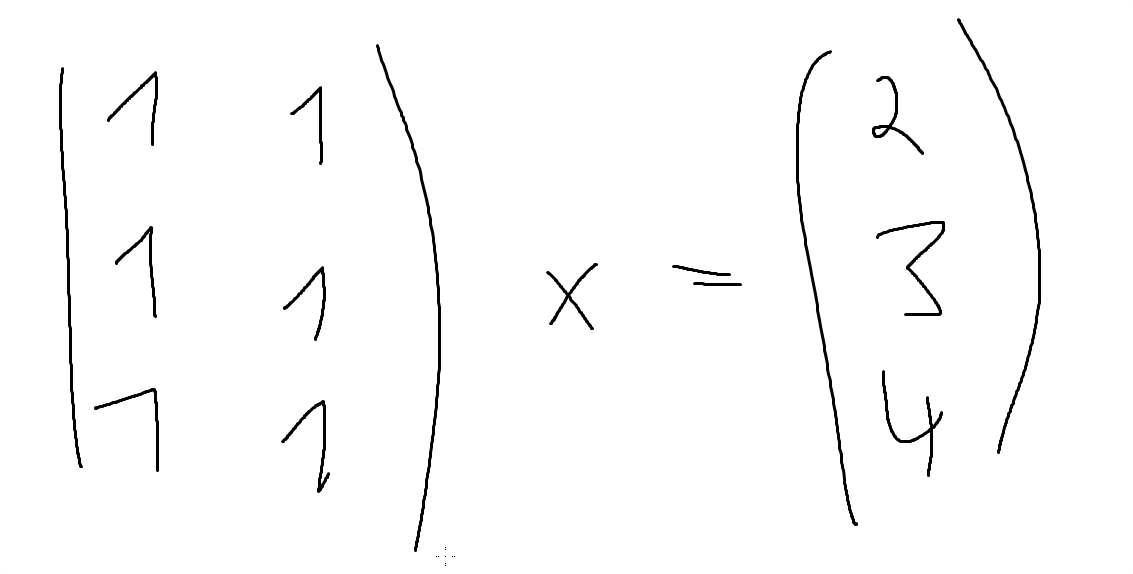 hard drum
But ye
wet stratus
paint skills ftw
quiet salmon
wet stratus
https://i.imgur.com/PEn1hIA.png
oh
hm
wait a minute
ok
but assume I'm choosing different coefficients for each vector
then if I have more equations than unknowns, this set of vectors is linearly independent
?
maybe that was written poorly
you just give the example
wet stratus
if you chose linearly independent columns then they are linearly independent, yes
quiet salmon
$S = {(4, -1, 2), (-4,10,2)}$
stoic pythonBOT
texaspb :rainbow:
 quiet salmon
show that they are linearly dependent (or not)
linearly dependent means that there is a nontrivial choice of coefficients a1, a1 such that
a1v1 + a2v2 = 0
correct?
wet stratus
yes
quiet salmon
ok then having the vectors be column vectors
it'd look something like this \
$a_{1}\begin{pmatrix} 4 \ -1 \ 2\end{pmatrix} + a_{2}\begin{pmatrix} -4 \ 10 \ 2\end{pmatrix} = \begin{pmatrix} 0 \ 0 \ 0\end{pmatrix}$
right?
stoic pythonBOT
texaspb :rainbow:
 wet stratus
yes
quiet salmon
then I'll have more equations than unknowns
so in this case
where every coefficient is different
I will always have a linearly independent set of vectors?
wet stratus
no
every coefficient being different is not enough
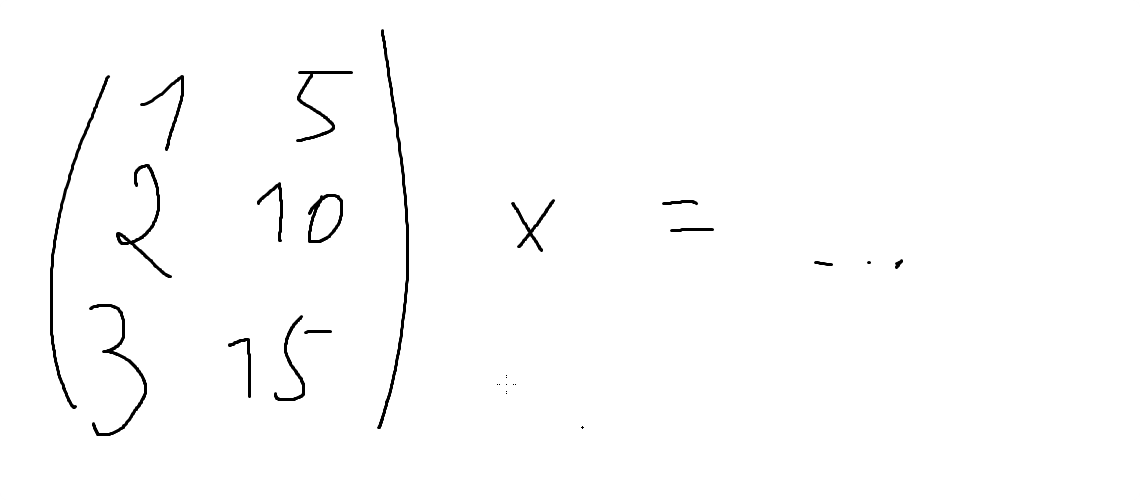
whoops wrong pic
so every coefficient is different. but clearly the columns are linearly dependent
quiet salmon
stoic python
**texaspb :rainbow:**
in my example here
I came to the conclusion that the only choice for a_1 and a_2 that makes the expression equal 0 is if they are both equal 0 too
just solving the system
the thing is I was tryign to find a way to tell if it's linearly independent or not by just looking
wet stratus
yeah that's pretty hard
best way to check for linear independence is to solve the system
 serene solstice

 copper hinge
serene solstice
copper hinge
serene solstice
Sorry but not a lot people can’t tell what you need help with if you just post a screenshot with no context.
serene solstice
copper hinge
Sorry but not a lot people can’t tell what you need help with if you just post a...
That's because I procrastinate at even writing a simple message. Duh.
Anyways....
copper hinge
Oh I didn’t know sorry.
serene solstice
No probs.
I still don't get the $X(tX - I_2) = t(tX - I_2) - X$ part.
stoic pythonBOT
Jonathan Phan
 serene solstice
Good people? A little help?
dusky epoch
aint this just elementary matrix algebra
wait, hold on
ah yes
$X^2 = tX - I$, so $X(tX - I) = tX^2 - X = t(tX - I) - X$
stoic pythonBOT
Ann
 serene solstice
dusky epoch
$X^2 = tX - I$, so $X(tX - I) = tX^2 - X = t(tX - I) - X$
serene solstice
dusky epoch
$X^2 = tX - I$, so $X(tX - I) = tX^2 - X = t(tX - I) - X$
"Ooooooohhhhhhhhh... I'm a fuckin' idiot!"
- Loud green-haired Irish man, c.2013
So is anyone else doing Titu Andresscu's Elementary Linear Algebra: A Problem-Solving Approach?
serene solstice
Please check if I did the following exercises correctly.


Haven't figured out 3c, though.
wintry steppe
latex your solutions if you want anyone to read them (at the very least, write them out cleanly and take clear, focused pictures)
it's also not clear what page of working corresponds to what problem
you also posted four problems at once. one at a time
ripe compass
what should I imagine with a linear image?
in my book it says "an image f: V->W is called a linear image if the addition and scalar multiplication is preserved. With this we mean f(u+v) = f(u) + f(v) and f(lamda * v) = lambda*f(v) for every u, v an element of V and all lambda an element of R"
I do not know what to imagine with this
wet stratus
is it called image or is that the word you chose to translate it as?
ripe compass
yea litteral translation
wet stratus
generally it's called linear mapping or linear transformation or linear function or stuff like that
 dusky epoch
what language are you translating from
ripe compass
dutch
dusky epoch
and what's the word in dutch?
ripe compass
afbeelding
wet stratus
there is a video by 3b1b that gives some nice intuition about what linear maps are. check out his playlist about linear algebra. or just check out his channel in general
hard drum
ah function or map then Ruffy
ripe compass
wet stratus
there is a video by 3b1b that gives some nice intuition about what linear maps a...
what's the title
I can't find any with linear maps in teh title
wet stratus
he may have called it linear transformations. or maybe matrices. or linear functions. don't remember. don't wanna look it up
dusky epoch
yeah he called it linear transformations
ripe compass
but it looks like an interesting series guess I'll check it all out before starting to actually study
 real bone
Anyone have an idea to prove that the sum is direct?
 wintry steppe
i do, by appealing to the definition of "direct sum"
you probably want to use the second condition on the operators to show this, given that you (hopefully) used the first to show that there is a sum in the first place
real bone
i've already shown that this is a sum
i can't quite get to them having pairwise intersection 0
i think the idea is to somehow use $\pi_i\pi_j=0$ for $i\neq j$
stoic pythonBOT
monkeman
 real bone
so i get $\text{im}(\pi_j)\subseteq \ker(\pi_i),$
stoic pythonBOT
monkeman
 real bone
@wintry steppe i don't know how exactly to go further
i can apply this to show that $\text{im}(\pi_i)\cap \text{im}(\pi_j)\subseteq \text{im}(\pi_i)\cap \ker(\pi_i)$
stoic pythonBOT
monkeman
 real bone
but thats about it
wintry steppe
hmm
ignore what i deleted
the thing i was worried about was not a missing assumption, but follows from the ones you had
@real bone you should now try to show that im(\pi_i) \cap \ker(\pi_i) vanishes. to do this, try to show that \pi_i is a projection
you will have to use the \pi_i \pi_j = 0 condition and the \pi_1 + ... + \pi_k = id condition, somehow
hint: ||apply the first to the second||
thank god texit let me delete that
in the old days i would have used my message delete privileges
dim epoch
stoic python
**monkeman**
Isnt this already enough to argue that the images are disjoint
If the whole Image of some pi_i is contained in the kernels of all other p_j for j neq i then the intersection of that image with the images of pi_j can only be 0
And the intersections being 0 is whats missing for the sum to be direct
or am i missing some elementary fact here
wintry steppe
dim epoch
If the whole Image of some pi_i is contained in the kernels of all other p_j for...
elaborate on why this follows
dim epoch

ah wait lol now i see it how you get the projection property and then the statement
took me longer than it should have
wintry steppe
same
real bone
wintry steppe
<@900170470584889375> you should now try to show that im(\pi_i) \cap \ker(\pi_i)...
I don't think it actually does vanish right? Like there might be some v!=0 in the image that maps to 0 and therefore in the kernel
wintry steppe
\pi_i being a projection guarantees that this vanishes
for if v = \pi_i(w) is in the kernel of \pi_i, then 0 = \pi_i(v) = \pi_i^2(w) = \pi_i(w) = v
so now you must show that \pi_i^2 = \pi_i
 glacial terrace
Why can we conclude the red line from the preceding statement?
 real bone
Wait so how would I go about proving it is a projection
wintry steppe
real bone
Wait so how would I go about proving it is a projection
follow the hint i wrote
wintry steppe
wintry steppe
hint: ||apply the first to the second||
.
wintry steppe
the two conditions together give you what you want
glacial terrace
For the (->) direction: Take B an ordered basis for F_n. Then [L_A]_B = A which is diagonalizable. So L_A is diagonalizable
 wintry steppe
not just any B will work
you need to pick a specific B that makes [L_A]_B = A
but once you have done that, your argument works
and really, once you have [L_A]_B = A, the corollary follows immediately from what you just posted
glacial terrace
hum
quiet salmon
guys quick question
what is the dimension of a polynomial vector space
like for example P_2
will it be 3 or 2
the dimension
for the polynomials of the form $a_0 + a_1x + a_2x^{2}$
stoic pythonBOT
texaspb :rainbow:
 wintry steppe
what do you think it should be?
write down a basis of P_2 and tell me how many elements it has
wintry steppe
there you go
quiet salmon
I was just confusing with the degree of it ig
wintry steppe
P_n will always have dimension n + 1, since you need to account for the constant term
 brittle mortar
can i ask someone to check my proof ? im not sure about the highlighted part, whether its a valid argument or not
 wet stratus
yup that's valid
hard drum
Yup nice
brittle mortar
ok, thank you!
glacial terrace
TTerra, regarding the base for F^n. It needs to be B = ((1,0,..,0), (0,1,0,...,0),...,(0,0,...,0,1))
Then L_A(e1) = A for every element in the base
no
I mean, we will get the ith column for each action on the base
wintry steppe
glacial terrace
TTerra, regarding the base for F^n. It needs to be B = ((1,0,..,0), (0,1,0,...,0...
this is correct (you could just say "standard basis")
glacial terrace
oh ok nice, thanks!
brittle mortar
brittle mortar
can i ask someone to check my proof ? im not sure about the highlighted part, wh...
btw, for the other side of this proof, can i just say that since U1 is contained in U2, their union is just equal to U2, which is a subspace so we're already done? (instead of taking the union and proving the properties of a subspace one by one the long way?)
real bone
lets say i have T,S: V -> V such that ker(T)=im(S). how do i construct S in terms of T?
TS=0 right?
hmm
wintry steppe
hmm
 wintry steppe
hint/suggestion: ||T(T - id)(T + id) = 0||
real bone
yeah but am i not trying to find pi_1,pi_2,pi_3 such that im(pi_1)=ker(T)
im(pi_2)=ker(T-id)
and im(pi_3)=ker(T+id)?
because V_0=ker(T), V_1=ker(T-id) and V_2=ker(T+id)
@wintry steppe am i missing something here? because thats what it seems to imply
OOOOH
IM TROLLING
i'm so sorry
i legit didn't get ur hint for a hot second
wait no
hmm
wintry steppe
real bone
lets say i have T,S: V -> V such that ker(T)=im(S). how do i construct S in term...
project onto ker(T)
few ways to do this. easiest is to pick a basis of ker T, extend to a basis of V, and chop off the components coming from the basis elements not in ker T
or pick an inner product and do orthogonal projection (admittedly, same as previous method with orthonormal bases)
real bone
wait so i'm assuming ur hint implied that the construction is something like pi_1=(T-id)(T+id)
pi_2=T(T+id)
and pi_3=T(T-id)
?
wintry steppe
it was just an observation that could be useful
 rapid ivy

what exactly does this
R^m and R^n mean?
doesnt that mean R is a vector of size m and n respectivly?
real bone
yes
rapid ivy
ok, thanks
rapid ivy
like there are m columns
since 1 column = a vector
well at least the trashy way im explaninng
wintry steppe
"R^n" means the set of vectors with n entries, each from R
$$\bR^n = {(x_1, \dots, x_n) : x_i \in \bR \text{ for each } i = 1, \dots, n}$$
stoic pythonBOT
TTerra
 wintry steppe
curly brackets are non-standard notation for vectors
real bone
oh oops
real bone
ok just ignore my clumsy latexing
wintry steppe
rapid ivy
so its a collection of vectors?
it is. R^n is a set of vectors just as i wrote
it's a vector space, so you can speak of a linear transformation defined on it or to it
rapid ivy
wintry steppe
it's a vector space, so you can speak of a linear transformation defined on it o...
can you explain this in simpiler terms, im still wrapping my head around all this
 mellow rampart
but a vector of R^n is one that's cartesian product of n real numbers
wintry steppe
that's exactly what i wrote
wintry steppe
rapid ivy
can you explain this in simpiler terms, im still wrapping my head around all thi...
the "it's a vector space" part or "linear transformation..." part?
mellow rampart
like a vector in $\mathbb{R}^2$ might be $(1, \pi)$
rapid ivy
got it
wintry steppe
i am choosing not to distinguish between row and column vectors
stoic pythonBOT
_gmz
 rapid ivy

i ask because im trying to wrap this around my head, but i dont think im grasping it correctly
if it perserves length, that means dot produt is same
rapid ivy
so the kernel is the same from Rm to Rn?
wintry steppe
rapid ivy
so the kernel is the same from Rm to Rn?
what do you think the kernel of such a linear transformation is?
i will phrase my question to you precisely: "if L: R^m -> R^n is length preserving, what do you think ker(L) is?"
rapid ivy
hmm
wintry steppe
think about it a bit
if a vector x in R^m satisfies L(x) = 0, see if you can use the "length preserving" assumption to infer anything about x
mellow rampart
wintry steppe
if a vector x in R^m satisfies L(x) = 0, see if you can use the "length preservi...
to clarify: this does not mean that for all x, L(x) = 0
wintry steppe
that's true, i need to be more precise with people like this
mellow rampart
@rapid ivy it's just that if the language isn't precise, it's hard to tell what the other person is saying
wintry steppe
i have edited it for more precision
mellow rampart
i'm sure they didn't mean it in a patronizing manner
wintry steppe
i didn't mean it in a patronizing way, but i can see how it came off that way
wintry steppe
rapid ivy
but hmm let me think some more
if you can't figure it out in general, try finding some specific examples of length preserving linear transformations. compute their kernels, and see if you can make a guess for the general situation
it's always good to work with examples, and only then go to the theory, when you're stuck proving something general
mellow rampart
R^2 -> R^2 captures the essence of the problem already
wintry steppe
wintry steppe
that's true, i need to be more precise with people like this
("like this" meant to refer to _gmz's message, not to belittle in any way. i apologize if it came off that way)
rapid ivy
jesus christ, i dont even know where to start
I think i can use the trasnpose is = the inverse
wintry steppe
wintry steppe
if you can't figure it out in general, try finding some *specific examples* of l...
this is where you can start, then

mellow rampart
do you have a geometric idea of what linear transformations from R^2 -> R^2 look like?
rapid ivy
mellow rampart
do you have a geometric idea of what linear transformations from R^2 -> R^2 look...
like a rotation or flip across a line
rapid ivy
ok
real bone
ok @wintry steppe for my problem can i write $\pi_1=1-T^2,$ $\pi_2=\frac{1}{2} T^2- \frac{1}{2}T$ and $\pi_3=\frac{1}{2} T^2+\frac{1}{2}T$?
the problem is i only get $\text{im}(\pi_1)\subseteq \ker(T)$ for example
stoic pythonBOT
monkeman
 wintry steppe
their sum isn't the identity map
stoic pythonBOT
monkeman
 real bone
now the sum is identity map
wintry steppe
their sum is the identity and the pairwise products are zero, so you can apply part (a)
wintry steppe
i said you can apply part (a), i didn't say it's the application of part (a) you need
that's something you'll have to check
wintry steppe

dim epoch
It's a nice problem tho
 torn stag
@rapid ivy Preserves length means $|Lx| = |x|$ for all $x \in \mathbb{R}^m$. It is a theorem that this implies $(Lx, Ly) = (x, y)$ for all $x, y \in \mathbb{R}^m$.
stoic pythonBOT
IlIIllIIIlllIIIIllll
 mellow rampart
are those intended to be angle brackets?
torn stag
the () mean dot product
rapid ivy
torn stag
<@224387905013940224> Preserves length means $\|Lx\| = \|x\|$ for all $x \in \ma...
A^T A = I ?
mellow rampart
torn stag
the () mean dot product
strange notation imo
torn stag
A^TA = I is equivalent to (Ax, Ay) = (x, y) for all x, y
mellow rampart
because V × V, defined correctly, is also a vector space
rapid ivy
torn stag
A^TA = I is equivalent to (Ax, Ay) = (x, y) for all x, y
so that means it orthogonal
torn stag
yes. The equivalence between length preserving and orthogonal is a theorem
rapid ivy
wait, so what step would i take after that once i recognize this?
im not seeing what this changes
wintry steppe
mellow rampart
strange notation imo
it's common enough and shouldn't cause confusion
rapid ivy

i learned what orthogonal matrices, but im unsure how i can see its kernel from that?
especially when its jut like R^m and R^n
my brain is truly pea
wintry steppe
suppose that x is in the kernel of A, which means that Ax = 0. can you use any properties of A to say anything about x?
rapid ivy
🥲
rapid ivy
wintry steppe
suppose that x is in the kernel of A, which means that Ax = 0. can you use any p...
that everything would map to 0?
wait
not necessarily
wintry steppe
im assuming that x is some vector which gets mapped to zero, im not saying that every vector gets mapped to zero
wintry steppe
i don't know what that means
rapid ivy
wait
wintry steppe
i want to know what the equation Ax = 0 would imply about x, if it were true for a given vector x
assume that x is some vector which A maps to zero (Ax = 0). what do you get to infer about x?
you must use the fact that A is length preserving at this step (or orthogonal)
wintry steppe
YES
rapid ivy
🤯
wintry steppe
exactly
rapid ivy
😹
im such an idiot
so just to clarify, with this question i should recognize that since orthogonal == length perserving, the only possible kernel is one where a vector maps to 0?
so im struggling to see how the idea of A^T A == (Ax,Ay) = (x,y) is useful in this case?
maybe im misunderstanding what this means?
wintry steppe
id rephrase that a little. instead of "orthogonal = length preserving" (which is true, but unnecessary), i just want to see how "length preserving" implies ker A = {0}
orthogonality comes later in the problem
(when you're asked to look at AA^T)
rapid ivy
thank you
rapid ivy
question, how would i find a transformation matrix for something like R^2 -> R^3
gray dust
google how to write a matrix of a linear map between finite dimension spaces (it requires a choice of basis of each space)
mossy geyser
Hi for this qn, my answer to a subspace S for V2 is : A line that lies in V2 which passes through the origin.


I'm wondering why the solution provided does not need to explicitly say that the line passes through the origin, and able to immediately point out that (0, 0, 0) is in the line through (1, -1, 1)?
wintry steppe
mossy geyser
I'm wondering why the solution provided does not need to explicitly say that the...
it's implied by the word "subspace" that it passes through the origin
the only line through a given point which is also a subspace is the one through that point and the origin
if you allow any line through your point, then you
- will not have a subspace unless you pass through the origin
- will have infinitely many lines; a unique one through each other point
it's just bad writing
rapid ivy
hi how tf do i get a vandermonde determinant
i have a 5x5 matrix and the number im getting is super large
 wintry steppe
rapid ivy
hi how tf do i get a vandermonde determinant
wintry steppe
rapid ivy
hi how tf do i get a vandermonde determinant
by using the formula for the determinant of a vandermonde matrix
in your example, the determinant you want should not be too large
rapid ivy
i tried a calculator and im getting like 288
but when i wrote it out

which is a very large number
so im so confused
wintry steppe
20321280 is a little larger than 288
wintry steppe
you're using the formula incorrectly
it should look like (5 - 4)(5 - 3)(5 - 2)(5 - 1) and so on
the determinant of this guy is $$\prod_{1 \leq i < j \leq n}(x_j - x_i),$$ and for your example, $n = 5$ and $x_1 = 1, x_2 = 2, x_3 = 3, x_4 = 4, x_5 = 5$
 stoic pythonBOT
TTerra
 rapid ivy
not quite following
wintry steppe
(technically your matrix is the transpose of the one i've copypasted here, but that doesnt change the determinant)
wintry steppe
yes
rapid ivy
i thought it was by row?
wintry steppe
you're probably interpreting the formula incorrectly
the matrix you posted is a "column vandermonde" matrix, so to speak
transpose it to get a "row vandermonde" matrix, a matrix of the form i posted above
then you can apply the formula i wrote
rapid ivy
wait youre supposed to transpose first?
🤯
also 1 row is going directly down right?
or am i switching the naming
oof
wintry steppe
maybe i should rephrase
what is your definition of a vandermonde matrix, and what is your formula for its determinant?
just in case we're thinking of different things
 fierce relic
Hi I don't want to interrupt but I can't tell if you guys are done so i'll just post it
wintry steppe
just posting it would be interrupting, but i don't particularly care
they seem to have disappeared, so go ahead
fierce relic
So I'm trying to learn about the pentagram map
but first i'm just trying to check if its a linear transformation
So i've started by trying to define a matrix equation by the intersection of the lines passing through every other vertex
and I know that every matrix defines a linear transformation
but does it follow that this matrix equation particularly defines a mapping from the point where the line originates to the intersection
I'm kind of confused
and I don't know how to go about looking at it other than this way
Everything I've found looks at it as a projective transformation
is that the same in this specific context?
And if it is then should i be looking at different matrices because it really feels that i should be
dusky epoch
the pentagram map?
fierce relic
so like
If you have a pentagon
and you connect all the vertices
the pentagon in the center is created by the intersections
and if you map the vertices from the outside one to the inside one
I mean it should be a linear transformation
I just have no idea on how to show that it is
Nvm I think you need more than lin alg for this lmfao
 dusty walrus
Can someone describe to me what a 3x3 matrix transform is. I need to transform some data I have, but literally know nothing about matrix transforms. Can it be explained in layman's terms please?
 limber sierra
a 3x3 matrix transform is a certain type of "well-behaved" function that maps ordered triplets to ordered triplets
dusty walrus
These values will apparently how me transform one color metric to another.

The values I have are the following
Red: 0.4686329572
limber sierra
by "ordered triplets" i mean lists of numbers of the form (a, b, c)
limber sierra
it probably just wants you to do matrix multiplication then?
dusty walrus
Yeah i'm not sure
It just says these values will help me transform my units to a different color metric.
limber sierra
,w {{0.9806, -0.0348, -0.0073}, {0.0065, 1.1191, -0.0601}, {-0.0132, 0.0017, 1.0297}} * {{0.4686329572}, {0.4921898868}, {0.4709272159}}
stoic pythonBOT


 Requested by Namington#1983
dusty walrus
Requested by Namington#1983
dusty walrus
Did you multiple the sum for each dimension per channel
being Red = SUM(0.9806, -0.0348, -0.0073) * 0.4686329572
limber sierra
not quite

so for computing the first entry
,calc (0.9806 * 0.4686329572) + (-0.0384 * 0.4921898868) + (-0.0073 * 0.4709272159)
stoic pythonBOT
Result:
0.43720361750113
the second entry uses coefficients from the second row of the 3x3 matrix instead of the first row
the idea is that this "weights" each parameter
the first entry (red) of the final vector is based on a "weighted sum" of the entries of the input vector
you'll note that the red entry has the highest weight
0.9806
because presumably "red" in your different colour metrics looks fairly similar
the blue and green values have very low weights relative to red's
-0.0384 and -0.0073
dusty walrus
Oh, so you're basically going Transformed Red = (0.9806 * Red value) + (-0.0384 * Green value) + (-0.0073 * Blue value)
limber sierra
so red's weight ends up contributing "the most" to the final sum
yes.
the second row represents the weighting for computing the green value, and the third row represents the weighting for computing the blue value
same process, but now instead of red having the largest number, it's green or blue (respectively)
it's presumably just a matter of different standards of what colours are associated with what numeric values
dusty walrus
Interesting okay
Specifically this is to transform density metrics
optical density
limber sierra
this is just my assumption off of little context though, but it's the only thing i can see really making sense
and it produces sensible results
dusty walrus
Is this the same thing as a linear transform?
limber sierra
yes
matrix multiplication is notation for representing linear transformations
(between finite dimensional vector spaces, blah blah blah a bunch of asterisks that dont matter)
dusty walrus
I see, yeah I know they stated it was for a linear transform so you're probably on the money with it
I appreciate your help man, thank you
mossy geyser
wintry steppe
if you allow any line through your point, then you
1) will not have a subspace ...
Thank you for the detailed expln. Will my answer that: A line that lies in V2 which passes through the origin being a subspace S of v2 suffice then? Since any combination of vectors in that line will still lie in V2 ?
serene solstice

The eigenvalues of A are the sol'ns of the eq'n $t^2 - 2\cos(x) + \cos(x)^2$. How do I continue?
stoic pythonBOT
Jonathan Phan
 dusky epoch
i think you forgot some things in the equation
i think maybe you meant t^2 - 2cos(x)t + cos^2(x) = 0?
quiet salmon
any set of vectors that is linearly independent on R^n is a basis for R^n?
saw a guy say this in a stack overflow post
is it true?
 tribal willow
yes
quartz compass
not any set, the set has to have n elements
quartz compass
I nearly did too
tribal willow
a set of n vectors which are lin indep span Rn
quiet salmon
cool
tribal willow
assuming vec space defined over R
idk if this applies for inf dim vec spaces tho
well i guess not cos we cant really say n vectors lol
willow crag
If i make a line with x = y*m + b, so that the intercept bis in the x-axis, and the slope m = (x1 - x0)/(y1 -y0) should the slope then not be equal to the angle between the vector (x1 - x0, y1 - y0) (green line) and a vector (0,1) (red line)?

I'm asking since I get some decimals off, but too much to be floating point precision
wet stratus
then it would only be possible to have slopes between -pi/2 and pi/2
does that seem reasonable?
or -90 and 90 degrees if you prefer that
willow crag
Well the slop can still be negative in value, that would allow it to be full radians, right?
slope*
willow crag
Ah, I see what you mean, the slope could be any number?
But isn't it always a ratio
Ooh no
It's not rip
Right! Okay, so arctan(m) gives me theta
serene solstice
dusky epoch
i think maybe you meant t^2 - 2cos(x)**t** + cos^2(x) **= 0**?
Ah yes. Thanks for the correction.
So we just solve this thing normally, right?
wet stratus
yes
you should probably notice that this has a very nice form
before just blindly applying the quadratic formula
 grave garden
Hii guys
When they say "eigenvalues with multiplicity" generally this is algebraic multiplicity right ?

Sth like so

Also for this one
I can understand that we should have blocks of matrix on the diagonal
But I dunno how we get the following result
wintry steppe
teacher says the answer is -1 but I think it doesn't have any limit
because the limit of floor(sin(3π/2)) + ε is 0 and there is no limit for sin(3π/2) - ε (as sin is never less than -1) so the right and the left limit differ from eachother so it doesn't have limit
which is the correct answer?

this isn't linear algebra, go to #real-complex-analysis
 wild rapids
while doing matrix elimination(like making upper trangular/lower trangular matrix), I mostly gets worst case scenario.. Can someone suggest me a proper way to do elimination.
 dapper jolt


having issues with part d
if i’m understanding this correctly, all this matrix ‘P’ does is take the coordinate vector (a1, a2, a3) with respect to the ordered basis a to its equivalent coordinate vector with respect to the ordered basis a’
but like, X’ is apparently the coordinate matrix relative to a’? so wouldn’t X = PX’ mean that we are going from a’ to a?
i just don’t really understand how this works (textbook is hoffman & kunze btw)
 dapper jolt
variables dont matter, all its saying is that the first two coordinates are the same
gray dust
 odd turtle
is the z and y switched in the sum?
odd turtle
is the z and y switched in the sum?
its important to read the form not the exact letters used
glacial terrace
is there any reason why we compute the eigenvalues with det(A-xI) = 0 and the polynomial characteristic is defined as det(xI - A) ?
Is it just because det(xI - A) makes the principal coefficient positive?
gray dust
glacial terrace
is there any reason why we compute the eigenvalues with det(A-xI) = 0 and the po...
det(A-xI) & det(xI-A) are off by a factor of (-1)^n
so u can actually define the charpoly as either one
hence use either to find eigenvalues
if u like monic polynomials then u can use det(xI-A)
glacial terrace
indeed
 polar marsh
can two different bases of a vectorspace have the same linear combination for a vector?
wintry steppe
sure, the zero vector looks the same in every basis of a vector space
polar marsh
wintry steppe
sure, the zero vector looks the same in every basis of a vector space
and except de zero vector?
wintry steppe
sure, if the two bases share a vector, that vector is gonna look the same in each
quartz compass
you can write it as an equation B_1 v = B_2 v and this means (B_1 - B_2)v = 0 so either v=0 or the columns of B_1-B_2 are linearly dependent
polar marsh
How can i prove that for a given n×n matrix we can find a linear map f wherfore this given matrix is the matrix representation of this map f, that is dependant on the basis we chose, or in other words why isn't it enough if i have a given matrix to find only one unique linear map?
I am sorry for my english, it is not my native language
wintry steppe
if $A$ is an $n \times n$ matrix and $\beta = (v_1,\dots,v_n)$ is an ordered basis of a vector space $V$, then you can define a map $L_{A, \beta}\colon V \to V$ by mapping $V$ isomorphically to $F^n$ using $\beta$, performing matrix multiplication, and then going back to $V$ using the first map's inverse.
stoic pythonBOT
TTerra
 dapper jolt
what does the T_v_k stuff mean here? the notation here seems confusing
 wintry steppe
in more precise terms, using the notation of the previous post, let $\varphi\colon V \to F^n$ be the map $$\varphi(a_1v_1 + \cdots + a_nv_n) = (a_1, \dots, a_n), \qquad a_1,\dots,a_n\in F.$$ this is an isomorphism. set $$L_{A, \beta}(v) = \varphi^{-1}(A \cdot \varphi(v)), \qquad v \in V.,$$ where $A \cdot \varphi(v)$ is ordinary matrix multiplication. with respect to the basis $\beta$, the linear map $L_{A, \beta}$ has matrix representation exactly what you'd expect: $[L_{A, \beta}]_\beta = A$.
that's how to precisely construct it
on to the second part of the question, if you pick a different basis, the map \varphi is gonna change
(i probably should have used some notation that emphasizes that \varphi depends on the choice of basis, but whatever)
it should become clear if you think about this construction a little bit that picking a different basis will (in general) give you a different linear map
wintry steppe
dapper jolt
what does the T_v_k stuff mean here? the notation here seems confusing
Tv_k means T applied to v_k
dapper jolt
right
so A_1, k is just the row vector of the matrix A that the v1 basis vector is multiplied by in the linear transformation?
dapper jolt
so it’s the scalar that’s multiplied by the v1 basis vector?
wintry steppe
sure
dapper jolt
is there a better way to describe it…
wintry steppe
i think that the way that the author's described it here is already pretty clear
maybe i can elaborate on it
dapper jolt
yea i’d appreciate it
polar marsh
wintry steppe
in more precise terms, using the notation of the previous post, let $\varphi\col...
Thx for the answer
wintry steppe
$Tv_k$ is an element of $V$, so it's going to be a linear combination of $v_1,\dots,v_n$, i.e., there are unique scalars $A_{1,k},\dots,A_{n,k}$ such that $$Tv_k = A_{1,k}v_1 + \cdots + A_{n,k}v_n.$$ that's how they're defined
stoic pythonBOT
TTerra

 zealous mural
I just join this server and when I saw the ''linear algebra'' I was hype. But, can someone tell me : how can we find RREF (reduced row echelon form).
wintry steppe
wintry steppe
in more precise terms, using the notation of the previous post, let $\varphi\col...
my latex vanished 
in more precise terms, using the notation of the previous post, let $\varphi\colon V \to F^n$ be the map $$\varphi(a_1v_1 + \cdots + a_nv_n) = (a_1, \dots, a_n), \qquad a_1,\dots,a_n\in F.$$ this is an isomorphism. set $$L_{A, \beta}(v) = \varphi^{-1}(A \cdot \varphi(v)), \qquad v \in V.,$$ where $A \cdot \varphi(v)$ is ordinary matrix multiplication. with respect to the basis $\beta$, the linear map $L_{A, \beta}$ has matrix representation exactly what you'd expect: $[L_{A, \beta}]_\beta = A$.
stoic pythonBOT
TTerra
 wintry steppe
@polar marsh this disappeared for some reason, i might have accidentally deleted it
putting it back up if you need to look
wintry steppe
zealous mural
I just join this server and when I saw the ''linear algebra'' I was hype. But, c...
i don't think anyone wants to walk through the steps of gaussian elimination
zealous mural
Ok
dapper jolt
wintry steppe
$Tv_k$ is an element of $V$, so it's going to be a linear combination of $v_1,\d...
i see this, gonna try and understand it - ty!
wintry steppe
it's not that complicated
all that's happening is "vectors in V get representations in the basis"
zealous mural
and by the way, to find the Null space of matrix, do we need to make, in a way or another, a substraction ?
 ripe totem
zealous mural
and by the way, to find the Null space of matrix, do we need to make, in a way o...
ripe totem
zealous mural
and by the way, to find the Null space of matrix, do we need to make, in a way o...
Someone can correct me if I'm wrong, but I think solving the homogeneous system AX=0 of matrix A should give you its Null space. That is, reducing the augmented matrix A|0 to RREF to solve.
mellow rampart
you're correct
dusky epoch
you are definitionally correct
mellow rampart
ofc you don't need to reduce to rref to know null space, but that is a way
 lucid glacier
You also don't need to consider an augmented matrix. Just rref
Row operations preserve the kernel
mellow rampart
ofc for Ax = 0 the augmented part of the augmented matrix doesn't matter anyways
 dusky epoch
the highlighted paragraph?
polar marsh
Do they mean if i chose the same basis for in input as output? Because if not, then i can choose a linear map that takes b_i as an input with (b_1...b_n) a basis in V and then an out put c_i from another basis (c1.... cn) without having the identity function
polar marsh
dusky epoch
the highlighted paragraph?
Yes
dusky epoch
yes, they mean the same basis for input and output
polar marsh
Oh okay
dusky epoch
the identity is a map from R^n to itself after all
polar marsh
So this would mean that if i have the identity matrix , i don't necessarily have the identity function
?
polar marsh
No the same
dusky epoch
so from a vector space to itself
polar marsh
Yes
dusky epoch
why'd you say "between two vector spaces" then...
but anyway
UNLESS STATED OTHERWISE, the input basis and output basis are understood to be the same
polar marsh
Yes i get this so thats why i asked if i would choose two different bases in V i would have another linear map
polar marsh
dusky epoch
if you "have" the identity matrix then you have the identity matrix
My question was that if i give you the identity matrix as a representation of a linear map f, then f isn't necessarily the identity function since i can chose two different bases in V.
polar marsh
Okay thank you
 little vigil
Applied linear algebra: The decoupling principle Anybody familiar with the book? Will i be fine with just a basic linear algebra course before attempting this book?
 dapper crypt
Anyone got a good problem sheet of questions where you factorise matrices? Such as $X_1(X_1-X_2)+(X_1-X_2)X_2$ is competing the square
stoic pythonBOT
Max..
 serene solstice

This one hurt my brain to calculate its eigenvalues. I know that it's a rotation, but a rotation of what?
quartz compass
I suppose in the eigenbasis you can think of it as a rotation in the complex plane in the components by x radians, idk that's sort of like 4 dimensional to think about
dapper jolt

can i get some help on 2 and 3b?
i was able to prove the reverse implication for 3b but i can't actually solve the problem
wet stratus
for 2 first find any basis oh H. then apply gram schmidt
dusky epoch
@dapper jolt would you like to have (b) be broken down into somewhat more elementary steps?
dapper jolt
yeah that'd be nice
dusky epoch
Let v ∈ V \ {0}.
(i) Prove that Jv ≠ 0.
(ii) Prove that Jv is not a scalar multiple of v.
(iii) Hence prove that {v, Jv} is a basis of V.
(iv) Hence prove that (v, Jv) is exactly the ordered basis you are looking for.
 prisma socket
if A and B are singular matrices and A+B is also singular and AB=BA then does it mean A^2+B^2 is singular and what about A^3+B^3 and what about A^4 + B^4 ? (A and B are matrices in size of nxn )
 molten pilot

regarding the proof of (b)
I don't get why we need row and column operations
can't we just put P=[B] and Q=[C] since multiplication by a matix can be viewed as a linear transformation? (B and C are from the proof of (a))
mellow rampart
i think so as well
 mellow rampart
but they probably want the proof of (b) to be from an entirely different angle, that doesn't rely on the direct connection b/w linear transformations and matrices
molten pilot
sigh
mellow rampart
anyways the vector space proof is a lot cleaner anyways so :/


 wintry steppe

molten pilot
the 0 vector of two different vector spaces is technically a different object, right?
slender yarrow
molten pilot
I just wanted to make sure lel
well yea the 0 depends on the vector space we're talking about
lucid glacier
Well for subspaces the 0 has to be the same
By uniqueness of the additive identity
wintry steppe
Hi, just seeking clarification. after checking out Gilbert Strang's linear algebra course for a little bit, is it right to assume that matrices and vectors can be assumed to anything and requires context?
like for eg```
| 1 5 |
| 2 4 |
i think you're overthinking it
a matrix is a matrix
if it represents something then it'll be made clear in context
wet stratus
$$\begin{pmatrix} 1 & 5 \ 2 & 4 \end{pmatrix}$$ is a matrix. $$\begin{pmatrix} 1 \ 2 \end{pmatrix}, \begin{pmatrix} 5 \ 4 \end{pmatrix}$$ are two vectors. \begin{align*} 1x+5y&= 0 \ 2x+4y&=0\end{align*} is a linear system of equations with two equations and variables. these are all different things
there is an obvious way to convert between them. but at first they are all different things
stoic pythonBOT
Denascite
 wet stratus
sometimes we don't make a huge distinction between any of those because there is such an obvious way to translate between all them. but they are different
wintry steppe
dusky epoch
if it represents something then it'll be made clear in context
ahh alright, thanks for the answer. I will think in context
wintry steppe
wet stratus
sometimes we don't make a huge distinction between any of those because there is...
ahhh I see, I guess I got confused when we look at matrix as a column space but then proceed with row elimination.
btw, is that regex up there? for the math drawings, thats so cool
wet stratus
That's latex
wintry steppe
ahhh, looks so complex but the result is really cool
wet stratus
Yeah it has a steep learning curve
glacial terrace
I don't understand why we get (4,-3)
 wet stratus
do you see why (4,-3) is a solution to the system?
glacial terrace
yeah but suppose there's something more abstract
suppose we have an eigenvalue t for some linear operator T and want to find the eigenvector
after doing the matrix representation with the basis
we find v the respective eigenvector for t by Tv = tv
what's the algorithm then?
wet stratus
well we solve the linear system (T-tI)v=0
if we already know t
and that's just a linear system which we solve in the usual way
for example by row reduction
young plinth
How would I solve this? I just need a start.
