#linear-algebra
2 messages · Page 311 of 1
 hollow finch
 wintry steppe
careful. any two columns of this matrix will be linearly independent, but it's only when you consider all three together that you have a linearly dependent set
rref just happens to give you the left-most linearly independent columns
 fair wren
wintry steppe
rref just happens to give you the left-most linearly independent columns
fair wren
wintry steppe
rref just happens to give you the left-most linearly independent columns
yes
only the left most columns are linearly independent -the columns of the original matrix-
fair wren
wintry steppe
did you read my first message?
ah i just repeat what u said?
wintry steppe
no and im not going to repeat either, because it's not important
i am being pedantic with the phrasing

 wintry steppe
it'd be a lot clearer if you started with "R(cu + dv)" and ended with "cR(u) + dR(v)" just like you wrote in part (a)
 little crater
oh
wintry steppe
you've definitely written way too much
little crater
wintry steppe
you've definitely written way too much
how do I handle the S(cT(u)+dT(v))? unless I define T(u) and T(v) as some vector and then back sub it.
this okay then
 wintry steppe
they are vectors so i don't know what you mean by "define as some vector"
little crater
yeah i get that but just from applying the rules
wintry steppe
what you wrote is correct. you can skip two lines as the red arrow shows, those lines are redundant

this is just "applying the rules" since T(u) and T(v) are vectors
little crater
yeah
would this problem have any sorts of different implications if it wasn't T: R^n to R^n and then S: R^n to R^n?
like if it was R^n to R^m and then R^m to R^n
wintry steppe
no
the solution would be the exact same
even for T: R^n -> R^m and S: R^m -> R^p, or for T and S defined on abstract vector spaces
nothing changes
little crater
I see
fair wren


then rank(P) = 3?
meaning the columns are linearly independent?
@wintry steppe
ty
wintry steppe
yes
fair wren
wintry steppe
yes
i have a list = (e_1, e_2, e_3) , e_1 and e_2 and e_3 are defined as the columns of P respectively (left to right)
since i've proven rank(P) = 3 = dim_R (R^3) then that list forms a basis?
wintry steppe
yes
fair wren
nice
little crater
thanks TTera (1 hour ago or so late 🙂 )

 wintry steppe
stop pinging me for all your questions
fair wren
wintry steppe
stop pinging me for all your questions
Sry
wintry steppe
assuming you row reduced it correctly, this is correct. use an online calculator to check yourself
wintry steppe
Is it possible to find Matrix A in the Matrix equation Ax=b with just x and b given?
little crater
wintry steppe
Is it possible to find Matrix A in the Matrix equation Ax=b with just x and b gi...
sure (you will have lots of Matrices that can get you from x -> b
fair wren
if a matrix P(u,v,w) is invertible and u,v,w in R^3 does that mean that (u,v,w) is a basis for R^3,
u,v,w are vectors in R^3
little crater
@wintry steppe have any example numbers in mind?
fair wren
little crater
<@456226577798135808> have any example numbers in mind?
rank(A²) = rank(A)?
A is a matrix
little crater
fair wren
rank(A²) = rank(A)?
what exactly are you asking for?
fair wren
so i have a matrix
P(u,v,w)
such that P²(u,v,w) = I_3
u,v,w are vectors in R^3
i want to show that (u,v,w) is a basis for R^3
fair wren
little crater
what exactly are you asking for?
so i want to show that rank(P) = 3
little crater
 but if rank(A^2) = rank(A) it would seem 1 example that would be I_3?
fair wren
ye idk
little crater
can't help much as we have not even discussed multiplying matrices
nor am I familiar with the terminology other than seeing it a few times before
fair wren
 little crater
makes sense
but really have not touched on that subject so sorry
basically the transformation needs to be bijectiive
little crater
wintry steppe
Is it possible to find Matrix A in the Matrix equation Ax=b with just x and b gi...
oh and seeing you said matrix a and nothing about being a linear transformatino you could easily just make it some constant thing where all x's map to that b

not sure if this would be allowed or not?
but as x has no bearing in the equation I don't see and issue exactly
and then I suppose just scale your identity matrix correctly for whatever space b is in
wintry steppe
I see
wintry steppe
little crater
<@456226577798135808> have any example numbers in mind?
Well I took vector x as (1 1) and vector b as (2 1)
So there exist infinitely many solutions, or matrices A, to satisfy this Matrix equation right
I'm talking about linear transformations by the way, sorry for not specifying that out 😅
little crater
wintry steppe
I'm talking about linear transformations by the way, sorry for not specifying th...
Yeah I mean the easy way for something like that would be 2 0, 0 1
Basically 2/1 and 1/1 in top left and bottom right
wintry steppe
Oh
little crater
wintry steppe
Oh
Will we work for any R^n to R^n just scale basically identity and then scale each 1 on the diagonal correctly to get that b you want
This assumes you x has all non zero values
Or else you would have to do something different
And obviously if it is linear transformation and x = 0 vector, we can't map to b unless b Is the 0 vector
 robust owl

Just curious if anybody can think of hint for the trick on this?
The previous exercise was to show M=M_{nxn}(F) is the direct sum of the set of nxn skew symmetric matrices and the set of nxn symmetric matrices
Things like dimension and bases haven't been introduced yet. Apparently there's a way to do this without using anything like that?
I'm thinking the trick is to pick A in M_{nxn}(F) and rewrite it in some sneaky form like in the previous problem.
One thing I had tried was to let A=B+C for B symmetric and C skew symmetric and then write B,C in terms of two more matrices each where one has the triangular form expressed in the defn of W_1. That seemed kinda promising but I think I'm missing some important detail that would lead me to the conclusion
 native rampart
You can get lower triangular matrices (take a symmetric matrix and remove the "upper part")
You have the complete set of lower triangular matrices and you have W_1
Using those 2 you can construct all matrices of M_nxn
robust owl
I'm not sure I understand your thinking.
native rampart
So take 2x2 as an example
Suppose you want
$\begin{pmatrix}
a & b\
c & d\
\end{pmatrix}
$
 stoic pythonBOT
Drake
 native rampart
Consider
$\begin{pmatrix}
a & c\
c & d\
\end{pmatrix}
$
and
$\begin{pmatrix}
0 & c\
0 & 0\
\end{pmatrix}
$
stoic pythonBOT
Drake
 native rampart
From these two you can get
$\begin{pmatrix}
a & 0\
c & d\
\end{pmatrix}
$
and from W1 you have
$\begin{pmatrix}
0 & b\
0 & 0\
\end{pmatrix}
$
stoic pythonBOT
Drake
 native rampart
So extract the "lower triangular" part and add an element of W_1 to get any matrix of M_{nxn}(F)
Oh mb,I thought i<=j would be upper triangular like that
robust owl
Doesn't one of the matrices I need have to be symmetric?
native rampart
Well yes
robust owl
When I fooled around with small examples I gave splitting up matrices into upper/lower pieces a shot but I kept getting stuck at producing a symmetric matrix 
native rampart
Consider
$\begin{pmatrix}
a & b \
c & d\
\end{pmatrix}
= \begin{pmatrix}
a & b \
b & d\
\end{pmatrix} - \begin{pmatrix}
0 & 0 \
b & 0\
\end{pmatrix} + \begin{pmatrix}
0 & 0 \
c & 0\
\end{pmatrix}
$
stoic pythonBOT
Drake
 native rampart
This should work
wintry steppe
little crater
Will we work for any R^n to R^n just scale basically identity and then scale eac...
Sure but can we look into this problem some other time? I was skipping some important concepts in between, so I'll look into them first then we'll surely look into this together 👍
In this text, are both binary operations specified here same or can they be different too?

 wet stratus
Well usually if we say one is a restriction of the other we mean they are the same operation just with a different domain. But nothing in this text says a*b=a°b for all a,b as a formula specifically, just a bit handwavy at the end
So honestly kind of a weird definition
wintry steppe
I see, thank you 👍
 slate hatch
How do I check for linear independance when there are more rows than columns in a matrix?
wet stratus
the same way as usual. solve the system Ax=0 and see if there is a nonzero solution
 native rampart
Consider the columns of the submatrix with nonzero determinant
Now The nonzero determinant part implies these columns form a LI set
because if you have a non zero linear combination that gives you zero,you can say the linear combination of columns in the kxk matrix with same coefficients is zero
@steep sandal
slate hatch
wet stratus
the same way as usual. solve the system Ax=0 and see if there is a nonzero solut...
but you can't row reduce it to rref
wet stratus
why not
 steep sandal
native rampart
Consider the columns of the submatrix with nonzero determinant
steep sandal
native rampart
Consider the columns of the submatrix with nonzero determinant
Got it if a col is ld then determinant will be zero we can make that col zero right???
native rampart
yea'
so you have a LI set with atleast k vectors,rank can only be greater than or equal to this
 feral gust
could someone maybe explain me why every field is a vector space?
wet stratus
well it's a vector space over itself. the vectors are just the field elements which you add with the field addition. and scalar multiplication is just the field multiplication
feral gust
thx 🙂
wintry steppe
they are always equal
wintry steppe
robust owl
Just curious if anybody can think of hint for the trick on this?
the hint almost gives it all away... anyway observe that 2A = (A +A^t) + (A - A^t)
what can you say about A + A^t and A - A^t
robust owl
One is symmetric the other is skew symmetric?
wintry steppe
exactly
so any matrix can be written as a symmetric matrix plus a skew symmetric matrix. to prove that its a direct sum, show there is no nontrivial way to write 0 as the sum of a symmetric matrix plus a skew symmetric matrix
native rampart
I mean that's not the problem
robust owl
Yeah, that's the last problem
I ended up generalizing what drake was talking about for the current problem.
native rampart
I actually don't see why my approach would fail for field 2
We aren't dividing by 2 anywhere
robust owl
I don't think it does fail for char 2.
native rampart
Ok,I guess they expected you to do something like the symmetric ,skew-symmetric thing
And dividing by 2 would be necessary for that
robust owl
Seems a little round-about to do that though lol.
wintry steppe
native rampart
And dividing by 2 would be necessary for that
yeah there A = (A + A^t)/2 + (A - A^t)/2
robust owl
wintry steppe
the hint almost gives it all away... anyway observe that 2A = (A +A^t) + (A - A^...
Is there some intuitive way to stumble on this identity if you're trying to write an arbitrary matrix as a sum of symmetric/skew symmetric matrices?
The best I can think of is that in order to write A as a sum of a symmetric+skew symmetric matrix you would have to know A+A^t and A-A^t are symmetric/skew symmetric and stumble on that identity by fooling around and adding them.
But idk if there's a better way to look at it?
 stuck tendon
robust owl
Is there some intuitive way to stumble on this identity if you're trying to writ...
stuck tendon
robust owl
Is there some intuitive way to stumble on this identity if you're trying to writ...
Write A = B + C for B symmetric, C skew-symmetric. Take transposes to obtain A^t = B - C, and then solve for B,C
robust owl
Ooh I like that a lot 
wintry steppe
robust owl
Is there some intuitive way to stumble on this identity if you're trying to writ...

Mathematics Stack Exchange
For the function $f(x)$ we can write it as sum of even and odd functions:
$$f(x)=\underbrace{\frac{f(x)+f(-x)}{2}}{\text{Even}}+\underbrace{\frac{f(x)-f(-x)}{2}}{\text{Odd}}$$
My question is why ...


 robust owl
 winter harbor
This may make things clearer or even more confusing, idk <:opencry:5860786148654...
winter harbor
This may make things clearer or even more confusing, idk <:opencry:5860786148654...
I'll probably need some time to reread and digest that but I find it very interesting. I haven't really spent a ton of time knowingly fooling around with involutions but the jist here is just that given any vector space V and any involution you can rewrite V as a direct sum of two spaces such that in one of the spaces in the sum every element under the involution maps to itself and the other space every element maps to its inverse. Then from there there's just a bunch of random places we can apply this by mucking about looking at various vector spaces and their involutions. Am I getting the big picture here?
winter harbor
robust owl
I'll probably need some time to reread and digest that but I find it very intere...
Yeah, that's exactly the big picture.
robust owl
That's weird and cool
 royal escarp
goddamn u wrote a whole essay
winter harbor
robust owl
That's weird and cool <:thonk:406575732563902485>
You can even generalize this decomposition to any endomorphism of finite order f : V -> V. (i.e f is such that f^n = id_V for some integer n >=1). And the decomposition you get is in terms of the n-th roots of unity (as long as n is the smallest such integer for which f^n = id_V) which is sort of a finite analogous of fourier analysis lol.
Yeah, it is pretty cool.
The Z/2 grading of V obtained by an involution makes it into something called a super vector space
Which are interesting for reasons unrelated to your original question lol
But is worth mentioning I guess.
 winter harbor
 normal loom
Well, if A admits an eigenbasis, then it is diagonalizable. Now, remember that a necessary and sufficient condition for a matrix to be diagonalizable is that each eigenvalue has equal algebraic and geometric multiplicity. Now, find the values of a such that the algebraic multiplicity of each eigenvalue of A (which you have already computed in number 1) is equal to its geometric multiplicity (which you have computed in number 2).
fair wren
normal loom
what did u find for the basis of each eigenspace of A?
 halcyon spindle
I starting by considering different types of 2x3 row-reduced echelon matrices. Type 1 is $\begin{bmatrix} 0 & 0 & 0 \ 0 & 0 & 0 \end{bmatrix}$. Type 2 is $\begin{bmatrix} 1 & a & b \ 0 & 0 & 0 \end{bmatrix}$. Type 3 is $\begin{bmatrix} 0 & 1 & a \ 0 & 0 & 0 \end{bmatrix}$. Type 4 is $\begin{bmatrix} 0 & 0 & 1 \ 0 & 0 & 0 \end{bmatrix}$. Type 5 is $\begin{bmatrix} 1 & 0 & a \ 0 & 1 & b \end{bmatrix}$. Type 6 is $\begin{bmatrix} 1 & a & 0 \ 0 & 0 & 1 \end{bmatrix}$. Finally type 7 is $\begin{bmatrix} 0 & 1 & 0 \ 0 & 0 & 1 \end{bmatrix}$.
 stoic pythonBOT
Plegasus
 halcyon spindle
Then I considered the solution space for each one and found out there were not equal.
So if R and R' have the same solutions then they must be in exactly one of those types.
I wanted to see I am heading in the right direction for this problem?
 vague crane
okay don't trust my opinion here since idk any linalg
but
i feel like
there is a better way
to solve that
halcyon spindle
yeah, that what I was thinking too.
vague crane
there is absolutely no way the end solution involves considering seven special cases and proving the final result must lie in one of them
halcyon spindle
what I was thinking was, I can explicitly write out the solution for each homegenous system for each type.
So if R and R' have the same solution then I can just "compare the solution".
vague crane
i mean
i don't see why it couldn't work
but that sounds like just
an awful process
unless there's some cute simplification that makes it easy
wait
im confused
how is there a 2x3 matrix with it's transpose also being 2x3
halcyon spindle
wdym? The transpose will be a 3x2 matrix.
halcyon spindle
Its R prime.
vague crane
lol
 tribal willow
consider the 7 possible rref 2x3 matrices
show that no two of them have the same soln
this is imo the most straightforward
tribal willow
this is hoffmann kunze?
vague crane
vague crane
hmm i think ur supposed to just use that rref is unique
yeah rref is unique so any solution given from it and some other matrix would be unique too
then it has to be the same
halcyon spindle
tribal willow
show that no two of them have the same soln
Thank you, that is what I was currently doing, just wanted to make sure.
vague crane
vague crane
then it has to be the same
ana does this work >.> im just starting linalg so not sure
tribal willow
thinking abt it
i think if anything this is an exercise of showing that rref is unique
vague crane
so assuming it is kind of defeating the purpose?
tribal willow
imo yeah
tribal willow
Mathematics Stack Exchange
In Hoffman and Kunze they have two exercises where they ask to show that if two homogeneous linear systems have the exact same solutions then they have the same row-reduced echelon form.
They firs...
vague crane
okay so im ngl i dont understand any of that
so i went hunting
and found this
which makes much more sense
tribal willow
wtf
 vague crane
tribal willow
wtf
vague crane
tribal willow
wtf
answer the question ana or else it will eat you
halcyon spindle
The whale?
vague crane
yep
wintry steppe
if A is a matrix how do i write the n-th column of it?
like A^n looks like its power
 fringe fjord
Multiply from the right by the n'th standard basis vector.
wintry steppe
row is from the left?
fringe fjord
Yes, this will be a column vector.
 keen sierra
i don't know if there's any truly standard notation but a_n is not uncommon for the n'th column of A
there's always the somewhat hideous but sometimes useful matlab-style notation A(:,n)
which is used in the likes of golub and van loan
 clever musk
hey, is this just wrong because two of the arguments are identical so φ(a_1, ..., a_k) has to be 0 to be alternating or am i missing something?
 wintry steppe
you are correct
clever musk
Ok but I'm kind of lost here, do I have to prove for linearity?

 zinc timber
so alternating map requires f(a,b)=-f(b,a) right
can you make something out of here?
clever musk
i actually don't understand how i can interpret the φ(e_k, e_k) for all k
zinc timber
it's given for the basis e_k
clever musk
like φ(e_1, e_1) = 0, φ(e_2, e_2) = 0?
zinc timber
yes
clever musk
ah ok
zinc timber
and they have asked if that's sifficient for alternating map
clever musk
zinc timber
can you make something out of here?
I'm not sure...
zinc timber
you are free to set values for ϕ (e_1, e_2) and ϕ (e_2, e_1)
the don't mecessarily have to satisfy f(a,b)=-f(b,a)
clever musk
Oh I see, but I'm not sure how to write that as a proof now
zinc timber
construct counter example
clever musk
But φ isn't defined as anything?
zinc timber

clever musk
xD
native rampart
clever musk
Ok but I'm kind of lost here, do I have to prove for linearity?
Well it's true tho
Oh mb nvm
It's false
I thought it was \phi(x,x)=0 for all x
clever musk
zinc timber
the don't mecessarily have to satisfy f(a,b)=-f(b,a)
So I can just take any vectors as long as they're not equal right?
clever musk
can any1 confirm?
zinc timber
I think I have given enough hints. Here's an example for 2x2 || f(X,Y)=x1y2+x2y1||
 timid sage
Just to confirm my understanding of the algebraic/geometric multiplicities of an eigenvalue.
The algebraic multiplicity is the number of times an eigenvalue appears right? So if our characteristic polynomial came out as (x-5)^2, the algebraic multiplicity for 5 would be 2?
And the geometric multiplicity is the number of distinct eigenvectors that exist for a given eigenvalue? Or alternatively, the dimension of the kernel/nullspace of (A - xI)?
 dusky epoch
The algebraic multiplicity is the number of times an eigenvalue appears right?
appears as a root of the charpoly
Or alternatively, the dimension of the kernel/nullspace of (A - xI)?
yes, that's the geometric multiplicity
timid sage
Sounds good, thanks
keen sierra
timid sage
And the geometric multiplicity is the number of distinct eigenvectors that exist...
technically not "number of distinct eigenvectors" - that number is always infinite since any nonzero multiple of an eigenvector is an eigenvector. you could phrase it as "maximum number of linearly independent eigenvectors" for that eigenvalue
timid sage
Yeah you're right, ty
wet stratus
keen sierra
technically not "number of distinct eigenvectors" - that number is always infini...
if we are being technical, over finite fields there can be only finitely many eigenvectors
keen sierra
wet stratus
if we are being technical, over finite fields there can be only finitely many ei...
fair point!
 limber forum
How to prove that matrix addition is commutative?
wet stratus
calculate A+B and B+A and see that they are the same
 spare widget
It's probably interesting to consider an example that breaks this, e.g. pick matrices over something that's not a field, for example quaternions, and instead of addition use quaternion multiplication.
spare widget
if you have commutativity of addition of the underlying object sure
wet stratus
calling something noncommutative addition is pretty disgusting
spare widget
see near-rings
wet stratus
bah. disgusting
 normal void
$\sum_{i=1}^{n} |x_i|$ \
subject to $Ax=b$
stoic pythonBOT
FantaSkink
 normal void
How do I show that this object function is not a linear transformation
We need some help to get started
dusky epoch
this function satisfies f(x) = f(-x), something that is impossible for a linear function to achieve unless it is the zero function, which yours clearly is not
normal void
Oh cool. That wasn't in our text book for some reason 🤔
That really helped. Thank you!
 slender silo
hi, anyone know how to search the equation of the cone surface? is there any math knowledge library?

 hexed vale
 spare widget
slender silo
hi, anyone know how to search the equation of the cone surface? is there any mat...
spare widget
slender silo
hi, anyone know how to search the equation of the cone surface? is there any mat...
this is not linear algebra, but the equation of the cone is x^2+y^2=r^2z^2/h^2, now plug in the ray coordinates for x,y,z
you get a quadratic equation in t, which you can solve in the usual way
 wintry spear
Hey everyone, my linear is super rusty, I'm trying to remember the process for solving a system like this where the solutions are unknown constants

but I want to solve it for when the matrix looks like


 true musk
V is a real vector space with finite dimensions. $f:V\times V\to\mathbb{R}$ is a bilinear function acting on V.
f satisfies the following property: for any $x,y\in V$, $f(x,y)=0\Leftrightarrow f(y,x)=0$
Prove that f is either symmetric or antisymmetric.
stoic pythonBOT
CollinGao-ALT
 true musk
 serene solstice
Take it as $(\begin{bmatrix}1&&\&1&\&&1\end{bmatrix}+x\cdot\begin{bmatrix}-1&0&1\0&0&0\1&0&-1\end{bmatrix})^n$
stoic pythonBOT
CollinGao-ALT


 wet stratus
yes
wintry steppe
yes
so D(sinx{0,1}) = cosx{0,1}?
what is that notation
sinx{0,1}?
just "D(sin x) = cos x" is enough
i have no idea what t is
the independent variable
wet stratus
lmao true. probably oversight
wintry steppe
use t and x interchangeably here, it does not matter
😕 .
do i need to know about derivetaives to learn LA?
no
they're just a fun example
wet stratus
although otherwise the question is also very simple so that's nice. just three times 0
wintry steppe

How come L(X) = A*X is incorrect?
would X->L(X)=A*X be the correct notation?
yes
the author is just being pedantic lol
you can write L(X) = AX and literally no one in the world will be confused with what you mean
wet stratus
that's incredibly pedantic. damn never seen something that pedantic before
wintry steppe
what would 2X->L(X)=2X mean?
wet stratus
that you have a map I that maps 2X to 2X
and that you have a map L that maps X to 2X
kind of
weird notation
wintry steppe
okay thanks
true musk
true musk
V is a real vector space with finite dimensions. $f:V\times V\to\mathbb{R}$ is a...
Anyone can HELP?
wintry steppe
since V is finite-dimensional, you could assume that f(x, y) = x^TAy for some matrix A, and work with that
 queen olive
can someone explain to me how the hell this works
so I'm trying to modify a normal projection matrix, who's inverse transformation looks like this
true musk
wintry steppe
since V is finite-dimensional, you could assume that f(x, y) = x^TAy for some ma...
This is too obvious
wintry steppe
lmao
winter harbor

queen olive
 wintry steppe
true musk
This is too obvious
wintry steppe
true musk
This is too obvious
what do you want me to say then?
queen olive
into one that has an arbitrary near plane and also transforms stuff preserving linearity
I realized that only the middle row is able to be changed, and so I set up a system of 4 equations and solved them

but, after doing gauss jordan elimination it says that this is impossible, saying that 0 = 2f(p1-p2)/n
however, if i'm understanding gauss jordan elimination correctly only the first 3 rows matter, and I can get two different results dependent on what 3 equations I put into the first four points. Additionally, it seems that if I only use the results from one it will only make the 3 conditions that I put in correct, like this:
blue is what the green should look like btw
so my solution is to get both matrices and interpolate between them, which somehow actually works
the issue is that this does not keep things that are collinear collinear
why, and how do I tackle this problem in a way that isn't janky and fucked up
because in 3d its even worse
wintry steppe
is the function space a vector space?
queen olive
what do you mean?
wintry steppe
this is unrelated to ur question btw
queen olive
ah
wintry steppe
wintry steppe
is the function space a vector space?
if the codomain if your functions is a vector space, sure. if S is a set and V is a vector space, then the set of functions S -> V becomes a vector space with pointwise addition and pointwise scalar multiplication
over what field tho?
what do you think?
functions arent "numbers" so i dont know
limber forum
what does matrix transposition means in geometrical sense?
is there some invariant like angle proportion which stays constant if i transpose the 2d or 3d matrix?
wintry steppe
"V is a vector space" assumes it's over some field, and...
over V?
V is not a field
V is a vector space over a field
field of V?
yes
but
then
oh
i guess u can multiply with it
if $f\colon S \to V$ is any function and $c \in F$, the field which $V$ is a vector space over, then $cf$ is the function $S \to V$ defined by $x \mapsto cf(x)$. (note that $f(x) \in V$ and $c \in F$, so $cf(x) \in V$ is defined.)
stoic pythonBOT
TTerra
 wintry steppe
this is "pointwise scalar multiplication"
wait functions == maps?
fine
call them maps and reserve "function" for things going to the base field
i wrote what i meant
no i mean are they the same thing?
the word "maps" in mathematics is usually reserved for a function between two sets equipped with extra structure (e.g. vector space structure, topology) which preserves that extra structure (e.g. linear map, continuous map)
but this is not universal
wet stratus
I use maps and functions for the same. no difference personally
wintry steppe
they both

"function" is sometimes reserved for things that go from a set (possibly with extra structure) to some choice of field. this is especially common in differential geometry; "function" on a manifold usually means "real-valued function"
this is purely a linguistic problem
just call them mappings or functions interchangeably, and elaborate when you need to
ok thanks
$x^2(4)=16$
wintry steppe
x->F(x)=x^2 then F4 = 16
winter harbor
limber forum
what does matrix transposition means in geometrical sense?
is there some invaria...
Yes to your second question. Indeed, the transpose of a real $m \times n$ matrix $A$ satisfies for every $x \in \mathbb{R}^{n}$ and $y \in \mathbb{R}^{m}$ the identity:
$$
\langle Ax, y \rangle = \langle x, A^{t} y \rangle
$$
And is in fact the unique such $n \times m$ matrix satisfying the abovementioned identity.
stoic pythonBOT
MISTERSYSTEM :urs:
 winter harbor
So both matrices A^{t} and A are very related when it comes to how they transform the plane via rotations or reflections.
 clever totem
i have to solve this task right now

this is what i got so far

anyone got an idea?
also V is a inner product space
true musk
Continuous function on closed interval [a,b]?
Or simply something about combinatorics written incorrectly?
slate hatch
Probably continuous functions
Since it involves calculating inner product space
Thanks for the help
 leaden venture
Can anyone please help me remember how to take the transpose of an expression, ie $(y - X^Tw)^T$
stoic pythonBOT
HaleyVinton
 wintry steppe
transpose is linear, and (AB)^T = B^TA^T
leaden venture
Thank you! Do $y$ and $X^Tw$ also switch positions? This is the part I cannot remember.
stoic pythonBOT
HaleyVinton
 wintry steppe
nope
leaden venture
Thanks!
clever totem
anyone got an idea?

for the previous question i had ideas, but for this i don't even know where to start...
true musk
the definition of projection is p(p(x))=p(x) right?
clever totem
yes
true musk
so obviously it's equivalent to $x-p(x)\in\text{ker }p$
stoic pythonBOT
CollinGao-ALT
 clever totem
that is true
clever totem
true musk
so (x-p(x),p(x))=0
how do you get to that?
true musk
wait a minute let y=p(z) then (x-p(x),p(z))=0
true musk
it said $\forall$
stoic pythonBOT
CollinGao-ALT
 clever totem
after all if $p:V\to W$ then y may not be in W
stoic pythonBOT
~Martin
 clever totem
p(z) would be in z and y not
oh wait
you are right
didnt see that p goes to V
thank you
wait it cant have the whole V as its image
then it doesnt work again
true musk
Now I want to prove for every $t\in\ker p,\exists x,x-p(x)=t$
stoic pythonBOT
CollinGao-ALT

 leaden tide
a straightforward way to see it is to decompose two given elements as the sum of something in the image of p and something in its kernel
then the fact that these two subspaces are orthogonal will help finish the proof
true musk
If $p=\text{id}$, then it is trivially correct
stoic pythonBOT
CollinGao-ALT
 clever totem
leaden tide
a straightforward way to see it is to decompose two given elements as the sum of...
clever totem
leaden tide
a straightforward way to see it is to decompose two given elements as the sum of...
 leaden tide
You didn't format it properly
You just proved that <p(x),y> and <x,p(y)> are equal, with both of them being <p(x),p(y)>
Going from what you wish to prove to a tautology is sound, but ugly
 random axle
yo yo
I understand this definition of a shear transformation

But what does it mean when the given shear definition is for example:

What does the 45 degree represent?
Does it give the constant of proportionality in a convoluted way or something
clever totem
leaden tide
You didn't format it properly
ok i messed it up haha

this time it looks better
intuitivly it makes sense to follow that <p(x),y_ker>=0
leaden tide
Still not
<p(x),y_Ker> = 0 = <x_Ker, p(y)>
you proved 0=0
Here's how you might format it :
$$\langle p(x), y \rangle = \langle p(x), p(y)+y_\text{Ker} \rangle = \langle p(x), p(y) \rangle$$
$$\langle x, p(y) \rangle = \langle p(x)+x_\text{Ker}, p(y) \rangle = \langle p(x), p(y) \rangle$$
stoic pythonBOT
Syst3ms
 leaden tide
Thus $\langle p(x), y \rangle = \langle x, p(y) \rangle$
stoic pythonBOT
Syst3ms
 leaden tide
ohhh, i got it the other way around
clever totem
this would be my reasoning, but i dont think it is a proper prove since it is like "think about it and it becomes clear"
 leaden tide
Right, a projection is orthogonal iff its image and kernel are orthogonal
So what you need to show is that $\forall x\in \text{Im}(p), \forall y\in\text{Ker}(p), \langle x,y \rangle = 0$
stoic pythonBOT
Syst3ms
 leaden tide
Hint : if x is in Im(p), what is x equal to?
clever totem
p(x)
clever totem
if $x\in Im(p)$ and $y\in Ker(p)$ then $\langle x,y\rangle$ would turn into 0
stoic pythonBOT
~Martin
 leaden tide
Yup, so that means Im(p) and Ker(p) are orthogonal
That is, p is an orthogonal projection
clever totem
clever totem
this would be my reasoning, but i dont think it is a proper prove since it is li...
should have gotten it from here already haha
oh wait is it trivial that $\langle p(x),y\rangle$ is 0 if $y\in Ker(p)$?
stoic pythonBOT
~Martin
 clever totem
i mean that is kinda the thing i wanna prove after all
clever totem
how do you get to <x,0>?
clever totem
oh yeah
i had:
$\langle p(x),y_{Ker} \rangle =\langle x_{Ker} ,p(y)\rangle $
here y is not in the Kernel, but $y_{Ker}$ is
 rocky glen
Hello, and sorry to barge in. It seems I do not have permission to create threads. I only have a short question.
What is the most informative introduction to Linear Algebra? I want to teach myself this topic but I already understand Mathematics overall so I am looking for a dense book with a focus on proof, not intuition or calculation. The more depth and generality the better for me.
stoic pythonBOT
~Martin
 clever totem
leaden tide
<p(x),y> = <x,p(y)> = <x,0> = 0
clever totem
leaden tide
<p(x),y> = <x,p(y)> = <x,0> = 0
in my problem y_K is not the same as y, thus y is not in the Kernel
leaden tide
This isn't for x and y in general
This is for y∈Ker(p)
y=y_Ker if you want your notation
clever totem
but if it's not in general what is it's use?
leaden tide
Because you're not trying to prove <x,y>=0 in general for x,y∈V (good luck with that btw)
What you're trying to prove is that Im(p) and Ker(p) are orthogonal
That's what being an orthogonal projection means
And the definition of two subspaces U and W being orthogonal is that for all u∈U and w∈W, <u,w>=0
clever totem
if x is in p(V) and y in Ker(p)
<p(x),y> = <x,p(y)> = <x,0> = 0
but i dont think i had <p(x),y> = <x,p(y)>
or better put i never had an expression whith p(y) where y is in the Kernel
 leaden tide
but i dont think i had <p(x),y> = <x,p(y)>
IT'S THE HYPOTHESIS
clever totem
not with p(y) where y is in the Kernel
leaden tide
Tell me what the kernel is a subspace of
clever totem
of V
 clever totem
y doesnt have to be in the kernel though right?
leaden tide
No?
Just like when I say that f(x) > 1 for all real x, it works for x=0
But x doesn't have to be 0
It can be anything, in particular it can be 0
clever totem
so you assume it to be in the Kernel, then the output clearly is 0
leaden tide
Yes?
clever totem
but i dont think that proves it for all possible x and y
thats where im stuck
leaden tide
leaden tide
And the definition of two subspaces U and W being orthogonal is that for all u∈U...
I spell out this restriction right there
what are you even trying to prove for all x and y?
clever totem
leaden tide
i want to prove that if this is true, then p is an orthogonal projection
leaden tide
I think you read that wrong
"p is an orthogonal projection if (for all x,y <p(x),y>=<x,p(y)>)" does NOT mean "for all x,y, (p is an orthogonal projection if <p(x),y>=<x,p(y)>)"
Your hypothesis is that the formula holds for all x and y, not just some fixed ones
And you use that to prove p is orthogonal
clever totem
yeah, as you say i dont want to fix my x and y
leaden tide
that's good, you don't have to
i suggest you brush up on quantifiers again, because you're getting stuck on some rather basic uses
clever totem
sry but what do you mean by quantifiers? im not a native speaker
like operators?
the thing is that i wanna show that if:
<p(x),y_K> = <x_K,p(y)>
Then <p(x),x_K>=0
ok thank you for your plentiful time^^
it really means a lot to me
i actually think i understood it after reseting my brain real quick
 visual hedge
Hey guys can someone explain what ∧ does here, how did we get the e3?

 lone flume
^ is the vector product @visual hedge
You can see $\varepsilon_3 = \varepsilon_1\times\varepsilon_2$, @visual hedge.
stoic pythonBOT
jnkena
 visual hedge
lone flume
^ is the vector product <@216312377371525120>
visual hedge
lone flume
^ is the vector product <@216312377371525120>
I can't see it, lemme see
winter harbor
visual hedge
Hey guys can someone explain what ∧ does here, how did we get the e3?
It is sometimes used as a notation for the vector product. Just be cautious, because it is most commonly used in the modern mathematics literature as a notation for the exterior/wedge product, which is a different notion. In this case, they are using it as a notation for the vector product.
The relationship between the vector product and the wedge product is given by Hodge Star Operator, where given two vectors $u,v \in \mathbb{R}^{3}$, we have that:
$$
\star(u \wedge v) = u \times v
$$
And this is one of the reasons why some people when talking about vectors in $\mathbb{R}^{3}$ use both notations interchangeably.
stoic pythonBOT
MISTERSYSTEM :urs:
 visual hedge
winter harbor
It is sometimes used as a notation for the vector product. Just be cautious, bec...
visual hedge
winter harbor
It is sometimes used as a notation for the vector product. Just be cautious, bec...
I keep reading and trying to understand and watching videos, I just don't get how it was calculated
lone flume
It is the vector product one learns in precalculus or prealgebra
$(v_1, v_2, v_3)\times (w_1, w_2, w_3)=\begin{vmatrix}i & j & k\v_1 & v_2 & v_3\
w_1 & w_2 & w_3\end{vmatrix}$
stoic pythonBOT
jnkena
 lone flume
$=(v_2w_3-v_3w_2, v_3w_1-v_1w_3, v_1w_2-v_2w_1)$
stoic pythonBOT
jnkena
 visual hedge
lone flume
$=(v_2w_3-v_3w_2, v_3w_1-v_1w_3, v_1w_2-v_2w_1)$
visual hedge
lone flume
$=(v_2w_3-v_3w_2, v_3w_1-v_1w_3, v_1w_2-v_2w_1)$
Thanks
Thanks for explaining guys, but I just never came across these ever before
lone flume
Oh, that's weird if you just run into that, isn't it? I mean, why?
lone flume
Are you actually studying Numerical II and you didn't ever studied x product? It's so interesting the difference in curricula between countries. In my country the vector product is studied with 17 years old at high school
lone flume
I encourage you studying the definitions and properties of the dot, vector and mixed products
If you want to know more you can revisit the theory if inner products which are a generalization of the dot product
lone flume
visual hedge
I hate it
Do you suffer from that?
visual hedge
lone flume
Do you suffer from that?
Idk man I just hate it, north africa is pretty f*ed
lone flume
Oh, North Africa...
visual hedge
What's more annoying is when teachers don't provide material such as PDFs for you to study with
lone flume
:O
visual hedge
This semester sucks for that reason
lone flume
If you need stuff ask us or maybe in the Internet
visual hedge
I know indeed people have been very helpful especially here
But us studying in french is also annoying
Kinda
visual hedge
winter harbor
It is sometimes used as a notation for the vector product. Just be cautious, bec...
Thanks man
visual hedge
lone flume
$(v_1, v_2, v_3)\times (w_1, w_2, w_3)=\begin{vmatrix}i & j & k\\v_1 & v_2 & v_3...
Yo man thank you so much, finally I could calculate it
I guess in $v_iw_j$ the index "i" is always the current column or row +1 and it loops so that when we're in the last column or in the 3rd one the index "i" for v is 1
stoic pythonBOT
Lionasty
 lone flume
visual hedge
Yo man thank you so much, finally I could calculate it
lone flume
visual hedge
Yo man thank you so much, finally I could calculate it
¡No problem! Thank you for asking!
lone flume
visual hedge
I guess in $v_iw_j$ the index "i" is always the current column or row +1 and it ...
I don't get what you mean with this.
 visual hedge
lone flume
I don't get what you mean with this.
visual hedge
lone flume
I don't get what you mean with this.
Talking about how to choose the indexes of v and w
slate hatch
Can anyone point me to a good resource on projections of continuous funtions onto subspaces
?
It's not explained very well in our course book
 gray dust
@wintry steppe R^2
gray dust
the t,u plane is R^2
gray dust
yes
wintry steppe
is there a mapping like that?
slender silo
spare widget
this is not linear algebra, but the equation of the cone is x^2+y^2=r^2z^2/h^2, ...
thank you. i got it.
tribal willow
is $A \in \mathbb F^{n\times n}$ correct notation for saying "$A$ is an $n\times n$ matrix with entries in $\mathbb F$"
stoic pythonBOT
anamono
 wintry steppe
yes
tribal willow
dope thanks
 pliant ore
how can you prove that the wedge product of linearly independent vectors must be nonzero?
pretty basic question i think, but somehow i jsut cant figure out a proof
 gleaming knot
Mathematics Stack Exchange
Given ${e_1,\cdots,e_d}$ a basis of $V$, we have $e_1\wedge\cdots
\wedge e_d$ is a non-zero vector in the exterior algebra $\Lambda_d (V)$.
Given a decomposable element which can be written as ...
pliant ore
gleaming knot
https://math.stackexchange.com/questions/2032509/show-e-1-wedge-cdots-wedge-e-d-...
uh yeah i've read that, thanks icy
gleaming knot
Why wasn't it helpful?
gleaming knot
Oh
serene solstice
true musk
And use the binomial expansion
Oooooooooooooohhhhhhhhh...............
Why didn't I figure that one out?
tribal willow
is this what’s commonly called a “Jordan block”?
 wintry steppe
usually jordan blocks are the other way around lol
the 1s are on the wrong diagonal
tribal willow
hmm yeah that’s what i saw online lol
wolfram mathworld says “The convention that 1s be along the subdiagonal instead of the superdiagonal is sometimes adopted instead (Faddeeva 1958, p. 50).”
native rampart
Well HK has a different definition of Jordan block
Conceptually both are equivalent
tribal willow
gotcha
 median forum
is this true ? $$|Ax|\le |A||x| \implies |AB| \le |A||B|$$
stoic pythonBOT
Fractal
 median forum
and Im not taking A to be an induced norm
I know this is true for induced norms
but I wonder if this other one is
otherwise, Id appreciate a counter-example
basically saying that if || does that with a vector norm, then it is submultiplicative
zinc timber
how are you taking the norm then?
zinc timber
Since induced norms tkaes into acc the multiplicative structure of L(V,V), it is not necessarily true that any other norm would
because the "definition of a norm" do not in general see the multiplicative structure
median forum
sure, but this is a weaker condition
zinc timber
so my guess would be no, but I'm also curious about a CE
median forum
Im wondering if it is sufficient
median forum
zinc timber
so my guess would be no, but I'm also curious about a CE
yeah
I suspect thats wrong
I was givne that in an exercise
I think they just wanted the norm to be induced
couldnt find anything about that elsewhere
but cant find any counter either
 dusky epoch
,rccw
stoic pythonBOT
 steep sandal
Anyone???
 dusky epoch
oh, so the determinant of the gram matrix.
steep sandal
Yeah
dusky epoch
right so maybe this is easier to show if we write it as G(v_1, ..., v_k) = |v_k^N|^2 * G(v_1, ..., v_k-1)
G(v_1, ..., v_k) should be equal to G(v_1, ..., v_k-1, v_k^N) but i cannot think of a way to show this right now that would not involve tedious matrix fuckery
steep sandal
I got that what uhh are saying and even know it is true by just observing gram matrix but how do we show on paper
steep sandal
dusky epoch
G(v_1, ..., v_k) _should_ be equal to G(v_1, ..., v_k-1, v_k^N) but i cannot thi...
Same I m also not getting that
dusky epoch
well ok let's package our vectors into an n by k matrix V = [v_1, ..., v_k]
so the gram matrix of {v_1, ..., v_k} is V^T V
now v_k^N is v_k plus a linear combination of v_1 through v_k-1
so if we let $V' = [v_1, \dots, v_{k-1}, v_k^N]$ we will get that $V' = VE$ where $$E = \bmqty{1 & & & & \alpha_1 \ & 1 & & & \alpha_2 \ & & \ddots & & \vdots \ & & & 1 & \alpha_{k-1} \ & & & & 1}$$
.
shit
i fucked up the typesetting hold on
stoic pythonBOT
Ann
 steep sandal
I didn't get what u did still I will pretend I got it
dusky epoch
$v_k^N = v_k + \alpha_1 v_1 + \alpha_2 v_2 + \dots + \alpha_{k-1} v_{k-1}$ for some coefficients $\alpha_i$ whose exact values i dont care about right now
stoic pythonBOT
Ann
 dusky epoch
do you understand this?
steep sandal
Yeah
dusky epoch
right
do you understand why V' = VE as i wrote above?
i fixed the matrix typesetting now
steep sandal
Yeah
stoic pythonBOT
Ann
 dusky epoch
on the one hand, this is equal to $$\det(E^TV^TVE)= \det(E^T) \det(V^TV) \det(E) = \det(V^TV) = G(v_1, \dots, v_k)$$
stoic pythonBOT
Ann
 dusky epoch
on the other hand, because v_k^N is by definition orthogonal to span{v_1, ..., v_k}, V'^T V' is block diagonal
it has one block of size (k-1)×(k-1) which is the gram matrix of {v_1, ..., v_k-1} and one block of size 1×1 whose element is v_k^N · v_k^N, or |v_k^N|^2
do you understand this?
steep sandal
Ok got it
dusky epoch
does anything else need explaining?
 fresh inlet
@keen sierra actually, it isn't obvious for me how induction is used in the case despite me understanding induction itself quite well.
There was another theorem in the book regarding multiplying a row/column by a scalar and getting determinant multiplied by the scalar as well. The proof involved using induction as well but I had understood the property by imagining a "call tree" where each minor is decomposed into other minors and is multiplied at a moment and only once. Should I do it another way?
lone flume
visual hedge
Talking about how to choose the indexes of v and w
They are simply the components in order.
keen sierra
fresh inlet
<@761155030513352705> actually, it isn't obvious for me how induction is used in...
the proof expresses the determinant as a linear combination of determinants of smaller matrices (the minors)
the induction hypothesis applies to the minors because they are smaller
fresh inlet
keen sierra
the induction hypothesis applies to the minors because they are smaller
Then in my opinion it first should be true for n x n matrix
And only then for (n - 1) x (n - 1) matrix
keen sierra
fresh inlet
Then in my opinion it first should be true for n x n matrix
you're proving it for the n x n matrix, under the assumption that it's true for (n-1) x (n-1) matrices
that's how the induction step works
fresh inlet
Hmm okay
fresh inlet
keen sierra
that's how the induction step works
It is just not obvious to me that if something is true for a 2x2 matrix, then it is true for a 3x3 matrix and so on...
keen sierra
fresh inlet
It is just not obvious to me that if something is true for a 2x2 matrix, then it...
it's true for a 2x2 matrix by explicit calculation
fresh inlet
Yes
keen sierra
then you can prove that it's true for a 3x3 matrix because you can express the determinant of a 3x3 matrix as a linear combination of determinants of 2x2 matrices
and similarly the determinant of a 4x4 matrix is a linear combination of determinants of 3x3 matrices
it's not automatically true for a 3x3 matrix just because it's true for a 2x2 matrix, you have to prove that, and that's the main part of the proof
fresh inlet
keen sierra
then you can prove that it's true for a 3x3 matrix because you can express the d...
I am not sure that when going from a 3x3 matrix to a 2x2 minor all just the right minors will be chosen which will result in determinant changing its sign
keen sierra
fresh inlet
I am not sure that when going from a 3x3 matrix to a 2x2 minor all just the righ...
well that's why the proof makes the distinction between the case where the minor corresponds to one of the rows that was swapped versus the case where it does not
fresh inlet
keen sierra
well that's why the proof makes the distinction between the case where the minor...
Can we get specifically to the case when i doesn't belong to {1, k}? Why is it obvious that A(i, 1) = −B(i, 1)? Because when decomposing the sigma it will have the same both cases when i doesn't belong to {1, k} and when i belongs to {1, k} inside. The first case is just a recursion and the second is not proved yet. Besides, when decomposing sigmas again and again at one moment we will get rid of cases where i doesn't belong to {1, k}. Should I try to comprehend the "i belongs to {1, k}" case first?
Gonna send the pictures again.

 steep sandal
Actually I didn't understand fully will try
fresh inlet
keen sierra
well that's why the proof makes the distinction between the case where the minor...
Are you done with me?

 wheat sorrel
Well for something to be linear both f(av) = af(v) and f(u+v) = f(u) + f(v) has to be true
You have to find a function where the first part is true but the last part isn't
normal void
$P_{y, x}=\sum_{\zeta=\max {y-k, 1}}^{\min {y+k, N}} \sum_{\xi=\max {x-k, 1}}^{\min {x+k, M}} \omega_{y-\zeta+k+1, x-\xi+k+1} O_{\zeta, \xi}$
stoic pythonBOT
FantaSkink
 normal void
How would this type of image convolution handle convolution of the original image $O$'s outer edge pixels?
Where kernel $omega$ is of size $2k+1\times 2k+1$

 wheat sorrel
Is this linear algebra?
normal void
It's a linear transformation on a matrix
 uneven raptor
serene solstice
uneven raptor
serene solstice
maybe think along the lines of f(x,y) = xy...
wheat sorrel
No that doesn't work because then neither of requirements are true
normal void
Lol ok, where should I ask then?
uneven raptor
wheat sorrel
No that doesn't work because then neither of requirements are true
it's non-linear and I didn't say that was an answer, it's just similar to an answer I thought of
zinc timber
some kind of rational function
 jovial current
Can anyone help with this, I'm lost
 winter harbor
normal void
It's a linear transformation on a matrix
winter harbor
normal void
It's a linear transformation on a matrix
I think you are more likely to get meaningful help in #numerical-analysis tho
winter harbor
serene solstice
Fix any nonzero vector v in R^2 (say take v = (1,0))
Now, for any vector x in R^2, denote by M(x) the matrix whose first column is given by x and whose second column is give by v.
Now, define f(x) = det(M(x))
Notice that a satisfies the above mentioned property.
since the det(M(ax)) = a*det(M(x)). So precisely f(ax) = a*f(x)
Notice that since v is non zero
then there exists at least one vector x in R^2 such that the determinant of M(x) is non zero.
Thus f defined in this way is not identically 0.
Moreover, it is not a linear map (check this).
You can generalize this example to any dimensions.
 teal grotto
jovial current
Can anyone help with this, I'm lost
teal grotto
jovial current
Can anyone help with this, I'm lost
is there any more information?
 hexed bronze
Need some help on this
 teal grotto
hexed bronze
Need some help on this
teal grotto
hexed bronze
Need some help on this
what have you tried?
hexed bronze
Well I get that the codomain is R, so I will need to use a 3×1 matrix. However I have no idea how to find the rank of that matrix
teal grotto
@hexed bronze for (i), can you explain in words what the kernel of T is describing? what property/properties the elements in the kernel have in common? i.e., what does it mean for a•x = 0?
hexed bronze
Orthogonality?
zinc timber
wym orthogonality?
jovial current
teal grotto
is there any more information?
Yes, I'll reply with it later ❤️ Thank you!
hexed bronze
zinc timber
wym orthogonality?
a must be orthogonal to x
zinc timber
yes
hexed bronze
yeah but how do I find the rank of x?
Aren't there like many vectors orthogonal to a
zinc timber
do you really need that?
hexed bronze
I need the dimension of null space
zinc timber
rank T = dim of the image
hexed bronze
zinc timber
rank T = dim of the image
Image?
zinc timber
hexed bronze
I need the dimension of null space
image of T
hexed bronze
Sorry, kinda losing you there. By image you mean the transformed space right
visual hedge
lone flume
They are simply the components in order.
What order tho? I just noticed that the number of the column doesn't appear in the index that's why in column 1 there is no index 1
zinc timber
hexed bronze
I need the dimension of null space
so null space is all the vectors that are perpendicular to a right?
hexed bronze
Yes..I got it dim must be 2 ig
zinc timber
i.e. (x, y, z) such that a1x+a2y+a3z = 0
zinc timber
hexed bronze
Yes..I got it dim must be 2 ig
ye
hexed bronze
zinc timber
i.e. (x, y, z) such that a1x+a2y+a3z = 0
Yeah
Is there any mathematical way to say this tho?
From rank point of view
zinc timber
zinc timber
i.e. (x, y, z) such that a1x+a2y+a3z = 0
^
zinc timber
dim W + dim W\perp = n
you can use this
if you know why this is true
W = span(a)
hexed bronze
Isn't that the rank nullity theorem itself? Like nullspace is orthogonal to row/column space iirc
zinc timber
no it's not
kinda mix of Gram-Schmidt and basis extension and shit iirc
anyway
given you have ax+by+cz=0
you can determine value of one given other 2
with this you can find a basis of the null space, which will have 2 elements so dim = 2
hexed bronze
Oh and the last part, what about the basis? Can I take a cross product
With some arbitrary vector, cauz all I need is 2 vectors along the plane for the nullspace
 errant mist
Anyone know what is the difference between a discrete time Markov chain and a time homogenous Markov chain? Im only familiar with the first of these where the probability of moving to the next state depends only on the current state and not the entire history
 next slate
 zinc timber
yes
next slate
zinc timber
yes
Thanks
 winter harbor
For proving that the set of symmetric polynomials is a subspace of the space of all real matrices of size $n \times n$, which we denote by $\mathcal{M}{n}(\mathbb{R})$, notice that the set of symmetric matrices is precisely defined as the kernel of the linear map:
$$
f : \mathcal{M}{n}(\mathbb{R}) \rightarrow \mathcal{M}{n}(\mathbb{R})
$$
Such that $f(A) = A - A^{t}$ for every matrix $A \in \mathcal{M}{n}(\mathbb{R})$.
stoic pythonBOT
MISTERSYSTEM :urs:
 winter harbor
Now, in order to find a basis for this space, notice that each symmetric matrix is precisely determined by the number of entries on or below the main diagonal (since the (i,j)-entry is equal to the (j,i)-entry), and there are (1/2)*n*(n+1) on or below the main diagonal.
This can give you an idea of how to proceed from here.
winter harbor
winter harbor
For proving that the set of symmetric polynomials is a subspace of the space of ...
*space of symmetric matrices
 magic venture
stoic python
**MISTERSYSTEM :urs:**
magic venture
stoic python
**MISTERSYSTEM :urs:**
that's a smart way of seeing things
but personally i would just show it's closed under linear combination
wintry steppe
they're both just as short and easy
lone flume
visual hedge
What order tho? I just noticed that the number of the column doesn't appear in t...
That notation with bars | A | is the determinant of the A matrix. And i=(1,0,0), j=(0,1,0) and k=(0,0,1). Look for determinant of order 3 and Sarrrus Rule, @visual hedge.
visual hedge
lone flume
That notation with bars | A | is the determinant of the A matrix. And i=(1,0,0)...
I can see it now man, thank you so much man!
 velvet moss
does any non zero matrix M over a field F have an infinite number of row equivalent matrices?
teal grotto
is F infinite?
velvet moss
mhm
teal grotto
then yes, all the scalar multiples of M are row eq to M
velvet moss
alright thanks, I was having some doubts on that assumption
I was worried it wouldn’t work for all fields
teal grotto
it doesn’t work for finite fields obviously since there are only finitely many matrices
teal grotto
yea
queen olive
what is a determinant
like i know how to calculate it, but in practical terms what does it actually mean
tribal willow
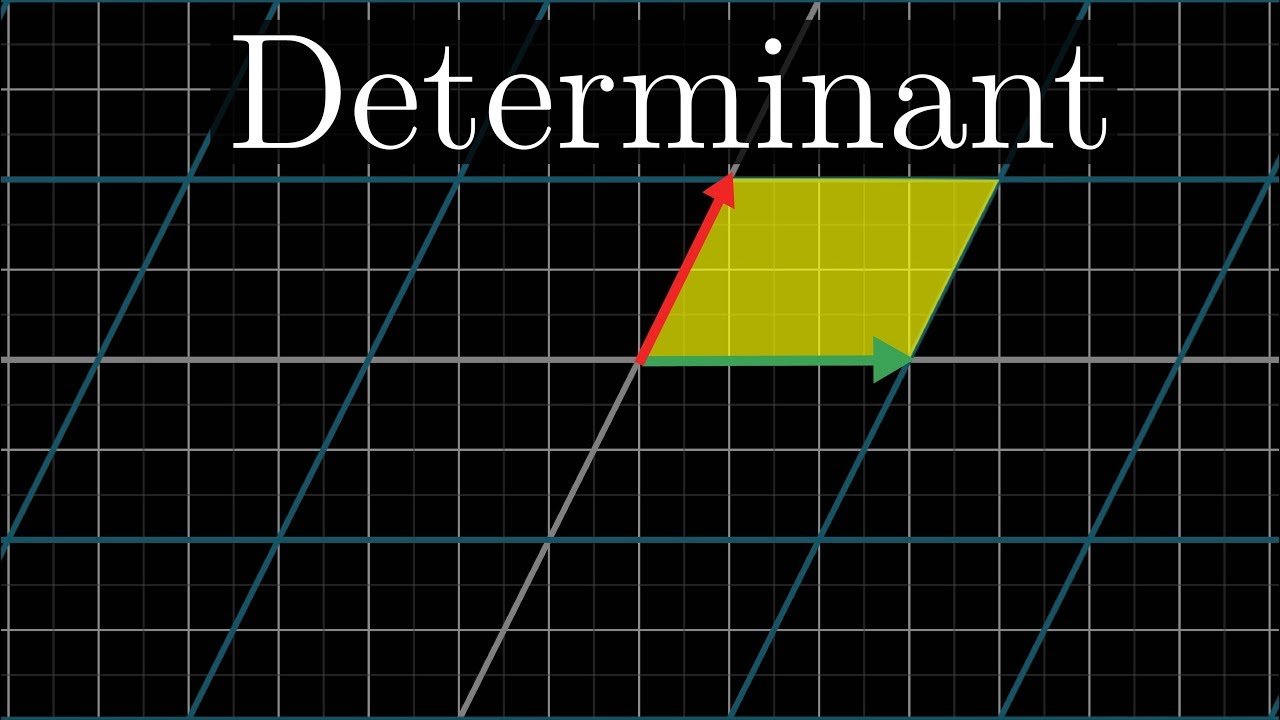
The determinant measures how much volumes change during a transformation.
Help fund future projects: https://www.patreon.com/3blue1brown
An equally valuable form of support is to simply share some of the videos.
Home page: https://www.3blue1brown.com/
Full series: http://3b1b.co/eola
Future series like this are funded by the community, throug...
queen olive
ty
wintry steppe
the determinant of a matrix is the signed volume of the parallelepiped its columns span
you can derive just about any fact about the determinant you'd like just from this nice geometric definition
 wild elm
For nxn matrices A,B if AP=PB where P is an nxn matrix does that imply A and B are similar or does P also have to be invertible for A and B to be similar?
zinc timber
notice that P doesn't have any condition given on it
can you pick one P such that AP=PB for all A, B?
 dusky epoch
"the composite linear map" here refers to the composition of T and S, as they say immediately after the phrase.
and surely you are familiar with the concept of "matrix of a map"?
@steep sandal
dusky epoch
the composition of T and S
steep sandal
Like function?
dusky epoch
yes, composition like functions.
"compositeness" is not an inherent property that some linear maps have and others don't, just so we're clear on that.
dusky epoch
dusky epoch
yes, composition like functions.
in fact they even use the same symbol: see that $\circ$ in $T \circ S$?
stoic pythonBOT
Ann
 steep sandal
Yeah
timid sage
How could I construct a 2x2 matrix that has 2 specific eigenvalues?
 quiet wren
Hi, if I have two (square) matrices A and B and A arises from B by increasing the diagonal elements do I have A >= B (eq. A-B is PSD)
zinc timber
timid sage
How could I construct a 2x2 matrix that has 2 specific eigenvalues?
put the eigen values in the digonal and rest to 0
zinc timber
quiet wren
Hi, if I have two (square) matrices A and B and A arises from B by increasing th...
isn't then A-B just the factors you have increased B and all off diaginal =0?
quiet wren
zinc timber
isn't then A-B just the factors you have increased B and all off diaginal =0?
Yes provided off-diagonals are the same, right?
zinc timber
you are changing only the diagonals, so rest are same
so the diff would be 0
(off diagonals)
timid sage
I'm suddenly seeing notation where a matrix is an exponent, like e^A
What is actually happening there?
zinc timber
power series
wintry steppe
matrix exponential 
zinc timber
since e^x = 1+x+x²/2!+..., you define e^A = I+A+A²/2!+...
 waxen wing
3b1b has a video on this
https://www.youtube.com/watch?v=O85OWBJ2ayo
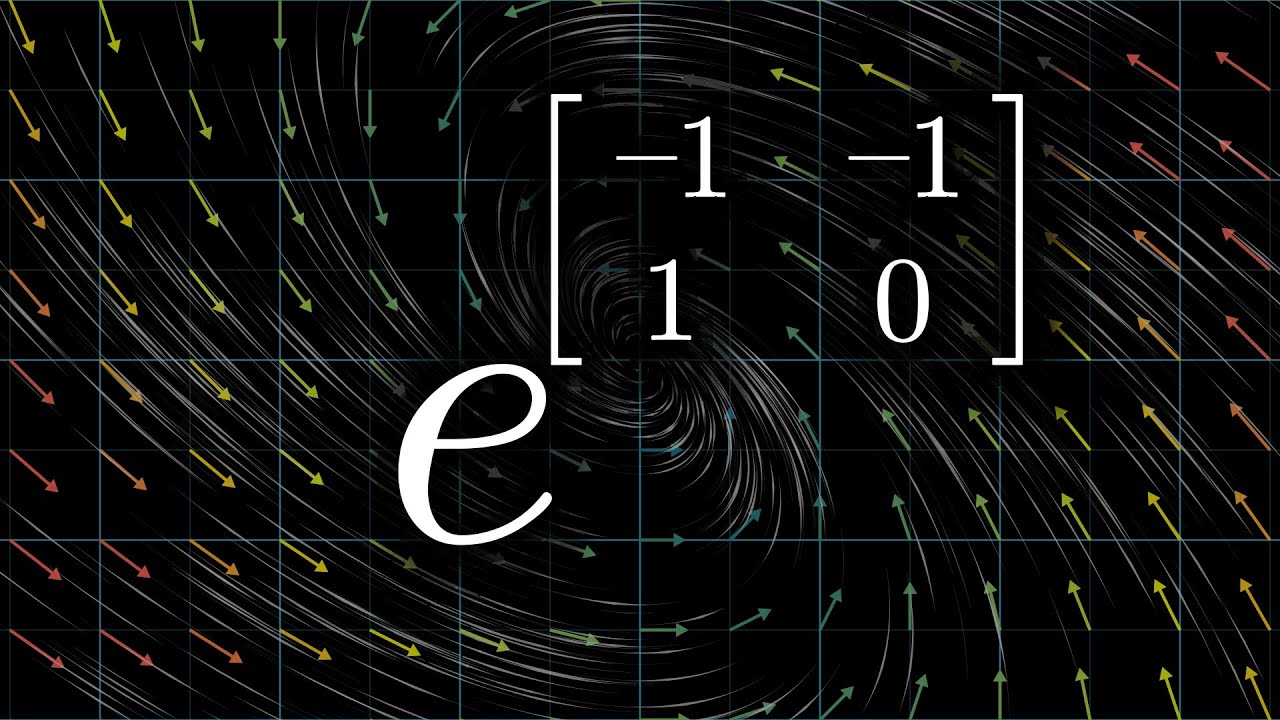
General exponentials, love, Schrödinger, and more.
Help fund future projects: https://www.patreon.com/3blue1brown
An equally valuable form of support is to simply share some of the videos.
Special thanks to these supporters: https://3b1b.co/mat-exp-thanks
The Romeo-Juliet example is based on this essay by Steven Strogatz:
htt...
 cold temple

I am thinking if $V/W$ is equivalent to ${\vec{v}+\vec{w}:\vec{v}\in V$ and $\vec{w}\in W}$
stoic pythonBOT
Trenton
 wintry steppe
the second set is V + W, which is just all of V
the first set is not even a subspace of V, it's something entirely different
cold temple
Umm the first set you mean is ${\vec{v}+W:\vec{v}\in V}$ and the second one to be ${\vec{v}+\vec{w}:\vec{v}\in V$ and $\vec{w}\in W}$?
stoic pythonBOT
Trenton
 cold temple
Sorry I can’t follow, where does the $V+W$ comes from?
stoic pythonBOT
Trenton
 wintry steppe
i am saying that the second set you wrote is the sum of the subspaces V and W
and since W is a subspace of V, this set is all of V
cold temple
wintry steppe
and since W is a subspace of V, this set is all of V
Ok got it thanks
uneven raptor
stoic python
**Trenton**
what you're probably thinking of here is the union of all elements (cosets) in V/W, which is V+W or V, and not the separate elements themselves.
zinc timber
hint || you only need the image of the basis ||
random axle
no my question is more like
would the plane's normal be mapped to the image plane's normal
zinc timber
you can visualize a skew transformation in 3d
or in 2D, take A= [1 1; 0 1]
and take the line y=0 and x=0. You should get analogous case for planes also
 hallow edge
Any relations between even and odd functions and symmetric and skew symmetric matrices?
New to linear algebra.
zinc timber
hallow edge
Any relations between even and odd functions and symmetric and skew symmetric ma...
use linearity to calculate T(-x) = T(-1 * x)
is this odd or even?
hallow edge
Odd
native rampart
hallow edge
Any relations between even and odd functions and symmetric and skew symmetric ma...
Well consider the function
T(X)=X^t
On the set of symmetric matrices this is even
On the set of skew symmetric matrices this is odd


 dark kite
 zinc timber
winter harbor
zinc timber
winter harbor
font is so small
zinc timber
winter harbor
pretty cool
winter harbor
Yeah so, I think the best analogy that can be done between even functions and symmetric matrices is that both of them are the eigenspace associated to the eigenvalue 1 of a certain involution on a given vector space.
And similarly
Odd functions and skew-symmetric functions are the eigenspace associated to the eigenvalue -1 of a certain linear involution.
And this gives you a decomposition of your space
as a direct sum of these eigenspaces
In one case you can write any function as a unique sum of even and odd functions.
And in the case of real square matrices, you can write any matrix as a unique sum of symmetric and skew-symmetric matrices.
By playing around with different vector spaces and different linear involutions, you can get similar decompositions.
zinc timber

 slim kraken
Let $(V, <\cdot , \cdot>)$ be an inner product space and $W \subseteq V$ a linear subspace. Then, $$(W^{\perp})^\perp = \overline{W}$$
stoic pythonBOT
Siupa
 slim kraken
Some hints?
slim kraken
I'm working with Hilbert spaces but I wrote inner product spaces because I don't think completeness is necessary for the proof
zinc timber
I believe you can show $(W^{\perp})^{\perp} \subseteq \overline{W}$
stoic pythonBOT
 zinc timber
for the other way around, take $w\in \overline{W}$ and so you get a sequence $(w_n) \subseteq W$ with $w_n \to w$
stoic pythonBOT
 zinc timber
maybe you can do something with <w_n, x>
completeness is necessary
you need W to be closed subspace at least
slim kraken
I mean if W is closed then this is just telling $(W^{\perp})^{\perp} = W$
stoic pythonBOT
Siupa
 zinc timber
true
slim kraken
I'm interested in the case where W need not be closed, so that the closure is non-trivial
zinc timber
ig you don't need it then
zinc timber
zinc timber
for the other way around, take $w\in \overline{W}$ and so you get a sequence $(w...
can you take over from here?
slim kraken
Don't know let me see, I'll try
zinc timber
use continuity of inner products
stoic pythonBOT

 dim sapphire
What is an endomorphism and how do you check whether a certain transformation is an endomorphism? The term endomorphism has been used freely by professors and assistant-helpers alike and I just took it as a given but i never really understood what it actually meant. My current understanding of the term is that an endomorphism is a transformation in which the domain and the image are in the same set. (sorry if i used any incorrect terms as my course isnt taught in English nor is English my first language)
wintry steppe
in the linear algebra context, an endomorphism is just a linear map from a vector space to itself
checking that something is an endomorphism boils down to checking that it is linear
dim sapphire
So T: V->V: (something somthing) would always be an endomorphism as long as it is linear
wintry steppe
yes
if you ever see the word "automorphism" that just means an endomorphism with an inverse that's also an endomorphism
(the inverse being an endomorphism part is usually automatic, like in linear algebra)
dim sapphire
so in general there's no need to worry about it as exam question for linear algebra will most probably involve endomorphisms, correct?
wintry steppe
i'd worry if i didn't know what an endomorphism was
fortunately, it's simple
i dunno about exam questions 
dim sapphire
I had an inkling of what it was, just wanted confirmation, thanks for answering ❤️
 golden wasp
whats a circulant matrix?
 tranquil steeple
golden wasp
whats a circulant matrix?
tranquil steeple
golden wasp
whats a circulant matrix?
A matrix where each row is the same, but shifted one step with respect to the previous row
tranquil steeple
golden wasp
whats a circulant matrix?
In linear algebra, a circulant matrix is a square matrix in which all row vectors are composed of the same elements and each row vector is rotated one element to the right relative to the preceding row vector. It is a particular kind of Toeplitz matrix.
In numerical analysis, circulant matrices are important because they are diagonalized by a di...
golden wasp
ah thank you
tranquil steeple
golden wasp
ah thank you
They are all diagonalized by the Fourier matrix (on that page too)
 tropic kernel
hi! sorry for messaging here but i just have a problem with these two matrices. the second matrix was a result of adding the row of the first matrix to the negative of the second row


so i thought the determinants would be the negative of each other
but they're equal for all values of t
why is that?
gray dust
adding a multiple of a row to another row doesnt change det
what ur thinking of instead is that scaling a row by k scales det by k
tropic kernel
ohhhh okay okay
my problem now is
i have a different set of matrices now


and i arrived at the second matrix by adding the first row to the negative of the second row
and the determinants are the negative of each other there
so i'm really confused i'm sorry
tropic kernel
ohhh i get it!
gray dust
then added 1st to 2nd, doesnt change det
tropic kernel
and then i added it to the second row
thank you so much and i'm so sorry for my questions
have a great day
gray dust
np 
@tropic kernel hang on
those matrices dont match what u did
following what u did, row 1 should be 0, 1-t, 0
this is the effect of adding -1*row 2 to row 1, which doesnt change det
but 0, t-1, 0 (maybe from an algebra mistake) is -1 times the actual result, which is why the det is mistakenly scaled by -1
 steep sandal
No assignment
 sly dock
 winter harbor
What is your definition of a reflection matrix?
 torn stag
@sly dock Q takes a vector $x$ and negates it's $u$ component because $Qx = x - 2(x, u)$. So it is reflection across the plane with normal vector $u$.
stoic pythonBOT
IlIIllIIIlllIIIIllll
 tribal willow
“Every entry off the main diagonal of N is 0.” is this not the same thing as saying N is a diagonal matrix
zinc timber
tribal willow
“Every entry off the main diagonal of N is 0.” is this not the same thing as say...
then what is it?
tribal willow
wdym
wintry steppe
you tell us anamono
tribal willow
oh
i was just asking what’s the difference between “Every entry off the main diagonal of N is 0” and “N is a diagonal matrix”
 vestal magnet
Hey all, How is everyone? 🙂
I need to get matrix J=P^-1AP where J is Jordan matrix, A is then given matrix and P is an invertible matrix
