#linear-algebra

2 messages Β· Page 253 of 1

winter harbor
#

Can you find an invertible matrix P such that the matrix A written above is such that

P^t A P = D for some diagonal matrix D, i.e a diagonal matrix D such that A is congruent to that? By the Sylvester's Law of Inertia, such a matrix P exists if A is non-singular. Also, the signature of a symmetric non-singular matrix is invariant under congruences.

#

Btw, P does not necessarily need to be an integer matrix.

zinc timber
#

guess he needs to diagonalize first opencryopencry

umbral void
#

my a_i are pretty general. I'm actually not even sure if they really can be any integers, or have to be nonzero

winter harbor
#

But you said the a_i would be integers.

winter harbor
umbral void
#

Yeah, but these matrices come up when looking at surgery links of lens spaces, and there I think we can wlog assume that all a's are non-zero. Still integers though

zinc timber
winter harbor
#

stare Surgery theory

zinc timber
#

welcome to the rabbitholeKEK

umbral void
#

in "invariants of 3-manifolds and projective representations of mapping class groups", Lyubashenko considers the case of lens spaces at the end

#

but when actually "computing" invariants, he only says this, so I guess it's either a hard question, or he just couldn't be bothered

#

meh

umbral void
#

low > high

winter harbor
#

I prefer to be high

#

It's actually funny how, in some sense, studying manifolds of low dimension (3 and 4) is somewhat more difficult than studying manifolds of dimension β‰₯ 5.

#

Because h-cobordism works

#

And other weird stuff

kindred hatch
#

anyone need to any help in linear

zinc timber
#

you can scroll up, there are lots of unanswered questions, start with them

kindred hatch
#

okay i will try

robust pond
#

I have a linear algebra question

#

I can perform the computation for 2 i think

#

which is im assuming to assemble the matrices as vectors

#

then put them into columns and row reduce?

#

which I get you shouldnt need to do

#

I'm not sure, I've googled around and I'm seeing a lot of reasons why the answer should be no

#

at least over R

#

but I'm not understanding/believing any of those reasons

#

much less over Z5

#

nvm

oak crater
#

Help, please πŸ™

zinc timber
oak crater
zinc timber
#

what's secant method of finding largest eigen value?

oak crater
zinc timber
#

you know what secant method is for finding roots?

#

I suppose you are to use it to find the roots of the char poly

#

I could be wrong

still lodge
robust pond
#

asking now in chill

#

$\left( \begin{tabular}{cccc|c} 0 & 1 & 1 & 2 & 0 \ 1 & 1 & 1 & 1 & 0 \ 2 & 1 & 1 & 0 & 0 \end{tabular} \right)$

#

can be reduced to

stoic pythonBOT
#

jan Niku

robust pond
#

can be reduced to

#

$\left( \begin{tabular}{cccc|c} 1 & 0 & 0 & 0 & 0 \ 0 & 1 & 0 & 0 & 0 \ 0 & 0 & 1 & 0 & 0 \end{tabular} \right)$

stoic pythonBOT
#

jan Niku

robust pond
#

this gives us independence, right?

#

im not really sure how to interpret this @nova yoke

#

i feel ive done the rref correctly, though

still lodge
#

just check on calculator πŸ€·β€β™‚οΈ

robust pond
#

well im not sure what it means

#

it doesnt really matter if its right or not

#

the steps to get to this over Z5 may be different than the R case i think

#

or something interesting may happen that allows a different result

#

but i wanna get the R case first

still lodge
#

i didnt fully read the q but that's a transformation from R4 down to R3 if you wanna work in reals

#

if you have a 3x4 and you multiply it by a 4x1 (element in R4) your output is a 3x1 (element in R3)

robust pond
#

i dont understand what you mean

fervent sluice
#

a = 1/2, and b = 1/2

robust pond
#

my original goal was just to determine if the columns are linearly independent

fervent sluice
#

see what happens then

robust pond
#

err rows

fervent sluice
#

so make a = 1/2 and b = 1/2

#

add em up

#

c = -1

robust pond
#

like for a,b,c corresponding to

fervent sluice
#

like the way in the question

#

the general linaer combination

robust pond
#

ok

fervent sluice
#

let a = 1/2, b = 1/2, c = -1

#

i mean the c part is unecessary

#

but just look at what happens

robust pond
#

sure

#

this was my original guess

#

so a counterexample

fervent sluice
#

yeah

robust pond
#

to assuming they are independent

fervent sluice
#

no they arent

robust pond
#

but how do you confirm that if you dont see it

#

right away

fervent sluice
#

very spooky stuff

robust pond
#

yea, they arent by counter example

#

so wait how do you confirm though

fervent sluice
#

oh yea

robust pond
#

if you dont know the counterexample

#

or cant find it

fervent sluice
#

yea the way i did it was just solve the matrxi

robust pond
#

solve?

fervent sluice
#

your matrix should work too

#

but i solved this one:

#

$$\begin{pmatrix}2&0&1\ 1&1&1\ 1&1&1\ 0&2&1\end{pmatrix}$$

stoic pythonBOT
robust pond
#

as columns

fervent sluice
#

reduced it

robust pond
#

you get a similar result

#

i did it this way first

fervent sluice
#

$$\begin{pmatrix}1&0&\frac{1}{2}\ 0&1&\frac{1}{2}\ 0&0&0\ 0&0&0\end{pmatrix}$$

stoic pythonBOT
fervent sluice
#

yeah u'll get the same result

robust pond
#

wait what

#

i got a different result

#

so i made an error

fervent sluice
#

spooky

robust pond
#

okay

fervent sluice
#

probably

#

i used a calculator

robust pond
#

say i didnt

#

and i got to like

#

well use your orientation

#

say you got to a diagonal of 1s then a row of 0's

fervent sluice
#

yea if u got some wacko numbers, u can test it out

robust pond
#

you interpret this as linear independence

#

right

fervent sluice
#

oh

#

yeah if u got identity you'd be dead

#

since you'd think its indepdent

robust pond
#

but here, since you get 2 rows of 0's

#

we have that the span of the original 3 can be defined by a basis of 2 vectors

#

bad

fervent sluice
#

yep

robust pond
#

its beginning to come back thonkzoom

#

okay so

fervent sluice
#

it's telling me exactly how to construct the counter example

robust pond
#

does this change in Z5?

fervent sluice
#

i have no idea

#

i only know basic lin alg

robust pond
#

thats okay

#

i appreciate your help

#

πŸ™‡β€β™‚οΈ

fervent sluice
#

πŸ‘

#

if Z is like integers, then i imagine 1/2 would be illegal or something

#

but even in that case, u could probably go a = 1, b = 1, c = 2

#

yea i just looked up z_5, and it seems like it'd still be dependent in z_5 (if im interpreting it correctly)

robust pond
#

Z5 would just be like

fervent sluice
#

a=1,b=1,c=2 works

robust pond
#

well im not sure it matters

#

its weird since like

#

i think the rules for rref change?

#

since you dont have additive inverses in the same way

fervent sluice
#

yea, but thats not a problem

robust pond
#

you cant subtract rows any more

fervent sluice
#

since its already about linaer independence

#

how we got the numbers is unrelated to whether its independent or not

robust pond
#

im not sure about that

#

rref uses those 3 basic moves right

fervent sluice
#

if we can prove it for the statement a[ ... ] + b[ ... ] + c[ ... ]

#

its all good

robust pond
#

these may collapse into each other for appropriate a b c right

#

or will they

fervent sluice
#

and we found a = 1, b = 1, c = 2

dim epoch
#

why is linalg not being done in chill

robust pond
#

i mean like

dim epoch
fervent sluice
#

cuz it aint chill

robust pond
#

we could get <2,1,1,0> to be 0,4,4,3

fervent sluice
#

wdym?

robust pond
#

i think thonk

#

well if a is 5

#

then you get 0,0,0,0

fervent sluice
#

yea theres still no problem

#

i don't think rref is a problem here

robust pond
#

so you can get a 0 vector out of <2,1,1,0> by multiplying by 5

fervent sluice
#

cuz you could've come up with the answer through oversvation

robust pond
#

oh i guess 5 isnt in Z5 though

fervent sluice
#

yeah its not

robust pond
fervent sluice
#

owait maybe it is

#

idk

robust pond
#

its not

#

5 is congruent 0

fervent sluice
#

i've just assumed it's 0,1,2,3,4

robust pond
#

in the mapping

#

yea

robust pond
#

right

#

i feel like this is true

fervent sluice
#

My view is that: a=1, b=1, c=2
Works in Z_5

#

so it should be fine

#

and is a valid counter example

stable kindle
#

if you don't have additive inverses something's gone very wrong

oak crater
fervent sluice
#

so it is dependent in Z_5

robust pond
#

the additive inverse of 1,1,1,1 in Z5 4,4,4,4 not -1,-1,-1,-1

fervent sluice
#

you do have additive inverse

#

yeah thats not a problem

#

I mean we can probably do rref in Z_5 without a problem

robust pond
#

so we can manufacture uhh

#

from 2 1 1 0

#

4 2 2 0

#

1 3 3 0

#

3 4 4 0

#

and 0 i guess

#

but non of that matters i guess

fervent sluice
#

what r u most concerned about?

robust pond
#

well nothing really

#

i guess your counter example still exists in z5

#

with a 2 and 4 instead

#

i think?

#

-1 -> 4 and 1/2 -> 2

fervent sluice
#

a=1,b=1 and c = 2

robust pond
#

still makes it work

#

ah

fervent sluice
#

is the counter example

robust pond
#

1s

fervent sluice
#

and i rephrase the statement to:

#

If a[ ... ] + b[ ... ] = c[ ... ], then it is not linearly indepedent

robust pond
#

oh shit

#

im sorry i just remembered

#

i have an advising appt in 5 minutes

fervent sluice
#

rip

robust pond
#

i appreciate your help a lot

fervent sluice
#

np, gdluck

robust pond
#

ill look into this more during work

#

catthumbsup πŸ™‡β€β™‚οΈ

upper badger
#

Hey Guys. I'm trying to learn linear algebra better and was wondering, is it true that for every real number there's an integer that is smaller?

dusky epoch
#

what do you think? do you think it's true or do you think it's false?

upper badger
#

i think its true

dusky epoch
#

and you are right

upper badger
#

Thanks, is there a way to describe it mathematically and instead of words

dusky epoch
#

do not fool yourself into thinking mathematics is only ever done and written with a sea of symbols and nothing else

upper badger
#

😳

dusky epoch
#

but it is possible to write "for every real number there is an integer smaller than it" entirely in symbols if you wish

#

$(\forall x \in \bR)(\exists n \in \bZ)(n < x)$

stoic pythonBOT
upper badger
#

sorry but does that A and E stand for?

dusky epoch
#

'for all' and 'exists' respectively

#

look up "logical quantifiers" and "first-order logic" if you want to learn more about this

upper badger
#

thx!

lavish jewel
#

your proof seemed incorrect

quaint steppe
#

Yeah i should substitute

lavish jewel
#

it was independent of the field, too

quaint steppe
#

I just notice

lavish jewel
#

you'd better pick a basis and make a matrix

quaint steppe
#

This i think is how should i have done it

#

But for R i just say that it does not exist

lavish jewel
#

that's better, yeah

dusky epoch
#

real symmetric matrix?

#

i don't think so

#

real symmetric matrices are always diagonalizable

#

so the charpoly of any such matrix would have to have as many real roots as its degree

#

which x^n - 1 doesn't

median ocean
#

can anyone help me with this

sour cloud
#

anyone know how its equal to that matrix?

stable kindle
#

you probably just do it

sour cloud
#

take the inverse and then multiply ?

tawdry hornet
#

(u+v).(u+v) = 16 ; u.u = 7 and v.v = 7/2; (u-v).(u-v) = ?

sour cloud
#

is there an easy way to find the inverse of a matrix without doing the using the augmented form of a matrix ?

minor jacinth
#

you can use gauss pivot

tranquil steeple
#

And obviously nobody does it by hand, if that was what you are asking.

glad acorn
#

By computer

prisma sail
#

LOL

median ocean
#

can someone help me with 2

ionic laurel
#

diagonalize

#

this matrix

#

if its diagonizable of course

#

so setup A = PDP^-1

#

Find P and D and then find P^-1 by inverting P

#

And use the common formula A^k = P * D^k * P^-1

#

Finding P and D is the trick to the question

#

and then the matrix multiplication part is just tedious

#

but you have to do it nonetheless

tropic pebble
#

Is k 5?

ionic laurel
#

yes

#

if A is the matrix given k is 5

tropic pebble
#

Thanks!

ionic laurel
#

πŸ‘

steel moon
#

for #2, to show span(S) is a subset of P3(R) can we just expand the stuff on the S and group the terms in their linear combination?

stoic pythonBOT
#

IlIIllIIIlllIIIIllll

worldly silo
#

can someone tell me which one is easier out of math 213 and math 203? (calc 3 or linear algebra)
I have a heavy schedule next sem so I want to take an easier class

nocturne jewel
gleaming knot
#

Looks like he's still on Piaget stage 3 nozoomi

#

Ok in all seriousness, calc 3 could be easy with an easy professor, so could linear algebra

limber sierra
golden kindle
#

**To prove the Cauchy Swartz Inequality, why does Sal Kahn start with the function (which he apparently brought out from thin air): **

$$ P\left(t\right)=\left|\right|t\vec{y}-\vec{x}\left|\right|^{2} $$

stoic pythonBOT
#

Tom Joney

zinc timber
#

it's not out of nowhere, though I admit could have been done in a better way

#

we are projecting $x$ onto $y$, so say the projected vector is $t\va{y}$. So the distance of the point from $t\va{y}$ to $\va{x}$ will be minimum.

stoic pythonBOT
#

Ryuzaki

golden kindle
#

Ok I didn't learn this ...

#

Plus I don't really get the solution To be honest.

#

(That you said.)

zinc timber
#

you don't necessarily have to learn it this way

golden kindle
#

Oh, so there are other proofs for it then or...

zinc timber
#

the length of a vector is always less of equals to it's projection onto any subspace

#

right?

golden kindle
#

Yes

zinc timber
#

say, we are projecting $a$ along $b$ then, the length of the projected vector will be $\frac{\innerproduct{a}{b}}{\norm{b}}$

stoic pythonBOT
#

Ryuzaki

zinc timber
#

this should be $\leq \norm{a}$

stoic pythonBOT
#

Ryuzaki

zinc timber
#

because a is being projected here

#

multiply both sides by ||b|| and you have <a, b> <= ||a||||b||

steep mural
#

Is it bad to take differential equations and calc 3 together?

zinc timber
#

@golden kindle?

golden kindle
#

Yes bro I'm trying to get it.. wait a sec

zinc timber
#

that's the easiest proof I can think of

golden kindle
#

That's smart man... good job

zinc timber
golden kindle
#

much better than the Khan Academy video

golden kindle
#

That is a smart way of approaching the proof for the inequality, good job

golden kindle
#

@zinc timber would this also be valid;

zinc timber
#

for R^3 or R^2 it works IG because we can mesaure the angle. for abstract spaces like C[0,1] there's not angle unless you define inner product first

#

and the angle is measured in terms of the inner product and cauchy-schwarts allows us to take arccos, not the other way around

#

so NO

golden kindle
#

k

zinc timber
ionic laurel
#

Linalg is a course that makes you start to think about theory

#

Calc 3 is much more straightforward

teal grotto
#

hmmm

brittle reef
#

hi

#

Anyone know about algebra tiles?

golden kindle
#

@zinc timber are you on bro I need help

#

I know that b/2a is the vertex of the parabola ax^2+bx+c, but why has Sal Kahn used it in his function here for the proof?

I know your proof is better but my teacher first wants me to understand his, so yeah

teal grotto
#

@golden kindle you only need to make sure that the discriminant of P is non-positive

#

hes basically done, not sure why sal is bringing up the vertex

teal grotto
#

i guess you can plug in the vertex here to find the minimum

golden kindle
#

Ok, but I can still use any number for the proof?

teal grotto
# golden kindle What do you mean?

when the discriminant of a quadratic is non-positive, then it has either one double root or no real roots at all, meaning its either always non-negative (or non-positive depending on the sign of the leading coefficient)

teal grotto
golden kindle
#

Ok... so I can't use anything but the vertex for the proof?

#

Strange bro

teal grotto
#

well, like, any old arbitrary point t probably wont work

#

not strange at all

golden kindle
#

Ok so just 5 or something

#

would work bro?

teal grotto
#

wouldn't

golden kindle
#

ok

#

Oh yeah now i see

#

Ive been up for somet ime

teal grotto
#

i actually dont know why hes bringing out the vertex

golden kindle
#

so my congitive abilities are... not good

teal grotto
#

just... b^2 - 4ac has to be less than or equal to zero

#

proof over with

#

qed

zinc timber
#

@golden kindle u don't need to tag me, there are others who can help

golden kindle
#

Ok sorry

golden kindle
#

Damn that's embarrassing...

oak crater
#

Prove that T is a linear Transformation and find the Kernel and Null space, N(T). Determine whether T is one-to-one.

limber sierra
#

have you tried anything? do you know where to start? where did you get stuck?

golden kindle
#

how are these two the same I'm confusion:

zinc timber
#

distributive property

golden kindle
#

so like FOIL?

limber sierra
#

yes

#

factor out (x+y) from the bottom line

#

and you get the top line

#

or apply the distributive property to the top line and you get the bottom line

quaint steppe
#

tried to answer some exercises in the book, for (a) is my proof correct?

marble lance
#

Yes it is

quaint steppe
#

Finally a correct proof

#

Thank you

marble lance
#

πŸ‘

errant mist
#

When I denote the equation for a hyperplane as: $(x|a^Tx = b)$ what is the geometrical interpretation of $b$ in this case? Will it be a constant corresponding to different levels of the hyperplane perhaps where $a$ is the normal vector and $x$ are some points?

stoic pythonBOT
#

Fredrikpiano

lavish jewel
#

it's an offset applied to every vector on the hyperplane

errant mist
#

offset as a translation?

lavish jewel
#

two ways of seeing are, first, treating the normal a^T as a rank 1 linear transformation. there will be a particular solution to a^T x = b, and then a rank n-1 null space. then the points on the hyperplane are given as a linear combination of the basis vectors of the null space plus the particular solution, which offsets them

#

the other is to recall that the equation of a hyperplane is alternatively written as a^T (x - x_0) = 0, where x_0 is a point on the hyperplane

#

so b = a^T x_0

#

you can then decompose x_0 into a component parallel to a and a component perpendicular to it, and then note that a^T (x_parallel + x_perp) = a^T x_parallel, which gives you the length of the position vector of x in the direction of the normal

#

vectors in general have no position in space, so it's the same as taking them all with reference to the origin, and so this a^T x_parallel is a distance from the origin in the direction of the hyperplane's normal

errant mist
#

For the first explanation would the particular solution be our b right?

lavish jewel
#

not really, it would also be this x_parallel

#

x_parallel is the particular solution to a^T x = b

#

b is just a scalar

#

note that when i say particular solution to a^T x = b, i mean the x that satisfies that equation given a and b

errant mist
#

ahh, yes. got it. The second way of "seeing it" you described was easier to see

lavish jewel
#

you can double check the intuition in a 2D case, where the hyperplane is a line

#

say the normal is a = [0,1], and let x = [x,y] (overloading the notation so it looks familiar later)

#

if we take a^T x = 0, for example, we get that 0x + 1y = 0 -> y = 0, a horizontal line passing through the origin

#

now if we simply change 0 to b, we get that y = b

#

and the horizontal moves up and down depending on b

errant mist
#

yes, that makes a lot of sense.

#

The only part I still dont get is the first part. If A^T is a rank 1 linear transformation can I view this as a linear independent column which I am multiplying with a particular solution?

zinc timber
#

A is of rank 1 so what do u mean?

#

there's only one vector (nonzero) so it's LI regardless

lavish jewel
#

you can view a^T as a row in a matrix that is 0 everywhere else

#

so if a is a tuple of length n, there are n-1 free parameters

#

(give or take an isomorphism cuz this gives a dim 1 subspace of a dim n vector space)

errant mist
#

and these n-1 free parameters corresponds to a null space rank of n-1 dimension?

lavish jewel
#

ye

#

a null space of dim n-1

#

when b = 0, this is equivalent to the hyperplane

#

otherwise, the hyperplane is a "flat" or affine subspace

errant mist
#

and we need the basis to span our space which is then offset by the particular solution which satisfies A^Tx = b?

lavish jewel
#

yeah

errant mist
#

ok, I got it

#

BTW for affine spaces could we have closed "shapes" ? I mean since we are not dealing with closed line segments I would assume this doesn`t work? Like all of R^2 would be an affine space, but some rectangle in R^2 would not, no?

lavish jewel
#

i think you're looking for affine/convex combinations or something like barycentric coords

#

these have some nice properties, but are more restrictive, since only certain values of the base field are allowed when combining the vectors

errant mist
#

right, its from affine combinations. Never heard of barycentric coords though.

lavish jewel
#

closely related

errant mist
#

ok

oak crater
oak crater
# oak crater Hel

Help, please the function is defined by f(x) = z where z is a complex number

zinc timber
#

you only need to show f(ab)=f(a)f(b)

oak crater
winter harbor
# oak crater Can I see how you did it?

That's basically just the definition of a group homomorphism. You shouldn't have too much of a problem checking that the identity on (C, Γ—) is, in fact, such an example.

winged prairie
#

any idea on how to start this one?

wintry steppe
#

you probably want to use finite dimensionality of V somehow

#

my hint is to read the proof of rank-nullity

#

or the dimension theorem

#

the rank + nullity = dim domain thingy

sinful valve
#

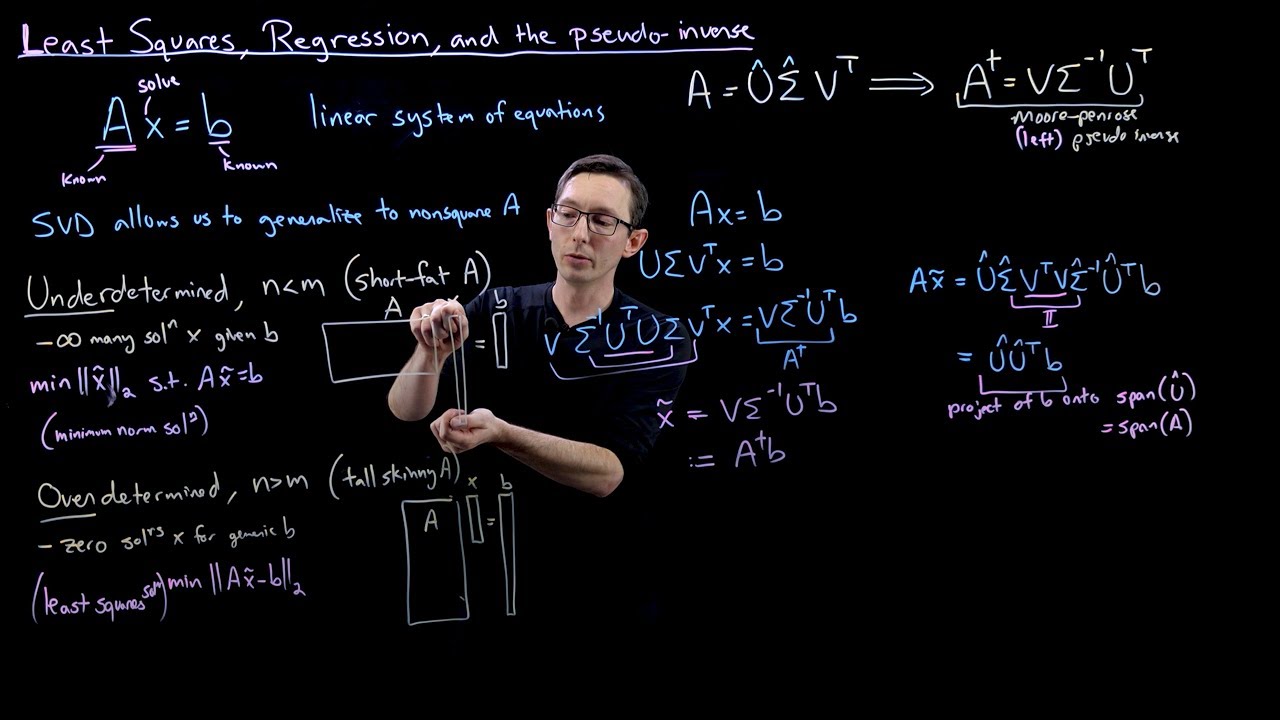
Can anyone explain the moore penrose inverse of a matrix

teal grotto
#

explain what about it

sinful valve
#

so regarding machine learing regression

#

it can solve the least squares thing

#

actually is it just like

#

an inverse with using the SVD as to generalise the result

#

rather than a square matrix basic inverse

zinc timber
#

you can think it of as a least square solver

#

if it's already invertible then it gives the exact inverse

sinful valve
#

yeah uh im just trying to think how its minimizng it just with svd

#

ive looked at the normal equation before they mentioned this

#

like whats the point of the bottom version even

teal grotto
#

less writing lol

sinful valve
#

so the sigma^+ ting

#

why do they invert the singular values , what significance is this

#

they also seemed to flip it about

#

so have they basically just converted to SVD

#

then inverted each part of the SVD and thats the pseudoinverse ?

#

i dont see exactly how they got that though

#

is $A^{+} = V \Sigma^{+}U^{*} = A^{-1}$ kinda.

stoic pythonBOT
#

shriller44

lavish jewel
#

what it does is perform an orthogonal projection onto the row space of the matrix A

sinful valve
#

so the idea of this is like

lavish jewel
#

if you expand the (A^TA)^-1 A^T expression with the svd, you should get an orthogonal projection mat

sinful valve
#

overdetermined A or something

#

yeah i mean i saw this

#

so if i just work from the derivation for the normal equation i can generalise it to the pseudoinverse

lavish jewel
#

they're the same thing

sinful valve
#

yeah as shown there i wanted to know where svd comes in exactly though

lavish jewel
#

you don't need it at all there tbh

#

it's just an easy way to get a nice geometric interpretation

#

say x is a vector that is not necessarily in the row space of the matrix A

#

then Ax = y is not unique

#

but if we take the pseudo inverse (A^TA)^-1 A and apply it to y, we get that x_rowspace = (A^TA)^-1 (A^T A)x

#

if A^T A is actually invertible, this is exact and the pseudo inv is the inverse

sinful valve
#

so rowspace u are on about

#

x being in line with A

lavish jewel
#

in general though, you would rather use that janky SVD inverse where you take the reciprocal of the singular values that are nonzero and ignore the rest (economy size svd), and the result is that x_rowspace = VcVc^T x

sinful valve
#

yeah that was what this guys video was on about

lavish jewel
#

then since Vc has orthonormal columns, VcVc^T is an orthogonal projection matrix

sinful valve
#

so the idea is just ignoring the bits of x that go beyond the row space?

lavish jewel
#

pretty much. you can't do anything about them cuz they get mapped to 0

sinful valve
#

okay fair

#

so yeah x is infinite for that

lavish jewel
#

?

sinful valve
#

but to solve our one we just cut out that as we need some actual value

#

well we have 0x + 0x^2 .... = 0 0 0 , so any input is 0

#

for the bit of x that goes beyond A

lavish jewel
#

i understood nothing of that

winged prairie
wintry steppe
#

yes that's what im referring to

#

its proof might give you an idea how to do your problem

#

something something extend a basis of ker T to a basis of V and look at the remaining vectors...

winged prairie
#

ayt ill try it out

#

ty

sinful valve
#

well if the bottom row of a matrix has all 0 = 0 then its always gonna be 0 thats all im saying

#

so its got infinite solutions

lavish jewel
#

that's not the same as x being infinite, but ok

sinful valve
#

and so the point of this whole svd bs is to just map the bit we care about

#

i dunno how to word it tbh

lavish jewel
#

that is not the point of the SVD btw, that's the point of the pseudo inverse

sinful valve
#

yeah that

lavish jewel
#

invert what you can, ignore the rest

sinful valve
#

yeah by infinite i was talkin about this

#

but yeah

#

oh this makes most sense acc now

#

was wondering what that x squiggle was on about but its just approx inverse

wintry steppe
#

I'm guessing there's some "obvious" way to transform a general binary quadratic into a homogenous one? Lagrange basically did this for integers and when it comes to restricting to Diophantine equations things get harder, so I would expect that doing it over the reals instead would be way easier, but I can't figure it out

#

I would expect that it's a matrix transformation that just essentially relabels your variables to get rid of the linear and constant terms

#

I tried it by hand but things just didn't work out

dark brook
#

I am a little confused to what this really means what the difference is between the two (and what $n \leq p$ points towards)
If $V \subseteq \mathbb{F}^p$ so $n \leq p$ we can do the $(B_1 \mid B_2) \sim \begin{pmatrix} I_n & T \ 0 & 0 \end{pmatrix}$ and why its different from if $V = \mathbb{F}^n$ and $T$ can be found with $T = B_2^{-1} B_1$ ?

stoic pythonBOT
#

HrJonas

dark brook
#

(sorry for the missing augmented line in the matrix)

winter harbor
#

Maybe that's what you are looking for.

#

And works in general for any polynomial over a field, of any number of variables and up to any degree.

wintry steppe
#

Huh that's interesting and pretty useful, thanks! but it will always require you bring in another variable

#

I just mean for example a transformation of (x, y) to (X, Y), where we have the general quadratic equal to a binary quadratic: ax^2+bxy+cy^2+dx+ey+f = AX^2 + BXY + CY^2 = 0 describing a curve

dark brook
#

If I've got 3 sets of vectors, {u1, u2, u3} in R^3, but I've got another set of vectors of only {v1,v2} - and I needed to find the matrix representation of the linear transformation F : R^3 -> R^2, I would end with a 2x6 augmented matrix if I wanted to RREF, right?

dark brook
#

Huh.

So if I've got $F(B_u) = \begin{pmatrix} 1 & 2 & 1 \ 2 & 6 & 0 \end{pmatrix}$ and the two vectors $B_v = \begin{pmatrix} 1 & 1 \ 0 & 2 \end{pmatrix}$, how do I end up with a 2x3 if I wanted to $\left( B_v \mid F(B_u) \right)$ ?

The $F(B_U)$ comes from $F(x,y,z) = \begin{pmatrix} x \ y - z \end{pmatrix}$

stoic pythonBOT
#

HrJonas

golden kindle
#

How did he replace 2(x dot y) with 2 times magnitude x times magnitude y

#

Like I'm not getting what he did here

#

Plus I'm not eniterely understanding the inequality itself

teal grotto
#

he applied cauchy shcwartz, the thing u we’re trying to understand yesterday

golden kindle
#

to the dot product?

#

I am confusion

teal grotto
#

xβ€’y <= |xβ€’y| <= ||x|| ||y||
this is what cauchy schwartz is

golden kindle
#

If it's lower than or equal why did he make it equal

#

as in replace it

#

Ah ok

#

hmm

teal grotto
#

it’s like saying if b <= b’, then
a + b + c <= a + b’ + c

golden kindle
#

ok...

#

Wait nvm I get it I think

torpid socket
#

Hey I have a question is a 4x3 the same dimension as 3x4

#

(Matrix)

teal grotto
#

whats the dimension of a matrix

torpid socket
#

What is a dimension

#

I don’t understand

#

It

still lodge
#

look into the rank nullity theorem

fallen zodiac
#

I answered with the rank of each but its wrong, why?
don't tell me the answer to that specific question

nocturne jewel
fallen zodiac
#

2

#

cuz 2 of em are redundants

nocturne jewel
#

which 2?

fallen zodiac
#

second and fourth ones

nocturne jewel
#

Yeah I think it should be 2

fallen zodiac
#

the bottom one i answered 3 cuz again 2 of em are redundants

#

but im wrong according to this homework website...

blissful vault
#

Does this work? I factorized p(t) with theorem 4.11 so that each eigenvector is sent to 0 in the sum.

golden kindle
#

Why is he using 'a-b' when he could just do 'a+b' O_O

golden kindle
#

What

fallen zodiac
#

what do you not get

golden kindle
#

I don't get why he didn't do a + b instead of a -b

fallen zodiac
#

thats what i showed you there

#

a-b and a+b are different, as i showed

golden kindle
#

the only difference is the direction isn't it

#

Plus your drawing is hard to get

fallen zodiac
#

the length too

#

it should be pretty easy to visualize

golden kindle
#

Oh yeah A- B is smaller right

fallen zodiac
#

yup

golden kindle
#

K now I get it

#

But they are both valid triangles, even if it was a + b right

fallen zodiac
#

idk in what context he used that

golden kindle
#

so He's trying to prove that thing

#

So I was wondering if he could do the proof with a + b or it wouldn't be valid

fallen zodiac
#

lemme see

#

im not fully sure, but my guess is no.
because what he did there is making both vectors start from a same origin. to make the third length a+b you'd have to do it differently and even if it works i dont see why you would complicate it.

#

someone correct me if im wrong

golden kindle
#

K

dark brook
#

If I've got $A \sim \begin{pmatrix} 0 & 1 & 0 & 0 \ 0 & 0 & 1 & 0 \ 0 & 0 & 0 & 1 \ 0 & 0 & 0 & 0 \end{pmatrix}$ what would the set of basis be? (I would imagine $v = {1,1,1}^T$ . Or would it be zero since we've actually got pivotelements every intrance and therefore all bound variables?

golden kindle
#

Shouldn't it be A dot - B here not -A dot B:

#

Because foil goes: a dot a + a dot - b etc

#

so I'm confused, there is no '-a'

stoic pythonBOT
#

HrJonas

fallen zodiac
solid siren
stoic pythonBOT
#

grist bundle

solid siren
#

Those things are equal

golden kindle
#

k

wintry steppe
#

Question: Im not really understanding something here

#

Everything makes sense except where C comes from ?

#

Shouldn't it be the transformation matrix D = C^-1 or D = AC^-1 based on this map?

#

Like I'm not understanding how a change to another basis ( C ^-1) and then transforming in the same basis afterwards ( D ) equates to D = C^-1AC..... especially based on this map makes no sense to me

#

<@&286206848099549185>

#

Also isn't CC^-1 just = identity matrix.......

warm lava
#

I think you can consider as DC^-1x=C^-1Ax

#

I am not sure that is it your question

wintry steppe
#

Where does the extra C come from ?

#

Like it says D = C^-1AC not D = C^-1A

#

Even by this formula DC^-1x=C^-1Ax still not really seeing where you'd get a C from

warm lava
#

DC^-1 = C^-1 A, then (DC^-1)C=(C^-1A)C, then D= C^-1AC

wintry steppe
#

Why are we randomly multiplying by C tho. Is that allowed because its like multiplying by 1.... but its a whole matrix lmao

warm lava
#

both sides are multiplying by C, then the equality holds

wintry steppe
#

Also D= C^-1AC why is C ^-1C ! = Identity matrix here. Do you have to group (C^-1A)

spark marlin
#

is a rational matrix just a matrix with all entries being rational numbers

warm lava
wintry steppe
#

Right.... but couldn't you write (DC^-1)C as C(DC^-1)=(C^-1A)C and by that logic it should be CDC^-1 = C^-1AC

warm lava
wintry steppe
#

Ohhhhh yeah I forgot

#

oops

#

Thank you that makes more sense now

#

lol

warm lava
#

you're welcome πŸ™‚

dark brook
#

So if I've got $F(B_u) = \begin{pmatrix} 1 & 2 & 1 \ 2 & 6 & 0 \end{pmatrix}$ and the two vectors $B_v = \begin{pmatrix} 1 & 1 \ 0 & 2 \end{pmatrix}$, how do I end up with $\left( B_v \mid F(B_u) \right)$ ?

The $F(B_U)$ comes from $F(x,y,z) = \begin{pmatrix} x \ y - z \end{pmatrix}$

stoic pythonBOT
#

HrJonas

dark brook
#

<@&286206848099549185>

zinc timber
#

not clear what u and v are in your case and what you are trying to achieve

dark brook
#

Sorry, I typed it way above. I'll clarify it.

So I am trying to find a matrix representation of F with respect to $B_1$ and $B_2$. $B_1$ was known earlier and consist of the vectors u1, u2, u3 and I took those inside $F(x,y,z)$ to get the linear transformation. Thats where $F(B_u)$ comes from. Then I got another set of vectors given, $v_1,v_2$ and took them into $B_v$. The idea was to do $\begin{pmatrix} x \ y - z \end{pmatrix}$ and find $A = B_v^{-1} F(B_u)$.

stoic pythonBOT
#

HrJonas

golden kindle
#

how did a 2 get here?

limber sierra
#

high school algebra

#

(x-y)Β² = xΒ² - 2xy + yΒ²

#

you might know terms like "distributive property" or "FOIL"

#

or "binomial expansion"

#

a derivation:

(x-y)Β² = (x-y)(x-y) = x(x-y) - y(x-y) = xΒ² - xy - yx + yΒ² = xΒ² - xy + yΒ²

golden kindle
#

yeah ik but this one is 100 times harder

#

To understand bro

limber sierra
#

i mean... its just that with x = aβ‚‚b₃, y = a₃bβ‚‚

golden kindle
#

yeah but theres too much steps in this equation

limber sierra
#

Β―_(ツ)_/Β―

#

its all rote, nothing clever is being done really

#

just apply high school algebra repeatedly

golden kindle
#

k

#

oh ok I see it...

#

$$ \left(a_{2}b_{3}-a_{3}b_{2}\right)\left(a_{2}b_{3}-a_{3}b_{2}\right) $$

$$ a_{2}^{2}b_{3}^{2}-a_{2}a_{3}b_{3}b_{2}-a_{3}a_{2}b_{2}b_{3}-a_{3}^{2}b_{2}^{2} $$

$$ a_{2}^{2}b_{3}^{2}-2a_{3}a_{2}b_{2}b_{3}+a_{3}^{2}b_{2}^{2} $$

Is right?

stoic pythonBOT
#

Tom Joney

dusky epoch
#

yes

dusky epoch
#

part c?

glad acorn
#

okay i've just figured out

#

I don't know whether what I have written down is enough to show the part(c)

dusky epoch
#

first off, $W \in \ang{S}$ is nonsense

stoic pythonBOT
dusky epoch
#

you meant $W \subseteq \ang{S}$

stoic pythonBOT
dusky epoch
#

and even so, what you showed is that every vector in <S> belongs to W, which is the reverse of what you wanted.

#

you want to show that for every w ∈ W there exist constants t1, t2, t3 such that t1 v1 + t2 v2 + t3 v3 = w

dusky epoch
#

write this as a system of equations

#

$t_1 \bmqty{2 \ -2 \ 5 \ -5} + t_2 \bmqty{0 \ 114 \ -111 \ -3} + t_3 \bmqty{0 \ 0 \ 3 \ -3} = \bmqty{x \ y \ z \ -x-y-z}$

stoic pythonBOT
dusky epoch
#

show that for any x, y, z ∈ R there exists a solution to this

glad acorn
#

oh ok I understand

glad acorn
#

I found this question strange

#

In part (a), I found that C’ and z’ can be sets of matrices and vectors since the only constraints are

(1)A’ is the RREF form of A
(2)C is row-equivalent to C’

#

Which is roughly

#

Have I done anything wrong? Only the matrix A’ is unique.

dusky epoch
#

...??

#

this sounds way too strange

#

although... wait

#

i think you might be right but it's kind of confusing

dusk hemlock
#

If u,v are vertices, and I have some matrix M, is it true that M maps (uxv) to the product M(u) x M(v)?

dusky epoch
#

vertices
did you mean vectors?

#

anyway, no, it's not true in general. i think it's only true for proper rotation matrices.

zinc copper
#

We saw that the double dual is naturally isomorphic to V (without explicitly mentioning the category theory). How would one go about showing that V is (not) naturally isomorphic to its dual?

zinc timber
#

for finite dimensions, the natural dual/double dual is always isomorphic to the original VS

zinc copper
#

I mean the dual is also isomorphic but I’m talking about natural isomorphisms

zinc timber
#

things get weird when dimension is not finite, V < V* < V**

zinc copper
#

And yeah I should have specified for finite dimensions

zinc timber
#

you mean the canonical map of V to V**?

zinc copper
#

Yeah

zinc timber
#

as I said, it's isomorphic to the original space, for finite dim

zinc copper
#

How do we show there’s no natural transformation from the identity functor to the dual functor though?

#

Again talking about natural isomorphisms not isomorphisms

dusky epoch
#

@zinc timber what's the sully for

zinc timber
quaint steppe
#

how can i prove this ? i know that i must show $Tv \in null(S)$ and maybe use the fact that ST=TS. But i don't know how to start.

stoic pythonBOT
#

jinichi

dusky epoch
#

you need to show that v ∈ null(S) implies Tv ∈ null(S).

zinc timber
#

ST(v) = TS(v)

dusky epoch
#

spoilers sully

zinc timber
#

ok then, sadcat

quaint steppe
solemn lotus
#

$V$ and $W$ are two vector spaces. Is there a linear map $T:V\to W$ such that $\ker T = \text{im } T$?

stoic pythonBOT
#

CoolShot

solemn lotus
#

hey, could i get some help with this?

zinc timber
#

under certain condition, a map T will exist

#

also do you mean W=V because $\ker T \subseteq V$ whereas $\text{im} T \subseteq W$

stoic pythonBOT
#

Ryuzaki

solemn lotus
#

not given in the question but ig that would have to be the case

zinc timber
#

ok first try to find a necessary condition using rank-nullity theorem

solemn lotus
#

with rank nullity we'll just get that $\dim V = 2a$ where $a = \dim(\ker T) = \dim(\text{im } T)$ right?

stoic pythonBOT
#

CoolShot

zinc timber
#

yes, so a necessary condition is that the dimV must be even

solemn lotus
#

hm yeah

zinc timber
#

now given the dim is even, assume $\mathcal{B} = {v_1, v_2, \cdots v_n}$ be a basis of $\mathfrak{N}(T)$

stoic pythonBOT
#

Ryuzaki

zinc timber
#

you should be able to extend it to a basis of entire V just by adding another n set of vectors

#

say $\mathcal{B}_V = \mathcal{B} \cup { u_1, u_2, \cdots, u_n}$

stoic pythonBOT
#

Ryuzaki

zinc timber
#

now can you find a LT given this?

solemn lotus
#

yeah i think so, let me try

#

would $T(v_i) = u_i$ work here?

stoic pythonBOT
#

CoolShot

zinc timber
#

why don't you try?

solemn lotus
#

hmm im not entirely sure how to see if this satisfies the ker(T) = im(T) condition

zinc timber
#

also I have assumed that $v_i$ are in the $N(T)$ so $T(v_i)=0$

stoic pythonBOT
#

Ryuzaki

zinc timber
#

you need to define T for u_i's

#

ok, as $v_i$ are already in the null space, all we need to do is find a map $T$ s.t. it maps the set ${ u_1, u_2, \cdots, u_n }$ to the null space, i.e. some LC of $v_i$'s. what is the obvious choice?

stoic pythonBOT
#

Ryuzaki

zinc timber
solemn lotus
#

$T(u_i) = 0$, ig

stoic pythonBOT
#

CoolShot

zinc timber
#

then we don't have $\text{im} T = \ker T$ as the kernel is the entire space

stoic pythonBOT
#

Ryuzaki

zinc timber
#

what about $T(u_i) = v_i$?

stoic pythonBOT
#

Ryuzaki

zinc timber
#

since $T^2(u_i) = T(v_i) = 0$ means that the range T $\subseteq \ker T$

stoic pythonBOT
#

Ryuzaki

zinc timber
#

but, as they have the same dimension, they are the same

solemn lotus
#

oh

#

then $\ker T = \text{im } T$

stoic pythonBOT
#

CoolShot

zinc timber
#

yeah

#

all that is left is proving all the thing I have said

solemn lotus
#

got it, tysm

#

yeah

winter harbor
# zinc copper How do we show there’s no natural transformation from the identity functor to th...

First of all, we have to make one thing clear here. The identity functor is a covariant functor, while the dual functor is a contravariant functor. Thus, the usual notion of natural transformation breaks down (we want the functors to have the same variance).

However, it makes sense to talk about a dinatural transformation between the identity functor and the contravariant functor. Try searching it up on the internet or looking it up on Mac Lane's textbook.

#

And yeah

#

Once the notion of a dinatural transformation is settled down

#

We can actually show that there's no such dinatural isomorphism between the identity functor on Vec_k and the dual functor.

rigid sorrel
#

Hey, I have a question. Show that T(x,y) is not equal to (x,y) for all (x,y) in R^2.

#

So here's what I did

#

Assuming that it's a Linear Transformation, it should satisfy the two properties 1. T(cu)=cT(u) and 2. T(u+v)=T(u)+T(v)

#

However, for some reason when I check these properties T(x,y)=(x,y) satisfies the conditions for being a Linear Transformation

#

But I must be doing something wrong while verifying the properties since the problem states that we need to show that T(x,y) can't be equal to (x,y)

#

Can anyone give me a hint and tell me which property doesn't satisfy?

dusky epoch
#

Show that T(x,y) is not equal to (x,y) for all (x,y) in R^2.
what is T(x,y)?

#

are we supposed to magically know how your question defines T(x,y)?

rigid sorrel
#

idk it just says show that T(x,y) is not equal to (x,y)

dusky epoch
#

can you send a screenshot

rigid sorrel
#

sure

#

gimme a sec

#

@dusky epoch here you go

#

Is it refering to one of the other T(x,y) you think?

zinc timber
rigid sorrel
#

I mean the unit we are on is about Linear Transformations, so I'm jus guessing that this is a Linear Transformation question lol

dusky epoch
#

T(x,y) = (x-h, y-k)

rigid sorrel
#

wait how do you know it's that one, and not T(x,y)=(x-2,y+1)?

nocturne jewel
rigid sorrel
#

I'm not on the first question

nocturne jewel
#

Yeah, and I was referring to the statement of you saying it's a linear mapping

#

but for iii, you should be using a generic translation T

#

ie what Ann said

rigid sorrel
#

okay thanks

faint dune
#

w^i is orthonormalsytem How did he conclude the term right after (x,x)? Did he leave out some steps

#

I would do it like this and be stuck to simplyfy that term.

spark leaf
#

Can someone tell the difference between positive definite and positive semi-definite? i read the definitions, it isn't clear the difference.

dusky epoch
#

are you talking about the definitions that involve $\ang{Ax, x}$ (or $x^TAx$ if talking about matrices)?

stoic pythonBOT
spark leaf
#

yes

dusky epoch
#

when x = 0, <Ax,x> will be 0 no matter what A is, whether it's any kind of definite or not

#

so what you're really interested in is the values of <Ax,x> for nonzero x

#

for posdef they all have to be positive

#

for pos-semidef they can be zero or positive (i.e. <Ax,x> β‰₯ 0 for nonzero x)

spark leaf
#

thanks

#

makes sense now

oak crater
#

Help, please

quaint steppe
#

you should just do a matrix addition and matrix multiplication on H and H, . Then see if it's on H, (same with K)

quaint steppe
#

not sure tho,

nocturne jewel
#

closure is when elements from H add to elements in H

quaint steppe
#

ayy right

#

then add H and H

#

and K and K

#

right?

#

the question looks familiar when I have taken my abstract algebra class

nocturne jewel
#

No, you add elements from H together, and see if you get something in H

quaint steppe
spark leaf
dusky epoch
#

what do you mean

spark leaf
#

i got 2, -2 for eigen values

dusky epoch
#

then your matrix is not pos-semidef.

spark leaf
#

so it is neither definite or semi definite?

dusky epoch
#

yup

#

if you want to talk eigenvalues, a matrix is posdef iff all of its eigenvalues are positive, and pos-semidef iff all of its eigenvalues are positive or zero

spark leaf
#

thanks

late granite
#

if not, then try to just plug in some values to show a counterexample

hollow finch
#

yes i love this notation for change of basis matrices.
so the idea is that you have some coordinate vector with respect to the basis B. you want to change that vector to be in terms of the basis D instead.

#

when we say "a coordinate vector wrt the basis $\mathcal{B}$", we're talking about the vector $[v]\mathcal{B}$ such that
$$v=
\begin{bmatrix}
2&-1&-3\
2&2&2\
2&2&0
\end{bmatrix}
[v]
\mathcal{B}$$

stoic pythonBOT
hollow finch
#

a simpler way to explain it is if

$[v]_\mathcal{B}=(a,b,c)$, then $v=a(2,2,2)+b(-1,2,2)+c(-3,2,0)$

stoic pythonBOT
hollow finch
#

so the question is asking you for a matrix $P_{\mathcal{D}\leftarrow\mathcal{B}}$, such that

$P_{\mathcal{D}\leftarrow\mathcal{B}}[v]\mathcal{B}=[v]\mathcal{D}$

stoic pythonBOT
hollow finch
# stoic python **nix**

so one way to approach this problem is to use this. we know that multiplying by that matrix gets the vector in terms of the standard basis. so if we can find some other matrix $P_{\mathcal{D}\leftarrow\varepsilon}$ such that

$P_{\mathcal{D}\leftarrow\varepsilon}v=[v]_\mathcal{D}$

then the matrix we're looking for $P_{\mathcal{D}\leftarrow\mathcal{B}}$ will just be

$P_{\mathcal{D}\leftarrow\mathcal{B}}=P_{\mathcal{D}\leftarrow\varepsilon}\begin{bmatrix}
2&-1&-3\
2&2&2\
2&2&0
\end{bmatrix}$

stoic pythonBOT
hollow finch
#

however, we know that
$$v=
\begin{bmatrix}
4&0&1\
-3&-3&-2\
-1&-4&-2
\end{bmatrix}
[v]\mathcal{D}$$
so we can also see that
$$\begin{bmatrix}
4&0&1\
-3&-3&-2\
-1&-4&-2
\end{bmatrix}^{-1}v=[v]
\mathcal{D}$$

stoic pythonBOT
sour cloud
#

so for part b we're just taking the inverse of D?

hollow finch
#

so

$P_{\mathcal{D}\leftarrow\varepsilon}=\begin{bmatrix}
4&0&1\
-3&-3&-2\
-1&-4&-2
\end{bmatrix}^{-1}$

and therefore

$P_{\mathcal{D}\leftarrow\mathcal{B}}=\begin{bmatrix}
4&0&1\
-3&-3&-2\
-1&-4&-2
\end{bmatrix}^{-1}\begin{bmatrix}
2&-1&-3\
2&2&2\
2&2&0
\end{bmatrix}$

stoic pythonBOT
hollow finch
#

a shorter symbolic way to say this is

$P_{\mathcal{D}\leftarrow\mathcal{B}}=P_{\mathcal{D}\leftarrow\varepsilon}P_{\varepsilon\leftarrow\mathcal{B}}$

$P_{\mathcal{D}\leftarrow\mathcal{B}}=(P_{\varepsilon\leftarrow\mathcal{D}})^{-1}P_{\varepsilon\leftarrow\mathcal{B}}$

and in general $P_{\varepsilon\leftarrow\mathcal{B}}$ is just the matrix with the basis vectors as the columns

#

part b is just going to be using the matrix you get in part a to change the coordinate vector to be in terms of the basis D

sour cloud
#

oh so for part a im taking the inverse of d and then multiplying it with b?

stoic pythonBOT
hollow finch
sour cloud
#

oh i see ok let me work on that thank you.

#

and then for part b how would i change the coordinate vector to D?

#

but its just a 1x3 matrix

hollow finch
#

$P_{\mathcal{B}_2\leftarrow\mathcal{B}1}[v]{\mathcal{B}1}=[v]{\mathcal{B}_2}$

stoic pythonBOT
hollow finch
#

thats what a change of basis matrix does

sour cloud
#

but how is it a 1x3 matrix ?

#

if im taking the inverse and multiplying it with a 3x3 matrix

hollow finch
#

$[v]_\mathcal{B}$ is just a vector.

stoic pythonBOT
sour cloud
#

oh ok

quaint steppe
#

how to prove this? am i on the right track? how can i continue?

dusky epoch
#

T is a linear map

#

use that

blissful vault
quaint steppe
#

Okay, Thank you guyz

bold sun
#

hey i need some help on this question idk what am doing at all......

dusky epoch
#

try to rewrite A(A^-1+B^-1)B by applying the distributive property twice

bold sun
#

hmm like ab (a^-1 +b^-1). or would it be like a(a^-1) + b(b^-1)

bold sun
#

actutally it would be (AA^-1+AB^-1)B= (AA^1 B +ABB^-1)

#

so it would then be In (b+a)

#

so then we have in(b+a)(a+b)^-1 ??

#

am i right so far?

nocturne jewel
#

Yeah

bold sun
#

hm so what would i do after would i say in a is same as a^-1 and in b is same abs b^-1

nocturne jewel
#

what?

#

what's in a

bold sun
#

In(a) inverse a

nocturne jewel
#

ok.. but In(A)!=A in general

#

so idk where you got the idea it was

bold sun
#

oooh

bold sun
nocturne jewel
#

you dont get (A+B)^(-2)

#

also be consistent with notation

#

either use In() or ^(-1)

median ocean
#

Can anyone help me with this

nocturne jewel
bold sun
#

ooooh i thought tat a times a^-1 is in

nocturne jewel
#

No.. AA^(-1)=I

#

cause like you just said, you're using in as inverse notation

bold sun
#

oooooh

#

identty matrix

nocturne jewel
#

yes, I is identity

bold sun
#

we sometimes write in so i get confused

nocturne jewel
#

yeah, your notation is all over the place from what I'm gathering

#

cause you've said in is the inverse and identity both within the past 10 mins

bold sun
#

yeah cuz both of these r used in the q its little confusing

nocturne jewel
#

They arent

bold sun
#

so its (a+b)(a+b)^-1

nocturne jewel
#

Yes

#

and that's clearly I

bold sun
#

yeah i see that now

#

okk that makes way more sense i think now cuz we say that a times a inverse usually is identiy matrix right?

nocturne jewel
#

yes, AA^(-1)=I

bold sun
#

okk i think i finally get it now Thank you ever sooo muchh

ionic laurel
#

Hi thre I have a question

#

This is a matrix

#

And the problem statement asked us to figure out a pattern if we were to figure out the powers of this matrix

#

if we say this matrix is A then you could say that A^n = A^(n+4)

#

But why does this happen? Can anyone explain?

torn stag
#

@ionic laurel Did you try to diagonalize the matrix

ionic laurel
#

Yes it is diagonizable

#

I know that but I’m asking why the pattern exists

wintry steppe
#

this happens because the matrix is similar to a diagonal one whose entries are all 4th roots of unity

#

i dunno

ionic laurel
#

Lol

#

Its ok

vivid field
#

I am honestly so lost and have no idea what to do next. Ive been following my professor but there are so many steps not being shown and I dont understand what is happening.

I need to re-write A as a product of two matrices -- one for rotation and one for scaling.

Ive gotten this far and I am not sure what to do next. Please provide assistance

#

??

#

<@&286206848099549185>

fallen ice
vivid field
#

Yes but I dont how my professor went about finding it

fallen ice
#

Scaling is just multiplying the matrix by some number, so if you know what is this number (which is in the scaling matrix), you can divide A by this number, and obtain a matrix with cos and sin finally. Right ?

rigid sorrel
#

If a Linear Transformation from P2 to R is defined as T(p)=integral from 1 to 0 of p(x) dx What is the kernel of T?

#

This is what I did

#

P2 is a polynomial of degree 2 ax^2+bx+c

#

we take the integral

#

from 0 to 1

#

so we get a/3+b/2+c=0

#

Where do I go from here?

#

Or is there a better approach?

nocturne jewel
rigid sorrel
#

um what does st mean?

nocturne jewel
#

such that

rigid sorrel
#

yes

#

how would I generalize this since there are many different solutions to this

wintry steppe
#

what does the question mean? can I get help with finding T(2u+3v)?

severe steppe
#

By a property of linear transformations, that expression is equal to 2T(u)+3T(v) which is easy to find @wintry steppe

wintry steppe
wintry steppe
#

oh. so why was it included in the question loll. the answer needs to be a 3x1 matrix. When I do that computation I only get a 2x1 of 43 and 38.

#

hold on nvm. forget what I said

#

I guess I’m just confused why I was given u and v to begin with

severe steppe
#

nice!

#

probably it was given to confuse the student haha

sullen bay
#

Hey! I'm just starting with linear algebra and my fundamentals are still very, very lacking (sorry), so please bear with me.
I'm struggling mightily with this problem and have been for a while, and would really appreciate a pointer.

hollow finch
#

i would start with the expression

$$c_1a_1+\ldots+c_{k-1}a_{k-1}+c_ka_k+c_bb=0$$

and use the fact that ${a_1,...,a_{k-1},b}$ being linearly independent implies that

$$c_1a_1+\ldots+c_{k-1}a_{k-1}+c_bb=0\implies c_1=\ldots=c_{k-1}=c_b=0$$

#

@sullen bay

stoic pythonBOT
hollow finch
#

think about how you could manipulate c_k to get the first expression to be the second expression

sullen bay
#

Got it

#

I'll try, thank you very much!

dark brook
#

If I've got a set of vectors $w_1,w_2,w_3$ and I need to find the coordinates of $F(w_1), F(w_2), F(w_3)$ with respect to $B_2$ which is ${v_1,v_2}$ - what would be a way to find it? I am also given $F(x,y,z)$, so I imagine putting $w_n$ into the functions, but I am not sure what after?

stoic pythonBOT
#

HrJonas

sullen bay
#

@hollow finch Sorry for the ping. The reason for this is that b is a linear combination of a_1...a_k, right?

#

OH I GET IT NOW @hollow finch thank you very much

#

That's a lot easier than I thought!

dense wave
#

should i take linear algebra before discrete math?

sinful valve
#

In computer science degree we did discrete before linear tbf

#

discrete and linear algebra have different applications though, pretty sure you dont need to do discrete to do linear algebra

#

i aint a mathematician so i dont know but thats just what im thinking

solemn lotus
#

in which chapter does lang talk about inner-product spaces?

wintry steppe
oak crater
#

How do i do it?

subtle walrus
#

what have you tried?

zinc timber
#

it's not linear algebra tho

quaint steppe
#

I saw this proof online
I don't understand why it's "aw" not just w.

#

Pls help me to understand this

zinc timber
#

we are defining $T(au+\text{something}) = aw$ the $a$ in front of $u$ is multiplied with $w$

stoic pythonBOT
#

Ryuzaki

quaint steppe
#

why is that so?

dusky epoch
#

if T(au + [linear combination of v's]) were defined as just w regardless of the value of a, it wouldn't be linear

#

because then you would have T(2u) = w β‰  T(u) + T(u)

quaint steppe
#

ohhhhh

#

thank you i understood now already that it is about being linearly independent

static dust
#

Q 27
Mine is coming out as A-8I

zinc timber
#

think the options are wrong

#

also the logo seems familiar, where is it form?@static dust

static dust
zinc timber
#

the second factor is supposed to be (A-I)Β² probably

static dust
#

Whoever made this question bank is dumb many mistakes are there

zinc timber
#

,rccw

stoic pythonBOT
static dust
zinc timber
#

nvm it's not

static dust
zinc timber
#

don't know what the question is trying to achieve

dusky epoch
#

,rccw

stoic pythonBOT
zinc timber
#

ya

dusky epoch
#

lmao what the hell

static dust
static dust
#

@zinc timber
Btw whats q 36?

dusky epoch
#

Q36 doesn't make any sense

static dust
#

Everyone is symmetric?

lavish jewel
#

no, there's one that isn't

static dust
lavish jewel
#

try transposing them and find out

static dust
#

A-At?

lavish jewel
#

also, is this an exam?

static dust
dusky epoch
#

apologies, i typo'd

#

it's 33 that is nonsensical

static dust
#

I guessπŸ₯²

lavish jewel
#

yeah 33 looks sus

static dust
#

Q 36?
Is it d?

lavish jewel
#

did you try transposing them to find out?

static dust
#

Yes

#

D is the one which came out sus

#

Skew symetric

#

@lavish jewel

lavish jewel
#

sounds about right

static dust
#

Is this sarcasm?

#

English isnt my language

static dust
#

Q 27
Mine is coming out as A-8I

#

@Edd#5182

#

@lavish jewel

lavish jewel
#

it was not sarcasm

#

A - 8I looks ok too

static dust
#

Yeah but it doesnt matches

lavish jewel
#

hmm?

#

ah

#

there might be a different factorization that helps out, then

#

idk which one though

zinc timber
# stoic python

it's like they are trying to hit "100 questions" deadline by adding whatever they can

#

so stupid

zinc timber
lavish jewel
#

nice catch

winged prairie
#

hey, im going through the proof of the theorem about matrix multiplcation as linear maps and i don't understand this final step

#

this is theorem

#

this is the full proof

#

why do they just take out the wj?

lavish jewel
#

they swapped the order of summation, w_j doesn't depend on the inner sum

#

it's the same as moving it out of the inner sum

#

all of the quantities in the expression are scalar, so use your usual properties of addition and multiplication

winged prairie
#

no i mean the conclusion they draw

#

like wj just gets removed from the final equation