#linear-algebra
2 messages · Page 209 of 1
 lavish jewel
 heavy crown
oh wow I think I understand yes
lavish jewel
then one could probably make a statement about the dimensions based on the rank
lavish jewel
that the solutions are unique means that the matrix is full column rank, so rank(A) = n, and m >= n
let's see
heavy crown
how'd you know that m >= n? and is it important to say that?
oh I think I see it now
lavish jewel
lemme think for a bit. this part should be easy, but i'm sleepy and i suck at math
right, the idea would be that for unique solutions, the null space should have only the 0 vector
heavy crown
that's because
after you said A spans R^m
means C(A)=R^M
so dimC(A) = dimR^M = m
and we also know that dimC(A) = rank(a) = n
so n=m
nice
heavy crown
lavish jewel
lemme think for a bit. this part should be easy, but i'm sleepy and i suck at ma...
you're very good no worries (:
lavish jewel
that seems ok to me, i'm sure someone else will pop up with a correction if we made a mistake somewhere
heavy crown
lavish jewel
that seems ok to me, i'm sure someone else will pop up with a correction if we m...
thank you for your help! 🙂 appreciate it
 misty storm
Is "vector in terms of basis" different from "alpha of the linear combination of basis to find vector"?
 twilit anvil
@misty storm not sure what an alpha of a linear combination is, could you give more context or an example?
 feral iron
not really sure how i'm supposed to approach this problem, I just got introduced to vector spaces and subspaces. My best guess is C right now. Do I write it as a matrix? How do I test for additive closure and all that from its current form
 twilit anvil
i think a 'vector in terms of a basis' means: for a vector x in your vector space, say R^n, choose a basis v1,...,vn. then your x can be written uniquely as a linear combination of v1,...,vn.
say x = c1v1 + ... + cnvn for some scalars c1,...,cn.
writing x as the vector (c1 ... cn) is expressing x in terms of the basis v1 , ... , vn.
twilit anvil
feral iron
not really sure how i'm supposed to approach this problem, I just got introduced...
you believe it's C. is that because you are able to write a matrix that has its nullspace defined by the set specified in the question?
or, have you tried doing that, but failed?
feral iron
no its literally just a hunch, but I did try to write a matrix
twilit anvil
have you computed the nullspace of a matrix before, by RREF?
feral iron
I'm not sure if I understand whhat I'm even supposed to do I just started making a matrix and I moved 4(x3) to one side to set it equal to 0
I think so but I don't really get what nullspace is
twilit anvil
my recommendation would be to study some examples of how you compute the nullspace of a matrix. this, you probably did before. then, from understanding how nullspaces are computed, you can tackle your problem of creating a matrix with a specific nullspace.
feral iron
so is a nullspace just the set of all the vectors that multiply by the matrix and equal zero?
twilit anvil
yes, in fact, the nullspace of the matrix A is an example of a subspace
it would be a good exercise to try and prove that, if you haven't already
feral iron
"W is a subspace because it has a zero element." what does this mean for it to have a zero element
does that mean an entry in the matrix is zero? or a row? or neither
or does that mean if every xn = 0 Ax = 0
 nocturne jewel
$0\in W$
twilit anvil
they mean that the zero vector is in W
 stoic pythonBOT
Mosh
 twilit anvil
W is a set of vectors, not a matrix
feral iron
okay so W has a zero element because
0-2(0) = 4(0) etc?
nocturne jewel
yes, x1=...=x4=0 satisfy the constraint on R4 to make W
twilit anvil
i have to take my leave, good luck with your problem, hope i was of help to you
feral iron
thank you
misty storm
one of the practice exercises my teacher issued mentions "spaces generated by vectors"
but vectors would only generate a subspace, technically, right?
or is it the same thing basically?
 stable kindle
subspaces are spaces
 north hedge
dont think so
misty storm
how would I go about figuring out wether or not that was the case?
north hedge
see how many linearly independent vectors there are that generate it ig
misty storm
0
north hedge
that still counts as having 1 linearly independent one
misty storm
sensible
misty storm
and if I have, say 2 or 3?
that would generate a subspace of dimensions 2 or 3, accordingly?
misty storm
ah
heavy crown
any clue anyone?
Let A be a real matrix non-square of order m x n, while m ≠ n.
Show that at least one of these matrices is non-invertible: A * transpose(A) , transpose(A) * A.
 stray granite
what does constrain mean in matrices
I have a matrix in non-RREF, and it is asking "Write down all the constrains on the variables xi
, i = 1, . . . , 6 from the system"
heavy crown
Is it correct to do rank(A* transpose(A)) = rank(A)² ?
 novel jetty
no
heavy crown
what is it equal to?
novel jetty
it is equal to rank(A)
heavy crown
why's that?
we know that rank(transpose(A)) = rank(A)
then rank(A* transpose(A)) = rank(A) too?
novel jetty
as a quick reason for why it's not rank A squared, if A=I and the dimension was n, the dimension on the left is n and the dimension on the right in your equation is n^2
novel jetty
heavy crown
then rank(A* transpose(A)) = rank(A) too?
yeah
you can show that they have the same null spaces
heavy crown
hmm I'm trying to see it
novel jetty
It's easier to see if you replace the right part with rank (transpose(A))
if x is in your nullspace and transpose(A)x=0, then multiplying both sides by A gives one part
if x is in the nullspace of A * transpose(A), then A*transpose(A)x=0 (vector) and so transpose(x)A * transpose(A)x = 0 (number)
but the lefthand side of that equation can be written as a dot product
heavy crown
oo I think I understand now
thanks for the detailed explanation 🙂 I see it now @novel jetty
novel jetty
np. If you're interested in applications of this, it comes up a lot in doing least squares estimates
heavy crown
good to know)
misty storm
guys
real quick
this is a change o' coordination matrix

is it from a->b
or b->a?
novel jetty
that notation isn't standard, so it depends on what book or notes you're using
 umbral birch
hey could anyone help with this?
 umbral birch
im assuming part a is just 4x5 matrix, but for the rest i have no clue @solid hedge
 flint jackal
umbral birch
im assuming part a is just 4x5 matrix, but for the rest i have no clue <@!424654...
flint jackal
umbral birch
im assuming part a is just 4x5 matrix, but for the rest i have no clue <@!424654...
That's incorrect dimensions, I'm pretty sure
 solid hedge
what did u learn about linear systems?
umbral birch
how come?
umbral birch
i thought so too
solid hedge
u know gauss elimination?
umbral birch
i do but im not too confident with it
novel jetty
having no solutions is equivalent to the right column being independent of the others
solid hedge
but u know the theory behind it?
umbral birch
not really
im having a hard time visualizing possible matrices for each scenario and its connection in terms of ranks
we would assume the matrix would be in RREF right?
novel jetty
you can assume that if you want
umbral birch
they dont give specific numbers right, so it could be anything, but i know rank has to do with leading 1s within a matrix no?
novel jetty
I find it easier to think of things in terms of linearly independent columns, but you could also look at 1's in RREF
umbral birch
ah i see
solid hedge

This video is provided by the Learning Assistance Center of Howard Community College. For more math videos and exercises, go to HCCMathHelp.com.
flint jackal
umbral birch
not really
Do you know the term full rank?
novel jetty
did your class cover span, basis, and linear independence?
umbral birch
going over span rn
ln independance is something im still learning
so im a bit confused about this question
umbral birch
flint jackal
Do you know the term full rank?
no i dont recall hearing that term
novel jetty
for the purposes of this problem, the right column being in the span of the left columns means that there is a way to write it as a linear combination of the left columns
the left columns being linearly independent means that there is at most one way to get any possible answer
being a basis can be important to parts of this problem, but knowledge of that isn't needed
novel jetty
that would be too much of a hint
finding variables to solve the system of equations is equivalent to finding a linear combination of the left columns that is equal to the right one
novel jetty
novel jetty
having no solutions is equivalent to the right column being independent of the o...
using what I said here, you could consider whether it is possible for this to occur at any number of linearly independent left columns
I think it will be hard for you to do things this way if you're struggling with spans and linear independence, but I can't think of a simpler way to do this
umbral birch
ah okay
twilit anvil
i was having trouble understanding this passage in lax's linear algebra book , about the transpose of a matrix:
namely the sentence '...we see the matrix T acting from the right on row vectors is the same as the transpose of the matrix T acting from the left on column vectors'. isnt the transpose of the matrix T acting from the left on the row vector l?
 feral iron
is something like
[1 0 0;
0 0 0;
0 1 0;
0 0 1 ]
considered not in echelon form because of the row of zeros not being on the bottom?
 limber sierra
correct, it is not in row echelon form.
but its very close
just need a couple swaps
 radiant yarrow
What does an object mean here?

 dusky epoch
nothing
lavish jewel
a thing
dusky epoch
they're introducing a new notation here
lavish jewel
it says "you run into this thing, and it looks like this, and you go 'oh, that's a tuple' "
 fickle citrus
Long story short tuples are equal if all components are equal
tuples are ordered pairs/triples/quadrutuple/quintuple/n-tuple(see the reason why they are called tuples now?), so (0,1) and (1,0) are not the same
 lapis fern
Hi #linear-algebra I’m kinda stuck on this problem.
This is what I have so far, just some rando thought that I’ve not managed to string together cohesively.
-
Since $\mathbb{U}_i $ is finite for all i, then each one has a finite basis. Call each basis $\mathcal{B}_i$ respectively.
-
If I take the Union of the bases, I will also get a finite set, (which I can’t prove, but MSE say this is covered in elementary set theory classes.)
$\bigcup^{m}_{i=1}\mathcal{B}_i \text{ is finite. }$
- It would be convenient at this point to take the span of the Union because that equals the subspace sum somehow?? I can prove this...
$span\bigg(\bigcup^{m}_{i=1}\mathcal{B}i \bigg)\stackrel{?}{=} \sum^{m}{i=1}\mathbb{U}_i $
And I’m stuck. I don’t know if this is the right plan of attack.....

Hi #linear-algebra I’m kinda stuck on this problem.
This is what I have so far, just some rando thought that I’ve not managed to string together cohesively.
-
Since $\mathbb{U}_i $ is finite for all i, then each one has a finite basis. Call each basis $\mathcal{B}_i$ respectively.
-
If I take the Union of the bases, I will also get a finite set, (which I can’t prove, but MSE say this is covered in elementary set theory classes.)
$\bigcup^{m}_{i=1}\mathcal{B}_i \text{ is finite. }$
- It would be convenient at this point to take the span of the Union because that equals the subspace sum somehow?? I can prove this...
$span\bigg(\bigcup^{m}_{i=1}\mathcal{B}i \bigg)\stackrel{?}{=} \sum^{m}{i=1}\mathbb{U}_i $
And I’m stuck. I don’t know if this is the right plan of attack.....
 native rampart
Finite union of finite things is finite
stoic pythonBOT
Videlicet
Compile Error! Click the  reaction for more information.
(You may edit your message to recompile.)
 native rampart
Yes, That's the right angle of attack
lapis fern
native rampart
Finite union of finite things is finite
I believe it, but I can’t prove it. There’s a proof in Halmos Elementary set theory
native rampart
The maximum number of elements in a finite union is when the sets are distinct
In that case,you just add the cardinalities
And finite sum of finite numbers is finite
lapis fern
How do I prove point 3?
$span\bigg(\bigcup^{m}_{i=1}\mathcal{B}i \bigg)\stackrel{?}{=} \sum^{m}{i=1}\mathbb{U}_i $
$$span\bigg(\bigcup^{m}_{i=1}\mathcal{B}i \bigg)\stackrel{?}{=} \sum^{m}{i=1}\mathbb{U}_i $$
stoic pythonBOT
Videlicet
 native rampart
You know span(UB_i) is a subset of \sum U_i?
lapis fern
i was trying to do double inclusion....
lapis fern
native rampart
You know span(UB_i) is a subset of \sum U_i?
So this was first step....

Span(U B_i) is just the set all linear combos of all the basis vectors....
native rampart
Now each a_i b_i is in \sum U_i
lapis fern
Yeah. Yeah. Okay. I see that
native rampart
So,Any Element in that set is in \sum U_i
 native rampart
I mean not exactly U_1,U_2 and so on
radiant yarrow
Won't representing a set of n-tuples from a field F make sense to be showed as $F_{n}$ instead of $F^n$?
stoic pythonBOT
Researcher in Pre-algebra
 native rampart
No
fickle citrus
The superscript notation is inspired from how the tuples are constructed from some product
radiant yarrow
Ohh
fickle citrus
And well, any notation works but ^n is common notation
radiant yarrow
Okay
native rampart
Also,You can see them as functions from {1,2,3...n} to F
lapis fern
native rampart
I mean not exactly U_1,U_2 and so on
b_i \in B_i, means that b_i is just a vector in U_i.....i see it.
native rampart
b_i could be in U_j where i!=j
lapis fern
native rampart
b_i could be in U_j where i!=j
Yes.....of course cuz these subspace could be equal for all we know.....but for sure b_i is in U_i cuz b_i is a vector whose can be decompose as a linear combo of B_i elements, which basis vectors
Wait, I’m confused, youre right. Each B_i can be of some any finite length.
native rampart
Take U_1=span{b_1,b_2,b_3}
U_2=span{b_3,b_4}
lapis fern
yeah.
native rampart
b_1 is in U_1,b_2 is in U_1,not U_2
lapis fern
Yeah. I see it.
Okay, so that’s one directional inclusion. How do I do the other inclusion?
native rampart
For the other direction note that if v=u_1+u_2...u_m, where each u_i is in U_i,then each u_i can be decomposed individually into basis vectors of that space
native rampart
native rampart
Take U_1=span{b_1,b_2,b_3}
U_2=span{b_3,b_4}
Suppose u_1=b_1+b_2 and u_2=b_3
Then u_1+u_2 can be written as (b_1+b_2)+(b_3)
lapis fern
so v= b_1 + b_2 + b_3
Okay. Okay. Cool. So the two subspace are equal.
dusky epoch
how come you mentioned being unable to prove that the finite union of finite sets is finite 
lapis fern
cuz I don’t know how to do it. But i believe it
lapis fern
lapis fern
I believe it, but I can’t prove it. There’s a proof in Halmos Elementary set the...

Mathematics Stack Exchange
The union of two finite sets is a finite set.
Let $X,Y$ be finite sets.
That means that there are $n, m\in \omega$ such that $X \sim n$ and $Y \sim m$, i.e. there are functions $f: X \overset{\text{
native rampart
Now,do you know |U A_i|<=\sum{|A_i|}?
dusky epoch
yes
lapis fern
so “lengths” of sets...
dusky epoch
the union of finitely many sets has at most as many elements as the total of the numbers of elements in each set
native rampart
Cardinality of union is less than sum of cardinalities
dusky epoch
if you take the union of five sets with 1, 10, 100, 420 and 69 elements, the union has cardinality at most 600
lapis fern
sure. I believe it. Ive seen a lot of finite sets in my life.
native rampart
Well,You can show that fact inductively from |A U B| <= |A|+|B|
lapis fern
native rampart
Now,do you know |U A_i|<=\sum{|A_i|}?
So this is some kind of elementary set theory proof?
native rampart
Suppose A and B have a common element,then |A|+|B| will have atleast one more element compared to |A U B| because you will be counting that one element twice in |A|+|B|
Yes
dusky epoch
yes, this is basic set theory
 wintry steppe
native rampart
Well,You can show that fact inductively from |A U B| <= |A|+|B|
wintry steppe
native rampart
Well,You can show that fact inductively from |A U B| <= |A|+|B|
by Induction?
dusky epoch
it's mostly bookkeeping
wintry steppe
lapis fern
So this is some kind of elementary set theory proof?
yeap.
native rampart
wintry steppe
by Induction?
|AUBUC|<=|AUB|+|C|<=|A|+|B|+|C|
Repeat similarly
There is also a thing called principle of Inclusion and Exclusion
$|A \cup B|+|A \cap B|=|A|+|B|$
limber sierra
uh
lapis fern
if its basic set theory at this point and it involves induction, i will try it solo. Lol, wish me luck.
stoic pythonBOT
Buncho Dragons
 native rampart
For finite sets
limber sierra
that is the most unintuitive form lmao
lapis fern
Thanks for the help folks! Y’all gave me a lot to work with.... this is all I had before:
 lapis fern
limber sierra
that is the most unintuitive form lmao
lapis fern
limber sierra
that is the most unintuitive form lmao
It double counts the intersection....it seems intuitive....
limber sierra
eh i guess
i always see it presented as |A U B| = |A| + |B| - |A cap B|
which feels more intuitive to me personally
lapis fern
Oh, lol. That one I have seen. Yes. That’s the form Axler shows in the text.
 dawn fractal
how would i obtain the basis for the column spaces of A and AB then
it's now known that the column vectors of A span Ax,
but are they necessarily LI?
bases*
lavish jewel
no, they are a spanning set
dawn fractal
as of now i have found out that C(AB) <= C(A)
but to relate it to the rank, i am not sure
lavish jewel
show me the task again, i forget what we're doing
dawn fractal
i used linear transformations to prove that im of composition is a subspace of im of the other

by im i mean range of the corresponding linear transformations
that i used
so that i could prove C(AB) <= C(A)
dawn fractal
obviously these are both finite dimensional, but
lavish jewel
and B is size n x p
dawn fractal
dawn fractal
obviously these are both finite dimensional, but
but idk if that directly implies rank AB <= rank A
together with C(AB) <= C(A)
wait no, lemme rephrase that
idk if C(AB) <= C(A) and C(AB),C(A) being finite dimensional directly imply rank AB <= rank A
lavish jewel
it's the column space
dawn fractal
i see
lavish jewel
the col space has dim = rank
dawn fractal
yes indeed
lavish jewel
without thinking too hard about it, consider what happens when the column space of B matches the row space of A
dawn fractal
i mean idk what u mean by "matches"
lavish jewel
is equal to
dawn fractal
lavish jewel
you know how the row space is the orthogonal complement of the null space
somehow i can imagine that in my head, but i don't directly know it
so i have to do casework?
lavish jewel
that's the easiest way imo. lots of grunt work without thinking much about it
dawn fractal
lavish jewel
without thinking too hard about it, consider what happens when the column space ...
for sure that would imply rank A = rank B
but in my proof i assume WLOG that rank A <= rank B
so that i need to prove rank AB <= min(rank A, rank B) = rank A
lavish jewel
you can split it into a handful of cases
dawn fractal
i.e. rank AB < rank A and rank AB = rank A?
lavish jewel
i was more thinking about the null and row space of A
dawn fractal
or that R(A) = C(B) and otherwise
lavish jewel
yeah, like so
dawn fractal
what about the null space
lavish jewel
like, is there anything other than the zero vector in the null space?
if there is, then the column space of B may or may not have components in the null space of A
dawn fractal
im not sure what u mean
lavish jewel
i'm not sure i can help you with this proof cuz i would do it based on what the dimensions and rank imply about the null space of A
maybe someone else has a different idea
dawn fractal
N(A) contains all the nx1 vectors that produce 0 when mulitplied to A
lavish jewel
so the question is
dawn fractal
interesting
lavish jewel
since rank(A) <= rank(B)
in which ways can B have a higher rank than A? how about the same rank?
i.e. which shapes of A and B, and are they full column/row rank? rank defficient?
dawn fractal
- if A is not full rank, then sure
- if they are both full rank, perhaps
lavish jewel
there aren't that many options, since the inner shapes must match (cols in A, rows in B)
dawn fractal
i was considering that from the start but i guess i thought it was too many to handle
lavish jewel
you could also think of what A is doing to B
it's taking vectors from B and using them as coordinates for the vectors in A
the result is a set of vectors in the span of the columns of A
so it cannot be higher dim than col A
i guess that's faster
show that AB is a set of vectors, each of which is a linear comb. of the columns of A
then if A has a nontrivial null space, the rank of AB can be smaller than the rank of A, or of B has very few cols too
dawn fractal
lavish jewel
the result is a set of vectors in the span of the columns of A
as in the cols of AB are l.c.'s of the cols of A
lavish jewel
mhm
dawn fractal
yeah i just said what u said lmao
dawn fractal
lavish jewel
so it cannot be higher dim than col A
interesting!
dawn fractal
lavish jewel
then if A has a nontrivial null space, the rank of AB can be smaller than the ra...
as in the rows of B that when multiplied to A produces 0?
wait wut
no that sounds wrong lmao
perhaps the transposes of those rows?
dusky epoch
if or iff?
lavish jewel
can you share the question exactly how it was originally written?
and S is an operator, a matrix, or what?
dusky epoch
are we allowed to view it as a matrix
okay
do you know what it means for an operator to be diagonalizable?
you meant eigenvectors
in any case
i'd rather you would have said that S can be written as PDP^-1 where P is invertible and D is diagonal
and now,
$S^2 = PDP^{-1}PDP^{-1}$
stoic pythonBOT
Ann
 lavish jewel
you good from there?
stable kindle

for 21, can i just do W = {(0, 0, a, b, c)}, and for 22 can i just do: W1 = {(0, 0, a, 0, 0)}, W2 = {(0, 0, 0, b, 0)}, W3 = {(0, 0, 0, 0, c)}
native rampart
Yea
stable kindle
ez
dusky epoch
are we assuming char(F) ≠ 2
dusky epoch
ah
dawn fractal
lavish jewel
so it cannot be higher dim than col A
wait, how is this necessary for columns of A to span C(AB)?
lavish jewel
do you know of a way to, for example, span a subspace of dim 5 using 4 linearly independent vectors?
i think you are not ready for this proof, you should go review the basics once more
dawn fractal
lavish jewel
do you know of a way to, for example, span a subspace of dim 5 using 4 linearly ...
nope
lavish jewel
because there isn't
dawn fractal
bases are minimal spanning sets
C(A) is spanned by the cols of A corresponding to cols in the RREF with a leading 1
my problem lies in how exactly i can determine those columns in the RREF with a leading 1
especially in AB
so is this where determining the nullspace of A, whether trivial or nontrivial, comes in?
 rose umbra
if T(u) =0 does it means T(t*u)=0? (t= IR)
lavish jewel
if T is a linear transformation, yeah
since you can take the scalar t outside
and yes, that's where the nullspace comes in
dawn fractal
oh that's what u meant
rose umbra
ty eppa
dawn fractal
then if the kth column of B is in N(A), then the kth column of AB is 0_{m,1}
so no leading 1 in the kth column of the RREF of AB and therefore wouldn't be included in the basis of C(AB)
lavish jewel
a quick google fu shows that the easiest way is as i said earlier, to write AB as a set of vectors, each of which is a column of B multiplied by A
and then use these rank arguments
dawn fractal
google fu?
lavish jewel

i'll just send you that, you can go from there using the definition of rank and C(A)
rose umbra
how to solve such a question?
 native rampart
Your conditions will be T(2,2,1)=(0,3,1), T(1,4,0)=(0,0,0),T(1,1,1)=(0,0,0)
Try to think how you get these conditions
rose umbra
native rampart
Your conditions will be T(2,2,1)=(0,3,1), T(1,4,0)=(0,0,0),T(1,1,1)=(0,0,0)
yes i got to here but not sure how to continue
rose umbra
right
native rampart
A linear transform is uniquely defined by how it acts on some basis
rose umbra
native rampart
A linear transform is uniquely defined by how it acts on some basis
what do you mean
native rampart
Suppose you have some basis {e_1,e_2,e_3}
Given any x,T(x) can be expressed in terms of T(e_1),T(e_2) and T(e_3)(T(c_1e_1+c_2e_2+c_3e_3)=c_1 T(e_1)+ c_2 T(e_2) +c_3 T(e_3))
So,Your transform is uniquely determined by those values
lavish jewel
are they asking you to build the transformation or is it just true/false?
rose umbra
native rampart
Suppose you have some basis {e_1,e_2,e_3}
is this theorem?
lavish jewel
what buncho wrote always applies
rose umbra
how does it called?
lavish jewel
i don't think it has a name. buncho just expressed the vector x in terms of the canonical basis, and then used the linearity of T
native rampart
If you want a name,you can call it the canonical theorem of linear algebra
rose umbra
native rampart
If you want a name,you can call it the canonical theorem of linear algebra
i cant understand this, it should be seperated ?

 rose umbra
native rampart
Your conditions will be T(2,2,1)=(0,3,1), T(1,4,0)=(0,0,0),T(1,1,1)=(0,0,0)
rose umbra
native rampart
Your conditions will be T(2,2,1)=(0,3,1), T(1,4,0)=(0,0,0),T(1,1,1)=(0,0,0)
why i need that then?
i can just say the form basis and that all (?)
native rampart
Yes
You also have to add that condition tells you what the images of the basis elements are
rose umbra
native rampart
You also have to add that condition tells you what the images of the basis eleme...
what if i told to find the linear transformtion?
native rampart
native rampart
Your conditions will be T(2,2,1)=(0,3,1), T(1,4,0)=(0,0,0),T(1,1,1)=(0,0,0)
This is your linear transform
I have a linear transform T, which satisfies T(2,2,1)=(0,3,1), T(1,4,0)=(0,0,0), T(1,1,1)=(0,0,0) and any value of T(x) can be computed knowing this
rose umbra
i mean how to find the build of T
lavish jewel
you can take the expressions buncho wrote and notice that it's basically a system of 9 variables, 9 equations
 umbral birch
would it be rank 1 and nullity 0
 lapis fern
stable kindle
lapis fern
stable kindle
what page in Axler is this?
stable kindle
it's exercise 1C
lapis fern
oh. i had not done 21 and 22.
wintry steppe
are you asking how to do it or how to make sense of it
put backslashes before *'s or _'s
that prevents discord from making them vanish
 drowsy sleet
det(A*) = det(A)*
Is this true?
drowsy sleet
wintry steppe
put backslashes before *'s or _'s
Thxx
wintry steppe
yes it's true
one way to see it is to just write out the huge formula for the determinant in terms of the entries and see what happens to the complex conjugates
drowsy sleet
Hmm i see
It didnt seemed to be intuitive to me
stoic pythonBOT
ττερρα

 snow jetty
Hello sirs, could you suggest me some video on Legendre polynomials? They are given as an example of an orthonormal basis... but I don't really get their sense and meaning
wintry steppe
stoic python
**ττερρα**
this is for 2x2 matrices. you can do a similar computation for matrices of arbitrary dimension
maybe with some induction if you want to be 1000% careful and rigorous
 neon turret
What is this question exactly asking for? I thought its asking for whether the eigenvalues for this matrix belongs to one of those sets.

Like what are the steps i need to do to get the answer here. Idc about the answer just wanna know what the question is asking for and what to do.
wintry steppe
yes, it's asking for the eigenvalues
compute the roots of the polynomial det(matrix - tI) in Z_5
drowsy sleet
wintry steppe
maybe with some induction if you want to be 1000% careful and rigorous
Thx so much
Its actually from a physics problem, so i wouldnt have to be 1000% rigorous luckily
nocturne jewel
if T is linear, then yes
wintry steppe

nocturne jewel
and U and V are from the input space obviously
rose umbra
nocturne jewel
if T is linear, then yes
is this obvious and I cant see it ? because every where I see has only the +
nocturne jewel
$T(au+bv)=aT(u)+bT(v)$
stoic pythonBOT
Mosh
 drowsy sleet
I have some questions on this problem
My attempt:
Part 1) by using the property of unitary and determinant, I can show that det(U)=1 and
|det(U)| =1
With that, i can then link to the euler’s formula and for some θ, e^iθ = 1 ?
How would this help part 2 tho

 quartz compass
drowsy sleet
I have some questions on this problem
My attempt:
Part 1) by using the property ...
quartz compass
drowsy sleet
I have some questions on this problem
My attempt:
Part 1) by using the property ...
but det(U) is not always 1
drowsy sleet
Even for unitary ones??
quartz compass
they explicitly say it's what you are to prove
it can be written as e^{i theta}
which isn't always 1
it's not even true for orthogonal matrices, a reflection can have determinant -1
(all orthogonal matrices are unitary matrices)
drowsy sleet
I see where my logic is wrong.
Btw does anyone have any recommendations on materials that can help brush up on some linalg concepts such as inner products, eigenvalues, hermitian etc
Im currently taking a quantum mechanics course and the theory is closely tied to linear algebra and yet, linalg2 course was not a prerequisite
Im struggling quite a bit
rose umbra
what i did here wrong ?
 nocturne jewel
looks right
rose umbra
but 2x3 matix make no sence
nocturne jewel
how so?
rose umbra
it should be R3->R2
nocturne jewel
$T[v]=\begin{bmatrix}0&0&0\ -1&0&1\end{bmatrix}v$
stoic pythonBOT
Mosh
 rose umbra
where v is (a,b,c)
nocturne jewel
needs to be 2x3 to be able to multiply by a R3 vector and get a R2 vector out
rose umbra
it should be 3x2 (?)
nocturne jewel
how do you multiply a 3x2 by a 3x1?
nocturne jewel
If $L: V\to W$ and dim(V)=n and dim(W)=m, then $(L)_\alpha ^\beta \in \mathbb{K}^{m\times n}$
stoic pythonBOT
Mosh
 nocturne jewel
yes, it's always T[v]=Av
rose umbra
@nocturne jewelwait a second its still make no sence to muliply 2x3 by 1x3
nocturne jewel
yeah, cause it's a column vector not a row vector
 solar tendon
can someone help with this problem
If a matrix A is not invertible, then A has an eigenvector.
would it be false?
wintry steppe
A is not invertible if and only if there is a non-zero vector v such that Av = 0.
solar tendon
so it would be false based on that right
wintry steppe
why?
solar tendon
because there is at least 1 matrix
wintry steppe
0 = 0 * v
solar tendon
where there is no non zero vector that can make the matrix 0
wintry steppe
so if A is not invertible, then its null space is non-trivial, right?
so you can find a non-zero vector v such that Av = 0
solar tendon
right
wintry steppe
but that can be written as Av = 0v
and since v is non zero, that says that v is an eigenvector of A
solar tendon
oh i see
i got it now
thanks
i have 1 more
All 2x2 real matrices have eigenvectors.
i think it is true
wintry steppe
do all second degree polynomials have roots?
since the roots of the characteristic polynomial of your matrix are the eigenvalues, it's basically the same question
solar tendon
yes
wintry steppe
right, that's what i mean
if you can find a matrix whose characteristic polynomial has no real roots then you're done
solar tendon
ok i got it
wintry steppe
right
solar tendon
thanks man
wintry steppe
this thing rotates vectors by 90 degrees, so it's impossible for any vector to be on the same line as its image
solar tendon
oh i see
wintry steppe
which is a nice geometric way to think about it having no eigenvectors
also, by the same logic, you can prove that any real matrix of odd dimension has an eigenvector
which is nice to know
 rustic moon
hey guys, i have a troubling friend. he's trying to tell me Axler's convention to use 0 to represent every 0 scalar, vector and matrix is bad but this is sacrilegious because clearly axler is a deity
how do i send him to hell
 verbal pivot
do not worry, in the afterlife, axler personally sends everyone of those sinners to hell
limber sierra
bet him $10 that he cant find a situation where it creates a meaningful ambiguity in axlers text
sometimes it creates an ambiguity that doesnt matter
(like 0 scalar or 0 matrix would both work)
or its clear from context that only the 0 vector makes sense in a given use
or whatever
(like if youre adding a matrix to it, it must be a matrix)
unless you go out of your way to make it a problem (eg use one-element matrices interchangably with scalars or something dumb), it isnt one
and you win $10
 old dirge
Having a hard time with this problem
Isn't this -4? I'm arguing with my friend since he thinks its -14
 fickle citrus
Unless the 0 vector is represented by 1 I don't see an issue with using just the symbol '0' and overloading it
,w det {{2, -1, -2}, {0, -3, 0}, {6, 0, -6}}
stoic pythonBOT


 Requested by ShatteredSunlight#7267
old dirge
Requested by ShatteredSunlight#7267
old dirge
that's what I fucking thought
fickle citrus
You could have typed that yourself 
old dirge
Sorry I don't know wolfram Alpha that well. I appreciate the help man
fickle citrus
Uhh you don't need wolfram specifically, but do try to learn a few computational things
For example numpy
https://numpy.org/doc/stable/reference/generated/numpy.linalg.det.html
Or matlab
https://www.mathworks.com/help/matlab/ref/det.html
These will help you verify computational things
This MATLAB function returns the determinant of square matrix A.
 viral flint
How much Axiom of Choice is needed to prove the following:
given linearly independent vectors v_ 0, (v_i : i in I) in a vector space V, there is a linear map f : V -> basefield such that f(v_i) = 0 but f(v_0) is non-zero?
lavish jewel
this is probably a better fit for the computing software channel
lavish jewel
i can possibly answer your question there
yes, it's mainly for linalg, but computationally. this channel is more for theory stuff
 night tapir
humm..
 weak needle
viral flint
How much Axiom of Choice is needed to prove the following:
> given linearly inde...
weak needle
viral flint
How much Axiom of Choice is needed to prove the following:
> given linearly inde...
I have a feeling no choice is needed here but this is a bit of an infirmal argument, you probably have to look closer to see if i’m using choice somehow. defining S=span(v0){0}={v| there is a in k st v=ak}{0} we can define a relation on Sxk by vRa iff v=av0. Now this relation is a function as if vRa and vRb then av0=bv0 which implies (a-b)v0=0 and if a-b is nonzero we multiply by the inverse to get v0=0 a contradiction. Now we call this function f and extend it to all of V by saying g(v)=0 if v is not in S and g(v) =f(v) otherwise. Do you think this works @viral flint ?
weak needle
weak needle
I have a feeling no choice is needed here but this is a bit of an infirmal argum...
There is a weird thing discord is doing with the backslashes. Wherever you see {0} nest to some set you should remove it from that set
viral flint
It's treating them as escapes.
Whenever \ is typed in front of a letter: \a, it doesn't get hidden. But \ in front of certain characters (mostly everything except letters and numbers and space) escapes it and disappears. It's to remove the formatting effects of *,_ (italics/bold/underline) and `.
weak needle
I see
 sage ibex
do \\ to get \
viral flint
Yes
Also
The relation -> function part is indeed, not a big deal
You're basically defining f(kv_0) = k, right?
The challenge is to extend that to the whole space so that it is linear.
weak needle
Yes, i just did it that way to be safe
viral flint
Your extension is not linear, as can be seen if we consider
k = g(kv) = g((kv + v_1) + (-v_1)) =/= 0 + 0 = g(kv + v_1) + g(-v_1)
where v_1 is a non-zero vector not in S.
weak needle
Ah shit you’re right
sage ibex

viral flint
There is a pretty "standard" way to prove this, but it requires constructing a basis for V, which relies on the Axiom of Choice.
Which is why I asked whether you need the full strength of AoC.
weak needle
Yes i know the standard proof, i was hoping that i could circumvent it aomehow
 unkempt light
Hey guys, why is it that if
B is the set of vectors
dim(B) = dim (V) (the vector space)
If it's linearly independent then B spans V
and vice versa?
 lavish jewel
B is a set of vectors in V?

 lavish jewel
if you have a set of linearly independent vectors taken from V, then you can do elementary transformations to get back to the canonical basis, i.e. rref a matrix with those vectors as its columns into an identity matrix
so you could express the canonical basis as a linear combination of the vectors in B (which were taken from V), and then use those canonical basis vectors to generate any vector in V
(this is just an example, not a proof)
 wary storm
What is the basis of vector space R(R)
nocturne jewel
wary storm
What is the basis of vector space R(R)
what is R(R)?
unkempt light
nocturne jewel
what is R(R)?
Maybe they meant Rn?
rose umbra
if im asked to prove/dis that in the euclidean space : does it refers to standard multiplication as the inner product?
 nocturne jewel
unkempt light
Maybe they meant Rn?
nocturne jewel
unkempt light
Maybe they meant Rn?
Well im waiting for them to respond, not someone with a wild guess
nocturne jewel
rose umbra
if im asked to prove/dis that in the euclidean space : does it refers to stan...
My guess is you can still just use a general IP
rose umbra
does it matters?
lavish jewel
which vector space are u and v from?
rose umbra
any*
nocturne jewel
any complex inner product space?
rose umbra
( any u and v )
lavish jewel
...
nocturne jewel
that's not what Edd asked
rose umbra
i mean from any vector space
nocturne jewel
Ok so if it's any complex IP space, then just a general IP
rose umbra
is it usually like that when the question doesn't refer to a specific IP?
stoic pythonBOT
Mosh
 lavish jewel
yeah, can't say anything about it, other than presumably they mean this $\Vert u \Vert^2$ norm is induced by the inner product $\langle u,u \rangle$
stoic pythonBOT
Edd
 lavish jewel
which is precisely what mosh just said
rose umbra
got it
nocturne jewel
The one thing is that the proof should be done in a complex IP space, so taking a real component makes sense
rose umbra
yea question asked for both
nocturne jewel
but yeah what I tex'd is the start, then it's just use linearity / conjugate linearity
lavish jewel
something like $\langle u, v \rangle = \overline{ \langle v, u \rangle }$ is gonna be needed
stoic pythonBOT
Edd
 rose umbra
nocturne jewel
$\norm{u-v}^2=\langle u-v,u-v\rangle$
rose umbra
nocturne jewel
$\norm{u-v}^2=\langle u-v,u-v\rangle$
what to do after that?
nocturne jewel
nocturne jewel
but yeah what I tex'd is the start, then it's just use linearity / conjugate lin...
.
nocturne jewel
expand the IP using linearity and conjugate linearity
rose umbra
nocturne jewel
expand the IP using linearity and conjugate linearity
by which space of R?
nocturne jewel
?
rose umbra
in order to exapnd the IP I need to know U and V dimension
nocturne jewel
no??
$\langle u-v,u-v\rangle = \langle u,u-v\rangle - \langle v,u-v\rangle$ by linearity
stoic pythonBOT
Mosh
 rose umbra
nocturne jewel
$\langle u-v,u-v\rangle = \langle u,u-v\rangle - \langle v,u-v\rangle$ by linear...
rose umbra
nocturne jewel
$\langle u-v,u-v\rangle = \langle u,u-v\rangle - \langle v,u-v\rangle$ by linear...
 rose umbra
yea its just what i got by now
nocturne jewel
<u-v,u-v>=<u,u-v>-<v,u-v>=<u,u>-<u,v>-<v,u>+<v,v>
rose umbra
nocturne jewel
<u-v,u-v>=<u,u-v>-<v,u-v>=<u,u>-<u,v>-<v,u>+<v,v>
i think i got something wrong
 nocturne jewel
yeah
rose umbra
why not
lavish jewel
why would it
rose umbra
those are scalars
lavish jewel
what two things are equal and have opposite signs
rose umbra
lavish jewel
what two things are equal and have opposite signs
what are wrong with the cancels?
i got this now and it seems fine

 lavish jewel
rose umbra
i got this now and it seems fine
lavish jewel
rose umbra
i got this now and it seems fine
the RHS of this is not the RHS of the original problem
rose umbra
lavish jewel
the RHS of this is not the RHS of the original problem
-2Re<u,v> =? -<u,v>-<u,v>
rose umbra
but that is the euclidean space
lavish jewel
what?
u and v are in general complex, and so is <u,v>
you can't just remove the Re
lavish jewel
stoic python
**Edd**
you're gonna need this
 gray dust
we're in a general (complex) inner product space V
such an inner product is a map $V\times V\to\bC$
stoic pythonBOT
RoκερραJαnpu
 gray dust
do it for unitary spaces 1st
lavish jewel
if you do it right for the complex one, it applies ot the real one too
gray dust
the result simplifies in real inner product spaces
rose umbra
what should be assumed in complex ?
rose umbra
rose umbra
i got this now and it seems fine
and is it wrong for euclidiean space?
gray dust
use the properties of inner products on unitary spaces
lavish jewel
stoic python
**Edd**
and use this
wintry steppe
Which topics in linear algebra is important if I am going to learn tensors
lavish jewel
bases, the 4 fundamental subspaces, svds, diagonalization
you can always reshape tensors into matrices, and the idea is to use tensors as mappings between vector spaces
though to represent stuff directly as multidimensional arrays, multilinear maps and forms are handy
 split hull
What is a-8(6+)m=
lavish jewel

 unique forge
Is it considered bad practice to use round brackets for vectors and square brackets for matrices?
 nocturne jewel
$m\cdot n =0$
stoic pythonBOT
Mosh
 wintry steppe
do you know how to find the value of inner product? @opaque heath you should've learnt that
if you already solved it just let us know by saying all g ok?
wintry steppe
i already solved it but i won't give you answer otherwise ann will hate me
wintry steppe
 opaque heath
i still havent solved the probelm though
opaque heath
i still havent solved the probelm though
ok so where are you stuck at?
twilit anvil
unique forge
Is it considered bad practice to use round brackets for vectors and square brack...
for handing in assignments, i think its fine.. just be consistent
 ruby wagon
Would anybody mind helping me out with this

I've been looking at it for a while now and I'm not sure where to start. The question should be self explanatory enough to not need much background clarification.
quartz compass
start by writing ABv=lambda v
now it'd be nice if we had BA there instead of AB
we can nearly get it if we multiply on the left by B
BABv = lambda Bv
so we should just define the new vector u=Bv
BAu = lambda u
oh hey, u is apparently the eigenvector of BA with eigenvalue lambda now
lavish jewel
byotiful
ruby wagon
thank you i feel stupid now
quartz compass
kinda just 50% writing down the eigenvalue/eigenvector thing and 50% just trying random stuff and hoping something sticks
to make an omelette you gotta break some eggs etc etc haha
you're welcome
ruby wagon
thank
opaque heath
wintry steppe
ok so where are you stuck at?
did you get 1,2,3,4,5,6,7 as possible values?

 stark saffron
What is abstract algebra? since I can't post in that channel.
limber sierra
the study of algebraic structures and their morphisms
groups, rings and ideals, fields, modules, algebras, etc
not a perfect definition but
good enough for a rough idea
twilit anvil
i think youre allowed to post, you can give yourself the role if you look at the #get-advanced-access channel
 cold harbor
how do i solve this?

 slow scroll
cold harbor
how do i solve this?
slow scroll
cold harbor
how do i solve this?
N_A = N_{rref A}, and finding dim(N_{rref A}) is just a matter of counting the number of free columns (columns that don't have pivots).
A is just the coefficient matrix corresponding to this system btw
 blissful vault
Can someone look over this proof? My approach was to first prove that a certain list is a basis with a contradiction argument. Then use this basis to show the properties of a direct sum. "F" in linear algebra done right is the real or complex numbers. For the proof, I wanted in either case for the dimension of F to be 1.
The part where I consider the F to be dimension 1 is where I'm a concerned about.
verbal pivot
I think that assuming that null(T) has a basis is not a correct step (at least in the context of Axler's book)
blissful vault
verbal pivot
I think that assuming that null(T) has a basis is not a correct step (at least ...
I believe we proved null(T) to be a subspace in all cases, so shouldn't that mean it has a basis?
verbal pivot
Yes, that is correct, null(T) is always a subspace, but I'm pretty sure, that doesn't necessarily means that it will be finite dimensional
You may consider the linear function that takes any polynomial (so that the domain is a infinite dimensional space) to the 0 scalar, the null space is the same as the space of all the polynomials
blissful vault
Ah, darn.
I see
Ya, the problem doesn't say anything about V being finite-dimensional. Thanks for that. Does the proof work if it is finite-dimensional?
verbal pivot
mmm
in the last part, where you justify that the intersection is {0}, you should show that a*u doesnt belong to the null space (although this a pretty direct)
the part where you show that R spans range(T) seems kinda weird to me, but this doesn't really mean that it's wrong too lol,
I don't think that saying that dim F = 1 is wrong (at least when we talk about real and complex fields)
Im pretty sure that Axler says that it is of dimension 1
(maybe in the chapter of duality ?)
I would inspect the proof a bit more but I have some things to do 😦 sorry
twilit anvil
it was proved earlier in Axler's book that if U is a subspace of V, then there is another subspace W so that V is the direct sum of U and W. I believe that in the finite dimensional case, having U = null T can simplify your proof. i dont see right away how you might use this fact for the general case though.
edit: after some thought i think this fact can be used nicely in the general (not finite dimensional) case. please message if you would like to talk more about it
wintry steppe
opaque heath
did you get 1,2,3,4,5,6,7 as possible values?
no, these are not possible values
so please reread the question completely
you missed one statement
sorry i just fell asleep
opaque heath
wintry steppe
no, these are not possible values
so please reread the question completely
you m...

this is my work i dont see anythign wrong with it though
wintry steppe
i saw it
can you guess which statement you missed?

let's read this again
missing what i mean is not to satisfy 1 statement
@opaque heath
 wintry steppe
all g?
opaque heath
yesyes
wintry steppe
よかたああ。。
slow scroll
@blissful vault You don't need to reference bases for this proof. I can walk u through it if you'd like. Just ping me. EDIT: actually you kind of do need bases, but in an almost trivial way i guess.
 wispy panther
Hi I have a question about SVD / PCA
are there any caveats when you cannot use it?
not when you should not use it
but you numerically / algebraically cannot use it?
(from #help-7|zen1thxyz )
lavish jewel
i don't see a reason why one couldn't calculate it
other than issues with numerical stability and how long it takes for huge matrices
i.e. the singular values might be very small but nonzero, and the computer does not have enough precision to get nonzero values. or backwards, small errors make singular values that should be 0 turn into small values
the latter can anyways be handled by using low rank approx
wispy panther
lavish jewel
i don't see a reason why one couldn't calculate it
thanks for the reply!
sorry I missed this
lavish jewel
hmm?
wispy panther
lavish jewel
the latter can anyways be handled by using low rank approx
I'm already using the low_rank packages, but it still give an error
lavish jewel
what error are you getting
wispy panther
RuntimeError: svd_cuda: For batch 0: U(65,65) is zero, singular U.
lavish jewel
i've never used pytorch, i couldn't say what the problem is
you'll have to trace the error back to see what exactly is the issue. all matrices have an svd
wispy panther
lavish jewel
i've never used pytorch, i couldn't say what the problem is
File "/usr/local/lib/python3.7/dist-packages/torch/_lowrank.py", line 170, in _svd_lowrank
U, S, V = torch.svd(B_t)
RuntimeError: svd_cuda: For batch 0: U(65,65) is zero, singular U.
I think it is somewhere deep inside their package
okay so, theoretically, all matrix have an SVD
that's good to know
wispy panther
thanks!

 marble lance
Yes
But what are you confused about
Do you not understand the question or not understand how to do it?
 urban spear
What I've got here is a matrix in some set of coordinates (s_1,s_2,s_3) and we're making a change of coordinates s -> t such that the matrix becomes constant. Does anyone know how they found that exact change of coordinates to make it work?

actually I'm not even sure I understand how to get the new matrix given that change of coordinates
 sharp wave
Hey 🙂 I've got a question concerning vectors. (It's been quite some time since I learned about them in uni)
For context: I'm implementing a 3D visualization application.
I've got a camera object in a 3D coordinate system. It's position would be my vector A.
I've got a point where my camera is looking at. This would be my vector B.
Now I want to calculate the straight line that is in a 90 degree angle from the line AB (Red Line in the picture).
Or to be more precise: Let's say I want to move the camera on the red line 1 unit to the left (which would move vector B also 1 unit to the left). What is my camera position now?
(Keep in mind: It has to be in 3D)
 lavish jewel
do you have the red line segment?
lavish jewel
except for the degenerate case where a and b lie on the same ray with source at the origin, a and b should span a plane
you could then do gram schmidt on b-a and a by keeping b-a as is
the second vector that gram schmidt yields will be in the direction of the red line segment
you would then want to move along the ray a + (second vector from g.s.)
if a and b are linearly dependent though, you will need more information
otherwise what you drew here as a red line segment would be a plane
sharp wave
okay. thank you very much for the help. there is still some stuff which I don't understand (yet). but now i know what I have to google and look into (gram-schmidt etc.)
snow jetty
maths 🤯 .
Where could I find a proof or explanation of equivalence of definitions of a bilinear non degenerate form: the first one is this crazy abstract thing

The second one is that the associated Gram matrix is inversible?
limber sierra
only proves equivalence between the second sentence of your image and the matrix property
(because the first sentence is actually more general)
(applies to the infinite dim case as well)
actually https://www.mat.uniroma2.it/~sorrenti/MAT204Fall06_files/Lecture5.pdf is a better source
proof of prop 4
snow jetty
Strange that they even consider** ii and iii** as different things. The roles are interchangeable
 lavish jewel
these are general bilinear forms
the form need not be symmetric
b(u,v) =/= b(v,u)
if you wanna write this as a matrix (since they said n-dimensional), this means that the col and row spaces might be different
and so the null and left null spaces might also be different
snow jetty
lavish jewel
b(u,v) =/= b(v,u)
but still, we just change the order of input; we prove just ii for example and then we say that to prove iii we just consider a function defined by the Gram matrix transposed and then that there is a bijection...
lavish jewel
i'm not sure i follow
where'd the gram matrix come from?
gram matrices are (hermitian) symmetric and define inner products
those are only a special case of bilinear forms
and also, if you just transpose, it's still the same vector u_0, for example, just now on the other side of the transposed matrix
the way this is written makes it clear that the left and right null spaces might be different
i.e. in general, u_0 =/= v_0
snow jetty
lavish jewel
i'm not sure i follow
Haha I think that they decided to call every associated matrix Gram matrix in my course 🤪 ... This is how they illustrate Sylvester's theorem
 lavish jewel
doesn't it just say the Gram matrix is a bilinear form?
not that all bilinear forms are gram matrices
snow jetty
They say "the Gram matrix of the associated bilinear form looks like this ☝️ "
But yes indeed, probably all that in the context od symmetric bilinear applications... the Sylvester's theorem makes no sense otherwise?
lavish jewel
wouldn't that just mean they took the bilinear form B and did B^T B?
idk which of all the sylvester theorems you mean
snow jetty
Yes like they gave two definitions of this theorem, the first one like this

"If Q is a quadratic form over a real vector space V of dimension "n" and if Q(x)= Σai*xi for a basis {v1,...vn} then the numbers p, q do not depend from the basis {v1,...vn}"
lavish jewel
mhm. quadratic forms are symmetric
snow jetty
then they say that "in terms of matrices"...

but obviously they mean symmetric forms indeed
snow jetty
snow jetty
so if I understand correctly this one can be generalised for all symmetric forms in some way?
I think they would call it Sylvester's law of inertia https://en.wikipedia.org/wiki/Sylvester's_law_of_inertia
lavish jewel
yep that's what i was looking at
and you can see that they immediately require the matrix to be symmetric
snow jetty

Seems that a symmetric matrix always defines a quadratic form and in the other sense

 elfin ether
Does anyone know what a minimal polynomial of a square matrix can tell about it's Jordan form? (for example here m_A is the minimal, and xhi_A is the char poly)
 snow jetty
elfin ether
Does anyone know what a minimal polynomial of a square matrix can tell about it'...
snow jetty
elfin ether
Does anyone know what a minimal polynomial of a square matrix can tell about it'...
the largest multiplicity of the minimal polynomial is the largest jordan block
(for each eigenvalue)
elfin ether
can this largest block appear multiple times?
snow jetty
elfin ether
can this largest block appear multiple times?
yes, take for example the identity matrix

In linear algebra, a Jordan normal form, also known as a Jordan canonical form
or JCF,
is an upper triangular matrix of a particular form called a Jordan matrix representing a linear operator on a finite-dimensional vector space with respect to some basis. Such a matrix has each non-zero off-diagonal entry equal to 1, immediately above the main ...
go to the "Minimal polynomial" paragraph
snow jetty
I understand it intuitively like this
There are several "Jordan chains" and each Jordan block corresponds to an separate "chain"
That's why it's logical that the sum of the geometrical multiplicities is the number of blocks
elfin ether
well i'm quite confused about this jordan thing
couldn't find much resources on youtube
snow jetty
The sum of algebraic multiplicities is the sum of "sizes" of blocks
snow jetty
elfin ether
couldn't find much resources on youtube
There is one
elfin ether
snow jetty
The sum of algebraic multiplicities is the sum of "sizes" of blocks
yeah that's like diagonalizable matrices
snow jetty
elfin ether
yeah that's like diagonalizable matrices
as a particular case
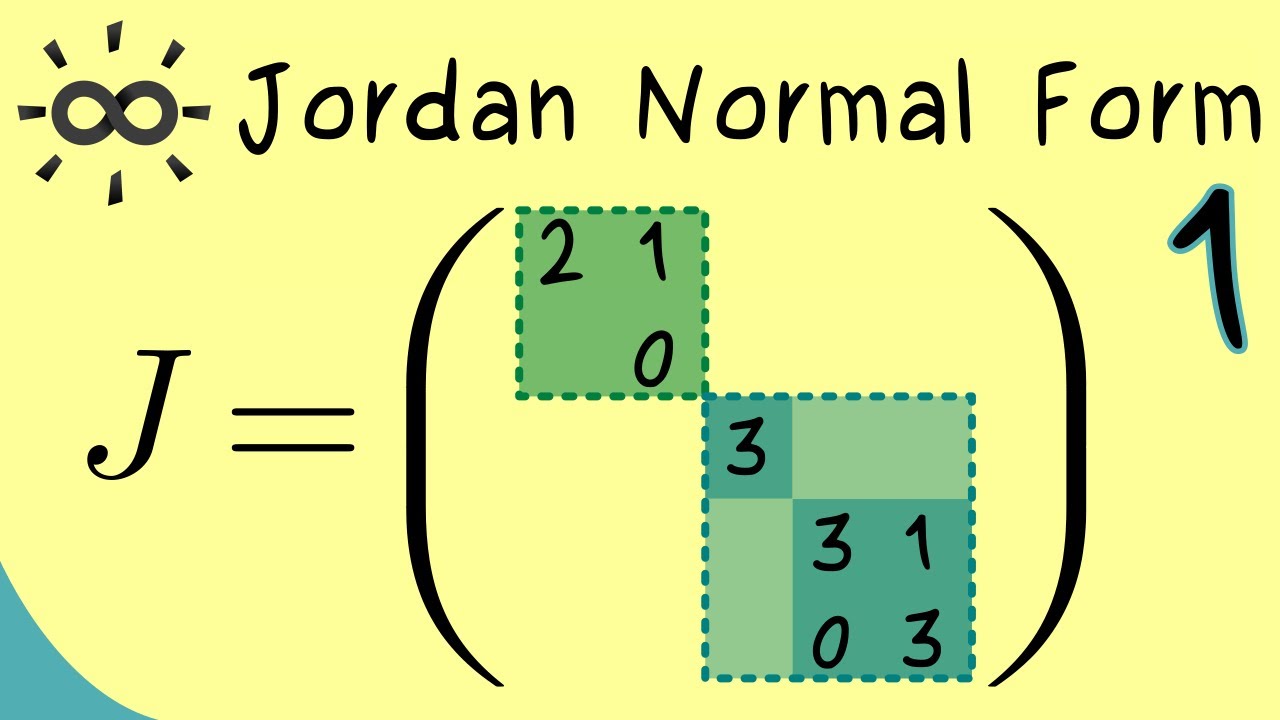
Support the channel on Steady: https://steadyhq.com/en/brightsideofmaths
Or support me via PayPal: https://paypal.me/brightmaths
Watch all parts: https://youtube.com/playlist?list=PLBh2i93oe2qtoBYrEIrVaLfEhZTnf7jml
PDF versions: https://steadyhq.com/en/brightsideofmaths/posts/1f1b4813-516a-48a8-9666-354c92b45ce7
Linear algebra series: https:...
there are 5 parts
elfin ether
snow jetty
https://www.youtube.com/watch?v=GVixvieNnyc
i saw all parts of this, it didn't give me intuitions
he gives the "chains" thing as a given
snow jetty
it follows from the primary decomposition theorem
snow jetty
In linear algebra, a Jordan normal form, also known as a Jordan canonical form
or JCF,
is an upper triangular matrix of a particular form called a Jordan matrix representing a linear operator on a finite-dimensional vector space with respect to some basis. Such a matrix has each non-zero off-diagonal entry equal to 1, immediately above the main ...
see paragraph
Invariant subspace decompositions
so if you have a split characteristic polynomial (for example in complex numbers) then you can split your vector space in invariant subspaces in such a way that they will be generalized eigenspaces
but don't worry we were learning this stuff 3 months though our section is "physics"
snow jetty
true, but the thing is, we also can define a generalized eigenspace like this

(a simple eigenspace would be a particular case for m=1)
 elfin ether
why do we take m to be the multiplicity in the min poly?
a larger m will give a larger kernel i believe
so normally eigenspaces don't sum to the vectorspace, but generalized ones do?
snow jetty
elfin ether
so normally eigenspaces don't sum to the vectorspace, but generalized ones do?
yes, if the characteristic polynomial is split
elfin ether
wdym split?
snow jetty
elfin ether
a larger `m` will give a larger kernel i believe
for example x^2+1 is not split, but (x+1)^2 is
snow jetty
(But in complex numbers all of them are split)
This is the fundamental theorem of algebra
snow jetty
elfin ether
a larger `m` will give a larger kernel i believe
For some time, but since a certain "m" the increasing stops 😄
snow jetty
elfin ether
you use all this in physics?
I didn't remember using Jordan forms (yet)
But diagonalisation for example in mechanics you diagonalise the inertia tensor to find an axis such that the moment of inertia L would be colinear to the rotation vector ω
But I am in the first year so it will come soon I guess
elfin ether
I don't like Jordan form, too much calculations involved :/
but it's cool to have a general form of diagonalization
snow jetty
However that's one of the major subjects
wintry steppe
jordan form is nice


 neat peak
is it true that $\tr_{V^}\left( \rho \left( g^{-1} \right)^ \right)=\tr_{V} \rho \left( g^{-1} \right)$?
stoic pythonBOT
ProphetX
 elfin ether
can someone help find the jordan form of this?

it's alphas on the main diagonal, and ones on a diagonal which is 2 above the main
the characteristic polynomial of this is (x - a)^n
i'm not sure what the process is now
dusky epoch
do we know if the order of this matrix is even or odd
elfin ether
no, but we can separate into these cases
dusky epoch
this is a simple permutation away from being in jnf
it'll have 2 blocks and both blocks will have alphas down the diagonal
and their sizes are half the size of the whole matrix
elfin ether
why though
dusky epoch
with the obvious interpretation for odd orders (ie order 2k+1 gives a block of size k and a block of size k+1)
the jordan basis is {e_1, e_3, e_5, ..., e_2, e_4, e_6, ...}
like. if you reorder your basis vectors so that all the odd ones come first and then all the even ones
elfin ether
how do you know all this?
dusky epoch
by looking ig
elfin ether
umm how would i derive all this
elfin ether
lol
dusky epoch
this just happened to jump out at me
 frosty vapor
maybe if you were wearing pants you would know
 spark dome
Given a vector v, is there a name for the space of linear operators such that v is an eigenvector?
And more generally for a set of vectors, the space of operators for which each vector is an eigenvector, so the intersection of these spaces over the elements in the set
blissful vault
slow scroll
<@!205094699202117633> You don't need to reference bases for this proof. I can w...
Saw this late. I appreciate it. I found a solution for this exercise.
slow scroll
This is how I would do it:
Let $u \in V \setminus \ker f$ and suppose WLOG that $f(u) = 1$. Now, let $v \in V$. Then there is $c \in F$ such that $$f(v) = c = cf(u) = f(cu).$$ Therefore, $v - cu \in \ker f$
stoic pythonBOT
kxrider
 blissful vault
What's the "V\ ker f"? I haven't seen the slash notation before.
slow scroll
"V - ker f." Just the set of V not in ker f
so $v-cu = x$ for some $x \in \ker f$, and $v = x + cu$. Hmm, yesterday I thought it was obvious that this is a unique way to write $v$ as sum of an element of the kernel and an element of $span{u}$, but now im not so sure actually.
stoic pythonBOT
kxrider
 slow scroll
yea yea it is. If x' + c'u = v = x + cu then x'-x = (c-c')u and therefore 0 = f(x'-x) = (c-c')f(u) = c-c' so c = c'.
and since c is uniquely determined, x is also uniquely determined.
yea, i guess to make the idea slightly more intuitive, v uniquely determines the "cu" as cu = f(v)u.
@blissful vault does that make sense? I'm using the characterization of the direct sum that goes like V = U \oplus W if each vector in V can be written uniquely as a sum of an element of U and an element of W
blissful vault
slow scroll
yea, i guess to make the idea slightly more intuitive, v uniquely determines the...
Yes! That looks vastly simplified from what I was doing with basis.
slow scroll
ye, and this way you sidestep all of the dimensionality issues.
stable kindle
sanity check: most two-element lists are linearly independent in C as a vector space over R, but linearly dependent in C as a vector space over C?
slow scroll
yeah, all two element sets of vectors in C are linearly dependent over C.
elfin ether
"Given an orthogonal transformation, prove that the complement of an invariant subspace is also invariant"
sounds easy but I can't figure it out, help?
viral flint
Let T be orthogonal (thus <Tv, Tw> = <v, w> for all v, w) and V be an invariant subspace. Let W be its complement.
Then you want to show that for any w ∈ W, Tw ∈ W. Being ∈ W is equivalent to being orthogonal to every element of V, i.e. x ∈ W iff <x, v> = 0 for every v ∈ V.
So assuming w ∈ W, can you show that Tw ∈ W?
 dire thunder
@viral flint assume Tw is not in W, that is Tw in V. Then if v is in V we should have 0 = <w, v> = <Tw, Tv> forcing Tw to be in W, contradiction
viral flint
elfin ether
"Given an orthogonal transformation, prove that the complement of an invariant s...
You are talking about the orthogonal complement of a subspace and not the complement of a subset, right?
dire thunder
viral flint
Tw not in W and Tw in V are not the same
this would be false still
given set X and Y in X
you take Y^c
for each x either x is in Y or in Y^c
the same for orthogonal complement
well technically you should treat also zero vector but it is easy
viral flint
dire thunder
i assumed orthogonal complement
It doesn't seem like you did, which is why I asked in the first place.
viral flint
dire thunder
the same for orthogonal complement
This part is wrong.
dire thunder
Tw is not in W, that is Tw in V. Then if v is in V we should have 0 = <w, v> = <Tw, Tv> forcing
viral flint
Consider a plane and its normal line in R^3. There are plenty of points which are neither in the plane nor in the line.
dire thunder
yes but man
not only one line is in orthogonal complement for plane
oh
i got your point
uh
i would have cleared up my proof then
but gtg
sorry
dawn fractal
Let $A\in\C^{n\times n}$ be normal. Show that $A$ is Hermitian if and only if all eigenvalues of $A$ are real. Formulate and prove similar statements for skew Hermitian and unitary matrices.
stoic pythonBOT
!superficialsicko
 dawn fractal
what does "similar statements" mean?
as in $A$ is skew Hermitian and unitary iff all eigenvalues of $A$ are real?
stoic pythonBOT
!superficialsicko
 dusky epoch
no
simiar does not mean copy-pasted
A is skew-Hermitian iff all eigenvalues of A are _____. A is unitary iff all eigenvalues of A are _____.
they ask you to fill in the blanks here
dawn fractal
figured
stoic pythonBOT
!superficialsicko

!superficialsicko

!superficialsicko

!superficialsicko

!superficialsicko
 dawn fractal
nvm i got it lmaoo
dawn fractal
any hint as to how i prove that A is unitary only if all eigenvalues of A have modulus 1?
given that A is normal in C^{nxn}
lavish jewel
if you already know that a unitary matrix is diagonalizable, you can use that
dawn fractal
not really
but i do know that A is normal iff it's unitary diagonalizable
and any A, whether or not it's normal, is unitary similar to an upper triangular matrix
weak needle
dawn fractal
not really
but i do know that A is normal iff it's unitary diagonalizable
and an...
unitary matrices are also normal, hence unitarily diagonalisable
dawn fractal
i see
that's what they meant
ty
ill think about it
since A is unitary diagonalizable
U^*AU = D for some unitary U, diagonal D
then
\begin{align*}
D^* &= ((U^A)U)^\
&= U^(U^A)^\
&= U^A^(U^)^*\
&= U^*A^U
\end{align}
stoic pythonBOT
!superficialsicko
 dawn fractal
but $U^*AU = D$
stoic pythonBOT
!superficialsicko
 dawn fractal
so is D* always equal to D?
dawn fractal
oh right
i was so confused when i thought D* = D
it seems like D*D needs to be equal to 1
i mean I
weak needle
Yes
dawn fractal
and from there im lost