#linear-algebra
2 messages · Page 195 of 1
 wintry steppe
 safe locust
wintry steppe
first try to write vector (-4, 8) as linear combination of other two vector, (1,...
safe locust
wintry steppe
first try to write vector (-4, 8) as linear combination of other two vector, (1,...
ok
done
solved for c1 and c2
now what
wintry steppe
ok so now just apply the linearity property
safe locust
wintry steppe
ok so now just apply the linearity property
wut ._.
wintry steppe
$T(\alpha v_1 + \beta v_2) = \alpha T(v_1) + \beta T(v_2)$
 stoic pythonBOT
η/rιμ
 safe locust
wintry steppe
$T(\alpha v_1 + \beta v_2) = \alpha T(v_1) + \beta T(v_2)$
safe locust
wintry steppe
$T(\alpha v_1 + \beta v_2) = \alpha T(v_1) + \beta T(v_2)$
so i have
-4 = c1(v1) + c2(v2)
8
what do i do?
c1=-7/2 c2=-5/2
v1= 1,3 v2= 3,1
wintry steppe
look at what i just wrote
safe locust
im confused ;-;
wintry steppe
$T(c_1 v_1 + c_2 v_2) = c_1 T(v_1) + c_2 T(v_2)$
stoic pythonBOT
η/rιμ
 wintry steppe
What is T(v1)?
safe locust
1
3
wintry steppe
so then just substitute
T is transformation so I think it should be () brackets. So now just apply the linearity property
what i wrote above
safe locust
wintry steppe
T is transformation so I think it should be `()` brackets. So now just apply the...
 wintry steppe
now apply this: #linear-algebra message
wintry steppe
what are you confused about?
safe locust
what im supposed to do now?
wintry steppe
I just told you what to do, i said in the message "apply this" linking the next step
wintry steppe
what is c1
safe locust
-7/2
wintry steppe
actually you sure its -7/2?
I think its supposed to be 7/2, not negative
check again
wintry steppe
what is v1
 wintry steppe
c1 and c2 both cannot be negative, only 1 of them is negative. But besides that
$T(-\frac{7}{2} \begin{pmatrix} 1 \ 3 \end{pmatrix}^T) = -\frac{7}{2} T(\begin{pmatrix} 1 \ 3 \end{pmatrix}^T)$ This is by the second property of linearity
stoic pythonBOT
η/rιμ
 wintry steppe
you know what
just read this

Mathematics LibreTexts
Let (T: \mathbb{R}^n \mapsto \mathbb{R}^m) be a linear transformation. Then there are some important properties of (T) which will be examined in this section.
i don't think you understand what you are doing
if you don't understand now, you are going to have hard time later
so make sure you properly understand what you are doing
safe locust
wintry steppe
i don't think you understand what you are doing
Lol, ur not wrong.
My teacher sucks at explaining stuff
wintry steppe
ok
 prime drum
It's not really teachers fault at the moment. Hybrid learning is not good for anyone.
 candid abyss
safe locust
wintry steppe
ok
candid abyss
safe locust
wintry steppe
ok
Could u help me solve it with 7/2 and ill go back and check that link after?
Due in a little
Sorry ;-;
wintry steppe
$T(-\frac{7}{2} \begin{pmatrix} 1 \ 3 \end{pmatrix}) = -\frac{7}{2} T(\begin{pmatrix} 1 \ 3 \end{pmatrix})$
stoic pythonBOT
η/rιμ
 wintry steppe
and you already know what T(1 3) is so just substitute that, then multiply it out
safe locust
wintry steppe
and you already know what T(1 3) is so just substitute that, then multiply it ou...
Ok so i did it for both
wintry steppe
make sure that either c1 = 7/2, c2 = -5/2, OR c1 = -7/2, c2 = 5/2
now just add your two matrices
thats your final ans
safe locust
wintry steppe
thats your final ans
Ty 😭😭
wintry steppe
what was your final ans?
safe locust
11 7
13 6
wintry steppe
what was c2?
safe locust
-5/2
wintry steppe
ok maybe its correct then idk, i havent actually solved it
but just check your work again
 wintry steppe
nice
safe locust
ty for the help

 plain saffronBOT
From
Rule 3
Stick to one channel and don't post the same question in multiple channels. Please don't ask for help in other channels if no one is responding in the one you have posted your question in.
wintry steppe
hey quick question
if i have something like A = DB + DC
can i move D to the left side by multiplying by inverse on the left?
all matrices
 dire thunder
assuming D is invertible
wintry steppe
its a diagonal matrix so sweet
 native rampart
Diagonal matrices can be non invertible tho

 verbal vessel
Suppose A and B are matrices such that
rank(AB) = rank(A)
show that if $x_1AB = x_2AB$ , then $x_1A=x_2A$
stoic pythonBOT
Alireza
 verbal vessel
I have to show B is invertible but I don't know how... can I have a hint?
 dusky epoch
rank(AB) ≤ min(rank(A), rank(B))
 fervent elm
are you able to get the determinant of an 8x8 matrix from their sub 4x4 matrix determinants
dusky epoch
not in general no
 lapis cosmos
verbal vessel
I have to show B is invertible but I don't know how... can I have a hint?
lapis cosmos
verbal vessel
I have to show B is invertible but I don't know how... can I have a hint?
Not true
For example A=diag {0,I_n*n}, B_ij=1 if i=j+1 ,0 otherwise .
You can directly prove that N(A)=N(AB) (the former is a linear subspace of the latter, and they have the same dimension )
 wild pilot
Can someone explain why MATLAB is giving me apparently spurious complex numbers when producing eigenvalues for the following matrix A =
 5     2
-2     1
eig(A)
ans =
3.0000 + 0.0000i
3.0000 - 0.0000i
dire thunder
,w eigenvalues {{5,2},{-2,1}}
stoic pythonBOT


 Requested by Commander Vimes#4407
dire thunder
Requested by Commander Vimes#4407
dire thunder
aight
@wild pilot ig it just solves det (A - lambda I) over C
and gets 3+i0 and 3-i0 as two roots
wild pilot
It's probably just one of these things that distracts me unnecessarily, but I can even find these eigenvalues in my head - it's just x^2- 6x +9 where x is lambda resulting in eigenvalues of 3, multiplicity of 2 - and I can't work out how the issue of complex numbers is enlivened here at all.
 quartz compass
well matlab isn't giving you the wrong answer
maybe it just happens to be when there's a double root it does some method that involves complex numbers or something
I don't think there's anything to worry about, it just has repeated eigenvalues
wild pilot
like when you add 2 and 2 and a computer says 4.000000000001 I guess due to some binary addition magic
dusky epoch
adding 2.0 and 2.0 will always give 4 even with floating point arithmetic
0.1 + 0.2 = 0.30000000000000004 though, because of rounding errors since computers use binary scientific notation rather than decimal
 novel hamlet
Anyone know online calculator that gives ste by step solution on spectral decomposition
 lavish jewel
i don't think any calculator uses a method you would do by hand
novel hamlet
lavish jewel
i don't think any calculator uses a method you would do by hand
tbh thats not a problem
lavish jewel
In numerical linear algebra, a Givens rotation is a rotation in the plane spanned by two coordinates axes. Givens rotations are named after Wallace Givens, who introduced them to numerical analysts in the 1950s while he was working at Argonne National Laboratory.
you would do that several times
 hoary osprey
yea its just the cartesian product of V with itself n times
wintry steppe
no
wintry steppe
 uneven shore
can you explain
uneven shore
can you explain
Tell me the definition of parallel vectors
uneven shore
They have the same direction?
wintry steppe
tell me the definition of direction then
uneven shore
The measure of the angle that it makes with a horizontal line
wintry steppe
that's far too complicated of a definition for this, and does not work in general vector spaces
two vectors are parallel if they are multiples of each other by a non-zero constant
uneven shore
Ooh okay
 unique tide

I get confused on this
How can the entries of A be a scalar multiple if you're going to be multiplying every entry by a different number?
unique tide
I think im getting confused on the scalar multiple definition
because I think that scalar multiple means you multiply every entry in the matrix by the same number
 stable kindle
well if it's a scalar multiple of (1 0) then it's just gonna be some (k 0)
so when you transform the vector by the matrix you get, what, (a c)?
unique tide
yes
stable kindle
so what do a and c have to be
stable kindle
i mean just
unique tide
can't it be any number lol
unique tide
0
unique tide
some value k?
stable kindle
so a scalar multiple of a vector is k * (m n) = (km kn)
unique tide
yes
unique tide
I understand that logic
but I feel like that just creates more questions than answers lmao
stable kindle
why
unique tide
like you can just multiply the column vector (1,0) by some number?
stable kindle
yes?
that's what a scalar multiple of it is
a scalar multiple just means you multiply it by some number
unique tide
right
stable kindle
the number is called a scalar
unique tide
so then why say [1,0], why not just use k alone
stable kindle
??
unique tide
like if matrix A is some entries abcd, why do we say it's a scalar multiple of [1,0] when we can multiple that vector by any number, why not just use the number itself as a scalar.
stable kindle
the matrix isn't a multiple of the vector
the vector after being transformed by the matrix is a scalar multiple of the vector
unique tide
ohh
stable kindle
where the scalar is anything, so i called it k
stable kindle
ok
unique tide
thank you
stable kindle
np
 blissful vault

just making sure if i am on the right track
here i should find a basis for f and g first
then i find a basis for [result] and h
s that correct?
 nocturne jewel
blissful vault
nocturne jewel
blissful vault
since {f,g,h} is a basis of $\mathbb{R}[t]_{\leq 2}$, the set you get after gram schmidt will be a basis and be orthonormal
stoic pythonBOT
moshill1
 nocturne jewel
so just go through orthonormalization and you're done
 sweet vine

 dreamy iron
From Treil’s LADW page 17.
What are the dimensions of this matrix T?
I know that it is n+1 entries wide. But I can’t figure out how tall it is.

My guess is that this is a square matrix.... meaning it is also n+1 entire tall.
 limber sierra
n+1 "entries tall", for the same reason it is n+1 "entries wide"
dreamy iron
(My justification is that the vector f’(t) is n+1 entries tall.)
limber sierra
youre counting 0, 1, 2, ... n as you go down a row or column
there are n+1 such elements
dreamy iron
Okay. So it is square. Tyty
What do you call a vector with non zero entries directly below the main diagonal?
limber sierra
"not upper triangular"
dreamy iron
lol
limber sierra
dont think theres a special term
dreamy iron
Okay
limber sierra
you can use a phrase like
"the n-by-n submatrix in the bottom-left corner is diagonal"
i guess
or "the n-by-n submatrix given by removing the top row and rightmost column is diagonal"
but i dont think theres a snappy word for it
dreamy iron
Lol. I can totally visualize that too. Imma use that phrasing. Tyty
limber sierra
these matrices come up in DEs but i havent heard a name before
dreamy iron
Okay. I can tell by the function definitions that T is not surjective.... but the matrix makes this obvious too....cuz it’s not “full rank.” I think that’s the right terminology.
 dusk sage
i have a question about cholensky decomposition

I'm confused by the statement B here
so does it mean that A is positive definite if the matrix L with positive diagonal entries is unique?
or each diagonal entry of L is unique?
so if I had L equal to this would A be positive definite?

 wintry steppe
Hey guys, Im new here. I have a question. Showing that the finite set of (Zn, Xn) is a group iff n is prime. Does it suffice to state that ' bc 0 isnt an element and u can get numbers in the set multiplying to reach 0, closure of group is not maintained thus it must be a prime'

No, (Zn, *n) is never a group. They are talking about Zn* not Zn.
Do you know what Zn* means, @wintry steppe
Yes. I do
What does it mean?
the set (1 2 3... n-1)
under mod n multiplication
no
Oh ok
Zn* is the group of units of Zn
stoic pythonBOT
Carla_
 wintry steppe
I see.
Thanks a lot @wintry steppe
Thanks for asking questions, i'm really bored and noone asking questions
So I hope it;'s cool if I ask further then 🙂
it is
So when we say Q*, we mean all the rationals which make a group under multn. Is that the same as saying, 'Q * is the group of units of rationals'
You know what a ring is?
A group with extra operation
New to this
maybe nvm then, and no thats not right, it is a group and has an extra operation but thats not enough
when we say Q* we mean all the invertible rationals (for multiplication)
when we say Z* we mean all the invertible integers...
etc
I seee
turns out that if R is a ring, then R* will always be a group
this because in rings, the second operation is associative and has identity. if we restrict to only the invertible ones, you hopefully can see that this is definition of a group
wintry steppe
wintry steppe
turns out that if R is a ring, then R* will always be a group
This makes sense to me bc it removes the addition identity 0
im thinking cartesian atm tho. not generically
the identity of the group of units will be the multiplication identity 1
0 can't be there cuz cuz of distributivity it is not invertible except in the zero ring but otherwise no lol
yup 🙂 ty ty
now last question for now
why should n be a prime in (Zn*,Xn) for it to become a group?
Is it due to the lack of closure ofthe group bc zero is there if two numbers multiply
well if it isn't prime, there will be numbers that multiply to 0 so it can't be group
Okay
but it's stronger than that: there will always be an inverse of every non-zero element if it's prime
so you have to prove that
yeaa, im trying to but it's doing my head in
yea iirc it's a bit tricky to prove it
so far i said. well if its not prime then u get 2 numbers multiplying to get it. so it has to br prime xD
but ur right
i feel like it's stronger than that
thanks carla. ur god sent
wintry steppe
@wintry steppe this is where I learnt my definition from btw. Are they equivalent to yours or is there a difference i'm missing on?
 wintry steppe
<@456226577798135808> this is where I learnt my definition from btw. Are they eq...
wintry steppe
wintry steppe
<@456226577798135808> this is where I learnt my definition from btw. Are they eq...
What are the invertible for multiplication elements of Q?
I see. Sorry
lol why sorry
 reef prism
yo guys what is matrix (A^2)^-1, is it A again? 😅
native rampart
No
lavish jewel
without any other context, identity ftw
 wintry steppe
have you heard of diagonalization?
wintry steppe
tell me what you know about it
 edgy kelp
matrix is diagnalizeable if there is a match that satisifes that above equation
P^-1AP
I think idk
wintry steppe
no
a matrix A is diagonalizable iff there is a matrix P and a diagonal matrix D such tha P^-1AP = D
wintry steppe
thats what you want to show
have you heard of eigenv* where * is either ectors or alues?
wintry steppe
I suppose you can just set up some linear equations after multiplying both sides by P on the left side.

 solid flower
it looks like some martian language to me, idk how you figured they were inequalities
 gloomy arrow
When you diagonalize a matrix PDP^-1, if P is unitary, does it matter which side the inverse is on?
nocturne jewel
Cause my chicken scratch is only slightly better 
wintry steppe
no Cuck,its okay, inverses of unitaries are still unitary
gloomy arrow
wintry steppe
no Cuck,its okay, inverses of unitaries are still unitary
Ty!
wintry steppe
but um you cant just swap them around
wintry steppe
gloomy arrow
When you diagonalize a matrix PDP^-1, if P is unitary, does it matter which side...
so be careful, it matters what you put in each side, not what you call it
gloomy arrow
wintry steppe
so be careful, it matters what you put in each side, not what you call it
Wait wait
So if P is unitary then P^-1DP=/=PDP^-1?
 lilac stratus
yeah
matrice multiplication isn't commutative
even just in the space of inversible matrices
 boreal crane
Jup that matrix space that is isomorphic to C for example
gloomy arrow
Okay I am asking because in one of my homeworks my professor wrote find D=PAP^-1 where P is unitary but I was like the P^-1 should be in the front
lilac stratus
well
if you find D = PAP^-1
then with P' = P^-1
you have D = P'^-1AP'
The order doesn't matter, if you find P s.t D = PAP^-1 and you're looking for P' s.t D = P^-1AP, then you've won since D = P^-1A(P^-1)^-1, so P' = P^-1 is the matrix you're looking for
(but P won't be equal to P', so the order does matter in that sense)
not sure if that's clear

gloomy arrow
The P' part is confusing me because I think hes just looking for P
lilac stratus
Ok lemme rephrase it
gloomy arrow
I can also send the question if perhaps my own wording is unclear
lilac stratus
Looking for P s.t D = PAP^-1 or looking for P' s.t D = P'^-1AP' is the "same thing"
since P^-1 = P' (or equivalently P'^-1 = P)
gloomy arrow
But then you just get back to D=PAP^-1
 gloomy arrow
PAP^-1 and P'^-1AP'
lilac stratus
Looking for M s.t D = MAM^-1 or looking for M' s.t D = M'^-1AM' is the "same thing"
my "P" wasn't the "P" of your question
i'm saying that if you find either M or M', you got the P of your question
if you have M'
well then just let P be M'
and if you've found M
then let P be M^-1
is this clearer ? 
gloomy arrow
Yeah I would need to take the inverse of M' to just find M
lilac stratus
yeah, that's what I was trying to say (sorry i'm not really fluent in english, my wording probably confused you )
gloomy arrow
Yeah I understand. But I dont think thats what my professor intended
because them M' would be the matrix of the eigenvectors put together but inverted
Any then I asked my friend and he told me that MAM^-1 is equal to M^1AM no inverse (') because M is unitary
So in regards to what my friend is saying, that would be incorrect
lilac stratus
I was just trying to say that it doesn't depend on whether you look for M or for M' in the process of solving the exercise, since in the end you get the P you're looking up to one last step of inversion
gloomy arrow
Right Right. I just want to know if my friend is correct in his statement
No primes/inversions
That you can swap them
because he said MAM^1=M^-1AM which I dont think is correct because you arent inverting the M. So like no M' and M'^-1. Just the same M

 gloomy arrow
Okay okay thank you thank you. Just because M is unitary would change that correct?
lilac stratus
I don't understand your question 
gloomy arrow
Sorry wouldnt*
I mean to ask if M is unitary, that would not change anything correct
lilac stratus
Oh
So like if M is unitary, is this still false that D = M^-1AM implies D = MAM^-1, is what you are asking ?
gloomy arrow
lilac stratus
Oh
yes that is what I am asking
lilac stratus
Then yeah, that's still false
gloomy arrow
Okay thank you just making triple sure
 crisp cloud
Hey, could someone check my work for this homework problem I miss

Teacher doesn't explain very well, but if you guys figure out what I got wrong, I'd appreciate it.
 split basin
Yo
Question
how do u use the degree symbol on keyboard
 glad acorn
may i ask why the nullspace of a linear mapping =0 ,then the linear mapping is one-to-one
native rampart
Because if the mapping is not one-one that implies,null space is non trivial
T(a)=T(b) implies T(a-b)=0
 nocturne oracle
crisp cloud
Teacher doesn't explain very well, but if you guys figure out what I got wrong, ...
nocturne oracle
crisp cloud
Teacher doesn't explain very well, but if you guys figure out what I got wrong, ...
basis vectors are linearly independent, so im assuming since you wrote that they were dependent, you must have forgotten to write "not" a basis
crisp cloud
F
nocturne oracle
indeed
glad acorn
native rampart
T(a)=T(b) implies T(a-b)=0
Is it iff?
lilac stratus
yes that's an equivalence
T(a) = T(b) <=> T(a) - T(b) = 0 <=> T(a-b) = 0
(the last equivalence comes from the fact that T is linear, more specifically comes from T(a+b) = T(a) + T(b))
glad acorn
Ok thanks
 jagged granite
If $A\in M_n(\mathbb C)$ and $(Ax,x)=0 \ \forall x \in \mathbb C ^n$, does it follow that $A=0 $?
stoic pythonBOT
bert
 jagged granite
How do I see this?
For M_n(R) I can see that it is skew symmetric. The trick is to look at (A(x+y),x+y)
 broken sun
Hello. If the intersection of the kernel and the image of an operator is zero, then why is the finite-dimensional vector space the direct sum of the kernel and the image?
wintry steppe
Are you sure of that?
broken sun
If this is not correct, please give a counterexample.
wintry steppe
0 0
1 0
or do you mean to ask that in the case their intersection is zero that its a direct sum?
 slow scroll
If f^2 = f then the space is a direct sum of the kernel and image of f
 spiral star
wintry steppe
or do you mean to ask that in the case their intersection is zero that its a dir...
spiral star
wintry steppe
or do you mean to ask that in the case their intersection is zero that its a dir...
yes, i didnt know there was a different interpretation lol
pretty sure the question was trivial intersection implies direct sum
broken sun
Yes, but I cannot understand your first interpretation of my question.
slow scroll
Wait umm I think I’m missing a condition on my statement
broken sun
I think my question has only one interpretation.
spiral star
yea
well anyway, you can just throw rank nullity at it and you get your answer
choose a basis for the kernel and a basis for the image. then combining them will give you a set of linearly independent vectors
and they will add up to the dimension of your space
broken sun
How can we show that such a union spans the whole space?
spiral star
like, the only thing you have to convince yourself of is that their direct sum is the entire space but that just follows from rank nullity
its just by dimension
dim V = dim (ker T) + dim (im T)
the direct sum will be a subspace of V with the same dimension as V
so it is V
broken sun
And since their intersection is zero, they must be independent.
spiral star
yea
broken sun
Ok. Thanks. Can you give a counterexample for infinite-dimensional case?
spiral star
the trivial intersection tells you already that their sum is a direct sum and their dimensions add up, and then rank nullity tells you that that the dimension of the direct sum is the same as that of the entire space
thats just all you need
the only thing that can "break" is rank-nullity in the infinite dimensional case
you cant use that argument like that anymore
broken sun
Ok. But, is there any counterexample?
spiral star
probably but i would have to think about it lol
slow scroll
There might not be. You’ll still have an equality between the cardinality of their dimensions, and that’s all you need
slow scroll
Explain?
broken sun
spiral star
the only thing that can "break" is rank-nullity in the infinite dimensional case
Rank-nullity is not true for infinite-dimensional case?
spiral star
when a + b = max{a,b} then you cant count in the same way as with naturals
rank nullity is still true
you just dont add up infinities like naturals
broken sun
spiral star
rank nullity is still true
So, why can we not use your already-mentioned argument for a proof for infinite-dimensional case?
spiral star
you can still follow the proof of the rank nullity theorem
slow scroll
im not saying we should add up infinities like naturals...
spiral star
you just cant use a counting argument
broken sun
spiral star
you just cant use a counting argument
What counting argument?
spiral star
that you span the entire space because the dimensions add up
this particular argument doesnt work
but you can try to follow the proof of the rank nullity theorem for arbitrary vector spaces
broken sun
spiral star
this particular argument doesnt work
Why?
spiral star
because cardinal arithmetic
slow scroll
spiral star
but you can try to follow the proof of the rank nullity theorem for arbitrary ve...
that's exactly what im suggesting?
spiral star
i wasnt saying anything against that, only against the counting argument
slow scroll
okay, but by dim V = dim ker T + dim im T, i clearly mean there is a bijection between a basis for V and the disjoint union of the bases for ker T and im T
nevermind, im being dumb, this (rank nullity for infinite dimensions) is not enough
The only thing you can conclude is that the cardinality of the dimension of ker T oplus im T is the same as V, not that they are equal
Also, sorry I said “I clearly mean there is a bijection...” above.
I really wasn’t being clear about what I was talking about.
spiral star
i think i might have a candidate for a counter example
from a sequence space
so if i write (a_n) for a sequence and define a map T(a_n) = (0, a_n)
i think that should be linear
it just prepends 0 to the sequence
T is not surjective
but injective
so ker T = {0}
but since its not surjective, ker T + im T != V
@broken sun happy now? :)
broken sun
spiral star
<@!722694050305802302> happy now? \:)
Thanks.
spiral star

you can get a counter example every time a linear map is injective but not surjective
that's something that can only happen in the infinite dimensional case
broken sun
Yes.
spiral star
(all in the context of endomorphisms)
jagged granite
jagged granite
How do I see this?
my question got buried
jagged granite
jagged granite
If $A\in M_n(\mathbb C)$ and $(Ax,x)=0 \ \forall x \in \mathbb C ^n$, does it fo...
Oh this is clear to me now. we do get (Ax,y)=0
lilac stratus
native rampart
However,if it were M_n(R) it wouldn't
wait why ?
If forall x € R^n, Ax = 0 then in particular Ax is zero on the canonical basis of R^n, so it must be the zero matrix, no ?

native rampart
I think someone found an explicit counter example
lilac stratus
where ? 


 bleak geode
does functions not come under algebra?
bleak geode
ok ill post there mb
 wary lily
 north steeple
Can someone help me understand inner product spaces
 gentle igloo
whats ur question abt them
gentle igloo
are you comfortable with what a vector space is?
gentle igloo
can u send the definition you have
north steeple
- positivity
- symetricity
-  additivity
- homogeneity
and then i have the definitions of those 4 htings
gentle igloo
yes so that is the definition of an inner product. and to boil it all down intuitively, it’s a function which gives a notion of “length” in a vector space. thus a vector space which has a notion of length in it (i.e. has an inner product defined over it) is called an inner product space
and the special function defining “length” must satisfy those properties in that definition in order for it to be an inner product
gentle igloo
it totally depends on which vector space we are dealing with...
north steeple
ok i can give an example
gentle igloo
did you mean to say can i get an example?
 fresh obsidian
Just out of curiosity, is multiplying by the determinant of a 3d transformation a valid way to compute a rotational solid along a non vertical or horizontal line?
 gentle igloo
yea exactly
 ancient perch
how were these quantities calculated?
 north steeple
how would I start this?
positivity: (u,u) > 0, for u != 0, and (u,u) = 0 iff u = 0 ```i have this
and im a little confused about the notation for the brackets
is that just two vectors
shoudlnt it be the dot product instead?
gentle igloo
the dot product is a specific example of an inner product.
north steeple
oh
gentle igloo
notice that in that little excerpt they didn’t mention which specific vector space we are talking about
it just says any inner product will satisfy that
north steeple
ok so for this question, lets say I have three vectors. u, v and w.
then i can assume u is not the zero vector
which means (u,u) > 0
is that correct so far?
gentle igloo
are you stating that u is not the zero vector?
north steeple
yes
gentle igloo
ok then yea
north steeple
and do i also have to satisfy (u,u) = 0, iff u = 0?
limber sierra
thats what the definition says, yes.
limber sierra
these are two separate statements
 north steeple
Ok right, so how do I satisfy both of those with the same vector?
limber sierra
you dont
gentle igloo
u don’t
limber sierra
the point is that its showing both cases
either u is equal to 0 or it isnt
if its equal to 0, then (u, u) = 0
if its not equal to 0, then (u, u) > 0
north steeple
ok so lets say we had vectors with actual values
limber sierra
and this holds with "u" representing ANY vector
north steeple
u = (0,0,0) in R^3
limber sierra
perhaps this rephrasing would make more sense to you:
for all vectors u, (u, u) ≥ 0; and (u, u) = 0 iff u = 0
gentle igloo
u can also think of it in terms of “length” if that’s more intuitive, that statement would then be saying if a vector has zero length then it’s the zero vector and vise versa
north steeple
ok so It only has to satisfy one of them
for positivity
well,
ok so what would be someting that doesnt satisfy it?
limber sierra
define (u, v) = 1 for all vectors u, v
then (0, 0) = 1 which contradicts (0, 0) = 0
in fact, if you come up with a totally random relation, it probably doesnt satisfy it
define (u, v) = x - y where x is the first entry of u and y is the first entry of v
this does satisfy (0, 0) = 0, but not (u, u) > 0 for u ≠ 0
indeed, (u, u) = 0 for all vectors u
(not just 0)
north steeple
its more confusing now
limber sierra
what dont you understand about those non-examples?
gentle igloo
remember that we’re just talking abt functions which take in pairs of vectors and spit out numbers. he’s just giving examples of such functions which don’t satisfy certain properties
limber sierra
the inner product is a function, yes
north steeple
oh ok
limber sierra
a function that takes as input two vectors and outputs a real number
north steeple
only two vectors?
limber sierra
we often write inner products as (u, v) or u · v or similar
but really theyre functions
in the same way that, say, addition is a function
which takes as input two things and outputs their sum
north steeple
can you give me a super easy example again
limber sierra
well, the most common example of an inner product is the dot product

in the above case, the inputs of the function are a and b
and the output is the sum of the products of their coordinates
north steeple
ok and this satisfies the 4 properties?
limber sierra
yes.
limber sierra
u · u = u_1 * u_1 + u_2 * u_2 + ... + u_n * u_n, right?
north steeple
yes
limber sierra
where each u_i is some entry in u
are you familiar with the fact that the square of a real number is always nonnegative?
north steeple
yes I am
limber sierra
there you go.
every term of the sum is a square
so every term is ≥ 0
if you add together a bunch of things that are ≥ 0, the sum is as well.
north steeple
ok that makes sense
now for symmetricity
this would mean
u_1 * v_1 = v_1 * u_1
which is true
gentle igloo
yup
north steeple
Additivity:
(u+v,w) = (u,w) + (v,w) for all u,v,w in V.```so
this one confuses me
i know its a property ive done many times before
but idk how to write it out
gentle igloo
just plug in u+v and w into the dot product formula
gentle igloo
i’m not trying to rush you but just lmk when ur done cause i got a question to ask too
gentle igloo
sweet thx np
i’m reading numerical linear algebra by trefethen and bau and currently learning abt algorithms for least squares problems. One of these algorithms is to use a modified gram schmidt procedure on the augmented matrix. this does not make sense to me.

specifically where it says that Q*b = R(1:n, n+1)
i can’t seem to prove why this would be true
if anyone needs any more of the page/any other part of the book i can send it
 amber sierra
I dont really understand what the rank and nullity of a matrix is.
How do I determine it for a matrix like
1 2 1
-1 0 3
1 5 7
please @ me when replying, thx
north steeple
two similar matrices have the exact same eigenvalue??
gentle igloo
yea they do
north steeple
ok and
im trying to find a basis for a eigenspace
i ended up with the zero vector
but I want to be sure
3 1 0
1 3 2
0 1 3```lambda = 3
is there a way for someone to confirm so I know if i did it right
gentle igloo
first off all the zero vector can’t be part of a basis
north steeple
ohh
gentle igloo
but how did you get three for an eigenvalue
gentle igloo
oh ok
north steeple
i did
3I - A```i being identity matrix, A being my matrix
then I just solved the system
gentle igloo
honestly i’m kinda rusty on this haha so i might not be the best for this
what system did you solve?
north steeple
oh no worries
0  -1  0 | x1
-1  0 -2 | x2 = 0
0 -1 0 | x3```those are two matrices
not one augmented
and 0 meaning zero vector
gentle igloo
oh i see
what’s the point of solving that system cause didn’t you say you were already given an eigenvector in that corresponding eigenspace?
gentle igloo
ohh
i honestly don’t think i ever learned how to do that but now i’m curious and giving it a try
gentle igloo
ok so this might be wrong but
nevermind i’m dumb
what’s the vector given as an eigenvector
north steeple
there is none
gentle igloo
you said that they gave you one though
north steeple
 gentle igloo
dude ngl the wording of that problem confuses me so much... good luck
nocturne jewel
north steeple
idk how to verify that tho
left multiplying the vector by the matrix should be the same as scaling the vector by 3
(defintion of being an eigenvector with eigenvalue)
$Av=\lambda v$
stoic pythonBOT
moshill1

 nocturne jewel
north steeple
how the heck do i do this
nocturne jewel
north steeple
how the heck do i do this
what's the question?
compute <f,g>?
if so what are they defining as the IP
north steeple
I just have to solve this
nocturne jewel
Ok but there's nothing to solve in your screenshot
north steeple
\left(2,\:2,\:1\right) 2t^5/2 dt
oh
f 2t^(5/2)dt
the f is some symbol
from calculus
nocturne jewel
???
north steeple
ive never used it
nocturne jewel
can you show me how they defined the inner product?
 nocturne jewel
the integral sign?
north steeple
ya
ive never used it before
but basically i need to solve that f thing withf 2t^(5/2)dt
nocturne jewel
Ok.. so you havent taken a calc course at your uni?
nocturne jewel
integral is the reverse of differentiation is the tl;dr
$\dv{x}\int_a^x f(t)\dd{t}=f(x)$
stoic pythonBOT
moshill1
 nocturne jewel
$\int_a^b f(x)\dd{x}=F(b)-F(a), F'=f$
stoic pythonBOT
moshill1
 north steeple
ok so
lets say I had a the inner product space V of continuous function [0,1]
where
u=2t, v=-t^2
how can I find lets say
d(u,v)
nocturne jewel
what's d(u,v)?
 gray dust
metric. d(u,v)=||u-v||
gray dust
but the norm above is defined by the inner product, which itself is defined by an integral, so this is more computation that you've not learned enough material to do
gray dust
again, you need to know how to compute an integral in order to compute the above
but to lay out the dependencies so you at least know the route of computation
the 'usual' inner product on $V$ is defined by
$$\ip{f}{g}=\int_0^1fg$$
which naturally defines a norm ('length' function) by
$$\norm{f}=\sqrt{\ip f}$$
which in turn naturally defines a metric ('distance' function) by
$$d(f,g)=\norm{f-g}$$
stoic pythonBOT
RokettoJanpu
 north steeple
Can somebody help me with this
i sent this here before

people told me I was correct
so I asked my teacher for a regrade, but she said she doesnt agree with me
a) should also be a basis
nocturne jewel
did you ask why it's not a basis?
north steeple
no, she just said she doesnt agree and I should check the solution
but it follows the definition of a basis
nocturne jewel
Ok so ask her why it isnt a basis
north steeple
ok i will
nocturne jewel
cause it is, d is just the more obvious basis
[a,b,a] = b[0,1,0]+a[1,0,1]
[a,b,a]=b[1,1,1]+(a-b)[1,0,1] if I did it right
 north steeple
ok ill ask her to prove me wrong then lol
She asked me to solve it on paper and send it to her
@nocturne jewel is the thing your wrote above it?
nocturne jewel
what?
north steeple
[a,b,a]=b[1,1,1]+(a-b)[1,0,1]
nocturne jewel
Yeah, though check it for yourself, and you'd need to show the basis vectors are lin indep
north steeple
any chanc eyou can help me with that, i really dont remember anything now that im done with math
if not i understand
nocturne jewel
follow the teacher's process
show that 0=a[1,0,1]+b[1,1,1] is only true when a=b=0
north steeple
wouldnt it be sufficient to show that the set of vectorts are linearly dependent
and span R^3
oh wait, does it span?
north steeple
whats W?
north steeple
oh i thought u had to show the set of vectors span R^3
for the basis
i alreeady wrote down the vectors being independent
nocturne jewel
d doesnt span R3 either
north steeple
oh ok
north steeple
so how would I go about doing this then
nocturne jewel
doing what?
nocturne jewel
"this"
north steeple
a) being a basis
 nocturne jewel
,rotate
stoic pythonBOT
 north steeple
idk how to check that
nocturne jewel
Take an arbitrary vector in W, [a,b,a] a,b in R
the only way you can get the 2nd entry to be b is make the scalar of [1,1,1, b
so [a,b,a]=X[1,0,1]+b[1,1,1]
for unknown X
a=X+b -> X=a-b
so $[a,b,a]=(a-b)[1,0,1]+b[1,1,1]$
stoic pythonBOT
moshill1
 nocturne jewel
since a and b are real, a-b is real so it's a valid scalar
north steeple
tbh i dont understand what you did, but if i write that down would that be sufficient ?
 gritty swift
north steeple
tbh i dont understand what you did, but if i write that down would that be suffi...
gritty swift
north steeple
tbh i dont understand what you did, but if i write that down would that be suffi...
intuitively those vectors point in different directions, so they're independent
one is not a scaled version of the other, so they span a plane
north steeple
how can i show the span part
gritty swift
what he did is the way you solve it in the general case, he showed the only solution to Ax = 0 is x = 0
gritty swift
these are the vectors ([1,1,1], [1,0,1]) you had
 north steeple
ya
gritty swift
to be dependent one must be a combination of the other
but they're on different lines, so that can't be
watch the first few videos of https://www.3blue1brown.com/essence-of-linear-algebra-page/

3Blue1Brown
Essence of linear algebra. Vectors, span, linear dependence, linear transformations, determinants, column space, change of basis, eigenvectors and eigenvalues, etc.
the first 4
saying "one is a combination of the others" is the same as saying Ax = 0 has a solution for x not being zero
north steeple
I get the independence part
i dont get how to write down and show my teacher it spans
north steeple
im not sure
here

I literally just need to prove im right
and i get 85% instead of 71%
and this is my only math class i have to take, so I just need help with this one last thing and thats it
gritty swift
oh thats a confusion question, what they mean is do those two vectors span [a,b,a]
so its a plane in R3
just write [a,b,a] as a linear combination of your two vectors [1,0,1] and [1,1,1]
north steeple
that proves it spans it?
gritty swift
yeah
gritty swift
1 sec

you just notice

then you multiply by the right guys to get a,b
they wrote it in a kinda confusing way, i'd have just said [a,b,a]
 north steeple
ok
so
i honestly have no idea what you did above
but its correct
then its correct
gritty swift
north steeple
i honestly have no idea what you did above
wdym
you know linear combinations?
its where you multiply constants times vectors and add vectors
north steeple
ok yes
gritty swift
gritty swift
this shows a way to combine your vectors to get [a,b,a]
so our vectors must span all [a,b,a]
since I just showed how you can get it as a combination
gritty swift

north steeple
i hope she will give me the mark
 smoky patio
hey guys, if A and B are conjugate square matrices, do they have the same eigenvectors + eigenvalues?
found out its same eigenvalues but not vectors
smoky patio
Suppose $T: V \to V$ is a linear transformation on some 2-dimensional real vector space V with eigenvalues 2 and 3. Then the limit $\lim_{n\to\infty} |trace(T^n)|^{1/n} equals?$
stoic pythonBOT
Delta Syndrome
 gritty swift
we know $T^nx = \lambda^n x$ so we know each eigenvalue is raised to the nth power, and $\text{Trace}(T) = \lambda_1 + \lambda_2$
so $$\lim_{n\to \infty} \left((\lambda_1 + \lambda_2)^n\right)^{1/n} = \lambda_1 + \lambda_2$$
stoic pythonBOT
uli
 gritty swift
does that work @smoky patio ?
smoky patio
oooh
why is trace T = lambda 1 + lambda 2?
shouldn't it be all the diagonals?
wait
omg
sorry
smoky patio
wait so the answer is 5?
gritty swift
I think
smoky patio
wait I think n going to infinity is a bit weird
gritty swift
they just cancel out, no?
smoky patio
somethings weird
can you take n out like that?
sry I don't mean to be doubtful of you
just trying to understand
gritty swift
please be doubtful of me
smoky patio
:'))
gritty swift
oh yeah you're right
$\text{Trace}(T^n) = \lambda_1^n + \lambda_2^n$
not the other way
stoic pythonBOT
uli
 smoky patio
oh so infty?
gritty swift
how do you figure infty?
smoky patio
wow this is cal1 stuff why am i struggling
gritty swift
isn't $\lambda_1^n + \lambda_2^n < (\lambda_1 + \lambda_2)^n$
smoky patio
is it infty or 0 lool
stoic pythonBOT
uli
 gritty swift
i'm tired too lmao
$$\lim_{n \to \infty} (2^n + 3^n)^{1/n}$$
stoic pythonBOT
uli

 gritty swift
euler is rolling over in his grave
smoky patio
AHAHA
gritty swift
now uh we should prolly show it analytically
is there a smart way to find limits like this i've forgotten
oh yeah can't you like put the limit inside the thingy sometimes
smoky patio
yeah I'm trying to remember how
gritty swift
no but the inside isn't defined at infty hm
oh
$$\lim_{x \to \infty} \left(2^{1/x} + 3^{1/x}\right)^x$$
looks kinda like the limit definition for e
but i'm not sure
stoic pythonBOT
uli
 gritty swift
oh wait
now i think you can do the limit of the inside, since its defined at infinity?
smoky patio
my reasoning is just that this term will be dominated by the higher one as n grows more and more
but that doesnt add anything for us
gritty swift
its super obvious i bet
gritty swift
yeah you can put the limit inside i think
just remembering the details now cough cough watching a khan academy video
smoky patio
I think you only would be able to if there was no x outside the brackets but there is right?
or
LOOL
nice
gritty swift
its like $$\lim_{x \to a} f(g(x)) = f(\lim_{x \to a} g(x))$$ if f is defined there
stoic pythonBOT
uli
 smoky patio
true yeah I'm braindead
gritty swift
i'm just tired trying to remember what f and g are
smoky patio
found it on math exchange if ur interested

Mathematics Stack Exchange
Just checking.
$2^n$ ($n \to \infty$) tends to $\infty$.
+
$3^n$ also ($n \to \infty$) tends to $\infty$
so the sum gets me $\infty$.
Now $(\infty)^{1/\infty}$ : $(\infty)^0 = 1$
I see no other ...
gritty swift
oh sandwich works cool
gritty swift
here's how symbollab does it https://www.symbolab.com/solver/step-by-step/\lim_{x\to\infty}\left(2^{x}%2B3^{x}\right)^{\frac{1}{x}}
Free Pre-Algebra, Algebra, Trigonometry, Calculus, Geometry, Statistics and Chemistry calculators step-by-step
the put exp(log()) around it then do the "limit chain rule" which is what i was trying to do earlier
oh and this is a good explaination https://math.stackexchange.com/a/503053
Mathematics Stack Exchange
I have to evaluate the limit of this function,
$$\lim_{x\to0^+} \arctan(\ln x)$$
I already know the answer, it's $-\dfrac{π}{2}$, but the only part I don't get it, how does it come to that? I di...
 soft burrow
it's sort of misleading to call it a "limit chain rule"; it's a property of continuous functions. A comment under that mathSE answer gives an example for a discontinuous function for which it fails
(why is this not in #calculus anyway)
 gray dust
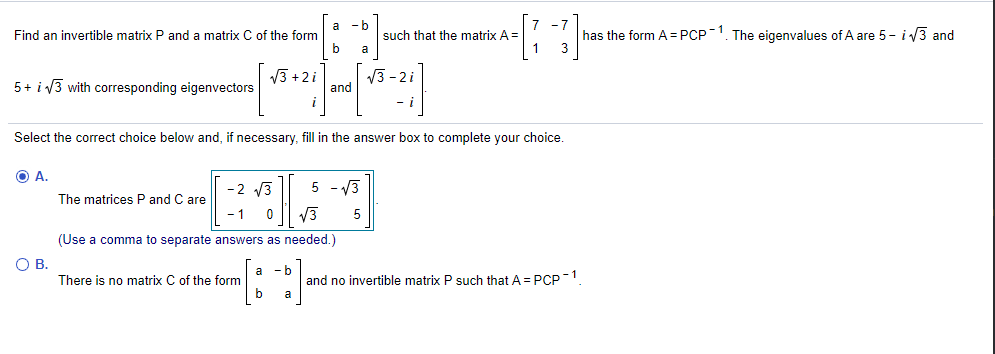
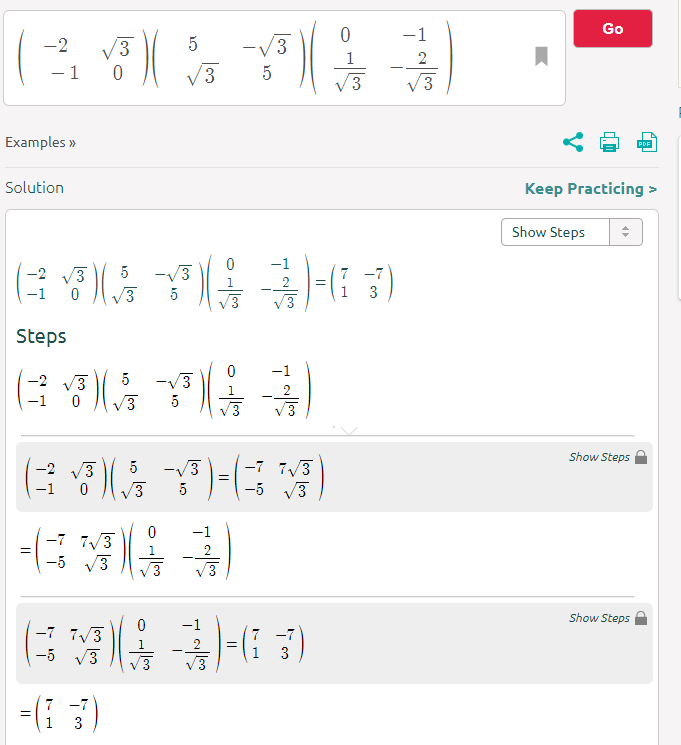
you should be able to check A=PCP^-1 yourself
 novel hamlet
How do I get exponent inside matrix?
I have {{1,2},{2,4}}^n
And I know

But I dont know how to do that
lavish jewel
that matrix should be pretty simple to diagonalize
you could diagonalize it and exponentiate the diagonal matrix of eigenvalues
lavish jewel
yes
novel hamlet
I'll try that, tought there was some "cheat" to do it, like for limits there le hospital rule
lavish jewel
i mean, it's a rank 1 matrix. you can directly write it as an outer product and the nonzero eigenvalue is the 2-norm squared of the vector
so all you have to do is find the vector that has this outer product and exponentiate its norm
i think?
novel hamlet
I'm not sure what is 2-norm
lavish jewel
the length of the vector
novel hamlet
But I'll see that spectral decomposition
Should not be problem for that smal matrix
 waxen flume

Am I just being asked to find the eigenvalues, then form a basis that spans the eigenvectors?
quartz compass
pretty much, well your eigenvectors can be used as your basis
waxen flume
quartz compass
pretty much, well your eigenvectors can be used as your basis
Thank you.
 wintry vine
is anyone else reading Linear Alg. by friedberg insel and spence?
 zealous junco
can someone explain why that $T|_{\mathbb{C}v^\perp}$ is normal

Its probebaly very obvious and i just skim reading
and i cant understand suddenly 😢
stoic pythonBOT
Anticipation
 native rampart
$T|{\mathbb{C}v^\perp} T^|{\mathbb{C}v^\perp}=T^|{\mathbb{C}v^\perp}T|{\mathbb{C}v^\perp} \newline
T^|{\mathbb{C}v^\perp}= T|{\mathbb{C}v^\perp}^$ which implies the result
zealous junco
$T|{\mathbb{C}v^\perp} T^\star|{\mathbb{C}v^\perp}=T^\star|{\mathbb{C}v^\perp}T|{\mathbb{C}v^\perp}$
stoic pythonBOT
Anticipation
 native rampart
$(T|{\mathbb{C}v^\perp}) (T^|{\mathbb{C}v^\perp})=(T^|{\mathbb{C}v^\perp})(T|{\mathbb{C}v^\perp}) \newline
T^|{\mathbb{C}v^\perp}= (T|{\mathbb{C}v^\perp})^$ which implies the result
zealous junco
why would first line be true?
stoic pythonBOT
Buncho Drunk

 wide trail
So I need to find the Col A and turn it into an Orthongonal basis. A = {[1,1,1,], [0,1,2]}, B = {[6,0,0]} I found that b is not in the Col A how would I turn A into an Orthongonal basis

I guess I can't get my head wrapped around it
 oblique rune
Is there any difference between $|\vec{v}|$ and $||\vec{v}||$? Both are the length of a vector right?
stoic pythonBOT
Exynouz
 oblique rune
Or does the double absolute value mean norm of a normalised vector?
native rampart
|v| is not a thing
 native rampart

lavish jewel
you also find it in physics books
native rampart
Ok, It's the same thing,then
lavish jewel
it's just a notation thing
double bars is more common, but you usually see single bars the first time they show it
there is no mistaking it when you can put stuff in bold, but it's pretty helpful when writing stuff by hand to use double bars for clarity
oblique rune
I see
Where can I ask my question about LaTeX?
I am getting a nonsensical error message
lavish jewel
someone on the math pedagogy channel was sharing invites to a latex server. you could also try your luck in the discussion general and chill channels
oblique rune
Ok nvm, I found a LaTeX discord server, thanks though :)
lavish jewel
aight


 wintry steppe
everything
 faint lintel
Like I subbed in J = N + D and then N = J-D