#linear-algebra
2 messages · Page 141 of 1
 wintry steppe
he means that if you peak any two random vectors and put them in the matrix then they are linearly independent iff det isnt 0
 robust pond
then you know that the whole thing cant be
wintry steppe
but by doing that youre not guaranteed the right answer, unless you do it twice
robust pond
but that just seems more involved
yea
also some might be and some might not
you just get lucky with this one
 gritty frigate
But, why not?
wintry steppe
cause its not fast, requires calculating determinants lol
robust pond
$\begin{bmatrix} 1 & 2 & 1 & 1 \ 2 & 4 & 3 & 4 \end{bmatrix}$
 stoic pythonBOT
jan Niku:
gritty frigate
Oh yep but it is 2x2
gritty frigate
It is kinda fast
robust pond
is checking a determinant faster than checking rank
wintry steppe
is it faster than saying 3 vectors cant be independent in r2?
gritty frigate
No of course not hahaha
wintry steppe
I hate determinants tbh
robust pond
lol
gritty frigate
But I guess he had to provide another answer hahaha
wintry steppe
like integrals and shiet only
gritty frigate
Determinants are amazing
gritty frigate
I love them and I dont know what the hell they are
wintry steppe
laplace 
robust pond
laplace is
 brisk fractal
determinants are dumb
@robust pond CRINGE
wintry steppe
I remember this one problem in my lin alg exam when I was only one of the few who got it correct, it was this very tricky laplace usage
robust pond
idk they didnt seem really useful to me @brisk fractal
wintry steppe
I like laplace since then
robust pond
other than showing up in the formula of an inverse
which is just like
factoring out a common factor anyways
wintry steppe
LA is better if its pure, calculus is better if you mean analysis
gritty frigate
Well, have you seen vectors in R3 right ?
gritty frigate
hahahaha
robust pond
$\mathcal L$
stoic pythonBOT
jan Niku:
robust pond
thats not it 🤔
wintry steppe
BRUH do you mean laplace transform?
robust pond
yea 
wintry steppe
I meant laplace way to calculate determinants
any determinant you wish with that

,w laplace expansion
stoic pythonBOT


 Requested by Godel#2664
gritty frigate
Requested by Godel#2664
gritty frigate
That definition is amazing
wintry steppe
looks scary but very ez
gritty frigate
I love how that is written
wintry steppe
ive never learned laplace transforms and I wish I could write this L @robust pond
gritty frigate
That L is pretty sexy
wintry steppe
so are you
stoic pythonBOT
jan Niku:
 gray dust
$F(s)=\L\brc f(s)$
stoic pythonBOT
RokettoJanpu:
robust pond
wrong L 🤔
gray dust
$F=\mathscr L\brc f$
stoic pythonBOT
RokettoJanpu:
robust pond
wrong L 
but an L nonetheless
wait godel what the hell is a laplace determinant
i got sidetracked
gray dust
wrong laplace
laplace expansion for finding det involves computing dets of smaller matrices (minors of the original matrix) as you iterate over a chosen row/col
 wispy copper
Basic stuff but right handedness depends on order?
For example if i,j,k are righthanded
j,I,k is left handed?
cyclic permutations conserve handedness?
<@&286206848099549185>
 quartz compass
wispy copper
quartz compass
wispy copper
@quartz compass just to clarify then, when texts say “the right handed set a,b,c” they mean the ORDERED set ...? Thanks :)
 cunning arch
can someone walk me through how they simplified in step 2?
i keep getting \begin{pmatrix}1+m^2&0\ 0&-m^2-1\end{pmatrix} when I multiply, I'm not sure how they got there
stoic pythonBOT
strawberrypocky:
Compile Error! Click the  reaction for details. (You may edit your message)
 limber sierra
i'm not sure what you're doing - it seems you're using rows for both matrices?
should be using rows of the first, columns of the second
for example, for the top-right entry (the green image)
it's in the first row, second column
so we expand on the first row of the first matrix (1 m), and the second column of the second (m 1)
1 * m + m * 1 = m + m = 2m
hence the top-right entry (green) is 2m
a similar process holds for all 4 positions
the bottom-right for example
it's in the 2nd row and 2nd column of the product (bottom) matrix
so we expand on the 2nd row of the first matrix, and 2nd column of the second
m * m + (-1) * 1 = m^2 - 1
cunning arch
wait give me a moment to read through it haha, thank you!!!
OH
I DON'T KNOW WHAT I WAS DOING EITHER
thank you so much
limber sierra
in the future, visualizing like this can be helpful
also, in case you're wondering about the 1/(1+m^2):
scalar-matrix multiplication commutes
cunning arch
oh nah i got that part, thank you so much
limber sierra
so we can just swap around the first matrix with the 1/(1+m^2)
and be fine
(but of course, we can't do this with two matrices)
 grizzled folio
Hey, I am writing a paper on linear algebra at a high school level, can anyone here read through a few pages (less than 5 minutes would be 👌 ) and give me some feedback?? Thanks!
 native rampart
Sure
 hollow finch
@grizzled folio I'd like to see it too
native rampart
Just post it here
grizzled folio
Ok, I'd rather DM both of you
native rampart
Suppose there is a x,such that x is not an eigenvector of T, Then Tx and x are linearly independent(Making V a T cyclic subspace)
If not,Then all vectors in the space will be eigen vectors of T,implying T=cI
 foggy lodge
Not sure if I follow
native rampart
Just take 2 cases:There is a vector,which is not eigen and There are no such vectors
foggy lodge
if its not an eigenvector, then Tx, x are lin indep, but how does it show that T is a cyclic subspace?
*V
oh wait
 solid bough
hi, idk if this is suppose to be trival,
Suppose S is a subspace for R(nxn) has a basis {b1 , b2 ,... br},
Denote B = [b1 b2 ... br], rank(B) = r
For any W in R(rxr) , denote BW = U = [u1 u2 ... ur]
If W is non-singular, then {u1, u2,..., ur} also form a basis for subspace S.
Can someone enlightened me?
 grand mesa
Can someone solve this?
 modern palm
hollow finch
modern palm
hollow finch
Pretty sure that's #prealg-and-algebra
@solid bough In case you still need help with your question: this is a case where it helps to think of matrix multiplication in terms of "column perspective"
$$\begin{bmatrix}\mid&\mid\c_1&c_2\\mid &\mid\end{bmatrix}\begin{bmatrix}x_1\x_2\end{bmatrix}=
x_1\begin{bmatrix}\mid\c_1\\mid \end{bmatrix}+x_2\begin{bmatrix}\mid\c_2\\mid\end{bmatrix}$$
stoic pythonBOT
nix:
hollow finch
this happens in all matrix multiplication for each individual column. so the columns of a matrix product AB are a linear combination of the columns of A (similarly the rows of AB are a linear combination of the rows of B which is "row perspective")
so the columns of BW are a linear combination of the columns of B, which means that the columns of BW are in the span of your basis B
if W is nonsingular then its a linear combination which leaves the columns linearly independent
since the span is the same and they are linearly independent, its just as valid a basis as the columns of B
 narrow moth
does anyone know what the qu means by working over Z3 and Z5? do we simply have to convert each entry to Z3 or Z5 at each stage?
narrow moth
<@&286206848099549185>
 soft burrow
basically yes
it implies that e.g. 3 or 6 wouldn't be invertible when working in Z_3
since they're zero
narrow moth
so if say i multiply the second row with 2 in z3 will i get ( 2 1 1 1 0 ) ?
soft burrow
yeah
narrow moth
so at each stage i just change numbers to z3 or z5 right?
soft burrow
yes
narrow moth
ok ty!
grizzled folio
Hey, as I said before, I am writing a paper on linear algebra at a high school level, can anyone here read through a few pages (less than 5 minutes would be 👌 ) and give me some feedback?? Thanks!
wintry steppe
Sure post it
grizzled folio
Can anyone else here look through this report?? 👆
soft burrow
I might check it out in my free time
 rugged basalt
Could somebody help me out with this?
I understand how I would solve it if it was just: y = au + Bv
but how do I solve it given the added y variable
 trail mulch
Have you tried appending a column full of 1's to match with the gamma coefficient?
 glass meteor
i tried working through this but im not sure where i went wrong
 ivory moon
@glass meteor www.math.odu.edu/~bogacki/cgi-bin/lat.cgi
solid bough
@solid bough In case you still need help with your question: this is a case where it helps to think of matrix multiplication in terms of "column perspective"
@hollow finch Thank you for the explanation, i think it becomes clearly when i view it as a linear combination. Just to clarify, if column vectors in B form a basis subspace S , then BW is still a basis for subspace S. Would this be viewed as a change of basis?
hollow finch
Typically we use change of basis for a basis of a vector space, but in the sense that we are changing a basis for a subspace i think that's appropriate. Not 100% sure but I think as long as W is invertible then coordinate vectors should stay unique and consistent
Even then I don't think I've considered coordinate vectors for a lower dimensional subspace. I feel like it should work though
 acoustic path
Hey there. Is it true that the row operations are just multiplying by matrices/vectors without writing the entire thing?
native rampart
I don't know how you multiply with vectors
But, yea you could see matrix multiplication as doing row operations
Look up elementary matrices
 pallid rampart
You can define the adjoint operator of a general linear operator over a (potentially infinite dimensional) complex vector space
So let $V$ be a complex inner space, $T$ be a linear operator on $V$, let $T^*$ be the adjoint of $T$. Then for each $v\in V$, $T^*v$ is the unique vector such that $\brk{Tv,v}=\brk{v,T^*v}$
stoic pythonBOT
Whoever:
pallid rampart
So basically the adjoint operator satisfy $\brk{Tv,v}=\brk{v,T^*v}$ for all $v\in V$
stoic pythonBOT
Whoever:
pallid rampart
If V happens to be finite dimensional, then you can find an orthonormal basis (it HAS to be an orthonormal basis) and you realize that the matrix of T* is the conjugate transpose of the matrix of T
@oblique rune
Hopefully that helps
 oblique rune
What is an inner space?
native rampart
Transpose of the cofactor matrix is also called adjoint
oblique rune
And what does ⟨Tv, v⟩ mean
Yes that's how I was taught
And I was told that it's used for finding inverses
And that was it
native rampart

oblique rune
Ikr
pallid rampart
Um
Well
Here’s the definition of inner product, and an inner product space is a vector space with an inner product
But I suggest you to read axler chapter 6,7
oblique rune
Oh I have a PDF of that book
pallid rampart
They talk about inner product and adjoint operator
oblique rune
Ok
oblique rune
Ok, I'll check it out and ask doubts if I have any, bye
pallid rampart
Oh trueee
@oblique rune yeah I think you meant a different adjoint matrix
I’m sorry
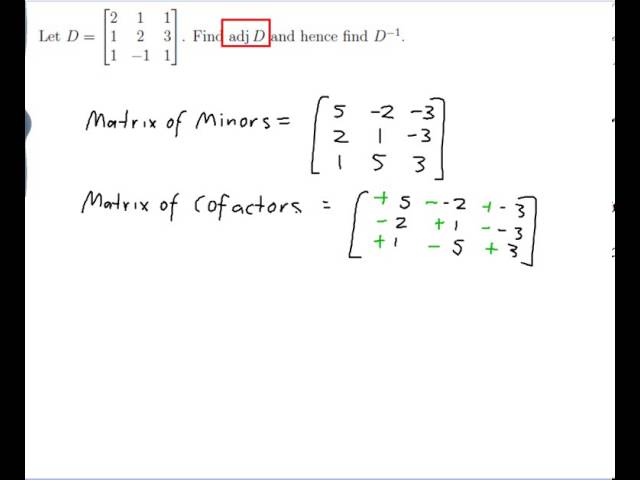
Worked example by David Butler. Features finding the adjoint of a matrix and then using this to find the inverse.
 rose umbra
does this means infinite solutions?
 honest token
Yes @rose umbra
there is 1 free variable
which you can choose to be any value
so infinite solutions
rose umbra
@honest token is it always the case with free variable?
rose umbra
and when I dont have free variable, is it always single answer?
unless i have contradiction(?)
honest token
If the system is consistent then you have a unique solution
If you have a contradiction you have 0 solutions
rose umbra
unique solution = one solution?
honest token
yes
rose umbra
thanks a lot !
honest token
welcome!
native rampart
It is enough to define an inner product on a finite-dimensional real space by specifying an orthogonal basis for the space, correct?
Yes
I mean,same for complex spaces too
 honest imp
im having a hard time answering t/f questions like these, can someone guide me through the thought process of figuring this out? I've gone as far as identifying the set as an Ax = 0 equation to further help, but not sure if thats something i should be doing. that would make A 6x4
and it can have 4 pivots at most
but how does any of that help me
wintry steppe
Do you know what a basis is.
wintry steppe
I get very confused about lattice in linear algebra, can someone help me understand what is it?
 half ice
@honest imp
Consider
(1,0,0,0,0,0)
(0,1,0,0,0,0)
But 4 of those
You seem to be eager to think of a matrix, but linear independence has nothing to do with matricies right away
honest imp
@half ice ty for the response!, this was one of the conclusions i came to when thinking about this problem. 4 of the vectors can be e1-e4 which are basis and are lin. independent
half ice
Glad you got it!
Wait no e1-e4 is not a basis for R⁶
But they are linearly independent yes
half ice
Details aside, that works as an answer to this question
honest imp
i have one more question if you dont mind helping while youre here :o
half ice
Go for it!
honest imp
for these types of questions, idk if its because i have a hard time visualizing it, but what would i be looking for when doing this problem?
 dusky epoch
think about the concepts of dimension and span
half ice
Do you know what dimension is?
honest imp
yes, im relatively new to the concept though
half ice
I'll bring this down to a lower dimension to really discuss the concept. The span of two vectors can be, at most, a plane
You can never get any 3D space by using the span of two vectors. That make sense?
honest imp
ya
half ice
R³ has dimension 3. That means,
- You need 3 vectors in order to span it
- More than three vectors "won't have enough room" and will be forced to be linearly dependent
honest imp
that makes sense too
half ice
R⁶ is the same game. Has dimension 6, you need at least 6 vectors in order to span it
So the question you posted above is false, 4 can't do it
honest imp
that seems a lot simpler than what i was thinking in my head  maybe its because i was over thinking it
if i had 4 vectors, they would be able to span r3 then but one of those vectors will become linearly dependent of the other?
trail mulch
yes, exactly
 oblique rune
@oblique rune yeah I think you meant a different adjoint matrix
@pallid rampart
Ohh yes I didn't specify that
Why is the inner product over a vector field of polynomials written like this?
I'm guessing it has something to do with how integral can be thought of as infinite summations of p(x)q(x)* but I don't know.
pallid rampart
there is no the inner product
oblique rune
oH yes
pallid rampart
that is only one inner product
oblique rune
My bad
pallid rampart
But you can just check the axioms
If this function (a function that assigns two vector to a scalar) satisfy all the axioms of an inner product then it is an inner product
oblique rune
That integral
pallid rampart
well that's the definition
that's the definition of one example of an inner product
oblique rune
Hmm ok, so since it returns a scalar, it's an inner product. But why is the integral evaluated from 0 to 1? Why can't it be something like 0 to 2
pallid rampart
well it's just an example
but you are right
the integral from 0 to 2 also defines an inner product
in fact the integral from a to b for any a≤b defines an inner product
oblique rune
But wouldn't the value change
pallid rampart
right
so that's why this is only one example of an inner product
there are many many inner products
pallid rampart
i mean yeah of course
by definition the same inner product means they produce the same value on every pair of vectors
therefore different inner product must give different values
that is what it means for two functions to be different
because afterall, inner products are just functions
oblique rune
Hmm I see
 uncut barn
is $mat^{-1}$ the inverse matrice ?
stoic pythonBOT
Cewein:
pallid rampart
No it's the inverse of t multiplied by ma on the left
grizzled folio
nevermind I figured it out
@wintry steppe I am currently writing a paper on linear algebra, would you be willing to give me some feedback??
 royal ore
Hello! I have to show <u+v, w> = <u,w> + <v,w> for any u,v,w ∈ ℝ²
half ice
Let u = (u1,u2) et cetera
Compute <u+v, w>
And compute <u,w> + <v,w>
Each computation should come out to the same thing, proving the claim
@royal ore
 wintry sphinx
but isn't <> an inner product? isn't that true by defn?
royal ore
yeah just needed to prove it but figured it out
now how would i show that <v,v> = 0 if and only if v = 0
half ice
Nah it's likely the dot product here
Same idea, evaluate <v,v> for v = (v1,v2) @royal ore
royal ore
what would <v,v> be evaluated as to show it's 0
half ice
What do you get for <v,v>? Lol
royal ore
wouldn't it be v1v1+v2v2
half ice
Exactly, or v1² + v2²
Because of the way squares work, this is always 0 or positive
So that means this is only ever 0 if v1² = v2² = 0
Which is just v1 = v2 = 0
Ergo <v,v> = 0 iff v = 0
royal ore
thank you
now I have a question that involves matrix multiplication
i got the product of B * Z
but now how does 3rd row of it get written as a linear combination of rows of Z
there's 4 for the 3rd row but 3 rows in Z
half ice
These are steps that you take in the multiplication
For example, in order to get that bottom left 3, you did
1(0) + 2(3) + 3(-1)
Note that the numbers I put in parentheses are the first digit of each of the rows of Z
And indeed:
1(0,1,-1,2) + 2(3,0,2,-1) + 3(-1,1,1,4)
Gives the bottom row of BZ
That's just doing multiple of your calculations at one time
royal ore
so just do 3(0) + 3(1) + 3(-1) + 3(2) ...
and then replace 3 with 4 for next row
or no
because it only does 3,4 and 6
royal ore
anyone know how to finish?
wintry steppe
$\begin{bmatrix} 0 & 1 & -1 & 2 \ 3 & 0 & 2 & -1 \ -1 & 1 & 1 & 4 \ \end{bmatrix}$
stoic pythonBOT
DrifAssault:
wintry steppe
@royal ore good?
royal ore
yeah that’s Z, but now how do I do a linear combination of 3 4 6 12 with it
royal ore
<@&286206848099549185>
wintry steppe
I've been trying to reduce this matrix, and find the conditions to make it consistent:
$$\begin{pmatrix}1&-3&a\ :1&-2&b\ :1&1&c\ :1&-4&d\ :1&5&e\end{pmatrix}$$
stoic pythonBOT
ryаn:
wintry steppe
Symbolab and others use some wacky technique to remove several columns
Anyone know what the heck they just did?
Oh nvm..
You can multiply by any constant, so I guess that's fair game.
Though, this feels a lot like multiplying with zero? How does this help find conditions for consistency?
honest token
@wintry steppe the equation is consistent iff all the rows containing 0s (except the last term) have a last term that is 0
so the rightmost column needs to have 0s in its 3rd and 5th rows to be consistent
wintry steppe
Right, though I'm slightly confused with what they did with multiplying R3 with some insane constant?
I've never seen this trick before, is there a name for it?
honest token
Gauss-Jordan elimination
native rampart
Row operations
honest token
or row reduction
wintry steppe
Well sure, it's row reduction, but I've only seen it with normal constants.
native rampart
why should it be any different?
wintry steppe
I guess not, but I'd personally not sure how I'd come up with such an expression.
Is it multiplying by a conjugate or something?
Oh nvm, yeah I see they're multiplying and subtracting with some conjugate.
honest token
yes
wintry steppe
Right, I think I have a better grasp, thanks!
honest token
welcome
 tacit sonnet
In a given vector space there can be n number of basis vectors right?
 marble lance
Huh?
tacit sonnet
I just meant to ask how many basis vectors are possible in a given vector space?
native rampart
how many elements can a set have?
marble lance
R^n can always have n basis vectors. So you can have any number of basis vectors.
 magic acorn
i went through all the questions but then i realized that in order to continue on to b-e i would have to complete a) at least which i dont understand at all
i dont get how you would use the quadratic equation
to find a and b
 subtle walrus
you can even turn any set into the basis of a vector space
magic acorn
meaning i would have to use a cartesian plane for x, y and z?
or would that be unrelated
subtle walrus
my remark was to the previous discussion
magic acorn
ah mb mb
magic acorn
alright so i completed a-c now but now idk how you would graph positive values on that certain function
 surreal thistle
hey does anyone here know anything about the rhombic tilings of spheres
theres two infinite families that im trying to find
im writing a paper about it
any resources or anything helps
 dusky kayak
In a right-angled triangle, one catheter is three times as long as the other. The hypotenuse is
4.0 m longer than the longest catheter. Calculate the circumference of the triangle. Round your answer to tens
meter.
Can i get som healp hear
sory for bad english
 patent python
can someone help me out with this
dusky kayak
prety ezzy math i know, but a friend recomended me to send here
patent python
i dont really understand how we get that part
@dusky kayak try doing pythagorean theorem and you get an equation from that with negative and positive length of each triangle leg. From there just add everything up. Just my idea though
equation looks like this i believe
16 + 12x + 9x^2 = x^2 + 9x^2
 novel sedge
I'm not sure my question belonged to multivar-calc-and-diffeq, so i posted there... might be linear algebra too though
 severe cedar
"Let H = {x \in R, x_1 + x_2 + x_3 + x_4 = 0} be a hyperplane and T: R^4 -> R^4 be a reflection on H. Find all eigenvalues and eigenvectors of H. Is T diagonizable?"
How tf do I solve this?
severe cedar
I've never encountered a problem like this before and it just showed up on my exam...
patent python
eigenvalues and eigenvectors are foudn on matrices
eigenvector would be a matrix with n rows 1 column
and eigenvalue is 1 value in that row
severe cedar
So failure is already a fact but I'm curious how to solve it
patent python
honestly dont remember how you find eigen~val/vectors. If i were you i would have just swapped the values around in the matrix seeing as its a reflection the values would be the same just in different positions
so X axis would have the value of another axis etc lol
honest token
@severe cedar you can solve the problem without knowing the matrix for T, i think
the eigenvectors are the vectors unchanged in direction and the eigenvalues are the factor they change magnitude by
so for the eigenvalue of 1: you can get 3 eigen vectors that span the plane
and the eigenvalue of -1: you can use the normal to the plane
because T has 4 eigenvectors, it is diagonalisable I think
severe cedar
Thanks. Then I might have gotten something right on that question at least
honest token
I'm not completely sure but that would get some marks
severe cedar
I "guessed" that I would get eigenvalue 1 of multiplicity 3 and -1 of multi 1 on the assumption it was a Householder reflection
 olive atlas
say i have the eigenvalues and the eigenvectors for a nxn matrix is there a way to get the original matrix?
 dark valley
whats the matrix rank?
 hard coral
the amount of linearly independent rows/cols
severe cedar
say i have the eigenvalues and the eigenvectors for a nxn matrix is there a way to get the original matrix?
@olive atlas
Given some n x n matrix A you can write it as A = BDB^-1 where D is a diagonal matrix with the eigenvalues diag(λ_1,λ_2...) and B is a matrix with the eigenvectors as columns, and B^-1 it's inverse. Be careful to match the eigenvectors and eigenvalues in the matrices. That is, if you have λ_1 in the first column of D, you should have the eigenvector corresponding to λ_1 in the first column of B etc.
This obviously requires the eigenvectors to be linearly independent, otherwise you won't be able to define the inverse of B.
olive atlas
also how do i determine the order for the eigenvalues i get from the roots of the characetestic polynomial like if i have a 3x3 matrix and i get -3,-2,-1 as the values how do i know which is value1, value2 and value3?
olive atlas
nvm order doesnt matter as long as the order of the eigenvectors matches the order of the corresponding eigenvalues
robust pond
what a weird username
@gilded solstice do you have a formula for inverse
you can just do this directly
wintry sphinx
you could also look at like A^2 = I and check the spectrum
 wary moss

this was on my linalg hw and I was able to prove that a second order homogenuous equation has at least two solutions by cases but generalizing to nth order... i have no clue
is there any hint to what direction i could go in?
since it seems that if i just try to prove it the same way i did before it would be impossible to account for every time a repeated root comes up
robust pond
might want to try #multivariable-calculus , although ig it works in both
wary moss
yeah idk where to put but i was hoping maybe the explanation would be more linalg-y if i put it in here
😔
 topaz geode
I'm doing Linear programming and I'm trying to understand this task. I have been looking all over my textbooks, but I can't find the definitions for these letters... Anyone that can help me out here?
 torpid horizon
can someone help me
with a math queston please
im willing to donate
im having troble with tis hw problemcan someone please help me
if someone can please help me i dont mind making a donation
torpid horizon
its
torpid horizon
im double checking
wintry sphinx
he's [checking]_2
 primal rapids
maybe you should think before you post
torpid horizon
 torn hornet
whats R_n
torpid horizon
means sunset
torn hornet
subset of what, and isomorphisms of what?
torpid horizon
yes
 wary sinew
Pixie join the voice call
torpid horizon
how?
wary sinew
Scroll down, it’s “mathematics” in the server
torpid horizon
where it says math voice?
wary sinew
Yeah
wintry sphinx
$\mathbb R^3$?
stoic pythonBOT
Saccharine:
wintry sphinx
is that what you mean
torn hornet
$R_2$
stoic pythonBOT
JohnDS:
wintry sphinx
$\mathbb R$
stoic pythonBOT
Saccharine:
 slow scroll
I vaguely remember a my linear algebra class using $\bR_n$ to mean rows
stoic pythonBOT
kxrider:
slow scroll
pretty dumb ik lol
torpid horizon
torn hornet
,rotate
stoic pythonBOT
half ice
@wary moss
It's not really an interesting question oop. Basically, given a linearly independent f and g, there's nothing preventing af + bg from being a solution
It is much more interesting to note that af + bg + ch could never be a solution
wary moss
right sure but what about for nth order diffeq?
torpid horizon
torn hornet
$\mathbb{Z}$
stoic pythonBOT
JohnDS:
half ice
A diffeq of order n has n linearly independent solutions. Perhaps they don't want a proof of this.
wary moss
i hope not
but i feel like they do 😔
my classmates say that's what it is asking though
half ice
From the sounds of it, they didn't do the first part well enough to generalize oop
 jolly dome
Can somebody plz help me with this?
 austere cedar
Write it as an augmented matrix and perform row operations until you have the column with entries 1 0 0.
 dense girder
royal ore
half ice
dense girder
royal ore
half ice
So if you do a matrix multiplication but only fill out the bottom row of BZ, you'll do
1(0,1,-1,2) + 2(3,0,2,1) + 3(-1,1,1,4)
In order to find it
Giving the third row of BZ as a linear combination of the rows of Z
royal ore
ohhhh
i was doing it really different
thanks
i thought the 3rd row of B*Z had to be used
wintry sphinx
there are a lot of ways to interpret this
you have shown that any vector of the form u = [blah, blah, z], where z is nonzero does not have a vector v such that Av = u, so therefore A is not surjective. Trying to find the inverse matrix will fail when you attempt to invert the basis vector [0, 0, 1], by the previous part. If A is not surjective, then the inverse cannot be defined for the elements which A does not hit.
wintry steppe
can anyone help me with a least squares parabola question?
wintry steppe
how do i do this
wintry steppe
i don't understand where i'm going wrong
limber sierra
well, L doesn't have ones on the diagonal
it has a 2 right there
what technique (if any) have you been taught to find LU decompositions? gaussian elimination?
 arctic hazel
i have a question about a linear algebra problem that i'm doing, but it's more about writing up the latex than the actual problem, if that's ok
i'm solving an augmented matrix, and i have this block of code to express it:
$$\left[\begin{array}{cc|c}{4 & 1 & 0 \ -3 & -1 & 0}\end{array}\right]\to\left[\begin{array}{cc|c}{4 & 1 & 0 \ 1 & 0 & 0}\end{array}\right]\to \left[\begin{array}{cc|c}{1 & 0 & 0 \ 4 & 1 & 0}\end{array}\right]\to \left[\begin{array}{cc|c}{1 & 0 & 0 \ 0 & 1 & 0}\end{array}\right]$$
stoic pythonBOT
Snodlop:
$$\left[\begin{array}{cc|c}{4 & 1 & 0 \\ -3 & -1 & 0}\end{array}\right]\to\left[\begin{array}{cc|c}{4 & 1 & 0 \\ 1 & 0 & 0}\end{array}\right]\to \left[\begin{array}{cc|c}{1 & 0 & 0 \\ 4 & 1 & 0}\end{array}\right]\to \left[\begin{array}{cc|c}{1 & 0 & 0 \\ 0 & 1 & 0}\end{array}\right]$$
```Compile error! Output:
! Missing } inserted.
<inserted text>
}
l.54 $$\left[\begin{array}{cc|c}{4 &
1 & 0 \ -3 & -1 & 0}\end{array}\right]...
I've put in what seems to be necessary to fix
the current column of the current alignment.
Try to go on, since this might almost work.
texit gives the same error that my other latex editor gave, but i don't know how to fix it
here's the text again so you can see what it looks like
$$\left[\begin{array}{cc|c}{4 & 1 & 0 \ -3 & -1 & 0}\end{array}\right]\to\left[\begin{array}{cc|c}{4 & 1 & 0 \ 1 & 0 & 0}\end{array}\right]\to \left[\begin{array}{cc|c}{1 & 0 & 0 \ 4 & 1 & 0}\end{array}\right]\to \left[\begin{array}{cc|c}{1 & 0 & 0 \ 0 & 1 & 0}\end{array}\right]$$
stoic pythonBOT
Snodlop:
Compile Error! Click the reaction for details. (You may edit your message)
arctic hazel
if this is the wrong place to ask a question like this, i'm sorry but i don't know where else to ask
limber sierra
uh
the contents of your arrays dont need to be wrapped in {}s
its an environment like any other
the \begin{array}{cc|c} and \end{array} suffice as a wrapping
$$
\left[
    \begin{array}{cc|c}4 & 1 & 0 \\-3 &-1 & 0\end{array}
\right]\to \left[
    \begin{array}{cc|c}4 & 1 & 0 \\ 1 & 0 & 0\end{array}
\right]\to \left[
    \begin{array}{cc|c}1 & 0 & 0 \\ 4 & 1 & 0\end{array}
\right]\to \left[
    \begin{array}{cc|c}1 & 0 & 0 \\ 0 & 1 & 0\end{array}
\right]
$$```Namington:
arctic hazel
oh that's absolutely perfect
thank you so much
this one error was driving me crazy and i had no clue what i did wrong
limber sierra
to clarify what was going on
normally you can insert {}s randomly in latex and itll kind of ignore them
the problem is that
because youre separating the entries of your array using &s and/or \\s
you're putting a { in one entry, and a } in the other entry
this confuses latex
since its expecting the { to be completed in the same entry (LaTeX is not very good at looking ahead)
so it tries to insert the "missing" } at the end of the entry with the {, and gives an error
the solution, as shown above, is just to remove the useless {}s that are confusing latex.
arctic hazel
ok that makes sense
i didn't realize that array was its own environment, i thought i still had to wrap the insides in braces
limber sierra
everything within \begin \ends is an environment
severe cedar
Given a linear operator on C^3, T(z_1,z_2,z_3) = (2z_2 + iz_3, iz_2, z_1), how would you going about finding the adjoint of this operator? Would you produce a matrix using the standard basis and find the conjugate transpose? Or is it possible to find the adjoint using <T(z),y> = <z,T^*(y)>
native rampart
The standard basis might not be orthonormal. Preferred method would be to convert to a orthonomal basis and take conjugate transpose
Sure,You can find the adjoint with that definition
(The adjoint being conjugate transpose of matrix of T in an orthonormal basis is based on that)
@severe cedar
severe cedar
With which definition, the last one?
native rampart
Yes
severe cedar
Thanks. I hope I got it right then.
What confused me too is that the standard inner product of C uses the conjugate of the second factor. So I'm not sure if the adjoint "removes" the conjugate in <z,T^*(y)>.
native rampart
Do you know how you get the representation matrix is conjugate transpose ?
severe cedar
sorry what
Do I know how to find the conjugate transpose of a representation matrix? Yes
and yeah the conjugate transpose matrix uses the conjugate so i guess that does it
native rampart
No,I am asking whether you know why taking conjugate transpose of a matrix representation of T gives you the matrix representation of T*?
severe cedar
hmm i'm not totally sure
native rampart
Let ($e_1,e_2...,e_n$) be an orthonormal basis .Do you know if $Te_1=c_1e_1+c_2e_2...c_ne_n \implies \langle Te_1 \mid ej \rangle=c_j$
stoic pythonBOT
DrunkenDrake:
 reef ridge
to solve a system of linear equations by EROs do i need to have the matrix completely reduced i.e.
[1 0 0] [1 a b ]
[0 1 0] or can it be [0 1 c ]
[0 0 1] [0 0 1 ]
in my lectures it was always completely reduced but looking at some other revision materials it shows this
does having it completely reduced just make it easier?
native rampart
Yes
reef ridge
okay so are either able to solve a system of linear equations
Man I wanna understand why gaussian elimination actually works but i gotta catch up on a lot of stuff and i've no time
 knotty blaze
@reef ridge for gaussian elimination you have to put it in "row echelon form" which looks for a system of 3 eq-ns looks like this
reef ridge
I understand what it is, i'm more wondering why elementary row operations and stuff to get there actually solve linear equations
if that makes sense
knotty blaze
okay the way I imagine it
is that each row is a variable
you're able to solve linear eq-ns because
you effectively get a solution for 3rd variable in the bottom row
z=constant
and this immediately allows you to solve the rest of the matrix as the rest is:
y+z=constant
but we already know z=const
reef ridge
right
reef ridge
yeah
knotty blaze
is that what you were wondering
reef ridge
not exactly but i'll come back to it later cause i need to study some other stuff
like i have no idea what this means
native rampart
What is a net?
reef ridge
i think it's supposed to say set
knotty blaze

Mathematics Stack Exchange
To prove a subset is a subspace of a vector space we have to prove that the same operations (closed under vector addition and closed under scalar multiplication) on the Vector space apply to the su...
 blissful coral
 honest token
@tacit girder the rank is 1 meaning the columns must be linearly dependent
so the second column has to be a multiple of the first one
 tacit girder
so a would =2
honest token
yes
tacit girder
thanks
honest token
welcome
 stuck stratus
'Let A be an orthogonal matrix. Show that A^2 is an orthogonal matrix, too.' How do I do this?
 steady fiber
we know $AA^T = I$,
let's find $A^2(A^2)T$
$$
AA(AA)^T = AAA^TA^T = A(I)A^T = AA^T = I
$$
stoic pythonBOT
PorosInMyAshe:
steady fiber
so A^2 has to be orthogonal too
stuck stratus
Got it thanks :)
Suppose that for a symmetric matrix A it holds that A = QRQ−1 with Q an orthogonal matrix and R an upper triangular matrix. Prove that R must be a diagonal matrix then
Is this correct: A = QDQ^-1 = QDQ^T. Then A^T = (QDQ^T)^T = (Q^T)^T D^T Q^T = Q D^T Q^-1. Then both D and D^T have to be upper diagonal matrixes so D is diagonal
?
gray dust
in most cases it's synonymous with identity matrix
gray dust
an identity matrix is a square matrix with 1s on the diagonal & 0s off it
cunning arch
if i'm given a transformation reflection matrix, how can i "prove" that it is rigid?
stoic pythonBOT
strawberrypocky:
Compile Error! Click the reaction for details. (You may edit your message)
cunning arch
close enough. ^ i got this transformation matrix, which is a reflection acorss the y=tantheta x line, and ik that reflections are all rigid, but idk my prof is asking me to prove it?
cunning arch
like just find the length of transformation matrix?
sorry i'm a bit lost, kinda don't remember the notatino
stoic pythonBOT
DrunkenDrake:
cunning arch
ooooh ok, thank you!
 tacit flume
i got this problem
The chance certain seeds grow into decent plants
depends on the time between buying the seeds and planting.
of it. If the seeds are planted after a week, there is a 92% chance of the seeds being planted.
that the seeds hatch. After four weeks, the chance is only 79% and after an
year this is still 6.7%
and i need to calculate this
The chance that a seed will hatch immediately after it has been planted is about 97%. Calculate this probability to one decimal accurate.
gray dust
 warped garden
hey all, I understand that matrix A must be a symmetric matrix for it to be orthogonally diagonalizable. But will it still be possible if matrix A is a diagonalizable matrix? Since during computation, the bases will be transformed to orthonormal bases. Or am I having some misconception in my thought process?
 golden dagger
im having trouble proving the following are equivalent
can anyone hint as to what I have to do
 quasi vale
multiply and divide by conjugate, that is $ (\sqrt{x+1} + \sqrt{x})$
stoic pythonBOT
Sup?:
quasi vale
starting with f(x)
golden dagger
ah got it, cheers
cunning arch
i'm just... so confused??? can someone walk me through one of them?
like i know what it means when something is one-to-one and/or onto, but like
hollow finch
@cunning arch can you describe what it means to be one-to-one/onto?
cunning arch
basically one-to-one is if each vector in like space D has a unique image/gets mapped to different places in R. onto is if each vector already has like at least 1 image in D
i think
or it's onto if the columns span R, and on-to-one if the columns of transofrmation matrix A is linearly dependent
wintry sphinx
so one way of doing this, if you're more familiar with the idea of using the columns of a matrix
is writing down the transformation matrix for each of them
 jagged marsh
so for an $n\cross n$ matrix $\mathbb{A}=[a_{ij}]$, where $a_{ij}=i+j$, how do you find det($\mathbb{A})?
stoic pythonBOT
Hellfire!:
Compile Error! Click the reaction for details. (You may edit your message)
 zealous vine
 rich dove
If it's a factorization you need, think of 5 as $\sqrt{5}^2$
stoic pythonBOT
A~Z:
native rampart
I think you get 0
Because if you subtract 2nd row from 1st row,you get 1,1,1...
Similarly row3- row 1 gives you 2,2,2...
@jagged marsh
dusky epoch
you have your system written down in matrix form
Ax = b
the augmented matrix is literally just A but with b stuck to it on the right
honest token
yes
honest token
what's your matrix
 thorny hemlock
one second
honest token
yes
thorny hemlock
idont think its right, cuz ive got elements on the left most collumn
i cant eliminate those
dusky epoch
yes it can
thorny hemlock
ive got elements below 0 first collumn
dusky epoch
you just need to stop being one track minded for a moment and like
switch rows 1 and 2
and then do rref again
thorny hemlock
wait waht
dusky epoch
what
thorny hemlock
switch rows 1 and 2 before or after
dusky epoch
you can continue from here
thorny hemlock
i can continue from where i am?
dusky epoch
yes you can continue from where you are right now
honest token
the 0 0 0 0 -3 row looks kinda sus 
dusky epoch
as long as you didn't fuck anything up in getting here
thorny hemlock
lemme check it with matlab
nvm
matlab only does rref
ehm
shall i try switching rows 1 and 3
in the original matrix
and redo ing it
dusky epoch
if you want
thorny hemlock
with switching rows
do we want the largest element row in the top row
that doesnt make sense but hopefully you understood lmao
dusky epoch
it doesn't mater
so long as the top left element isn't zero and you can actually do the elimination
dusky epoch
idk
the hand(mouse?)writing is certainly horrid
but i dont feel like checking this
thorny hemlock
um
ok
assuming that im correct
how would i work out x1 x2 x3 x4 now
@dusky epoch @honest token
honest token
you can't
dusky epoch
recall how to convert augmented matrices back into equations
thorny hemlock
is that necessary ?
the rank of the augmented and coefficiant matrix are different so that means no solutions right
honest token
its no solutions because the bottom row has all 0s except the last column
which is non 0
thorny hemlock
ok for this one
thats the row echelon form of the augmented
what next
@honest token any idea?
this one seems possible
 hidden ember
factor out 2 from the second row?
honest token
That's definitely possible
thorny hemlock
so i can just change the matrix ?
honest token
no, you can divide the entire row by 6
thorny hemlock
honest token
so that you get 1 as the pivot
honest token
yes
thorny hemlock
what next
hidden ember
or you could have just subtracted the second row from the first row
honest token
fair point
thorny hemlock
um how do i convert the equations back?
honest token
the bottom one is 0x + y + 4/3 z = 2/3
thorny hemlock
so $x + 3y + 4z = 1$ and $y + 4/3 z = 2/3$
hidden ember
you will get a parametric form such that for any Z that is a real number there is a solution that satisfies the system
stoic pythonBOT
Yes:
thorny hemlock
why is z free
hidden ember
if a variable corresponds to the pivot column it's called basic variable
but here
z does not correspond to a pivot column
thorny hemlock
we are talking horizontal correspondence ?
thorny hemlock
and 3y + 4z = 0
honest token
yes
thorny hemlock
what does this parametric form mean
hidden ember
it means writing ur basic variables in terms of ur free variables
thorny hemlock
hidden ember
such that for ur free variable, a real number, there is a solution that satisfies the system
hidden ember
they wrote y in terms of z
but z = u
so y in terms of u
now if u take any real value say 1, you will get a solution that will satisfy ur linear system
hidden ember
((:
tacit girder
anyone can help
https://gyazo.com/6d6f09d98acbf55370ba2023b46c32d1

 hidden ember
hm
honest token
$\begin{bmatrix} 1 & 1 \ 0 & 0 \ 1 & 1 \end{bmatrix}$
stoic pythonBOT
Frosty_:
honest token
works
tacit girder
how did u get tehre
honest token
you know its 3 by 2
tacit girder
yeah
honest token
then assume its like $\begin{bmatrix} a & b \ c & d \ e & f \end{bmatrix}$
stoic pythonBOT
Frosty_:
hidden ember
yeah sounds good
honest token
welcome
 tranquil hazel
Can someone explain this, and why it would be true or false?
honest token
@tranquil hazel think of A as $\begin{bmatrix} a & b \ c & d \ e & f \end{bmatrix}$ and u as $\begin{bmatrix} a \ c \ e \end{bmatrix}$
stoic pythonBOT
Frosty_:
honest token
is that vector in R^3
 dark gale
does it have 3 entries?
tranquil hazel
yes
honest token
then...
honest token
welcome
wintry steppe
which step is wrong?
where is the mistake
i think its 3 cus thats not how the rule works
 shy totem
very quick question, why is it multiplying everything by 6 here?
this was shit i had years ago and fully forgot
honest token
common multiple of 2 and 3
honest token
To get rid of the denominator, yes
 mild igloo
I can solve for t2 and t3 but how would I get t4?
tbh I dont understand the picture or how the sectioning is working here
 lucid cedar
I bodied my LA test today thanks to this discord. Thanks to all the Helpers
 dim venture
consider not @ ing all of them like that then...
 south sedge
gotta find the angle between the vectors u and v.
u + 3v is orthogonal to 2u - v. And u +7v is orthogonal to 2u + v.
which gives
looking at a solution
how did it get to the red marked one?
 acoustic zodiac
can someone explain to me what a generator space is, i didn't really get it
limber sierra
as in a generating set of a vector space?
im not familiar with the precise term "generator space"
acoustic zodiac
generator set yeah sorry
limber sierra
a generating set is just a set of vectors; the idea behind a generating set is that we can make every vector in a certain space out of vectors from that set
let me give an analogy
if i asked you "what words can you spell with only the letters a, c, e, and f?", the set {a, c, e, f} would be the generators of some "space" of words
acoustic zodiac
hmm alright makes sense
limber sierra
and some words in this space would be "ace", "face", "cafe", "efface"
of course we're dealing with vectors
not letters
the way we construct vectors out of other vectors is by taking linear combinations
 nocturne jewel
Is there an easy way to determine if a block matrix is invertible?
limber sierra
essentially, adding vectors, and multiples of vectors, to each other
a proper intuition for this can only really be developed by practicing it but
as an example
lets suppose our generating set is $\left{\begin{pmatrix}1\0\1\end{pmatrix}, \begin{pmatrix}-1\2\2\end{pmatrix}\right}$
stoic pythonBOT
Namington:
acoustic zodiac
hmm we use a different notation but ok
limber sierra
then the vector $\begin{pmatrix}4\-2\1\end{pmatrix}$ would be in the space generated by this set
stoic pythonBOT
Namington:
limber sierra
since $\begin{pmatrix}4\-2\1\end{pmatrix} = 3\begin{pmatrix}1\0\1\end{pmatrix} - \begin{pmatrix}-1\2\2\end{pmatrix}$
stoic pythonBOT
Namington:
acoustic zodiac
hm yeah alright
lemme translate a theorem real quick though, it's about a "generated subspace", this is what i don't really get
heard about it?
limber sierra
the generated subspace is a subspace generated by a given (generating) set
so the subspace generated by my example of $\left{\begin{pmatrix}1\0\1\end{pmatrix}, \begin{pmatrix}-1\2\2\end{pmatrix}\right}$ would be ALL vectors of the form:
[
a\begin{pmatrix}1\0\1\end{pmatrix} + b\begin{pmatrix}-1\2\2\end{pmatrix} = \begin{pmatrix}a - b\2b\a + 2b\end{pmatrix}
]
stoic pythonBOT
Namington:
limber sierra
for any a, b
as an example, $\begin{pmatrix}1\0\0\end{pmatrix}$ would NOT be in this subspace, since it would need to solve:
[ \begin{pmatrix}1\0\0\end{pmatrix} = \begin{pmatrix}a-b\2b\a+2b\end{pmatrix}]
but $2b = 0$ implies $b = 0$, but then we must have $a = 1$ and $a = 0$ simultaneously, which is impossible
stoic pythonBOT
Namington:
limber sierra
(assuming you're dealing with real-number-valued or complex-number-valued vectors)
acoustic zodiac
huhh i'm getting trouble typing with "" "" on latex
these things _
they disappear
limber sierra
underscores?
acoustic zodiac
yeah
acoustic zodiac
yeah but in this case is the subspace generated by $\sum_{i=1}^{n}{\alpha^i\cdot v_{i}$
stoic pythonBOT
rcatalang:
Compile Error! Click the reaction for details. (You may edit your message)
acoustic zodiac
which is all linear combinations
limber sierra
indeed
so the generating set of that is the set of vectors v_i
wait
what's the full statement of the theorem
acoustic zodiac
Let $W\subset E$. The set of all linear combinations ($\sum_{i=1}^{n}{\alpha^i\cdot v_{i}$) of the vectors of $W$ is $<W>$, the generated subspace, and it's the smallest subspace that contains W.
oops
there's probably something wrong with what i copied now that i'm reading it out loud
limber sierra
okay, it seems this is a definition-combined-with-a-theorem
stoic pythonBOT
rcatalang:
Compile Error! Click the reaction for details. (You may edit your message)
limber sierra
it defines "generated subspace" as a set of all linear combinations of elements of W
which is a definition (and the most common one)
then it states the result that this is the SMALLEST subspace containing W
which is a theorem
acoustic zodiac
yes, that's the part i don't really get, what does "smallest" even refer to?
limber sierra
if a subspace of E contains every element of W, it must contain <W>
i.e. <W> must be a subset of that subspace
acoustic zodiac
yes
limber sierra
as an example, if $W = \left{\begin{pmatrix}1\0\0\end{pmatrix}\right}$, then the set $\langle W \rangle$ is the set of all linear combinations of this vector, i.e. vectors of the form
[
\begin{pmatrix}a\0\0\end{pmatrix}
]
for some $a$.
now if we define a new subspace $S \subset E$, if $S$ contains $W$, then $\langle W \rangle \subset S$
stoic pythonBOT
Namington:
limber sierra
in particular, every vector of the form $\begin{pmatrix}a\0\0\end{pmatrix}$ (i.e. every vector in $\langle W \rangle$) must also be in $S$.
stoic pythonBOT
Namington:
limber sierra
this is what we mean by "smallest"
<W> being the "smallest" subspace containing W means that every subspace containing W also contains <W>
acoustic zodiac
oh, well that makes sense
nocturne jewel
ad-bc != 0 means a matrix is invertible right?
limber sierra
if we took another subspace, for example the subspace $S$ generated by $\left{\begin{pmatrix}2\1\0\end{pmatrix}, \begin{pmatrix}1\1\0\end{pmatrix}\right}$, then since:
[
\begin{pmatrix}2\1\0\end{pmatrix} - \begin{pmatrix}1\1\0\end{pmatrix} = \begin{pmatrix}1\0\0\end{pmatrix}
]
the subspace contains $W$, which means that $\langle W \rangle \subset S$.
stoic pythonBOT
Namington:
limber sierra
this ends up being a very important fact for many proofs
basically any proof of a big result involving "dimension" relies on it in some way
(though often, it'll be through citing another theorem whose proof used this fact.)
@nocturne jewel for a 2x2 matrix, yes.
acoustic zodiac
ohhh now with your examples my prof's proof makes more sense, thanks
nocturne jewel
What about a block matrix that's 2x2?
acoustic zodiac
he was doing it for any W and any <W>, so it got a bit confusing
limber sierra
oh you mean like
a matrix composed of 4 blocks arranged in a 2x2 pattern?
the statement isnt as nice im afraid
limber sierra
yeah you cant just apply that without proof
nocturne jewel
proof of the ad-bc != 0 => invertible?
limber sierra
since the ad - bc works for 2x2 matrices whose entries are, you know, numbers
that block matrix will not be 2x2
(unless each block happens to be 1x1)
nocturne jewel
yeah it's m+n x m+n
But yeah i have no idea how to go about showing it's invertible lol
limber sierra
well, it suffices to find its inverse, and then show (upon multiplication) that their product is the identity matrix
of size (m+n) x (m+n)
are you familiar with block matrix multiplication?
nocturne jewel
Yeah (did it once but I can look at the textbook and notes)
limber sierra
of note is this
assuming A_1, D_1, A_2, D_2 are square
(which they are in this case)
nocturne jewel
why do a and d have to be square?
limber sierra
otherwise those products dont all make sense!
limber sierra
anyway, given C_1 = 0, see if you can find a set of values for A_2, B_2, C_2, D_2 that makes the bottom matrix there an identity matrix
(so A_1A_2 + B_1C_2 and C_1B_2+D_1D_2 will have to be identity matrices, while A_1B_2+B_1D_2 and C_1A_2+D_1C_2 will have to be zero matrices)
(substituting C_1 = 0 will greatly simplify these computations; it essentially becomes a system of equations.)
nocturne jewel
Ok I got entries I expected, then one I didnt
Top right is -A^-1BD^-1
Nvm it worked out
slow scroll
"the general solution to this system is: the set of all (1,0,-1,0) + t(-1,1,0,0) + s(-2,0,-2,1) such that t, s are in R"
by R i mean $\bR$.
stoic pythonBOT
kxrider:
slow scroll
@main nacelle
 wheat prairie
curiousity question: Can one say let S be the set of all vectors of all dimensions? If so how would it be denoted?
native rampart
Just S
wheat prairie
so if they were let's say vectors of real numbers can't i call it R ^ n where n is a variable?
native rampart
Wdym vectors of real numbers?