#linear-algebra
2 messages · Page 139 of 1
 gray dust
 cobalt vale
I got it. thanks man @gray dust
although, i have another question
do you need to be in row echelon to identify pivots ?
for example
-3 5 -1
0 2 1
0 0 -3
we can clearly see that the pivot positions are -3 2 and 3 right ? or would u need to row reduce it to prove it
 half ice
You're correct that's enough
Upper triangular will reduce to identity
If nothing on the diagonal is 0
gray dust
@cobalt vale it's already in ref so you can immediately count off pivots
 gritty frigate
If a line in R3 has a director vector with two components = 0. The line will have infinite projecting planes?
half ice
Director vector lol
half ice
Np it's just funny. Unfortunately I don't follow the rest. Projecting planes?
gritty frigate
Yeah, It is a plane that has the line and is perpedicular to any xy,yz or zx plane
Again, sorry if it is not the name of the concept, translating math is kinda hard
half ice
The line will be parallel to the x-axis, or the y-axis, or the z-axis
gritty frigate
Yep
half ice
Yeah and will be perpendicular to either of those planes
gritty frigate
And the plane, which that line is normal to will have infinite "projecting planes" ?
 fair vector
Can anyone explain to me the concept of spans ? Like what does it mean when something spans R^n
 native rampart
Ok, Let's say you have a set of vectors
And you consider the set of all linear combinations of said vectors,that set is called the span of your vectors{say you chose (1,0,0) and (0,1,0) in vector space R^3 ,then all vectors of form x(1,0,0)+y(0,1,0) will be the span of {(1,0,0),(0,1,0)}}
@fair vector
Now if the span of vectors is R^n ,you say the vectors span R^n
fair vector
Yea got it i understood this but if there is a specific case for example in exams they give random cases lk {3,1,2} and {4,4,2} does this span R^3 how should i proceed
is their any tricks
native rampart
You know what a basis is?
fair vector
yea
native rampart
Check the number of linearly independent vectors in your spanning set
If it is equal to dim(space),it spans. Otherwise it doesn't span
fair vector
oh okay thanks i didnt know all this
 robust pond
i have a dumb question
 dusky epoch
shoot
robust pond
this arrowed part
i know ive done this before but now i cannot for the life of me remember
you find the free variables
then you set it to be some parameter
im not understanding how to use this though
this is for finding the bases of the null space
most links i find skip over the details
or maybe the details are included and im not seeing it
dusky epoch
you can switch back to the equation view
you have
x1 + x4 = 0
x2 + x4 = 0
x3 + x4 = 0
robust pond
oh you just split it into a system
i figured that was not valid for a second
im not sure why
i got it 🙇♂️ thanks
 lucid cedar
im trying to understand a proof that i am working through that contains this line
It seems rather non obvious that this statement is true and it is given without explanation
native rampart
Is your doubt about T being linear?
lucid cedar
no
dusky epoch
it's a geometric series
 opaque plover
Hello, I am kinda stuck with this problem: How many equivalence class are there for this relation?
 marble lance
@opaque plover do you still need help?
opaque plover
@marble lance yes please
marble lance
Sorry, will ping you in 20 min
opaque plover
alright thanks
marble lance
@opaque plover nvm
Do you know that for every integer a and positive integer b, you can find integers q and r so that a = bq + r and 0 <= r < b?
opaque plover
How do you come to this conclusion, because I cant follow you, sry
dusky epoch
this is just division with remainder
for example, if a = 258 and b = 13, then you get 258 = 13*19 + 11
opaque plover
yeah i got that
marble lance
Okay, great
So now you have to show two things: 0, 1,2,...,n-1 belongs to different equivalence classes; and every integer belongs to one of those classes
That would mean there are n equivalence classes: one for each possible remainder after division by n
Does that make sense? @opaque plover
Consider 0 <= i < j < n-1. Then 0 < j-i < n, so j-i is not a multiple of n. So i and j belong to distinct equivalence classes. This proves the first part
Now consider any integer a. Then a = nq + r, so a-r = nq. Then a belongs to the same equivalence class as its remainder r. This proves the second part.
opaque plover
ohhh yeah that makes sense, how can you solve this so fast lol
marble lance
I'm already familiar with the proof. This is a very well known equivalence relation
marble lance
Np
 calm hamlet
If I want to prove the vector space of real sequences with limit=0 H is a hyperplane of the vector space of real convergent sequences N, is it a valid proof to say:
I take any real convergent sequence (a_n) of limit L, I build the sequence (b_n) such as b_n=A_n -L belongs to H, and then each sequence from N can be separated in one sequence from H and one constant sequence, then H is a hyperplane of N?
dusky epoch
what's your defn of a hyperplane
 magic light
https://i.imgur.com/6hmO665.png
Hello, I need an answer here if possible
I am asked if there exists a linear transformation
T, s.t Ker(T)=V AND
3 is a eigenvalue of T
Now, for Ker(T)=V that means it spans all the same
but 3 is an eigenvector meaning
T(v) = 3v for some v
because v != 0, then 3v != 0 and thus T(v) is NOT in Ker(T), does that disprove the existence of such a transformation?
Because on one hand KerT = V
on the other hand here's a v that is only in the Image ?
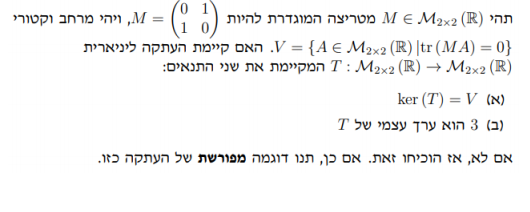
V, T, M all written in the picture
 wintry steppe
I'm going through Linear Algebra Done Wrong by Treil and I was wondering about the question in the image below part c. I'm not sure how to show that it's not a vector space.
native rampart
There is no additive identity
 idle current
<@&286206848099549185> pls, it's semi-urgent
@magic light Why is that?
wintry steppe
Can the coefficients on linear combinations be irrational?
 mortal stream
why not
wintry steppe
Well I dont see how anything would be linearly independent
native rampart
Well I dont see how anything would be linearly independent
@wintry steppe they can be anything from any field
(Ok,The field your vector space is defined with)
mortal stream
for your vector space question, consider two polynomials, one with leading coefficient 1 and one with -1
add them and you'll see that the result is not in the set
hence it's not closed
wintry steppe
So wait what would an example of a linearly independent system in R be then?
magic light
@idle current because I submitted it as a test answer, and I got partial points, wanted to know if I can get a little more depending on how wrong I was
there's only a limited amount of days that I can ask for a review
wintry steppe
The reason I ask is because im struggling to see how any system could be independent in R if we can just take any real number as coefficients
 slate haven
should this be evaluated as $(x_1 \wedge x_3) - (2x_1 \wedge x_2) + (4x_2 \wedge x_3)$ or as $x_1 \wedge (x_3 - 2x_1) \wedge (x_2 + 4x_2) \wedge x_3$
I'm slightly confused as i can't find anything in the notes. My feeling tells me that the first evaluation should be correct since it's kind of a multiplication but idk, might be a dumb question
 stoic pythonBOT
chrisply:
slate haven
ok well since the exterior product fulfills distributivity it should definitely be the first evaluation order, right ?
 scarlet trail
2t+8=3
 stuck stratus
can someone help?
 dawn remnant
Have you solved the characteristic equation?
dusky epoch
why am i of all people getting pung out of the blue
dawn remnant
Oh, they pinged me first, then deleted the message 😛
dusky epoch
k so what are you having trouble with
dusky epoch
if you want
 quaint marlin
And then solve for lambda?
dusky epoch
before you solve for lambda you need an equation to solve for lambda
quaint marlin
Could I use the 4x-y+lambda z = 8?
dusky epoch
depending on what you mean by "use"
do you want me to pretend this question admits one and only one solution path & tell you exactly what steps go into it?
dusky epoch
evaluate determinant, set determinant equal to zero, solve for lambda
wintry steppe
on top its the solution for Ax=b, but they ask for the solution for Ax=0
If you need an hint: || Suppose Ax = b and Ay= b. Then what is A(x-y)?||
 cunning arch
Sorry for the really late response, I'm still a bit confused. A(x-y) would just be b-b=0 (?)
Are we supposed to solve the system 5+t+3r=0, 1+t=0,-2+5r=0,3+t+r=0? Because that ends up inconsistent so no solution set, so I think that's incorrect
wintry steppe
no. you are not given A
what they tell you is that all vectors of that form where t and r are numbers are solution for the system Ax=b
and they want you to find the solution to Ax=0 from just that information. They do not tell you what A and b are.
lucid cedar
Im trying to solve for the eigenvalues and vectors of the Map:
T(w,z) = (-z,w)
Axlers explanation for finding the Evalues is lengthy and easy to follow. They are i && -i. His explanation of the vectors is just "Therefore the vectors are (w,wi),(w,-wi)" and i just cant see how he came to this conclusion.
nevermind i see how it works
wintry steppe
how did i mess up on the gaussian elimination to incorrectly determine that this matrix's vectors are linearly independent
 brisk fractal
(1,4) + (-1,4) = (0,8)
also, avoid writing that the matrices are equal, because they're not
they're equivalent via elementary matrices
wintry steppe
ok thanks
brisk fractal
can someone confirm that rankA = rankA^T = nullA = nullA^T = 1 for this matrix
I'm also not really sure what he wants the reader to say about their relation
wintry steppe
🤔
can someone confirm that rankA = rankA^T = nullA = nullA^T = 1 for this matri
Sounds right
relation
It's the same space (1, i)?
Maybe there's a term for that or something
brisk fractal
I thought that was interesting, I noticed that A^2 = 0 and figured there was something to it
there's probably some wacky spectral theory shit you can do with nilpotent matrices
brisk fractal
wdym by "have no solution"
cobalt vale
the system has no solution
brisk fractal
oh, like if Ax does not equal b for some b in the codomain
cobalt vale
that system has no solution
so its not linearly independent
therefore it's not a basis of r2
or am i missing something here
ax=0
oh wait yikes
i performed elementary operations wrong
brisk fractal
if you put it into a matrix, you can reduce it to
0 2
20 0
which implies that nullity of the matrix is 0
brisk fractal
no worries
brisk fractal
d is false, that's only true for surjective linear maps
everything else looks good
cobalt vale
i dont agree with d
cobalt vale
i was thinking more like. for any vector w in W there exists at least one v in V such that T(v)= w=>T(V) = W
that was my explanation for it
brisk fractal
see, that's not necessarily true though
let T be a matrix, if there isn't a pivot in every row, then that's not true
brisk fractal
the pivot stuff is confusing, but once you think with rank stuff it becomes 30x easier
brisk fractal
hit me
brisk fractal
true, false, false, false, true, true, false, false, false, false I think
brisk fractal
I wrote f is true
cobalt vale
no f is false
brisk fractal
I'm not 100%, I just finished the exact same material
cobalt vale
a pivot in the last column would make it inconsistent
brisk fractal
pivot in each row is consistency, pivot in each column is spanning
cobalt vale
because you get 1 = 0
brisk fractal
it's rows not columns in F
brisk fractal
sorry, pivot in each row of the coefficient matrix
not the augmented matrix
I guess if they're specifically referring the the augmented, then no, but none of the pivot rules refer to augmented matrices iirc
wintry steppe
How to debunk every single mathematical theory:
this is incosistent
because 1=0
brisk fractal
Sorry, yeah, i didn't read the "augmented" part because that fucks everything up
but h is false, that would imply that columns have pivots, not rows
i is true, I was dumb
j is equivalent to h I believe
wait fuck yeah I'm being dumb
j is true my bad
 dense sonnet
Can anyone recomend a book that talks about the history of the hessian matrix? On wiki there really isn't any history behind it. Thank you
cunning arch
ok i'm legitimately stupid. despite the help earlier, i still don't know what to do with this. i understand what it's asking, just not how to find it (?). could someone guide me through this one please?
half ice
Just for ease of writing, I'll label those vectors such that:
x = u + tv + rw
It is the case that:
Au = b
Just by setting t = r = 0
Then,
Ax = b
A(u + tv + rw) = b
Au + A(tv + rw) = b
b + A(tv + rw) = b
A(tv + rw) = 0
cunning arch
oooooooh
wow that ended up being a lot more simple than i thought. thank you so much @half ice, that made a lot more sense :)
half ice
Np! Feel free to ask if you need anything else
 limber sierra
why urgently?
 soft burrow
the "(1 point)" might be a hint lmao
- Requesting help during an exam is a bannable offense.
#rules
cunning arch
so uh, am i the only one they cold-DMed to get help? nice 
limber sierra
i'd normally rather give the benefit of the doubt, but considering the cold DM...
hrm...
wintry steppe
It's not really urgent
Not an exam
Still here
Just urgent because I intend on sleeping soon
Anyways I figured it out
 elfin mist
what's a good place to learn about dual and double dual spaces?
native rampart
Hoffman kunze had a good introduction,I think
elfin mist
alright cool I'll check it out
dusky epoch
does x = [0;0;0] satisfy the equation a · x + 2 = 0 or not
 tired garden
Obviously not since we add 2 to it after
Is that it?
any vector multiplied by 0 vector will give 0s
Adding 2 will give us 2
dusky epoch
yes that is it
 unique yew
The question asks to find the set of solutions for x+2y+3z=0. How can this be done?
 scenic vapor
is a "square semi orthogonal matrix" always going to be orthogonal?
i thought a square matrix could not be semi orthogonal
 quasi vale
@unique yew We can solve for x or y or z if we have values for two variables. So put y=t, where t is any real number, z=s, where s is any real number and solve for x.
unique yew
@quasi vale how is this going to prove the number of solutions?
also thanks for answering
 whole nimbus
can anyone help me out on the 3rd step? the solution is so vague in microsoft's math solver.
 wintry sphinx
@dim venture it means that if U is a subset of W, then Uperp (orthogonal complement) a subset of Wperp
 honest imp
https://discordapp.com/channels/268882317391429632/409596215697866773/767872137380888606
if anyone can help that'd be nice
brisk fractal
is this supposed to be a "gotcha!"?
I did det(A^T) = (-1)^n*det(A) = det(A), and if n is odd then -det(A) = det(A) and so det(A) = 0
if n is even then it's not necessarily true right
 pallid rampart
Let n be odd, then look at the $n\times n$ matrix $(a_{i,j})$ with $a_{i,n-i+1}=\begin{cases}1&i=1,2,...,n/2\-1&i>n/2\end{cases}$ and $0$ everywhere else
stoic pythonBOT
Whoever:
pallid rampart
Basically the matrix $\begin{bmatrix}0&0&\dots&0&0&\dots&0&1\0&0&\dots&0&0&\dots&1&0\\vdots&\vdots&\ddots&\vdots&\vdots&&\vdots&\vdots\0&0&\dots&0&1&\dots&0&0\0&0&\dots&-1&0&\dots&0&0\\vdots&\vdots&&\vdots&\vdots&\ddots&\vdots&\vdots\0&-1&\dots&0&0&\dots&0&0\-1&0&\dots&0&0&\dots&0&0\end{bmatrix}$
Let's see if texit can render this abomination
stoic pythonBOT
Whoever:
 true talon
Ive made the system into an augmented matrix. Then tried to make it into row echelon. After this I tried solving for the different solutions
I’m unsure if my equations and approach are correct
I’m pretty sure my iii is incorrect
 pseudo abyss
So geometrically these are two lines through origin...they have a unique solution i.e $(0,0)$ if and only if their slopes are different i.e $12\neq (1-\lambda)(2-\lambda)$...so infinitely many solutions are possible when $12= (1-\lambda)(2-\lambda)$ which i am sure you can solve...
stoic pythonBOT
Arpan:
true talon
@pseudo abyss thanks! could you explain how you equated both the equations and figured that out tho?
pseudo abyss
Just equate the slopes of the two lines...first one is $(\lambda-1)/12$...second one is $1/(\lambda -2)$
stoic pythonBOT
Arpan:
true talon
yeah i get that, but why is that when they are equal to 12 that they have infinite solutions, but unique solutions when they arent equal to 12
 wise flare
dusky epoch
wise flare
dusky epoch
no obviously in a server of thousands nobody is ever online and this server has been empty and desolate for years /s
@wise flare is there a question you wanted to ask
 pure thistle
Can someone tell me how the matrix (f:e,e) and (f:a,a) are calculated? I need the methodology. No need to explain to me just tell me what to google
half ice
@pure thistle
This looks like the outputs of f evaluated at e1, e2, then arranged into a matrix. Then the other matrix is the outputs of f evaluated at a1, a2
I wouldn't know what to tell you to Google, I don't know why they're doing this
Have some context, perhaps?
pure thistle
The subject is linear algebra 2. This one is the first thing written in notes and i dont remember if it was in linear algebra 1 or I'll learn it in linear algebra 2
half ice
It could be a linear operator represented in two different basis?
pure thistle
Yeah probably something like that
 restive forge
someone want to tell me how to find the image of transformations
robust pond
if someone could help me understand why my answer on this problem is wrong;
here's the givens I have
I'm trying to find [id]_C ^B
I'm attempting to use:
so i figure that
$[\text{id}]_c ^b = \begin{pmatrix} 1 & -3 \ -1 & -3 \end{pmatrix} \begin{pmatrix} \sfrac{1}{3} & \sfrac{1}{9} \ \sfrac{-1}{3} & \sfrac{2}{9} \end{pmatrix} = \begin{pmatrix} \sfrac{4}{3} & \sfrac{-5}{9} \ \sfrac{2}{3} & \sfrac{-7}{9} \end{pmatrix}$
stoic pythonBOT
jan Niku:
robust pond
this is wrong though, im struggling to see why
 golden drum
@half forge If V and W have the same dimension, you can map a basis from V to a basis from W, that's a Isomorphism
native rampart
You don't speak of dimensions if V and W are infinite dimensional
 half forge
so then is it false or true
dusky epoch

2 finite dim vector spaces over a field F
not specified to be findim & over the same field
 gloomy spoke

Mathematics Stack Exchange
Show that the determinant of a matrix $A$ is equal to the product of its eigenvalues $\lambda_i$.
So I'm having a tough time figuring this one out. I know that I have to work with the characteristic
Why's the coefficient 1, other than (-1)^n?
Must not have been |c|(-1)^n where c is a constant?
gloomy spoke
Oh that seems too heavy to assume implicitly 😅
But even if that's the case, there doesn't seem done obvious reason why the equation will turn out to be as such... Can you guide me with a hint?
native rampart
I mean,The easiest thing to do is probably convert the matrix to a upper triangular matrix similar to it
The det(A) being product of eigenvalues and tr(A) being sum both follow immediately
gloomy spoke
What I understand without Leibniz is - the eighth values must form linear factors in the char polynomial, and the method of taking det will give that -1^n
Okay @native rampart, that seems quick. I'll think and revert if that's fine..
 tacit sonnet
A Hilbert Space is just a linear vector space with some additional properties? Is my understanding correct?
gloomy spoke
Yes
tacit sonnet
Okay, thanks but I still am not able to understand it fully what it means... I looked it up on Google but the answers there just confused me... so,, can someone please explain it to me... just an overview would do
wintry steppe
what is T(u+v) equal to?
 brittle juniper
it's written in your picture
wintry steppe
oh
 bold python
Assume that $T:V\to V$ is a linear transformation and that $\beta$ is a ordered basis for $V$ let $[T]\beta$ be the coordinate matrix to to the matrix $T$ with respect to $\beta$ then $$T \quad\text{is isomorphic}\quad \iff [T]\beta \quad\text{is invertible}$$ then if $T$ is isomorphic we have $[T^{-1}]\beta=([T]\beta)^{-1}$
stoic pythonBOT
homomorphism:
bold python
how is $[T^{-1}]\beta = ([T]\beta)^{-1}$, why is this true?
stoic pythonBOT
homomorphism:
native rampart
How did you write [T] post B?
bold python
T post B?
native rampart
(What do you call the small beta on the bottom)
bold python
ordered basis of V
native rampart
$T \mapsto [T]\beta$ so
$T^{-1} \mapsto [T^{-1}]\beta$ implying
$TT^{-1} \mapsto [T]\beta [T^{-1}]\beta$
i.e.,
$[T]\beta[T^{-1}]\beta=I$
stoic pythonBOT
DrunkenDrake:
native rampart
Do you understand the isomorphism condition?
bold python
what justifies that you can write $[T]^{-1}\beta = ([T]^{-1}_\beta)$
stoic pythonBOT
homomorphism:
Compile Error! Click the  reaction for details. (You may edit your message)
bold python
yeah, that it holds the same structure under a transformation
native rampart
You know $[T]\beta [T^{-1}]\beta$=I
stoic pythonBOT
DrunkenDrake:
native rampart
Which means $[T^{-1}]\beta$ = ${[T]\beta}^{-1}$
stoic pythonBOT
DrunkenDrake:
 rotund jetty
If i have a linear transformation from a vector space to itself, do I need to write the input space and the output space wrt the same basis? For the purposes of representing it as a matrix
native rampart
You could just say it's an operator on V ,or whatever your vector space is
rotund jetty
oh yeah that is how the question is phrased
I have a linear operator on V, and need to show that I can get a matrix representation of some form or some other form
and I'm wondering if I can let the "input basis" and the "output basis" be different
native rampart
You could,but you generally wouldn't
rotund jetty
Ok, thanks!
 waxen jacinth
Anyone that can explain this to me? The span is smth I just cant wrap my head around
No matter how many times I read the textbook, I don't get wts going on
robust pond
I'm on this topic rn too so kinda blind leading the blind but
at least on parts a and b
i think the dimension of the space is going to be the number of linearly independent columns you have
native rampart
Yes
robust pond
so to find b, you just need to find r and s to make those two columns linearly dependent
i dont think you can get to dim W = 1
just looking at the first and last rows
but thats my guess
native rampart
Yeah
robust pond
@waxen jacinth you prolly got recommended this already but the 3b1b video on span is good
once you can visualize or grok or understand span the rest sorta falls into place
at least thats how it was for me
robust pond
me too last night
cept the one on bases
i dont really like his videos on lin alg but i keep going back to them for some reason
rotund jetty
Do you know the definition of "span" diemia?
waxen jacinth
Well for 2 of those vectors, to be linearly indep, theyd need to fulfill these conditions:
r-2=1
r+2=/=1
s-1=0
I think
rotund jetty
not quite
waxen jacinth
A span is (probably gonna butcher the statement) a representation of the linear combinations of vectors
rotund jetty
well, sort of; the span is the set of all possible linear combinations
so it's every vector you can get to through linear combinations
waxen jacinth
Yeah, for example in 2D, u can get either all 2D vectors or just a line restricted by the vectors whose combinations u find
rotund jetty
So yeah for the dimension of the span of those vectors to be 3, all of them need to be linearly independent, so you need
$$a_1\begin{pmatrix}1 \ 0 \ 0 \ 0 \end{pmatrix} + a_2\begin{pmatrix}0 \ r - 2 \ s - 1 \ 0 \end{pmatrix} + a_3\begin{pmatrix}0 \ 2 \ r + 2 \ -3 \end{pmatrix} = \begin{pmatrix}0 \ 0 \ 0 \ 0 \end{pmatrix}$$
To have no solutions other than $a_1 = a_2 = a_3 = 0$
stoic pythonBOT
Nicholas:
rotund jetty
if all three are linearly independent, they'll span something 3 dimensional
waxen jacinth
Yeah
It'll be at most an "infinite cube" I guess
In a 4D space
One plane remains untouched
In the 4D coordinate system
The other 3 are all filled in
rotund jetty
so you can literally just solve for the values of $r$ and $s$ that cause that equation to only have the solution where $a_1 = a_2 = a_3 = 0$
stoic pythonBOT
Nicholas:
waxen jacinth
Can't I just plug them all in one matrix and make it so there are only 2 pivots?
Since the problem needs dim(W)=2
Oh nvm
Lul Im just tired excuse me ur correct
I havent had anything but 2 eggs today xd
Yes, so 3 pivots then
rotund jetty
wait weren't you solving dim(W) = 3?
rotund jetty
yes, but do dim(W) = 3 first
waxen jacinth
Both those questions should be solved, but the first one is dim(W)=3
rotund jetty
it's more direct
waxen jacinth
Yeah sorry xd
rotund jetty
just find the values of r and s so that the only solution to the linear dependence I wrote above is a_1 = a_2 = a_3 = 0
waxen jacinth
So, for that, I'd need
r-2=1
s-1=0
r+2 can be anything?
No, r+2 should be 0
As the last column will serve as the pivot column
On -3
I think.
Im confused
I mean, no matter what I do to these vectors, theyre never gonna be linearly independent cuz theres too many variables
rotund jetty
yes they very much are able to be linearly independent
I would suggest breaking it up row by row. First, look at the top row, then look at the bottom row. You can get rid of 2 of the variables right away
rotund jetty
So the first row gives you $a_1 + 0 + 0 = 0$, so $a_1 = 0$
stoic pythonBOT
Nicholas:
rotund jetty
the last row gives you $0 + 0 - 3a_3 = 0$, so $a_3 = 0$
stoic pythonBOT
Nicholas:
rotund jetty
so you now need to find the values of $r$ and $s$ that FORCE $a_2 = 0$ and you're done
stoic pythonBOT
Nicholas:
rotund jetty
that gives you 3 linearly independent vectors, so a 3-dimensional subspace
brittle juniper
There are a lot of projections that aren't injective 
 normal falcon
robust pond
normal falcon
robust pond

rotund jetty
@waxen jacinth if r = 2 and s = 1, then a_2 = 5 or a_2 = 3 or a_2 = any real number works
you want either r or s to NOT equal 2
so that a_2 = 0 works
robust pond
@normal falcon yes
native rampart
How do I show that the projection is an injective linear transformation?
Show Ea=0 implies a=0
Usually it's not
 hard coral
well and prove it is indeed linear. I'm pretty sure that does not necessarily imply linearity on its own
(take f(x) = e^x -1 for example, def. not linear as f(a)+f(b) = e^a + e^b - 2 ≠ e^(a+b) - 1 = f(a+b); but f(0) = e^0 - 1 = 1-1 = 0)
brisk fractal
Sorry, I posted this earlier in a question channel and I didn't get any help so I'll post again
Is this as straightforward as the matrix just being rows of Av_k, and so $A = (\lambda v_1, ..., \lambda v_n, Av_{n+1}, ..., Av_k)$, which is just the block triangular matrix since $\lambda v_n = \begin{pmatrix} 0 \ \vdots \ \lambda \ \vdots \ 0 \end{pmatrix} $ in that basis
stoic pythonBOT
bacono:
Compile Error! Click the reaction for details. (You may edit your message)
wintry steppe
@brisk fractal seems like some spectral stuff
 slow scroll
(To bacano) Yea I think you have the right idea. For a proof, u would just have to show that the action of the block matrix on basis vectors is the same as the action of A on basis vectors
stoic pythonBOT
n3therite:
wintry steppe
^ not super sure what to do
brisk fractal
(To bacano) Yea I think you have the right idea. For a proof, u would just have to show that the action of the block matrix on basis vectors is the same as the action of A on basis vectors
@slow scroll doesn't this just imply that the linear operators are equal, not necessarily the matrices? or does that not matter if they're in the same basis
calm hamlet
the image of the first k vectors v_i by A is λv_i, so you can write the first k rows of the matrix as the beginning of λ•I_n.
For the other vectors, you have no information other than their image exists.
So you can write the first k rows as λ•I_k on top and 0_kx(n-k) at the bottom, and the (n-k) other rows as a combination of some (n-k)xk matrix on top and some (n-k)x(n-k) matrix at the bottom since you have no information
 hollow finch
suppose i have some m-dimensional subspace W of an n-dimensional vector space V with basis vectors w1,...,wm. if i put the coordinate vectors of each vector wi with respect to the standard basis of R^n as the rows of a matrix A, then the null space of A will contain every vector x in R^n for which the standard Euclidean inner product on R^n of the coordinate vector of wi and x is zero.
could i then say that a basis for the null space of A, v1,...,v(n-m), consists of coordinate vectors for a basis for the orthogonal complement of W back in V? or would that only work for a specific inner product on V?
slow scroll
that is just a consequence of working in the usual inner product on R^n (or C^n). You can't do this with arbitrary inner products
hollow finch
so you cant always use that null space method to find a basis for the orthogonal complement because the inner product might be different?
however if we're dealing with some definition of an inner product which results in exactly the same thing as the dot product of the coordinate vectors (a standard inner product i guess?), then it does still work though?
brisk fractal
okay well I've proven the two lemmas
I have no fucking clue of how to go about 1.9
the geometric multiplicity of an eigenvalue is just null(A-aI) right
and I assume they want you to fuck around with A so it can be arranged like in 1.8 so you can take the determinant using 1.7 to obtain some result about algebraic multiplicity of the same eigenvalue
but, for our space, we just know that Ker(A-aI) has a basis, not that that basis corresponds to the same basis at V
or at least to some finite subset
 tulip basalt
is this a valid elementary row operation: (R3-1/3(R1+R2))?
brisk fractal
yes
tulip basalt
Thank you!
 proper valley
 nocturne jewel
Is there an application for transposes? (context my course just introduced the transpose this week but I dont see the point in it)
dawn remnant
they will be useful in a lot of ways, yes.
dawn remnant
for one, there matrices for which $M^{-1} = M^T$ (orthogonal matrices, the O group), and also those for which $\bar{M}= M^T$ (where the bar is complex conjugate) (hermitian matrices), and both of these groups happen to be common in physics. @nocturne jewel
stoic pythonBOT
ConfusedReptile:
nocturne jewel
Yeah when M = M^T it's symmetric
dawn remnant
(orhogonal matrices conserve distances and so are basically rotations, whereas any transform from a basis to another happens to be a hermitian matrix, and a lot of physics uses coordinate transforms)
so yeah, transposes will be important.
nocturne jewel
Ok cause first glance is: Swap rows and columns ✅


 brisk fractal
if you have a linear combination of the vectors in the set, then one vector in the set is in the span of the other vectors and by definition the set is then linearly dependent
 dreamy iron
yes.
brisk fractal
so then what are you proving exactly
by definition the set would be linearly dependent
dreamy iron
well, i don't think that it's by definition.
if you have a linear combination of the vectors in the set, then one vector in the set is in the span of the other vectors
I just proved this statement, no?
that's what i did.
adding a linear combination of the vectors in your set, will not let you leave your set
brisk fractal
the definition of linear dependence of a set of vectors is if $0 = \sum \alpha_n \mathbf{v}_n$ for nontrivial $\alpha_n$, i.e. $\mathbf{v}n = \frac{1}{\alpha_n} \sum{n \neq i} \alpha_i \mathbf{v}_i$, or rather $v_n$ has a representation as a linear combination of the other vectors
thank you latex
limber sierra
_ outside of math mode fucks things up.
limber sierra
latex tries to autocorrect since it thinks you forgot to add a $ before the v_n
brisk fractal
anyway, it follows directly from the definition, you don't need to prove it really
limber sierra
but it doesnt autocorrect it afterwards
dreamy iron
anyway, it follows directly from the definition, you don't need to prove it really
@brisk fractal
you must have very generous TAs
 desert vessel
texit is kind of messed in the sense that dollar signs are bad latex anyway, I much prefer using \( and \[
limber sierra
what
$ for in-line mathmode is totally fine
$$ are more dubious because of spacing reasons
desert vessel
it does? I swear it doesn't
stoic pythonBOT
Namington:
example: \[7x+5\]
https://en.wikipedia.org/wiki/Grave_accent#:~:text=The grave accent ( ` ) (,many%20other%20western%20European%20languages.
The grave accent ( ` ) ( or ) is a diacritical mark used to varying degrees in English, French, Dutch, Portuguese, Italian and
many other western European languages. It is also used in other languages using the Latin alphabet, such as Mohawk and Yoruba, and with non-Latin writ...
desert vessel
wow I'm dumb then
dreamy iron
surround your entire text with it, it'll force the tex to work
limber sierra
no
that wouldnt have fixed it here
the problem was the v_n outside of math mode
thats it
desert vessel
tex generally works without code mode in markdown
limber sierra
latex doesnt like underscores outsidde of math mode
desert vessel
put $ around $v_n$
limber sierra
back on topic
brisk fractal
oh shit I see what you mean nami
dreamy iron
the definition of linear dependence of a set of vectors is if $0 = \sum \alpha_n \mathbf{v}_n$ for nontrivial $\alpha_n$, i.e. $\mathbf{v}_n = \frac{1}{\alpha_n} \sum_{n \neq i} \alpha_i \mathbf{v}_i$, or rather v_n has a representation as a linear combination of the other vectors
ninnymonger:
Compile Error! Click the reaction for details. (You may edit your message)
stoic pythonBOT
bacono:
limber sierra
the problem is the v_n
desert vessel
kek
limber sierra
latex thinks _
brisk fractal
there we go, thank you nami
dreamy iron
can you read
@limber sierra i didn't believe you. now i do.
limber sierra
aaaanyway
this is not linear algebra @wintry steppe
and youre interrupting an ongoing discussion anyway
okay
let me try and
get back on topic
the nicest proof of the fact you're trying to show ninny is
say you have a pair of vectors u, v that is not linearly independent
this means that au + bv = 0 for some nonzero a, b
dreamy iron
yes.
limber sierra
now say we add a new vector to this set, say w
dreamy iron
but i said nothing about a and b's being linearly dependent or not.
limber sierra
yeah good point
my bad
okay so
say you have au + bv = w
so w is a lin comb of u and v
then au + bv - w = 0
qed
desert vessel
yeah that's how I would prove it
dreamy iron
v_1 + v_2 + (av_1 + b_v2)
brisk fractal
but yeah, ninny, you're overcomplicating it a bit
desert vessel
let $w = av_1 + bv_2$ and there
limber sierra
you can give v_1, v_2 any coefficients youd like
desert vessel
you're done
dreamy iron
does it work though, as it is?
limber sierra
for v_1, v_2
stoic pythonBOT
tfrankov:
limber sierra
so if you have a linear combination, say av_1 + bv_2
then you can just take
the coefficients -a and -b
-av_1 + -bv_2 + (av_1 + bv_2) = 0
by basic algebra
if you prefer to write it like that
anyway ill skim your proof one sec
this manipulation is unjustified if x is zero
indeed, you just assert x is not equal to 0 without ever showing it
limber sierra
so?
i'm assuming that's supposed to be an alpha, not an a
but even then
z could be 0
and then x = -zalpha = 0
dreamy iron
yeah, alpha
limber sierra
indeed, no matter what you do, x = y = z = 0 will be a solution
youre not supposed to reason on that case, youre supposed to show there exist coefficients x, y, z not all 0 that solve 0 = xv_1 + yv_2 + z(av_1 + bv_2)
[here a means alpha, b means beta]
dreamy iron
but that's trivial solution
we need to find that a zero vector can be found without the trivial solution to show linear-dept.
limber sierra
exactly, and you never do that
unless you mean youre setting -z to x/alpha
but that doesnt work
dreamy iron
my starting assumption was only a \neq 0 and b \neq 0
and from that, i found that z, y, x, can all be non-zero and still yeild the zero vector.
dreamy iron
unless you mean youre setting -z to x/alpha
@limber sierra yes?
dreamy iron
how? what values should x, y, z take?
@limber sierra they're just elements of a field, any elements.
limber sierra
$x\begin{pmatrix}1\0\end{pmatrix} + y\begin{pmatrix}0\1\end{pmatrix} + \frac{-x}{1}\left(1\begin{pmatrix}1\0\end{pmatrix} + 2\begin{pmatrix}0\2\end{pmatrix}\right)$
observe that i've set z = x/alpha
forgot a negative, whoops
whenever texit wakes up...
stoic pythonBOT
Namington:
limber sierra
i forgot to list x, y
ugh
wait no this is fine
and yeah that provides a counterexample to your proposal of
setting z = -x/alpha
since clearly that sum is (0, -1)
which is not the 0 vector
indeed, the problem comes from this step
even if we assume everything is nice and nonzero
(which is true but you dont justify it)
as soon as you manipulate the x/a = y/b
it is no longer equal to -z
indeed, let's think about what you mathematically did to the equation x/a = y/b
to get from x/a = y/b to y/x = b/a
you multiply both sides by b/x
since (x/a)(b/x) = b/a, and (y/b)(b/x) = y/x
so if youre doing that to both sides
you also have to do it to -z
-zb/x = y/x = b/a
which... doesnt really tell you much
but the point is: you shouldnt have to derive anything (and indeed the thing you derived is false)
all you need to do is give an example of values of x, y, z
that make xv_1 + yv_2 + z(av_1 + bv_2) = 0 true
(of course, your values will depend on the values of a, b)
the example i gave is x = -a, y = -b, z = 1
then you have:
xv_1 + yv_2 + z(av_1 + bv_2) = -av_1 + -bv_2 + (av_1 + bv_2) = 0
which is certainly true
and this proves linear dependence
since we do have a nonzero coefficient
(indeed, z is guaranteed to be nonzero, since it's just 1)
dreamy iron
the example i gave is x = -a, y = -b, z = 1
@limber sierra
this makes sense.
i don't get what happened here: #linear-algebra message
limber sierra
i followed your proposal of setting z = -x/alpha
i considered the set {(1, 0), (0, 1)}
and then the linear combination 1(1, 0) + 2(0, 1)
and then set z = -x/alpha as you suggested
but the resulting sum was not (0, 0) the zero vector
it was (0, y-2)
so clearly your proposal doesnt work
oh whoops i just realized i typod
this is what i meant
replacing that 2 with a 1
dreamy iron
yeah, i figured that two was a typo....lemme do some scratch work.
 dreamy iron
mood
i'm trying to recover. that was a lot to take in. i'm still trying to understand what my unjustified step was.
limber sierra
your unjustified step was thinking $-z = \frac{x}{\alpha} = \frac{y}{\beta}$ implies $-z = \frac{x}{y} = \frac{\beta}{\alpha}$
stoic pythonBOT
Namington:
limber sierra
heres a simpler example of where this doesnt work:
2-1 = 1 = 1
but 1=1 becomes 0=0 when we subtract 1 from both sides
that dosnt mean 2-1 = 0 = 0
 drifting sandal
uh.... can linear programming and research op be included here?
dreamy iron
no. i never made the leap that -z = b\a
limber sierra
ah i misunderstood what you were doing
your work is very weird since its unclear what youre actually trying to accomplish
let me reread
dreamy iron
limber sierra
okay, so it seems your proposal is to set z equal to -x/a, and also equal to -y/b?
so youre picking z "after" you pick x and y?
but then what should x and y be set to
👀
dreamy iron
anything.
limber sierra
but that can't be the case as
if you don't set y to the correct value
x/a = y/b wont be true
indeed, you need to set y = xb/a
that would in fact fix this example
since then y would be -2x
but in any case, all of this work/derivation is a very... indirect way of showing the result
the only thing you need to show is that nonzero x, y, z that satisfy this equation exist
you dont need to show how you found them or whatever
you just need to:
#1 - tell us what they are (and that they're nonzero)
#2 - show that they make the equation equal to 0
now if you set y to the correct value then your proof kind of suffices as step #2?
but one needs to go "backwards" through your proof to connect the dots
and its not always necessarily clear that these "backwards" manipulations are justified
(although in this case, everything you did is invertible so it DOES work, but you never explicitly state that either)
a far easier way to show that your proposal for #1 suffices to show #2
is to just plug in the values
into the equation xv_1 + yv_2 + z(av_1 + bv_2)
and show that they make it equal to 0
now, dont get me wrong: you're allowed to go the other way to figure out what those values should be
(this is very commonly done in epsilon-delta proofs for instance)
but you dont need to show us that
dreamy iron
the example i gave is x = -a, y = -b, z = 1
@limber sierra
imma go with this. this is short and sweet
thank you for your kind time and attention.
 undone pumice


 wintry steppe
Would anyone be interested in tutoring me at an hourly rate?
Just failed my midterm
half ice
Feel free to ask any questions you may have here. We don't condone money transactions over the server
 urban karma
umm guys, what channel i will ask about quadratic equation
 orchid grove
Yo guys
Does anyone know how to do it?
I have been stuck on it for a while now lol
 mild igloo
if I have a matrix a 2x2 and matrix b 3x2 can I do a*b?
half ice
Nah fam
soft burrow
$b$ would represent, say, a linear transformation $T_b: \bR^2 \to \bR^3$ while $a$ represents a $T_a: \bR^2 \to \bR^2$. The composition $T_a \circ T_b$ is not well defined. Therefore your matrix product $ab$ can't be well defined either
stoic pythonBOT
derivada.schwarziana:
half ice
I like to go with this picture when thinking of matrix multiplications. The only way the matrix multiplication works is if the dot products uses two similarly sized vectors
half ice
I never went back
Some of my 4th year engineering exams have matrices aligned like this lol
soft burrow
my dept's freshman algebra actually motivates matrices by the dot product in some way; start studying rotations in the plane (i.e. R^2) and you'll naturally be led to the rotation matrix
some notes I took waaaaaay back then:
 spice storm
@soft burrow french?
 little frigate
That's not french
 frosty vapor
see the url
orchid grove
This isn't a quiz
It's a learning activity
Where we have multiple attempts and we can answer as many times as possible
Want me to prove it
Look
If u want proof @frosty vapor
soft burrow
What kind of quiz tells you that you got the answer right after you input it
many of them actually. even Khan's do iirc
Does anyone know how to do it?
the orth. complement of "a" is all vectors that are orthogonal to "a"
orchid grove
Damn how did u do that so quick lol
Ohh ok I got what u mean
So u made the variables y and z =0 so the answer doesn't look gross
Thanks guys!
Also what do those symbols mean
soft burrow
So u made the variables y and z =0 so the answer doesn't look gross
yeah, since here we just need one vector
orchid grove
Below the solution the bot posted
soft burrow
oh, if I react I can e.g. delete the rendered TeX, or delete my original message where I wrote the code
for instance I just removed the original messages to clean things up
soft burrow
I should be studying rn  sorry
sorry
but post your question anyway and see if someone else answers
orchid grove
Lol u a graduate student?
soft burrow
last year undergrad, taking some grad stuff
orchid grove
Ohh ok cya later then and good luck with ur studies!
Wait
@soft burrow um, it says that it is wrong?
soft burrow
uh I might've made some dumb error somewhere. We had x+17w=0 right? so x=-17w, and if w=1 then x=-17. (-17,0,0,1) or (17,0,0,-1) should work
orchid grove
Yay thank you!
Another question for anyone free, just posted again so u guys don't have to search for it
 old flame
Hello guys, I am having trouble connecting the proof. I started on both sides, so if $S=S^{m}$, then I'm done. However Im not sure how to show that, and this approach may not even be correct, any help would be appreciated
stoic pythonBOT
Otoro:
old flame
<@&286206848099549185>
old flame
Well if it's not that, then it may perhaps be $(STS^{-1})(STS^{-1})=ST^{2}S^{-1}$
stoic pythonBOT
Otoro:
old flame
So is it the case that $(STS^{-1})^{n}$, is just the inside composed to itself n times I guess
stoic pythonBOT
Otoro:
native rampart
Well if it's not that, then it may perhaps be $(STS^{-1})(STS^{-1})=ST^{2}S^{-1}$
Yes
stoic pythonBOT
DrunkenDrake:
native rampart
So you get $(STS^{-1})^n=S(T^n)S^{-1}$
stoic pythonBOT
DrunkenDrake:
native rampart
(Prove that by induction)
old flame
Oh.....
So are you saying that I need a prove by induction within the question 14 ?
And from that result, I could conclude that^^
native rampart
Yes
 fringe matrix
hey
quick question: in Matrix, the dimension of its kernel is also the number of "0" as eigenvalues, right?
like the power of (lamda) in M(matrix) in the charcristic polynomial
native rampart
Yes(No of linearly independent vectors with eigen value 0)
fringe matrix
I mean
thouse are different things, no?
algebric and geometric they are not necessarily equal
native rampart
They are always equal
fringe matrix
no
if the matrix is Diagonalizable they are equal
1 2
0 1
The charcristic polynm is (1-x)^2 so "1" is eigenvalue with the power of 2. but the number of lineary independent eigenvectors with eigenvalue "1" is 1
native rampart
Geometric
old flame
Here is my attempt. By theorem 5.10, let $\lambda$ be the eigenvalue of T. Suppose a is an eigenvalue of $P(T)$, then for any $v \in V$, $P(T)v=av$. Then $$P(T)v=[a_0+a_1T+...+a_mT^{m}]v=a_0v+a_1Tv+...+a_mT^{m}(v)]v$$ $$=a_0v+a_1\lambda v+...+a_m \lambda^{m} v=[a_0+a_1\lambda+...+a_m \lambda^{m}]v=P(\lambda)v$$ Thus, $av=P(\lambda)v$, therefore, $P(\lambda)=a$. I think that reversing the steps are also valid, proving both directions.
stoic pythonBOT
Otoro:
native rampart
How do you know eigenvectors of P(T) are also eigenvectors of T?
 past void
Hi 😄 I'd appreciate some help with this problem. We can see that (d) doesn't form a subspace since the zeroth vector isn't part of it, but I'm lost on the others
Do I have to go through them one by one to prove they fulfill the requirements to be a subspace or is there a more efficient method?
native rampart
The efficient method is to show ca+b will be in the space for all vectors a,b and scalars c
past void
Okay and then to find a basis for said subspace, in the case of (a) for example, would vectors (2, -1, 5) and (6, -1, 15) be correct?
Since any vector in the subspace can be written as a linear combination of those two
native rampart
Yes
past void
Okayy thanks ❤️
old flame
@native rampart I assume that you mean I need to prove the other direction separately then
old flame
because lambda is an eigenvalue of T as I've stated at the start
native rampart
I meant to ask,how do you know v should be an eigenvector of T,if it's an eigenvector of P(T)
old flame
well, is it something like because P(T) are just composite functions in terms of T, so if it is an eigenvector of P(T), then v must be a eigenvector for each term in P(T), which are T's
native rampart
Mathematics Stack Exchange
$\newcommand{\N}{\mathbb{N}}
\newcommand{\Z}{\mathbb{Z}}
\newcommand{\F}{\mathbb{F}}
\newcommand{\C}{\mathbb{C}}
\newcommand{\LM}{\mathcal{L}}$
Question: Suppose $\F = \C, T \in \LM(V), p \in \math...
wintry steppe
plambda
old flame
thanks
 sharp totem
For a, it is false right? I know that T is injective if A has a pivot in each column
But in the case of a 2 x 3 matrix, we have linear dependence
So it is not true?
And can someone help me with c also?
It should be true by definition but not sure how to exactly prove it
waxen jacinth
Anyone that can help me with this? He dropped the bomb when my professor uploaded it, I've no clue how to approach it at all xd
hard coral
Ask yourself: What is a linear subspace?
native rampart
Exact same question was asked above
waxen jacinth
- Must include the o-th vector
- Closed under addition, e.g the sum of two vectors a and b must be enclosed within this subspace
- Closed under multiplication, e.g the product of two vectors must be enclosed within the subspace
Must've been my friend, we take the same course xD
If the answer is in previous messages I can just revise those
hard coral
Are you sure about 3?
hard coral
Right. So if any of those are not fulfilled, it is not a linear subspace
As you have to explain your answers, they probably want you to show that you know that :P
waxen jacinth
:v
At best, I know surface-level theory around these
Idk the interactions that arise from the statements
hard coral
Well can you express o in W_a?
What happens if you take 2 vectors of the form given in W_a and add them together? Can you rewrite the result that it looks like a vector as given in W_a?
If you take a vector from W_a and multiply it with k can you rewrite it to fit the from given?
waxen jacinth
I suppose?
hard coral
Do it on paper or however you have to hand in your assignment. That's literally what they want to know. And if you can do all those things, you then have to compute a basis and figure out the dimension
 queen gate
Hi, I see on Internet that the GCD of two numbers a and b, can be compute using the Thomae's function, like
GCD(a, b) = a f(b/a)
But what is the Thomae's function for a and b with a, b ∈ N ?
limber sierra
thomae's function, for a rational number, computes a lowest-terms fraction p/q for b/a, then returns 1/q
in practice, this doesnt really help you compute gcds
since you still need to compute the lowest-terms representation of b/a
which is... basically the same thing as computing the GCD
queen gate
Ok, thank you for your explanation.
I work on an exercise in algorithm, and in this exercise, I want to compute the GCD, but do you think there is a formula to compute the GCD easier than the Euler method ?
native rampart
You mean euclid?
queen gate
yes, sorry 😅
limber sierra
there's the binary GCD algorithm, which is faster than the euclidean algorithm, but harder to do by hand and to implement in an algorithm
if you want to compute GCDs by hand, the euclidean algorithm is about as good as you can do.
queen gate
I m not going to compute the GCD by hand but with an algorithm... so you think binary gcd algorithm can be good ?
limber sierra
what are you hoping to gain out of this algorithm?
again, the binary GCD is faster
though the reduction won't be DRASTIC
up to 50% or so
so if the euclidean algorithm was gonna take 10 minutes, the binary algorithm wouldn't suddenly speed that up to something managable
native rampart
How is that not drastic?
limber sierra
we're talking computational complexity here
where efficiency gains can often let you compute orders of magnitudes larger inputs in the same time
queen gate
I 'want' an algorithm with the minimum time of computation (and if it's possible, with a minimum complexity)
I have only 3.45 sec to compute 784 GCD in the worst case
limber sierra
how large are your inputs?
limber sierra
...okay, then a lookup table is probably impractical
queen gate
i think
limber sierra
in that case yeah, as far as i know you cant do better than the binary GCD algorithm
queen gate
ok
limber sierra
i may be incorrect though, not a computer scientist
limber sierra
i know for really large inputs theres a more ring-theoretic algorithm based off lehmer's
but that's only faster after like, dozens of digits
queen gate
ok
limber sierra
and its slower before then
queen gate
ok, so I think the binary solution can be a good way
limber sierra
queen gate
thx
 thorn lichen
??
native rampart
No c_i is zero
@thorn lichen
Can someone please help with b?
Just use condition of linear dependence
thorn lichen
not sure abou tthis
 austere cedar
If A is the matrix which rotates all points by theta radians, then the inverse matrix undoes the transformation which a rotation in the opposite direction by theta degrees.
thorn lichen
ok thanks
native rampart
Or just row reduce till you get a row reduced echelon matrix
brisk fractal
yeah drake that's the chump easy way out
imagine using row reduction when you could calculate a fuckton of subdeterminants
half forge
i am reviewing my teachers solution but i dont get how she got it
brisk fractal
put the matrix into an augmented matrix with the right side being the identity matrix, then row reduce the left side into reduced echelon form
that should transform the right side into the inverse
brisk fractal
a matrix has nonzero determinant iff the matrix is invertible
half forge
which part a is she talking about?
brisk fractal
above, when she calculates the matrix for T in the basis of R^4
brisk fractal
yes
 crude oasis
does anyone know of a good resource to use for studying bases.... im in my first upper division linear class and was looking for something other than my textbook
brisk fractal
she took the matrix, and calculated the determinant
are you confused on how to calculate a determinant
half forge
yes, but how did she get these numbers?
i put it into the calculator and they got this
brisk fractal
yeah I'm unsure what she did to get that determinant
I got -4 using row reduction
regardless it's still nonzero
half forge
oh okay i seee
 wide grail
Can I get help with 5?
This is a sample exam btw thats why it has point numbers
What are the dimensions of the vector in R^2 thats being transformed?
stoic pythonBOT
Nathan(Shaw511/Damballah):
wide grail
so this is gonna equal some 3x1 matrix
and thats our T?
yep got that
I just don't understand what any of this means lol
stoic pythonBOT
Nathan(Shaw511/Damballah):
wide grail
oooh
so a=2 b=1, c=1 d=-1 e=1 and f=0
okay still kinda confused though
if the x_1 x_2 vector is in R^2
then what is the T matrix in?