#linear-algebra
2 messages · Page 130 of 1
 regal mesa
 jagged gulch
It could work in either channel
 mossy trail
So we would get a1T(u1)+a2T(u2)+a3T(u3)=0, and it would have a nontrival solution correct?
 native rampart
Yes
jagged gulch
But that could definitely lean more into abstract algebra since this series of channels is more for early university courses whereas you probably wouldn't hit tensors in a first linear algebra course
or maybe you would, but I don't think it's super common
native rampart
Because there exist non zero a1,a2,a3 such that a1u1+a2u2+a3u3=0
regal mesa
@jagged gulch i'll address my question in abstract algebra, thanks
 magic light
I'd do it like this https://i.imgur.com/CR1Vlu1.png
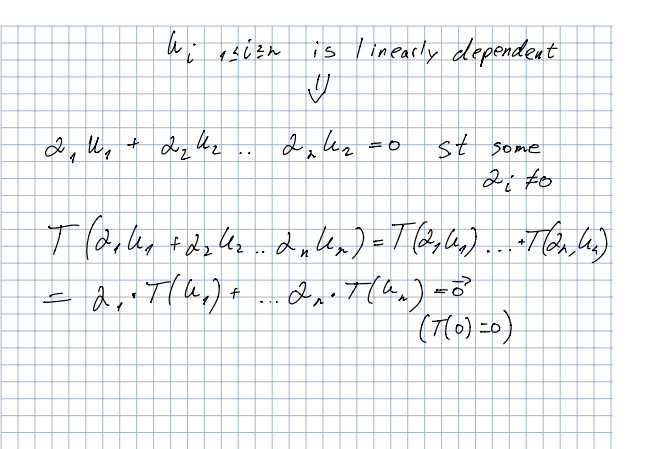
looks okay, @limber sierra ?
basically we have some a_i that has a non-zero solution, equal to 0
that's by definition dependent
https://i.imgur.com/D3p4zsA.pngd
I have a transformation via the matrix A, I need to find the kernel and image of the transformation
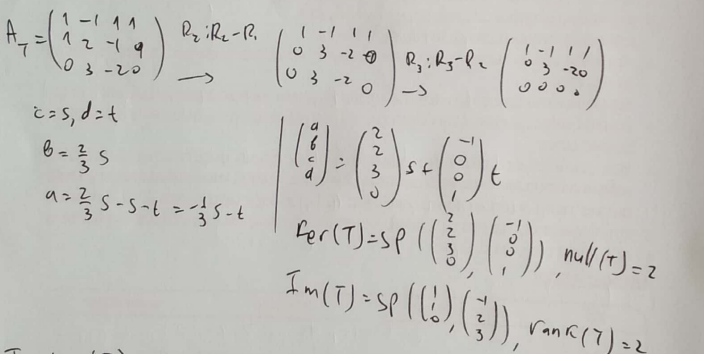
can someone explain what he did to get (a, b, c, d) = (2, 2, 3, 0)... on the right side after the line?
I solved this identically and got stuck after finding a & b (like on the left)
<@&286206848099549185>
 gray dust
a general form of vector in ker(A) is (a,b,c,d). after you write em in terms of free vars s,t you plug in & rewrite (a,b,c,d)=sv_1+tv_2, v_1 & v_2 being vectors
 wintry steppe
i'm having trouble setting up the equation
 marble lance
Well you need to set up two equations and solve them simultaneously
Let x be the amount of water from the 155°F source and y the amount of water from the 100°F source
Then you need x + y = 75
And what would the weighted average be for the temperature? Set that equal to 110
wintry steppe
so $\frac{x+y}{2}=110$?
 stoic pythonBOT
maddog:
 limber sierra
(just an aside: note that, due to 0 in fahrenheit not actually representing "no heat", youll need to adjust for this in some way)
(the most common way to do this, and the way chemists do it, is to work in Kelvin instead of Fahrenheit.)
(there are other approaches though, e.g. adding a suitable constant)
wintry steppe
okey dokey @gilded solstice
So as a matrix:
1 2 -1 5
3 -1 2 3
5 3 (a^2 - 9) (a + 10)
There is "no solution", when the matrix is "inconsistant". or in other words there is no place where all the equations "cross" each other.
lol im not sure how to do the no solutions
but for infinitely, we jsut gotto make a few vectors equal i think
so i think:
p(1 3 5) + q(2 -1 3) = (-1 2 (a^2 - 9))
p1 + q2 = -1
p3 + q-1 = 2
p5 + q3 = (a ^ 2 - 9)
hmm maybe im messing this up, anyone with a better grasp on linalg wanna help?
wintry steppe
oooh
I've got a feeling, making the column vectors dependant should make it have "no solutions"
 dusky epoch
of what
you claim C to be the span of what
you seem to have a very weird idea of "span" or "the same thing"
marble lance
- C is not a span, because it is the linear combinations of every two points in C so it's not just 2 specific points.
- It's not the span, because there are constraints on what the coefficients can be
Np
dusky epoch
a span is the linear combination of two vectors
bruh no
the span of a collection of vectors is a set consisting of all the linear combinations of said vectors
bad
marble lance
It's not two specific points, but every pair of distinct points. And there is only one line passing through each pair.
dusky epoch
you can define affine sets as being closed under affine combinations of any arbitrary number of terms, not just 2
marble lance
Oh, okay, thanks
dusky epoch
a set A is affine if x_1, x_2, ..., x_n in A and c_1 + c_2 + ... + c_n = 1 implies sum c_i x_i in A
that is in fact exactly what i just said
 haughty dew
can someone help me out with grokking tensor products? im just staring at this, and am a little confused: Z (tensor_Z/4Z) Z/2Z. i havent really looked too deeply into tensor products before this, and was wondering how i'd go about understanding what this structure actually is
haughty dew
um, just an introductory homological algebra class, but i think tensor products generally get introduced in undergrad.. i guess i should have paid attention /:
 unreal sierra
Its okay wait for the seniors about that
Im engineering student I don't know about that
haughty dew
haha cheers
 junior fractal
i feel like i have a dumb question
if you take the RREF of a 3x4 matrix, under what conditions would you not get identity on the left hand side
i ask, because i have a big ass system of equations im trying to slove for mechanics, but when i type it into matlab, it doesnt show me a solution but rather just identity with a 1 in the top left.
marble lance
If you ignore the last column of your matrix, and the resulting matrix is not invertible, then you won't get the identity
marble lance
Not invertible, as in the inverse doesn't exist and the determinant is zero, yeah
junior fractal
oh ie i have a free variable
marble lance
It does not necessarily mean there are no solutions
dusky epoch
how are you expecting a 3 by 4 matrix to have an inverse
marble lance
Anyway, is your question answered? Because I'm not sure what exactly you are looking for?
 shrewd slate
If I have a matrix wrt the standard basis M(T) and I change one of its columns, can I claim that only one of the generalized eigenspaces of T is affected?
If T is a complexified operator
 errant wyvern
does anyone by any chance have the proof of polarazation identity for complex vectors on hand?
native rampart
Just expand each term
dusky epoch
you could just expand the RHS yeah
using $\nrm{v}^2 = \ang{v,v}$ and then sesquilinearity
stoic pythonBOT
Ann:
errant wyvern
ahh i see thanks
 winged belfry
on part B right now, for part a I got $$2a_1 + a_2 = b$$
What does part B even mean? Not sure what Ax = b means or where to start.
stoic pythonBOT
Apollo:
native rampart
Find x such that Ax=b
winged belfry
aactually nvm
magic light
https://i.imgur.com/D3p4zsA.pngd
I have a transformation via the matrix A, I need to find the kernel and image of the transformation
can someone explain what he did to get (a, b, c, d) = (2, 2, 3, 0)... on the right side after the line?
I solved this identically and got stuck after finding a & b (like on the left)
The way I understand it it should be (-1 / 3, 2/3, 0)s
I got the t right...
am I missing something?
because a = -(1/3)s - t
so how did we get to 2 and -1 in the answers?
magic light
<@&286206848099549185>
 quasi vale
must be a mistake
if it's a = -(1/3)s - t, then you have (-1/3, 2, 2, 0)s + (-1, 0, 0, 1)t
 spice ruin
Im not sure what the most efficient way of solving this is
obviously I could plug shit in until it works but that kinda defeats the whole point
 devout void
anyone can help me out
the intuition behind gram schmidt process of orthogonality
ik the formula but i cant really imagine what's happening
native rampart
Let us say {b1,b2,b3,b4,b5} is the basis which undergoes the gram Schmidt process
e1 will be just be b1
for e2,you take b2 and then chop off its components along e1
devout void
so e1 is always (1 0 0 0.... 0) ?
native rampart
You can start with a different basis
native rampart
Yes
devout void
got it
say no more fam
daaaaamn now it all makes sense haha
what about dot product
any intuition behind that ?
i mean ik the formula
but why 2 vectors multiplied give off numbers?
native rampart
We are defining the multiplication to gives us a number
devout void
huh?
native rampart
Nvm
devout void
wait so on gram schmidt process wont b1b2b3 end up the same as e1e2e3?
native rampart
If {e1,e2,e3} is an orthonormal basis yes
devout void
bruh what's the point of doing all that formula on the first place
native rampart
We are trying to reduce the inner product to a dot product
The good thing with dot product is we can safely ignore things like e1.e2
 hollow finch
@devout void it won't always end up being e1e2e3, thats not how gram schmidt works. if b1 and b2 are scalar multiples of e1 and e2, then when doing gram schmidt on b3 you will get a scalar multiple of e3.
@devout void as for geometric intuition of the dot product, i personally like 3blue1brown's video on the topic. essentially it has to do with projections.
however in the context of gram schmidt, the dot product is not multiplying vectors. its the euclidean inner product. and like all inner products spaces, the inner product define distance/length and angles between vectors in that inner product (vector) space. since the dot product is the standard inner product for euclidean space, how it defines distance and angles is relatively intuitive and aligns nicely with euclidean geometry.
devout void
@hollow finch no no i didnt mean to relate the dot product with gram schmidt
just wanted to ask that aswell
i checked the vid of 3blue1brown and it was rly interesting
hollow finch
nice thats really great to hear
devout void
so basically that can be expressed as a transformation of the vectors into 1D
so the sum is literally a number (1 point) ?
devout void
@hollow finch ?
hollow finch
the dot product is sometimes denoted this way:
$$\vec{v}\cdot\vec{w}=\vec{v}^T\vec{w}$$
stoic pythonBOT
nix:
hollow finch
so as matrix multiplication
the v and w on the right are nx1 column vectors
so a 1xn multiplied with a nx1 gives you a 1x1 matrix which we often just say is a scalar
but you are pretty close to correct. an inner product in general is a function that associates a real number with two vectors in a vector space.
i personally wouldnt call it a transformation but i cant say that would be entirely incorrect
 vernal pebble
hello
The question asks: if true, give an explanation. If false, provide a counterexample
I believe that it is true. First, I used the def of singular matrices and wrote Aa=0 and Bb=0 for some a,b != 0
 half forge
can someone help me with spanning and subsets
vernal pebble
and I need to show that (A+B)c=0 for some c != 0
with some substitution, I was able to come up with A(c-a) + B(c-b)=0. Is this enough to show that A+B is singular?
vernal pebble
lemme come up with one, give me a sec
hm... I'm having trouble
i tried A=[1 1;0 0] and B=[0 0;1 1] and A+B turned out to be singular
i also tried A=[1 2;1 2] and B=[2 4;1 2] and A+B was also singular
and for the special cases, if either mtx is built only with 0s, then the statement also holds true
gray dust
give me an easy nonsingular matrix
gray dust
another one, even easier
vernal pebble
[1 0; 0 1] lol
gray dust
write it as a sum of singular matrices
gray dust
[1 0; 0 1] lol
use this
vernal pebble
hm i tried [1 -1; -1 1] and [0 1; 1 0] but the latter matrix is nonsingular : (
oh shoot
[1 0; 0 0] and [0 0; 0 1]
gray dust
all done
vernal pebble
tysm @gray dust !
gray dust
you're welcome 
vernal pebble
you helper ppl are amazing : 3
wintry steppe
ello got a question about finding a linear transformation L:
I got the following vectors
u1 = [1 0 1]
u2 = [1 1 1]
u3 = [-1 1 0]
u4 = [2 1 3]
And I need to find L such that L(u1) = u2 and L(u3) = u4.
And the question is whether there is such a L that satisfies the above equations, and if there is find the standardmatrix for it.
I have tried to do it the naive way which is just to solve the equation L(x) = Ax. This yields:
A*[1 0 1] = [1 1 1]
A*[-1 1 0] = [2 1 3]
And then i just solve the linear equation for the 9 different entries in matrix A with gauss-jordan, but this leads to a cumbersome augmented matrix and I'm not sure if this is the right way to do it. Would appreciate if someone could point me to an easier way of solving this. Thanks in advance!
 slow scroll
@wintry steppe Let e1, e2, ...., en denote the standard basis vectors. Then you can (much more easily) find linear transformations A, B such that A(e1) = u1 and B(e1) = u2 and A(e2) = u3 and B(e2) = u4. Now, if you make these invertible, there is an easy way to combine A and B to get the linear transformation you want.
Also, looks fine @half forge
slow scroll
@half forge are you familiar with isomorphisms?
wintry steppe
Okay, but I don't understand why we are looking at 2 matrices? My understanding was because we got the equations L(u1) = u2 and L(u3) = u4 this would equate to A *u1 = u2, A*u3 = u4, where * denotes matrixmultiplication, so the standard matrix we are looking for is just A. Also I'm confused as to why you presented them in the order that you did, i.e A(e1) = u1 and B(e1) = u2 and A(e2) = u3 and B(e2) = u4?
slow scroll
My understanding was because we got the equations L(u1) = u2 and L(u3) = u4 this would equate to A u1 = u2, Au3 = u4, where * denotes matrixmultiplication, so the standard matrix we are looking for is just A
you're not wrong. I'm just suggesting an easier way. To say that A(e1) = u1 just means that the first column of A is u1. Similarly for the others. Suppose A is invertible. What happens when you take BA^{-1}?
wintry steppe
okay so if I go by your suggestion then I get:
A =
1 -1
0  1
1  0

B =
1 2
1 1
1 3
As the matrices, but A can't be invertible right? because it's not a square matrix?
slow scroll
right, but you can just do something like A(e3) = e3 and B(e3) = e3.
wintry steppe
Okay, I got a question about why it's valid to seemingly arbitrarily choose values for the a and b matrices in this fashion? I think theres something I don't seem to understand
like if i chose A(e1) = u4, would that also be valid choice?
oh no okay the input is u1 and u3 so those are the only valid ones for A?
and B is the "output matrix"
slow scroll
You just need A to be invertible, so you clearly can't have A(e1) = u1 and A(e3) = u1 or something like that.
you'll have issues if e3 happens to be in the span of u1 and u3, but ehh im not too worried about it
wintry steppe
okay hm so i following your suggestion again i then get:
A =
1 -1 0
0  1 0
1  0 1

B =
1 2 0
1 1 0
1 3 1
yeah. do you understand why you're doing this?
wintry steppe
let me think
there are some things I don't understand but I want to express that more clearly.
It's the justification for choosing the values for the matrix A and B.
So the method you presented by choosing the column vectors for the A (idk if this corresponds to the standard matrix yet, maybe thats what u meant by BA^(-1)) is just choosing them as u1 and u3, because I guess we had A*u1 = u2 and A*u3 = u4 and the column vectors of the matrix B corresponds to u2 and u4 since i guess it's the image of L.
Then you somehow want to find the standard matrix by doing BA^(-1)?
ah ye by taking the inverse of the image you reverse it back to the standard matrix? or is it just the input x of the function L(x)?
slow scroll
Well, if A(e1) = u1 and A(e2) = u3 then A^-1(u1) = e1 and A^-1(u3)=e2.
So what happen when you compose this with B?
wintry steppe
u get the standard matrix i would assume?
SA = B => S = BA^(-1)
okay, so thats a neat way of doing it if its right
slow scroll
im not quite sure how you define standard matrix, but to be explicit, i just mean
BA^{-1}(u1) = B(A^{-1}(u1)) = B(e1) = u2 and
BA^{-1}(u3) = B(A^{-1}(u3)) = B(e2) = u4
wintry steppe
oh okay
but wouldnt BA^(-1) be equal to the standard matrix for the linear function L that satisfies L(u1) = u2 and L(u3) = u4
Because SA = B? I see A as consisting of the input elements u1 and u3 to L and B as the elements of the image of L(u1) and L(u3), and where S denotes the standard matrix
Basically solving the function L(x) = Sx, where S denotes the standard matrix
i may be using terminologies incorrectly here, i apologize
slow scroll
I think you have the right idea. Basically, you were asked to find a matrix that maps u1 to u2 and u3 and u4. We used the fact that it is easy to find a matrix that maps e1 to u1, e2 to e3 and another matrix that maps e1 to u2 and e2 to u4. Taking inverses allows you to combine them to get the matrix of the linear transformation you want
wintry steppe
okay it's a neat method that you presented
really appreciate it
I didn't think of it this way
i.e prior to asking
slow scroll
np. the method is sort of inspired by change of basis, if you've heard of that
slow scroll
ah okay
wintry steppe
but ye again ty 😄
and sorry to have bothered you with so many questions
and my vague descriptions
hehe
slow scroll
npnp, and nah ur good
winged belfry
ok whenever someone has free time can they dm me or help me with this
from what I've seen on chegg / slader, still confused
like why is x1 assigned 1, x2 assigned 1, and x3 assigned a 0
slow scroll
are a1, a2, a3 supposed to be the columns of A?
winged belfry
yea
slow scroll
are you familiar with the fact that A(1,0,0) = a1, A(0,1,0) = a2 and A(0,0,1) = a3 when A = [a1 a2 a3]?
winged belfry
I am not, not sure what that means
slow scroll
So, A = [a1 a2 a3] is the matrix whose columns are a1, a2, a3. Multiplying A by the vector (1,0,0) just gives you the first column. Similarly for the second and third columns.
And more generally, A(x1, x2, x3) = (x1)a1 + (x2)a2 + (x3)a3.
winged belfry
I guess a few questions, so first, we multiply
a1 1
a2 * 0
a3 0
?
slow scroll
im not sure why you wrote things vertically like that since a1, a2 and a3 are already columns. But the idea is this:
you have A(x1, x2, x3) = b = (1)a1 + (1)a2 + (0)a3 = (0)a1 + (1)a2 + (1)a3. by the definition of matrix multiplication. So what can x1, x3, and x3 be?
winged belfry
why multiply it 1,1,0?
does the matrix multiplication definition say to do that or...
slow scroll
recall this
So, A = [a1 a2 a3] is the matrix whose columns are a1, a2, a3. Multiplying A by the vector (1,0,0) just gives you the first column. Similarly for the second and third columns.
And more generally, A(x1, x2, x3) = (x1)a1 + (x2)a2 + (x3)a3.
A(x1, x2, x3) = (x1)a1 + (x2)a2 + (x3)a3 might not be the definition of matrix multiplication for you, but it follows directly from whatever definition you use, and its the more straightforward characterization for this question.
winged belfry
so why do we multiply the matrix by that specific vector?
slow scroll
(x1, x2, x3) is a generic vector. It can be anything
just like the x in Ax = b can be anything
winged belfry
oh I meant the (1,0,0), am i multiplying the entire A matrix by that? Or am i multiplying column 1 by that and column 2 by something different and so on?
slow scroll
the entire matrix. When you apply whatever definition of matrix multiplication you use to compute A(1,0,0), the last two zeros of (1,0,0) will kill the last two columns leaving you with a1. Similarly for the other columns. Its just a general fact.
winged belfry
ohh and we are trying to get this in RREF?
slow scroll
no, don't think of it that way. Since
A(x1, 0, 0) = (x1)A(1,0,0) = (x1)a1
A(0, x2, 0) = (x2)A(1,0,0) = (x2)a2
A(0, 0, x3) = (x3)A(1,0,0) = (x1)a3
we have by linearity,
A(x1,x2,x3) = A((x1, 0, 0) + (0, x2, 0) + (0, 0, x3)) = A(x1, 0, 0) + A(0, x2, 0) + A(0, 0, x3) = (x1)a1 + (x2)a2 + (x3)a3
The important thing is that A(x1, x2, x3) = (x1)a1 + (x2)a2 + (x3)a3
So if b = a1 + a2, and x = (x1,x2,x3) and
Ax = A(x1,x2,x3) = (x1)a1 + (x2)a2 + (x3)a3 = a1 + a2 = b
So what must the x1,x2,x3 be here?
winged belfry
1,1,0? so its a1 + a2 = a1 + a2?
slow scroll
exactly. And we also have b = a2 + a3 = a1 + a2. So what other value of (x1,x2,x3) gives us b?
winged belfry
hmm not sure, just has to be a zeroed out a1 right? and assume a2 + a3 = a1 + a2?
so 0,1,1?
slow scroll
yep!, so A(1,1,0) = A(0,1,1) = b.
We have found two solutions to Ax = b. So how many solutions exist?
winged belfry
couldn't we just keep incrementing it? Like
2,2,0 and 0,2,2
3,3,0 and 0,3,3
?
slow scroll
by linearity, we have A(2,2,0) = 2A(1,1,0) = 2b
so not quite, but ur on the right track. for any system Ax = b, we can say exactly one of the following about the solutions:
- there are infinitely many
- there is exactly one
- there are no solutions.
winged belfry
ohhh ok so it's infinite then
slow scroll
yep.
slow scroll
npnp
wintry steppe
does anyone know any good resources to make my own exams
I want to practice matrix maths but idk where to find good study material
and whenever i study for tests, i write and solve my own questions for further prep
but idk what the questions on IB further math look like 😦
 frosty vapor
^
wintry steppe
schaums?
oh wait
is that schaum's outlines?
and also what's the ib database
(i'm not taking IB, but I want to practice just in case I apply to foreign colleges and need to compete with Irish or Welsh or other English peoples)
 soft burrow
they're kind of an old series aren't they
I happen to own a linalg one but in Spanish
it's from the early 70s
dusky epoch
ok, what's giving you trouble here?
devout void
so the actual number is the same but concept is different
range is the whole solutions of T(v)
without null
and rank is the dimension of this T(v)?
dusky epoch
no
rank is dim(range), and range includes 0 always
the range of T is the set of all T(v) for v in the domain
devout void
So if i have a T that makes Rcubed to Rsquared basically range is a span of 2 vectors and rank is equal 2?
devout void
ye
dusky epoch
that's never pronounced as R cubed
dusky epoch
anyway no just because T: R^3 -> R^2 doesn't mean range(T) will be all of R^2
T can have rank 1 or 0 if you pick the numbers just right
devout void
well lets say i picked a matrice that it's vectors are independant
than my statement is correct ?
dusky epoch
vague af lmao
devout void
wait
let me type it detailed
if i use a matrice 2x3 i will get this T: R^3 -> R^2
1- if my matrice has 3 vectors whom 2 are linear independant then my range will be these 2 vectors and rank = 2
2- if my matrice has 1 vector independant then range is 1 vector and rank is 1
dusky epoch
my range will be these 2 vectors
will be spanned by these two vectors
devout void
yes sorry
dusky epoch
but otherwise yes
devout void
Rang(T)= Span {(v1),(v2)}
and if i pick a matrix 2x3 where all nums are 0
then rang(T) = Span {(0)} dim(rang(T)) = 0
okay i guess i got it
thanks Ann
What about A^-1 M Av
this is how to apply a T on another T1 starting from orthonormal base ?
dusky epoch
... wat
devout void
ehm
Well if i have my normal i j k base
every vector is expressed as xi +yj + zk
wher x y z scalars
if i have another base with different i j k
i would express this base as a matrix transformation of 3x3
where each column has each vector base
now if i want to apply a transformation into this 3x3 base
i need to do the formula A^-1 M Av
 flat sedge
@half forge when is it due? I’m gonna sleep first then I’ll prolly be able to help.
 toxic mantle
if det(A) = 4 and det(B) = 5
find the value of det(2A^-1 B)
When do I multiply by 2?
wait actually... nvm
It's just 2 * 1/4 * 5 right?
 zinc lava
if I'm reading your notation right, yes.
devout void
if i have 2 random bases B and C how can i find a vector in C be expressed in B coordinates?
native rampart
"Vector in c" doesn't make sense
B and C describe the same vector space( Assuming both are basis)
devout void
alright shall i post an exercise ?
native rampart
Go ahead
devout void
exercise number 2
we have 2 bases B and B' in R^2 and Matrix A which expressed the T of base B
find matrix P from B' to B
ik how to do this
native rampart
if i have 2 random bases B and C how can i find a vector in C be expressed in B coordinates?
@devout void Notice how each vector in C can be expressed as a linear combination of vectors information B and express according.
Eg: let {(1,0),(0,1)} be B and {(1,1),(1,2)} be C. take (x1,x2) expressed in basis C. That would be the vector x1(1,1)+x2(1,2) in our basis B
Which is (x1+x2,x1+ 2x2)
devout void
ik when 1 base is the classic base
my problem is when both bases are weird
like this exercise
native rampart
Let A be the matrix whose columns are basis of B and A' be the matrix whose columns are basis of B'
x and y be the representations of some vector in B and B' respectively
Then Ax=A'y
stoic pythonBOT
DrunkenDrake:
native rampart
So matrix you need is $A^{-1} A'$
stoic pythonBOT
DrunkenDrake:
 ivory moon
Can you take derivatives and integrals of a matrix
gray dust
yes entrywise
limber sierra
that feels kinda cheating
i'd honestly be more tempted to interpret "derivative of a matrix" as the derivative of the linear transformation the matrix represents
in which case yeah, derivatives and integrals are certainly allowed
(though derivatives wont be super interesting)
 coral storm
hollow finch
coral storm
hollow finch

 keen patrol
Is Gilbert Strang's book on Linear Algebra good to teach myself liner algebra?
 robust pond
im just gonna come in here
My teacher in class told us that the first column of your L matrix will always be the first column of your A matrix
before doing any reduction
but this is implying that you need 1's along the diagonal
is this only during LDU factorization that the requirement comes up?
and then during simple LU factorization you can just take the first column of A for L?
or is my teacher full of shit
 spice storm
I believe is
0 -8
0 0
robust pond
incorrect
robust pond
im sorry that answer is incorrect for both lower and upper
if anyone is able to walk me through this problem id appreciate it
spice storm
Row reduce the first matrix on the left
stoic pythonBOT
jan Niku:
spice storm
great. Now D= will be equal to
-8 0
0 6
robust pond
that's incorrect
oh wait its an error with this site  one moment
i figured it out, sorry
spice storm
Nice
robust pond
despite the teacher telling us we could get partial credit, the site uses the inputs to verify it's correct rather than using a bank
so you cant actually get partial credit

spice storm
damn that sucks.
robust pond
thanks 🙇♂️
spice storm
I hate only homework. I wished they would just let us do it in paper then submit it
so we can get partial credit
robust pond
im just frustrated because there was no indication that it was using my inputs, so i thought i was performing it incorrectly
robust pond
is there a good reason why i should expect each of the right hand column equations to be true
it doesnt look like you could further split down A into vectors then do the multiplication at least if a^-1 is already split
oh wait
nvm i figured it out, it just doesnt seem reasonable it should work that way when you split it up
 thorn lichen
since x4 is a column of 0's
when describing the solution in parametric form
should i include a vector multiplied by x4?
flat sedge
@half forge apply the sub space test. Assign p(x), q(x) ∈ W as arbitrary polynomials of third degree. Take the sum of those polynomials expanded. And you’ll see the first two terms that satisfy the condition provided are the only ones that matter. From there, you can deduce whether or not vector addition is satisfied.
Then assign c ∈ ℝ and see if scalar multiplication works out under the conditions provided. And lastly, for the zero vector existence in W, you should be able to see it is similar to the previous two justifications.
Otherwise, recall the dimension of P_n(F) is usually n + 1. But for subspaces note dim(W) ≤ dim(V). Depending on how your basis for W looks like, then you can determine W’s dimension.
Good luck!
Hint: if dim(W) = dim(V), then V = W. Is this the case? Or nah? Just something to think about on your problem.
 void relic
it's very similar to what you did in a)
you can just smush those three 2-vectors together to make the 2x3 matrix you want
 lavish drift
is it worth practicing and getting fast at reducing matrices to reduced row echelon form by hand or do we learn a better tool to do it later
or is it not that useful of a skill in general
void relic
entirely useless
spice storm
useless. If your class is online just use a online calcaulator
native rampart
You could just write a program,if calculator is not sufficient
spice storm
There is a program my friend gave me
lavish drift
ok, cause i was thinking about cranking out a few worksheets a day but if people usually just do it with a calculator and thats allowed on exams then whatever
native rampart
I don't think that would be allowed on exams
lavish drift
:/ nvm then
spice storm
@lavish drift is your class online?
lavish drift
yeah but theres a webcam during exams
native rampart
It isn't too bad for 3x3 matrices
lavish drift
and a browser lockdown thing
native rampart
You could always write your own code
lavish drift
and honesty my biggest problem with exams is time anyway so ig its time to learn another useless skill
yeah it doesn't sound too hard, im like ok at python
spice storm
But anyways, if your professor does not allow a calc the problems given will be easy
spice storm
@native rampart and a browser lockdown thing. So he can't leave and go to his desktop
lavish drift
ill send an email to my prof anyway just to make sure
spice storm
Sounds good. But if you want practice do some 3 x 3
lavish drift
kk thanks
spice storm
Don't worry about it. you'll do great @lavish drift
flat sedge
With time, you could essentially skip steps in row reduction and draw an arrow to what you interpreted in your head. Every step is just super tedious
dusky epoch
try a matrix with more cols than rows
 hidden ember
no but does my reason prove this statement correct?
dusky epoch
no it doesn't
that's like trying to prove "all people in this room are over 18" by pointing at one specific person and saying they are 20
hidden ember
oh
so isn't that how you say true or false by considering special cases?
idk, i am confused. how should i even approach this
@dusky epoch I still don't get it though, can u explain me how it's true or false
native rampart
try a matrix with more cols than rows
This
 stark acorn
@short tide
Im here
I attempted doing
a11+b11
for the first entry box
No dice.
hidden ember
This
@native rampart lol idk what you mean by try
a matrix with more columns could have any kind of numbers? how would it help with this question
 stable sand
the question is saying that for every single augmented matrix with a pivot position in every row, the equation Ax=b is inconsistent
you've shown one example where it's inconsistent
does that make the statement true?
stable sand
👍
 short tide
The first should indeed be a11+b11. I'm having some issues with my computer, I'll get back at you once everything works @ned
hidden ember
sure
short tide
This doesn't work @stark acorn?
stark acorn
@short tide I figured it out my man.
I already knew how to do it, i was just trying to check my work by parrtially puting the answer in, and it was giving me wrong answer, but when i put full answer in. I got full marks
 barren void
$||A||_{max}\le||A||_2$
stoic pythonBOT
Tomás Sentagne:
 novel tundra
not sure if this is the right channel but this seems like itd be easy but i dont know what im doing wrong to get the answer im getting for y
pic didnt save 😔
robust pond
,rotate 50
stoic pythonBOT
novel tundra
;_; im confused
marble lance
Very first step
You are adding the two equations so that the y's cancel out
But you subtracted the x's instead of adding them
marble lance
Np
 warm sequoia
Hello guys, I'm looking for three subspace $U$, $V$ and $W$ of $\mathbb{R}^3$ such that $U \cap V = {0}, V \cap W = {0}, W \cap U = {0}$ yet the sum is not direct. I don't really know what i'm really looking for. Any quick help please ? :)
stoic pythonBOT
Gas:
native rampart
Isn't that the definition of a direct sum?
 pallid rampart
No the direct sum is $U_1\oplus\cdots\oplus U_n$ if $(U_1+\cdots+U_{i-1}+U_{i+1}+\cdots+U_n)\cap U_i=0$ for $i=0,1,2,\dots,n$
stoic pythonBOT
Whoever:
native rampart
Ok,I meant U+V+W with those conditions
pallid rampart
U+V+W meet what condition?
native rampart
Such that no two out of U,V and W intersect non trivially
warm sequoia
Oh then i need to have $(U \cap W) \neq 0$ or $(U \cap V) \neq 0$ or $(V \cap W) \neq 0$ ?
stoic pythonBOT
Gas:
pallid rampart
Well yeah that's not direct sum
stoic pythonBOT
Gas:
pallid rampart
You need to have $(U+V)\cap W\neq0$
stoic pythonBOT
Whoever:
warm sequoia
oh ?
pallid rampart
So you may choose two subspaces with $U\cap V=0$ and $U+V=$ the whole space, then choose $W$ that is disjoint from $U,V$
warm sequoia
Why not $U \cap (V + W) \neq 0$ or $ (U + W) \cap V \neq 0$ ?
pallid rampart
well
they are the same
just by changing the roles of U,V,W you get the same thing
pallid rampart
sure
warm sequoia
But like
if i want to go trivial
i could get $U = \span{(1,0,0),(0,1,0)}, V = \span{(0,0,1)}$
stoic pythonBOT
Gas:
Compile Error! Click the  reaction for details. (You may edit your message)
warm sequoia
(my span doesn't work :( )
pallid rampart
\text{span}
warm sequoia
$U = \text{span}{(1,0,0),(0,1,0)}, V = \text{span}{(0,0,1)}$
stoic pythonBOT
Gas:
warm sequoia
Then U+V would be $\mathbb{R}^3$
stoic pythonBOT
Gas:
warm sequoia
Oh
I might have understood haha
If i take $W = \text{span}{(1,1,1)}$ then it should work right ?
stoic pythonBOT
Gas:
pallid rampart
Yes
warm sequoia
Okay thanks a lot for the tip :)
pallid rampart
You may find a simpler one though
span{(1,0)}, span{(0,1)}, and span{(1,1)}
But yeah you got the idea
pallid rampart
lmao you're welcome
 fading thunder
 half ice
You might know "take half and square it"?
 void cloud
anyone know how to do b
are we supposed to get a matrix when we multiply the vector with its transpose
 hasty estuary
one gives a 1x1 and the other gives a 3x3
void cloud
yea
and the rank is the # of pivots right
how do we find rank of the matrix if they're variables
 ocean sequoia
its all comes from the same column itll be rank 1
because the entries will be linear combinations of v1,v2,v3
does that makes sense?
void cloud
how does the linear combinations make the rank 1
ocean sequoia
because for a v * vt transpose matrix its all a linear combination of v
and v has a rank of one
void cloud
ohhh i see now
the rank wouldnt change
because it's a linear combination so ye the rank wouldnt change then
 void cloud
v^T also has a rank of one right
wintry steppe
What does |v> mean?
gray dust
commonly denotes a state vector in quantum mechanics
 obsidian bluff
i think this is lin alg not sure tho
what is meant by proper and lower semi-cont function?
 vast thicket
Why are all 1 dimensional invariant subspaces the eigenspaces?
Isn't it possible to have a 1 dimensional invariant subspace that is not an eigenspace?
gray dust
@vast thicket give me an example. if you can't then prove such spaces are eigenspaces
vast thicket
if W is 1 dimensional and T invariant and {v} is a basis for W then forall w in W, T(w) in span{v}
so T(w) = c_w v for some scalar c_w
but this does not imply that it is an eigenspace because the scalars may be different
@gray dust
 slim pine
is linear algerba same thing as algerba?
 gusty hollow
No, it is far more complicated.
void relic
algebra < linear algebra < algebra < linear algebra
gray dust
@vast thicket you didn't do enough to conclude anything
v in W & W is T invariant, so Tv in W, ie exists c where Tv=cv, hence v is an eigenvector of T
by linearity, forall kv in W, Tkv=kTv=kcv=ckv
vast thicket
@gray dust the eigenspace is E_k = {v in V: T(v) = kv}
k is fixed here
but in W you got for each v there exists c
this c may be different for each v in W
gray dust
v is fixed
if W is 1 dimensional and T invariant and {v} is a basis for W
v in W & W is T invariant, so Tv in W, ie exists c where Tv=cv
vast thicket
i agree that every v in W is an eigenvector of T
but does this mean W is an eigenspace?
gray dust
v is fixed
vast thicket
okay W = span{v}
and W is T invariant so T(v) = cv for some c
so v is an eigenvector of T
gray dust
that's my argument broken up
vast thicket
does W = {w in V: T(w) = cw}?
@gray dust if T(v) = cv is v unique?
nvm
we can also take multiples of v
gray dust
does W = {w in V: T(w) = cw}?
not always
gray dust
span{i} is id_{R^2} invariant & 1-dim. its vectors get scaled by 1 but E_1=R^2
vast thicket
oh i see
so every 1 dimensional T invariant subspace is a subspace of an eigenspace?
or its an eigenspace in W
i think we can say that if V has 1 dimensional non trivial T invariant subspace then T has an eigenvalue
so if T does not have an eigenvalue then there are no 1 dimensional non trivial T invariant subspace
gray dust
span{v} is T invariant iff v is an eigenvector of T
gray dust
idk if it clarified the wording in the ans key but np
half forge
can someone explain too me , whats linear indpeendent?
 chilly lion
Found the trace easily but could someone please help me with what the A^T(2, 3) means?
gray dust
likely the (2,3) entry of A^T
 chrome dawn
Transposes means switch columns and rows
chilly lion
Oh its just the entry 2,3?
gray dust
seems so
gray dust
no prob
 nimble cedar
is this implying that only 4 pivots are needed, instead of the usual 6, one per each column?
just a bit confused on the question
half forge
if i have a system that looks like this, can i take the determinant to determine Linear indepence?
soft burrow
yep, it's non-zero iff the columns are L.I. iff the rows are L.I.
iff the only solution to that system is the trivial vector (0,0,0,0)
soft burrow
it might help to reduce to [upper|lower] triangular form through gaussian elimination and then the determinant is the product of the diagonal entries
so basically yes
half forge
i'll do that right now
soft burrow
do i have to do row echelon form?
@half forge yes to this I mean
 rich dawn
Can someone give me some clarification on c for this question?

The term "weights"
well
not
weights
yeah the scalars
But how exactly am i providing those scalars
to complete the equation
well 0
uh.
not sure
so
im assuming the scalars have to be in terms of a and b
right
because i'
trying to show that [a b] is in the span of those two vectors
so rref gives me those totals in terms of a and b
oh
i understand it now actually
actually
dumb question from me
now that i look at it
hmm.
jagged gulch
the first matrix is the same as the one in the question description but with the third column multiplied by 2
similar thing happens in the second matrix
stark acorn
Thats all i need to know
jagged gulch
the third one is obtained by swapping the first and third columns
stark acorn
Thank you 🙂
jagged gulch
np
stark acorn
@jagged gulch How do these effect the determinant
I forgot the property regarding these
jagged gulch
ah yeah, so in both cases it's adding a multiple of a column to another column
as it turns out, it doesn't effect the determinant
jagged gulch
ooh the second one is not the same thing actually
the second matrix first multiplied the second column by 6, then adding the first column to the second column
you should know what multiplying a column (or row) by a scalar does to the determinant, and row reductions (replacing a column with the sum of it and the scalar multiple of another row) don't effect the determinant
stark acorn
@jagged gulch Thanks, I kind've get it now.
jagged gulch
yeah, unfortunately I can't give you any intuition as to why the determinant isn't changed by adding a scalar multiple of a column to another column, but depending on how your prof introduced it that might just be a property you have to memorize
or at least get a feel for
stark acorn
I think so, this is for calc 3
jagged gulch
Oh so then you definitely have to memorize it lol
was linear algebra a prereq for calc 3 for you?
stark acorn
Nope
jagged gulch
yeah they kind of just spring a lot of linear algebra on you early on in calc 3
stark acorn
Haha for sure
jagged gulch
good luck in your course
stark acorn
The last half year has been dense
in about 7 months, Ive done calc I, Calc II, and Calc III
jagged gulch
that's the general consensus lol
stark acorn
It was hard getting acustomed to a completely online course
jagged gulch
what book did your prof use for calc 2?
stark acorn
There was no lectures
Just homework assignments, quizz, and tests
Everything self-taught
jagged gulch
I remember tutoring someone using that book, I remember not being a big fan but it looks like they've revamped it in the past year
no lectures!
did you at least have office hours?
stoic pythonBOT
Gas:
warm sequoia
nvm :)
 lucid cedar
Idk if anyone is around, but i have a kind of simple question. Can a mapping T(v) from V -> W exist if v does not include every vector in V
axler kind of beats around this point imo and does not directly say if this is the case or not. and its a focal point of my homework and class work
lucid cedar
Can a mapping from a subspace of V be a linear map if that subspace is defined
lucid cedar
gotcha so the entire domain must be defined
native rampart
Yes
lucid cedar
that was my understadning and was how i went about my homework. glad to hear i can go to bed
thanks!
 torn tangle
Sup gamers
In this book
I'm a bit confused about the first two parts of chapter one
Are n-tuples the same as vectors?
native rampart
Vectors can be described as n tuples
(Thanks to the axiom of choice)
Also,Does lang never formally define what a span of a set of vectors is?
 dim venture
is it a sufficient proof that 0 is an eigenvalue if it satisfies Av - Lv = 0
where L is the eigenvalue
native rampart
Yea, You can safely treat vectors as n tuples
(For an example of vector space, which we don't usually describe through n tuples,take the vector space of polynomials whose degree is less than some n)
dim venture
for a nxn matrix A, does A^2 =/= 0 imply it is not invertible?
dusky epoch
no
a matrix can satisfy A^2 ≠ 0 and be invertible, or satisfy A^2 ≠ 0 and be not invertible
dim venture
referring to Drake's response, what does it mean for a nullspace to be non-trivial?
native rampart
Sorry I thought that meant =
dim venture
no worries, I am just curious to understand what you meant
native rampart
A non trivial null space means the space of vectors v such that Av=0 has non zero elements in it
dim venture
so if I have dim(Ker(A)) = n-1, where A is a nxn matrix with n>1, then the nullspace is said to be non-trivial
dusky epoch
that's a stronger condition than just saying the nullspace is nontrivial
nontrivial just means dim(ker(A)) > 0
dim venture
Okay, thank you
This is very helpful, thank you both
so if I have dim(Ker(A)) = n-1, where A is a nxn matrix with n>1, then the nullspace is said to be non-trivial
As Ann was saying, since I have dim(Ker(A)) = n-1, does this suggest I have n-1 linearly independent eigenvectors corresponding to 0?
dusky epoch
yes
dim venture
what other ways are there to show diagonalizibility other than algebraic multiplicity = geometric multiplicity
native rampart
If the minimal polynomial is a product of linear factors,That would imply the operator is diagonalizable
(Like (x-1)(x-2) and not (x-1)^2(x-2) )
dim venture
thank you, but I don't have the matrix so I cannot determine the minimal polynomial
here is more context for my question:
A is a nxn matrix
rank(A) = 1
A^2 =/= 0 (not equal to 0)
0 is an eigenvalue
there are n-1 linearly independent eigenvectors corresponding to 0
the goal is to show A is diagonalizable
I am able to determine geometric multiplicity based on the dimension of the nullspace, but am stuck at the algebraic multiplicity
(and I'm also not sure if I need to prove geo m = alg m for the non-zero eigenvalue)
native rampart
There is only one non zero eigenvalue
dim venture
that should imply that geo m = alg m for that non zero eigenvalue but I'm not sure how to show it, or be sure of it
dusky epoch
both multiplicities are 1 lol
dim venture
just that simple? ffs
native rampart
You have an eigen basis of nullspace,now just add a last vector which is not in null space. Let x be that vector not in null space A(Ax)!=0,so Ax has to be cx for some c.(Since the space of vectors not in null space is spanned by 1 vector)
dusky epoch
yeah it is just that simple
dim venture
You have an eigen basis of nullspace,now just add a last vector which is not in null space. Let x be that vector not in null space A(Ax)!=0,so Ax has to be cx for some c.(Since the space of vectors not in null space is spanned by 1 vector)
I don't know what this shows or implies
native rampart
nvm,ignore
dim venture
so I'm still stuck on showing the alg m of the 0 eigenvalue is n-1
native rampart
Are you ok with showing it's diagonalizable?
dim venture
I was thinking of determining the number of repeated roots for the characteristic polynomial
native rampart
Now,write the matrix in that basis
If you write the characterstic equation,you get the algebraic multilplicity of 0 is n-1
dim venture
Det(A- lambdai)=0^k and show k = n-1?
native rampart
Det(A- lambdai)=0^k and show k = n-1?
@dim venture *x
dim venture
@dim venture *x
U lost me here
native rampart
det(A-xI)=x^(n-1) (x-c)
(Write A in a basis in which (n-1) basis vectors are mapped to zero and the last is not )
dim venture
You have an eigen basis of nullspace,now just add a last vector which is not in null space. Let x be that vector not in null space A(Ax)!=0,so Ax has to be cx for some c.(Since the space of vectors not in null space is spanned by 1 vector)
I think I don't know what you are saying because I don't even understand what is going on here
native rampart
Did you show any vector not in null space of A is an eigenvector?(in this case, where dim(ker(A))=n-1)
That is What I tried to show
dim venture
No, I thought the definition of an eigenvector v was Av = Cv, where C is the eigenvalue
magic light
I still don't understand how to calculate inner products
I don't get the operation
<u, v > = ?
< {1, 1}, {2, 2} > = ?
hasty estuary
inner product of (a,b,c) and (p,q,r) is ap + bq + cr
magic light
ok
so if I take two vectors {1, 1} and {-2, 2} I should get -2 + 2 = 0 right
ah
ok it makes sense now
native rampart
Inner product could be something other than a dot product
magic light
mm
magic light
Sorry
OK
I don't understand this
Let V be a vector space over R
and let these:

be inner products
what the hell does that mean?
also ignore the symbol between them, it just means "and" in Hebrew
dusky epoch
i'm guessing you're considering three different inner products
one is denoted by simple brackets, another by brackets with a _1 and the third by brackets with a _2
magic light
what does that mean with a_2
dusky epoch
i'm just talking about the subscript symbols lol
these subscripts just let you distinguish between the three products
magic light
yeah so 3 different inner products but
how do I know what the operation is
it's just a minus sign
dusky epoch
like if you took two vectors $v, w$ then their 3 inner products would be $\ang{v,w}, \ang{v,w}_1$ and $\ang{v,w}_2$
stoic pythonBOT
Ann:
native rampart
You define the operation
magic light
OK, the question continues :
We defined the norm to be
https://i.imgur.com/fMbNnsG.png
and with (1) and (2) as well
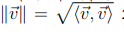
the first question is "show that if u, v in V then
https://i.imgur.com/DZELHSn.png
 native rampart
Just expand
dusky epoch
yeah just expand
magic light
expand what... ?
dusky epoch
use $\nrm{x}^2 = \ang{x,x}$
stoic pythonBOT
Ann:
magic light
the operation is undefined I thought
dusky epoch
on the right hand side
three times
then linearity
it's just algebra
the fact that you don't have a formula for <v,w> should not stop you from being able to do manipulations
magic light
OK, so I just use the characteristics of inner products then
magic light
yeah, properties - translation
ll u + v ll ^ 2 = <u, v>
ll u ll ^2 = <u, u>
ll v ll^2 = <v, v>
so we have <u, v > = 1/2 * ( <u, v> - <u, u> - <v, v>) = 1/2 * ( <u, u - v> + <v, v> )...?
or ehm
-u
native rampart
ll u + v ll ^ 2 = <u, v>
ll u ll ^2 = <u, u>
ll v ll^2 = <v, v>
@magic light | | u+v | |^2 is not that
native rampart
Yes
magic light
( u + v, u + v ) = (u + v, u) + (u + v, v) = (u, u) + (v, u) + (u, v) + (v, u)?
since its over R
then (v, u) = (u, v)
that should be product not parenthesis
sorry
< u + v, u + v > = <u + v, u> + <u + v, v> = <u, u> + <v, u> + <u, v> + <v, u>
man this requires concentration
if I'm given a base (e1, e2) are these special vectors?
native rampart
What have you tried?
wintry steppe
Prove that Col(AB) is contained in Col(A)
Let vector b ∈ Col(AB)
So this means there is a vector c so that (AB)c = b
Col(AB) is contained in Col(A) if Col(AB) is a subset of Col(A)
Ax = b
so Ax = (AB)c
native rampart
You found an x such that Ax=b
wintry steppe
I first had what you just said... but for that to be true A has to be invertible, so you can multiply both sides by A^-1 right?
and you don't know if A is invertible or not
native rampart
That is to show that an x exists
But,we have already found an x without invoking that,so it's fine
wintry steppe
Yeah and if it exists, the proof is done, but if it doesn't then how does it prove the statement 🤔
wintry steppe
yes but
can you just insert that
for that you'd have to multiply both sides by A^-1 right
wintry steppe
So when I get to Ax = A(Bc) I've proven that Col(AB) is a subset of Col(A)
native rampart
Yes
native rampart
Actually it's more like A(Bc)=b therefore atleast one x such that Ax=b must exist
native rampart
yes,by saying we have shown atleast one such x exists
wintry steppe
when I write there is c so (AB)c = b
or A(Bc) = b
so there is an x such that Ax = b
so b is in Col A
native rampart
Yea,You are done
wintry steppe
and so Col(AB) is a subset of Col(A)
Wow alright thanks :)
So for this one I got:
b ∈ Col(AB)
So there is a c such that (AB)c = b
So Bx = b does not always have a solution
So Col(AB) is not a subset of Col(B)
Is that correct?
native rampart
Yes
wintry steppe
alr ty
native rampart
If you want to be more rigorous, take some matrices A and B and give a case where there is a element in col(AB) but not in Col(B)
wintry steppe
For C its basically the other way around right?
Let b be in Row(AB)
So there is a c such that ((AB)^T) c = b
or (B^T A^T)c = b
or B^T (A^T c) = b
So A^T x = b does not always have a solution
so Row(AB) is not a subset of Row(A)
B^T x = b does have a solution
so Row(AB) ⊆ Row(B)
dim venture
(can i ask a question or should I wait)
wintry steppe
@dim venture no go ahead
dim venture
okay thank you
wintry steppe
:)
dim venture
(its computation it'll be quick)
I got
[ 0 6 -12
6 3 -3
12 -3 12]
but apparently its wrong
the formula I used was ePB * [T]E = [T]B
native rampart
Does ePb*[a]b=[a]e?
dim venture
Does it not? I thought it did
native rampart
Idk the notation
dim venture
From Course Notes
Idk the notation
ah then this might help clarify
this should have been a very simple direct multiplication, but it said I was wrong. I am confident in my computation, but please feel free to check me
native rampart
[T]b = P^-1* [T]e* P
(P here is ePb)
dim venture
oh
native rampart
I guess you should read the text
dim venture
You are right. The immediate examples only showed how to find the change of basis matrix ePb
(I got it right now, thanks Drake)
wintry steppe
@native rampart
About the examples you asked for:
A = [1 1]
[1 1]
B = [0 1]
[0 0]
AB = [0 1]
[0 1]
native rampart
Yea,When you are submitting(assuming this is an assignment), write these examples as to why your wrong claims doesn't work
wintry steppe
[1]
[1] this is in Col(AB), but not in Col(B).
And [0 1] is in Row(AB), but not in Row(A)
You mean when submitting answers
native rampart
Yes
native rampart
If wrong, yes
wintry steppe
I'll keep that in mind 🤔
I got 1 more proof
Gonna try it now
One sec 😅
If AB = 0, then Col(B) is a subspace of Nul(A)
Let vector b ∈ Col(B)
So there is a c such that Bc = b
Ab = A(Bc) = (AB)c = o c = o
Ab = o
so b is in Null(A)
So Col(B) ⊆ Null(A)
native rampart
Yes
wintry steppe
Nice
I'm getting the answers on monday so that's why I'm asking lol
For this question
A and B are nxn matrices with Rank n. So they have a pivot in every column and row. So they are invertible so AB = A = B. So AB also has Rank n
is that correct 🤔
wintry steppe
Aren't you supposed to write that AB = IB = B
wintry steppe
But equivalent
native rampart
Yes
wintry steppe
A and B are invertible matrices. The product is again invertible. So AB can be reduced to I. So it has Rank n
native rampart
Yea,That works too
 obsidian wren
quick question on norms
what approach would you guys take to 1 and 2?
for 1 i used the holder inequality after multiplying through by |v|_1
but that doesnt work for 2 and now im stuck
i feel like i should have seen something
wintry steppe
Let b be an element of Col(A)
There is a c such that Ac = b
So (AB)x = b
or A(Bx) = b has a solution.
So Col(A) ⊆ Col(AB)
native rampart
Also works if B is surjective
wintry steppe
🤨
magic light
https://i.imgur.com/T8osaqH.png
How do I find the base of the image and kernel here?


usually I would have a Transformation matrix
so I would eliminate columns to find the base
native rampart
nvm
magic light
and I would make it equal to 0 to find the kernel
but how would I find the image and kernel here?
do I just go with the regular base -
T(1, 0, 0) T(0, 1, 0) T(0, 0, 1) and then put these in a matrix and eliminate?
for the image at least
native rampart
Yes
magic light
OK
 half storm
Remember that a basis for the image of a linear transformation (or any vector space) is not unique.
magic light
So for example T(1, 0, 0) I get the matrix:
3 -1
4 0
magic light
what do I do with this matrix though?
magic light
T(0, 1, 0 ) =
-2 5
1 3
T(0, 0, 1) =
0 1
-1 0
magic light
yeah
half storm
The only thing that you know is that set spans the image.
magic light
usually I put these in a matrix so I can rule out any linear dependency
half storm
Now you've got to show that it is a basis - i.e. all the matrices are linearly independet.
wintry steppe
Wait...
Let b be an element of Col(A)
There is a c such that Ac = b
So (AB)x = b
or A(Bx) = b has a solution.
So Col(A) ⊆ Col(AB)
Is this proof not correct @native rampart ? 🤨
magic light
but these are matrices themselves whcih confuses me
half storm
You actually do the same thing in a sense.
native rampart
It is correct. Just wanted to generalise(Didn't work)
wintry steppe
oh alr
half storm
You make a linear combination of the matrices that you've come up with right?
You end up with a system of equations
4 actually.
magic light
You make a linear combination of the matrices that you've come up with right?
that's what I don't get
half storm
It's like you would with vectors right?
magic light
with vectors you just put them side by side I guess