#linear-algebra
2 messages · Page 114 of 1
 barren void
@barren void
So this means that T is onto because the range of T is all vector sp. of 2x2?
@tribal lodge
As I understand T is not onto
 wintry steppe
x_1 = x_2
 pallid rampart
Well that doesn't tell you anything
wintry steppe
what should I be looking at
pallid rampart
If one row is a multiple of the other row
Or one column is the multiple of the other column
If one row is -6 and 6, that doesn't mean the two rows must be linearly dependent
You can have something like
$$\begin{bmatrix}-6&6\0&1\end{bmatrix}$$
 stoic pythonBOT
Whoever:
pallid rampart
and the rows are linearly independent
wintry steppe
why is it linearly independent
thats what I don't get
-6x1 + 6x2 = 0
and x2 = 0
that's what we're looking at here right ?
pallid rampart
If the rows of a square matrix A are linearly independent, then the only solution to AX=0 is when X=0
So when you set up the equations, you can conclude x_2=x_1=0, then the rows are linearly independent
wintry steppe
okay I see
so in the case of the previous matrix
-6x1 + 6x2 = 0
and
5x1 - 5x2 = 0
there is no way to say x1 = 0 or x2 = 0
pallid rampart
x1 and x2 can be 0, but they do not need to be
and therefore the rows are not linearly independent
because there is another solution, namely x1=x2=1
so yes
pallid rampart
Now most of the time when they say obviously linearly independent/dependent, they're just replying on intuition
which hopefully you'll develop soon
wintry steppe
hopefully yeah 😂
 half storm
I need to show that if the anihilator of W is invariant with respect to the tranpose of T, that W is T-invariant.
I can prove the converse.
Here's what I have so far
Let $x \in W$ Consider $T(x)$. We know that for any $g \in W^{0}$ that $T^{t}(g) := g \circ T \in W^{0}$ So $ (g \circ T)(x) = 0 \implies g(T(x)) = 0$
stoic pythonBOT
JohntheDon:
half storm
<@&286206848099549185>
 forest quail
wouldn't this be false because if u was a zero vector, it would just be a point?
my prof says it's true, but i can't figure out why
wintry steppe
your prof probably forgot about the case where u is 0
forest quail
ah okay
pallid rampart
The inner product should not be a function but a scalar
pallid rampart
So $\brk{\vec{v_2},\vec{u_1}}=\int_0^4 \vec{v_2}\vec{u_1}\dd{x}=\int_0^4\sqrt{x}\dd{x}$
stoic pythonBOT
Whoever:
pallid rampart
This is how you should calculate the inner product
pallid rampart
The expression for u_1, u_2, u_3 are all correct
But you didn’t evaluate a single inner product correctly
 brittle lark
cool
brittle lark
yeah thats how i interpreted it
 untold wagon
heya
im just learning linear algebra and need a bit of help with a matrix
[2 5 | 1 0]
[4 1 | 0 1]
..A.......I
i want to use elimination to find the inverse
how do i remove 4 at A(2,1)
or is the matrix singular
wintry steppe
A isn't singular
if you want to remove that 4, one thing you can do is add -2 times the first row to the second row
you can see that A isn't singular by either working out the computation you've started here, or by calculating it's determinant and seeing that it's nonzero
untold wagon
@wintry steppe thanks
pallid rampart
I don't think I can decipher that
brittle lark
lol uh
i made a mistake half way through
anyhow ill rewrite that
my prof will prob say the same thing
brittle lark
Should be much more readable now lol
As in what does it mean by associated normal system, ik it can’t be rref because thats c4
pallid rampart
Alright yes that is correct
The first image
But you don't need to scale them at the end
Because the question explicitly said you only need to find an orthogonal basis
Not an orthonormal basis
 gray dust
@brittle lark you don't need to normalize. additionally this'd lose points bc the answer mustn't have fractions
brittle lark
wait so
okay let me fall back to smth i left out, when he says no fractions (he said this in a lecture) he only meant in the vectors not the numbers you multiply them by
also you're saying i dont need to normalize?
so just take the fractions out of the answer
pallid rampart
It is stated in the question
gray dust
normalize v=divide by ||v||
pallid rampart
That you can't have fractions
brittle lark
gotcha so i just remove the fractions from my answer and im good to go
(assuming i understood correctly)
gray dust
the issue is you don't get you did extra work
gray dust
yes only orthogonalize
brittle lark
yeah i got it now, i just misunderstood thank you lol
gray dust
yeah just keep in mind the difference of orthogonal vs orthonormal bases 
brittle lark
did any of you catch the question i asked about c?
 dire delta
I have two vectors A and B that are added together to create C
is the following basis enough to uniquely identify A and B (Rotational invariance assumed)
- The opening angle of A and B
- A + B
- A^2 + B^2
The applications is I have two indistinguishable vectors going into an ML model and I would like my representation of the two vectors to not involve enforcing a lexiographic ordering for which vector is vector 1 and which is vector 2. It would preferable to describe the two vectors using only combinational qualities like those above.
 dusky epoch
opening angle?
gray dust
@brittle lark the matrix in c2 represents Ax=b. its associated normal system is A^T Ax=A^T b
brittle lark
so i find A^T*A
gray dust
& A^T b
brittle lark
so which value would the answer to that part be
from the equation
all i have is A
i dont have x or b
although A^T A cant be it because the rref of that gives me 0=1 so yeah...
gray dust
the matrix in c2 represents Ax=b
do you know what this means
brittle lark
some what my professor never really explained it just kinda started saying it in his prerecorded videos
...
 thick dock
what kinda system are you working on?
Is it a wave equation of sorts?
gray dust
to recap in a linear system Ax=b, A is a known matrix & b is a known column vector, x is an unknown column vector
gray dust
the system's augmented matrix is (A|b), a matrix made by cramming A with b as the last column
brittle lark
okay i understand
so i have A and b
x is unknown
so when i do A^T A should I remove the b column?
right?
gray dust
what's A?
brittle lark
how do i use the bot thing in here to send that formatted?
gray dust
ok just look at the eqns in c1
brittle lark
yeah so it's like (-2^2, -2, 1) for the first row of A
dusky epoch
$ \bmqty{1 & 2 \\ 3 & 4 \\ 5 & 6} $
Ann:
gray dust
yes & b is a column vector containing the values on the right side of each eqn
brittle lark
yep
brittle lark
yeah i recall that, i dont think it caused any errors in my math beyond what i sent in that picture, I simplified them all. but i just added the ()
(1, -1, 1), (0, 0, 1)
gray dust
ok now get the augmented matrix of
associated normal system is A^T Ax=A^T b
brittle lark
so my answer is [A^T A|b] or [A^T A|A^T b]
this is the part im confused at with what you gave me
in regards to the equation A^T Ax=A^T b
gray dust
to recap in a linear system Ax=b, A is a known matrix & b is a known column vector, x is an unknown column vector
the system's augmented matrix is (A|b), a matrix made by cramming A with b as the last column
i'll rephrase it as the augmented matrix of (matrix)(unknown)=(column) is (matrix|column)
brittle lark
so it's [A^T A|A^T b]
because A^T is also on the right side of the equal sign in that equation
gray dust
the whole right side is the column
gray dust
@brittle lark cool
brittle lark
I've learned i will never take an online class again because it's these little things that i cant raise my hand about and ask during class... thank god i found this discord
gray dust
ye stop by again if you ever need
brittle lark
that might be right now because the next and last question on today's assignment is off the walls crazy
granted there's a lot of explanation but it has literally nothing to do with his lectures
Please tell me im not the only one that thinks my professor just put some calc concepts into this assignment because he like calculus or smth...
gray dust
where are you stuck? @brittle lark
brittle lark
one second actually i figured out the next step i think
there's just so much information in the question which makes it hard to follow lol
so i have to find what that series converges to right? iirc the p-series test doesn't tell you what something converges to, just that it converges
its been a while since i took calc2...
gray dust
once you get ||t^2||^2 it's easy algebra to get the series' value
brittle lark
okay so i guess im confused as to what i should be plugging into the * formula
to get the value of ||t^2||^2
gray dust
do you know what ||v|| denotes?
brittle lark
normalizing
oh wait it'd just be t^2 for both f(x) and g(x) right
then take the square root of the result of the * equation?
gray dust
not quite, idk wym in normalizing
gray dust
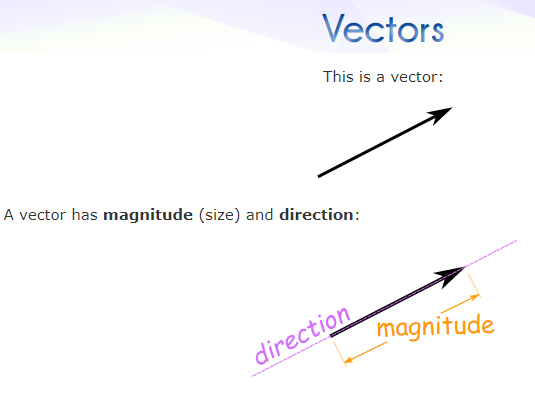
physicists call it magnitude
brittle lark
definitely not what my professor called it but we are probably talking about the same thing
gray dust
if you plot a vector in R^n it's what you'd call its "length"
gray dust
https://i.gyazo.com/e01285ea7839c8b58ad2d495d2de67e6.png ever saw smth like this in physics?
 brittle lark
yes
gray dust
the vector's got "length", physicists call it magnitude, linalg calls it norm
brittle lark
ok
gray dust
take a vector in R^n v=(1,2,3). how do you find ||v||?
brittle lark
1^2+2^2+3^2
gray dust
not quite
gray dust
note the steps you did. you basically did ||v||=sqrt(v dot v)
gray dust
how did your class introduce inner products?
gray dust

gray dust
that's an inner product on a certain kind of vector space but did you cover just what it is in general?
gray dust
that's meh
ok think back to the dot product on R^n. it takes 2 vectors and gives a scalar while obeying certain rules
brittle lark
okay
gray dust
btw did you cover the defn of a vector space?
brittle lark
yes i am pretty sure
gray dust
axioms & such?
brittle lark
no
i have no idea what an axiom is
i think thats in the next/last unit
its a 1 month summer class
gray dust
this class is chaos
brittle lark
lol
gray dust
https://mathworld.wolfram.com/VectorSpace.html not familiar at all?
gray dust
or https://en.wikipedia.org/wiki/Vector_space#Definition just read the stuff in the chart
these are basically criteria that a set, along with given definitions of vector addition & scalar multiplication, must satisfy in order to qualify as a vector space
brittle lark
gotcha i read it it makes sense
gray dust
it's how we generalize what a vector space is beyond what you usually think of as a box of pointy arrows
brittle lark
wait theres a little more to the definition section
one sec
okay so axioms are like rules
gray dust
ehh you can take it that way for just this
again, the vector space axioms are criteria a set must satisfy in order to be a vector space
brittle lark
okay
gray dust
accompanying a vector space is a so-called field of scalars, a set from which scalars are picked, and in your linalg class you'll probably only ever look at vector spaces whose accompanying field of scalars is the set of real or complex numbers
brittle lark
so how does this tie back to the ||t^2|| stuff? I'm following what you're saying im just not sure where you're going with it
gray dust
ok think back to the dot product on R^n. it takes 2 vectors and gives a scalar while obeying certain rules
when you look at a vector space other than R^n, there are certain ways you can define taking 2 vectors and getting a scalar while obeying largely the same rules the dot product on R^n does
brittle lark
okay
gray dust
that's what an inner product is, a function that takes in 2 vectors from whatever vector space you're working with and gives a scalar, that has certain properties like the dot product does
brittle lark
okay
gray dust
then you can view the dot product just as the (standard) inner product on R^n. and back in R^n, you find the length/norm/magnitude of v by ||v||=sqrt(v dot v)
if you have a general vector space upon which an inner product is defined, you can then also define a norm by ||v||=sqrt(<v,v>), <v,v> being the inner product of v with itself
brittle lark
so i plug in t^2 for f(t) and g(t)
since in my case v=t^2
then i take the sqrt of that
gray dust
if you rearrange, ||v||^2=<v,v>
gray dust
yeah. also if this seems long winded, it was to give you a peek at what a linalg class usually covers, so to give background & motivation for the computations you do in class
brittle lark
yeah no thank you lol it did clear up some confusion in other areas lol
 old flame
If $U={(x,0,0) | x \in F}$ and $W={(y,y,0) | y \in F}$ under the context of sums of subspace, why is $U+W={(x,y,0) | x,y \in F}$
stoic pythonBOT
Otoro:
dusky epoch
U is the span of {(1, 0, 0)} and W is the span of {(1, 1, 0)}
old flame
Sorry I haven't learnt about span yet
dusky epoch
are you asking why it isn't {(x+y, y, 0) | x,y ∈ F}
you could write it like that too
old flame
Yup
dusky epoch
it's just that every vector of the form (x+y, y, 0) can also be written in the form (x,y,0) and vice versa
old flame
Oh so the vector x+y just became another vector called x?
Just a problem with notations yeah ?
dusky epoch
x+y isn't a vector
old flame
Oh sorry, scalars I meant
dusky epoch
i mean sure if you wanna look at it like that
old flame
Okay thanks
half storm
Does this extend to the infinite dimensional case?
So if V and W are infinite dimensional, does there always exists a unique linear map between a basis for V and any subset of W?
dusky epoch
does there always exists a unique linear map between the a basis for V and any subset of W?
wat
i mean yea if you have a hamel basis for V then i guess this same existence & uniqueness of that linear map will still be true
half storm
Cool.
dusky epoch
but also nobody cares about bases for infinite dimensional vector spaces
half storm
I have to use this for a proof I'm pretty sure.
I mean they are importnat in some context right?
Like for fourier series
dusky epoch
not in the strict linear-algebraic sense
half storm
But I have heard that people are less interested in studying them.
dusky epoch
hamel bases only allow finite linear combos
if you wanna add infinitely many things then convergence issues get in the way
half storm
Do you have any idea how you would go about proving this for infintie dimensional spaces. It's clear that if V is finite dimensional, then it's a consequence of Theorem 2.6
But in the infinite-dimensional case right, where $\beta$ is infinite. It seems a bit more difficult to find what the linear transformation has to be.
stoic pythonBOT
JohntheDon:
half storm
@dusky epoch
dusky epoch
what isomorphism
half storm
sorry, I meant linear transformation.
dusky epoch
recall the definition of a basis: for every vector for every $x \in V$ there exists a family of scalars ${c_v }{v \in \beta}$ such that $$x = \sum{v \in \beta} c_v v,$$ with the proviso that all but finitely many $c_v$ are zero.
moreover, this representation is unique.
stoic pythonBOT
Ann:
half storm
From what you're showing me it seems that it's going to be very similar to the linear map that they give for the finite-dimensional case where
$T: V \to W$ $T(x) := \sum_{i = 1}^{n} a_iw_i$
Where $a_i$ are the set of scalars that you just gave i.e. $ x = \sum_{i = 1}^{n} a_ix_i $ where $x_i \in \beta$
stoic pythonBOT
JohntheDon:
half storm
Don't you run into the problem of potentially taking a sum over infinitely many numbers.
Those convergence issues that you were talking about.
half storm
oh "all but finitely many are zero"
I see.
So you define the function basically in the same way. So you define the function $ T: V \to W$ $T(x) := \sum_{(c_v \neq 0) \land (v \in \beta)} c_vf(v)$
stoic pythonBOT
JohntheDon:
half storm
They solved a system of equations.
If I type a lot of this out then I'll be repeating a lot of what they are saying
But basically you were supposed to find a matrix represenation of that linear map between $P_3 \to M_{2 \times 2}$ yea
stoic pythonBOT
JohntheDon:
half storm
that matrix that they have right $\rho_{c}$, it's a 2x2 matrix and we know that for any 2 x 2 matrix, we can express it as a linear combination of the matrices in the set $C$.
stoic pythonBOT
JohntheDon:
 fickle agate
oh ok so did they basically figure out the a(matrix_1 in c) + b(Matrix_2 in c) + c(matrix3_in c) + d(Matrix3_in d) = matrix [20 45 -24 69]
half storm
Yup
That's exactly it.
When you solve that, those numbers that they have should pop out.
👍
fickle agate
i'll clear my msgs (johnthedon has an unanswered q above)
half storm
no problem.
stoic pythonBOT
JohntheDon:
 delicate zealot
I have a question about expression vectors in different coordinates systems. I'm not sure that I am doing the problem correctly. If I'm not can you point out my error and if I'm right can you explain why?
Naturally this is all surprising and confusing when seeing something like this for the first time and I'm just trying to wrap my brain around it as best as I can
 umbral smelt
Uhh, why do you think you did that wrongly? lol
I don't really know the terminology for this in English, so sorry in advance
delicate zealot
Well I just don't understand why the process works I guess
That hasn't clicked yet
umbral smelt
But I think you want to change alpha into the coordinate bases w.r.t gamma right?
delicate zealot
yeah
umbral smelt
So yeah, the coordinate bases w.r.t to some bases is basically we just take the scalars as it's vector (I know this is poorly worded)
So, if we want to change the elements of alpha into the coordinate bases w.r.t to gamma, you need to change it into a linear combination of gamma first
delicate zealot
OHHHHHHHHHHHHHHH there's a theorem that says that as long as the basis represents the same vector space then you can express one vector in a certain basis as a linear combination of the basis vectors of a different coordinate system
umbral smelt
then, after you found the scalars that satisfies the linear combinations, you take the scalars, and you get the vector w.r.t to gamma base
because it's a linear combination of gamma bases
delicate zealot
yes yes yes yes I think that this is starting to make sense now as to why that process works
I don't give a rip if I can do the work if I don't understand what it means so thanks for helping me work though that 🙂
Brain took awhile to see why it worked
gotta understand the why before you can feel good about the how
umbral smelt
You're welcome!
 latent ledge
Suppose V and W are finite-dimensional and $T \in\mathcal{L}(V,W)$. Prove that there exist a basis of V and a basis of W such that with respect to these bases, all entries of $\mathcal{M}(T)$ are 0 except that the entries in row j , column j , equal 1 for $1 \leq j \leq\dim range T$.
stoic pythonBOT
Konoha:
latent ledge
this is rank null theorem problem, but I not certain to say that j,j entries are 1
say v1,v2,...,vn satisfy Tv1=w1,...,Tvn=wn where w1,...,wn is part of the basis of W, and Tu1,..Tuk maps to the null of W
half storm
@half forge Well, they gave you multiple choice so there is something you can do. You can take each of the vectors and see if they satisfy they aformentioned conditions yea?.So say if i were to take the first vector $ a = (1 , 1 , -6 )$. I check to see if it is in the span of the aforementioned vectors i.e. there exists $ a,b,c$ s.t. $ a (1,1,1) + b (1, -1, 0) + c( 4, 0 , -5) = (1,1,-6)$ and then check to see if $(1,1,-6)$ is orthogonal to $(1,1,1) \text{ and } (1,-1,0)$ i.e. $(1,1,-6) \cdot (1,1,1) = 0$ and $(1,1,-6) \cdot (1,-1,0) = 0$.
If the vector statisfies all three of those statements then it's the one that you want.
If it doesn't move on to b) c) d) until it does satisfy all three of those statements.
Of course, you could solve directly i.e. without checking all of the vectors.
stoic pythonBOT
JohntheDon:
half storm
I can go ahead and tell you that the first one (1,1,-6) doesn't work because $(1,1,-6) \dot (1,1,1) = 1 + 1 - 6 = -4 \neq 0$ so $(1,1-6)$ is not orthogonal to $(1,1,1)$. So it's not the vector we are looking for.
stoic pythonBOT
JohntheDon:
 half forge
oh so whicj is the answer?
half storm
d) is. But you should probably figure out how to solve for it yourself.
half storm
I'll tell you how to do it but I won't give you the answer this time. You need to check if each of those vectors are in the span of (1,1,1) (1,-1,0). If it's in the span, then you check to see what it's distance from (4,0,-5). i.e. use the distance the formula between two points.
wintry steppe
why does it say that the components of $\begin{bmatrix} 1 \ -2 \ 1 \end{bmatrix}$ and $\begin{bmatrix}0 \ 1 \ -1 \end{bmatrix}$ add to 0? am i missing something here
stoic pythonBOT
polynomial:
half forge
for which one?
wintry steppe
i'm not talking to you
i'm asking a question
verbatim
Every combination of v = (1,-2,1) and w = (0,1,-1) has components that add to 0.
@dusky epoch
 spice storm
it means they are orthoganal
dusky epoch
uh
what
Every combination of v = (1,-2,1) and w = (0,1,-1) has components that add to 0.
this is false
dusky epoch
can i see the entire problem
dusky epoch
 so it's a blank, not a zero
wintry steppe
yes.
dusky epoch
okay no aight
i just got it
it took me this long bc i lit just woke up
but i just got it
wintry steppe
got what
dusky epoch
every linear combination of v and w is in the subspace {(x,y,z) | x+y+z=0}
cause v and w are
half storm
@half forge Do you know the taylor explansion of the matrix exponential is.
This one is easy to look up
Then you just differentiate term by term.
dusky epoch
aight uh.
one of these convos has got to move
wintry steppe
ann
what does that have to do with it, though
like
the components do not add to 0
for every combination
dusky epoch
actually they do
wintry steppe
oh wait
i mean
i guess i get what you mean
but
like
that is very bad wording
?
dusky epoch
it's not the worst wording i've seen
but it's kinda wonky yes
wonky enough to confuse my brain in "not yet fully woken up" mode
wintry steppe
🙂
what does it mean
for a vectors components to add to 0
is there any particular significance to it
or was that just the way to solve the problem without algebra
i.e. by noticing that they add to 0 after you combine them
dusky epoch
it means that the vector's components, when added, give 0
wintry steppe
yes but is there any more significance to it
wintry steppe
ok
dusky epoch
beyond the ability to say that the vector is orthogonal to (1,1,1) i suppose
spice storm
the answer zero will come significance when you learn orthogonality. @wintry steppe
 weary isle
Why max((A-B)+B) <= max(A-B)+max(B) ?
weary isle
@dusky epoch I have figured it out with the help of others. Try to think A and B in terms of triangle side length
dusky epoch
ok you didn't answer my question
weary isle
10 <= 6 + 8
 cursive narwhal
She asked you what A and B are
dusky epoch
this does not answer my question of "what are A and B in this context"
what part of "what are A and B in this context" do you not understand
did you even read the message where i asked you "what are A and B in this context"
dusky epoch
aight that's a lot of symbols
cursive narwhal
can you like
dusky epoch
are A and B supposed to be functions or what
cursive narwhal
just post the original thing from the start next time?
dusky epoch
oh wait. i forgot. i don't get the privilege of getting direct answers to my questions.
wintry steppe
lol
rip ann
maybe you should try asking a third time
third time's the charm as the saying goes
(/s)
weary isle
How to prove max(sum(k*x)) <= max(x) , 0 <= k <= 1 and sum(k) = 1 ?
dusky epoch
i know you hate responding to these questions in a simple and clear manner, but what is x?
@weary isle
...ok, so now that you've edited it: what's k now?
it's not clear what you're even trying to say let alone how to prove it
and can you please post your clarification as a new message instead of making a nonsensical edit to your original
@weary isle?
if you don't want me to help you then please say so explicitly
yes
weary isle
@dusky epoch both k and x are sequences of values
dusky epoch
okay... so then why max(sum(k*x)), and not just sum(k*x)?
not that you can't take the max of a single number - you just get the number itself - but the wording is just weird to me
also, will i have to ping you for every single reply? @weary isle
weary isle
@dusky epoch wait, I am still reorganizing my thought
dusky epoch
this answers neither of my questions.
dusky epoch
aight what the fuck am i looking at lmao
half storm
I mean for the second statment you need to show that 0 (i.e. the zero polynomial is unique). The uniqueness of an additive identity is importnat.
But you've shown what is the most important part.
The set {1, t, t^2, t^3, ..., t^n} is a basis yup.
And if the aforementioned set is linearly independnet then it indeed does form a basis for P^2. There is a theorem that says any linearly independent set that has the same number of elements as the Hamel Dimension of the space is a basis for it.
So yea that works.
Yup
That's the standard basis.
Yea, I've heard about it. I'm doing the same thing and I understand LA alot better than I did when I first took the class.
half storm
Yea these are kind of hard and require some algebraic shuffling.
You have to be clever with the algebra
I think that the first thing you probably want to do is use the fact that you have distributivity over scalar additon right, so
$0v = (0 + 0) v = 0v + 0v$
stoic pythonBOT
JohntheDon:
 marble lance
That's exactly right, but if you're still very early in a LA class, it might be expected that you don't work so loosely with associativity of vector addition and that you keep the brackets where you have three terms, and show how you move the brackets
marble lance
That's a fine proof.
spice storm
@wintry steppe I found the proof very lacking. Where is your let Statement? What properties did you use?
 formal stump
Not sure if this is the right channel but does anyone know how to get the answer to this?
gray dust
formal stump
thanks
 celest slate
so
basically like
well, linear algebra involves infinite spaces
those too, but I mean like
you can go an infinite amount in any dimension
1,2,3...infinity
R3
see, in my head, it’s often easiest for me to get intuition by looking at small subsets of the space, and examining what happens to that subset
and doing that is a lot easier to express in abstract algebra
already, learning basic set theory has cleared up tons of confusion
because when I imagine an example in my head, now I can actually write down what that example is
I couldn’t do that before
and I still can’t always do that, which is why I want abstract algebra so I can
I was saying things like “Take N, where N is an arbitrary number. Now if you choose a certain value of N...”
and obviously that makes no sense
 quartz compass
if anything it will make your life worse
linear algebra is more concrete than abstract algebra
celest slate
now I can say “Define N to be the set of numbers (n,2n,....). Now, imagine taking the number n.”
And obviously now it’s a lot more evident exactly what I mean, and a lot easier for me to avoid confusing myself
Concrete isn’t good when I often wind up getting an intuition that’s hand-wavy and not concrete
quartz compass
hey I was gonna say that
celest slate
ik I did shorthand
quartz compass
you basically just said concrete isn't good because it's not concrete @celest slate
celest slate
I meant “Let N be the set of numbers n in R such that n^2 < n^4. Now choose a number n from N, and consider the equation n^3....”
yes
general mathematical writing
exactly
is that not... I was under the impression a lot of that writing comes from abstract algebra
well yes but
that sort of set and group writing
quartz compass
lol set and group writing
celest slate
the knowledge for how to do that would be best explained in an abstract algebra course, right?
quartz compass
what's your goal
quartz compass
what do you like
celest slate
My goal is, when I get confused and ask a question, to be able to understand the answers I get
quartz compass
why do math and not, biology say
half storm
That style of writing you're talking about comes from set theory
celest slate
yes
that specific example does, John
I think other styles of writing similar to that are from group or ring or stuff theory right?
half storm
Abstract Algebra uses this notation because set theory is the basis of all mathematics
quartz compass
I think if you learn any of that you'll just make your problems worse
celest slate
I know
quartz compass
you seem to have no idea what you're talking about currently, trying to learn abstract algebra on top of that will just make you have more jargon piled onto your nonsense
celest slate
I meant um
half storm
Abstract algebra itself studies properties on sets and operations on them these are algebraic structures.
quartz compass
abstract algebra is a topic, not just notation
celest slate
I might say “variables come from high school algebra. Matrices come from Linear algebra. Groups come from....”
how would you finish that sentence
I know it’s a topic but it introduces notation is my point
wait what
quartz compass
notation is introduced in every topic
if there's something you don't understand, you look at the notation in the topic you're in already
celest slate
yes I know
quartz compass
you don't hop to another topic
your entire conception is like this though
so don't say you know when you don't
half storm
The most notation you can get from a group is something like this $ \langle G, * \rangle $
stoic pythonBOT
JohntheDon:
celest slate
but I can’t always express my confusion in the notation of the current topic
quartz compass
yep
celest slate
Until I learned set theory, I couldn’t express my confusion from linear algebra whatsoever
basic basic set theory I mean
I want to learn more advanced set theory
wdym proofs
like, real analysis?
I can do proofs, at least I think I can
as long as I know the foundational concepts for stuff
what book
can you give me an example of what a proofs based problem might look like, and I can tell you if I know how to do it
sure I mean
hang on a sec
let me go get you one of my old proofs
celest slate
\
Theorem:
Let $a,b,c$ be natural numbers. Then, $(a+b)+c) = a+(b+c)$.
\
Proof:
\
The proof is by induction on $b$, with $a,c$ being fixed. We need to check two things:
\
- When $b=0$, the property holds.
\
- When the property holds for $b$, the property also holds for $b'$, where $b'$ is the successor to $b$.
\
I will frequently be using the properties that $a+b = b+a$ and that $(a'+b) = (a+b)'$.
\
Because for all $a$ it is known that $a+0 = a$, then $(a+0)+c = a+c = a+(0+c)$, so the base case is true.
\
Now, suppose that it has been shown that $(a+b)+c = a+(b+c)$ for some arbitrary $b$. Then, we need to show that $(a+b')+c = a+(b'+c)$. We can do this by the following chain of reasoning:
$$(a+b')+c = (a+b)'+c = ((a+b)+c)' = (a+(b+c))' = ((b+c)+a)' = (b+c)'+a = a+(b+c)' = a+(b'+c)$$
Hence, by induction, the statement holds for all natural numbers.
stoic pythonBOT
Notchmath:
celest slate
besides a stray parenthesis on the first line I just noticed, there’s a proof I did
so in terms of “intro to proofs”, how does that affect things
quartz compass
affect what things
celest slate
like
quartz compass
next time you get stuck trying to figure something out, just ask about that specific thing and see what the person here tells you to do for that and ask what prereqs they'd recommend maybe
celest slate
does that give you an idea of where I am with proofs?
would you still recommend I take an intro to proofs class first?
quartz compass
you said you have no goal so it doesn't matter
we can't really recommend anything if you have no goal
celest slate
I said I did have a goal
quartz compass
you didn't earlier when I asked
celest slate
yeah I did
quartz compass
you said you couldn't express it
celest slate
My goal is, when I get confused and ask a question, to be able to understand the answers I get
@celest slate
quartz compass
that's too vague
celest slate
that’s what I said earlier
quartz compass
that could apply to biology
celest slate
oh
quartz compass
has nothing to do with math
celest slate
in math I meant
quartz compass
why do you like math
celest slate
and I don’t mean conceptually understand, I mean understand the language of math they’re written in
quartz compass
what's so great about math
celest slate
I like the logic behind it, I like coming up with creative ways to approach problems, I like connecting seemingly unrelated ideas, I like the fact that it’s highly conceptual and less grounded in reality
half storm
These are decent reasons. If you like to think about abstractions then math can be a thing for you.
Of course there is logic in and of itself.
half storm
You could just study this or other forms of philosophy.
celest slate
but I don’t have the language to express abstractions
half storm
Yea, I understand. I say study whatever you feel.
quartz compass
if you have the abstraction in your mind, you can make the language yourself
I give you permission
wintry steppe
if we have $\begin{bmatrix} 1 \ 1 \ 0\end{bmatrix}$
stoic pythonBOT
polynomial:
celest slate
my understanding is that, while to fully express abstractions I would need almost every topic, the one which will most help me express an abstraction is Abstract Algebra
wintry steppe
and we reflect that over a line with direction $\begin{bmatrix} 1 \ -1 \ 2\end{bmatrix}$
stoic pythonBOT
polynomial:
wintry steppe
then do we get $\begin{bmatrix} -1 \ -1 \ 0\end{bmatrix}$
stoic pythonBOT
polynomial:
celest slate
polynomial would you mind waiting a second?
wintry steppe
but you're not asking questions
you're just discussing math
why can't you do that in #math-discussion
quartz compass
just ask in a questions channel @wintry steppe
half storm
I mean there are a lot of abstractions in a lot of different areas of mathematics lol.
half storm
I mean abstract algebra has abstract in it's name and it is full of "abstractions".
celest slate
n-dimensional spaces
quartz compass
abstract algebra just has the word abstract in it lol
celest slate
finite n-dimensional spaces
half storm
This is linear algebra ; a subset of abstract algebra .
quartz compass
it should probably have a different name, like group, ring, and field theory
celest slate
yes
wintry steppe
this should really be in #math-discussion
celest slate
but groups rings and fields are what I want to be able to express
quartz compass
ok then learn it
celest slate
so why would abstract be bad to go to now
wintry steppe
@wintry steppe how so
quartz compass
you can safely ignore polynomial
half storm
Well, you can't discuss abstract algebra without discussing those things. So if you do want to study those algebraic structures, then you should study abstract algebra
wintry steppe
@wintry steppe good logic so if i was talking with someone about dog food in #discrete-math
@wintry steppe and someone came in asking a question
you'd also tell them to not interrupt right
sound logic
quartz compass
you were saying you want to learn abstract stuff, so you decide "I'll learn abstract algebra" - that's bad @celest slate
half storm
^
quartz compass
if you want to learn about commutative rings, then you say "I'll learn abstract algebra" - that's good
half storm
Right but if you want to study those things such as groups rings and fields, then abstract algebra is fine.
celest slate
but in particular
quartz compass
like there are genuine ideas to focus on
pallid rampart
At a higher level, all the fields of math are pretty abstract
celest slate
the concepts that I wind up having in my head, I’m pretty sure they’re all groups and rings and fields
and sets
quartz compass
yeah, intro to proofs is probably your best bet
just describe your concepts in english and through examples or whatever and see what people say about them as they are
if they fit to already established notions, great
if not, who cares
quartz compass
sure whatever, I don't believe you
celest slate
well
quartz compass
just go learn abstract algebra if you're so hell bent on it when you don't seem to have any idea what it really is
quartz compass
just learn it
celest slate
and those terms are rings and fields and groups
quartz compass
why are we having this conversation if you know the answer
wintry steppe
you're just talking about education
celest slate
because he told me I shouldn’t and I don’t understand why
quartz compass
the rules aren't so strict as you believe @wintry steppe
they don't have to answer you
wintry steppe
so what?
that guy
@wintry steppe
said its rude
even though you're the ones talking in a questions channel
quartz compass
so stop interrupting or I'll delete your messages for being rude @wintry steppe
quartz compass

 limber sierra
its a general subject channel where questions happen to be allowed
celest slate
oh
wintry steppe
yeah but they're not talking about linear algebra and want me to go somewhere else even tho i want to talk about linear algebra
half storm
Notchmath it seems to me that you are more intersted in things like math logic and symbolic logic.
celest slate
I thought you meant I shouldnt do it until I got to after analysis and linear algebra
 thorn robin
completely unrelated
but why do you two have the exact same pfp? 😂
celest slate
oh okay
quartz compass
lol he wants me to notice him @thorn robin
celest slate
intro to what
quartz compass
I'm his senpai lmfao
quartz compass
imitation is the highest form of flattery, every day is a compliment
you could have picked anyone, but you chose me
wintry steppe
nice try
quartz compass
sweet kid
celest slate
well
and I’m not approaching any of this with the goal of number theory, at least not moreso than “I do all the cores, and eventually once I have the cores I can expand further to more courses, including number theory”
no no no not at all
I don’t want to cherry-pick
The reason I want to stop analysis for now
It seems more focused on reconceptualising what I already know into a more abstract form
which I mean, yes that’s very helpful
but in terms of allowing me to ask questions outside of what I already know, it’s not
Rudin’s abstract algebra book?
what’s rudin in this context
Okay I guess
here’s what I need to do
Can you briefly explain exactly what analysis (in Rudin) entails, what abstract algebra entails, and what topology entails
celest slate
so I can understand exactly what the course itself is
well what do you mean more general settings
 median forum
metric spaces should be between topology and analysis
celest slate
so
median forum
topology is basically a generalization of geometry
adding structures that entail geometric and distance properties in sets Id say
Id say analysis + topology = func anal
median forum
Im only saying this, because the motivation for it was euler trying to classify shapes, wasnt it?
analysis is a qualitative way of studying calculus
celest slate
ohhhh
median forum
a more advanced one
celest slate
well Tao was just sort of proofs-based arithmetic and set theory, as far as I got
well my point being
what exactly is after that
not exactly
generally
median forum
thats because analysis is the firtst proofs subject for a lot of people
median forum
continuity, convergence, integration..
median forum
thats a weird statement
celest slate
oh of course
but I mean in terms of
what I do first to help develop my intuition for higher level mathematical concepts
wdym it’s a weird statement
quartz compass
seems fine to me
median forum
I personally dont know how to even separate or classify my liking of finite vs infinite things
celest slate
like, I’m more interested in the integers than I am in the reals
quartz compass
graph theory, combinatorics, stuff you can do on a computer
median forum
I feel like thats way more specific than saying one likes finite things, merosity
but I get it now ig
celest slate
more interested in the set of numbers between 0 and 100, and how it relates to other sets of numbers, than I am in the set of numbers between 0 and infinity
quartz compass
ok that sounds weird to me lol
celest slate
more interested in the unit square and its properties than I am in the infinite plane
quartz compass
but sure, whatever floats your boat
median forum
hah
so you didnt have the right idea either 
 celest slate
to feel like I can grab one end, grab the other end, and play with it like putty
median forum
bounded is a metric property
celest slate
I can’t
well
you misunderstand
like
you can’t fold the plane into a torus
well you sort of can but it’s weird
idk
median forum
or lie groups ig
celest slate
I mean like imagine it as a physical object I can interact with, and see what happens as I do different things to it
yeah
but also, imagine taking a square and folding one corner onto another corner
 celest slate
I like
I like numbers as things in space, I guess
not arbitrary coordinates but as actual things
in my head
median forum
actual? 
celest slate
like
aargh i can’t explain myself
like I like to imagine the square that represents 5, and the square that represents 7, stick them on top of each other, and see what I get
or line
or cube or whatever
my point is
you can’t do that with the reals, you can’t do that with infinity
celest slate
like
I might imagine 5 as a 5x5 grid of points
and imagine 7 as a 7x7 grid of points
and slide those grids around on each other and see what happens
things like that
median forum
a lot of what youre saying is already generalized in maths
median forum
youre only talking about very specific things
celest slate
fine
median forum
those could be seen from the perspective if any area
median forum
you learn how to generalize that and find underlying structures
thats what youll find areas about
celest slate
what course would you recommend I take
median forum
hardly is there a specific example of something
celest slate
so I could mathematically express and generalize that
median forum
uhh
it could be any from basic diff equations, group/ring theory or basic analysis in the line
celest slate
it does when I can’t stop conceptuaising things that way
wdym
um, up through linear algebra
arithmetic, pre-algebra, geometry, algebra, trig, calculus 1-3, differential equations, linear algebra
statistics
maybe
I got an A in diffeq, but idk that I really understood a thing I was doing
it was... a weird class
median forum
but which diff eq?
highschool des?
never had a course that general
ah
so basic ODEs
gotcha
like learning what exponentials are useful for 
dang
imagine having that structure into hs
after hs I didnt know shit
median forum
mb
half storm
lol were you solving differential equations?
wintry steppe
Just checking my answer
2 and 6 are independent ? They both have no free variables in ref
celest slate
I don’t think I know exactly what that means
wdym by “differential equation”
the term itself wasn’t clearly defined to me
median forum
6 isnt
stoic pythonBOT
slimvesus:
celest slate
I think I did some stuff like thag
median forum
oh nvm
6 is
celest slate
or 0
median forum
mb
wintry steppe
thx fractal
half storm
Are you asking are they a linearly indepenent set?
celest slate
I think I was mostly confused because it felt just like more calculus
half storm
Cause 7 isn't.
celest slate
and also there were drones and mathematica
I wasn’t really
I felt like I wasn’t doing anything
but I got over 100% so
I clearly was doing something
half storm
lol ODE's does kind of feel like that though
celest slate
Calc 1 through DE all felt the same tbh
the drones were only a small thing on occasion
half storm
lol I spent most of my time in that class wondering "how the fuck did someone figure out this algorithm to solve this"
median forum
I mean
tbf notch
a lot of things there sound like hs math
celest slate
wdym
half storm
It was mostly just recognizing what the equations looked like and then use the standard procedure to solve it.
celest slate
sure but that was also the case in calc 2 and stuff
the issue is I genuinely can’t remember a single equation that I can tell you with 100% certainty was from DE as opposed to Calc III or even Calc 2
median forum
its hard to give motivation to study maths
a lot of it is either self given or by experience
celest slate
can you give an example
and I’ll see if I know how to solve it
oh
well but that was calc I sort of
stoic pythonBOT
slimvesus:
celest slate
you wouldn’t need to know anything beyond calc 1 to do that
median forum
ay''+by'+cy=0
stoic pythonBOT
slimvesus:
median forum
a,b,c constants
damn slim
we thought of the same 
but yours is not homogenous
yikes
median forum
well technically neither, cause yours is specific but not homogenous
wintry steppe
If two vectors u = [1, 2], v=[2,4] are linearly dependent, then they span is one dimension less than how many components they have ?
u and v would span R^2 but they are linearly dependent so they just span R?
median forum
wym how many components?
wintry steppe
ah interesting okay
yeah for sure
if they span a two-dimensional subspace of R^3
would you say they span R^2 or R^3?
lol
median forum
you can have all kinds of planes passing through zero in R3
not sure there is any youd call R2
and the kind of isomorphism is very strong might I add
wintry steppe
why
median forum
they span the plane x,y
wintry steppe
if I do c * [1,0,0] and v * [0,1,0] cant I reach everything in r^2 ?
wintry steppe
oh okay I think I get it
like you said
[1,0,0] and [0,1,0] both span a two-dimensional subspace of R^3 (in this case the xy plane)
oh okay
and [1,0] and [0,1] together span R^2
I haven't
Should I ?
Yeah it's linear algebra this semester followed by differential equations next semester
wintry steppe
The last thing we study is diagonalization and eigenvectors
median forum
des + linalg is v crammed
wintry steppe
yeah I know linear transformations
median forum
isomorphism of vector spaces that is
celest slate
so as not to clutter?
median forum
sure
wintry steppe
oof that was discrete math class which I barely remember lol
Injective means that for every input there will be a different output, surjective means one input can map to multiple outputs
wintry steppe
oh okay so surjective can have one input map to multiple outputs, it just has to have all outputs covered
lol right
half storm
@wintry steppe You're trying to say that if a map is surjective. The the elements of the codmain can correspond to more than one element in the domain.
So for any output you can have multiple inputs
And that's right.
quartz compass
personally the reason I care about surjective and injective is because together you get bijective which means it's invertible
and usually you like to do and undo things
wintry steppe
wait so isomorphism
is this ?
S(T(x)) = x
T(S(x)) = x
oh okay I had no idea it was called isomorphism
okay I gotcha
its nice to have a link with bijective, making connections here lol
celest slate
so
Fractal verified for me it was indeed deq I took
and I also remember why it was so weird
it was mixed with calc III during the first semester of the year
and during the second semester, there was like nothing
wintry steppe
Sure, I'll try
celest slate
halfway through the second semester all the other students graduated and I was the only one left
and the course was designed around that earlier end date
but it meant for half a semester I was doing literally nothing
wintry steppe
So you want a linear transformation like T(x, y) right ?
celest slate
that’s why I couldn’t remember what I did
wintry steppe
alright
celest slate
because I didn’t
I was taking DE and I wasn’t aware of it
I thought I was still in calc iii
median forum
isomorphism of vector spaces <=> bijective homomorphism <=> bijective linear transformation <=> invertible linear transformation
median forum
preserves the operations of vector spaces
half storm
Yea it would just have to be additive I think
median forum
it would be a homomorphism of groups, but not of vector spaces
stoic pythonBOT
slimvesus:
median forum
homomorphisms/isomorphisms in general are to be specified
half storm
Same.
median forum
I mean
modules have their own ig
in fact, I forgot how isomorphisms worked for a second and I only recalled it because theyre bijective homomorphisms
half storm
That isn't an isomorphism.
 median forum
well
half storm
Oh I see what you're saying.