#linear-algebra
2 messages · Page 99 of 1
 foggy lodge
It's the number of vectors in the basis of the vector space spanned by M
How's one way you can find the number of basis vectors
 cold topaz
solve the matrix
foggy lodge
What do you mean by solve
 radiant jasper
If it's a vector space of all m by n matrices then the dimension of such space is m times n
foggy lodge
I don't think sm means that
 dusky epoch
ah yeah, vague wording
dusky epoch
let's have @cold topaz clarify what they meant
foggy lodge
Yeah
dusky epoch
because as stated it's impossible to understand
dusky epoch
i don't hate you
i'm pointing out that what you wrote is impossible to understand the way it is written
you are not expressing yourself clearly
since when does me saying that qualify as a sign that i hate you?
foggy lodge
I mean it's a reasonable guess to assume sm was given a matrix with real entries
cold topaz
ok.
this is the problem. How do i figure out its dimension?
foggy lodge
Lmao
cold topaz
slader says 4.
dusky epoch
dimension of WHAT
radiant jasper
It's still not a subspace
dusky epoch
@cold topaz dimension of what
cold topaz
dimension of WHAT
@dusky epoch M
dusky epoch
there's no M here
cold topaz
M_22
foggy lodge
For each entry, you will need a matrix vector
dusky epoch
$M_{2,2}$ presumably refers to the \textbf{space of 2 by 2 matrices}, and that has dimension 4.
 stoic pythonBOT
Ann:
foggy lodge
Since there are 4 such entries in a 2x2 matrix, the dimension is 4
dusky epoch
$M_{2,2}$ isn't a matrix, it's a vector space.
stoic pythonBOT
Ann:
foggy lodge
Yep
cold topaz

foggy lodge
To illustrate, you will need
1 0           0 1
0 0            0 0

0 0            0 0
1 0           0 1
I'm too lazy to use latex
dusky epoch
that's one of the many possible bases of M_2,2
cold topaz
so four rows and 12 entries in each?
cold topaz
each entry has 48 element???!~~?!!!!!
foggy lodge
There are 48 entries
cold topaz
48 entires is not equal to dim 48
foggy lodge
How many vectors will you need to form the full basis of 4x12 matrices
cold topaz
4
foggy lodge
Not quite
cold topaz
column vector
foggy lodge
Ann let's not complicate it
@cold topaz I'd like to clarify a few things. Vectors aren't just column vectors or arrows in space. Rather, they are elements of a special type of set called a vector space
A vector space follows some special rules, which you should look up in your textbook or on Wikipedia. Any element of a vector space is called a vector.
 wintry steppe
a vector space is not a 'special type of set'
foggy lodge
This set of 4x12 matrices forms a vector space because it follows the rules of a vector space
wintry steppe
it's a set with additional structure
foggy lodge
Of course, but I'm using special in the sense that it's distinguishable from other sets due to the fact that it follows certain axioms
wintry steppe
the underlying set itself doesn't satisfy the vector space axioms
foggy lodge
I'm going off the standard and intuitive way of adding matrices and scalar multiplying, there really is no reason to overcomplicate this
Most of the vector spaces encountered in an early linalg class use familiar definitions of addition and scalar multiplication
Extra detail is counterproductive imo
wintry steppe
if you've decided to introduce vector spaces, you should do it in a way that doesn't form conceptual clutches which don't generalise
foggy lodge
I don't think the approach is to explain the concept in the fullest generality either. Some familiarity needs to be gained in order to generalize
 sonic osprey
Then what's the point of talking about the axioms of a vector space
foggy lodge
You bring up a fair point, which I failed to address earlier. By axioms, I really only meant the closure under addition and scalar multiplication, since the regular definitions of addition and scalar multiplication for various sets cover the rest of the other axioms
Edited for clarity
wintry steppe
tbn vector spaces should be introduced as objects of Vect_K
 dreamy iron
Ummm....it’s the next vector?
sonic osprey
what next vector?
dreamy iron
So like,
v_1 == <1, 0,0,0,........,0_n........ >
v_2 ==<0,1,0,0,0,.......,0_n,.......>
.
.
.
v_n == <0,0,0,.......1_n,......>
sonic osprey
Okay, well for one, you should be more explicit in what the v_i are
dreamy iron
Are those even elements of F^{infty}?
sonic osprey
Nope, but they can be if you extend on infinitely many zeroes afterwards
dreamy iron
oh.....
sonic osprey
anyways, the problem is that
You're assuming that F^{\infty} is finite dimensional, so you know it has some finite basis
but you don't know that this is the basis
It oculd be some other finite set of vectors that's the basis
i.e., maybe there's a basis that contains the vector v = <1,1,1,1,1,1,1,....>
All you know is that there exists a finite basis, not what it looks like
dreamy iron
I’m not at basis yet. Axler hasn’t covered basis, not until 2.B
nevertheless, I’m only assuming these span the space, not that they are line. indept.
dreamy iron
The header says 2.A, lol.
All you know is that there exists a finite basis, not what it looks like
@sonic osprey
oh, okay. Yeah. This is true.
Um...is this approach salvageable?
dusky epoch
what does v_{n+1} even mean?
You haven't defined it at all
wintry steppe
hint: ||in a finite-dimensional vector space no linearly independent set can have more members than the dimension||
oh lol he hasn't doesn't done basis yet 
dreamy iron
hint: ||in a finite-dimensional vector space no linearly independent set can have more members than the dimension||
@wintry steppe
he has done this.....
dimension of a space is formally covered in 2.C
dusky epoch
your approach is "imma pull a vector out of my ass that somehow isnt in the span of my v_i and then parrot off that its not in the span and therefore the v_i don't span F^infty but they do span F^infty contradiction bluh bluh"
problem is
dreamy iron
Yes. That’s the gist of it
dusky epoch
you have not shown you can find a vector not in the span of your v_i
dreamy iron
I guess that’s true, cuz i cant seem to find a vector in F^∞
wintry steppe
well
dreamy iron
if this approach is a deadend, I’d like to know to try and not salvage it.
(I did the type-up in half an hour. It did feel too easy.)
foggy lodge
Yo this questions actually pretty cool
sonic osprey
I mean, contradiction is the right idea
wintry steppe
suppose F^\infty has finite dimension, say n, so no linearly independent set L can have |L|>n
dusky epoch
wait.
sonic osprey
so take the v_i that span your space like you do, and try to find a vector outside of the span of the v_i for a contradiction
like you tried to do
dusky epoch
@dreamy iron you have this lemma already right?
dreamy iron
Yes. I have alrdy.
 warm sparrow
I did an rough translate
solve without external "assisting stuff" from parabel y=x^2+1 places(dots) where its distance is 2 from line y=(3/4)x+1
wintry steppe
bruh
warm sparrow
xd
 storm python
just because you have y = mx + b doesn't mean you're doing linear algebra
wintry steppe
bruh
warm sparrow
im only on 5th course, we have 13
warm sparrow
Thanks dad
wintry steppe
bruh
foggy lodge
Awesome
dusky epoch
for any n you can find a LI list of n+1 elements
dreamy iron
Is that the hint, @dusky epoch ? Leverage the lemma 2.23?
wintry steppe
yes do that
dreamy iron
Okay, TyTy
dusky epoch
yes make use of that
warm sparrow
@storm python pubes, I dont understand this discord
storm python
why did you call me pubes?
wintry steppe
@warm sparrow are you doing an exam
dreamy iron

warm sparrow
@wintry steppe No
 dreamy iron

warm sparrow
@wintry steppe Because its the final return date and I am leaving to my cottage soon, and if I can't do them until then then I gotta wait
storm python
@warm sparrow you didn't answer my question
foggy lodge
Lmfao
warm sparrow
@storm python Because your name reminds me of the words pube
foggy lodge
Holy shit lmao
storm python
i see
warm sparrow
pubilus
 pallid rampart

Don't know why you are doing this, but allow me to analyze the situation for you right now
If you want help, you probably shouldn't trigger a lot of other people
And listen to what you've been told
But of course these are all based on the assumption that you want help
storm python
that's too much to ask whoever
 torn hornet
wtf happened here lmao
wintry steppe
$\bigcup_{i=1}^{\infty} A_i = \lim_{i\to \infty} A_i$
stoic pythonBOT
Godel:
dusky epoch
what do you even mean by the limit of a sequence of sets
wintry steppe
well thats what I was not sure about, how you define that and if you need aoc
Was thinking about something like ideals
 tawdry palm
How would the sets be linearly independent is what I don’t get when they are subsets
wintry steppe
yeah thats what I was confused about as well
I mean there has to be like a 'limit set' since they are all nested subsets of V, but I think you need aoc for that
dusky epoch
no
the union of the A_i is the union of the A_i
it is by definition the set of all objects that are elements of at least one of the A_i
dusky epoch
bruh you're overthinking it
if you wanna get into set theory stuff this is just axiom of union
wintry steppe
I think Im just right and you jsut say no without thinking about my thing
dusky epoch
you don't need fucking AOC for this
$\bigcup_{i=1}^{\infty} A_i = {v \in V \mid (\exists i \in \bN)(v \in A_i) }$
stoic pythonBOT
Ann:
dusky epoch
or are you also gonna object to my use of the axiom schema of comprehension?
wintry steppe
yeah I dont quite believe it
dusky epoch
or my use of, dare i say, an existential quantifier?
so you don't believe in even restricted comprehension?
what are you, a fucking ultrafinitist?
wintry steppe
Language please, no need to get mad I found a very nice way and you didn't.
dusky epoch
very nice way to do what
you're trying to refute the obvious here
we didn't even get started on the linear algebra
it looks to me like you're just denying that $\bigcup_{i=1}^{\infty} A_i$ exists or denying that what i sent up there (which is literally its definition) is true
stoic pythonBOT
Ann:
wintry steppe
no, you're denying existence of the maximal element of such union
doesnt matter, continue, I jsut wanted to ask about that.
dusky epoch
maximal element? excuse me?
 torn silo
yeah ann you know the maximal element of N
wintry steppe
N is not bounded
dusky epoch
are you trying to claim that there exists a natural number $N$ such that $$\bigcup_{i=1}^{\infty} A_i = A_N?$$
stoic pythonBOT
Ann:
torn silo
i love this server so much
dusky epoch
because that need not be the case at all, except if the ambient vector space is findim. but nothing was said about it being findim.
wintry steppe
exactly
dusky epoch
what are you "exactly"ing to
dusky epoch
yeah, i never argued that there would be such an N.
tawdry palm
So guys what’s the answer 😂
dusky epoch
btw what does A_i's being linearly independent mean
it still means the same thing as if they weren't
anyway the answer is to check your infinite union against the definition of linear independence
and remembering exactly what the defn of linear independence is for an arbitrary, not necessarily finite set of vectors
tawdry palm
Can you dumb it down for me lol
Is it A,B,C or D
wintry steppe
ann is telling you what to do
check your definition of linear independence
probably something like *the only linear combinations equal to zero are the trivial ones"
so take a linear combination equal to zero in the union and see if that is true or not
 uneven crater
hey, can someone explain to me what dots and lines are in matrices? like what do they mean here?
wintry steppe
the columns of the matrix are the vectors a_i
uneven crater
@wintry steppe what are the dots then? does this mean the entire first column is a1, and second is a2, etc....
 jagged nymph
wb
whats a good place to start learning linear algebra from
any book recommendations?
wintry steppe
@uneven crater that's basically it. it's the same as writing a vector like (v_1, ..., v_n); you can't actually write all n entries, so the ellipsis denotes that they're going from 1 to n
uneven crater
👍
 placid oracle
@jagged nymph im using https://www.math.brown.edu/~treil/papers/LADW/LADW-2014-09.pdf
wintry steppe
the book by friedberg insel and spence is pretty good, i used it in my first year and liked it
axler's LADR is good but if it's your first time learning linalg you probably don't want the "determinant free" approach
ive heard good things about hoffman and kunze
ultimately you want something with a lot of examples
 quiet gorge
can someone tell me why i have to find the minimum polynomial in Jordan decomposition instead of just finding the algebric and geometric multiplicites of the eigenvalues?
torn silo
I assume because your teacher told you so?
quiet gorge
so it's the same? because he said that you can't be sure about the eigenvectors without the minumum polynomial
wintry steppe
Given matrix $A = \begin{bmatrix}
1 & 0 \
1 & \epsilon
\end{bmatrix}$ I want to find $\norm{A}$ and $\norm{A}_{\infty}$
stoic pythonBOT
Godel:
 zinc tapir
Whats the strategy to transform a matrix into an identity matrix
wintry steppe
If its possible to make it into an identity matrix, you can use gaussian elimination
 subtle walrus
it's easier to use the map f(x) = 1 for all x
@wintry steppe did you define matrix norms via the vector norm?
wintry steppe
yeah
A_infty is jsut the max length of a row which would be 1 +eps^2)^1/2, not sure about the other one
subtle walrus
then if you don't know more about how those matrix norms behave, the general strategy is to (a) find a tight upper bound and (b) find a vector where that value is attained
wintry steppe
I tried to find the max of Ax on x=[x1,x2] such that x1^2 + x2^2 = 1
subtle walrus
why would the infinity norm be the max length of a row
wintry steppe
why not?
wintry steppe
what does that mean then
subtle walrus
the sum is the sum of the i-th row
 quartz compass
sum of absolute values of entries is not the length
wintry steppe
true yeah I just noticed
subtle walrus
you sum up the absolute values of each entry and take the max of that
wintry steppe
ye
1 +eps
anyways, had trouble with the other one
I tried some things and got me into some weird calculus stuff and not sure if thats the approach
quartz compass
what norm are you using
the regular euclidean norm I guess
|(a,b)| = sqrt(a^2+b^2) is how you measure lengths of vectors or not
the casual way would just be parametrize the unit vectors by (cos t, sin t) and differentiate the result of multiplying by the matrix and maximize the square, assuming epsilon is small replace with (1-t^2/2, t) to approximate by hand
subtle walrus
eh, this is probably the 1-norm
 gritty frigate
I can not understand the determinant definition
Do you have any good source that provides a good explanation ?
torn silo
the wikipedia page is actually pretty comprehensive
if its just about the intuition behind it then https://www.youtube.com/watch?v=Ip3X9LOh2dk&vl=en
Home page: https://www.3blue1brown.com/
The determinant of a linear transformation measures how much areas/volumes change during the transformation.
Full series: http://3b1b.co/eola
Future series like this are funded by the community, through Patreon, where supporters get ea...
the dude is pretty solid for that if you're willing to invest the time
subtle walrus
the definition of the determinant is extremely technical
tbh the best you can do is the intuition of scaling and remember the important properties
quartz compass
it's probably a good idea to draw a parallelogram in the plane with one vertex on the origin and two points at (x_1, y_1) and (x_2, y_2) and find the area of the parallelogram in terms of these numbers just to get a glimpse of the connection first hand
 cobalt tartan
If I have a matrix Af = b such that the k-th column of A is not independent of the rest of the columns of A, how do I prove that the k-th entry of f is non-zero?
My idea was to try to see what happens if the k-th eentry of f is 0
But I'm not getting anywhere
Oh and A is mxn
tehn in this case we know that the rank of A is at most m - 1
 eternal finch
I don't think that what you're trying to prove is true.
If I understand correctly, then A = {{1, 1}, {0, 0}}, f = {{1}, {0}}, and b = {{1}, {0}} are such that Af = b, the second column is in the span of the first, but the second coordinate of f is 0.
cobalt tartan
Err sorry
That there is a solution that has f_k non-zero
Not necessarily that f_k is 0
eternal finch
Oh, I see.
cobalt tartan
i.e, for some fixed b
And some fixed A, whereby the k-th column of A is not LI of the rest of the columns of A
eternal finch
Well, I think I'd try the same thing you did. Set the k-th entry of f to 0.
It'd probably be easier if you write Af as a linear combination of the columns of A.
cobalt tartan
Yes
So we see tht
$Af = f_1A_1 + f_2A_2 + \cdots + f_kA_k + \cdots + f_nA_n = b$
stoic pythonBOT
Liria ^(;,;)^:
cobalt tartan
Oh
Oh wait because it's LI
We can wirte $A_k$ as a linear combination of $A_1 + cdots A_n$
stoic pythonBOT
Liria ^(;,;)^:
cobalt tartan
But I don't think that that helps us?
cobalt tartan
Like if we let $A_k = c_1A_1 + \cdots + c_nA_n$
stoic pythonBOT
Liria ^(;,;)^:
eternal finch
Sure.
cobalt tartan
Then we can rewrite $Af = f_1A_1 + \cdots + f_kA_k + \cdots + f_nA_n = (f_1 + c_1f_k)A_1 + \cdots + (f_n + c_nf_k)A_n$ right?
stoic pythonBOT
Liria ^(;,;)^:
cobalt tartan
Like the value of $f_k$ doesnt' really matter because you can make somethingg equivalent to $f_k$ by increasing each element of $f$ by $c_i$ right?
stoic pythonBOT
Liria ^(;,;)^:
eternal finch
What you're showing right now is that, whatever f_k is, there is a solution f such that f_k = 0.
Not saying it's wrong, but you're not proving what you want to prove.
cobalt tartan
Yea
Oooh wait
Ok we can go the other way around
We can decrease each element $f_i$ by $c_i$
stoic pythonBOT
Liria ^(;,;)^:
cobalt tartan
To go and recreate $f_k$?
stoic pythonBOT
Liria ^(;,;)^:
eternal finch
Yeah, pretty much.
cobalt tartan
Wait can I just sum them all up and say that $f_k = \sum c_i$ lol
stoic pythonBOT
Liria ^(;,;)^:
eternal finch
To reiterate, you'd start with $Af = f_1 A_1 + \dots + f_{k - 1} A_{k - 1} + f_{k + 1} A_{k + 1} + \dots + f_n A_n$ and end up with $Af = (f_1 - c_1) A_1 + \dots + (f_{k - 1} - c_{k - 1}) A_{k - 1} + A_k + (f_{k + 1} - c_{k + 1}) A_{k + 1} + \dots + (f_n - c_n) A_n$.
stoic pythonBOT
Red Herring:
stoic pythonBOT
Liria ^(;,;)^:
eternal finch
$A_k = c_1A_1 + \cdots + c_nA_n$.
stoic pythonBOT
Red Herring:
eternal finch
Okie.
cobalt tartan
Thank you!
Wait one more question
"Consider a fixed b in R^m and Ax = b which is consistent. Prove that there is a feasible solution g such that at most m coordinates of g are non-zero"
cobalt tartan
Yes
If it's consistent then we require rank(A) = m
So I'm all but certain that that plays into it
eternal finch
Yes, it does play into it.
cobalt tartan
And that if we have more than m coordinates of g non-zero then it would stop being o solution because then we'd have too many 0s in out output?
eternal finch
?
There's nothing stopping a feasible solution from having more than m coordinates.
cobalt tartan
Err wait sorry
If we have fewer than m non-zero coordinates, such as m - 1 coordinates being non-zero then our solution would... I think we'd still get a solution though?
But I mean it just says prove that there is a feasible solution with this constraint
So I'm not really sure besides the rank(A) = m part
eternal finch
Ok, so you want to show that there is a feasible solution g with at most m coordinates non-zero.
So, let's try proving by contradiction.
Suppose that there isn't a feasible solution with at most m coordinates non-zero.
Let x be an arbitrary feasible solution.
What can you say about Ax?
Actually, let's start with the lead you have before considering what Ax looks like.
What is the definition of rank?
eternal finch
Hm, this definition is not very suggestive. So, in the previous problem, we wrote Af as a linear combination of the columns of A.
Could you interpret rank in this context?
cobalt tartan
rank is equivalent to the number of LI columns
cobalt tartan
Yes
eternal finch
And column space, yeah?
cobalt tartan
yes
The columnpsace is the range of the matrix; any coordinate in g that goes to 0 is basically just throwing out that column of the matrix from its output
eternal finch
Right.
rank is equivalent to the number of LI columns
So, this is good.
I'm going to give another equivalent statement that's more helpful.
The rank is the dimension of the column space.
This will tell you something about expressing Ax as a linear combination of the columns of A. Namely, if you have Ax as a linear combination of more than rank(A) columns of A, then you can do better.
eternal finch
Precisely.
cobalt tartan
But we can't reduce $g$ to have fewer than m coordinates?
stoic pythonBOT
Liria ^(;,;)^:
eternal finch
So, we let x be an arbitrary feasible solution such that Ax = b and x has more than m nonzero coordinates.
That means that we can write Ax = A_1 x_1 + ... + A_n x_n.
You say that we can reduce that number of coordinates to exactly m.
What you should say at this point is that you can rewrite A_1 x_1 + ... + A_n x_n as a linear combination of m columns of A.
That is, Ax = A_1 c_1 + ... + A_m c_m.
cobalt tartan
Yes
eternal finch
This shows there is a vector g such that Ag = b and g has at most m nonzero coordinates.
Do you see why?
cobalt tartan
Because if you had less then you would not gget b
eternal finch
There might be a vector v with less than m nonzero coordinates such that Av = b. We don't know.
cobalt tartan
We have insufficient information to determine ttat
eternal finch
Consider this. If you have A is a matrix and x is a vector, then you can write Ax as a linear combination of the columns of A if the product Ax makes sense.
What if you start with a linear combination of columns of A?
cobalt tartan
What do you mean?
eternal finch
What I mean is Ax = A_1 x_1 + ... + A_n x_n.
Then, A_1 x_1 + ... + A_n x_n = Ax, right?
cobalt tartan
Yes
eternal finch
The rank is the dimension of the column space.
This will tell you something about expressing Ax as a linear combination of the columns of A. Namely, if you have Ax as a linear combination of more than rank(A) columns of A, then you can do better.
Liria ^(;,;)^Today at 3:38 PM
Yes
we can reduce the number of non-zero coordinates down to exactly m
Red HerringToday at 3:38 PM
Precisely.
Liria ^(;,;)^Today at 3:39 PM
But we can't reduce g to have fewer than m coordinates?
Red HerringToday at 3:41 PM
So, we let x be an arbitrary feasible solution such that Ax = b and x has more than m nonzero coordinates.
That means that we can write Ax = A_1 x_1 + ... + A_n x_n.
You say that we can reduce that number of coordinates to exactly m.
What you should say at this point is that you can rewrite A_1 x_1 + ... + A_n x_n as a linear combination of m columns of A.
That is, Ax = A_1 c_1 + ... + A_m c_m.
Try to rereading this if you don't get it yet.
cobalt tartan
I will in a few, I'm goisg to eat now 
wintry steppe
Hi
[6, -5, -2/3] + t[1,3,2]
Is this a vectorial equation or a symmetric equation ?
Or a vectorial equation in symmetric form? lol
quartz compass
it's not an equation at all on account of there not being an equals sign
quartz compass
haha sorry
that's the equation of a line
imagine the first vector as being a point on the line, then the choice of t tells you by how much in the direction of the other vector you 'slide'
wintry steppe
Ok I gotcha
hmm
Would the left side be parametric equation and the right side symmetric equation ?
quartz compass
left side yeah, right side I'm unfamiliar with that terminology
maybe it goes by a different name in the US, maybe someone else knows
eternal finch
I used Stewart, and they used that terminology.
 autumn basin
Can anyone help with this Gaussian elimination question, part bii? I have an answer but it's different to my friend's and I'm not exactly sure why
My working for bi and bii
cold topaz
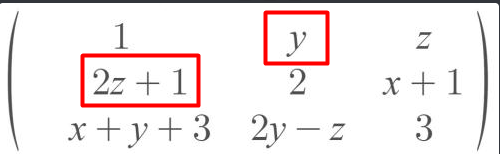
if i want to find the values of x, y, z so that the given matrix is orthogonally diagonalizable, where do i begin?
autumn basin
Bruh
quartz compass
I'm assuming orthogonally diagonalizable means it's a symmetric matrix
cold topaz
true @quartz compass
that's what im focusing
and got the transpose
and then it's a mess
quartz compass
don't think so hard
look at what entries have to be the same to make it symmetric
 quartz compass
make 2 more equations
you should have a system of linear equations, surely you know a way to solve that
cold topaz
we get three equations with three unknowns
autumn basin
I'll post my question again since you buried it
Just looking for a check really, I think I've done the right thing in part ii but the fact I got a different answer to a mate worries me slightly
eternal finch
,w {{0, 0, 1}, {0, 1, 0}, {1, 0, 0}} * {{1, 2, 2}, {5, 4, 4}, {2, 4, 8}} * {{0, 1, 0}, {0, 0, 1}, {1, 0, 0}} = {{1, 0, 0}, {1/2, 1, 0}, {1/4, 1/8, 1}} * {{8, 2, 4}, {0, 4, 2}, {0, 0, 3/4}}
stoic pythonBOT
 Requested by Red Herring#8090
eternal finch
Requested by Red Herring#8090
eternal finch
Iirc, LU decompositions aren't unique.
@autumn basin
Unsure if pivoting strategy would make the factorization unique, tho.
autumn basin
oh my dumb brain never thought to use WA to check smh
seems like I had the right idea then
eternal finch
Get your friend to check, too. They could be right as well.
autumn basin
good point
my lecture notes are so strange on this topic, he prefers using a "D L U" decomposition and writing A=D-L-U so that L and U's elements are negative
While you're here mate, I wonder if you'd be able to look at another small part
eternal finch
Sure.
autumn basin
In this question, seems like I get complex eigenvalues - I'm not entirely sure how to interpret that
foggy lodge
Yeah
autumn basin
I have lambda=+-root(2)*i which doesn't sound fantastic
foggy lodge
That's normal
autumn basin
o
foggy lodge
That means your eigenvectors are being rotated
autumn basin
could you explain what you mean by that? Sorry, I'm not exactly the best at linear algebra 😦
foggy lodge
That's chill, basically all linear transformations can be represented as a composite transformation, and what diagonalization does is that it decomposes a transformation into a change of basis, then a scaling, and then a change of basis back
But for complex eigenvalues things change
If we take
0 -1
1 0
Then the eigenvalues are +-i
That's one example
See where it takes i hat and j hat
autumn basin
Ok, I think I see what you mean
foggy lodge
Here there's pure rotation
But you can have scaling and rotation
With complex eigenvalues
foggy lodge
I honestly forgot how to do the computations for complex eigenvalues
autumn basin
This is my working for the problem so far
although I can't really compare 1 and root(2)i
eternal finch
Note that it's the max of the absolute value of lambda you're looking for.
autumn basin
oh hang on
right
well that's just root(2) then
man, I'm really good at missing small stuff which is kinda worrying
eternal finch
Same.
foggy lodge
Word
autumn basin
tbh it's linear algebra I have the most trouble with since I'm better at misreading matrices than I am at actually using them
foggy lodge
I saw this problem yesterday, where you prove that this is infinite dimensional, but I can't seem to crack it myself
Definitely seems like the way to go is to prove the existence of a set of independent vectors which has a cardinality larger than the dimension
But I've no way of proving it
eternal finch
Do you have a rough idea of what to try?
foggy lodge
I proceeded by contradiction, stated that a basis for F infty is B={v1, v2, ..., vk}
So dim F inf = k
And I stated that all sets of independent vectors have a cardinality leq |B|
 rotund jetty
Could you show that this has a greater dimension than R^n for any n?
eternal finch
I think that's basically his argument.
What's missing is what v_1, ..., v_k actually are.
foggy lodge
Yeah
eternal finch
Did you try a particular basis?
foggy lodge
No
I mean standard basis is what I had in the back of my head
But standard basis is infinite
But I haven't proved that
eternal finch
So, I'm thinking, each of these vectors eventually ends.
Er, as in the tail is 0's.
foggy lodge
I don't think that's a fair assumption
radiant jasper
Standard bases are easy to work with
eternal finch
Oh, ok.
foggy lodge
I was thinking of using pivots and matrix representations
Making this more or less a direct proof ig
eternal finch
You can do simpler than that.
A basis is a list of linearly independent vectors with the right length.
foggy lodge
Yeah
eternal finch
You assumed that the dimension of the space is k.
foggy lodge
Yep
eternal finch
This means any list of k linearly independent vectors is a basis.
foggy lodge
Yep
I was thinking of using another basis
But I didn't really know what to do with it
eternal finch
Well, you said you had the standard basis in mind, so let's use the standard basis of F^k.
So, that list is supposedly a basis of F^infty.
Except?
foggy lodge
The length is infinite
So the proof should rely on proving the standard basis is a basis
eternal finch
The length of the standard basis of F^infty is infinite, yes, but what I stated was
k linearly independent vectors is basis + standard basis of F^k is k linearly independent vectors => standard basis of F^k is a basis of F^infty
 woeful crown
noob question but wouldn't F^inf include some finite sequences? and if so how would that work with an inf basis
eternal finch
F^infty is defined above (see pic) as all infinite sequences.
No finite sequences.
foggy lodge
There are no finite sequences
woeful crown
oh whew
woeful crown
I think that answers it
radiant jasper
k linearly independent vectors is basis + standard basis of F^k is k linearly independent vectors => standard basis of F^k is a basis of F^infty
@eternal finch Small mistake here vectors in F^k are lists of len k but in F^infty should be len infinity
eternal finch
Ah, right.
Yes, my bad.
Standard basis of F^k with zero tails appended to themeach vector would be linearly independent.
foggy lodge
I don't really think I can zero in onto any list of k independent vectors, because they don't form a basis
eternal finch
Er, what I mean was, for example, if I have k = 2, then the standard basis of F^2 is {(1, 0), (0, 1)}.
So, I could propose {(1, 0, 0, ...), (0, 1, 0, ...)} as my basis of F^infty.
So, I guess by "them" I meant the vectors.
foggy lodge
But I would assume you would have to do things differently with a finite dimensional vector space vs an infinite dimensional vector space
Or is it enough to prove dim F^k = k
And just take the limit
eternal finch
I'm not sure "limit" is defined, but isn't
Or is it enough to prove dim F^k = k
And just take the limit
the spirit of this captured by your argument
I proceeded by contradiction, stated that a basis for F infty is B={v1, v2, ..., vk}
So dim F inf = k
And I stated that all sets of independent vectors have a cardinality leq |B|
already?
But I would assume you would have to do things differently with a finite dimensional vector space vs an infinite dimensional vector space
Also, unsure what the thing being done is.
eternal finch
Well, yes, that's certainly true.
Nothing done so far hinges on things particular to a finite-dimensional vector space.
Luckily.
eternal finch
To recap the work so far.
Let B be a basis of F^infty.
Let |B| = k.
Hence, dim F^infty = k.
Any list of k linearly independent vectors in F^infty is a basis.
foggy lodge
Yep
eternal finch
Inspired by the standard basis, choose the standard basis of F^k but with each vector given an infinite number of zeros at the end.
That's a list of k linearly independent vectors in F^infty.
eternal finch
Yeah.
eternal finch
Np, was fun.
cold topaz
can u please enlighten me what's going on?
eternal finch
Huh. What's the codomain of T?
cold topaz
before that, it says Suppose that T: P2 -> P3
and this is the rest
cold topaz
so I plug in xp(x+1) for x of x^2?
 gray dust
this looks like linalg but is really just #prealg-and-algebra
gray dust
example. a function on R, f(x)=sin(x)+x^2. f(x^2)=?
gritty frigate
I m going to ask a pretty stupid question
If I have a matrix with the aumented part
Just the coeficient matrix
Can I do row operations ?
eternal finch
If I have a matrix with the aumented part
Just the coeficient matrix
Do you mean if you have a matrix without the augmented part?
But yes, you can do row operations on a nonaugmented matrix.
gritty frigate
Can iswitch columns ?
foggy lodge
Yeah
eternal finch
Sure, you can switch columns.
foggy lodge
You can do anything to a matrix
Augmented matrices are just notation to make life easier
When solving a linear equation
 marble parcel
Why this is so? (Can't understand from the reason given in parentheses)
dusky epoch
if a_2 through a_m were zero it'd force a_1 to be zero too
marble parcel
Oh understood. Thank you
 sand maple
Officially taking Linear Algebra I starting on June 9th c::
sand maple
Any tips before I start?
wintry steppe
if you're taking a theory-focused course get comfortable with fields, complex numbers, and polynomials
that was basically the first week or so of mine
torn hornet
and if you are not taking a theory-focused LA course
drop and take a theory focused LA course
wintry steppe
^
wintry steppe
the computations are made a lot easier if you know what's happening behind the scenes
e.g. multiplying matrices is just composing linear transformations with some basis choices
well, not "easier", but less mindless
maybe thats not a good example
foggy lodge
i dont think any la class is purely computational tbh
yeah perhaps
like one example is probably determinants
finding the right cofactor expansion and all
radiant jasper
maybe thats not a good example
@wintry steppe I think it's a good example
wintry steppe
"measuring how n-dimensional volume scales with the linear map" is a pretty good explanation for the determinant that i think you can motivate in 2-d without too much theory
radiant jasper
I still don't quite understand determinant but most of the computation problems are pretty easy to solve
wintry steppe
its literally just how volume scales, geometrically at least
torn hornet
geometric intuition is honestly not very important
quartz compass
john is wrong
foggy lodge
i like geometric intuition
sonic osprey
the only important thing about the determinant is whether its zero or not so
eternal finch
Same. I love it geometric intuition.
torn hornet
yeah
eternal finch
I wish I could explain more stuff geometrically...
wintry steppe
algebraist's view of the determinant vs geometer's view of the determinant lmao
torn hornet
im not saying geo intuition isnt important, im saying it isnt important for determinents
quartz compass
I guess if you never plan on changing coordinates the value doesn't matter
eternal finch
changing coordinates
Oh yeah. Good application.
radiant jasper
I watched 3b1b and know the geometric intuition but I don't see the connection between the geometry and permutation and stuff
wintry steppe
everyone arguing about the determinant
y'all this is how axler made his book
torn hornet
lol
quartz compass
that's why they had to make a book to do linear algebra wrong
wintry steppe
my linear algebra prof said on the first day "axler's book is linear algebra done wrong"
eternal finch
Hey, I quite like Axler.
quartz compass
lol
wintry steppe
"unique basis element of alternating n tensors on R^n sending the usual basis to 1"
radiant jasper
I like Axler's book. I feel it's very readable for me
wintry steppe
theres your defn
eternal finch
I like Axler's book. I feel it's very readable for me
Yes, I was quite surprised at the clarity.
wintry steppe
im not saying axler is a bad book at all, i actually like it
radiant jasper
But I don't have much experience in rigorous math
eternal finch
im not saying axler is a bad book at all, i actually like it
Yeah, got it, up with determinants. :^)
quartz compass
I'm writing a book called "Calculus Done Right" and we don't ever use limits, we just define derivatives as linear maps
wintry steppe
bruh
eternal finch
Wowie.
torn hornet
yes im in
foggy lodge
damn
wintry steppe
i really like axler's proof that every complex operator has an eigenvalue (i think thats the one)
its a well written book
foggy lodge
b-ok
wintry steppe
my uni used friedberg for first year la until just last year, when they used axler
eternal finch
Yep.
wintry steppe
||>buying books||
eternal finch
I actually still go on ||gen.lib.rus.ec||, but almost always end up using the ||b-ok|| mirror.
Habit.
foggy lodge
b-ok is too damn good
foggy lodge
that day will never come
wintry steppe
this is the proof
foggy lodge
not for me
eternal finch
pallid rampart

eternal finch
wintry steppe
what the fuckj
eternal finch
Lol, I will stop sh*tposting.
foggy lodge
Wow, math is so elegant
wintry steppe
oh fu*k
pallid rampart
There is the elegant math that everyone likes, and there is combinatorics
torn hornet
pallid rampart
Ew the font
torn hornet
elegent math
wintry steppe
prime numbers
torn hornet
yes marcus had cursed font in 1st edition
foggy lodge
this is somehow worse than comic sans
 dusky epoch
no
sonic osprey
@wintry steppe are you a geometer
sonic osprey
ok good
wintry steppe
why's that good
sonic osprey
geometers suck >: (
sonic osprey
he can compute christoffel symbols all day to make himself feel better
sonic osprey
honestly makes it better
sand maple
Oh TTerra, the class im taking is an intro to linear algebra lol
wintry steppe
that still doesnt really distinguish between computation-based or theory-based
but
i dont know what a computational class entails, but i guess you could get comfortable with basic geometry in R^2 and R^3 concerning vectors, lines, planes
you'll probably learn it all in the class anyways but those things aren't too hard to learn
foggy lodge
tbf my class had a standard amount of theory
nothing too in depth but it wasnt all just "find the determinant of this matrix"
wintry steppe
i should be using my uni's "computational" class as an example
as you can see, its not too computational
 limber sierra
if your course has an emphasis on stuff like matrix operations, computing things, the determinant, etc it's "computational"
sand maple
Literally all they say
wintry steppe
yeah thats a good way to put it
sand maple
Matrices, systems of linear equations, vector spaces, linear transformations, determinants, inner products and norms, eigenvalues and eigenvectors, diagonalization
limber sierra
if it has an emphasis on stuff like arbitrary vector spaces, proving theorems, etc
then thats "theory"-based
yeah that sounds more computational but it depends how each topic is "approached"
limber sierra
my undergrad LA course started as a ring theory course for like 2 weeks
wintry steppe
wat
limber sierra
and only introduced matrices after about 2 months of vector space theory
wintry steppe
i think any theory focused course on LA starts with fields and/or rings
limber sierra
defined some basic ones, ways to "make new structures" out of rings
so quotienting and stuff
defined fields
we never actually defined an ideal so like
suuuper basic
but this served as an intro to proofs
proving basic theorems about rings, getting an intuition for what Q[x]/(x^2-5) would mean or whatever
wintry steppe
wow that sounds a lot more advanced than what my class did
i would have loved something like that
maybe its just cause i havent taken algebra yet but i dont really see where rings would come up in LA
other than "by the way this is a ring" for a few things
were there any advantages to working with them?
torn hornet
i mean im assuming some module stuff was introduces
as they are more general structures than vector space(altho nowhere near as nice)
limber sierra
well this class was weird in general
to be fair
like we did 2 lectures of category theory definitions randomly???
purely so we could state the first isomorphism theorem using commutative diagrams
???????
torn hornet
tf
wintry steppe
wtf
limber sierra
im still not sure the motivation behind that
limber sierra
we actually didnt do MUCH module stuff
we did prove first iso for arbitrary modules but
"accidentally"
torn hornet
lol
limber sierra
like our proof didnt rely on vector space properties at all
so the lecturer was like
"btw if you repalce the word 'vector space' with 'module' the proof still works"
wintry steppe
what year is this
limber sierra
first year "honors" course
torn hornet
lol
wintry steppe
good lord
torn hornet
"whats some good lab rats to experiment wierd cirriculum"
"ah yes the freshmen ofc"
limber sierra
nah it was
basically a big state school
but canadian
the university of alberta, ranked roughly #100
this linear algebra class didnt actually cover that much content? like
wintry steppe
what the hell
limber sierra
we never used the word "jordan" i dont think for example
we got to a little bit of spectral stuff at the end of the course but thats about it
change of basis stuff was given a whole 1 lecture, and i still dont really know gram-schmidt [besides "it's iwasawa decomp"]
limber sierra
its
not very good
also the lecturer changes every year so
its probably very different nowadays
this was half a decade ago and it was taught by an analyst for some reason?
and our intro analysis was taught by an algebraist which had some
...interesting... consequences
hold on one sec
this is how we initially discussed the derivative
we gave it a proper definition later
but yeahhh
wintry steppe
now this is comedy
limber sierra
imagine proving linearity by observing that the derivative function forms a subalgebra of the real functions on an interval of R
truly the optimal approach
anyway, this was "interesting" but most of the course was very slow
like we only defined a derivative in the second semester lmao
well okay
we got the definition in like
the last lecture of the first semester
[and it showed up on the final]
wintry steppe
is there anything to be gained at all by defining the derivative that way
other than tormenting first years with the words algebra and subalgebra
limber sierra
well its not a definition its just an algebraic contextualization
anyway uhhhh i guess the motivation was that
and this is just conjecture
but maybe its that
we were introducing derivatives really late, as i said
second semester
so the prof figured "students have already developed a lot of linear algebra intuition"
"so i might as well discuss the derivative using algebraic notions of linearity"
"before getting into the boring technical stuff"
maybe?
im not sure this really explains it
and i cant say it provided any advantages
wintry steppe
yeah that seems like a pretty reasonable take on it
it still would be a lot more straightforward to define it with limits and then show linearity though, i think
but i guess if you want to instill the "linear approximations" intuition early, that's one way to try it
limber sierra
well we defined it with limits right after
this particular definition was always phrased as "optional"
and was never necessary for anything, the rest of the course was a fairly standard analysis course
hell, it didnt even do any topology
besides defining open/closed sets on R^n
and that kinda thing - limit points and whatnot
we never defined a metric space or whatever
or a topology
or etcetc
torn hornet
limber sierra
so if anything it was fairly "light"
wintry steppe
maybe the instructor just wanted to include something to his personal taste
limber sierra
yeah, that's what i'd guess
he also defined power series using R[x] and then someone in the class told him
"not everyone here is actually taking the linear algebra class also"
and i just remember him having like
a mortified look on his face
remembering that there were like 2 engineering students in this course for some reason
[iirc though the engineering students did fairly well, so good on them]
wintry steppe
Let V be a $\mathbb{F} $-vector space, and $ U \subset V$ it's linear subspace. Then $ U $ is Abelian group, and we can look at factor group $ V \backslash U = {x + U | x \in V }$
stoic pythonBOT
milos:
wintry steppe
Oh it got lost by copy pasting I guess
Let V be a $\mathbb{F} $-vector space, and $ U \subset V$ it's linear subspace. Then $ U $ is Abelian group, and we can look at factor group $ V \backslash U = {x + U | x \in V }$
stoic pythonBOT
milos:
 elfin ingot
whats the problem
wintry steppe
@elfin ingot chess 5+0
elfin ingot
im in game now
pallid rampart
In linear algebra, the quotient of a vector space V by a subspace N is a vector space obtained by "collapsing" N to zero. The space obtained is called a quotient space and is denoted V/N (read V mod N or V by N).
elfin ingot
okay 1 sec
wintry steppe
Like, we defined factor group in this case as G/~_1
pallid rampart
@wintry steppe @elfin ingot smh take it into #chess-go-shogi
wintry steppe
And ~_1 is a class of equivalence
pallid rampart
It is called quotient space
wintry steppe
No, I mean back when we did groups
We didn't mention the definition I sent above
What definition did you use?
We defined a relation of equivalence
~_r and ~_l
r is for right cosests, and l is for left cosets
Nah nvm, looks like I forgot the definition of a coset lol
And that was my problem
 brittle fog
Hey, could someone help me with a problem I have? i need to calculate the Gradient of this function
[||P(UV - M)||_F^2] with respect to U and V.
where P is a sort of indicator function that I think shouldn't affect the gradient.
How should I start on this? Any advice or things to look at?
stoic pythonBOT
RamJam413:
 fickle tree
I am asked to draw k = 2v - w + u I just don't see it. Is it like something outside of the triangle?
dusky epoch
,rccw
stoic pythonBOT
brittle fog
@fickle tree Idea: Consider 2v - w + u = (v-w) + (v+u)
fickle tree
Something like this? @brittle fog
Why the yellow is v-w? I don't see where you came up with this sorry
 zinc copper
I would just go through this step by step
Start from B
Then go along v
Add another v to it
Imagine the tip of w coming to where you are, and going to its tail
And then add u
And then you join B with that point
Which would end up being the tip of a rectangular base pyramid identical to this one on the top right if you were to tile it
 rocky skiff
can someone help he bring (6;5)(-3;-2) matrix to 20th degree
brittle fog
@rocky skiff Compute its SVD and then raise it to the 20th power
Or find a pattern from one or two powers and extrapolate
eternal finch
I don't think you need SVD; the matrix is diagonalizable, so you can use eigendecomposition instead.
brittle fog
oh right
 karmic oracle
what does SVD stand for? I'm assuming D is diagonalization or something?
eternal finch
Singular value decomposition.
brittle fog
its a whole thing
karmic oracle
is that like a more general Jordan Canonical Form?
(you don't have to answer that, I have wikipedia)
I honestly think I have never seen this before.
brittle fog
Im not sure if its any more or less general but its probbaly more computationally efficient and perhaps intuitively helpful
It sort of breaks the matrix up into its actions on space
In my mind its similar to separating a vector into its direction and magnitude
karmic oracle
it also works on m by n matrices, I see!
karmic oracle
Man, numerical analysis gets all the cool stuff.
brittle fog
I would say SVD is also very analytically important for algebraic reasons
eternal finch
What do you mean by separate values?
brittle fog
So if x is an eigenvector of A, what does that imply
limber sierra
compute $A\vec{x}$
stoic pythonBOT
Namington:
brittle fog
yeah
limber sierra
and reason what $\lambda$ must be to make $A\vec{x} = \lambda x$
stoic pythonBOT
Namington:
limber sierra
it's important to keep in mind that this definition, fundamentally, is what an eigenvector is
so fi you dont know how to approach a question
think of this definition first
and see if it's useful
 sick dragon
@brittle fog that some eigen*vector=Ax
brittle fog
Do you happen to know how to compute a complicated matrix gradient @limber sierra
limber sierra
i'd rather not.
brittle fog
ok
sick dragon
alright i messed up my matrix multriplication is the problem
🤦
is there a matrix multiplication calculator htat works
??????????
limber sierra
that's the correct multiplication
but you asked it the wrong question
your original vector is (1, 1/2)
that vector is (1, 3/2)
[and you really shouldn't be relying on calculators to multiply small matrices anyway]
sick dragon
goddammit
i read 3/2 for some reason 😄
what's the connection here with determinant?
if the rhs=0 for this, does that mean the determinant is zero?
limber sierra
im not sure what you mean by "rhs" here
sick dragon
right-hand-side
sick dragon
(a-lambdaI)x
sick dragon
yes
limber sierra
anyway, as that image says
A - lambda I is singular
which means "has determinant 0"
brittle fog
It also equals 0 when x is an eigenvector
limber sierra
It also equals 0 when x is an eigenvector
oh yeah, shit, sorry
an eigenvector of that eigenvalue
 lapis fern
Question regarding the definition of linear-independence.
Abhijeet Vats:
@stoic python
https://discordapp.com/channels/268882317391429632/359052604149465088/683880845077118997
Namington:
@stoic python
https://discordapp.com/channels/268882317391429632/540211747613704221/700913275843510293
Given P : the sum of the several scaled-vectors equal the zero-vector
Given Q: all the various scalars are zero.
These definitions are in the form P implies Q.
If I take their negation I should get the definition of linear dependence, right??
not(P implies Q) == not( P or not(Q) ) == not(P) and Q
I can't mangle the above into a form that says
_there exists a NON-zero scalars in our set of scalar and the sum of the several scaled-vectors is still equal to the zero-vector. _
stoic pythonBOT
Videlicet:
 half ice
Yes I think I misunderstood your question and didn't answer
A dependent set of vectors is a set of vectors that are not independent
lapis fern
yup, i agree.
half ice
I don't think this takes the form P → Q. Instead, I think you're looking at:
P: The sum equals zero
Q: The scalars are all non-zero
S: The set is independent
Then:
P and Q → S
That is actually an if and only if, cause that's how definitions do.