#linear-algebra
2 messages · Page 96 of 1
 gritty frigate
I set an unkown matrix 2x2
and multiply it with A (which is 2x2)
The result has to be I
So X is the unknown matrix
AX = I
I get two separated ecuation systems
x,y,z,w
I would not be able to solve them if the A matrix could not be reduced to Gauss Jorda (or just Gauss)
So that proves me that if I system has 1 solution It can be reduced, meaning it can also have an A-1
If not it could not be reduced so A-1 would not exist
If you are simply interested in the 2-by-2 case...
Linear algebra began with the study of systems of equations. A natural question to ask is if the system has solutions.
For a 2-by-2 homogeneous system whose coefficient matrix is {{a, b}, {c, d}}, when you do row reduction, you get {{a, b}, {0, d - bc / a}}.
Can this be considered for any n*n matrix?
The system has a nontrivial solution if d - bc / a = 0.Another way to write this is ad - bc = 0.
And so our determinant appears. It’s called a determinant because it determines if the system has a nontrivial solution.
@eternal finch
Can use this also for any nxn matrix
?
 torn silo
no there is the rule of saurrus which works a bit like it
but else you have to use laplace to reduce the size of the matrix
 eternal finch
What’s rule if Saurrus have to do with it? (Only remember how to apply rule, dunno where it comes from.)
gritty frigate
Red could yopu please explain what you mentioned before ?
eternal finch
@gritty frigate You can arrive at the expression for the 3-by-3 determinant by applying the same method to {{a, b, c}, {d, e, f}, {g, h, I}}, but good luck finding one for an n-by-n matrix using the same method.
 half ice
We are definitely back to "wtf is a determinant" again. I'd Google the "Laplace expansion" which is imo the easiest way to get the determinant of a matrix
torn silo
basically a matrix is made up of two vectors v(a11, a21) and w(a12,22)
gritty frigate
Yep
torn silo
you can create a parallelogram
using those two
and the area of that parallelogram is a11a22 - a12a22
gritty frigate
how do you relate the vector to the parallelogram ?
gritty frigate
done
torn silo
okay now should be able to draw a parallelogram with those two
with something like (1 0) (0 1) it just be a square, to give you an idea
gritty frigate
Yep
wow.....
This is just amazing..
I undertand where you want to go to
Men
Math is just...
Gorgeous
 pale coyote
Men...
eternal finch
...are savage creatures. Of which I am one. :^)
 cursive narwhal
I'm not a man
pale coyote
get outta here fishy
eternal finch
How could they tell?...
pale coyote
that's exactly what a fish would say
cursive narwhal
A fish wouldn't say anything, actually
eternal finch
Proof I am man. >:)
 quartz compass
don't fall for it, it's a red herring
gritty frigate
If you are simply interested in the 2-by-2 case...
Linear algebra began with the study of systems of equations. A natural question to ask is if the system has solutions.
For a 2-by-2 homogeneous system whose coefficient matrix is {{a, b}, {c, d}}, when you do row reduction, you get {{a, b}, {0, d - bc / a}}.
The system has a nontrivial solution if d - bc / a = 0.
Another way to write this is ad - bc = 0.
And so our determinant appears. It’s called a determinant because it determines if the system has a nontrivial solution.
@eternal finch
eternal finch
Zoom zoom zoomy zoomer.
cursive narwhal
Zooming straight into your mom
pale coyote
😮
pale coyote
😄
pale coyote
i cant take this rollercoaster anymore
gritty frigate
I dont speack english, what is row reduction ?
pale coyote
svensk?
eternal finch
It’s Gaussian elimination.
eternal finch
Or stuff similar to it.
Well, yeah, I mean, row reduction doesn’t have to be Gaussian elimination, I guess.
Anything that gets it in that triangular form via elementary row operations.
cursive narwhal
You're just using your elementary row operations
eternal finch
Right.
cursive narwhal
Wait what the fuck, why do you have that stupid looking fish in your profile picture lol
Prank
eternal finch
???
It’s not stupid...
It’s...
Well, it’s red.
And it’s a fish.
And I like red fish.
cursive narwhal
I like red fish too
eternal finch
Sometimes blue fish.
cursive narwhal
I often bathe my fish in the blood of my enemies
cursive narwhal
Very
eternal finch
Don’t get iron overdose.
Roflmaohahahahashofunny
Giddit???
Sheared sheep?
🐑
gritty frigate
The range of a matrix
Is the number of equations that are not the same bethween them ?
 gritty frigate
|A| is the detemrinant of A ?
cursive narwhal
Yes that's typically used as notation for the determinant. det(A) is also used quite a bit
gritty frigate
If a matrix is not nxn
Then it has no determinant
and can not be inverted
right
?
cursive narwhal
Determinants are not defined for non-square matrices
Matrix invertibility is not something that applies to non-square matrices. But that's something that can be understood without the help of the determinant
@gritty frigate If you want an elaboration on that, then just say so.
gritty frigate
I understand dont worry !
Thanks a lot
You ve been very kind and helpful
What do you mean when you say "that is something that can be understood without the help of the determinant" ?
cursive narwhal
That means that you don't have to introduce the determinant in order to show that invertibility is a relevant concept only for square matrices.
gritty frigate
Not Square matrix are not affected
cursive narwhal
It doesn't make sense to talk about invertibility with regards to non-square matrices.
 subtle walrus
tbf you can generalize matrix inverses to non-square matrices
at least in some form
cursive narwhal
Oh?
subtle walrus
it's called the pseudoinverse
or moore-penrose inverse
at least that is the only way to generalize it, im familiar with
its used in like numerical methods
cursive narwhal
But it's not an actual inverse is it? It's something different from what we typically think of as inverses to maps?
subtle walrus
ye, its different
like, you have to differentiate between left and right inverses for starters
due to dimension reasons
cursive narwhal
Ok yea that makes sense, i'll do some reading on it
 short fiber
I have a matrix A of size m by n. Say that m < n, then I compute the right pseudo inverse: A'(AA')^(-1)
How would I use the right pseudo inverse to solve Ax = b? I know that for the left pseudo inverse I can do the following:
Ax = b
A'Ax = A'b
x = (A'A)^(-1)A'b
(A'A)^(-1)A' = left pseudo inverse of A because m > n and A is full rank
What are the steps I need to follow to get the right pseudo inverse on the right hand side of Ax=b, such that:
x = A'(AA')^(-1)b
If you pre-multiply on the right hand side, shouldn't you also pre-multiply on the left hand side?

On a number of previous occasions, I have used the pseudoinverse of a matrix solve systems of equations, and do other things such as channel mixing. However, the demonstration I gave before isnR…
short fiber
is there any expert I could tag here to get some help with my question?
gritty frigate
Just leave it here and eventually someonle will asnwer it
I will give you my opinion
I think it should pre multiply as you mentioned, I dont think that the property is not valid for T matrix
But I dont know
torn silo
shub just scroll up and you'll find people that talk about pseudo inverse
short fiber
I did
still didn't answer my particular question
how can you get a right pseudo inverse on the right hand side of Ax = b?
cursive narwhal
@gritty frigate Well, you're trying to find values of x such that the determinant of the matrix is 0, right? I think using EROs to reduce it to an upper triangular matrix would be the best option. Then, you just need to multiply the diagonal terms
short fiber
The process I linked is pre multiplying A' on right hand side but then multiplying A' in the middle on the left hand side. Is that legal in linear algebra?
cursive narwhal
?
cursive narwhal
Eh just explain yourself here I can use latex here to work through the math with you
short fiber
@cursive narwhal any idea about my question?
gritty frigate
How can I use latex ?
cursive narwhal
It'll also allow me to get rekt by other people if i say something wrong
gritty frigate
It will make everything easier for me too
 wintry steppe
@gritty frigate it's not that bad if you take the 3x3 determinant shortcut
the x^3 terms and x^2 terms cancel out
gritty frigate
It is pretty hard to express myself using english
cursive narwhal
It's okay, take your time. Which language do you normally use for math?
wintry steppe
I have no idea what the deleted messages meant
short fiber
@wintry steppe can you help with my question?
cursive narwhal
Shub, no i don't know anything about pseudoinverses because Loch just told me about them literally 30 minutes ago
gritty frigate
It's okay, take your time. Which language do you normally use for math?
@cursive narwhal Spanish
cursive narwhal
Okay, DM me and I'll refer you to a friend who could potentially help you
Might be easier for you to do this stuff if a native speaker can guide you through it
wintry steppe
your question is equivalent to finding $x$ such that $[(x+2)(x+3(x+4)+x^3+x^3]-[(x+2)x^2+(x+4)x^2+(x+3)x^2]=0$
 stoic pythonBOT
Botnuke:
wintry steppe
which is an easy problem, as all the x^3 and x^2 terms cancel
gritty frigate
This is amazing
I have a class now, as soon as I finish I will contact you guys
Thanks !
cursive narwhal
Lol dafuq alright
short fiber
can anyone tell me how to get right pseudo inverse to solve Ax = b
gritty frigate
your question is equivalent to finding $x$ such that $[(x+2)(x+3(x+4)+x^3+x^3]-[(x+2)x^2+(x+4)x^2+(x+3)x^2]=0$
@wintry steppe You arrived there finding the determinant ?
stoic pythonBOT
AfterJack:
wintry steppe
yes, do you know the shortcut for finding 3x3 determinants?
wintry steppe
just googled it
yea, that's apparently the name for it
if you simplify that expression, it reduces to 26x+24=0
so you have your x
gritty frigate
I learned matrix 3 days ago so I have some basic thins to learn
things
What meas if the det(a) = 0 ?
Means
wintry steppe
do you agree that the determinant of your matrix is equal to this? $[(x+2)(x+3(x+4)+x^3+x^3]-[(x+2)x^2+(x+4)x^2+(x+3)x^2]$
stoic pythonBOT
Botnuke:
gritty frigate
I do
wintry steppe
the question is to find an x that makes the determinant (which can be written as the above expression) 0
so set that equal to 0
and solve for x
it simplifies to 26x+24=0
in other words
if you substitute $x=-\frac{12}{13}$ into this matrix https://cdn.discordapp.com/attachments/540211747613704221/712417807668740156/jk.png
 wintry steppe
the determinant is 0
gritty frigate
I know what is happening
as I mentioned I learnt matrix 3 days ago
i know this :
If a matrix is 2x2 then if det(a) = 0, the system has no solution
wait
I will send a picture
short fiber
<@&286206848099549185> please answer my question. I want to know how we can get right pseudo inverse on the right hand side of Ax = b
 hallow cliff
whats the problem?
gritty frigate
It happens JUST for 2x2 matrix ?
hallow cliff
no
wintry steppe
part 1) is true for all square matrices
hallow cliff
^
cursive narwhal
Part 2) is true for all square matrices of size 2 
wintry steppe
well, the formulas become not simple
it happens to be the case that there is that easy one for 2x2 matrices
but inverses of larger matrices are much more tedious to find
gritty frigate
Laperace Theorem to find the determinant ?
wintry steppe
yea
gritty frigate
of an N dimension matrix
wintry steppe
or cofactor method, whatever it's called
gritty frigate
You mentioned earlier that I should find the values for x, such that x is equals to 0
What happens when det(A) A3x3 = 0 ?
wintry steppe
do you mean like, why does anyone care about whether or not a matrix has a 0 determinant or not?
short fiber
So I should assume that the right pseudo inverse cannot be used when Ax = b?
because I can't seem to find any proof of it online
everyone is deriving the left pseudo inverse but no one bothers with the right pseudo inverse
 hexed steeple
Can someone explain to me what the highlighted statement means?
gritty frigate
@wintry steppe maybe that could asnwer my quesiton
cursive narwhal
It means that the vectors in that set are not mutually orthogonal
So the inner product of any two vectors is not 0
wintry steppe
yea, take the dot product of f2 and f3
and see what happens
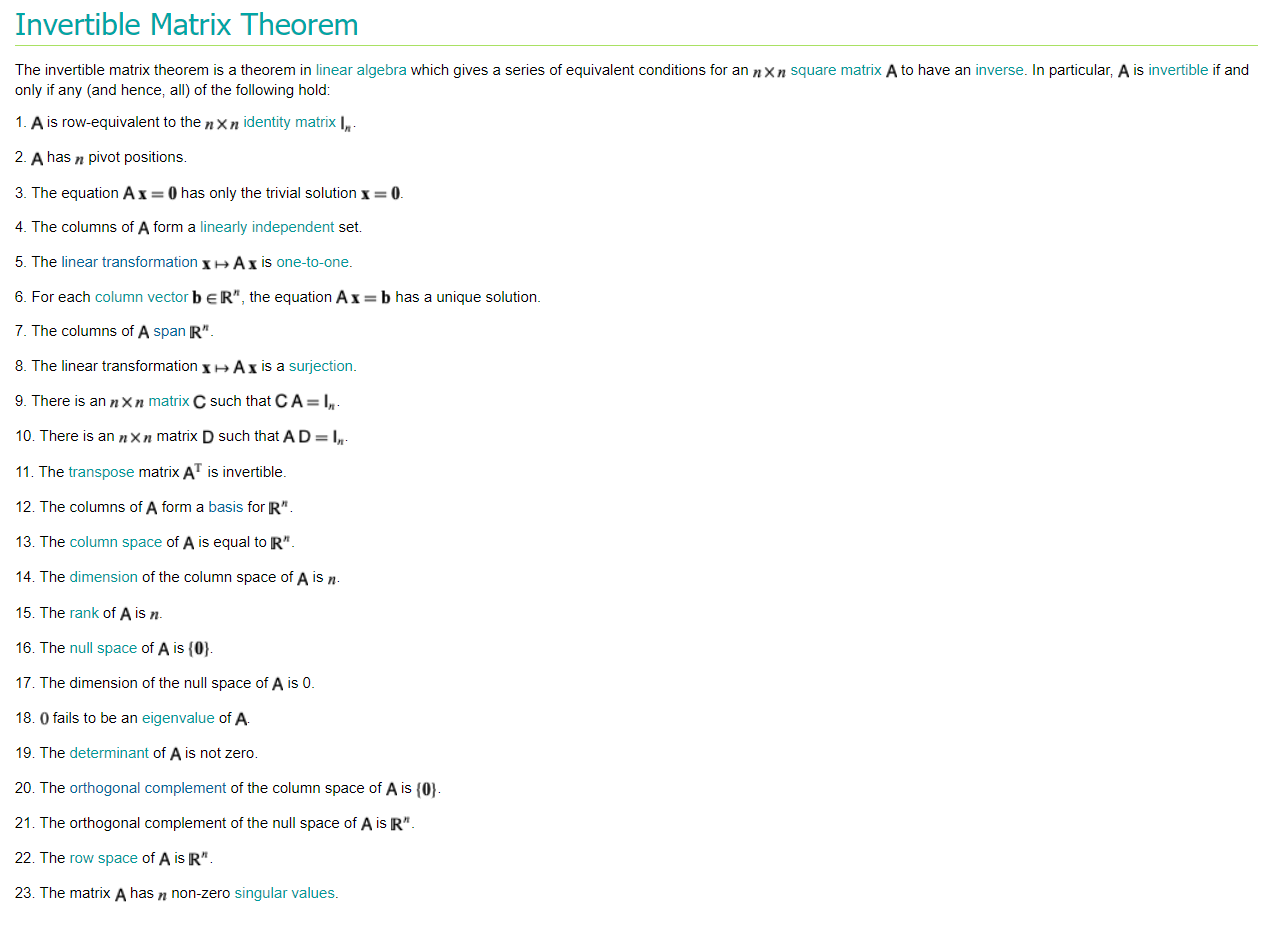
it turns out that a whether or not a matrix has a determinant or 0 or not says a great deal about the matrix
https://i.imgur.com/IJRLSKl.png for example, if the determinant of the matrix is nonzero, then all of these 23 properties hold
 cursive narwhal
@hexed steeple In this case, they're referring to the canonical inner product on R^3, I'd assume.
wintry steppe
you probably don't know what most of these things are, but that's fine
hexed steeple
@cursive narwhal that makes a bit more sense
wintry steppe
for now, just know that a nonzero or zero determinant tells many useful facts about the matrix
hexed steeple
@wintry steppe I've learnt about most of those properties except how they tie to orthogonality. My text book hasn't shown me that part specifically yet
wintry steppe
oh I was talking to the other guy
hexed steeple
oh lol
gritty frigate
That is about a matrix which det is different from zero
What happens if zero is the det of A ?
wintry steppe
if the determinant is 0, then all of those properties DONT hold
which is also useful information
if the determinant of a matrix is nonzero, then all of those hold
if the determinant of a matrix is zero, then none of those hold
hallow cliff
yeah all of these are if and only if statements
so if one of them holds, all of them do
and if one of them doesn't, none of them do
gritty frigate
Okey I get it
hexed steeple
It means that the vectors in that set are not mutually orthogonal
@cursive narwhal So the gram-schimdt process does not make any/all of the vectors mutually orthogonal but orthogonal relative to the next vector?
thats what I deduced from the gram-schimdt process
hallow cliff
uh, all vectors should be mutually orthogonal
cursive narwhal
Gram-Schmidt Orthonormalization is a process that forms an orthonormal list of vectors
hallow cliff
after you apply the process
gritty frigate
the question is to find an x that makes the determinant (which can be written as the above expression) 0
@wintry steppe But why this
hexed steeple
@hallow cliff thats what I thought but now I'm confused
wintry steppe
it seems like that was just an exercise to build your understanding of how determinant calculations work
gritty frigate
why you do want to know the value for x such that det x = 0
wintry steppe
I don't really have an answer for that
cursive narwhal
You see, you can define multiple inner products on a given vector space
So the vectors may be orthogonal with respect to one inner product
But not with respect to the other
hexed steeple
Ah I see
cursive narwhal
So for example, the canonical inner product on $\bR^n$ takes two vectors $x,y \in \bR^n$ and defines:
$\langle x,y \rangle = \sum_{k=1}^{n} x_k y_k$
Where $x_k,y_k$ are the components of $x$ and $y$.
stoic pythonBOT
Abhijeet Vats:
cursive narwhal
But you can certainly define other inner products.
hexed steeple
@cursive narwhal Thanks!
wintry steppe
can someone help me with a hw problem?
i think i have got it but im not sure, so a matrix is 3 * 2019 and b is 2019 * 11 and c is 3 * 11 and C^tAD is 11*2020 and D^tBC^T is 2020 * 3, the size of d would be 2020 x ?
also one more thing if a equation is built like this (4BA^-1D)^-1 also equals to 4^1B^-1AD^-1?
 ocean sequoia
I cant understand this for the life of me is anyone able to help me break it down
how do you read A subscript(j,k) am I suppose to assume thats a matrix? The author never makes it clear what he is refering too
ocean sequoia
So we just dont know the dimensions of F
and this is a way to say what dimension A is in?
 limber sierra
so its just a sum over elements running over all "pairs" of values from 1 to m and 1 to n
uhh
A is an element of F so it doesnt have a dimension
its... a scalar
ocean sequoia
ohhh
so A1,1 would be adding to the first element of the first vector?
wait no that doesnt make sense
so its just a sum over elements running over all "pairs" of values from 1 to m and 1 to n
what do you mean for pairs of values i guess
limber sierra
lets say m = 3, n = 4
then there would be 12 different As
$A_{1,1} A_{1,2} A_{1,3} A_{1,4} A_{2,1} \dots A_{2,4} A_{3,1} \dots A_{3,4}$
stoic pythonBOT
Namington:
limber sierra
the reason they separate this into ms and ns is that
each A_m,n is paired with an x_n
based off its n value
well should i say
each A_j,k is paired with an x_k
but yeah
limber sierra
uh let me be more explicit
this would be $(A_{1,1}x_1 + A_{1,2}x_2 + A_{1,3}x_3 + A_{1,4}x_4, A_{2,1}x_1 + A_{2,2}x_2 + A_{2,3}x_3 + A_{2,4}x_4, A_{3,1}x_1 + A_{3,2}x_2 + A_{3,3}x_3 + A_{3,4}x_4)$
er
whoops
stoic pythonBOT
Namington:
limber sierra
its a vector
its kinda ugly in that format, let me write it as a column vector
$\begin{pmatrix}A_{1,1}x_1 + A_{1,2}x_2 + A_{1,3}x_3 + A_{1,4}x_4\A_{2,1}x_1 + A_{2,2}x_2 + A_{2,3}x_3 + A_{2,4}x_4\A_{3,1}x_1 + A_{3,2}x_2 + A_{3,3}x_3 + A_{3,4}x_4\end{pmatrix}$
stoic pythonBOT
Namington:
ocean sequoia
why is the first entry A1 instead of 1x1+A1
limber sierra
so $T\begin{pmatrix}x_1\x_2\x_3\x_4\end{pmatrix} = \begin{pmatrix}A_{1,1}x_1 + A_{1,2}x_2 + A_{1,3}x_3 + A_{1,4}x_4\A_{2,1}x_1 + A_{2,2}x_2 + A_{2,3}x_3 + A_{2,4}x_4\A_{3,1}x_1 + A_{3,2}x_2 + A_{3,3}x_3 + A_{3,4}x_4\end{pmatrix}$ for some family of scalars $A_{j,k}$ where $1 \leq j \leq m, 1 \leq k \leq n$
stoic pythonBOT
Namington:
ocean sequoia
ah
limber sierra
using "scalars" here is kind of incorrect
but close enough
"elements of the underlying field" would be more correct
(for example, the vector space R over the scalar field Q would admit entries from R but not scalars from R \ Q)
ocean sequoia
oh lol
limber sierra
dont worry about it here, in this context youre working over F^n
i just realized
so it doesnt matter here
ocean sequoia
ok
thank you
im going to spend some time trying to get my head around why that is a form for every transformation
limber sierra
but yes
if youre asking "is A_j,k a matrix"
the answer is "kind of"
they're entries in a matrix A
normally this result is phrased in terms of matrix multiplication
where $T(v) = Av$ for your vector $v$
stoic pythonBOT
Namington:
limber sierra
if you create a matrix $\begin{pmatrix}A_{1,1}&A_{1,2}&A_{1,3}&A_{1,4}\A_{2,1}&A_{2,2}&A_{2,3}&A_{2,4}\A_{3,1}&A_{3,2}&A_{3,3}&A_{3,4}\end{pmatrix}$
stoic pythonBOT
Namington:
limber sierra
you should be able to see the connection
so, this theorem motivates the definition of matrix-vector multiplication basically.
@ocean sequoia if that helps clear it up
wintry steppe
Anyone can explain why the eigenvectors generated by an eigenvalue must necessarily be lin indep to eigenvectors generated by another eigenvalue?
eternal finch
If v_1 and v_2 are eigenvectors of T corresponding to distinct eigenvalues k_1 and k_2, then what can you say about their linear dependence?
First, you look at the equation a_1 v_1 + a_2 v_2 = 0.
You can apply T to the equation to get a_1 k_1 v_1 + a_2 k_2 v_2 = 0.
eternal finch
Eh, but the pictures are so big lol
Maybe I should use brackets.
a[1] v[1] + a[2] v[2]...
No, that's worse.
eternal finch
Ok, I will prep the proof first, then.

Mathematics Stack Exchange
How can I prove that if I have $n$ eigenvectors from different eigenvalues, they are all linearly independent?
@wintry steppe First answer.
Ha ha, I knew somebody else would've done it directly.
Most recent book I've read, Axler, does it by contradiction.
wintry steppe
Thanks for the help
 tardy sequoia
If we let x€R^n a non-zero n-vector and A = zz^T.
Is the null space of A is 1 and rank of A is also 1?
I think like that because A will be just a real number. We can express any real number multiple of 1.
eternal finch
What's z?
tardy sequoia
Correction:
If we let z€R^n a non-zero n-vector and A = zz^T.
Is the null space of A is 1 and rank of A is also 1?
I think like that because A will be just a real number. We can express any real number multiple of 1.
tardy sequoia
By R^n I mean a column vector
eternal finch
Ok, so z is n-by-1, yeah?
tardy sequoia
Yeah
eternal finch
And z^T is 1-by-n.
 storm python
Is € the poor man's ∈
eternal finch
Hence, A = zz^T is what-by-what?
eternal finch
Doesn't R^{1, n} usually mean one row and n columns?
That would make z a row vector.
tardy sequoia
What will be a row vector * its transpose ?
eternal finch
A number. However, you said at the beginning that z was a column vector.
tardy sequoia
My mistake
eternal finch
As in z is a column vector, or z should be a row vector?
If z was meant to be a row vector, then A = zz^T would indeed be a number. If z is not 0, then zz^T would indeed be a multiple of 1, and the rank of A would be 1.
However, the nullity would not be 1. Remember that the rank and nullity of a matrix add up to the number of columns.
tardy sequoia
Thanks a lot
 autumn kraken
Is $span((1, 0), (0, 1)) = \bR^2$ because you can represent every element in $\bR^2$ with those two vectors like $(3, 4) \in \bR^2, (1, 0) * (3, 4) + (0, 1) * (3, 4) = (3, 4)$ ?
or am I understanding this wrong
because $span(M)$ is also defined as the "smallest subspace that contains M" and I don't really understand that definition
eternal finch
So, let's start with the definition of span.
The span of a list of vectors is the set of all linear combinations of those vectors.
So, if you have two vectors u and v, then their span is the set of all vectors of the form au + bv, where a and b are scalars.
Now, what's a subspace? It's a subset of a vector space that's also a vector space.
Suppose you wondered what a subspace that contained u and v looked like.
Well, by virtue of being a subspace, the subspace contains all linear combinations of u and v.
This is because (1) if a vector space contains x and y, then it contains x + y, and (2) if a vector space contains x, then it contains all vectors ax, where a is any scalar.
A subspace containing u and v could have more vectors than the linear combinations of u and v, but it must at least have those linear combinations.
This is why we say the span of M is the smallest subspace that contains M.
Coming back to your first question, is R^2 the span of (1, 0), (0, 1) because you can represent every element in R^2 with those two vectors?
Yes. More precisely, R^2 is the span of (1, 0) and (0, 1) because you can write any vector in R^2 as a linear combination of (1, 0) and (0, 1).
Your example, btw, would be (3, 4) = 3(1, 0) + 4(0, 1), which is a linear combination of (1, 0) and (0, 1).
autumn kraken
Thanks a lot. You basically summed up what I had to learn in the last week, but now I feel like I understand it
Maybe I should get a book about this, because the examples of my prof are quite difficult to understand
I don't know if he's doing it on purpose or not
pale coyote
What a helpful fish
 golden cloak
I need help:
Let V be a finite dim. vect space, A in End(V) fixed.
Define: P_A = {B in End(V) | AB = 0}
Need to show that P_A is a subspace of End(V) (not so hard) and that every subspace of End(V) can be obtained that way.
The second part is a problem.
My line of thinking is, "how can I find some A such that AB = 0 for every B in M, M subspace of End(V)", but no clue...
 light brook
hello, I have one question: if we know that a matrix A is an invertible matrix and that A is not an identity matrix, is it possible that we have A is the same as its inverse? if so, can you give an example?
 dusky epoch
$\mat{0 & 1 \ 1 & 0}$
stoic pythonBOT
Ann:
light brook
'A is not an identity matrix'
dusky epoch
this is not the identity
dusky epoch
yes this is an example of a matrix which is not I but equals its own inverse
pale coyote
@golden cloak did you get it?
golden cloak
@pale coyote no
dusky epoch
can i see your original problem again cyber
 pale shell
What is the geometric interpretation of a row vector
golden cloak
@dusky epoch
cybergnosticToday at 3:55 PM
I need help:
Let V be a finite dim. vect space, A in End(V) fixed.
Define: P_A = {B in End(V) | AB = 0}
Need to show that P_A is a subspace of End(V) (not so hard) and that every subspace of End(V) can be obtained that way.
The second part is a problem.
My line of thinking is, "how can I find some A such that AB = 0 for every B in M, M subspace of End(V)", but no clue...
pale coyote
@golden cloak Fix a basis for $M$ and think of how the rows of $A$ would have to be related to the columns of the basis you chose
stoic pythonBOT
moonside:
dusky epoch
hang on i'm not even sure if that's the case
take V = R^n and take the subspace of End(V) composed of diagonal matrices
suppose there exists a matrix A such that AB = 0 iff B is diagonal
from that you get AI = 0 since I is diagonal
but then that means A = 0
which means AB = 0 even for non-diagonal B
contradiction
so you're asked to prove a false statement
pale coyote
lul
golden cloak
if it means something, the b) part of the question is,
show that F_f : End(V) --> End(V) defined by:
F_f(g) = fg, g in End(V) is linear, and that every linear operator from End(V) can be obtained that way
it would be preferred to do that without matrices, because this question is from lectures before notion of matrix of a linear transformation
pale shell
If I put two elementary operations into one matrix will it do both or should I multiply both elementary matrices for that
 molten pumice
Uh...how are you putting them into one matrix?
 sick dragon
Why is {v1,v2} a correct response?
My understanding is the other two are correct since they are dependent on v3
 why {v1,v2} as well?
subtle walrus
$v_3 = -2v_1 + 3v_2$
stoic pythonBOT
Lochverstärker:
subtle walrus
what does "dependent on v3" even mean
cursive narwhal
@sick dragon If you're still not very sure, then just note that a basis for any vector space is just going to be a linearly independent list of vectors that spans the space. So, Loch showed that v_3 can be expressed as a linear combination of v_1 and v_2. That, incidentally, also shows that v_1 can be expressed as a linear combination of v_2 and v_3 and the same applies for v_2 as well.
If I can express one of the vectors in a list as a linear combination of the other vectors in the list, then that list is linearly dependent
sick dragon
Thank you
cursive narwhal
You're welcome (even though Loch did most of the work)
 acoustic path
hallo
acoustic path
ich kann kein deutsch.
 distant granite
ok no problem 🙂
distant granite
do you have any ressources where i can see what is the verfahren
sorry i didn t know the word in english
torn silo
no worries
 nocturne oracle
i feel like i missed something, why is this the case
cursive narwhal
You can try proving it or disproving it
It's an assertion. You know what a subspace is supposed to be. So, work with that.
Let $b = 0$. Then, you need to prove that the given set is a subspace of $\mathbb{F}^4$. That requires you to check that it's non-empty, that it is closed under addition and that it is closed under scalar multiplication. I'm also assuming that the underlying field over here is just $\mathbb{F}$.
Then, for the other direction, suppose that the given set is a subspace of $\mathbb{F}^4$. Then, you need to show that b = 0 in that case.
stoic pythonBOT
Abhijeet Vats:
cursive narwhal
@nocturne oracle Let me know if you have any issues, yea?
nocturne oracle
yeah im just confused, is x3 analogous to u, or is (x1, x2, x3, x4) analogous to u
U is the whole second line in the earlier image, right?
cursive narwhal
Indeed, U, in your specific case, is just the set:
$$U = {(x_1,x_2,x_3,x_4) \in \mathbb{F}^4 : x_3 = 5x_4 + b }$$
stoic pythonBOT
Abhijeet Vats:
cursive narwhal
$(x_1,x_2,x_3,x_4)$
stoic pythonBOT
Abhijeet Vats:
cursive narwhal
That's the vector u
nocturne oracle
yeah alright
distant granite
how to know if there is a unreduceable row echolon form for a matrix using the the gauss elimination?
so after u reach the first form
is there a way to know i can go to the second form
torn silo
I don't understand the question
are you asking how to go from the first to the second matrix?
distant granite
no my question is there a way to know there is a streng Zeilenstufenform for a matrix
row echolon form
in english
torn silo
you'll see if you can't go any further
distant granite
oh ok thanks
cursive narwhal
It's like a powerup for an anime character or something of a final form
"Now, I shall show you the power of my Streng Zeilenstufenform."
distant granite
haha yeah it feels weird saying it i'm not german neither
distant granite
i study in german i m tunisian
cursive narwhal
No u
distant granite
dude wtf
cursive narwhal
My brain is weird, ignore me
eternal finch
o///o
subtle walrus
don't make me get my strenge Zeilenstufenform
cursive narwhal
Is that the name of the bdsm whip you have lol
distant granite
lochverstärker is the kind of bdsm u looking for xD
i know what each word means but combining them doesn't make sens to my tiny brain
subtle walrus
it's ok, i didnt know what strenge Zeilenstufenform is either
cursive narwhal
It's my final form
 short sapphire
if you were my professor and i filled 2 pages with this jordan decomposition
just for the factorization to be wrong
would you still fail me
anyone
please
torn silo
well that depends
did you just put down random calculations or did you explain what was happening?
short sapphire
no BRUH
BRUH
I did it over 3 times
to find the generalized vector
@torn silo but to find it you have to go through trial and error
where you have to pick which vectors man
like i did it 4 times
its tiring and i have 12 other fucking questions
I dont know anymore
short sapphire
what do you mean bruh
torn silo
jordan matrix no trial and error
you take one of the vectors that isnt a linear combination of the vectors in the previous kernel
short sapphire
we talking about the same thing bro?
where i have to match the fucking jordan matrix
to the original one bro?
using the column vectors
as the fucking
Q matrix or whatever
to multiply them
IGHT WHATEVER man. I'll just hold my F
fuck my life
pale coyote
BRUH BREEEH
torn silo
if you're still there can you show me an example
eternal finch
Use the definition of matrix multiplication and transpose.
See what the (i, j)-th entry of B^t A^t is.
eternal finch
Yes, that's right. AI = IA.
eternal finch
Also, for the $B^t A^t$ problem, what I mean is use the formula $(AB){i, j} = \sum{k = 1}^n A_{i, k} B_{k, j}$.
gritty frigate
Thanks !
stoic pythonBOT
Red Herring:
eternal finch
So finicky, @.@
 native lodge
yes
native lodge
find a numerical example where this is not true
 narrow mortar
ye
native lodge
so it's really your choice to use anything you want
narrow mortar
A= (0,1), B= (1,0)
distant granite
how do we prove a set is a base of a vector space ?
eternal finch
how do we prove a set is a base of a vector space ?
A basis is a linearly independent list of vectors that span the space. All bases have the same length, which is the dimension of the space. It is sufficient to prove that a basis is linearly independent and has a length equal to the dimension of the space or that a basis spans the space and has a length equal to the dimension.
distant granite
nice thanks !
dusky epoch
@narrow mortar i don't know, is it?
distant granite
@eternal finch this one is giving me troubles bc idk how to measure the length of the first vector space
distant granite
a vector space
dusky epoch
i mean duh but what vector space is it
dusky epoch
the DIMENSION of U, if that's what you meant, depends on what V is
what do you mean not known
distant granite
i meant dimension not length sorry
dusky epoch
it should be given in the problem
otherwise it makes no sense
because V cannot be just any arbitrary vector space
dusky epoch
did you look above
distant granite
but u can see it's not specified
dusky epoch
did you look above
dusky epoch
THERE WE GO!
distant granite
sorry
so i need to find the dimensions of b
and prove that it's lin independent
dusky epoch
the dimensions of b
no
there's no lowercase b, and uppercase B is not a vector space and so doesn't have a dimension
 gray dust

distant granite
i see
dusky epoch
you need to show two things
- B is linearly independent
- for every f ∈ U there exist constants c1, c2, c3 such that f(x) = c1(x^2-1) + c2(x^3-4x) + c3(x^4-1)
distant granite
hmmm ok thanks a lot fo ur time
distant granite
i actually have read the script from my uni and another book
so much stuff to learn
i need to connect the stuff in my teeny tiny brain
wintry steppe
hey can anyone help some intro to linear algebra questoins?
gray dust

gritty frigate
Having X-1
Beaing that an inverse matrix
how can I get the value of the origignal X?
gritty frigate
Yep
dusky epoch
$X = (X^{-1})^{-1}$
stoic pythonBOT
Ann:
dusky epoch
yes
gritty frigate
How can I dot it if it is an equation ?
dusky epoch
??
gritty frigate
How can I learn to use latex ?
gray dust
#resources, stackexchange, https://www.overleaf.com/learn
gritty frigate
$X^{-1}=M^{-2}(2N^{t}+I) $
stoic pythonBOT
AfterJack:
gritty frigate
Do I have to solve all and then apply the property
Or can I something on both sides ?
I dont know if the expression on the left has inverse
So I will not keep the equality
gray dust
 gritty frigate
But I should do it in both sides
and I dont know if the left side has its inverse
I just know X has
and it is an 2x2 matrix
dusky epoch
if 2N^T + I has no inverse then the equation cannot be true no matter what
since X^-1 is invertible by definition
its inverse is X
so 2N^T+I is forced to have an inverse
gritty frigate
You are right
It MUST be inverso
Inverse
I m making a lot of stupid questions
If not then the left side is not equial to the right side
However, there is no point in doing that. I should first solve and then do X-1-1
I will be doing one more inverse if I do it applying the operation to both sides
short sapphire
@pale coyote y you make fun of the way i speak
@torn silo I was trying to freaking decompose A into QJQ^-1 (dont know latex) here's the freaking example. Doesnt matter anymore i guess
eternal finch
So, say you have two vectors u and v.
They span some subspace.
Does their span change if you change the magnitude of the vectors but not their direction?
eternal finch
You mean a V2 in the direction of W2?
 high granite
No
eternal finch
V1 was already defined to be a unit vector in the direction of W1, tho.
high granite
So I let V1 be in dir W1
high granite
Find V2 in directions of W1 (which is zero) and W2
eternal finch
W1 = (1, 1, 1, 1), which is not 0?
Also, what does it mean for V2 to be in the directions of W1 and W2? A vector can only point in one direction.
high granite
Shouldn't V2 dir W1 be zero because it is orthogonal to W1
eternal finch
That's a different assertion than you made previous. Ok, so you say V2 should point in the direction of W1 and should equal 0 because it should be orthogonal to W1?
eternal finch
Ok, so you say V1 points in the direction of W1, and V2 is orthogonal to it.
high granite
Yes
eternal finch
Sure. Then, V1 and V2 would span the subspace spanned by W1 and W2.
That's part of what you want.
Your original question was "how does finding V1 in the direction of W1 helpful"?
gritty frigate
How do I do t of an square matrix ?
eternal finch
Now you know.
high granite
Thanks @eternal finch
eternal finch
And you also know a bit about V2.
Np.
How do I do t of an square matrix ?
t?
Transpose?
eternal finch
Say A is a square matrix.
Take the first row.
Write it as the first column of your new matrix.
Take the second row.
Write it as the second column of your new matrix.
Etc.
At the end, you get A^t as your new matrix.
 nimble raft
👏 🥳 👏
eternal finch
Congratulations! @real plaza
wintry steppe
based
6 and -6 are the eigenvalues
but once u try to find a nontrivial solution for (A - -6I)x = 0
you cant
dusky epoch
no
remember that the vector also has x2
and x2 does not appear in any equations
and therefore there are no restrictions on it
wintry steppe
oh so for it to be trivial x1 and x2 has to be both zero?
dusky epoch
yes
wintry steppe
so x2 here is a free variable
oh now i get it
how were u able to do it that fast?
u have a special calculator or something?
wintry steppe
r u a mathematician?
degree?
i have a calculator that gets the reduced row echelon form in 5 seconds
imagine having to reduce every problem
nimble raft
i have a browser and several websites that gets rref in less than 5 seconds
wintry steppe
well yeah u can say less than 5 seconds
limber sierra
it just requires noting that
-6 + 6 = 0
since this means that the entire second column of the matrix is 0s
limber sierra
i'm not sure why you took this in the direction of a tangent against row reduction
i'm just pointing out that
this didnt require it
dusky epoch
this matrix was small enough for mental calculation to be an option for me
wintry steppe
yeah i know
limber sierra
because of how matrix multiplication works; if you have a 0 column, then clearly multiplying by a vector on the right will "eat" one of the entries in the vector
wintry steppe
r u guys math majors
limber sierra
kind of.
wintry steppe
 limber sierra
yeah, i'm pretty sure everyone's seen that video
nimble raft
i have not
 eternal finch
So, counting is a very natural thing to do. One apple, two apples, three apples.
And you can define rules on how to combine quantities.
Two apples plus two apples equals four apples.
And eventually, you realize that, for example, two of anything plus two of the same thing equals four of that thing.
So, you abstract and work with those counting words instead of the original items.
Numbers.
Is there an analogous way to describe vectors?
The first thing I would do is say that there's a lot of things you just can't describe with one number.
For example, displacements in two dimensions.
But a vector very much depends on the reference objects.
Like, for example, the quantity "two miles north and three miles east".
That's the same quantity as [choose your change of basis and insert vector above in new coordinate system here].
nimble raft
Btw you can get the norm of a vector with cross product right?
dusky epoch

nimble raft
I'm beanboozled.
Working on this problem
Not sure how I'm supposed to approach (a)
I assume O is some scalar?
OR = (1 - t)OP + tOQ = OP - tOP + tOQ?
Maybe I should ignore O?
r = p - tp + tq?
(1, -2, 0) - t*(1, -2, 0) + (4, -5, 6) = (3, 4, 4)
I wonder what happens if i just keep algebraing
r = p - tp + tq
r - p = - tp + tq
r - p = tq - tp
r - p = t(q - p)
(r - p)/(q - p) = t?
Then everything would be zero?
rip, i don't think vector divison exists.
Well if its OR, would be (0, 0, 0) (3, -4, 4)
Hmm not sure.
Not sure, I assume its just a point.
Just another interpretation of a vector, I assume?
Well, I think it could be interpreted either way.
Assuming the point originates from 0.
Oh weird..
So maybe its just a fancy way of saying it comes from the origin?
I guess, I thought in general the ideas were interchangeable as long as the vector didn't have some arbitrary origin.
From a textbook I'm using
Aight, thanks for the help tho!
distant granite
let's say we have two subspaces U1 and U2 from V
i want to prove that the sum of two vectors one of each subspace is in U1 U U2
is that possible ?
distant granite
so u mean add v1 + v2 +v1 -v1
and work from there ?
i don't get your point ethan sorry i m still a beginner
ah sorry i didn't post the exercice's question: We have two subspaces U1 and U2 of V. i need to prove U1 U U2 is a subspace of V if and only if U1 C U2 or U2 C U1
it's not about proving that U1+U2 = span(U1 union U2)
it's with a line underneath haha idk really
yes
i know the steps
i'm stuck at the part at where i need to prove that the sum of two vectors in U1 U U2 is in the subspace
oh so the condition i start with is that U1 C U2 or U2 C U1
i started out with only U1 C U2
yeah i didn’t know how
i ve split the work in 3 cases
i ve sent a pic
the third case is the one i m having troubles with
oh yeah makes sense thanks a lot !!!
have a great day my friend
torn silo
but U1 has to be in U2 alread
y
otherwise it wont work
the union of a subspace means you just stuff those two subspaces together
ahh okay
otherwise youd have something like the subspace generated by (1,0,1) and another one by (0,1,0) but (1,1,1) isn't in the union even though it can be created by addition
 serene zenith
Hi guys, I'm trying to understand what this equation is expressing. Some symbols I understand (sum, capital pi) but its mainly the zj < zi I don't quite understand what it really means https://i.imgur.com/MTjNaBK.png
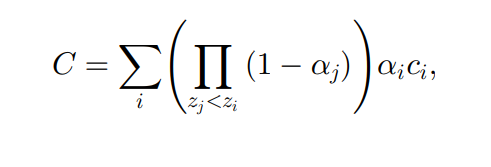
First term is sum of all i and I think the capital pi is the product of all i and j which is multiplied by the 1 - omega multiplied by j (not sure if that symbol is omega)
Is the zj < zi just saying when j is less than i?
 sage ermine
I have mostly no idea what that means, but the symbol is alpha
And I'm fairly certain that means multiply all values for j that are less than i
serene zenith
Ah ok
Yes, that makes sense. This is for computer graphics and is basically talking about a very common operator called over that is used to blend pixels of a screen together for a final colour output
Here is how it is normally displayed https://i.imgur.com/FAsvNUi.png
 sage ermine
Oh yeah, then it's basically telling you to do a for loop
Computer codes I do understand
serene zenith
Ok it makes sense what you said about multiplying all values for j that are less than i
sage ermine
(or at least that'd be by guess)
Yeah, probably
Does it specify ever that i and j are naturals?
serene zenith
It doesn't go into much detail other than the fact that the first expression is basically refactored from the second expression I sent
I guess its a more compact form as opposed to explicitly writing a1 x c1 + (1 - alpha1) x (a2 x c2 + (1 - alpha2)) ...
Thanks for your help man! I kind of understand what's going on now haha
sage ermine
I'm assuming this is the right place to ask for 3D vectors
There's a thing called vector exclusion
They're sort of like the opposite of the dot product
vxcl(v1, v2) returns v2 with no component in v1
So say I had a velocity vector called V and I wanted to get the horizontal velocity of it, if I have an up vector
I could just do vxcl(up, V)
Right?
sage ermine
Yeah, probably what it is
Thanks, I'm just kinda new to 3D vectors and what you can do with them
 eager kestrel
Implement orthogonal iteration and calculate the six largest eigenvalues with an absolute tolerance of 10−6
. Use the MATLAB command for "exact" eigenvalues. Karte
so p = 6 and take as X0 the first six columns of the unit matrix. How many iterations are needed?
n = 13;
R = 'S';
G = numgrid(R,n);
spy(G)
title('A Finite Difference Grid')
https://gyazo.com/d3da6039c48fee3f315dd1d8347a3eab


i have no idea of how do this? any ideas?
 humble oak
can changing the constants of a system affect its original rank?
hallow cliff
yes
 vapid copper
i have a question about a matrix multiplication type of task
A is a 3 x n matrix and E is
How can you create matrix EA from A with just this?
according to the solution, it's
"by adding 2 times row 3 to row 3"
but i don't see how that solves the problem
half ice
I assume A is your identity?
1 0 0
0 1 0
0 0 1
@vapid copper
Take the third row, add it to the second. That's an elementary operation so you can do that.
vapid copper
@half ice no it isn't, necessarily
the task just states that it's a 3xn matrix
nothing about identities or anything
that's why i dont understand
half ice
Do you happen to have a pic of the task?
vapid copper
yes however it is in danish
"Let A be a 3 x n matrix and let E be the matrix E = ...
How does the matrix EA appear from A?"
the crossed answer states "By adding 2 times row 3 to row 2"
pale coyote
what about it?
nocturne oracle
like what does it mean
pale coyote
do you understand limits of sequences?
nocturne oracle
um i guess not?
does it just mean the set of all convergent series?
or sequences rather
dusky epoch
sequences that converge to 0 specifically
nocturne oracle
are they not equivalent
nocturne oracle
oh yea
pale coyote
so here youre considering sequences $(a_1, a_2, a_3, \ldots)$ for which $\lim_{n\to\infty} a_n = 0$.
stoic pythonBOT
moonside:
nocturne oracle
wait, so they dont necessarily have to be sums?
like you could have (1,0,0,0,.....)
pale coyote
converges to 0
dont confuse sequences with series. A series is an infinite sum, and you actually define what convergence of a series means by examining the convergence of an associated sequence (the sequence of partial sums)
nocturne oracle
yes thats what i mean, like the i th term of a series corresponds to the i th term of its sequence
but you could also have sequences such as (1,0,0,0.....), which satisfy the limit property, no?
pale coyote
A series $\sum_{n=0}^\infty a_n$ as two associated sequences: 1. The sequence of terms, which is just the list of the individual things youre adding $(a_0, a_1, a_2, \ldots)$ and 2. The sequence of partial sums $(S_0, S_1, S_2, S_3, \ldots)$ where $S_N = \sum_{n=0}^N a_n$
stoic pythonBOT
moonside:
nocturne oracle
oh yeah
pale coyote
Here we are dealing solely with sequences though
nocturne oracle
ok right
well so if we have the two sequences S1 and S2, with both limits of 0, S1+S2 must also have a limit of 0 as well, right?
and multiplying S1 by a constant wont change the limit, so the limit is still 0.
but how do I show 0 is an element?
just use the S1 + (-1)S1 = 0?
or does that not work because these are sequences
vapid copper
@half ice Sorry for disturbing, but did you ever figure it out?
pale coyote
You need to define what the 0 element in the space of sequences is
nocturne oracle
wydm by 0 element
oh yeah
um is it just the sequence of 0's? but that doesnt really make sense
(0)?
pale coyote
why doesnt it make sense
nocturne oracle
how can the number 0 be an element {the list of sequences with limit 0}
like all of the elements are of the form $(a_0, a_1, a_2, \ldots)$
stoic pythonBOT
Sideurk:
pale coyote
it cant
you need to define an element of your space (i.e. a sequence that converges to 0) which acts as the 0 element
stoic pythonBOT
Sideurk:
pale coyote
yeah, you just have to check that this acts like a 0 element should
well i suppose you need to define what the operations in your candidate vector space are (+ and scalar mult)
these are all kind of obvious, but still good to be explicit
nocturne oracle
ok I feel dumb now, so the "0" isn't necessarily the number 0, but it just has to act as the additive identity, correct?
pale coyote
well even in something familiar like $\mathbb{R}^3$, the 0 element isnt the number 0
stoic pythonBOT
moonside:
pale coyote
yep
nocturne oracle
gotcha, thx for being patient
pale coyote
my pleasure
torn silo
because x + y := y apparently
 jovial sigil
Show that U +W has dim 3
 deft patio
Sorry for the danish text, but I'm trying to declare rule here in Maple. (new here, let me know if it's not the right place)
What am I doing wrong?
left: the assignent
right: Maple
deft patio
oh ok, thx
nocturne oracle
So F^3 is the direct sum of U and W because each element of U + W can only be expressed as ( x, y, z)?
half ice
"can only" is a weird way to say this lol
U + W are vectors of the form (x,y,z) which is F³
nocturne oracle
I agree, the wording is wierd
half ice
Oh I see your question haha
Every vector in U + W requires a unique choice of U and a unique choice of W
nocturne oracle
Like, I get that each vector ( u_i, u_j, u_k) is unique because like U can only change the first two points and W can only change the third
But if W was like {( 0, y, z) in F^3}, then each point ( u_i, u_j, u_k) would not be unique
because the u_j is then dependent on two variables., right?
and in that case F3 would not be the direct sum of U and W
eternal finch
Yeah, that's right.
nocturne oracle
Can I get a hint on how to deal with f'(-1) = 3f(2)? its my first exposure to this type of equation
eternal finch
First, how do you tell if a set is a subspace or not?
nocturne oracle
closed under addidtion, scalar mult, and 0 is it
eternal finch
I mean in general.
nocturne oracle
um, if u_1 + u_2 is in U
nocturne oracle
if two elements of that set added remain in that set