#linear-algebra
2 messages · Page 92 of 1
 odd kite
 neat halo
Lol
Sorry
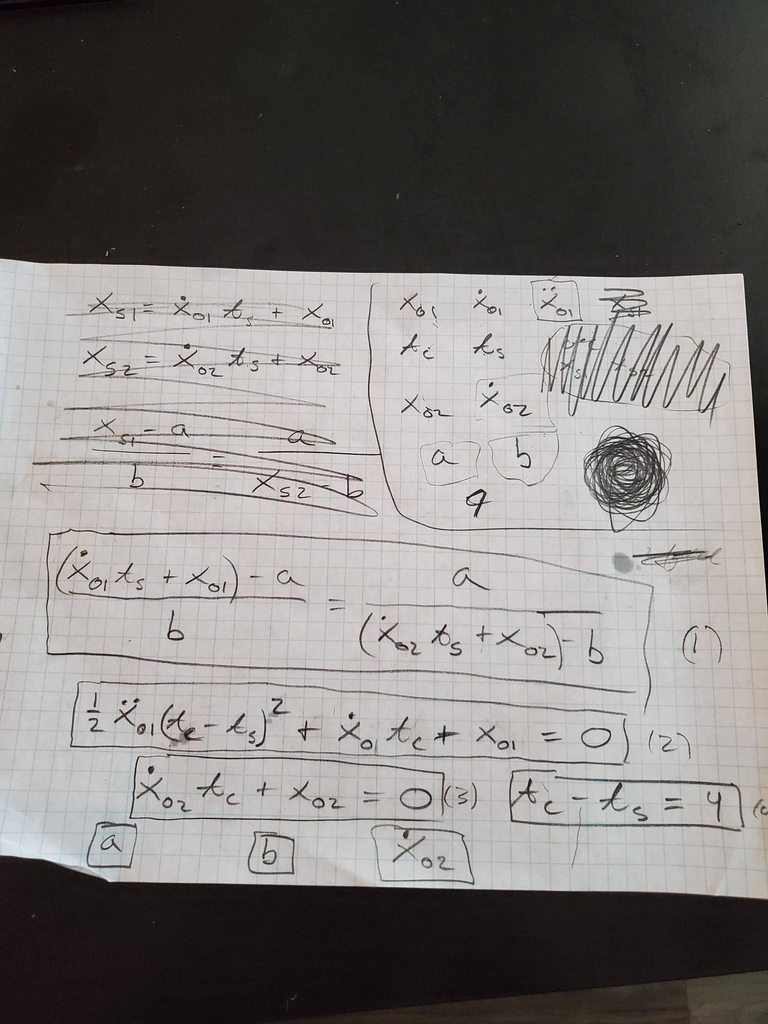
If it helps, this is actually a scenario with a car and bicycle approaching an intersection, with the car braking as the cyclist exits occlusion. Instantaneous and constant acceleration is assumed
And I'd like to get an expression for the deceleration magnitude needed to avoid a collision
Maybe I should ask this in the physics discord and not the linear algebra mathematics channel hahah
 cold topaz
why is it that the initial statement doesnt have the power?
 pallid rampart
Because we want an inequality that only involves || ||, but it is more convenient to work with || ||^2 when doing a proof
cold topaz
but are we going to get the same result if we have numbers instead of u and v?
 limber sierra
what is the norm of a "number"
pallid rampart
The norm of a single number, if you interpret it as the norm on R^1, is exactly the same as the absolute value | |
limber sierra
you're missing my point
we're not talking about scalars, we're talking about vectors
 dreamy depot
Suppose that $U$ is a subspace of $V$ what is $U+U$ ? I answered this question by saying that $U+U$ would indeed form a direct sum
 stoic pythonBOT
Zophike1:
dreamy depot
Is my reasoning correct
 eternal finch
U + U is not a direct sum.
eternal finch
Btw, there is an analogy to sets. If you have a subspace U and you take U union U, what do you get?
It is similar for U + U.
limber sierra
a subspace of a set??
eternal finch
Yeah, but it's not just any old subspace.
limber sierra
ok
 clear vessel
T/F (+ proof): "let T: R^n -> R^n be the transformation defined by T(v) = λ*v, where λ > 0 is some real number, and let A be the standard matrix for T. if B is a matrix that is similar to A, then there is a basis of R^n consisting of eigenvectors of B." do the eigenvectors of A form a basis of R^n? I also know that if A and B are similar, they have the same eigenvalues, but not eigenvectors. am i allowed to assume that this standard matrix A follows Ax=λx?
eternal finch
Do the eigenvectors of A form a basis of R^n? Yeah, they do.
cold topaz
did i prove this the right way?
eternal finch
Why is <u, u> + <v, v> = <u + v, u + v>?
cold topaz
@eternal finch because the first component of the first vector goes with the first component of the second vecftor, and second with second and so on. no?
eternal finch
Ok, so notation is messing you up.
In this context, <u, u> is not a vector.
It is the inner product of u with u.
I'd suggest you stop writing vectors with angle brackets and start using parentheses or brackets.
To avoid the mixup.
If you use a dot for product, it might be clearer why that line is wrong.
$|u|^2 + |v|^2 = \sqrt{u \cdot u}^2 + \sqrt{v \cdot v}^2 = u \cdot u + v \cdot v$
stoic pythonBOT
Red Herring:
eternal finch
@real plaza Not sure where the confusion stems from. If A is similar to B, then
A = P^-1 B P.
Then,
= P^-1 B P P^-1 B P . . . P^-1 B P P^-1 B P
= P^-1 B B . . . B B P
= P^-1 B^k P.```

So, yes, A^k ends up being similar to B^k.Ah, ok.
Yeah, you do diagonalize a matrix to find high powers of it.
You already know that the power of a diagonal matrix is very easy to compute.
The fact that A being similar to some diagonal matrix D, that is A = P^-1 D P, means that to compute A^k where k is very big, all you need to do is compute P^-1 D^k P.
Two steps.
One, compute D^k.
Very easy.
Ok, three steps.
Two, multiply on the right by P.
Three, multiply on the left by P^-1.
Yeah.
So, that's why we do it.
It being diagonalizing.
Not sure what similarity transformation is, hold up.
Yeah, ok.
That's right.
Wait.
Ok, I'm not sure what a similarity transformation is.
Ok, so apparently a similarity transformation is a map that takes a matrix A to a matrix P^-1 A P.
So, what defines a similarity transformation is the P.
We should be careful. Don't mix similarity with diagonalizability.
A is similar to B if and only if A = P^-1 B P for some transformation matrix P.
B doesn't have to be diagonal.
A doesn't have to be diagonal.
A is diagonalizable if and only if A = P^-1 D P for some transformation matrix P and some diagonal matrix D.
So, A is diagonalizable is equivalent to A being similar to a diagonal matrix D.
So, similarity is something broader than diagonalizability.
clear vessel
T/F (+ proof): "let T: R^n -> R^n be the transformation defined by T(v) = λ*v, where λ > 0 is some real number, and let A be the standard matrix for T. if B is a matrix that is similar to A, then there is a basis of R^n consisting of eigenvectors of B."
Do the eigenvectors of A form a basis of R^n? Yeah, they do
I also know that if A and B are similar, they have the same eigenvalues, (because by manipulating B = P^1*A*P, i can get that det(B-λI) = det(A-λI)), but the eigenvectors are generally not the same. idk how to show that the eigenvectors of B form a basis of R^n, or if this is even provable (statement is false)
eternal finch
Mmm, intuitively, the eigenvectors of A and B are the same, since A and B represent the same linear operator, just in different bases. Coordinates will not be the same.
Hm, so, I'm not too sure about on real vector spaces. I'd need to think about that.
But on complex vector spaces, there is always an upper triangular matrix for a transformation.
That is, if you have a matrix A, there is always an upper triangular matrix B such that A = P^-1 B P.
And the upper triangular matrix has the eigenvalues on the diagonal. The eigenvalues will be the same.
 wintry steppe
Hey
Is there a difference between a linear mapping and a linear opperator?
My professor introduced linear mappings, and then he called them linear operators
eternal finch
An operator is a map from a domain to itself.
eternal finch
Yeah.
stoic pythonBOT
maxdy:
wintry steppe
Thats exactly what he said
eternal finch
Ok, so @real plaza, if A and B are similar but not diagonalizable, they still have the same eigenvalues as each other.
Just because you can't find a diagonal matrix doesn't mean eigenvalues are different.
Showing they have the same eigenvalues is independent of the fact they are diagonalizable.
Uh, I wouldn't say that's an operator @wintry steppe but terminology is just terminology.
If in the context of your class operator is the same as mapping, then eh.
wintry steppe
Hey this is what I think he wanted to say
I think that linear operator for example + is (f+g)(x) = f(x) + g(x)
I guess + is linear operator on these two functions
🤔
actually
linear operator = linear mapping here 🤦♂️
eternal finch
@real plaza Got an example of A and B are similar but not diagonalizable.
,w inverse({{1, 0}, {1, 1}}) * {{2, 2}, {0, 2}} * {{1, 0}, {1, 1}}
stoic pythonBOT
 Requested by Red Herring#8090
eternal finch
Requested by Red Herring#8090
eternal finch
The result and the middle matrix in the input are similar, but definitely not diagonalizable.
You'll see they have the same eigenvalues.
@sick dragon What is your definition of matrix-vector multiplication?
It should make sense once you try to take a matrix A with a different number of columns than the number of entries in x.
For example, say you had the matrix {{1, 0}, {0, 1}} and tried multiplying it with {
{1},
{1},
{1}
}.
It wouldn't work.
 sick dragon
that makes sense
eternal finch
Yeah. @real plaza
cold topaz
for tr(U^T V), do you get the transpose of U, and the multiply it by the matrix V, and then calculate the trace
OR
you just multiply the coresponding elements of U and V and add them together?
Which one is ur preferred way?
 gray dust
i remember you asked about this the other day. you think these are different ways to get the answer. they are not
you should follow the order of computation as suggested, which is compute U^T*V then take the trace of the result
cold topaz
it bothers me
gray dust
but because the trace is the sum of the diagonal entries, you only need to compute the diagonal entries of U^T*V. computing the non diagonal entries is a waste of time
 humble oak
hello, i am extremely paranoid this system over here has non-trivial solutions right?
limber sierra
it does, yes
limber sierra
consider for example, $\begin{bmatrix}1\1\-1\end{bmatrix}$
stoic pythonBOT
Namington:
clear vessel
T/F (+ proof): "let T: R^n -> R^n be the transformation defined by T(v) = λ*v, where λ > 0 is some real number, and let A be the standard matrix for T. if B is a matrix that is similar to A, then there is a basis of R^n consisting of eigenvectors of B."
Do the eigenvectors of A form a basis of R^n? Yeah, they do
I also know that if A and B are similar, they have the same eigenvalues, (because by manipulating B = P^1*A*P, i can get that det(B-λI) = det(A-λI))
i read somewhere that the eigenvectors are generally not the same, but someone said above that intuitively the eigenvectors of A and B are the same "since A and B represent the same linear operator, just in different bases. Coordinates will not be the same." if its true that the eigenvectors are the same for similar matrices, I could easily show that the eigenvectors of B form a basis of R^n (cuz they the same eigenvectors of A that form a basis of R^n) but idk if its that easy
eternal finch
Ok, let me try to phrase it using matrices.
Let A and B be n-by-n matrices that are similar to each other.
Then, A = P^-1 B P for some matrix P.
Let v be an eigenvector of A.
This means that Av = kv for some k.
A = P^-1 B P, so Av = P^-1 B P v.
Then, Av = kv is the same as saying P^-1 B P v = kv.
Which is the same as saying BPv = kPv.
So, we see that Pv is an eigenvector of B.
Keep in mind that, in their use above, A and B are matrices and v and Pv are coordinate vectors.
Similar to how you can see A and B as encoding the same transformation, v and Pv encode the same vector in different coordinates.
cold topaz
@humble oak when u have a row of 0s then it is nontrivial
wintry steppe
Does this also mean v * v = | | v | | ^ 2 ?
gray dust
the book just said it
clear vessel
wintry steppe
sry, just stressed to the point that i'm getting paranoid about my own understanding of definitions
a = b, so b = a. really simple, not sure why i doubted that
gray dust
stress probably
cold topaz
is the solution correct on Slader?
I got 1 ≼ sqrt(132).
Who is correct here?

Solved: Free step-by-step solutions to exercise 21 on page 361 in Elementary Linear Algebra: Applications Version (9781118879160) - Slader
clear vessel
T/F (+proof) "If B is the reduced row echelon form of a matrix A, then the pivot columns of B form a basis for the column space of A."
 elfin ingot
eternal finch
elfin ingot
eternal finch
@real plaza So, you have linear transformations. A linear transformation can be represented as a matrix with respect to any basis, but some bases give rise to matrices that are easier to work with than others. The relation between these matrices is similarity.
And then diagonalization is a more specific thing to study that falls under this similarity business.
Understanding similarity is helpful to understanding what's going on when you diagonalize a matrix.
odd kite
@real plaza expressing the matrix in a different coordinate system
 craggy roost
Does anyone know how I can find a projection of a 3x3 matrix onto another 3x3 matrix?
humble oak
@cold topaz a wee bit late, but why does a row of zeroes => non trivial soln?
cold topaz
it's an indicator
eternal finch
Keep in mind that's only true if the system is Ax = 0 where A is square. If you have A is not square, you might not get a nontrivial solution.
wintry steppe
Hiii help I’m completely stuck on this one if anyone can help me?
Also is a) just P2? Im extremely uncertain 😅
c) I might be able to do, but a and b im unsure 🤔
eternal finch
So, what's the definition of kernel?
Another term for it is null space.
Oh, didn't see
Also is a) just P2? Im extremely uncertain 😅
It is not.
wintry steppe
I believe its the of all solutions that map to the 0 vector?
eternal finch
If we were talking about a system of equations, sure.
Here, we're dealing with a transformation, so it's easier to phrase it in different terms.
So, instead of saying "solutions", "inputs" would be a better word, I think.
The kernel is the set of all inputs that map to zero.
That's not a subset of P_2.
wintry steppe
In that case, would it be R4? Because there are 4 values to input-?
youre putting in matrices, not vectors in R4
it would be in M(2x2)
gray dust
not at all. https://i.gyazo.com/b730f2c4d964980e4502689f4e714c20.png try telling us what this line says

 wintry steppe
guess i spoiled it :(
gray dust
it's fine, you didn't really give away anything
wintry steppe
Sorry I’m very confused
But I guess that line just says that a transformations of a 2x2 matrix maps to a polynomial in P_2 I think
gray dust
that's part of it, stating the domain/codomain of a linear map T. what's the other part say?
wintry steppe
Whatever values a, b, c, d that you input into the 2x2 matrix will output into the polynomial of that form
gray dust
ok, just to be sure, what's the domain & codomain of T?
wintry steppe
The domain is the inputs and the codomain is the outputs
gray dust
what you said for codomain is kinda off, and i specifically asked for the domain/codomain of T, not definitions for those words
wintry steppe
Ahh okay so
I think
The domain is the set of all the inputs for which the transformation acts
And the codomain is the set that contains all of the vectors resulting from the transformation
Idk if thats any better? Akdjsjc transformations have always been confusing to me
gray dust
codomain's still off
it's rather the set where the function's outputs CAN land in
this is distinct from the function's image (you probably call this range) which is the set of values the function actually outputs
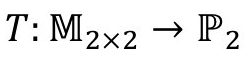
there are 2 parts to the pic i linked. the 1st part is of the form T:X-->Y. this states a function called T whose domain is X and codomain is Y
here we got a function T whose domain is the set of 2 by 2 matrices, and codomain is the space of polynomials degree 2 or less
wintry steppe
Ooooh okay I see
So that I described was the range and not the codomain
That makes more sense
gray dust
lmk when you understand the other stuff i said, which refers to this bit https://i.gyazo.com/08e9c5ea8b26f4559594cb1845977bfe.png
 wintry steppe
I think I understood that bit as well now
gray dust
ok the 2nd bit defines how T maps some element in its domain
an example similar to what you've done in high school algebra: "a function f:R-->R defined by f(x)=2x"
to match up with the format you're probably more comfortable with, i'll rewrite the 2nd bit as
$T\m{a&b\c&d}=(a-b)+(b-c)x+(c-d)x^2$
stoic pythonBOT
RokettoJanpu:
wintry steppe
So far that makes sense
gray dust
now we're done with reading comprehension, time to actually do the hw. do you have the definition of kernel?
wintry steppe
Yeahh, I think its all of the inputs that map to the 0 vector?
gray dust
exactly what is the 0 vector in this case?
wintry steppe
Whatever values you input would map to 0 + 0x + 0x^2
 dusky epoch
Whatever values you input would map to 0 + 0x + 0x^2
answer the question being asked
gray dust
so ker(T) is the set of 2 by 2 matrices that map to the 0 polynomial
gray dust
to get things rolling, you can let ((a,b),(c,d)) be the general form of a matrix in ker(T), set T(...)=0, and see what you can get from that
wintry steppe
Right, I will give that a shot.
Also, is this to answer part a) or part b) ?
gray dust
a) wants ker(T), b) wants a basis for ker(T)
wintry steppe
So I got something, I’m not sure if its any good, if you dont mind checking?
gray dust
k
wintry steppe
Oki, sorry, so I got this?
gray dust
so ker(T) is the set of 2 by 2 matrices that map to the 0 polynomial
no reason to write column vectors
and you messed up the row operations
gray dust
yes, now write out ker(T), preferably w/ setbuilder
wintry steppe
Oki, and I assume the answer to a) is M_2x2 then
And also I’m starting to lose focus and I dont wanna hold you any longer since its really late so I will continue and attempt the rest in the morning but thank you for your time and patience, I really really appreciate it
gray dust
the q in a) is vague and so i rephrased it to simply ask "what is ker(T)?" which you didn't fully answer yet. still waiting on this
now write out ker(T), preferably w/ setbuilder
if you need time off, take it, just keep this in mind for later
pallid rampart
Oh I think a) is asking you to say ker(T) is a subspace of what vector space
gray dust
that's still vague
 pliant pumice
yo this isn't technically linear but it's sorta a linear problem and it's been a while since i've taken linear
can someone help me find this matrix
(not sure if this is the right place to ask this, sorry)
dreamy depot
Anyone care to check this http://mathb.in/42105
In my solution I wrote $u,v$ as a set of linear combinations then used subspace criterion is the solution correct ?
stoic pythonBOT
Zophike1:
limber sierra
???
this wont necessarily work in all sums
counterexample: suppose H + K is a direct sum and u = 0
then its impossible for v to be nonzero
but then you're not considering all vectors in H + K
maybe this is supposed to be $u = s_1u_1 + s_2u_2$?
stoic pythonBOT
Namington:
limber sierra
but no, then the proof doesnt work
dreamy depot
damn 😦
limber sierra
indeed, this only works if your subspace is of dimension exactly 2
since otherwise you can't span your subspace with 2 vectors
(v_1 and v_2)
and so there will be some vectors that are necessarily "left out"
dreamy depot
yeah ture
so would writing $u$ as $u = s_{1}u_{1} + s_{2}u_{2} + \cdot \cdot \cdot \cdot + s_{i}u_{i}$ work ?
@limber sierra
limber sierra
that seems clunky
stoic pythonBOT
Zophike1:
limber sierra
why not just write $u + v = (s_1u_1 + s_2u_2) + (t_1v_1 + t_2v_2)$
stoic pythonBOT
Namington:
limber sierra
and reason from there
note that H and K are subspaces, so they are both closed under addition and scalar multiplication
dreamy depot
Yeah i figured that
limber sierra
hence, if $u_1, v_1 \in H, u_2, v_2 \in K$
stoic pythonBOT
Namington:
limber sierra
we can rearrange the above to $(s_1u_1 + t_1v_1) + (s_2u_2 + t_2v_2)$
stoic pythonBOT
Namington:
limber sierra
what can you conclude from this?
dreamy depot
That $H+K$ is a subspace
stoic pythonBOT
Zophike1:
limber sierra
why?
ok, let me rephrase my question
if $u_1, v_1 \in H$, what can you say about $s_1u_1 + t_1v_1$?
stoic pythonBOT
Namington:
dreamy depot
That $s_{1}u_{1} + t_{1}v_{1} \in H+K$
stoic pythonBOT
Zophike1:
limber sierra
i mean, that's true, but not a proof
but theres a stronger statement you can make
why do you think I mentioned that H is closed?
dreamy depot
So you can use the 2nd condition of the subspace criterion
limber sierra
let me summarize
$H$ is a subspace, so it is closed under vector addition and scalar multiplication
that means if $u_1, v_1 \in H$, then $s_1u_1 \in H$ and $t_1v_1 \in H$
also if $a, b \in H$ then $a + b \in H$
where is texit
dreamy depot
ahhh ok that makes sense
limber sierra
...took ya long enough
anyway, going back to this, the left sum is in H and the right sum is in K (for the same reason)
dreamy depot
can't you rearrange $u+v$
stoic pythonBOT
Zophike1:
dreamy depot
ahhh okay but what's wrong with saying with what I said eariler
was the statement too weak ?
limber sierra
what you said earlier about what?
dreamy depot
hold on let me copy paste I said that That $s{1}u{1} + t{1}v{1} \in H+K$
stoic pythonBOT
Zophike1:
dreamy depot
in response to your eariler question also how did you write $v$ ?
stoic pythonBOT
Zophike1:
dreamy depot
I think that's what missed up the proof
limber sierra
sure, say $s_1u_1 + t_1v_1 \in H+K$ and $s_2u_2 + t_2v_2 \in H+K$
stoic pythonBOT
Namington:
dreamy depot
ahhh ok
limber sierra
how does this prove that $(s_1u_1 + t_1v_1) + (s_2u_2 +t_2v_2) \in H+K$?
stoic pythonBOT
Namington:
limber sierra
hint: it doesnt
since you havent established closure under +
that's the thing you're trying to prove.
BUT if you show that the left sum is in H
and the right sum is in K
then the sum of them both is in H+K by definition
so yeah, your form was too weak.
dreamy depot
😦
limber sierra
@dreamy depot i supposed $u = s_1u_1 + s_2u_2$ for $u_1 \in H, u_2 \in K$
stoic pythonBOT
Namington:
limber sierra
and similarly $v = t_1v_1 + t_2v_2$ for $v_1 \in H, v_2 \in K$
stoic pythonBOT
Namington:
limber sierra
[as an aside: you dont actually need the scalars here at all]
[since subspaces are closed under multiplication]
[so if a is in a subspace, then a' = ra for scalar r also is]
dreamy depot
so adding $u,v$ isn't enough here you have to show that each $u,v \in H+K$
stoic pythonBOT
Zophike1:
limber sierra
you dont have to show that, thats part of the assumption
dreamy depot
ahhh okay i'm trying to figure out where I went wrong here
@limber sierra could you point out the error again plz ?
limber sierra
which one
dreamy depot
What was wrong with writing $u = s_{1}v_{1} + s_{2}v_{2}$
stoic pythonBOT
Zophike1:
limber sierra
then you're limited in what vectors you can write
let me try and make an explicit counterexample
dreamy depot
Ahhh okay so if you write $u = s_{1}u_{1} + s_{2}u_{2}$, $v = s_{1}v_{1} + s_{2}v_{2}$
limber sierra
since apparently your're just
stoic pythonBOT
Zophike1:
limber sierra
not familiar with dimensions
??
consider R^4 and the following subspaces:
the subspace consisting of vectors with 0s in the third and fourth entry
the subspace consisting of vectors with 0s in the first and second entry
stoic pythonBOT
Zophike1:
limber sierra
then if you write, say, $\begin{pmatrix}1\0\1\0\end{pmatrix} = \begin{pmatrix}1\0\0\0\end{pmatrix} + \begin{pmatrix}0\0\1\0\end{pmatrix}$
stoic pythonBOT
Namington:
limber sierra
theres no way to add this to $\begin{pmatrix}0\1\0\1\end{pmatrix}$ for example
stoic pythonBOT
Namington:
limber sierra
using your definition
dreamy depot
yeah I figured
limber sierra
anyway i'd write
something like
let $u, v \in H + K$. by definition of $H+K$ this means we can write $u = u_h + u_k, v = v_h + v_h$ for $u_h, v_h \in H, u_k, v_k \in K$
stoic pythonBOT
Namington:
dreamy depot
Because I understand how to use the subspace criterion and what it means
@limber sierra I think eariler in the discussion you wrote that $u = s_{1}u_{1} + s_{1}t_{1}$ \in H+K$
would that work as well
dreamy depot
oof my bad
@limber sierra i'm just struggling with the definition of $u,v$ also Axler at this point of the book hasn't introduced dimeionsons
stoic pythonBOT
Zophike1:
limber sierra
well you dont need dimensions, they just provide an easy counterexample
but my above counterexample works too
dreamy depot
ahhh okay
limber sierra
anyway, for ANY vector $v$ in $H+K$, we know we can write it as $v_h + v_k$ for $v_h \in H, v_k \in K$
stoic pythonBOT
Namington:
limber sierra
that just how $H+K$ is defined
stoic pythonBOT
Namington:
dreamy depot
ahhh okay that makes sense i'm going to try to redo the exercise now sorry for being dumb 😦
dreamy depot
@limber sierra I manged to redo the proof
Observe that $u_{1},u_{2} \in H$ as well as that $v_{1},v_{2} \in K$ it's important to note that,
$$u = s_{1}u_{1} + s_{2}u_{2}$$
$$v = s_{1}v_{1} + s_{2}v_{2}$$
Before proceeding on any further it's easy to note that we have the zero vector present since,
$$0 = 0u_{1} + 0u_{2}$$
Hence $s_{1}u_{1} \in H, s_{1}v_{1} \in K$ furthermore we can note that,
$$u+v = \big( s_{1}v_{1}+s_{1}u_{1}\big) + \big(s_{2}v_{2} + s_{2}v_{2} \big) $$
Now we can say that $s_{1}v_{1} + s_{1}u_{1} \in H$ as well as that $s_{2}v_{2} + s_{2}v_{2} \in H$ Since $H,K \subset V$ thus $u+v \in H+K$ since $H$ and $K$ are subspace of $V$ hence $H+K$ is a subspace of $V$.
stoic pythonBOT
Zophike1:
dreamy depot
@limber sierra ^ Is it good I finally get it and understand it
humble oak
hello, with regard to this question here what does it mean to find basic solutions?
i think i have it, but i am not sure it is correct. for the first column i have [2 -3 1 0] and for the 2nd column i have [-1 1 0 1]
 quasi vale
@humble oak yeah it's correct
humble oak
thankies
dreamy depot
Can anyone check the redone proof ?
Very dumb question to show a given space X is a vector space does it suffice to show that X is a subspace of another space V. Since subspaces are vector spaced in there own right ?
 quartz compass
yep
dreamy depot
Oh thanks @quartz compass also do you have to prove that subspace is a vector space or you dont have to since it's obvious?
dreamy depot
Damn :( but you see why I ask right ?
quartz compass
the idea is simple enough though, if you already have a vector space, you know certain things are already satisfied so you don't have to check quite so much
I don't see why you ask
if you want to prove something is a vector space, you have to effectively do something that proves it's a vector space
dreamy depot
Well it's easier to show something is a subspace then it is a vector space
Ahh okay
quartz compass
subspaces are still vector spaces, but you already have the benefit of knowing it has a little structure already that you inherit
so you don't have to redo stuff you already know, that's all
dreamy depot
@quartz compass ahh okay that makes sense I only asked cause it seemed like a dumb idea
quartz compass
idk why you're calling it a dumb idea
there's no reason to make any kind of judgment on whatever natural questions come to, it's a waste of mental energy, and it makes you look kind of sad
dreamy depot
Yeah sorry just being harsh on myself I was looking on MSE and I found a simular question

Mathematics Stack Exchange
If we define $U$ as a subspace of a vector space $V$ then does that mean that $U$ is also a vector space?
quartz compass
you can find proofs online of how to do this too, you should go find it or grab a linear algebra book to learn
dreamy depot
Yeah I am don't worry 🙂
quartz compass
I just mean it would be more efficient than randomly finding MSE posts or reading wikipedia or however to just search through a book directly
don't read the whole book, just read the part about what you need to show that a vector subspace is a vector space
maybe skim a few parts earlier or in the appendix to get the notation straight so you get what they're saying
pallid rampart
Read an entire book because it’s interesting: 
Read an entire book just to understand one theorem:
Read an entire book just to understand one meme: 
dreamy depot
I'm working through that Linear Algbra books because its interesting and I have a class on it
 narrow mortar
hey can someone help me
 placid oracle
star ask your question
Let V be a vector space of dimension n. We say that vectors v1, v2, . . . , vm are in general position if every n of them are linearly independent. Consider two collections of n + 1 vectors v1, v2, . . . , vn+1 and w1, w2, . . . , wn+1 in general position. How can I prove that there exists a
linear map f : V → V such that f(vi) is proportional to wi for 1 ≤ i ≤ n + 1.
placid oracle
redraw that same triangle over an actual graph, from there u can calculate the lengths of each side
narrow mortar
hm but
ik a= sqrt 5
and b = sqrt 73
and c= sqrt 106
why is a the smallest length
narrow mortar
?
ye but a is the hypotenuse
it doesn't make sense that its less than everything else
well to find height i did
h^2 = a^2 -b^2
and then h^2 = 5-73
h= sqrt -63
which doesn't make sense
ok
cold topaz
is my solution correct?
narrow mortar
its not a right triangle 😮
omg
ALL THIS TIME I THOUGHT IT WAS
uh
?
whats that
?
nope
idk that
the dot thing u said idk
narrow mortar
ye
whats that?
this is actually
part of a calc course
its called calulus and vectors
and i just learned vectors
i think thats
chapter 7 tho
were on chapter 6
lol
😛
i was looking at chapter 7 a few days ago and saw something called dot idk
me too lol
cosine law?
we have been using it
is vector a like the sqrt 5 i found
wintry steppe
you can figure out the lengths of all the sides and use the law of cosines to figure out the angles
narrow mortar
this length?
alright but
what angle do i use
oh ok
but i only have 2 sides
?
wintry steppe
compute the vectors representing all the sides
narrow mortar
how?
wintry steppe
are you familiar with the parallelogram vector addition thing?
a + the vector in the middle = b
narrow mortar
yes
u mean
lol sorry
i drew that quick
@wintry steppe
@wintry steppe
lol
uh
well u said to use cosine law
@wintry steppe
which angle should i find
ye
wintry steppe
you can figure out all of the sides
narrow mortar
how?
wintry steppe
draw all of the sides on the parallelogram addition thingy
and take off half of it
the vector going up
narrow mortar
yes
wintry steppe
but draw all of the sides on it
narrow mortar
ok
wintry steppe
and then take off the top half of it
and you'll notice a correspondence between that and your triangle
gray dust
@real plaza most of your essay is fine
wintry steppe
okay
narrow mortar
parallelogram
cold topaz
is this channel free?
wintry steppe
now draw the vector through the middle
wintry steppe
label all the sides: a, b, a+b
wintry steppe
all of them
narrow mortar
oh
gray dust
@real plaza s'all good, gives me more chances to poke holes in what you say 
wintry steppe
narrow mortar
lol
wintry steppe
now do you see that a is the sum of two vectors?
wintry steppe
it doesn't matter
wintry steppe
it could be an acute triangle or an obtuse triangle
narrow mortar
ok
wintry steppe
and you can figure out whether it actually is a right triangle once you get that third side
could u use something like sine law or cosine law for this?
narrow mortar
oh ok
wintry steppe
u can find the angle using
cos(x) = u dot v / (mag(u) * mag(v))
yeah he doesn't know what a dot product is
narrow mortar
she*
wintry steppe
oh she sorry
wintry steppe
but dot product is the first thing u learn in lin alg
wintry steppe
I think this is one of those things that makes you feel bad about using the old methods
and then they introduce something new in the next chapter
 half ice
Do many people learn the dot product at all in linear algebra? Haha
wintry steppe
i still think u can solve the triangle with sine and cosine law
wintry steppe
you can solve for the other unlabeled side in a similar manner
narrow mortar
my brains gonna explodeeee
wintry steppe
then you have two choices: you can use Heron's formula, an online calculator, or use the law of cosines
narrow mortar
i dont even know herons law
narrow mortar
but i have to show my work lol
wintry steppe
and yeah two, because the law of cosines looks disgusting
wintry steppe
ill include work @narrow mortar
cold topaz
is it ok to ask my question?
wintry steppe
@cold topaz your null space looked correct
wintry steppe
you can check this yourself
cold topaz
im having doubt about the vector s. the rest im ok with
wintry steppe
ensure that your basis in your orthogonal complement is orthogonal to the basis of your space
why would you have doubt about it? it's orthogonal to u, v, and w
wintry steppe
h + b = a
narrow mortar
why?
wintry steppe
well actually lemme download a paint app
cold topaz
in general, when the columns x is all zeros, the value of x = 1 at the corresponding(row vector) postion. am i right?
wintry steppe
yes, but I don't understand why you'd separate out that special case
@narrow mortar
let's label these vectors
you have a = b + d
let's actually set the direction for e as well
now you can see that d + (-c) = e
and since a = b + d, you have d = a-b
once you have the lengths of d and e, you have all of the sides of the triangle
wintry steppe
because it's the vector addition thing
wintry steppe
it's not adding their lengths
wintry steppe
it's adding the vectors
wintry steppe
the process goes as follows:
- Figure out all of the vectors
- Get all their lengths
- Geometry
narrow mortar
OH I SEEEEE
u go right then up
ohhhhhhh
😮
ohhhhh
ahhhhhhhh
WOW
ok
😛
lol
wintry steppe
u can solve with pythagaros if u add b and c
you don't know that the vector d is orthogonal to a
narrow mortar
i did that at first
then i got -63
the height is doing down tho
which is weird
wintry steppe
matter of fact
narrow mortar
?
wintry steppe
actually I think there's a problem with the question
@wintry steppe you don't know that the vector d is an altitude
wintry steppe
vectors b and c aren't even parallel; they don't even make a straight line to make the bottom of the triangle
wintry steppe
no that's the problem
narrow mortar
this is so hard 😦
wintry steppe
they're not
narrow mortar
oh
wintry steppe
they're not exactly opposite in direction
narrow mortar
ok
wintry steppe
could u solve left triangle and add right triangle>
wintry steppe
this is what they look like drawn properly
narrow mortar
- area of triangle 2
narrow mortar
oh 😮
wintry steppe
when there are multiple triangles
wintry steppe
but the two triangles put together don't make a triangle
wintry steppe
no, that was what i was wondering too
the diagram, as drawn, isn't nearly what it looks like
wintry steppe
cuz c is not in the span of b
narrow mortar
huh
wintry steppe
b and c look like they're oppositely pointed, right?
narrow mortar
yes
wintry steppe
but drawn properly, they're nowhere close
wintry steppe
it connects, but it's not straight
gray dust
@real plaza at the very heart of it is understanding bases, if you get that then all else, changing between bases, similarity, eigenbasis (& diagonalization stuff) should fall in naturally over time
wintry steppe
i feel like u can add all the vectors to solve for e
solving for e is easy
but the problem is that the bottom of the triangle isn't straight
wintry steppe
it's something like this
narrow mortar
?
wintry steppe
sadly, that yellow line is E, no?
narrow mortar
uh what
wintry steppe
does star herself know the answer?
your shape
looks like this
the bottom isn't straight
it's only "straight" if you define another inner product space, but then there's no finding the area without knowing what it is
i got question
what we are given is a vector
how does that even translate into a line
it doesn't
a vector in Euclidean space blah blah blah blah gives a direction
the span of that vector is a line
narrow mortar
back
wintry steppe
@narrow mortar i have an idea
narrow mortar
?
narrow mortar
idk 😦
wintry steppe
the center is your triangle, and in order to find your area, u can take the outer rectangle and subtract the triangle that are not part of your original triangle
@wintry steppe idk if this is approachable, im also a noob but can you verify?
if thats not it then idk :c
good luck @narrow mortar
narrow mortar
😦
wintry steppe
the problem
narrow mortar
?
wintry steppe
is that it's not a triangle
wintry steppe
it looks something like this
narrow mortar
ok one sec
wintry steppe
d = (-4, -10)
that's orthogonal to neither of the two vectors
what kind of grade 12 homework is this D:
narrow mortar
i told u its an assignment
for the unit
there were 6 questions
this was the last one
lol
??
wintry steppe
im out, sorry, cant help :c
placid oracle
nvm ill post after this question, my bad
eternal finch
@real plaza
Isn't a similarity transformation just a transformation, that takes a matrix of a linear transformation, and changes the basis used to form the matrix,
Yes.
into the simplest basis possible?
No. A similarity transformation doesn't necessarily change it to the simplest basis. It's just a change in basis. Diagonalization would be changing to the simplest basis.
So a similarity transformation is just a change of basis, isn't it?
Yes.
And a diagonalization is part of the similarity transformation; so
A = P^-1 * D * P
A is your original matrix (of any arbitrary linear transformation), and D is the diagonalized matrix; the P matrix transforms the basis of your original transformation matrix into a "new" transformation matrix
You can have a case of similarity A = P^-1 B P where B isn't diagonal.
Right.
In fact, sometimes, it isn't possible to diagonalize a matrix.
But you can still change your basis to something simpler than what you started with.
You might learn about something called the Jordan canonical form.
If you can't diagonalize a matrix, you can still get pretty darn close using JCF.
If you do look into it, then you'll need to look into generalized eigenvectors first. I didn't learn about JCF in my first course, tho.
narrow mortar
@wintry steppe
I used this
and entered the points and got
so now ik the area
just need to get there
is that right?^^ the website
lol
eternal finch
@real plaza Ah, for me it was required for my major.
I'm applied math.
You?
I see.
That's cool.
wintry steppe
@narrow mortar I don't believe that would work
you haven't gotten the coordinates of the vertices of the triangle
though
a bit of modification could make it work
and ultimately this is an issue you need to address with your instructor
the shape, as presented, is not a triangle
because b and c are not parallel vectors
narrow mortar
?
why not?
but i entered the
given coordinates
from the question
then it just solved its area
I also found
17.117 9.22 10.77 - Obtuse scalene triangle, area=44. Computed angles, perimeter, medians, heights, centroid, inradius and other properties of this triangle.
@wintry steppe
would that work?
or no?
wintry steppe
the question didn't give you coordinates
the question gave you vectors
it didn't give you the coordinates of the vertices
the problem here is that you don't have a triangle
so there's no consistent way to find the area
narrow mortar
:c
then how do i do this
its due tom 😦
@wintry steppe
i got the height
its 2 root 29
wintry steppe
honestly
you should just write
that this thing isn't a triangle
and then just write out all of the vectors for all of the sides
and compute one of the triangle's areas using Heron's formula (find a calculator online)
narrow mortar
how do i find all the sides
u know im confused on the labelling
can u highlight what a b and c even is
@wintry steppe can u help me do that
why isn't it a triangle tho?
my friend got sqrt(8497) for the area
wintry steppe
a and b and c are put there
I told you why it isn't a triangle; b and c are not parallel
they do not face the same or opposite direction
the angle between them is 130 degrees
cold topaz
is this sentence mathematically correct?
<x>, <y>, <z> form basis for the orthogonal complement of A
wintry steppe
You should probably write {v1, v2, v3} is a basis for the orthogonal complement of A
cold topaz
thanks a lot
pallid rampart

narrow mortar
hi
pallid rampart
Hi
narrow mortar
hiii
 slow scroll
hi
wintry steppe
yes still awake
narrow mortar
look
WHAT MY TEACHER
WROTE AND I SOLVED IT WRONG well mt friends solved it wrong they helped me
basically we did
1/2 (|b-c| * |b-a|)
is that wrong accordint to what he said?
@wintry steppe
when the diagram was
@wintry steppe see was what we did alright?
wintry steppe
I mean it's just not
the diagram is drawn completely wrong
like idk what to tell you
it's not just not a right triangle
it's not a triangle at all
literally
the bottom does not connect in a straight line
b is not parallel to c
literally write this to your instructor:
There are multiple triangles in this picture. It's not clear which triangle's area needs to be found.
The big "triangle" is not a triangle; the vectors b and c are not parallel. They are at a 130 degree angle to each other.
so no
any purported "solution" is wrong
because the problem is ill-defined
wintry steppe
the question is
what triangle is he even talking about
I see two triangles here
I think you can agree that we both see two triangles here
slow scroll
i see 3
wintry steppe
and before you say, "it's the big triangle"
@slow scroll there are actually 4
because the diagram is drawn incorrectly
wintry steppe
I've been telling this to you repeatedly
narrow mortar
IK BUT MY BRAINS LIKE AN EGG
wintry steppe
the diagram, drawn correctly, looks like this
okay?
and this isn't under any sort of standard coordinate system; this is rotated and reflected
but
it looks something like that
vectors b and c do not point straight at each other
narrow mortar
wintry steppe
now tell me, if I give you that diagram and ask you to find the area of "the given triangle"
narrow mortar
thats the traingle
wintry steppe
no, it is not
narrow mortar
why
wintry steppe
because you can't just take the measurements of the vectors and stick them in as points
that's not how it works
narrow mortar
lol
wintry steppe
literally not how it works
wintry steppe
As I said before
you need to ask your instructor which triangle
I cannot solve a problem that is not properly asked
It's like if I ask you to find the area of the given triangle:
Just ask your instructor
why b and c are not parallel
wintry steppe
yknow what
narrow mortar
@wintry steppe
wintry steppe
let's graph the vectors
 pale coyote
the question youre given doesnt make sense
pale coyote
tell him to fuck himself
narrow mortar
GUYS
EVEN MY FRIENDS THINK ITS A TRIANGLE
HOW DO I TELL THEM ITS NOT
can someone give me proof
limber sierra
what the fuck is going on here
limber sierra
uh, are we assuming these vectors are translated into the proper positions?
narrow mortar
HOW U GET THAT
narrow mortar
?
wintry steppe
and then just use vector math to compute the other vertices
the top vertex is (-1, 2)
the middle vertex is (3, -8)
narrow mortar
?
wintry steppe
I know I'm not wrong
narrow mortar
ik ur not either
wintry steppe
I graphed it in desmos
wintry steppe
and drew the lines with paint
wintry steppe
it's not a square
it's some weird quadrilateral
now if I give you this figure
limber sierra
is there a reason we're assuming the vectors arent translated at all
wintry steppe
and ask you to "find the area of the given triangle"
wintry steppe
because the vectors are drawn against the sides
so even if the figure were translated, the vectors should still be consistent
wintry steppe
because
vector b takes you from (0,0) to (3, -8)
and c is pointing the opposite direction, but if you subtract c (i.e. go along c backwards)
you get (3, -8) - (5, 9) = (-2, -17)
narrow mortar
ok this question is making us all wanna kill ourselves coz it makes no sense
pale coyote
your teacher sucks
wintry steppe
and then pushed in some random numbers into the vectors
and that's not how it works
so what you should do
is send the diagram I've graphed
along with a note that b and c are not parallel
and ask which triangle
wintry steppe
because, to put it frankly, it's a nonsensical question
narrow mortar
THIS IS TOTALLY A TRIANGLE
wintry steppe
that's an interesting way of putting it
pale coyote
no say you suck and shouldnt have a job teaching math
narrow mortar
can u show me
how u connected on desmos?
my friends are questioning my sanity
atm
wintry steppe
I didn't connect the dots on desmos
I screenshotted it and put it into paint
and that's how I labeled the sides too
your teacher will probably realize his mistake
narrow mortar
lol
wintry steppe
you can see that the angle between b and c is 130 degrees from the picture
half ice
Oh god are we still talking about this? I've slept for 4 hours
wintry steppe
you can find the area of the quadrilateral, since you're given all of the sides, including the length that goes through
narrow mortar
lol
wintry steppe
so you just find the area of both triangles and add them up
half ice
I mean you can do it, but you definitely weren't expected to